


Many psalms in the later sections of the Book of Psalms begin with the exclamation, “praise the Lord!” (106:1; 111:1; 112:1; 117:1; 135:1; 146:1; 147:1; 148:1; 149:1; 150:1), whilst some end with that same exclamation (105:45; 106:48; 115:18; 117:2; 135:21; 146:10; 147:20; 148:14; 149:9; 150:6). We find this phrase at the beginning and at the end of Psalm 149, which is offered by the lectionary as the psalm for this coming Sunday.
Singing (v.1) is mentioned often in the psalms: “how good it is to sing praise to our God” (147:1), “with my song I give thanks to him” (28:7), “I will praise the name of God with a song” (69:30), and so the people of Israel are encouraged to “sing to God … lift up a song to him who rides on the clouds” (68:4), “raise a song, sound the tambourine, the west lyre with the harp” (81:2). A whole sequence of “songs of ascent” are included in this book, reflecting the journey of pilgrims as the approach the temple to bring their offerings (psalms 120—134).
, was a staple part of the temple liturgy. The Chronicler regularly reports the role that “the singers” had in the Temple, where “they were on duty [to sing] day and night” (1 Chron 9:33). They were to “play on musical instruments, on harps and lyres and cymbals, to raise loud sounds of joy” (1 Chron 15:16; see also 2 Chron 5:12–13; 9:11; 23:13; 29:28; 35:15).
In the return of the people to the city after the Exile, singers take their place alongside “the gatekeepers and the temple servants” (Ezra 2:70; 7:7; 7:24; Neh 7:1, 73; 10:28, 39; 12:45–47; 13:5). Often in these passages they are mentioned in association with the Levites. It was the descendants of Levi who had been appointed to take care of the Tabernacle (Num 1:51–53; 1 Sam 6:15; 2 Sam 5:24; 1 Ki 8:4) and then the Temple (1 Chron 6:48), “living in the chambers of the temple free from other service” (1 Chron 9:33–34).
Psalms are often communal. This particular psalm which we hear this coming Sunday is set “in the assembly of the faithful” (Ps 149:1), as others seem to be (Ps 7:7; 89:5; 107:32). Still other psalms reflect a setting in “the sanctuary of the Lord” (Ps 60:6; 68:35; 96:6; 108:7; 150:1). Sing “a new song” is often enjoined by the psalmists (33:3; 40:3; 96:1; 98:1; 144:9; and here, 149:1). This refrain is picked up by the four living creatures and the twenty-four elders in heaven (Rev 5:9) and then “the one hundred and forty-four thousand who had [the Lamb’s] name and his Father’s name written on their foreheads” (Rev 14:1–2). These latter texts have occasioned much interest in what, exactly, that “new song” was. But who knows?
The instruction to “let them praise his name … making melody to him with tambourine and lyre” (v.3) is repeated in “praise the Lord with the lyre, make melody to him with the harp of ten strings” (Ps 33:2) and further expanded in the complete orchestral array that is mentioned in Ps 150:1–6, as well as in narrative texts concerning the band of prophets coming to meet Samuel and Saul (1 Sam 10:5) and the sons of Jeduthun (1 Chron 25:1–8). Job notes that faithful people “sing to the tambourine and the lyre” (Job 21:12) and David, of course, was recognised for his skill with the lyre (1 Sam 16:14–16, 23; 18:10).
The role of playing the tambourine appears to have been linked with young girls (Ps 68:25) and women (1 Sam 18:6), following the example of “the prophet Miriam, Aaron’s sister” (Exod 15:20). There are tambourines in the instrumental array in the time of David (2 Sam 6:5; 1 Chron 13:8) and they are noted by Jeremiah (Jer 31:4) and in Judith’s “new psalm” of praise to God (Judith 16:1).
Their presence at weddings is reflected in the sad tale of the wedding of the family of Jambri, where weapons concealed amongst “the tambourines and musicians” are used to perpetrate a huge slaughter, such that “the wedding was turned into mourning and the voice of their musicians into a funeral dirge” (1 Mac 9:37–41).
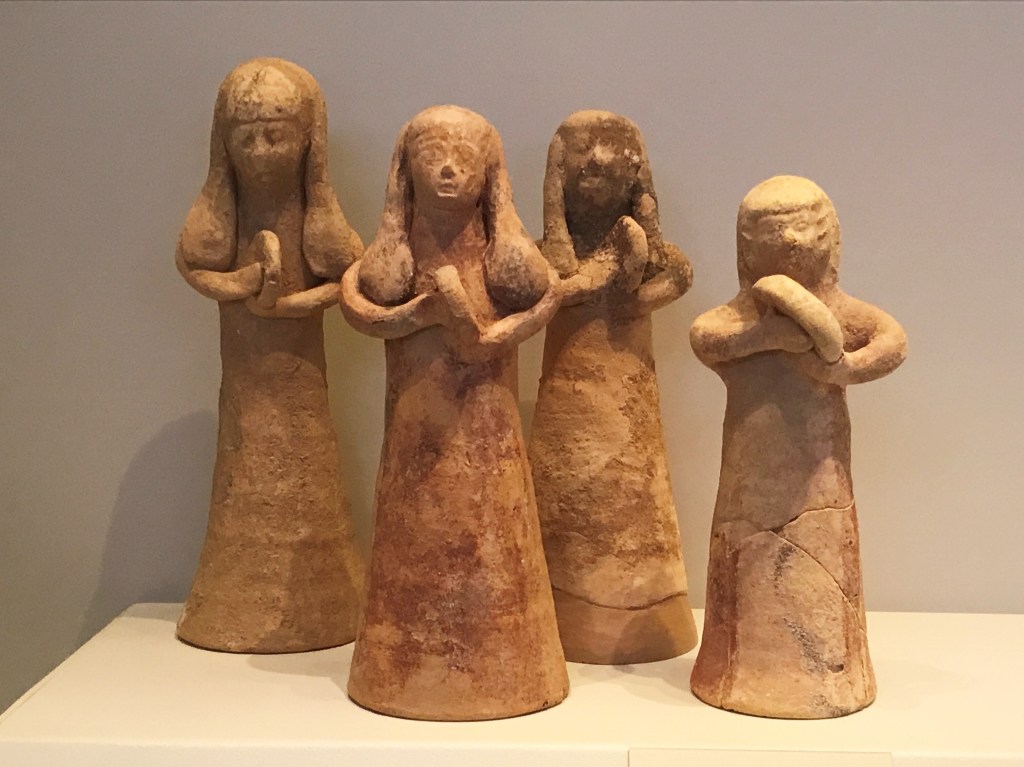
These small figurines, six–eight inches tall, represent female figures playing the hand-drum, which was probably a woman’s instrument in ancient Israel.
These terracottas are in the collection of the Israel Museum in Jerusalem. Photo by Carol Meyers, Duke University; from
https://jwa.org/encyclopedia/article/women-with-hand-drums-dancing-bible
Dancing in temple worship (v.3) is also noted in other psalms; on Zion “singers and dancers alike say, ‘all my springs are in you’” (Ps 87:7), and praising God “with tambourine and dance” is encouraged in the great final psalm of praise (Ps 150:4). Dancing appears also in the narrative texts concerning Miriam (Exod 15:20), the daughter of Jephthah (Judg 11:34), Saul (1 Sam 8:6), and David (2 Sam 6:5; 1 Chron 13:8; 15:29).
The psalm ends with a celebration of the ways that God’s justice will be implemented (Ps 149:6–9), which is bracketed by reference to “the faithful” who “exult in glory” (v.5) and the closing affirmation, “this is glory for all his faithful ones” (v.9). These “faithful ones” are active in offering praise in other psalms (Ps 30:4), for they are valued by God. The psalmists affirm that the Lord “will not forsake his faithful ones” (Ps 37:28) and that their death is “precious … in the sight of the Lord” (Ps 116:15).
Yet regarding God’s just actions as the “glory” which God grants to these “faithful ones” is a reminder of the realities of the world in which the Israelites lived. It was marked by conflicts and battles, by bloodshed and killings, by invasions and deportations, so the judgement of God was sought by the “faithful ones” in brutal terms. With “two-edged swords”, with fetters and chains of iron, so “the judgement decreed” by the Lord God will take place (vv.6–9).
After which, the psalmist takes breath, and concludes, “Praise the Lord!” Indeed!

 An Informed Faith