I will pass through the land (Exod 12, 13; Narrative Lectionary for Pentecost 19C)

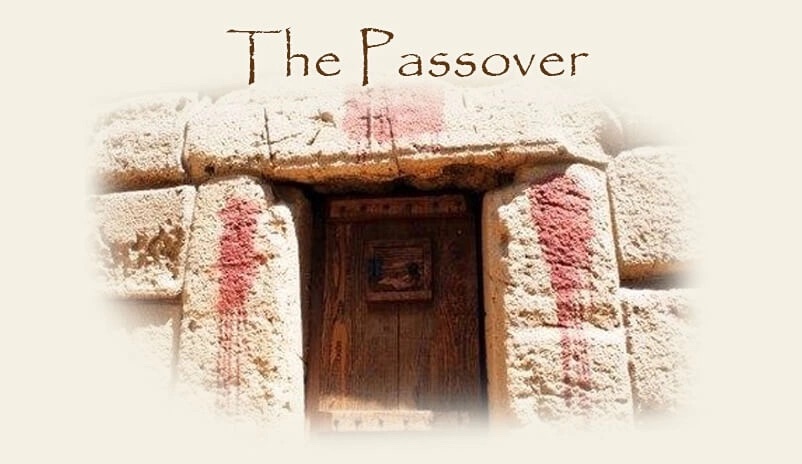
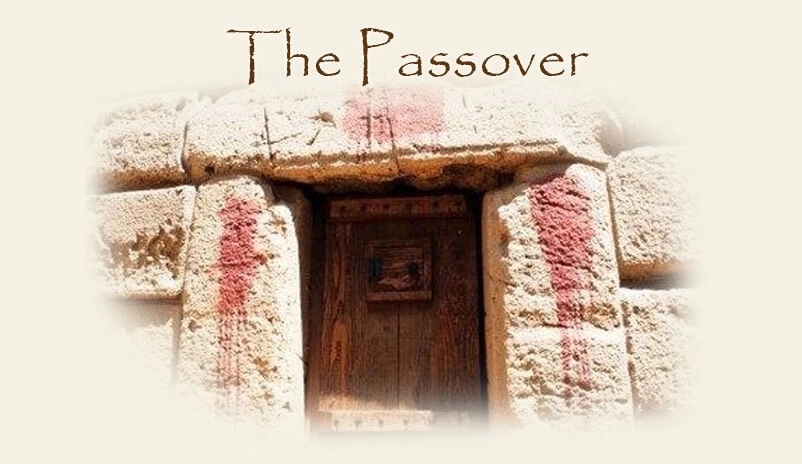
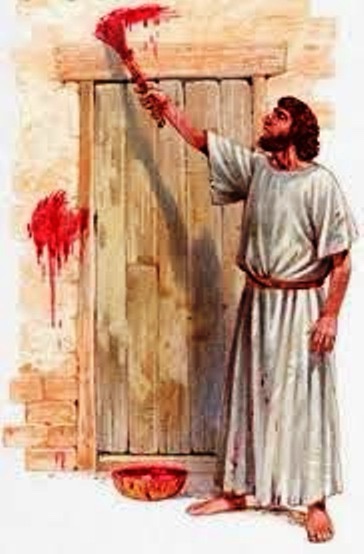
The instructions are clear: “take some of the blood and put it on the two doorposts and the lintel of the houses in which they eat it” (Exod 12:7). The explanation is also clear: “I will pass through the land of Egypt that night, and I will strike down every firstborn in the land of Egypt, both human beings and animals … the blood shall be a sign for you on the houses where you live: when I see the blood, I will pass over you, and no plague shall destroy you when I strike the land of Egypt” (Exod 12:12–13).

It’s a story of hope, expressed in joy; and it’s a story about death, filled with despair. We will hear it this Sunday, as it is offered as the Narrative Lectionary reading for Pentecost 19 (Exodus 12:1–13; 13:1–8). It all depends on where you stand as you hear the story. Are you in the shoes of the escaping Hebrews? Or in the shoes of the Egyptians who saw their beloved children slaughtered?
The story that is told about the Exodus in the Hebrew Scriptures is a story filled with hope. It tells of the liberation of an oppressed people, suffering under the burdens of forced labour; it recounts the sequence of events that led to the miraculous escape from slavery, crossing through the Sea of Reeds, travelling unhindered through the wilderness, into a land which the story claims was promised by God—a promised land, gifted to a chosen people by a holy God.

The story that is told in the Hebrew Bible about the Exodus is also a story filled with violence. There is the violence executed in Pharaoh’s actions in having the young boys murdered. There is the violence that is threatened by the Egyptian army as their chariots and horses thunder in hot pursuit of the escaping Israelites. 

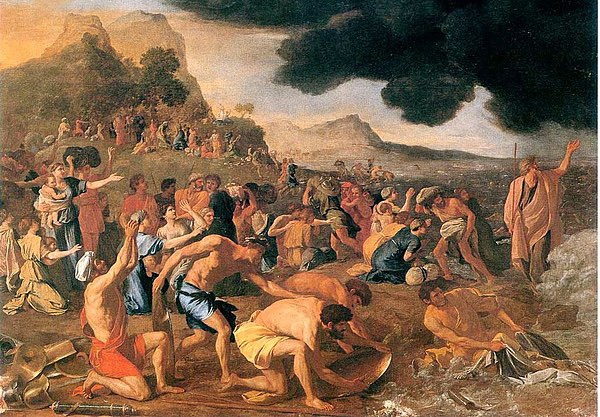
Worse, there is the insistent violence in the series of increasingly damaging plagues which God is said to have sent against the Egyptians. And finally, there is the climactic and catastrophic violence of the surging of waters over the army and their horses, as they as swamped and drowned in the middle of the Sea of Reeds.

It is a difficult story to take at face value; what sort of people remember such a tale of incessant violence? and what sort of a God takes sides with one group of people and acts in such a vicious way against their opponents? Furthermore, how can we accept this story as part of our canon of scripture, when it is so filled with violent act after violent act?
This is not the only place that we encounter violence in the Hebrew Scriptures; as the story goes on, it proves to be one of invasion, massacre, colonisation, and dispossession of people in the land of Canaan; and then, a string of battles take place in various locations, as the invading Israelites gradually exert their dominance over the indigenous people of the land. 

All of this violence is indeed of deep concern, and it can be seen to place the whole of those scriptures under a cloud. However, I don’t want to fall into the supercessionist trap, the approach taken in the second century by Marcion of Sinope, who discarded the whole of the Old Testament—and, indeed, a significant part of the New Testament! We have these stories as part of our scriptures, and we need to hear them, ponder them, and engage critically with them.

Nor do I want to gloss over the fact that acts of violence, both those committed by human beings, and those attributed to the Lord God, can be found in many parts of the New Testament. It is a ubiquitous problem. Violence is expressed in many texts in scripture—both Jewish and Christian—and, indeed, is found in the texts of many other religious traditions. Human beings live, and die, by violence. We can never escape it, it seems.

If we take these texts as a literal account of historical events, we have significant theological issues to address. And there are a number of difficult historical questions that must be addressed, if we want to hold to the claim that Exodus is reporting an historical “as it really happened”. Where is the evidence for the escape of a huge number of people at that time? (There is none.) Who was the Pharaoh of the time? (There are two very different suggestions about this.) 

What about the evidence for the huge crowd that spent 40 years in the desert? Where are the bones of the dead, the remains of campsites, from that crowd, if that is accepted to be the massive crowd 600,000 males (plus their women and children) that would set forth into the wilderness (see Exod 12:37) and then their descendants? There is absolutely no evidence for these archaeological remains, at all.

But such a forensic historical interrogation is not my approach to the story of the Exodus, nor to other parts of Hebrew Scripture, nor, indeed, to the narratives found in the New Testament.

So my approach to these texts has been to undertake an appreciative enquiry approach: what is this text saying? what drives the energy of the writer? what issues of concern do I read and hear—explicitly in the words used, and implicitly, in between and under what is said? what elements can I affirm, as contributing constructively to the Hebrew Scriptures’ understandings of God? and, as a consequence of that, to the New Testament’s understandings of God?
To begin, we need to recognise that the Exodus was seen as the paradigm for liberation—political, cultural, social, religious—which has shaped Jewish life for millennia. It is no wonder that it was picked up as a key motif for early followers of Jesus, to describe his significance: preaching the kingdom of God, the righteous-justice of a compassionate God, a challenge to the collective political, social, and religious status quo, and a liberating way of being for those following him.

A group of priests in the exile in Babylon collected and collated materials from earlier traditions, and developed a series of stories that conveyed in saga form the key elements of their national story. Symbolism and poetry were the paramount features of these stories, originally oral, later written on scrolls.

In the latter stages of the Exile or perhaps in the early stages of return to the land and rebuilding society, the stories and sagas were drawn into the set of scrolls we know as the Torah, the first part of the TaNaK. Symbolism featured prominently in these poetic stories and narrative rehearsals of the past.

The Passover occupies a central place in the long, sweeping narrative that is told in Hebrew Scripture. As well as the story of the Passover which led to the exodus from Egypt (Exod 12–15) and the thrice-documented priestly regulations governing the annual celebration (Lev 23:4–8; Num 28:16–25; Deut 16:1–8), the story is told of celebrating Passover at key moments in that ongoing narrative: at the foot of Mount Sinai (Num 9:1–14), at Gilgal when about to enter the land of Canaan  (Josh 5:10–12), when the Temple worship was restored under Hezekiah (2 Chron 30:1–27), and during the great reformation that took place under Josiah (2 Ki 23:21–23).

The priest-prophet Ezekiel, in his vision of the restored land and new Temple, seen during the Exile, insists that the Passover be celebrated on a recurring annual basis (Ezek 45:21–25). Even though the Temple that was eventually rebuilt was of a different size and shape, when the Exiles returned under Darius, the Passover was celebrated at the dedication of the rebuilt Temple (Ezra 6:19–22).

Over time, interpreters under influence from later developments in thinking began to “reify” and “historicise” these symbolic sagas and develop the idea that they reported “events that actually happened”. They didn’t—as we have noted, there is no evidence outside the Bible for the sequence of events found in the Exodus saga. But the story had a potency for these priestly writers as the land was restored, the Temple rebuilt, society reconstructed.

The Passover story, leading up to the escape of the Exodus, that Jews recall and relive each year and which Christians remember on a regular basis in the eucharistic celebration, tells the age-old scapegoat dynamic in a dramatic story filled with symbolism. It too was not an historical event, but a story developed to explain the special significance of the people of Israel and their faith in a god who took extraordinary steps to secure their freedom.

Of course, within the emerging Jewish movement that had a focus on Jesus as an authoritative teacher of the Torah, a key way of grappling with the fact that Jesus was put to death as a criminal, hung on a cross under the orders of the Roman Governor, was to draw on this story of blood shed, lambs sacrificed, and salvation gained.

The timing of the death of Jesus is placed within the Passover festival by all four canonical Gospels. That is the festival that remembers the story of what happened to Israel, long ago—and that passes on the story that this happens year-in, year-out, as the faithful people of Israel remember and relive their national salvation.

One Gospel even locates the actual hour when Jesus dies on the cross as being “on the day of preparation for the Passover” (John 19:14, 31). Jesus, already identified in this Gospel as “the lamb of God who takes away the sins of the world” (John 1:29, 36), dies when the Passover lambs are being slaughtered in preparation for the Passover meal that evening. (The other three Gospels, of course, place the last meal of Jesus with his disciples at the Passover meal—Mark 14:12–25 and parallels—and thus, in their chronology, he dies on the day after Passover.)
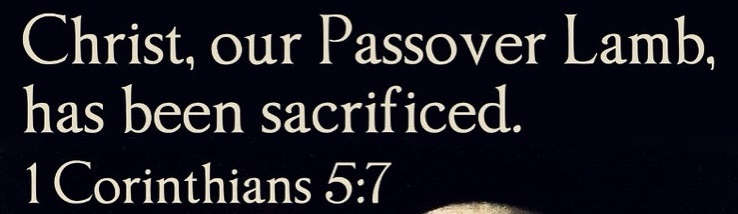
Jesus is remembered as the “paschal lamb … who has been sacrificed” (1 Cor 5:7); it is by the shedding of his blood that atonement with God takes place (Rom 3:25), that faithful people are justified (Rom 5:9), that peace is achieved (Col 1:20), that redemption occurs (Eph 1:7). One writer makes much of this, emphasising that this redemption is eternal (Heb 9:12; 13:20), opening up “a new and living way” (Heb 10:19–20). It is his shed (sprinkled) blood makes Jesus “the mediator of a new covenant” (Heb 12:24) and that his faithful people are sanctified (Heb 13:12).

So this ancient story, passed down by word of mouth and then written in scrolls that themselves were passed down for reading and understanding, sits deeply within the self-understanding of both Jewish and Christian people. It is a story we cannot avoid.

Escaping from oppression: how do we make sense of The Exodus? (Exodus 12; Pentecost 15A)

The instructions are clear: “take some of the blood and put it on the two doorposts and the lintel of the houses in which they eat it” (Exod 12:7).

The explanation is also clear: “I will pass through the land of Egypt that night, and I will strike down every firstborn in the land of Egypt, both human beings and animals … the blood shall be a sign for you on the houses where you live: when I see the blood, I will pass over you, and no plague shall destroy you when I strike the land of Egypt” (Exod 12:12–13).

It’s a story of hope, expressed in joy; and it’s a story about death, filled with despair. We will hear it this Sunday, as it is offered as the Hebrew Scripture reading for Pentecost 15 (Exodus 12:1–14). It all depends on where you stand as you hear the story. Are you in the shoes of the escaping Hebrews? Or in the shoes of the Egyptians who saw their beloved children slaughtered?

The story that is told about the Exodus in the Hebrew Scriptures is a story filled with hope. It tells of the liberation of an oppressed people, suffering under the burdens of forced labour; it recounts the sequence of events that led to the miraculous escape from slavery, crossing through the Sea of Reeds, travelling unhindered through the wilderness, into a land which the story claims was promised by God—a promised land, gifted to a chosen people by a holy God.

The story that is told in the Hebrew Bible about the Exodus is also a story filled with violence. There is the violence executed in Pharaoh’s actions in having the young boys murdered. There is the violence that is threatened by the Egyptian army as their chariots and horses thunder in hot pursuit of the escaping Israelites.

Worse, there is the insistent violence in the series of increasingly damaging plagues which God is said to have sent against the Egyptians. And finally, there is the climactic and catastrophic violence of the surging of waters over the army and their horses, as they as swamped and drowned in the middle of the Sea of Reeds.

It is a difficult story to take at face value; what sort of people remember such a tale of incessant violence? and what sort of a God takes sides with one group of people and acts in such a vicious way against their opponents? Furthermore, how can we accept this story as part of our canon of scripture, when it is so filled with violent act after violent act?

The Crossing of the Red Sea by Nicholas Poussin (1633–34)

This is not the only place that we encounter violence in the Hebrew Scriptures; as the story goes on, it proves to be one of invasion, massacre, colonisation, and dispossession of people in the land of Canaan; and then, a string of battles take place in various locations, as the invading Israelites gradually exert their dominance over the indigenous people of the land.

All of this violence is indeed of deep concern, and it can be seen to place the whole of those scriptures under a cloud. However, I don’t want to fall into the supercessionist trap, the approach taken in the second century by Marcion of Sinope, who discarded the whole of the Old Testament—and, indeed, a significant part of the New Testament! We have these stories as part of our scriptures, and we need to hear them, ponder them, and engage critically with them.

Nor do I want to gloss over the fact that acts of violence, both those committed by human beings, and those attributed to the Lord God, can be found in many parts of the New Testament. It is a ubiquitous problem. Violence is expressed in many texts in scripture—both Jewish and Christian—and, indeed, is found in the texts of many other religious traditions. Human beings live, and die, by violence. We can never escape it, it seems.

If we take these texts as a literal account of historical events, we have significant theological issues to address. And there are a number of difficult historical questions that must be addressed, if we want to hold to the claim that Exodus is reporting an historical “as it really happened”. Where is the evidence for the escape of a huge number of people at that time? (There is none.) Who was the Pharaoh of the time? (There are two very different suggestions about this.)

What about the evidence for the huge crowd that spent 40 years in the desert? Where are the bones of the dead, the remains of campsites, from that crowd, if that is accepted to be the massive crowd 600,000 males (plus their women and children) that would set forth into the wilderness (see Exod 12:37) and then their descendants? There is absolutely no evidence for these archaeological remains, at all.

But such a forensic historical interrogation is not my approach to the story of the Exodus, nor to other parts of Hebrew Scripture, nor, indeed, to the narratives found in the New Testament.

So my approach to these texts has been to undertake an appreciative enquiry approach: what is this text saying? what drives the energy of the writer? what issues of concern do I read and hear—explicitly in the words used, and implicitly, in between and under what is said? what elements can I affirm, as contributing constructively to the Hebrew Scriptures’ understandings of God? and, as a consequence of that, to the New Testament’s understandings of God?

To begin, we need to recognise that the Exodus was seen as the paradigm for liberation—political, cultural, social, religious—which has shaped Jewish life for millennia. It is no wonder that it was picked up as a key motif for early followers of Jesus, to describe his significance: preaching the kingdom of God, the righteous-justice of a compassionate God, a challenge to the collective political, social, and religious status quo, and a liberating way of being for those following him.

A group of priests in the exile in Babylon collected and collated materials from earlier traditions, and developed a series of stories that conveyed in saga form the key elements of their national story. Symbolism and poetry were the paramount features of these stories, originally oral, later written on scrolls.

In the latter stages of the Exile or perhaps in the early stages of return to the land and rebuilding society, the stories and sagas were drawn into the set of scrolls we know as the Torah, the first part of the TaNaK. Symbolism featured prominently in these poetic stories and narrative rehearsals of the past.

The Passover occupies a central place in the long, sweeping narrative that is told in Hebrew Scripture. As well as the story of the Passover which led to the exodus from Egypt (Exod 12–15) and the thrice-documented priestly regulations governing the annual celebration (Lev 23:4–8; Num 28:16–25; Deut 16:1–8), the story is told of celebrating Passover at key moments in that ongoing narrative: at the foot of Mount Sinai (Num 9:1–14), at Gilgal when about to enter the land of Canaan (Josh 5:10–12), when the Temple worship was restored under Hezekiah (2 Chron 30:1–27), and during the great reformation that took place under Josiah (2 Ki 23:21–23).

The priest-prophet Ezekiel, in his vision of the restored land and new Temple, seen during the Exile, insists that the Passover be celebrated on a recurring annual basis (Ezek 45:21–25). Even though the Temple that was eventually rebuilt was of a different size and shape, when the Exiles returned under Darius, the Passover was celebrated at the dedication of the rebuilt Temple (Ezra 6:19–22).

Over time, interpreters under influence from later developments in thinking began to “reify” and “historicise” these symbolic sagas and develop the idea that they reported “events that actually happened”. They didn’t—as we have noted, there is no evidence outside the Bible for the sequence of events found in the Exodus saga. But the story had a potency for these priestly writers as the land was restored, the Temple rebuilt, society reconstructed.

The Passover story, leading up to the escape of the Exodus, that Jews recall and relive each year and which Christians remember on a regular basis in the eucharistic celebration, tells the age-old scapegoat dynamic in a dramatic story filled with symbolism. It too was not an historical event, but a story developed to explain the special significance of the people of Israel and their faith in a god who took extraordinary steps to secure their freedom.

Of course, within the emerging Jewish movement that had a focus on Jesus as an authoritative teacher of the Torah, a key way of grappling with the fact that Jesus was put to death as a criminal, hung on a cross under the orders of the Roman Governor, was to draw on this story of blood shed, lambs sacrificed, and salvation gained.

The timing of the death of Jesus is placed within the Passover festival by all four canonical Gospels. That is the festival that remembers the story of what happened to Israel, long ago—and that passes on the story that this happens year-in, year-out, as the faithful people of Israel remember and relive their national salvation.

One Gospel even locates the actual hour when Jesus dies on the cross as being “on the day of preparation for the Passover” (John 19:14, 31). Jesus, already identified in this Gospel as “the lamb of God who takes away the sins of the world” (John 1:29, 36), dies when the Passover lambs are being slaughtered in preparation for the Passover meal that evening. (The other three Gospels, of course, place the last meal of Jesus with his disciples at the Passover meal—Mark 14:12–25 and parallels—and thus, in their chronology, he dies on the day after Passover.)

Jesus is remembered as the “paschal lamb … who has been sacrificed” (1 Cor 5:7); it is by the shedding of his blood that atonement with God takes place (Rom 3:25), that faithful people are justified (Rom 5:9), that peace is achieved (Col 1:20), that redemption occurs (Eph 1:7). One writer makes much of this, emphasising that this redemption is eternal (Heb 9:12; 13:20), opening up “a new and living way” (Heb 10:19–20). It is his shed (sprinkled) blood makes Jesus “the mediator of a new covenant” (Heb 12:24) and that his faithful people are sanctified (Heb 13:12).

So this ancient story, passed down by word of mouth and then written in scrolls that themselves were passed down for reading and understanding, sits deeply within the self-understanding of both Jewish and Christian people. It is a story we cannot avoid.

It was yet another Passover meal—or was it? (Maundy Thursday, Year C)

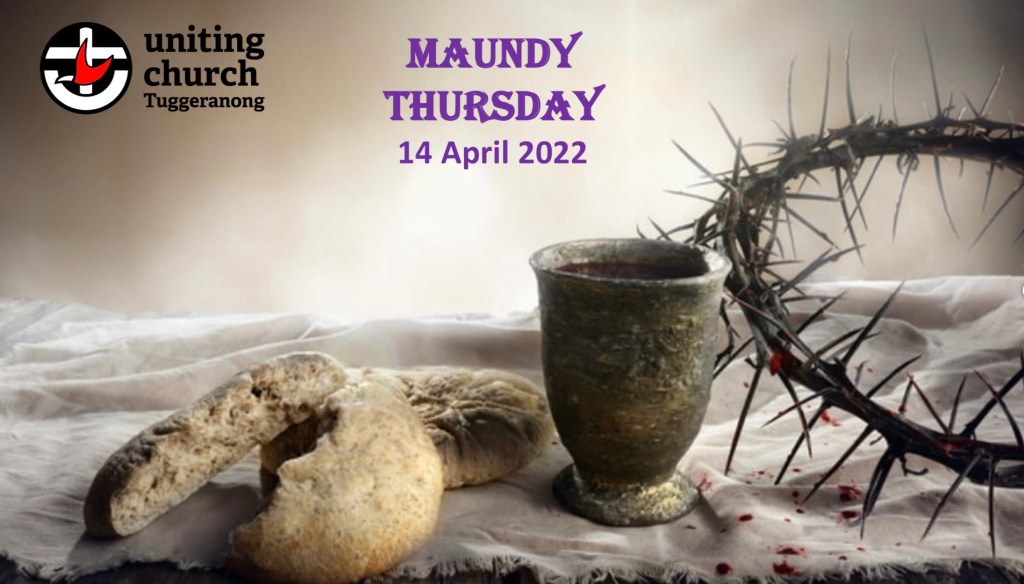
The following liturgy was written in April 2022 and conducted at Tuggeranong Uniting Church on Maundy Thursday, 14 April 2022. The liturgy was conducted around a labyrinth, laid out in the worship area. There were six tables, each forming the focus of one section of the liturgy.

Seven candles were lit at the end of the first section, as reflective music played. Participants were invited to remove their shoes for the service, to sit and meditate or gently walk the labyrinth whilst the reflective music was playing.

After the words for each following section, a candle was extinguished, and reflective music was played, during which participants could sit and meditate, or walk a section of the labyrinth. Participants were encouraged to stay in their place on the labyrinth, or move to a nearby chair, as the words of each section were spoken.

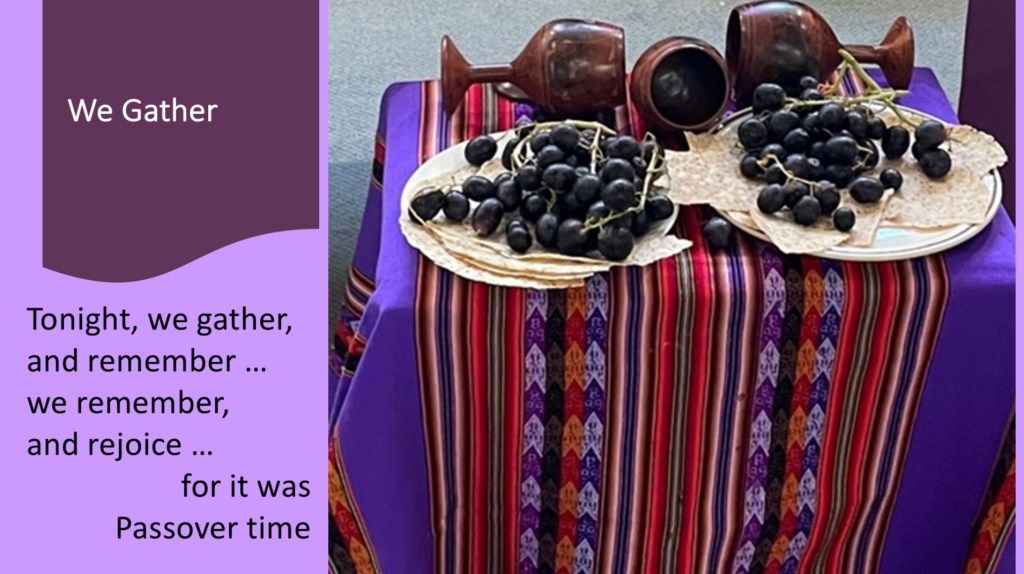
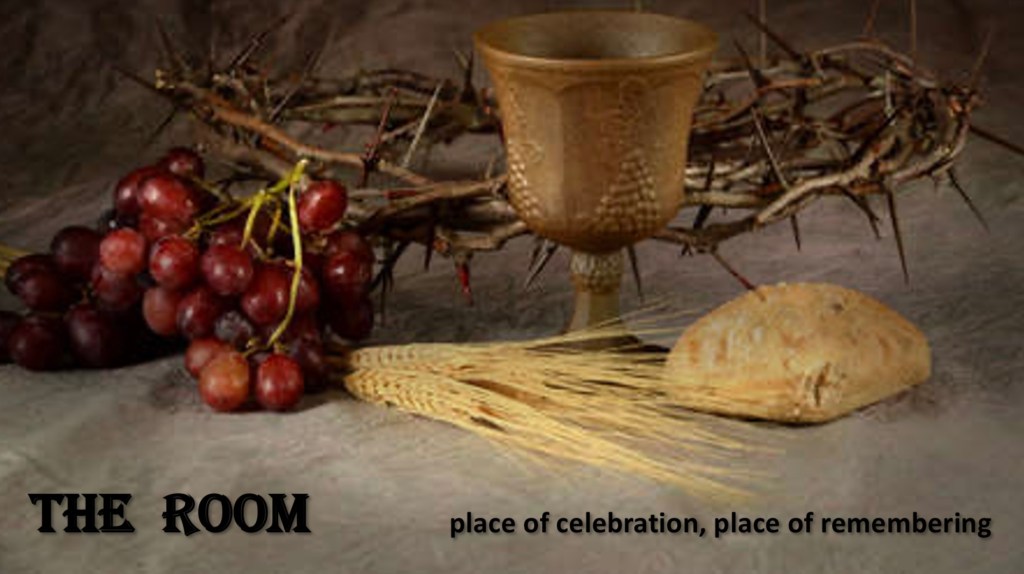
The first and last sections took place focused around a table on which some cups, grapes, and bread were set, forming the elements for communion in the last section.

***** *****

A LITURGY FOR MAUNDY THURSDAY in the YEAR OF LUKE (Year C)

1 The Room

(Please remove your shoes)

Tonight, we gather, and remember;

we remember, and rejoice …

for it was Passover time.

Now of course, it began in celebration;

a gathering of friends and family;

a joyful occasion, with the drinking of wine,

some singing, some laughing; a meal shared together;

but then, a kiss … a betrayal … a denial … a trial …

Yet it began in celebration.

For years, it was so; for decades, for centuries,

on this very night, we would gather, joined as family,

to remember, to rejoice, to recall the act of liberation.

So we praise you, Lord our God, King of the universe;
You who have chosen us and made us holy,

a nation of priests, a people set apart.


Yes, we praise you, Lord our God, King of the universe;
You who create the fruit of the vine.
Yes, we praise you, Lord our God, King of the universe;
You who bring forth bread from the earth.

We praise you in the lighting of the candles,

signs of your presence amongst us tonight;

in these sparkling, enlivening lights,

we remember that we are a light to the nations.

THE CANDLES ARE LIT

SONG: Bless the Lord, my soul (Taize)

*****

2 The Road

It was yet another Passover meal — or was it?

We began like every other Passover meal;

we began by recalling the story …

and yet, although we did not know it,

this time it would be different;

a different Passover celebration;

a different time entirely.

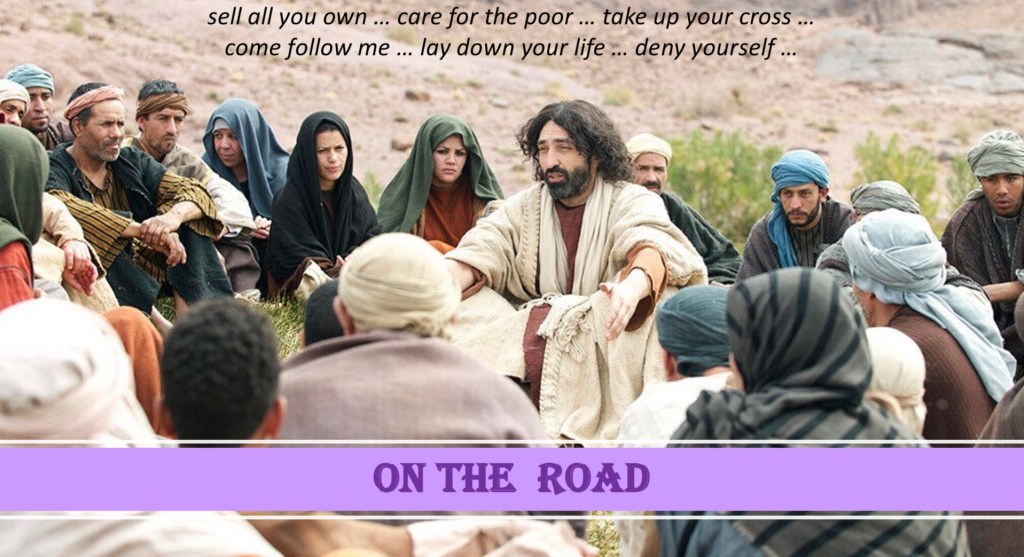
It probably began with what he said

as he went on ahead, going up to Jerusalem.

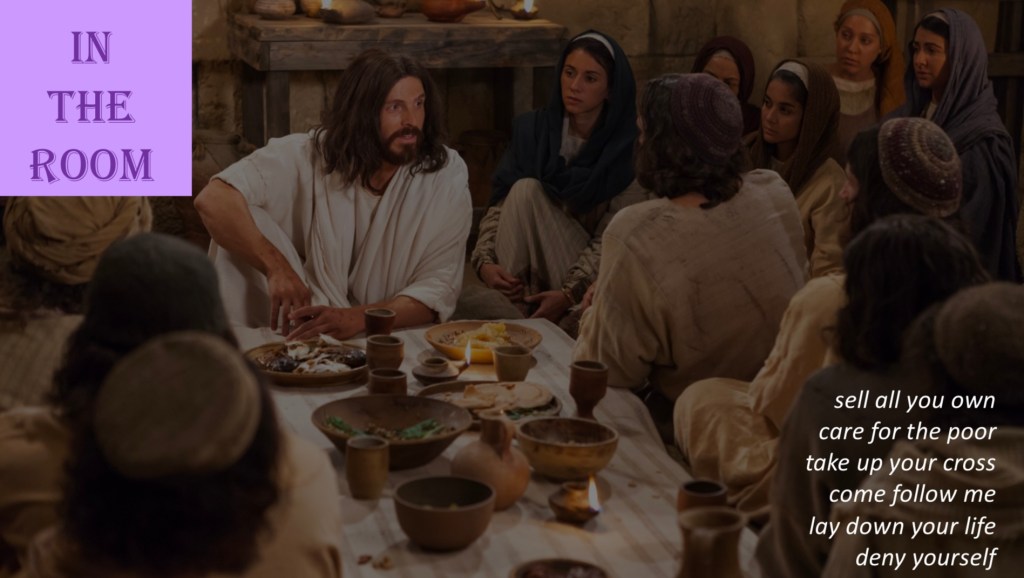
“Sell all you own, care for the poor;

Take up your cross, come follow me;

Lay down your life, deny yourself.”

Looking back, we can hear the resonances;

the hints were there; but we were deaf.

We couldn’t grasp these words;

for the journey was the moment,

the crowds that surged as he healed,

the crowds that marvelled as he taught,

the crowds that continued with him on the way,

enthralled, persuaded, believing.

You see, the journey was the moment,

destination Jerusalem, holy city,

city of the prophets, city of the kings,

the holy place where God still dwells.

Hosanna, blessings, celebration;

“Bless the king, sound hosannas;

peace in heaven, the promise is near,

glory abounds”, the crowd cries out;

the day of salvation is at hand.

“Sell all you own, care for the poor;

Take up your cross, come follow me;

Lay down your life, deny yourself.”

We cared not for those hard words now;

the swirl of the crowd, the shouts of acclamation,

the spreading of cloaks and waving of branches,

reminders of the times of triumph,

anticipation of the coming glory.

Blessed is the king;

he comes in God’s name.

He comes in God’s glory,

he comes bearing peace.

When would we see it?

A CANDLE IS EXTINGUISHED on table 2

SONG: Hosanna, hosanna, hosanna to the king of kings

*****

3 The Room

Now the festival drew near:

unleavened bread, called the Passover,

the celebration of redemption,

the time of God’s salvation.

God came, God saved us,

we hurried to respond;

no time to prepare, no time to bake the bread;

we gathered what we could, left hurriedly,

in haste, intent on being ready—

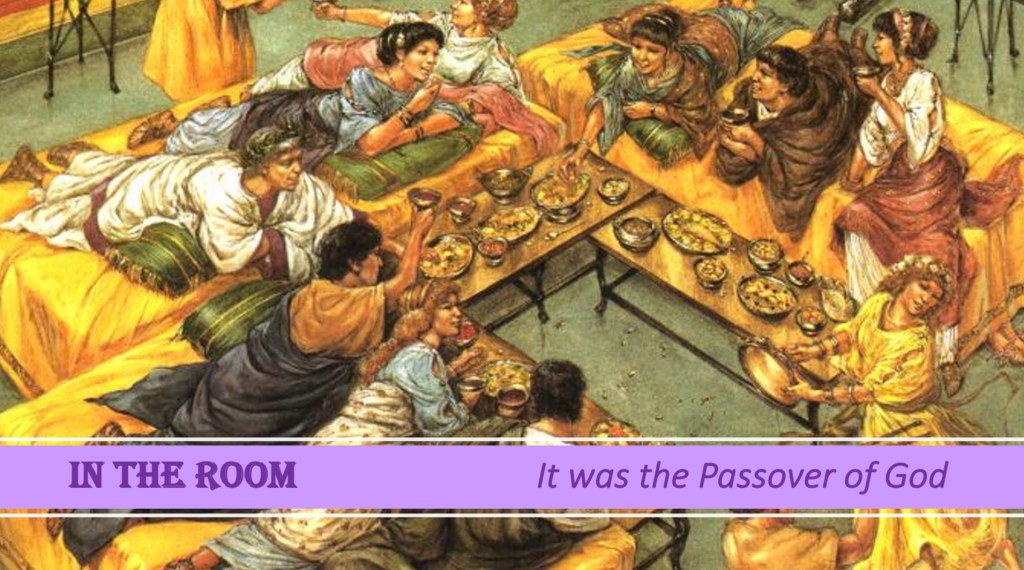
it was the Passover of God,

when God saved the people.

So we gathered, now, to remember,

retell the ancient story,

relive the present promise.

The table was set, with bread and wine,

for this festival of the Lord,

the celebration of Passover …

We met around the table; a family extended,
with brothers and sisters, children and friends;
aunts … uncles … cousins … disciples …
a cacophony of colleagues, family and followers.

As we met around the table, we joined our voices,

with a psalm of celebration; a psalm of hallelujah.

We gathered as a family,

with roasted lamb and bitter herbs,

unleavened bread, four cups of wine;

we gather now, to celebrate,

and as we do, we anticipate:

God, you saved us then;

O God, save us now.

A CANDLE IS EXTINGUISHED on table 3

SONG: Laudate Dominum

*****

4 The Room

You know the Passover is coming,

when God will save the people;

“and the Son of Man will be handed over;

they will mock him, they will whip him,

they will nail him to the cross, to die.”

For the Passover is coming,

when God will save the people.

“I have eagerly desired to share this time,

to celebrate this Passover, with you, my friends.”

First, the cup which signals the kingdom to come;

“take it, drink from it, remember as you drink”;

then the bread, “this is my body”,

words that strained our incredulity.

Then yet again a cup, the covenant renewed;

familiar ground? yet curiously,

“the cup poured out, a new covenant,

sealed in my blood, shed for you”.

Then words of betrayal; woe to that one,

one we had trusted, one we had honoured.

What was going on in his mind?

We could not know:

of the gathering of leaders, we knew not,

of the plot to seize him quietly, we knew not,

of the thirty pieces of silver, we knew not.

Unthinkable, it turns out, what he was doing:

unimaginable, the consequence of this squalid deal.

But we were at a meal that was filled with celebration;

the somber notes he sounded were lost amidst the joy.

It was the Passover of God,

when God has saved the people.

It was a gathering of friends and family;

a joyful occasion, with the drinking of wine,

some singing, some laughing; a meal shared together.

A CANDLE IS EXTINGUISHED on table 4

SONG: Jesus, remember me, when you come into your kingdom (Taize)

*****

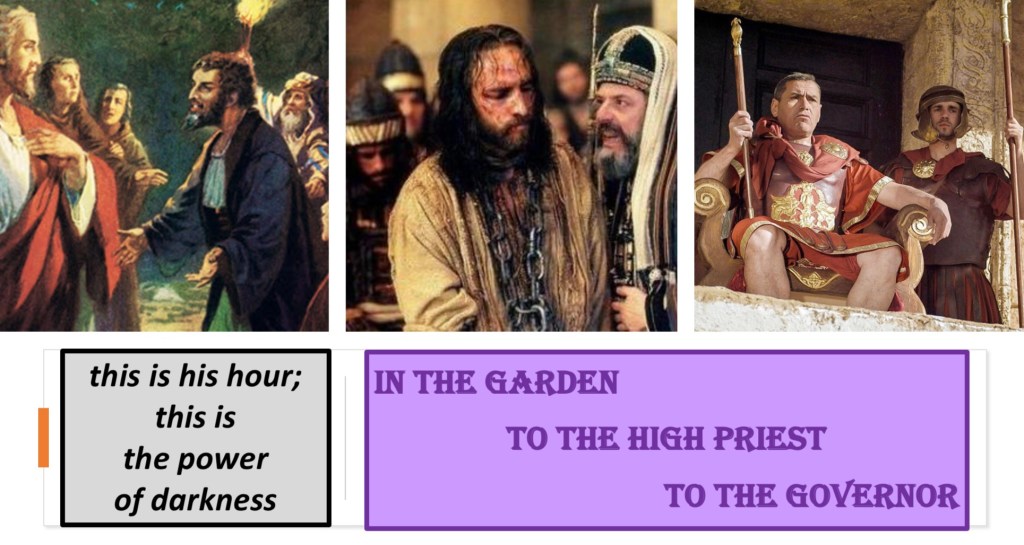
5 The Garden

Not too long after the betrayer left him,

not too long after, they came for him.

Not just the crowd in the garden,

not just the priests from the temple,

not just the elders who had formed an unholy alliance,

scribes and priests together, on the hunt;

but they came with their thugs, the temple police,

intent on arresting him, as if he were a criminal.

“I was with you, day after day, in the temple,

and you didn’t come for me there. But now—

but here, in this dark moonlit moment,

under cover of night, you seize me?

This is your hour; this is the power of darkness.”

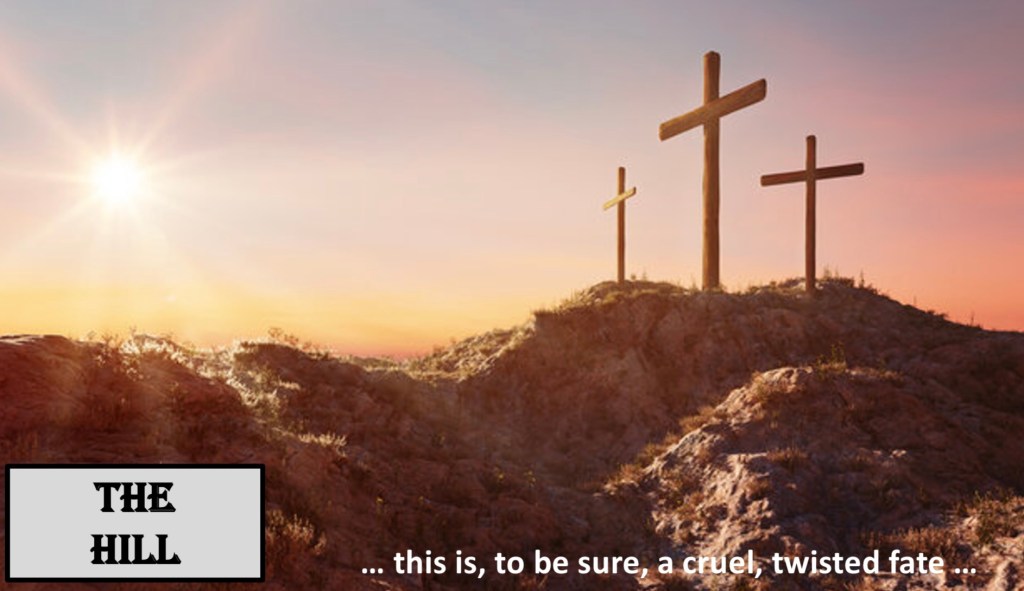
So began this cruel, twisted fate,

from Gethsemane to Golgotha.

With brute force they manhandled him;

to the High Priest, mocking him on the way.

The mocking continued in the assembly,

priests and scribes, elders of the people,

taunting, baiting, condemning.

And then to Pilate, accusing him of crimes

that made no sense to our listening ears.

“Sell all you own, care for the poor;

Take up your cross, come follow me;

Lay down your life, deny yourself.”

That’s what we remembered him saying.

They said, however, that he perverts the nation,

forbids the paying of taxes,

claiming to be Messiah,

claiming to be king.

So Pilate sends him to Herod;

and Herod sends him back to Pilate;

and Pilate insists there is no charge to answer.

Of course there was no charge to answer!

His words cut to the heart of what it means

to be a disciple, to be committed to the covenant,

to share generously with those in need,

to put the concerns of others before oneself,

to open the eyes of the blind

and enable the lame to walk,

to proclaim good news for the poor

and liberation for the captives …

… then again, then perhaps,

that can sound somewhat …

confrontational …

revolutionary …

no wonder that they say he came

to turn the world upside down.

But we had no notion of this

as we walked the road, while he healed and taught,

or as we entered the city, surrounded by jubilations,

or as we sat with him at table, remembering with joy.

Yet there he stood:

charged, condemned;

sentenced to be crucified,

the punishment of slaves,

the fate in store for rebels,

perhaps, even, the inevitable outcome

of a predetermined plan?

Lord, have mercy;

Lord, have mercy …

A CANDLE IS EXTINGUISHED on table 5

SONG: Stay with me (Taize)

*****

6 The Hill

So they led him away, to the top of the hill,

the place of punishment for rebels and criminals.

There were no echoes, now,

of the jubilant cries of the crowd;

there was no sound that fitted

with family celebrations at Passover;

there most certainly was no longer the basis

for acclaiming him as King,

for announcing him as Saviour,

for decreeing he was Lord.

Naked, bloodied, scourged, humiliated,

brought down to common status

as the wooden beam was lifted high;

the mocking words of the soldiers,

the scornful tongues of the leaders,

the taunting cry of the disbelieving thief;

the silent sobbing of companions on the way,

the eerie overshadowing, the turmoil of darkness.

This, to be sure,

was a cruel, twisted fate.

So he died.

What cry pierced the air?

Distraught rejection, some would say;

a cry of sheer abandonment.

Others claim it was far more serene;

“Abba, Father, into your hands

I commend my being, I place my spirit.”

“Sell all you own, care for the poor;

Take up your cross, come follow me;

Lay down your life, deny yourself.”

Who remembers those words now?

A CANDLE IS EXTINGUISHED on table 6

SONG: Be still, and know that I am God

*****

7 The Room

We returned to the room;

the place of celebration;

the place of remembering.

There is no doubt that we would remember;

the events of the past few days

are seared into memory,

caught in the web of recollection,

every year, every month, every day.

But how could we celebrate?

The Passover of God,

the time of salvation,

the deed of redemption,

in the days of Moses.

That surely would continue;

we would most certainly recall,

we would indeed remember,

embedding the story for our children

and their children.

Would this passing of the master

be a Passover for God?

How could this untimely ending

be the cause of celebration?

So we gather, we remember.

It began in celebration;

a gathering of friends and family;

a joyful occasion, with the drinking of wine,

some singing, some laughing; a meal shared together;

but then, a kiss … a betrayal … a denial … a trial …

“Sell all you own, care for the poor;

Take up your cross, come follow me;

Lay down your life, deny yourself.”

SONG: Eat this bread (Taize) as we exit the labyrinth

(Around the final table)

So he took the bread,

as they had always taken the bread;

and lifting it high, he offered his prayers to God.

And we take the bread, and break it:
and we praise you, Lord our God, King of the universe;
You who bring forth bread from the earth.

WE EAT THE BREAD

Then he took the cup,

as they had always taken the cup;

and lifting it high, he offered his prayers to God.

And we take the cup, and drink it,

and we praise you, Lord our God, King of the universe;
You who create the fruit of the vine,

You who bring forth hope from anguish,

You who bring forth what was promised,

You who bring forth life from death.

WE DRINK THE CUP

A CANDLE IS EXTINGUISHED

For it was the Passover of God,

when God redeemed the people,

when God saved his chosen people.

And it is the Passover of God,

when God still redeems his people,

when God still saves his faithful people.

And the shouts of acclamation

and the silent shedding of tears

join mysteriously in celebration,

join as one across the years.

In this cruel, twisted fate

is the Passover of God;

for God still redeems his people,

for God saves his faithful ones.

THE FINAL CANDLE IS EXTINGUISHED

We step out in faith

we walk forth in hope

treading the path before us

walking into life as his follow ers …

WE LEAVE TO THE MUSIC of Wait for the Lord

***** *****

Song playlist

0 As people gather, a selection of quiet meditative songs and chants

1 Bless the Lord my soul

2 Hosanna, hosanna

3 Laudate dominum

4 Jesus, remember me

5 Stay with me

6 Be still and know

7 Eat this bread

8 Wait for the Lord

Tables

1 In the Foyer, with communion elements. White

2 The Road. Green. Branches, cloaks

3, 4 The Room. Purple. Each has a cup and plate

5 The Garden. Red. Sword.

6 The Hill. Black. Cross.

7 In the Foyer. White. Broken cups and plates with elements