Perishable and imperishable, physical and spiritual, of the dust and of heaven (1 Cor 15; Epiphany 7C)

The “resurrection of the dead ones” (the Greek word translated as “the dead” is plural, reflecting a raising of many believers) was a Jewish belief that had developed in preceding centuries; not all Jews accepted it (see Acts 23:6–8) and amongst some Gentiles there was scepticism about the idea (see Acts 17:32). There was also dispute about this matter in Corinth, resulting in a number of debates about particular aspects of this belief. In the section of 1 Cor 15 dealt with last week, two such matters have been explored, debated, and dispatched.

Thus week the lectionary picks up at v.35, where a third pastoral situation might possibly be indicated. The form employed (a rhetorical question attributed to an indefinite person) was commonly used by a skilled rhetorician to raise an objection which he knew could be raised, allowing it to be dealt with in advance (the same technique is found in Rom 2–6 and 9–11). The question provides an opportunity for further eschatological teachings about the nature of the resurrection body (15:35–50) and a further display of Paul’s rhetorical prowess. 

The issue at stake here is the nature of the resurrection body, identified in an opening pair of questions: “how are the dead raised? with what kind of body do they come?” (15:35). These are not mere rhetorical questions; Paul and Sosthenes fully intend to address such enquiries with a detailed exposition. The weight of the argument, in my mind, lies in a set of contrasts by juxtaposition, advanced in a sequence of logical steps in vv.42–49:

What is sown is perishable / what is raised is imperishable. 

It is sown in dishonour / it is raised in glory. 

It is sown in weakness / it is raised in power. 

It is sown a physical body/ it is raised a spiritual body. 

If there is a physical body / there is also a spiritual body. 

Thus it is written, “The first man, Adam, became a living being”/

the last Adam became a life-giving spirit. 

But it is not the spiritual that is first /

but the physical, and then the spiritual. 

The first man was from the earth, a man of dust; /

the second man is from heaven. 

As was the man of dust, so are those who are of the dust; /

and as is the man of heaven, so are those who are of heaven. 

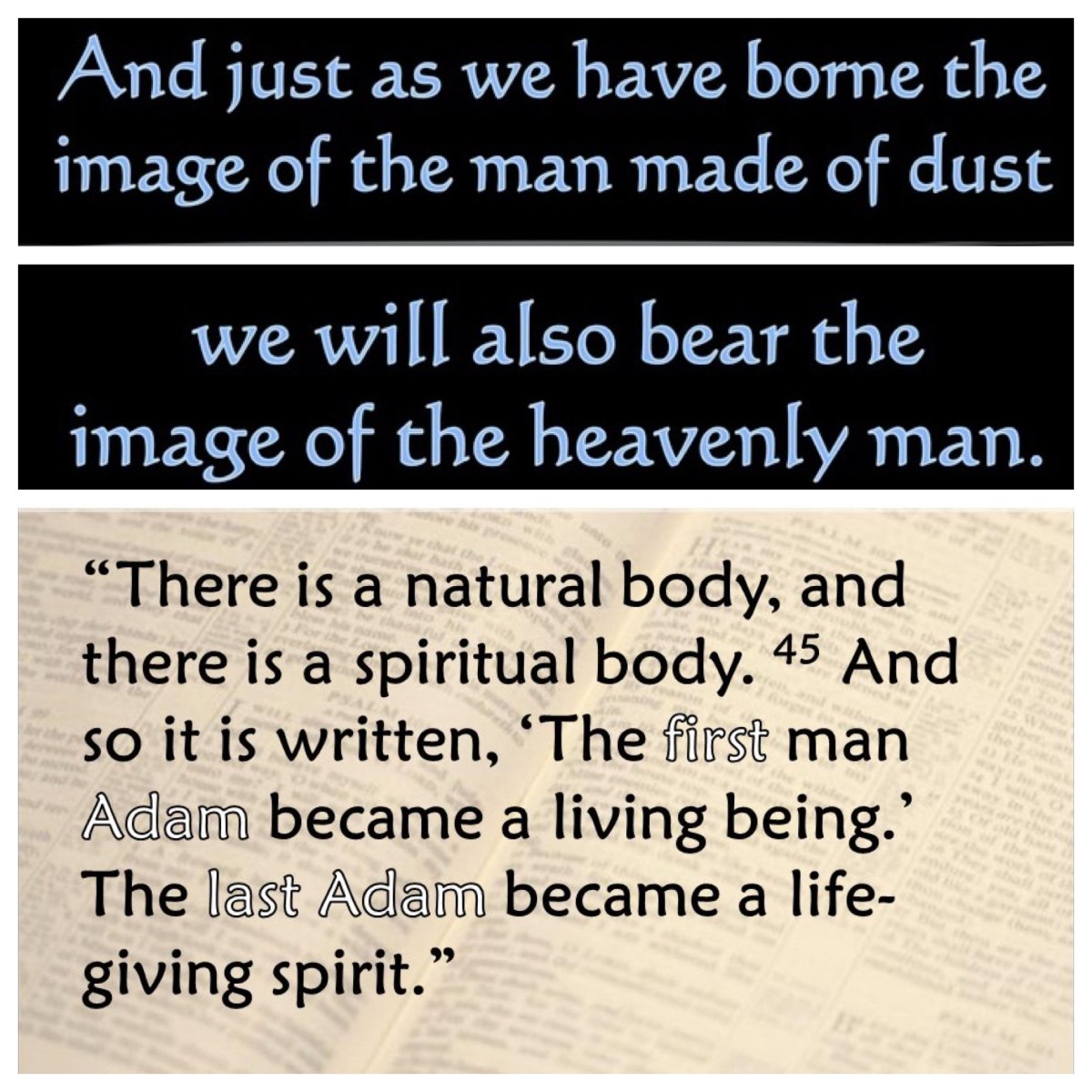
Just as we have borne the image of the man of dust, /

we will also bear the image of the man of heaven.
The symmetry is certainly poetically and rhetorically satisfying. The argument is a straightforward typology, in which one thing is seen to correspond to another thing on a different plane, or in a different dimension—but also to differ from them: the first man correlates with the second man, but while the first is “the man of dust”, the second is “the man of heaven; and while “the living being” shares the same living existence with “the life-giving spirit”, this being also differs from that spirit.

The language found here draws on terms used by the authors of the letter in earlier chapters. A contrast between “perishable” and “imperishable” has already been made in the discussion of the race in which “all runners compete” in the statement that “athletes exercise self-control in all things; they do it to receive a perishable wreath, but we an imperishable one” (9:25). The perishable reward is the winner’s wreath (9:25), while the imperishable reward is clearly the salvation referred to in an earlier verse (9:22). This language will return in the concluding couplet at the end of the discussion of this particular issue (v.50).

The clear contrast of the saying about the wreath carries over into the discussion in ch.15 where “the perishable” is contrasted with “the imperishable”, and “what is sown” is juxtaposed alongside “what is raised”. This contrast would seem to draw strongly on the Platonic distinction between spirit and flesh, in which the spirit is the realm of ultimate reality, but the flesh represents the prison in which human beings are trapped during this life.

The letter proposes that the former is sown “in dishonour, in weakness”—features characterising sinful humanity—while the latter is raised “in glory, in power”—attributes of the divine. These are the characteristics of “the man of dust”, Adam, who encompasses those who are set to experience death (15:21–22). It is through “the life-giving spirit”, the “last Adam”, that resurrection life is granted (15:45). We might thus consider that the argument here is thoroughly dualistic; the Platonic influence is undoubted. 
So a similar contrast is drawn between “spiritual” and “physical”; this has been an important factor in the argument of the early chapters of this letter. In their opening thanksgiving, Sosthenes and Paul noted that the saints in Corinth “are not lacking in any spiritual gift” (1:7). However, a little later they lament that they could not address them as “spiritual people”, for they still need milk, not solid food, as befits “infants in Christ” (3:1–2). And the exercise of “spiritual gifts” in Corinth, canvassed in quite some detail in ch.12—14, reveals a chaotic exuberance in which the “building up of the assembly” is almost entirely lacking. Perhaps the note in the opening thanksgiving was ironic, then?

Indeed, in one section of the letter (in ch.2), the spiritual / physical contrast is very strong; the contrast is set in stark fashion. First, the human heart is unable to conceive “what God has prepared for those who love him” (2:9, introduced as scripture, most likely paraphrasing Isa 52:15 or Isa 64:4). Accordingly, God’s wisdom is “secret and hidden”, for “no one comprehends what is truly God’s except the Spirit of God” (2:7, 11). 

Thus, there is a clear distinction between “those who are unspiritual”, who “do not receive the gifts of God’s Spirit … and are unable to understand them”, and “those who are spiritual [who] discern all things” (2:14–15). It is the believers in this latter group who have been granted “the Spirit that is from God, so that we may understand the gifts bestowed on us by God” (2:12). The closing word in this section is, “we have the mind of Christ” (2:16, riffing off the affirmation of Isa 40:13).

This spiritual / physical contrast is bound up with the contrasts between wisdom / folly (1:18–25) and weakness / power (1:26–31) that formed the basis for the clarion declaration, “when I came to you, brothers and sisters, I did not come proclaiming the mystery of God to you in lofty words or wisdom; for I decided to know nothing among you except Jesus Christ, and him crucified” (2:1–2). That is the foundation for the message articulated throughout this letter.
Although Paul maintains that “my speech and my proclamation were not with plausible words of wisdom” (2:4), the message that he brought the Corinthians was indeed imbued with wisdom—although he maintains that “it is not a wisdom of this age or of the rulers of this age, who are doomed to perish”; rather it is “God’s wisdom, secret and hidden, which God decreed before the ages for our glory” (2:6–7). In like fashion, whilst Paul declares that he came to the Corinthians “in weakness and in fear and in much trembling” (2:3), there was nevertheless “a demonstration of the Spirit and of power” when he was with them (2:4). 

So there is a deep paradox in this language, for in any one word there can be two related, but quite distinct, meanings. Wisdom is both human and divine; power is both absent and yet present. It is perhaps this paradox, in which qualities overlap and inter-relate, rather than a simplistic dualism of spheres, keeping the two entities far apart, that we might best see in these words of chapter 15. 

Although the language appears sharp and polemical, the contrast is rhetorical rather than existential: wisdom is made foolish in order to convey wisdom, power is rendered weak in order to express power, and spiritual matters are gifted to those whom we might regard as thoroughly physical, fleshly, material, in order that the Spirit might be at work in and through human beings. It’s a paradox.

So here is the paradox at play: it is the expression of spiritual things—the gifts of wisdom, knowledge, faith, healing, miracles, prophecy, discernment, tongues, and interpretation (12:8–10), or the gifts granted to “apostles … prophets … teachers”, as well as “deeds of power, gifts of healing, forms of assistance, forms of leadership, various kinds of tongues, [and] interpret[ation]” (12:28–30)—which are manifested amongst the human beings in the community of faith in Corinth, and indeed in other such communities in other places and other times. There is no fundamental dualism; rather, the spiritual infuses and works in and through the physical. That is the key to the paradox.

So the “man of dust” is but a type for the “man of heaven”; and those who believe, who are “called to be saints” (1:2; see also 6:1–2) share in both images. The “man of dust”, of course, evokes the second version of the creation story, in which “the Lord God formed humankind (ha-adam) from the dust (aphar) of the ground” (Gen 2:7a). And in that verse lies also the seed of the idea that the “man of heaven” would be “a living being” (1 Cor 15:45), for the creation narrative continues, “and [God] breathed into his nostrils the breath of life (nishmat hay-yim); and the man became a living being (nephesh hay-yah)” (Gen 2:7b). The wordplay in Hebrew is delicious!

So the argument presented in 1 Cor 15:42–49 is in fact, in its form, a midrashic exposition of scripture. Its foundation is this twofold portrayal of the “man of dust” and the “living being” (Gen 2:7). Its climax draws from another scripture—this time, from the first creation narrative, which itself reaches its narrative climax in the poetic affirmation that “God created humankind (ha-adam) in his image, in the image of God (betselem elohim) he created them; male and female he created them” (Gen 1:27). 
One final note is that it is Paul’s use of the reference to “the last Adam” (that is, Jesus) as “a life-giving spirit” (1 Cor 15:45) that ties the whole argument into this discussion of resurrection. Spirit and resurrection are closely linked. The same connection is stated quite explicitly by Paul in the letter that he, alone, wrote to the Romans. When he is discussing “those who live according to the Spirit” (Rom 8:5), he declares “the Spirit of him who raised Jesus from the dead dwells in you, he who raised Christ from the dead will give life to your mortal bodies also through his Spirit that dwells in you” (Rom 8:11). The indwelling of the Spirit in the lives of believers is equivalent to the act of “giv[ing] life to your mortal bodies”.

Then, however, the authors conclude their discussion of the resurrection body with a pair of contrasts that make it perfectly clear that resurrection life exists in an altogether different plane from this earthly life: “flesh and blood cannot inherit the kingdom of God, nor does the perishable inherit the imperishable” (1 Cor 15:50). We will think more on this in next week’s blog. 

Suffice to say that, in my mid, this conclusion has lapsed back into the Platonic dualism inherent in the language; but as I have noted, I don’t think this was entirely what Paul (and Sosthenes) actually meant to do. Theologically, in my mind, the kingdom of God is precisely evident in the flesh and blood that characterises ice as we currently know it. Is this not what Jesus meant in his most provocative sayings about the kingdom? 

See also 

Paul, Demetrius and Damaris: an encounter in Athens (Acts 17:16-17,22–34)

The following dialogue was written by Elizabeth Raine and John Squires,and delivers as the sermon for the Tuggeranong Uniting Church on Sunday 14 May 2023.

*****

While Paul was waiting in Athens for Silas and Timothy, he was greatly upset when he noticed how full of idols the city was. So he argued in the synagogue with the Jews and the gentiles who worshipped God, and in the public square every day with the people who happened to come by.

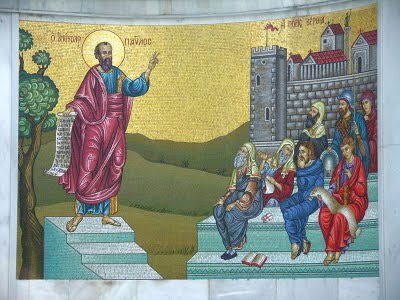
Then Paul was brought before the city council, which met at the Areopagus in Athens. Today, as we listen to what Paul said to the council, we are also going to listen in to what might have been going through the minds of two people in his audience: a learned Greek man called Demetrius, and a woman of deep faith, known as Damaris.

Paul stood up in front of the meeting of the Areopagus and said, “People of Athens, I see that in every way you are very religious.”

Demetrius: Yes, this is correct. We are very proud of our religions here in Athens. As religious people, we worship lots of gods. Just look around you, and you will see altars and temples of every size, shape, and description. Over there, is the fine temple to Zeus. And beside it, the shrine to Apollo; it, too, is a remarkable holy building. It is not for nothing that we in Athens have the reputation of great piety.

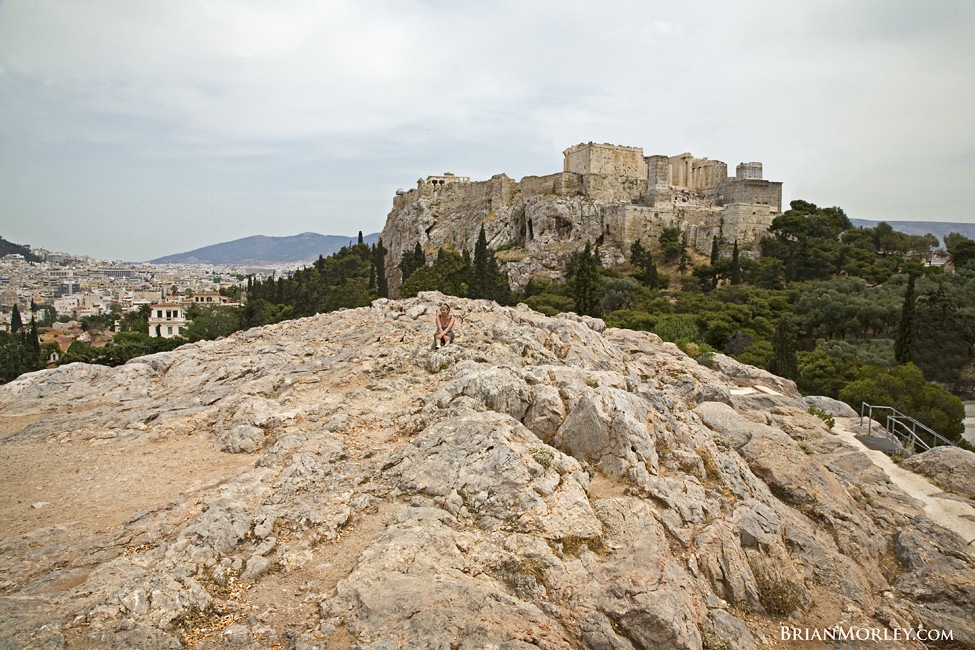
And, of course, when you turn your eyes to the top of the hill, you will see the pride and joy of our city: the magnificent temple of Artemis, where our ancestors have long worshipped the greatest of all goddesses. This temple is world famous. It is respected — even envied, dare I say — by peoples of all other nations.

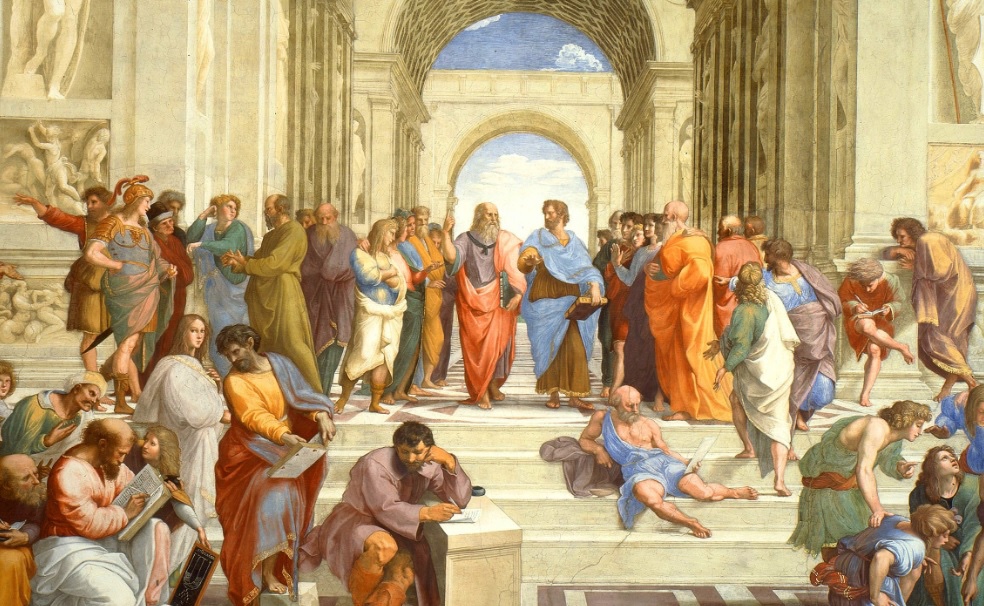
And Athens has also been blessed by many famous teachers of philosophy. Plato and Socrates, Aristotle and Pythagoras, Epicurus and many more. Why, even today, I believe that you could find no better array of teachers in any other city!

Yes, all of this shows you just how religious we are. This Paul is so right when he describes us in such generous terms.

Damaris: Indeed, it is true that we do have a lot of temples in our city. And we certainly have many fine teachers, as you say. Lots of people say that we are the most religious city in the world.

But something is missing, I think. There is so much ritual and pomp and ceremony that goes on; sometimes, I think that this can get in the way of worshipping the gods, rather than helping us to worship them.

And there are so many teachers who speak truths that are complex;  sometimes it hurts my head just to listen to them all! And all those poor animals that are sacrificed to all of these gods and goddesses. I wonder whether this really is such a good idea.

I have heard it said that Paul believes in a god that cannot be depicted on stone. It’s a curious idea to us Athenians; but some of my friends have told me about the group that believes this idea. A god that exists, but that we can’t see, or know much about at all is an odd idea.

23Paul continued, “For as I walked through your city and looked at the places where you worship, I found also an altar on which is written, ‘To an Unknown God.’ That which you worship, then, even though you do not know it, is what I now proclaim to you. God, who made the world and everything in it, is Lord of heaven and earth, and does not live in temples made by humans. Nor does God need anything that people can supply by working for him, since it is God himself who gives life and breath and everything else to all people. From the one person God created all human beings, and he made them live over the whole earth. God himself fixed beforehand the exact times and the limits of the places where they would live.”

Demetrius: Mmm, yes. Good point. I agree. Paul has said some important things about this God. When you boil it all down, there is a force in human history that looks over all things. Providence, or Fate, we call it.

And despite all of these shrines and images of the gods, there is a quality about the divine that is rather unknown to us. In the end, we would have to say that the gods are beyond our understanding. This is what our revered teacher, Plato, said about them. The gods transcend this earthly life and really have no need of our human worship.

Many of the priests in our city would be horrified by this, as they insist that we get access to the gods by offering sacrifices. But this kind of other-worldly god is very attractive. I like what Paul has to say.

Damaris: Yes, I too find Paul’s words attractive, Demetrius. And it is reassuring to know that all the things that happen in life are ultimately under the control of Divine Providence. But I am a little bit worried about what Paul seems to be saying. The god he is talking about seems to be rather removed from us all. I wonder how Paul thinks this god of his could be accessible to us? How could we relate to this god, if we can’t see his image?

Paul went on to say, “God did this so that they would look for him, and perhaps find him as they felt around for him. Yet God is actually not far from any one of us; as someone has said, ‘In him we live and move and exist.’ It is as some of your poets have said, ‘We too are his children.’”

Demetrius: Well, this is a surprising turn. From a god who is so far away from us, to a god who is near to us. Come to think of it, Paul is on to something here. In fact, he is quoting from our own Greek traditions here. I recognise those words he said — Aratus, I think it was, the poet, who said of god “in him we live and move and exist”. And “we are god’s children” — I know that, too. Well, that is very good, a Jew like Paul, showing that he knows our poetry and philosophical writings.

Damaris: I quite like the idea of a god who is with me all the time. All of these holy places and holy rituals can get too much, and tend to place too many things in between the gods and ourselves. Sometimes I’d just like to be able to relate to a god in an intimate, and personal way. So a god who is with me all the time — not just when I visit his shrine or place a sacrifice on his altar — is an appealing concept. “We are God’s children” — God as the one who gives birth to us, who nurtures us, who disciplines us, and who loves us. This sounds really good.

Demetrius: Yes, this is great. A god who is always with us. Why don’t we build an altar to him! I’ll get in touch with my friend Stephanas, he has a very good stone mason as one of his slaves, and we’ll see what we can come up with. I can just see it now; “To the god in whom we live and move and exist: this statue was erected by Demetrius and Stephanas” — no, “this statue was erected by Demetrius, with help from Stephanas”. Oh, why not just, “erected by Demetrius, a leading citizen of the city”. In large letters. Yes, that will look fine. And we’ll use the best stone; and have it trimmed in gold, with bright colours, so that it stands out, and….

“No!”, said Paul. “Since we are God’s children, we should not suppose that his nature is anything like an image of gold or silver or stone, shaped by the art and skill of a human being.”

Demetrius: No?

Damaris: I think I see the point. If this god is always near to us, then it would be silly to build an altar or erect a temple for him. After all, the temple is where the god or goddess lives, so that we know where to go to visit them. But if the god is always with us, then we don’t need to build him or her a home. So, if we aren’t going to build an altar or put up a statue, how are we going to worship this god?

Then Paul explained, “God has overlooked the times when people did not know, but now he commands all people everywhere to turn away from their evil ways. For God has fixed a day in which he will judge the whole world with justice, by means of a man he has chosen. He has given proof of this to everyone by raising that man from death!”

Demetrius: Oh, now he has spoilt it. What! How can a person be raised from the dead? Everyone knows that once we die, we go down into the underworld and live as shadows. Once you cross the river Styx, your previous life is left far behind. Who would want to go back into the earthly body once again?

No, this claim by Paul raises too many questions that are just not able to be answered satisfactorily. Any talk about raising the dead and bringing back their bodies is stupid.

Damaris: Well, to tell you the truth, I’ve always been worried by this idea. The thought of being a shadow after I die doesn’t really hold any attraction for me. I am much more interested in the story of a god who is able to transform death. What a powerful and caring god this must be! After all, death is what we all must face, and what we all fear so much.

And further, I am starting to see something quite special in what Paul is talking about. He has mentioned a special man, a chosen human being, who will be the one to carry out God’s justice in all the world. This idea is what really grabs me. To think that a god can not only be with us, but that this god can be a human being, just one of us, is really very special.

Now that I think about, this message reminds me of a letter that I received from my sister in Corinth just recently. As I recall now, she spoke about this man named Paul, who had visited the city, and had preached about a man from Nazareth, in the province of Galilee. Paul said that this man, Jesus, was not only a great prophet, but that he had been raised from the dead, and that he is the one who will bring God’s justice into the world. Perhaps this Paul that we are listening to today is the same person that she was talking about?

As Paul puts it, this God has a presence and a power that touches human life in profound and moving ways. This kind of power is lacking in the stone images that I see around me. Paul is leading me right into the heart of this God. So I think I will take his advice, and turn away from the gods I used to worship, and wait for the coming of divine justice through this man who is raised from the dead.

When the people heard Paul speak about a raising from death, some of them made fun of him, but others said, “We want to hear you speak about this again.”

Demetrius: Well, I have to say that this Paul is a bit of a surprise. I admit that he has said one or two foolish things — but not quite as many as I thought he would when he started. But this business of being raised from death is just not on. Yet some of the things that he has said are worth pondering. He is quite a philosopher, isn’t he? I can’t make up my mind about him, and about the god that he has proclaimed to us, and the religion that he has told us about. I’ll need some time to reflect on what he has said.

Perhaps he will be back in the public square tomorrow; I hope so. Maybe I will go there with my kitchen slaves in the morning, when they go to buy our household food for the midday dinner.

Then Paul left their meeting. Some men joined him and believed; among them was Dionysius, a member of the Areopagus, a woman named Damaris, and some others.

*****

As we return to the 21st century, it is worthwhile pondering Paul’s words and actions, and the response that both Damaris and Demetrius had to these words.

The words of Luke suggests that perhaps Paul was “off duty”, as his prime reason for being in Athens was to wait for Silas and Timothy to rejoin him there. Unable to do nothing or ignore the temples of idols around him, Paul’s idea of “off duty” appears to be to argue with everyone he meets in the town square. However this may have been perceived, Paul’s message of “the God you are looking for, the God you don’t even have a name for, the God who is in danger of getting lost in the plethora of all the other idols you are worshipping – let me tell you about that God…” is the God that we surely could take with us into our own town squares – maybe represented today by our cathedrals of consumerism in the large shopping malls, clubs and coffee shops we frequent today.

Paul presents his “new teaching” and “strange ideas” by meeting the Athenians on their own ground, by quoting two of the Greek poets: the Cretan Epimenides (600 BCE), that “in him we live and move and have our being,” and then the opening lines of the Phaenomena by Aratus (315-240 BCE), a Greek poet and Stoic of Cilicia, that “we are his children.”

It is also worth noting that Paul does not condemn them as unredeemed pagans on a one-way trip to hell, he tells them that both he and they worship the same God. Paul plainly saw God at work in the world through all people, and we would do well to remember this as well. Paul viewed the venerable Areopagus as just another place where the Lord of all creation had gone before him and was already present; indeed, as Paul said to the Athenians, “He is not far from each one of us.”

We Christians need to be aware of isolating and insulating ourselves from our culture’s mainstream. We must avoid being inward-looking, self-absorbed, and judgmental, instead of engaging people in our contemporary Areopagus. Instead, we need to follow Paul’s example of living, learning and sharing the gospel in the marketplace of ideas, engaging real people where they live, work, and think, in order to gain a hearing for our “strange ideas” about God, grace, and the resurrection.

*****

See also