

Sing a new song to the Lord (Psalm 149; Pentecost 15A)

Many psalms in the later sections of the Book of Psalms begin with the exclamation, “praise the Lord!” (106:1; 111:1; 112:1; 117:1; 135:1; 146:1; 147:1; 148:1; 149:1; 150:1), whilst some end with that same exclamation (105:45; 106:48; 115:18; 117:2; 135:21; 146:10; 147:20; 148:14; 149:9; 150:6). We find this phrase at the beginning and at the end of Psalm 149, which is offered by the lectionary as the psalm for this coming Sunday.

Singing (v.1) is mentioned often in the psalms: “how good it is to sing praise to our God” (147:1), “with my song I give thanks to him” (28:7), “I will praise the name of God with a song” (69:30), and so the people of Israel are encouraged to “sing to God … lift up a song to him who rides on the clouds” (68:4), “raise a song, sound the tambourine, the west lyre with the harp” (81:2). A whole sequence of “songs of ascent” are included in this book, reflecting the journey of pilgrims as the approach the temple to bring their offerings (psalms 120—134).

, was a staple part of the temple liturgy. The Chronicler regularly reports the role that “the singers” had in the Temple, where “they were on duty [to sing] day and night” (1 Chron 9:33). They were to “play on musical instruments, on harps and lyres and cymbals, to raise loud sounds of joy” (1 Chron 15:16; see also 2 Chron 5:12–13; 9:11; 23:13; 29:28; 35:15).

In the return of the people to the city after the Exile, singers take their place alongside “the gatekeepers and the temple servants” (Ezra 2:70; 7:7; 7:24; Neh 7:1, 73; 10:28, 39; 12:45–47; 13:5). Often in these passages they are mentioned in association with the Levites. It was the descendants of Levi who had been appointed to take care of the Tabernacle (Num 1:51–53; 1 Sam 6:15; 2 Sam 5:24; 1 Ki 8:4) and then the Temple (1 Chron 6:48), “living in the chambers of the temple free from other service” (1 Chron 9:33–34).
Psalms are often communal. This particular psalm which we hear this coming Sunday is set “in the assembly of the faithful” (Ps 149:1), as others seem to be (Ps 7:7; 89:5; 107:32). Still other psalms reflect a setting in “the sanctuary of the Lord” (Ps 60:6; 68:35; 96:6; 108:7; 150:1). Sing “a new song” is often enjoined by the psalmists (33:3; 40:3; 96:1; 98:1; 144:9; and here, 149:1). This refrain is picked up by the four living creatures and the twenty-four elders in heaven (Rev 5:9) and then “the one hundred and forty-four thousand who had [the Lamb’s] name and his Father’s name written on their foreheads” (Rev 14:1–2). These latter texts have occasioned much interest in what, exactly, that “new song” was. But who knows?

The instruction to “let them praise his name … making melody to him with tambourine and lyre” (v.3) is repeated in “praise the Lord with the lyre, make melody to him with the harp of ten strings” (Ps 33:2) and further expanded in the complete orchestral array that is mentioned in Ps 150:1–6, as well as in narrative texts concerning the band of prophets coming to meet Samuel and Saul (1 Sam 10:5) and the sons of Jeduthun (1 Chron 25:1–8). Job notes that faithful people “sing to the tambourine and the lyre” (Job 21:12) and David, of course, was recognised for his skill with the lyre (1 Sam 16:14–16, 23; 18:10).

The role of playing the tambourine appears to have been linked with young girls (Ps 68:25) and women (1 Sam 18:6), following the example of “the prophet Miriam, Aaron’s sister” (Exod 15:20). There are tambourines in the instrumental array in the time of David (2 Sam 6:5; 1 Chron 13:8) and they are noted by Jeremiah (Jer 31:4) and in Judith’s “new psalm” of praise to God (Judith 16:1).

Their presence at weddings is reflected in the sad tale of the wedding of the family of Jambri, where weapons concealed amongst “the tambourines and musicians” are used to perpetrate a huge slaughter, such that “the wedding was turned into mourning and the voice of their musicians into a funeral dirge” (1 Mac 9:37–41).
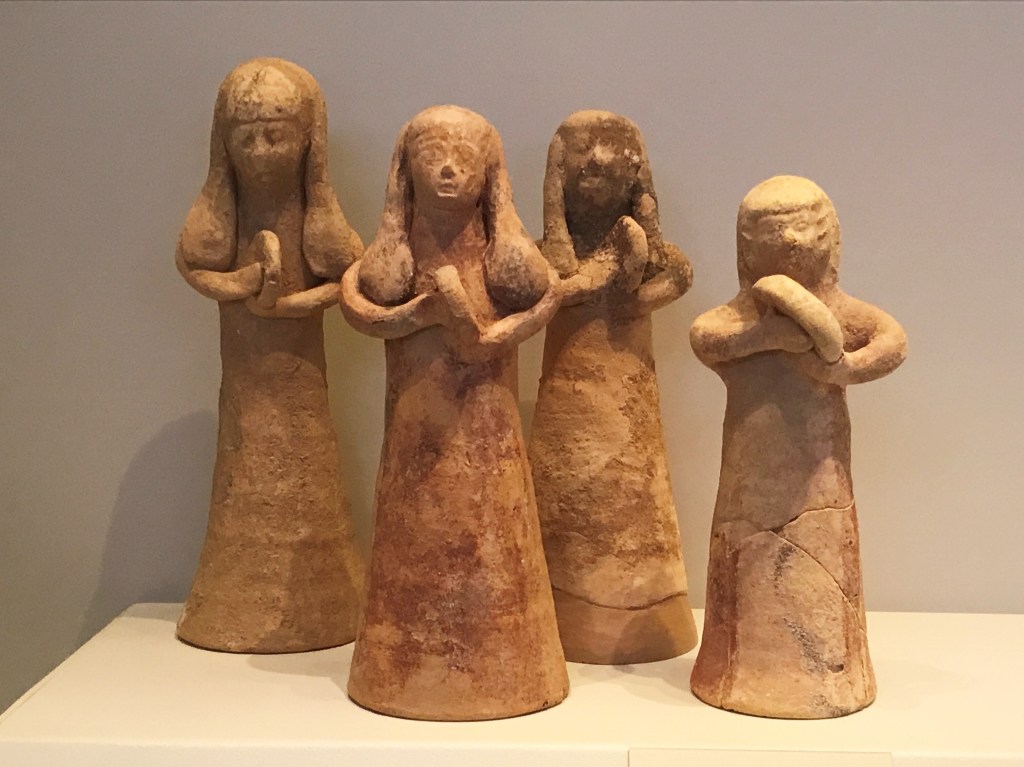
A group of terracotta figurines dating to the eight-seventh century BCE.
These small figurines, six–eight inches tall, represent female figures playing the hand-drum, which was probably a woman’s instrument in ancient Israel.
These terracottas are in the collection of the Israel Museum in Jerusalem. Photo by Carol Meyers, Duke University; from
https://jwa.org/encyclopedia/article/women-with-hand-drums-dancing-bible

Dancing in temple worship (v.3) is also noted in other psalms; on Zion “singers and dancers alike say, ‘all my springs are in you’” (Ps 87:7), and praising God “with tambourine and dance” is encouraged in the great final psalm of praise (Ps 150:4). Dancing appears also in the narrative texts concerning Miriam (Exod 15:20), the daughter of Jephthah (Judg 11:34), Saul (1 Sam 8:6), and David (2 Sam 6:5; 1 Chron 13:8; 15:29).

The psalm ends with a celebration of the ways that God’s justice will be implemented (Ps 149:6–9), which is bracketed by reference to “the faithful” who “exult in glory” (v.5) and the closing affirmation, “this is glory for all his faithful ones” (v.9). These “faithful ones” are active in offering praise in other psalms (Ps 30:4), for they are valued by God. The psalmists affirm that the Lord “will not forsake his faithful ones” (Ps 37:28) and that their death is “precious … in the sight of the Lord” (Ps 116:15).

Yet regarding God’s just actions as the “glory” which God grants to these “faithful ones” is a reminder of the realities of the world in which the Israelites lived. It was marked by conflicts and battles, by bloodshed and killings, by invasions and deportations, so the judgement of God was sought by the “faithful ones” in brutal terms. With “two-edged swords”, with fetters and chains of iron, so “the judgement decreed” by the Lord God will take place (vv.6–9).
After which, the psalmist takes breath, and concludes, “Praise the Lord!” Indeed!
I will offer a sacrifice and call on the name of the Lord (Psalm 116; Easter 3A)

This coming Sunday, the third Sunday in the season of Easter, the lectionary offers a series of verses from psalm 116 (1–4, 12–19). This psalm is one of six psalms, numbered from 113 to 118, which are known as Hallel psalms—from the Hebrew term hallelu-jah, meaning “praise the Lord”. That phrase starts psalm 113 and ends psalms 115, 116, and 117. These psalms were, and are, used in Jewish communities at times of festive celebration; so they are also most suitable in the current Christian season of Easter.

The opening section of this psalm celebrates a rescue from near death (v.8) and continuing in life (v.9), which is a relevant motif for the season of Easter—it evokes the story of Jesus we heard over the Easter weekend, recently. In verse 5, the psalmist identifies some central characteristics of God. That God is merciful and gracious is a recurring Israelite theme (Exod 34:6; 2 Chron 30:8–9; Neh 9:17, 32; Jonah 4:2; Joel 2:13; Ps 86:15; 103:8, 11; 111:4; 145:8–9).

That God is righteous is likewise declared in scripture (Deut 32:4; Ps 145:7; Job 34:17). The psalmists regularly thank God for God’s righteousness (Ps 5:8; 7:17; 9:8; 33:5; 35:24, 28; 36:6; 50:6; etc) and note the importance of humans living in that way for righteousness (Ps 18:20, 24; 85:10–13; 106:3, 31; 112:1–3, 9). The book of Proverbs advises that the wisdom it offers is “for gaining instruction in wise dealing, righteousness, justice, and equity” (Prov 1:3) and the prophets consistently advocated for Israel to live in accordance with righteousness (Hos 10:12; Amos 5:24; Isa 1:22; 5:7; 28:17; 32:16–17; 54:14; Jer 22:3; Ezek 18:19–29; Dan 9:24; 12:3; Zeph 2:3; Mal 4:1–3; Hab 2:1–4).

These recurring notes of the nature of God then form the basis for a Christian understanding of Jesus, who affirms mercy (Matt 23:23), teaches righteousness (Matt 5:6, 10, 20; 6:33), and exudes grace (John 1:14–18). This is an ancient Jewish psalm that we Christians can joyfully sing and affirm!

The second part of the psalm focusses on appropriate ways for the psalmist to respond to the experience of escaping death (see v.8). The psalmist affirms, “I will pay my vows”—not once (v.14), but twice (v.18). Other palms refer to paying vows before God (Ps 22:25; 50:14; 61:8; 65:1; 66:13; 76:11). The words of the psalmist are echoed by Eliphaz in one of his speeches to Job: “you will delight yourself in the Almighty, and lift up your face to God; you will pray to him, and he will hear you, and you will pay your vows” (Job 22:26–27).

Paying a vow is a public act, most likely undertaken in the Temple precincts, as v.19 indicates. The psalmist indicates two such public actions to “pay my vows”. First, the cup of salvation is to be lifted up (v.13). Perhaps this was the drink offering that was to be presented each year at the Festival of First Fruits (Lev 23:13), an expression of deep gratitude for God’s continuing care.

Then, because of the predominance of sacrifices within Israelite religion, offering “a thanksgiving sacrifice” is also an appropriate response (v.17). The regulations for this sacrifice (found in Lev 7:11–15; see also Ps 50:14) indicate that it can be made at any time during the year, as a regular expression of that gratitude for God’s care.

Jews today do not bring specific physical sacrifices, but understand the scriptural language about sacrifice to refer to a way of living. It is said that, on one occasion, as Rabbi Yochanan ben Zakkai and his disciple Rabbi Yehoshua were leaving Jerusalem, Rabbi Yehoshua looked at the ruins of the destroyed Temple and despaired, “Woe to us! The place where Israel obtained atonement for sins is in ruins!” Rabbi Yochanan said to him, “My son, be not distressed. We still have an atonement equally efficacious, and that is the practice of benevolence” (Aboth de Rabbi Nathan 4).

So this is how this ancient psalm functions in Judaism today: as a call to a way of life that is offered fully to God. This parallels the way that Christian writers developed a spiritualised understanding of sacrifices—both of the sacrifice of Jesus, and of the sacrifices to be offered by followers of Jesus.

The offering of his life on the cross by Jesus is understood by early Christian writers within the framework of the ancient Jewish system of sacrifices and offerings: “Christ loved us and gave himself up for us, a fragrant offering and sacrifice to God” (Eph 5:2); “he is the atoning sacrifice for our sins, and not for ours only but also for the sins of the whole world” (1 John 2:2).

In John’s Gospel, the time when Jesus dies is not the day after Passover (as in the Synoptics), but on “the Day of Preparation for the Passover” (John 19:14), as the Passover lambs were being slaughtered and prepared for the meal that evening. The symbolism is potent; Paul adopts this symbolic and spiritual understanding as he notes, “our paschal lamb, Christ, has been sacrificed” (1 Cor 5:7).

Those who follow Jesus are called to live in the same sacrificial mode, offering their lives to God. Paul refers to the gifts sent by the Philippians (most likely financial support for his mission) as “a fragrant offering, a sacrifice acceptable and pleasing to God” (Phil 4:18).

Most famously, he appeals to the Romans “to present your bodies as a living sacrifice, holy and acceptable to God, which is your spiritual worship” (Rom 12:1), and reinterprets the Exodus story as spiritualised symbolism, telling the Corinthians that “all were baptised into Moses in the cloud and in the sea, and all ate the same spiritual food, and all drank the same spiritual drink; for they drank from the spiritual rock that followed them, and the rock was Christ” (1 Cor 10:2–4).

Other letter-writers whose works were collected into the New Testament speak of “a spiritual circumcision … putting off the body of the flesh in the circumcision of Christ” (Col 2:11) and encourage believers to “let yourselves be built into a spiritual house, to be a holy priesthood, to offer spiritual sacrifices acceptable to God through Jesus Christ” (1 Pet 2:25).

So this psalm, and others like it, continue to hold a valued place in Christian spirituality, because of this process of reinterpretation that has taken place in Second Temple and Rabbinic Judaism, and in the early stages of the Jesus movement. The reference to the vows to be paid and the thanksgiving sacrifice to be offered can be understood as metaphors for the way that we are to live our lives as the offering of ourselves to God in obedience and gratitude.

The psalm ends with a joyful exclamation which picks up the key theme: hallelu-jah! praise the Lord! This encapsulates the joyful appreciation for God and God’s way that encompasses all of these psalms of Hallel. It is a fitting psalm for the Easter season.