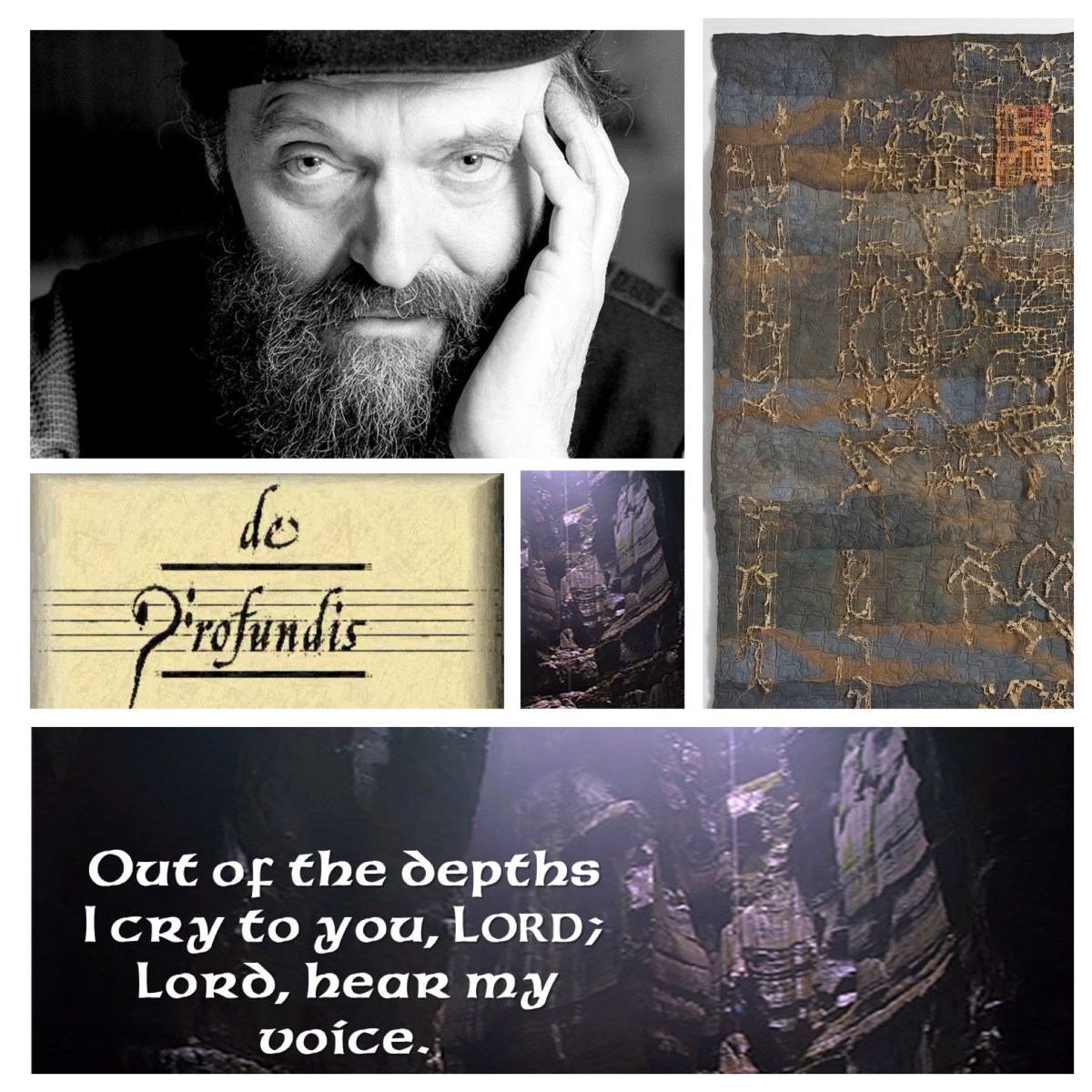
Out of the depths (Psalm 130; Pentecost 6B)

The psalm offered by the lectionary for this coming Sunday, Psalm 130, is one of a series of 15 psalms (Psalms 120—134), each of which is each identified as shir hammalowt, “a song of ascents”. They are so called because it is believed they were sung by faithful Israelites as they made their pilgrimage, ascending to Jerusalem, on one of the three annual festivals—the Feast of Unleavened Bread (Passover), the Feast of Weeks (Pentecost), and the Feast of Tabernacles (as listed in Deut 16:16).

The series of Songs of Ascent begins with “in my distress I cry to the Lord” (Ps 120:1), moving on to “I lift up my eyes to the hills” (Ps 121:1). I like to imagine that this was being sung as the outline of the city built on and around Mount Zion appeared in the far distance. We can imagine the pilgrims drawing closer to the walls of the city as the psalmist sings, “I was glad when they said to me, ‘Let us go to the house of the Lord!’” (Ps 122:1), then sings of lifting up their eyes to “you who are enthroned in the heavens” (Ps 123:1).

Next, the pilgrims offer expressions of trust in God (Ps 124:8; 125:1–2), celebrating “when the Lord restored the fortunes of Zion” (Ps 126:1), and yearn that the Lord God might “restore our fortunes … like the watercourses in the Negeb” (Ps 126:4).

By this time, I imagine the pilgrims viewing both the city from outside its walls and the Temple on its highest point, singing “unless the Lord builds the house, those who build it labor in vain; unless the Lord guards the city, the guard keeps watch in vain” (Ps 127:1). This psalm then celebrates the gift of sons (Ps 127:4–5) and the following psalm celebrates “your wife [who] will be like a fruitful vine within your house; your children will be like olive shoots around your table”, concluding “thus shall the man be blessed who fears the Lord” (Ps 128:3–4).

I also like to imagine that, as the pilgrims were entering the city, the pilgrims sang to celebrate, “the Lord is righteous; he has cut the cords of the wicked” (Ps 129:4), followed by a heartfelt cry to God from “out of the depths” (Ps 130:1) and an affirmation that “with the Lord there is steadfast love, and with him is great power to redeem” (Ps 130:7).

Next, the psalmist simply observes, “I have calmed and quieted my soul” (Ps 131:2); and then, as the Temple is immediately before them, the pilgrims sing, “Let us go to his dwelling place, let us worship at his footstool” (Ps 132:7).

Then follows the two shortest of all the Songs of Ascent, to bring the series to a close. One song celebrates the unity of the people, with oil running down the head “like the dew of Hermon, which falls on the mountains of Zion” (Ps 133:3), and then in the final song the pilgrims are “stand[ing] by night in the house of the Lord”, concluding with the prayer, “may the Lord, maker of heaven and earth, bless you from Zion” (Ps 134:3). It is a beautiful blessing to conclude the whole sequence.

In Psalm 130, the psalmist utters a cry of deep despair: “out of the depths I cry to you, O Lord” (Ps 130:1), picking up the opening prayer of the first song of ascent, “in my distress I cry to the Lord, that he may answer me” (Ps 120:1). The depths of the earth were the place where sinful people went (Ps 63:9; Isa 14:15), following the lead of the Egyptians who pursued the Israelites and “went down into the depths like a stone” (Exod 5:4–5; Neh 9:11; Isa 63:11–13). There, in the depths, God’s anger burned (Deut 32:22). It would indeed be a place causing distress, as the psalmist’s prayer recognises.

However, those banished to the depths were able to be brought back from the depths by God’s decree (Ps 68:22; 71:20; 86:13), so in this psalm the cry of the psalmist from the depths is followed by the plea, “Lord, hear my voice! Let your ears be attentive to the voice of my supplications!” (Ps 130:2).

This plea, “hear my voice”, is uttered in three other psalms (Ps 28:2; 64:1; 119:49), and twice the psalmist affirms that God does indeed listen: “O Lord, in the morning you hear my voice” (Ps 5:3) and “evening and morning and at noon I utter my complaint and moan, and he will hear my voice” (Ps 55:17).

Supplication is regularly made by the psalmist (Ps 28:2; 30:8; 55:1; 86:6; 119:170; 142:1) and the affirmation is clear: “the Lord has heard my supplication; the Lord accepts my prayer” (Ps 6:9). The psalmist’s confidence in God’s trustworthy response to prayer is undergirded by three qualities attributed to God in this short psalm: forgiveness (v.4), steadfast love (v.7a), and power to redeem (vv.7b—8).

The psalmist prays for forgiveness from God (Ps 25:18: 79:9) and affirms that “Praise is due to you, O God, in Zion; and to you shall vows be performed, O you who answer prayer!”, for “when deeds of iniquity overwhelm us, you forgive our transgressions” (Ps 65:1–3). In another psalm, we hear the song, “happy are those whose transgression is forgiven, whose sin is covered” (Ps 32:1), which thus undergirds the affirmation in this psalm, “there is forgiveness with you, so that you may be revered” (Ps 130:4).

With this trusting attitude, the psalmist sings, “I wait for the Lord, my soul waits” (Ps 130:5–6), reflecting a common attitude across many psalms, waiting for the Lord: “you are the God of my salvation; for you I wait all day long” (Ps 25:5); “it is for you, O Lord, that I wait; it is you, O Lord my God, who will answer” (Ps 38:15); “for God alone my soul waits in silence, for my hope is from him” (Ps 62:5). So the psalmist encourages others, “be strong, and let your heart take courage, all you who wait for the Lord” (Ps 31:24) and affirms that “those who wait for the Lord shall inherit the land” (Ps 37:9).

As the psalmist waits, it is trust in the steadfast love of God which is envisaged and yearned for (Ps 130:7). Elsewhere, the psalmist addresses God as “a God merciful and gracious, slow to anger and abounding in steadfast love and faithfulness” (Ps 86:15) and sings of how “steadfast love and faithfulness will meet; righteousness and peace will kiss each other” (Ps 85:10). The refrain which praises God’s steadfast love and faithfulness is found in many places in the Hebrew Scriptures (Exod 34:6; 2 Chron 30:8–9; Neh 9:17, 32; Jonah 4:2; Joel 2:13; Ps 86:15; 103:8, 11; 111:4; 145:8–9).

Accordingly, the prophet Micah affirms that God’s steadfast love will rescue those who “lick dust like a snake, like the crawling things of the earth”, and will indeed “cast all our sins into the depths of the sea” (Mic 7:17, 19). This may be a vivid description of the state in which the psalmist finds themself, as they cry “out of the depths” (v.1); there, the steadfast love of the Lord will indeed meet them (v.7). So the psalmist confidently affirms, “I wait for the Lord, my soul waits, and in his word I hope” (Ps 130:5).

In that waiting, the psalmist believes, the redemption of the Lord will surely be experienced: “Israel, hope in the Lord! For with the Lord there is steadfast love, and with him is great power to redeem. It is he who will redeem Israel from all its iniquities” (Ps 103:7–8). Through the establishment of the covenant and the giving of Torah, God “sent redemption to his people;” (Ps 111:9), and so prayers seeking redemption are regularly offered: “rise up, come to our help; redeem us for the sake of your steadfast love” (Ps 44:26); “redeem me from human oppression, that I may keep your precepts” (Ps 119:134); “as for me, I walk in my integrity; redeem me, and be gracious to me” (Ps 26:11).

The psalmist is confident, also, about God’s redemptive activity: “I call upon God, and the Lord will save me … he will redeem me unharmed from the battle that I wage, for many are arrayed against me” (Ps 55:16, 18). The foundational story of the Exodus, the primal myth of the people of Israel, assures the psalmist of the promise of abode that “I will free you from the burdens of the Egyptians and deliver you from slavery to them; I will redeem you with an outstretched arm and with mighty acts of judgment” (Exod 6:6).

That same divine redemption continued to bring the people into the land promised to them; as David asked of God, “is there another nation on earth whose God went to redeem it as a people, and to make a name for himself, doing great and awesome things for them, by driving out before his people nations and their gods?” (2 Sam 7:23; 1 Chron 17:21). So as the psalmist prays out of the depths, confidently waiting for God to act, they know that “it is [the Lord] who will redeem Israel from all its iniquities” (Ps 130:8).

This psalm resonates with me, from its opening plea, “out of the depths I cry”, to its closing affirmation that, through “the steadfast love” of the Lord, “he will redeem”. In my own moments of deep distress, I have experienced comfort and assurance that I am not unvalued. The love and care of people, grounded in their own faith and expressed in specifically acts of support for and encouragement towards me, have brought the transforming, redeeming presence of the loving God into my life at those moments of distress. I am grateful for this; my own faith has been deepened and strengthened in this way.
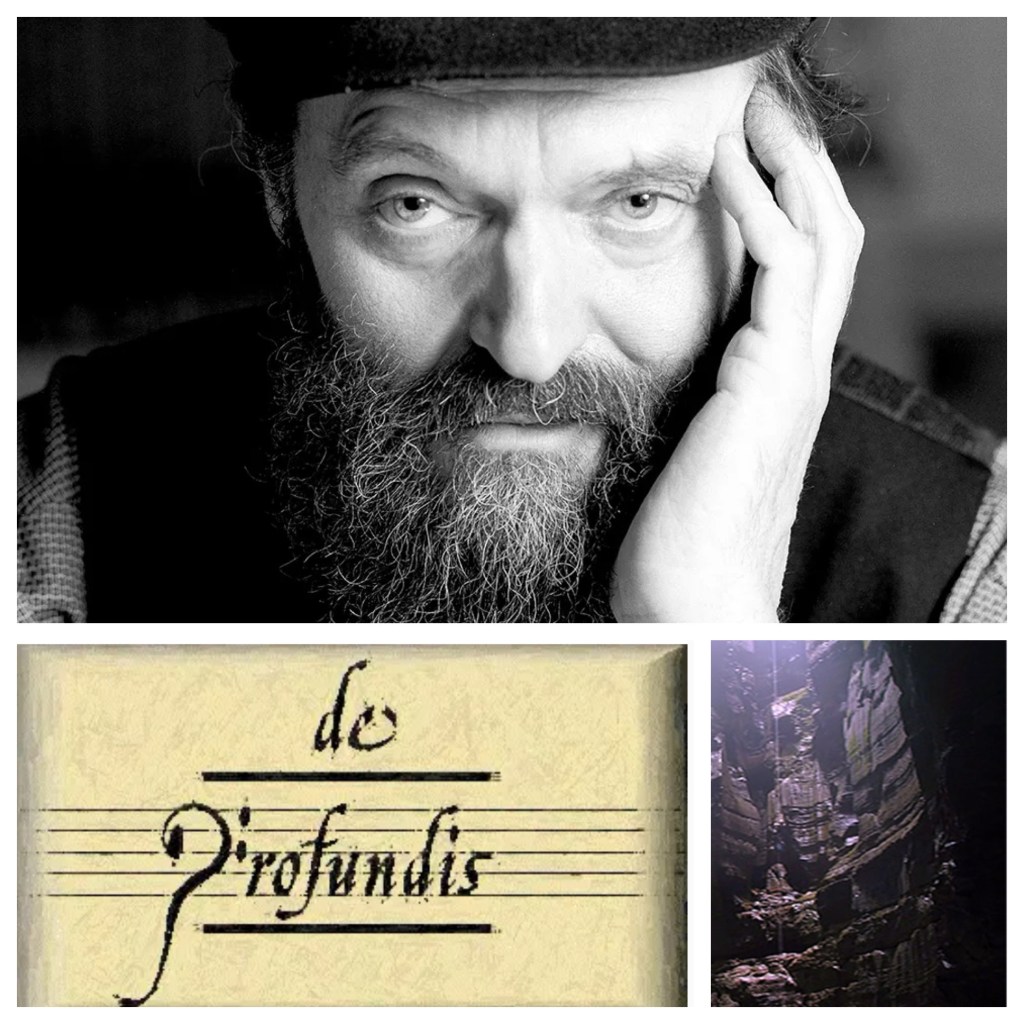
My favourite musical setting of the psalm is that by contemporary Estonian composer Arvo Pärt, a setting for a four-part male choir, with organ and percussion. In this short seven- minute piece, Pärt employs his distinctive style of a slowly-moving ostinato in the deep notes of the organ as a foundation, over which the choir moves slowly, building in volume to a climactic moment in unison, just before the music dies away at the end, returning to silence, the ending marked by a single note from a tubular bell.

Music critic John Irvine, in reviewing this piece, wrote: “De Profundis (1980) is an impassioned and yet simple vocal setting … where the voices climb out of the very depths of despair, with a funereal drum beat. Immediately we are drawn into an atmosphere of impassioned worship and reverence.” (https://www.crossrhythms.co.uk/products/Paul_Hilliars_Theatre_Of_Voices/Arvo_Part_De_Profundis/17054/)
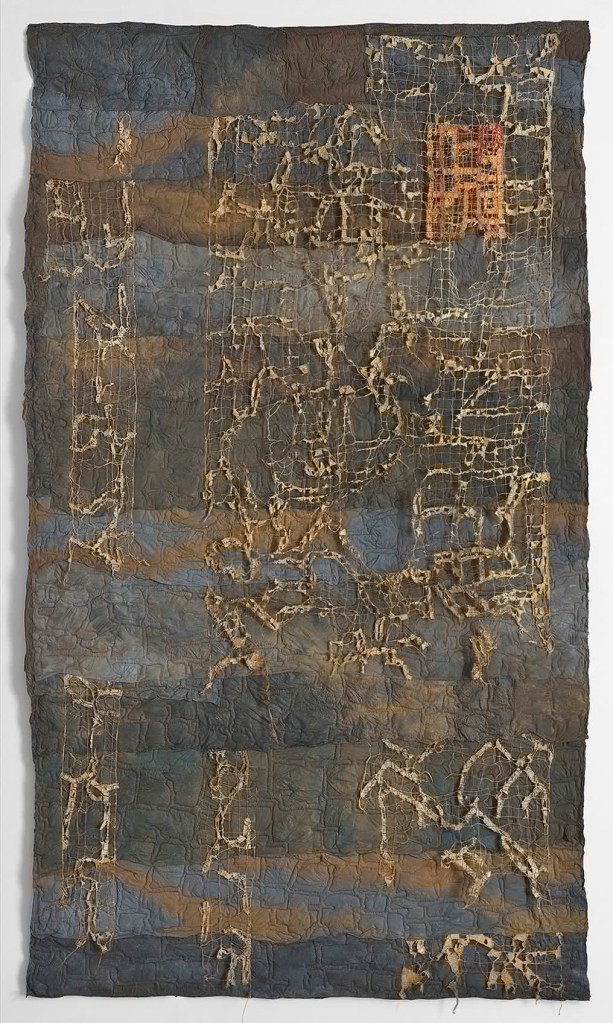
This is the artwork that Elizabeth purchased for me on my 70th birthday. It is a piece which we saw at the “Urban Narratives” exhibition last year in Newcastle, held by Timeless Textiles. It is called De Profundis, Latin for “Out of the Depths”, which is how Psalm 130 begins. This psalm contains the affirmation of hope, “my soul waits for the Lord, more than those who watch for the morning”.

The artwork was made by ESZTER BORNEMISZA, an artist based in Budapest, Hungary. She works with waste newspaper, vintage cloth, and other soft materials that she finds “discarded”. Her basic process of creation is machine stitching and paper casting with additional elements of printing, dyeing and painting.

She writes, “From the beginning I have worked with various used textiles, which I have inherited and received from friends. I feel more conscious of environmental issues when I recycle material trying to draw attention to the environmental impact of waste; while tons of garments end up in the dump, we still keep the same level of consumption. I also like to experiment with used materials that I up-cycle to give them new connotations: spoilt X-ray films, computer keyboard integrated circuit films and buttons, discarded electric and chicken-wires and plastic covering sheets from constructions wastes.

“Recently I have mainly used newsprints that play a central role in my work as they provide further visual experiences by their ephemeral character. They are fragile; the content is obsolete sometimes already at the hour of appearance while still bearing fragments of important details from the recent past. They deliver deluges of information from which we must sift out the true from the fake. I use them in my recent translucent works capturing the play of opaque and open elements that play an important role: the shadow behind the work adds another layer of complexity.”

This explains something of why I really love this striking piece of art—combining wonderful artistic creativity with social commentary and environmental responsibility!

See her portfolio of works at https://bornemisza.com

Psalm 86: a primer of prayer (Pentecost 4A) part II

Psalm 86 is offered by the lectionary for this coming Sunday, the Fourth Sunday after Pentecost. This psalm comprises a string of prayers, offering petition, thanksgiving, adoration, and intercession, filled with phrases that occur in other psalms and prayers in Hebrew Scripture. Although some commentators have criticised it for being unoriginal, it serves an important purpose, collating many phrases that can serve well those who pray.

In an earlier blog, I considered the structure of this psalm, and explored three types of prayers that are to be found in it: thanksgiving, adoration, and intercession. See

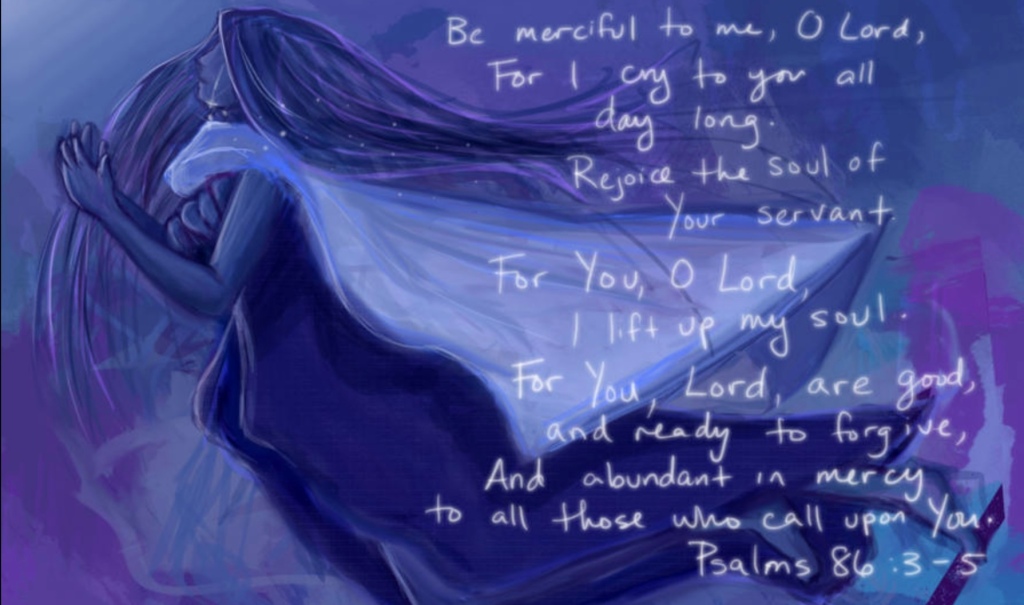
In this blog, I turn my attention to the petitions that are included in this psalm. The opening section (verses 1–7) includes a substantial collection of petitions to be prayed in times of trouble. Along with the further petitions in verse 11 and verses 16–17, there are a total of eleven petitions to God in this psalm. Let’s consider each of them in turn.

“Incline your ear, O Lord” (v.1) is a request made in other psalms (Ps 17:6; 31:2; 71:2; 88:2; 102:2); in one psalm, there is a confidence that God “will hear the desire of the meek … will strengthen their heart … will incline your ear to do justice” (10:17–18). Likewise, a number of psalms include the request for God to “answer me” (v.1; see Ps 4:1; 13:3; 27:7; 55:2; 69:13, 16, 17; 102:2; 108:6; 119:145; 143:1, 7). In one psalm the author affirms that “I call upon you, for you will answer me, O God” (Ps 17:6); likewise, in Ps 86, the psalmist affirms with confidence that “in the day of my trouble I call on you, for you will answer me” (v.7).

In the same verse, the psalmist describes themselves: “I am poor and needy” (v.1)—a self-description also offered at Ps 40:17; 70:5; and 109:22. The phrase is placed in parallel with “the downtrodden” at Ps 74:21. That God stands with the poor and needy is asserted regularly in the psalms; “because the poor are despoiled, because the needy groan, I will now rise up, says the Lord; I will place them in the safety for which they long” (Ps 12:5).

So God “raises the poor from the dust and lifts the needy from the ash heap” (Ps 113:7); God “maintains the cause of the needy and executes justice for the poor” (Ps 140:12). “As for me, I am poor and needy, but the Lord takes thought for me; you are my help and my deliverer, O God” (Ps 40:17; also 70:5). And the psalmist pleads that the king will “judge your people with righteousness and your poor with justice … defend the cause of the poor of the people, give deliverance to the needy” (Ps 72:2, 4)

“Preserve my life” is the next petition (v.2), echoing the same prayer found at Ps 64:1; 79:11; 119:49, 159; 143:11; a prayer made on the basis that God is “a hiding place for me [for] you preserve me from trouble” (Ps 32:7), for “though I walk in the midst of trouble, you preserve me against the wrath of my enemies” (Ps 138:7).

The psalmist undergirds this request to God with the declaration, “I am devoted to you” (v.2), a phrase that might also be translated as “I am a godly person” or “I am a faithful person”. The Hebrew word used here, hasid, is the basis for the contemporary group of ultra-conservative Orthodox Jews known as Hasidic Jews. Many psalms uses this word as a description for those in Israel who were godly people (Ps 12:1; 52:1) or faithful people (Ps 4:3; 16:10; 30:4; 32:6; 37:28; 50:5; 52:9; 79:2; 85:8; 89:19; 97:10; 116:15; 132:9, 16; 145:10). The NRSV also translates this word as blameless (Ps 18:25) and as saints (Ps 31:23).

*****

The plea of the psalmist for God to “save” them (v.2) is another persistent refrain throughout the psalms—both “save me” (Ps 6:4; 7:1; 22:21; 31:2, 16; 44:6; 54:1; 57:3; 59:2; 69:1; 71:2, 3; 109:26, 116:4; 119:94, 146; 142:6; 143:9) and “save us” (Ps 28:9; 31:2; 80:2; 106:47; 118:25). This is a request grounded in the assurance that “God is my shield, who saves the upright in heart” (Ps 7:10); “the Lord is near to the brokenhearted, and saves the crushed in spirit” (Ps 34:18); God “fulfils the desire of all who fear him; he also hears their cry, and saves them” (Ps 145:19). Of course , God as Saviour is an important Hebraic way of understanding the divine, that then has implications and influence as the New Testament documents are written, centuries later.

The self-description of the psalmist in this verse, as “your servant who trusts in you” (v.2), is a description found also in verses 4 and 16. The writer presents themselves as God’s servant in a number of other psalms (Ps 19:11, 13; 27:9; 31:16; 35:27; 69:17; 109:28; 116:16; 143:2, 12) as well as twelve times in Psalm 119 (vv.17, 23, 38, 49, 65, 76, 84, 124, 125, 135, 140, 176).

The attitude of trust in God (v.2) is a stance which is shared with other psalms. “Those who know your name put their trust in you, for you, O Lord, have not forsaken those who seek you”, the psalmist sings (Ps 9:10). “O my God, in you I trust; do not let me be put to shame; do not let my enemies exult over me” (Ps 25:2), they sing, affirming that “steadfast love surrounds those who trust in the Lord” (Ps 32:10), “happy are those who make the Lord their trust” (Ps 40:4), and “in God I trust; I am not afraid” (Ps 56:4; and similar, 55:23).

“Be gracious to me, O Lord” (v.3) is yet another petition that is typical of the psalms. The psalmist regularly implores God, “be gracious to me, for I am in distress” (Ps 31:9; similarly, 6:2; 9:13; 56:1), or “be gracious to me, and hear my prayer” (Ps 4:1), or “be gracious to me and answer me” (Ps 27:7), or simply, “be gracious to me” (Ps 25:16; 26:11; 30:10; 41:4).

In one song, the psalmist muses, “has God forgotten to be gracious?” (Ps 77:9), but in typical style, this cry of lament transforms into words of praise, for “you are the God who works wonders … with your strong arm you redeemed your people” (Ps 77:11–20). God showing grace towards God’s faithful people is indeed “your custom toward those who love your name” (Ps 119:132).

The cry for God to be gracious is a constant and insistent plea, “for to you do I cry all day long” (v.3). The cry of the psalmist is expressed often (Ps 3:4; 5:2; 17:1; 18:6; 27:7; 28:2; 39:12; 57:2; 61:1; 77:1; 88:1–2; 102:1; 119:146–147, 169; 120:1; 142:1, 5–6). Even though the psalmist cries to God “with my whole heart” (Ps 119:145), there are times when this cry feels futile; “I cry by day, but you do not answer me, and by night, but find no rest” (Ps 22:2), and “O Lord, I cry out to you; in the morning my prayer comes to you; why do you cast me off? why do you hide your face from me?” (Ps 88:13–14).

Yet the psalmist is persistent, crying “all day long” (v.3); this mirrors the oppression and distress experienced by the psalmists “all day long”. Various psalms reflect “sorrow in my heart all day long” (Ps 13:2), “groaning all day long” (Ps 32:3), “all day long I go around mourning” (Ps 38:6), “all day long I have been plagued” (Ps 73:14). “All day long my foes oppress me” (Ps 56:1), laments the psalmist, “all day long my enemies taunt me” (Ps 102:8), even bemoaning that “we are being killed all day long” (Ps 44:22). Extended personal distress seems to mark a number of psalms.

However, in other psalms, we have affirmations that “the eyes of the Lord are on the righteous and his ears are open to their cry” (Ps 34:15); “when the righteous cry for help, the Lord hears” (Ps 34:17); “I waited patiently for the Lord; he inclined to me and heard my cry” (Ps 40:1); “he regarded their distress when he heard their cry” (Ps 106:44). As the psalmist cries “out of the depths”, so they are assured that “with the Lord there is steadfast love, and with him there is great power to redeem” (Ps 130:1–8).

The same dynamic, of calling out to God and anticipating an answer, is sung in the petition in v.6, “give ear, O Lord, to my prayer”. This is found in ten other psalms (Ps 5:1; 17:1; 39:12; 54:2; 55:1; 80:1; 84:8; 140:6; 141:1; 143:1), and the parallel request, “listen to my cry of supplication” (v.6) is also offered in two other psalms (Ps 5:2; 61:1).

The psalmist’s confidence that, “on the day of my trouble I call on you, for you will answer me” (v.7), is also reflected at Ps 17:6. This confidence is undergirded by the words spoken by God to those who trust in God: “those who love me, I will deliver; I will protect those who know my name; when they call to me, I will answer them” (Ps 91:14–15).

Verse 11 moves from the offering of prayers and anticipation of receiving answers, to the request to “teach me your way, O Lord, that I may walk in your truth”. The language here reflects another common element in the relationship between the psalmist and the divine, as a student learning from a teacher.

“Teach me” (v.11) is what the psalmist asks for, seeking to be taught “your ways … your paths … your truth” (Ps 25:4–5), “your way” (27:11; 143:8), “your will” (Ps 143:10), “the fear of the Lord” (Ps 34:11), and “wisdom in my secret heart” (Ps 51:6). Throughout the longest psalm of all, there are regular petitions for the Lord to teach “your statutes” (Ps 119:12, 26, 33, 64, 68, 124, 171) as well as “good judgement and knowledge” (Ps 119:66). The psalmists appear to be keen students, thirsting for knowledge.

The next request is for God to “give me an undivided heart” (v.11)—an unusual request, not found in any other psalm, and using a Hebrew word that appears in only two other places in Hebrew Scripture (Gen 49:6; Isa 14:20). The purpose of this request, “to revere your name” (v.11), draws on a very common Hebrew word, found often in the formulaic “do not be afraid” (Gen 15:1;21:17;26:24; 35:17;46:3; Exod 14:13; 20:20; etc.; and on into New Testament texts). This is no fear in the sense of negative terror, for the psalmist clearly draws on the positive sense of the verb, yare’, to indicate a reverence towards God.

*****

In the final set of verses, there are three further petitions worthy of note. “Turn to me and be gracious to me” (v.16) is a petition repeated exactly (Ps 25:16; 119:132) and in shortened form, “turn to me” (Ps 69:16; 119:79). “Give your strength to your servant” (v.16) recalls the closing verse of a powerful nature psalm, “may the Lord give strength to his people! may the Lord bless his people with peace!” (Ps 29:11). The latter part of verse 16, “save the child of your serving girl”, echoes the petition of verse 2, “save your servant who trusts in you”, which we have dealt with above.

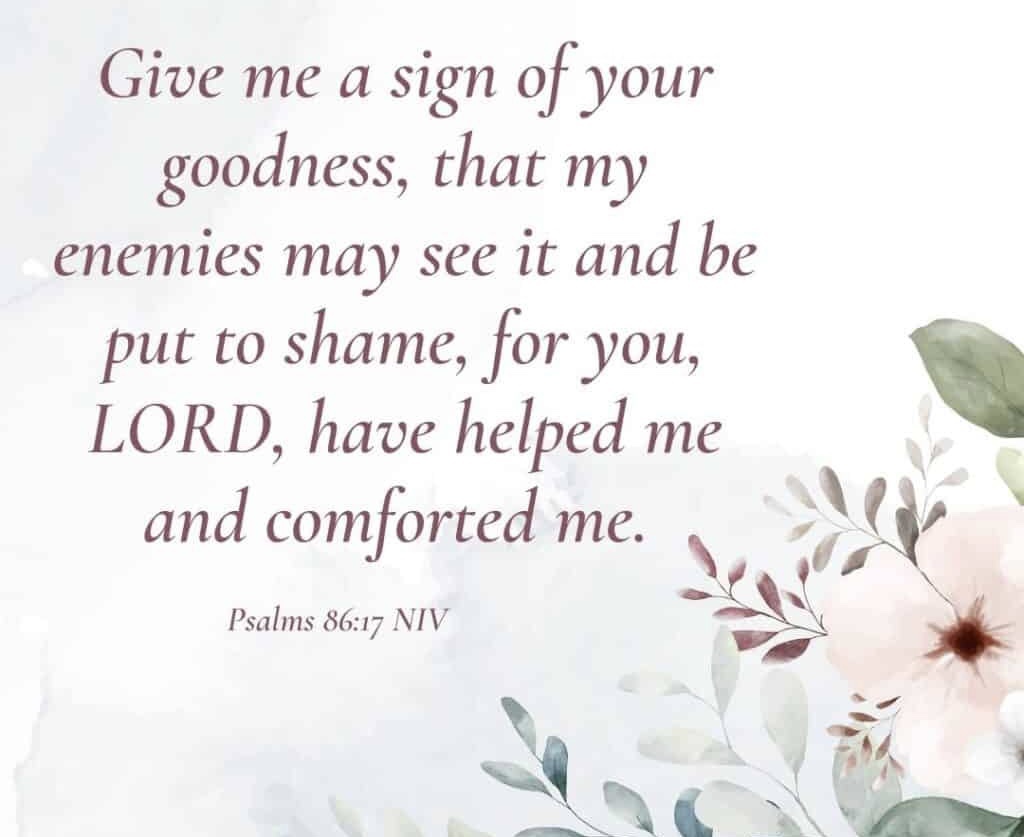
Finally, “show me a sign of your favour” (v.17) does not reflect any other psalm, but does evoke the petition of Gideon to the Lord, “now I have found favour with you, then show me a sign that it is you who speak with me” (Judg 6:17).

The purpose of this sign which is sought by the psalmist, “so that those who hate me may see it and be put to shame” (v.17), does however reflect a common request across a number of psalms, pleading for enemies to be “put to shame” (Ps 6:10; 31:17; 35:4, 26; 40:14; 50:5: 57:3; 70:2; 71:13, 24; 83:17; 97:7;109:28; 119:78; 129:5). The other side of this petition is the request, “do not let me be put to shame” (Ps 25:2, 20; 31:1, 17; 71:1; 119:31, 116).

*****

And so we can see that throughout this psalm, in offering petition, thanksgiving, adoration, and intercession, the psalmist has made use of many phrases that occur in other psalms and prayers in Hebrew Scripture. This psalm, a primer for prayer, serves an important purpose, as it draws together many phrases that can serve well those who pray.

Psalm 86: a primer of prayer (Pentecost 4A) part I

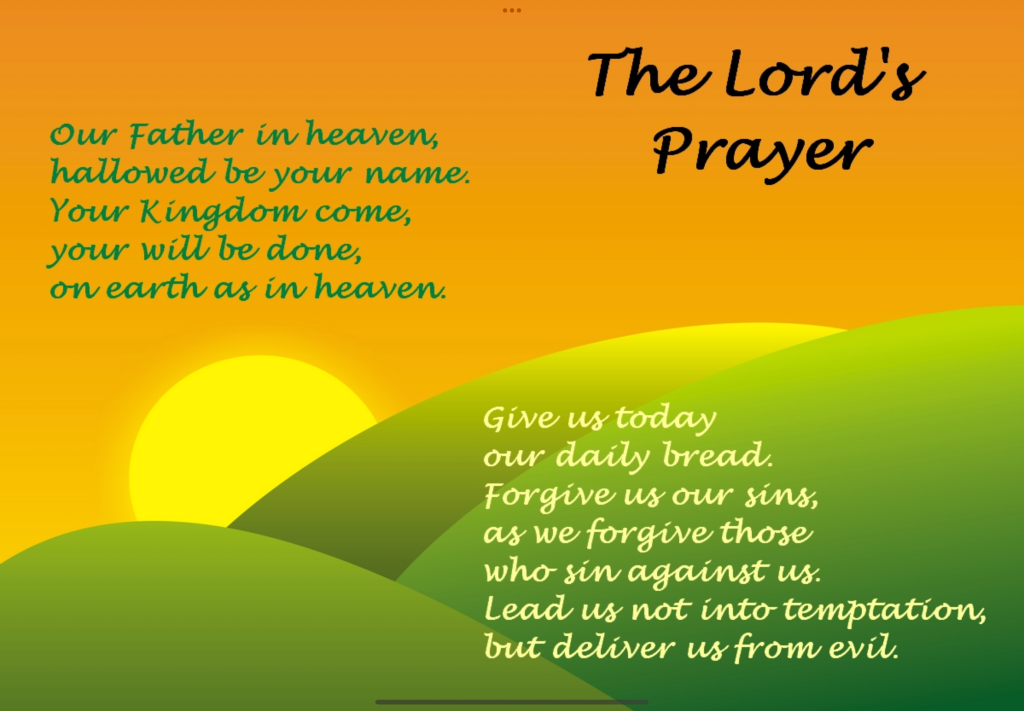
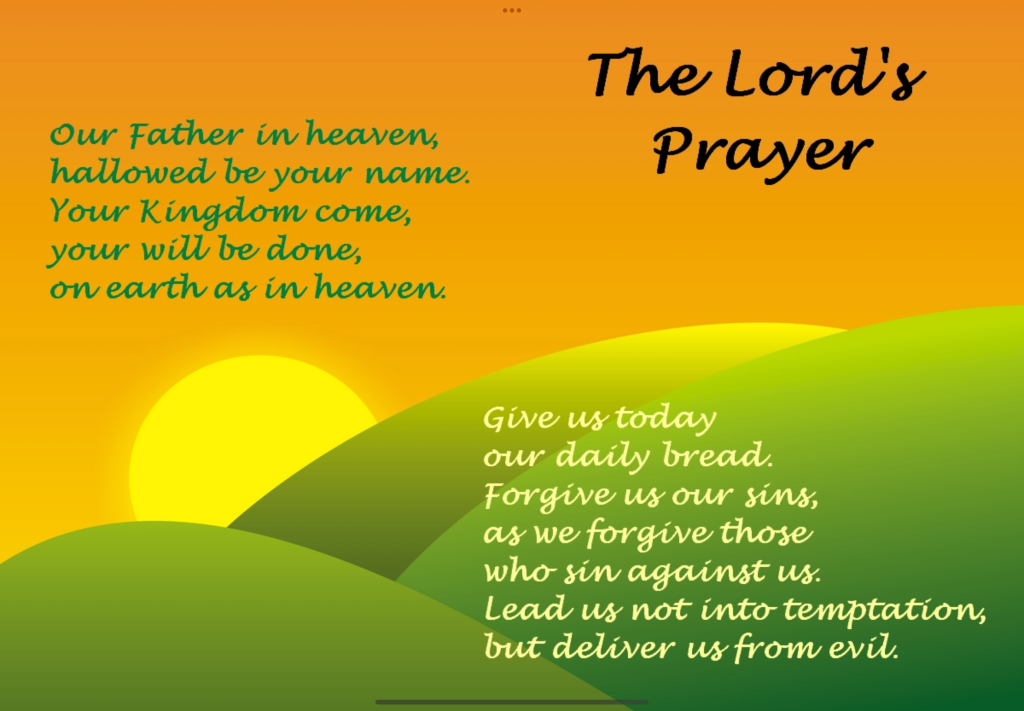
Christians are used to praying The Lord’s Prayer on a regular basis, in obedience to the instructions of Jesus recorded in two Gospels: “when you pray, say …” (Luke 11:2; Matt 6:9). This prayer can be considered a succinct primer for prayer, since it contains the key elements of praying.

After an opening adoration of God (“our Father in heaven, holy is your name”), there follows prayers for the world (“your kingdom come, your will be done”), petitions for ourselves (“give us bread for the day, forgive us our sins, do not bring us to the time of trial”), and intercessions for others (“as we forgive those who sin against us”). In the later version of the prayer, a closing benediction is included (“yours is the kingdom, the power, the glory”), ending, of course, with “Amen”. The pattern is clear and concise. See

and

and

There is a similar primer for prayer in Hebrew Scriptures, and it is offered by the lectionary for this coming Sunday, the Fourth Sunday after Pentecost. Psalm 86 comprises a string of prayers, offering petition, thanksgiving, adoration, and intercession, filled with phrases that occur in other psalms and prayers in Hebrew Scripture. Although some commentators have criticised it for being unoriginal, it serves an important purpose, collating many phrases that can serve well those who pray.

(And a similar criticism of unoriginality can be levelled against The Lord’s Prayer; every phrase in that prayer reflects ideas expressed already in Hebrew Scriptures. The originality of the prayer lies not in its content, but in the distinctive way that Jesus has drawn together each element into a cohesive unity.)

Psalm 86 is a prayer which is titled as “A psalm of David”, one of 72 psalms directly attributed to the poet king. Critical studies of the Psalms maintain a strong degree of scepticism regarding the attribution to David of those songs. As the psalm is a fine compilation of various psalmic phrases, however, we will maintain references to the author as “the psalmist”.

The psalm falls into four sections, each with its own style of praying. First (86:1–7), the psalmist cries out in great need, asking God to hear and act on his or her behalf. Then, in a traditional formulaic statement (86:8–10), the psalmist offers adoration of God as the only true God, the Lord of the nations. In the following verses (86:11–13), the psalmist asks God to teach them God’s way and to unite their heart to fear God’s name, so that they might glorify God’s name forever. Finally (86:14–17), in light of the enemies that are perceived, the psalmist again appeals to God’s mercy and grace to deliver them.

The opening section of the prayer (verses 1–7) thus includes a substantial collection of petitions to be prayed in times of trouble. Along with the further petitions in verse 11 and verses 16–17, there are a total of eleven petitions to God in this psalm. (We will explore these further in a subsequent blog post.)

Thanksgiving is the focus in verses 12–13, when the psalmist declares, “I will give thanks to you, O Lord my God, with my whole heart, and I will glorify your name forever; for great is your steadfast love toward me; you have delivered my soul from the depths of Sheol”. Prayers giving thanks to God occur frequently in the book of Psalms (Ps 7:17; 9:1; 28:7; 30:12; 44:8; 54:6; 57:9; 75:1; 79:13; 92:1; 97:12; 100:4; 105:1; 106:1, 47; 107:1; 108:3; 109:30; 111:1; 118:1, 19, 28–29; 122:4; 136:1–3, 26; 138:1–2; 140:13; 142:7; 145:10; see also 1 Chron 29:13; 2 Chron 30:22; Neh 12:24).

Celebrations of being delivered from Sheol likewise occur in other psalms (Ps 30:3; 49:15; 71:20; and see a counterpoint at Hos 13:14). Glorifying the name of the Lord is also a common practice (Ps 22:23; 29:2; 66:2; 72:19; 96:8; 105:3; 115:1; 148:13; 1 Chron 16:8–10, 28–30, 35; Isa 24:15; and for a counterpoint, Mal 2:2). Each of these phrases connects in multiple ways with other parts of Hebrew Scripture.

Adoration is offered in verses 8 to 10 and again in verse 15 of Psalm 86. In the latter verse, the psalmist addresses God as “a God merciful and gracious, slow to anger and abounding in steadfast love and faithfulness”—the same refrain found in many places in the Hebrew Scriptures (Exod 34:6; 2 Chron 30:8–9; Neh 9:17, 32; Jonah 4:2; Joel 2:13; Ps 86:15; 103:8, 11; 111:4; 145:8–9). In both thanksgiving and in adoration, then, the psalm echoes the prayers offered in other psalms as well as in prophetic works.

In the first expression of adoration, the psalmist draws a clear comparison between the Lord God and the many other gods: “there is none like you among the gods, O Lord, nor are there any works like yours” (v.8). This reflects early (pre-Exilic) understandings about the Lord God amongst the many gods, before the Exilic experience crystallised the move into monotheism, articulated especially by Second Isaiah, that “beside me there is no god” (Isa 45:5, 14, 18, 21, 22; 46:9), and in Deuteronomy, that “the Lord is God; there is no other besides him” (Deut 4:35, 39; 5:7; 6:14; 7:4; 8:19; 11:16, 28; 13:6–7, 13; 17:3; 18:20; 28:14, 36, 64; 29:26; 30:17–20).

Could this be a clue that supports the claim in the title of this psalm, that it was written by David? The pre-monotheistic view of the Lord God amongst the gods is reflected in the ancestral narratives concerning Jacob (Gen 31:30–35; 35:1–4). Psalm 82 begins, “God has taken his place in the divine council; in the midst of the gods he holds judgement” (Ps 82:1); of these gods, he says “they have neither knowledge nor understanding, they walk around in darkness” (Ps 82:5).

This criticism reflects the claim that while they wandered in the wilderness, the people “made [God] jealous with strange gods, with abhorrent things they provoked him; they sacrificed to demons, not God, to deities they had never known, to new ones recently arrived, whom your ancestors had not feared” (Deut 32:16–17).

This critical view of other gods is also reflected in the opening words of the Decalogue: “You shall have no other gods before me. You shall not make for yourself an idol, whether in the form of anything that is in heaven above, or that is on the earth beneath, or that is in the water under the earth. You shall not bow down to them or worship them; for I the Lord your God am a jealous God, punishing children for the iniquity of parents, to the third and the fourth generation of those who reject me, but showing steadfast love to the thousandth generation of those who love me and keep my commandments” (Exod 20:2–5).

In the song of celebration attributed to Moses after passing through the Sea of Reeds, the people rejoice, asking “who is like you, O Lord, among the gods? who is like you, majestic in holiness, awesome in splendor, doing wonders?” (Exod 15:11). Later, Jethro the Midianite affirms, “I know that the Lord is greater than all gods, because he delivered the people from the Egyptians, when they dealt arrogantly with them” (Exod 18:11). The distinctiveness of the Lord God is known and celebrated in these ancient sagas. The psalm thus may well have origins in the time of David, long before later post-Exilic theological developments had occurred.

Intercession is the flavour of the prayers offered in verses 14 and 17. Although there is antagonism towards “the insolent … a band of ruffians” (v.14), nevertheless the psalmist hopes that “those who hate me may see [a sign of your favour] and be put to shame” (v.17). Prayers for enemies to be put to shame occur regularly in the psalms (Ps 6:10; 35:4, 26; 40:14; 57:3; 70:2; 71:13, 24; 83:17; 109:28; 119:78; 129:5) and the prophets look for this fate to meet those who are unfaithful (Isa 42:17; 44:9, 11; Jer 2:36; 17:13; 50:2; 51:47; Hos 10:6; Zech 10:3-5).

But praying for enemies to experience God’s grace, as in Ps 86:17, is rare. The psalmist prays for God’s favour to be shown to the faithful people of Israel (Ps 90:17; 106:4; 119:58) and the ancestral sagas record that God showed favour to Noah (Gen 6:8), Joseph (Gen 39:4), Moses (Exod 33:12-17), the people in the wilderness (Lev 26:9), Samuel (1 Sam 2:26), Manasseh (2 Chron 33:12-13), and the remnant who returned to the land (Ezra 9:8).

There is, nevertheless, no other prayer in Hebrew Scripture for God to show favour to enemies, apart from the final verse of Psalm 86. This distinctive prayer thus reaches out across the centuries to link with the teaching of Jesus, to “love your enemies, do good to those who hate you, bless those who curse you, pray for those who abuse you” (Luke 6:27-28).

Picturing God as the one who “has helped me and comforted me” (v.17) does resonate strongly, however, with other scriptural passages. God comforts—most famously in Psalm 23, where the psalmist prays, “your rod and your staff, they comfort me” (Ps 23:4), but also in the longest psalm of all, where we hear the plea, “let your steadfast love become my comfort according to your promise to your servant” (Ps 119:76), as well as the affirmation, “when I think of your ordinances from of old, I take comfort, O Lord” (Ps 119:52).

So, in a famous oracle, the prophet Jeremiah promises Israel that God says, “I will turn their mourning into joy, I will comfort them, and give them gladness for sorrow” (Jer 31:13), and another prophet in exile sings, “the Lord will comfort Zion; he will comfort all her waste places” (Isa 51:3). Years later, a post-exilic prophet affirms that God declares, “as a mother comforts her child, so I will comfort you; you shall be comforted in Jerusalem” (Isa 66:13), and another, Zechariah, conveys the message that “cities shall again overflow with prosperity; the Lord will again comfort Zion and again choose Jerusalem” (Zech 1:17).

Not only will God comfort; God is also the one who helps (Ps 86:17). “The Lord helps [the righteous] and rescues them; he rescues them from the wicked, and saves them, because they take refuge in him”, says the psalmist (Ps 37:40). “It is the Lord God who helps me”, says Isaiah (Isa 50:7, 9). So God is “helper of the orphan” (Ps 10:14), “the God of the lowly, helper of the oppressed, upholder of the weak, protector of the forsaken, saviour of those without hope” (Judith 9:11). “Surely, God is my helper”, sings the psalmist (Ps 54:4), and so they pray, “O Lord, be my helper” (Ps 30:10).

How God is understood in this psalm, and the way that God relates to the people who are in covenant with God, and indeed with all people of the world, is entirely consistent with these elements as expressed elsewhere in scripture.

(more in the next blog …)

Our Father in heaven: a pattern for prayer (Luke 11, Matt 6) part III

In the series of Gospel readings offered by the Revised Common Lectionary, there is a break from the sequential readings from the Gospel of Matthew begun in early January each year. This year—Year A—we began with the early chapters of the Gospel according to Matthew (from 2:1 through to 5:37); but when the season of Lent began, that pattern was interrupted.

We return to Matthew with Matt 9 on the Second Sunday after Pentecost, jumping from where we had left the Gospel back in February, in the middle of the Sermon on the Mount. That means that we have omitted the passage where Jesus says “pray then in this way”, giving his disciples a set of words (6:9–13) that has come to be known as The Our Father (after its opening phrase) or The Lord’s Prayer (after the one who gave it to his disciples). So this week I am posting about this well-known and much-loved prayer. Previous posts were at

What of “the kingdom, the power, and the glory”? These terms are thoroughly scriptural, being found through the pages of Hebrew Scripture. Although not in the earliest manuscripts of either Matthew’s or Luke’s version of The Lord’s Prayer, the closing doxology is found in the text of the Didache (which I think was a second century document) and makes its way into later manuscripts of the canonical documents. That most likely signals that there was an oral tradition that this phrase was in use in later times, so later scribes felt the need to write it back into the words attributed to Jesus.

In scripture, it is not only the kingdom, the power, the glory which is prayed for—there is also the greatness, the majesty, and the victory which is sought, as well as riches and honour. The key text which draws all of these terms together, and places them into a prayer addressing God, is when David assembles “all the officials of Israel, the officials of the tribes, the officers of the divisions that served the king, the commanders of the thousands, the commanders of the hundreds, the stewards of all the property and cattle of the king and his sons, together with the palace officials, the mighty warriors, and all the warriors” (1 Chron 28:1) and addresses them as they prepare to commence work on building the Temple of the Lord in Jerusalem.

After delivering detailed plans for the building to his son Solomon (1 Chron 28:11–19)—plans which had been revealed to him by the Lord—David commissions Solomon for the task, presents him to the people, and then prays a prayer of blessing: “Blessed are you, O Lord, the God of our ancestor Israel, forever and ever. Yours, O Lord, are the greatness, the power, the glory, the victory, and the majesty; for all that is in the heavens and on the earth is yours; yours is the kingdom, O Lord, and you are exalted as head above all. Riches and honour come from you, and you rule over all. In your hand are power and might; and it is in your hand to make great and to give strength to all. And now, our God, we give thanks to you and praise your glorious name.” (1 Chron 29:10–13).

Kingdom, power, and glory are also collected together in Psalm 145: “All your works shall give thanks to you, O Lord, and all your faithful shall bless you. They shall speak of the glory of your kingdom, and tell of your power, to make known to all people your mighty deeds, and the glorious splendor of your kingdom” (Ps 145:10–12). It is God who holds the attributes of power and glory in overseeing God’s kingdom.

These terms were also terms used to honour (and, indeed, flatter!) human kings; the prophet Daniel addresses King Nebuchadnezzar in similarly extravagant terms: “You, O king, the king of kings—to whom the God of heaven has given the kingdom, the power, the might, and the glory, into whose hand he has given human beings, wherever they live, the wild animals of the field, and the birds of the air, and whom he has established as ruler over them all—you are the head of gold” (Dan 2:37–38).

However, the more common use of such flowery ascriptions of might and power are addressed to God, the king (as we have seen above). It is God who exercises power (Exod 15:6; 32:11; Num 11:23; Deut 4:34; 26:8; Ps 21:13; 130:7; 147:5; Isa 10:33; Jer 16:21; Dan 5:23; Nah 1:3).

It is also God in whom glory rests, as many stories on the narrative books attest (Exod 16:7, 10; 24:16–17; 40:34–35; Lev 9:6, 23; Num 14:10, 21; 16:19, 42; 20:6; Deut 5:24; 1 Ki 8:11; 1 Chron 16:28–29; 2 Chron 5:14; 7:1–3). The psalmists also acknowledge the glory of God (Ps 8:1; 24:8–10; 26:8; 29:1–3; 96:7–8; 102:15–16; 104:31; 113:4; 138:5; 148:13). The glory of the Lord is manifest to prophets (Isa 2:19–21; 6:3; 10:16–18; 24:23; 40:5; 42:8; 58:8; 59:19; 60:1–2; 61:3; Ezek 1:28; 3:12, 23; 9:3; 10:4, 18–19; 11:23; 43:4–5: 44:4; Hab 2:14; Zech 2:8).

In telling the story of Jesus, who preaches “the kingdom of God” and indicates that it has come near in him (Mark 1:14; Luke 17:20), the Gospels make note of the power of Jesus (Mark 5:30; 6:2; Matt 11:20; 13:54; Luke 4:14, 36; 5:17; 6:19; 8:46; 19:37; John 10:18) as well as his glory (Luke 2:32; 9:32; John 1:14; 2:11; 8:54; 12:41; 17:5, 22–24).

So the concluding doxology in the longer version of the prayer, ascribing the kingdom, the power, and the glory to God, is both a fitting scriptural conclusion as well as consistent with Jesus’s own perceptions of his role in God’s overarching plan of salvation.

Our Father in heaven: a pattern for prayer (Luke 11, Matt 6) part II

In the series of Gospel readings offered by the Revised Common Lectionary, there is a break from the sequential readings from the Gospel of Matthew begun in early January each year. This year—Year A—we began with the early chapters of the Gospel according to Matthew (from 2:1 through to 5:37); but when the season of Lent began, that pattern was interrupted.

We return to Matthew with Matt 9 on the Second Sunday after Pentecost, jumping from where we had left the Gospel back in February, in the middle of the Sermon on the Mount. That means that we have omitted the passage where Jesus says “pray then in this way”, giving his disciples a set of words (6:9–13) that has come to be known as The Our Father (after its opening phrase) or The Lord’s Prayer (after the one who gave it to his disciples). So this week I am posting about this well-known and much-loved prayer. The first post is at

“Give us bread for the day” has often been seen to be evoking the story embedded within the foundational myth (establishing the central identity) of the people of Israel, when the Lord provided manna to the people whilst they journey in the wilderness (Exod 16; Num 11); further reference is made to this manna in additional books of Hebrew scripture (Deut 8:3, 16; Neh 9:20; Ps 78:24).

That gift of manna, striking in the wilderness experience, was also provided to the Israelites when they camped at Gilgal, on the verge of entering into the land of Canaan (Josh 5:10–12). The story has a potency that makes it an essential element in the identity of Israel: it is a nation which trusts in the gracious provisions of God.

Jesus continues that attitude; God is the one who will provide when something is asked for (Mark 11:24; Matt 7:7, 11; 9:38; Luke 10:2; 11:9, 13; John 14:13; 15:7, 16; 16:23). Consistent with that, asking for “bread for the day” is an appropriate prayer to offer.

The next petition raises other questions. Differences in the Greek terms used in the early versions of this prayer point to the matter; is it “forgive us our sins” or “cancel the debts we owe”? On the different words used, see

Of course, forgiveness is part of the “gospel” of Hebrew Scriptures; the claim that God forgives is found in numerous places. Abraham wrangles with God to forgive Sodom (Gen 18:16–33); Moses pleads, successfully, with the Lord to forgive Israel after their rebellion in the wilderness (Num 14:1–25), and less successfully after the incident involving the golden statue of a calf (Exod 32:30–35). Jeremiah foresees that within the new covenant given by God, forgiveness will be offered (Jer 31:34).

A refrain in a number of places is that “the Lord is slow to anger, and abounding in steadfast love, forgiving iniquity and transgression” (sin” (Exod 34:6–8; Num 14:18; Neh 9:17b; Ps 145:8–9; Joel 2:13; Jonah 4:2; see also 2 Kings 13:23; 2 Chron 30:9). King Solomon prays for God to forgive the people (1 Ki 8:33–40; 2 Chron 6:18–40), the psalmist prays for forgiveness (Ps 25:18; 79:9), and so do some prophets (Ezek 16:63; Dan 9:19; Amos 7:2). Jesus’ prayer petition for God to forgive, in the central prayer he taught, continues this motif.

The associated clause of the prayer, instructing us to follow the example of God and forgive the sins of others, also reflects enduring Israelite understandings. Joseph forgives his brothers (Gen 50:15–21), David forgives Abigail (1 Sam 25:26–28, 32–35). Jesus exhorts his followers to forgive seven times (Luke 17:1–4) or seventy times seven (Matt 18:21–22), and is remembered as the one who came to forgive sins (Mark 2:10; Matt 9:6; Luke 5:24; 23:34), and so this clause of the pray is consistent with that.

If the prayer is about asking God to cancel debts,rather than forgive sins, then another theme in Hebrew Scripture is drawn in by Jesus. The release of slaves and the cancelling of debts was meant to be practised in society every fifty years during the year of Jubilee (Lev 25:8–17; see esp. v.13). Luke explicitly signals this theme in the opening speech of Jesus that he alone reports: “the Spirt of the Lord is upon me … to proclaim release to the captives and recovery of sight to the blind, to let the oppressed go free, to proclaim the year of the Lord’s favour” (4:18–19). The reference to “the year of the Lord’s favour” is commonly taken to be an indication of the Jubilee.

The practice of the Jubilee is, however, dubious. The levitical prescriptions appear to be the ideal that the priests hoped for; actual evidence that this was ever implemented in Israelite society is lacking. Indeed, it is suggested that while the people were in Exile, the land of Israel would “lie desolate”, and “enjoy its sabbath years” (Lev 26:34), providing recompense for all those years when “it did not have on your sabbaths when you were living in it” (Lev 26:35).

Nevertheless, Jesus may well be instructing his followers to pray that this will be a reality in society; that the people “shall proclaim liberty throughout the land to all its inhabitants”, and that those who had been taken to work elsewhere would return “to your property and every one of you to your family” (Lev 25:10). His prayer indicates that he wanted his followers to implement this practice in their lives.

The phrases “save us” and “deliver us” introduce the next two petitions. “Save me” or “save us” is the cry of psalmists (Ps 6:4: 7:1; 22:21; 31:2, 16; 44:6; 54:1; 55:16; 57:3; 59:2; 69:1; 71:2–3; 80:2; 86:16; 106:47; 109:26; 119:94, 146; 142:6; 143:9), and most famously in the Hallel psalm, Psalm 118, in the context of various phrases repeated in Christian worship on a regular basis: “This is the day that the Lord has made; let us rejoice and be glad in it. Save us, we beseech you, O Lord! O Lord, we beseech you, give us success! Blessed is the one who comes in the name of the Lord.” (Ps 118:24–26).

Prophets also cry out for God to save them (Isa 25:9; 33:22; 36:18; 37:20; Jer 17:14), as do the elders of Israel (1 Sam 4:3), the people of Israel (1 Sam 7:8), and the kings David (1 Chron 16:35) and Hezekiah (2 Ki 19:19).

“Deliver me” or “deliver us”, likewise, is a prayer addressed to God by Jacob (Gen 32:10), the people of Israel (Judg 10:15), the friends of Daniel (Dan 3:17), and time and time again by the psalmists (Ps 3:7; 6:4; 7:1; 25:20; 31:1, 15; 39:8; 40:13; 43:1; 51:14; 59:1–2; 70:1–2; 79:9; 106:4; 109:21; 119:170; 120:2; 140:1; 144:11). As Ben Sirach prays in the latter stages of his closing poem, “may he he entrust to us his mercy, and may he deliver us in our days!” (Sir 50:24).

“The time of trial” is a phrase found only in this prayer (Matt 6:13; Luke 11:4) and in the prayer which Jesus is said to have prayed in the Garden of Gethsemane (Mark 14:38; Matt 26:41; Luke 22:40, 46). However, the notion of being tested or put on trial is common in scripture. Moses reminds the Israelites of “what the Lord God did to Pharaoh and to all Egypt, the great trials that your eyes saw” as they wandered in the wilderness (Deut 7:18–19; 29:2–3).

Speaking about the righteous, the psalmist asserts that “the Lord will not abandon them to their power, or let them be condemned when they are brought to trial” (Ps 37:33), whilst the poet who wrote Lamentations reflects that in the invasion of Jerusalem the wrathful God “has besieged and enveloped me with bitterness and tribulation” (Lam 3:5), and Jib poetically reflects, “what are human beings, that you make so much of them, that you set your mind on them, visit them every morning, test them every moment?” (Job 7:17–18).

Several commentators point to the similarity between the request in the prayer taught by Jesus for God to “save us in the time of trial” and that found in later rabbinic teaching in the Babylonian Talmud. In the tractate Berakot, one is encouraged to ask the Lord, “Lead me not into error, nor into iniquity, nor into temptation nor into disgrace” (b. Ber. 60b).

Various prophets describe what took place in Israel, as they were invaded and conquered, and what they foresee in the future, when the Day of the Lord comes, in graphic terms that depict intense trials and tribulations. That is picked up in apocalyptic passages in New Testament texts. Being saved from such trials is in view when Jesus indicates that God will ensure that the apocalyptic trials that he foresees will come to an end (Mark 13:20; Matt 24:22). The seer of Patmos assures the church in Philadelphia that “because you have kept my word of patient endurance, I will keep you from the hour of trial that is coming on the whole world to test the inhabitants of the earth” (Rev 3:10).

Likewise, the phrase “the evil one” is absent from Hebrew Scripture, but the notion of evil is present throughout—from the garden of Eden, where Adam and Eve flaunt the ban on their eating fruit from “ the tree of the knowledge of good and evil” (Gen 2:15–17; 3:1–7), through the forty years when Israel,was condemned to “wander in the wilderness for forty years, until all the generation that had done evil in the sight of the Lord had disappeared” (Num 32:13), and the generations under the Judges when “the Israelites did what was evil in the sight of the Lord” (Judg 2:11; 3:7, 12; 4:1; 6:1; 9:23; 10:6; 13:1).

In their debate with Samuel regarding the need for a king in Israel, the people confess “the evil of demanding a king for ourselves” (1 Sam 12:19); this comes to fruition again and again in the following centuries. Under Jeroboam, son of Solomon, his wife prophesies against him, declaring that “you have done evil above all those who were before you” (1 Ki 14:9); under his brother Rehoboam, the people of Judah “did what was evil in the sight of the LORD; they provoked him to jealousy with their sins that they committed, more than all that their ancestors had done” (1 Ki 14:22).

The same formulaic denunciation then condemns almost all of the northern kingdom kings who follow: Nadal at 1 Ki 15:25–26; Baasha at 1 Ki 15:33–34; Zimri at 1 Ki 16:15–20; Omri at 1 Ki 16:25–28; Ahab at 1 Ki 16:29–30, 22:37–40; Ahaz at 1 Ki 22:51–53; Jehoram at 2 Ki 3:1–2; Ahaziah at 2 Ki 8:26–27; Jehoash at 2 Ki 13:10–13; Jeroboam II at 2 Ki 14:23–29; Zechariah at 2 Ki 15:8–12; Menahem at 2 Ki 15:17–22; Pekahaiah at 2 Ki 15:23–26; Pekah at 2 Ki 15:27–31; and Hoshea at 2 Ki 17:1–4. In other words, almost all of the kings of Israel! (Of course, the work comes from those telling the story in the southern kingdom.)

The notion of a personified “evil one” does not emerge until much closer to the time of Jesus. Satan was originally “an adversary” to Balaam (Num 22:22–23), David (1 Sam 29:4; 2 Sam 19:22; 1 Chron 21:1), Solomon (1 Ki 11:14, 23–25) and the high priest Joshua in the time of return from Exile under Darius of Persia (Zech 3:1–10). In Jewish literature in the ensuing centuries—1 Enoch, Jubilees, 2 Enoch—the adversary develops into an evil personage.

Most famously, the accuser from the heavenly court, delegated by God to prosecute the case against Job (Job 1:6–12; 2:2–8), would eventually become Satan, tester of Jesus (Mark 1:13), a fallen heavenly being (Luke 10:18) who is “deceiver of the whole world” (Rev 12:9; 20:2–3), and “the evil one” from whom Jesus instructed that we should pray to be delivered. He thus draws deep from the wells of his Jewish heritage in these petitions—“deliver us … save us”.

Our Father in heaven: a pattern for prayer (Luke 11, Matt 6) part I

In the series of Gospel readings offered by the Revised Common Lectionary, there is a break from the sequential readings begun in early January each year. This year—Year A—we began with the early chapters of the Gospel according to Matthew (from 2:1 through to 5:37); but when the season of Lent began, the Gospel readings were taken largely from John, with John and Luke featuring during the Sundays after Easter. Only now, after Trinity Sunday, does the sequential pattern resume.

However, that pattern begins with Matt 9 on the Second Sunday after Pentecost, jumping from where we had left the Gospel back in February, in the middle of the Sermon on the Mount. The missing chapters (5:38 to 9:8) are omitted by the lectionary. Now, the words of Jesus in the Sermon on the Mount are confronting and difficult—but that is no reason to avoid them!

What is omitted is the latter part of the sequence of Antitheses, including the command to love our enemies; teachings on fasting, prayer, and almsgiving; and a series of sayings about assorted matters, each of which presses us to be more intentional and focussed in our discipleship.

And in the middle of all of that, “pray then in this way”, says Jesus, giving his disciples a set of words (6:9–13) that has come to be known as The Our Father (after its opening phrase) or The Lord’s Prayer (after the one who gave it to his disciples). So before we get too far into the series of readings in the season of Pentecost, I thought I would offer some thoughts about this well-known and much-loved prayer.

Christians are used to praying this prayer on a regular basis, in obedience to the instructions of Jesus recorded in two Gospels: “when you pray, say …” (Luke 11:2; Matt 6:9). This prayer can be considered a succinct primer for prayer, since it contains the key elements of praying.

After an opening adoration of God (“our Father in heaven, holy is your name”), there follows prayers for the world (“your kingdom come, your will be done”), petitions for ourselves (“give us bread for the day, forgive us our sins, do not bring us to the time of trial”), and intercessions for others (“as we forgive those who sin against us”). In the later version of the prayer, a closing benediction is included (“yours is the kingdom, the power, the glory”), ending, of course, with “Amen”. The pattern is clear and concise.

Each element in this prayer is and expression of traditional Jewish piety; every line draws from Hebrew Scripture. Although this prayer is so frequently associated with Jesus, it is not a prayer that is original to him in its content or orientation. The originality of the prayer lies not in its content, but in the way that Jesus has drawn together each element into a cohesive unity.

The structure of the prayer is pleasingly aesthetic. There is an opening address to God (“our father in heaven”) and a closing benedictory phrase (“yours is the kingdom, the power, and the glory”). These phrases frame the who,e prayer; whilst the largest component of the prayer, the inner section, is focussed on us where we are in this present time, the outer frames set our lives into this larger context.

Following the opening phrase, there are three clauses addressed to God (“holy is your name … your kingdom come … your will be done”). These clauses extend the opening address to God, identifying key elements in how we understand God. (See below for further discussion of this.) The third clause is extended with the phrase “on earth as in heaven”, drawing our attention to the close correlation that is expected between the divine and we human beings.

Before the closing phrase, there are three requests made of God, for ourselves (“give us bread for the day … forgive us our sins … do not bring us to the time of trial”) with the second and third phrases extended with an additional phrase (“as we forgive those who sin against us” and “rescue us from the evil one”).

The second extension draws the attention of people who are praying the prayer away from us as people praying (give us, forgive us) to others who are beyond the scope of the group praying—to other people in society with whom we engage day by day.

And the third extension draws the attention of people away from us as people within this material world, to a dimension that is somehow beyond, transcending this world. Reference to “the evil one” raises the spectre (oops!) of the realm of “principalities and powers” (as referred to in the epistles). Life as we know it is not entirely within our own control; there are other forces—both evil, and also good—that impinge upon us. It’s an interesting extension in a prayer which is, at least in the larger middle section, focussed on our here-and-now in this world.

So in my mind, just as the opening and closing phrases balance each other, so these three petitions balance with the three addresses to God in the earlier half of the prayer. The symmetry is not exact, in terms of precise syllables or words used; but the syntactical structure is clearly patterned and pleasingly symmetrical, in my mind.

And then, to make sure that we know that the prayer is ending, we have the tag-line, as it were: “for ever and ever, Amen”. So in my mind, quite often when I pray this prayer, I hear the structure as an invitation to pause, focus on God, remember our needs and remember also others, recall the immediate dimension as well as the transcendent, and then conclude with gratitude to God. The Amen at the end is the typical conclusion to prayer, signalling the agreement of the prayers and all present to what has been prayed.

*****

2

The content of the prayer, as previously noted, draws at every point from Hebrew Scripture. The opening address identifies God as father, and as “hallowed”—a somewhat archaic adjective, rarely used now in common speech, meaning holy, consecrated, sacred, or revered. The related noun, hallow, denoted a saint in older English. The concept of being holy, however, was well- known in ancient Israel, and appears frequently in Hebrew Scripture.

Addressing God as “father in heaven” is found in just a few texts in Hebrew Scriptures: in the cry of “the faithful one”, “you are my Father, my God, and the Rock of my salvation!” (Ps 89:26), in the praises of the psalmist, “Father of orphans and protector of widows is God in his holy habitation” (Ps 68:5), and in the questioning of the prophet Malachi: “have we not all one father? has not one God created us? why then are we faithless to one another, profaning the covenant of our ancestors?” (Mal 2:10).

By contrast, that God’s name is holy is an affirmation found many times in Hebrew Scriptures. God is addressed as holy (Ps 22:3) and God’s name is holy (Ps 30:4; 33:21; 97:12; 103:1; 105:3; 106:47; 111:9; 145:21). “Holy One” is a term applied to God in the Writings (Ps 71:22; 78:41; 89:18; Prov 9:10; Job 6:10; Sir 4:14; 23:9; 53:10; 47:8; 48:20) and by the Prophets (Isa 1:4; 5:19, 24; and a further 24 times; Jer 50:29; Ezek 8:13; Hos 11:9, 12; Hab 1:12; 3:3). When Hannah sings with joy of the son whom she is expecting, she describes God as the Holy One (1 Sam 2:2).

Just as God was holy (Lev 11:44; 19:2; 20:7; 21:8; 1 Sam 2:2; Ps 99:5, 9), so God had called Israel to be a holy people (Exod 19:5–6; Deut 7:6; 14:2; 26:19; 28:9) and to live lives of holiness (Lev 11:45; Ps 77:13). God provided the people with a “holy land” for them to live (Josh 5:15) and there was a “most holy place” in the heart of the Temple where God dwelt (1 Kings 7:50; 1 Chron 6:49). And so, the followers of Jesus are instructed to consider themselves as God’s holy people (1 Cor 3:17; 6:19; Eph 5:25–27; Col 1:22; 3:12; Heb 3:1; 1 Pet 1:13–16; 2:5, 9) and to live accordingly.

“Your kingdom come” also expresses a hope that is central to the Hebrew Scriptures. Israel, of course, eventually adopted the pattern of nations that surrounded it, and appointed a king (1 Sam 8–10)—although not without some wrangling with the prophet Samuel (1 Sam 8:10–18). The various kings of the ensuing centuries each had to reckon with the prophets that were anointed by God and gifted by the Spirit, often to their great frustration!

A number of psalms acknowledge that God is in fact sovereign over Israel, declaring “the Lord is king” (Ps 10:16; 93:1; 96:10; 97:1; 99:1; and see also 1 Chron 16:31). “The Lord sits enthroned over the flood; the Lord sits enthroned as king forever”, says one song (Ps 29:10), amd extending the scope of divine sovereignty, “the Lord, the Most High, is awesome, a great king over all the earth”, is a striking claim in Ps 47:2.

One psalm claims that the kingdom of the Lord “is an everlasting kingdom, and your dominion endures throughout all generations” (Ps 145:13; also Dan 4:3; 7:27). Whilst the prophets who speak about a future kingdom invariably foresee a restoration of the greatness of a Israel in the land (Isa 9:7; 11:1–5; Amos 9:11–15; Obad 1:21), the developing notions relating to the demand for justice-righteousness, the judgement of God, the prediction of a Day when the Lord will act, and the coming of The End are all premised on the sovereignty of the Lord God and a certainty that God will indeed act to bring in a time and a place where God’s ways will guide all. See

For “on earth as in heaven” in the Lord’s Prayer, see

So Jesus stands firmly in that prophetic line of assurance in God’s sovereign power and certainty that God’s kingdom will come for people of all the nations (Mark 9:1; Matt 8:11; 16:28; 24:14; Luke 9:27; 13:29) and, indeed, that this kingdom has come near to Israel through his own message and activities, as he regularly declares (Mark 1:15; Matt 4:17; 10:7; 12:28; Luke 10:9, 11; 11:20). So this line in the prayer expresses both faithful Jewish expectations and typical perspective of Jesus.

See more at