
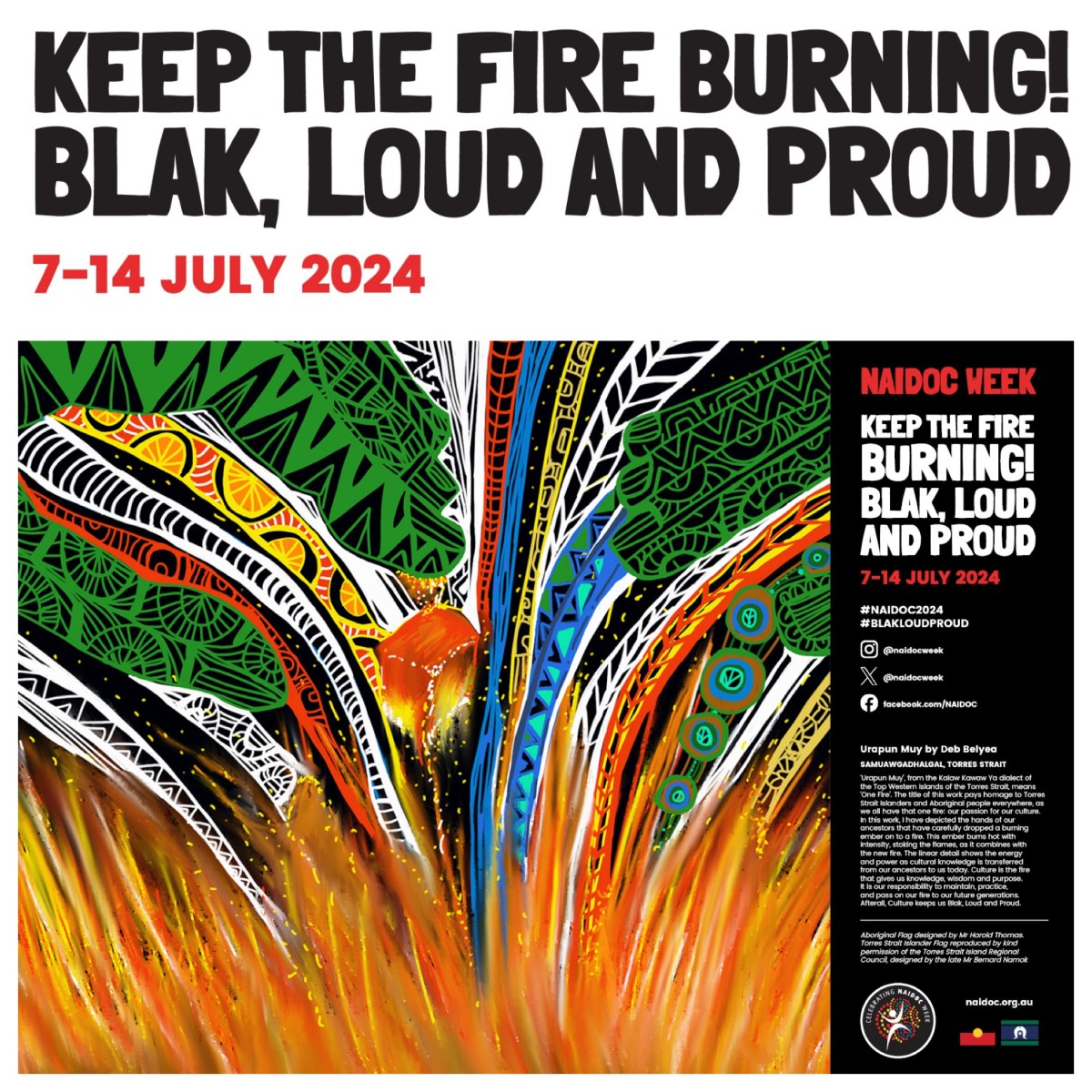
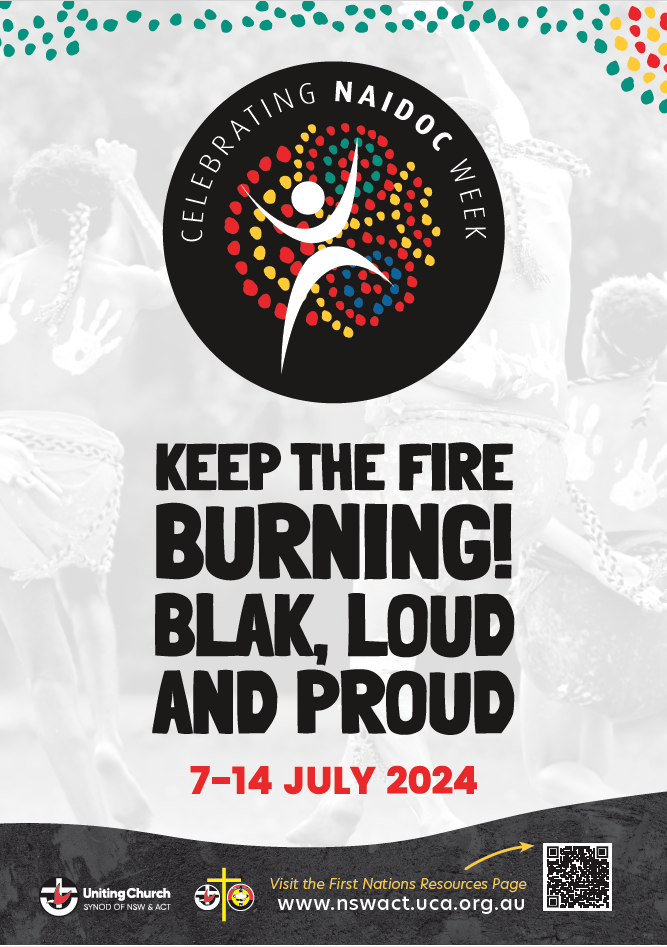
Every July, NAIDOC Week takes place. It runs from the first Sunday in July (this year, 7July) until the following Sunday (this year, 14 July). The week has a focus on the First Peoples of this continent and its surrounding islands—the Aboriginal and Torres Strait Islanders from the more than 250 nations that existed on this continent and its surrounding islands before the invasion of 1788.
NAIDOC Week has been held for over 50 years, under the auspices of the National Aborigines and Islanders Day Observance Committee (which forms the acronym NAIDOC). The origins of this week are attributed to Aboriginal Christian leader, William Cooper, who called churches to recognise and celebrate Aboriginal and Torres Strait Islander communities in worship services. For many years, congregations across the Uniting Church have recognised and celebrated NAIDOC Week in worship services.
The theme for 2024 is Keep the Fire Burning! Blak, Loud and Proud.
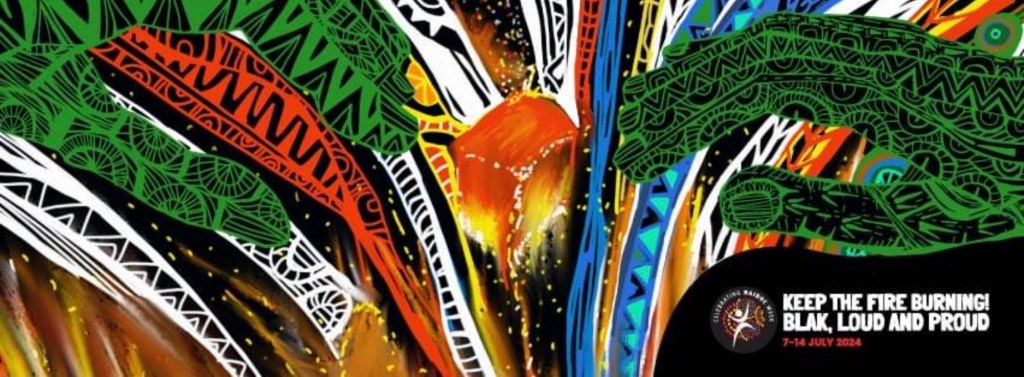
The NAIDOC WEEK website explains the theme:
“This year’s theme celebrates the unyielding spirit of our communities and invites all to stand in solidarity, amplifying the voices that have long been silenced.
“The fire represents the enduring strength and vitality of Indigenous cultures, passed down through generations despite the challenges faced. It is a symbol of connection to the land, to each other, and to the rich tapestry of traditions that define Aboriginal and Torres Strait Islander peoples. As we honour this flame, we kindle the sparks of pride and unity, igniting a renewed commitment to acknowledging, preserving, and sharing the cultural heritage that enriches our nation.
“Blak, Loud and Proud encapsulates the unapologetic celebration of Indigenous identity, empowering us to stand tall in our heritage and assert our place in the modern world. This theme calls for a reclamation of narratives, an amplification of voices, and an unwavering commitment to justice and equality. It invites all Australians to listen, learn, and engage in meaningful dialogue, fostering a society where the wisdom and contributions of Indigenous peoples are fully valued and respected.
“Through our collective efforts, we can forge a future where the stories, traditions, and achievements of Aboriginal and Torres Strait Islander communities are cherished and celebrated, enriching the fabric of the nation with the oldest living culture in the world.”
This July during NAIDOC Week the Uniting Church will be marking two significant anniversaries in the life of the church and our relationship with First Peoples. 10 July marks the 30th anniversary of the Covenant between the Uniting Aboriginal and Islander Christian Congress (UAICC) and the Uniting Church in Australia, while mid-July marks the 15th Anniversary of the revised Preamble to the Uniting Church Constitution.
The Covenant with the UAICC (Congress) was a result of years of discernment and planning from Aboriginal Christian leaders within the Uniting Church who held a prophetic vision for a more just and healed future. In the Christian faith, the term “covenant” is used to signal a commitment of two parties to each other. In the Bible, a covenant is initially made by the Lord God with Noah, “with you and your descendants after you, and with every living creature that is with you, the birds, the domestic animals, and every animal of the earth with you, as many as came out of the ark” (Gen 9:9–10).
The same covenant is then renewed with Abraham (Gen 17:1–7, 15–16), where Abraham is identified as “the ancestor of a multitude of nations” (Gen 17:4) who would then be party to that covenant in subsequent generations. The covenant is then renewed with Abraham’s son, Isaac (Gen 17:19, 21) and then with Jacob (Israel) (Gen 35:9–15). Later, it is extended to Moses and the whole people (Exod 19:1–4) and sealed in a ceremony involving “the blood of the covenant” (Exod 24:1–8).
Many centuries later, a prophet during the Exile proclaimed that God was promising, “this is the covenant that I will make with the house of Israel after those days, says the Lord: I will put my law within them, and I will write it on their hearts; and I will be their God, and they shall be my people” (Jer 31:31).

That renewed covenant is what Christians believe was enacted by Jesus, when he submitted to death on a cross; dying as a sacrifice, he shed “the blood of the covenant” (Mark 14:24; Matt 26:28; Luke 22:20; 1 Cor 11:25) and is recognised as “the mediator of a better covenant” (Heb 8:6) or “the mediator of a new covenant” (Heb 9:15; 12:24)—even though in terms of the declaration made by Jeremiah, this was actually yet another renewal of the one covenant that God had made and renewed with God’s people over the millennia.
So entering into a covenant in our current time reflects this strong biblical understanding of what a genuine partnership looks like; it is an expression of an intentional promise to seek mutual understanding, to listening and to serve together within a shared life.
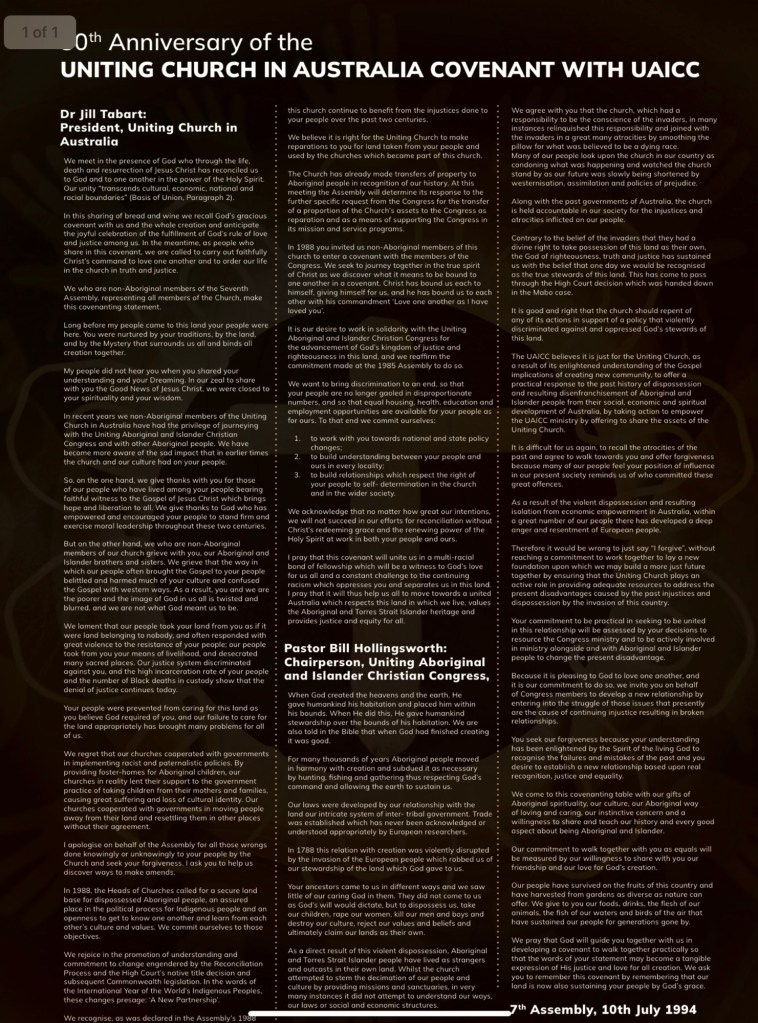
The Assembly of the Uniting Church has offered a reminder of the importance of what took place 30 years ago. The next few paragraphs come from that piece, “Save the Date: 30th Anniversary of the Covenant”, at https://uniting.church/save-the-date-covenant-anniversary/
First, it recalls that in May 1988 when the 5th Assembly met, Rev Charles Harris and Rev Dr Djiniyini Gondarra with other UAICC leaders called for a Covenant to bind the UCA and the UAICC together in relationship. This was endorsed by the full Assembly by acclamation. Six years later, the Covenanting Statement was formally signed at the 7th Assembly, on 10 July 1994.
In the Covenanting Statement read at the meeting, then President Dr Jill Tabart formally apologised for the church’s role in colonisation and dispossession of Australia’s First Peoples and committed the church to a new relationship. In response Pastor Bill Hollingsworth, then National Chair of UAICC, offered an inspiring challenge to the church to honour this commitment. (The full text of both speeches is below.)
The statement continues to serve as a formational part of the Uniting Church’s commitments to walking together as First and Second Peoples and to self-determination for First Peoples.
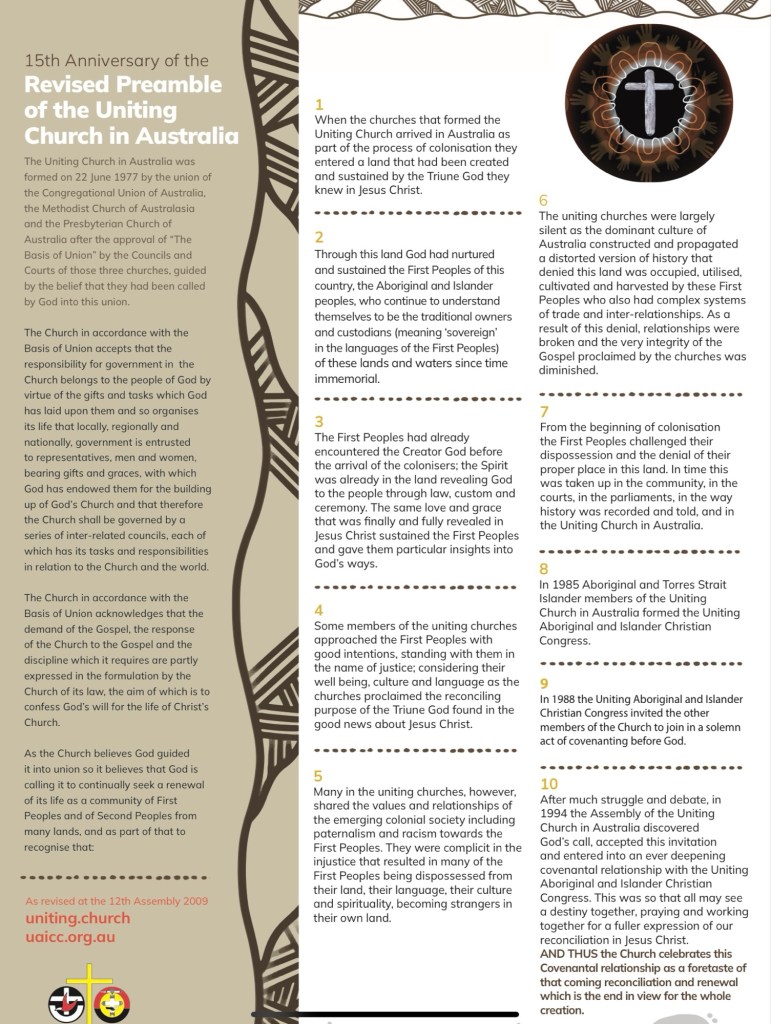
In a significant milestone in the covenant journey, the Uniting Church’s Constitution was revised to include a revised Preamble at the 12th Assembly (15–21 July 2009). The first half of this revised Preamble contains a number of significant statements of truth about the experience of the First Peoples over the past 240 years. (The full text of the revised Preamble is below.)
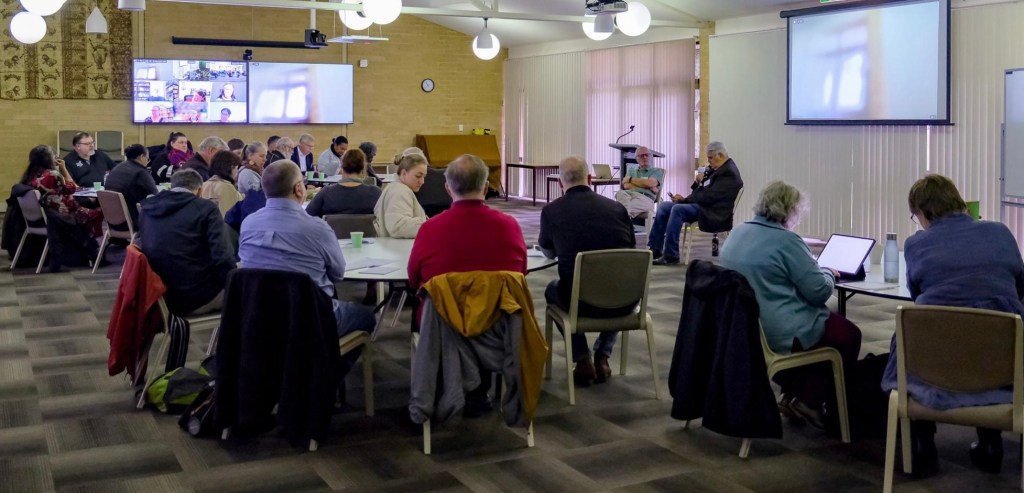
Significantly, the revised Preamble affirms that “The First Peoples had already encountered the Creator God before the arrival of the colonisers; the Spirit was already in the land revealing God to the people through law, custom and ceremony” (Preamble, para. 3). A conference reflecting on the Preamble has just been held in Sydney.
The declaration made in paragraph 3 of the revised Preamble provides a fundamental theological affirmation which undergirds both our present respect for First Peoples, and our understanding that a relationship with and an understanding of God are not limited to western Christian perceptions of the divine.
This has been an important step for the Uniting Church to take, moving out from the concept that God’s covenant love is offered to a narrow group of people with a particular way of expressing their commitment to God through Jesus (mediated by Western culture, Enlightenment thinking, and Protestant ethic), and that rather this covenant love is offered with grace and hope to people of all times, in all places, in many and varied ways, reflecting the wide diversity of human identities and experiences.
And so, just as we have accepted within Christianity that the God we know in Jesus was active in relationship with human beings for many centuries before the time of Jesus—through the covenant with the people of Israel, as the Hebrew Scriptures attest—so we can agree that God was in relationship with the peoples of the continent we call Australia and the islands which surround it, “in time beyond our dreaming”, in Daramoolen … in Tjukurrpa … in Alcheringa. This is the truth that we now recognise and affirm—and it’s an important affirmation to make!
The NSW.ACT Synod has various resources relating to NAIDOC WEEK 2024 at https://www.nswact.uca.org.au/resources/naidoc-week-resources-for-your-church/
For my thoughts from two years ago about the resonances between “Uniting Church theology” and the themes of NAIDOC WEEK over the years, see
 An Informed Faith