Justice rolling down like waters, righteousness like an ever-flowing stream (Amos 1, 5; Narrative Lectionary for Pentecost 22)

Discussion of the Narrative Lectionary passage from Amos

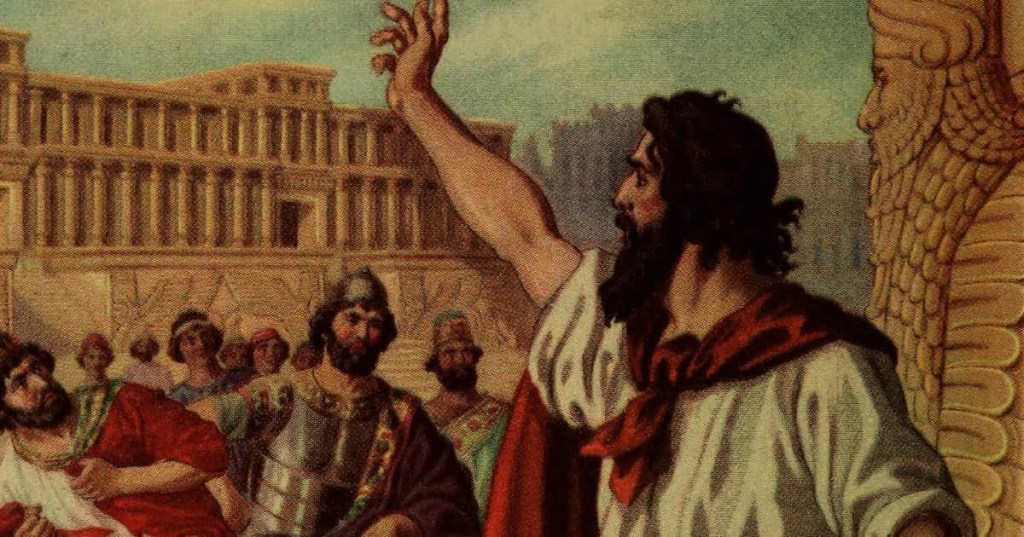
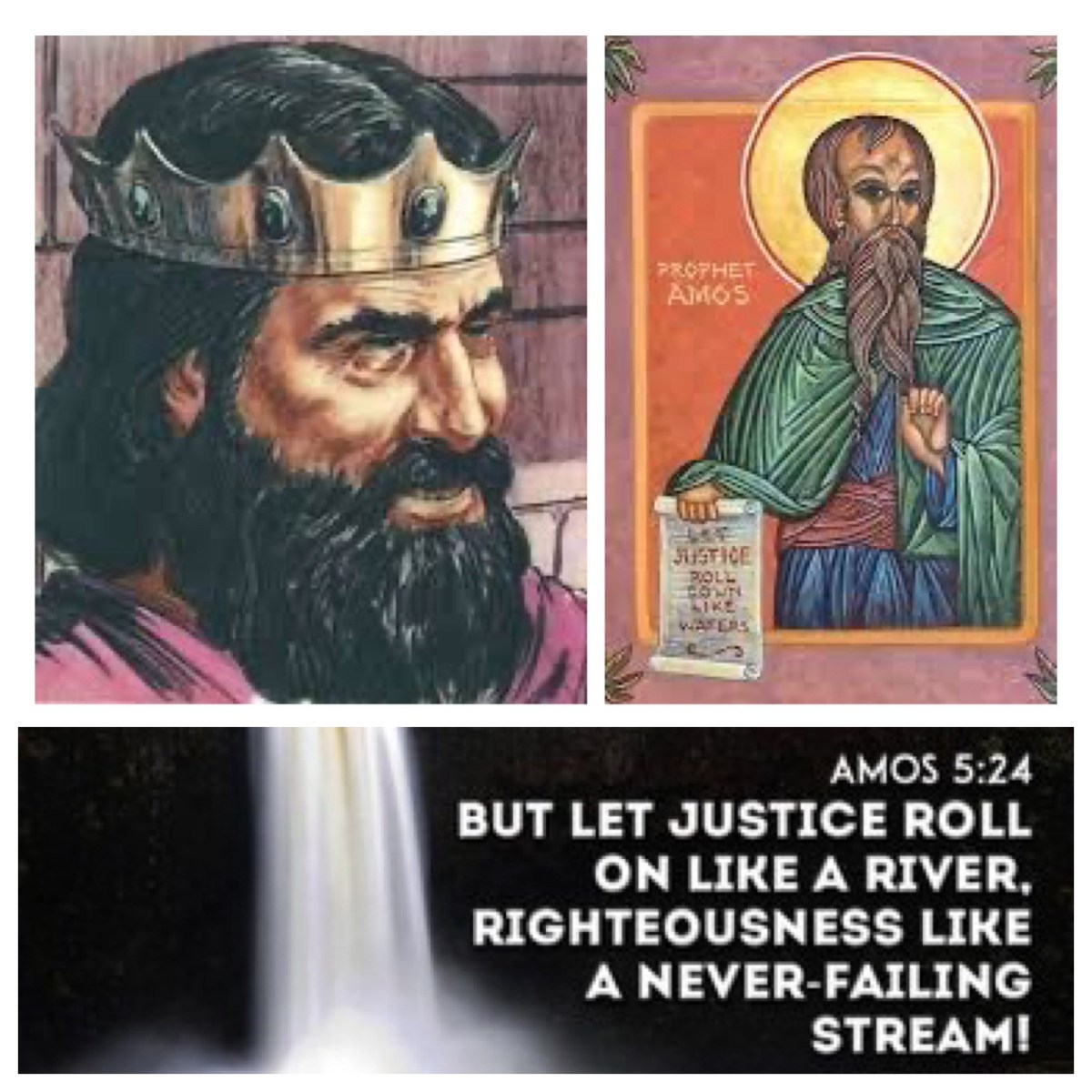
The prophet Amos lived in the northern kingdom of Israel during the reign of Jeroboam II, the thirteenth king of Israel, who reigned for four decades (786–746 BCE; see Amos 7:10). It was a time of prosperity, built on the trading of olive oil and wine with the neighbouring nations of Assyria to the north and Egypt to the south. Jeroboam, however, is remembered as a king who oversaw multiple acts of sinfulness during his years on the throne. 
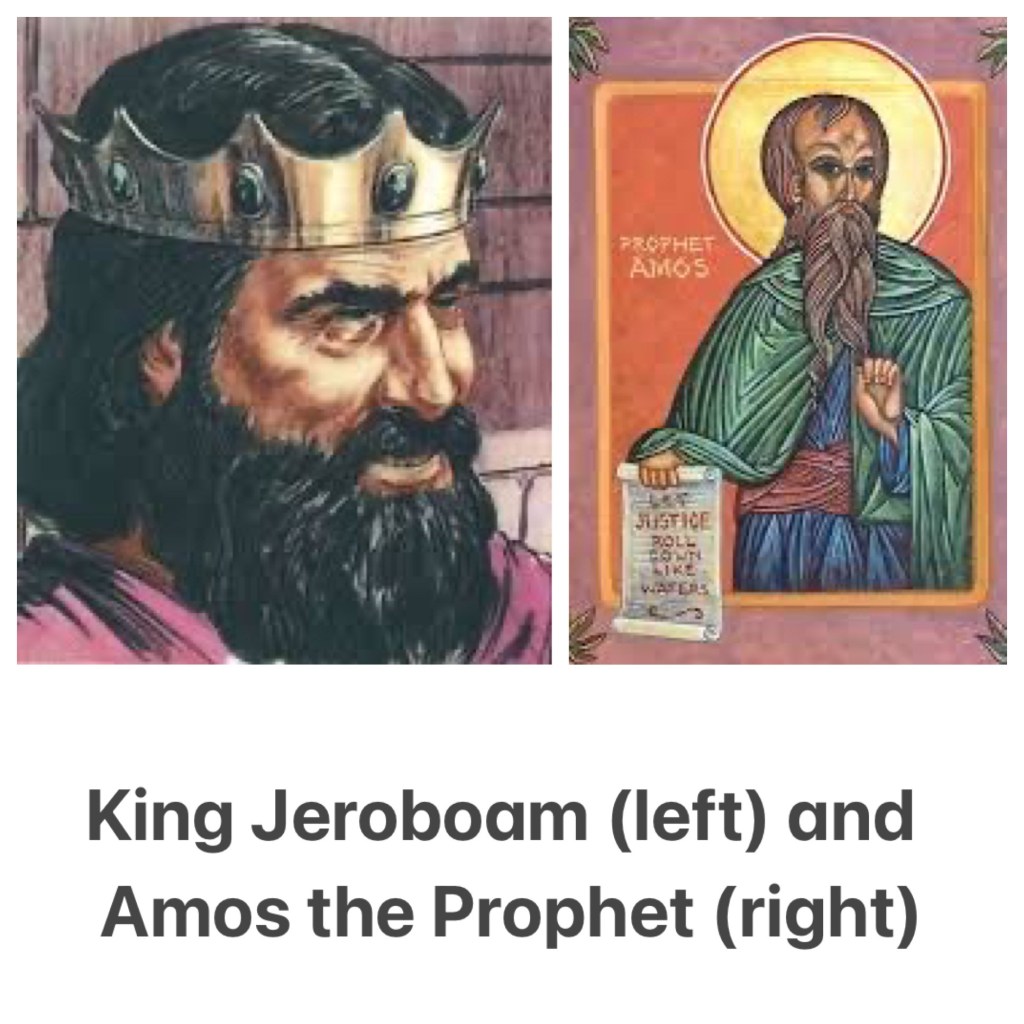
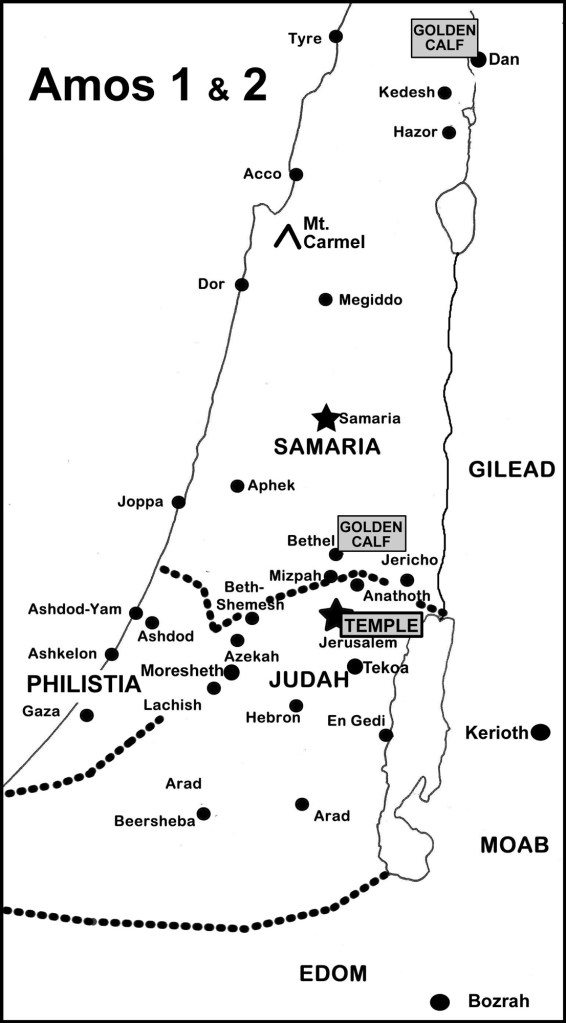
Most infamously, he replicated the sin of Aaron, who oversaw the creation of a golden calf during the time that the people of Israel were awaiting the return of Moses from his time on the top of Mount Sinai (Exod 32). Jeroboam had the city of Shechem built, as a direct challenge to the centrality of Jerusalem; and he had two golden claves built and installed, one at Bethel, the other at Dan (1 Ki 12:25–30). 

For these and other persistent sins during his 22 years as king, reported at 1 Ki 12:31–33 and 13:33–34, Jerobaom incurred the divine wrath, such that God determined that “ the house of Jeroboam [was to be] cut it off and destroyed from the face of the earth” (1 Ki 13:34). Later passages in this book refer to “the sins of Jeroboam” (1 Ki 14:16; 15:30; 16:2, 19, 31; 2 Ki 10:29, 31; 13:2, 6, 11; 14:24; 15:9, 18, 24, 28; 17:22) and “the way of Jeroboam … and the sins that he caused Israel to commit, provoking the Lord, the God of Israel, to anger by their idols” (1 Ki 16:26).

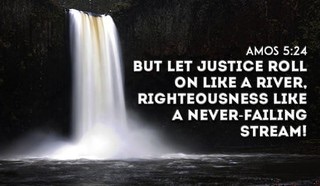
So although the Temple in Jerusalem was the focus for religious activity in the southern kingdom (Judah), Jeroboam had established a number of religious sites in the northern kingdom. Amos warns about the sites at Dan, Bethel, Gilgal and Beersheba (Amos 5:5; 8:14). At these places, not only was the Lord God worshipped, but idolatrous images were used in worship services (5:26). Amos is trenchant in his criticism of the worship that the people offer (5:21–27); embedded in this crisis is a doublet of poetry, words most often associated with Amos: “let justice roll down like waters, and righteousness like an ever-flowing stream” (5:24).
Indeed, it is the perpetration of social inequity within Israel that most causes him to convey the anger of divine displeasure. He admonishes the rich for the way that they mistreat the poor: “they sell the righteous for silver, and the needy for a pair of sandals—they who trample the head of the poor into the dust of the earth and push the afflicted out of the way” (2:6–7); “you trample on the poor and take from them levies of grain” (5:11). 

Again, Amos rails: “you trample on the needy and bring to ruin the poor of the land … buying the poor for silver and the needy for a pair of sandals, and selling the sweepings of the wheat” (8:4, 6). In a biting oracle, he criticises the “cows of Bashan who are on Mount Samaria” for the way they “oppress the poor, crush the needy” (4:1). 

Bashan was the mountainous area to the northeast of Israel (Ps 68:15), which rejoiced in majestic oaks (Isa 2:13) and extensive pasture lands (1 Chron 5:16). The luxurious lifestyle of these people can well be imagined. The reference to “winter houses … summer houses … houses of ivory … and great houses” (3:15) is telling. Luxury and opulence is evident amongst the wealthy.

So,  too, is the description of “those who lie on beds of ivory, and lounge on their couches, and eat lambs from the flock, and calves from the stall; who sing idle songs to the sound of the harp, and like David improvise on instruments of music; who drink wine from bowls, and anoint themselves with the finest oils” (6:4–6). The extravagance of the wealthy is obvious, juxtaposed against the plight of the poor, as we have noted.

Amos indicates that God had given Israel a number of opportunities to repent, “yet you did not return to me” (4:6, 8, 9, 10, 11). God pleads for Israel to “seek me and live” (5:4), “seek the Lord and live” (5:6), “seek good and not evil, that you may live” (5:14).

But this is all in vain; ultimately, the prophet insists, the Lord God will bring on the day of the Lord—a day of “darkness, not light, and gloom with no brightness in it” (5:18–20). God is determined; “the great house shall be shattered to bits, and the little house to pieces” (6:11); later, he insists again, “the dead bodies shall be many, cast out in every place” (8:3). 

In so many reports of prophetic activity, it is justice which is the heart of their message—God’s justice; the justice which God desires for the people of God; the justice which God speaks through the voice of the prophets; the justice that God calls for in Israel; the justice that provides the measure against which Israel will be judged, and saved, or condemned.

Moses himself was charged with ensuring that justice was in place in Israelite society. One story told of the time after the Israelites had escaped from Egypt places Moses as a judge. Whilst in the wilderness of Sin, being visited by his father-in-law Jethro, we learn that “Moses sat as judge for the people, while the people stood around him from morning until evening” (Exod 18:13). 

Noticing that Moses was overwhelmed by the volume of matters requiring adjudgment, Jethro suggested—and Moses adopted—a system whereby appointed men who “judged the people at all times; hard cases they brought to Moses, but any minor case they decided themselves” (Exod 18:14–16). The charge given to these men is clear: they are to give a fair hearing to every member of the community, and they “must not be partial in judging: hear out the small and the great alike; [do] not be intimidated by anyone, for the judgment is God’s” (Deut 1:16–17). 

Prophets coming after Moses thus inherited this responsibility to ensure that justice was upheld within society. The most famous prophetic word of Amos is, as we have noted, his call for “justice and righteousness” (Amos 5:22). Micah asks the question, “what does the Lord require of you but to do justice?” (Mic 6:8), while through the prophet Hosea, the Lord God promises to Israel, “I will take you for my wife in righteousness and in justice, in steadfast love, and in mercy” (Hos 2:19).

Isaiah ends his famous love-song of of the vineyard by declaring that God “expected justice” (Isa 5:7) and he tells the rebellious people of his day, “the Lord is a God of justice; blessed are all those who wait for him” (Isa 30:18). He proclaims God’s judgement on those who “turn aside the needy from justice … and rob the poor of my people, that widows may be your spoil, and that you may make the orphans your prey!” (Isa 10:1–2). 

Other prophets join their voices to Isaiah’s declaration. Ezekiel laments that “the sojourner suffers extortion in your midst; the fatherless and the widow are wronged in you” (Ezek 22:7). Jeremiah encourages the people of Jerusalem with a promise that God will allow them to continue to dwell in their land if they “do not oppress the sojourner, the fatherless, or the widow” (Jer 7:5–7). 

Second Isaiah foresees that the coming Servant “will bring forth justice to the nations” (Isa 42:1) and knows that God’s justice will be “a light to the peoples” (Isa 51:4). The words of Third Isaiah continue in this prophetic stream, for this anonymous prophet begins his words with a direct declaration, “maintain justice, and do what is right” (Isa 56:1). He goes on to articulate his mission as being “to bring good news to the oppressed, to bind up the brokenhearted, to proclaim liberty to the captives, and release to the prisoners” (Isa 61:1), thereby demonstrating that “I the Lord love justice” (Isa 62:8).

This commitment of Amos and many of the prophets resonates also with the psalmist, who praises “the God of Jacob … who executes justice for the oppressed; who gives food to the hungry … [who] sets the prisoners free, [who] opens the eyes of the blind, [who] lifts up those who are bowed down [and] loves the righteous, [who] watches over the strangers [and] upholds the orphan and the widow” (Ps 146:5, 7–9). See 

https://johntsquires.com/2023/05/14/father-of-orphans-and-protector-of-widows-psalm-68-easter-7a/
In the sound of sheer silence (1 Kings 19; Narrative Lectionary for Pentecost 21)

On the passage about Elijah in 1 Ki 19 proposed by the Narrative Lectionary

In the passage which the Narrative Lectionary places before us this coming Sunday (from 1 Kings 19), we come to Elijah; one of the key prophetic figures whose deeds are recounted in the books of the Kings or whose words are collected within the Hebrew Scriptures under the catch-all second section of Nevi’im (Prophets).

Elijah, famous for being described as “a hairy man, with a leather belt around his waist” (2 Ki 1:8), was first introduced as Elijah the Tishbite, meaning he came from Tishbe in Gilead (1 Ki 17:1), a place whose precise location has occasioned some debate.  See

This initial portrayal of Elijah is nested within the accounts of that long period of time when Israel was ruled by kings, when prophets functioned as the conscience of the king and the voice of integrity within society. The distinctive dress of Elijah perhaps sets him apart from the court of the kings, where a more “civilized” dress code was presumably operative. Nevertheless, Elijah does have some engagement with the kings who ruled at the time he was active: Ahab, and then Ahaziah. Indeed, his distinctive dress points to his emboldened attitude towards those kings.

Elijah operated during the period when Ahab ruled Israel; he figures in various incidents throughout the remainder of 1 Kings—most famously, in the conflict with the prophets of Baal which came to a showdown on Mount Carmel (1 Ki 18), and then later in his confrontation with Ahab and his wife Jezebel, over the matter of Naboth’s vineyard (1 Ki 21). Like Jesus, Elijah was no shrinking violet!

Elijah first appears in the narrative of the various kings, seemingly out of nowhere, just after King Ahab had taken as his wife Jezebel, daughter of King Ethbaal of the Sidonians, who presumably influenced him to begin his worship of Baal (1 Ki 17:31–33). In the same way, at the end of his time of prophetic activity, Elijah simply disappears from sight soon after Kong Ahaziah died. Elijah hands over his role to his successor, Elisha, and as “a chariot of fire and horses of fire separated the two of them”, Elijah ascends in a whirlwind into heaven (2 Ki 2:1–15).

In the book we know as 1 Kings, the compiler of the Deuteronomic History (which stretches from Deuteronomy through Joshua and Judges to Samuel and then Kings) reports many incidents which attest to the courage and power of Elijah. The boldness of Elijah is evident in the confrontations that he has with various rulers; this is made clear, centuries later, to the followers of Jesus, in the earliest account of his life, when John the baptiser is depicted as a fiery desert preacher, calling for repentance, just as Elijah had called the kings to account (Mark 1:1–8). 

In a later account of Jesus, there is a clear inference connecting John with Elijah when Jesus notes, “Elijah is indeed coming and will restore all things; but I tell you that Elijah has already come, and they did not recognize him, but they did to him whatever they pleased” (Matt 17:11–12).

Then, in his sermon in Nazareth (Luke 4:16–30), Jesus refers to the first reported miracle of Elijah, when he provided a widow in Zarephath with food and oil that “did not fail”, even though the land was in drought (1 Ki 17:1–16). In subsequent incidents in 1 Kings, Elijah raises a dead son (17:17–24), directly confronts King Ahab with his sins (18:1–18), and famously stares down the prophets of Baal in a mountaintop showdown (18:19–40), leading to the breaking of the drought (18:41–46).

Elijah later condemns Ahab over his unjust seizure of the vineyard of Naboth (21:17–29) and then stands before Ahab’s son, King Ahaziah, to condemn him to death (2 Ki 1:2–16); a death “according to the words of of the Lord that Elijah had spoken” which is promptly reported (2 Ki 1:17). 

During the rule of Ahab, Elijah had also most famously heard the Lord God “not in the wind … not in the earthquake … not in the fire”—but rather in something else, which the NRSV renders as “the sound of sheer silence” (1 Ki 19:11–12). This incident is, as noted, the story set before us by the lectionary this coming Sunday. We need to ponder what is being conveyed through the symbols employed in this story. 

The three means by which God is said not to have appeared to Elijah reflect the very same means through which Moses, and the people of Israel, did experience the manifestation of the Lord God in their midst. When the escaping Israelites arrived at the Sea of Reeds, according to one version of this archetypal story, “the Lord God drove the sea back by a strong east wind all night, and turned the sea into dry land; and the waters were divided” (Exod 14:21). 

The people later celebrated the defeat of the Egyptians who were pursuing them: “you blew with your wind, the sea covered them; they sank like lead in the mighty waters” (Exod 15:10). The wind was a sign of God’s presence, and an agent of divine protection—indeed, it was the very same “wind from God” which “swept over the face of the waters” at the beginning of creation (Gen 1:2). But for Elijah, the Lord God was “not in the wind”.

Then, as they had travelled through the wilderness, the people were accompanied by a blazing fire, another sign of divine presence: “the Lord God went in front of them in a pillar of cloud by day, to lead them along the way, and in a pillar of fire by night, to give them light, so that they might travel by day and by night” (Exod 13:21). The fire signalled the divine presence.

Indeed, the very same flaming fire had been manifested to Moses when he was but a mere shepherd in Midian; “the angel of the Lord appeared to him in a flame of fire out of a bush; he looked, and the bush was blazing, yet it was not consumed” (Exod 3:2). What follows is the account of the call of Moses; God tells him “I will send you to Pharaoh to bring my people, the Israelites, out of Egypt” (Exod 3:10). The fire had been the assurance to Moses that it was the Lord God who was present.  But for Elijah, the Lord God was “not in the fire”.

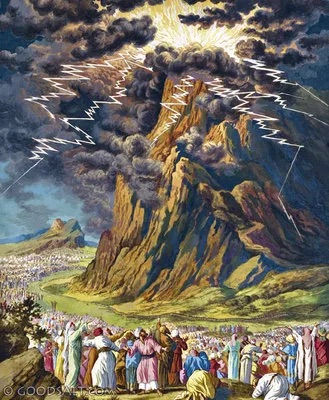
The same element of fire was present when Moses and the people ultimately arrived at Mount Sinai in the wilderness of Sinai (Exod 19:1–2). “Mount Sinai”, so the account goes, “was wrapped in smoke, because the Lord had descended upon it in fire; the smoke went up like the smoke of a kiln, while the whole mountain shook violently” (Exod 19:18). Associated with this there was “thunder and lightning, as well as a thick cloud on the mountain, and a blast of a trumpet so loud that all the people who were in the camp trembled” (Exod 19:16). 

The scene at Sinai surely reflects the experience of an earthquake; the same phenomenon that prophets would later interpret as a sign of divine presence—indeed, divine judgement. “You will be visited by the Lord of hosts”, Isaiah subsequently tells the people of his time, “with thunder and earthquake and great noise, with whirlwind and tempest, and the flame of a devouring fire” (Isa 29:6). 

Still later, Zechariah describes how “the Mount of Olives shall be split in two from east to west by a very wide valley”, and instructs the people, “you shall flee as you fled from the earthquake in the days of King Uzziah of Judah; then the Lord my God will come, and all the holy ones with him” (Zech 14:4–5).

Nahum reflects on the jealous and avenging nature of God, declaring that “his way is in whirlwind and storm, and the clouds are the dust of his feet; he rebukes the sea and makes it dry, and he dries up all the rivers; the mountains quake before him, and the hills melt; the earth heaves before him, the world and all who live in it” (Nah 1:2–5). 

This dramatic motif continues on into later apocalyptic writings (Isa 64:1; 1 Esdras   4:36; 2 Esdras 16:12). The prophets and their apocalyptic heirs  knew clearly that this whole dramatic constellation of events revolving around an earthquake was a sign of divine presence.  But for Elijah, the Lord God was “not in the earthquake”. He was heard in something quite different.

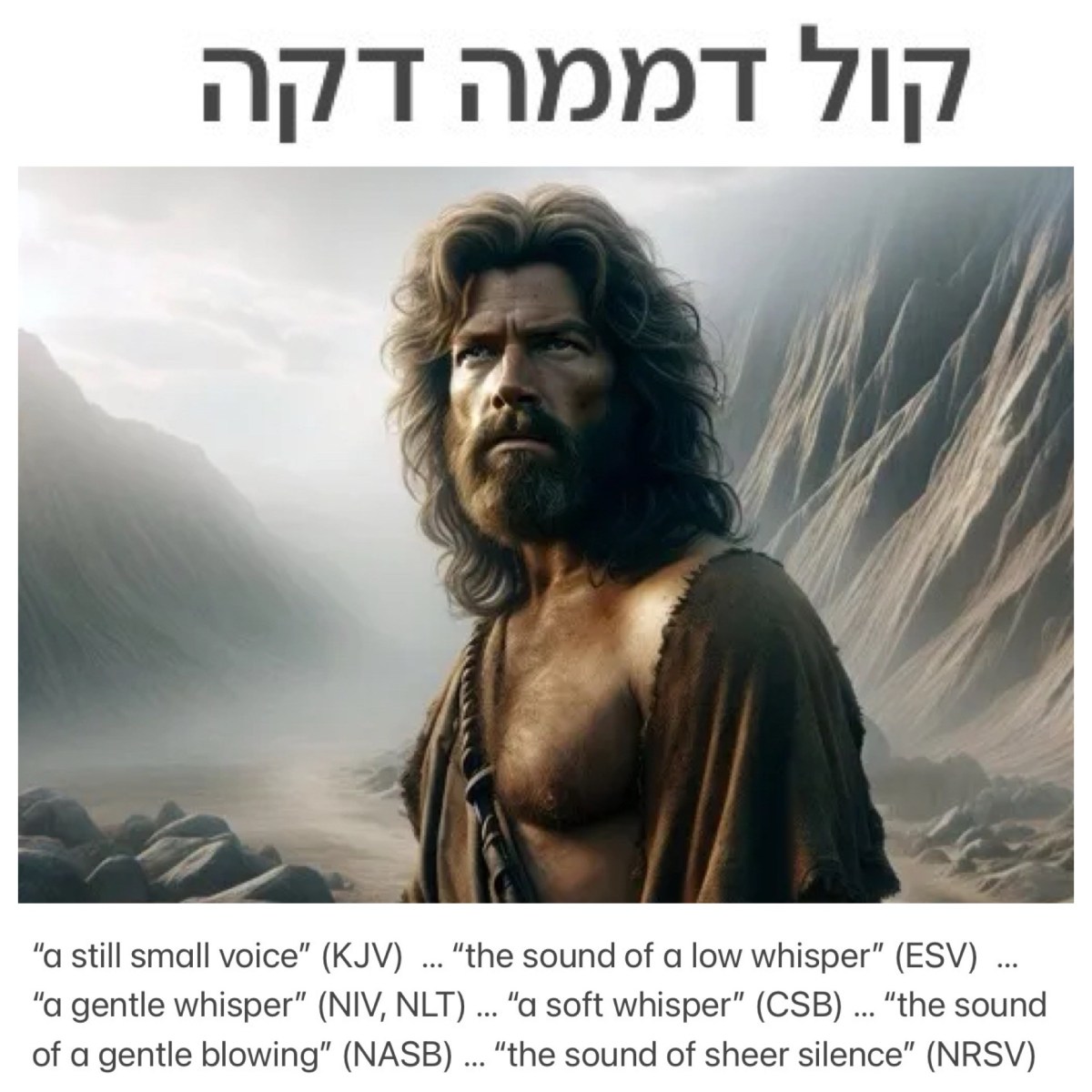
What did Elijah hear? The Hebrew phrase in verse 12 is qol d’mamah daqqah. The King James Version translated this as “still small voice”.  More recent translations have provided variants on how these words might be translated. Alternatives that are found include “the sound of a low whisper” (ESV), “a gentle whisper” (NIV, NLT), “a soft whisper” (CSB), or “the sound of a gentle blowing” (NASB). These reflect variations on the kind of nuance that the KJV was offering. 

Screenshot

However, the NRSV option of translating this phrase as “the sound of sheer silence” is more confronting: the presence of God is sensed in the absence of sound; any communication from the deity comes, not in audible sounds, but in the utter absence of any sound. It is a striking paradox!

And in the context of the developing story of 1 Kings, the paradox is strong. Earlier, the prophet had stood firm against the might of Baal, the foreign god whom Ahab and Jezebel had prioritized in the life of Israel (1 Ki 18:17–40). When “the four hundred and fifty prophets of Baal and the four hundred prophets of Asherah who eat at Jezebel’s table” gathered on Mount Carmel, they failed to obtain any response from their god, the god of storms. No matter how intensely the pleaded, all they heard was “no voice, no answer, no response” (18:29).

Elijah, by contrast, prays to the Lord God and the fire of his god fell on the sacrificial altar; it consumed “the burnt offering, the wood, the stones, and the dust, and even licked up the water that was in the trench” (18:38). The victory was absolute and complete; the storm god had been defeated. And yet, the deity who accomplished this would communicate most personally and intimately with his chosen prophet, “not in the wind … not in the earthquake … not in the fire”, but rather in “a sound of sheer silence” (19:11–12). What a deliciously powerful irony!

Elijah was his own, distinctive man, with his own, distinctive encounter with God. He experienced God in a way quite different from what was experienced by Moses and the people of Israel. He experienced God in a way that stood apart from his contemporaries who were priests and prophets of Baal. For that reason, whilst the Lord God of Elijah stands over and against the Baal of Ahab and Jezebel, so too Elijah stands alongside and apart from Moses as a different, but equally great, leader of the people.

Speak, for your servant is listening (1 Samuel 3; Narrative Lectionary for Pentecost 18)

The two books of Samuel and the early chapters of 1 Kings recount the development of the monarchy in Israel, with stories of Saul, David, and Solomon, the first three men charged with the responsibility of leading Israel and ensuring that there was justice in the land. We have four passages proposed by the Narrative Lectionary at this point of the cycle, beginning this Sunday with 1 Sam 3:1–21.

These stories also engage us with the lives of prophets, Samuel and Nathan—men who were called to speak the word of God. This week we hear about the call of the young Samuel. We are told that as Samuel grew up, “the Lord was with him and let none of his words fall to the ground; and all Israel from Dan to Beer-sheba knew that Samuel was a trustworthy prophet of the Lord” (1 Sam 3:20–21). Years later, Nathan is commissioned by “the word of the Lord” to “go and tell my servant David, ‘thus says the Lord’” (2 Sam 7:4–5). That is the role of the prophet—to listen to what God says to them, and then to speak forth the word of the Lord to the people of their society.

Samuel, Nathan, and other prophets were particularly called to speak truth to the king and to recall them to the centrality of their role, to ensure that God’s justice was a reality in Israelite society (Isa 42:1–4; 61:1–2;  Mic 3:8). We see this when Nathan confronts David (2 Sam 12), when Elijah confronts Ahab and the priests of Baal (1 Ki 18), when Isaiah advises Hezekiah (2 Ki 20), and when Josiah consults Huldah (2 Ki 22; 2 Chron 34).

As we pay attention to the details of the stories, let us remember that these stories are not “history” as we know it today. Rather, they are ancient tales told and retold, passed on by word of mouth and then written down, because of their enduring significance for the people of ancient Israel. Scholars call such stories “myths”, meaning that they convey something of fundamental importance. (We might best define myth as “a traditional story, usually associated with the time of origins, of paradigmatic significance for the society in which it is told”.)

See more on the nature of these stories at 

Identifying the stories in the narrative books of the Hebrew Scriptures as myths doesn’t mean they are “not true”—rather, it means that we need to read them, not as historically accurate accounts, but as stories which convey fundamentally important ideas. These stories were valued by people of ancient times. They may well offer us, in our own times, insights and guidance of value.

So we read and ponder these stories from old once again, in our time, because we believe that there is wisdom and guidance in the dynamics we see at work in this ancient society. We pay attention to them because we believe that the same Spirit who anointed the kings, and who called and equipped the prophets, is the very Spirit who today meets us, calls us, and equips us.

This Sunday, the Narrative Lectionary offers us a narrative that recounts the call of the young boy, Samuel, to the role of prophet (1 Sam 3:1–21). Samuel was the designated prophet whose wisdom guided the people in the early period of the monarchy. This story from the early years of Samuel’s life instructs us as we hear it in later times, to listen to God’s voice, and to respond with obedience. 

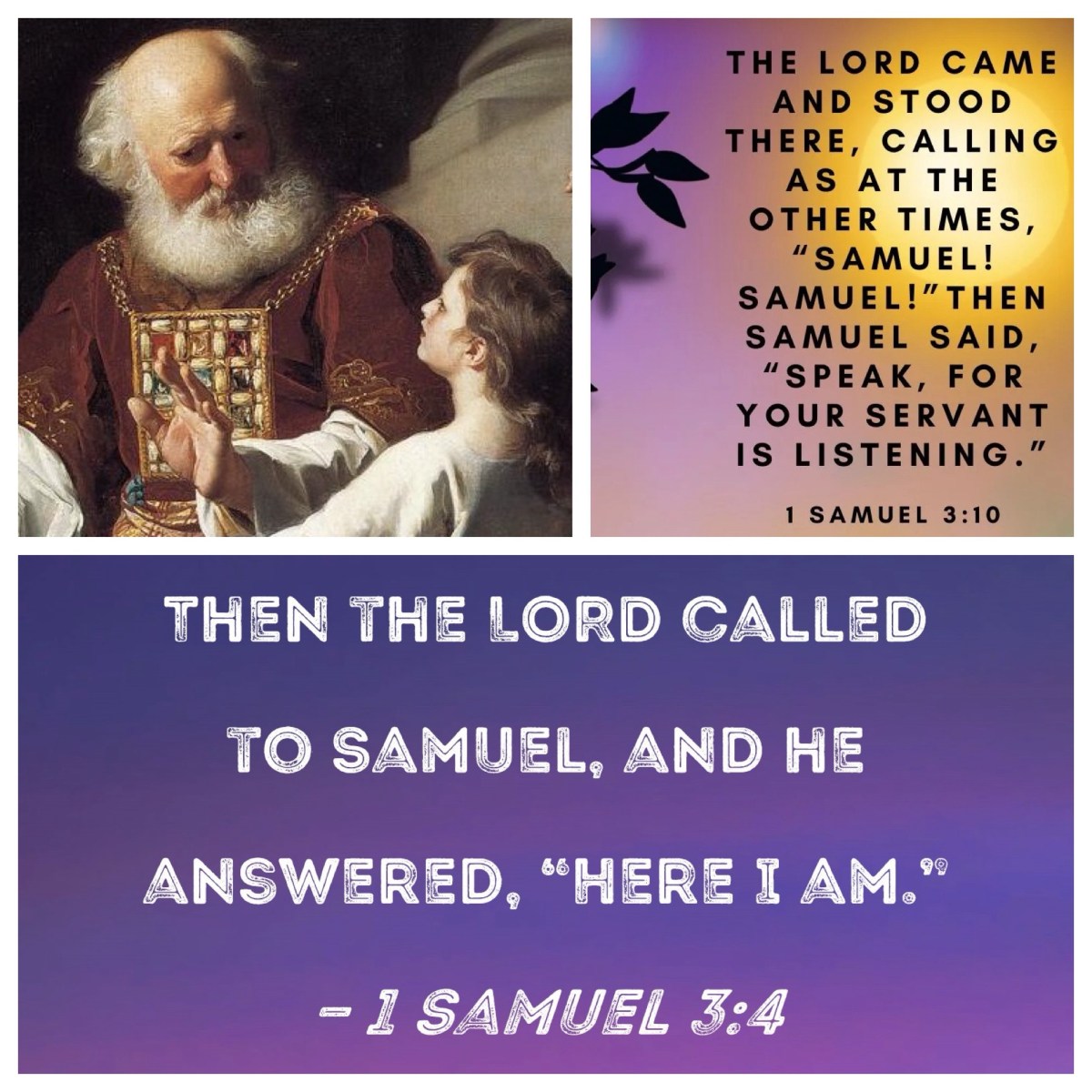
Young Samuel was in the temple, where the elderly Eli was priest. In the evening, while the lamp was still burning, Samuel hears a voice. The voice simply calls his name. “Here I am”, Samuel responds when he hears that voice. He is sure that it is Samuel who is speaking to him—there is nobody else around. Three times, he hears “Samuel”; and three times, he responds “here I am” (vv.4,6,8). 

Samuel had been thinking that it was Eli speaking to him; but it was not the priest, it was the voice of the Lord. The story conveys a sense of confusion and unknowing. This reflects something of the uncertainty that people of faith often have with regard to “hearing the voice of the Lord”. 

Indeed, the fragility of living by faith without clear and obvious demonstration of he presence of God is signalled in the opening verse: “the word of the Lord was rare in those days; visions were not widespread” (v.1). The poor vision of the elderly priest, Eli (v.2), is a second signal of this uncertainty. The priest cannot see; the child hears but does not understand.

Paying attention to the voice of the Lord is a persistent refrain in Hebrew Scriptures. Indeed, the psalmist rejoices in the clarity of God’s voice: “the voice of the Lord is over the waters; the God of glory thunders, the Lord, over mighty waters; the voice of the Lord is powerful; the voice of the Lord is full of majesty” (Ps 29:3–4). Yet another psalmist recalls the time, in the wilderness, when the people of Israel “grumbled in their tents, and did not obey the voice of the Lord” (Ps 106:25). The people were not always faithful, even though the voice sounded with clarity. They needed reminders of that voice.

In the foundational saga of Israel, Moses is called by the voice of God while tending sheep on Mount Horeb (Exod 3:4). In obedience, he leads the people to freedom—and then informs the people, “if you will listen carefully to the voice of the Lord your God, and do what is right in his sight, and give heed to his commandments and keep all his statutes”, then God promises not to inflict them with disease (Exod 15:26). Later, when Moses has delivered to them “all the words of the Lord and all the ordinances”, the response of the people is an affirmative “all the words that the Lord has spoken we will do” (Exod 24:3).

A number of the prophets indicate that they are impelled to declare “the word of the Lord” to a sinful people because they have heard, and are obedient to, “the voice of the Lord”. Isaiah hears the voice of the Lord calling him: “whom shall I send, and who will go for us?” (Isa 6:8). Isaiah is given words of woe to pronounce over the people (Isa 6:9–13); he warns the leaders of Israel, “listen, and hear my voice; pay attention, and hear my speech” (Isa 28:23). 

His fellow-southerner, the shepherd Amos, opens his words with the bold declaration, “the Lord roars from Zion, and utters his voice from Jerusalem” (Amos 1:2), before he launches into his long series of oracles against the surrounding nations (Amos 1:3—2:3) and then against Judah and Israel (Amos 2:4–16).

The image of the lord as a roaring lion is used also by Joel, “the Lord roars from Zion, and utters his voice from Jerusalem, and the heavens and the earth shake” (Joel 3:16), while in another oracle he says, “the Lord utters his voice at the head of his army; how vast is his host!” (Joel 2:1). Joel’s words of judgement penetrate to the heart of the evil of the people: the coming day will be “a day of darkness and gloom, a day of clouds and thick darkness!” (Joel 2:2), and so he calls the people to “return to [the Lord] with all your heart, with fasting, with weeping, and with mourning; rend your hearts and not your clothing” (Joel 2:12–13).

Micah also declares, “the voice of the Lord cries to the city (it is sound wisdom to fear your name)” (Mic 6:9) before he lambasts the people for their wickedness: “your wealthy are full of violence; your inhabitants speak lies, with tongues of deceit in their mouths” (Mic 6:12; the whole damning oracle is 6:9–16).

Called as a youth by “the word of the Lord” (Jer 1:4–8), Jeremiah hears the assurance, “I have put my words in your mouth” (Jer 1:9); the prophet later instructs the people, “amend your ways and your doings, and obey the voice of the Lord your God, and the Lord will change his mind about the disaster that he has pronounced against you” (Jer 26:13). Again, he tells them, “obey the voice of the Lord in what I say to you, and it shall go well with you, and your life shall be spared” (Jer 38:20). Eventually, the people affirm, “whether it is good or bad, we will obey the voice of the Lord our God to whom we are sending you, in order that it may go well with us when we obey the voice of the Lord our God” (Jer 42:6).

In the return from exile, both Haggai (Hag 1:12) and Zechariah (Zech 6:15) rejoice that Israel “obeyed the voice of the Lord their God”; but Daniel laments that his people “have not obeyed the voice of the Lord our God by following his laws, which he set before us by his servants the prophets; Israel has transgressed your law and turned aside, refusing to obey your voice” (Dan 9:10).

And yet, various prophets had hesitated when first hearing “the voice of the Lord”. The initial response of Moses is “who am I that I should go to Pharaoh, and bring the Israelites out of Egypt?” (Exod 3:11), followed by a series of further objections that he raises (Exod 3:13; 4:1; 4:10). Amos explains to the priest Amaziah how his call had surprised him: “I am no prophet, nor a prophet’s son; but I am a herdsman, and a dresser of sycamore trees” (Amos 7:14).

Isaiah seeks to excuse himself from the prophetic task: “I am lost, for I am a man of unclean lips, and I live among a people of unclean lips” (Isa 6:5). Jeremiah objects, “truly I do not know how to speak, for I am only a boy” (Jer 1:5). A number of the prophets are, initially at least, reluctant spokespersons for the Lord God.

By contrast, in the story told in 1 Sam 3, after hearing his name spoken by the Lord for a third time, Samuel responds with a declaration of obedience: “speak, for your servant is listening” (v.10). This was just as the priest Eli had instructed him (v.9). Here, Samuel demonstrates careful listening, patience, openness to what he encounters, and complete obedience to that voice.

Just beyond the passage set by the lectionary, the narrator indicates that what will follow will be dramatic and compelling; it will “make both ears of anyone who hears of it to tingle” (v.11). The immediate drama which les ahead will tell of punishment for the sins of the house of Eli. Young Samuel is given his first commission: tell his patron Eli about what lies in store for him. Samuel, in fear and trembling, dutifully does so (v.18); Eli recognises the word of the Lord in the voice of the prophet, and accepts his fate. 

The pattern of Samuel’s life is thus set: he will need to summon inner strength, demonstrate commitment to the cause, use clarity of speech, and model integrity of life. The fact that the young Samuel already demonstrated these qualities may well be why this story is remembered and retold. These two stories from the early years of Samuel’s life are remembered in order to instruct those who hear them in later generations, to listen and to obey, to be brave and focussed. And so we, in our time, are to hear the story, reflect on it, and respond appropriately.

Judging Israel; undoing creation (Jer 4; Pentecost 14C)

“A hot wind comes from me out of the bare heights in the desert toward my poor people, not to winnow or cleanse— a wind too strong for that. Now it is I who speak in judgment against them.” (Jer 4:11–12)

We’ve been following the words of Jeremiah over the last three weeks. He has had some very stern messages to deliver. Perhaps this helps us to see the origins of the term “Jeremiad”. The Oxford Dictionary of Literary Terms defines it as “either a prolonged lamentation or a prophetic warning against the evil habits of a nation, foretelling disaster”. The second sense (a prophetic warning) comes directly from the way that the prophet Jeremiah spoke about, and to, the people of Israel in his time.

Jeremiah was, indeed, a voice of doom and gloom. At his calling, the Lord God informed him, “I will utter my judgments against them, for all their wickedness in forsaking me; they have made offerings to other gods, and worshiped the works of their own hands”. He then admonished the young Jeremiah, telling him to “gird up your loins; stand up and tell them everything that I command you”, before putting the very fear of God into him with the warning, “do not break down before them, or I will break you before them” (Jer 1:16–17). That’s stern stuff!

But is this going too far? I think today we would want to call to account the speaker of these words, to remind them not to abuse the power that they have in this relationship, and to be mindful of the vulnerability of the young person to whom they are speaking! (A friend who worked for the then Department of Community Services said years ago that Yahweh would these days be notified to the department if he spoke and acted in this way!)

So Jeremiah remains faithful to his call, through all the challenges and difficulties this brought him. For four decades he is relentless is calling the people of his day to account for their sins: “the house of Israel and the house of Judah have broken the covenant that I made with their ancestors” (11:10); “we have sinned against the Lord our God, we and our ancestors, from our youth even to this day; and we have not obeyed the voice of the Lord our God” (3:25). 

In the passage set before us by the lectionary for this coming Sunday, the prophet reports God’s anguish about Israel: “my people are foolish, they do not know me; they are stupid children, they have no understanding; they are skilled in doing evil, but do not know how to do good” (4:22). In despair, God decides to use a foreign power to bring Israel to their senses. He tells the prophet, “I am now making my words in your mouth a fire, and this people wood, and the fire shall devour them. I am going to bring upon you a nation from far away, O house of Israel, says the Lord” (5:14–15). Thus Jeremiah foretells the invasion of the Babylonians (see 2 Ki 25).

Jeremiah senses that God has fixed the course to be taken: “they have taught their tongues to speak lies; they commit iniquity and are too weary to repent. Oppression upon oppression, deceit upon deceit! They refuse to know me, says the Lord … Shall I not punish them for these things? says the Lord; and shall I not bring retribution on a nation such as this?” (9:5–6, 9). National disgrace awaits them, as they submit to a foreign power.

Eventually, from his exile in Egypt, and as others from his nation are taken north into exile by the invading Babylonians, Jeremiah tells the Israelites, “It is because you burned offerings, and because you sinned against the Lord and did not obey the voice of the Lord or walk in his law and in his statutes and in his decrees, that this disaster has befallen you, as is still evident today” (44:23). He has been resolute in his condemnation of the sinful people. He is now, sadly, vindicated. And so God decrees, “I am going to watch over them for harm and not for good; all the people of Judah who are in the land of Egypt shall perish by the sword and by famine, until not one is left” (44:27).

I must confess that it seems quite easy, at the moment, to slip into a simplistic interpretive pattern and apply these words—spoken long again against a sinful nation—to the very nation, today, who still bears the same name as those ancient people: Israel. The sins of the modern nation of Israel are manifold. Established as a refuge for a persecuted people, the nation has turned persecutor. Given land in recognition of the way they had been disposed and dispersed, the landholders sought more and more land, building settlements on Palestinian land, erecting a strong, impenetrable wall to keep “them” from “us”.

In a series of battles, they have waged war to ensure their safety and security. Besieged by leaders of organisations arrayed against them, they have continued to shoot, bomb, and destabilise such “terrorist” groups. Yet what is happening in Gaza today is no longer able to be distinguished from genocide—the very same genocidal actions that the Jewish people experienced almost a century ago. The sins of the nation appear (at least to me) to be clear, persistent, and utterly repugnant. Jeremiah’s words to ancient Israel—“I am determined to bring disaster on you, to bring all Judah to an end” (44:11) could well be the words of God to the modern nation of Israel.

Can we simply apply to condemnation of Jeremiah to modern Israel? It’s tempting; but it’s not responsible interpretation. And it leaves open the door to the accusation—repeated often, now—that this is antisemitic. I don’t believe it is antisemitic, because such criticisms are directed against the policies and practices of the modern nation-state of Israel, and what they result in, and not against all Jews everywhere, simply for being Jewish. So we need to steer clear of this kind of simplistic equation. The criticisms are political and pragmatic, not based on religion or ethnicity. 

For my analysis of the current situation involving Israel, Hamas, Gaza, and Palestine, see

and

All of this is in the book of Jeremiah: denunciation after denunciation of the people, warnings of divine punishment, and oracles portending imminent exile and absolute destruction. We can’t get away from that.

However: the passage that the lectionary offers for this coming Sunday raises the stakes even higher. In this passage (Jer 4:11–12, 22–28), the wrath of God is directed not just to Israel, but to all creation. The looming catastrophe is not just national; it is global, cosmic in its scope.

To be sure, the passage reports God’s anguish about Israel, as we have noted: “my people are foolish, they do not know me; they are stupid children, they have no understanding; they are skilled in doing evil, but do not know how to do good” (4:22).

But then comes a most remarkable sequence of sentences, in which the whole of creation seems to be in view. “I looked on the earth, and lo, it was waste and void; and to the heavens, and they had no light”, God is saying. “I looked on the mountains, and lo, they were quaking, and all the hills moved to and fro. I looked, and lo, there was no one at all, and all the birds of the air had fled. I looked, and lo, the fruitful land was a desert, and all its cities were laid in ruins before the Lord, before his fierce anger” (4:23–26).

Writing on this Jeremiah passage in With Love to the World, the Rev Dr Anthony Rees, Associate Professor of Old Testament in the School of Theology, Charles Sturt University, notes: “This is a remarkably evocative passage. It begins with a hot wind, a symbol of judgement (as in Jonah 4). It moves quickly to a promise of destruction from the North (Dan and Ephraim); it almost seems that God is cheering on those who would do Judah harm.”

But there is more than just evocative poetry here. It seems to me that the words of Jeremiah might be describing the end result of a process that is happening in our own time. Since the start of the Industrial Revolution, and continuing apace into the 21st century, the damage that human beings have been causing to the planet has been increasing with noticeable impacts seen in so many areas: global warming, more intense extreme weather events, more frequent extreme weather events,  the diminishing of the ice caps at the poles of the earth, the warming of the oceans’ temperature, rising sea levels impacting particularly islands in the Pacific, the bleaching of the Great Barrier Reef, and so many more things that can be attributed to human-generated climate change. 

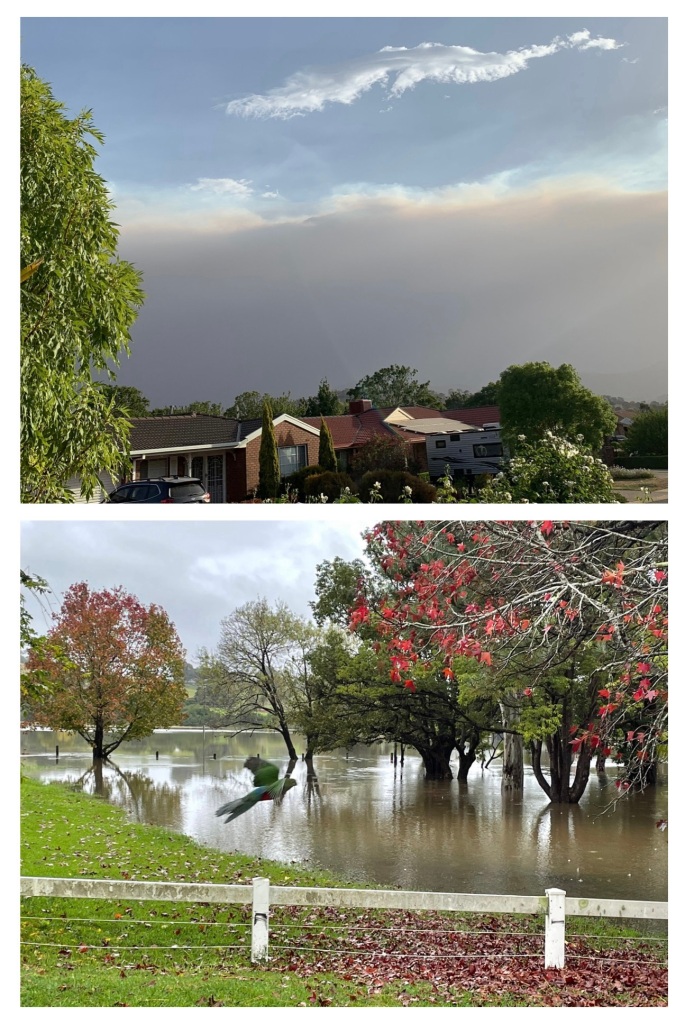
In our own household, in just the past five years, we have seen a searing bushfire come within a few kilometres of our suburb, and then a massive downpour lead to rising floodwaters that reached the other side of the road on which we live. Climate change is real, and close. We are well on track, as many scientists are saying, to see a planet with a radically altered ecosystem. 

The view from our front yard:
Gordon, ACT, January 2020 (top),
during the severe bushfire in the ACT;
Dungog, NSW, May 2025 (bottom),
during the east coast flooding

Anthony Rees continues his reflections on Jer 4: “Judah is destroyed, the people and land laid waste on account of childish stupidity and ignorance. A remarkable image is then seen: the earth is described as waste and void, the very same description given of the earth in Gen 1:2 before God’s creative activity begins.”

The passage in Jeremiah has God narrating his view of the systematic undoing of his work as the Creator, as that has been set out in the narratives of Gen 1 and Gen 2, and in the poetry of Psalms 8, 19, 65, 104, and 148. God sees that the earth was once again “waste and void” (Jer 4:23a), as it was in the beginning (Gen 1:2). All that the landscape showed was a ravaged wilderness, for no longer did the earth bring forth vegetation: “plants yielding seed of every kind, and trees of every kind bearing fruit with the seed in it” (Gen 1:12; 2:8–9; and see Ps 65:11–13; 104:14–15, 27 –28). Rather, what God sees is that “the fruitful land was a desert, and all its cities were laid in ruins” (Jer 4:26).

In the heavens there is no light (Jer 4:23b), thus undoing God’s early creative work (Gen 1:3, “let there be light”; and Ps 8:3; 19:4b—6; 148:3). Hills and mountains were shaking (Jer 4:24); the stability they provided, the unshakeable foundation of the earth, has been undone (Ps 65:6; 104:5, 8; 148:9). All the birds have fled (Jer 4:25), undoing the work of God reported at Gen 1:21–22 (and see Ps 8:8; 104:12; 148:10b).

Anthony Rees notes, “Jeremiah looks to the heavens and the light is gone. God’s creative work has been undone on account of human failure. And again, human failure has consequences that go beyond our species: mountains sway, birds flee, arable land is turned to desert. What good news is there to be found here? What image of hope?”

The relevance for today of Jeremiah’s poetic “vision” that undoes the vision of creation expressed long ago by priests and poets is striking. And his perception that it is human sinfulness that is at the root of this is noteable. We know what we need to do to slow the rate of change, so that the climate remains within an inhabitable range. We know what we need to do to stop pumping gases into the air that are changing the way the planet works. We know what changes we need to make to our way of living—a whole host of changes, large and small—but we lack the will to do so. Our national policies continue to favour the industries that contribute most to the degradation of our environment. Our daily practices show minimal change, if that, in so many households.

Anthony Rees concludes, “Perhaps we might best read this text as a warning, and commit ourselves to working in ways that maintain relationship with God, our neigbours, and the rest of the created order.” It is certainly a timely word, given our critical situation. How do you respond to Jeremiah’s mournful poetry? What changes can you make? What lobbying can you undertake? What advocacy can you commit to do? Are we always going to be condemned to be, like ancient Israel, those who “are skilled in doing evil, but do not know how to do good”?

https://www.withlovetotheworld.org.au

I am a potter shaping evil against you (Jer 18; Pentecost 13C) 

The passage from Jeremiah proposed by the lectionary for this coming Sunday (Jer 18:1–11) is the third in a series of eight passages, taken from various sections of the work, that we read and hear during this long season “after Pentecost”. It’s a well-known passage because of the way it uses the common figure of a potter working his clay to form a vessel for domestic use. The potter spoils his work, so he starts again and works another vessel (vv.1–4). 

The image of a potter is used elsewhere in Hebrew Scripture. It appears in an oracle by the prophet Isaiah (Isa 29:13–16). He poses a question to God: “You turn things upside down! Shall the potter be regarded as the clay?” (29:16). This is the very oracle whose words are used by Paul in his words to the Corinthians: “the wisdom of their wise shall perish, and the discernment of the discerning shall be hidden” (Isa 29:13; 1 Cor 1:18–19).

Paul also uses the clay element of the imagery when he later tells the Corinthians that “we have this treasure in clay jars, so that it may be made clear that this extraordinary power belongs to God and does not come from us” (2 Cor 4:7). Paul is referring to his preaching of the message about Jesus, who gives “the light of the knowledge of the glory of God” in his face (2 Cor 4:6).

We also find the potter—clay imagery used by the later unnamed prophet whose words are included in the second section of the book of Isaiah. He speaks of “the one coming from the north” who “shall trample on rulers as on mortar, as the potter treads clay” (Isa 41:21–29, see v.25). He later instructs the people not to question the intentions of God. Those who do so should remember they are “earthen vessels with the potter”; he warns them, “does the clay say to the one who fashions it, ‘What are you making’? or ‘your work has no handles’?” (45:9–13, see v.9). The image of the potter represents the sovereign power of God to act as God wishes and intends. That’s how Paul also understands it in 1 Cor 1.

In the passage offered to us for this coming Sunday, the prophet Jeremiah uses this image specifically to warn Israel that, since the people have become, in effect, “spoiled goods” because of their entrenched idolatry (Jer 18:8), the Lord God can be of a mind to discard them as unwanted. As the potter, God has unfettered freedom to mould and shape the clay exactly how he wills.

Mixing metaphors, Jeremiah then turns to the horticultural imagery employed in the opening scene of the book (“I appoint you over nations and over kingdoms, to pluck up and to pull down, to destroy and to overthrow, to build and to plant”, 1:10). So, he declares, God can decide to “pluck up and break down and destroy” the sinful nation (18:7), just as God may decide on another occasion to “build and plant” a nation (18:9).

In both instances, however, the Lord God retains the sovereign right to exercise a change of mind. If an evil nation repents, “I will change my mind about the disaster that I intended to bring on it” (18:8). Conversely, if a faithful nation, planted by God, turns to evil, “I will change my mind about the good that I had intended to do to it” (18:10). Although Christians have been taught to think of God as unchangeable, eternally the same—under the influence of the stark declaration of Heb 13:8—the testimony of Hebrew Scripture is actually that God can, and did, and will, change God’s mind.

See 

So the message for Israel is clear: “I am a potter shaping evil against you and devising a plan against you”, says God; and so the plea to the people is “turn now, all of you from your evil way, and amend your ways and your doings” (18:11). The notion that God can act with evil intent is perhaps a claim that later Christian theology reacts against; after all, don’t we have the devil, Satan himself, to be responsible for all that is evil intent the world? 

Yet in the world of ancient Israel, a near-contemporary of Jeremiah articulates the twofold nature of God’s sovereign actions. It comes with the territory of claiming that the Lord God is the only God—the beginnings of monotheism. “I am the Lord, and there is no other; besides me there is no god”, says the unnamed prophet of Second Isaiah. As a consequence, he reports the claim of God: “I form light and create darkness, I make weal and create woe; I the Lord do all these things” (Isa 45:5–7). There is no hiding behind Satan as the instigator of evil; for this prophet, as for Jeremiah, the Lord himself is able to act with evil intent. 

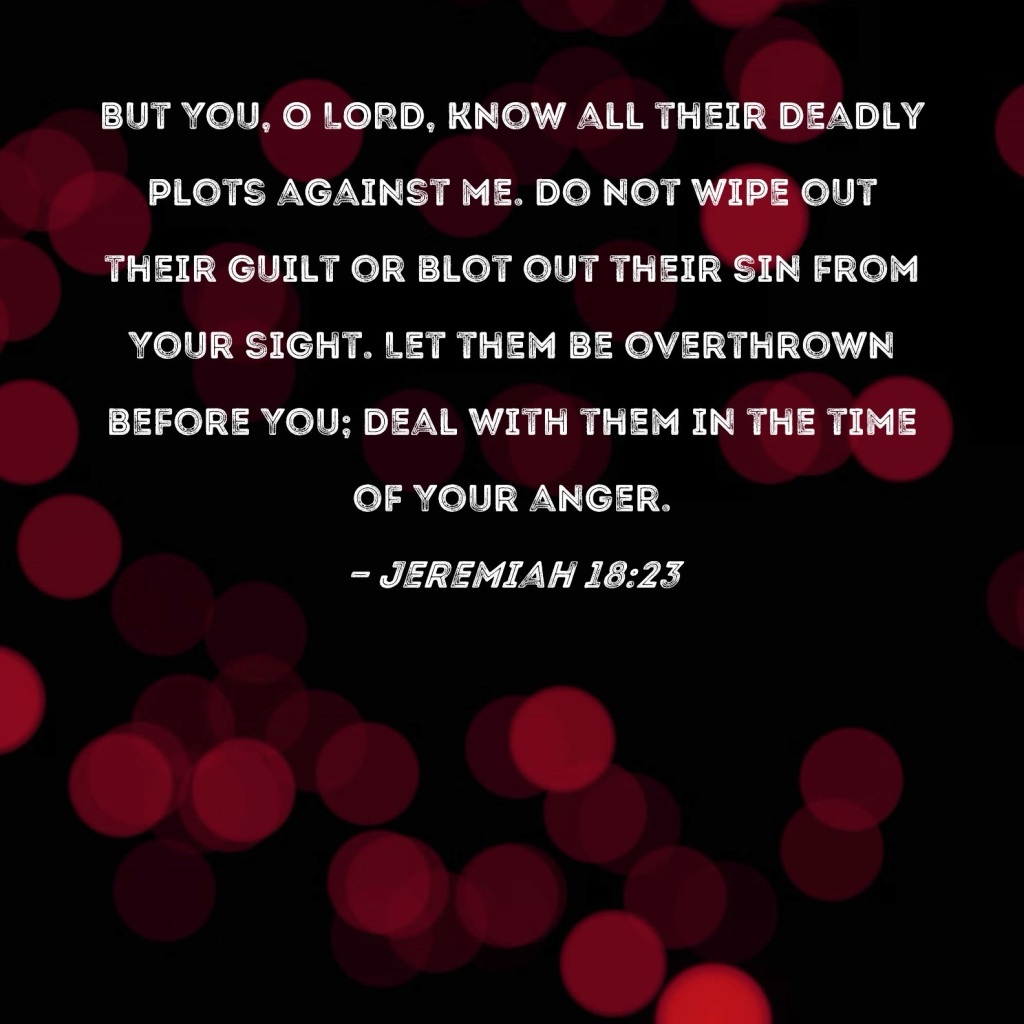
Yet God does call for Israel to repent (Jer 18:11). However, their stubborn refusal to repent (18:12) leads to more recriminations from God (18:13–17), and their plotting against the prophet (18:18) leads him to plead with God (18:19–23), culminating in his strident words, “Do not forgive their iniquity, do not blot out their sin from your sight; let them be tripped up before you; deal with them while you are angry” (18:23). 

The prophet’s anger matches—and perhaps even inflames—the divine wrath. So God commands the prophet to “buy a potter’s earthenware jug …. go out to the valley of the son of Hinnom at the entry of the Potsherd Gate … break the jug in the sight of those who go with you … [and declare] so will I break this people and this city, as one breaks a potter’s vessel, so that it can never be mended” (19:1–13). In this way the Lord God stands resolute against the sinful nation, who have “stiffened their necks, refusing to hear my words” (19:15). And so the scene that has begun with a command to go to the potter’s house ends with a smashed pot and wrathful words of vengeance.

On the thread of divine wrath running through scripture, see

and

A good question to ponder, though, is this: God calls Israel to repent. They need to remain faithful to the covenant. Yet Israel refuses to repent. They depart from their covenant commitment. So God acts as God has promised, to bring punishment upon them. Is this acting in an “evil” way? Or is God simply being good to God’s word?

Writing about this passage and others offered on other days this week in the daily Bible study guide, With Love to the World, the Rev. Dr Anthony Rees, Associate Professor of Old Testament in the School of Theology, Charles Sturt University, comments that “the readings this week demonstrate something of the complexity inherent in reading Jeremiah. Emerging from a chaotic, traumatic world, the texts shows the wounds of that experience, so that hope and hopelessness exist side by side. Chronology breaks down, suggestive of the challenge presented by the trauma of being unable to ‘think straight’”.

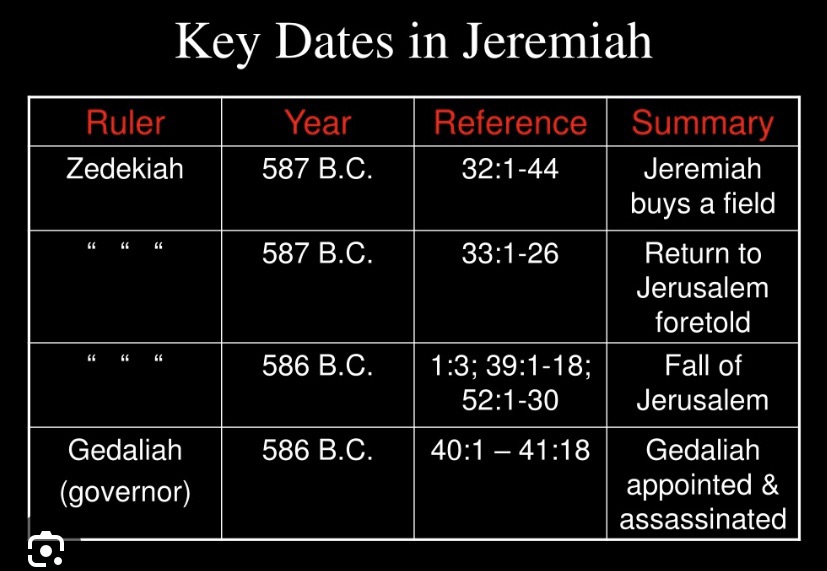
The disrupted nature of this book as a whole is well-documented. The chronological disjunctures throughout the 52 chapters can be seen when we trace the references to various kings of Judah: in order, we have Josiah in 627 BCE (Jer 1:2), jumping later to Zedekiah in 587 BCE (21:1), then back earlier to Shallum (i.e. Jehoahaz) in 609 BCE (22:11), Jehoiakim from 609 to 598 BCE (22:18), and Jeconiah in 597 BCE (22:24).

The book then returns to Zedekiah in 597 BCE (24:8), then back even earlier to Jehoiakim in April 604 BCE, “the first year of King Nebuchadrezzar of Babylon” (25:1)—and then further haphazard leaps between Zedekiah (chs. 27, 32-34, 37–38, and 51:59) and Jehoiakim (chs. 26, 35, 45) as well as the period in 587 after the fall of Jerusalem when Gedaliah was Governor (chs. 40–44). It is certainly an erratic trajectory if we plot the historical landmarks!

Rather than a straightforward chronological progression, the arrangement of the book is more topical, since oracles on the same topic are grouped together even though they may have been delivered at different times. This topical arrangement is easy to trace: 25 chapters of prophecies in poetic form about Israel, 20 chapters of narrative prose, and six chapters of prophecies against foreign nations. 

Early in the opening chapters, as Jeremiah prophesies against Israel, he reports that God muses, “you have played the whore with many lovers; and would you return to me?” (3:1). The idolatry and injustices practised by the people of Israel have caused God concern. Throughout the poetry of the prophetic oracles in chapters 1—25, God cajoles, encourages, warns, and threatens the people. The passage proposed for this Sunday sits within this opening section of oracles.

There are various theories as to how the book was put together; most scholars believe that someone after the lifetime of Jeremiah has brought together material from collections that were originally separate.

Indeed, A.R. Pete Diamond concludes that “like it or not, we have no direct access to the historical figure of Jeremiah or his cultural matrix”; we have “interpretative representations rather than raw cultural transcripts”, and thus he argues that the way we read this book should be informed by insights from contemporary literary theory, and especially by reading this book alongside the book of Deuteronomy, as it offers a counterpoint to the Deuteronomic view of “the myth of Israel and its patron deity, Yahweh” (Jeremiah, pp. 544–545 in the Eerdman’s Commentary on the Bible, 2003). 

So whereas Deuteronomy advocates a nationalistic God, Jeremiah conceives of an international involvement of Israel’s God. Commenting on this, Anthony Rees observes: “In this famous passage the covenant obligations which govern Judah’s relationship with God are given a broader understanding. Any nation can avoid divine punishment by turning from evil. Likewise, a nation that turns to evil stands condemned by God.”

Prof. Rees then draws an interesting conclusion. “Perhaps this relativizes Judah’s relationship with their God”, he proposes. “However, they maintain something the other nations lack: knowledge. Repeatedly God affirms that they are the only people amongst the nations who have been known by God and know God.”

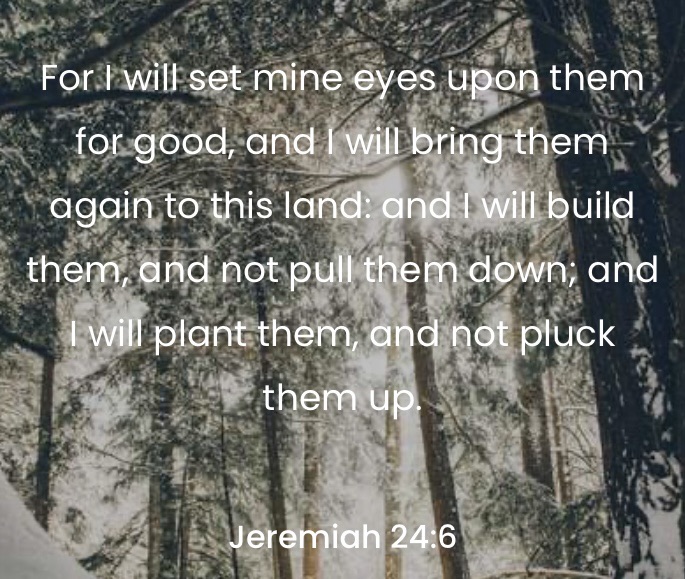
In a later oracle, when God is considering to bring Israel back out of exile, into their land, he says, using familiar imagery, “I will build them up, and not tear them down; I will plant them, and not pluck them up” (Jer 24:6).

He continues, “I will give them a heart to know that I am the Lord; and they shall be my people and I will be their God, for they shall return to me with their whole heart” (24:7). This is the fruit of knowledge: to be completely faithful to the Lord God.

And then, in yet another oracle—and this one so well-known because of how it is used in the New Testament—the prophet reports God’s intention to make “a new covenant” and to “put my law within them and … write it on their heart”. In this situation, “no longer shall they teach one another, or say to each other, ‘Know the Lord’, for they shall all know me, from the least of them to the greatest” (Jer 31:31–34). This knowledge is at the heart of the covenant. As the psalmist sings, “this I know, that God is for me” (Ps 56:9b). Or, as the Sunday school song goes, “Jesus loves me, this I know”.

So Prof. Rees concludes: “This is the great tragedy of [Israel’s] failure, and our own, that we know, and yet still follow our own plans that run contrary to the desires of God. Still, here we have the prophetic call to turn, to amend our ways and to live into that which, and whom, we know.” It is a call that stands, still, in our own time. How do we respond?

Screenshot

In the sound of sheer silence (1 Kings 19; Pentecost 2C)

In the passage which the lectionary places before us this coming Sunday (from 1 Kings 19), we meet the first of a number of prophetic figures whose deeds are recounted in the books of the Kings or whose words are collected within the Hebrew Scriptures under the catch-all second section of Nevi’im (Prophets).

The first of these prophetic figures is the Elijah the Tishbite, who was introduced as coming from Tishbe in Gilead (1 Ki 17:1), a place whose precise location has occasioned some debate.  See https://www.biblegateway.com/resources/encyclopedia-of-the-bible/Tishbite

Elijah is later described as “a hairy man, with a leather belt around his waist” (2 Ki 1:8). This initial portrayal of Elijah is nested within the accounts of that long period of time when Israel was ruled by kings, when prophets functioned as the conscience of the king and the voice of integrity within society. The distinctive dress of Elijah perhaps sets him apart from the court of the kings, where a more “civilized” dress code was presumably operative. Nevertheless, Elijah does have some engagement with the kings who ruled at the time he was active: Ahab, and then Ahaziah. Indeed, his distinctive dress points to his emboldened attitude towards those kings.

Elijah operated during the period when Ahab ruled Israel; he figures in various incidents throughout the remainder of 1 Kings—most famously, in the conflict with the prophets of Baal which came to a showdown on Mount Carmel (1 Ki 18), and then later in his confrontation with Ahab and his wife Jezebel, over the matter of Naboth’s vineyard (1 Ki 21). Like Jesus, Elijah was no shrinking violet!

Elijah first appears in the narrative of the various kings, seemingly out of nowhere, just after King Ahab had taken as his wife Jezebel, daughter of King Ethbaal of the Sidonians, who presumably influenced him to begin his worship of Baal (1 Ki 17:31–33). In the same way, at the end of his time of prophetic activity, Elijah simply disappears from sight soon after Kong Ahaziah died. Elijah hands over his role to his successor, Elisha, and as “a chariot of fire and horses of fire separated the two of them”, Elijah ascends in a whirlwind into heaven (2 Ki 2:1–15).

In the book we know as 1 Kings, the compiler of the Deuteronomic History reports many incidents which attest to the courage and power of Elijah. The boldness of Elijah is evident in the confrontations that he has with made clear, centuries later, to the followers of Jesus, in the earliest account of his life, when John the baptiser is depicted as a fiery desert preacher, calling for repentance, just as Elijah had called the kings to account (Mark 1:1–8). In a later account of Jesus, there is a clear inference connecting John with Elijah when Jesus notes, “Elijah is indeed coming and will restore all things; but I tell you that Elijah has already come, and they did not recognize him, but they did to him whatever they pleased” (Matt 17:11–12).

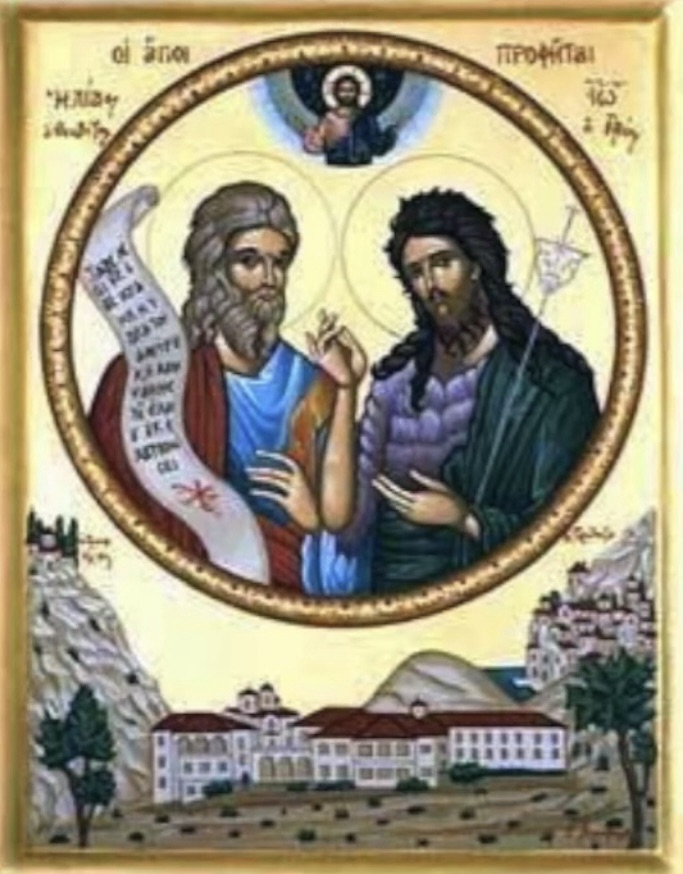
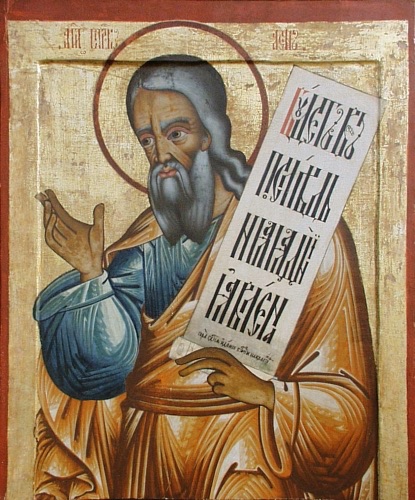
An icon of the Prophet Elijah and Saint John the Baptist from the Monastery of the Prophet Elias (Elijah) in Preveza, Greece

Then, in his sermon in Nazareth (Luke 4:16–30), Jesus refers to the first reported miracle of Elijah, when he provided a widow in Zarephath with food and oil that “did not fail”, even though the land was in drought (1 Ki 17:1–16). In subsequent incidents in 1 Kings, Elijah raises a dead son (17:17–24), directly confronts King Ahab with his sins (18:1–18), and famously stares down the prophets of Baal in a mountaintop showdown (18:19–40), leading to the breaking of the drought (18:41–46).

Elijah later condemns Ahab over his unjust seizure of the vineyard of Naboth (21:17–29) and then stands before Ahab’s son, King Ahaziah, to condemn him to death (2 Ki 1:2–16); a death “according to the words of of the Lord that Elijah had spoken” which is promptly reported (2 Ki 1:17). 

During the rule of Ahab, Elijah had also most famously heard the Lord God “not in the wind … not in the earthquake … not in the fire”—but rather in something else, which the NRSV renders as “the sound of sheer silence” (1 Ki 19:11–12). This incident is, as noted, the story set before us by the lectionary this coming Sunday. We need to ponder what is being conveyed through the symbols employed in this story. 

The three means by which God is said not to have appeared to Elijah reflect the very same means through which Moses, and the people of Israel, did experience the manifestation of the Lord God in their midst. When the escaping Israelites arrived at the Sea of Reeds, according to one version of this archetypal story, “the Lord God drove the sea back by a strong east wind all night, and turned the sea into dry land; and the waters were divided” (Exod 14:21). 

The people later celebrated the defeat of the Egyptians who were pursuing them: “you blew with your wind, the sea covered them; they sank like lead in the mighty waters” (Exod 15:10). The wind was a sign of God’s presence, and an agent of divine protection—indeed, it was the very same “wind from God” which “swept over the face of the waters” at the beginning of creation (Gen 1:2). But for Elijah, the Lord God was “not in the wind”.

Then, as they had travelled through the wilderness, the people were accompanied by a blazing fire, another sign of divine presence: “the Lord God went in front of them in a pillar of cloud by day, to lead them along the way, and in a pillar of fire by night, to give them light, so that they might travel by day and by night” (Exod 13:21). The fire signalled the divine presence.

Indeed, the very same flaming fire had been manifested to Moses when he was but a mere shepherd in Midian; “the angel of the Lord appeared to him in a flame of fire out of a bush; he looked, and the bush was blazing, yet it was not consumed” (Exod 3:2). What follows is the account of the call of Moses; God tells him “I will send you to Pharaoh to bring my people, the Israelites, out of Egypt” (Exod 3:10). The fire had been the assurance to Moses that it was the Lord God who was present.  But for Elijah, the Lord God was “not in the fire”.

The same element of fire was present when Moses and the people ultimately arrived at Mount Sinai in the wilderness of Sinai (Exod 19:1–2). “Mount Sinai”, so the account goes, “was wrapped in smoke, because the Lord had descended upon it in fire; the smoke went up like the smoke of a kiln, while the whole mountain shook violently” (Exod 19:18). Associated with this there was “thunder and lightning, as well as a thick cloud on the mountain, and a blast of a trumpet so loud that all the people who were in the camp trembled” (Exod 19:16). 

The scene at Sinai surely reflects the experience of an earthquake; the same phenomenon that prophets would later interpret as a sign of divine presence—indeed, divine judgement. “You will be visited by the Lord of hosts”, Isaiah subsequently tells the people of his time, “with thunder and earthquake and great noise, with whirlwind and tempest, and the flame of a devouring fire” (Isa 29:6). 

Still later, Zechariah describes how “the Mount of Olives shall be split in two from east to west by a very wide valley”, and instructs the people, “you shall flee as you fled from the earthquake in the days of King Uzziah of Judah; then the Lord my God will come, and all the holy ones with him” (Zech 14:4–5).

Nahum reflects on the jealous and avenging nature of God, declaring that “his way is in whirlwind and storm, and the clouds are the dust of his feet; he rebukes the sea and makes it dry, and he dries up all the rivers; the mountains quake before him, and the hills melt; the earth heaves before him, the world and all who live in it” (Nah 1:2–5). 

This dramatic motif continues on into later apocalyptic writings (Isa 64:1; 1 Esdras   4:36; 2 Esdras 16:12). The prophets and their apocalyptic heirs  knew clearly that this whole dramatic constellation of events revolving around an earthquake was a sign of divine presence.  But for Elijah, the Lord God was “not in the earthquake”. He was heard in something quite different.

What did Elijah hear? The Hebrew phrase found in verse 12 is qol d’mamah daqqah.

The King James Version translated this as “still small voice”.  More recent translations have provided variants on how these words might be translated. Alternatives that are found include “the sound of a low whisper” (ESV), “a gentle whisper” (NIV, NLT), “a soft whisper” (CSB), or “the sound of a gentle blowing” (NASB). These reflect variations on the kind of nuance that the KJV was offering. 

However, the NRSV option of translating this phrase as “the sound of sheer silence” is more confronting: the presence of God is sensed in the absence of sound; any communication from the deity comes, not in audible sounds, but in the utter absence of any sound. It is a striking paradox!

And in the context of the developing story of 1 Kings, the paradox is strong. Earlier, the prophet had stood firm against the might of Baal, the foreign god whom Ahab and Jezebel had prioritized in the life of Israel (1 Ki 18:17–40). When “the four hundred and fifty prophets of Baal and the four hundred prophets of Asherah who eat at Jezebel’s table” gathered on Mount Carmel, they failed to obtain any response from their god, the god of storms. No matter how intensely they raised their frenzied pleas, all they heard was “no voice, no answer, no response” (18:29).

Elijah, by contrast, prays to the Lord God and the fire of his god fell on the sacrificial altar; it consumed “the burnt offering, the wood, the stones, and the dust, and even licked up the water that was in the trench” (18:38). The victory was absolute and complete; the storm god had been defeated. And yet, the deity who accomplished this would communicate most personally and intimately with his chosen prophet, “not in the wind … not in the earthquake … not in the fire”, but rather in “a sound of sheer silence” (19:11–12). What a deliciously powerful irony!

Elijah was his own, distinctive man, with his own, distinctive encounter with God. He experienced God in a way quite different from what was experienced by Moses and the people of Israel. He experienced God in a way that stood apart from his contemporaries who were priests and prophets of Baal. For that reason, whilst the Lord God of Elijah stands over and against the Baal of Ahab and Jezebel, so too Elijah stands alongside and apart from Moses as a different, but equally great, leader of the people.

Appropriating prophetic passages in the season of Epiphany (Epiphany 4C to 7C)

Every Sunday throughout the Christian year (save for the six Sundays in the season of Easter), the Revised Common Lectionary provides a passage from Hebrew Scripture as the First Reading in the set of four readings for that Sunday. (During Easter, a passage from Acts stands as the First Reading, providing stories from the early years of the movement which Jesus founded.)

Each year, during the season of Epiphany, the First Readings relate to the prophetic figures of ancient Israel. In Year C (this year), they are drawn from the books of Isaiah and Jeremiah. I think we need to be wary how we hear and interpret these prophetic passages. There is often a temptation to hearvthesemoldermreadings and argue that, because of what the Gospel passage says, they have now been “ fulfilled” in Jesus. 

That’s a danger that we should work carefully to avoid—for if we simply take Hebrew Scriptures as providing the “set up” which is being “fulfilled” in Jesus, we are running the risk of an inappropriate appropriation of the older texts. It’s a path that can lead us to a supercessionist attitude towards Hebrew Scriptures and, by extension, to Judaism. (By supercessionism I mean “the belief that Christians have replaced Jews in the love and purpose of God”.) This post is designed to steer us in a different direction.

Each year, the Feast of Epiphany includes Isaiah 60:1–6 as the First Reading. In this passage, the prophet foresees that “nations shall come to your light, and kings to the brightness of your dawn” (Isa 60:3); he specifies that when they come to the light of the Lord, “they shall bring gold and frankincense, and shall proclaim the praise of the Lord” (Isa 60:6). The reason for reading this on Epiphany is obvious—it correlates well with the story in Matthew of when the magi came to visit Jesus, and “they offered him gifts of gold, frankincense, and myrrh” (Matt 2:11).

The first Sunday after the Feast of Epiphany is always the day on which the Baptism of Jesus is recalled. One year (Year B) places the beginnings of the priestly creation account (Gen 1:1–5) alongside this Gospel story. In the other two years, passages from Second Isaiah are offered; for this year, Year C, this is Isaiah 43:1–7, which includes the affirmation, “do not fear, for I have redeemed you; I have called you by name, you are mine; when you pass through the waters, I will be with you” (Isa 43:1b—2). The presence of water in both of these passages seems to be the reason for their linking with the baptism of Jesus.

The sequence of passages will continue with selections from Third Isaiah (Isa 62:1–5, Epiphany 2C), First Isaiah (Isa 6:1–13, Epiphany 5C), and two excerpts from Jeremiah (Jer 1:4–10, Epiphany 4C, and Jer 17:5–10, Epiphany 6C). A section of Nehemiah 8 is offered on Epiphany 3C, while the sequence concludes with a story recounting the moment when Joseph revealed himself to his brothers when they had come to Egypt (in Gen 45) on Epiphany 7C.

I think it is noteworthy that two of these passages relate specifically to “call”. For Epiphany 4C, the call of the young prophet Jeremiah is placed alongside the Lukan account of the reception accorded to the young(ish) Jesus when he spoke at the synagogue in his home town.  Jeremiah is told by the Lord that the message he will speak to his people will be about “to pluck up and to pull down, to destroy and to overthrow, to build and to plant” (Jer 1:10). It won’t be a straightforward task for Jeremiah—as the rest of the book reporting his oracles confirms.

In like manner, Jesus is initially met with amazement “at the gracious words that came from his mouth” (Luke 4:22). However, after he recounts older stories in which he commends the faith of outsiders (a widow of Zarephath, a leper of Syria), the people turn on him, “drove him out of the town, and led him to the brow of the hill on which their town was built, so that they might hurl him off the cliff” (Luke 4:29). The duality of positive and negative responses, evident throughout the ministry of Jesus, is signalled in this early, programmatic incident.

For Epiphany 5C, when the Gospel moves on the recount the call of Simon Peter and those who were fishing with him (Luke 5:1–11), the Hebrew Scripture passage placed alongside this is the narrative of the call of Isaiah (Isa 6:1–13). Simon and his fellow fishermen were beside the lake of Genessaret, while Isaiah was in the Temple in Jerusalem.  Both men, however, recognize that they are in the presence of an awesome power. Isaiah cries out, “Woe is me! I am lost, for I am a man of unclean lips, and I live among a people of unclean lips; yet my eyes have seen the King, the Lord of hosts!” (Isa 6:5). Simon Peter “fell down at Jesus’ knees, saying, ‘Go away from me, Lord, for I am a sinful man!’” (Luke 5:8). 

Isaiah’s commissioning alerts him to the reality that those to whom he speaks will be struck with incomprehension; they will “not look with their eyes, and listen with their ears, and comprehend with their minds, and turn and be healed” (Isa 6:10). His role will be to call for repentance from a sinful people. Simon Peter is given the charge, “from now on you will be catching people” (Luke 5:10).  That imagery also refers to the reality that in the prophetic rhetoric of years past, the metaphor of fishing for a human being has indicated the means of carrying out the judgement of God (Jer 16:16–18; Hab 1:14–17; Ezek 29:4–5). See 

The two Hebrew Scripture call narratives thus inform and enrich the Gospel passages that are heard alongside them on those days. A similar dynamic is at work on Epiphany 6C, when the Gospel offers a set of blessings and curses spoken by Jesus (Luke 6:20–26). Alongside this is a pair of sayings, a curse and a blessing, that Jeremiah spoke  to Israel: “cursed are those who trust in mere mortals … blessed are those who trust in the Lord” (Jer 17:5–8). Both Jeremiah and Jesus address their contemporaries with a challenge through their words. The challenge is to meet the testing of the Lord (Jer 17:10) and to receive the “great reward” awaiting in heaven (Luke 6:23).

And perhaps the tale of reconciliation told in Genesis 45 dramatically illustrates the central theme of the words of Jesus which are offered on Epiphany 7C: “love your enemies, do good, and lend, expecting nothing in return … be merciful, just as your Father is merciful” (Luke 6:35–36). Joseph exemplifies what Jesus teaches.

As I noted above,  I think there is always a temptation to hear a passage from the older scriptures, inherited from the ancient stories of Israel, as being “fulfilled” in a story told in the later scriptures, formed by the early Church. This pattern draws on a flat reading of the statement by Jesus that “everything written about me in the law of Moses, the prophets, and the psalms must be fulfilled” (Luke 24:44). It fosters a perspective that sees everything in Hebrew Scriptures as material that Jesus “brought to fulfilment”. It contains an implicit ideology that anything that took place in Judaism was “incomplete” and “in need of fulfilment”. The pathway into supercessionism is clear. For further discussion of supercessionism, see https://johntsquires.com/tag/supercessionism/

By contrast, I think that each of these paired passages can be read in a way that accords greater value to the Hebrew Scripture texts. I am reminded of what Richard B. Hays has written about in his book Echoes of Scripture in the Gospels (Baylor, 2017). Hays describes what he labels as figural reading, which is to read back from the Gospel into the older texts and see patterns and figures at work that may not have been evident at the time they were created.

The later texts in the New Testament can throw light on the passages in Hebrew Scripture, without insisting that hey “predict Jesus” and are “fulfilled” in Jesus. We can notice, not only how the NT writers shaped their words in ways that drew from Hebrew Scripture passages, but also how the internal dynamics in the later texts both utilise and illuminate those earlier passages, drawing forth from them new levels of meaning.

As the blurb for this book states, “He shows how each Gospel artfully uses scriptural echoes to re-narrate Israel’s story [and] to assert that Jesus is the embodiment of Israel’s God.” I think that is a really helpful way to think about how the paired passages work together, informing and enlightening each other. And that’s an appropriate thing to be looking for in those season of Epiphany—mutual understanding and enlightenment!

A Reflection for the Day of Mourning (19 January 2025)

Since 2019 the Uniting Church has marked a Day of Mourning on the Sunday before 26 January to reflect on the dispossession and ongoing injustices faced by Australia’s First Peoples, acknowledge our shared history and renew our commitment to justice and healing. The Uniting Church has acknowledged our nation’s history through its Preamble to the Constitution, Covenanting Statements, and at many other times through its covenanting journey.

I will be giving this reflection on Sunday 19 January 2025 at the Dungog Uniting Church.

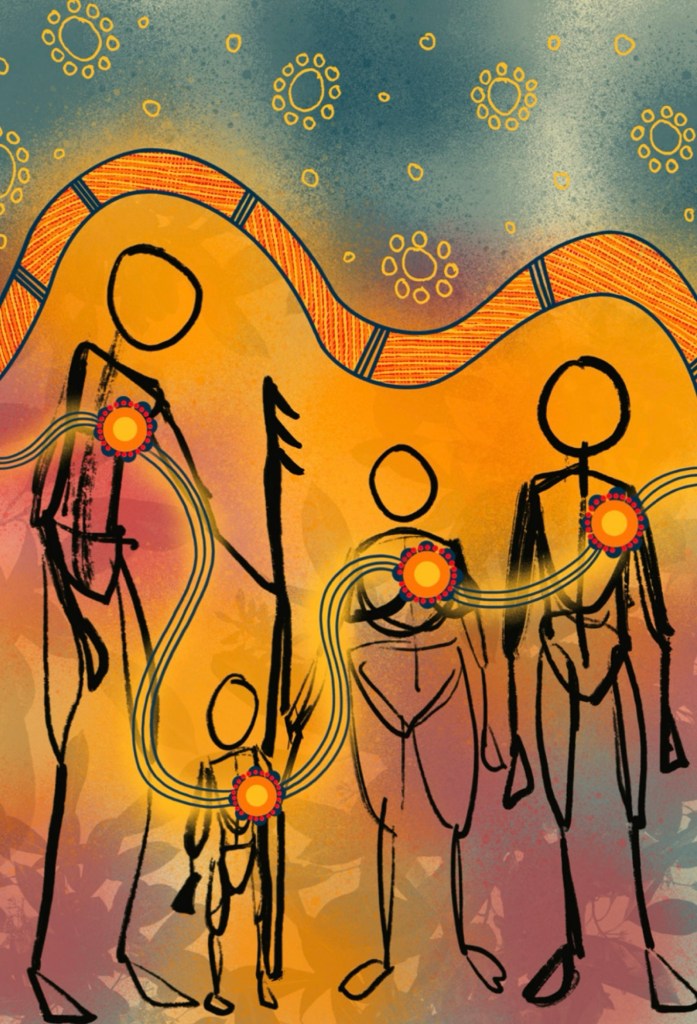
Artwork by Zoe Belle, Guwa Koa and Kuku Yalanji woman

Prayer of Confession

Merciful God, as Second Peoples of this land, whose ancestors travelled and settled in Australia, we acknowledge with sorrow the injustice and abuse that has so often marked the treatment of the First Peoples of this land.

We acknowledge with sorrow the way in which their land was taken from them; the way their their language, culture and spirituality was suppressed.

We acknowledge with sorrow that the Christian church was so often not only complicit in this process but actively involved in it.

We acknowledge with sorrow that in our own time the injustice and abuse has continued.

We have been indifferent when we should have been outraged, we have been apathetic when we should have been active, we have been silent when we should have spoken out.

Gracious God, forgive us for our failures, past and present. By your Spirit, transform our minds and hearts so that we may boldly speak your truth and courageously do your will. Through Jesus Christ our Lord. Amen.

Reading Isaiah 62:1–5

For Zion’s sake I will not keep silent,
and for Jerusalem’s sake I will not rest,
until her vindication shines out like the dawn,
and her salvation like a burning torch.
The nations shall see your vindication,
and all the kings your glory;
and you shall be called by a new name
that the mouth of the LORD will give.
You shall be a crown of beauty in the hand of the LORD,
and a royal diadem in the hand of your God.
You shall no more be termed Forsaken,
and your land shall no more be termed Desolate;
but you shall be called My Delight Is in Her,
and your land Married;
for the LORD delights in you,
and your land shall be married.
For as a young man marries a young woman,
so shall your builder marry you,
and as the bridegroom rejoices over the bride,
so shall your God rejoice over you.

Reflection

We all know, I expect, what it feels like to be deeply disappointed; let down, betrayed, forsaken, abandoned. The emotions felt at such a time—emotions of despair and desolation—are named in the reading from Isaiah 62 which we have heard today. 

This part of Isaiah comes from the time when the exiles from Israel were returning to their land, leaving behind the difficulties they experienced during their five decades of exile in the foreign land of Babylon. They had returned to a devastated city; it probably looked like the images we have seen on our TVs, from bombed residential areas in Syria and Gaza, to the devastation of mass destruction of buildings from tornadoes in Florida and Louisiana and fires in Los Angeles. 

In just such a setting, as the people laboured day and night to rebuild and restore their beloved city, an unnamed prophet speaks out, bringing a word of hope: “You shall no more be termed Forsaken, and your land shall no more be termed Desolate, but you shall be called My Delight Is in Her and your land Married.” The hope that the prophet offers is of a time when desolation is left behind, when the sense of being forsaken has been replaced by loving acceptance and care and belonging; the language of a marriage provides a good analogy.

There are people in our midst, in this town, across this country, who know that sense of desolation and being forsaken. Today we remember them, especially, on a day which the Uniting Church now names as the annual Day of Mourning. On this day, we remember that First Peoples, custodians of this land since time immemorial, caring for creation in their respectful lifestyle and customs, were invaded, colonised, massacred, marginalised, and demonised.

The massacres across the country that took place from the early years of British settlement into the second decade of the 20th century, and the shattering of families by the removal of the stolen children, which lasted well into the 1960s, have given the Gringai, Worimi, Biripi, Wonnarua, and many other peoples cause for ongoing lament and despair. Many still alive today remember what was done to them or to their parents and grandparents. The pain is live.

So on this Day of Mourning, we commit to standing with the First Peoples, acknowledging their pain, sharing their distress (to the extent that we can), treating them respectfully, and committing to work for justice for the First Peoples today. We should know that their pain is still real, present, and powerful. 

The referendum held last year offered a ray of hope across the country; fuelled by a campaign of disinformation that played on fears and prejudices, that hope was shattered. The Uniting Church had joined with many other Christian denominations, and leaders of a number of faith communities, to advocate a Yes vote. We have shared in the disappointment of First Peoples, and the sense that this is yet another hurt that they have to bear.

On Australia Day in 1938, a large group of protestors marched through the streets of Sydney, followed by a congress attended by over a thousand people. One of the first major civil rights gatherings in the world—decades before Martin Luther King Jr led massive rallies in the USA—it was known as the Day of Mourning. Following the congress, a deputation led by William Cooper presented Prime Minister Joseph Lyons with a proposed national policy for Aboriginal people. Unfortunately, this was rejected because the Government did not hold constitutional powers in relation to Aboriginal people. That changed in 1967.

From 1940 until 1955, the Day of Mourning was held annually on the Sunday before Australia Day and was known as Aborigines Day. In 1955 Aborigines Day was shifted to the first Sunday in July after it was decided the day should become not simply a protest day but also a celebration of Aboriginal culture. This led to the formation of the National Aborigines Day Observance Committee (NADOC), which later then became NAIDOC, the week in July focussed on remembering Aboriginal people and their heritage.

In 2018, At the Uniting Church Assembly in Melbourne—which Elizabeth and I attended—it was decided to reinstate an annual Day of Mounring on the Sunday before Australia Day. So we stand in a grand tradition, and we stand in solidarity with our brothers and sisters, people who have cared for this land over millennia—many, many thousands of years. 

This year, President Charissa Suli and Congress chairperson Mark Kickett invite us “to listen deeply and learn humbly, and bear one another’s burdens; to receive the outstretched hand of friendship offered in grace and hope, and to trust in Jesus, whose reconciling love continues to mend the brokenness within and among us.”

They remind us that “the same ancient Spirit of God which has always been present in these lands has given us ‘a destiny together’ as the body of Christ in this time and place”, and so invite us “to celebrate the immense gift we have in each other [as First and Second Peoples], giving thanks for the transformative and boundless love of Christ which holds us.”

Let us pray.

Gracious God, we know that reconciliation between First and Second Peoples is a challenge. We sense that this must begin with reconciling ourselves in truth and humility with you, our God.

We know that is then that we can do the work of being peacemakers and justice seekers.

So help us to act responsibly and respectfully, to care for one another and to support one another. Amen.

We sing The Aboriginal Lord’s Prayer

Artwork by Zoe Belle, Guwa Koa and Kuku Yalanji woman

Prayers adapted from the resources for the Day of Mourning 2025, https://uniting.church/wp-content/uploads/2024/12/Day-of-Mourning-2025_Final.pdf

Artwork by Zoe Belle, Guwa Koa and Kuku Yalanji woman. “The artworks depict the story of Christ’s presence being amongst First Peoples of these lands of his creation for generations. His teachings have long been displayed within the stories, songs, dances and ceremony First Peoples have used them to connect with God as great Creator and teacher for our communities.”

Good news to the oppressed, liberty to the captives: a message of hope (Isaiah 61; Narrative Lectionary for Advent 3C)

For this coming Sunday, the Narrative Lectionary is offering a very familiar passage from Third Isaiah, that part of the long book of Isaiah that is usually dated to a time when the exiles were returning from Babylon and re-establishing life in Jerusalem and the surrounding area. The passage (Isa 61:1–11) is best known within Christianity as providing the key elements for the manifesto that Jesus—at least in Luke’s Gospel—sets out to follow. 

Luke reports that Jesus quotes the opening verse of this oracle when he attends the synagogue in his hometown of Nazareth and was invited to read from the scroll of Isaiah (Luke 4:16–20). Most famously, Luke places the opening verse of the prophet on the lips of Jesus, and the first line of verse 2—but then stops short of quoting what follows, regarding “the day of vengeance of our God” and the mourning that will be associated with the mixed emotions of returning to a devastated city and engaging in the rebuilding programme: “they shall build up the ancient ruins, they shall raise up the former devastations; they shall repair the ruined cities, the devastations of many generations” (Isa 61:4).

The passage offered by the lectionary needs to be seen, primarily, within the context in which it was first spoken. The third section of the book of Isaiah (chapters 56–66) has begun with a familiar prophetic announcement: “maintain justice, and do what is right, for soon my salvation will come, and my deliverance be revealed” (Isa 56:1). As the people of Judah were returning to their land, to the city of Jerusalem (from the 520s BCE), the book sets out what this justice will look like through a series of powerful oracles.

The prophet sounds a vivid counter-cultural note in the midst of the events of his time. He begins with the promise to foreigners and eunuchs that “I will give, in my house and within my walls, a monument and a name better than sons and daughters; I will give them an everlasting name that shall not be cut off” (Isa 56:5). This is a striking contrast to the narrative provided in the books of Ezra and Nehemiah, which tell of the return to the city, the rebuilding of the walls, the renewal of the covenant and the public reading of the Law, the rededication of the Temple—and actions designed to remove foreigners (especially women) from within Israel (see Ezra 10; Neh 13). 

Ezra and Nehemiah exhibited a zealous fervour to restore the Law to its central place in the life of Israel. Ezra, learning that “the holy seed has mixed itself with the peoples of the lands” (Ezra 9:2), worked with “the elders and judges of every town” to determine who had married foreign women; the men identified “pledged themselves to send away their wives, and their guilt offering was a ram of the flock for their guilt” (Ezra 10:19). (So much for the importance of families!)

 Nehemiah considered that this project to “cleanse [the people] from everything foreign” (Neh 13:30) was in adherence to the command that “no Ammonite or Moabite should ever enter the assembly of God, because they did not meet the Israelites with bread and water, but hired Balaam against them to curse them” (Neh 13:1–2; see Num 22—24). The restoration of Israel as a holy nation meant that foreigners would be barred from the nation.

The oracle at the start of the third section of Isaiah stands in direct opposition to this point of view; “the foreigners who join themselves to the Lord … and hold fast my covenant—these I will bring to my holy mountain, and make them joyful in my house of prayer; their burnt offerings and their sacrifices will be accepted on my altar; for my house shall be called a house of prayer for all peoples” (Isa 56:6–7). 

Jesus, of course, quoted this last phrase in the action he undertook in the outer court of the Temple (Mark 11:17). Later, the welcome offered to the Ethiopian court official by Philip, who talked with him about scripture and baptised him, a eunuch (Acts 8:26–38), is consistent with the prophetic words, “to the eunuchs who keep my sabbaths, who choose the things that please me and hold fast my covenant, I will give them an everlasting name that shall not be cut off” (Isa 56:4–5). (From the earliest days, the church practised an inclusive welcoming of diversity that was consistent with this prophetic declaration.)

Other words in this last section of Isaiah also resonate strongly with texts in the New Testament. The ingathering of the outcasts (56:8) and the flocking of all the nations to Zion (60:1–18) together are reflected in the prediction of Jesus that “this good news of the kingdom will be proclaimed throughout the world, as a testimony to all the nations; and then the end will come” (Matt 24:14). 

The statement that those coming from Sheba “shall bring gold and frankincense, and shall proclaim the praise of the Lord” (60:6) most likely informed the story that Matthew created, concerning the wise ones from the east who came to see the infant Jesus and “offered him gifts of gold, frankincense, and myrrh” (Matt 2:11).

Further oracles set out exactly what the justice that God desires (56:1; 61:8) looks like. The extensive worship of idols (57:1–13) will bring God’s wrath on the people; “there is no peace, says my God, for the wicked” (57:13). Rather, “the high and lofty one who inhabits eternity, whose name is Holy” chooses “to revive the spirit of the humble and to revive the heart of the contrite” (57:15). 

Because God indicates that “I will not continually accuse, nor will I always be angry” (57:16), the prophet conveys what the Lord sees as the fast that is required; not a fast when “you serve your own interest on your fast day, and oppress all your workers” (58:3), but rather, a fast “to loose the bonds of injustice, to undo the thongs of the yoke, to let the oppressed go free, and to break every yoke … to share your bread with the hungry, and bring the homeless poor into your house; when you see the naked, to cover them, and not to hide yourself from your own kin” (58:6–7). These words resonate with the actions of “the righteous” in the well-known parable of Jesus, as they gave food, water, a welcome, clothing, and care to those sick or imprisoned (Matt 25:31–46).

The prophet laments that “there is no justice … justice is far from us … we wait for justice, but there is none … justice is turned back … the Lord saw it, and it displeased him” (59:8–15); he declares that, as a consequence, God “put on righteousness like a breastplate, and a helmet of salvation on his head; he put on garments of vengeance for clothing, and wrapped himself in fury as in a mantle” (59:17)—a description that underlines the later exhortations to the followers of Jesus to “put on the whole armour of God, so that you may be able to stand against the wiles of the devil” (Eph 6:10–17).

Because the Lord “loves justice” (61:8), the prophet has been anointed “to bring good news to the oppressed, to bind up the brokenhearted, to proclaim liberty to the captives, and release to the prisoners; to proclaim the year of the Lord’s favour, and the day of vengeance of our God” (61:1–2)—words which are appropriated by Jesus when he visits his hometown and reads from the scroll of Isaiah (Luke 4:18–19); “today this scripture has been fulfilled in your hearing”, Jesus declares (Luke 4:21).

Adhering to this way of justice, practising the fast that the Lord desires, means that he will give Israel a new name: “you shall no more be termed Forsaken, and your land shall no more be termed Desolate; but you shall be called My Delight Is in Her, and your land Married; for the Lord delights in you, and your land shall be married” (Isa 62:4). We have already seen the symbolic significance of names in considering the prophet Hosea and in Isaiah 8.

By contrast, vengeance will be the experience of Edom; using the image of trampling down the grapes in the wine press, the prophet reports the intention of God: “I trampled down peoples in my anger, I crushed them in my wrath, and I poured out their lifeblood on the earth” (63:1–6). So vigorously does God undertake this task, that he is attired in “garments stained crimson” because “their juice spattered on my garments and stained all my robes” (63:1–3). Once again, the prophet speaks in graphic terms.

Confronted with this display of wrath and vengeance, the prophet adopts an attitude of penitence, yearning for God to “look down from heaven and see, from your holy and glorious habitation” (63:15). His plea for the Lord to “tear open the heavens and come down, so that the mountains would quake at your presence—to make your name known to your adversaries, so that the nations might tremble at your presence!” (64:1–2) must surely have been in the mind of the evangelists as the reported the baptism of Jesus, when he “saw the heavens torn apart and the Spirit descending like a dove on him” (Mark 1:10).

The book ends with a sequence in which the prophet reports the words of the Lord which indicate that Israel will be restored (65:1–16), followed by the statement that the Lord is “about to create new heavens and a new earth” (65:17–25; 66:22–23).

This vision is taken up and expanded in the closing chapters of the final book of the New Testament (Rev 21:1–22:7). The closing vision of Trito-Isaiah incorporates a number of references to earlier prophetic words: building houses and planting vineyards (65:21) recalls the words of Jeremiah (Jer 29:5–7); the image of wolves lying with lambs and lions “eating straw like the ox” recalls the vision of Isaiah (Isa 11:6–7). 

The promise that “they shall not hurt or destroy all on my holy mountain” (65:25) recalls that same vision of Isaiah (Isa 11:9), whilst the next promise about not labouring in vain nor bearing children for calamity (65:23) reverses the curse of Gen 3:16–19. The story of creation from the beginning of Genesis is evoked when the Lord asserts that “heaven is my throne and the earth is my footstool … all these things my hand has made” (66:1–2); these are the words which Stephen will quote back to the council in Jerusalem (Acts 7:48–50) and will lead to his death at their hands.

Even to the very end of this book, the judgement of the Lord is evident; the prophet declares that “the Lord will come in fire, and his chariots like the whirlwind, to pay back his anger in fury, and his rebuke in flames of fire; for by fire will the Lord execute judgment, and by his sword, on all flesh; and those slain by the Lord shall be many” (66:15–16). 

Nevertheless, the glory of the Lord shall be declared “among the nations” (66:19) and “they shall bring all your kindred from all the nations as an offering to the Lord” (66:20). The universalising inclusivism that was sounded at the start of this prophet’s work is maintained through into this closing oracle. In “the new heavens and the new earth which I will make … all flesh shall come to worship before me, says the Lord” (66:22–23). The vision lives strong!