A fully-developed theology from just one psalm? (Psalm 119; Pentecost 7A) §1

I set myself a challenge: develop a fully-rounded theology from just one psalm. Easy, I thought; the shortest psalm, 117, has a number of key elements in its two verses: praise (“praise the Lord” twice, at the beginning and the end), adoration (“extol him”), a recognition of divine love (“great is his steadfast love towards us”), the universal orientation of that love (“all peoples”), and the assurance of divine fidelity (“the faithfulness of the Lord endures forever”).

There: done and dusted! … although, I think, on further reflection, that this looks more like the outline of a litany (praise—adoration—intercession —blessing) than a fully-developed theology. As a litany, it is succinct; as a theology, it is still quite deficient.

So, what about a challenge to develop a fully-rounded theology, not from the shortest psalm, but from the longest psalm? For just two psalms later, we have the 176–verse grand acrostic of the Hebrew Scriptures: Psalm 119—a small portion of which (119:105–112) is offered by the lectionary this coming Sunday. What would a theology look like, using only the verses in this psalm? And how full (or inadequate) would that theology be?

I love the way that this wonderfully artistic creation contains key elements of a theological understanding of the world. There are components regarding the nature of God, the human condition, and the divine response to that human condition. There is much to be gleaned regarding revelation and also salvation. And there are indications that touch on the character of living a faithful life, as well as signs of what the future is to be. All of these elements contribute to a fully-developed theology, surely?

This longest psalm of all, Psalm 119, is an acrostic series of 22 eight-verse stanzas (arranged alphabetically) in which the author(s) consistently affirm the value and importance of the teaching (Hebrew, torah) which sits at the centre of faith for the person singing this psalm. “I will delight in your statutes; I will not forget your word” (Ps 119:16). By contrast to “the arrogant”, whose “hearts are fat and gross”, the psalmist declares, “I delight in your law” (Ps 119:70).

The psalm includes the petition, “let your mercy come to me, that I may live, for your law is my delight” (Ps 119:77), noting that “if your law had not been my delight, I would have perished in my misery” (Ps 119:92). It also affirms, “I long for your salvation, O Lord, and your teaching (torah) is my delight” (Ps 119:74). Echoing these words many centuries later, Paul, in the midst of his agonising about Torah in Romans 7, is able to affirm, “I delight in the law of God in my inmost self” (Rom 7:22). Delight for the Law runs through Jewish history.

This longest of all psalms is a series of 22 meditations on teachings, or Torah, which is usually translated as “law”. It contains regular affirmations of the place of Torah in personal and communal piety: “give me understanding, that I may keep your law and observe it with my whole heart” (v.34); “Oh, how I love your law! it is my meditation all day long” (v.97).

The psalmist contrasts their devotion to Torah with those who neglect or ignore it: “I hate the double-minded, but I love your law” (v.113); “I hate and abhor falsehood, but I love your law” (v.163). They rejoice that “great peace have those who love your law; nothing can make them stumble” (v.165). From this long and persistent affirmation of Torah throughout all 22 stanzas, we can indeed devise a fully-fledged theology, canvassing many of the key issues that we have come to associate with theology.

(In what follows, I will refer to the psalmist as “they”, making no assumptions about who they were, even their gender. As psalms were collective songs, it is reasonable to suggest that they were developed within the community, by members of the community—so “ they” is a reasonable assumption, I feel.)
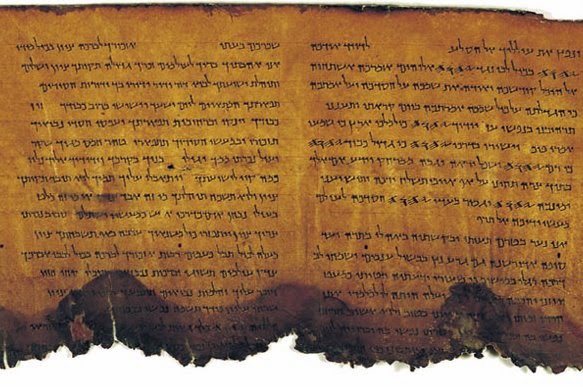
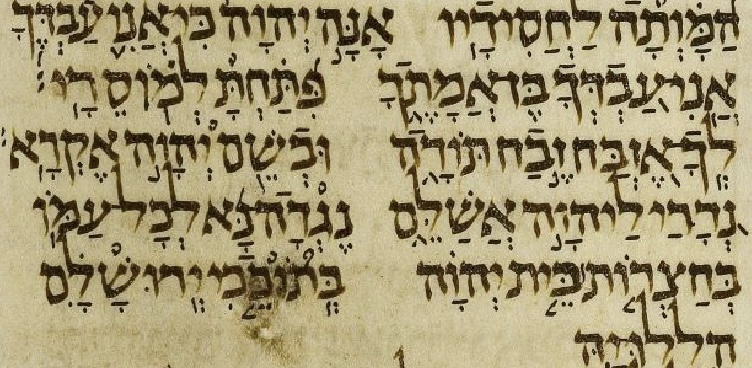
4QPs Dead Sea Scroll Psalm 119 from the First Century CE

1 God

Undergirding the joyful appreciation of Torah in the lengthy psalm is a consistent trust in God, who is consistently acknowledged as the author and giver of Torah, but is also celebrated as creator: “your hands have made and fashioned me” (v.73). That affirmation reflects famous words sung in another psalm, “I praise you [God], for I am fearfully and wonderfully made; wonderful are your works; that I know very well” (Ps 139:14).

God’s creative power is at the centre of Hebrew Scripture. It is celebrated in passing in many psalms (Ps 8:3–8; 33:6–7; 74:16–17; 95:4–5; 96:5; 100:3; 103:14; 115:15; 121:2; 124:8; 136:4–9; 146:5–6); in the majestic celebratory psalm, Psalm 104, which rejoices, “Lord, how manifold are your works! In wisdom you have made them all” (Ps 104:24); and in the carefully-crafted priestly account of creation that stands at the head of Hebrew Scripture (Gen 1:1–2:4a). It is noted with appreciation also in psalm 119 (v.73).

A second element in this psalm is that God’s mercy is valued; “great is your mercy, O Lord” (v.156), and so the psalmist prays, “let your mercy come to me, that I may live; for your law is my delight” (v.77). This is a common refrain in other psalms, where God is asked to show mercy (Ps 25:6; 40:11; 51:1; 123:2, 3). As one proverb says, “no one who conceals transgressions will prosper, but one who confesses and forsakes them will obtain mercy” (Prov 28:13). A similar sentiment is offered by Isaiah: “the Lord waits to be gracious to you; therefore he will rise up to show mercy to you, for the Lord is a God of justice; blessed are all those who wait for him” (Isa 30:18).

Then, we might note the love of God. A recurrent refrain in Hebrew Scripture is a celebration of “the steadfast love of the Lord” (Exod 34:6; 2 Chron 30:8–9; Neh 9:17, 32; Jonah 4:2; Joel 2:13; Ps 86:15; 103:8, 11; 111:4; 145:8–9). This affirmation presents God as “merciful and gracious, slow to anger, and abounding in steadfast love and faithfulness, keeping steadfast love for the thousandth generation”.

God is praised for showing love by redeeming the people in the Exodus (Exod 15:13) and then guaranteeing abundance in the land is promised to the people: “he will love you, bless you, and multiply you; he will bless the fruit of your womb and the fruit of your ground, your grain and your wine and your oil, the increase of your cattle and the issue of your flock, in the land that he swore to your ancestors to give you”, says Moses (Deut 7:13).

Solomon later praises God, saying “you have shown great and steadfast love to your servant my father David … and you have kept for him this great and steadfast love, and have given him a son to sit on his throne today” (1 Ki 3:6; also 2 Chron 1:8), and then as he dedicates the Temple, he prays “there is no God like you in heaven above or on earth beneath, keeping covenant and steadfast love for your servants who walk before you with all their heart” (1 Ki 8:23; 2 Chron 6:14).

When the foundations of the Temple are laid, after it has been destroyed by the Babylonians, the people sing, “praising and giving thanks to the Lord, ‘for he is good, for his steadfast love endures forever toward Israel” (Ezra 3:11). When a covenant renewal ceremony takes place under Nehemiah, he addresses God as “a gracious and merciful God” and continues, “the great and mighty and awesome God, keeping covenant and steadfast love” (Neh 9:31–32). A number of prophets refer to God’s enduring, steadfast love (Isa 16:5; 43:4; 54:8, 10; 63:7; Jer 9:24; 31:3; 33:11; Dan 9:4; Hos 2:19; 11:3–4; Jonah 4:2; Micah 7:18–19; Zeph 3:17).

Reference is made to the steadfast love of God on seven occasions in this psalm (verses 41, 64, 76, 88, 124, 149, and 159). Such love is often linked with Torah—“the earth, O Lord, is full of your steadfast love; teach me your statutes” (v.64); and again, “deal with your servant according to your steadfast love, and teach me your statutes” (v.124). An important function of Torah is thus to communicate the extent of divine live.

In tandem with God’s mercy and steadfast love, so divine justice is also noted. “Great is your mercy, O Lord; give me life according to your justice” (v.156); and “in your steadfast love hear my voice; O Lord, in your justice preserve my life” (v.149).

Justice, of course, is at the heart of the covenant that God made with Israel. Moses is said to have instructed, “justice, and only justice, you shall pursue” (Deut 16:20), the king is charged with exhibiting justice (Ps 72:1–2; Isa 32:1), whilst many prophets advocate for justice (Isa 1:17; 5:7; 30:18; 42:1–4; 51:4; 56:1; Jer 9:24; 22:3; 23:5; 33:15; Ezek 18:5–9; 34:16; Dan 4:37; Hos 12:6; Amos 5:15, 24; Mic 3:1–8; 6:8).

So God, says the psalmist, holds the people of the covenant to the standard set in Torah: “you rebuke the insolent, accursed ones, who wander from your commandments” (Ps 119:21). The assumption throughout this psalm is that the creator God is personal, approachable, relatable; just and fair, kind and loving.

See further posts at
Psalm 86: a primer of prayer (Pentecost 4A) part II

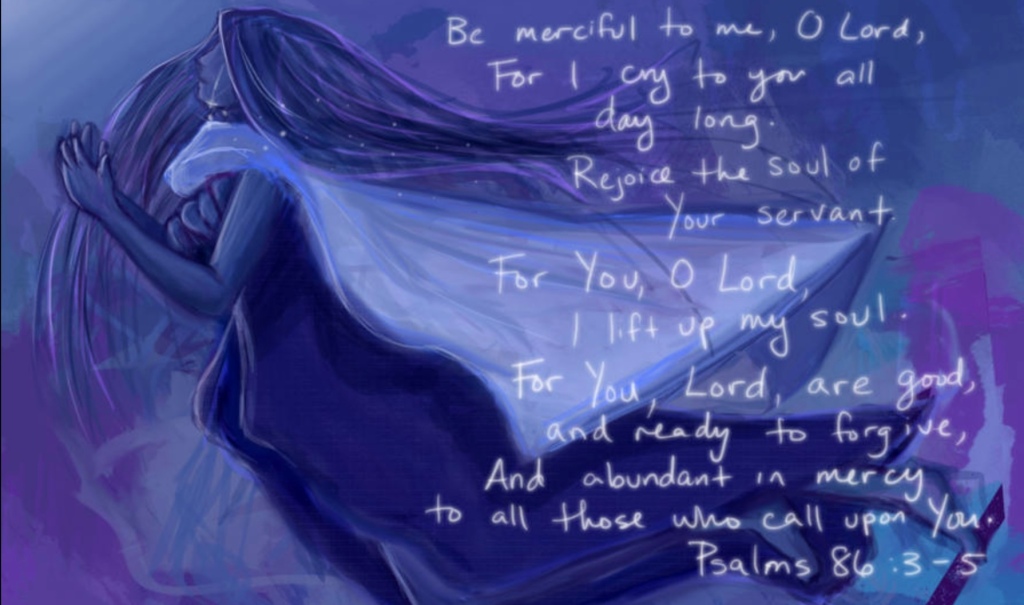
Psalm 86 is offered by the lectionary for this coming Sunday, the Fourth Sunday after Pentecost. This psalm comprises a string of prayers, offering petition, thanksgiving, adoration, and intercession, filled with phrases that occur in other psalms and prayers in Hebrew Scripture. Although some commentators have criticised it for being unoriginal, it serves an important purpose, collating many phrases that can serve well those who pray.

In an earlier blog, I considered the structure of this psalm, and explored three types of prayers that are to be found in it: thanksgiving, adoration, and intercession. See

In this blog, I turn my attention to the petitions that are included in this psalm. The opening section (verses 1–7) includes a substantial collection of petitions to be prayed in times of trouble. Along with the further petitions in verse 11 and verses 16–17, there are a total of eleven petitions to God in this psalm. Let’s consider each of them in turn.

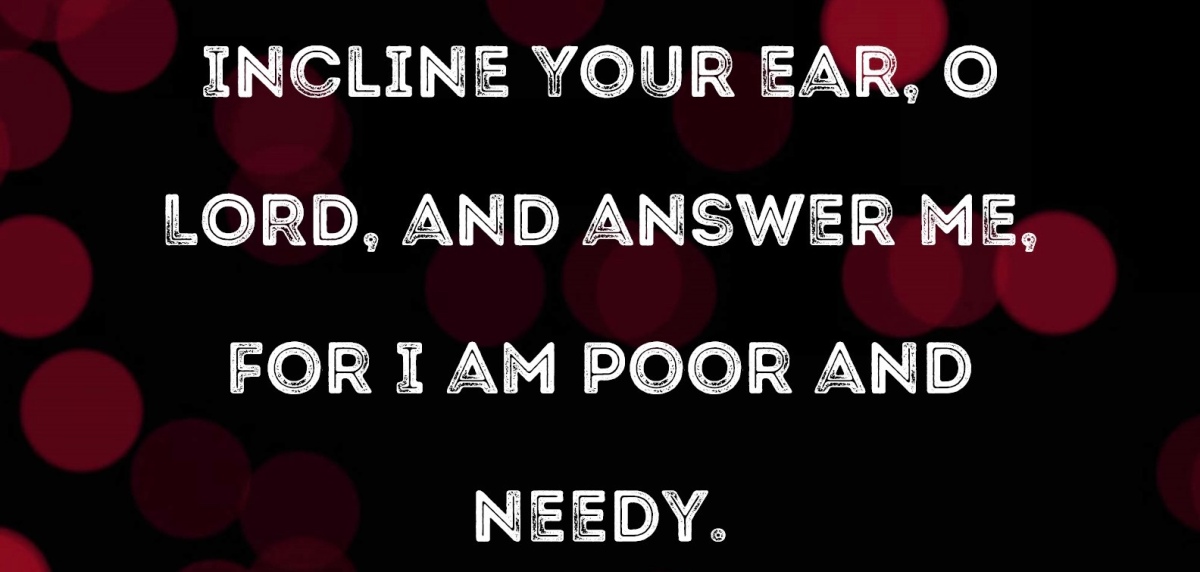
“Incline your ear, O Lord” (v.1) is a request made in other psalms (Ps 17:6; 31:2; 71:2; 88:2; 102:2); in one psalm, there is a confidence that God “will hear the desire of the meek … will strengthen their heart … will incline your ear to do justice” (10:17–18). Likewise, a number of psalms include the request for God to “answer me” (v.1; see Ps 4:1; 13:3; 27:7; 55:2; 69:13, 16, 17; 102:2; 108:6; 119:145; 143:1, 7). In one psalm the author affirms that “I call upon you, for you will answer me, O God” (Ps 17:6); likewise, in Ps 86, the psalmist affirms with confidence that “in the day of my trouble I call on you, for you will answer me” (v.7).

In the same verse, the psalmist describes themselves: “I am poor and needy” (v.1)—a self-description also offered at Ps 40:17; 70:5; and 109:22. The phrase is placed in parallel with “the downtrodden” at Ps 74:21. That God stands with the poor and needy is asserted regularly in the psalms; “because the poor are despoiled, because the needy groan, I will now rise up, says the Lord; I will place them in the safety for which they long” (Ps 12:5).

So God “raises the poor from the dust and lifts the needy from the ash heap” (Ps 113:7); God “maintains the cause of the needy and executes justice for the poor” (Ps 140:12). “As for me, I am poor and needy, but the Lord takes thought for me; you are my help and my deliverer, O God” (Ps 40:17; also 70:5). And the psalmist pleads that the king will “judge your people with righteousness and your poor with justice … defend the cause of the poor of the people, give deliverance to the needy” (Ps 72:2, 4)

“Preserve my life” is the next petition (v.2), echoing the same prayer found at Ps 64:1; 79:11; 119:49, 159; 143:11; a prayer made on the basis that God is “a hiding place for me [for] you preserve me from trouble” (Ps 32:7), for “though I walk in the midst of trouble, you preserve me against the wrath of my enemies” (Ps 138:7).

The psalmist undergirds this request to God with the declaration, “I am devoted to you” (v.2), a phrase that might also be translated as “I am a godly person” or “I am a faithful person”. The Hebrew word used here, hasid, is the basis for the contemporary group of ultra-conservative Orthodox Jews known as Hasidic Jews. Many psalms uses this word as a description for those in Israel who were godly people (Ps 12:1; 52:1) or faithful people (Ps 4:3; 16:10; 30:4; 32:6; 37:28; 50:5; 52:9; 79:2; 85:8; 89:19; 97:10; 116:15; 132:9, 16; 145:10). The NRSV also translates this word as blameless (Ps 18:25) and as saints (Ps 31:23).

*****

The plea of the psalmist for God to “save” them (v.2) is another persistent refrain throughout the psalms—both “save me” (Ps 6:4; 7:1; 22:21; 31:2, 16; 44:6; 54:1; 57:3; 59:2; 69:1; 71:2, 3; 109:26, 116:4; 119:94, 146; 142:6; 143:9) and “save us” (Ps 28:9; 31:2; 80:2; 106:47; 118:25). This is a request grounded in the assurance that “God is my shield, who saves the upright in heart” (Ps 7:10); “the Lord is near to the brokenhearted, and saves the crushed in spirit” (Ps 34:18); God “fulfils the desire of all who fear him; he also hears their cry, and saves them” (Ps 145:19). Of course , God as Saviour is an important Hebraic way of understanding the divine, that then has implications and influence as the New Testament documents are written, centuries later.

The self-description of the psalmist in this verse, as “your servant who trusts in you” (v.2), is a description found also in verses 4 and 16. The writer presents themselves as God’s servant in a number of other psalms (Ps 19:11, 13; 27:9; 31:16; 35:27; 69:17; 109:28; 116:16; 143:2, 12) as well as twelve times in Psalm 119 (vv.17, 23, 38, 49, 65, 76, 84, 124, 125, 135, 140, 176).

The attitude of trust in God (v.2) is a stance which is shared with other psalms. “Those who know your name put their trust in you, for you, O Lord, have not forsaken those who seek you”, the psalmist sings (Ps 9:10). “O my God, in you I trust; do not let me be put to shame; do not let my enemies exult over me” (Ps 25:2), they sing, affirming that “steadfast love surrounds those who trust in the Lord” (Ps 32:10), “happy are those who make the Lord their trust” (Ps 40:4), and “in God I trust; I am not afraid” (Ps 56:4; and similar, 55:23).

“Be gracious to me, O Lord” (v.3) is yet another petition that is typical of the psalms. The psalmist regularly implores God, “be gracious to me, for I am in distress” (Ps 31:9; similarly, 6:2; 9:13; 56:1), or “be gracious to me, and hear my prayer” (Ps 4:1), or “be gracious to me and answer me” (Ps 27:7), or simply, “be gracious to me” (Ps 25:16; 26:11; 30:10; 41:4).

In one song, the psalmist muses, “has God forgotten to be gracious?” (Ps 77:9), but in typical style, this cry of lament transforms into words of praise, for “you are the God who works wonders … with your strong arm you redeemed your people” (Ps 77:11–20). God showing grace towards God’s faithful people is indeed “your custom toward those who love your name” (Ps 119:132).

The cry for God to be gracious is a constant and insistent plea, “for to you do I cry all day long” (v.3). The cry of the psalmist is expressed often (Ps 3:4; 5:2; 17:1; 18:6; 27:7; 28:2; 39:12; 57:2; 61:1; 77:1; 88:1–2; 102:1; 119:146–147, 169; 120:1; 142:1, 5–6). Even though the psalmist cries to God “with my whole heart” (Ps 119:145), there are times when this cry feels futile; “I cry by day, but you do not answer me, and by night, but find no rest” (Ps 22:2), and “O Lord, I cry out to you; in the morning my prayer comes to you; why do you cast me off? why do you hide your face from me?” (Ps 88:13–14).

Yet the psalmist is persistent, crying “all day long” (v.3); this mirrors the oppression and distress experienced by the psalmists “all day long”. Various psalms reflect “sorrow in my heart all day long” (Ps 13:2), “groaning all day long” (Ps 32:3), “all day long I go around mourning” (Ps 38:6), “all day long I have been plagued” (Ps 73:14). “All day long my foes oppress me” (Ps 56:1), laments the psalmist, “all day long my enemies taunt me” (Ps 102:8), even bemoaning that “we are being killed all day long” (Ps 44:22). Extended personal distress seems to mark a number of psalms.

However, in other psalms, we have affirmations that “the eyes of the Lord are on the righteous and his ears are open to their cry” (Ps 34:15); “when the righteous cry for help, the Lord hears” (Ps 34:17); “I waited patiently for the Lord; he inclined to me and heard my cry” (Ps 40:1); “he regarded their distress when he heard their cry” (Ps 106:44). As the psalmist cries “out of the depths”, so they are assured that “with the Lord there is steadfast love, and with him there is great power to redeem” (Ps 130:1–8).

The same dynamic, of calling out to God and anticipating an answer, is sung in the petition in v.6, “give ear, O Lord, to my prayer”. This is found in ten other psalms (Ps 5:1; 17:1; 39:12; 54:2; 55:1; 80:1; 84:8; 140:6; 141:1; 143:1), and the parallel request, “listen to my cry of supplication” (v.6) is also offered in two other psalms (Ps 5:2; 61:1).

The psalmist’s confidence that, “on the day of my trouble I call on you, for you will answer me” (v.7), is also reflected at Ps 17:6. This confidence is undergirded by the words spoken by God to those who trust in God: “those who love me, I will deliver; I will protect those who know my name; when they call to me, I will answer them” (Ps 91:14–15).

Verse 11 moves from the offering of prayers and anticipation of receiving answers, to the request to “teach me your way, O Lord, that I may walk in your truth”. The language here reflects another common element in the relationship between the psalmist and the divine, as a student learning from a teacher.

“Teach me” (v.11) is what the psalmist asks for, seeking to be taught “your ways … your paths … your truth” (Ps 25:4–5), “your way” (27:11; 143:8), “your will” (Ps 143:10), “the fear of the Lord” (Ps 34:11), and “wisdom in my secret heart” (Ps 51:6). Throughout the longest psalm of all, there are regular petitions for the Lord to teach “your statutes” (Ps 119:12, 26, 33, 64, 68, 124, 171) as well as “good judgement and knowledge” (Ps 119:66). The psalmists appear to be keen students, thirsting for knowledge.

The next request is for God to “give me an undivided heart” (v.11)—an unusual request, not found in any other psalm, and using a Hebrew word that appears in only two other places in Hebrew Scripture (Gen 49:6; Isa 14:20). The purpose of this request, “to revere your name” (v.11), draws on a very common Hebrew word, found often in the formulaic “do not be afraid” (Gen 15:1;21:17;26:24; 35:17;46:3; Exod 14:13; 20:20; etc.; and on into New Testament texts). This is no fear in the sense of negative terror, for the psalmist clearly draws on the positive sense of the verb, yare’, to indicate a reverence towards God.

*****

In the final set of verses, there are three further petitions worthy of note. “Turn to me and be gracious to me” (v.16) is a petition repeated exactly (Ps 25:16; 119:132) and in shortened form, “turn to me” (Ps 69:16; 119:79). “Give your strength to your servant” (v.16) recalls the closing verse of a powerful nature psalm, “may the Lord give strength to his people! may the Lord bless his people with peace!” (Ps 29:11). The latter part of verse 16, “save the child of your serving girl”, echoes the petition of verse 2, “save your servant who trusts in you”, which we have dealt with above.

Finally, “show me a sign of your favour” (v.17) does not reflect any other psalm, but does evoke the petition of Gideon to the Lord, “now I have found favour with you, then show me a sign that it is you who speak with me” (Judg 6:17).

The purpose of this sign which is sought by the psalmist, “so that those who hate me may see it and be put to shame” (v.17), does however reflect a common request across a number of psalms, pleading for enemies to be “put to shame” (Ps 6:10; 31:17; 35:4, 26; 40:14; 50:5: 57:3; 70:2; 71:13, 24; 83:17; 97:7;109:28; 119:78; 129:5). The other side of this petition is the request, “do not let me be put to shame” (Ps 25:2, 20; 31:1, 17; 71:1; 119:31, 116).

*****

And so we can see that throughout this psalm, in offering petition, thanksgiving, adoration, and intercession, the psalmist has made use of many phrases that occur in other psalms and prayers in Hebrew Scripture. This psalm, a primer for prayer, serves an important purpose, as it draws together many phrases that can serve well those who pray.

Psalm 86: a primer of prayer (Pentecost 4A) part I

Christians are used to praying The Lord’s Prayer on a regular basis, in obedience to the instructions of Jesus recorded in two Gospels: “when you pray, say …” (Luke 11:2; Matt 6:9). This prayer can be considered a succinct primer for prayer, since it contains the key elements of praying.

After an opening adoration of God (“our Father in heaven, holy is your name”), there follows prayers for the world (“your kingdom come, your will be done”), petitions for ourselves (“give us bread for the day, forgive us our sins, do not bring us to the time of trial”), and intercessions for others (“as we forgive those who sin against us”). In the later version of the prayer, a closing benediction is included (“yours is the kingdom, the power, the glory”), ending, of course, with “Amen”. The pattern is clear and concise. See

and

and

There is a similar primer for prayer in Hebrew Scriptures, and it is offered by the lectionary for this coming Sunday, the Fourth Sunday after Pentecost. Psalm 86 comprises a string of prayers, offering petition, thanksgiving, adoration, and intercession, filled with phrases that occur in other psalms and prayers in Hebrew Scripture. Although some commentators have criticised it for being unoriginal, it serves an important purpose, collating many phrases that can serve well those who pray.

(And a similar criticism of unoriginality can be levelled against The Lord’s Prayer; every phrase in that prayer reflects ideas expressed already in Hebrew Scriptures. The originality of the prayer lies not in its content, but in the distinctive way that Jesus has drawn together each element into a cohesive unity.)

Psalm 86 is a prayer which is titled as “A psalm of David”, one of 72 psalms directly attributed to the poet king. Critical studies of the Psalms maintain a strong degree of scepticism regarding the attribution to David of those songs. As the psalm is a fine compilation of various psalmic phrases, however, we will maintain references to the author as “the psalmist”.

The psalm falls into four sections, each with its own style of praying. First (86:1–7), the psalmist cries out in great need, asking God to hear and act on his or her behalf. Then, in a traditional formulaic statement (86:8–10), the psalmist offers adoration of God as the only true God, the Lord of the nations. In the following verses (86:11–13), the psalmist asks God to teach them God’s way and to unite their heart to fear God’s name, so that they might glorify God’s name forever. Finally (86:14–17), in light of the enemies that are perceived, the psalmist again appeals to God’s mercy and grace to deliver them.

The opening section of the prayer (verses 1–7) thus includes a substantial collection of petitions to be prayed in times of trouble. Along with the further petitions in verse 11 and verses 16–17, there are a total of eleven petitions to God in this psalm. (We will explore these further in a subsequent blog post.)

Thanksgiving is the focus in verses 12–13, when the psalmist declares, “I will give thanks to you, O Lord my God, with my whole heart, and I will glorify your name forever; for great is your steadfast love toward me; you have delivered my soul from the depths of Sheol”. Prayers giving thanks to God occur frequently in the book of Psalms (Ps 7:17; 9:1; 28:7; 30:12; 44:8; 54:6; 57:9; 75:1; 79:13; 92:1; 97:12; 100:4; 105:1; 106:1, 47; 107:1; 108:3; 109:30; 111:1; 118:1, 19, 28–29; 122:4; 136:1–3, 26; 138:1–2; 140:13; 142:7; 145:10; see also 1 Chron 29:13; 2 Chron 30:22; Neh 12:24).

Celebrations of being delivered from Sheol likewise occur in other psalms (Ps 30:3; 49:15; 71:20; and see a counterpoint at Hos 13:14). Glorifying the name of the Lord is also a common practice (Ps 22:23; 29:2; 66:2; 72:19; 96:8; 105:3; 115:1; 148:13; 1 Chron 16:8–10, 28–30, 35; Isa 24:15; and for a counterpoint, Mal 2:2). Each of these phrases connects in multiple ways with other parts of Hebrew Scripture.

Adoration is offered in verses 8 to 10 and again in verse 15 of Psalm 86. In the latter verse, the psalmist addresses God as “a God merciful and gracious, slow to anger and abounding in steadfast love and faithfulness”—the same refrain found in many places in the Hebrew Scriptures (Exod 34:6; 2 Chron 30:8–9; Neh 9:17, 32; Jonah 4:2; Joel 2:13; Ps 86:15; 103:8, 11; 111:4; 145:8–9). In both thanksgiving and in adoration, then, the psalm echoes the prayers offered in other psalms as well as in prophetic works.

In the first expression of adoration, the psalmist draws a clear comparison between the Lord God and the many other gods: “there is none like you among the gods, O Lord, nor are there any works like yours” (v.8). This reflects early (pre-Exilic) understandings about the Lord God amongst the many gods, before the Exilic experience crystallised the move into monotheism, articulated especially by Second Isaiah, that “beside me there is no god” (Isa 45:5, 14, 18, 21, 22; 46:9), and in Deuteronomy, that “the Lord is God; there is no other besides him” (Deut 4:35, 39; 5:7; 6:14; 7:4; 8:19; 11:16, 28; 13:6–7, 13; 17:3; 18:20; 28:14, 36, 64; 29:26; 30:17–20).

Could this be a clue that supports the claim in the title of this psalm, that it was written by David? The pre-monotheistic view of the Lord God amongst the gods is reflected in the ancestral narratives concerning Jacob (Gen 31:30–35; 35:1–4). Psalm 82 begins, “God has taken his place in the divine council; in the midst of the gods he holds judgement” (Ps 82:1); of these gods, he says “they have neither knowledge nor understanding, they walk around in darkness” (Ps 82:5).

This criticism reflects the claim that while they wandered in the wilderness, the people “made [God] jealous with strange gods, with abhorrent things they provoked him; they sacrificed to demons, not God, to deities they had never known, to new ones recently arrived, whom your ancestors had not feared” (Deut 32:16–17).

This critical view of other gods is also reflected in the opening words of the Decalogue: “You shall have no other gods before me. You shall not make for yourself an idol, whether in the form of anything that is in heaven above, or that is on the earth beneath, or that is in the water under the earth. You shall not bow down to them or worship them; for I the Lord your God am a jealous God, punishing children for the iniquity of parents, to the third and the fourth generation of those who reject me, but showing steadfast love to the thousandth generation of those who love me and keep my commandments” (Exod 20:2–5).

In the song of celebration attributed to Moses after passing through the Sea of Reeds, the people rejoice, asking “who is like you, O Lord, among the gods? who is like you, majestic in holiness, awesome in splendor, doing wonders?” (Exod 15:11). Later, Jethro the Midianite affirms, “I know that the Lord is greater than all gods, because he delivered the people from the Egyptians, when they dealt arrogantly with them” (Exod 18:11). The distinctiveness of the Lord God is known and celebrated in these ancient sagas. The psalm thus may well have origins in the time of David, long before later post-Exilic theological developments had occurred.

Intercession is the flavour of the prayers offered in verses 14 and 17. Although there is antagonism towards “the insolent … a band of ruffians” (v.14), nevertheless the psalmist hopes that “those who hate me may see [a sign of your favour] and be put to shame” (v.17). Prayers for enemies to be put to shame occur regularly in the psalms (Ps 6:10; 35:4, 26; 40:14; 57:3; 70:2; 71:13, 24; 83:17; 109:28; 119:78; 129:5) and the prophets look for this fate to meet those who are unfaithful (Isa 42:17; 44:9, 11; Jer 2:36; 17:13; 50:2; 51:47; Hos 10:6; Zech 10:3-5).

But praying for enemies to experience God’s grace, as in Ps 86:17, is rare. The psalmist prays for God’s favour to be shown to the faithful people of Israel (Ps 90:17; 106:4; 119:58) and the ancestral sagas record that God showed favour to Noah (Gen 6:8), Joseph (Gen 39:4), Moses (Exod 33:12-17), the people in the wilderness (Lev 26:9), Samuel (1 Sam 2:26), Manasseh (2 Chron 33:12-13), and the remnant who returned to the land (Ezra 9:8).

There is, nevertheless, no other prayer in Hebrew Scripture for God to show favour to enemies, apart from the final verse of Psalm 86. This distinctive prayer thus reaches out across the centuries to link with the teaching of Jesus, to “love your enemies, do good to those who hate you, bless those who curse you, pray for those who abuse you” (Luke 6:27-28).

Picturing God as the one who “has helped me and comforted me” (v.17) does resonate strongly, however, with other scriptural passages. God comforts—most famously in Psalm 23, where the psalmist prays, “your rod and your staff, they comfort me” (Ps 23:4), but also in the longest psalm of all, where we hear the plea, “let your steadfast love become my comfort according to your promise to your servant” (Ps 119:76), as well as the affirmation, “when I think of your ordinances from of old, I take comfort, O Lord” (Ps 119:52).

So, in a famous oracle, the prophet Jeremiah promises Israel that God says, “I will turn their mourning into joy, I will comfort them, and give them gladness for sorrow” (Jer 31:13), and another prophet in exile sings, “the Lord will comfort Zion; he will comfort all her waste places” (Isa 51:3). Years later, a post-exilic prophet affirms that God declares, “as a mother comforts her child, so I will comfort you; you shall be comforted in Jerusalem” (Isa 66:13), and another, Zechariah, conveys the message that “cities shall again overflow with prosperity; the Lord will again comfort Zion and again choose Jerusalem” (Zech 1:17).

Not only will God comfort; God is also the one who helps (Ps 86:17). “The Lord helps [the righteous] and rescues them; he rescues them from the wicked, and saves them, because they take refuge in him”, says the psalmist (Ps 37:40). “It is the Lord God who helps me”, says Isaiah (Isa 50:7, 9). So God is “helper of the orphan” (Ps 10:14), “the God of the lowly, helper of the oppressed, upholder of the weak, protector of the forsaken, saviour of those without hope” (Judith 9:11). “Surely, God is my helper”, sings the psalmist (Ps 54:4), and so they pray, “O Lord, be my helper” (Ps 30:10).

How God is understood in this psalm, and the way that God relates to the people who are in covenant with God, and indeed with all people of the world, is entirely consistent with these elements as expressed elsewhere in scripture.

(more in the next blog …)

Forcing scripture to support doctrine: texts for Trinity Sunday (Gen 1, Psalm 8; Trinity A)

This coming Sunday is one of those extremely rare moments in the course of the church year. It’s a Sunday that raises some difficulties for me. First, it’s one of the very few times in the Christian calendar that a Sunday is named for a doctrine, rather than for a biblical story (Easter, Pentecost, Christmas, and the like). And second, it is unusual in that it presents problems for the shapers of the lectionary, since (in my view) the Doctrine of the Trinity is not actually proclaimed in the biblical texts.

Indeed, we might well argue that the texts which are selected for this coming Sunday (Genesis 1, Psalm 8, 2 Corinthians 13, and Matthew 28) are actually being asked to undertake work that they weren’t intended to do, and that they can’t actually do without significant violence being done to them. None of them were created with a view to being foundations for a doctrine that was developed some centuries later (in the case of the New Testament texts) or, indeed, a millennium or more later (in the case of the Hebrew Scripture passages).

And further, the two passages from Hebrew Scripture were actually written well before the time of Jesus, long before the Church came into being, centuries before Christian doctrine was developed in the height of the neo-Platonic speculative theology of the late Roman Empire. They were not shaped with such doctrinal expressions in mind; in fact, they were, and are, sacred texts in another religious expression, Judaism—which, although we Christians claim it as the context from which our faith evolved, nevertheless is a distinct and separate faith tradition.

Setting these two passages of scripture in the lectionary for a Sunday when the focus is on a Christian doctrine is anachronistic and invites us, unless we think carefully, to do violence to the text in our interpretation of them within that doctrinal context. In the normal,course of events, placing a narrative or piece of poetry from ancient Israelite religion alongside texts from the New Testament makes some sense, insofar as our understanding of such passages must always be informed by the heritage bequeathed by Hebrew Scripture texts. But setting such ancient texts as resources to interpret the fourth- and fifth-century doctrinal perspective is quite unhelpful.

Perhaps we should have readings from Origen, Athanasius, and Augustine, for Trinity Sunday? But the fact is, that we have texts from Genesis, the Psalms, Paul, and a Gospel, for this Sunday. What do we make of them?

Genesis 1, the story of the creation of the world, is most likely offered for Trinity Sunday in Year A because the opening verses refer, in turn, to God, a wind, or breath, from God sweeping over the waters, and the activity of God speaking in order to bring forth elements of that creation (Gen 1:1–3). It is not too difficult to read that with Christian spectacles on, and see the presence of God the Creator, the Word of God, and the wind, or breath, as God’s spirit. So numerous Christian interpreters have pressed upon their people, for centuries.

However, arguing that this provides the foundation for the full Christian doctrine of the Triune God does severe damage to the intentions of the passage, at least as we may understand them if we read the text carefully. There is no suggestion that these three elements are persons who are interrelated into one being. There is no indication that they are related, other than the fact that the breath and the speaking are activities of God. That is in no way unusual or extraordinary.

Indeed, if we think some more about the God who is described in these opening few verses, we would recognise that there are a number of other activities undertaken by God, or manifestations of God’s being, that are reported in the various scrolls of the Hebrew Scriptures. As well as the voice (speaking) and the wind (breathing), there are other aspects of the person of God which are said to be active: the mouth, the hands, the fingers of God. Such quasi-independent activity is not limited to two entities alone. The notion of a three-in-one person is nowhere to be found in these scripture passages.

So we need to read Genesis 1 in that much broader context. In addition, we need to be aware of the other “personifications” of the deity that appear in Hebrew Scripture. The ruach—the spirit of God—is, of course, active in calling prophets (1 Sam 10:6, 16; Isa 42:1; 61:1; Ezek 2:2; Dan 5:14; Joel 2:28–29; Mic 3:8; Zech 7:12).

Alongside the spirit, Wisdom, Hochmah, takes on her own persona and role in the wisdom literature; she is the “master worker” who works with God to create the universe (Prov 8:22–31), so that “The Lord by wisdom founded the earth; by understanding he established the heavens; by his knowledge the deeps broke open, and the clouds drop down the dew” (Prov 4:19). It is Wisdom who “cries out in the street; in the squares she raises her voice”, teaching God’s ways to the people (Prov 1:20–23; also 8:1–9). The psalmist affirms that “the fear of the Lord is the beginning of wisdom” (Ps 111:10). Wisdom is God at work in creating and in teaching.

In the narratives telling of the years wandering in the wilderness, the Glory of God, the kabod, appears regularly. When the people arrived at the edge of the wilderness, “the Lord went in front of them in a pillar of cloud by day, to lead them along the way, and in a pillar of fire by night, to give them light, so that they might travel by day and by night; neither the pillar of cloud by day nor the pillar of fire by night left its place in front of the people” (Exod 13:21–22). This manifestation is identified as “the glory of the Lord” (Exod 16:10).

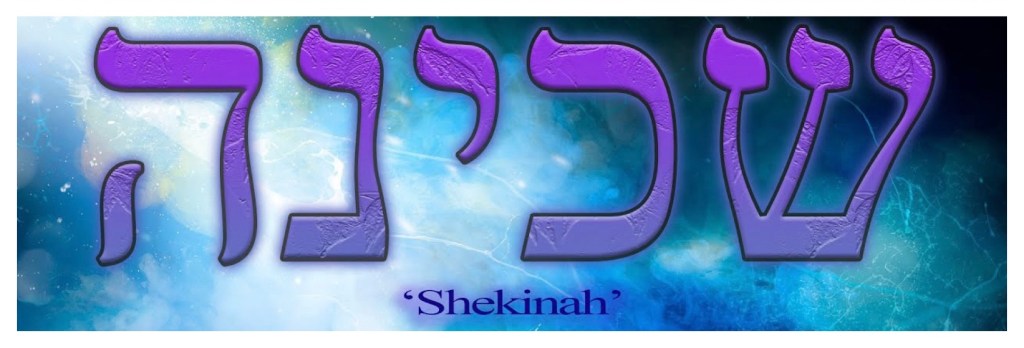
On arrival at Mount Sinai, “the glory of the Lord settled on Mount Sinai, and the cloud covered it for six days … the appearance of the glory of the Lord was like a devouring fire on the top of the mountain in the sight of the people of Israeli” (Exod 24:16–17). In rabbinic literature, this phenomenon is given the name shekinah—a further way of describing the manifestation of divine activity. The Shekinah is yet another manifestation of the divine which becomes personified over time in Jewish traditions; not a separate person, rather an expression of God’s being.

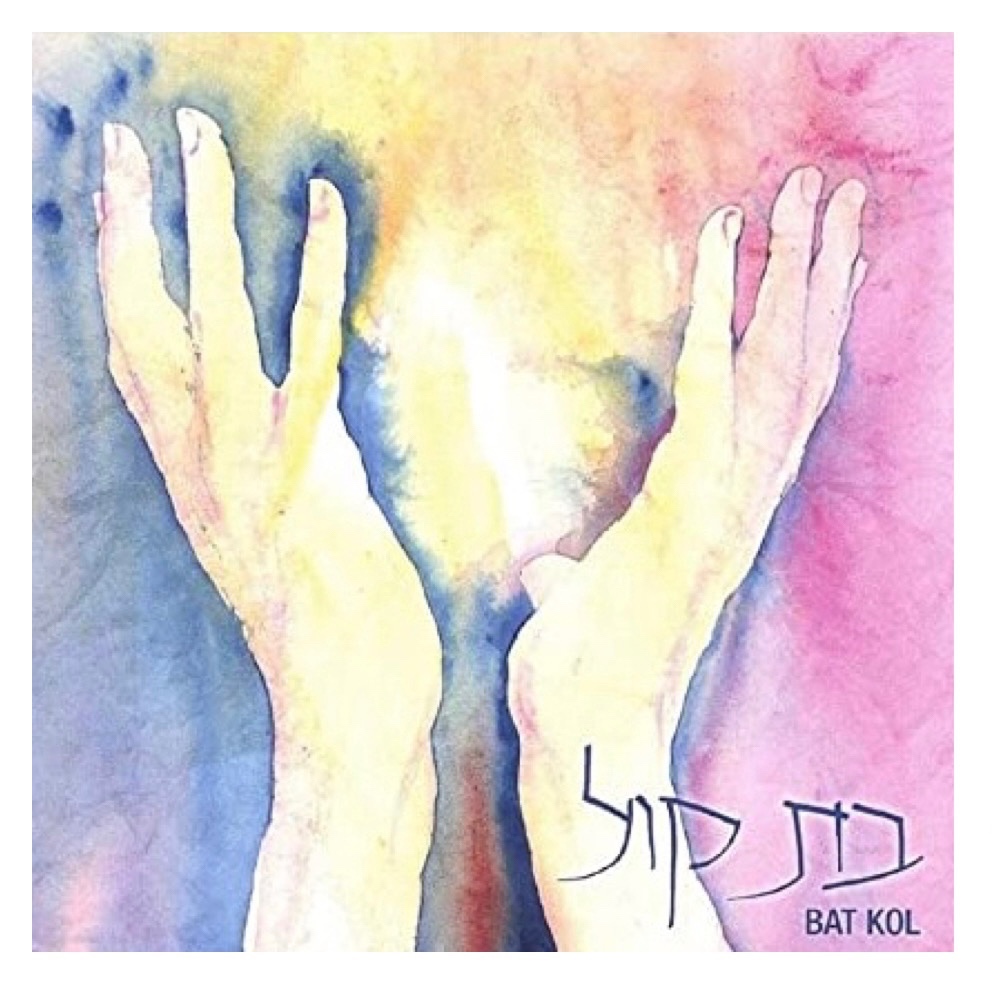
Yet another rabbinic term for divine manifestation is the Bat Qol, the voice of God. This takes the many statements in scripture about God speaking, and attributes quasi-personal firm to the voice of. God. The term Bat Qol literally means “the daughter of the voice”, as if simply by speaking, God generates a personality or a being from that process.

There is much discussion in rabbinic literature about the role and function of the Bat Qol. It was thought that the Bat Qol had been active in biblical times, even though there is no explicit statement of her activity in Hebrew Scripture. A common view in rabbinic literature is that the Bat Qol became the way that God communicated with humanity after the end of the prophetic era.

Also in later rabbinic discussions, even Torah itself—the teaching, or instruction, of God which was given in “the Law”—is personified and seen to be active in and of itself. So along with word and breath (or spirit), there is Wisdom (Hochmah), Glory (Shekinah), Bat Qol, and Torah, who are active expressions of God in the developing Jewish tradition.

Psalm 8 is also offered by the lectionary for Trinity Sunday in Year A; and it is also offered by the lectionary on this day in Year C, as well as for New Years Day in each of the three years. It is a logical companion piece with the Genesis story of creation, which is reflected in verses 1–2 and 7–9. In the middle of the psalm, the place of humanity is in focus; here the emphasis is on the relationship that humanity has with the deity (“a little lower than God, crowned with glory and honour”, v.5) and the responsibility of “dominion” that is given to humans over animals, birds, and fish (vv.7–8).

Perhaps the connection for this Sunday is with the element in the doctrine that lays claim to Jesus as not only human, but also divine; the connection point between the divine realm and the human world? But there is no specific pointer towards Jesus, naturally, in this psalm, and no indication that there was any need for any enhancement, so to speak, of the way that humans related to the divine, beyond that which is set out in this psalm. So it really doesn’t provide a biblical pointer towards understanding the doctrine of the Trinity.

*****

to be continued in a further post …

Father of orphans and protector of widows (Psalm 68; Easter 7A)

The psalm that is offered by the lectionary for this coming Sunday, the Seventh Sunday in Easter, is a song in which the psalmist prays for the enemies of Israel to be scattered (v.1) and the wicked to perish (v.2), celebrating that God has restored the languishing heritage of the people (v.9) and praying for God to give “power and strength to his people” (v.35).

It is a psalm most clearly marked by celebration and praise, with exhortations to “be joyful … exult before God … be jubilant with joy … sing praises to God’s name, and lift up a song to the Lord (verses 3–4, 32). It would seem that it comes from a time and a place of stability and prosperity for Israel.

Of particular importance are two verses which set out some central tenets of Israelite faith for the society of the day. Just as God takes care of orphans and protects widows (v.5), so are people of faith to do likewise. Just as God gives the desolate a home to live in (v.6a), so in Israelite society those on the edge are to be cared for. And just as God releases prisoners into prosperity (v.6b), so the Jubilee release was meant to be practised in society, as a time every fifty years during which debts are to be remitted (Lev 25:8–17; see esp. v.13).

The practice of the Jubilee is, however, dubious. The levitical prescriptions appear to be the ideal that the priests hoped for; actual evidence that this was ever implemented in Israelite society is lacking. Indeed, it is suggested that while the people were in Exile, the land of Israel would “lie desolate”, and “enjoy its sabbath years” (Lev 26:34), providing recompense for all those years when “it did not have on your sabbaths when you were living in it” (Lev 26:35).

A similar claim concludes the work of the Chronicler; the land was to keep sabbath, to “make up for its sabbaths”, in order “to fulfil the word of the Lord by the mouth of Jeremiah“ (2 Chron 36:20–21). After the return to the land, under Nehemiah, the law of sabbath rest was to be followed, it was decreed (Neh 10:31); whether this was the case is not clear from this or any other biblical text.

Likewise, the only evidence before the Exile for the release of slaves, as the levitical text prescribed, comes in the time of Zedekiah, spurred on by a prophetic word from Jeremiah (Jer 34:8–9). After initial compliance, the officials reneged and “took back the make and female slaves they had set free, and brought them again into subjection as slaves” (Jer 34:10–11).

Jeremiah accordingly predicts, in very graphic terms, the disaster that will ensure. “I will make you a horror to all the kingdoms of the earth”, he declares; the bodies of those handed over to the enemy “shall become food for the birds of the air and the wild animals of the earth” and the Babylonian forces will capture and burn Jerusalem and make the towns of Judah “a desolation without inhabitant” (Jer 34:12–22).

On the other hand, the statement regarding widows and orphans does reflect an ethos which was both advocated and implemented in society. The evidence for this claim is prolific.

Widows in ancient Hebrew society were in a perilous position. In a strongly patriarchal society, the patronage of a man was vital: a man as husband and provider, a man as father and protector, a man as the household head. Children without fathers—orphans—as well as women without husbands—widows—were in equally perilous situations. They were vulnerable people, often at risk of being mistreated and exploited, of being pushed to the edge of society and being forgotten. They could well be the desolate who needed housing (Ps 68:6).

In our time, we require those in leadership in the church to have obtained a Working With Vulnerable People card, to signal that they are aware of the power imbalances present in situations where they minister. In the ancient world, no such system existed; but we do find in the Hebrew Scriptures that there are regular exhortations and instructions to the people to take care of widows and orphans, the key classes of vulnerable people in that society.

In the Torah, we find the command, “you shall not mistreat any widow or fatherless child” (Exod 22:22) and the instruction to gather a tithe of produce and invite “the Levite, the foreigner, the fatherless, and the widow to come and eat and be filled” (Deut 14:28–29). Even in ancient society, vulnerable people needed protection.

More that this, the Torah provides that the widow and the fatherless child were to included along with the sojourner in celebratory moments in Israel, at the Feast of Weeks (Deut 16:9–12) and the Feast of Booths (Deut 16:13–15). This was also to be the practice when the men were in the field harvesting; they were to leave some for gleaning by ”the alien, the orphan, and the widow” (Deut 24:19–22); and similar prescriptions govern the time when tithing (Deut 26:12–13; also 14:28–29).

A widower’s brother was expected to marry a widow (Deut 25:5–10), for it was the duty of a widower’s kin to provide a widow with children if she didn’t have any. If it was not possible for a widow to remarry, it was the duty of the community to care for her (Exod 22:22–23; Deut 10:18; 24:17; Isa 1:17). Beyond the biblical period, in the Diaspora, a portion of the offering collected in the synagogues was be given to the widows and poor, on the analogy of the gleaning provision whilst living in the land.

Not everyone adhered to these prescriptions. Among the prophets, Isaiah proclaims God’s judgement on those who “turn aside the needy from justice … and rob the poor of my people”, including the way that they exploit the fatherless and widows (Isa 10:1–2). Likewise, Ezekiel includes those who “have made many widows” in Israel amongst those who will experience the full force of God’s vengeance (Ezek 22, see verse 25). He observes that “the sojourner suffers extortion in your midst; the fatherless and the widow are wronged in you” (Ezek 22:7).

Jeremiah assures the people of Edom, to the south of Israel, of God’s care for them: “leave your fatherless children; I will keep them alive; and let your widows trust in me” (Jer 49:11). He encourages the people of Jerusalem with a promise that God will allow them to continue to dwell in their land if they “do not oppress the sojourner, the fatherless, or the widow, or shed innocent blood in this place … or go after other gods” (Jer 7:5–7).

In a later chapter, Jeremiah is instructed to tell the King of Judah, “do no wrong or violence to the resident alien, the fatherless, and the widow, nor shed innocent blood in this place” (Jer 22:1–3). The prophet Zechariah speaks similarly: “do not oppress the widow, the fatherless, the sojourner, or the poor, and let none of you devise evil against another in your heart” (Zech 7:10).

Accordingly, the people of Israel would regularly have sung, in the words of the psalmist, “the Lord watches over the sojourners; he upholds the widow and the fatherless, but the way of the wicked he brings to ruin” (Ps 146:9). Care for widows was central to the life of holiness required amongst the covenant people. This psalm reminds them of that claim on their lives.

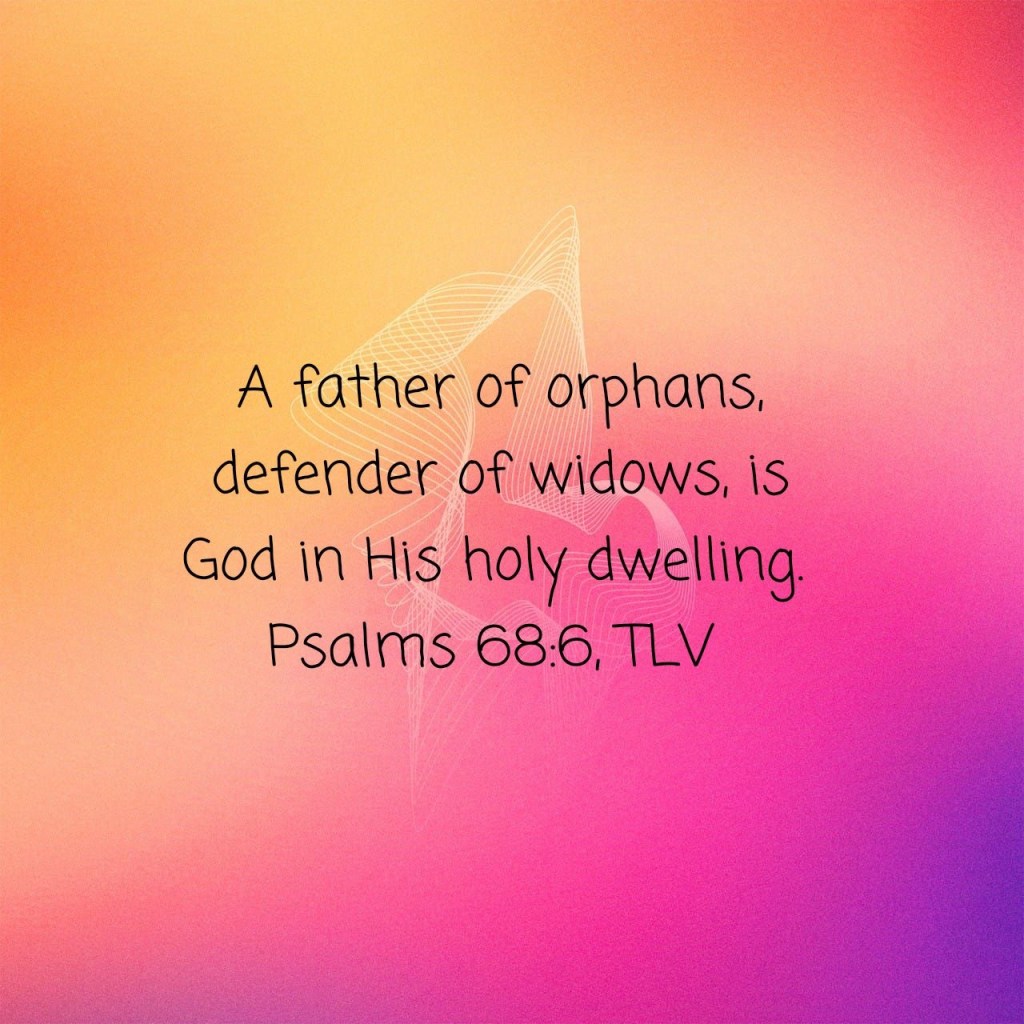
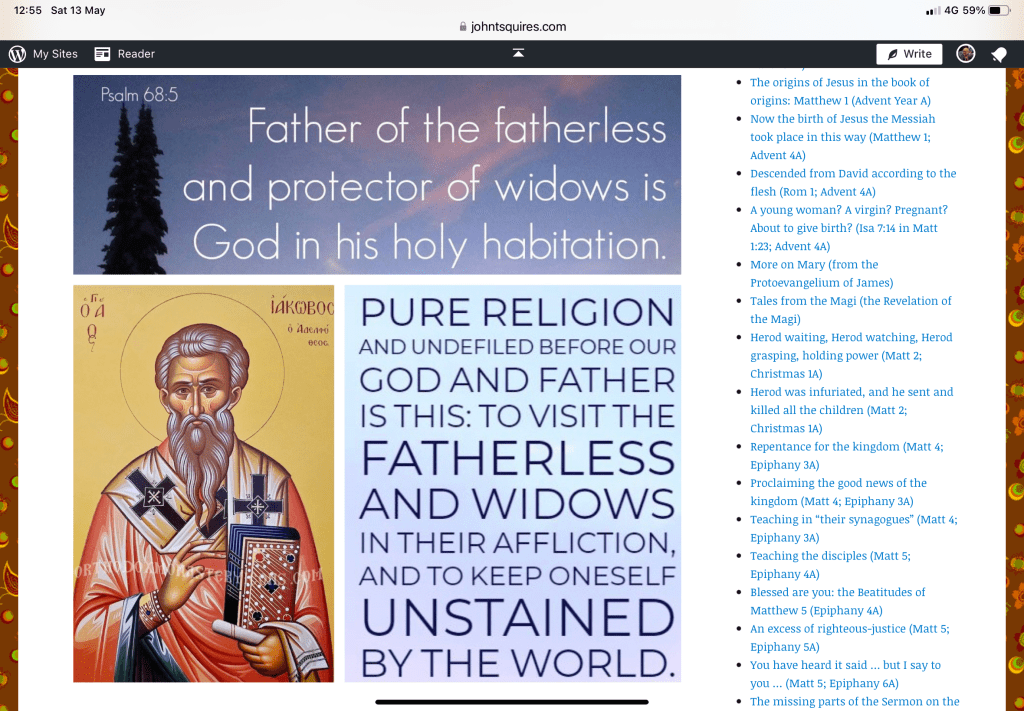
This reflected the standard set by God; “Father of orphans and protector of widows is God in his holy habitation” (Ps 68:5); this God is the one who “executes justice for the fatherless and the widow” (Deut 10:18). At the very heart of the holiness of God, the holy people are to exhibit this just and compassionate care for the vulnerable.

So the curses of Deuteronomy 27 include the declaration, “Cursed be anyone who perverts the justice due to the sojourner, the fatherless, and the widow” (Deut 27:19). The book of Psalms includes a prayer for God to rise up against the wicked, who “kill the widow and the sojourner, and murder the fatherless” (Ps 94:6). That psalm ends with an assurance that “the Lord … wipe them out for their wickedness; the Lord our God will wipe them out” (Ps 94:23).

The prophet Malachi includes this in his vision of the coming day of the Lord: “I will draw near to you for judgment. I will be a swift witness … against those who oppress the hired worker in his wages, the widow and the fatherless, against those who thrust aside the sojourner, and do not fear me” (Mal 3:4).

What is wished for the wicked who persecute the faithful is expressed with vitriol in Psalm 109: “May his children be fatherless and his wife a widow” (Ps 109:9). Another psalm expresses similar hopes, but in a less aggressive manner: “The Lord watches over the sojourners; he upholds the widow and the fatherless, but the way of the wicked he brings to ruin” (Ps 146:9). Who would be so foolish as to act differently? Yet people did; and prophets called, again and again, for justice.

And so we read that “religion that is pure and undefiled before God, the Father, is this: to care for orphans and widows in their distress, and to keep oneself unstained by the world” (James 1:27). This is what the brother of Jesus, James, affirms in the letter attributed to him, summing up a strong thread running through Israelite religion and on into Second Temple Judaism.

It is no wonder that Jesus himself had positive words to say about widows (Mark 12:41–44; Luke 18:1–8) and children (Mark 10:13–16), and that the early church cared for widows (Acts 6:1–6) and honoured those who were of this status (1 Tim 5:3–16). This is, after all, the way of God, “father of orphans and protector of widows”, who houses the desolate and releases the prisoners (Ps 68:5–6).

Bless our God; truly God has listened (Psalm 66; Easter 6A)

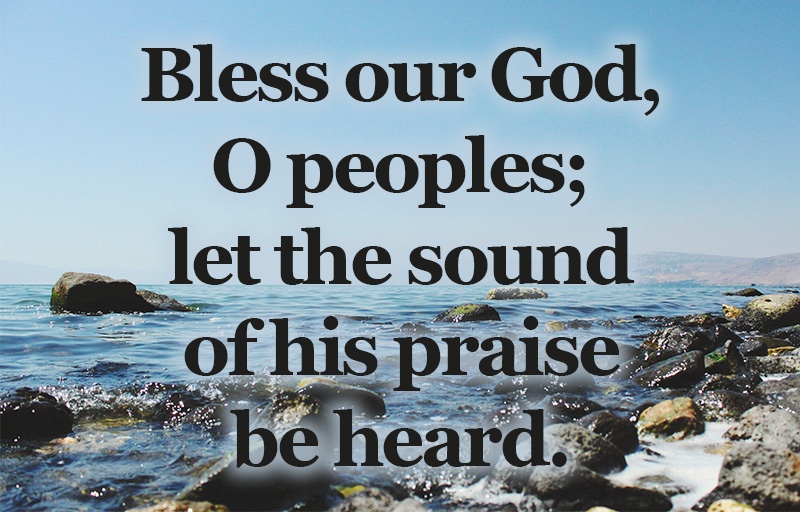
“Bless our God, O peoples, let the sound of his praise be heard” (v.8). That’s the opening line of the section of Psalm 66 which offered by the lectionary for this coming Sunday, the Sixth Sunday in Easter (Ps 66:8–20). In these words, the call is made for people to bless and praise God because he is the one “who has kept us among the living” (v.9). This makes this psalm a most suitable song for the season of Easter, when the church celebrates the new life offered to believers through the resurrection of Jesus from the dead.

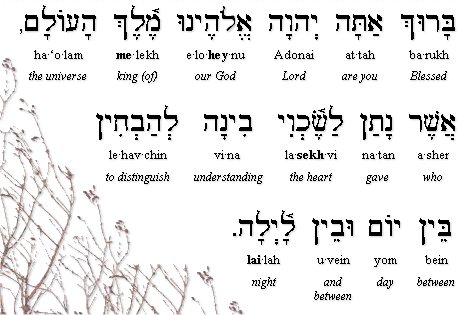
Blessing God is a favourite Jewish activity—indeed, so many prayers still used by Jews today begin with a phrase of blessing: “Blessed are you, O Lord our God …”. Blessed are You, O Lord our God, Ruler of the universe, Who brings forth bread from the earth is prayed before a meal. Blessed are You, o Lord our God, Ruler of the universe, who creates the fruit of the vine is prayed before drinking wine.

And a favourite blessing which I learnt from Jews is Blessed are you, O Lord our God, Ruler of the Universe, who has kept us alive, sustained us, and brought us to this moment. It’s a prayer to mark momentous occasions in life. All of these prayers of blessing begin with the Hebrew words, Baruch atah Adonai Elohenu melekh ha’olam, the same formula of approaching, acknowledging, and blessing God.

We can see that formula used in blessings spoken by David, who exhorts the people to “bless the Lord your God” (1 Chron 29:19), and the psalmist, who prays, “Blessed are you, O Lord; teach me your statutes” (Ps 119:12), as well as in later Jewish texts such as Tobit 3:11; 8:5, 15–17; Judith 13:17; 14:7; the Prayer of Azariah (six times), and 1 Maccabees 4:20. It appears also in New Testament texts such as Luke 1:68; Rom 9:5; 2 Cor 1:3; Eph 1:3; and 1 Pet 1:3.

More familiar, perhaps, is when Jesus uses a prayer of blessing, but speaks it to human beings; “blessed are you, Simon son of Jonah” (Matt 16:17), or “blessed are the eyes that see what you see”, to his disciples (Luke 10:23), or “blessed are those who have not seen and yet have come to believe” (John 20:29), and most famously of all, in a set of blessings spoken to a crowd on a level place (Luke 6:20–22) or to his disciples on a mountain top (Matt 5:3–12). Jesus blessed people. But blessing God is something that is not unknown within Judaism.

The primary reason to bless God, then, is that we are “kept among the living” (v.9). What follows from that affirmation is the statement, “You, O God, have tested us; you have tried us as silver is tried” (v.10). We know that life entails testing; no human being has avoided those moments in their lives when trials and testings are presented, seeking to entice us to think or act in unhelpful ways.

Scripture reflects this reality, that life entails testing, at many places. The fundamental paradigm is set out in the paradigmatic story of Abraham and Isaac (Gen 22:1–19), and then in narratives about Joseph (Ps 105:16–19), the years when the people wandered in the wilderness (Deut 8:2), the incident at Rephidim (Exod 17:1–7; Deut 6:16; 33:8; Ps 81:7), and then whilst the people were living alongside hostile nations when in the land (Judg 3:1–6). And, of course, there is the similar paradigmatic testing story in the life of Jesus (Mark 1:12-13 and parallels).

The Psalmist notes that “the Lord tests the righteous and the wicked” (Ps 11:5) and the prophet declares the word of the Lord, that “I have refined you, but not like silver; I have tested you in the furnace of adversity” (Isa 48:10; so also Zech 13:7–9). In the words of the sage, then, “I said in my heart with regard to human beings that God is testing them to show that they are but animals” (Eccles 3:18) and, using the same imagery as Ps 66, notes that “the crucible is for silver, and the furnace is for gold, but the Lord tests the heart” (Prov 17:3).

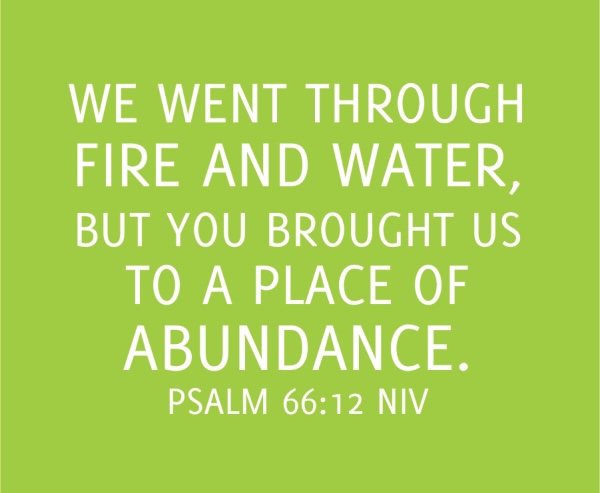
After listing various ways in which the people have been tested—“you brought us into the net; you laid burdens on our backs; you let people ride over our heads; we went through fire and through water” (vv.10–11), the psalmist declares, “you have brought us out to a spacious place” (v.12 in the NRSV translation), or “a place of great abundance” (in the NIV).

The unusual Hebrew word which is translated as “spacious place”, la-yerawah, appears also in Psalm 23 in the affirmation, “my cup overflows” (Ps 23:5); the root word, ravah, has a sense of saturation, abundance, or being filled to overflowing (according to the Brown—Driver—Briggs Lexicon). The end result of testing is a place of fulfilment and satisfaction.

In response, the psalmist states, “I will come into your house with burnt offerings; I will pay you my vows” (v.13). Prescriptions for burnt offerings, to be offered at the altar of burnt offerings (Deut 12:27; Exod 20:24), are detailed in Lev 1:1–17 and 6:8–13. They are integral to the rituals of the Temple and have a firm place in the piety of faithful people in ancient Israel.

Also integral to the temple liturgy are the vows which are to be paid to God. The psalmist elsewhere affirms, “I will pay my vows” (Ps 22:25; 50:14; 61:8; 65:1; 66:13; 76:11; 116:14, 18). The words of the psalmist are echoed by Eliphaz in one of his speeches to Job: “you will delight yourself in the Almighty, and lift up your face to God; you will pray to him, and he will hear you, and you will pay your vows” (Job 22:26–27).

So the psalm continues, “I will offer to you burnt offerings of fatlings, with the smoke of the sacrifice of rams; I will make an offering of bulls and goats” (v.15). This correlates with the levitical provisions, as already noted. The psalmists inevitably write from within the religious system of the time—which makes sense, since the psalms were composed for singing within the Temple liturgy.

This contrasts with many of the words of the prophets, who in a sense stand on the edge of the religious life of the nation, and offer their criticisms of the excesses and injustices that were part of life at that time (as, indeed, they continue to be, sadly, today). We might think, for instance, of how the prophets criticised the people for their offerings and sacrifices whilst tolerating such injustice in their communal life (Isa 1:11–14; Jer 6:20; Ezek 20:27–28; Hos 8:13; 9:4; Mal 1:14).

So the prophetic critique of Temple practices (which Jesus picks up at Matt 9:13; 12:7, quoting Hos 6:6) needs to be held in tension with the psalmists’ affirmations of those practices when they are performed faithfully. Although Jesus, following Hosea, appears to place mercy (hesed) in opposition to sacrifice, both mercy and sacrifice are integral to Israelite religion.

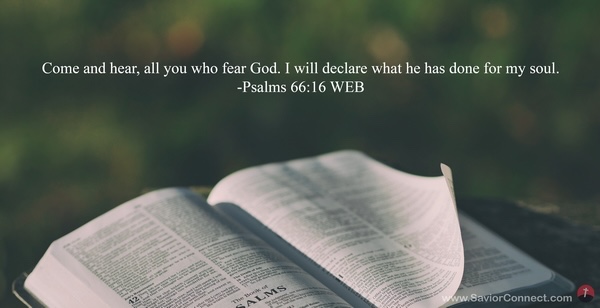
To end this song, the psalmist offers an exhortation followed by an affirmation. The exhortation is to “come and hear, all you who fear God, and I will tell what he has done for me” (v.16). “Those who fear God” is a typical characterisation of faithful people who trust in God and adhere to God’s ways of justice and righteousness, including Abraham (Gen 22:12), Joseph (Gen 42:18), leaders appointed by Moses (Exod 18:21), and indeed all who are faithful amongst the people (Lev 19:14, 32; 25:17, 36, 43; Deut 4:10; 6:2, 13, 24; etc; 1 Sam 12:14, 24; 1 Ki 8:40–43).

As Moses declares, “O Israel, what does the Lord your God require of you? Only to fear the Lord your God, to walk in all his ways, to love him, to serve the Lord your God with all your heart and with all your soul, and to keep the commandments of the Lord your God” (Deut 10:12).

“What God has done” is an occasional biblical phrase, appearing in assorted places (Num 23:23; Deut 3:21; Josh 23:3; Ps 64:9; Eccles 3:11; Jer 5:19; Dan 9:14). In the New Testament, it is picked up in what Jesus says to a healed demoniac (Luke 8:39) and then in writings of his disciples (Rom 3:24–26; 8:3; Acts 2:22, 36; 14:27; 15:12; 21:19; John 3:16–17). It affirms the continuing and ongoing actions of God—what a former generation of scholars called “salvation history”—which is known through the stories of Israel and then through the life of Jesus and his followers.

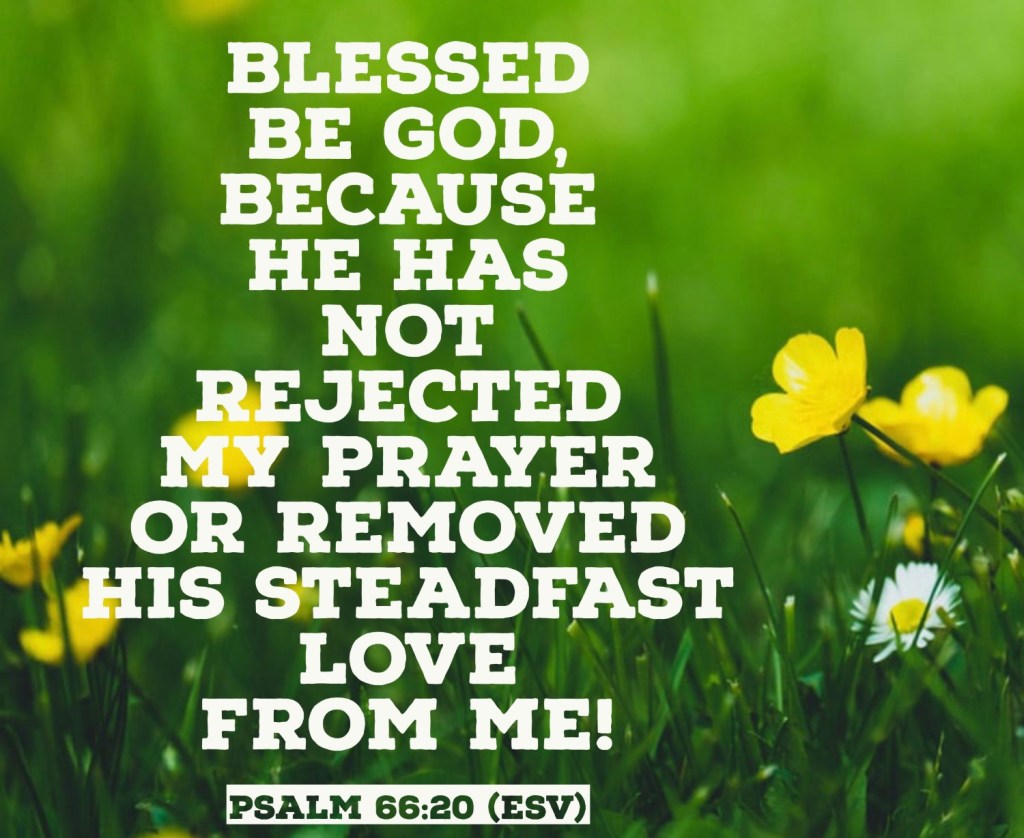
The affirmation which closes this psalm is offered in typical Hebraic style, with parallel phrases that repeat and develop the central idea. In verse 19, the first statement, “truly God has listened”, is mirrored in the next phrase, “he has given heed to the words of my prayer”. In verse 20, “he has not rejected my prayer” is then expressed in a varied manner in the closing phrase, “[he has not] removed his steadfast love (hesed) from me”.

From Exodus to Nehemiah, God’s steadfast love and faithfulness (hesed) is praised, in a refrain which recurs in many places (Exod 34:6; 2 Chron 30:8–9; Neh 9:17, 32; Jonah 4:2; Joel 2:13; Ps 86:15; 103:8, 11; 111:4; 145:8–9). Here, the psalmist uses this central insight into the nature of God to conclude the song, in which human trust in God and fidelity to God’s way have been well-expressed throughout.

The final words of the psalm form a blessing (linking back to verse 8) which emphasises the hesed of God (variously translated as mercy, or steadfast love). The psalm as a whole thus ties together the religious practices of the people (vows and sacrifices) and the understanding of God’s essential being (merciful and loving). It is a reminder that we need to hold the whole of the biblical witness together as revelatory of God; not select one aspect, not preference one over another, but hold all together. For in that, we draw near to the fullness of God.

I will offer a sacrifice and call on the name of the Lord (Psalm 116; Easter 3A)

This coming Sunday, the third Sunday in the season of Easter, the lectionary offers a series of verses from psalm 116 (1–4, 12–19). This psalm is one of six psalms, numbered from 113 to 118, which are known as Hallel psalms—from the Hebrew term hallelu-jah, meaning “praise the Lord”. That phrase starts psalm 113 and ends psalms 115, 116, and 117. These psalms were, and are, used in Jewish communities at times of festive celebration; so they are also most suitable in the current Christian season of Easter.

The opening section of this psalm celebrates a rescue from near death (v.8) and continuing in life (v.9), which is a relevant motif for the season of Easter—it evokes the story of Jesus we heard over the Easter weekend, recently. In verse 5, the psalmist identifies some central characteristics of God. That God is merciful and gracious is a recurring Israelite theme (Exod 34:6; 2 Chron 30:8–9; Neh 9:17, 32; Jonah 4:2; Joel 2:13; Ps 86:15; 103:8, 11; 111:4; 145:8–9).

That God is righteous is likewise declared in scripture (Deut 32:4; Ps 145:7; Job 34:17). The psalmists regularly thank God for God’s righteousness (Ps 5:8; 7:17; 9:8; 33:5; 35:24, 28; 36:6; 50:6; etc) and note the importance of humans living in that way for righteousness (Ps 18:20, 24; 85:10–13; 106:3, 31; 112:1–3, 9). The book of Proverbs advises that the wisdom it offers is “for gaining instruction in wise dealing, righteousness, justice, and equity” (Prov 1:3) and the prophets consistently advocated for Israel to live in accordance with righteousness (Hos 10:12; Amos 5:24; Isa 1:22; 5:7; 28:17; 32:16–17; 54:14; Jer 22:3; Ezek 18:19–29; Dan 9:24; 12:3; Zeph 2:3; Mal 4:1–3; Hab 2:1–4).

These recurring notes of the nature of God then form the basis for a Christian understanding of Jesus, who affirms mercy (Matt 23:23), teaches righteousness (Matt 5:6, 10, 20; 6:33), and exudes grace (John 1:14–18). This is an ancient Jewish psalm that we Christians can joyfully sing and affirm!

The second part of the psalm focusses on appropriate ways for the psalmist to respond to the experience of escaping death (see v.8). The psalmist affirms, “I will pay my vows”—not once (v.14), but twice (v.18). Other palms refer to paying vows before God (Ps 22:25; 50:14; 61:8; 65:1; 66:13; 76:11). The words of the psalmist are echoed by Eliphaz in one of his speeches to Job: “you will delight yourself in the Almighty, and lift up your face to God; you will pray to him, and he will hear you, and you will pay your vows” (Job 22:26–27).

Paying a vow is a public act, most likely undertaken in the Temple precincts, as v.19 indicates. The psalmist indicates two such public actions to “pay my vows”. First, the cup of salvation is to be lifted up (v.13). Perhaps this was the drink offering that was to be presented each year at the Festival of First Fruits (Lev 23:13), an expression of deep gratitude for God’s continuing care.

Then, because of the predominance of sacrifices within Israelite religion, offering “a thanksgiving sacrifice” is also an appropriate response (v.17). The regulations for this sacrifice (found in Lev 7:11–15; see also Ps 50:14) indicate that it can be made at any time during the year, as a regular expression of that gratitude for God’s care.

Jews today do not bring specific physical sacrifices, but understand the scriptural language about sacrifice to refer to a way of living. It is said that, on one occasion, as Rabbi Yochanan ben Zakkai and his disciple Rabbi Yehoshua were leaving Jerusalem, Rabbi Yehoshua looked at the ruins of the destroyed Temple and despaired, “Woe to us! The place where Israel obtained atonement for sins is in ruins!” Rabbi Yochanan said to him, “My son, be not distressed. We still have an atonement equally efficacious, and that is the practice of benevolence” (Aboth de Rabbi Nathan 4).

So this is how this ancient psalm functions in Judaism today: as a call to a way of life that is offered fully to God. This parallels the way that Christian writers developed a spiritualised understanding of sacrifices—both of the sacrifice of Jesus, and of the sacrifices to be offered by followers of Jesus.

The offering of his life on the cross by Jesus is understood by early Christian writers within the framework of the ancient Jewish system of sacrifices and offerings: “Christ loved us and gave himself up for us, a fragrant offering and sacrifice to God” (Eph 5:2); “he is the atoning sacrifice for our sins, and not for ours only but also for the sins of the whole world” (1 John 2:2).

In John’s Gospel, the time when Jesus dies is not the day after Passover (as in the Synoptics), but on “the Day of Preparation for the Passover” (John 19:14), as the Passover lambs were being slaughtered and prepared for the meal that evening. The symbolism is potent; Paul adopts this symbolic and spiritual understanding as he notes, “our paschal lamb, Christ, has been sacrificed” (1 Cor 5:7).

Those who follow Jesus are called to live in the same sacrificial mode, offering their lives to God. Paul refers to the gifts sent by the Philippians (most likely financial support for his mission) as “a fragrant offering, a sacrifice acceptable and pleasing to God” (Phil 4:18).

Most famously, he appeals to the Romans “to present your bodies as a living sacrifice, holy and acceptable to God, which is your spiritual worship” (Rom 12:1), and reinterprets the Exodus story as spiritualised symbolism, telling the Corinthians that “all were baptised into Moses in the cloud and in the sea, and all ate the same spiritual food, and all drank the same spiritual drink; for they drank from the spiritual rock that followed them, and the rock was Christ” (1 Cor 10:2–4).

Other letter-writers whose works were collected into the New Testament speak of “a spiritual circumcision … putting off the body of the flesh in the circumcision of Christ” (Col 2:11) and encourage believers to “let yourselves be built into a spiritual house, to be a holy priesthood, to offer spiritual sacrifices acceptable to God through Jesus Christ” (1 Pet 2:25).

So this psalm, and others like it, continue to hold a valued place in Christian spirituality, because of this process of reinterpretation that has taken place in Second Temple and Rabbinic Judaism, and in the early stages of the Jesus movement. The reference to the vows to be paid and the thanksgiving sacrifice to be offered can be understood as metaphors for the way that we are to live our lives as the offering of ourselves to God in obedience and gratitude.

The psalm ends with a joyful exclamation which picks up the key theme: hallelu-jah! praise the Lord! This encapsulates the joyful appreciation for God and God’s way that encompasses all of these psalms of Hallel. It is a fitting psalm for the Easter season.

This is the day: let us be glad and rejoice! (Psalm 118; Easter Sunday A)

Psalm 118 is one of the Hallel Psalms—six psalms (113 to 118) which are sung or recited on high festival days, such as Passover (Pesach), the Festival of Weeks (Shavuot), and the Festival of Booths (Sukkot), as well as Hanukkah and the beginning of each new month. This final Hallel Psalm, like the other five, is intended to be an uplifting, celebratory song, suitable for the congregation to hear and to sing as a way to inspire and rejoice.

It is no surprise that this psalm is offered by the lectionary for this coming Sunday, Easter Sunday (Ps 118:1–2, 14–24), for this is a day which celebrates with joy the raising of Jesus from the dead (Matt 28:1–10). This psalm is very suited to the celebrations that take place in churches on this high holy day.

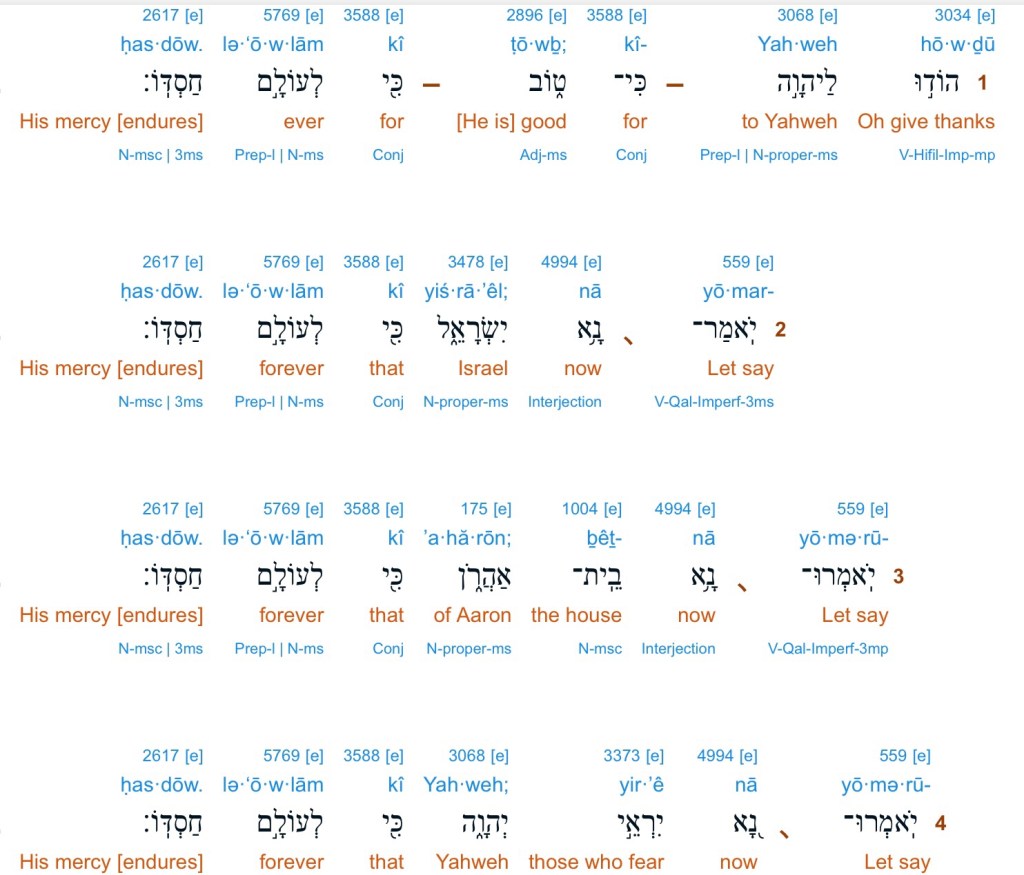
The psalm begins with a call to “give thanks” and an affirmation of the “steadfast love” of the Lord (vv.1-2). The next two verses, following the same pattern are omitted by the lectionary. However, I am thinking that the pattern of the first four verses, calling people to join in the affirmation, “his steadfast love endures forever”, could well be extended from “Israel … the house of Aaron … those who fear the Lord”, to include “let those who know the risen Lord Jesus say, “his steadfast love endures forever”.

God’s steadfast love is a recurrent theme throughout Hebrew Scripture, which often sings praises for “a God merciful and gracious, slow to anger and abounding in steadfast love and faithfulness” (Exod 34:6; 2 Chron 30:8–9; Neh 9:17, 32; Jonah 4:2; Joel 2:13; Ps 86:15; 103:8, 11; 111:4; 145:8–9).

Affirmations of “[God’s] steadfast love” (v.2) are found in psalms (Ps 5:7; 6:4; 13:5; 17:7; 18:50; 21:7; 25:6–7; 25:10; 26:3; and another 100 times) and various narratives (Gen 24:12–14, 27; 32:10; 39:21; Exod 15:13; 20:6; 34:6–7; Num 4:18–19; Deut 5:10; 2 Sam 2:6; 7:15; 15:20; 22:51; 1 Ki 3:6; 8:23; 1 Chron 16:34, 41; 17:13; 2 Chron 1:8; 5:13; 6:14; 6:42; 7:3, 6; Ezra 3:11; 7:28; 9:9; Neh 1:5; 9:17, 32; 13:22).

Many prophets speak about God’s “steadfast love” (Isa 16:5; 54:10; 55:3; 63:7; Jer 9:24; 16:5; 32:18; 33:11; Lam 3:22, 33; Dan 9:4; Hos 2:19; 6:6; 10:12; Joel 2:13; Jonah 4:2; Micah 7:18), and Job also refers to it (Job 10:12).

The pervasive presence of this theme indicates just how central it was to ancient Israelite thought and how integral it was to how God was understood. The idea carries on into New Testament writings through the love that God expresses in Jesus (John 15:9; Rom 8:39; Eph 2:4–7; 1 John 3:1; 4:9) and is manifest through the Spirit (Rom 5:5; Gal 5:22).

However, we should never imagine that the God of love is simply “a New Testament idea”, in contrast to a perceived (completely inaccurate) view of “the God of wrath” in the Old Testament. The idea of divine love is shared in equal measure amongst both testaments. (So, too, we find the idea of divine judgement in both testaments—but that is another story!)

*****

In the selection of verses offered by the lectionary (vv.1–2, 14–24), we encounter some other well-known concepts. The reference to “the chief cornerstone” (v.22) appears also in an oracle of Isaiah, “see, I am laying in Zion a foundation stone, a tested stone, a precious cornerstone, a sure foundation” (Isa 28:16), which continues, “I will make justice the line, and righteousness the plummet” (Isa 28:17).

It is found also in Zechariah’s strident oracle against the shepherds, of whom the prophet says, “of them shall come the cornerstone, out of them the tent peg, out of them the battle bow, out of them every commander. Together they shall be like warriors in battle, trampling the foe in the mud of the streets; they shall fight, for the Lord is with them, and they shall put to shame the riders on horses” (Zech 10:4–5). Clearly, the “cornerstone” (along with “the tent peg” and “the battle bow”) offers a somewhat cryptic reference to an anticipated future leader in Israel.

The “cornerstone” has then been picked up in the New Testament, where it is interpreted as referring to Jesus; in a speech attributed to Peter when he and John were before the Council in Jerusalem because of a “good deed done to someone who was sick” (Acts 4:9), namely, the healing of a man lame from birth (Acts 3:1–10). “This man is standing before you in good health by the name of Jesus Christ of Nazareth, whom you crucified, whom God raised from the dead”, Peter is reported as saying; “this Jesus is ‘the stone that was rejected by you, the builders; it has become the cornerstone.’ There is salvation in no one else, for there is no other name under heaven given among mortals by which we must be saved” (Acts 4:11). This is a critical theological statement placed on the lips of Peter.

In like manner—although less directly, in a more allusive fashion—Jesus equates himself with this “cornerstone” when draws to a close his parable about the vineyard and the tenants who killed all who were sent to them by the master, culminating in the master’s son; at that point in the parable, Jesus curtly concludes, “have you not read this scripture: ‘The stone that the builders rejected has become the cornerstone; this was the Lord’s doing, and it is amazing in our eyes’?” (Mark 12:10–11; Matt 21:42; Luke 20:17). In this citation of the psalm, Jesus has extended to include the following verse, about “the Lord’s doing”, which is a cause for amazement.

We hear that affirmation on Easter Sunday, in the psalm: “this is the Lord’s doing; it is marvellous in our eyes” (Ps 118:23). When included in a Christian liturgy, these words seem very readily to reflect the experience of the first Easter—a marvellous deed, indeed.

The psalm then continues in an upbeat manner, with “this is the day that the Lord has made; let us rejoice and be glad in it” (Ps 118:24), echoing once more an oracle of Isaiah, “Lo, this is our God; we have waited for him, so that he might save us; this is the Lord for whom we have waited; let us be glad and rejoice in his salvation” (Isa 25:9). That oracle includes three elements included in this section of the psalm: joy, at the chosen time, with knowledge of salvation.

The linking of “be glad” with “rejoice” is also common throughout Hebrew Scriptures (1 Chron 16:31; Ps 14:7; 32:11; 40:16; 48:11; 53:6; 70:4; 90:14; 96:11; 97:1; 149:2; Prov 23:24–25; 24:17; Isa 35:1; 65:18; 66:10; Lam 4:21; Joel 2:21, 23; Zech 10:7). The people of Israel were called to joyous praise quite often.

The celebration of the means of salvation is certainly a theme that is relevant to Easter Sunday, when this psalm is offered in the lectionary. It is worth singing and celebrating on this day!

*****

On Hallel psalms, see

Save us, we beseech you: singing a Hallel psalm (Psalm 118; Lent 6A, Palm Sunday)

“Save us, we beseech you, O Lord!” This is the cry we hear in the psalm which is offered by the lectionary for this coming Sunday, Palm Sunday, the Sunday in Lent. Psalm 118 is one of the Hallel Psalms—six psalms (113 to 118) which are sung or recited on high festival days, such as Passover (Pesach), the Festival of Weeks (Shavuot), and the Festival of Booths (Sukkot), as well as Hanukkah and the beginning of each new month. This final Hallel Psalm, like the other five, is intended to be an uplifting, celebratory song, suitable for the congregation to hear and to sing as a way to inspire and rejoice.

See

It is no surprise that this psalm is offered by the lectionary for this coming Sunday, Palm Sunday—because the Gospel story for this day, of Jesus entering the city of Jerusalem to the acclaim of the crowd (Matt 21:1–11), is certainly one of celebration and joy. It is also, equally unsurprisingly, offered as the psalm for a week later, on Easter Sunday, which celebrates something much greater and more enduring: the raising of Jesus from the dead (Matt 28:1–10).

But clearly the psalm has a good fit with the Palm Sunday story that we will hear on Sunday; indeed, the Gospel writers report that the crowd cheering Jesus was singing, “Blessed is the one who comes in the name of the Lord”—which is, of course, a verse from the final Hallel Psalm (Ps 118:26).

Blessing God is a favourite Jewish activity—indeed, so many prayers still used by Jews today begin with a phrase of blessing: “Blessed are you, O Lord our God …”. Blessed are You, O Lord our God, Ruler of the universe, Who brings forth bread from the earth is prayed before a meal. Blessed are You, O Lord our God, Ruler of the universe, who creates the fruit of the vine is prayed before drinking wine. And a favourite blessing which I learnt from Jews is Blessed are you, O Lord our God, Ruler of the Universe, who has kept us alive, sustained us, and brought us to this moment. It’s a prayer to mark momentous occasions in life.

All of these prayers of blessing begin with the Hebrew words, Baruch atah Adonai Elohenu melekh ha’olam, the same formula of approaching, acknowledging, and blessing God.

We can see that formula used in blessings spoken by David (1 Chron 29:19 and the psalmist (Ps 119:12), as well as in later Jewish texts such as Tobit 3:11; 8:5, 15–17; Judith 13:17; 14:7; the Prayer of Azariah (six times), and 1 Maccabees 4:20. It appears also in New Testament texts such as Luke 1:68; Rom 9:5; 2 Cor 1:3; Eph 1:3; and 1 Pet 1:3.

More familiar, perhaps, is when Jesus uses a prayer of blessing, but speaks it to human beings; “blessed are you, Simon son of Jonah” (Matt 16:17), or “blessed are the eyes that see what you see”, to his disciples (Luke 10:23), or “blessed are those who have not seen and yet have come to believe” (John 20:29), and most famously of all, in a set of blessings spoken to a crowd on a level place (Luke 6:20–22) or to his disciples on a mountain top (Matt 5:3–12).

So the cry of the crowd as Jesus enters Jerusalem, “Blessed is the one who comes in the name of the Lord” (Ps 118:26) is a typical Jewish exclamation at a moment of joyful celebration.

*****

A further reason for linking this psalm with the Gospel narrative might well be that the cry of the crowd, “Hosanna!” (Mark 11:9–10; Matt 21:9; John 12:13). The word transliterated as “Hosanna” might actually be better translated as “save us”—another quote from the previous verse in that same psalm (Ps 118:25). The Hebrew comprises two words: hosha, which is from the verb “to save”, and then the word na, meaning “us”. Hosanna is not, in the first instance, a cry of celebration; rather, it is a cry of help, reaching out to God, pleading for assistance—and yet with the underlying confidence that God will, indeed, save, for “his steadfast love endures forever” (vv.1, 29).

See

Whilst the psalm, overall, sounds thanks for a victory that has been achieved, the petition, “save us” (v. 25) lies behind the first substantial section of this psalm (vv.5–14), which is largely omitted by the lectionary offering for this coming Sunday (which is Ps 118:1–2, 14–24). That section begins “out of my distress I called on the Lord” (v.5), claims that “the Lord is on my side to help me” (v.7), and concludes with rejoicing, “I was pushed hard, so that I was falling, but the Lord helped me; the Lord is my strength and my might; he has become my salvation” (vv.13–14).

Save us” is a prayer offered in other psalms (Ps 54:1; 80:2; 106:47); the petition appears more often in the singular, “save me” (Ps 7:1; 22:21; 31:16; 54:1; 55:16; 59:2; 69:1; 71:2; 109:26; 119:94, 146; 142:6; 143:9). “Save us” when faced with danger is the prayer of the elders of Israel as they faced the Philistine army (1 Sam 4:3) and the all the people a little later (1 Sam 7:8), David when the ark was put in place in Jerusalem (1 Chron 16:35), Hezekiah when Judah was being threatened by the Assyrians (2 Ki 19:19), as well as the prophet Isaiah at the same time (Isa 25:9; 33:22; 37:20).

This prayer in the context of festive celebrations—the context for which Psalm 118 appears to have been written—expresses the firm confidence of the people, trusting in the power of their God. That viewpoint is perfectly applicable to the Palm Sunday story (and even more so to the Easter Sunday narrative!).

But this psalm is not only a prayer of celebration; it is also a strong statement about the resilience and trust of the people, expressing their belief that God will give them redemption, even in the face of their Roman overlords, who had held political and military power for many decades. If this is what the crowd intended with their cry as Jesus enters the city—and I have no reason to see otherwise—then this is a striking, courageous political cry embedded in the story! It is a cry that affirms that salvation is at hand.

*****

Salvation is what is in the mind of the people as they cry, “save us” (v.25) and the earlier affirmation, “I thank you that you have answered me and have become my salvation” (v.21). As we have noted, “save us” was a recurring cry amongst the Israelites. In the song sung after the Exodus, the people acclaim God, singing “the Lord is my strength and my might, and he has become my salvation” (Exod 15:2). In his song of thanksgiving after battles with the Philistines, David praises God as “my rock, my shield and the horn of my salvation” (2 Sam 22:3; also vv.36, 47, 51; and 1 Chron 16:23, 35).

The same language, of salvation, appears in the psalms (Ps 13:5; 18:2, 35, 46; 24:5; 25:5; and another 40 times) and the prophets (Isa 12:2–3; 25:9; 33:2, 6; 45:8, 17; 46:13; 51:5–6; 52:7, 10; 56:1; 59:11; 61:10; 62:11; Mer 3:23; Mic 7:7; Hab 3:18). From the psalms, we remember “the Lord is my light and my salvation” (Ps 27:1); from Isaiah, “I will give you as a light to the nations, that my salvation may reach to the end of the earth” (Is 49:6).

There are a dozen occasions in Hebrew Scripture when God is identified as Saviour (2 Sam 22:3; Ps 17:7; 106:21; Isa 43:3, 11; 45:15, 21; 49:26; 60:16; 63:8; Jer 14:8); as the Lord God declares through Hosea, “I have been the Lord your God ever since the land of Egypt; you know no God but me, and besides me there is no Saviour” (Hos 14:4).

Salvation is linked with righteousness; “the salvation of the righteous is from the Lord … he rescues them from the wicked and saves them” (Ps 37:39–40). Being righteous is a quality of the Lord God (Ps 11:7; 35:28; 50:6; 71:16; 85:10; 89:16; 97:2, 6; 103:17; 111:3; 116:5; 119:137, 152; 129:4; Isa 45:21; Jer 23:6; 33:16; Dan 9:16; Zeph 3:5) which is thus desired of those in covenant with God (Gen 18:19; 1 Sam 26:23; 2 Sam 22:21, 25; 1 Ki 10:9; 2 Chron 9:8; Job 29:14; Ps 5:8; 9:8; 11:7; 33:5; Prov 1:3; Isa 1:27; 5:7; 28:17; 42:6; 61:11; Jer 22:3; Ezek 18:5–9; Hos 10:12; Amos 5:24; Zeph 2:3; Mal 3:3).

It is no surprise, then, that this psalm celebrates that “[God] has become my salvation” (Ps 118:21) by holding a “festal procession with branches” (v.27), entering through “the gates of righteousness” (v.19) and proceeding all the way “up to the horns of the altar” (v.27), singing “save us, Lord” (v.25) and “blessed is the one who comes in the name of the Lord” (v.26). This is a high celebratory moment!

So the closing verses take us back to the opening refrain, “O give thanks to the Lord, for he is good, for his steadfast love endures forever” (v.29; see also vv.1–4). The celebration is lifted to the highest level, with praise and thanksgiving abounding. And that makes this a perfect psalm for Palm Sunday!

****(

On the indications of the political nature of the Palm Sunday scene, see

Flesh and bones, spirit and life (Ezek 37, Psalm 130, Rom 8, John 11, Lent 5A)

On the Fifth Sunday in Lent, the scripture passages offered by the lectionary revolve around a central theme: life in contrast to death. It’s not every Sunday that all four passages line up to provide a clear and obvious focus on a single theme. For more than half of the Sundays in the year, the Hebrew Scripture, Epistle, and Gospel each follow their own course, and any overlap of theme is accidental, not planned. For Sundays in Advent, Christmas, and Lent, as well as key days like Pentecost, Trinity, and the Reign of Christ, the thematic overlap is intentional. This week we have just such a Sunday!

Death is at the heart of the story of Lazarus that forms the Gospel passage for Sunday (John 11:1–45). Initially, Jesus is told “he whom you love is ill” (John 11:3), but when he arrives in Bethany, Martha accosts him with “Lord, if you had been here, my brother would not have died” (11:21)—an accusation repeated by her sister Mary (11:31); and then comes a graphic description provided by Martha as they draw near to the tomb: “already there is a stench because he has been dead four days” (11:39).

The emergence of Lazarus from the tomb marks a climactic moment, for the family in Bethany and many of their neighbours (11:44–45), but also for the chief priests and Pharisees, who together determine to put Jesus to death (11:53). The seventh sign recounted in this Gospel is the most significant miracle of Jesus, but also the deed that determines the fate of Jesus. Soon after this event in Bethany, he says, “I have come to this hour” (12:27), the hour when “I am lifted up from the earth, [when I] will draw all people to myself” (12:32), the hour when the Father will “glorify your Son so that the Son may glorify you” (17:1). The death of Jesus is to be, paradoxically, the complete fulfilment of his mission (19:30)—the pathway into life eternal (3:16; 10:28; 17:3).

This climactic movement, of death moving to life in Bethany, resonates with the words of the prophet Ezekiel and also the writings of the apostle Paul that are offered for this coming Sunday. Ezekiel confronts the signs of death: “The Lord set me down in the middle of a valley; it was full of bones. He led me all around them; there were very many lying in the valley, and they were very dry” (Ezek 37:1–2). Paul considers the state of humanity: “to set the mind on the flesh is death … the mind that is set on the flesh is hostile to God; it does not submit to God’s law—indeed it cannot, and those who are in the flesh cannot please God” (Rom 8:6–8).

So, death is in view in these three readings. It is no wonder that the psalm we are offered alongside them speaks a cry of deep despair: “out of the depths I cry to you, O Lord” (Ps 130:1). The depths of the earth were the place where sinful people went (Ps 63:9; Isa 14:15), following the lead of the Egyptians who pursued the Israelites and “went down into the depths like a stone” (Exod 5:4–5; Neh 9:11; Isa 63:11–13). There, in the depths, God’s anger burned (Deut 32:22).

However, those banished to the depths were able to be brought back from the depths by God’s decree (Ps 68:22; 71:20; 86:13), so the cry of the psalmist from the depths is followed by the plea, “Lord, hear my voice! Let your ears be attentive to the voice of my supplications!” (Ps 103:2). As the prophet Micah affirms, God’s steadfast love will rescue those who “lick dust like a snake,

like the crawling things of the earth”, and will indeed “cast all our sins into the depths of the sea” (Mic 7:17, 19). So the psalmist affirms, “I wait for the Lord, my soul waits, and in his word I hope” (Ps 103:5).

Just as Lazarus emerges from the tomb where his dead body was laid, so Ezekiel foresees a wondrous revival amongst the dead bones of the people of Israel: “I will put my spirit within you, and you shall live, and I will place you on your own soil; then you shall know that I, the Lord, have spoken and will act,” says the Lord” (Ezek 37:11). The vision he sees emac s that dramatically. Likewise, Paul glimpses that same hope: “if the Spirit of him who raised Jesus from the dead dwells in you, he who raised Christ from the dead will give life to your mortal bodies also through his Spirit that dwells in you” (Rom 8:11).

Both prophet and apostle hold to the hope enacted in the Gospel and articulated by the psalmist: “Israel, hope in the Lord! For with the Lord there is steadfast love, and with him is great power to redeem. It is he who will redeem Israel from all its iniquities” (Ps 103:7–8).

*****

Ezekiel was both a prophet and a priest (Ezek 1:3). He had been exiled to Babylon during the siege of Jerusalem by King Nebuchadnezzar II of Babylon (599 BCE; see 2 Kings 24:10–17). His prophetic activity was thus undertaken entirely in exile. He addresses both those in exile with him in Babylon, and also those left behind in Judah. His prophecies continue through the period when the people in Judah were conquered and taken to join Ezekiel in exile (587 BCE; see 2 Ki 25:1–21), and then for some time after that.

A dramatic vision opens the book, in which “the glory of God” appears in the form of a fiery, flaming chariot (1:4–28). Priestly attention to detail marks the account of this vision, whilst contains multiple allusions to other scriptural stories. The bright cloud and flashing fire evokes the scene on Mount Sinai, when God gave Moses the Law (Exod 19:16–19); the “burning coals of fire” (1:13) remind us of the burning coals in the scene of the call of Isaiah (Isa 6:6); and “the bow in the cloud on a rainy day” evokes the sign of the covenant made with Noah (Gen 9:12–17). In seeing this vision, Ezekiel has had a life-transforming experience!

Ezekiel is impelled to play his role as a prophet by “the hand of the Lord” (1:3; 3:22; 8:1; etc); indeed, he says, “the spirit lifted me up” (3:12). That same spirit continues to lift him up with regularity (8:3; 11:1, 24; 37:1; 43:5) to show him vision after vision. More than this, Ezekiel declares that “the spirit entered me” (3:24), a process which he promises will be experienced by Israel as a whole (36:26–28)—for the Lord says he will “pour out my spirit upon the house of Israel” (39:29).

This emphasis on the renewing spirit of God is seen, most dramatically, by Ezekiel when he is taken by the spirit into “the middle of a valley … full of bones” (37:1) and sees a vision that he conveys in what must be his most famous oracle. What Ezekiel sees in this valley of dry bones is the work of God, as God puts sinews and flesh and skin on the bones, and breathes into the bodies so created, so that they live (37:5–6, 8, 10).

The vision indicates what God will do: “I will put my spirit within you, and you shall live, and I will place you on your own soil” (37:14). The end of the exile, it seems, is in sight. This passage is often interpreted in a Christian context as a pointer both to the resurrection of Jesus, and also to the general resurrection; indeed, its appearance on the Fifth Sunday in Lent means that it complements, and indeed illuminates, the dramatic story of Jesus bringing Lazarus back to life, as he approaches the tomb, and cries in a loud voice, “Lazarus, come out!” (John 11:38–44).

For Ezekiel, however, this vision is not a far-into-the-future prediction (foretelling), but a word of hope to the people in their immediate situation (forthtelling). Indeed, the very next section of this chapter reports a proclamation of Ezekiel which is quite directly forthtelling. The two sticks that he takes (37:16) stand for Judah and Israel; as he joins the sticks, so he points to the return of these peoples from their exile, their return “to their own land”, and a cleansing which will mean “they shall be my people, and I will be their God” (37:21–23, 27).

That final phrase is a common covenantal affirmation made by God (Lev 26:12; Ruth 1:16; Jer 7:23; 11:4; 24:7; 30:22; 31:1, 33; 32:38; Ezek 11:20; 14:11; 36:28; Zech 2:11; and Hos 1:10–11, overturning Hos 1:9). The reunited people shall have one king (37:24) and they will observe “an everlasting covenant” (37:26).

So the dramatic story that the prophet Ezekiel reports from his vision set in the middle of a valley full of dry bones is intended to speak directly into the life of the covenant people of God, the people of Israel, offering them hope despite their current circumstances.

*****

Paul also was commissioned for his task through a vision—reported in graphic terms by Luke, who makes the moment into a grand call-and-commissioning scene (Acts 9:3–8; 22:6–11; 26:12–18), but mentioned only briefly, in general terms, in passing by Paul himself (1 Cor 9:1; and perhaps Gal 1:1, 12). Of course, Luke was not present for this event, so he shaped in along the lines of classic call-and-commissioning narratives that existed in earlier Jewish writings. (I have explored this in detail in my commentary on Acts in the Eerdman’s Commentary on the Bible, 2003).

That vision turned Paul from persecutor of the followers of Jesus to an apostle fervently declaring “the good news of Jesus Christ” as far as possible, “from Jerusalem and as far around as Illyricum” (Rom 15:19). (Illyricum was a Roman province that covered the coastal area of the Balkans, northwest of Macedonia stretching towards Italy.) Paul delivers this good news in person to many communities, but he sets it out at length in his letter to believers in Rome, which he had not yet visited.

Paul is embued with the same hope that the psalmist and the prophet demonstrate. He rejoices with the Thessalonians that they share with him in “hope in our Lord Jesus Christ” (1 Thess 1:3), tells the Galatians that “through the Spirit, by faith, we eagerly waits for the hope of righteousness” (Gal 5:5), and reminds the Corinthians that “faith, hope and love abide” (1 Cor 13:13). In a subsequent letter to believers in Corinth, he asserts that “he who rescued us from so deadly a peril will continue to secure us; on him we have set our hope that he will rescue us again” (2 Cor 1:10)

Paul reports to the Romans that “we boast in our hope of sharing the glory of God” (Rom 4:2) and that it is “in hope that we were saved” (Rom 8:24). He affirms that it is “by steadfastness and the encouragement of the scriptures, we might have hope” (Rom 15:4), notes that scripture promises that “the root of Jesses shall come … in him the Gentiles shall hope” (Rom 15:12), and so characterises God as “the God of hope” (Rom 15:13). He shares in that strong hope which is sung by the psalmist and spoken by the prophet, and which is acted out in the Gospel reading for this Sunday.