Wear It Purple Day at the Rainbow Christian Alliance

Today, 25 August, is Wear It Purple Day. This day was founded in 2010 in response to global stories of real teenagers, real heartache, and their very real responses. The day is specifically designed to foster supportive, safe, empowering and inclusive environments for rainbow young people around the world.

On the website for Wear It Purple Day, we are told more about the story of its origins:

“In 2010, several rainbow young people took their own lives following bullying and harassment resulting from the lack of acceptance of their sexuality or gender identity. One member of this group was 18 year old Tyler Clementi, who took his own life after being publicly ‘outed’ as gay by his roommate, prompting a frenzy as reports poured in of various young people sadly in the same situation.

“As the world saw the faces of precious young lives lost, some young people found a new sense of conviction and purpose to ensure that young people everywhere would know that there were people who did support and love them. Wear it Purple was established to show young people across the globe that there was hope, that there were people who did support and accept them, and that they have the right to be proud of who they are.”

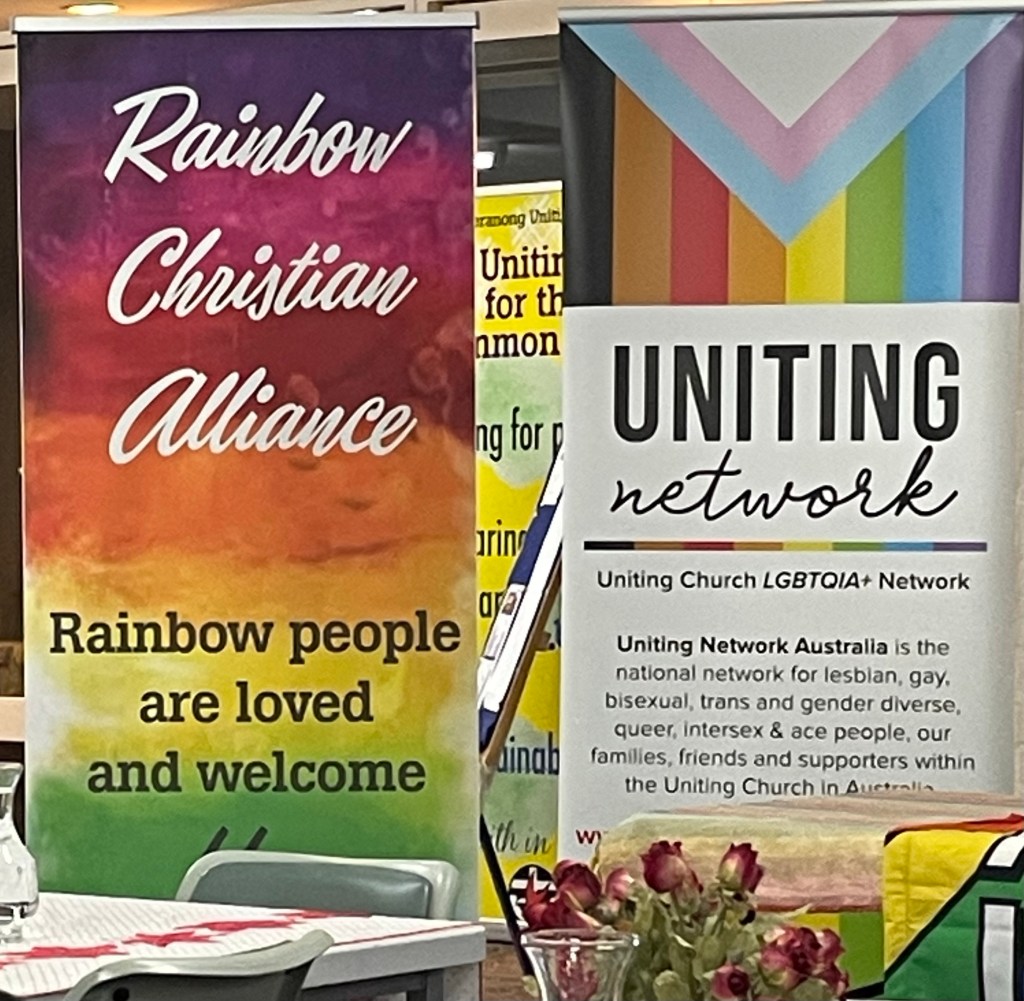
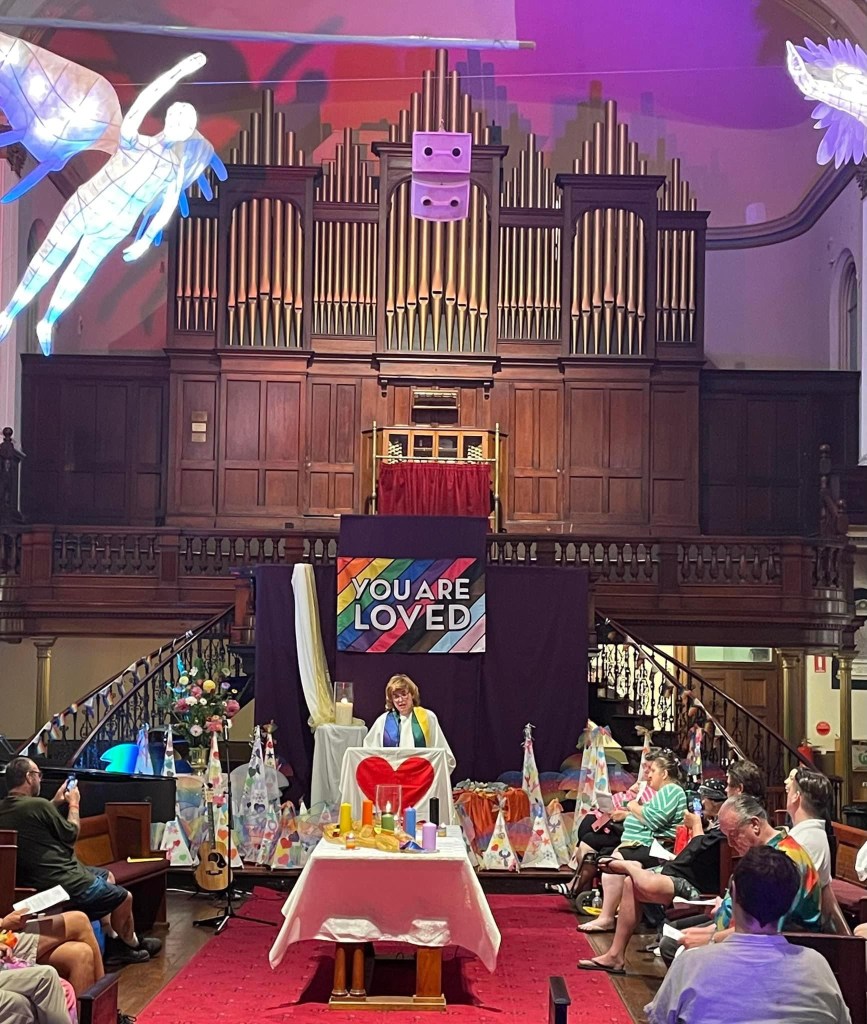
Locally, in the lead up to this day, the Rainbow Christian Alliance (RCA) that meets at Tuggeranong Uniting Church (TUC) once each month held an evening to give a local focus on Wear It Purple Day. So, on Sunday 13 August, RCA members and visitors came dressed in purple—it was a dazzling display!

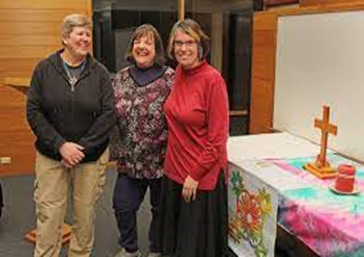
Local Greens MLA, Johnathan Davis, was the guest for the evening. (Sadly, as Johnathan does not own any purple clothing, he didn’t come dressed in purple, as the phot above shows!). Johnno, as he likes to be called, describes himself as “a young shamelessly queer person in public life”. He was elected to the Legislative Assembly of the Australian Capital Territory in 2020, as one of a number of Green members of that Assembly.

In the ACT, the Greens and Labor have formed a coalition government for the past few years, working together to provide reasonable and intelligent government for the territory. Johnno is not the only gay member of the Legislative Assembly—in fact, the ACT Chief Minister is a gay man in a longterm relationship. And he pointed out that while the Deputy Leader of the Greens is a practising Muslim, this indicates the breadth of opinions amongst the local political parties in the ACT.

Johnathan spoke about how he was radicalised politically by his own public school experiences—including a time when the then government was proposing to close the high school that he was attending. Indignant at this move, Johnno mobilised the school community and was successful in stopping the closure of his school. His first successful political campaign!

Wear It Purple is a day that is important to celebrate, he said. Visibility is so important to young gay and lesbian people—and, also, to young intersex and transgender people, as well as asexual and bisexual young people. Visibility such as like Wear It Purple Day provides is personally empowering for such people and it works to ensure that young rainbow people are not isolated. The Day helps to provide a shared sense of identity amongst young rainbow people, giving them encouragement and support from others of same identity—and, indeed, from straighten allies in the wider community who support this Day.

Johnathan talked about some of the initiatives that the ACT Government has introduced to strengthen mental health support for young rainbow people. We know that rainbow people are more liable to have mental health crisis, to attempt suicide, and indeed to die from their own hands, than those in the straight community. This is exacerbated even more for younger members of the rainbow community.

Studies show that the situation is very serious for members of this community. For instance, I have found that LGBTIQ+ Health Australia has stated the following in its October 2021 report:

For more statistics, and the details of the studies relied on, see https://assets.nationbuilder.com/lgbtihealth/pages/549/attachments/original/1648014801/24.10.21_Snapshot_of_MHSP_Statistics_for_LGBTIQ__People_-_Revised.pdf?1648014801

The ACT Government has recently opened a “queer space cafe”, which is a safe haven space, in the northwest of Canberra. Already, after just a short period of time, the impact of this safe haven space has proved to be incredibly powerful. It is based on the observation that early intervention, when a person is facing a mental health crisis, is far more effective than waiting until the issues have magnified and become far more difficult to manage.

The cafe is staffed by people who transform a simple space to sip coffee and chat into a one-stop shop to refer people in need to whatever services might best be able to support their need. Johnathan says that this reflects the current approach of the ACT Minister for Mental Health, Emma Davidson, MLA, to divert mental health funding away from government-run services into supporting existing community services that are working well. (Emma Davidson is, like Johnathan Davis, a member of the Greens Party.)

Johnathan also spoke quite candidly about his own faith. He volunteered that “Faith has not been an issue for me for many years, but my recent connections with Tuggeranong Uniting Church has led me to re-evaluate my position and rethink faith questions”. He noted that his understanding of God and his experience of church did not correlate—a disjuncture that, sadly, is the case for many people in today’s society, especially when they experience a church that is dogmatic, and judgemental, and what they experience is condemnation and exclusion.

“When I came out”, Johnno said, “everyone who had a problem with my sexuality attributed that to their faith”. That is, they judged him on the basis of what they believed (and what they had been taught) was “right”, rather than encountering him as he was, and building relationships with him from that.

The approach at Tuggeranong Uniting is quite different from this; the community has worked hard to develop an inclusive and welcoming community where relationships are valued over judging, where being an inclusive space has a higher value than being a set-apart, “holy” community of faith. (There are quite a number of other Uniting Churches which are similar in this regard.)

So Johnno continued, saying that “I feel like I can reconsider my faith because of the contact I have had with Tuggeranong; this church is prodding me to re-evaluate my faith”. He had said the same when interviewed for the recent video, “Transforming Connections”, which was recently released. He finished with an indication that he would like to continue to develop his relationship with TUC in the future.

The website for Wear it Purple Day notes that the Day has developed into an international movement. “New generations of rainbow young people continue to be dedicated to promoting the annual expression of support and acceptance to rainbow young people. What started out small has now grown; however the message remains the same: Everybody has the right to be proud of who they are.”

On 25 August, why not celebrate Wear it Purple Day? Be part of a movement that has the potential to save thousands of lives. Be part of this change.

*****

On Wear It Purple Day, see

https://www.wearitpurple.org/our-story

On Rainbow Christian Alliance, see
From violent conflict to joyful celebrations: Pride Month

Earlier this month, Elizabeth and I attended the regular monthly gathering of Rainbow Christian Alliance (RCA), where rainbow people of faith, who identify with one or more of the letters in LGBTIQA, join with allies to share food, conversation, and prayer, and discuss matters of mutual concern.

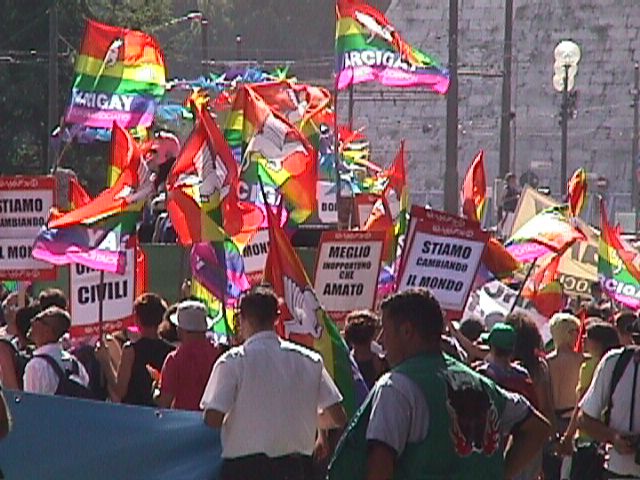
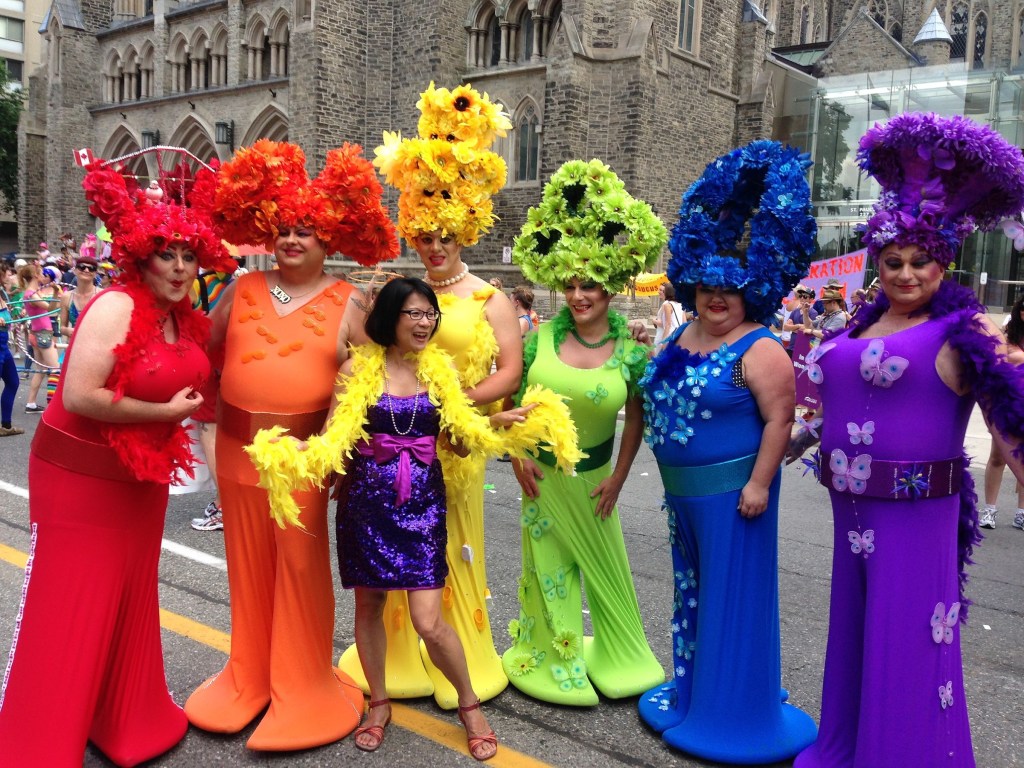
This time, the theme for RCA—since it is Pride Month during June—was “Proud of Pride?” Pride Month runs throughout the month of June. It honours the 1969 Stonewall Riots, a tipping point for the then Gay Liberation Movement in the USA.

In response to a police raid of a gay bar, the Stonewall Inn, on 28 June 1969, in Greenwich Village, New York City, members of the gay community began a rolling series of spontaneous protests that were marred by police violence, which generated increasingly aggressive protests in response.

Simultaneous Gay Pride marches were held a year later, in New York, Chicago, and Los Angeles, to remember the Stonewall Riots. That custom has continued each year since, and has grown into Pride Month.

The long-term result of these protests was that gay rights groups sprang up in every major US city, and the decriminalisation of homosexuality (which had already occurred in Illinois in 1962) spread across the fifty states over the next four decades. A similar slow-drip rollout occurred across the states and territories of Australia, from South Australia in 1972, to 1997 in Tasmania, the last state to decriminalise consenting homosexual activity.

Today, Pride Month is a time for celebrations, including pride parades, picnics, parties, workshops, symposia and concerts. It offers an opportunity to “celebrate the diversity of the lesbian, gay, bisexual, transgender and intersex community … to reflect on just how far civil rights have progressed in half a century… and an opportunity to protest discrimination and violence”. (quoted from https://unyouth.org.au/event/global-issues-resources/national-pride-month/)

Those present at the Rainbow Christian Alliance gathering earlier in June engaged in a discussion of the differences between the sin of pride—hubris, according to the ancient Greeks—and the situation of LGBTIQA+ people today, where their expressing of pride in their gender identity or their sexual orientation is encouraged.

It is my view that the longterm historical prejudice and discrimination that LGBTIQA+ people have experienced—and that many continue to experience today—means that it is quite different for rainbow people. To express pride in their identity is something that is important and necessary for them to do. It is a way of claiming a place as a respected, honoured, and valued member of society.

That is quite different from someone like myself (a cis-gender white straight male, who has experienced so many points of privilege in life) expressing pride. Any expression of pride by myself about my privileges would be hubris; rainbow pride is seeking to redress past wrongs and establish a good and positive place in society for LGBTIQA+ people.

The Rainbow Christian Alliance provides a safe space for people to gather under the umbrella of the church. The importance of this space is evident at every RCA gathering, where friendship, support, compassion, and empathy is always strong. Participants keep coming back because they are valued and respected. Acceptance and affirmation are central to what takes place at each gathering.

As an ally, I find that welcoming rainbow people into the physical space where I worship week by week is complemented by the fact that I always feel welcomed into the emotional “rainbow space” that people create on these Sunday nights. Being able to take part in such a gathering is so important for all of us; there are mutual benefits for all of us.

Many of the people who participate in RCA have had negative experiences, related to their sexuality and/or gender, from family members, and from churches. The churches that give the most grief are of a more conservative theology, and a substantial proportion of those are Pentecostal, but even mainstream churches, Anglican and Catholic alike, have inflicted hurt and perpetrated harm by the way they have dealt with people in their midst who “come out” in relation to their gender identity or sexual preference.

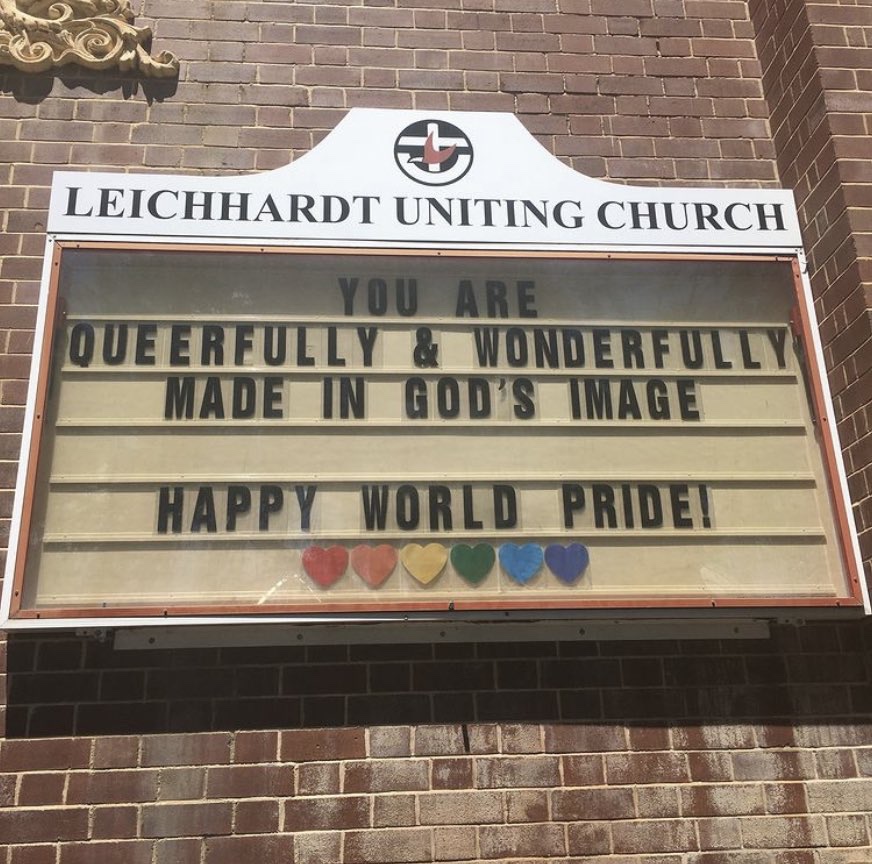
I am glad that the Uniting Church has held a strong line in relation to LGBTIQA+ people. We have consistently grappled with issues of sexuality and, more recently, gender identity, exploring the biblical, theological, and pastoral dimensions with care, compassion, and integrity. That we can offer safe spaces in so many of our Congregations, now, is a small testimony to the determination we have to hold fast to the Gospel, as we best understand: we value, we accept, we include, and we advocate for people across the spectrum, as integral members of our community of faith.

See also

Gather—Dream—Amplify: World Pride 2023

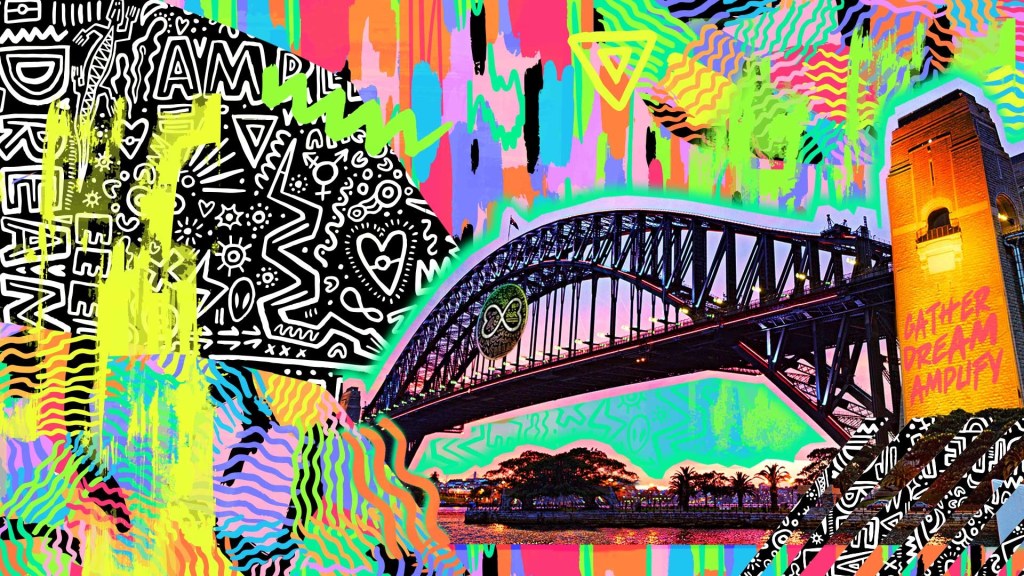
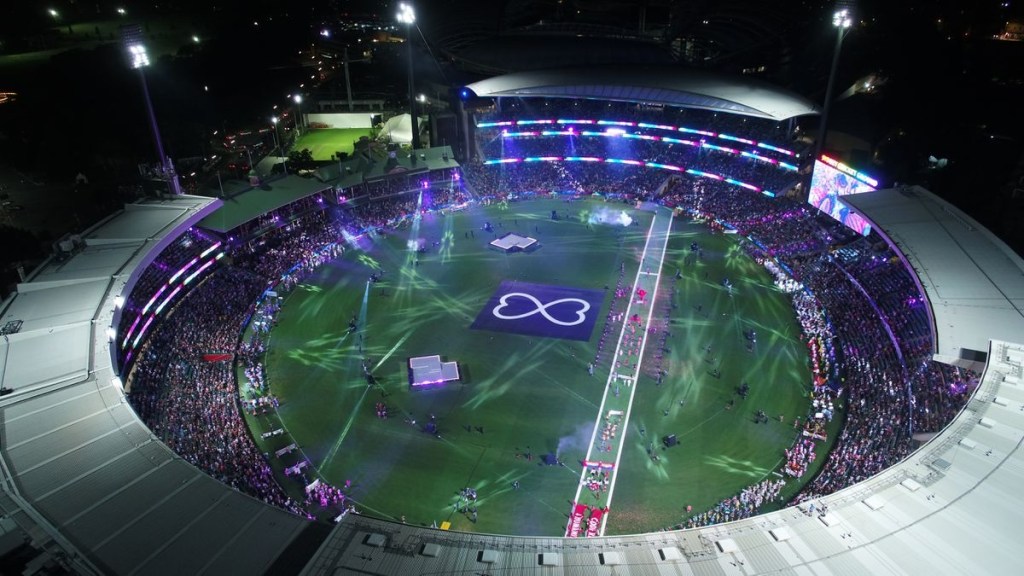
World Pride 2023 is taking place in Sydney at the moment. It started on 17 February and runs through to 5 March, with a concentration of Pride-related events in Sydney, including a fine Pride Concert last night and the annual Gay and Lesbian Mardi Gras Parade that is taking place later today, Saturday 25 February. This is the first time that World Pride has taken place in the southern hemisphere.

The theme for World Pride 2023 is Gather—Dream—Amplify. The website describes the event as “A time to listen deeply, learn, take action, protest and party … A time to dream. Imagine the future we want and demand it … A time to step aside, making sure there is an abundance of space for everyone. New voices. New dreams. A time for new perspectives and possibilities.” It is a positive, optimistic, affirmation.

World Pride has been held since 2000, when it took place in Rome. It was next held six years later, in Jerusalem (2006), and then a further six years later, in London (2012). Momentum grew, as subsequent gatherings took place in Toronto (2014) and then Madrid (2017).

Two years later, in 2019, World Pride was held in New York City, commemorating the 50th anniversary of the Stonewall uprising, with five million spectators attending in Manhattan over the central Pride weekend. The Stonewall uprising is widely considered to mark the start of the modern Gay Rights Movement (now more commonly referred to as the fight for LGBTQIA+ rights).

In 2021, World Pride was shared between Copenhagen, Denmark, and Malmo, Sweden. The Crown Princess of Denmark was patron of the event, making her the first ever royal to serve as patron for a major LGBTQ event.

This year, in Sydney, the key events include a Fair Day on Sunday 19 Feb, the formal Opening Ceremony and Concert in the Sydney Domain on Friday 24 Feb, the annual Mardi Gras Parade and Party on Saturday 25 Feb; a Human Rights Conference from Wednesday 1 to Friday 3 March; a First Nations Gala Concert and a Mardi Gras International Arts Festival and Film Festival; and on the last day, Sunday 5 March, a Pride March over the Sydney Harbour Bridge and a grand Closing Ceremony.

Faith communities are actively involved in World Pride 2023, with a full listing of events at https://www.worldpridefaith.com.au/?mibextid=S66gvF&fbclid=IwAR15hAd9eTPZqO1QlU_o_XyEBD7n8-dtFSChxoMGLr3ILkEBgjHvG2kdar8

The Uniting Church is strongly supportive of the event, and a number of Sydney churches are involved. See https://uniting.church/uniting-churches-welcome-world-pride/

The Pitt St Uniting Church, located in the heart of Sydney, is actively involved in World Pride 2023, bringing a strong faith voice into the event. Pitt St is holding a photo exhibition, Queer Faces of Faith and providing a rehearsal space for the Out&Loud&Proud Choir rehearsals, as well as providing a safe and celebratory faith space and pastoral support to World Pride people in the heart of the CBD. A full program of prayer support for World Pride is operating as well. See https://pittstreetuniting.org.au/wp-content/uploads/2023/02/Diary-of-Praise-and-Prayer-for-World-Pride-2023.pdf

*****

Christians have had an unhappy relationship with LGBTIQA+ people. Sadly, far too many Christians hold a judgemental and discriminatory attitude towards people whom they regards as sinners, and many of these carry those negative attitudes through into discriminatory, oppressive, and damaging actions.

These negative attitudes were born long ago, in societies with different understandings of sexuality and gender. Many such societies of the past were centred around what they perceived as normality. “Normality” is what is most commonly found. “Normality” is also what is needed to ensure the ongoing survival of society. So regular reproduction of the species was essential in such societies, especially given the rate of deaths was much higher than in most modern societies.

The communities reflected in the Bible are no exceptions to this. Humanity is defined in Hebrew Scripture as needing to strive for perfection, so we see those who cannot see or hear, with missing limbs or those unable to speak, excluded from worship and community on the basis of how they differ from “perfection”. They are perceived as a threat to the good order and flourishing of society, because of their inherent “difference” from the norm. This is reflected in ancient Israelite law, and this continued on into in the understandings of the New Testament writers.

In modern times, our understanding of “normality” has broadened from such a binary understanding, to include now a spectrum of what is seen as “normal”. No longer do we exclude people on the basis that their physical appearance does not conform to the physical appearance of the majority of people, for instance. The understanding that the human brain operates on a spectrum has been well established, and we are now used to hearing regular references to the fact that neurodiversity in human beings has placed people at various points along a spectrum of neurological functioning.

The same applies to human sexuality. As further research is done, it has becoming increasingly clear that the way that people experience and express their sexuality, like the way that the brains of different people function differently, exists on a spectrum and is not confined to a binary state. Gender identity and sexual orientation both sit on such spectrums rather than existing in oppositional binary states.

Within such spectrums, there are “standard deviations” which we expect to find in any human population. This is a perfectly “normal” phenomenon. So, today we recognise that there is a range of gender identity along a spectrum of identities, and a range of sexual orientation along a range of sexual orientation.

Our Bible is an ancient document. It was written at a time when “normality” was seen as living within the divine favour and existing in a way that accords with the divine statutes. Those who failed to conform to the “normality” of those statues were seen as “abnormal”, incomplete and perhaps, at times, sinful. They occupied what we today call “the tails of the bell curve”. They were not seen as “normal”, since they were unable to promote the future of community.

In ancient times, sexual behaviour that fell into the expected variation of the tails of the bell curve was frequently perceived as “not normal” and threatening to the community, and an aberration that threatened the survival of the community. That is no longer the case for us, today.

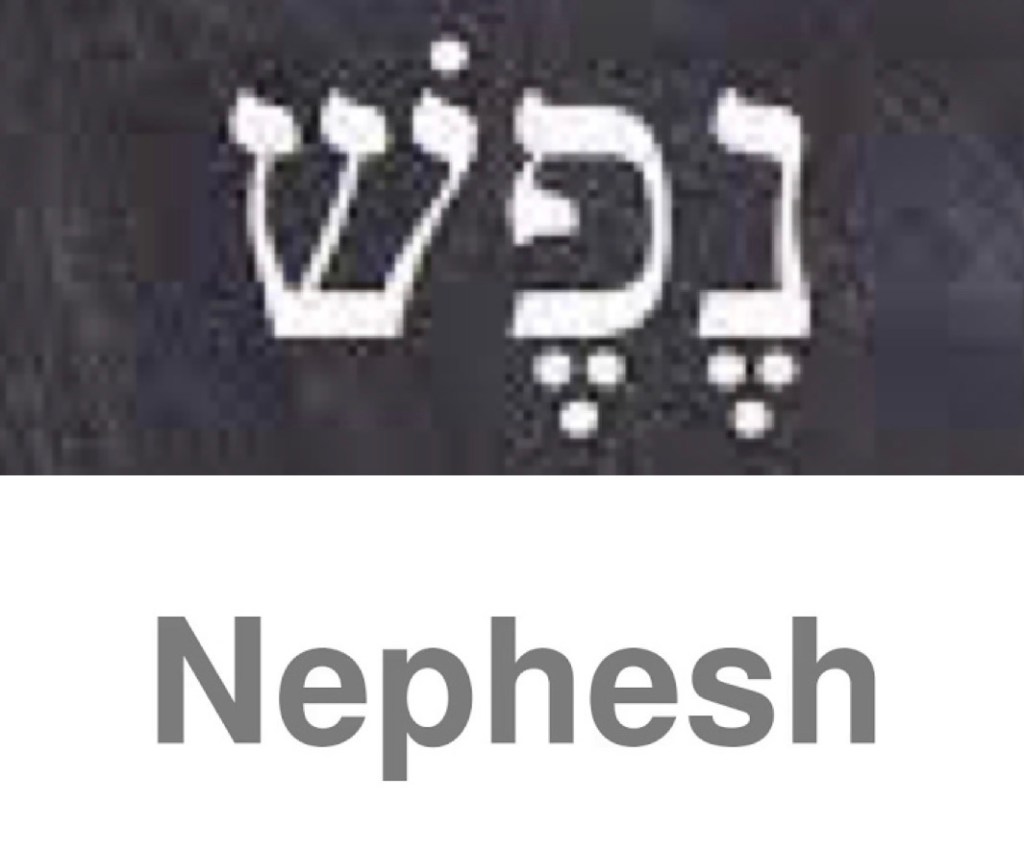
The Hebrew Scriptures use the word nephesh (נֶפֶש) to describe human beings (and, indeed, all other living creatures). It is a common Hebrew word, appearing 688 times in Hebrew Scripture. It is most commonly translated (238 times) as “soul”; the next most common translation is “life” (180 times). The word is a common descriptor for a human being, as a whole. (I have learnt much about nephesh in my discussions with my wife, the Rev. Elizabeth Raine.)

However, to use the English word “soul” to translate nephesh does it a disservice. We have become acclimatised to regarding the soul as but one part of the whole human being—that is the influence of dualistic Platonic thinking, where “body and soul” refer to the two complementary parts of a human being. In Hebrew, nephesh has a unified, whole-of-person reference, quite separate from the dualism that dominates a Greek way of thinking.

Nephesh appears a number of times in the first creation story in Hebrew scripture, where it refers to “living creatures” in the seas (Gen 1:20, 21), on the earth (Gen 1:24), and to “every beast of the earth, and to every bird of the air, and to everything that creeps on the earth, everything that has the breath of life (nephesh hayah)” (Gen 1:30).

It is found also in the second creation story, where it likewise describes how God formed a man from the dust of the earth and breathed the breath of life into him, and “the man became a living being (nephesh hayah)” (Gen 2:7). The claim that each living creature is a nephesh is reiterated in the priestly Holiness Code (Lev 11:10, 46; 17:11). So we human beings are part of a wide spectrum of creatures, all created by God, all seen to be “good”, a wonderful kaleidoscopic variety of beings.

Our theology of the human being needs to underline the claim that all people, no matter where they are located on the bell curve, are “nephesh” and are filled with the sprit of God. We are all part of the creation that, in Christian and Jewish mythological, God declared “very good” (Gen 1:31). We are, each and every one of us, “fearfully and wonderfully made”, as the psalmist sings (Ps 139:14a)—like the intricate, complex, and beautiful created world in which we live, each human being is, exactly as they are, one of the “wonderful works” of the Lord God (Ps 139:14b).

And that is exactly what World Pride 2023 is celebrating!

*****

See also

and for Canberra people, there is a safe space every Sunday morning at 9:30am and once a month on Sunday at 6:00pm (the 2nd Sunday of the month) at Tuggeranong Uniting Church, where Elizabeth Raine and Sharon Jacobs lead the ministry team. See

and for further biblical discussion, see

“Impishly uncomplicated, lightly subversive”: remembering Father Peter Maher

During the last week, the funeral of a Roman Catholic priest, Father Peter Maher, took place. I have known Peter for five decades, and was very sorry to learn that he was unwell earlier this year. I met him when he was training as a priest; in those early years, Peter and I were in a Christian musical together for a while (organised by the Anglican Youth Dept—very ecumenical!!).

I attended Peter’s ordination at St Mary’s Cathedral in the mid 1970s—and in an early act of quiet defiance of the established doctrines of his Church, he gave me, a Proddy, communion!. Peter then attended my ordination in 1980–and I gave him communion (with no angst in terms of Uniting Church polity). Peter and his brother Chris visited us while I was studying in the USA. We caught up from time to time over meals—Peter was a superb cook and delighted in offering hospitality through good food and even better conversation!

Years later, Peter spent a year as my professional supervisor when my previous supervisor took a sabbatical year. His gentle approach and incisive commentary was invaluable, especially as that was a time of heightened stress and intense emotional pressure because of an ugly and unhappy situation in my church environment at the time.

I heard Peter’s stories about his run-ins with George Pell, always told with a lightness of tone despite the cost that this brought to his own ministry. I was chatting to him a couple of months ago about an LGBTIQA+ initiative here in Canberra. There are lots of rich memories, even though we weren’t in regular communication over the last few decades.

Peter was a strong advocate, throughout his ministry, for “the least and the lost”, and especially, in recent decades, for members of the LGBTIQA+ community. His weekly Mass for rainbow people, held at St Joseph’s Church in Newtown, attracted people and was the basis for the formation of a wonderfully extensive community of people of faith who identify with sexual or gender diversity. Peter lived a lifetime of work devoted, in various ways, to the gender agenda—affirming, supporting, counselling, encouraging, and advocating for, the many people of faith (and of no faith) within the broad LGBTIQA+ community.

The former Executive Director of Uniting in the NSW.ACT Synod of the Uniting Church, Peter Worland, described Peter as “A mighty man. Small physically but massive heart … for others”. My Uniting Church colleague Rod Pattenden captured the very essence of Peter’s modus operandi: “impishly uncomplicated in attitude and lightly subversive”. The Roman Catholic media commentator, Noel Debien, referred to Peter’s “generous and inclusive ministry [which] he carried out at great cost to himself. He suffered significantly because of his compassion for others, but that was far, far outweighed by the blessing of his ministry. He made a huge pastoral difference” in the ArchDiocese of Sydney.

Noel recalls that “few (very few) priests I have ever known have had so much integrity, humour, compassion and determination to live the Gospel every day.” He continues, “I find it odd that in Sydney, we have gay bishops, archbishops with gay and lesbian siblings, clergy who are gay (and celibate) as well as huge numbers of Catholics with LGBTQIA kids, uncles, aunts and friends—and at a funeral like this, the church is not adequately able to fully recognise the real nature of LGBTQI ministry in our city.”

Another friend of Peter noted “This constant presence. This smile. Peter taught us about patience. About relationship. About being open to the most unlikely of allies. Planting seeds. And slowly waiting. And now we must wait to meet him again.” I saw a comment that described “the delight and mischief in his eyes”—how true! Another person noted, quite poignantly, “Peter was always encouraging and welcoming to me, even though I felt pretty unworthy.” That, there, is the Gospel, lived in all aspects of life.

Yet another wrote, “Peter always did the best he could and made the best of things. If something didn’t go as hoped for he’d say “that’s okay we can…”. “Well I’m glad because…”. A shrug, a twinkle of his nose and a “whatever”. He didn’t let what anyone else thought stop him from doing the right thing. He celebrated the smallest of wins and smallest of changes. An excited ‘Yes!’ fistpumped in the air. Always enthusiasm and heartfelt sincerity and seriousness in the one package.”

Others noted his “steadfast commitment to solidarity and equality”, his “warmth, kindness and affection … generosity, tenacity, laughter and good humour”. One wrote “Thank you for being a prophet. And teaching others to be too. Thank you for making mischief. Making change. With a twinkle of delight and hope in your eyes. Thank you for being a protector for people you will never meet. Doing justice.” Another, “Thank you for the healing. For the deep hearing. For the liturgy. For nourishing weary souls.” More Gospel qualities, so clearly evident!

These are wonderful testimonies to a man whose life was given in devoted service to the God who offers the grace of inclusivity, a celebration of God’s abiding love.

The songs and readings that Peter chose for his funeral are at

https://docs.google.com/document/u/0/d/1sRxct-DbuSVy-J_HafzxKiJw17rRIP63ew7wa0qFbis/mobilebasic

A fine tribute to Peter is at https://www.misacor.org.au/item/28929-rip-peter-maher-vigorous-priest-sydney-longtime-editor-of-the-swag

*****

See also

Challenged and transformed: with thanks for rainbow people, this Lent

The following reflection was written by John Squires and Elizabeth Raine, and shared with the Rainbow Christian Alliance at Tuggeranong Uniting Church on Sunday 13 March 2022.

In many churches, including the Uniting Church, today is called the Second Sunday in Lent. Our church follows the calendar of seasons that is held by many churches around the world; instead of spring, summer, autumn, winter, we have Advent, Christmas, Epiphany, Lent, Easter, and Pentecost.

The season of Lent lasts for just six weeks, and it leads into the three day celebration of Easter. It’s called Lent, incidentally, not because it is tilted or skew-whiff, but because in the northern hemisphere, where such seasons were first given their names, the days are starting to lengthen (the name was Lencten in Old English).

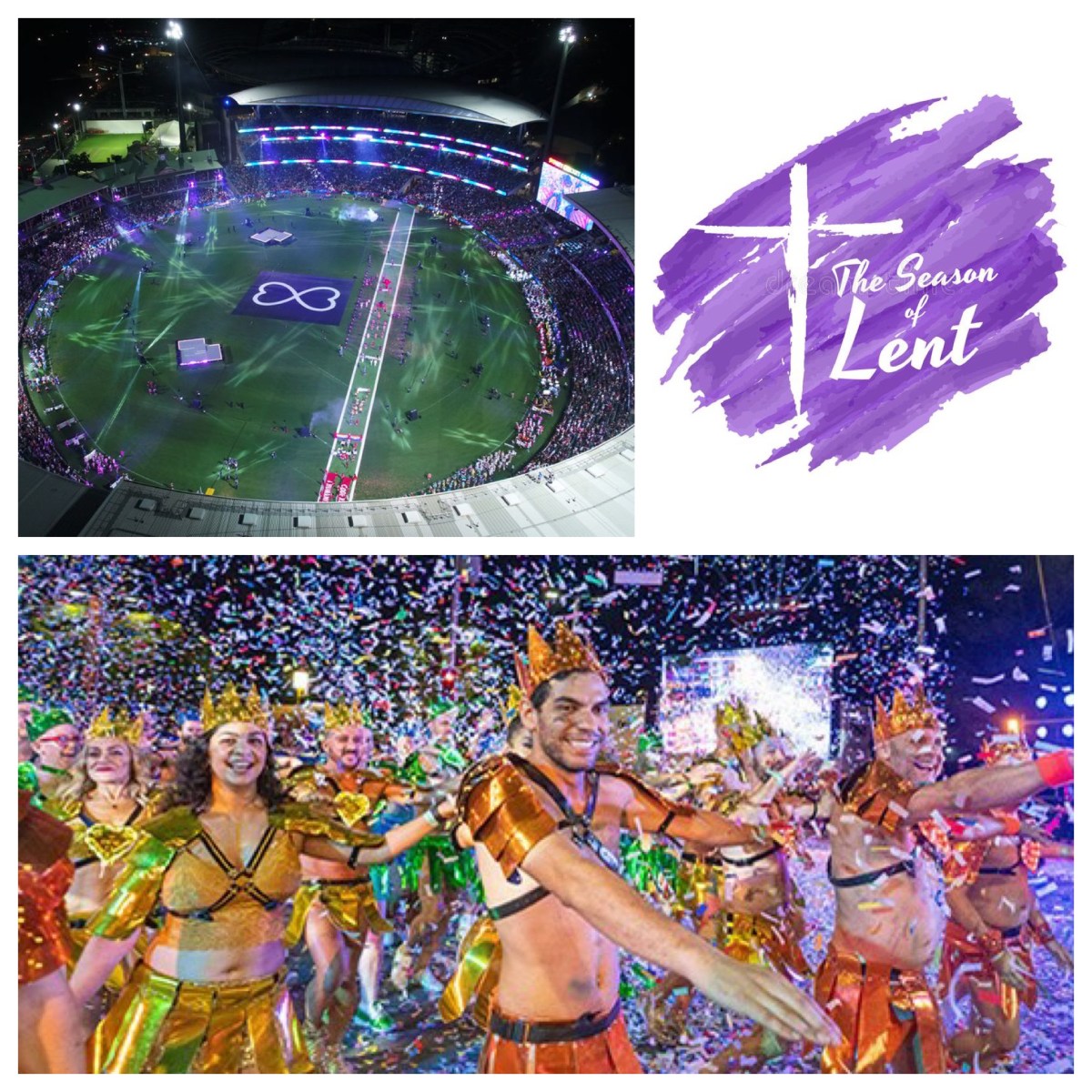
In the Roman Catholic and Orthodox churches, Lent is a period of fasting. The day before, Mardi Gras, which is French for Fat Tuesday, was a day to use up all the fatty goods in the kitchen — eggs, flour, milk — so they were out of the way for Lent. The day is also known as Pancake Tuesday. In South America, in countries where Roman Catholicism was the dominant religion, Mardi Gras became a public festival, a day not only to feast, but a day for street parades, for big banquets to celebrate, with colourful costumes and extravagant public exhibitions of joy.

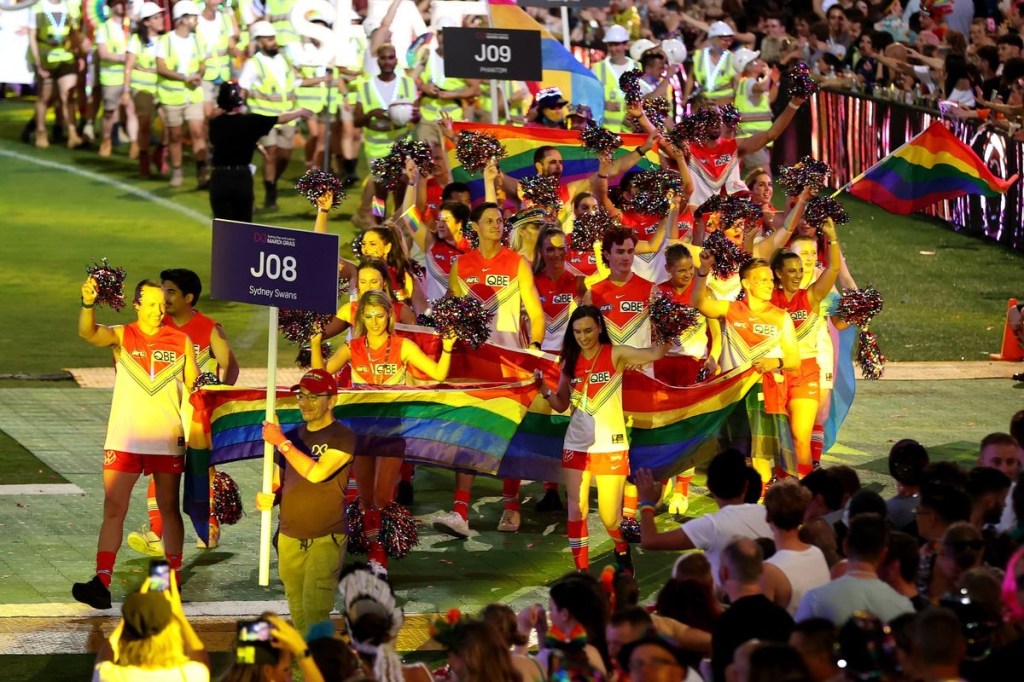
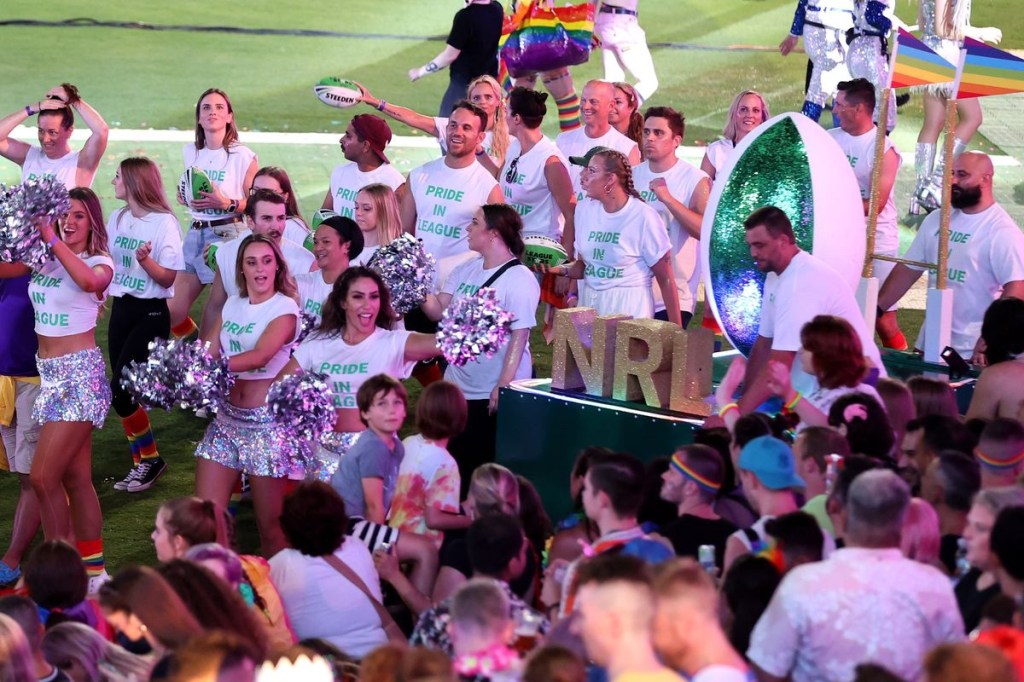
And that has surely been the inspiration for the Sydney Gay and Lesbian Mardi Gras, both in recent years with colourful and extravagant floats, and in the decades before, with lots of rainbow groups marching, and even in the early days of protest and attempting to “claim the streets” and “go public” about gays and lesbians and more.

*****

Immediately after Mardi Gras, Fat Tuesday, comes Ash Wednesday — a solemn day of penitence; and the fasting continued right through Lent, until Easter Sunday. We don’t actually do full-on fasting in the Uniting Church, but in recent times it has become customary to decide to “give up something for Lent” — chocolate and alcohol being the most common, but also more significant things like not driving your car and catching public transport; or not eating meat. In this way, Lent becomes a time of challenge, as we try to remind ourselves each day of the importance of being faithful to God. We “give up” so that we can focus in more clearly on God, if you like.

So there is already a connection between the season of Lent and rainbow people; because Lent starts immediately after Mardi Gras. And the annual Sydney Gay and Lesbian Mardi Gras, now an institution in our annual public events; the extravagantly colourful celebrations of that event mark, if you like, the climax of joy as rainbow people celebrate that they are each made exactly as they are, and they can be happy about that.

We both enjoyed watching (on TV) the parade of organisations and people that were out and proud, out and loud, a week ago, walking unhindered around the SCG — a striking contrast to the first Mardi Gras, when police barricaded the road and people were arrested. It is truly wonderful to see that the rainbow colours can be flown in society, that people can acknowledge and declare who they are, and not be under threat of arrest.

*****

So in the cycle of seasons for Christians, after Mardi Gras comes Lent. And Lent is about giving up; or, at least, focussing intently on Jesus, the one in whom we see most clearly see God. How else might Lent relate to the experience of rainbow people?

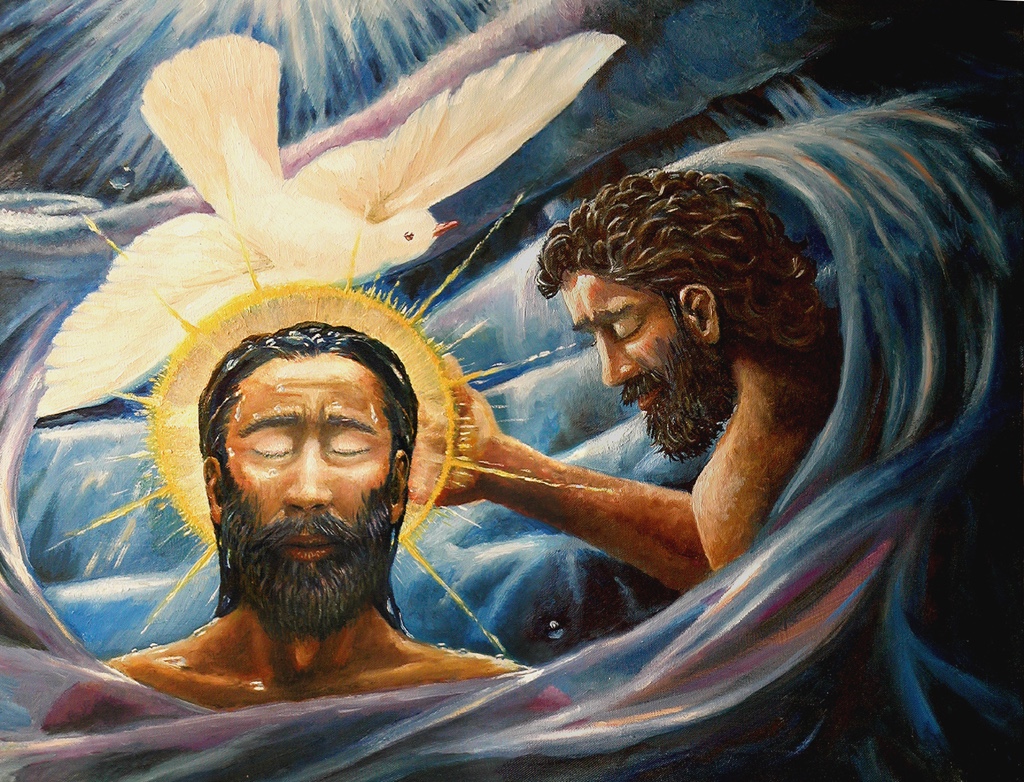
There are a collection of stories that the church retells each year, in association with Lent. In preparation for Lent, the story is told of the day that Jesus was baptised: in the river Jordan, to the east of Jerusalem, fully submerged into the water by his crazy cousin John, baptising people as they repented of their sins.

John was crying out to the people who came to him, to repent; to change their way of being and living; to be transformed, completely, by being baptised. That’s what is meant by the single Greek word that John used, calling people to metanoia—to a complete transformation of who they are and how they love. Jesus came to that moment, willing to submit to that call, willing to experience metanoia in his own life.

OLYMPUS DIGITAL CAMERA

And yet for Jesus, this baptism became more than just the moment of call, or the moment of change; it was the moment when God publicly acknowledged him, when God declared, “this is my son, my beloved child; listen to him”. In that voice, booming from the clouds, a central affirmation is made: look at him, this is who he is; can you see that this is really who he is? And from that moment, Jesus began his mission of challenging people and transforming society.

The story of the baptism of Jesus tells us that, when God looks at us, God sees us exactly as we are; and we may well also hear God saying to use, and to those around us, “this is my child, my beloved one; I can see exactly who they are, and I am well pleased that this is who they are”. God sees me, a straight white male, and is well pleased; God sees a lesbian woman, and is equally well pleased; a trans man, and God is pleased; an intersex person, and is well pleased; an enbie, a gay, a pan sexual—God is just well pleased with each of us, as we are, and declares us to be beloved. And that means that we can get on with the kind of life that we each want to live, and are called to live.

*****

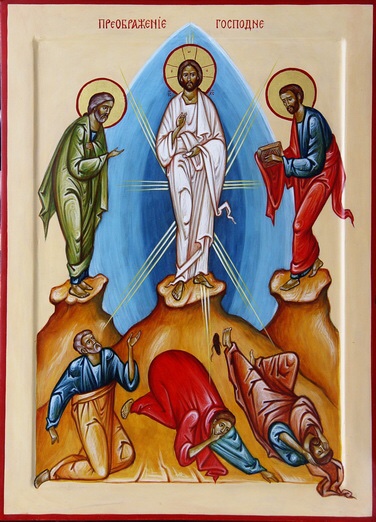
There’s another story about Jesus that is associated with Lent. It’s a story that, from our rather privileged, straight, perspective, sounds a great challenge to us. It’s a story about being changed; about being transformed. It’s a story that shows that being transformed means you are able to stand and challenge others to be transformed. It’s the story of when Jesus took his three closest friends to a mountain, and they had a shared experience of seeing Jesus standing between two of the greats of their people: Moses, to whom God had given the Law to govern the people of Israel, and Elijah, through whom God had established a long line of prophets in Israel.

The Gospel writers say that Jesus was transformed at that moment. But in this story, also, there is the indication that the friends of Jesus were transformed. That moment on the mountain was a challenge to each of them; the response that Peter wanted to make was seen to be inadequate. Jesus challenged him to respond differently. It was another moment when metanoia, complete transformation, took place. And these disciples did change; yes, it took some time, but these friends of Jesus ultimately became leaders amongst the followers of Jesus, and spearheaded the movement that became the church.

The change, the metanoia, that occurred within Peter, James, and John, spread widely. They faced the challenge head on, and responded with their own metanoia. That is mirrored, today, in changes that are taking place in society. As we watched the Mardi Gras last weekend, it soon became evident that this was no longer a side carnival, an event that was important to a minority group in society, and that’s all.

For the Mardi Gras—commercialised, mainstreamed, headlined and noticed—now reflects the way that society has been challenged—by you, by rainbow people—and how it has responded in metanoia, by being transformed. Banks, unions, police, sports teams, churches, golfing clubs, and more—all marched in the Mardi Gras, all affirming that there is a place in their ranks for rainbow people, no matter what letter an individual identifies with. And that reflects a very significant change in society, in which public acknowledgement and public discussion of gender and sexuality can take place.

Sure, there is still work to be done—much work to be done; many changes still to occur, deeper acceptance still to take place. But the changes are clear and evident; and it has been because those who themselves have been able to meet challenges by holding firm and calling for change, have then effected transformation, thoroughgoing change, in society. Rainbow people are changing our society. Last week’s Mardi Gras demonstrated that.

And for that, we are grateful, and say: thanks be to God.

A Safe Place for Rainbow Christians

A post from guest blogger Delia Quigley

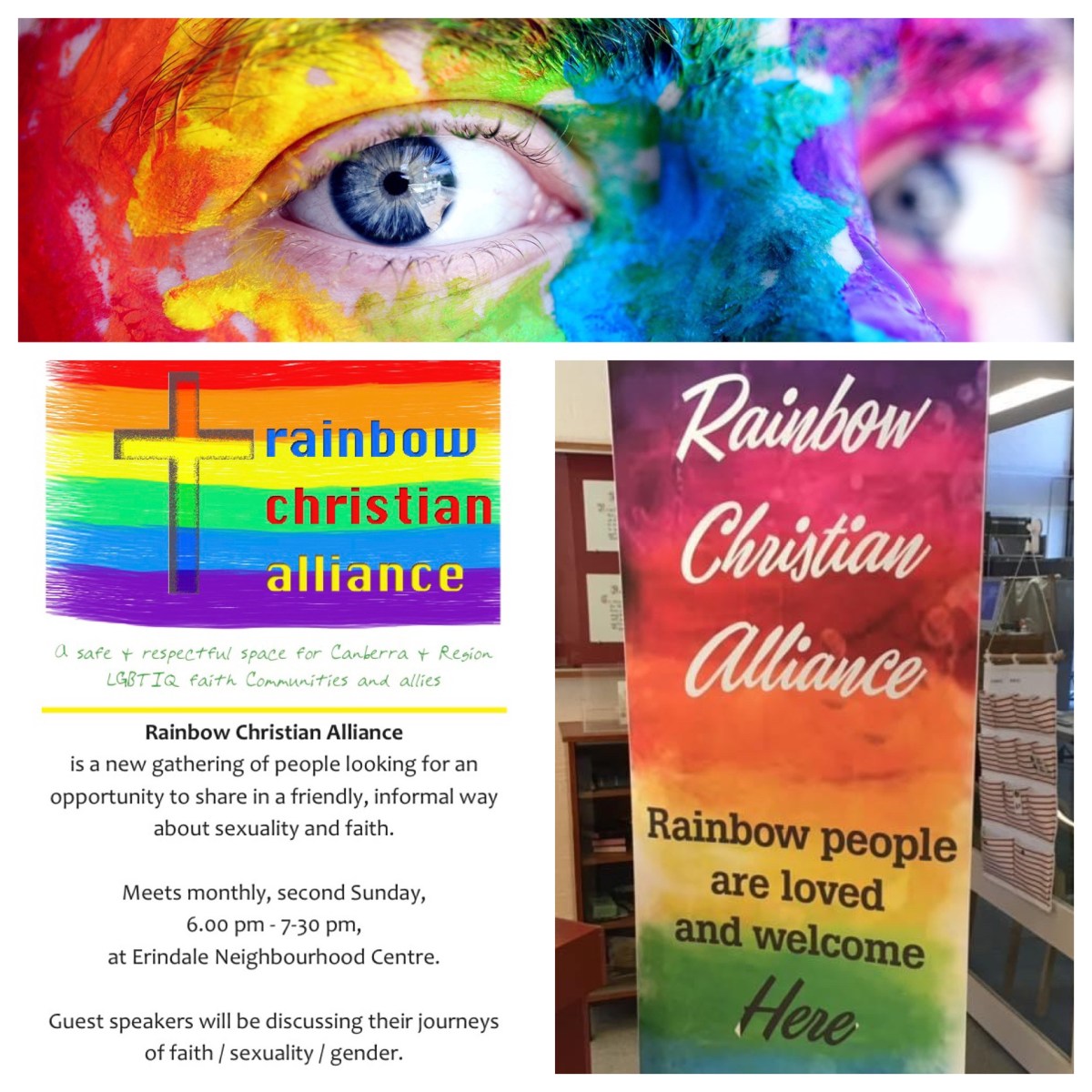
July 2015 saw the beginning of  Rainbow Christian Alliance (RCA) as a joint program run in partnership between Tuggeranong Uniting Church (TUC) and Diversity ACT community services. RCA was initiated to provide a Safe Place for LGBTIQA+ people of faith, their families and friends who wanted to be able to get together in fellowship in an environment away from the judgement, hurt and pain often caused by Christian Churches and other faiths to the LGBTIQA+ community.

See the source image

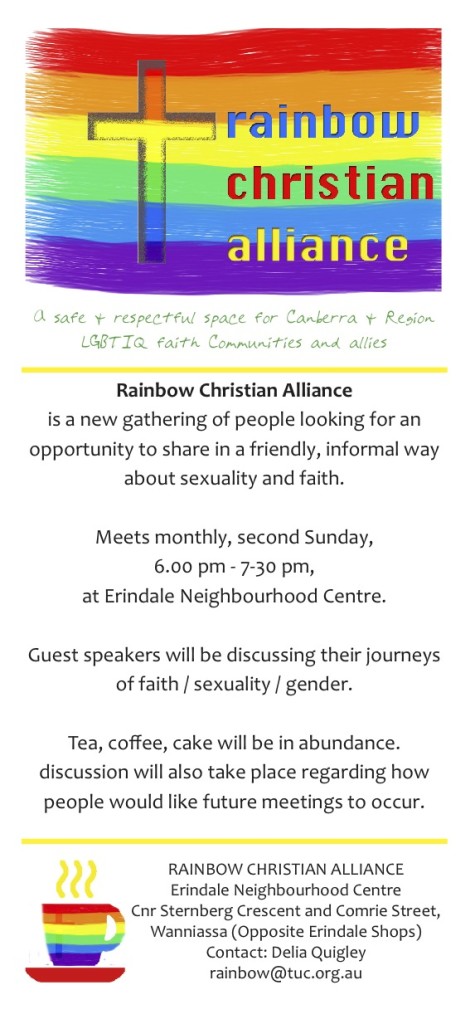
RCA  gathers  on the second Sunday of each month with a dinner church format, meeting with LGBTIQA+ people of faith and their allies; gathering, chatting, eating, then sharing in a variety of worship styles including modified liturgy, readers theatre, discussion groups, guest speakers and the evening is usually wrapped up with dessert and much more chatting!

Initially RCA was led by Delia Quigley, Rev Anne Ryan and  Megan Watts

Initially the RCA project was set up utilising the space in the Erindale Neighbourhood Centre, next door to TUC, but since the arrival of COVID-19 and the requirements for modifications including increased space for those gathered, RCA has been meeting in the TUC auditorium.

Following the commencement of RCA in July 2015, an invitation was extended by Rev Aimee Kent and a partnership was also created with Goulburn Grace Community. Dare Café commenced in Goulburn in February 2016, meeting monthly, and later incorporating a Bible Study group. The Dare Café and Grace Community has been impacted by COVID-19, but Pastor Amy Junor is now keen to work with the Dare Café group and keep things moving where possible.

See the source image

Over its six years, RCA has provided support to many people, including Ministers or Pastors who lost their congregation or Church because of their own sexuality, as well as people who faced exorcism, conversion therapies or even had lobotomies performed on them to cure their sexuality!

RCA also provided information to other congregations on LGBTIQA+ education and issues, including at the very stressful time of the Marriage Plebiscite. Following the June 2016 Orlando shooting at the Pulse night club in the USA, where 49 patrons were killed and 53 were wounded, RCA partnered with Canberra City Church to hold a Blue service for Orlando which was catered for with heart warming soups and fresh bread rolls by the City Church Congregation.

In more recent times RCA has had increasing support from TUC Congregation members, who provide a core support group to assist with set up, catering and running of RCA, giving more space for the leadership team of Rev. Miriam Parker-Lacey, James Ellis and Rev. Elizabeth Raine to concentrate on working with the group activities.

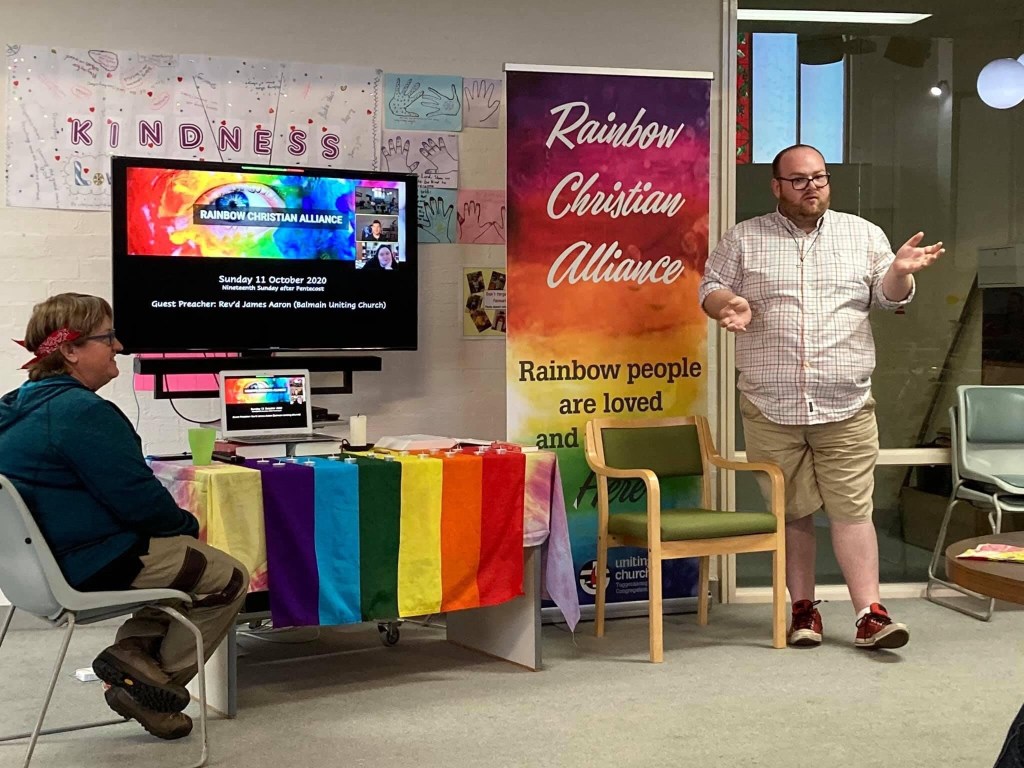
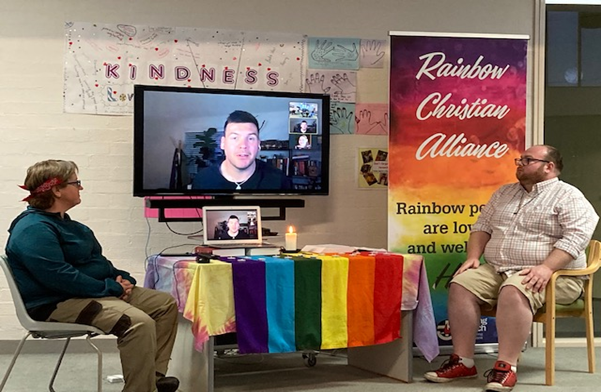
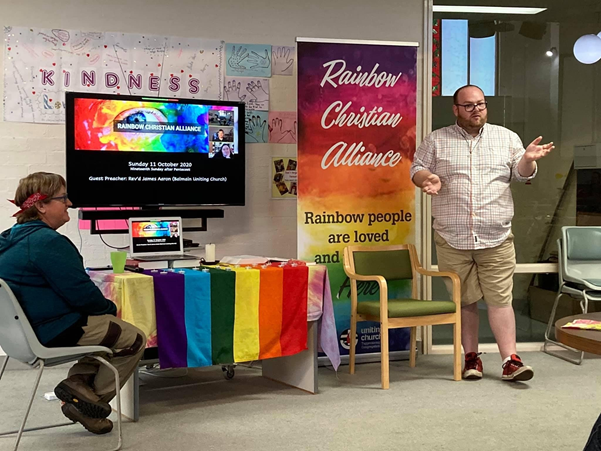
Rev Aaron James pictured speaking online to the RCA gathering in October 2020
with Rev Miriam Parker-Lacey and James Ellis 

RCA has provided a safe place for many and has had steady numbers of attendees of approximately 20-22 people at each gathering over the past 6 years.  Obviously there has been changes as to who attends, but the numbers have remained steady and in recent months there has been an increase in LGBTIQA+ youthful attendees. These younger attendees may not face some of the issues older generation LGBTIQA+ people faced but there are still many  ongoing issues for LGBTIQA+ plus Christians.

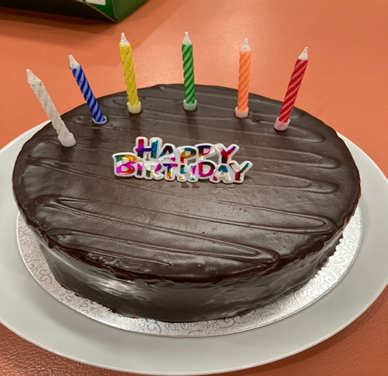
6th Birthday gluten-free chocolate mud cake 

Sadly, since the Marriage Plebiscite, there has been an increased push from certain quarters to demonise Transgender or Non-Binary people, and the current Olympics has been used to push fears that Trans people are stealing women’s rights and your children! (The “protect your children” fears was also previously used to push the falsehood that homosexuality equalled paedophilia.)

There are ongoing pushes for legislative changes being introduced by Mark Latham in NSW to prevent even mentioning LGBTIQA+ issues in classrooms.  LGBTIQA+ people are also faced with possible legislation to be tabled by the current Federal Government on ‘Religious Freedom’. Initially the Prime Minister promised to look at legislation to keep LGBTIQA+ young people safe, but there is much cynicism as to what may be introduced and many LGBTIQA+ people fear exclusion or even loss of employment because of their sexuality or gender identity

The Rainbow Christian Alliance continues to provide a Safe Space for people who have been hurt or marginalised within society–even by the church–to gather, relax in each other’s company, and share their faith.

More information on RCA can be found at  https://tuc.org.au/worship/rainbow-christian-alliance/ or on Facebook at https://www.facebook.com/groups/1025029234182558

See also https://www.abc.net.au/news/2017-08-17/what-is-it-like-to-be-christian-and-in-the-lgbtiq-rainbow-family/8808584