On the mount of the Lord it shall be provided (Genesis 21–22; Narrative Lectionary for Pentecost 14)

Discussion of the passages from Genesis 21–22 for the Narrative Lectionary.

The pair of passages from Genesis proposed by the Narrative Lectionary for this coming Sunday contain a paradox. On the one hand, after years of Abraham and Sarah yearning in vain for a son, “the Lord did for Sarah as he had promised; Sarah conceived and bore Abraham a son in his old age” (Gen 21:1–2). The son was named Isaac, meaning laughter; as Sarah, aged 100, declares, “God has brought laughter for me; everyone who hears will laugh with me” (21:6).

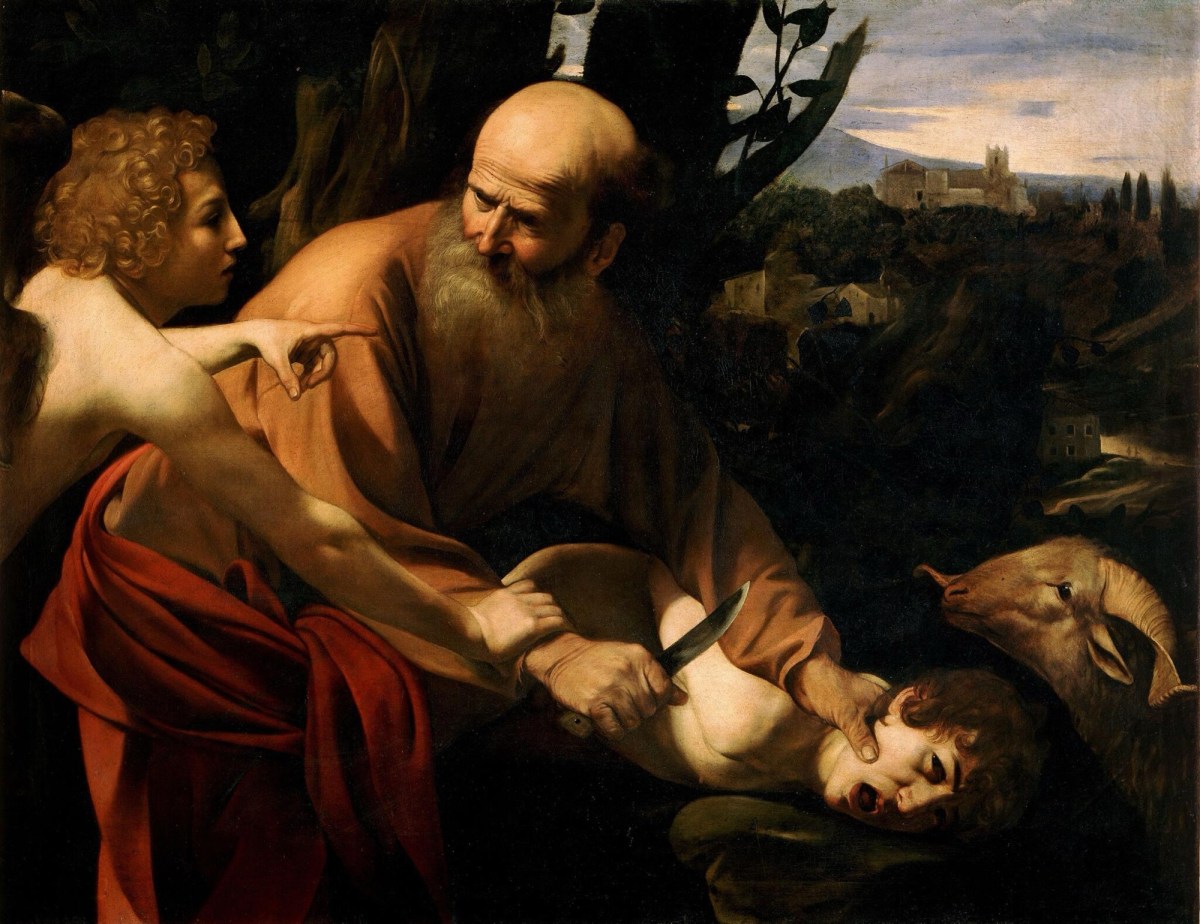
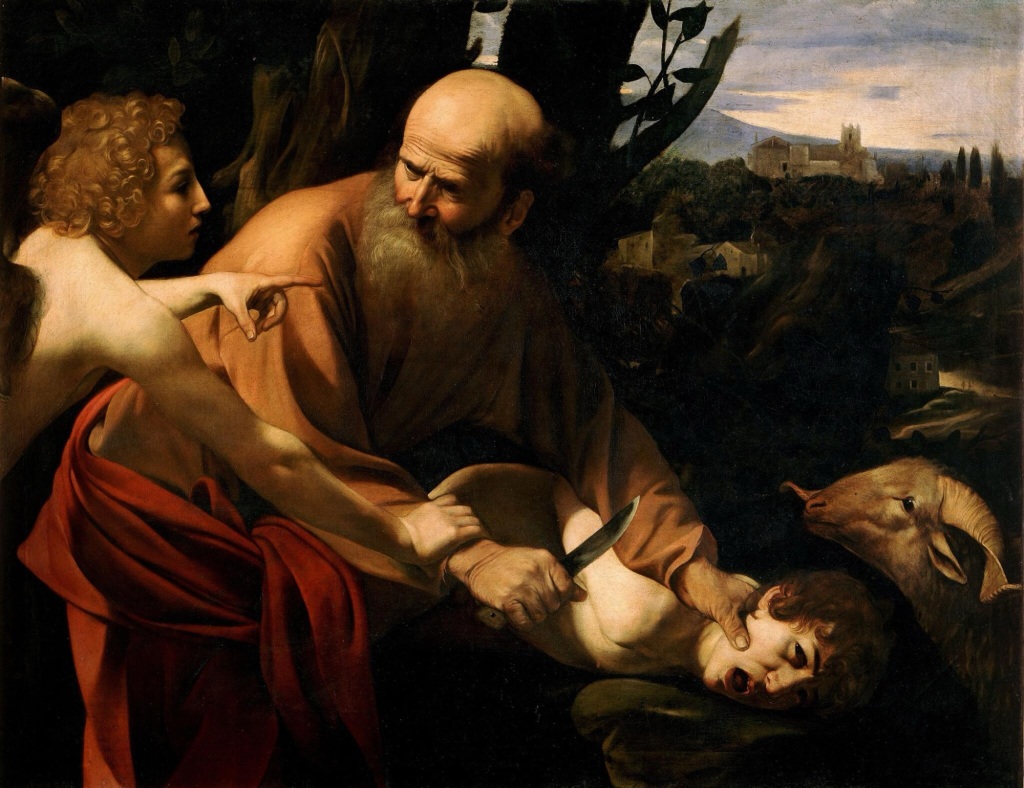
Yet in the second passage offered by the lectionary, we read some chilling words: “Abraham reached out his hand and took the knife to kill his son” (Gen 22:10). How does this relate to the joy seen at the birth of Isaac? There is no laughter in this story. It’s a horrifying story. How is this edifying material for hearing in worship?
Questions abound. Who is this God who calls Abraham to take his “only son” up the mountain and “offer him there as a burnt offering” (22:2)? Where is the God who, it is said, has shown “steadfast love” to the people of Israel (Exod 15:13), and before that to Joseph (Gen 39:21), to Jacob (Gen 32:9–19), and indeed to Abraham himself (Gen 24:27)? Why has God acted in a way that Is seemingly so out of character in this incident in Gen 22? Or is this the real nature of God, and these later displays of “steadfast love” are simply for show?

This story is indeed troubling: it presents a God who demands a father to kill his beloved son, with no questions asked. It is not just the knife in Abraham’s hand which is raised (22:10)—there are many questions raised by this seemingly callous story. 

My wife, Elizabeth Raine, has a cracker of a sermon in which she compares this story with the account of Jephthah and his daughter (Judg 11:29–40). Whilst the Lord commands Abraham to kill his son as a burnt offering, it is the vow made by Jephthah to sacrifice “whoever comes out of the doors of my house to meet me, when I return victorious from the Ammonites” as a burnt offering (Judg 11:30).

And whilst the Lord intervenes in what Abraham is planning to do at the very last moment, sending an angel to command him, “do not lay your hand on the boy or do anything to him” (Gen 22:11–12), Jephthah is held to the vow he has made—by his very own daughter, who knows that she will be the victim of this vow (Judg 11:39). There is no divine intervention in this story. 

And worse, whilst Abraham had carefully prepared for the sacrifice, taking his donkey, two servants, and the wood for the fire up the mountain with him (Gen 22:3–6), Jephthah’s vow was made on the spur of the moment (Judg 11:30–31), and when his daughter insisted that he must carry through with this vow, he gives her, as requested, two full months for her to spend with her companions before he sacrificed her (Judg 11:37–39). Surely he might have had time in those two months to reconsider his vow and turn away from sacrificing his daughter?

It would seem, then, that the daughter was dispensable; the son, the much loved only son of Sarah and Abraham, was clearly indispensable. That would clearly reflect the values of the patriarchal society of the day, in which “sons are indeed a heritage from the Lord, the fruit of the womb a reward” (Ps 127:3). 

And Abraham would have followed the same pathway, sacrificing his only son, had not the Lord intervened. Neither father is looking very appealing in these two stories! Which makes it hard to see how the story of the sacrifice told in Judg 11, and the story of the almost-sacrifice told in Gen 22, can be “the word of the Lord” for us, today, in the 21st century. Indeed, the story of Abraham and Isaac comes perilously close to being a story of child abuser—if not physical abuse, by the end of the story, at least emotional and spiritual abuse.

Situations of abuse destroy trust. After such an experience, how could Isaac ever trust his father again? And as we hear the story, how can we trust God? How could we ever believe that his commands to us are what we should follow?—if he follows the pattern of this story, and changes his mind at the last minute, after pushing us to the very brink of existence? How could we trust a God like this?

Or, if the story involving poor Isaac is really about God providing, as Abraham intimates early on (22:8), and then concludes at the end (22:14), then it is a rather malicious way for God to go about showing how he is able to “provide”. Provision, and providence, should be something positive—not perilous and threatening, as in this story.

Or yet again, if the story is about testing Abraham’s faith, as many interpreters conclude, then it is a particularly nasty and confronting way for God to do this—and that points to a nasty streak in the character of God. Is this really what we want to sit with? Was there not some other way for God to push Abraham to test his faith? 

What do we do with such a story within our shared sacred scriptures?
The Jewish site, My Jewish Learning, states that “although the story itself is quite troubling, it does contain a message of hope for Rosh Hashanah. In the liturgy we ask God to “remember us for life.”  The binding of Isaac concludes with his life being spared, and he too is “remembered for life.”  Abraham’s devotion results in hope for life.”

How does the message of hope for life emerge from this story? Clearly, the life of Isaac is spared; but this is a terrible way to teach that message!

James Goodman, writing in My Jewish Learning, explains how he was taught to understand this story. “I learned that the story was God’s way of proclaiming his opposition to human sacrifice”, Goodman writes. 

He refers to the way his Hebrew-school teacher explained this story: “God had brought Abraham to a new land. A good and fertile land, where it was common for pagan tribes, hoping to keep the crops and flocks coming, to sacrifice first-born sons to God. Then one day, God commanded Abraham to sacrifice Isaac, the beloved son of his old age. 

“Abraham set out to do it, and was about to, when God stopped him. He sacrificed a ram instead. In the end, Abraham had ‘demonstrated his—and the Jews’—heroic willingness to accept God and His law,’ and God had ‘proclaimed’ that ‘He could not accept human blood, that He rejected all human sacrifices’.”

See https://www.myjewishlearning.com/2013/09/11/understanding-genesis-22-god-and-child-sacrifice/

Setting the story in the broader context of the practice of child sacrifice is a way of accepting that this terrible story might indeed have some value. Seeing the story is a dramatised version of God’s command not to sacrifice children can be a way to deal with it. “Do not lay your hand on the boy or do anything to him”, the angel says; so Abraham obeys, finds a ram, offers the ram as a burnt offering (22:12–13). And so, the name of the place is given: “the Lord will provide”(22:14).

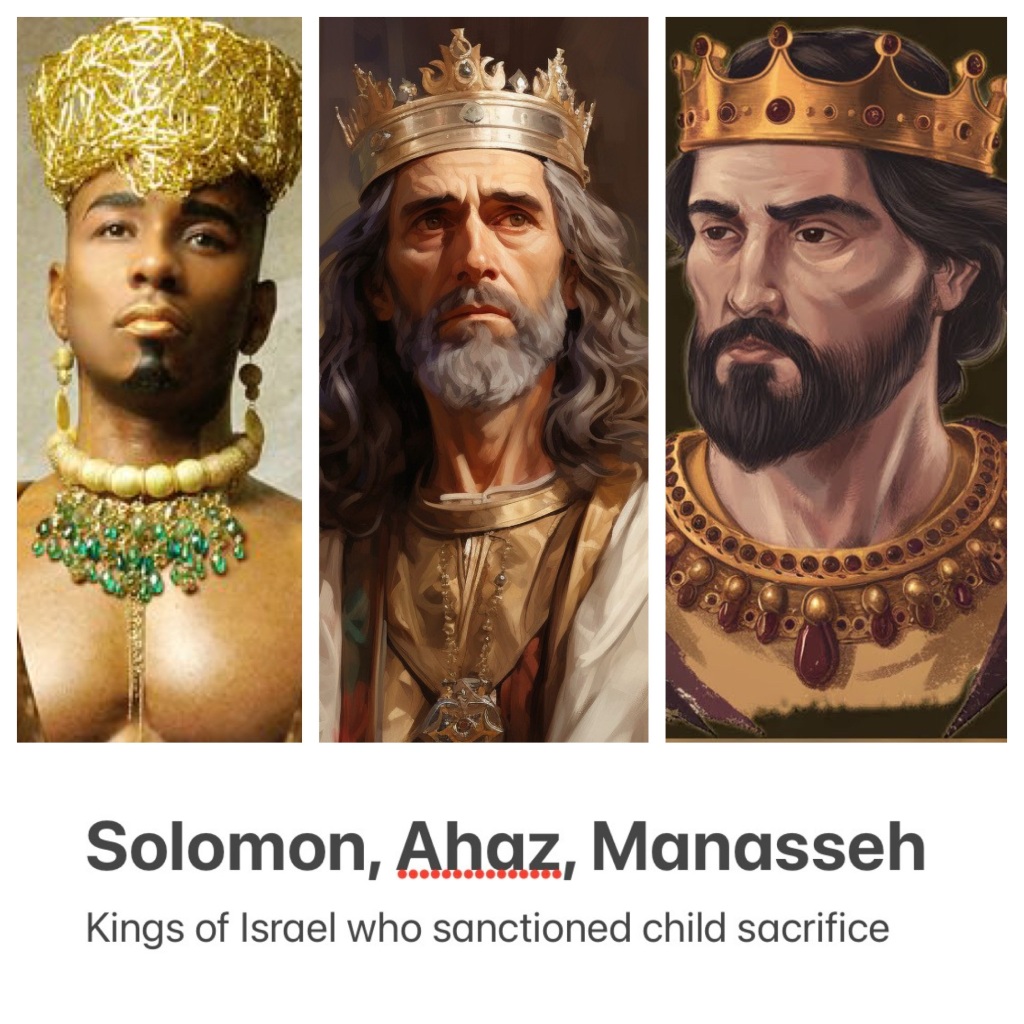
Three kings of Israel, at different times in the history of Israel, are said to have practised child sacrifice, as they turned to practices found in nations other than Israel. Solomon in his old age is said to have turned to the worship of Molech (1 Ki 11:7); this practice was subsequently adopted by Ahaz, who “made offerings in the valley of the son of Hinnom, and made his sons pass through fire, according to the abominable practices of the nations whom the Lord drove out before the people of Israel” (2 Chron 28:3). Likewise, Manasseh “made his son pass through fire; he practiced soothsaying and augury, and dealt with mediums and with wizards” (2 Ki 21:6). 
Direct commands not to sacrifice children are found in two books of Torah in the scriptural texts. Most direct is “you shall not give any of your offspring to sacrifice them to Molech, and so profane the name of your God: I am the Lord” (Lev 20:18). In Deuteronomy, other nations are condemned as they “burn their sons and their daughters in the fire to their gods” (Deut 12:31), so the command is “no one shall be found among you who makes a son or daughter pass through fire” (Deut 18:10). The prophet Jeremiah also asserts that this practice is not something that the Lord God had thought of (Jer 7:31). 

So the passage we have in the lectionary responds to this practice by telling a tale which has, as its punchline, the command “do not lay your hand on the boy or do anything to him” (22:12). Might this be the one redeeming feature of this passage? 

But if that is the case, the story belongs back in the days when child sacrifice was, apparently, widely practised. What, then, does it say to us today??
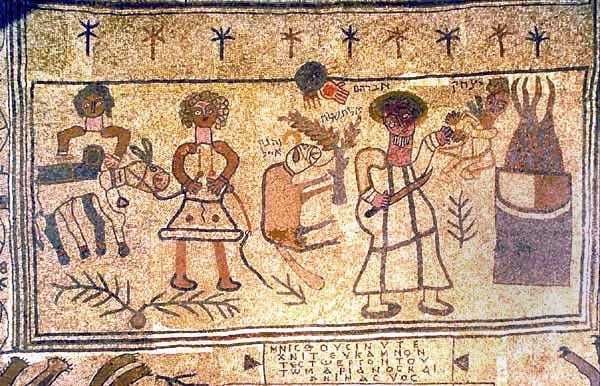
A sixth-century CE floor mosaic from the Beth Alpha synagogue, in Israel’s Jezreel Valley. The mosaic lay near the door, so that anyone who entered was confronted by the scene. In this mosaic, Abraham and Isaac are identified in Hebrew. The hand of God extends from heaven to prevent Abraham from proceeding. Below the hand are the Hebrew words, “Lay not [your hand].” Next to the ram are the words, “Behold a ram.”

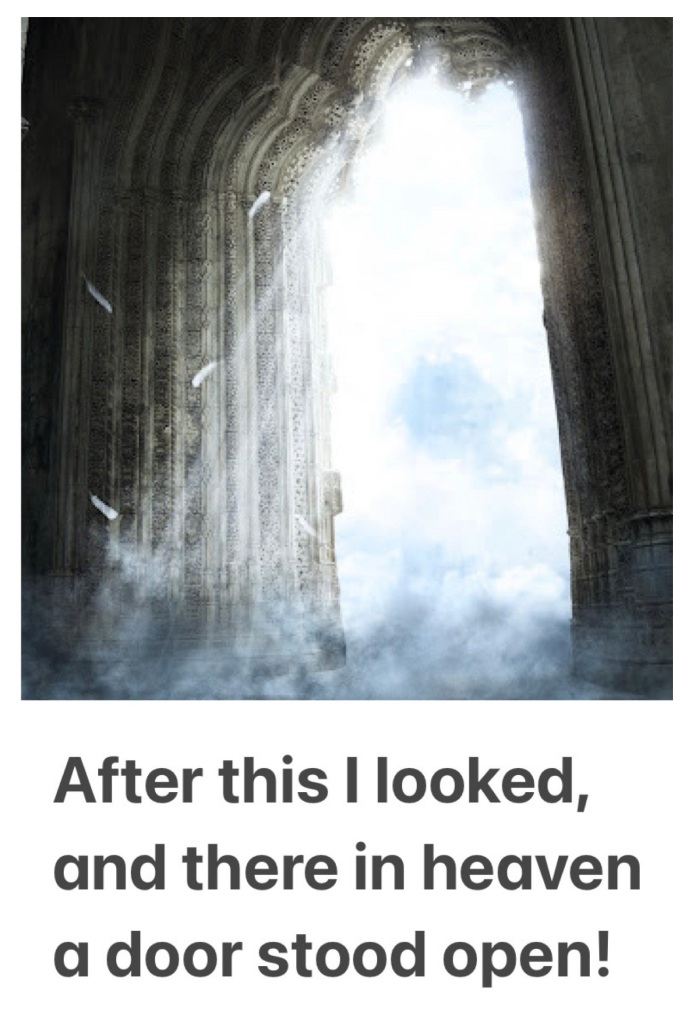
There in heaven a door stood open (Rev 4)

In the book of Revelation, we are invited into a world of unfettered imagination, with evocative imagery, enticing language, and disturbing rhetoric. The whole book comes from words spoken by “one like the Son of Man, clothed with a long robe and with a golden sash across his chest” (Rev 1:13). Clearly, it is a vision of the glorified Jesus Christ, now conveying his “revelations” to John, who is instructed to write letters to seven churches (in chapters 2—3) and then to detail a series of amazing visions (in chapter 4 onwards to the end of the book). 

Each vision contains graphic descriptions and dramatic happenings. The first of these visions (proposed for this coming Sunday in the Narrative Lectionary Summer Series for this year) sets the scene set for what will later be revealed as a colossal, cosmic battle between good and evil. 

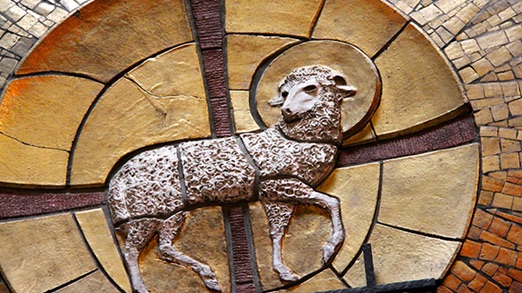
It opens with the striking claim that the door into heaven is opened (4:1). A disturbing and increasingly detailed dramatization of “what must take place after this” is revealed. The vision comes to a climax with an image of a slaughtered lamb (5:11–14), which  is the passage set in the Narrative Lectionary for a week after this coming Sunday.

Gazing into heaven, the author views a magnificent scene of worship. The importance of this scene is signalled by gleaming jewels and a shining rainbow, golden crowns and white robes, thrones and torches of fire, a sea of glass, grumbling thunder and flashes of lightning (4:3–6).

Thunder and lightning were characteristic of the God of Israel. In the book of Job, Elihu praises God, describing “the thunder of his voice and the rumbling that comes from his mouth … his voice roars; he thunders with his majestic voice” (Job 37:1–5). The psalmist sings of  “voice of the Lord over the waters” which thunders with powerful and is “full of majesty” as it “breaks the cedars of Lebanon … flashes forth flames of fire … shakes the wilderness of Kadesh … causes the oaks to whirl, and strips the forest bare” (Ps 29:3–9).

Thunder and lightning were associated with the foundational event of Israel, in the Exodus from Egypt. David sang of how the Lord God “thundered from heaven; sent out arrows, and scattered them—lightning, and routed them; then the channels of the sea were seen, the foundations of the world were laid bare at the rebuke of the Lord, at the blast of the breath of his nostrils” (2 Sam 22:14–16; Ps 18:13–19). The same graphic descriptions occur at Ps 77:16–20. 

In the book of Exodus, the scene at Mount Sinai includes thunder and lightning, a thick cloud, the blast of a trumpet, the shaking of the mountain and a spreading haze of smoke from the burning fire, an intensifying of the trumpet blast and peals of thunder  (Exod 19:16–19). This was the setting for Moses’ encounter with the Lord, when (according to the story passed on through the generations) the foundation of Torah was laid. The biblical nature of the imagery is very clear; these are all associated with an encounter with the divine.

Twenty-four elders and four six-winged creatures sing praises to “one seated on the throne” (4:2–11), and to a slaughtered lamb “with seven horns and seven eyes” (5:1–14). The hymns they sing in chapters 4, 5, and 7 appear to combine attributes of God which feature in scriptural songs of praise (holy, worthy, glory, honour, power, creator) as well as elements familiar from other New Testament texts in which early Christian thinking is developing. The twenty-four elders, sitting on thrones (4:4), along with the seven spirits (4:5; see also 1:4; 3:1) represent numbers of great symbolism throughout scripture, if we consider the twenty-four to comprise two lots of twelve.

The four living creatures each have a distinctive facial feature: “the first living creature like a lion, the second living creature like an ox, the third living creature with a face like a human face, and the fourth living creature like a flying eagle” (4:7). These four creatures allude to the chariot vision which opens the book of Ezekiel, in which the prophet sees four such creatures, with “the face of a human being, the face of a lion on the right side, the face of an ox on the left side, and the face of an eagle” (Ezek 4:10). These creatures emerge out of the midst of “

“a great cloud with brightness around it and fire flashing forth continually, and in the middle of the fire, something like gleaming amber” (Ezek 4:4), later revealed to be a magnificent chariot (Ezek 4:15–28), on which sat “something that seemed like a human form” (v.26).

Jesus is depicted in this book as “one like the Son of Man, clothed with a long robe and with a golden sash across his chest” (Rev 1:13). He is the supreme authority, the one who has risen from the dead and is at one with God (1:18). Yet there is a stark counterpoint running throughout the whole book. Jesus is the one who has been pierced (1:7); perhaps this evokes the piercing of Jesus’ side as he hung on the cross (John 19:34–37, citing this as a fulfillment of Zech 12:10).

In this initial vision, the Lord God Almighty is seated on the throne, surrounded by four six-winged creatures (4:2–11), perhaps reminiscent also of the six-winged seraphim seen by Isaiah in his vision in the temple (Isa 6:1–2). The one on the throne is holding a scroll with seven seals, which no one was able to open (5:1–4). These seals form the basis for the sequence of visions in 6:1—8:1, culminating in the vision of seven angels holding seven trumpets (8:2), yet another angel burning incense (8:3–4), and the inevitable “peals of thunder, rumblings, flashes of lightning, and an earthquake” (8:5). The markers of the divine are evident once more.

The author continues on, to introduce the one who has power to open the scroll: “the Lion of the tribe of Judah, the Root of David” (5:5)—phrases which clearly evoke the Davidic lineage of Jesus which the Gospel writers have so carefully claimed. (The same Davidic lineage is noted at 22:16.) Immediately, and despite the magnificent splendour of the scene being described, with its many dazzling jewels and angelic creatures, this “Lion” is described as a “Lamb standing as if it had been slaughtered” (5:6).

This paradoxical description of Jesus as “the Lamb that was slaughtered” recurs in hymns later in the book (5:9, 13; 13:8). His victory has been won, not through the power of force, but by submission to death. It seems that it is the fact that he has been slain which qualifies him to open the scroll. His power lies in his avoidance of violence, his submission to death.

This theme is the power that this strange book from a distant past offers us in the turmoil of the present. Our world today—as, indeed, the world time and time again over the centuries—is beset by conflict, aggression, and devastating warfare. Mass starvation and the killing of civilians in Gaza; a genocide, many now (rightly) say. Decades of terrorist activity and the exercise of military power in Israel, the West Bank, Gaza, and surrounding nations. An entrenched military battle on many fronts in the Ukraine, bogged down in the ego of a long-term tyrant. Ethnic violence and long-enduring civil warfare in the Sudan. Armed uprisings in the Congo. A civil war in Myanmar following the 2021 military coup. The list could go on to cover many–far too many–places.

The Geneva Academy of International Humanitarian Law (an institute of the University of Geneva) is monitoring more than 110 armed conflicts which are currently active across the globe. It’s a sad testimony to human greed for power, and to the seemingly endless capacity to inflict terrible damage on others.

The Way of the Lamb is a way that turns away from conflict as a means to resolve differences. In 1982, the National Assembly of my church (the Uniting Church in Australia) passed a resolution declaring “that God came in the crucified and risen Christ to make peace; that he calls all Christians to be peacemakers, to save life, to heal and to love their neighbours. The call of Christ to make peace is the norm, and the onus of proof rests on any who resort to military force as a means of solving international disputes.” 

It reiterated this affirmation some decades later, in 2003, when the Assembly further declared that “that the Church is committed to be a peacemaking body”. This is central to who we are as a faith community. Many other church denominations around the world have similar resolutions marking a similar commitment. Pope John XXIII had issued his encyclical “Pacem in Terris” in 1963. Yet wars snd conflicts have continued. More recently, Pope Francis issued a “Prayer for Peace” in which he invited the faithful to pray, “Renew our hearts and minds, so that the word which always brings us together will be “brother”, and our way of life will always be that of: Shalom, Peace, Salaam!”. Pope Leo XIV prayed for peace in the Middle East and in other conflicted areas. The church yearns for peace. Too many leaders perpetuate antagonism, foment conflict, engender wars.

We need to recapture the central element of the way of discipleship as a commitment to the way of peace, as we seek to follow Jesus in our contemporary world. This is the vision of Revelation. May it be that, as we hear again of the door in heaven standing open, and the vision of the “Lamb standing as if it had been slaughtered”, we recommit to praying for peace, living in a peaceable way, and writing to our political representatives urging them to withdraw support for any armed conflict (including the withdrawal of arms and financial support for those perpetrating aggression). 

Holy, blameless, undefiled …  exalted and made perfect forever (Heb 7; Pentecost 23B)

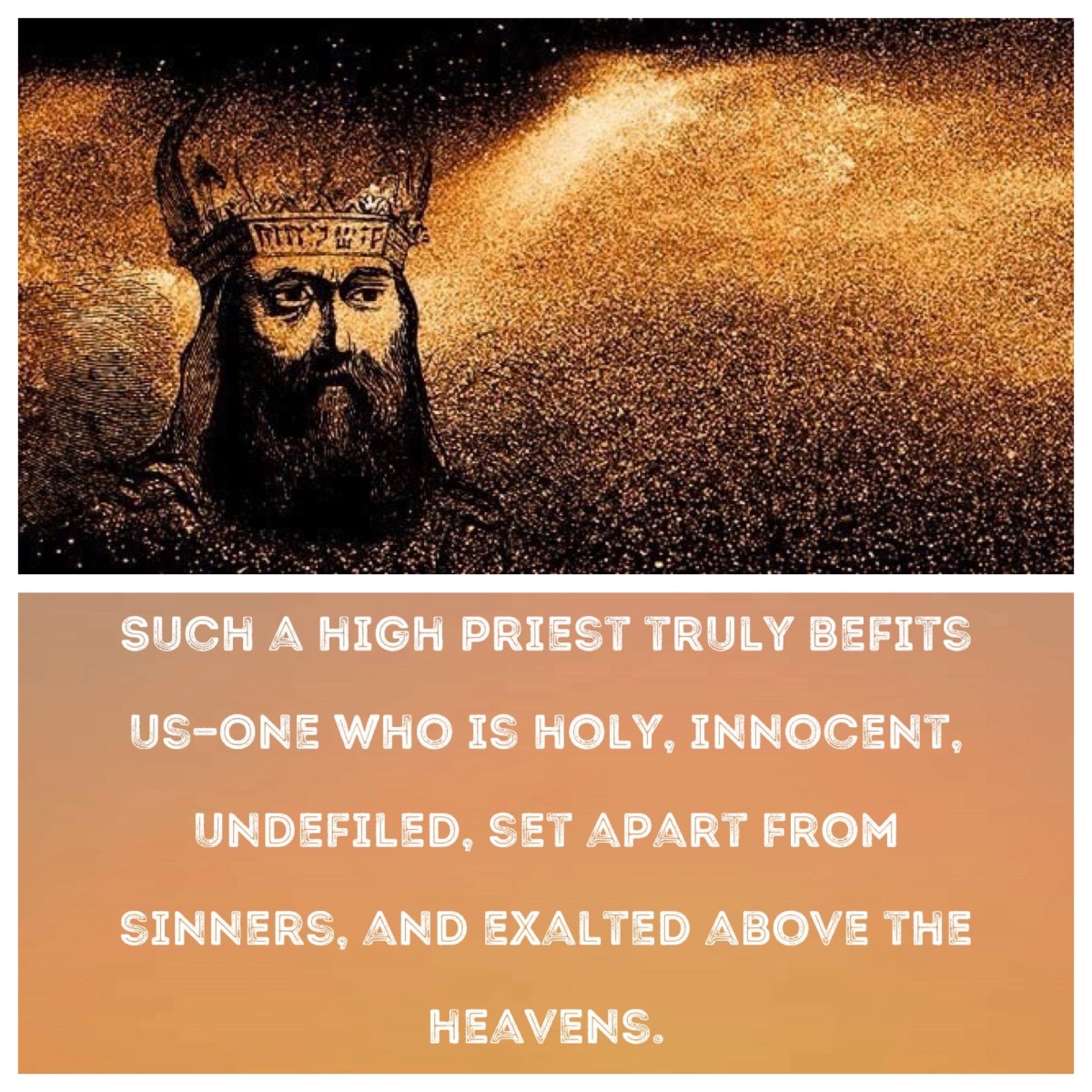
“Holy, blameless, undefiled, separated from sinners, and exalted above the heavens … [one] who has been made perfect forever.” That’s how the unknown author of the book of Hebrews describes Jesus (Heb 7:26, 28). That’s an incredibly high state of being that is described—an almost unattainable perfection of life. How, then, might we relate to such a person?

To understand why Jesus is described as holy and made perfect, we first turn to the heritage of the author of this “letter to the Hebrews”. In Israelite religion, the idea of being perfect was integral to the appreciation of God. We find this expressed at various places in Hebrew Scripture. “This God—his way is perfect”, the psalmist sings (Ps 18:30; echoed also at Deut 32:4; 2 Sam 22:31; Job 37:16), and in another psalm, “the law of the Lord is perfect, reviving the soul” (Ps 19:7). It is later echoed by Paul, who claims that “the will of God” is “good and acceptable and perfect” (Rom 12:2).  

So, too, is the state of being holy a central element of God’s being; “Holy One” is one of the ways that God is addressed God in the Writings (Ps 71:22; 78:41; 89:18; Prov 9:10; Job 6:10; Sir 4:14; 23:9; 53:10; 47:8; 48:20) and by the Prophets (Jer 50:29; Ezek 8:13; Hos 11:9, 12; Hab 1:12; 3:3). This is especially the case in Isaiah, where “the Holy One of Israel” is addressed 29 times, by First Isaiah (Isa 1:4 to 37:23), Second Isaiah (Isa 40:25 to 55:5), and Third Isaiah (Isa 60:9, 14).

This, also, is echoed in  New Testament texts. The mighty saviour, promised to Israel, would come to lead the people to serve God “in holiness and righteousness before him all our days” (Luke 1:69, 75). Jesus is addressed by demons as “the Holy One of God” (Mark 1:45; Luke 4:34) and by Simon Peter (John 6:69). The followers of Jesus are then instructed to live as God’s holy people (1 Cor 3:17; 6:19; Eph 5:25–27; Col 1:22; 3:12; Heb 3:1; 1 Pet 1:13–16; 2:5, 9); Paul prays for the Thessalonians, that God may “strengthen your hearts in holiness that you may be blameless before our God and Father” (1 Thess 3:13).

Of course, holiness (qodesh) was a central element of piety in ancient Israel, exemplified by the Holiness Code of Leviticus (Lev 11:44–45; 19:2; 20:7–8). The code was to be overseen by the priests, who were to “make a distinction between the unclean and the clean” (Lev 11:47; 20:25; cf. Ezek 22:26; 44:23). Accordingly, they were consecrated, set apart as holy (Exod 40:13; Lev 16:32; 21:10), so that the people as a whole might be deemed to be “holy people” (Deut 7:6; 14:2, 21; 28:9). Holiness was a fundamental requirement of the priests.

Accordingly, every priest needed to be “perfect” (tamim), with no sign of blemish—“not one who is blind or lame, or one who has a mutilated face or a limb too long, or one who has a broken foot or a broken hand, or a hunchback, or a dwarf, or a man with a blemish in his eyes or an itching disease or scabs or crushed testicles”, according to Lev 21:16–24. These perfect priests were charged with offering to God the tamid, the daily sacrifice, of “two male lambs a year old without blemish, daily, as a regular offering”, each and every day (Num 28:3).

The temple itself that Solomon built was required to be perfect (1 Ki 6:22), and for the sacrifice of wellbeing to be offered there “to be acceptable it must be perfect, there shall be no blemish in it” (Lev 22:21). The prescriptions of Leviticus maintain the need for all faithful people to bring an offering or sacrifice that is “acceptable” (Lev 1:4; 7:18; 19:5–8; 22:17–21, 26–30); for a sacrifice of wellbeing “to be acceptable it must be perfect; there shall be no blemish in it” (Lev 22:21). That was the role of the priests: to examine carefully the animals being brought for sacrifice, to ensure that they were “perfect” (tamim). So a state of perfection was required of both priests and their victims. 

Of course, the author of Hebrews sets the perfection of Jesus into a distinctive framework, for he asserts early in this book that God, in “bringing many children to glory”, has made Jesus, “the pioneer of their salvation, perfect through sufferings” (Heb 2:10). It is through “the sprinkled blood” of Jesus, “the mediator of a new covenant”, that “the spirits of the righteous [are] made perfect” (Heb 12:23–24). 

The perfect nature of Jesus comes through his submission and obedience, evidenced in the “prayers and supplications, with loud cries and tears”, which he offered “to the one who was able to save him from death” (Heb 5:7–8). The end result is that he was “made perfect [and] became the source of eternal salvation for all who obey him, having been designated by God a high priest according to the order of Melchizedek” (Heb 5:9–10).

On the priesthood of Mechizedek and that of Jesus, see 

In applying these two terms, holy and perfect, to Jesus, the author of Hebrews is locating him within the ambit of the priests. The addition of two further terms, blameless and undefiled, intensifies this sense, but relates to another aspect of the comparison. The command not to defile oneself occurs at two key places in the levitical prescriptions. It stands at the conclusion of the long list of animals, birds, and fish which are categorised as either unclean or clean, as “the living creature that may be eaten and the living creature that may not be eaten” (Lev 11:43–44). It is also a repeated injunction in the section concerning sexual relations (Lev 18:20–30).

The same command appears in the instruction, “you shall not defile the land in which you live, in which I also dwell” (Num 35:34; reiterated at Deut 21:23). The prophet Ezekiel understands that the person “who is righteous and does what is lawful and right” is the one who “does not defile his neighbour’s wife” (Ezek 18:5–6, 14–15) and that the people of Israel are to “not defile yourselves with the idols of Egypt” (Ezek 20:7, 18,   31). 

The Hebrew term tamim, which is often translated as perfect, but also as blameless, is related to the word used for the daily sacrifice, tamid. It contains a strong sense of being whole, perfect, undefiled, without defect or blemish. It is applied numerous times throughout Leviticus to the various animals which are to be offered in sacrifice to God; they are all to be “without blemish” (Lev 1:3, 10; 3:1, 6, 9; 4:3, 23, 28, 32; and many more times). So in Hebrews, the application to Jesus of the words blameless and undefiled relates him most specifically to the sacrificial victims rather than to the priests.

We see this most intensely in the apologetic argumentation of Hebrews 9—10, where the death of Jesus is portrayed as “the sacrifice of himself” (9:26), “a single sacrifice for sins” (10:16) in “the offering of [his] body” (10:10), “a single offering [by which] he has perfected for all time those who are sanctified” (10:14), which “he offered once to bear the sins of many” (10:28). These statements all relate Jesus to the “perfect offering” of his life, “the power of an indestructible life” (7:16). 

For this reason—that he is the perfect sacrifice—he is understood to have been the final definitive offering; “he has appeared once for all at the end of the age to remove sin by the sacrifice of himself” (Heb 9:27). The author of Hebrews particularly emphasises this “once for all” element; “this he did once for all when he offered himself” (7:27); “he entered once for all into the Holy Place, not with the blood of goats and calves, but with his own blood, thus obtaining eternal redemption” (9:12). 

As a result, the author claims, “we have been sanctified through the offering of the body of Jesus Christ once for all” (10:10). This then undergirds the author’s criticism of the repeated sacrifices offered under “the law”, which “can never … make perfect those who approach” (10:1–4). This leads, then, to a supercessionist view of Judaism—a route that I refuse to take.

I offer more consideration of the supercessionism which results from this line of argument in posts on the Hebrews readings in the lectionary in coming weeks.

Two other phrases that are applied to Jesus by the author of Hebrews are striking. As well as being holy and perfect, blameless and undefiled, Jesus is portrayed as being “separated from sinners” and “exalted above the heavens” (Heb 7:26). Both these phrases contribute to a high view of Jesus. We can understand something of their significance by delving, once again, into Hebrew Scripture.

It is a refrain of many of the more conservative theological preachers that people are separated from God by their sin. God does not wish for us to sin, and stands look from us when we do sin, so the argument goes. It is the very nature of God to be “separated from sinners”. This understanding is indeed reflected in the past by the way that the ancient Israelite cult was set up. 

The tabernacle, as the place where God resided, was to be kept as a sacred, holy, set-apart place, which the priests were to oversee. Leviticus includes the clear instruction, “you shall keep the people of Israel separate from their uncleanness, so that they do not die in their uncleanness by defiling my tabernacle that is in their midst” (Lev 15:11). The “uncleanness” of the people—their sinfulness because of the ways they disobeyed the Torah—was to be dealt with through the system of sacrifices and offerings made to the Lord God, to deal with their sin.

The clear affirmation of the post-exilic prophet whose words are collected in the third section of Isaiah is that “your iniquities have been barriers between you and your God, and your sins have hidden his face from you so that he does not hear” (Isa 59:2). The way forward is to seek a path of reconciliation and forgiveness with God, to overcome these barriers. 

Presenting Jesus as “separated from sinners” places him in the position of God; this equates him with the holy God, the blameless one, pure and undefiled, who stands apart from sinners even whilst offering a way for those sinners to seek forgiveness of sin and reconciliation with God.

This high view is intensified in the further description of Jesus as “exalted above the heavens” (Heb 7:26). Long before Jesus, David had prayed to God, rejoicing in “the greatness, the power, the glory, the victory, and the majesty” that belong to God (1 Chron 29:11). This prayer continues, “for all that is in the heavens and on the earth is yours; yours is the kingdom, O Lord, and you are exalted as head above all”. The psalmists reflect this conception of God as “exalted above the heavens” (Ps 57:5, 11; 108:5). This is reflected directly in Heb 7:26.

So Jesus stands with God, in the holy place, exalted in the heavens, separated from sinners; and yet, as priest, he oversees the process that brings sinful people back into relationship with God; and as the sacrificial offering itself, he sheds his blood in order to enable this forgiveness and reconciliation to take place. The imagery is rich and complex, even if the logic of Jesus as God, priest, and victim all-in-one, is somewhat hard to grasp.

‘Christ died for us’: reflections on sacrifice and atonement

Dealing with the sinful manifestations of human nature is at the heart of Christian doctrine, and theories of atonement regularly grapple with how this is effected. Many books within the New Testament indicate that their authors are grappling with how best to express the central claim of Christianity, that Jesus enables those who follow him to enter into a renewed relationship with God. The letter for this coming Sunday, the Fourth Sunday in Easter, does just this (1 Pet 1:19–25).

However, I can’t see that the New Testament, anywhere, sets forth a fully-developed, single-focussed theory of atonement. There are a range of metaphors used to describe the process, in various places, by various authors: sacrifice, atonement, ransom, expiation/propitiation, liberation/salvation, reconciliation, disarming the powers, and modelling humility, for instance.

In true systematic theology style, over the centuries, various theological writers have plucked verses from various places in the New Testament, and woven together, with little regard for their original context or intention, to form a developed theory that owes more to rationalist deductive argumentation, than it does to biblical texts. That’s the first thing that I distance myself from.

Paul notes that “Christ died for us”. That’s a short and simple way to describe the significance of the death of Jesus; we find it at Rom 5:6,8, 14:15; 1 Cor 8:11, 15:3; 2 Cor 5:14-15; Gal 2:21; and 1 Thess 5:10. That’s five of the seven authentic letters; the matter of the death of Jesus does not figure at all in what is being discussed in Philemon; and in Philippians, the death of Jesus serves to emphasise his humility and obedience (Phil 2:8), and Paul’s main interest is in his this death serves to effect a transformation in believers (Phil 3:21).

This affirmation, “Christ died for us”, forms the foundation for an intricate and complex system of sacrificial atonement theology which is developed beyond the time of the New Testament. These eight times when Paul says, “Christ died for us”, join with a number of other passing comments elsewhere in New Testament texts, to provide the basis for what would become, over time, a detailed understanding of the death of Jesus as a death made on behalf of, and in the place of, believers. An explanation is developed, drawing especially on the Jewish sacrificial system, in which the sacrifices of animals were understood to be the way by which the sins of people were forgiven.

This area of Christian theology—how to understand the death of Jesus—is known as soteriology (relating to “how we are saved”), with a strong emphasis being placed on atonement (that is, what is the mechanism for bringing us back into reconciled relationship with God). The atonement has become a debated and disputed arena. How do we understand this today?

One concern that is often expressed concerns the way that a religious system has a focus on a violent action at the centre of its belief system. Can it be a good thing to celebrate the way that God causes, or at least approves of, the putting to death of Jesus? We have every right to ask critical and penetrating questions about this aspect of our faith.

Another element of the debate is the claim that can be paraphrased as “Jesus died in my place, he was sacrificed for my sins, to save me from hell”. This is the classic way that I hear this view expressed, and it is often described as the substitutionary atonement theory. It depends on, but moves well beyond, the understanding that was inherent in the Jewish sacrificial system.

In my mind, there are a number of points at which this kind of statement about the death of Jesus (often referred to as Penal Substitutionary Atonement, or PSA), narrows the understanding of faith far too much.

For a start, it focuses intensely on a personal dimension, to the detriment of the wider relational, societal, and political dimensions. Easter faith, to me, is broader, more expansive, more encompassing, than just the focus on my personal eternal destiny. I find this communal orientation expressed very strongly in scripture, both in relation to the atonement as well as in many other broader ways. The narrow expression of atonement is based on an understanding of God who is a wrath-filled, vengeance-seeking God, seeking to impact individual lives in a highly judgemental way. I don’t find that perspective in scripture.

Then, the narrow understanding of atonement plays off the will of God over against the actions of a devil figure. This is a problematic element because it contradicts the idea of an all-loving, all-just God. Is all evil in the world to be attributed to a personified devil? What has the allegedly all-powerful and all-loving God done about this?

Such simplistic dualism is problematic, if we just leave it at this. Hebrew scripture steadfastly resists any temptation to sit in a dualistic worldview, and the New Testament continues in that vein, despite pressures from the Hellenistic worldview, as direct heir of the Platonic dualistic schema.

Appreciating the sacrificial dimension of the story of Jesus dying on the cross is important. Jesus went willingly to his death. He did, in the end, offer his life as a sacrifice. The key verse often cited for this understanding is Mark 10:45 (“the Son of Man came not to be served but to serve, and to give his life a ransom for many). Other verses that relate include Rom 3:25-26, Eph 5:2,1 John 2:1-2, 4:10, as well as the whole argument of Hebrews (see especially Heb 2:17, 9:23-28, 10:12, 13:12).

Understanding the death of Jesus as a sacrifice remains at the heart of our Christian faith. The option of taking up a violent path was rejected by Jesus. He did not stir up an uprising against the imperialist Roman overlords, despite opportunities to do so (on Palm Sunday, for instance). He did knowingly offer his life as a sacrifice. After an inner struggle about this matter (Mark 14:32-35 and parallels in the Synoptics), it appears that Jesus went willingly to his death (Mark 14:36, and reflected in the whole prayer that the evangelist crafts in John 17).

The preaching of Jesus in the period prior to his arrest offered a vision of a kingdom in which righteous-justice is dominant and peace is evident (Matt 6:33, 7:21, 21:43, 25:34-36; Mark 12:32-34; Luke 4:16-19, 6:20-21, 12:31-34, 18:24-25). In this preaching, he signalled his key commitments, which are instructive as we consider what he thought he was doing, when he submitted to death. We need to consider these words as we think about the significance of Jesus for our faith, and for how the sinfulness of humanity is dealt with.

The way that Jesus calls us into faithful discipleship is central to this approach. To enter the kingdom means to live in accord with the righteous-justice that Jesus advocates. The greater picture beyond the events of the cross is hugely significant. The cross, the event of the death of Jesus, points beyond to this greater vision. It is the whole life of Jesus, along with his death, which is crucial as we grapple with how Jesus transforms us from “sinful humanity” to “justified and saved” (to use the biblical terms that have become the catchcries in this debate).

His manner of death was consistent with this vision; the complete commitment of Jesus to this vision meant that his death, unjust and violent as it was, provides a glimpse into the way of faithfulness for each of us in our lives. Following the way of Jesus is treading this path of nonviolent affirmation of the greater vision.

*****

See more discussion of specific texts at

and a general overview at

Righteous by faith and at peace with God (Rom 5; Lent 3A)

We are being offered a veritable feast by the lectionary during the season of Lent, through Hebrew Scripture passages which recall key moments in the story of Israel (Abraham, Moses, David, return after exile) as well as in Gospel narratives telling of the transformative encounters which Jesus had with a range of people (a Pharisee and a Samaritan woman, a man born blind and two sisters of a dead man).

Alongside this, the lectionary offers us a set of readings from Paul’s longest and most richly-developed theological letter, that which he wrote to “all God’s beloved in Rome, who are called to be saints” (Rom 1:7). After exploring the rationale for human sinfulness (Rom 5:12–19, Lent 1A), we have read of Paul’s use of Abraham as a model to explain how God “reckons us to be righteous” (Rom 4:1–5, 13–17, Lent 2A).

Today we are offered another passage replete with fundamental theological affirmations (Rom 5:1–11, Lent 3A) and in two more weeks we will hear yet another “purple passage” from Romans (Rom 8:6–11, Lent 5A). In the intervening week we are diverted in Ephesians, most likely because the passage illuminates the Gospel story of Jesus enabling the man born blind to see (John 9).

Whilst Romans 4 exhibits many signs of the diatribe style, as we have noted, Paul seems to set this to one side for a time. He will pick up the pattern of apostrophe (posing questions to a hypothetical listener) and speech-in-character (providing answers to those questions from an imaginary person) in the next chapter: “What then are we to say? Should we continue in sin in order that grace may abound? By no means! How can we who died to sin go on living in it?” (Rom 6:1–3).

He will extend that through the agonising of the following chapter: “What then should we say? That the law is sin? By no means! Yet, if it had not been for the law, I would not have known sin.” (Rom 7:7). He will pick this up again at the end of his lengthy argument begun in 5:1 when he exclaims: “What then are we to say about these things? If God is for us, who is against us? He who did not withhold his own Son, but gave him up for all of us, will he not with him also give us everything else? Who will bring any charge against God’s elect? It is God who justifies.” (Rom 8:31–34).

Paul uses these techniques because he is, in the depths of his being, what we would call a “pastoral practitioner”. He is a good theological thinker, but he is oriented at every point to the pastoral engagement that he has with people in the churches which (mostly) he has founded—the church in Rome being a key exception to this, since he writes to a community that he has not yet visited.

Paul tells the Thessalonians that he seeks to operate “like a father with his children” (1 Thess 2:11), “like a nurse tenderly caring for her own children” (1 Thess 2:7). He tells the Philippians “how I long for all of you with the compassion of Christ Jesus” (Phil 1:8), and the Corinthians that “I wrote you out of much distress and anguish of heart and with many tears, not to cause you pain, but to let you know the abundant love that I have for you” (2 Cor 2:4). And he assures the Romans that he prays that “by God’s will I may come to you with joy and be refreshed in your company” (Rom 15:32).

Amidst all the harsh rhetoric, direct intervention, and controlling instructions that pepper all the letters of Paul, this kind, compassionate, caring heart can be glimpsed. Paul does what he does for the sake of the people whom he serves. Rabbinic midrash and rhetorical diatribe a pre pressed into the service of compassionate care for his people.

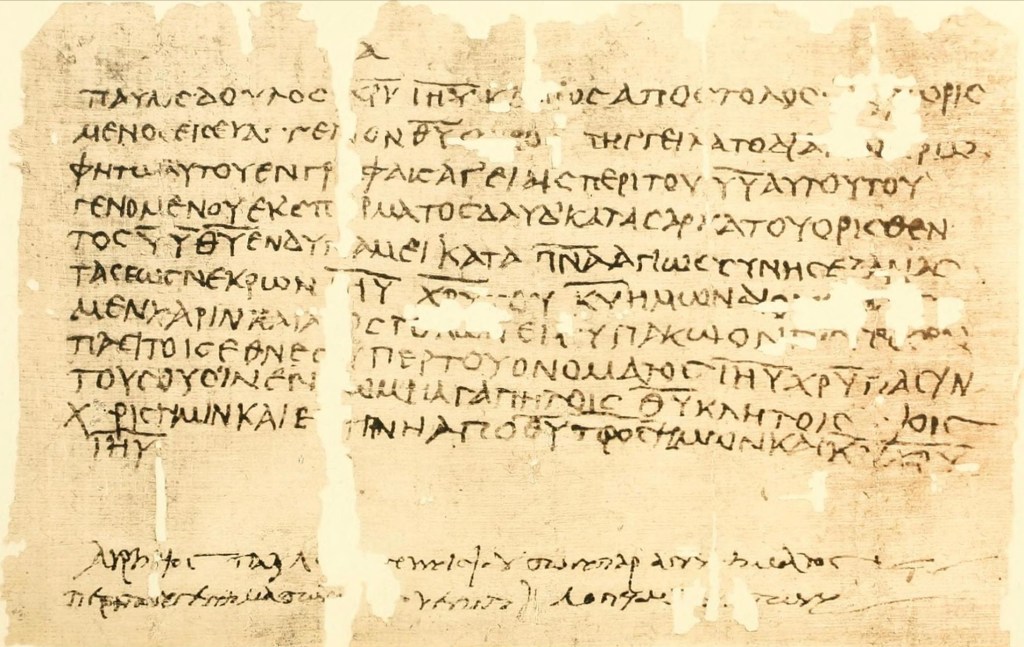
The opening of Paul’s letter to the Romans,
from an early fourth century papyrus (p10)

*****

But for the passage from Romans which we are offered this coming Sunday (Rom 5:1–11), the style changes. Rather than the diatribe style of question—response, shaped by the Pharisaic midrashic pattern of exploring key scripture passages, Paul seems to switch, to become a doctrinal pedagogue much as we find in later patriotic, medieval, and reformed writers.

In just eleven verses, Paul identifies and names a sequence of ten key theological claims—perhaps the closest he ever gets to becoming what we know as a “systematic theologian”. Paul mentions, in turn, justification by faith, peace with God, access to God’s grace, the glory of God, the place of sufferings, endurance, and hope, the gift of the Holy Spirit, the function of the death of Christ and the process of being justified by his blood, salvation from God’s wrath, and finally, reconciliation with God. They are each worth pondering.

Being justified by faith—or, in another English translation, being made righteous by faith—is the first concept which has pride of place in this passage—and, indeed, forms the basis for the theological argument that is developed throughout this Gospel. Paul’s opening statement is that, in the Gospel, “the righteousness of God is revealed through faith for faith”, quoting a scripture passage to provide the basis for his assertion (Rom 1:17); that righteousness is explained at length through the ensuing chapters, canvassing a range of matters in the process.

Righteousness, of course, has its origins deep in the Hebrew Scriptures. Abram had been given promises by God but he expresses doubt that these promises would come to pass (15:2-3). God provides further reassurance; the multitude of stars in the sky is testimony to that (15:5). Abraham’s resulting affirmation of faith leads to the famous phrase, so central to Paul’s later argument about righteousness: “he believed the Lord; and the Lord reckoned it to him as righteousness” (15:6; see Rom 4:3,9,22).

The psalmists regularly thank God for God’s righteousness (Ps 5:8; 7:17; 9:8; 33:5; 35:24, 28; 36:6; 50:6; etc) and note the importance of humans living in that way for righteousness (Ps 18:20, 24; 85:10–13; 106:3, 31; 112:1–3, 9), whilst the book of Proverbs advises that the wisdom it offers is “for gaining instruction in wise dealing, righteousness, justice, and equity” (Prov 1:3) and the prophets consistently advocated for Israel to live in accordance with righteousness (Hos 10:12; Amos 5:24; Isa 1:22; 5:7; 28:17; 32:16–17; 54:14; Jer 22:3; Ezek 18:19–29; Dan 9:24; 12:3; Zeph 2:3; Mal 4:1–3; Hab 2:1–4).

So “being made righteous with God” (Rom 5:1) is both a central element of Paul’s theology, and a strong thread running from Hebrew scriptural texts into the life of the early church.

Peace with God is the second element in this section. Paul regularly commences his letters with the formulaic “grace and peace to you” (Rom 1:7; 1 Cor 1:3; 2 Cor 1:2; Gal 1:3; Phil 1:2; 1 Thess 1:1; Phlm 3), but the peace spoken of at 5:1 goes deeper than this formula. God is “the God of peace” (1 Thess 5:23) who offers peace “which surpasses all understanding” (Phil 4:7). “God is a God not of disorder but of peace” (1 Cor 14:33) so believers are urged to live in peace (2 Cor 13:11). The Galatians are told that of the fruits of the Spirit is peace (Gal 5:22); the Philippians are informed that “the peace of God, which surpasses all understanding, will guard your hearts and your minds in Christ Jesus” (Phil 4:7).

Such peace is grounded in the understanding of God expressed in Hebrew Scriptures. The Psalmist prays, “may the Lord bless his people with peace” (Ps 29:11), celebrates that God “will speak peace to his people, to his faithful, to those who turn to him in their hearts”, such that “steadfast love and faithfulness will meet; righteousness and peace will kiss each other” (Ps 84:8, 10), and gives thanks that God “grants peace within [Jerusalem’s] borders” (Ps 147:4).

The vision of peaceful co-existence amongst all creatures is declared. by various prophets (Isa 2:2–5; Mic 4:1–5; Isa 52:7; 57:19; 60:17; 65:25) and amongst the names of the one whom Isaiah foresees as the hope for Israel’s future is “Prince of Peace” (Isa 9:2). Both Ezekiel (Ezek 13:8–16) and Jeremiah (Jer 14:13–22) decry those who cry out “peace when there is no peace”. Ezekiel states that God promises, “I will make a covenant of peace with them; it shall be an everlasting covenant with them” (Ezek 37:26; also 34:25, and Zech 8:12).

*****

This being-made-righteous and the consequent gift of peace comes, according to Paul’s comments later in this passage, through the death of Jesus on the cross. He uses a number of phrases to describe this death, and its “benefits” for believers. In verse 6, he notes that “Christ died for the ungodly”, and in verse 8, “while we still were sinners, Christ died for us”.

“Christ died for us” is a common phrase in Paul’s letters—so much so that it is regarded as a formulaic statement (an early credal affirmation?) which appears in various forms (Rom 6:10; 8:34; 14:9; 1 Cor 8:11; 2 Cor 5:14–15; 1 Thess 5:9–10; see also Gal 1:4; 2:20; Rom 7:4; 1 Thess 4:14; and the later formula of 1 Tim 2:5–6). Specifically relating the death of Christ to dealing with sin is also addressed by Paul in some detail earlier in this letter (Rom 3:9–26; 5:15–21; 6:5–14) as well more briefly as in other letters (1 Cor 15:56–57; 2 Cor 5:21; Gal 3:22).

To explain how this death deals with our sins, Paul here specifies that “we have been made righteous by his blood” (Rom 5:9). This clearly relates to the practice of faithful Jews, who for centuries brought their sacrifice to the Temple, so that the priests could kill the animals brought as offerings to God. Shedding blood was integral to this process.

The Torah specifies that the priests should receive “a bull of the herd” as a sin offering, and “the bull shall be slaughtered before the Lord; the anointed priest shall take some of the blood of the bull and bring it into the tent of the meeting … and dip his finger in the blood and sprinkle some of the blood seven times before the Lord” (Lev 4:3–6). Some of the blood is also placed on the horns of the altar and the rest “he shall pour out at the base of the altar of burnt offering” (Lev 4:7).

Likewise, the priest was to “slaughter the guilt offering, and its blood shall be dashed against all sides of the altar” (Lev 7:2); to purify a leper, two lambs are offered, and the priest “shall slaughter the lamb … and take some of the blood of the guilt offering and put it on the lobe of the right ear of the one to be cleansed [the leper] and on the thumb of the right hand and on the big toe of the right foot” (Lev 14:13–14; so also 14:25).

So likewise for the bull on the Day of Atonement: “Aaron … shall slaughter bull as a sin offering for himself … and sprinkle the blood with his finger on the front of the mercy seat … seven times” (Lev 16:11, 14), and then do the same with “the goat of the sin offering” (Lev 16:15–19), before then releasing a live goat (the “scapegoat”) or “bear all their iniquities to a barren region, and the goat shall be set free in the wilderness” (Lev 16:22).

The significance of the shedding of blood is clearly and strikingly articulated in the Torah: “the life of the flesh is in the blood; and I have given it to you for making atonement for your lives on the altar; for, as life, it is the blood that makes atonement” (Lev 7:11). When the blood of the animal is shed, that life is given as an offering to effect atonement. So, too, when the blood of Jesus was shed, his life functioned as an atoning offering for human beings.

The slaughter of animals and the sprinkling of blood thus signifies the sacrificial offering of a gift to God, seeking cleansing or forgiveness. Applying this common practice to Jesus makes sense in the context of the time—but it is an image which is far more difficult for us to accept and appreciate in the modern world, where we might feel that we have moved beyond such “primitive practices”, as some callously call those ancient practices.

What we can take from this language, perhaps, is the observation that sacrifice for sin, seeking to remove the tarnish of that sinfulness and find restoration and wholeness, was a dynamic signalled elsewhere in Hebrew Scripture—most clearly in that famous fourth Servant Song in Second Isaiah, which refers to the servant as the one who “has borne our infirmities and carried our diseases … wounded for our transgressions, crushed for our iniquities; upon him was the punishment that made us whole, and by his bruises we are healed” (Isa 53:4–5). As “the Lord has laid on him the iniquity of us all”, so “it was the will of the Lord to crush him with pain [to] make his life an offering for sin” (Isa 53:6, 10).

That same dynamic is at work every year in Australia, as those military people who have died in battle over the past century are remembered each ANZAC Day for their sacrifice and thanked for what they have bequeathed to our society. It is the same dynamic of sacrifices offered by some to ensure the safety of the many.

So, Paul is able to affirm that when Jesus died, it was to assure us of forgiveness, to deal with our sinfulness, and to restore us to the original state of goodness (Gen 1:26–31) that was God’s gift and intention for humankind.

See more on this at

*****

This passage is so beloved within the church, and was so highly regarded by the creators of the lectionary, that it appears again, slightly reduced in length, in the readings for the Third Sunday after Pentecost, later in this year (5:1–8), as well as in an even shorter form in the readings for Trinity Sunday in Year C (5:1–5). So I am going to reserve my comments on the remainder of the elements I have identified in this passage until it returns, later this year, in the readings for the Third Sunday after Pentecost! I will leave you, simply, with Paul’s clear affirmation that, “since we are made righteous through faith, we have peace with God through our Lord Jesus Christ” (5:1).

See also

A priest forever, “after the order of Melchizedek” (Hebrews 5; Pentecost 21B)

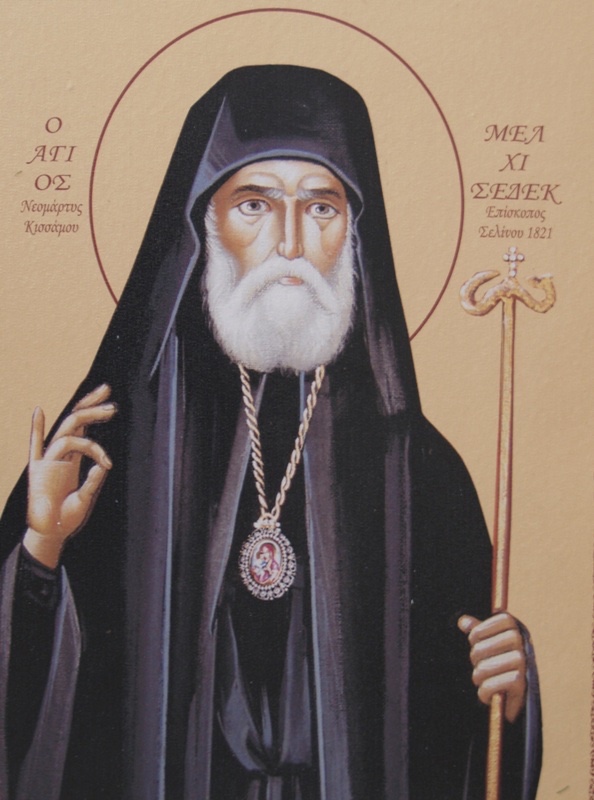
“You are a priest forever, according to the order of Melchizedek” (Heb 5:6 and 7:17, quoting Psalm 110:4). This is a distinctive teaching, found only here in the New Testament. What are we to make of it? Who is Melchizedek? How is he relevant to Jesus? Why is this relevant for us today?

The book we know as “the letter to the Hebrews” is a most distinctive work. It is regularly described as a letter, but it doesn’t follow many of the conventions of a Hellenistic letter. It claims to be a word of exhortation, but many long sections in the work are in fact didactic expositions, not pastoral encouragements.

Alone amongst the twenty one letters in the New Testament, this book makes no claim as to its author. It sits oddly amongst the thirteen letters of Paul, the three letters of John, the two letters of Peter, and the single letters of James and Jude. See https://johntsquires.com/2021/09/29/the-word-of-exhortation-that-exults-jesus-as-superior-hebrews-1-pentecost-19b/

Whilst Paul describes Jesus as a sacrifice, whose death offers us forgiveness of sins and reconciliation with God, only Hebrews portrays Jesus as the priest who makes the sacrifice, slaughtering the sacrificial beast (2:17; 3:1; 5:1–6; 6:20; 7:26–28; 8:3; 10:12) and simultaneously as the victim, lying on the altar as the one whose blood is being shed (9:11–14; 9:26; 10:19; 12:24; 13:20). And only Hebrews makes the declaration noted above, that the nature of the priesthood of Jesus is that he is priest “according to the order of Melchizedek”.

Melchizedek is a Semitic name which is comprised of two separate words: melek, meaning king, and zedek, from tsedeqa, the Hebrew word for righteousness. These terms bring together two key aspects of life and faith for the ancient Israelites. The king was the ruler and leader, through whom the people were in covenant with God (2 Sam 7). Righteousness was the central characteristic of God, which was to be the central commitment of the people of Israel (Gen 18:19). So the king was to rule by righteousness (Psalm 72:1-4).

We meet Melchizedek, the king of righteousness, early in Genesis, when Abram is making his way from Egypt, where he went during the famine (Gen 12:10), through the Negev (Gen 13:1). Abram meets Melchizedek in a place named as The King’s Valley (Gen 14:17). It occurs after God had called Abram and Sarai from their life in Ur of the Chaldees (Gen 11:31) and before God makes a covenant with Abram (Gen 15), which Abram (at the ripe old age of 99 years) seals through the rite of circumcision (Gen 17).

The encounter with Melchizedek is a short interlude in the saga, immediately after Abram has recused his son Lot from a coalition of kings in the Mesopotamian region (Gen 14). Salem, of which he is said to be king (Gen 13:18), is very probably Jerusalem—Psalm 76:2 places Salem in parallel with Zion, pointing to this identification. And Jerusalem was the seat for King David and his descendants, so it makes sense that The King’s Valley would be in this area.

Melchizedek offers Abram bread and wine, and prays over him, conferring a blessing on him (Gen 14:19–20). It is the blessing of “El ʿElyon,” which is a name of Canaanite origin, probably designating the high god of their pantheon. Abram responds by offering Melchizedek a tithe (Gen 14:21), and is insistent that Melchizedek accept all that is offered.

In Roman Catholic tradition, the offering of bread and wine by Melchizedek is regarded as a “pre-presentation of the Mass”—a prefiguring of the sacrifice of Jesus celebrated in their liturgy. He is mentioned in the First Eucharistic Prayer of the Mass, and is remembered as a martyr each year on 26 August. However, the offering of a meal to troops returning from battle was simply a common practice at the time; see, for instance, the lavish meal provided for the returning troops of David at 2 Sam 17:27–29.

The portrayal of Abram as the leader of an army (Gen 14:13–16) which was able to defeat the forces of a coalition of many kings (Gen 14:8–9) is recognised as an anomaly; elsewhere in the section of Genesis recounting the saga of Abraham (Gen 12–25), there is no indication at all that Abram had any any warmongering tendency or any capacity to fight battles.

Because of this, Old Testament scholar Joseph Blenkinsopp has suggested that the story of Melchizedek was inserted into the narrative about Abram to give validity to the priesthood and tithes connected with the Second Temple, after the Exile (which was the period when the book of Genesis was compiled). The links are made in that the King of Salem blesses and breaks bread with the ancestor of David, king in Jerusalem, and confers a priestly blessing from one of the gods of the land on the ancestor, Abram, from whom the Levites descended and amongst whom the sacrificial system and tithing requirements evolved.

The story has a clear validating purpose for the patterns that are being (re)established amongst the returned exiles in Jerusalem. It explains why David set up his headquarters in Jerusalem, and established a priesthood there which would receive offerings from all the people under his control. That validated the claims of the priests as the administered and oversaw the sacrificial system of the Temple cult, for they were seen to be adhering to the pattern established long ago under David—and, indeed, demonstrated long before that, by Abram.

There is nothing else known about Melchizedek, either in the Hebrew Bible, or in other ancient texts. We have no genealogy of Melchizedek; he simply appears, blesses Abram, and disappears from the story. He serves his single purpose, and then is heard of no more.

Certainly, the unique role and distinctive character of Melchizedek—and perhaps his mysterious origins—have made him a character of fascination. And that has been intensified within Christianity, because of the way that the book of Hebrews equates Jesus with Melchizedek and puts them into parallel with each other.

The word of exhortation encourages those who received this “letter” to “hold fast to [their] confession” that they have “a great high priest who has passed through the heavens” (Heb 4:14; see https://johntsquires.com/2021/10/05/a-great-high-priest-who-has-passed-through-the-heavens-hebrews-4-pentecost-20b/)

Thus, Jesus is decreed to be son of God (Psalm 2:7, cited at Heb 5:5) and then “a priest forever” (Psalm 110:4, cited at Heb 5:6). Both psalms which are cited are royal psalms, considered to provide messianic indicators, and thus are picked up within New Testament writings to claim the significance of Jesus, son of God, priest of the new covenant.

These psalms feed into the line of interpretation which sees Jesus in exalted terms—in this book, at least—as the great high priest, the superior high priest, the perfect high priest, the one who is pioneer and perfecter of our faith. And that line runs on beyond the New Testament, into other sects and cults that accord prominence to Melchizedek.

Viewed in this light, some interpreters press the point, making the analogy claim that, “just as Abraham, the ancestor of the Levites, paid a tithe to Melchizedek and was therefore his inferior, so the Melchizedek-like priesthood of Christ is superior to that of the Levites. Furthermore, just as the Old Testament assigns no birth or death date to Melchizedek, so is the priesthood of Christ eternal.” See https://www.britannica.com/biography/Melchizedek

But for myself, that is pressing the point too far, and wringing every tiny drop of significance out of something that I see more as an exotic reference to an ancient tale—a story that is not historical, but was crafted for its own apologetic purposes amongst the returned exiles in Jerusalem. It’s a little bit of New Testament exotica. Thanks, Hebrews!!

*****

See also ten facts about Melchizedek:

1. Only three books of the Bible mention Melchizedek

2. The New Testament says more about Melchizedek than the Old Testament

3. Melchizedek is a contemporary of Abraham’s

4. Melchizedek has no recorded family

5. Melchizedek was a priest of God Most High

6. Melchizedek gives blessings (or at least one)

7. Melchizedek is the king of Salem

8. Melchizedek’s name means “king of righteousness”

9. The order of Melchizedek is royal and everlasting

10. Melchizedek was greater than Abraham and Aaron

https://overviewbible.com/melchizedek-facts/

See