She laughed. But what else do we know about Sarah? (Gen 11–23, for Pentecost 6A)

We know that “she laughed”. And that she produced a miracle baby at the ripe old age of 90 (or so it is said). But what else do we know about Sarah? Before she disappears from view in the Hebrew Scripture passages that the lectionary is offering us, let’s spend some time thinking about Sarah.

During this season after Pentecost, the lectionary has been offering us stories selected from the ancestral sagas of Israel, tracing the way that the promise to Abraham—“I will make of you a great nation” (Gen 12:1), “look toward heaven and count the stars … so shall your descendants be” (Gen 15:5)—was able to come to fruition.

Over successive Sundays, we have read of the call to Abram (ch.12), the promise of a child to Sarah (ch.18), the banishment of Abraham’s son through his slave girl Hagar (ch.21), the near-sacrifice of the preferred son, Isaac (ch.22), and the manoeuvring by Abraham to ensure a wife for Isaac who is of “my country and my kindred” (ch.24).

In future Sundays, we move on to stories about the twin boys born to Isaac and his wife Rebekah (ch.25), Jacob’s dream at the Jabbok (ch.28), Jacob and his marriages to, first Leah, and then Rachel (ch.29), and then the story of Jacob at Penuel, which explains how he had his name changed to Israel (ch.32). The story then focusses on one of Jacob’s twelve sons, Joseph, who is taken to Egypt (ch.37) and later saves his brothers during a famine (ch.45).

These stories—have you noticed?—follow the male line of descent, and place the male at the centre of the story. It is Abram’s call, Abraham’s near-sacrifice of Isaac, Isaac who needs a wife, Jacob who has a dream, Jacob who obtains two wives, Jacob who wrestled with God, and Joseph who becomes the saviour of his brothers.

What role is played by the women in the story? We do know the names of the matriarchs—Sarah, Rebekah, Leah and Rachel—and they do figure in the stories; but the focus is quite patriarchal, as would befit the nature of ancient society.

Sarah, whom we meet initially as Sarai (11:29), is essential to the storyline at various points; and she has come to be venerated alongside Abraham in later traditions. Paul refers to her as the means by which God’s promise is fulfilled (Rom 9:9) and he even offers her and Hagar together as providing an allegory for “the present Jerusalem, in slavery … and the Jerusalem above [who is] free, our mother” (Gal 4:21–26).

In the letter to the Hebrews, Sarah is named (in contrast to many other women) and takes her place alongside Abraham as part of “so great a cloud of witnesses” (Heb 12:1)—although all that is said of her is the stark declaration, “Sarah herself was barren” (Heb 11:11). The miracle, it would seem, was that “from one person, and this one as good as dead, descendants were born” (Heb 11:12)—that is to say, it was the transformation of the “as good as dead Abraham” that is being celebrated here.

In 1 Peter, Sarah is put forward as one of the “holy women who hoped in God”—although, in this instance, what is said of her again mirrors the patriarchal dominance of society; “Sarah obeyed Abraham and called him lord. You have become her daughters as long as you do what is good and never let fears alarm you” (1 Pet 3:5–6).

It takes an exilic prophet, whose words were appended to the earlier scroll of Isaiah, to give Sarah (almost) equal billing with Abraham: “Listen to me, you that pursue righteousness, you that seek the Lord. Look to the rock from which you were hewn, and to the quarry from which you were dug. Look to Abraham your father and to Sarah who bore you; for he was but one when I called him, but I blessed him and made him many.” (Isa 51:1–2).
So, what do we know of Sarah from those ancestral narratives which were told by word of mouth, handed down the generations, and ultimately (sometime in the Exile in Babylon) written down in the form we now have them, in the scroll entitled Bereshit, which we know as the book of Genesis?

We meet Sarai (meaning “my princess”) in the list of descendants of Terah, the father of Abraham (Gen 11:29), although (as in the Hebrews reference) it is simply noted that “Sarai was barren; she had no child” (11:30). That’s a serious roadblock in a passage that is listing descendant upon descendant!

In that same passage, we are told that Sarai, daughter-in-law of Terra, accompanied the family when they journeyed from Ur of the Chaldeans to Haran, where they settled (11:31). The journey had been intended to go as far as Canaan; that would not take place until the Lord called Abram to “go from your country and your kindred and your father’s house to the land that I will show you” (12:1). Sarai is there, as well as Lot and his perpetually-unnamed wife, “and all the possessions that they had gathered, and the persons whom they had acquired in Haran” (12:5).

The next story involving Sarai is perplexing and disturbing. Because of a famine, Abram “went down to Egypt to reside there as an alien” (12:10). We know that Sarai accompanies him, because he forewarns her, “I know well that you are a woman beautiful in appearance; and when the Egyptians see you, they will say, ‘This is his wife’; then they will kill me, but they will let you live. Say you are my sister, so that it may go well with me because of you, and that my life may be spared on your account.” (12:11–13).

The story is repeated twice more in Genesis; once when Abraham repeats this ruse in Gerar, before King Abimelech (20:1–7), and again when Isaac tells the same Abimelech that Rebekah is his sister (26:6–11)! It seems that the fruit does not fall far from the tree; Isaac exactly replicates his father’s devious strategy.

In between those two instances of spousal deception in Gen 12 and Gen 20, Sarai has been the cause of plagues falling onto Pharaoh and his house (12:17), settled with her husband “by the oaks of Mamre, which are at Hebron” (13:1, 18), and presumably learnt from Abram about the covenant which the Lord made with him (15:1–21)—although the text is silent about where Sarai was as this revelation came to Abram.
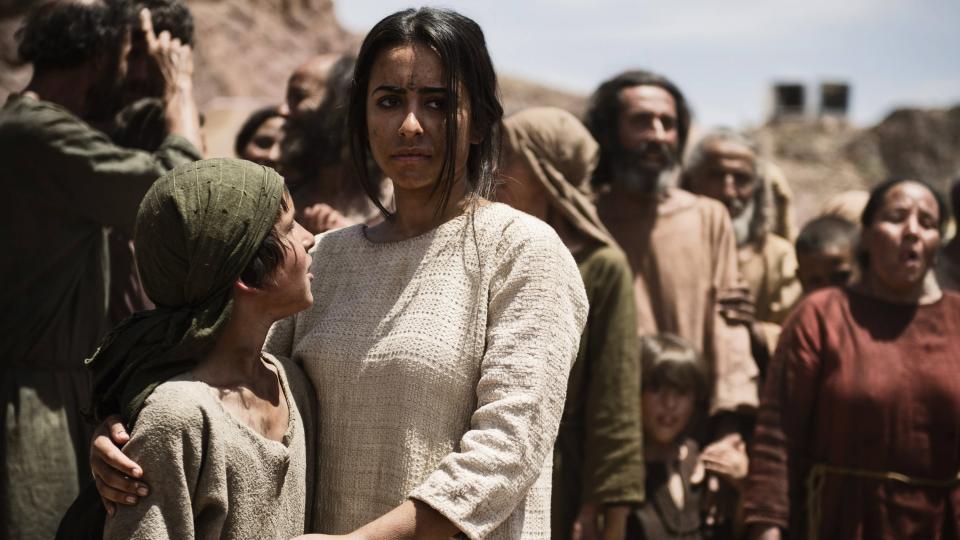
Sarai is front and centre, however, in the next story told, as she offers her Egyptian slave-girl, Hagar, to Abram so that he might reproduce, and fulfil the divine promise (16:1–3). Tension between the servant girl and her mistress resulted, so “Sarai dealt harshly with her, and she [Hagar] ran away from her [Sarai]” (16:6). Eventually, an angel instructed Hagar to “return to your mistress, and submit to her” (16:9), so she did, and in time bore a child to Abram.

In the next story, the circumcision of Abram and “every male among you” (17:1–27), we might wonder what role was played by Sarai. Did she witness the ceremony? Did she and her women assist those who were subjected to this procedure? Certainly, in the midst of the conversation that Abram has with God at this time, both he and his wife are given new names: “no longer shall your name be Abram, but your name shall be Abraham” (17:5), and “as for Sarai your wife, you shall not call her Sarai, but Sarah shall be her name” (17:15).

Abram, whose name describes his status in the story as “exalted ancestor”, will henceforth be known as Abraham, “ancestor of a multitude”, in keeping with the promise of God that “you shall be the ancestor of a multitude of nations” (17:4), while Sarai, “my princess”, will henceforth be known simply as “princess”, without any inflection indicating that she is “owned” by anyone.

So Sarah takes her place at the centre of the story at this point. Her status as princess means that “she shall give rise to nations; kings of peoples shall come from her” (17:16), and the birth of a son, Isaac, is predicted (17:19) and his role in continuing the lineage is confirmed (17:20). That birth is again foreshadowed when three visitors stay with Abraham and Sarah at Mamre (18:10). Sarah’s sceptical laughter (18:12) was already prefigured in the name allocated to her son, Isaac—meaning “he laughs” (17:19).

Before Isaac is born, however, the terrible story of inhospitality and divine vengeance on Sodom and Gomorrah is told in some detail (18:16–19:29), and the origins of the southern neighbours of Israel, the Moabites and Ammonites, is told (19:30–38), as well as the deception of Abraham in Gerar, when he passes the pregnant Sarah off as his sister (20:1–7).

Then comes the birth of Isaac (21:2–3), after which she rejoices, “God has brought laughter for me; everyone who hears will laugh with me” (21:6)—after which Sarah again orders Hagar, and also Ishmael, to depart into the wilderness. Sarah instructs Abraham to “cast out this slave woman with her son” (21:10); “the matter was very distressing to Abraham on account of his son” (21:11).

And so the schism between Abraham and Sarah is opened up; the events of the next incident, when Abraham takes Isaac to a mountain in Mariah, to sacrifice him (22:1–3), appear to seal the split. As I was talking with my wife, Elizabeth Raine, about this difficult story last week, she pointed out to me that we do not see Abraham and Sarah together in the same place after this.
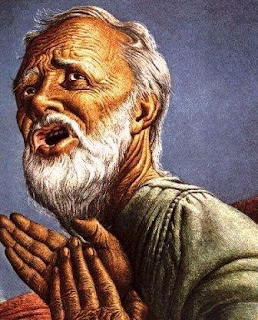
Abraham now appears not to be living with his wife, Sarah—he is in Beersheba, with his servants (22:19) whilst Sarah remains at Hebron, where she dies (23:1–2). Was this because of the tension that grew between the patriarch and the matriarch after he had almost sacrificed his son? This is the story we read last week; see

Tensions were already evident earlier in the story, when Sarah had banished Hagar and Ishmael into the wilderness of Beersheba (21:10–14). To send them on their way, Abraham made sure that they had bread and water to sustain them in the wilderness (21:14). As Elizabeth noted, we do not see Abraham and Sarah together again in the story.

It is only on her death that Abraham travels to where Sarah had been living, in Hebron, some 42km further north. Abraham sought to purchase a field there to serve as the burial place for Sarah. Ephron the Hittite, moved with compassion, wanted to gift him a field with a cave where Sarah’s body could be laid (23:7–12), but Abraham insisted and paid Ephron the value of the field, 400 shekels of silver (23:12–16). He dies at least honour her appropriately at the point of her death.

*****

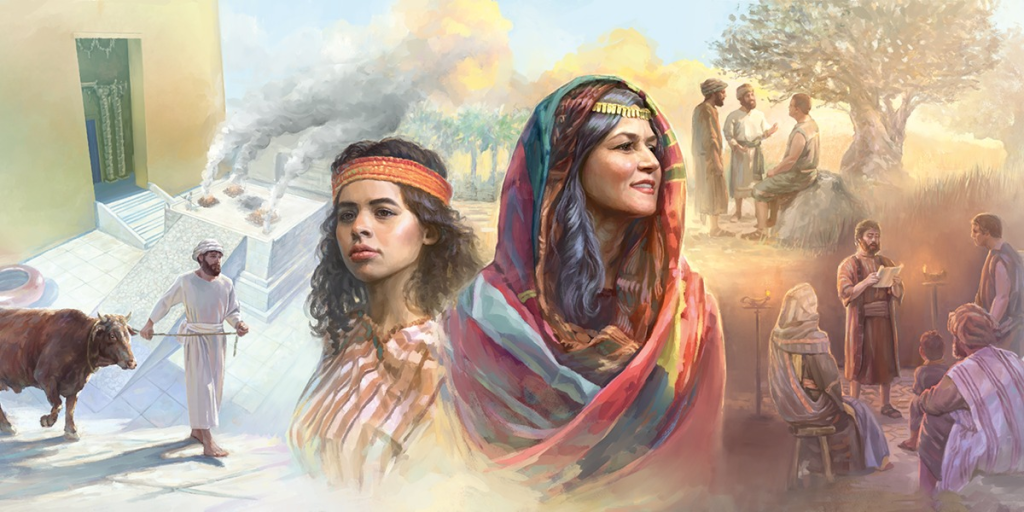
Writing in My Jewish Learning, Jewish educator Rachael Gelfman Schultz notes that “Genesis contains the greatest concentration of female figures in the Bible (32 named and 46 unnamed women). The fact that Genesis consists of a series of family stories (including several genealogies) accounts for the remarkable concentration of female figures.” Sarah is an important figure in that list of women. Rabbinic tradition lists her among the seven women prophets, the others being Miriam, Deborah, Hannah, Abigail, Huldah, and Esther.

See https://www.myjewishlearning.com/article/sarah-in-the-bible/

Nissan Mindel, writing in Chabad.org, observes that “Sarah was just as great as Abraham. She had all the great qualities that Abraham had. She was wise and kind, and a prophetess. And G‑d told Abraham to do as she says.”

He describes the home that they made in Beersheba, noting that whilst Abraham received visitors, offered them hospitality, and conversed with them (following the pattern shown in Gen 18), “Sarai was busy with the women folk, and long after all visitors were gone, or had retired to sleep, Sarai would sit up in her tent, making dresses and things for the poor and needy.

“When everybody was fast asleep, there was still a candle burning in Sarai’s tent, where she was sitting doing some hand-work, or preparing food for the next day. So G‑d sent a special Cloud of Light to surround her tent. For miles and miles around, the Cloud of Glory could be seen hovering over Sarai’s tent, and everybody said, “’There dwells a woman of worth.’”

See https://www.chabad.org/library/article_cdo/aid/112057/jewish/Abraham-And-Sarah.htm

So there is much to value, and honour, about Sarah, princess, prophet, and matriarch supreme. We would do well not to overlook her, the matriarch of matriarchs, amidst the stories of the patriarchs.

Among egalitarian religious congregations of Jews throughout the world, the most popular addition to the traditional liturgy is the mention of the Matriarchs in birkat avot (the blessing of the ancestors), the opening blessing of the Amidah:

Praised are You, Adonai our God and God of our ancestors, God of Abraham, Isaac, and Jacob, God of Sarah, Rebekah, Rachel, and Leah, great, mighty, awesome, exalted God who bestows lovingkindness, Creator of all. You remember the pious deeds of our ancestors and will send a redeemer to their children’s children because of Your loving nature.

https://jwa.org/encyclopedia/article/matriarchs-liturgical-and-theological-category
Visiting Abraham and Sarah by the oaks at Mamre (Gen 18; Pentecost 3A)

During the long season of “ordinary time” After Pentecost, the lectionary offers stories of some quite extraordinary people, drawn from the sagas that tell of the key moments in the story of Israel. These sagas are found in the narrative books, Genesis, Exodus, Deuteronomy, Joshua, and Judges. These stories run through until the Twenty-Fifth Sunday after Pentecost, in mid-November.

This coming Sunday, we hear a well-known story relating to the patriarch and matriarch whose adventures comprises significant part of Genesis (12:1—25:11). The story tells of how Abraham and Sarah undertook the long journey from Ur to Canaan (12:1–9), spent time in Egypt (12:10–20) and the Negeb (13:1–14:24), entered into covenant with God (15:1–21) and sealed this with a ceremony of circumcision (17:1–27).

Abraham himself has also fathered a child with his servant, Hagar (16:1–16); that dimension of the story appears important as it signals that there would be a descendant of Abraham, to fulfil the promise made earlier (12:2; 15:12–21). Yet the child who arrives is the son of Hagar, not Sarah. So the passage which is offered by the lectionary for this coming Sunday (Gen 18:1–15) addresses the infertility of Abraham and Sarah, by telling of how this couple learnt that they would, indeed, become parents together.

Abraham was allegedly aged 100 years, while Sarah was aged 90 years (see 17:17). It is no wonder that Sarah, when she learns of her forthcoming pregnancy, laughs (18:12)—although when confronted about this, she denies having laughed (18:15). Yet the name of the son to be born to Sarah, Isaac, means “the one who laughs”. So the joke is on her!

In the next two weeks, the lectionary will offer stories from subsequent chapters of Genesis, that focus on the two sons of Abraham: first, Ishmael, banished to the desert by his father, where he and his mother were vulnerable (21:8–21); and then Isaac, called to his own sacrifice under the hand of his own father (22:1–14). Certainly, Abraham does not come out of either of these stories looking very good!

The news about Isaac comes to Sarah and Abraham after a visit from three men, one of whom looks forward to the birth of a son to Sarah (18:10). Abraham had welcomed the visitors, as was the custom, saying “let a little water be brought, and wash your feet, and rest yourselves under the tree; let me bring a little bread, that you may refresh yourselves” (18:4–5).

Quite tellingly—given the strongly patriarchal nature of ancient society—we next learn that “Abraham hastened into the tent to Sarah, and said, ‘Make ready quickly three measures of choice flour, knead it, and make cakes’”. There we have it: the man decides, the woman implements. Has this changed in today’s society? A little? A lot? The jury is still out …

But more than this; “Abraham ran to the herd, and took a calf, tender and good, and gave it to the servant, who hastened to prepare it” (18:7). The master selects the animal; the servant prepares the meal. Again, all in accord with the customs of the time. But the next verse has always jarred with me: “Then he took curds and milk and the calf that he had prepared, and set it before them” (18:8). The food that he had prepared??? The food that he had ordered others to prepare, surely!

In his commentary on this passage in With Love to the World, the Revd Dr John Jegasothy, a retired Uniting Church Minister who came to Australia some decades ago, seeking asylum from civil war in Sri Lanka, observes that “strangers and aliens were considered as enemies in the ancient times. We, today, warn our children not to talk to strangers, because they could be predators”. He notes that, in the experience of his own family, “we have met many strangers in our lives, like new neighbours or new migrants in this multicultural country, who have become friends and channels of blessings to us. We too have become good neighbours and friends to them.”

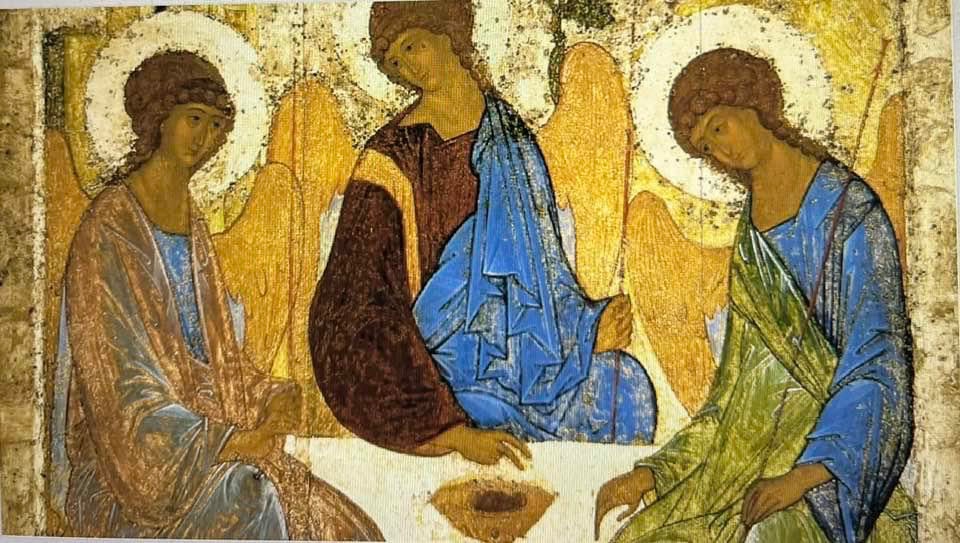
The visitors, offered hospitality by Sarah and Abraham, bring an important revelation to them. These three travellers are the means by which God speaks into the ongoing story. Later Christian interpreters have, unhelpfully and inaccurately, seen the “three men” as a visitation of the Triune God—an interpretation made famous through Andrew Rublev’s early 15th century icon (pictured).

The story, of course, is an ancient Jewish legend, which tells of hospitality and progeny; the Christian doctrine of the Trinity was shaped amidst the patriarchal polemics of the state-sponsored church of the later Roman Empire as church leaders argued about complex matters of speculative philosophical questions. (Was Jesus truly human? Was he truly divine? How are God and Jesus related? Do they share the same essence? Are they of like nature, or of exactly the same nature? and so on …)

The two are worlds apart. It’s another case where Christian interpreters, wanting to find “biblical proof” for that doctrine, have done great damage to a passage of Hebrew Scripture, forcing it to say something that clearly is not evident from a plain reading within the ancient Israelite context.

If we focus on the dynamic that is evident in the story, we see how it highlights the importance of hospitality. And that should encourage and inspire us, as we go about our daily lives, to offer that hospitality to others: to welcome the stranger, invite into our homes and our lives those in need of food, drink, and shelter; to reach out to those caught in the prisons of their minds, their poverty, their crimes, their inadequacies.

All of which sounds like sage words … now, where have we heard that before?

*****

See also

“In you all the families of the earth shall be blessed” (Gen 12; Pentecost 2A)

Each year during the Sundays which follow after the festival of Pentecost, the Gospel readings offer a series of stories, encounters, and parables from the Gosepl attributed to Matthew. In parallel to those stories, in the Hebrew Scripture readings, the lectionary offers a sequence of passages telling some of the key moments in the story of Israel, from the narrative books, Genesis, Exodus, Deuteronomy, Joshua, and Judges. These stories run through until the Twenty-Fifth Sunday after Pentecost, in mid-November.

This sequence of passages offers us stories which were told, retold, and probably developed over quite some time by the elders in ancient Israel. They are stories which define the nature of the people and convey key values which were important in ancient Israel. These faithful people from the past stand, for us today, as role models to encourage us, centuries later, in our own journey of faith. They are stories which are worth holding up for our reflection and consideration.

These stories each have the function of an aetiology—that is, a mythic story which is told to explain the origins of something that is important in the time of the storyteller. The online Oxford Classical Dictionary defines an aetiology as “an explanation, normally in narrative form (hence ‘aetiological myth’), of a practice, epithet, monument, or similar.”

Whilst telling of something that is presented as happening long back in the past, the focus is on present experiences and realities, for “such explanations elucidate something known in the contemporary world by reference to an event in the mythical past”.

See https://oxfordre.com/classics/display/10.1093/acrefore/9780199381135.001.0001/acrefore-9780199381135-e-7050;jsessionid=3DB38C42C54D01E1CBFA8682FB55DA4C

The ancestral narratives of Israel (Gen 12–50), as well as the series of books known as “the historical narratives” (Exodus to 2 Kings, Ezra—Nehemiah) are all written at a time much later that the presumed events which they narrate. The final form of the books as we have them most likely date to the Exile or post-exilic times, although pre-existing sources would have been used for many of these stories. (There are specific references to earlier written documents—now lost to us—scattered throughout 1—2 Kings.)

Those older stories were remembered, retold, and then written down, because they spoke into the present experiences of the writers. Common scholarly belief is that the stories found in Gen 12–50 were originally oral tales, that were collected together, told and retold over the years, and ultimately written down in one scroll, that we today call Genesis.

*****

For this coming Sunday (the Second Sunday after Pentecost), we are offered the account of the calling of Abram, who journeys into a new future (Gen 12:1–9). This has been a key passage for Jews throughout the centuries; Abram is remembered and honoured as “the father of the nation”—indeed, as “the father of all nations”; and this passage claims that it was God’s intention to grant the blessing of abundant descendants to Abram and his wife, to fulfil this promise.

The passage is found after the opening 11 chapters, which are often labelled the “Primeval History”, since they recount the creation of the world and the sequence of events which were fundamental for understanding human existence (such as human sinfulness and conflict, the expansion of humanity, the great flood, the growth of tribal entities, and the diversification of languages).

The passage also stands at the head of those stories, originally oral, which were collected because they revealed much about the nature of Israel as a people and as a nation. These chapters tell stories about the patriarchs and their wives (Abram and Sarai, Isaac and Rebekah, Jacob and Leah and Rachel). This particular passage introduces key themes for the people of Israel.

The passage indicates that Abram took his wife Sarai and his nephew Lot with him, “and all the possessions that they had gathered, and the persons whom they had acquired in Haran; and they set forth to go to the land of Canaan” (Gen 12:5). They would also have had the (always unnamed) wife of Lot with them, for their companions would undoubtedly have included both males and females within the extended family grouping. We need to read this ancient aetiology with a contemporary critical awareness. Certainly, the faith of Abram and Sarai and their extended family is a key message conveyed by this passage.

The story explains four important aspects of life and faith for the people of ancient Israel and on into contemporary Judaism: the land is given to this people, the people (of Israel) will become “a great nation”, the name (of Abram) will be blessed, and the descendants of Abram, “all the families of the earth”, will likewise be blessed. These four points—land, pepople, name, descendants—loom large throughout the history of Israel. Indeed, they maintain their potency into the present age—and need to be read and understood with political and cultural sensitivity today.

*****

This passage sounds the initial claim of the people of Israel to the land of Canaan. This was promised by God to Abram and his descendants, we are told. They set out towards that land; “when they had come to the land of Canaan, Abram passed through the land to the place at Shechem, to the oak of Moreh. At that time the Canaanites were in the land. Then the Lord appeared to Abram, and said, ‘To your offspring I will give this land.’ So he built there an altar to the Lord, who had appeared to him.” (Gen 12:5–7). The claim recurs at various points throughout the ensuing narratives, culminating in the conquest narrated in the book of Joshua.

See more on this aspect of the passage at

and on the difficulties involved in the story of invasion and violent colonisation, see

In his commentary on this passage in With Love to the World, the Revd Dr John Jegasothy, a retired Uniting Church Minister originally from Sri Lanka, reflects on this story of journeying to a new land, from his own perspective as an asylum seeker some decades ago. “As a family we had to decide to leave Sri Lanka and migrate to Australia on Special Humanitarian Visa as I was a human rights advocate and death came close. God had a plan for me to be an advocate for refugees here.”

Dr Jegasothy continues, “I look at our journey as a journey like Abram and Sarai undertook. They absolutely trusted in God’s promises and because of their faith they were counted as righteous.” There is an invitation here for each of us to ponder this story, in terms of our own journey of faith. How and when has God called us on to journey into new places or new experiences?

*****

Alongside the claim to the land of Canaan, the story of Gen 12 portrays Abram (and Sarai) as the origin of a multitude of descendants; through them, “all the families of the earth shall be blessed” (12:3). Initially, this claim appears to be quite precarious; after all, the first mention of Sarai indicates that “Sarai was barren; she had no child” (11:29–30).

Later, when Sarai advises Abram, “see that the Lord has prevented me from bearing children; go in to my slave-girl; it may be that I shall obtain children by her” (16:1–2), Abram diligently obeys; he “went in to Hagar, and she conceived; and when she saw that she had conceived, she looked with contempt on her mistress” (16:4). Tensions between the wife, Sarai, and the slave-girl, Hagar, lead to Hager’s flight into the wilderness, where she gave birth to Abram’s son, Ishmael (16:7–16).

Still later, when Abram (now Abraham) sealed the covenant with the Lord God through the ritual of circumcision (17:1–14), he is told that Sarai (now Sarah) will now be blessed by the Lord, for “I will give you a son by her; I will bless her, she shall give rise to nations; kings of peoples shall come from her” (17:16). And in due time—despite the laughter of Sarah (18:12)—Isaac is born (21:1–3).

The lectionary studiously avoids the story of the birth of Ishmael, but provides us with a sequence of passages that recount the promise to Sarah (18:1–15, Pentecost 3A), the banishing of Hagar and Ishmael (21:8–21, Pentecost 4A), and the near-sacrifice of Isaac (22:1–14, Pentecost 5A), before turning to the story of Isaac and his wife Rebekah (Pentecost 6A) and then on to Jacob (with excerpts from chs. 25 to 37, Pentecost 7A to 11A).

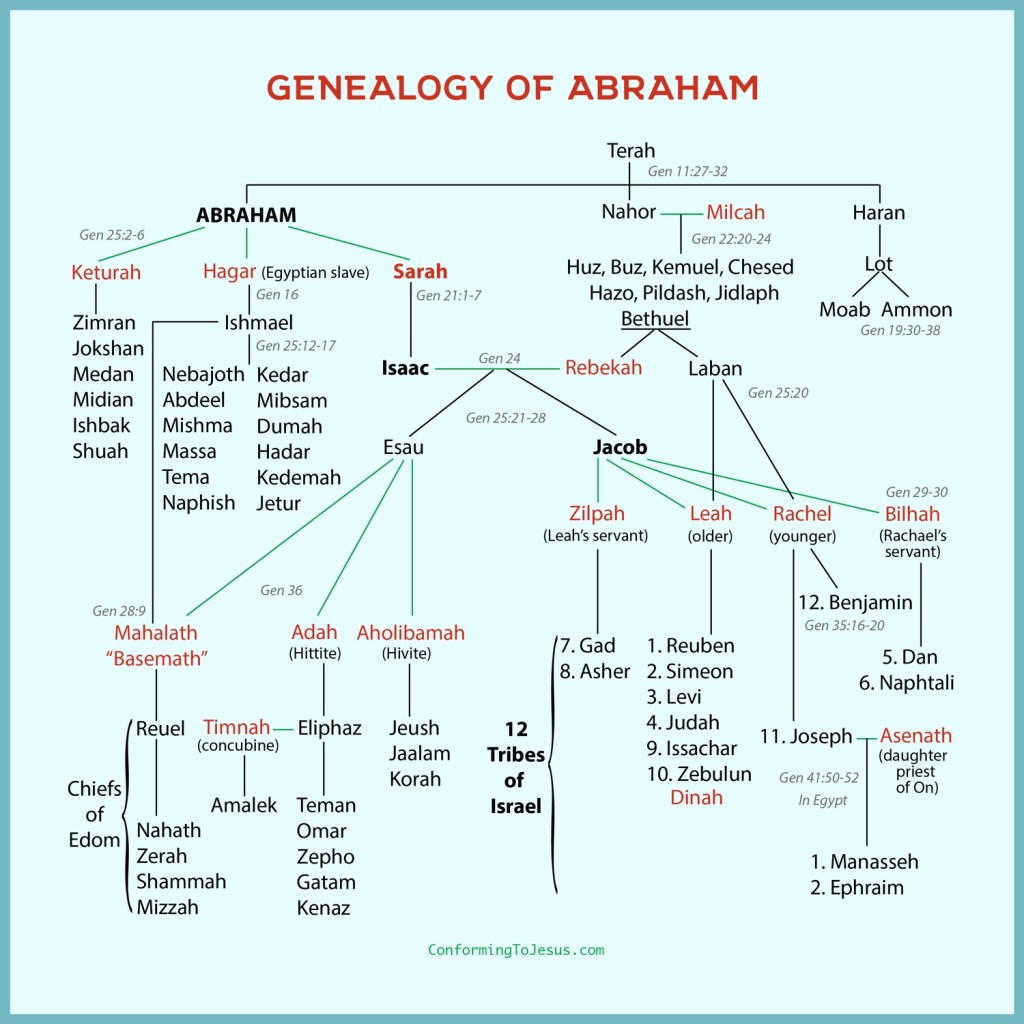
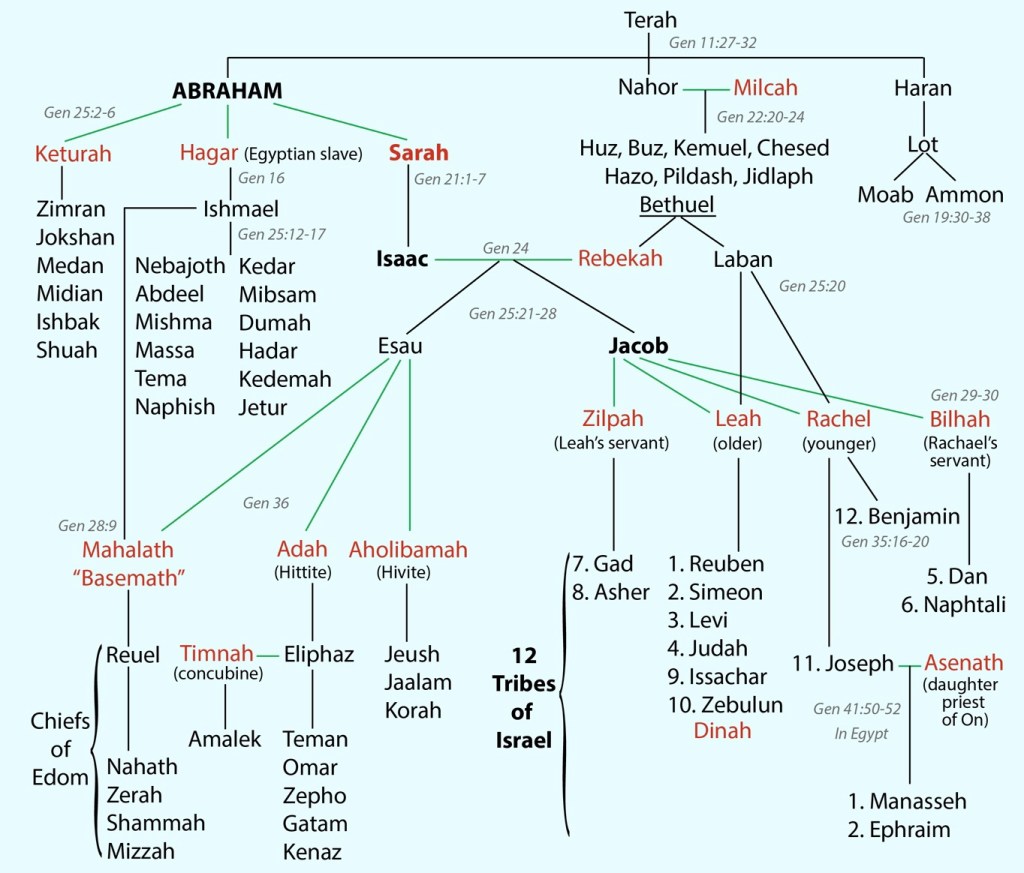
After Sarah died, Abraham married Keturah and had six sons with her (25:1–4). He also “gave gifts to the sons of his concubines while he was living” (25:6), so there were other (unnamed) progeny of Abraham. In due time, Abraham and Sarah’s son Isaac and his wife Rebekah gave birth to twins, Jacob and Esau (25:19–26), whilst Ishmael, the son of Abraham and Hagar, was the father of twelve sons who had many descendants (25:12–18), as well as a daughter who was the ancestor of the Edomites. Abraham’s brothers Nahor fathered twelve sons (22:20–24) whilst Haran was the father of Lot (11:27), who himself fathered Moab and Ammon. Many of these descendants continued reproducing, and so the line of Abraham grew and expanded, generation by generation.

Collectively, this family was responsible for a multitude of descendants, which brings to fulfilment God’s promise to Abraham, “I have made you the ancestor of a multitude of nations; I will make you exceedingly fruitful; and I will make nations of you, and kings shall come from you” (17:5–6). The tenuous moments in the story leave us, as readers, wondering whether this promise would come to fruition; in time, of course, that fulfilment is reported in the Genesis narrative. Abraham does indeed become “father of all nations”, and a key figure in the sagas about Israel that were told and retold throughout the ages.