Expectations: a key theme for Advent

What follows is a piece that I wrote a few weeks back for Ruminations, the quarterly journal of Saltbush, which is a ministry that resources rural and regional Uniting Churches in the Synod of NSW and the ACT. I wrote it just at the time when “expectations” were swirling around the church; I’m publishing it now as the theme of Expectations seems to be most appropriate for the season of Advent.

*****

The Synod of NSW.ACT has recently met, and given consideration to “The Presbytery Project”, which has the subtitle “Future Directions for the People of God on the Way”. The expectations surrounding the move to the Three Presbyteries Model are no doubt clear: sharing of resources, mobilising of personnel, collaboration of teams, hope for the future.

Just after that meeting, the Synod of Victoria and Tasmania met and adopted their vision for the future, entitled the “Faithful Futures Project”. It is setting expectations in that Synod; it aims “to prepare the Uniting Church in Victoria and Tasmania for the next 10 to 15 years”. And, of course, right across Australia, the church has been pondering the outcomes of the 2024 Assembly, when the Act2 Project was received and its proposals adopted. Already newly-constituted Commissions are meeting, planning the steps ahead in their respective areas. No doubt they have expectations about what they will achieve.

Indeed, even in my small rural church, we have had a recent process in which people have shared “what I hope for this church”, learning about better ways to be welcoming, and setting out steps for mission in the local community. And the Presbytery in which I live has a neat slogan on its website, declaring that it seeks to “Live by Faith, be Known by Love, and be a Voice of Hope”.

Expectations abound at every level!

Jesus was no stranger to the basic human element of “expectations”. He didn’t know about the anticipatory joy of an expectant parent, looking to the birth of their child. He presumably was a stranger to the bubbling internal expectations that mount when you have just two months before you start that “dream job” that you have just been offered. And I am not sure that he ever took part in a day-long, facilitated workshop of setting forth the “purpose, mission, and values” of a faith community!

But Jesus knew about expectations. The earliest account of his adult life tells us that his first words in public were words of expectation: “the time is fulfilled, and the kingdom of God has come near” (Mark 1:15). In another account of his life, he is reported as saying “the kingdom of God is not coming with things that can be observed; … in fact, the kingdom of God is among you” ( Luke 17:20-21). That surely must have set his followers agog as they scurried to determine just how this expectation of the coming kingdom was, in fact, now present among them.

Indeed, Jesus lived at a time when expectations were running high amongst his people. This was not a new thing. In the foundational story of the Exodus from Egypt, it is said that Moses offered words of expectation to the people: “Do not be afraid, stand firm, and see the deliverance that the Lord will accomplish for you today; for the Egyptians whom you see today you shall never see again” (Exod 14:13).

The scrolls containing the words of the prophets, which faithful Jews would have known quite well, were full of words of expectation: “the days are coming when all that is in your house will be carried off to Babylon”, announced Isaiah (Isa 39:16); “the days are surely coming, says the Lord, when I will make a new covenant with the house of Israel and the house of Judah”, said Jeremiah, during that exile (Jer 31:31); “I am coming to gather all nations and tongues”, declared an anonymous prophet after the people had returned from Babylon (Isa 66:18). Each important step in the story of Israel had been prophetically signalled by a word of expectation. 

And by the time of Jesus, after centuries of continuing foreign rule, and after a series of uprisings, defeats, compromises, and plots to regain control, expectations continued to run amok amongst the Jewish population. For some, the expectation was that they would someday regain political control of their land (the zealots and political revolutionaries of the day). For others, the expectation took shape in a vision of “the sons of light” waging a final cataclysmic battle against “the sons of darkness” (as in one of the Dead Sea Scrolls). Still others held to the word of the Lord, “I am sending my messenger to prepare the way before me, and the Lord whom you seek will suddenly come to his temple” (Mal 3:1). 

It was this latter expectation that had gripped John, as he carried out his programme of calling people to repentance and baptising them in the river. And as he did so, the man from Nazareth came and submitted himself for baptism. “Behold the Lamb of God, who takes away the sin of the world!” one later writer claimed that he said (John 1:20).  His expectations had come to pass in ways that perhaps even he had not thought possible.

The followers of Jesus certainly had expectations about him. “Are you the one who is to come?”—the question that John had sent his followers to ask of Jesus (Matt 11:3; Luke 7:19)—soon became their question. Expectations about what Jesus would achieve abounded. “We had hoped that he was the one to redeem Israel”, two of his followers mused, soon after he had been put to death (Luke 24:21). That was some expectation, to be sure! 

Some of those not as enchanted by the way of Jesus also had expectations about him. “How long will you keep us in suspense? If you are the Messiah, tell us plainly”, they taunted him (John 10:24). Hovering somewhere around Jesus was the expectation that he might in fact be the figure long hoped-for, come to redeem Israel. And even as he hung in the cross, he was again mocked and taunted: “He saved others; he cannot save himself. Let the Messiah, the King of Israel, come down from the cross now, so that we may see and believe” (Mark 15:31–32). Again, that expectation that he was someone significant—or that he thought he was someone significant—is in play. Just what might we expect from this Galilean stirrer? 
The path that Jesus trod both met expectations, but also failed to meet expectations. He did achieve something significant; but he did not do so in the way that was most surely expected. He would redeem Israel; but only by giving his life. He would be shown to be Messiah; but not on the clouds of glory—rather, on a rough wooden cross. “Truly this man was God’s Son!”, the Roman soldier is claimed to have said as he witnessed this cruel death (Mark 15:39).

Perhaps Judas had unreasonably  high expectations about Jesus; he was one of the inner group that travelled with him, ate with him, learnt from him, and began to carry out the mission that Jesus had given them (Luke 9:1–6). And yet his expectations took a sharp turn; we don’t know what drove him to betray Jesus with a kiss, nor do we know what expectations he had about what would eventuate from that. His sad end (Matt 27:3–6; compare Acts 1:18–19) perhaps reflects his recognition—tragically, too late—that his expectations regarding Jesus were doomed to fail.

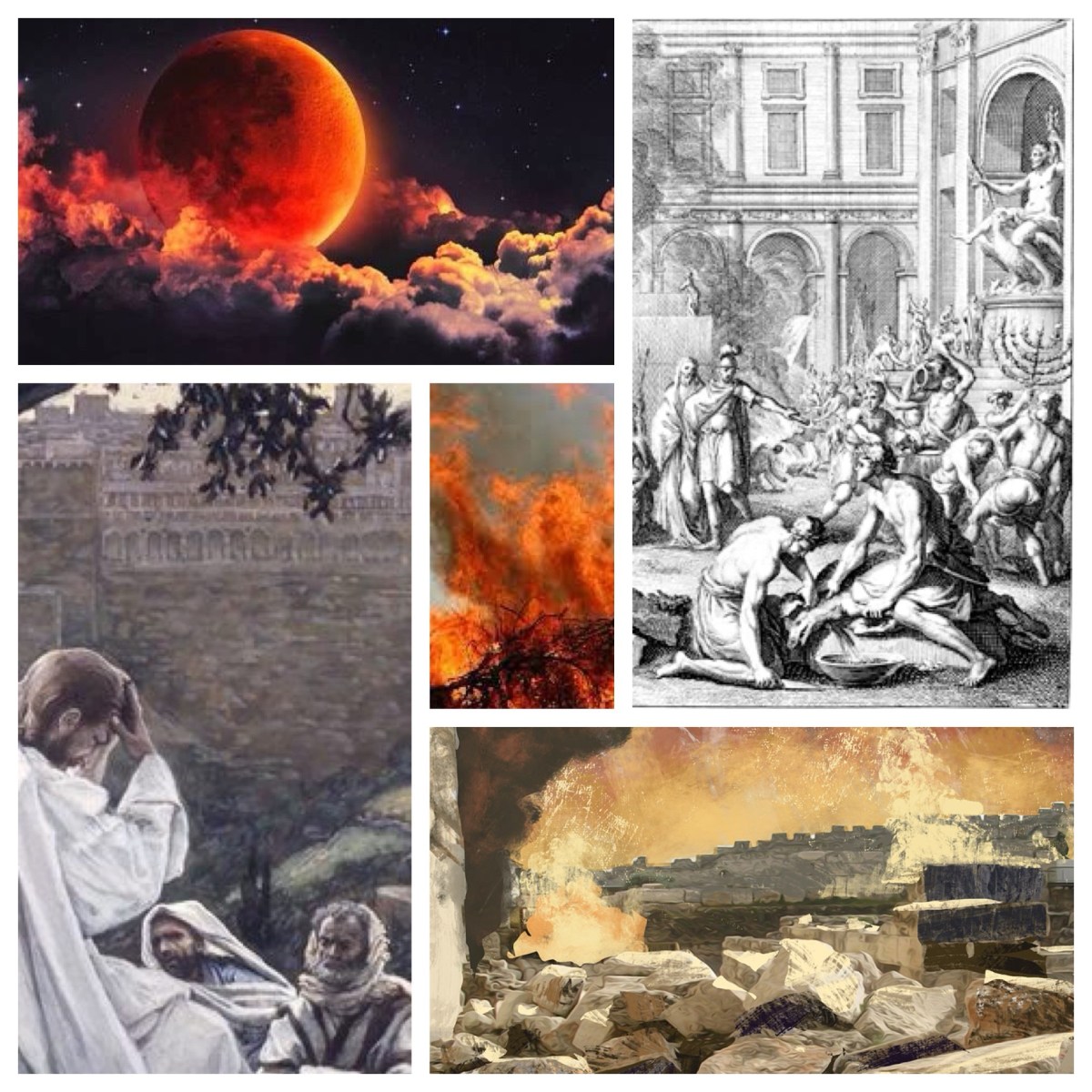
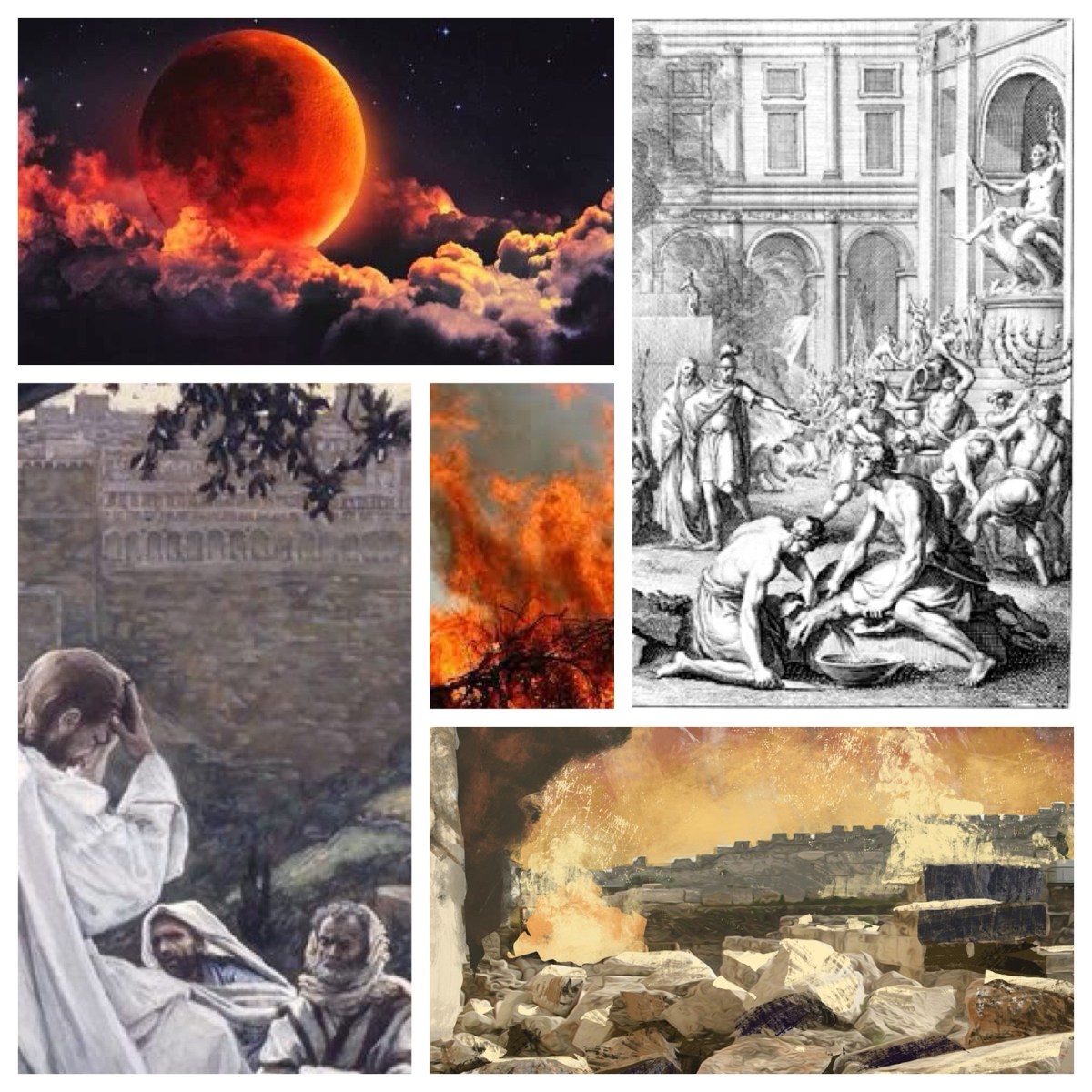
And let’s not get too caught up in the complexities of the apocalyptic expectations that swirled around at the time—expectations that Jesus addressed, and redefined, in one of his longer teaching sessions (Mark 13:5–37). On the one hand, he is clear that something unexpected and yet long yearned-for will indeed take place (“they will see ‘the Son of Man coming in clouds’ with great power”, Mark 13:26). The expectations people held in relation to him were justified, it would seem.

And yet, he warns his followers to “beware that no one leads you astray” with specific timetables (13:5), advising them that chaotic times of cosmic upheaval are nothing “but the beginning of the birth pangs” (13:8), there will be suffering that will need to be faced and endured (13:19), and insisting that “about that day or hour no one knows” (13:32), that “you do not know when the time will come” (13:33, 35). Expectations may be raised, hopes may be high; but resolution is not easily attained.

So how do we deal with expectations? “Managing expectations” has entered the language both of business practice and of personal psychology. We need to be wary of setting expectations too high. Thinking about how all nations will flock to Jerusalem is setting expectations too high. They didn’t, and they won’t (especially today, in the fiery political landscape of Israel and Palestine). So too is expecting that everyone will see clearly that Jesus, the Messiah, is the Son of God who is the one to perform miracles at will and the one to redeem all of Israel and all of the nations—that, too, is unrealistic. We haven’t seen this, and he hasn’t redeemed everyone at all. Life continues on despite the failure to meet such high expectations.

And in similar fashion, setting expectations too low is something we should avoid. The young adult comes home from their first attempt at sitting for a drivers license, and proudly announces “I got it!” Dad looks up, amazed, and responds, “Wow! I really didn’t think you’d get it this time”. The expectation was set low, the triumph evaporates all-so-quickly. We need to manage our expectations: not too high, not too low.

And what of expectations we might have for our church community? Have you talked together in your congregation or faith community about what you hope for? what you would love to see happen? what you could work together to try to achieve? what you can pray for, bringing reason and knowledge into your words of hope and expectation to God? 

We should have expectations; we should talk about our expectations; and most importantly, we should be working together to see how we might achieve those expectations, and make them become a reality. Sometimes that can be a hard thing to do. Nevertheless, it is central to our life together.

As for expectations in our own personal spiritual life: that’s another area to consider carefully. We all have our familiar daily or weekly practices. They may be shaped by years of loving care and devoted repetition; we may be growing into a particular spiritual practice as we return to it consistently over time; or we may be now just “trying something new” in our spiritual life. Whatever the case may be, we have expectations about what that spiritual practice will do for us, and how it will help nurture our life of discipleship. We should identify our personal expectations and see how we are moving towards achieving them.

At the end of three of the Gospels, there are words that Jesus is reported as saying as he appeared, after his resurrection, to his followers. These words set the expectations for his followers. Matthew reports his words, “make disciples of all nations, baptizing them in the name of the Father and of the Son and of the Holy Spirit, and teaching them to obey everything that I have commanded you” (Matt 28:19–20). In these words, Jesus offers a clear set of expectations. 

Luke reports that he said “you are witnesses of these things”, of all that he has told them, so he offers them a command which contains an expectation: “stay here in the city until you have been clothed with power from on high” (Luke 24:48–49). In the subsequent volume written by Luke, the expectation and the charge is clear: “you will receive power when the Holy Spirit has come upon you; and you will be my witnesses in Jerusalem, in all Judea and Samaria, and to the ends of the earth” (Acts 1:8).

Most simply of all, John has Jesus say to the disciples, “peace be with you … as the Father has sent me, so I send you … receive the Holy Spirit” (John 20:21–22). Whichever Gospel account we prioritise for ourselves, the charge is clear—and the sense of expectation is strong. And so may it be for us,  day after day, as we walk the way of Jesus, full of expectation!

Justice rolling down like waters, righteousness like an ever-flowing stream (Amos 1, 5; Narrative Lectionary for Pentecost 22)

Discussion of the Narrative Lectionary passage from Amos

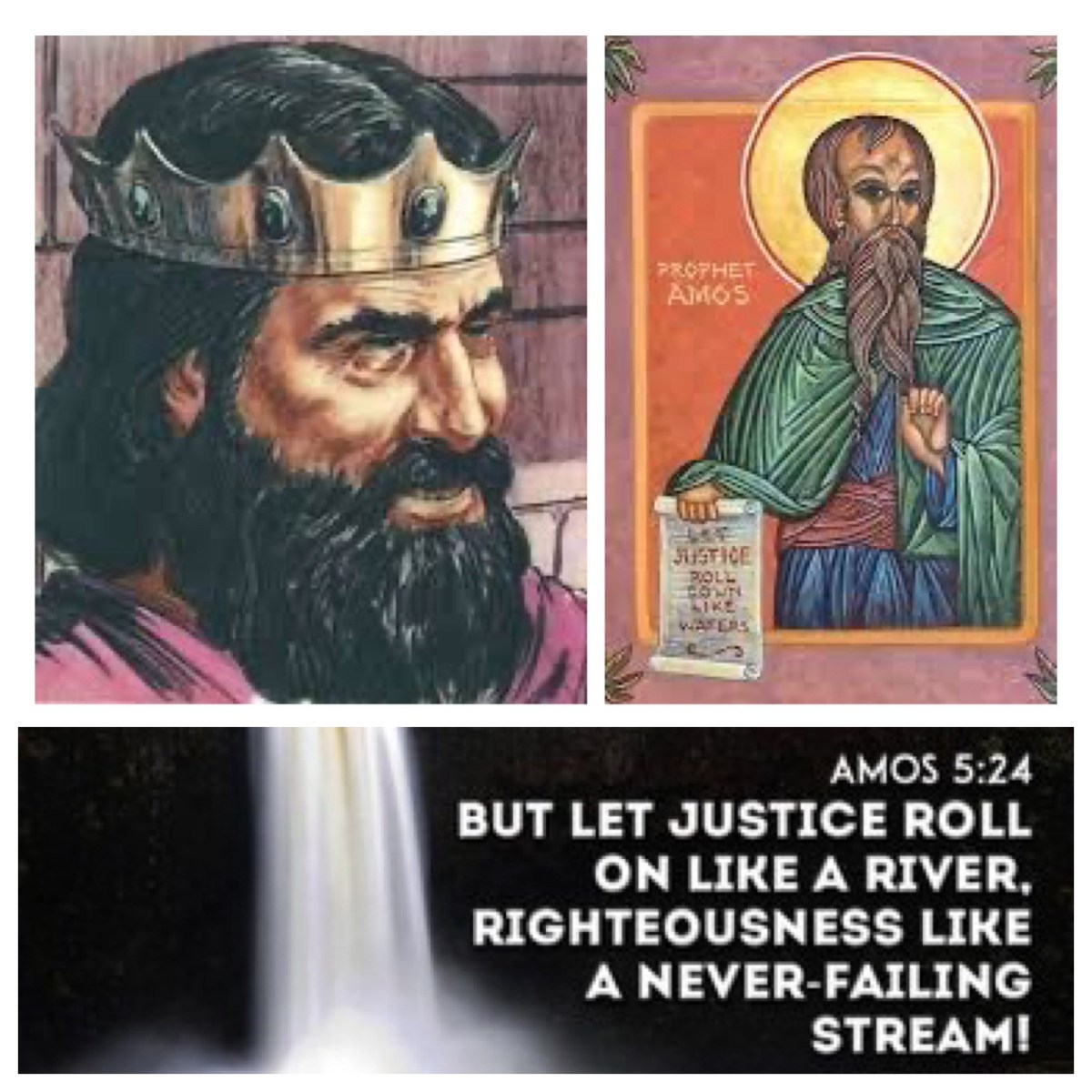
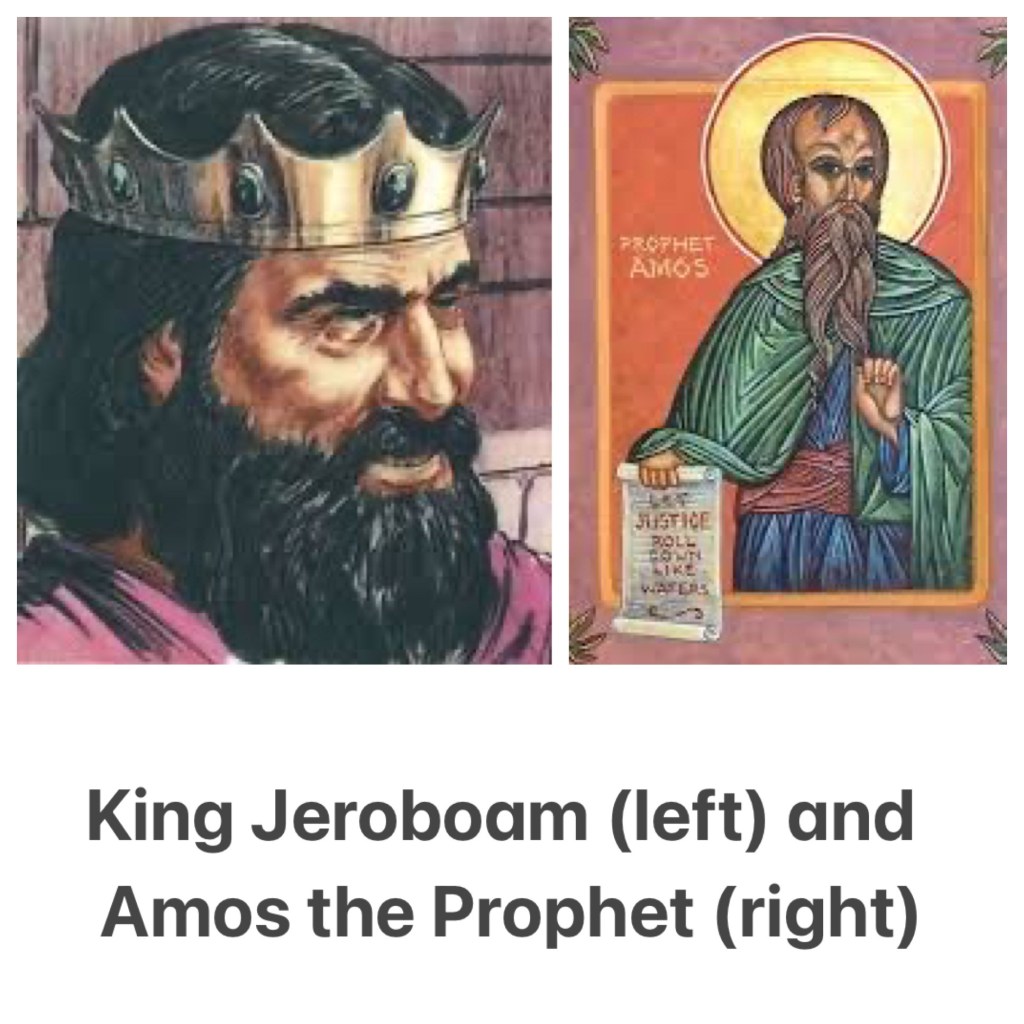
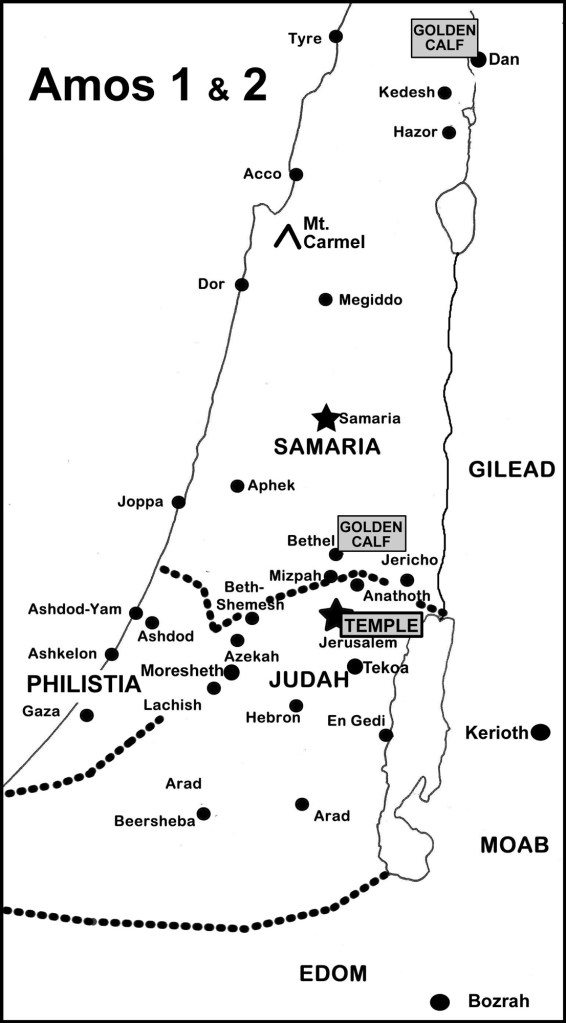
The prophet Amos lived in the northern kingdom of Israel during the reign of Jeroboam II, the thirteenth king of Israel, who reigned for four decades (786–746 BCE; see Amos 7:10). It was a time of prosperity, built on the trading of olive oil and wine with the neighbouring nations of Assyria to the north and Egypt to the south. Jeroboam, however, is remembered as a king who oversaw multiple acts of sinfulness during his years on the throne. 

Most infamously, he replicated the sin of Aaron, who oversaw the creation of a golden calf during the time that the people of Israel were awaiting the return of Moses from his time on the top of Mount Sinai (Exod 32). Jeroboam had the city of Shechem built, as a direct challenge to the centrality of Jerusalem; and he had two golden claves built and installed, one at Bethel, the other at Dan (1 Ki 12:25–30). 

For these and other persistent sins during his 22 years as king, reported at 1 Ki 12:31–33 and 13:33–34, Jerobaom incurred the divine wrath, such that God determined that “ the house of Jeroboam [was to be] cut it off and destroyed from the face of the earth” (1 Ki 13:34). Later passages in this book refer to “the sins of Jeroboam” (1 Ki 14:16; 15:30; 16:2, 19, 31; 2 Ki 10:29, 31; 13:2, 6, 11; 14:24; 15:9, 18, 24, 28; 17:22) and “the way of Jeroboam … and the sins that he caused Israel to commit, provoking the Lord, the God of Israel, to anger by their idols” (1 Ki 16:26).

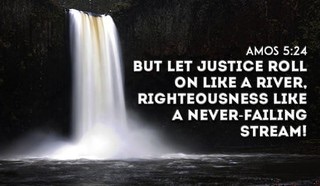
So although the Temple in Jerusalem was the focus for religious activity in the southern kingdom (Judah), Jeroboam had established a number of religious sites in the northern kingdom. Amos warns about the sites at Dan, Bethel, Gilgal and Beersheba (Amos 5:5; 8:14). At these places, not only was the Lord God worshipped, but idolatrous images were used in worship services (5:26). Amos is trenchant in his criticism of the worship that the people offer (5:21–27); embedded in this crisis is a doublet of poetry, words most often associated with Amos: “let justice roll down like waters, and righteousness like an ever-flowing stream” (5:24).

Indeed, it is the perpetration of social inequity within Israel that most causes him to convey the anger of divine displeasure. He admonishes the rich for the way that they mistreat the poor: “they sell the righteous for silver, and the needy for a pair of sandals—they who trample the head of the poor into the dust of the earth and push the afflicted out of the way” (2:6–7); “you trample on the poor and take from them levies of grain” (5:11). 

Again, Amos rails: “you trample on the needy and bring to ruin the poor of the land … buying the poor for silver and the needy for a pair of sandals, and selling the sweepings of the wheat” (8:4, 6). In a biting oracle, he criticises the “cows of Bashan who are on Mount Samaria” for the way they “oppress the poor, crush the needy” (4:1). 

Bashan was the mountainous area to the northeast of Israel (Ps 68:15), which rejoiced in majestic oaks (Isa 2:13) and extensive pasture lands (1 Chron 5:16). The luxurious lifestyle of these people can well be imagined. The reference to “winter houses … summer houses … houses of ivory … and great houses” (3:15) is telling. Luxury and opulence is evident amongst the wealthy.

So,  too, is the description of “those who lie on beds of ivory, and lounge on their couches, and eat lambs from the flock, and calves from the stall; who sing idle songs to the sound of the harp, and like David improvise on instruments of music; who drink wine from bowls, and anoint themselves with the finest oils” (6:4–6). The extravagance of the wealthy is obvious, juxtaposed against the plight of the poor, as we have noted.

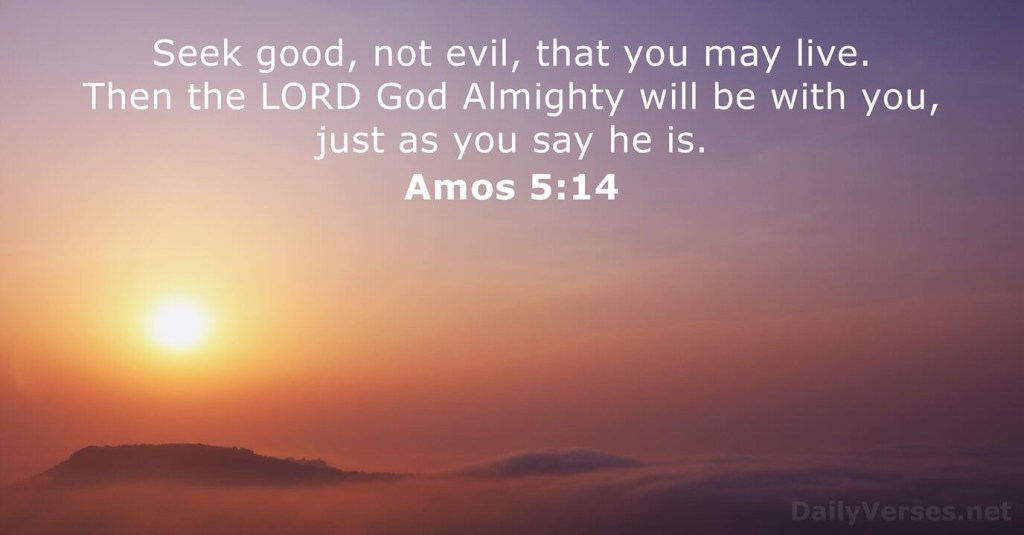
Amos indicates that God had given Israel a number of opportunities to repent, “yet you did not return to me” (4:6, 8, 9, 10, 11). God pleads for Israel to “seek me and live” (5:4), “seek the Lord and live” (5:6), “seek good and not evil, that you may live” (5:14).

But this is all in vain; ultimately, the prophet insists, the Lord God will bring on the day of the Lord—a day of “darkness, not light, and gloom with no brightness in it” (5:18–20). God is determined; “the great house shall be shattered to bits, and the little house to pieces” (6:11); later, he insists again, “the dead bodies shall be many, cast out in every place” (8:3). 

In so many reports of prophetic activity, it is justice which is the heart of their message—God’s justice; the justice which God desires for the people of God; the justice which God speaks through the voice of the prophets; the justice that God calls for in Israel; the justice that provides the measure against which Israel will be judged, and saved, or condemned.

Moses himself was charged with ensuring that justice was in place in Israelite society. One story told of the time after the Israelites had escaped from Egypt places Moses as a judge. Whilst in the wilderness of Sin, being visited by his father-in-law Jethro, we learn that “Moses sat as judge for the people, while the people stood around him from morning until evening” (Exod 18:13). 

Noticing that Moses was overwhelmed by the volume of matters requiring adjudgment, Jethro suggested—and Moses adopted—a system whereby appointed men who “judged the people at all times; hard cases they brought to Moses, but any minor case they decided themselves” (Exod 18:14–16). The charge given to these men is clear: they are to give a fair hearing to every member of the community, and they “must not be partial in judging: hear out the small and the great alike; [do] not be intimidated by anyone, for the judgment is God’s” (Deut 1:16–17). 

Prophets coming after Moses thus inherited this responsibility to ensure that justice was upheld within society. The most famous prophetic word of Amos is, as we have noted, his call for “justice and righteousness” (Amos 5:22). Micah asks the question, “what does the Lord require of you but to do justice?” (Mic 6:8), while through the prophet Hosea, the Lord God promises to Israel, “I will take you for my wife in righteousness and in justice, in steadfast love, and in mercy” (Hos 2:19).

Isaiah ends his famous love-song of of the vineyard by declaring that God “expected justice” (Isa 5:7) and he tells the rebellious people of his day, “the Lord is a God of justice; blessed are all those who wait for him” (Isa 30:18). He proclaims God’s judgement on those who “turn aside the needy from justice … and rob the poor of my people, that widows may be your spoil, and that you may make the orphans your prey!” (Isa 10:1–2). 

Other prophets join their voices to Isaiah’s declaration. Ezekiel laments that “the sojourner suffers extortion in your midst; the fatherless and the widow are wronged in you” (Ezek 22:7). Jeremiah encourages the people of Jerusalem with a promise that God will allow them to continue to dwell in their land if they “do not oppress the sojourner, the fatherless, or the widow” (Jer 7:5–7). 

Second Isaiah foresees that the coming Servant “will bring forth justice to the nations” (Isa 42:1) and knows that God’s justice will be “a light to the peoples” (Isa 51:4). The words of Third Isaiah continue in this prophetic stream, for this anonymous prophet begins his words with a direct declaration, “maintain justice, and do what is right” (Isa 56:1). He goes on to articulate his mission as being “to bring good news to the oppressed, to bind up the brokenhearted, to proclaim liberty to the captives, and release to the prisoners” (Isa 61:1), thereby demonstrating that “I the Lord love justice” (Isa 62:8).

This commitment of Amos and many of the prophets resonates also with the psalmist, who praises “the God of Jacob … who executes justice for the oppressed; who gives food to the hungry … [who] sets the prisoners free, [who] opens the eyes of the blind, [who] lifts up those who are bowed down [and] loves the righteous, [who] watches over the strangers [and] upholds the orphan and the widow” (Ps 146:5, 7–9). See 

https://johntsquires.com/2023/05/14/father-of-orphans-and-protector-of-widows-psalm-68-easter-7a/

On remembering, celebrating, and contextualising (Halloween, All Saints, and All Souls) … and Samhain.

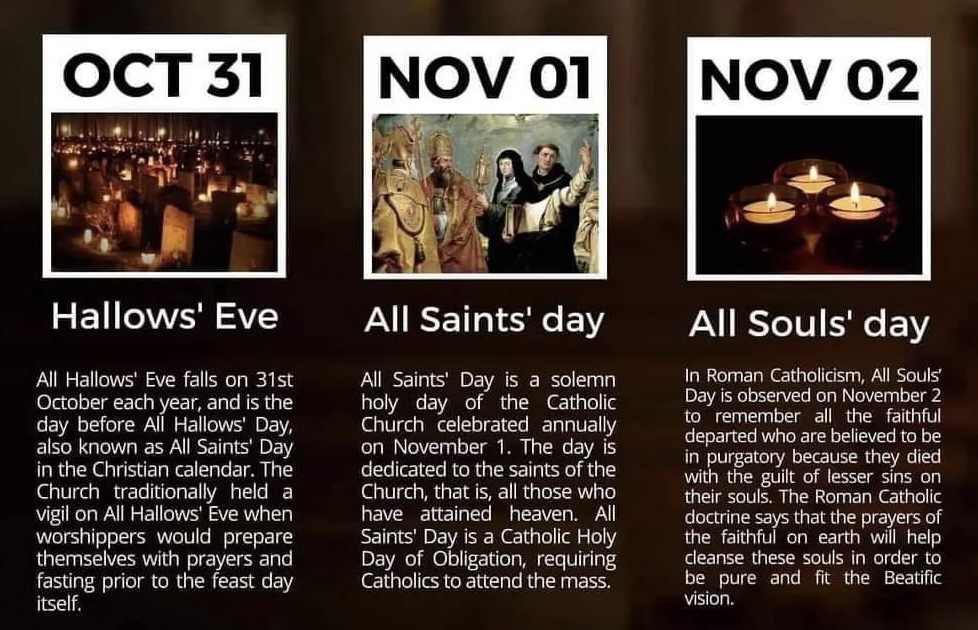
Today, 31 October, begins a special sequence of days, which in traditional Roman Catholic piety form a triduum (simply meaning, “three days”). There is one set of three days that is very well-known: the Great Three Days of Easter (Good Friday—Holy Saturday—Easter Sunday). This current sequence of three days is the “other” three days—standing in the shadow of those other three days. Whilst the three days of Easter celebrate new life (the Triduum of Life), this “other” set of three days has been called the Triduum of Death.

Why, death? Well, the explanation lies in the three particular days that are included: All Hallows’ Eve, All Saints’ Day, and All Souls’ Day. All three have to do with life beyond this life as we know it, in one form or another—that is, they are dealing with death and those who have died.
All Hallows’ Eve is best known to us as Halloween; it falls, every year, on 31 October, round about six months after Easter Sunday. Unlike Easter, however, this is not a “moveable feast”, following the pattern of the lunar cycle (which does not lineup with our solar-based calendar). Halloween falls, each and every year, on the very last day of October.
It needs to be said that the contemporary commercialised celebration of Halloween is a long way from its origins in medieval Christian piety. And so it also needs to be emphasised that Halloween is not a pagan festival. It has its origins deep in Christian history and tradition.

The English word ‘Halloween’ is a shortening of All Hallows’ Eve(n), which long ago began this series of three holy days, designed to enable the faithful to remember the saints of old (All Saints’ Day on 1 November) and the faithful who have died, “the souls of the faithful departed” (All Souls’ Day on 2 November). These three days, Halloween—All Saints’ Day—All Souls’ Day, belong together—as the “other” Christian triduum (like Good Friday—Holy Saturday—Easter Sunday).

How long ago this sequence began is not clear, as local customs varied. There is evidence that some days had been identified as the time to remember individual saints or groups of saints in some locations in the 7th to 9th centuries. By around 800, churches in Northumbria and Ireland apparently remembered “all saints” on 1 November.

In the online resources of the Northumbria Community, there is a good statement about the significance of this time: “The old belief was that there was danger and vulnerability at this time of transition, which was neither in one year nor the next. Spiritual barriers could be dissolved. Inevitably, looking back led to the remembrance of those who had died and gone before; and, as the dark, cold days were awaited, protection was sought against the evil spirits that were bound to be abroad until spring returned. These old beliefs were never quite eradicated by the coming of Christianity, but lingered as a persistent superstition, a residual folk memory.” See

https://www.northumbriacommunity.org/saints/celtic-new-year-all-hallows-eve-and-all-saints-tide-october-31stnovember-1st/

By the 12th century, All Saints’ and All Souls’ had become holy days of obligation in the medieval churches, and various rituals developed for each day. Baking and sharing cakes for the souls of baptised people is evidenced in some European countries in the 15th century; this may be the origins of trick-or-treat. Lighting candles in homes on these days was done in Ireland in the 19th century—another element which is reflected in current Halloween practices.

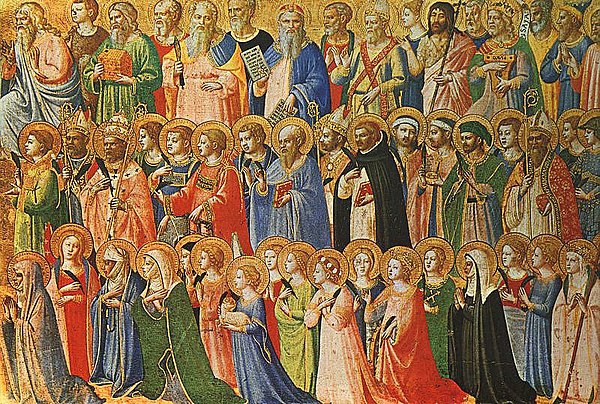
The Forerunners of Christ with Saints and Martyrs
by Fra Angelico (1395–1455)

I have had the experience, in churches today, of being caught up in a grand worship experience for All Saints’ Day, the middle of the three days (a number of these were memorable experiences where my wife Elizabeth Raine created and presided at the liturgy). We surrounded ourselves with the memory of saints of ancient and more recent times, and recalled with gratitude saints of the present times, particularly those important to the immediate locality or congregation.

In those times of worship, we joined in singing “for all the saints who from their labour rest—alleluia! alleluia!” (from a hymn by William Walsham How), and then “a world without saints forgets how to praise; in loving, in living, they prove it is true— their way of self-giving, Lord, leads us to you” (from a hymn by Jacob Friedrich).

It is sometimes claimed that Halloween originated as a response to existing pagan rituals—but we need some considered nuance as we reflect on this. A number of the current practices involved in Halloween certainly do show the strong influence of folk customs with pagan origins in a number of Celtic countries.

This is especially so in relation to Samhain in Ireland, marking the start of winter with a festival from sundown on 31 October to sundown on 1 November. This was a liminal time when the boundary between this world and the world beyond was thinned; at this time, it was thought, the spirits could more easily enter this world. The connection with the Christian days of All Saints’ and All Souls’ is thus clear to see.

However, this does not mean that we can simply (and simplistically) conclude that these days have pagan origins; rather, what we ought to recognise is that, like other Christian festivals, there has been a blurring of customs and practices and a linking of Christian patterns with pagan festivities.

This blurring and linking is a natural tendency that has taken place time after time in place after place. This is what historians and scholars of religion call syncretism—the merging and assimilating of traditions that were originally discrete, with separate origins. It can also be called eclecticism; but I prefer to see this more accurately as contextualisation, the shaping of a tradition in the light of the immediate social and cultural context.

For that is what Halloween did in the mists of the time when it was being created and shaped—existing practices of pagan neighbours were co-opted and adapted by faithful Christians. Then, the practices were extended with the introduction of days to remember All Saints and All Souls. (The same dynamic was at work in the ways that Easter was shaped, drawing on northern hemisphere Spring practices, and the way that Christmas also developed, drawing on northern hemisphere Winter Solstice practices—but these are stories for other times of the year!)

The same perspective can be applied to the ways that Halloween, in particular, is commemorated each year. Lamenting the commercialisation of a festival that was originally Christian is a poor strategy. (And, as noted, this commercialisation has already happened with Christmas—which is now peak selling period for so many businesses and peak holiday period for many families—and in a different way with Easter—which is now a second peak holiday period for so many families.)

This kind of commercialisation (Jack-o’-Lantern pumpkins, bright lanterns, all manner of costumes, the proliferation of sweets for Halloween, trick-or-treat, and more) is now well underway with Halloween. We won’t turn the clock back. People of faith can simply hold to Christian understandings and practices in the midst of the increasing changes being made in broader society. As we observe what is taking place around us, the best strategy, surely, is to inform ourselves of the origins of, and reasons for, the season, and to reflect on those matters that take us to the heart of our faith.

*****

To close, here is my poetic musing on this season in the life of the church:

Every year in the church we remember,

we remember the saints of old;

those who kept silence, those who spoke clearly,

monks and ascetics, sisters and nurses,

teachers and preachers, writers and poets,

mystics and prophets, all serving faithfully;

saints who were blessed in their lives,

saints who blessed others through their lives.

Every year in the church we remember,

we remember those souls now departed;

family, friends, acquaintances, strangers,

known and remembered, hallowed in death.

To commemorate all the faithful departed,

we mark this time as All Souls’ Day.

And the evening before All Saints’ Day,

it is best known as “Halloween”.

Hallowed, sanctified, sainted in memory,

recalled in remembrance, all saints and all souls.

Once in each year, that is our focus;

once in each year, year after year.

“We thank you for the ministry you have exercised”. A service of Closure of Ministry.

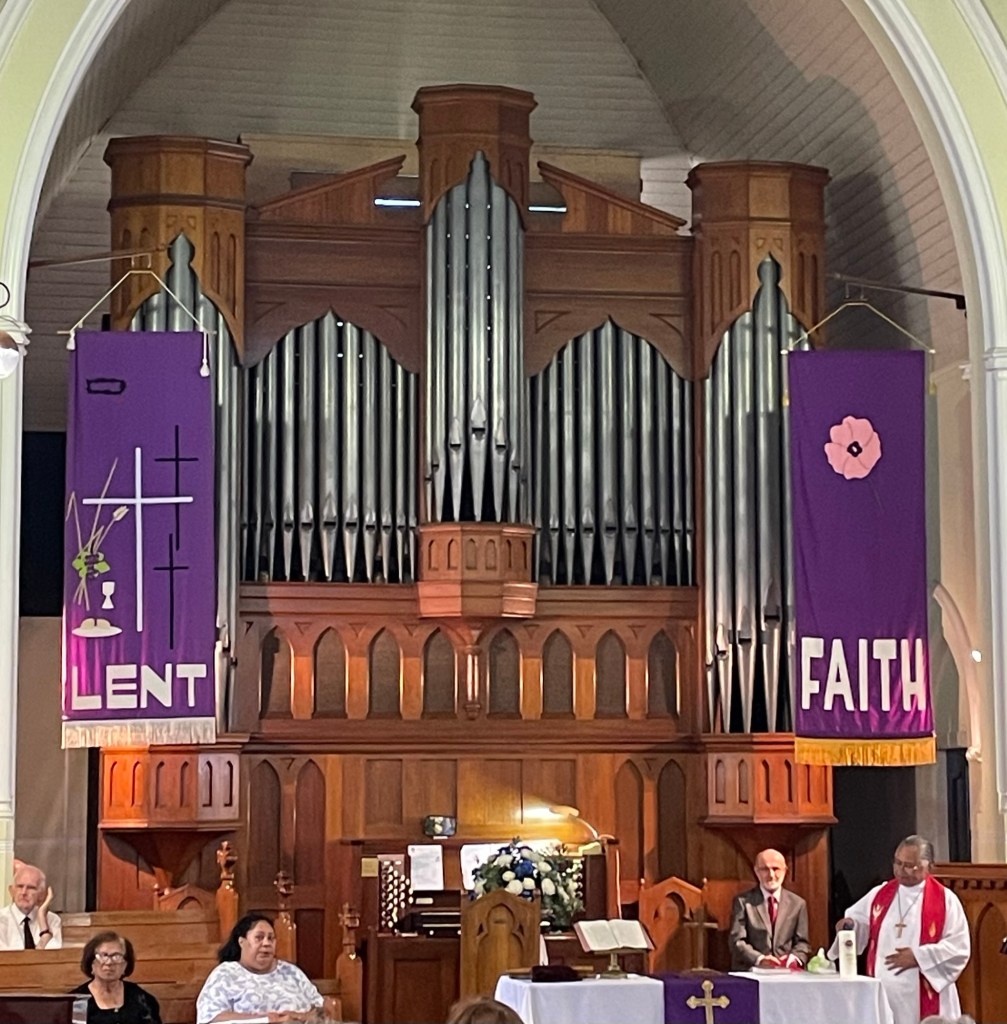
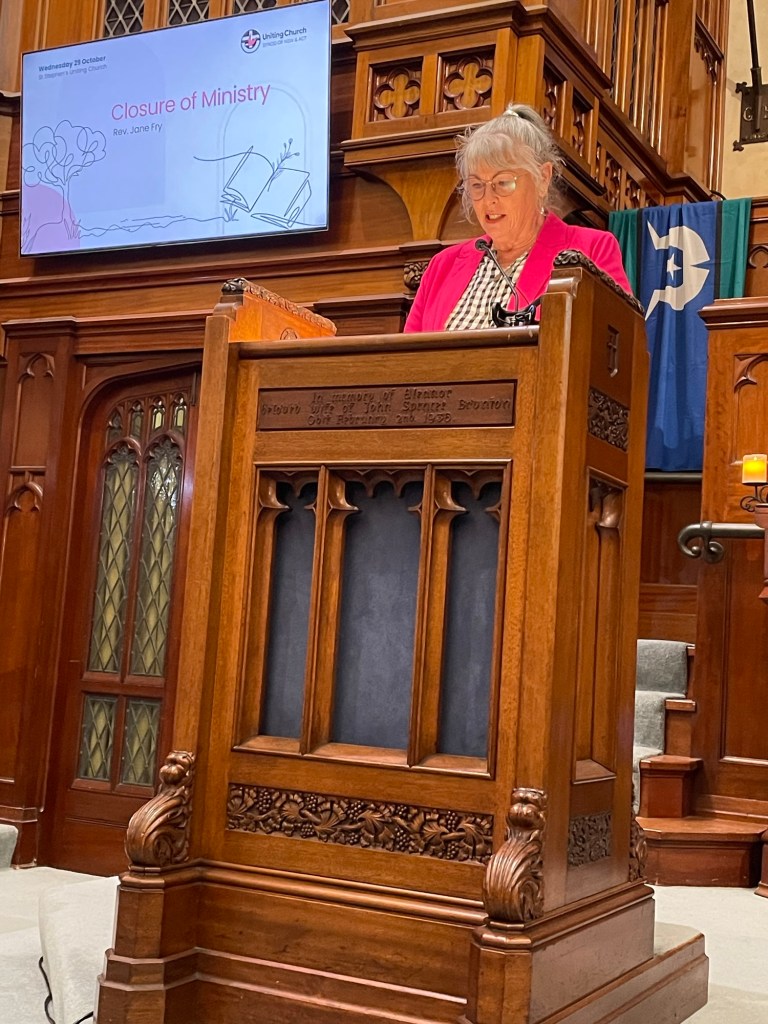
Elizabeth and I have just attended the Closure of Ministry service at which the Rev. Jane Fry concluded her years of service as the Secretary of the Synod of NSW.ACT—or, as Elizabeth referred to it, the Synod of the ACT and NSW (ever loyal to our time in the Canberra Region Presbytery!)

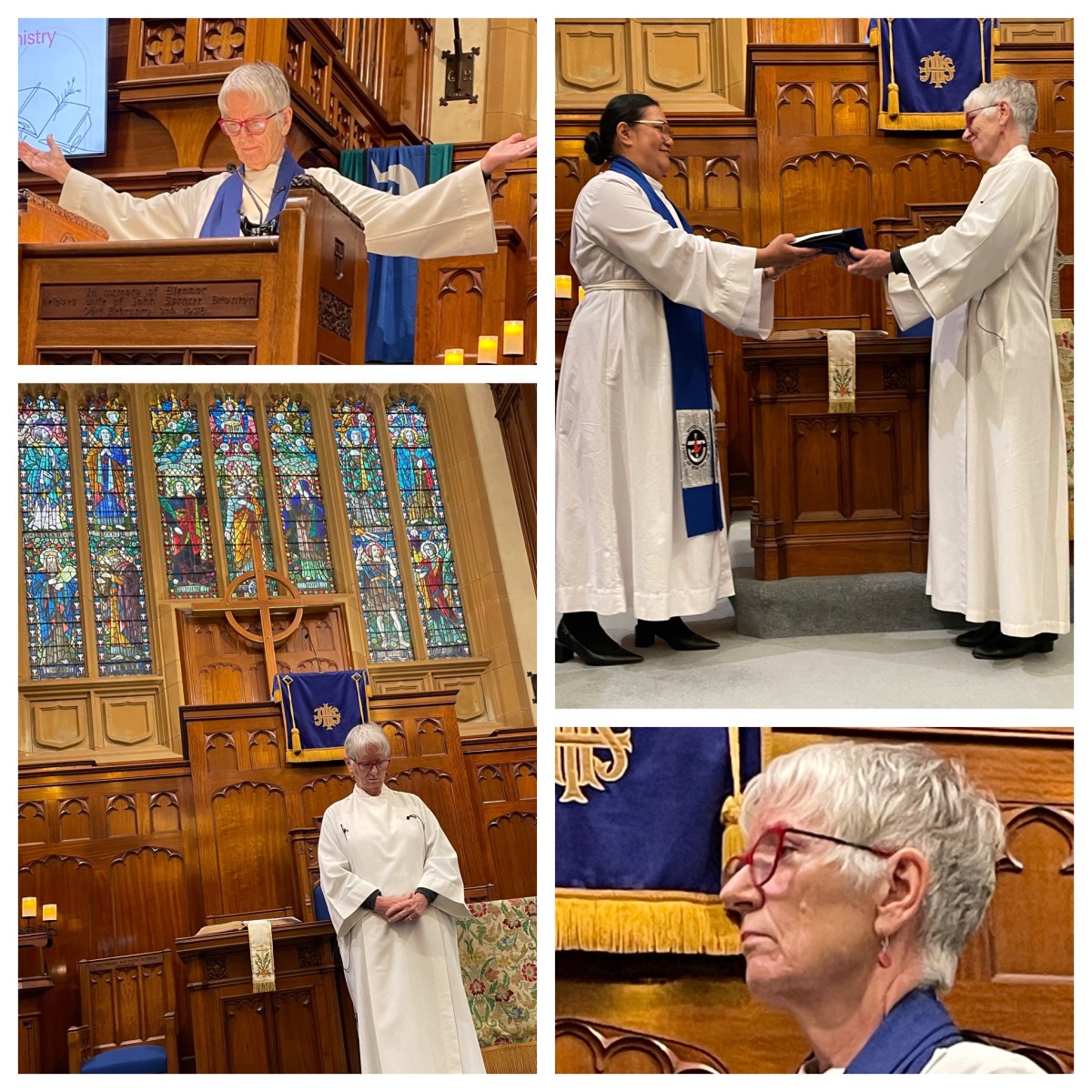
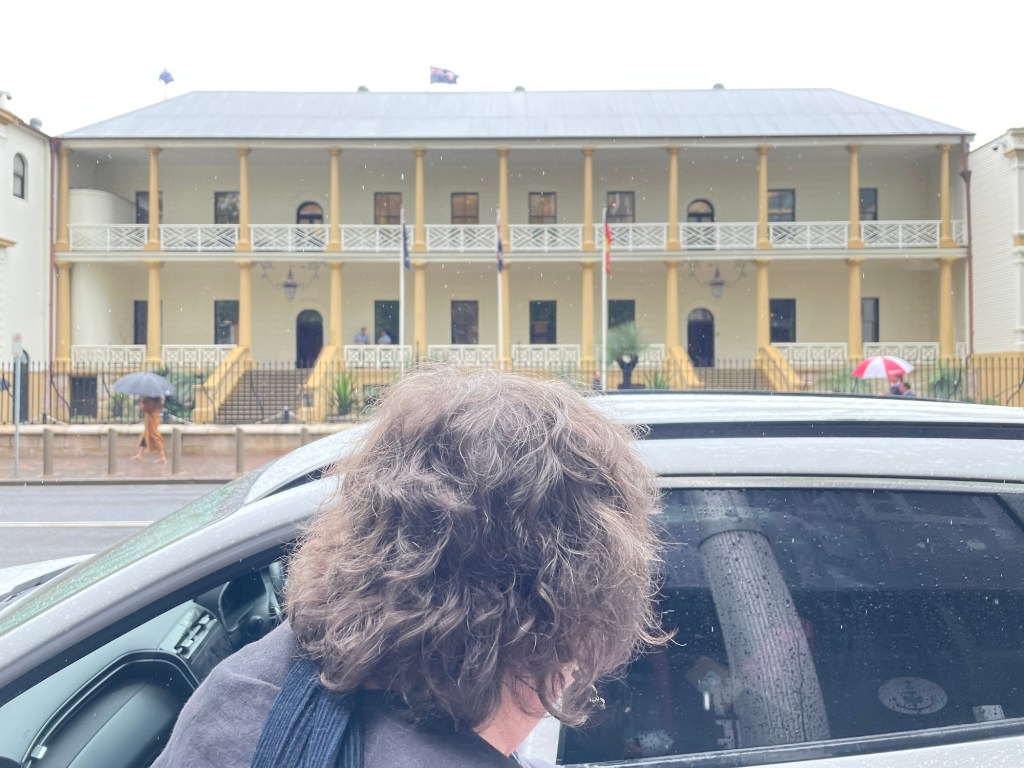
It was held in the impressive surroundings, dripping with signs and symbols of Christendom, in St Stephen’s Uniting Church in Macquarie Street, Sydney, directly opposite the NSW Houses of Parliament. The team from St Stephens, under the wise and gentle leadership of Ken Day, did a fine job in hosting the crowd of people who came for this important occasion.

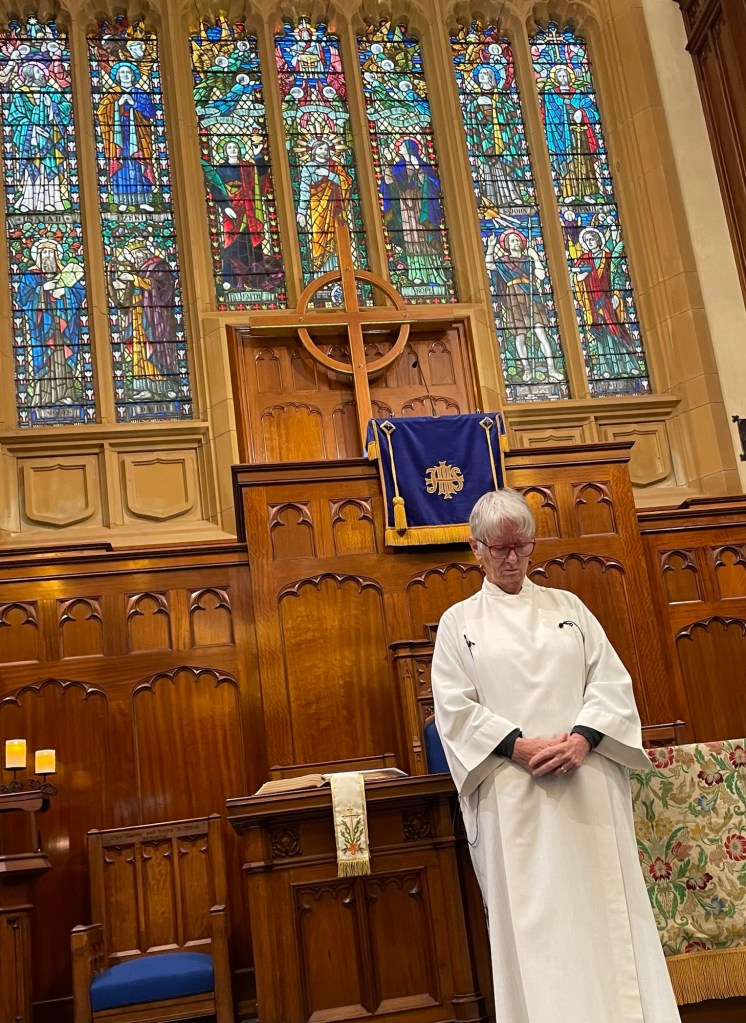
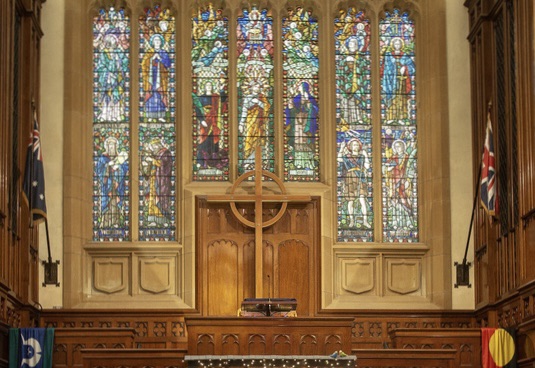
Banks of wooden pews filled the large floor area of the church, with wooden panelling running around the walls. At the front, above the high central (typically Presbyterian) pulpit, stained glass windows reached up to the high vaulted ceiling—including various Hebrew prophets and early Christian saints (including, of course, St Stephen himself). Two flags from the glory days of Church and Empire hung high at the front—the Australian Blue Ensign on the left, the British Union Jack on the right—and the respective flags of Aboriginal and Torres Strait Islanders were draped over the railings running out from the high pulpit. Rich symbolism abounded.

Our venturing all the way into the Sydney CBD for this event (170km, but who’s counting?) meant, on the one hand, that we had to endure the thick, turgid, stress-evoking traffic snarls of Sydney; nothing can be a stronger signal to Elizabeth and myself that we have made the right decision to retire in rural Dungog! Yet this visit also offered the welcome opportunity to celebrate and express gratitude for the gifts Jane has brought to this crucial leadership role, and to meet up with many people with faces and names familiar from past years (or decades)! It was good to reconnect in person with many who for some time now have been “Facebook friends”. The bonds of years past hold strong.

There were multiple conversations in the church’s Ferguson Hall in the time after worship, as we ate, drank, and caught up, under the watchful eye of the Rev. John Ferguson, after whom the hall is named. Ferguson was minister of St Stephen’s from 1894 to 1925, including a term as Moderator-General of the Presbyterian Church in Australia commencing in 1909. 

Alan Dougan writes in the Australian Dictionary of Biography that “his inaugural address, published as The Economic Value of the Gospel, raised a storm in Melbourne and praise from trade union leaders. Billy Hughes said ‘The new moderator preaches a gospel all sufficient, all powerful. He grapples with the problems of poverty … he insists on justice being done, though the heavens fall. I advise every citizen to read every word of it’.”

Ferguson was a most enlightened minister, it would seem; apparently he sought an audience with the Pope on a visit to Rome in 1914, “an action that evoked much hostile criticism in Sydney”, says Dougan. The tribalism in Sydney’s ecclesial life, clearly evident in this reaction, is sadly still alive and well in this city, where sectarian fundamentalism (“We Know The Truth, and Only We Have It!”) has an iron grip in some churches. Not in the Uniting Church, however!

Jane Fry calling the people to worship

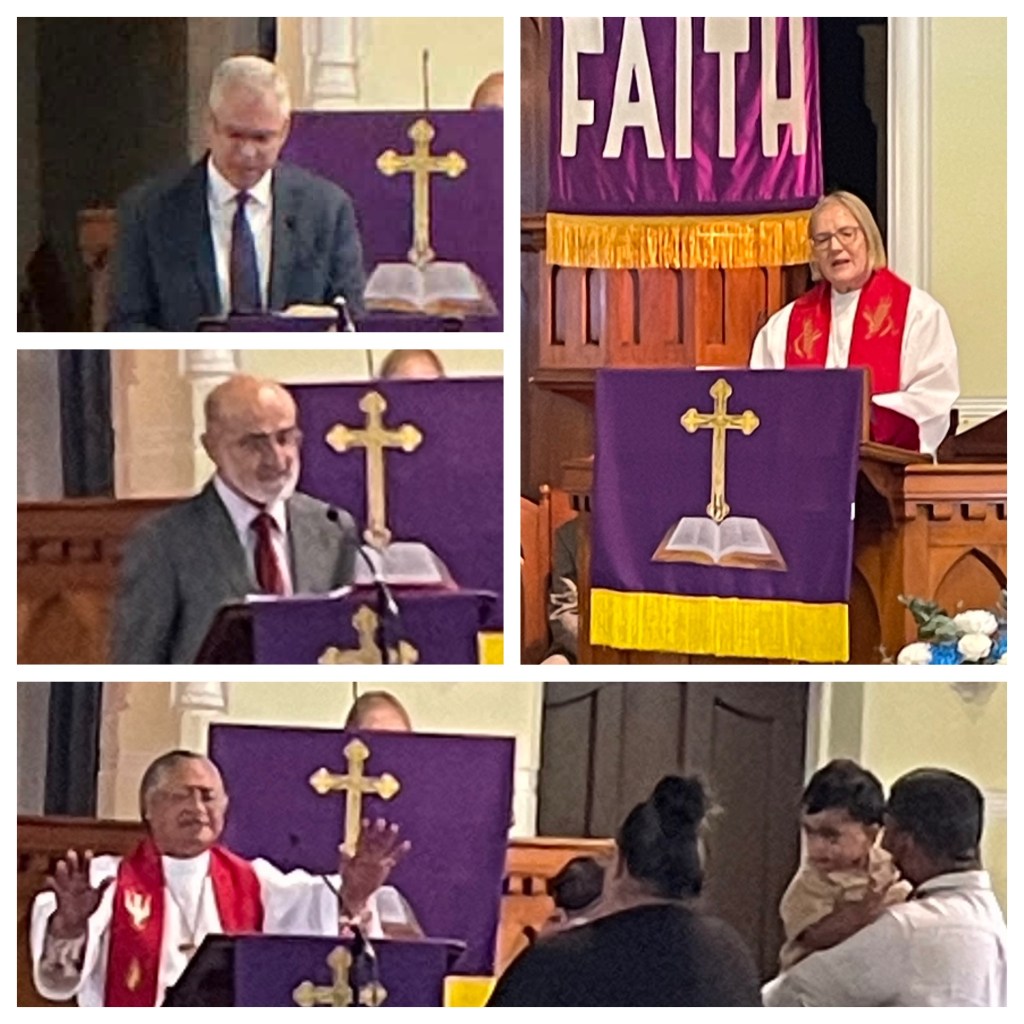
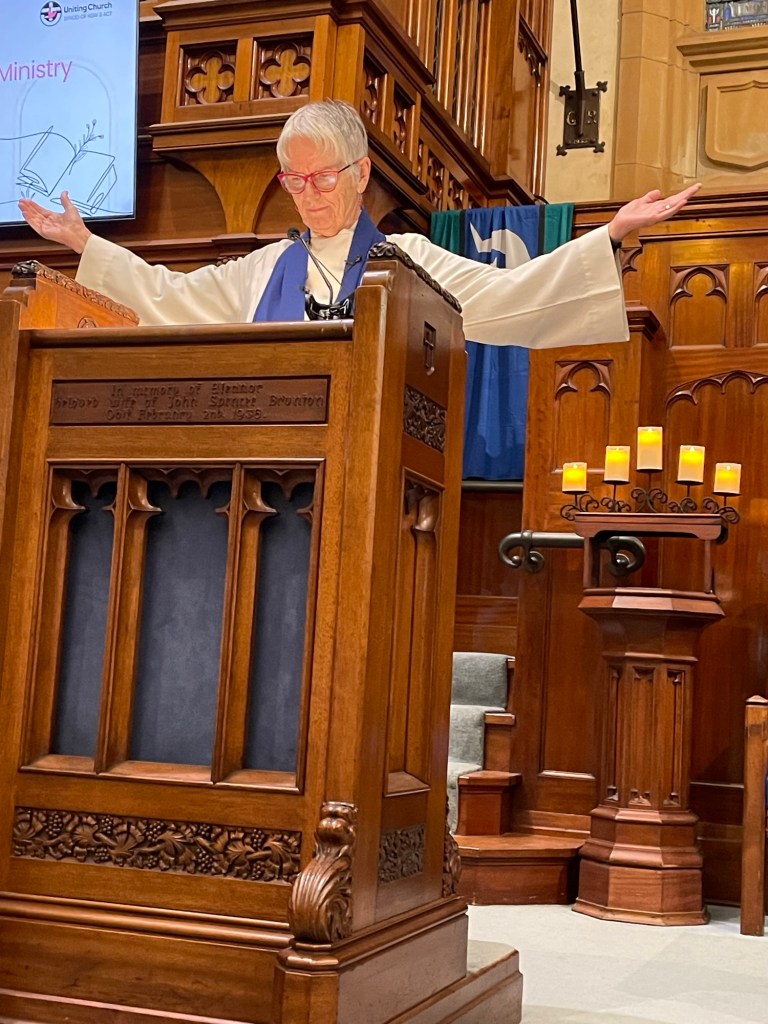
The church on this occasion held a full congregation when the service itself began, with Jane in characteristic pose, arms outstretched, as she called the people to worship: “Look! Listen!”, with a string of appropriate scripture sentence after each iteration. Nathan Tyson then acknowledged Country, giving thanks for the First Peoples who have cared for the land for millennia, and offering a gracious and warm welcome to the many Second Peoples (of multiple cultural heritages) who had gathered for the occasion.

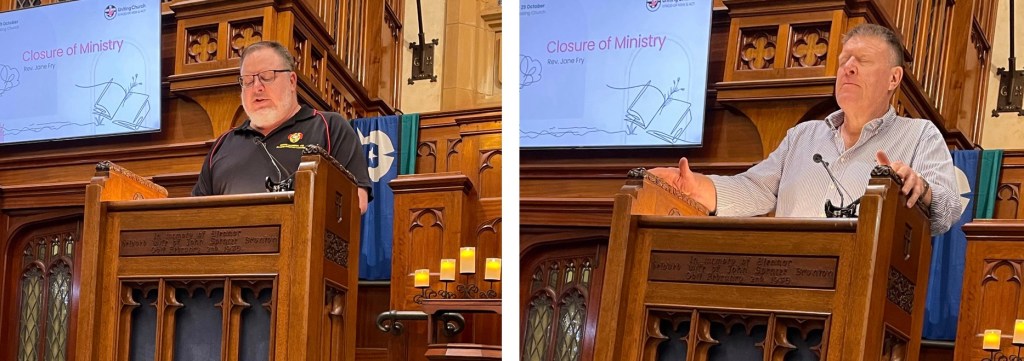
Nathan Tyson (left), Simon Hansford (right)

Past Moderator Simon Hansford brought words of confession (“we speak words of cynicism and anger; for this we are sorry …”) before offering an Assurance of God’s pardon, to which we replied, “thanks be to God”. Jane and Simon had worked together as a fine set of leaders of the Synod team for six years, through the difficulties and challenges of the COVID pandemic. It was good to have his clarity of thought in these prayers of confession.

We sang a number of good hymns, including a favourite one written by Charles Wesley “a long time ago”, as wry Jane’s annotation in the order of service observed. How many people were like me: enjoying the melody and harmony of “And can it be” whilst inwardly recoiling at the blood, wrath, and divine vengeance permeating the hymn, before divine grace eventually shone through? 

Yes, these words show that it was indeed “a long time ago” that such theology reigned supreme; fortunately within the Uniting Church we can see that “the Lord has yet more light and truth to break forth from his word” (in the words of John Robinson, spoken to the Pilgrims in 1620 as they departed on their journey to “the new world” in 1620, and then include in a hymn written by British Congregationalist George Rawson in  the 1850s).

So it is that, as a church, we do indeed rejoice in the affirmation that we “remain open to constant reform under [God’s] Word” and that as “a pilgrim people, always on the way towards a promised goal” we are able to delve into our scripture, traditions, and heritage, “give thanks for the knowledge of God’s ways with humanity which are open to an informed faith”, “sharpen its understanding of the will and purpose of God by contact with contemporary thought”, and stand “ready when occasion demands to confess the Lord in fresh words and deeds”. (Excerpts from the UCA Basis of Union)

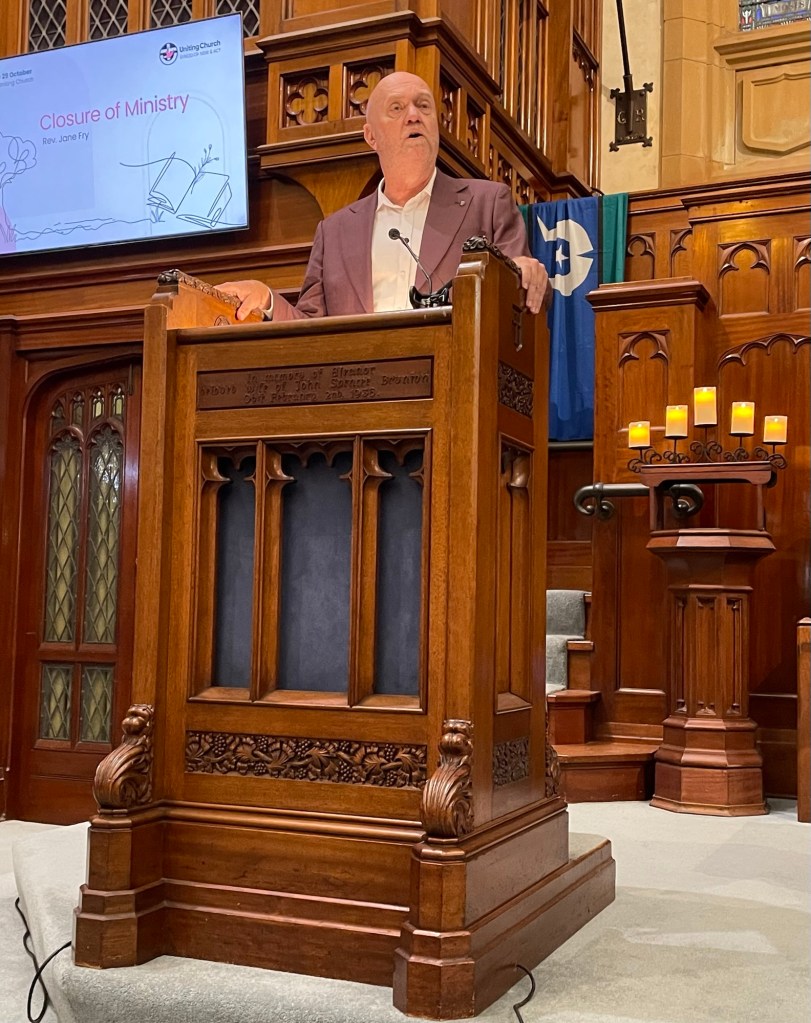
Neale Roberts of Uniting brought two readings from scripture, delivered with eloquence, nuance, and expression. From the scriptures we share with Jewish people he read a passage celebrating Wisdom: “When he marked out the foundations of the earth, I was there, beside him … now, then, listen to me” (Proverbs 8).

Neale Roberts

And then he read words attributed to Jesus: “do not worry about your life … look at the birds of the air … consider the lilies of the field … do not worry about tomorrow, for tomorrow will bring worries of its own; today’s trouble is enough for today”. As Neale observed to me afterwards, “I am sure Jane picked that passage for its final words, as a word to the church today”. They do indeed encapsulate the deep faith and strong hope that Jane has always exuded.

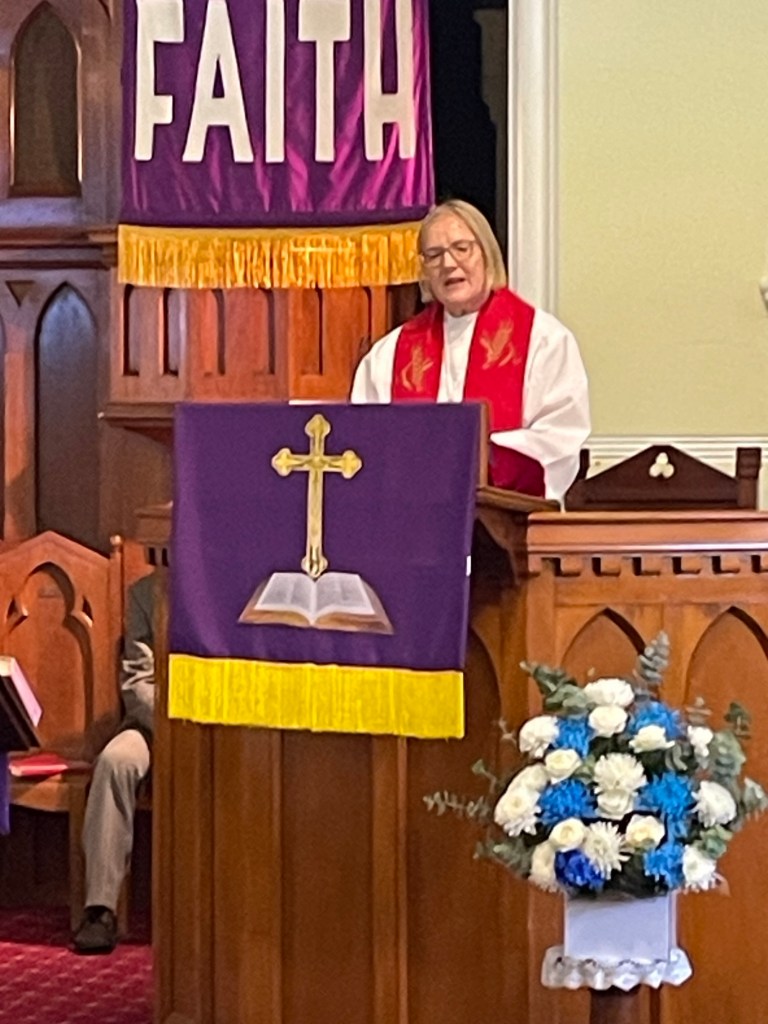
Elizabeth Raine, friend and colleague of Jane since they first met as theological students at UTC in the early 1990s, preached the sermon. Indeed, as a personal aside, I was struck the fact that all who offered leadership in this service, apart from Nathan Tyson, had studied theology and undergone formation for ministry at UTC during the 1990s; perhaps a fine testament to the grounding they had received then—more certainly, a clear indicator of the qualities and giftedness that each person has brought to ministry over the ensuing decades. The church has benefitted much from the calling to which each of them has responded.

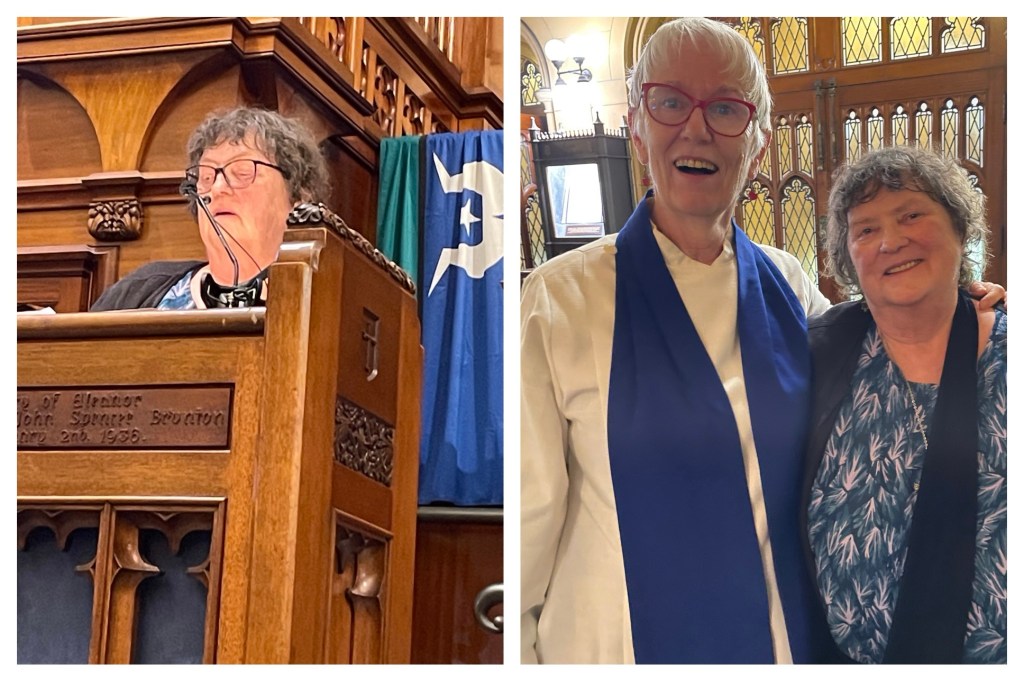
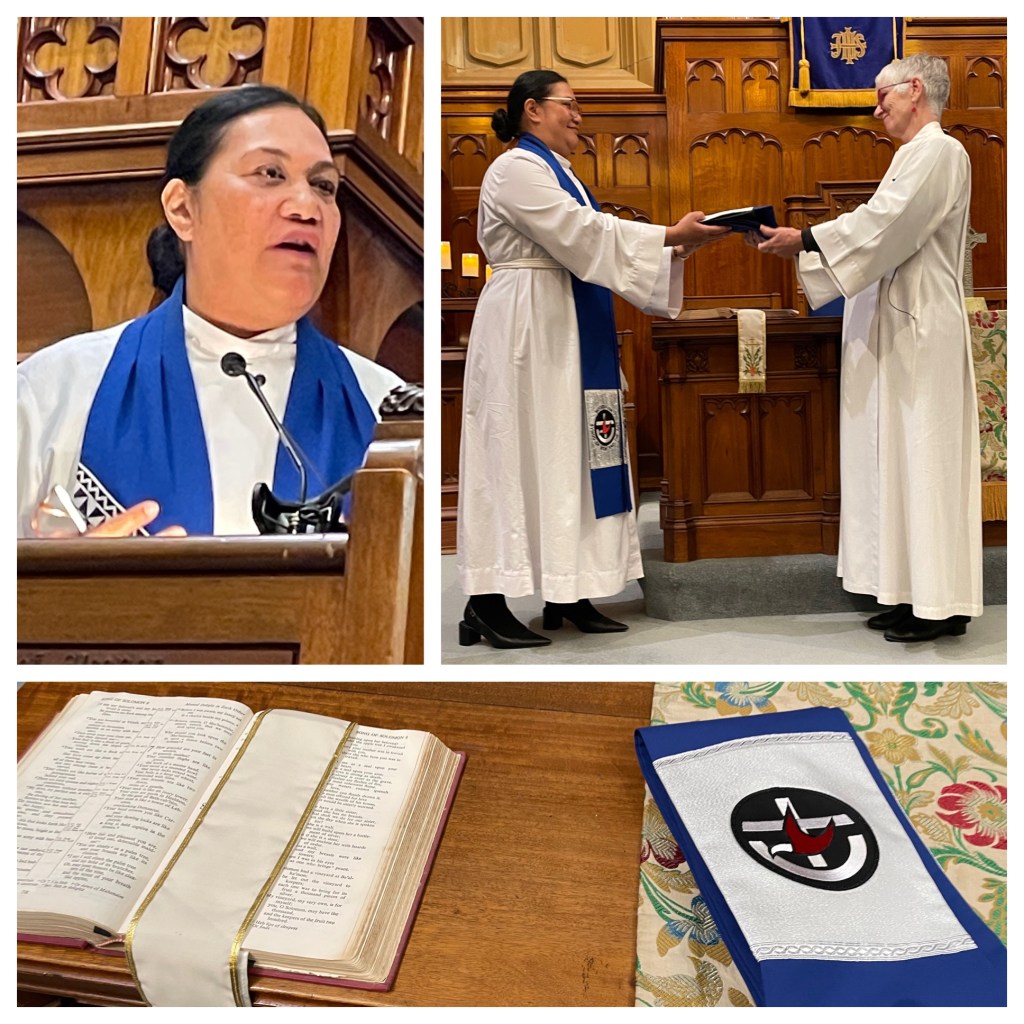
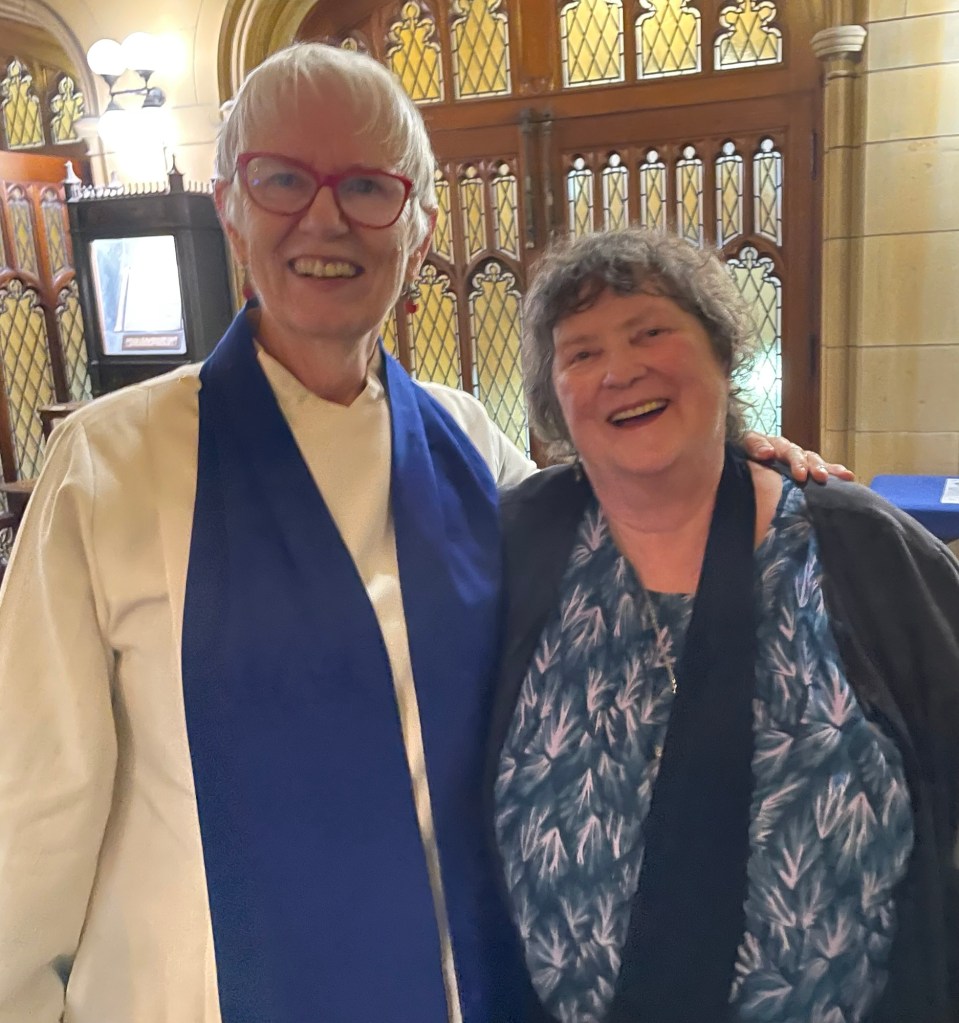
Elizabeth preaching (left); Elizabeth and Jane (right)

Elizabeth spoke about the figure of Wisdom who had been the focus of the Proverbs reading. She warned the congregation, “I told Jane I would be feral and unfiltered … and Jane said to me, ‘go for it!’” And so she did. You can read the full sermon via the link at the end of the blog, but here are some choice extracts: “Wisdom calls us on an unexpected journey … she transgresses male boundaries, standing at the street corner, raising her voice in public places … but Wisdom has been grafted on to Jesus by the early church scholars … they were consumed by their categories and systems … we emerged with a transgendered Holy Spirit … a meek, obedient virgin-mother became the model for women … the figure of Wisdom has been overshadowed.”

Elizabeth offered incisive exegetical insights into the riches that the poetic passage in Proverbs contains. concluded that Wisdom speaks to the church today; “she offers us a relational faith, listening to others, working together for the common good … anyone, but anyone, can acquire what she offers … she would undoubtedly value the invitation of Jesus to his disciples to ‘fish on the other side of the boat’, to be open to new possibilities, not to be bound to practices of the past, and to hold to a relational, experimental theology”. “How will we as a church relate to Wisdom?” she concluded.

Lady Wisdom, from the “Women of the Bible” series
by Sara Beth Baca; https://www.sarahbethart.com

It was clear from the many expressions of thanks—mostly, not entirely, from women in the congregation—that Elizabeth’s “unfiltered” feminist exposition of this crucial passage had struck a very positive chord for many who were present. “We need to hear this message, we need to hear your voice” was a regular refrain. Preachers and teachers in the church should take note; there is, within informed Uniting Church people, a deep appetite for substantive biblical preaching with a clear, prophetic, feminist hermeneutic that speaks directly into our situation today!

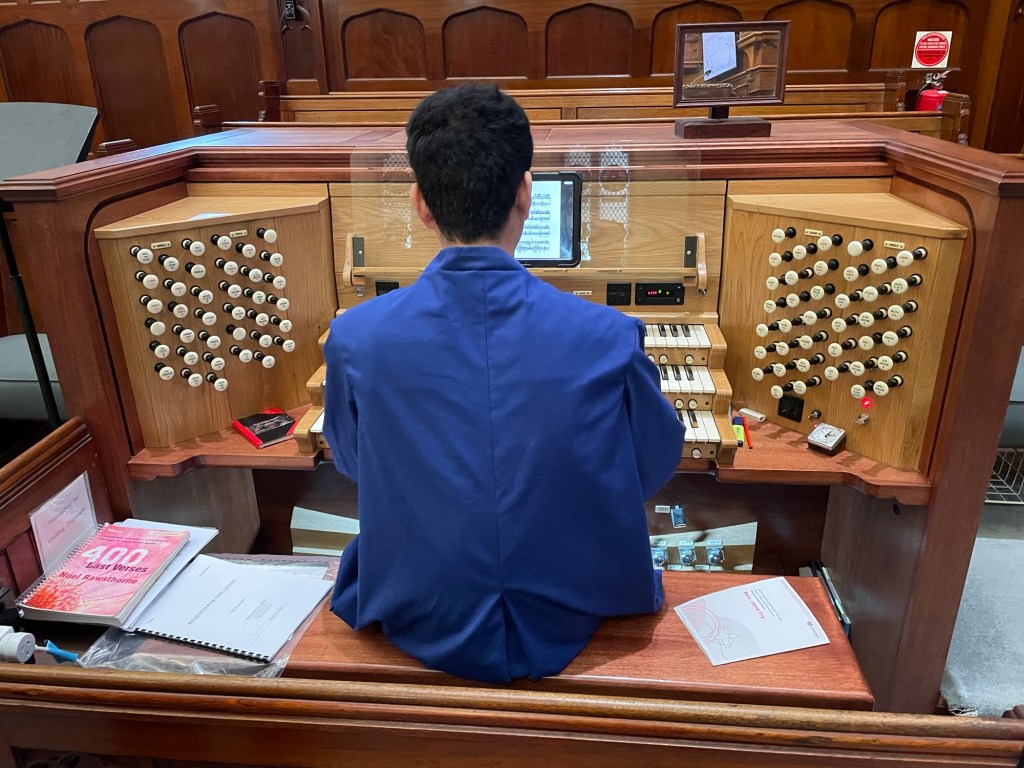
After joining in an Affirmation of Faith, we enjoyed the inspiring playing of the Stephens’ Organ Scholar, Andrei Hadap (pictured in action above), as we meditated on the delightful words of a hymn by Thomas Troeger: “how shall we love this heart-strong God who gives us everything, whose ways to us are strange and odd: what can we give or bring?” Associate Secretary of Synod Bronwyn Murphy then led the prayers of the people to this “heart-strong God”: “so much pain held within one small planet … so hear us, O God, as we pray for your earth … for all people, gathered within your welcome … for the Uniting Church, a body in transition … and for Jane and her family”.

Bron Murphy prays

Jane then spoke in her characteristic direct and challenging style. She referred to the “nine years of drama, change, and engagement across the church”. She is, she confessed (as if we needed reminding!) “a sceptical person, not an early adopter [who] did not expect the recent significant decisions of Synod to have been adopted!” Her reflection at this point was, once again, characteristically Jane; she saw this as an indication that “God is not done with the Uniting Church”.

She reminded all present that “the change [we have] initiated is just housekeeping. Synod is administrative, Presbytery has an oversight role, but the Congregation is where faith is nurtured”. She emphasised that the church is called to “nurture faith, form discipleship, and welcome all: these are the critical elements of being the church.” Her final word exuding the hope she has always held over the years in fulfilling her leadership roles in Congregation, Presbytery, and Synod: “neglecting the disciplines of faith is incredibly dangerous: prayer is the foundation. Letters us remember: ‘God has got this’”.

The Moderator receives from Jane the stole which symbolized
her ministry as Secretary of Synod

The Moderator, Mata Havea Hilau, then led the formal closure of ministry for Jane, offering the thanks of all present in the worship space and those participating via the livestream, and praying for Jane, “May the God who rested on the seventh day to delight in all the creation hold you in her arms as you have held this work, celebrate with us the life that takes life from you, and give you grace to let go into a new freedom”; to which all the people responded: Amen!

In the Ferguson Hall after the service, in the midst of the plethora of conversations filling the space with a cascade of sounds, Peter Walker, the incoming Secretary of Synod and former Principal of UTC (and yet another graduate of UTC from the 1990s!) presided over a brief time of formality. Jane expressed her thanks to many people who had worked alongside her and encouraged her over the past nine years. She was given a gift of a lovely bunch of native flowers.

And then the crowd dispersed, stepping back into the rain, the traffic, the chaos of everyday life … … …

*****

You can read the full text of Elizabeth’s sermon at

Happy is the one who listens to me, watching daily at my gates, waiting beside my doors; for whoever finds me finds life!

A sermon on Wisdom in Proverbs 8

A sermon on Proverbs 8: 22–36, preached by the Rev. Elizabeth Raine in St Stephen’s Uniting Church, Sydney, at a service of Closure of Ministry for the Rev. Jane Fry, outgoing Secretary of the Synod of NSW.ACT, on Wednesday 29 October 2025.

When Jane asked me to preach at this event, I was very surprised. I expected that a former Moderator or Board Chair would be invited to preach at such an important event as the General Secretary of the NSW/ACT Synod retiring. But here I am!

Jane (left), Elizabeth (right)

It is true that Jane and I go back many years, as we went through UTC together, bonded by the attitude of the sexist male colleagues who accused us from everything from ‘sleeping our way to high distinctions’ to being ‘feminists’, like it was some sort of virus. I confess this rather patriarchal attitude has informed this sermon, though it is also true that so many more women now occupy prominent positions in our church, which is a very good thing.

I did warn her that I was unsettling, potentially feral and capable of saying things that were unfiltered in my sermons. Was she sure she wanted to risk such a this? Apparently she did, so here I am.

I was grateful to Jane for her friendship and support then, and I am grateful to her now for her presence as General Secretary over the last 9 years. She has approached this position as she does most things, with integrity, thoughtfulness and a straightforward approach to dealing with what I call ‘faffing around’. Jane has a deep and abiding love for the church and hopes only for its successful transition into the future, and I wish her well for her future in retirement.

Wisdom, from the “Women of the Bible” series by Sarah Beth Baca; https://www.sarahbethart.com/products/p/full-image-women-of-the-bible

The book of Proverbs from which one of the readings we heard is drawn tells us a lot about Wisdom (hochma in Hebrew). She is a central character in chapters 1–9, and she appears as a mystical feminine aspect of God. “Lady Wisdom”, as she is known, is a central character in many chapters of Proverbs, and those who know her are seen asrighteous people. She calls to us and invites us on an unexpected journey. She is offered as a role model for us, her teachings are a template for life, and she a pioneer who opens up a pathway to faith and obedience.

Scholars have debated how the personification of Wisdom should be interpreted, especially as Wisdom is stated to be the first creation of God (“the Lord created me at the beginning of his work, the first of his acts of long ago”, Prov 8:22) and is involved in the creation process itself (“the Lord by wisdom founded the earth”, Prov 3:19). Is wisdom meant to be a specific aspect of God or even a separate being from God? Or should all such language be taken as mere metaphor?

She has been described in many ways—as an aspect of God, as a divine entity existing in her own right, even as something approaching a feminine deity, as Proverbs 8 states: Wisdom was present at the beginning of creation as a co-creator with God, who delighted in her presence.

The divine Wisdom has fascinated ecclesiasts and scholars since the inception of the Christian church. As we have heard, Wisdom has been described in many and various ways but Wisdom’s primary function was understood by the very early Christians to be a mediating force between God and the world, and was particularly associated with the work of creation.

The text from Proverbs 8:22 was important for this belief: here, Wisdom declares, “The Lord created me at the beginning of his work, the first of his acts of old”. Wisdom was believed to be a vehicle of God’s self-revelation, granting knowledge of God to those who pursue her through scripture and learning. 


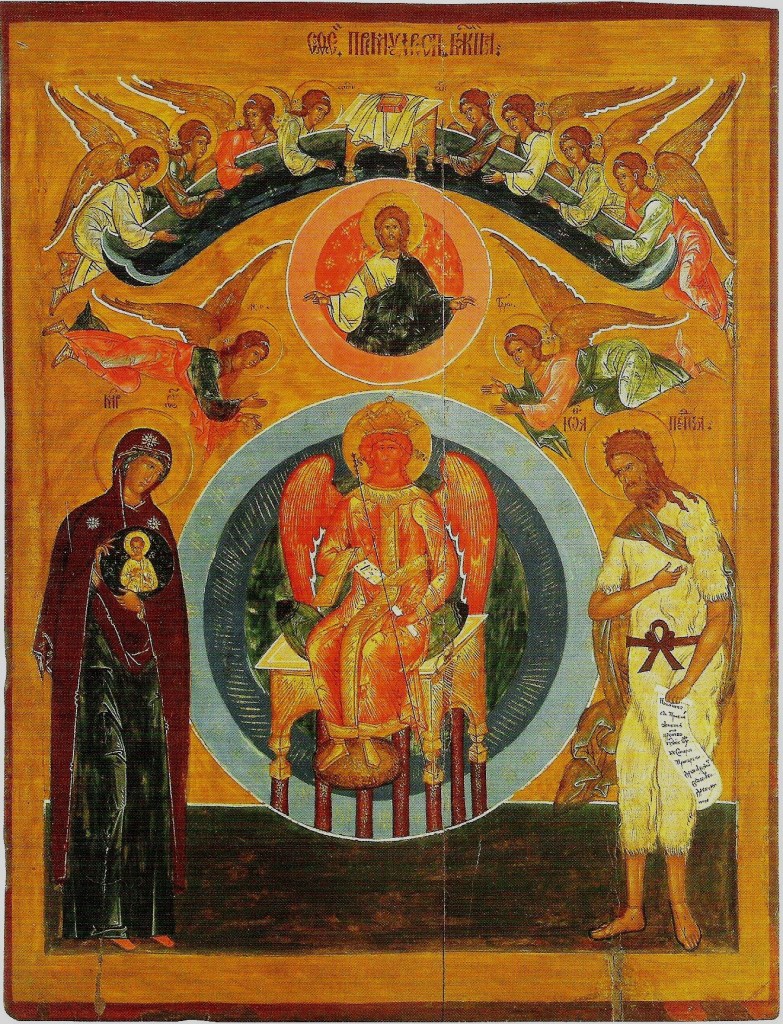
Wisdom (Sophia) on her throne supported by seven pillars
A 16th century Icon of Divine Wisdom
in the St George Church in Vologda, Russia

Despite this, the Christian tradition, for most of its life, cannot be said to be famous for finding the feminine aspect of the divine. Relentlessly masculine, the early Christian church systematically excised any sense of the feminine from the orthodox view of God, spirit and Jesus.

The ruach (Holy Spirit) became masculine through the language of Latin; the bat qol (the voice of God) of the rabbinic literature found a different, masculine grammatical construct in Greek, and hochma or sophia (wisdom) morphed into the figure of Jesus, as the New Testament writings firmly associated the attributes of Wisdom with the person of Jesus Christ. 

This last is most clearly seen in the letter to the Colossians. This document was originally attributed to the apostle Paul, but is now thought to have been written by a follower of Paul, soon after the apostle’s death in the early 60s. Some early verses in Colossians make it clear that Wisdom had been grafted onto Jesus:

“He is the image of the invisible God, the firstborn of all creation; for in him all things in heaven and on earth were created, things visible and invisible, whether thrones or dominions or rulers or powers — all things have been created through him and for him.”

The Divine Feminine through whom God created the world was replaced with the Divine Masculine. A good example of this can be found in the writings of Justin Martyr – he claimed that Jesus was Wisdom, Logos and the Glory, thereby removing the feminine Spirit (ruach), Wisdom (hochma), and Glory (shekinah) all in one stroke. 

Wisdom sadly morphed into a male saviour, who by assuming the divine characteristics Wisdom was meant to share with God, found himself inserted as the third person of a doctrine of trinity with a transgendered holy spirit, who crossed masculine, neuter and feminine across biblical languages.

Instead of recognizing Wisdom, this feminine aspect of the divine, early Christian male leaders instead have tried to satisfy women throughout the world by presenting them with role models of martyrs and virgins, thereby setting a standard that the vast majority of females cannot possibly aspire to.

Wisdom fast lost her independence and feisty nature, and the meek, obedient woman, characterized by the mother of Jesus (another virgin), was held up as the model to which all women should strive to be.

However: far from being obedient and submissive, Wisdom occupies what is the domain of men, teachers and prophets. She stands on busy street corners, she is at the town gate; she sets her table at the crossroads where many pass by. Unlike her counterpart in Proverbs 31, there is nothing of the domestic goddess about her. She is radical, counter cultural and subversive. She teaches knowledge and leads her people on their way through history. In a most unfeminine way, unaccompanied by a male chaperone, she raises her voice in public places that are the domain of men and calls to everyone who would hear her. 

Wisdom offers us a radical example of faithfulness yet she remains a disturbing presence. She is a most unladylike figure, venturing outside the house, to stand beside the crossroads, crying out in full voice, surprising and startling and provoking with her words.

She transgresses boundaries by standing amidst the male elders at the city gates and presuming to teach them. She has a clear voice, a colourful personality, a dominant presence, and offers words of hope and the promise of life. She is a vehicle of God’s self-revelation, and grants knowledge of God to those who pursue her through scripture and learning. 

The prominent biblical scholar, Elisabeth Schüssler Fiorenza, has written this about Wisdom:

Divine Wisdom is a cosmic figure delighting in the dance of creation, a “master” crafts wo/man and teacher of justice. She is a leader of Her people and accompanies them on their way through history. Very unladylike, she raises her voice in public places and calls everyone who would hear her. She transgresses boundaries, celebrates life, and nourishes those who will become her friends. Her cosmic house is without wallsand her table is set for all.

In short, the biblical figure of Wisdom represents a spirituality of roads and journeys, of public places and open borders, of nourishment and celebration, of justice and equality – rather than a spirituality of categories, doctrines, closed systems and ideologies. Her dramatic modus operandi stands in striking contrast to the slow and methodical way of operating that we see in the classic formulations of Christendom, doctrines that have come to define the church in the eyes of those outside of it.

The church fathers, the male patriarchs of the church, and the myriad of male theologians who followed were, in my humble opinion, consumed with their categories; they articulated their doctrines by amassing the data, analysing the information, systematising the component parts and categorising the key dogmas. And they wrote down these dogmas and systems and turned them into the doctrines by which faith was measured.

By contrast to these closed systems of belief and knowledge, the biblical figure of Wisdom asks for a relational faith, and invites us to develop a wide openness in the way we approach others and God. She requires of us that we really listen to others, including those we don’t agree with … she calls us to listen, to understand, to speak in ways that connect with others and ways that build productive and fruitful relationships across the differences that separate us.

Wisdom calls us to work together, for the common good, with others in our society. She is not a figure bound to buildings, books and writing; she is an outdoor, community spirit, seeking relationships with people, engaging wholeheartedly in the public discourse, debating back and forth in the public arena the key elements of a faith-filled life.

What Wisdom presents is a radical democratic concept, in that anyone, whether illiterate or educated, whether without or with status, whether poor or wealthy, can acquire what she offers. 

She invites us to be life-long learners of the faithful and missional type, and calls us to be constantly open to challenge and change as we read, study, think, discuss, explore, debate, and decide. 

I think that Wisdom is precisely the kind of person who would have relished the invitation, once offered to his disciples by Jesus, to fish on the other side of the boat. She would value the opportunity to look in a different direction, to reconsider the task at hand and seek a new way of undertaking it. Rather then remonstrating with Jesus saying ’but we have always done it this way’, she would jump at the chance to set out in a new arena, to pioneer a new task, to reshape her missional engagement so that it was fresh, invigorating, and creative, open to new possibilities and exciting pathways. What a role model that is, for the church today!

Lady Wisdom, by Canadian artist Kiernan Antares (2013)
https://womenspiritualpoetry.blogspot.com/2013/12/lady-wisdom-by-kiernan-antares.html

So, the question that I invite you to ponder at this moment is: How will we interact with Wisdom? Are we open to the exploration and discoveries that the biblical figure of Wisdom invites us to pursue? 

Are we content with just repeating our tried and true traditions from the past? Are we happy staying in our familiar comfort zones? Will our mission be simply no more than wishing people to walk through ourdoors, as we remain in our comfortable, self-contained spaces?

Or will we choose the way of the rather unladylike and subversive Wisdom, the radical at the street corner, crying out to all who pass by? Can we adopt Wisdom’s model invitation of radical hospitality as relevant to the church today? Should we be more concerned with ‘raising our voices’ in the public arena than confining ourselves to church buildings?

Hopefully as a church we will choose to follow the path of Wisdom into the future, which through its relational, radical and inclusive theology offers us the potential to transform contemporary situations of injustice, brokenness and violence in the communities we serve. By taking our stance in the marketplace, we can demonstrate the ways that show our deep and profound relationship with and love for God, and how that love is extended to all people. Hopefully all of us, not just a few, can follow Wisdom out of our enclosed gatherings to the space where such social and spiritual change can take place.

I trust that as a church, we will continue to encounter Wisdom, hochma, and learn from her, again and again in the coming years.

*****

You can read a report of the whole service of Closure of Ministry at

In the sound of sheer silence (1 Kings 19; Narrative Lectionary for Pentecost 21)

On the passage about Elijah in 1 Ki 19 proposed by the Narrative Lectionary

In the passage which the Narrative Lectionary places before us this coming Sunday (from 1 Kings 19), we come to Elijah; one of the key prophetic figures whose deeds are recounted in the books of the Kings or whose words are collected within the Hebrew Scriptures under the catch-all second section of Nevi’im (Prophets).

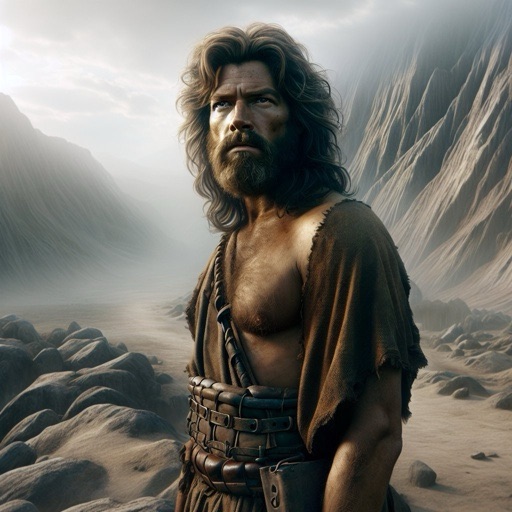
Elijah, famous for being described as “a hairy man, with a leather belt around his waist” (2 Ki 1:8), was first introduced as Elijah the Tishbite, meaning he came from Tishbe in Gilead (1 Ki 17:1), a place whose precise location has occasioned some debate.  See

This initial portrayal of Elijah is nested within the accounts of that long period of time when Israel was ruled by kings, when prophets functioned as the conscience of the king and the voice of integrity within society. The distinctive dress of Elijah perhaps sets him apart from the court of the kings, where a more “civilized” dress code was presumably operative. Nevertheless, Elijah does have some engagement with the kings who ruled at the time he was active: Ahab, and then Ahaziah. Indeed, his distinctive dress points to his emboldened attitude towards those kings.

Elijah operated during the period when Ahab ruled Israel; he figures in various incidents throughout the remainder of 1 Kings—most famously, in the conflict with the prophets of Baal which came to a showdown on Mount Carmel (1 Ki 18), and then later in his confrontation with Ahab and his wife Jezebel, over the matter of Naboth’s vineyard (1 Ki 21). Like Jesus, Elijah was no shrinking violet!

Elijah first appears in the narrative of the various kings, seemingly out of nowhere, just after King Ahab had taken as his wife Jezebel, daughter of King Ethbaal of the Sidonians, who presumably influenced him to begin his worship of Baal (1 Ki 17:31–33). In the same way, at the end of his time of prophetic activity, Elijah simply disappears from sight soon after Kong Ahaziah died. Elijah hands over his role to his successor, Elisha, and as “a chariot of fire and horses of fire separated the two of them”, Elijah ascends in a whirlwind into heaven (2 Ki 2:1–15).

In the book we know as 1 Kings, the compiler of the Deuteronomic History (which stretches from Deuteronomy through Joshua and Judges to Samuel and then Kings) reports many incidents which attest to the courage and power of Elijah. The boldness of Elijah is evident in the confrontations that he has with various rulers; this is made clear, centuries later, to the followers of Jesus, in the earliest account of his life, when John the baptiser is depicted as a fiery desert preacher, calling for repentance, just as Elijah had called the kings to account (Mark 1:1–8). 

In a later account of Jesus, there is a clear inference connecting John with Elijah when Jesus notes, “Elijah is indeed coming and will restore all things; but I tell you that Elijah has already come, and they did not recognize him, but they did to him whatever they pleased” (Matt 17:11–12).

Then, in his sermon in Nazareth (Luke 4:16–30), Jesus refers to the first reported miracle of Elijah, when he provided a widow in Zarephath with food and oil that “did not fail”, even though the land was in drought (1 Ki 17:1–16). In subsequent incidents in 1 Kings, Elijah raises a dead son (17:17–24), directly confronts King Ahab with his sins (18:1–18), and famously stares down the prophets of Baal in a mountaintop showdown (18:19–40), leading to the breaking of the drought (18:41–46).

Elijah later condemns Ahab over his unjust seizure of the vineyard of Naboth (21:17–29) and then stands before Ahab’s son, King Ahaziah, to condemn him to death (2 Ki 1:2–16); a death “according to the words of of the Lord that Elijah had spoken” which is promptly reported (2 Ki 1:17). 

During the rule of Ahab, Elijah had also most famously heard the Lord God “not in the wind … not in the earthquake … not in the fire”—but rather in something else, which the NRSV renders as “the sound of sheer silence” (1 Ki 19:11–12). This incident is, as noted, the story set before us by the lectionary this coming Sunday. We need to ponder what is being conveyed through the symbols employed in this story. 

The three means by which God is said not to have appeared to Elijah reflect the very same means through which Moses, and the people of Israel, did experience the manifestation of the Lord God in their midst. When the escaping Israelites arrived at the Sea of Reeds, according to one version of this archetypal story, “the Lord God drove the sea back by a strong east wind all night, and turned the sea into dry land; and the waters were divided” (Exod 14:21). 

The people later celebrated the defeat of the Egyptians who were pursuing them: “you blew with your wind, the sea covered them; they sank like lead in the mighty waters” (Exod 15:10). The wind was a sign of God’s presence, and an agent of divine protection—indeed, it was the very same “wind from God” which “swept over the face of the waters” at the beginning of creation (Gen 1:2). But for Elijah, the Lord God was “not in the wind”.

Then, as they had travelled through the wilderness, the people were accompanied by a blazing fire, another sign of divine presence: “the Lord God went in front of them in a pillar of cloud by day, to lead them along the way, and in a pillar of fire by night, to give them light, so that they might travel by day and by night” (Exod 13:21). The fire signalled the divine presence.

Indeed, the very same flaming fire had been manifested to Moses when he was but a mere shepherd in Midian; “the angel of the Lord appeared to him in a flame of fire out of a bush; he looked, and the bush was blazing, yet it was not consumed” (Exod 3:2). What follows is the account of the call of Moses; God tells him “I will send you to Pharaoh to bring my people, the Israelites, out of Egypt” (Exod 3:10). The fire had been the assurance to Moses that it was the Lord God who was present.  But for Elijah, the Lord God was “not in the fire”.

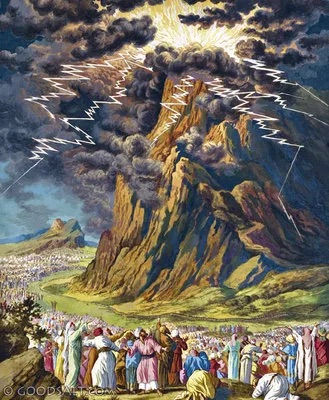
The same element of fire was present when Moses and the people ultimately arrived at Mount Sinai in the wilderness of Sinai (Exod 19:1–2). “Mount Sinai”, so the account goes, “was wrapped in smoke, because the Lord had descended upon it in fire; the smoke went up like the smoke of a kiln, while the whole mountain shook violently” (Exod 19:18). Associated with this there was “thunder and lightning, as well as a thick cloud on the mountain, and a blast of a trumpet so loud that all the people who were in the camp trembled” (Exod 19:16). 

The scene at Sinai surely reflects the experience of an earthquake; the same phenomenon that prophets would later interpret as a sign of divine presence—indeed, divine judgement. “You will be visited by the Lord of hosts”, Isaiah subsequently tells the people of his time, “with thunder and earthquake and great noise, with whirlwind and tempest, and the flame of a devouring fire” (Isa 29:6). 

Still later, Zechariah describes how “the Mount of Olives shall be split in two from east to west by a very wide valley”, and instructs the people, “you shall flee as you fled from the earthquake in the days of King Uzziah of Judah; then the Lord my God will come, and all the holy ones with him” (Zech 14:4–5).

Nahum reflects on the jealous and avenging nature of God, declaring that “his way is in whirlwind and storm, and the clouds are the dust of his feet; he rebukes the sea and makes it dry, and he dries up all the rivers; the mountains quake before him, and the hills melt; the earth heaves before him, the world and all who live in it” (Nah 1:2–5). 

This dramatic motif continues on into later apocalyptic writings (Isa 64:1; 1 Esdras   4:36; 2 Esdras 16:12). The prophets and their apocalyptic heirs  knew clearly that this whole dramatic constellation of events revolving around an earthquake was a sign of divine presence.  But for Elijah, the Lord God was “not in the earthquake”. He was heard in something quite different.

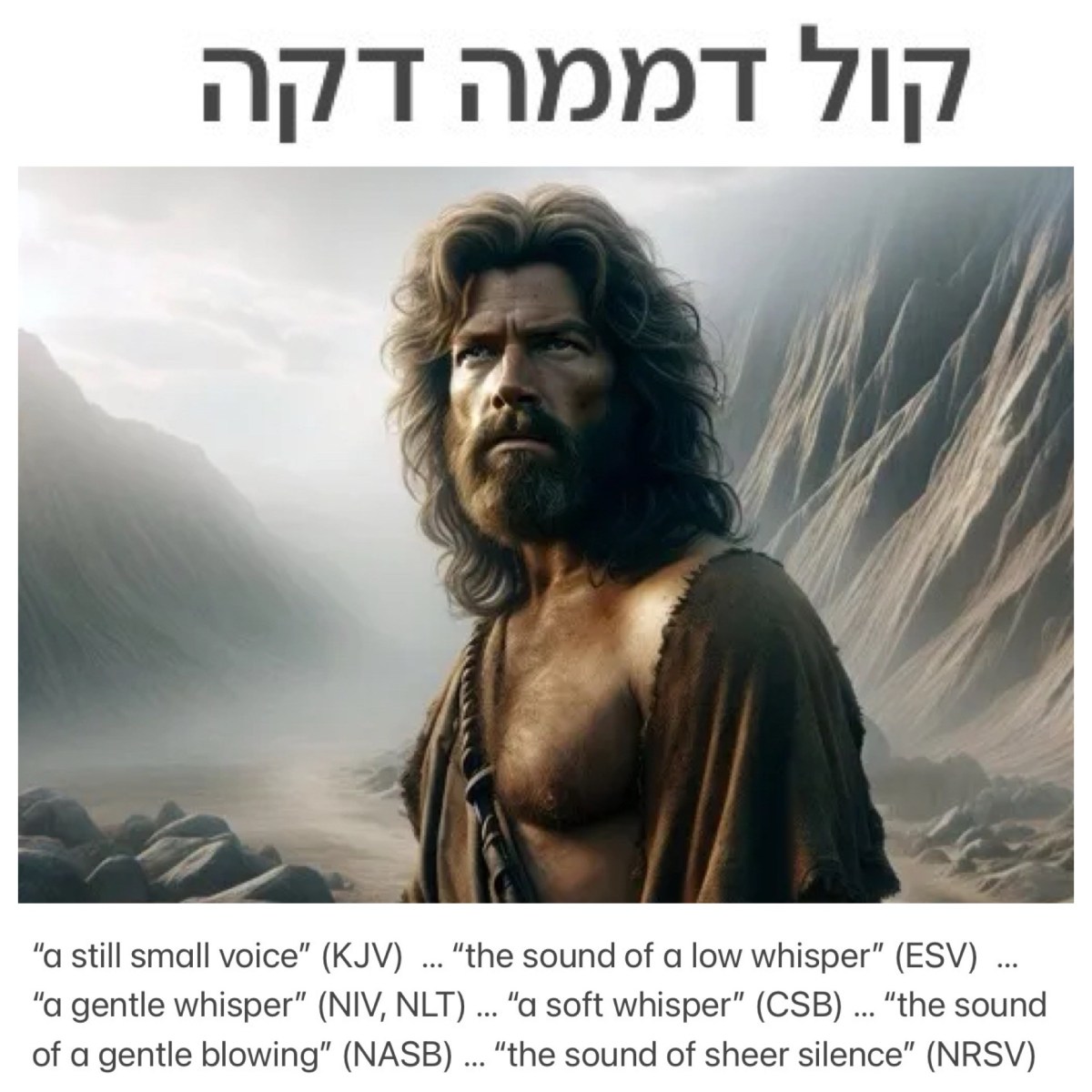
What did Elijah hear? The Hebrew phrase in verse 12 is qol d’mamah daqqah. The King James Version translated this as “still small voice”.  More recent translations have provided variants on how these words might be translated. Alternatives that are found include “the sound of a low whisper” (ESV), “a gentle whisper” (NIV, NLT), “a soft whisper” (CSB), or “the sound of a gentle blowing” (NASB). These reflect variations on the kind of nuance that the KJV was offering. 

Screenshot

However, the NRSV option of translating this phrase as “the sound of sheer silence” is more confronting: the presence of God is sensed in the absence of sound; any communication from the deity comes, not in audible sounds, but in the utter absence of any sound. It is a striking paradox!

And in the context of the developing story of 1 Kings, the paradox is strong. Earlier, the prophet had stood firm against the might of Baal, the foreign god whom Ahab and Jezebel had prioritized in the life of Israel (1 Ki 18:17–40). When “the four hundred and fifty prophets of Baal and the four hundred prophets of Asherah who eat at Jezebel’s table” gathered on Mount Carmel, they failed to obtain any response from their god, the god of storms. No matter how intensely the pleaded, all they heard was “no voice, no answer, no response” (18:29).

Elijah, by contrast, prays to the Lord God and the fire of his god fell on the sacrificial altar; it consumed “the burnt offering, the wood, the stones, and the dust, and even licked up the water that was in the trench” (18:38). The victory was absolute and complete; the storm god had been defeated. And yet, the deity who accomplished this would communicate most personally and intimately with his chosen prophet, “not in the wind … not in the earthquake … not in the fire”, but rather in “a sound of sheer silence” (19:11–12). What a deliciously powerful irony!

Elijah was his own, distinctive man, with his own, distinctive encounter with God. He experienced God in a way quite different from what was experienced by Moses and the people of Israel. He experienced God in a way that stood apart from his contemporaries who were priests and prophets of Baal. For that reason, whilst the Lord God of Elijah stands over and against the Baal of Ahab and Jezebel, so too Elijah stands alongside and apart from Moses as a different, but equally great, leader of the people.

I have built you an exalted house, a place for you to dwell in forever (1 Kings 5, 8; Narrative Lectionary for Pentecost 20)

Discussion of the passages from 1 Kings 5, 8 offered by the Narrative Lectionary

Some weeks ago, the Narrative Lectionary offered the story of God calling Moses to lead his people out of slavery, into freedom (Exod 3–4), followed by another story about the way that Moses exercised this leadership during a testing time (Exod 16). Two weeks ago, we heard the story of God calling Samuel to be prophet (1 Sam 3)—the first of many who would be called to that role. Then last week, we moved on to hear the story of God calling David to be king. So we have had stories about a range of leaders in ancient Israel: the Liberator, the first Prophet, and the most beloved King. 

This coming Sunday we jump to another element that is foundational in the religion of ancient Israelite society. For many years—ever since the “wandering in the wilderness”—the people had a focal point for worshipping their God. The Tabernacle, created during the “wilderness story”, was a mobile sanctuary, travelling with the people (Exod 25:1–9). This sanctuary was faithfully served by the Levites, a group set apart for this priestly role (Num 1:48–54).

However, the central figure in this coming Sunday’s story is not a Priest, but rather a King—Solomon, one of the many offspring of David, and the one who, by all manner of machinations, succeeded his father on the throne. The lectionary deftly steps over all those stories, told with gruesome detail in the early chapters of 1 Kings.

Solomon was not first in line to ascend the throne; that would lie with the eldest of his brothers still living, Adonijah. Adonijah knows this; the first book of Kings opens with the revelation that, since “David was old and advanced in years … Adonijah son of Haggith exalted himself, saying, ‘I will be king’; he prepared for himself chariots and horsemen, and fifty men to run before him” (1 Ki 1:1,5).

However, Solomon plots with his mother Bathsheba and the palace prophet Nathan to arrange for the assassination of his older brother. In addition, a number of other people also had to be eliminated to establish Solomon’s firm grip on the monarchy, and to ensure there were no other possible legitimate claimants to the throne remaining. Such was the raw and vicious nature of “life at the top” those days. (Has anything much changed?)

In fairly quick succession, after Solomon had arranged for the death of his eldest brother Adonijah (2:13–25), he banished the high priest Abiathar who had supported Adonijah (2:26–27) and replaced him with another priest loyal to himself. Next he removed Joab, a cousin who was the commander in the former king’s army (2:28–34). He achieved this via a hit man, Benaniah, who became the general of his army (2:35). 

Then, Solomon had Shimei, who was a relative of Saul, the king before David, killed (2:36–46). In this way all potential contenders for the throne and their powerful supporters were removed, mostly by violent means. As the narrator curtly comments, “so the kingdom was established in the hand of Solomon” (2:46b).

Fortunately for preachers following this lectionary, there is no expectation that there will be any need to read, reflect on, and speak about these chapters during worship. They certainly reveal the depths of degraded humanity! Rather, in the manner that characterises the Narrative Lectionary, we move from high point to high point—and so, this coming Sunday (in 1 Ki 5:1–5), we hear about the beginning steps taken by Solomon in the preparations for erecting the building which would not only sit on the highest point in Jerusalem, but would stand as a symbolic representation of the highest elements—what was best, most valued, most important—in ancient Israelite society.

Solomon, King of Israel, consults with Hiram, King of Tyre (who has a large navy and workforce) regarding the materials and labour needed to undertake this major building project (1 Sam 5); as the narrator indicates, “Solomon’s builders and Hiram’s builders and the Gebalites did the stonecutting and prepared the timber and the stone to build the house” (1 Ki 5:18). And then, after seven years of intense work, the temple is complete (7:1). Here, the lectionary (wisely) skips over the tedious detail of the items made by the artisans and craftsmen of Solomon (6:1–38).

The second part of the reading offered by the lectionary for this coming Sunday tells of how, after thirteen years, King Solomon assembled “the elders of Israel and all the heads of the tribes, the leaders of the ancestral houses of the Israelites” (8:1). Again, the lectionary skips over the detailed account of the work of Solomon’s men in building his own house: the House of the Forest of Lebanon, the Hall of Pillars, the Hall of the Throne, and the house where he would live (7:1–12).

In like manner, the lectionary jumps over the detailed account of the work of Hiram the bronze worker: pillars, stands, basins, pots, and a whole host of items to be used in the sanctuary (7:13–50). Thank goodness the lectionary compilers jumped over all of those verses!

At any rate, when Solomon assembles the leaders of the nation, in the presence of “all the people of Israel” who had assembled, the priests and Levites bring forward the Ark of the Covenant, the Tent of Meeting which had housed the Ark for decades, and “all the holy vessels that were in the tent (8:1–4). It was surely an impressive majestic procession, followed by a scene of overflowing abundance, as the priests received and sacrificed “so many sheep and oxen that they could not be counted or numbered” (8:5). 

There’s no mention of the rivers of blood that must surely have flowed as these sacrifices took place. It may seem like a most unpleasant and unedifying scene to modern eyes and ears; however, the sacrificing of blood was an expression of the central Israelite belief that “the life of the flesh is in the blood … as life, it is the blood that makes atonement” (Lev 17:11). Each sacrifice of a chosen animal was a sacred offering of life that symbolised the obedience and dedication of the person, or people, who had brought the animal to be sacrificed. They were dedicating their whole life to the Lord God through this action, and in return, they were receiving atonement (the forgiveness of their sins) for all the misdeeds they had performed.

Finally, after the procession and sacrifices, the Ark was brought to “the most holy place” (8:6). The presence of the Ark evoked Solomon’s father, David, and his taking of the city from the Jebusites. Solomon was making clear that he was seen to be standing in that fine tradition.

The Ark was placed in the space known as “the Holy of Holies”, as a much later Jewish-Christian writer describes it (Heb 9:3). It was from that time to be set apart as holy for only the High Priest to enter, and at that but once a year (Heb 9:7).

The scene is presented as one of profound religious significance, for “when the priests came out of the holy place, a cloud filled the house of the Lord, so that the priests could not stand to minister because of the cloud; for the glory of the Lord filled the house of the Lord” (1 Ki 8:10–11). The Temple from that time became the fixed dwelling place of God; “O Lord, I love the house in which you dwell, and the place where your glory abides”, one psalmist sings (Ps 26:8); another sings, “bring an offering, and come into his courts; worship the Lord in holy splendour; tremble before him, all the earth” (Ps 96:8b-9). Other psalmists likewise assert the holiness of God in his temple (Ps 11:4; 24:3–4; 48:1; 99:1–5,9). 

Holiness (kadushah) was central to the people of Israel. Those who ministered to God within the Temple, as priests, were to be especially concerned about holiness in their daily life and their regular activities  in the Temple (Exod 28–29; Lev 8–9). The priests oversaw the implementation of the Holiness Code, a large section of Leviticus (chapters 17–26), which explained the various applications of the word to Israel, that “you shall be holy, for I the Lord your God am holy” (Lev 19:2; also 20:7,26). The people were expected to be a holy people, dedicated to God, serving obediently by adhering to all the laws and commandments that Moses had received from the Lord God at Sinai (Exod 19:5–6).

As the glory of the Lord fills the Temple, Solomon makes the solemn declaration to his God that “I have built you an exalted house, a place for you to dwell in forever” (1 Ki 8:13). He then offers an extended prayer which stretches over the next 38 verses—another element of the whole story that the Narrative Lectionary, mercifully, does not prescribe for reading in worship!


Henry J. Soulen, ‘Queen of Sheba Visits Solomon’ (1967), illustration in Everyday Life in Bible Times
(National Geographic Society, 1967), pp. 230-231

Solomon, I am sure you are thinking, is remembered as The Wise King. As the lectionary has offered this passage for this Sunday, it is worth our thinking further about Solomon. Next week we will jump forward a century or so, to the prophet Elijah. So we might, today, reflect on  the quality of Solomon he is best known for: his wisdom. In 2 Chronicles 1, God says to Solomon, “because you have asked for wisdom and knowledge for yourself … wisdom and knowledge are granted to you” (2 Chr 1:11). 

And later, King Solomon is said to have “excelled all the kings of the earth in riches and in wisdom. And all the kings of the earth sought the presence of Solomon to hear his wisdom, which God had put into his mind. Every one of [those kings] brought silver and gold, so much, year by year” (2 Chron 9:22–24). And so, Jesus relates how “the Queen of the south [the Queen of Sheba] came from the ends of the earth to hear the wisdom of Solomon” (Matt 12:42). 

This wonderfully wise, insightful, discerning man, Solomon—bearing a name derived from the Hebrew for peace, “shalom”—became a powerhouse in the ancient world. But he did not always live as a man of peace, as we have seen in tracing his rise to the throne. Indeed, as ruler he used his 4,000 horses and chariots and 12,000 horsemen to good effect; we read that “he ruled over all the kings from the Euphrates to the land of the Philistines and to the border of Egypt” (2 Chron 9:26). 

Solomon was remembered as king over the greatest expanse of land claimed by Israel in all of history. This large scope of territory noted in scripture forms the basis for the claims of zealous fundamentalist Zionists, in the 21st century, that Israel should run “from the river to the sea”. It’s a claim that has fuelled the building of illegal Jewish settlements on the West Bank and the erection by the modern state of Israel of The Wall which divides Israel from Palestinian Territories—but which divides families and friends as it seeks to separate Israelis from Palestinians.

Solomon, there can be no doubt, was a warrior. And warrior-kings were powerful, tyrannical in their exercise of power, ruthless in the way that they disposed of rivals for the throne and enemies on the battlefield alike. Think Alexander the Great. Think Charlemagne. Think Genghis Khan. Think William the Conqueror. Solomon reigned for 40 years—a long, wealthy, successful time. (Although 40 years, in Israelite time, is basically a way of saying “a heaps long time”.)

Yet in the passage we hear this Sunday Solomon appears not as a powerful king. Rather, he is a humble person of faith. He stands before all the people, raises his arms, and prays to the God who is to be worshipped in the Temple that he had erected. He is a person of faith, in the presence of his God, expressing his faith, exuding his piety.

The prayer of Solomon goes for thirty-eight solid verses; there are eight different sections in this prayer. In the first two sections of this prayer, Solomon identifies two important features of the newly-erected Temple.  The first is that the fundamental reason for erecting this building is to provide a focal point, where people of faith can gather to pray to God (2 Ki 8:23–30). The second key element of Solomon’s prayer is that the Temple reaches beyond the people of Israel, covenant partners with the Lord God. He recognises that the Temple is also the place for the prayer of “a foreigner, who is not of your people Israel, [who] comes from a distant land because of your name” (2 Ki 8:41–43). 

This is a striking and dramatic element to include in this dedication prayer before all the people of Israel! Perhaps that is the best way we can remember Solomon: a man of his time, committed to his people, but open to receiving the gifts and the prayers of people from afar. Would that, in our present world of nationalistic fervour, militaristic aggression, and parochial bigotry, there were more rulers like that!

For more on the prayer of Solomon in 1 Kings 8, see