Justice and kindness, and walking humbly (the prophet Micah)

Continuing my series on the prophets in ancient Israel … this blog relates to Micah. Although this prophet offers significant passages for reflection (as noted below), no excerpts from this book appear in the Year C sequence of Hebrew Bible readings on the Prophets. (There are three excerpts at other times in the lectionary, as noted below, but none of Micah appears in the current sequence of readings from the Prophets.)

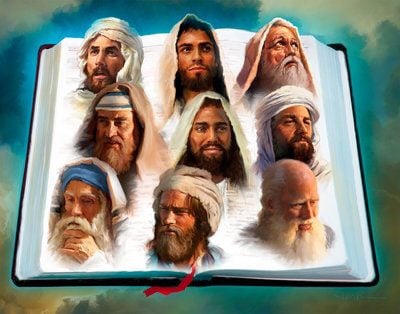
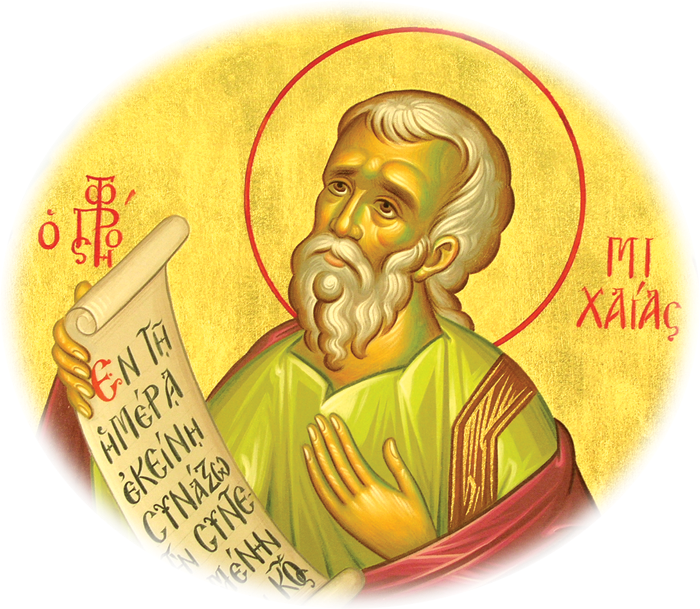
The prophet Micah is introduced in the opening chapter of the book bearing his name, as “Micah of Moresheth in the days of Kings Jotham, Ahaz, and Hezekiah of Judah” (Mic 1:1). This places him in the second half of the 8th century BCE. As he was active in the southern kingdom, he does not directly experience the conquest and exile of people in the northern kingdom in 721 BCE, although he must have been aware of the disasters falling his countrymen to the north. His prophetic activity is thus a couple of decades after Amos and Hosea.

Indeed, the southern kingdom of Judah directly experienced a military attack from the Assyrian king Sennacherib in 701, attacking several towns in Judah (see 2 Kings 18–19; Micah 1:10–16) before retreating from Jerusalem. As Micah says, “the sins of the house of Israel” (1:5) have reached down and infected the house of Judah; “her wound is incurable; it has come to Judah; it has reached to the gate of my people, to Jerusalem” (1:9, 12).

Under Hezekiah, the economic patterns in Judah changed from a reliance on barter, to an international trading society. Literacy rates rose, and the size of Jerusalem grew to be a large city with a population of around 25,000—which is considered to be about five times larger than the population of Jerusalem under Solomon!

Associated with this growth was the development of corrupt practices and the rise of hypocrisy amongst the people. The rulers in Jerusalem “give judgment for a bribe, its priests teach for a price, its prophets give oracles for money; yet they lean upon the Lord and say, ‘Surely the Lord is with us! No harm shall come upon us’” (3:11).
Micah, like many other prophets, conveys God’s deep concern about the way that some in society were profiting unjustly from their mistreatment of the poor. He rails against those who “covet fields, and seize them; houses, and take them away; they oppress householder and house, people and their inheritance” (2:2). Their haughty demeanour will swiftly turn to lamenting, as they cry out “we are utterly ruined; the Lord alters the inheritance of my people; how he removes it from me!” (2:4).

In another oracle, he dramatises the state of the people, attacking the heads and rulers of the people as those “who tear the skin off my people, and the flesh off their bones; who eat the flesh of my people, flay their skin off them, break their bones in pieces, and chop them up like meat in a kettle, like flesh in a cauldron” (3:1–3).

Micah decries their selfish actions in very specific terms: “its rulers give judgment for a bribe, its priests teach for a price, its prophets give oracles for money” (3:11). (This particular condemnation of leaders in Judah appears in the lectionary towards the end of the Pentecost cycle in Year A, to accompany the strident words of condemnation of the leaders of his day, uttered by Jesus in Matt 23:1–12.)

Still later, Micah remonstrates with the people for “the treasures of wickedness in the house of the wicked, and the scant measure that is accursed” (6:10). He conveys God’s displeasure: “Can I tolerate wicked scales and a bag of dishonest weights? Your wealthy are full of violence; your inhabitants speak lies, with tongues of deceit in their mouths.” (6:11–12). He laments that “the faithful have disappeared from the land” (7:2); of those who are left, he says, “their hands are skilled to do evil; the official and the judge ask for a bribe, and the powerful dictate what they desire; thus they pervert justice” (7:3).

The people are accused of following “the statutes of Omri and all the works of the house of Ahab” (6:16)—two kings who are condemned for their idolatrous and evil ways (on Omri, see 1 Ki 16:25–26; on his son Ahab, see 1 Ki 16:30, 22:37–39).

Micah, like Amos before him, declares that punishment will come on the people in a time of deep darkness: “it shall be night to you, without vision, and darkness to you, without revelation; the sun shall go down upon the prophets, and the day shall be black over them” (2:6; cf. Amos 5:18–20). Because of the evil deeds of the heads and rulers, “Zion shall be plowed as a field; Jerusalem shall become a heap of ruins, and the mountain of the house a wooded height” (3:12).

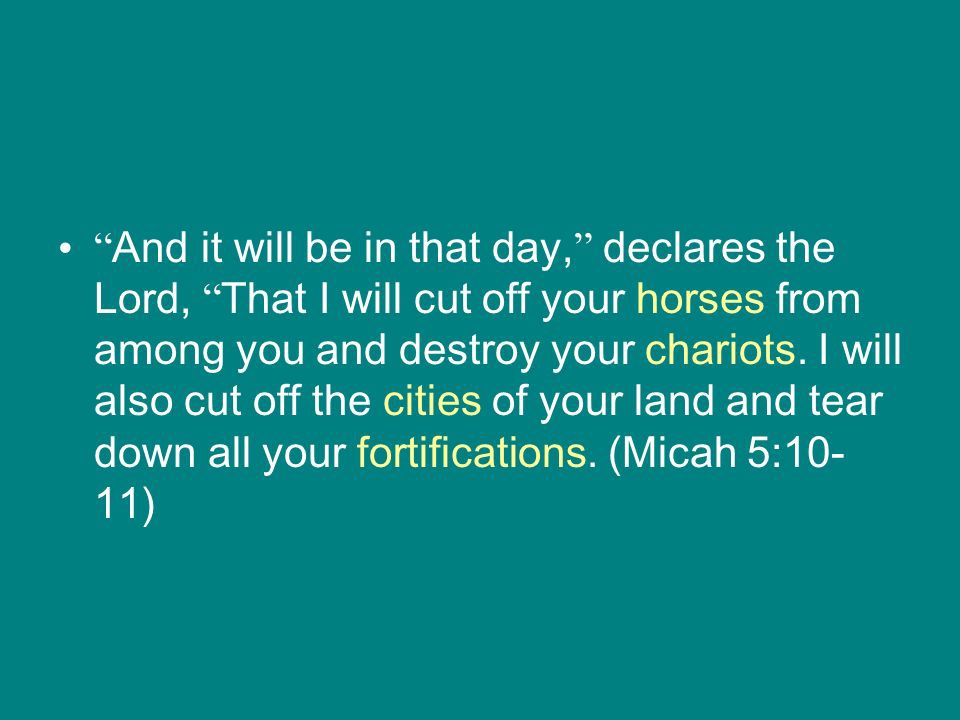
In a future time of anger and wrath, says the prophet, God will wreak vengeance: “I will cut off your horses from among you and will destroy your chariots; and I will cut off the cities of your land and throw down all your strongholds; and I will cut off sorceries from your hand, and you shall have no more soothsayers; and I will cut off your images and your pillars from among you” (5:10–15). The disdain with which the people have treated their covenant with the Lord, described in some detail here by the prophet, will merit this savage punishment.
*****

Although this is a short book (with only seven chapters), Micah is best known for a number of his oracles; first, the vision of universal peace that he utters: “many nations shall come and say, come, let us go up to the mountain of the Lord … they shall beat their swords into plowshares, and their spears into pruning hooks” (4:1–4). This oracle is found also in Isa 2:2–4 (although because of the canonical order of books, the Isaiah oracle appears first in reading order). For an interesting discussion of “which came first, Isaiah 2 or Micah 4 ?”, see https://abramkj.com/2012/12/11/which-came-first-isaiah-or-micah-comparing-isaiah-22-4-with-micah-41-3/)

In Matthew’s Gospel, another oracle from Micah is cited: “you, O Bethlehem of Ephrathah, who are one of the little clans of Judah, from you shall come forth for me one who is to rule in Israel” (5:2–6; see Matt 2:6). This oracle is set in the lectionary for Advent 4 during Year C.

In the context in which Micah speaks these words, they refer to a coming ruler of Judah. In Matthew’s narrative, the prophetic word provides support for the notion that the Messiah was to be born in Bethlehem (Matt 2:3–5; also John 7:42), which then means that the story of the birth of Jesus needs to take place in Bethlehem. Two evangelists work hard to tell stories that, in different ways, adhere to this requirement (Matt 2:1; Luke 2:4).

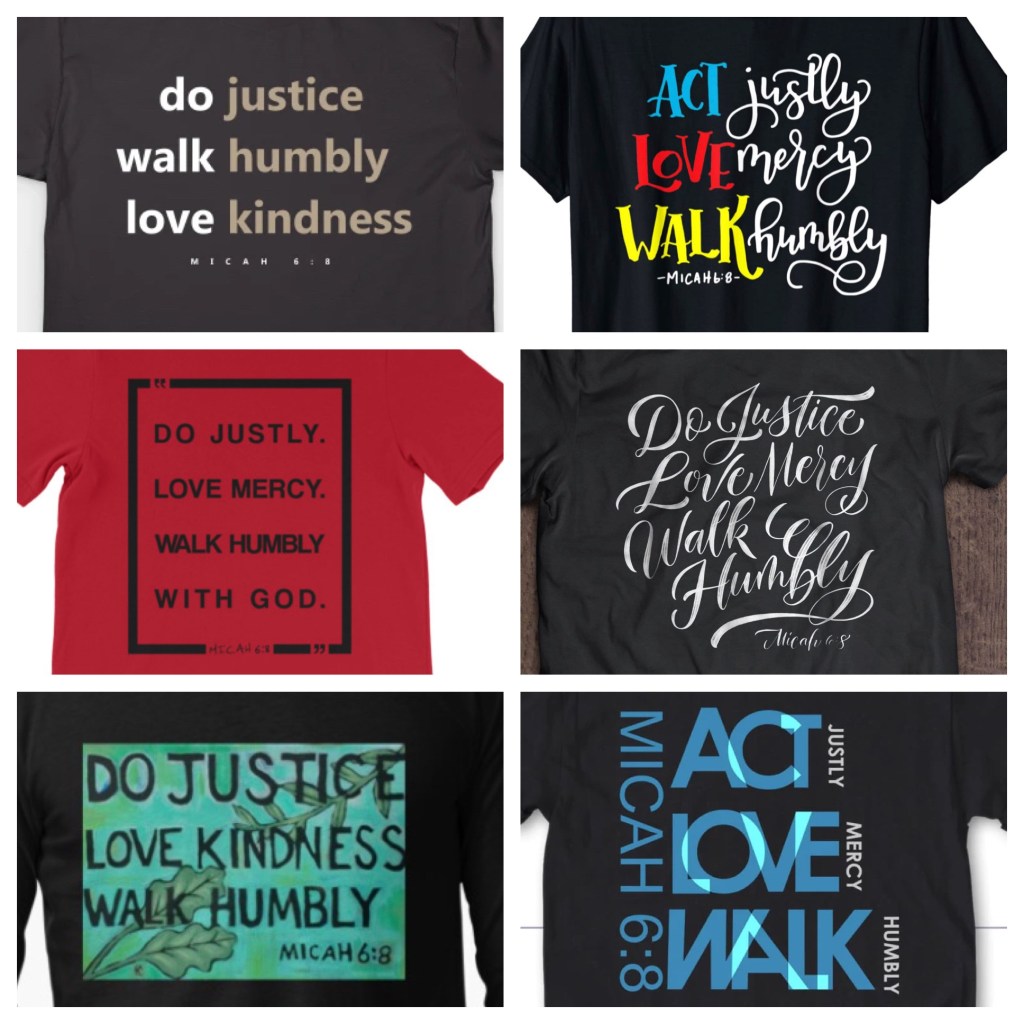
The third oracle of Micah which is well known appears within an extended scene that reads like a lawsuit being prosecuted in court. It begins with the charge: “rise, plead your case before the mountains, and let the hills hear your voice … for the Lord has a controversy with his people, and he will contend with Israel” (6:1–2). Then it moves through some argumentation, before the famous rhetorical question is posed: “what does the Lord require of you, but to do justice, and to love kindness, and to walk humbly with your God?” (6:8). This oracle is offered by the lectionary at Epiphany 4 in Year A.

This verse has gained a life of its own; it is regularly quoted to support people of faith undertaking acts of social justice; and as you can see, it adorns a multitude of t-shirts as a succinct “quotable quote”.
It has also been the inspiration for many organisations bearing the prophet’s name—locally, there is Micah Australia (“empowering Australian Christians to advocate for global justice”; see https://www.micahaustralia.org), which is part of the Micah Challenge International (birthed by the World Evangelical Alliance and Micah Network; see https://lausanne.org/content/lga/2015-03/micah-challenge-international).

The closing verses of this short book reiterate the central nature of God, in the mind of this prophet, and indeed of many of the authors of the material in the Hebrew Scriptures: “who is a God like you, pardoning iniquity and passing over the transgression of the remnant of your possession? [God] does not retain his anger forever, because he delights in showing clemency” (7:18). This recalls the recurring scriptural refrain that God is “merciful and gracious, slow to anger, and abounding in steadfast love and faithfulness” (Exod 34:6; see also Num 14:18; Neh 9:17b; Ps 145:8–9; Joel 2:13; Jonah 4:2; as well as 2 Kings 13:23; 2 Chron 30:9).

Many scholars consider that this more hopeful ending (7:11–20), and indeed some other parts of the book, come from years well after the time of the prophet Micah (indeed, some date some oracles to a time when the exile was ending, in the 520s BCE). Yet the way the book is presented conveys the message that Micah does not give up; despite his fierce words of judgement, he inspires the people to hold on to hope.

*****

See also
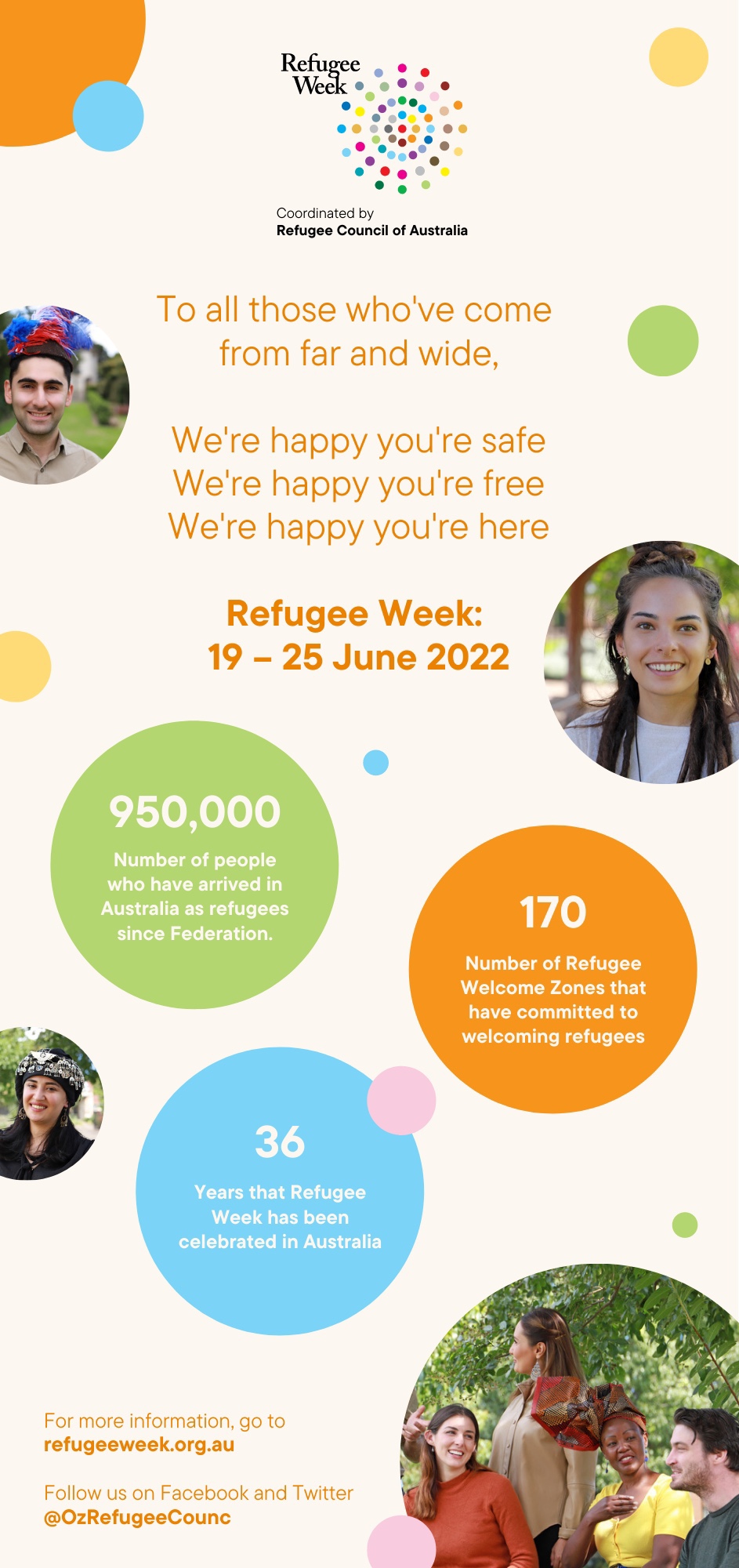
Refugee Week 2022: a time to seek Healing

Refugee Week is held each year, providing an opportunity to highlight aspects of the refugee experience and help the broader community to understand what it is like to be a refugee.

This year, Refugee Week runs from Sunday 19 June to Saturday 25 June. Healing is the theme of Refugee Week 2022. This theme builds on a recognition of the importance of human connections, which has been underscored by the current pandemic. 

The website for this year’s Refugee Week says, “Mainstream and refugee communities alike can draw upon shared hardship to heal wounds, to learn from each other and to move forward. Healing can occur through storytelling, through community and also through realisation of our intrinsic interconnectedness as individuals.”

The first Refugee Week events were organised in Sydney in 1986 by Austcare (Australians Caring for Refugees). Austcare’s mission is to assist refugees overseas, displaced people and those affected by landmines to rebuild their lives, through the expert delivery of development programs in partnership with local communitities and other agencies.

In 1987, the Refugee Council of Australia (RCOA) became a co-organiser of the week, and the week became a national event from 1988. RCOA took on responsibility for the national coordination of Refugee Week from 2004.

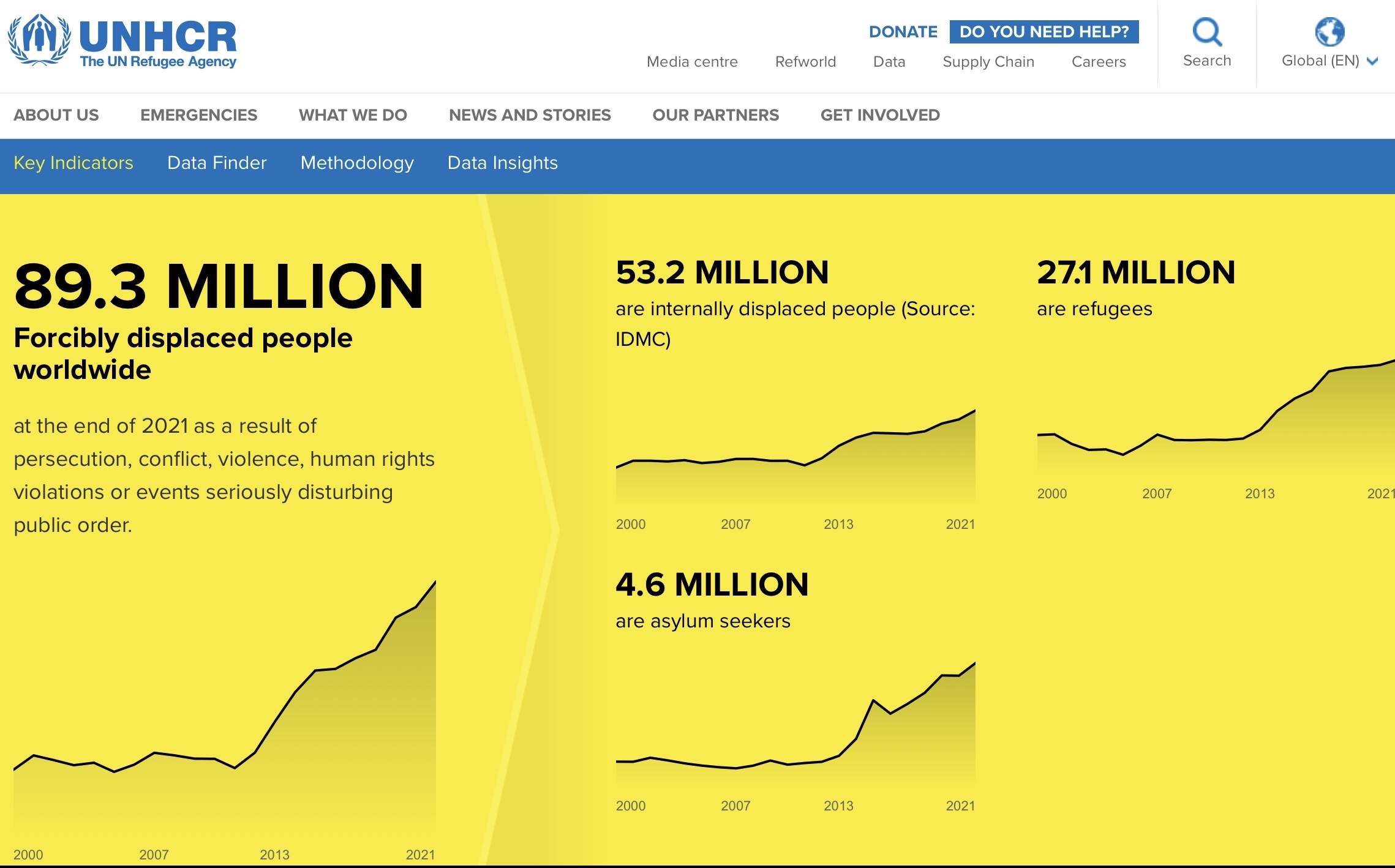
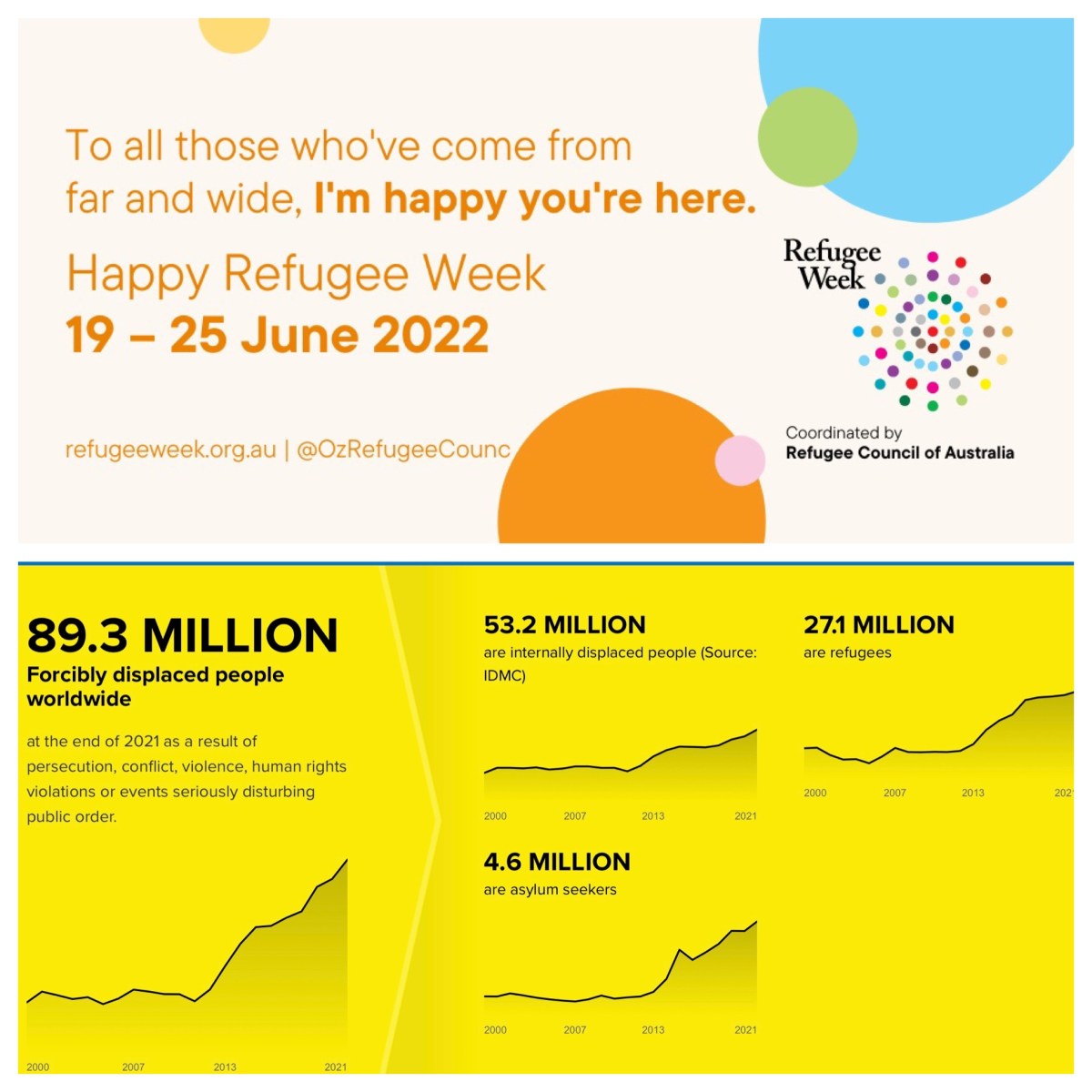
According to the UNHCR, the United Nation’s Refugee Agency, there are now 89.3 million forcibly displaced people, as a result of persecution, conflict, violence, human rights violations or events seriously disturbing public order in their countries of origin. (A year ago, the figure was 82.4 million forcibly displaced people.)

35 million of these people are children, aged under 18 years. 1 million of these children were born as refugees; in the years 2018 to 2020, an average of between 290,000 and 340,000 children were born into a refugee life per year.

Over half of these people (53.2 million) are classified as “internally displaced”, meaning that they are homeless within their own country. 27.1 million are officially classified as refugees, meaning that they are “unable or unwilling to return to their country of origin owing to a well-founded fear of being persecuted for reasons of race, religion, nationality, membership of a particular social group, or political opinion.” This is the definition in the Convention and Protocol Relating to the Status of Refugees—an international agreement which Australia signed in 1951, the year it was published.

These statistics, from the UNHCR, illustrate
the significant rise, globally, of displaced people,
refugees, and asylum seekers in the past decade.

A further 4.6 million people are classified as asylum seekers. Under Article 14 of the 1948 Universal Declaration of Human Rights, everyone has the right to seek asylum The 1951 Refugee Convention prohibits states from imposing penalties on those entering ‘illegally’ who come directly from a territory where their life or freedom is threatened. (Terms such as ‘illegals’, ‘queue jumpers’ and ‘boat people’ are both inaccurate and unhelpful—even though they appear in the media with saddening regularity, they are terms that should be avoided.)

See https://www.unhcr.org/en-au/1951-refugee-convention.html

More than two thirds of all refugees currently under the UNHCR’s mandate come from just five countries: the Syrian Arabic Republic (6.7 million), Venezuela (4.0 million), Afghanistan (2.6 million), South Sudan (2.2 million), and Myanmar (1.1 million).

The countries which are currently hosting the most number of refugees are Turkey (3.6 million), Pakistan (1.4 million), Uganda (1.4 million), Germany (1.1 million), Sudan (just over 1 million), and the Islamic Republic of Iran (just under 1 million). Developing countries host 86 per cent of the world’s refugees, and the Least Developed Countries provide asylum to 27 per cent of the total.

In the last full year (2020–2021), Australia’s Refugee and Humanitarian Program was set at 13,750 places. We willingly accept this amount of incoming refugees, and recognise the value that such people do bring to the Australian society. we have fallen victim to the fear pedalled by unscrupulous elements in society, and in government, over the past decade, about the “hordes” of people seeking the safety of refuge in ur country.

In Australia, the most enduring myth about people seeking asylum is that most arrive by boat. They don’t. The clear fact is that most people seeking asylum arrive by air. It’s time for us to throw overboard the fear of people who come here seeking refuge and asylum on boats, and recognise that the fear fuelled by right-wing agitators over the past decade has not served us well at all.

Adhering to the provisions of the Refugee Convention, as a,country, would be an excellent step,for us to take this year. That would be a significant step towards Healing in our national life.

See stories and additional statistics at https://www.refugeeweek.org.au/wp-content/uploads/2022/05/RCOA-Refugee-Myths-and-Facts-2022-WEB.pdf

The shame continues: SIEV X after 20 years

It was 20 years ago yesterday, on 18 October 2001, that a small, overcrowded fishing boat set sail from Sumatra, Indonesia. On board were well over 400 asylum seekers—far too many for the small boat—who had fled the terrors of life in Iraq and Afghanistan. The boat was headed for the Australian territory of Christmas Island, a few hundred kilometres away. Asylum seekers sought to reach Christmas Island so that they could then claim asylum in Australia.

This was completely in accord with the 1951 Convention relating to the Status of Refugees, which Australia accepted—and included in part within legislation adopted in the Migration Act 1958. See https://www.kaldorcentre.unsw.edu.au/publication/refugee-convention

Unfortunately the boat, which was seriously overloaded, sank the next day, 19 October 2001 (20 years ago today). This mean that 353 people drowned (146 children, 142 women and 65 men). The actual name of the boat is not known; it is known today as SIEV X. SIEV is the acronym used by the surveillance forces for a Suspected Illegal Entry Vessel Unknown. The Roman numeral X designates this as the tenth such boat so categorised by Australian authorities. The acronym dehumanises those on board the boat and generalises the tragedies of all those fleeing their homelands.

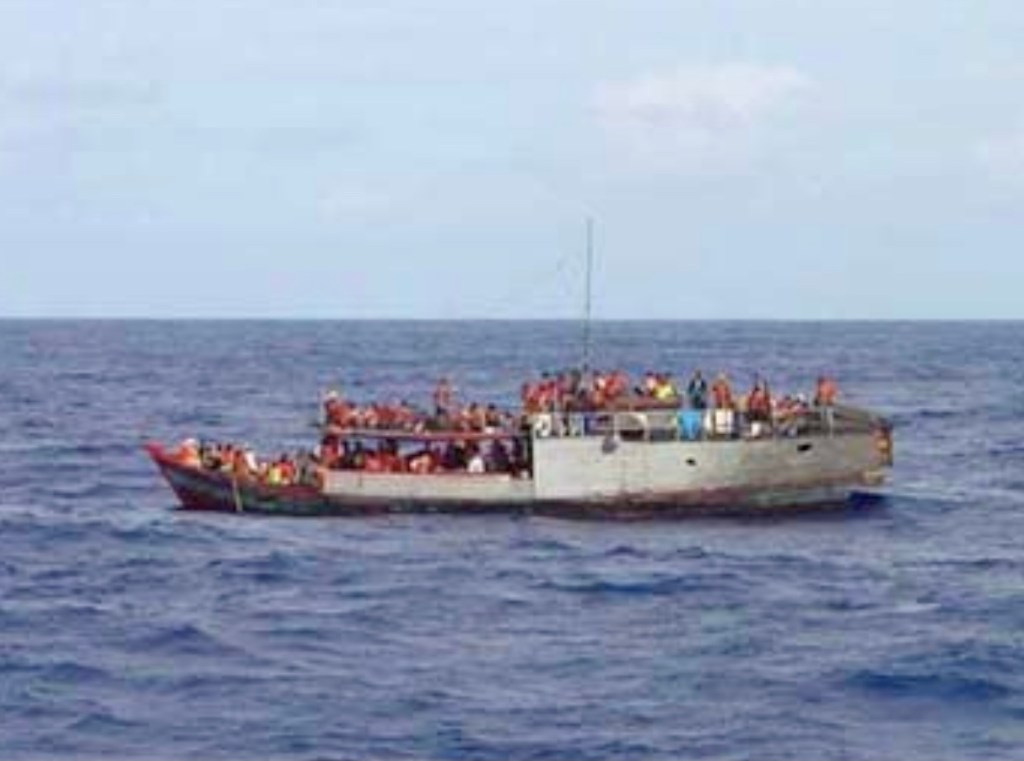
(This is not the vessel known as SIEV X. It is a photo of a boat filled with refugees, used as an example of the scenario on a SIEV X memorial page, https://www.safecom.org.au/sievx-memorial.htm)

According to survivors,more than 100 people remained alive in the water that night. Two vessels arrived and shone searchlights across the ocean, but they failed to rescue anyone. Some time later, 45 people were rescued by fishermen in the area.

The sinking and deaths occurred during an Australian federal election campaign, soon after the saga that involved the Palapa, another boat that sank, and the Tampa, the Norwegian vessel that rescued those on board the Palapa (see https://johntsquires.com/2021/08/26/20-years-on-and-the-shame-continues-the-palapa-the-tampa-and-children-overboard/) The Federal Government turned these two events into political footballs, tapping into the xenophobia and jingoism of some in the population—and won the election.

The shame that was generated by the callous and illegal actions of the Australian Government in events surrounding each of these incidents continues today, in the ever-worsening policies in our nation relating to refugees and asylum seekers. Whilst Australia has accepted around 190,000 migrants each year for the past few years (around three times the number admitted 25 years ago), there are only around 6,000 refugees admitted within that number each year. (I have taken these figures from a government publication, accessible at https://www.aph.gov.au/about_parliament/parliamentary_departments/parliamentary_library/pubs/rp/rp1617/refugeeresettlement#_Toc461022111)

In 2002, a Senate Select Committee had been established to investigate “A Certain Maritime Incident” (the “children overboard” incident in the whole Palapa—Tampa affair). The committee also investigated the SIEV-X sinking. It concluded that “… it [is] extraordinary that a major human disaster could occur in the vicinity of a theatre of intensive Australian operations and remain undetected until three days after the event, without any concern being raised within intelligence and decision making circles.” (See “Findings” under “SIEV X -Chapters 8 and 9” at https://www.aph.gov.au/Parliamentary_Business/Committees/Senate/Former_Committees/maritimeincident/report/a06)

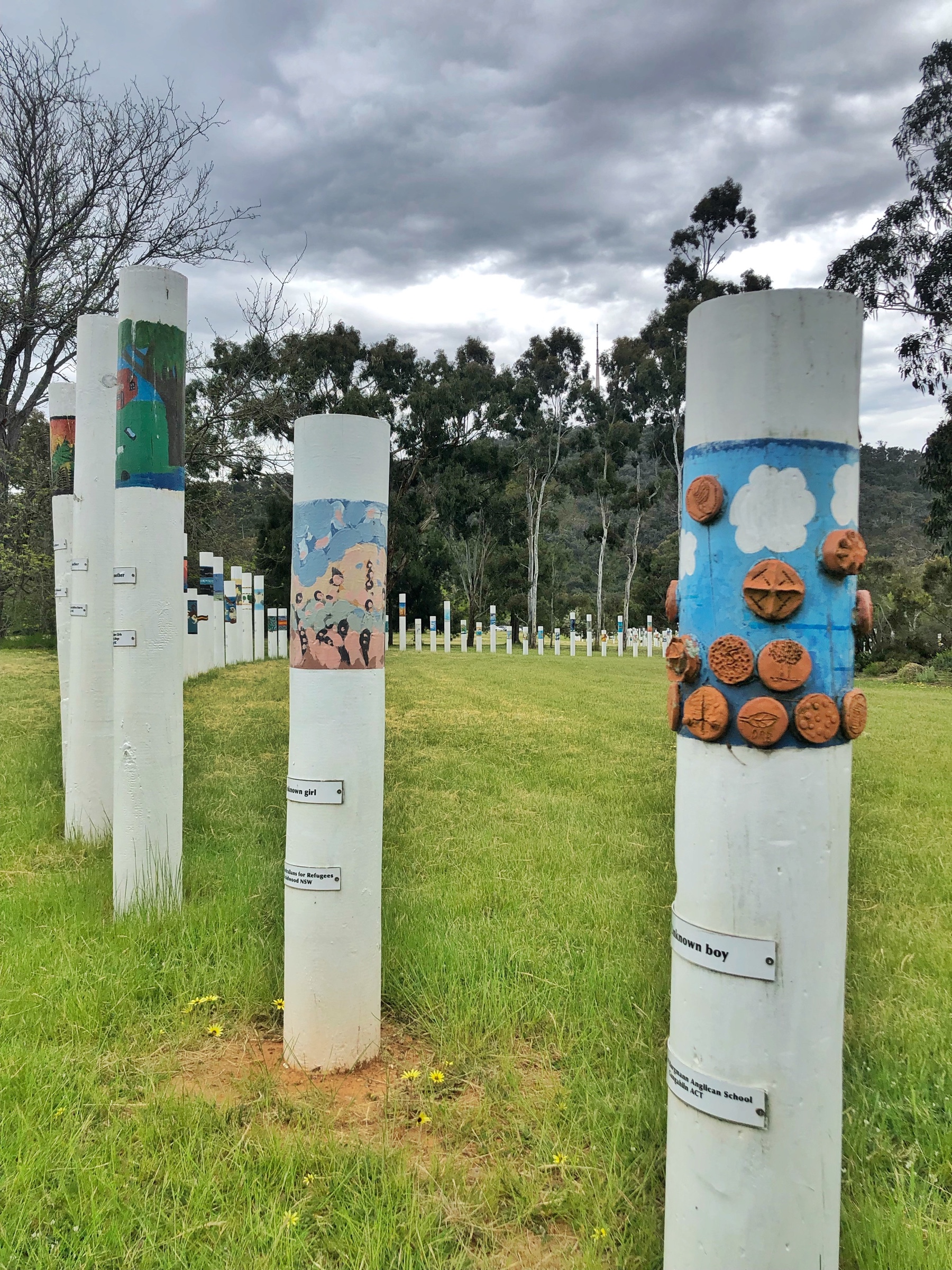
On the weekend almost five years after the sinking (15 September 2006), a memorial to the 353 people who died in that event was opened in Weston Park in Canberra, ACT. The memorial had 353 white poles, each of which had been decorated by a community group, a school group, or a church group, drawn from right around Australia. Each pole represented one of the deceased.

The Uniting Church has a strong connection with this memorial. The artwork for the 353 poles was gathered by a national competition. Pieces from this artwork competition were first displayed at Pitt St Uniting Church in Sydney, and then at Wesley Uniting Church in Melbourne, before being put on display in Canberra at the Canberra City Uniting Church. At that event in Canberra, the design for the memorial was announced—the poles were to be put into the ground in a design that represented the outline of the vessel, when viewed from above.

Overhead view of the memorial,
from https://www.sievxmemorial.com

The then Prime Minister indicated that the Federal Government was opposed to the project, but the ACT Chief Minister, John Stanhope, opened the project in 2006. Permission had not been granted to make the memorial permanent, so a crowd of people carried the poles into the places designated for them. The event received strong national coverage. Public opinion was galvanised against our inhuman national policy regarding refugees.

The next year, 2007, the memorial became permanent. It remains to this day as a reminder of the willingness of the Australian people to assist our neighbours in need; and the intransigence of our federal leadership (sadly, a bipartisan intransigence) when it comes to such matters.

The need to be a welcoming country to people who are rightly fleeing the persecution and violence being perpetrated against them in their homelands, is still an issue today, as the Christians United for Afghanistan project indicates. See https://www.unitedforafghanistan.com/#sign

The photos I have used were taken just recently (October 2021) by Willem Kok, a member of the Yarralumla Uniting Church, which is the Uniting Church Congregation that serves the area that includes Weston Park and the SIEV X memorial.

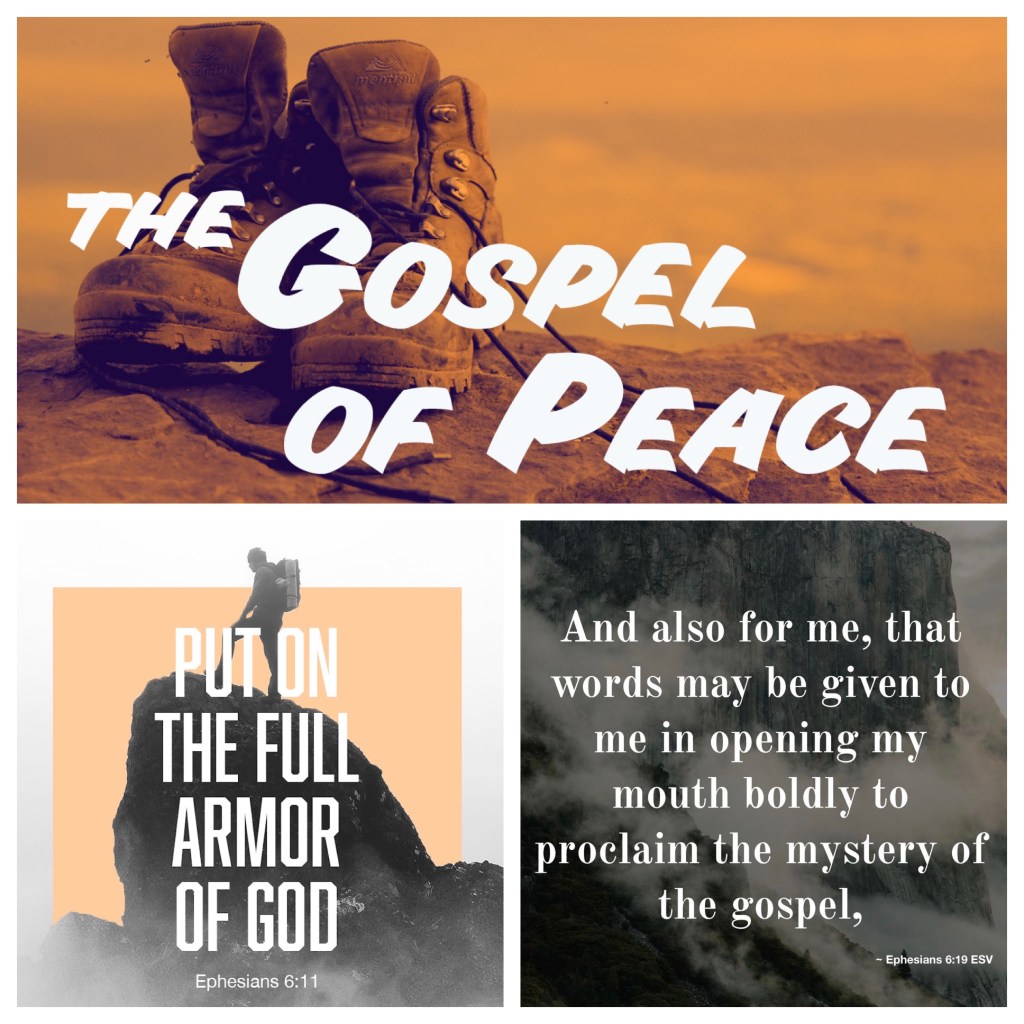
Declare boldly the gospel of peace, put on the armour of God (Ephesians 6; Pentecost 13B)

This morning, as the Canberra Region Presbytery gathered online to meet in council, the theme for consideration was Advocacy. At the start of the meeting, the Rev. Andrew Smith led the gathering in a time of reflection and preparation. Andrew read from the closing section of Ephesians 6 (the epistle that is offered in the revised common lectionary for the Sunday after the meeting).

Andrew invited members of the presbytery to listen, reflect, and then write in the chat what stands out for them, as we consider advocacy and hear these words about “the cosmic powers … the armour of God … the gospel of peace … the mystery of the gospel” (Eph 6:10—20).

Those present noted motifs such as “speaking boldly” … “boldly to proclaim the mystery of the gospel” … “declare it boldly” … “speak directly and bluntly to power”. One person noted that perseverance is required, and there is no indication of victory only resources for the fray. One participant observed, “I saw a shimmering chainmail ‘armour’, more the quality of water that is soft, resists and extinguishes flaming arrows, and wears down hard places over time” and, a little later, “I also wondered about cloaks of feathers as ‘armour’ insisting on identity, diversity, justice for all – those cloaks we have seen in parliaments in recent times”.

Some people noted the imperative present in this passage: “I MUST speak” … “ the imperative is incontestable; we have the armour to take whatever gets thrown at us” … “we have no other option but to speak up for justice” … “we MUST stand strong against evil and pray continually,  we have the armour of God to give us strength and protection”. Another person observed the need for “thorough preparation and then to stand”. One noted, “I was struck by the phrase “fighting against the spiritual forces of evil”.  It brings out the spiritual nature of injustice and the need for faith and commitment to address this.”

Some participants related the biblical text to current circumstances: “In the electronic world in which we live, the actions of the principalities and powers for good and evil are more clearly revealed, so our enemies and allies are more clearly seen.”

One commented at length: “An Ambassador in chains to me shows three ideas. Firstly the idea of servant leadership the need to take actions in the service of others. Secondly, the idea that an advocate has no choice but to be a prisoner to their passion to help others an idea of a destiny to do good. Thirdly, the need to be empathetic with the suffering of others not from a vantage point outside their hardship but from a feeling of a common struggle and hardship.”

Another highlighted that “faith in Christ is the basis to understand and do good”; another said, “first we must read the Bible and understand God’s will, then proclaim it in the need for justice for others”. Others commented, “pray constantly, be bold, be well prepared, promote peace” … “every footfall can bring peace to our context” … “’Be Strong in God’ – struggle against evil, with Prayer, Preparation, God’s Protection, and then Action”. One noted “the promise of being able to ‘stand firm’”, another highlighted “feeling that you are armed with God’s love to speak up with no fear”, yet another, “constant prayer in the Spirit”.

One observed that the passage speaks of “the whole armour, not just feet, we have been given the armour to use”; another that “the whole armour of God evokes a gathering of so many things- love, peace and truth. These are in uneasy relationship. Here faith comes in that there is a way through.” That led another person to note “the irony of dressing like a Roman soldier”, and yet another to observe “the internal contradictions between putting on the armour and proclamation of peace”.

A good question posed was, “Where is the distinction between God’s justice and human justice? or are they the same?” That’s a question worth pondering beyond this particular reading, in each of our actions, day by day, week after week.

Collated from the chat at the August 2021 Presbytery meeting by John Squires

See also https://johntsquires.com/2021/08/16/justice-and-only-justice-you-shall-follow/