Mission and discipleship: training for the kingdom

This blog follows on from the earlier post, “Fostering a culture of ‘an informed faith’”. In that blog, I set out how the Uniting Church’s Basis of Union provides us with a stimulus to foster a culture of “an informed faith”. See https://johntsquires.com/2023/09/17/fostering-a-culture-of-an-informed-faith/

In this blog, I am focussing on an extrapolation from that basis, into an area that is of vital concern for the contemporary church—developing disciples who are well-equipped to engage in the mission of God.

Underlying this paper is an observation that my friend and colleague Craig Mitchell made last year: “When the ‘missional turn’ began to take hold in the UCA, we somehow made an either/or choice to resource mission instead of discipleship. We stopped resourcing local faith formation and education. Today most churches lack a plan for these, yet discipleship is one of the key aims of most councils. It’s like bemoaning the quality of preaching while cutting homiletics or biblical scholarship.”

Craig’s comment is undergirded by the important research he undertook in the course of completing his PhD, written up as (Re)forming Christian Education in Congregations as the Praxis of Growing Disciples for a Missional Church, PhD Thesis, Flinders University, 2018. See https://theses.flinders.edu.au/view/3da42e12-260f-4d92-b78a-51a9d193ee60/1

In this work, Craig explored a number of “intentional learning communities” within the Uniting Church. (The context where I was involved in team ministry with my wife, the Rev. Elizabeth Raine, was one of the “intentional learning communities” that Craig explored.) Craig has made available his conclusions and many resources relating to this research through his website; see https://craigmitchell.com.au/forming-disciples-in-mission/

I begin my own reflections with our current context. It is widely recognised that we are in a changing context for the church. The Christian Church now occupies a new position within society; no longer do we find that the church is considered to be at the centre of society. The old Christendom model of the village church in the centre of the marketplace, where people were to be found each day of the week, where the priest or vicar was the most educated person in the village, is no longer who we are as church.

Indeed, the view of church held by many in society is changing. There are various reasons for this. Certainly, the media has played a role, especially in the years when the Royal Commission has been in the spotlight, and many people in society have lumped all denominations together and tarred us all with the same brush as certain Roman Catholic and Anglican Dioceses and individuals. That’s not fair, to be sure, but it is a reality, unfortunately.

Such stereotyping is easy to do and proves to be the first port of call in many situations. Further steps have been taken by individuals and groups in society, who move from seeing the church as irrelevant, to taking a more antagonistic view of religion, and the church in particular. So we find ourselves in a changed and changing context.

The key questions for many congregations at this time, then, are these: what is the most faithful and most effective form of mission, today, in this changed and changing context? what is the way that we are being called, as the church, to demonstrate that God loves the world—the whole world—and that we are here to serve others at their points of need?

During the years that I served as Presbytery Minister—Wellbeing in the Canberra Region Presbytery, I worked to a set of five key commitments which the Presbytery had identified as key goals. The first two of these were Resourcing Congregations to function in healthy ways and Working with Congregations to discover new futures. Both of these proved to be important for developing a robust understanding and an effective practice of mission.

A fundamental element in the process of strengthening the mission of the church, is to encourage the development of a missional imagination amongst the leadership of each congregation. Such an imagination will approach the life of the congregation in two ways; it will enhance the existing missional commitments of congregations, but will also be working to ensure that local leadership pushes into new areas and adopts new methods of missional engagement.

To have missional imagination means to see, at every step, how the church can be on mission: in the traditional ways, in fresh expressions and new initiatives. This takes some work; I have found that I needed structured experiences to prompt me along the pathway of “developing a missional imagination”.

So I have learnt much about this by taking part in the Mission Shaped Ministry Course, developed in the UK but now widely applied in Australia. And I learnt more about God’s mission and fresh expressions of church as I prepared and led sessions designed to inform, challenge, and develop the missional imagination of those taking part in the course.

This course encourages the learning of new skills (community engagement, community development, creative missional activities). It also requires congregations to consider a re-prioritising away from the established paradigm of “being church”. In the current paradigm that is practised by many churches, Sunday worship and aged care worship enjoy high priority; maintaining established church groups and activities has a medium-high priority; and developing new initiatives is regularly perceived as too difficult and too threatening. This course challenges and invites people to re-order those priorities, and focus on developing new initiatives.

Teaching, they say, is the best way of learning. As a teacher, in tertiary contexts as well as with lay leaders of Congregations, I know that I have learnt much from all those times when I have undertaken preparation for, and then facilitation of, learning experiences for others. And the Uniting Church’s commitment for its ministers to be “lifelong learners” feeds directly into those experiences. I know that I learnt by teaching!

Experiencing, also, is a key element in learning. Reflective practice works best when a person is immersed in a experience, and then steps “outside” of that experience to consider what took place; to reflect on how they felt, how they acted, how they responded to others, what they did that was helpful, what they did that they might do differently next time.

I am grateful that I was taught long ago to be a “reflective practitioner”, and that I have been encouraged—and required—to practise those skills throughout my ministry. Regular supervision with a qualified professional supervisor is a great discipline for developing and extending those skills!

Alongside the importance of teaching and experiencing for the learning process, then, I want to place a further dimension, which encompasses both structured learning opportunities and reflection on experience. That dimension is one that ought to be familiar to anyone who listens regularly to the stories about Jesus that are collected in our Gospels: it is the matter of discipleship.

I fear, however, that the church today has “dropped the ball” with regard to discipleship. Worried about our declining numbers, our ageing buildings, our lack of outreach, our fixation on certain matters of doctrine and church practice, we have overlooked the fundamental element of being a follower of Jesus—a disciple.

The earliest written account of the life of Jesus, which we know as Mark’s Gospel, emphasises the necessity of following Jesus; “follow me” is an important refrain from the beginning of Mark’s story. In three early scenes, the command of Jesus, “follow me”, is met each time with an immediate response: Simon and Andrew follow him (1:17), then James and John follow him (1:19), and then Levi the tax collector follows him (2:14). Each leave what they are doing and follow Jesus.

What is involved in this “following”? The Gospel narratives make it clear that it involved walking along the dusty roadways alongside Jesus; sleeping in the homes offered to the wandering group by sympathetic villagers; eating at table with whomever happened to be present; witnessing the “deeds of power” that Jesus was equipped to undertake; and listening carefully as he taught in parables, offered succinct, pithy sayings, and gave extended discourses as opportunity presented.

“Have you understand all this?”, Jesus asked his followers, impertinently confronting them after having offered a series of parables (Matt 13:51). It’s my favourite question, amongst all the questions that Jesus asked. The response of the disciples (“Yes”) needs surely to be heard with a grain (or more) of salt. Clearly, there was more work for Jesus to do (see Matt 14:26; 15:23; 16:5–12, for subsequent examples of times when the disciples clearly did not understand).

How do we understand all that Jesus offers? The words he speaks after asking that impertinent question (Matt 13:51) contain a vital clue. He speaks about “every scribe who has been trained for the kingdom of heaven” in these words (Matt 13:52). The Greek word translated “trained” is mathēteutheis, from the root word manthanō, meaning “to be a disciple, to be a learner”. And that root word also morphs into the noun, mathētēs, which is regularly translated as “disciple”.

At the heart of discipleship is learning. This is why the first disciples were to follow Jesus—to learn. They learnt by listening (but we know that most learning doesn’t happen from simply listening). They learnt by watching (which has a better success rate—but is still not optimal). They learnt by being involved (which brings an even better result). And then, they learnt by doing, as Jesus sent them out, two by two, “to proclaim the kingdom of God and to heal” (Luke 9:2)—to do, for themselves, precisely those things that he had been doing, and they had been observing.

And, of course, after they returned from this practical experience, “they told Jesus all they had done, and he took them with him and withdrew privately to a city called Bethsaida” (Luke 9:10). I imagine that this was a very vigorous debriefing session as they recounted and reflected on their varied experiences during this period. This is precisely what we now recognise to be excellent pedagogical practice: some orientation, an immersion experience, and then in-depth reflection on what was learnt in that experience. (And then, repeat, and repeat, and repeat!)

Last year, I co-authored an article on mission with my wife, Elizabeth Raine (Minister at Tuggeranong Uniting Church in Canberra). The article was published in Uniting Church Studies vol.24 no.2, pp.43–51, and is available online at

https://drive.google.com/file/d/1QzokSsFEwU-sbrOb7e8DheQIEiw5-ngh/view?pli=1

In that article, we write as follows:

“We believe that mission is something that anyone can do, but it is not something that comes easily and naturally to most people. Training in mission is essential. Being prepared to step outside the familiar and comfortable “box” of church is an essential element—so the right mindset is the first step.

“After that, training can inspire, encourage, refine, and develop missional sensitivities and lead to strong missional practices. But without that commitment to do something different, to reach out of the predictable, to experiment and explore, no mission will occur. Business as usual is a big temptation to many church people; and business as usual can quickly stifle mission (unless mission itself is the “business as usual”).

“So, training in the “how-to” of Messy Church, Godly Play, Fresh Expressions, GodSend, and Mission Shaped Ministry, can indeed inspire and equip people to become missional in their orientation. These courses don’t provide any guarantee, but they do each offer a set of stimuli, challenges, and resources for people to consider how to “do church differently” and hopefully also “engage in mission”.

“There is a clear principle that is often articulated, with which we agree, and which we feel should be stated again and gain. Mission is about the world, not the church. Mission means knowing the community we live in, the society of which we are a part, and the culture(s) that shape(s) us, the expectations and patterns and customs of people.

“Mission means shaping and reshaping the way we “do church” in the light of these matters. The Mission of God is God doing things in the world, and we, as the people of God, joining with that activity. It means going out to others, not expecting others to come in to us. A missional church is not simply a church that opens the doors and expects people to flock in to the wonderful programmes that are on offer. A missional church is one that is always oriented outwards, a church whose people are dispersed, engaged in communities, actively involved in the various needs of people across these communities.”

In the context of the ACT-2 processes, and also in the light of what I have earlier written regarding the “culture of an informed faith”, I think it is imperative that we incorporate within our thinking and planning the essential element that each Congregation (re)commits to being an intentional learning community in which “the continuing witness and service of evangelist, of scholar, of prophet and of martyr” is valued, explores, and acted upon.

Learning from the voices of experience, alongside times of learning from being immersed into experiences and then reflecting on them, provide a rich way to develop discipleship and foster a missional imagination. May it be that one of the outcomes of the ACT-2 process is just such an outcome—a network of intentional learning communities in which missional imagination fostered, from which fresh expressions of church emerge, and through which the kingdom of God is proclaimed and enacted in contemporary Australian society.

*****

See also
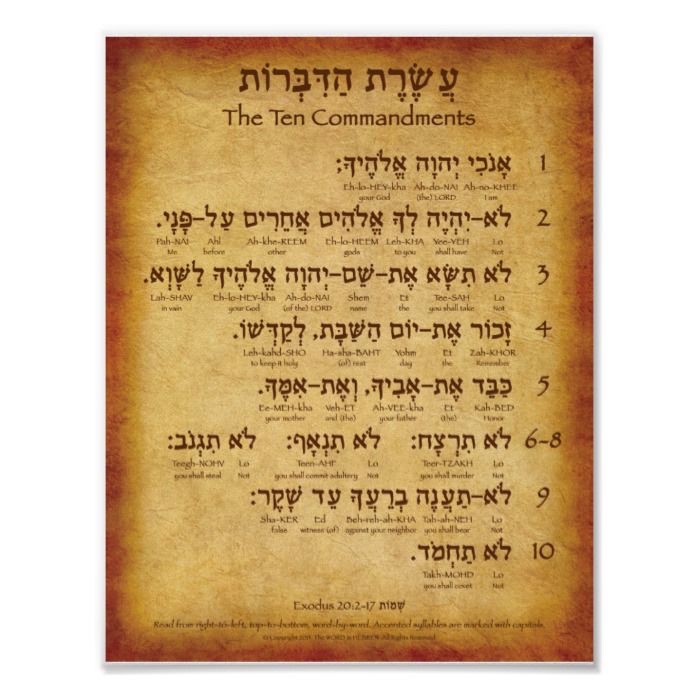
Ten things about the Ten Words (Exod 20; Pentecost 19A)

The Hebrew Scripture reading for this coming Sunday contains a set of well-known words—the Ten Commandments (Exod 20:1–20), given to Moses on Mount Sinai, for him to take down to the people of Israel as their set of guidelines for faithful living within the covenant. That covenant was sealed by God and Moses in the previous chapter (19:1–8).

These words set the pattern for life that the Israelites are to follow. They accept and commit to this way of life, declaring “everything the Lord has spoken we will do” (19:8). Those Ten Commandments are then followed by multiple other commands for living (20:22—23:19). It is these commands that the people are instructed to live by, to which they again make their commitment: “all the words that the Lord has spoken we will do” (24:3).

Moses then confirms this in a very public way: he arranged for “burnt offerings and sacrificed oxen [to be] offerings of well-being to the Lord”, as well as dashing half of the blood from those offerings against the altar he had constructed (24:5–6).

Then we read that Moses “took the book of the covenant, and read it in the hearing of the people; and they said, ‘All that the Lord has spoken we will do, and we will be obedient’” (24:7)—and the remaining half of the blood from the offerings was dashed on the people, who are told “see, the blood of the covenant that the Lord has made with you in accordance with all these words” (24:8).

What do we make of these familiar words? The Ten Commandments are probably one of the most well-known passages in Hebrew Scripture—even if most people would struggle to identify the specific requirements of all ten of the commandments. It’s more “the vibe of the thing” that we recall, rather than the precise words.

Here are ten things about these Ten Commandments that help us to understand and appreciate their significance—both in Judaism, the religion that developed from ancient Israelite practices, as well as in Christianity, which appropriated the stories, songs, oracles, and teachings of Judaism as the foundation for its own development.

1. The description of these commandments. In Judaism, this collection of ten commands is known as the Aseret ha-Dibrot, a Hebrew phrase often translated by Jews today as “Ten Statements” or “Ten Declarations”. This is how this collection of “the words of the covenant” are described at Exod 34:28 (and again at Deut 4:13; 10:4). The second word in that phrase is simply “word”—so we might well think of these ten statements as “Ten Words” spoken by God to provide guidance and instruction to the Israelites.

2. The two versions of these Ten Words. The first version of these words is what we have in Exodus 20. (The lectionary edits the selection offered, omitting verses 5–6 and 10–11, to shorten some of the longer parts.) The second version appears in Deuteronomy 5. There are many similarities between the two versions, although the Deut 5 version is longer. One noteworthy difference is the instruction relating to the sabbath; “remember the sabbath day” (Exod 20:8), contrasted with “observe the sabbath day” (Deut 5:12). The difference in the verb is a just slight nuance of difference.

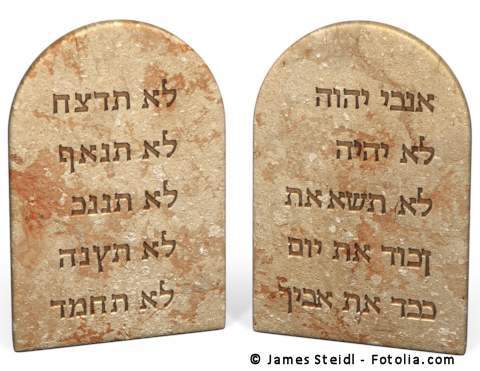
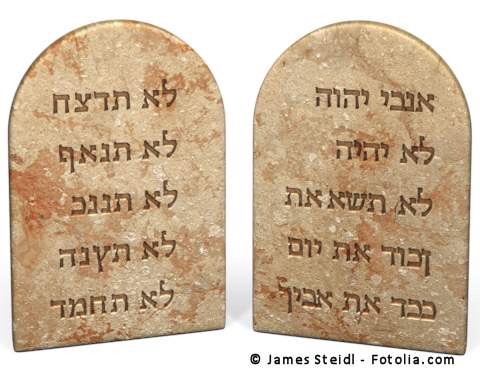
3. Two tablets of stone. Moses is given “two tablets of stone” by God, who informs him that they contain “the law (torah) and the commandment (mitsvah), which I have written for their instruction (horotam, from yara)” (24:12). The Hebrew words used here are part of a larger group of terms which describe all the instructions given throughout the first five books of scripture, the Torah. These tablets are later described as having been written “by the finger of God” (31:8), noting also that “the tablets were the work of God, and the writing was the writing of God, engraved upon the tablets” (32:6).

These two tablets are the ones that are notoriously broken by Moses in his anger when he discovers that the Israelites, in his absence, had made an image of a golden calf (32:19). This leads to the production of a replacement set of stone tablets, which Moses himself wrote under God’s instructions (34:1–4, 28).

These two tablets have most likely influenced the interpretation of the Ten Words as comprising one set of words in which the orientation is towards God (“you shall have no other gods … you shall not make an idol … you shall not make wrongful use of the name of the Lord your God … remember the sabbath day”, 20:2–11) and a second set oriented towards other humans (“honour your father and your mother, you shall not murder, you shall not commit adultery, you shall not steal, you shall not bear false witness against your neighbour, [and] you shall not covet”, 10:12–17). This, in turn, may have been an influence on the later rabbinic exposition (taken up by Jesus) of the Law as requiring love of God and love of neighbour (see Mark 12:28–31 and parallels).

4. How many laws do we have to remember? The natural desire to summarise and synthesise long lists into shorter, more readily remembered lists, may well account for the desire, in this encounter between Jesus and the scribe, to reduce all the commands to two. But there were other aspects involved in this process.

The Rabbis observed that the Torah, the first five books of scripture, actually contain 613 commandments (mitzvoth). There are 248 positive commands (“you shall …”) and 365 negative commands, or prohibitions (“you shall not …”). Collectively, these are known as mitzvoth, commandments; they comprise the Torah, the Law. In strict Jewish households, every one of them must be carefully observed.

However, the Babylonian Talmud (b. Makkoth 23b—24a) reports a rabbinic sermon in which various texts were cited in an attempt to make it easier to remember the central principles of the Torah. Rabbi Simlai declared that David reduced the 613 laws to eleven, citing Psalm 15. After him, Isaiah came, and found the basis in six commandments, quoting Isaiah 35:15-16.

Then the famous Micah triplet is cited, involving just three laws, “do justice, love kindness, walk humbly with your God” (Micah 6:8); before a later section of Isaiah is cited, noting that it proposed just two laws, “maintain justice, and do what is right” (Isa 56:1). Finally, Rabbi Simlai said there was an even shorter way to remember all the laws, and he cited Amos 5:4 as a single command: “seek me and live”.

Rabbi Nahman bar Isaac, however, proposed another prophetic text which provides one statement that summarises the Torah: “the righteous person lives by their faith” (Hab 2:4). This verse, of course, is familiar to Christians from Paul’s citation of it at Rom 1:17 and Gal 3:11.

Another way to summarise the Law is offered by the story of Rabbi Hillel, who is approached by a Gentiles seeking to convert to Judaism. Hillel says to the enquirer, “What is hateful to you, do not do to your neighbor. That is the whole Torah; the rest is the explanation of this—go and study it!” (b.Shabbat 31a). In like manner, when he was asked “which commandment is the most important of all?” (Mark 12:28), Jesus replies by citing two simple words: to love God (Deut 6:5) and to love neighbour (Lev 19:18).

5. Reading these words regularly. The Ten Words are read in full three times each year in Jewish synagogues. Jews follow a one-year lectionary, in which every verse in the first five books of scripture (the Torah, or the Five Books of Moses) is read in sabbath service during the course of the year. The weekly readings (called parashot, or “portions”) begin with Gen 1 and conclude with Deut 34. (The Jewish calendar follows the lunar cycle, and so it has 12 months of 29 or 30 days each, with an extra month added seven times every nineteen years. It’s complicated!)

So the Exodus passage is heard in the week when Exod 18:1—20:23 is read; and later in the year, the Deuteronomy version is heard, when Deut 3:23—7:11 is read. The Ten Words are also read at the Feast of Shavuot, which in the Jewish cycle of festivals is when the giving of the Law (the Ten Words) is remembered.

6. Quoted in the New Testament. The various commandments of these Ten Words are quoted in assorted New Testament passages. Jesus, in Matthew’s Gospel, affirms that all of the Law holds good; he comes to fulfil, not abolish, the Law (Matt 5:17). In the Sermon on the Mount, he specifically interprets—and intensifies—commands relating to murder and adultery, as well as not using God’s name in vain (Matt 5: 21–37).

Elsewhere in this Gospel, Jesus reinforces the importance of honouring parents (Matt 15:14) and of keeping this and further Words (murder, adultery, stealing, and lying, Matt 19:18). Paul likewise affirms that “the one who loves another has fulfilled the law” and “love is the fulfilling of the law” (Rom 13:8–10). In that passage, he cites four of the Ten Words (those relating to adultery, murder, stealing, and covetousness).

Earlier in the letter, he has referred to those words relating to stealing, adultery, and idol worship (Rom 2:21–22). Worshipping God, the first Word, is commended at Matt 4:10 and Luke 4:8; avoiding idol worship is advocated in the letter of the Jerusalem Church (Acts 15:20) and by Paul (1 Cor 6:9–10). The Sabbath is kept by Jesus (Luke 4:16) and Paul (Acts 17:2), as well as at Heb 4:9. Covetousness is condemned by Jesus (Luke 12:15) and Paul (Rom 7:7–11). So all ten of these Ten Words are affirmed in the New Testament—some on a number of occasions.

7. Numbering the list of ten. Judaism, unlike Catholicism and Protestantism, considers “I am the Lord, your God” to be the first “commandment”. Catholicism, unlike Judaism and Protestantism, considers coveting property to be separate from coveting a spouse. Protestantism, unlike Judaism and Catholicism, considers the prohibition against idolatry to be separate from the prohibition against worshipping other gods. No two religions agree on a single way to divide this stream of words into a list of ten distinct commands. So whose list should we follow?

8. Torah as a gift. To the Israelites of the past, as well as to Jews of today, the Torah is experienced as a gift which enriches their lives, not as a crass demand which weighs them down. The relationship that the people of Israel had with God was signalled in the Covenant that is offered to them. Exodus reports that the Lord spoke to Moses, “if you obey my voice and keep my covenant, you shall be my treasured possession out of all the peoples—indeed, the whole earth is mine, but you shall be for me a priestly kingdom and a holy nation” (Exod 19:5–6).

The Covenant is an outworking of this deep and abiding relationship between God and God’s people. That Covenant was not an idealised or abstract idea; it was known and expressed in each of the 613 laws contained within the Hebrew Scriptures. So the Law was considered to be a gift to the people, to be celebrated and valued as much as to be kept (Ps 19:7–11, 40:8, 119:97–104, 169–176). These Ten Words thus play a vital role in the shaping of society so that we live in ways that keep us in covenant relationship with God.

9. The basis of ethics. The Ten Words have formed a solid foundation for ethical principles, not just in Judaism and Christianity, but in wider societies more generally. During the early centuries of the church, these commandments are referenced in various documents, including the second century Didache, and they came to occupy their place in the developing catechism of the church, as Augustine of Hippo indicates in his Questions on Exodus.

The medieval scholastic, Thomas Aquinas, declared in his Summa Theologiae that these commandments provided “the primary precepts of justice and all law, and natural reason gives immediate assent to them as being plainly evident principles”. In his Institutes of the Christian Faith, Jean Calvin provides a detailed consideration of the Ten Commandments. He writes that “God has so depicted his character in the law that if any man [sic.] carries out in deeds whatever is enjoined there, he will express the image of God, as it were in his own life … it would be therefore a mistake for anyone to believe that the law teaches nothing but some rudiments and preliminaries of righteousness by which men [sic.] begin their apprenticeship, and does not also guide them to the true goal, good works.”

Their influence continues into 21st century societies across the globe. Writing in the Desert News (a conservative LDS publication), Paul Edwards proposes that “as long as people yearn for a cohesive and cooperative society that supports familial ties, secures the integrity of personhood and property, shuns petty jealousies and violence, and seeks to treat all alike in the eyes of social authority and before God, then the Ten Commandments — which accomplish these and much more — will continue to be inescapably relevant.”

10. The last word on the Ten Words relates to the last of these ten commandments. It is a curiosity not often commented on—but this last command indicates that these words are directed towards the males in the community, not to everyone, males and females alike. The final command specifies that a person “shall not covet your neighbour’s wife”, and the wording used clearly indicates that these words are directed towards males. It doesn’t say, “you shall not covet your neighbor’s husband”—which is the first indication that the instruction is directed towards men.

Further, we might note that Hebrew is a language in which gender can be indicated in the choice of words; and in this instance, every time the possessive pronoun “your” appears in this commandment, each of those possessive pronouns are masculine. It is your (male) neighbour’s house, your (male) neighbour’s wife, your (male) neighbour’s slave or ox or donkey, or anything that belongs to your (male) neighbour.

And it is noteworthy that there are feminine words used in this commandment (wife and maidservant), so the distinction is being drawn with intention and care. It is the male who possesses house and male slave and ox and donkey, as well as female slave and wife—all are possessions of the male. Which is only to be expected in the patriarchal culture in which these commandments were articulated.

And so, as we hear these Ten Words this coming Sunday, there are many things for us to reflect on!

See also
The law of the Lord is perfect (Psalm 19; Pentecost 19A)

The psalm that is offered by the lectionary for this coming Sunday (Psalm 19) contains some very well-known phrases. It deals with the way that we know God, and know about God—through creation, and through scripture. Those two “ways of knowing” form the basis for the later theological development of the notions of “natural revelation” (that we can know about God by observing the world around us) and “scriptural revelation” (that we can know about God by reading and studying the scriptures).

However, in this psalm, although there are two clearly delineated sections (verses 1–6 and 7–13) with a concluding verse 14, there are overlaps and connections between those two sections. Howard Wallace notes that “there are certain connections between the [two] parts of the psalm: word connections (e.g. ‘hid’ and ‘hide’ in vv. 6 and 12; ‘heart’ in vv. 8 and 14) … also the theme of ‘speech’ ties the psalm together (e.g. in vv. 1, 2, and 14, and presumed in the words ‘precepts’ and ‘commandments’)”. He concludes that “these connections invite us to consider the psalm as a unity with the meaning of the whole greater than the sum of the parts.”

See https://hwallace.unitingchurch.org.au/WebOTcomments/LentB/Lent3BExod20Ps19.html

Creation is the focus in the first six verses. The psalmist’s view is fixed on “the heavens”, which are “telling the glory of God” (v.1). In those heavens the Lord “has set a tent for the sun, which comes out like a bridegroom from his wedding canopy, and like a strong man runs its course with joy” (v.4–5)—clearly a description of the daily movement of the sun across the sky (from our perspective), from east to west, as verse 6 then elucidates.

In other psalms, the psalmist praises God for the heavens as the place where “you have set your glory above the heavens” (Ps 8:1); as a consequence, “the Lord has established his throne in the heavens” (Ps 103:19). By contrast with earthly idols—deaf, dumb, blind, immobile, mute—“God is in the heavens” (Ps 115:3–7; 123:1), from where he blesses the house of Israel (Ps 115:12–13).

So a recurrent refrain is, “your steadfast love is higher than the heavens, and your faithfulness reaches to the clouds” (Ps 36:5; 57:10; 108:4). “Be exalted, O God, above the heavens; let your glory be over all the earth” is another repeated prayer (Ps 57:5, 11; 108:5). In the same mode, another psalm rejoices that “your power and your righteousness, O God, reach the high heavens” (Ps 71:19).

However, another psalm declares that God “thundered in the heavens, and the Most High uttered his voice; and he sent out his arrows, and scattered them; he flashed forth lightnings, and routed them” (Ps 18:13–14). These natural elements, in the view of this psalmist, reflect the righteous judgement of the Lord—a view that we would distance ourselves from, today. (See also Ps 50:4–6; 76:7–9.)
By contrast, the rain that poured forth from the heavens when the people of Israel were in the wilderness “restored your heritage when it languished … in your goodness, O God, you provided for the needy” (Ps 68:7–10). So the heavens can be the source of nourishment and refreshment, as another psalm affirms: “he commanded the skies above, and opened the doors of heaven; he rained down on them manna to eat, and gave them the grain of heaven” (Ps 78:23–29).

Along with “the moon and the stars that you have established”, the heavens are seen to be “the work of your fingers” (Ps 8:3). “The Lord made the heavens” (Ps 96:5), “the heavens are yours, the earth also is yours”, other psalms offer, declaring that “the world and all that is in it—you have founded them” (Ps 89:11). It is “by the word of the Lord the heavens were made”, the psalmists sing (Ps 33:6; 102:25; 136:5), providing a bridge which connects both the heavens and the Law of the Lord, as in Psalm 19. Both the creation and the scriptures are the Lord God speaking to humanity.

The Law of the Lord is what shapes the second part of the psalm (verses 7–14). Those verses contain a ringing affirmation of the Torah as “perfect, reviving the soul … sure, making wise the simple … right, rejoicing the heart … clear enlightening the eyes … pure, enduring forever … true and righteous altogether … more to be desired than gold … sweeter also than honey” (Ps 19:7–14).

The terms used here in parallel to describe Torah (law, decrees, precepts, commandment, fear, ordinances) are found regularly in the narrative books to describe the collection of laws (Deut 8:11; 11:1; 1 Ki 2:3; 6:12; 8:58; 2 Ki 17:34–37; 1 Chron 22:13; 28:17; Neh 9:13; 10:29) as well as right throughout Psalm 119. See

https://johntsquires.com/2023/07/13/a-fully-developed-theology-from-just-one-psalm-psalm-119-pentecost-7a-§§4-5/

Such affirmations of Torah sound out insistently throughout the majestically grand doublets of the 176 verses which are artistically-arranged into acrostic stanzas of Psalm 119 (“happy are those … who walk in the way of the Lord … I long for your salvation, O Lord, and your law is my delight”, vv.1, 174). This psalm indicates that the Law shapes the way that the covenant is kept; and the covenant gives expression to the steadfast love and grace of God.

So much is Torah valued, that it apparently offers perfection: “the law of the Lord is perfect” (Ps 19:7), which we might compare with “I have seen a limit to all perfection, but your commandment is exceedingly broad” (Ps 119:96). In this regard, the psalmist’s appreciation for Torah as perfection seems to reflect the priestly desire for people to offer perfect sacrifices, without blemish (Lev 22:21), and Solomon’s desire to build the Temple as a perfect house for God (1 Ki 6:22).

Indeed, such a conception of perfect Torah also resembles the sage’s musings regarding Wisdom: “to fix one’s thought on her is perfect understanding” (Wisdom 6:15), and thoughts found in a prayer attributed to Solomon: “even one who is perfect among human beings will be regarded as nothing without the wisdom that comes from you” (Wisdom 9:6).

Much value is accorded to these words of Torah. As well as calling the law “perfect”, we hear that “the decrees of the Lord are sure” (Ps 19:7), a claim echoed in another psalm (Ps 93:5). The precepts of the Lord that are right (Ps 19:8; see also 119:75, 137, 172) means that one who is faithful and obedient will be led “in right paths” (Ps 23:3) as they pray “put a new and right spirit within me” (Ps 51:10). “The commandment of the Lord is clear” (Ps 19:8) is a claim that informs the later portrayal of those who trace the course of Wisdom “from the beginning of creation … [who] make knowledge of her clear” (Wisd Sol 6:22).
The psalmist extends the adoration of the Law, declaring that “the fear of the Lord is pure” (Ps 19:9), a claim extended in another statement found in wisdom texts, “the fear of the Lord is the beginning of wisdom” (Ps 111:10; Prov 1:7; 9:10; 15:33; Sir 1:18, 27; 19:20). A further elaboration, “the ordinances of the Lord are true and righteous altogether” (Ps 19:9), is the way that Ezra describes the laws given to Moses on Mount Sinai (Neh 9:13). They are righteous (Ps 119:7, 62, 106, 160, 164), good (119:39), the basis of hope (119:43) and comfort (119:52).

The closing affirmation, “more to be desired are they than gold,

even much fine gold; sweeter also than honey, and drippings of the honeycomb” (Ps 19:10), is echoed in “how sweet are your words to my taste, sweeter than honey to my mouth!” (Ps 119:103). By contrast, when Job asks, “where shall wisdom be found? and where is the place of understanding?”, he proposes that “gold and glass cannot equal it, nor can it be exchanged for jewels of fine gold” (Job 28:12–19), and concludes, “the fear of the Lord, that is wisdom; and to depart from evil is understanding” (Job 28:28).

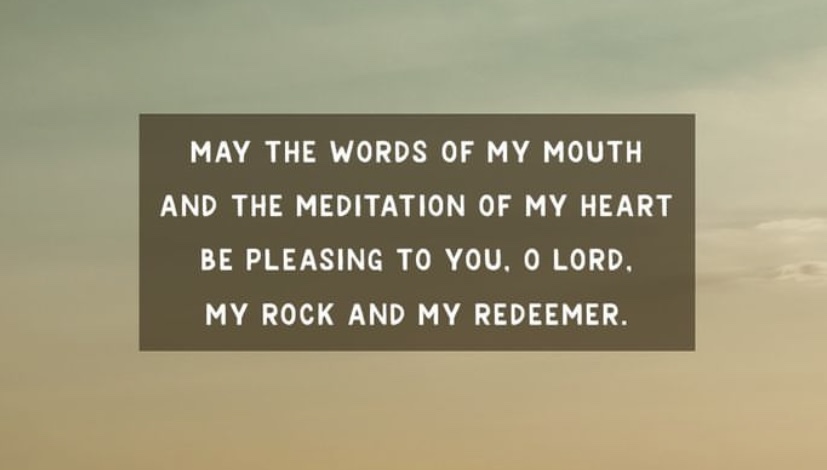
Meditation and prayer is then affirmed in the final verse which brings the psalm to a close: “let the words of my mouth and the meditation of my heart be acceptable to you, O Lord, my rock and my redeemer” (v.14). They echo the plea of another psalm, “hear my prayer, O God; give ear to the words of my mouth” (Ps 54:2).

Yet another psalm affirms that “all the kings of the earth shall praise you, O Lord, for they have heard the words of your mouth” (Ps 138:4), while in another psalm the prayer is, “may my meditation be pleasing to him, for I rejoice in the Lord” (Ps 104:34). Finally, the closing verse of Psalm 19 resonates with a similar affirmation in Psalm 49, “my mouth shall speak wisdom; the meditation of my heart shall be understanding” (Ps 49:3).

Going into the kingdom of God ahead of you (Matt 21; Pentecost 18A)

Two weeks ago, in following along with the excerpts from the Gospel of Matthew which the Revised Common Lectionary has been offering us this year, we heard a parable that threatened that God would torture a person until they forgave a person who owed them a modest debt (18:23–35). Where is the compassion in that? Is this really what we understand God to be like? Should this story really be in our scriptures?

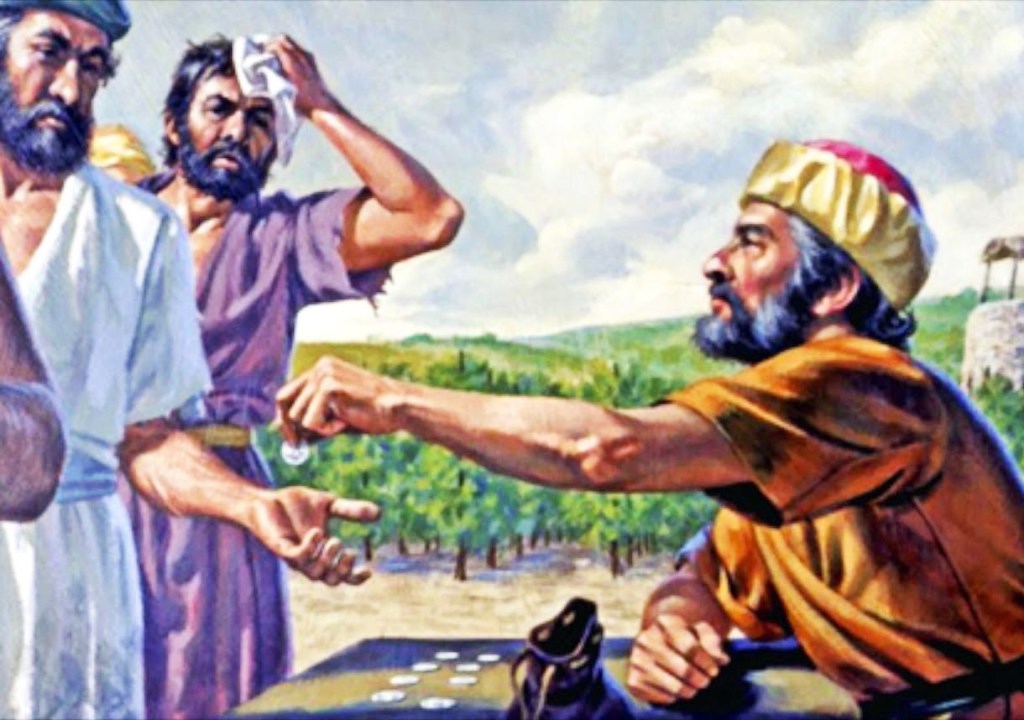
Last week, we heard a parable in which people who laboured in a vineyard for quite different lengths of time were given the same pay at the end of the day (20:1–16). Where is the justice in that? The rationale for this is that “the last will be first, and the first will be last” (20:16)—a saying that Jesus utters on other occasions, as well. Is this really what we understand the kingdom will be like? Does this unjust story really deserve a place in our scriptures?

This week, we will be confronted with a parable in which two sons each say one thing, but do the opposite (21:28–30). Where is the honesty in that? Be a person of your word—do what you say, say what you mean to do! But there is even more, as Jesus continues on after having spoken this parable with words that are even more confronting: “the tax collectors and the prostitutes are going into the kingdom of God ahead of you” (21: 31). Is this really what we have to look forward to? It makes me want to cry out, “Hey! there’s a queue here—just wait your turn!”

Parables, according to Tim Mackie and Jon Collins of the Bible Project, were used by Jesus as “a means of indirect communication to critique and dismantle his listener’s views of the world to show them the true nature of God’s Kingdom.” See https://bibleproject.com/podcast/parables-subversive-critique/

And so that is the case in each of these parables. There’s a good amount of critiquing and dismantling going on; and a fair bit, also, of reconstructing a picture of what that kingdom might well be like. Whilst we might expect—indeed, we might yearn—to have stories which reinforce our view that God is loving, kind, and compassionate to all, the fact is that the parable of the unjust steward—and other sayings of Jesus—insist that God exercises vengeance in the course of ensuring justice.

We might well hope to have stories that communicate that God’s justice means equity and fairness for everyone; yet the parable of the labourers in the vineyard—and other sayings of Jesus—insist that God operates in ways that are counter-cultural and in opposition to the expected norms of fairness in society.

And certainly we might anticipate that Jesus will tell stories that assure us of the claim that a life of faithful obedience and careful adherence to stringent ethical standards will lead to our experiencing the welcoming arms of God, perhaps a prioritised means of entry into the loving embrace of God; yet the conclusion that Jesus offers to the parable of the two sons is completely different, with a shocking declaration that those entering the kingdom ahead of us will be precisely the people that we would expect to be debarred from entry!

What is going on? And in particular, why does Jesus assert that “the tax collectors and the prostitutes are going into the kingdom of God ahead of you” (21:31)?

*****

In the three Synoptic Gospels, Jesus is presented as one who “eats with tax collectors and sinners” (Mark 2:15–16; Matt 9:10–11; Luke 5:30–31). Jesus clearly declares, “I have come to call not the righteous but sinners” (Mark 2:17; Matt 9:13; Luke 5:32). Two of those Gospels also report that he was known as “a glutton and a drunkard, a friend of tax collectors and sinners” (Matt 11:19; Luke 7:34).

Indeed, Matthew, one of the twelve men initially called to be a disciple, was a tax collector (Matt 9:9; 10:3), although in Luke’s narrative he is named as Levi (Luke 5:27). This man, Levi, does not appear amongst the twelve named disciples (Luke 6:13–16; Acts 1:13), and the Matthew named in these Lukan lists is not identified as a tax collector.

In a striking parable reported only by Luke, a tax collector is presented favourably, in contrast to a Pharisee (Luke 18:9–14); that story resonates with the affirmation of tax collectors given at Matt 21:31–32. Soon after that parable is told, Luke reports an encounter that Jesus had with a rich chief tax collector named Zacchaeus (Luke 19:1–10). In this passage, the tax collector acts above and beyond the call,of duty, announcing that “half of my possessions, Lord, I will give to the poor; and if I have defrauded anyone of anything, I will pay back four times as much” (Luke 19:8).

By contrast, in a teaching passage found only in Matthew’s Gospel, tax collectors are linked with Gentiles in a declaration that a recalcitrant sinner who refuses to repent after being given multiple opportunities should be considered “as a Gentile and a tax collector” (Matt 18:17), clearly indicating that they are to be expelled from the community.

That statement appears to be in direct contradiction to the later declaration of the Matthean Jesus that we hear in this coming Sunday’s passage—a declaration that “the tax collectors and the prostitutes are going into the kingdom of God” ahead of the (presumably) faithful disciples, because “John came to you in the way of righteousness and you did not believe him, but the tax collectors and the prostitutes believed him; and even after you saw it, you did not change your minds and believe him” (Matt 21:31–32).

These words seem to correlate with the earlier aphorism of Jesus, “the last will be first, and the first will be last” (Matt 20:16), a saying that recurs in other contexts, when Jesus points to a child as a sign of the kingdom (Mark 9:35) and in response to a declaration of fidelity made by Peter (Mark 10:31; Matt 19:30). Indeed, this latter occurrence in Matthew’s Gospel not only concludes a sequence of incidents set in Judea (Matt 19:1–30), but also introduces the parable we heard last Sunday (20:1–16)—a parable which ends with the very same saying.

“The last will be first, and the first will be last” thus bookends that parable, indicating that it has a programmatic significance. And it is that claim from which Jesus then launches, in this coming Sunday’s reading, into the parable that drives home this upside-down character of the coming kingdom, noting that “the tax collectors and the prostitutes are going into the kingdom” ahead of the disciples, which he then drives home the point with intensity: “even after you saw it, you did not change your minds and believe him” (21:32).

That’s fair warning: Jesus is giving plenty of opportunity for his disciples to hear, understand, and respond to his message. And if we don’t, then he won’t pull any punches! Perhaps that’s actually the point of this parable. So it seems we are back to judgement—a motif that I have noted is intensified and amplified in Matthew’s account of Jesus, when compared with the Gospels of either Mark or Luke. See

Darkness, weeping, and gnashing of teeth: the scene of judgement (Matt 22; Pentecost 20A)

A final parable from the book of origins: on sheep and goats, on judgement and righteous-justice (Matt 25; Pentecost 26A)

We have been given fair warning!!

Is the Lord among us, or not? (Exodus 17; Pentecost 18A)

It’s a good question: “is the Lord among us, or not?” It’s a question posed by the Israelites in the story that the lectionary presents for our consideration this coming Sunday (Exod 17:1–7). It’s a question that people of faith have asked, time and time again, throughout history. It’s a question that is still asked, in our own time, by people experiencing difficulties in their lives.

The people of Israel have been travelling in the wilderness. They entered the wilderness of Shur after crossing the Red Sea (15:22), and continued on into the wilderness of Sin (16:1). We are not told how long they had been in this desert wandering, when they arrived at Rephidim; the whole “wilderness wandering” saga of the Israelites is quite blurred, not only in terms of time, but also in terms of places. It is, after all, a story—not a history, as I have noted in previous blogs. So the teller of this story deems these details unimportant. What is important, by contrast, is what the storyteller chooses to highlight: complaints, leadership, and provision.

The people had already raised a complaint against Moses and Aaron when they had no food to eat (Exod 16:2–3). God had responded by providing food—quails and manna (16:13–14). That precedent, surely, must have meant that, when confronted with another lack—this time, of water—they might immediately have turned to God in prayer, requesting that God supply water. We might have thought this. But no—once again, they turned on their leaders: “the people quarreled with Moses, and said, ‘Give us water to drink’” (17:2A). “Is the Lord among us, or not?”, they wonder.

Moses, understandably, pushes back, saying, “why do you quarrel with me? why do you test the Lord?” (17:2b). Perhaps another line of response—following on from the observations I made in my post last week about the incident in the wilderness of Sin (ch.16)—might have been to show some understanding that the people had been through a series of traumatic events—oppressive slavery, a number of plagues, a hurried escape from Egypt, and then witnessing the mass drowning of the Egyptian army.

The cumulative experience of these traumas could well explain the attitude of the Israelites; suffering piled upon suffering, distress multiplying distress, and an acting-out of bad behaviour, as the text indicates. (Bearing in mind that this is a story, not an actual historical event, so it portrays characters as created by the narrator, and is not reporting on real historical people; and noting also that contemporary psychological insights should be applied with great caution—if at all—to stories from antiquity!)

But the story indicates that the people did not cave under the pressure from Moses. In response to his accusatory questions—“why? why?”—we are told, “the people thirsted there for water; and the people complained against Moses and said, ‘Why did you bring us out of Egypt, to kill us and our children and livestock with thirst?’” (17:3). It’s an unreasonable accusation. Moses most certainly was not leading them out of their state of slavery to kill them—he was seeking to save them, to rescue them and bring them into a new state of refuge and safety.

However, their state has led them to make unreasonable accusations. So Moses then intercedes with God: “what shall I do with this people?”, noting that “they are almost ready to stone me” (17:4). The crisis has not been averted! “Is the Lord among us, or not?” remains a key question.

*****

The response of God is not to equip Moses with words to speak to the Israelites (which is what he did when calling Moses, initially, in Exod 3:15–22), but to encourage Moses to act in a way that will persuade the Israelites (as he did when Moses pushed the point, earlier on, in Exod 4:1–9). “Is the Lord among us, or not?” Moses is going to ensure that they sense that he is, indeed, present.

The prophet, in ancient Israel, was called and commissioned to speak words to the people—to be the mouthpiece of the Lord God—and also to enact the justice and mercy that God shows towards the people, in deeds. That dual role is integral to the calling of Moses (Exod 3:1—4:17), who serves as the role model supreme for prophets in Israel (Deut 18:15; 34:10) and serves also as the template for Jesus, as Peter declares (Acts 3:20–26).

So Moses leads the people by acting in a way that directly meets the ends of the people. “Give us water”, they cry; so Moses struck the rock, confident that “water will come out of it, so that the people may drink” (Exod 17:6)—and indeed, the water did flow, and the people did drink. “Is the Lord among us, or not?” Moses is hoping to demonstrate that this is a question that invites—indeed, requires—the answer, Yes!

That place, like many other places in the narratives of Genesis and Exodus, is named for what takes place there. However, the place is not named in a way that highlights “the people drank”. Rather, it is named Massah and Meribah, “because the Israelites quarreled and tested the Lord, saying, “Is the Lord among us or not?” (17:7). Massah means “testing” and Meribah means “quarrelling”. That’s quite a name for this place to be known by!

The place is to be remembered for the difficulties that took place there—not for the miracle of providing water at that place. The larger narrative of the dramatic Exodus from Egypt and the lengthy wilderness wanderings does not shy away from the difficulties and conflicts of that part of the story. Those tensions and conflicts need to be told, and remembered. The wilderness was not an easy place to be. “Forty years” in the wilderness (that is, a heals-long time, indeed) was not an enjoyable experience to have.

Elsewhere in Hebrew Scripture, the forty years in the wilderness are remembered and described in ways that overlook or remove any reference to those difficulties and conflicts. Jeremiah, at his calling, is charged to declare the word of the Lord: “I remember the devotion of your youth, your love as a bride, how you followed me in the wilderness, in a land not sown” (Jer 2:2). One psalm retells the saga of the Exodus from Egypt and the time in the wilderness (Ps 136:10–16) and inserts a repeating refrain of gratitude to God after each statement, “his steadfast love endures forever”. This psalm makes it seem like it was a wonderful experience to have had!

Similarly, Hosea remembers fondly how the Lord God loved Israel and “led them with cords of human kindness, with bands of love; I was to them like those who lift infants to their cheeks; I bent down to them and fed them” (Hos 11:1,4)—although he does note that, sadly, “the more I called them, the more they went from me; they kept sacrificing to the Baals, and offering incense to idols—yet it was I who taught Ephraim to walk, I took them up in my arms; but they did not know that I healed them” (Hos 11:2–3). That’s a realistic recollection of the time.

So various psalms, likewise, remember this time as a difficult period of time. One psalmist recalls this very incident as a time “when your ancestors tested me, and put me to the proof, thought they had seen my work; forty years I loathed that generation and said, ‘They are a people whose hearts go astray, and they do not regard my ways’” (Ps 95:10).

Another psalm remembers the strong faith evident through the Exodus, but goes on to lament that “they believed his words; they sang his praise; but they soon forgot his works; they did not wait for his counsel … they had a wanton craving in the wilderness, and put God to the test in the desert … they were jealous of Moses in the camp, and of Aaron, the holy one of the Lord” (Ps 106:12–16). In Deuteronomy, this time is remembered as “the great and terrible wilderness, an arid wasteland with poisonous snakes and scorpions” (Deut 8:15).

Two ways of remembering those years: a time of great blessing from God; a time of great testing for Israel. “Is the Lord among us, or not?” is a key question—one worth remembering and pondering in any time of difficulty or challenge. We might well ask ourselves, then: how do these two very strong memories—these two vivid expressions of the drama of Israel—relate to one another, inform one another, enrich one another?

See also
A parable of grace—and a story of grace (Matt 20 and Matt 27; Pentecost 17A)

A sermon on Matthew 20:1–16, written and preached by the Rev. Elizabeth Raine

The Gospel of Matthew was the subject of my PhD research, and I so enjoy teaching that Gospel to groups of people, especially when it comes around in the lectionary (as it has this year). And this might well lead you to think that I look forward to being able to share something of my interest in that gospel in weekly sermons.

However, I have found that as much as I like teaching Matthew, I actually don’t like preaching Matthew—at least not the passages that have fallen to my lot in recent months. You may have noticed that in most of the gospel readings we have heard over the few months, there is almost always a line or two about judgment, eternal punishment, and wailing and gnashing of teeth. Last week’s reading was no exception, with the unforgiving slave finding himself not only unforgiven, but also condemned to be tortured.
Matthew is very fond of predicting a harsh judgment and eternal punishment for his enemies. His gospel contains more references to hell and eternal punishment that most of the New Testament put together, with the possible exception of the book of Revelation. He sneaks these references into his material wherever possible, changing his Markan source to reflect his own interests in God’s wrath.

Now while this is interesting to teach, it is not very helpful when trying to construct a sermon that is meant to give food for thought and help folk reflect on their faith. Not all of us want our enemies to be gnashing teeth and wailing in hell. When I teach and research Matthew, I find myself often asking this question of Matthew’s gospel: what are its redeeming features as far as nurturing faith goes?

This is actually tricky to answer. Even last week’s teaching on forgiveness was undermined by the harsh punishment of the slave. And Matthew is actually a grace-free gospel, in that the Greek word for grace, charis, is never used by the author. Many of the stories in Matthew have a pronounced down side. Matthew often includes things such as alienation from family, name-calling, murder, impossible ethical demands and eternal damnation in his gospel.

However, Matthew does have one unique and I think, extraordinary act of redemption in his gospel, apart from Jesus’ death.

I will start with explaining what this is by using this week’s reading. The parable we encounter in this passage (Matt 20:1–16) is unique to Matthew’s Gospel. As such, it may be considered an insight into the special focus of the Gospel, and reflect something of the writer’s understanding of life around him in first century Palestine.

This story of the vineyard workers may well be taken straight from agricultural life in a Palestinian village. Like many of Jesus’ parables, it draws on images and practices familiar to the lifestyle of the crowds who gathered around Jesus to listen to him. Such familiarity would have caught the crowd’s attention and helped them understand the religious teaching that Jesus wanted to convey.

Like many of Jesus’ parables, though, the story has an unexpected twist. Even in first century Palestine, the concept of equal work for equal pay was an established principle. But here we find the vineyard owner paying the same wage to the labourers, regardless of how much or how little time they worked during the day. Such an uneconomical practice must have taken the crowd by surprise. What lord or owner would make such a foolishly generous offer?

The clue is in the last verse of the story, in a saying that Jesus has used a number of times, and one that was no doubt familiar to his disciples and regular followers: “the last shall be first and the first shall be last”.

With this phrase, the vineyard is revealed as the kingdom of heaven, and the owner is, of course, God – the God who is as generous to those who seek his kingdom at the last minute as he is to those who found it much earlier.

The verses which follow after this parable show that it must have been difficult for the disciples to hear, especially James and John! The request of the mother of James and John made it clear that they and the other disciples had given up everything they had to follow Jesus, with the expectation of heavenly reward. Now those who would join the movement later, who have not given up so much or suffered as long, would be greeted by God as equals.

Most scholars think that Matthew may have included this story to defend Jesus’ inclusion of sinners in the kingdom as well as the righteous, though this doesn’t explain why the emphasis is on those who come to the kingdom later. Maybe Jesus meant the story to be understood symbolically, with the ‘last’ being the same as the ‘least’, and thus servanthood and humbleness are being emphasised.

I have another take on this. In a swift segue, I am now jumping into another story in Matthew that does not make it into the lectionary. And that is the story of Judas.

What do we remember Judas for? What is his story? Does anyone remember how Judas died?

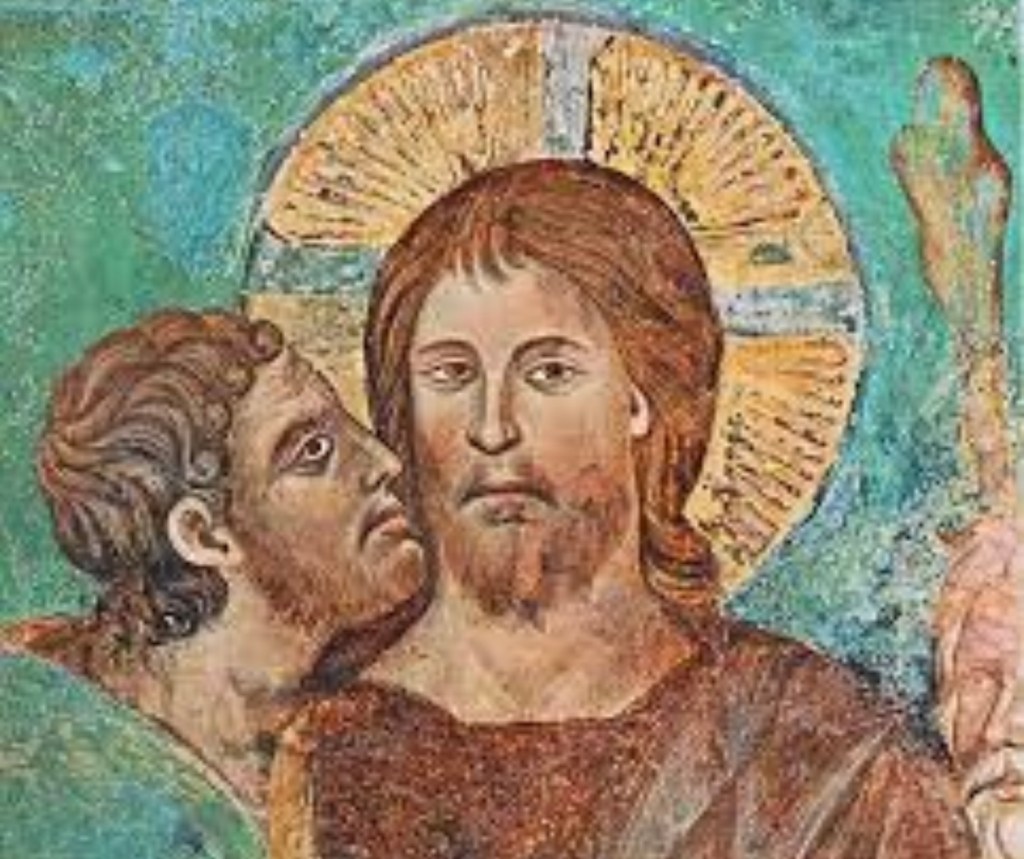
All the gospels state that Judas goes to the chief priests and asks for money to betray Jesus. Luke and John both state that Satan entered into Judas. John also calls him a devil and a thief. All the gospels have Judas arrive in the Garden of Gethsemane to betray Jesus with a kiss. It is what happens after this that is unique to Matthew.
Judas, as befitting his actions, meets with an untimely end. There is one version of Judas’ death in Acts: this man acquired a field with the reward of his wickedness; and falling headlong, he burst open in the middle and all his bowels gushed out. This became known to all the residents of Jerusalem, so that the field was called in their language Hakeldama, that is, Field of Blood. (Acts 1:18).

Another less familiar version of Judas’ death is found in the second century church father Papias. Papias obviously had a colourful imagination. A fourth century bishop named Apollonius cites what a second century bishop named Papias apparently claimed about Judas: Judas did not die by hanging, but lived on, having been cut down before choking. And this the Acts of the Apostles makes clear, that falling headlong his middle burst and his bowels poured forth.

Apollonius goes on to say that Papias the disciple of John records this most clearly, saying thus in the fourth of the Exegeses of the Words of the Lord: Judas walked about as an example of godlessness in this world, having been bloated so much in the flesh that he could not go through where a chariot goes easily, indeed not even his swollen head by itself. For the lids of his eyes, they say, were so puffed up that he could not see the light, and his own eyes could not be seen, not even by a physician with optics, such depth had they from the outer apparent surface. And his genitalia appeared more disgusting and greater than all formlessness, and he bore through them from his whole body flowing pus and worms, and to his shame these things alone were forced [out]. And after many tortures and torments, they say, when he had come to his end in his own place, from the place became deserted and uninhabited until now from the stench, but not even to this day can anyone go by that place unless they pinch their nostrils with their hands, so great did the outflow from his body spread out upon the earth.

One of the exercises we do in introduction to New Testament Studies is to examine which, or indeed, any account of the death of Judas could be historical. Most of the students find these two versions to be fiction. But we do have another account in the gospel of Matthew.

Matthew treats Judas differently from the beginning. For a start, only Matthew mentions the sum of 30 pieces of silver being Judas’ fee for the betrayal. The sum of 30 shekels of silver was the value put on the Lord by the corrupt leaders of Israel in the book of Zechariah.

Only in Matthew does Judas ask the question “Is it I, Rabbi?” when Jesus states that one of them will betray him. Just as an aside here, in Matthew’s gospel, Jesus is only called rabbi twice, and both times it is by Judas.

At the moment of the betrayal, only in Matthew does Jesus refer to Judas as ‘friend’, and he also tells him “may that for which you are here be done”. This is rather different to the question of Luke’s Jesus: “Judas, do you betray me with a kiss?” The Jesus of Mark and John says nothing to Judas at this point.

Whilst the account found in Luke—Acts indicates that Judas goes off to enjoy his ill-gotten gains, and is only cut short in this aim by some judicious punishment on God’s part, the story is very different in Matthew.

In a passage unique to this gospel, the Judas of Matthew is overcome with remorse when he sees Jesus is condemned. He repents, returns the thirty pieces of silver to the chief priests and elders, and states that he has “sinned by betraying innocent blood”. Met with disinterest and no compassion by the priests, Judas throws the money down in the temple, then leaves, to hang himself. The Greek in Matthew leaves us in no doubt as to Judas’ self-inflicted fate, despite Papias’ attempts to resurrect him so he can then unrepent, and go off and buy his field as per the account in Acts.

Judas, through Christian history, has been demonized for his actions. One can see this beginning in the later gospels of Luke and John, who insist that Judas was a sinner possessed by the devil or Satan, and of course in the later Papias, whose Judas is a very caricature of evil. Matthew does not join in this demonisation of Judas. Not only that though, Matthew goes even further, in that Matthew offers to Judas one of the greatest acts of salvation in our New Testament – he actually redeems Judas.

How can you be sure of that?, I hear you cry. Firstly, note that Judas repents. Repent is a word used sparingly in this gospel. It first appears with John the Baptist, he cries to people to ‘repent for the kingdom of heaven draws near”. John also tells them to ‘bear fruit worthy of repentance’. Jesus echoes the cry of ‘Repent, for the kingdom has drawn near’ in the next chapter.

In chapter 11, Jesus upbraids the cities of Chorazin and Bethsaida for not repenting, despite having many miracles carried out in them. In chapter 12, he reminds the unrepentant that the city of Ninevah repented when hearing Jonah’s proclamation about God. Where does Judas’ repentance fit with this?

The depiction of Judas throughout Christian history as infamy embodied has led most exegetes to the conclusion that this repentance in Matthew is merely regret, and not genuine repentance.

I have two things to say to this view. Firstly, it would seem that suicide is a rather drastic reaction to mere regret. Suicide speaks of deep remorse and repentance to me. Secondly, Matthew does not use ‘repent’ unless he means it. In fact, in the parable that follows this one in chapter 22, Matthew uses this very word to describe the actions of the son that initially refused to work in the vineyard, then changed his mind (or repented) and went. Jesus makes the point it is this son who did the will of the father.

So we should assume that Judas’ repentance is genuine. This is underscored by Judas not keeping the money but returning it.

Last of all, we need to consider Judas’ motivation in his act of betrayal. In looking at this, we should note firstly that Jesus goes to his death obedient to the will of God. Judas, therefore, becomes part of enacting the will of God. So the question is raised, “Does Judas have a choice”? I am sure that Matthew doesn’t think so, despite Jesus saying earlier ‘woe to the one who betrays the son of man’. The eventual fate of Judas bears out Jesus words, but does not damn him eternally.

The next surprise is that Jesus calls Judas ‘friend’ at the moment of betrayal, and makes the thoughtful statement “may that for which you are here be done” to Judas, implying some sort of foreordained action. 

The knock down argument is the scriptural fulfillment that follows hard on the telling of Judas’ demise, when the priests decide to purchase a field with the money:

Then was fulfilled what had been spoken through the prophet Jeremiah, “And they took the thirty pieces of silver, the price of the one on whom a price had been set, on whom some of the people of Israel had set a price, and they gave them for the potter’s field, as the Lord commanded me.” (Matt 27:9–10)

And Judas’ actions in betraying Jesus for 30 pieces of silver, is from the prophet Zechariah, another scriptural fulfillment allusion to the betrayal and sale of the Lord.

Now Matthew’s God is somewhat wrathful in his judgments, but is always just. If Judas had no choice, how can he then be condemned?

Judas’ suicide resembles that of Ahithophel, the man who had assisted Absalom in his rebellion against King David, and was thus the betrayer of David. Like Judas, Ahithophel hangs himself, yet is still described by many of the rabbis as having entered the world to come, or heaven as this world was known.

Judas not only shows regret and remorse, he repents, and in doing so, makes a confession to the priests of his guilt. He returns his ill-gotten gains. When the priests refuse to take the money, Judas throws it into the temple. When they do not reconsider his crime for the shedding of innocent blood, Judas enacts the appropriate punishment on himself. He seeks to make atonement through his own death.

Christians have always given lip service to the notion that even in the last days of life, true repentance is possible. However, the tradition in regard to Judas has consistently and systematically denied him this.

Not so Matthew. His parable of the workers in the vineyard insists that all who come to the right understanding of Jesus and God, even if it be very late in the day, will be welcome in the kingdom. Surely, in accord with the story he tells, this must include Judas.

Matthew, this grace-free, most judgmental of gospels, is also the gospel that extends the most mercy to one of Christianity’s most hated characters. Whatever Matthew’s exact reasons for his version of events, the parable – and its corollary in the story of Judas – surely must remind us of God’s overwhelming grace, a grace that is inclusive of all who would seek God.

Matthew: tax collector, disciple, apostle, evangelist—and “scribe trained for the kingdom”?

Today, 21 September, is the day in Roman Catholic and Anglican (and some Protestant) churches when Matthew is honoured as a saint. Matthew is best known for the fact that his name is attached to the first Gospel, in the order that the four Gospels appear, in the New Testament. So today is a good day to reflect on the figure remembered by many as Saint Matthew.

We know, however, that this Gospel wasn’t the first written Gospel—that was Mark’s, which clearly was a source used by the author of Matthew’s Gospel. By tradition, the attributed author of this Gospel, Matthew, was a tax collector whom Jesus called to follow him. (Why a tax collector who followed Jesus would take the work of a junior and erratic follower as the basis for his work, remains unexplained.)

At any rate: after this tax collector became a disciple of Jesus, he was appointed as an apostle, and later he allegedly wrote an eye-witness account of the time he spent with Jesus. That account runs up until the crucifixion and burial of Jesus, and is wrapped around with some opening chapters about the beginnings of the life of Jesus, and a closing chapter relating to the body of Jesus, his resurrection and departure from his followers.

The tradition that this first Gospel was an eye-witness account by one of the twelve apostles has come under careful scrutiny from biblical scholars, exploring the language, structure, imagery, and ideas found in that narrative.

The consensus from this scholarly work is that the first Gospel in the New Testament was not an eye-witness account, but a carefully crafted account of Jesus, originating in a community of people who had maintained their Jewish culture and practices whilst affirming that Jesus of Nazareth was the long-awaited Messiah—a community that was, therefore, in conflict with the views and teachings of the synagogue leaders in their town, who did not see Jesus in that way.

Within ecclesial tradition, the picture of Matthew, tax collector—disciple—apostle, who subsequently wrote an eye-witness account of the time he spent with Jesus, holds sway. Within biblical scholarship, Matthew is simply a character who appears briefly in the story told by the first Gospel in the New Testament.

Matthew is identified in one short verse narrating his call by Jesus (Matt 9:9). He is also included in the list of twelve who were called to be apostles, with the added descriptor, “the tax collector” (Matt 10:3). He is also named in three other books, with nothing further said about him (Mark 3:18; Luke 6:15; and Acts 1:13). But little else about him is conveyed in the four books that name him. See

Those five fleeting references are the only times we see directly this person in the biblical narratives. He is surely there in other scenes, but he simply blends into the collection of “the disciples” (Mark 2:23; 3:7; 5:31: 6:1, 35, 41, 45; 7:17; 8:1–10, 14, 27, 34: 9:14, 28, 31; 10:10, 13, 23–24; 11:19; 12:43; 13:1; 14:12–16; and Synoptic parallels), “the twelve” (Mark 4:10; 6:7; 9:35; 14:20; and Synoptic parallels; and John 6:66–71; 20:24), or, even more anonymously, into “the crowd” (Mark 2:4, 13; 4:1; Matt 7:28; 13:2; Luke 5:1; 6:17; 7:11–12; 8:4; John 6:2; 12:9, 12; Acts 1:15; 2:6; etc.).

And yet, in the evolving church traditions, Matthew emerges from the shadows to take centre stage as disciple, apostle, saint, and author of the Gospel which is placed first in the New Testament. Some churches even maintain the patristic claim that Matthew wrote in Aramaic, and was later translated into the Greek version that forms the basis of the New Testament text.

The claim about Aramaic comes from a fourth century report by Eusebius of Caesarea that a second century bishop, Papias of Heirapolis, claimed that Matthew “put the logia in an ordered arrangement in the Hebrew language (Ἑβραΐδι διαλέκτῳ), but each person interpreted them as best he could” (Eusebius, Ecclesiastical History 3.39.16). We should note that this is a somewhat indirect witness at quite some remove, and also that the Greek word Ἑβραΐδι can be translated either as Hebrew or as Aramaic.

But this claim falls down from the clear evidence of the Greek text of Matthew’s Gospel, which mirrors very closely both the Gospel of Mark, at many points, and the Gospel of Luke, at other points, in passages found only in Matthew and Luke.

The two key conclusions drawn by many scholars are twofold: first, that Matthew (like Luke) used the Gospel of Mark as a basis for writing a narrative about Jesus—but modified and adapted both the order and wording of passages; and second, that Luke and Matthew had access to another source (whether oral or written) for many of the sayings of Jesus (the source is known as Q). This makes it completely unlikely that Matthew wrote, in Aramaic, or in Hebrew, the earliest account of Jesus.

And ascribing the authorship of this Gospel to the tax collector identified at Matt 9:9 is also a patristic move. The title of this (and the other) Gospels, identifying the alleged author, is found only in later manuscripts and patristic writings; the narrative itself fails to identify anyone as the author, let alone the tax collector named Matthew. This claim is a later apologetic move, most likely made to provide an “apostolic authorisation” to the Gospel.

See

So what do we say, then, of “Matthew”, the purported author of this Gospel, a work which the author declares at the start to be “the book of origins of Jesus, Messiah” (Matt 1:1)? For me, a key to the way that the author of this “book of origins” operated is provided at Matt 13:52, where Jesus concludes a sequence of parables with the statement that “every scribe who has been trained for the kingdom of heaven is like the master of a household who brings out of his treasure what is new and what is old”.

That description encapsulates very clearly, for me, who the author of this Gospel was—a scribe, “trained for the kingdom”, drawing on old resources, but reshaping them so that they are seen to be new. We can see this in many ways in the narrative that he constructs. We can especially see this in the way he presents Jesus as an authoritative teacher of Torah—the one whose words are to be heard, remembered, studied, and passed on. Thus, the reason for his writing of this Gospel.

In this Gospel, we are offered a distinctive, at times unique, portrayal of Jesus. Only in this Gospel does Jesus affirm that all of “the law and the prophets” stand, are not to be annulled, and indeed have been “fulfilled”, or given new life and meaning, by what Jesus teaches (Matt 5:17–20).

So the encounters between Jesus and his disciples, and the scribes and Pharisees, at various moments in the narrative (9:2–8, 10–13; 12:38–42; 15:1–20; 16:1–4; 19:3–9; 21:15–16; 22:34–46) inevitably revolve around differing interpretations of Torah prescriptions and include regular references to (Hebrew) scriptural passages.

Jesus debates the way that the scribes and Pharisees interpret Torah; he meets them on their terms, and engages in these debates in accordance with “the rules” of scripture interpretation. Far from abandoning the Torah, he rather keeps the commandments, valued as “what is old”, and provides distinctive insights and understandings, “what is new”, as he intensifies and radicalises them. (“You have heard it said …”, hard enough; “but I say to you …”, an impossible counsel of perfection?)

In this Gospel alone, Jesus affirms “the scribes and the Pharisees” as those who “sit on Moses’ seat” and teach well—but fail to live by that teaching in their lives (23:1–3). Accordingly, Jesus not only teaches how to live by the law, with a ferocious intensity (5:21–48; 23:13–36), but he puts his teachings into practice; he maintains the old but fills it with new meaning. He “brings out … what is new and what is old”. All of this is central to the way that this anonymous scribe has told the story of Jesus. And that is worth remembering today.

Turning to Philippians (Pentecost 17A)

At the completion of the long sequence of Epistle texts that the lectionary has offered from Romans 4–14 (Pentecost 2A to 16A), we now turn our attention to a letter that had been written to “all the saints in Christ Jesus who are in Philippi, with the bishops and deacons” (Phil 1:1). The section that is offered for this coming Sunday (Pentecost 17A) is Phil 1:21–30, which begins with the assertion, “for me, living is Christ and dying is gain” (1:21), and then goes on to offer a sympathetic identification with the Philippians in their struggles—“since you are having the same struggle that you saw I had and now hear that I still have” (1:30).

This means that we miss the opening section of this letter, where some important foundational factors are set forth. The opening verse indicates that the authors are “Paul and Timothy, servants of Christ Jesus”, which means that this letter, like three other authentic letters of Paul (2 Corinthians, 1 Thessalonians, and Philemon), has input from Timothy, whom Paul describes as “my beloved and faithful child in the Lord” (1 Cor 4:17), “our brother and co-worker for God in proclaiming the gospel of Christ” (1 Thess 3:2).

Timothy is claimed as co-author in two further letters written after the lifetime of Paul (Colossians and 2 Thessalonians), whilst another two letter, most likely from an even later time, towards the end of the first century, are written to Timothy, to encourage Timothy in his later role as “a good servant of Christ Jesus, nourished on the words of faith and of the sound teaching that you have followed” (1 Tim 4:6), and to “guard what has been entrusted to you” (1 Tim 6:20; 2 Tim 1:14).

In this letter, however, Timothy has matured from the young apprentice who has accompanied Paul in his activities in Philippi, Thessalonica, Beroea (Acts 16:1—17:14), and then in Corinth, Ephesus, Macedonia, and Troas (Acts 18:5—20:6). He has experienced much as he travels with Paul during this critical period. His faith, like Paul’s, had been tested, and strengthened by these experiences.

And perhaps Timothy continued with Paul, and others, in the journey beyond Troas. Was Timothy part of the “we” who are said to have made the journey from Troas to Miletus, then Cyprus, Ptolemais, Caesarea, and into Jerusalem (Acts 20:7—21:26)? If so, he was witness to many significant events in the latter part of the public activities of Paul, right up to the time of his arrest (Acts 21:27–36) and his very public defence in Jerusalem (Acts 21:37—22:21). Assuming, of course, that the account in Acts has a level of historical plausibility and accuracy (an assumption that needs to be tested at each stage along the way.)

The recipients of this letter are “all the saints in Christ Jesus who are in Philippi, with the bishops and deacons” (1:1). Philippi, like Thessalonica, was also located on the major transport link of the Egnatian Way. The site had first been colonized in the fourth century BCE, probably because of its abundant water supplies and fertile land. The discovery of gold nearby led Philip, the father of Alexander the Great, to establish a Macedonian garrison there in 356 BCE and fortify the city.

This Macedonian colony grew in size over time and became a Roman colony after the Battle of Philippi in 42 BCE, when Mark Antony and Octavius defeated Brutus and Cassius, the assassins of Julius Caesar.

A community of believers was established in the city during Paul’s visit, as reported in Acts 16:11–40; Paul himself refers briefly to this visit (1 Thess 2:2) and a subsequent visit to the city is mentioned in Acts 20:5. Later evidence for an ongoing Christian presence comes from a letter of Polycarp to the church in Philippi (about 160 CE).

This letter to the Philippians follows the typical letter structure in general terms only. There is a long main section (1:12–4:7, the body of the letter), introduced by a standard address and thanksgiving (1:1–11) and concluded by exhortations and greetings (4:8–23). The body of the letter is an extended encouragement to unity, initially signalled in the key term koinonia (“sharing”, or “fellowship”) which appears twice in the opening thanksgiving (1:5, 7).

We might well assume that the personal,references in this letter relate directly to Paul—certainly, that is the assumption of most interpreters. So it is Paul who states that he is writing this letter during one of his numerous periods of imprisonment. He refers directly to his imprisonment (1:7, 12–14, 17) and links that with his experience of suffering (1:17, 29–30). Later in the letter he develops a theological understanding of his situation by linking his suffering to that experienced by Jesus in his crucifixion, as a precursor to his resurrection (3:7–11).

However, attempts to specify his precise historical situation cause puzzlement. References to “the whole imperial guard” (1:13)—using the Latin term praetorium—and to “the emperor’s household” (4:22) might suggest that Paul and Timothy were writing to the Philippians when Paul was under imperial arrest in Rome, in the early 60s (as reported in Acts 28), but these terms were also used to describe the Roman military presence and civil serviced in provincial centres away from Rome. So the letter could have originated in any Roman-controlled city.

Other suggestions are that the letter was written when Paul was under arrest either in Caesarea (Acts 24–26), or in Ephesus (on the basis that 2 Cor 1:8–9 refers to a time in prison in that city). The latter claim is made because Caesarea and Rome are further away from Philippi, whereas there seems to have been a relatively short distance between Paul and the Philippians, enabling visitors to move back and forth in prompt fashion (2:19–30; 4:10–18). Ephesus would fit better because it was closer to Philippi. This places the letter near the end of the time that Paul was active in his evangelising mission.

The instruction that sits within the passage we hear this coming Sunday, “live your life in a manner worthy of the gospel of Christ” (1:27), is an instruction that signals a key concern in this letter. Indeed, in the following chapter, Paul and Timothy intensify this with an encouragement to “let the same mind be in you that was in Christ Jesus” (2:5), before citing an early Christian hymn (2:6–11), that we will read on the following Sunday.

Later in the letter, the Philippians are urged to “rejoice in the Lord” (3:1), to “stand firm in the Lord” (4:1), and to “keep on doing the things that you have learned and received and heard and seen in me, and the God of peace will be with you’ll (4:9). The tone of sensitive encouragement to follow the example offered by Jesus runs throughout the letter, which has a markedly friendly tone in most sections of the letter.

In later weeks, the lectionary omits the one section of the letter, 3:2–4, which is the clear exception to this! Perhaps the antagonism to which this short section points (in the reference to “dogs” and “evil workers”) underlies the brief comment in the section that we read this Sunday, when Paul and Timothy indicate that they wish to know “that you are standing firm in one spirit, striving side by side with one mind for the faith of the gospel, and are in no way intimidated by your opponents” (1:27–28). Apart from these fleeting notes, the tone of this letter is positive, encouraging, and affirming.

The road to freedom: seeking the safety of refuge (Exod 16; Pentecost 17A)

This coming Sunday, we will hear a story that didn’t happen—yet a story that is always happening. Like all the stories we have heard in previous weeks—stories of Abraham, Sarah, and Hagar, of Isaac and Rebekah, stories of Jacob, Leah, and Rachel, and the twelve sons of Jacob, the stories of Joseph and his brothers and the stories from early in the life of Moses—these stories did not actually happen as they are reported; but they are told because the dynamics at work in the stories reflect the realities of life as humans experience it.

I don’t think we can say that these ancestral stories happened as actual historical events. Certainly, the historical elements in the story of the Exodus are impossible to validate using the standard methods of historical criticism. However, they are worth remembering and retelling, because they are always happening, in the murky depths of human life.

So this year in the lectionary cycle, as we read and hear these stories yet again, they refresh our understanding of life and they take us into the centre of our existential being. They have been told and retold throughout the centuries, because they express things that are deep within our lives.

The people depicted in the wilderness in today’s passage (Exodus 16:2–15) are quite relatable characters, to me. We are introduced to “the whole congregation of the Israelites” right at the start, and are told that they “complained against Moses and Aaron in the wilderness” (v.2). I’m going to pass on making any connection between this verse and any congregation of which I have been a part, or in which I have ministered. Let’s just say that humans complaining should not be a surprise to us!

However, let’s pause and consider: the complaint raised by the Israelites against Moses and Aaron appears to be quite unreasonable. How long have they been travelling in the wilderness? And already they seem to think that life was better for them back in Egypt, where “we sat by the fleshpots and ate our fill of bread”. Now, in the wilderness, the accuse their leaders of wanting “to kill this whole assembly with hunger” (v.3).

However, if you put yourself into the situation of the Israelites, you might well have a more empathic understanding of their situation. Their years in Egypt were intensely difficult: the Egyptians “set taskmasters over them to oppress them with forced labour … [they] became ruthless in imposing tasks on the Israelites, and made their lives bitter with hard service” (Exod 1:11–14). How were the Israelites to respond? Fright? Fight? or Flight??

We might hypothesise—imagining what might have been going through the minds of the Israelites in the story as they considered their situation. (As noted above, I don’t think that this was an actual historical event—but it is told in Exodus as a history-like narrative, and that history-like character invites us to consider how the hypothetical characters in that story might have thought and acted.)

In such a situation, fright would have been an understandable response. The power of the Egyptian overlords would have generated fear amongst the Israelites as they struggled to complete the increasingly demanding tasks imposed upon them. As there presumably were many years between the death of Joseph (Gen 50:26) and the time when “a new king arose over Egypt, who did not know Joseph” (Exod 1:8), that suggests that fright gripped the people and paralysed them into inaction. They continued as slaves under increasingly difficult conditions.

The thought of fight might have entered the minds of some—standing up for their rights and asserting themselves in order to gain freedom may well have been suggested, even debated, during this extended interim period. Indeed, as the story recounts, Moses himself, fuelled by a passion for justice and a dislike of injustice, was known to have intervened with passion and force into a situation of injustice—such that “he saw an Egyptian beating a Hebrew, one of his kinsfolk; he looked this way and that, and seeing no one he killed the Egyptian and hid him in the sand” (Exod 2:11–12). The next day, fearing that his actions were known, he fled across the desert to Midian, where he remained for quite some years.

Would Moses have thought to press hard against his Egyptian overlords, agitating for them to act justly in relation to the Israelites? His initial thoughts in this regard may well have been completely deficient—that is, until he had encountered God in the burning bush (Exod 3:1–5). From that bush, the voice had come, commissioning Moses to approach Pharaoh “to bring my people, the Israelites, out of Egypt” (3:10).

Moses, of course, argued with God about what that would mean (3:11–4:17)—but in the end, he returned to Egypt (4:18–31) with the intention of confronting Pharaoh, to say “Let my people go” (5:1). The initial request was simply “so that they may celebrate a festival to me in the wilderness” (5:1)—but Pharaoh was resistant, leading to the long sequence of divinely-initiated plagues (7:14—10:28), culminating in the plague of the death of “all the firstborn in the land” (12:29–32).

It was flight, however, which won the day for the Israelites—after they, in turn, had been convinced by Moses that this was what God wanted them to do (12:3, 21–28). And that flight, according to the story line, was supported by the interventions of the divine into the sequence of human events: “at midnight the Lord struck down all the firstborn in the land of Egypt, from the firstborn of Pharaoh who sat on his throne to the firstborn of the prisoner who was in the dungeon” (12:29), and then “the Lord brought the Israelites out of the land of Egypt, company by company” (12:51), and then “the Lord went in front of them in a pillar of cloud by day, to lead them along the way, and in a pillar of fire by night, to give them light, so that they might travel by day and by night” (13:21).

Then, when confronted with the sea in front of them, “the Lord hardened the heart of Pharaoh king of Egypt and he pursued the Israelites, who were going out boldly” (14:8), and then “the Lord drove the sea back by a strong east wind all night, and turned the sea into dry land; and the waters were divided. The Israelites went into the sea on dry ground, the waters forming a wall for them on their right and on their left. The Egyptians pursued, and went into the sea after them, all of Pharaoh’s horses, chariots, and chariot drivers.” (14:21–23).

And so the story resolves the tension: “the Lord tossed the Egyptians into the sea. The waters returned and covered the chariots and the chariot drivers, the entire army of Pharaoh that had followed them into the sea; not one of them remained. But the Israelites walked on dry ground through the sea, the waters forming a wall for them on their right and on their left.” (14:27–29).

The Israelites, so the story reveals to us, had thus experienced a long sequence of frightening and troubling events—culminating in their witnessing the mass drowning of the army that was pursuing them. The narrator makes it clear that “the Lord saved Israel that day from the Egyptians; and Israel saw the Egyptians dead on the seashore” (14:30). Today, meeting people who had experienced such a sequence of events, we would recognise that they had been immersed in a series of traumas, and we would readily explain their current state of being with reference to PTSD—post-traumatic stress disorder.

Of course, as we have noted, the narrator shrugs all of this off with the glib summation, “Israel saw the great work that the Lord did against the Egyptians; so the people feared the Lord and believed in the Lord and in his servant Moses” (14:31). The narrator expects the people in the story to move on. And so we are then given the full set of lyrics of the song that Moses led the people in singing, “I will sing to the Lord, for he has triumphed gloriously … the Lord is my strength and my might … this is my God, and I will praise him” (15:1–18), followed by a recapitulation of the earlier verses in the song that Miriam and the women sang, “Sing to the Lord, for he has triumphed gloriously; horse and rider he has thrown into the sea” (15:21).

But as the story continues on, the narrator cannot but help give indication of the ways that the trauma of this long sequence of events has impacted on the Israelites. The first indication of that comes in the complaint of the people when they could find no water; they cried out to Moses, and God intervenes again to enable him to provide water for drinking (15:22–25). The next indication comes in the passage which the lectionary offers us this coming Sunday, when another set of complaints is brought against Moses and Aaron, for the people are now hungry (16:1–3).

A further indication of this will be our focus on the following Sunday, when we hear the story of another moment of complaint, at Rephidim (17:1–7). And there are further stories of complaint at Num 11:1–15 and 14:1–4.

If we enter into the story and imagine the state of the people, there can be no doubt that they would have been gripped with terror and fear—wondering what the future would hold, lamenting the difficulties of the present, and looking back already on the past with “rose-coloured glasses”, unable to remember exactly how difficult and oppressive it was for them to live in Egypt.

And yet, the narrator wants us to understand that, in the midst of the complaints raised by the people, there was hope: they camped at a fertile oasis at Elim (15:27), they ate the quails and manna provided each day (16:13–18; Num 11:7–9); they had water to drink at Massah and Meribah (17:7).

The story that is shaped in the narrative of Exodus has a strong belief in an active, interventionist deity. That is possible to claim with the benefit of hindsight, knowing that the people did survive their time in the wilderness, did have nourishment and water, did eventually enter the land promised to them, and did settle and become prosperous in the land. That is the blessing of telling a story long after the time in which it is set; the long range result can be known!

It was not the case in the midst of the story, as the events being narratives took place. Doubt and fear grounded in uncertainty, as well as dysfunction generated by repeated traumatic events, would have blurred and marred any sense of confident hope, surely. And that is precisely the situation that we find ourselves in, today. Life is “happening” to us. We do not have a guarantee of the end-in-view, the longterm result that is hoped for. We ,I’ve by faith, with hope, yearning and trusting.

So the story we hear this coming Sunday (Exod 16:2–15) tells of God’s provision for the people of Israel—and, by extension, for people of faith today—as they, and we, live with an attitude of hopeful expectation and patient faith.

The climax of the story, at least in terms of the verses that the lectionary offers us, is the simple affirmation that the “fine flaky substance, as fine as frost on the ground”, the “bread from heaven” that they found, was indeed “the bread that the Lord has given you to eat” (16:4, 14–15).

Later in the chapter, we are told that this was the staple diet of the people for “forty years” (16:35), which is the standard biblical expression for “a very, very long time”. And much later, of course, in Christian tradition, Jesus of Nazareth is presented as “the bread from heaven”, the “living bread” which is given “for the life of the world” (John 6:31–51)—bread which lasts, not for ”forty years”, but “forever” (John 6:51).

Also in the story told in Exodus 16, we are told that “the house of Israel called it manna” and that “it was like wafers made with honey” (16:31). An explanation of this name—drawn from the comment made in Numbers—is that the phrase means “this is aphids”, indicating that the dew was crystallised matter deposited by insects. (See “the manna was like coriander seed, and its color was like the color of gum resin”, Num 11:7.)

An alternative explanation for the name manna lies within the text of Exodus itself; for when the people ask, “what is it?” (16:15), the Hebrew is man hu. And so the name reflects the initial puzzlement—a nice ironic twist, indeed.

How do we read this story today? For me, the story of the first half of Exodus has really strong resonances with the story of millions of people in the world today. These are people that we call refugees and asylum seekers—people fleeing from oppression and mistreatment in the land where they were born, travelling through difficulties and dangers, to seek the safety of refuge in a new land; a land that becomes, for them, a land of hope, a land of promise.

The United Nations Refugee Agency, UNHCR, keeps track of current numbers and publishes a summary each year. For 2022, the figures are:

You can see the consistent rise in numbers throughout this century, reflecting the persistence of civil war and uprisings in many places. Each person in those millions of people has experienced trauma, sought to escape, travelled along difficult pathways on land or sea, and is seeking safety in another country—or is patiently waiting to be resettled from the refugee camp where they are, into another country.

The UNHCR notes that over half of all refugees under UNHCR’s mandate and other people in need of international protection (52% in total) come from just three countries: 6.8 million from the Syrian Arab Republic, 5.7 million from the Ukraine, and another 5.7 million from Afghanistan. Just over a third (38%) of the 35.3 million refugees are being hosted in five countries (Türkiye, Iran, Colombia, Germany, and Pakistan), so there are a number of countries that are well-off and could well allow for a larger intake of refugees, to share in some of that burden of hosting and resettling such people.

Perhaps the Exodus story can resonate in our current global context, and remind us of the value of people who are seeking the safety of refuge, the importance of meeting their needs, and the necessity of remembering the trauma that they experienced which has pushed them to flee their homeland and seek safety elsewhere. The people of Israel, in the ancient story told by Exodus, were refugees, seeking asylum in a foreign land. And as people of faith, we might well ponder: how do we serve as the agents of God, to offer to refugees and asylum seekers, today, “the bread that the Lord has given [them] to eat”?

Leaving Romans — or not (Pentecost 17A)

After a long stretch of passages taken from Paul’s long and complex letter to the Romans, the Revised Common Lectionary now leads us into shorter letters by Paul. First, we will spend four weeks considering passages from Philippians (Pentecost 17A to 20A), followed by five weeks focussed on the first letter to the Thessalonians (Pentecost 21A to 25A). After that, we have the Festival of the Reign of Christ, before we head into Advent, and there we stop the continuous pattern of the long season after Pentecost.

But before we leave Romans, it might be timely to look back, and consider the impact that this letter has had on Christianity. Romans is often seen as expressing the central paradox of the Gospel: God, being righteous, requires righteousness from people; God gives the Law to define that righteousness; yet in Jesus Christ, God has acted to make people righteous apart from this Law. In short, we are “justified” (made righteous) by the grace of God alone, not through any work that we ourselves do.

This, of course, was a doctrine that was born in controversy. Paul first articulates this paradox in a polemical argument in Galatia, where it seems that fervent advocates for the Gospel were maintaining that it was only by full and complete adherence to the Law that a person was able to be made righteous. Paul is incredibly snarky about this; he says such people are not “of God” (Gal 1:11–12), they are preaching “another Gospel” (1:6), that nobody is ever made righteous by the Law (3:11), and that relying on the Law is akin to being accursed (3:10).

This polemic continues in the later letter to the Romans, although in this letter Paul seeks to argue the case step by step, rather than simply call his opponents names. He sets out the theme of God’s righteousness (Rom 1:16–19), explains how this process is not dependent on the Law (3:21–26), calls on Abraham as a key example for the process of being made righteous apart from the Law (4:1–25), argues that Christ fulfils the Law (10:4; 13:8–10), and deals in detail with how the people who do depend on the Law are still integral to God’s plan of salvation (9:1—11:32). See more at

The significance of this letter can be seen in the fact that it is placed first in the collection of letters by Paul—in a sense declaring that “this exposition of the argument is the lens through which all other letters should be read and understood”. Its significance was recognised, in the 2nd century, by Marcion of Sinope, who recognised Paul as THE Apostle and excised all other letters from his version of the New Testament (as well as three of the four Gospels).

In response, Jewish Christians rejected Paul and his letters. Another form of marginalising his letters took place amongst eastern believers, leading to an emphasis in Orthodoxy on John’s Gospel—it was only the “mystical” aspects of Pauline theology which they utilised in their theological schema.

Paul’s letter to the Romans was a strong influence on Augustine, both in leading to his conversion, and in providing the foundations for developing his theological position, especially in relation to “original sin”. Rom 13:11–14 was the passage that led the young libertine Augustine to adopt an ascent in lifestyle and embrace Christ: “let us walk decently, as in the daytime, not in partying and drunkenness, not in sexual immorality and sensual indulgence, not in fighting and jealousy, but put on the Lord Jesus Christ and make no provision for the desires of the flesh”. (See Augustine, Confessions, 8:29.)

Augustine of Hippo

It was Augustine’s distinctive interpretation of just one small phrase in Rom 5:12 that undergirded his view on the original sin of all human beings, born into depravity and needing the grace of God to be saved. Pelagius remonstrated with him, saying “you undermine the moral law by preaching grace”; Augustine countered with detailed exposition of Pauline theology, grounded in his understanding of Romans. See my discussion of this at

In the preface to his (unfinished) commentary on Romans, Augustine wrote that God’s grace “is not something that is paid in justice like a debt contracted. No, it’s a free gift … Paul preached that [the Jews] should believe in Christ, and that there was no need to submit to the yoke of carnal circumcision.”

Paul’s letter to the Romans, along with his letter to the Galatians, was a key element in the argument that Martin Luther mounted against the church of his day, as he criticised the doctrines and practices of medieval Catholicism and paved the way for the German Reformation of the church.

When Luther was teaching on Paul’s letter to the Romans in 1513–1516, he had a dramatic experience: “‘I felt that I was altogether born again and had entered paradise itself through open gates.’ This new understanding of this one verse—Rom 1:17— changed everything; it became in a real sense the doorway to the Reformation. ‘Thus that place in Paul was for me truly the gate to paradise,’ says Luther (Latin Writings, 336–337).”

Luther’s argument that righteousness is a gift which God gives by grace from faith in Jesus Christ, and not something earned or merited through human religious and moral performance, has influenced both how Paul has been viewed throughout the ensuing centuries, and also how many Protestant theologians viewed Catholicism. It led to the development of what has been called the “introspective conscience” of modernity, in distinction from the strongly collectivist understandings that more recent interpreters see at work in Paul’s writing.

Portrait of Martin Luther by Lucas Cranach the Elder, 1530.
Photograph: Ullstein Bild/Getty

In his commentary on Romans, Luther wrote, “It [Romans] is the true masterpiece of the New Testament, and the very purest Gospel, which is well worthy and deserving that a Christian man should not only learn it by heart, word for word, but also that he should daily deal with it as the daily bread of men’s souls. For it can never be too much or too well read or studied; and the more it is handled the more precious it becomes, and the better it tastes.”

Two centuries later, on May 24, 1738, John Wesley was attending an evening service at Aldersgate Street in London. Part of Martin Luther’s commentary on Romans was read aloud. Wesley remembers, “He was describing the change which God works in the heart through faith in Christ. I felt my heart strangely warmed. I felt I did trust in Christ, Christ alone, for my salvation; and an assurance was given me that he had taken my sins away, even mine; and saved me from the law of sin and death” (John Wesley, Works (1872), volume 1).

John Wesley

The letter to the Romans has also played a key role in the theological development of Karl Barth, the most prolific and probably most influential theologian of the 20th century. In the summer of 1916, Barth decided to write a commentary on Paul’s Epistle to the Romans as a way of rethinking his theological inheritance. The work was published in 1919; a second edition, with many revisions, followed in 1922.

This work, like many of his others, emphasizes the saving grace of God and the complete inability of human beings to know God outside of God’s revelation in Christ. Specifically, Barth argued that “the God who is revealed in the cross of Jesus challenges and overthrows any attempt to ally God with human cultures, achievements, or possessions”.

Karl Barth

Barth led the attack on Protestant Liberalism, which in his view had held an impossibly optimistic view of the human condition and of the possibility of universal salvation. Romans was key to Barth’s creation of Neo-Orthodoxy and his insistence that Christianity was not a human religion, but a divine revelation. And that set the parameters for a key theological debate throughout the 20th century.

Phew! That’s an awful lot of influence for just one letter! We might be leaving Romans behind in the weekly lectionary offerings; but it is certain that the influence of Paul’s letter to the Romans continues apace, influencing our theology—whether we are aware of that, or not!

(And, yes, I know that this is a string of men interpreting what men have written and said … perhaps someone needs to explore and discover how a number of women have received and understood and used this letter?)

*****

For my string of exegetical posts about Romans that I have posted throughout Year A, see https://johntsquires.com/2023/09/18/ruminating-on-romans/