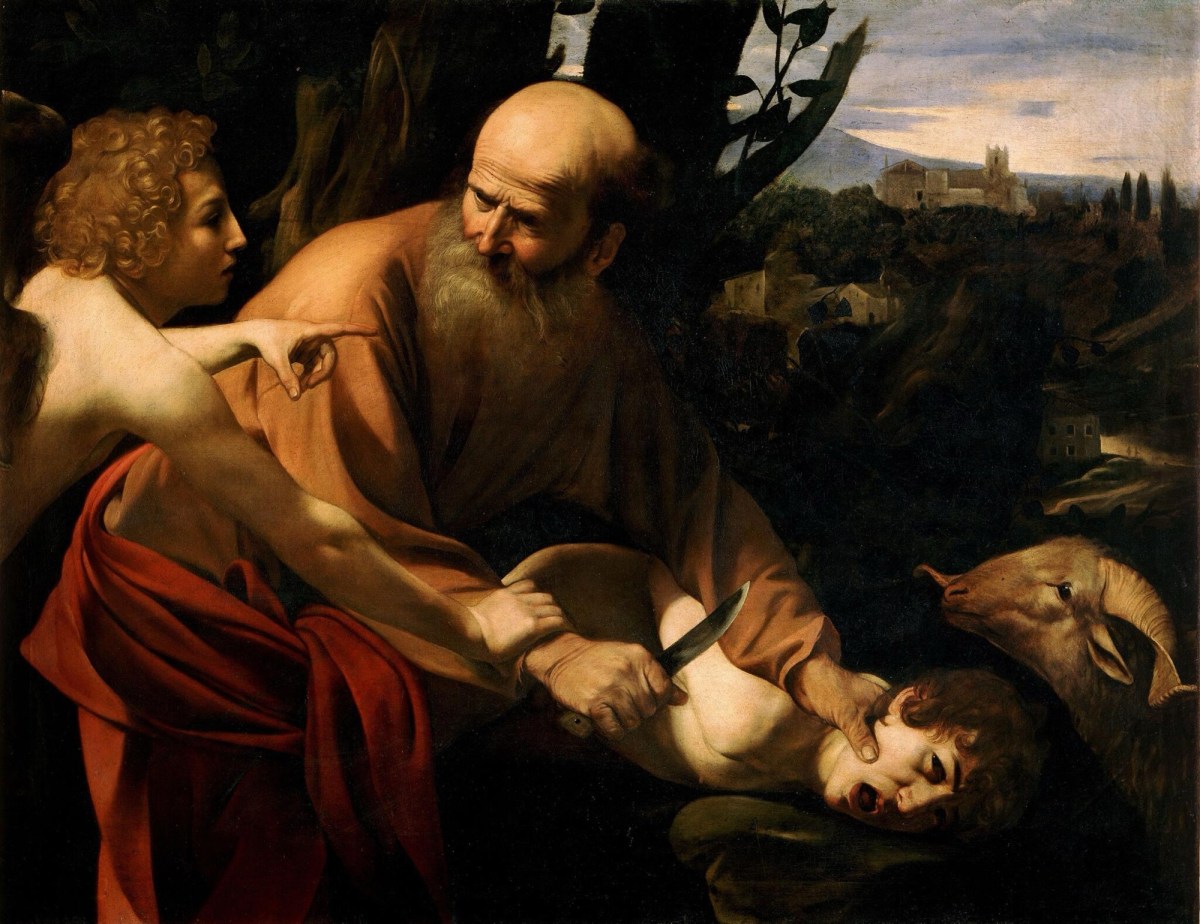
Seven days and one pair: and God saw that it was good (Genesis 1; Narrative Lectionary for Pentecost 13)

Discussion of Gen 1:1–2:4a for the Narrative Lectionary

The lectionary Gospel reading for the first Sunday in this fourth year of the Narrative Lectionary cycle takes us back to the very beginning of the Bible, to the poetic priestly account of the creation of the world (Gen 1:1—2:4a). There is so much to say about this foundational text; I will be selective!

The story serves as an origin story—for ancient Israel, for the canon of scripture, for Christian thinkers. Words used in origin stories like this have a particular power—and origin stories are always created with care and deliberation, and passed on with love as explaining the essence of being. Each element reflects something of significance in the experience of ancient Israel, and indeed of contemporary humanity.

The first two verses introduce the key characters: God, first described as the one who creates; a formless void, which is how the earth is first described; darkness, an entity in and of itself (not defined in any further way); and the breath of God, sweeping over the waters of the void. 

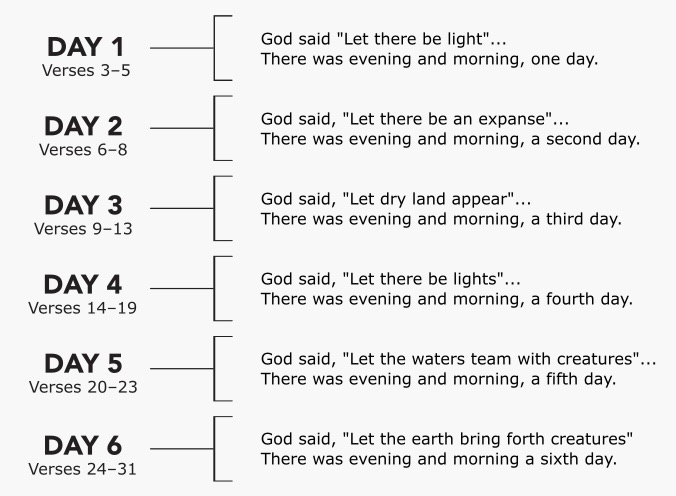
The story that follows in Gen 1 places the creation of light, the first act of creation, at the head of the story. All that happens after that is bathed in the light of God’s creation. Telling of the creation of light (1:3–5) establishes a pattern which is then repeated, five more times, for each of the various elements whose creation is noted in this narrative: the dome, or firmament, separating the waters (1:6–8); waters and dry land, with vegetation (1:9–13); lights in the sky and seasons (1:14–19); swarms of living creatures in sea and sky (1:20–23); living creatures on the earth (1:24–25); and humankind, male and female, in the image of God (1:26–31).

The third verse introduces light, which comes into existence through a single word of command. Then God said, “Let there be light”; and there was light (1:3). Light is the key entity in the creation story, signalling the creative process which then ensues. Each subsequent creative action results from something that God said (verses 6, 9, 11, 14, 20, 24, 26). And each creation is affirmed with the phrase, and it was so (verses 7, 9, 11, 15, 24, and then verse 30).

The fourth verse tells of God’s approval of what had been created: And God saw that the light was good (1:4). Likewise, God then affirms as good the creation of earth and seas (1:10), vegetation (1:12), the sun for the day and the moon for the night (1:18), all living creatures in the seas and in the sky (1:21), then the living creatures on the earth (1:25). Finally, after the creation of humanity in the image of God, there comes the climactic approval: God saw everything that he had made, and indeed, it was very good (1:31).

In a number of the six main sections of the narrative, God explicitly names what has been created: he called the light Day, and the darkness he called Night (1:5), then God called the dome Sky (1:8), God called the dry land Earth, and the waters that were gathered together he called Seas (1:10), followed by plants yielding seed of every kind, and trees of every kind bearing fruit with the seed in it (1:12), and the greater light to rule the day and the lesser light to rule the night—and the stars (1:16). 

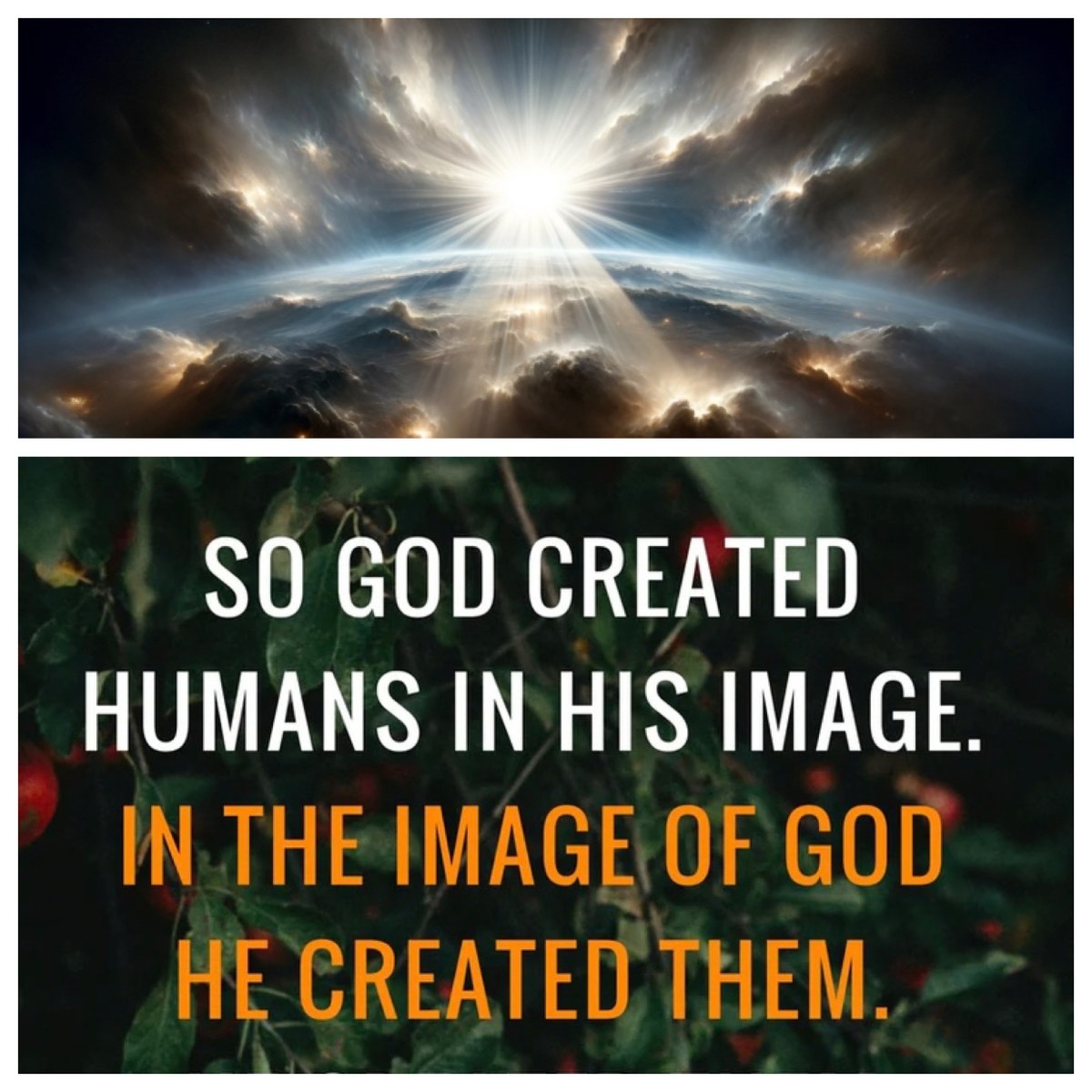
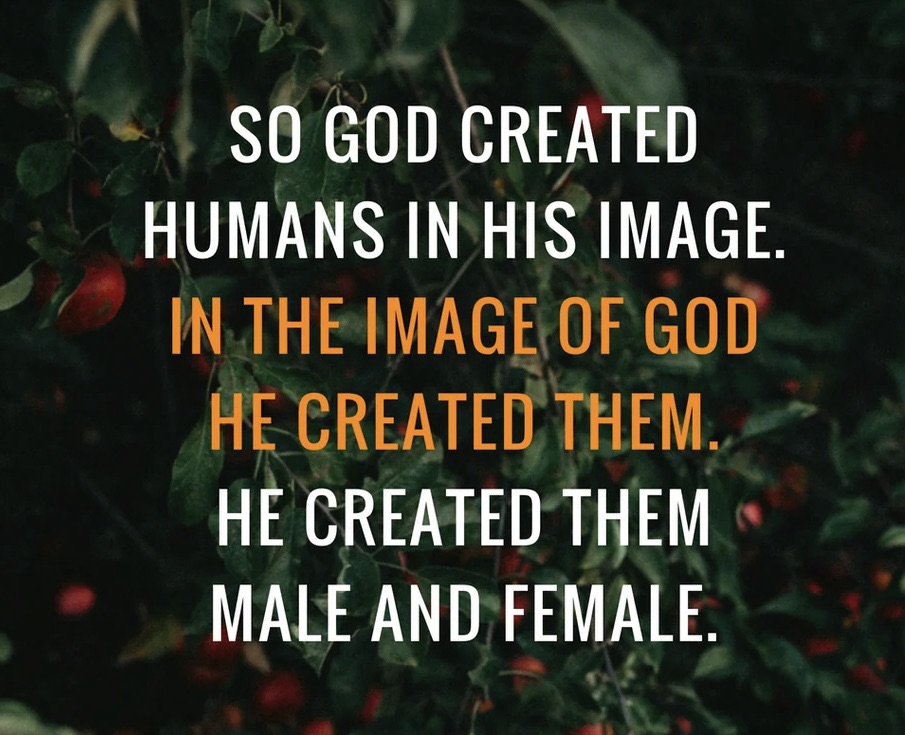
After this, the categories of living creatures are identified (1:21, 25), before the climax of creation is identified: “So God created humankind in his image, in the image of God he created them; male and female he created them” (1:27), and then God’s blessing is narrated (1:28).

Finally, each section concludes with another formulaic note: and there was evening and there was morning, the first day (1:5; likewise, at verses 8, 13, 19, 23, 31), before the whole narrative draws to a close with the note that on the seventh day God finished the work that he had done, and he rested on the seventh day from all the work that he had done (2:2). Of course, it is from this demarcation of the sections of the creative process as “days” that there came the traditional notion that “creation took place over seven days”. 

The notation of “days”, however, is simply to give the story a shape that we can appreciate—they are not literal 24-hour periods, but a literary technique for the story, much like we find that some jokes, some children’s songs, and some fairy stories are constructed around threes (“three men went into a pub …”, or “three blind mice”, or “Goldilocks and the three bears”, etc).

The story is thus told with a set of simple, repetitive phrases, but arranged with sufficient variation to give aesthetic pleasure, and with a growing sense of building towards a climax, to shape the narrative arc towards the culmination of creation (humanity, 1:26) and the completion of the creative task (sabbath rest, 2:2–3).

*****

One verse in this stylised poetic account of creation has attracted much attention over the decades. It is a verse that is most famously quoted by Jesus in an encounter he has with some Pharisees—and so it forms a foundational idea for Christians, as well as Jews. And it is a verse that has particular relevance and importance in the immediate contemporary context, when matters of gender identity and sexuality are regularly in the public discourse.

The story told in Mark 10:2–16 reports this encounter; as they debate the matter of divorce, Jesus offers the Pharisees a quote from a key verse in Genesis, “from the beginning of creation, ‘God made them male and female’” (Gen 1:27).

This verse needs attention; here I want to notes the rabbinic exploration of this text and associated matters. A warning in advance: this will lead to the conclusion that the strict binary understanding of human gender is inadequate. The rabbis clearly understood that not everyone fits these categories. That has important implications for our current understandings of human sexuality and gender.

The quotation from Genesis made by Jesus, that God made human beings as male and female, sounds like a definitive declaration: this is the reality, this is who we are, there is nothing more to debate! Certainly, that’s the way this verse has been used in the “gender wars” that have swirled through western societies in recent times. “God made male and female” became “God made Adam and Eve, not Adam and Steve”, in an early salvo against the emerging number of people who were “outing” themselves as same-gender attracted. “Not so” was the sloganeers’ reply; two genders, each attracted to the opposite, is who we are. Definitively. Resolutely. Absolutely.

It’s worth noting some aspects of this statement in its original context in Genesis. What the priestly authors of the creation story wrote was “God created humankind in his image, in the image of God he created them; male and female he created them” (Gen 1:27). The emphasis is not so much on defining who we are are gendered people—but rather, the verse is reflecting on the amazing feature that, within humanity, signs of divinity are reflected. And in association with that, the statement indicates that the two genders familiar from humanity are somehow reflected in the very nature of God. 

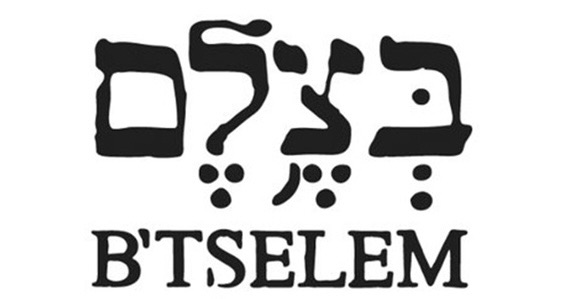
As God’s creatures, we are images of that creating being. The Hebrew word used, tselem (image), indicates a striking, detailed correlation between the human and the deity. This was the insight brought by the authors of this passage, perhaps shaped and honed over generations of telling and retelling the story, passing on through the oral tradition the insights of older generations.

My sense is that these ancients were not so much making a definite declaration about the nature of humanity—an early dogmatic assertion, if you like—as they were actually reflecting on their experience. They sensed that there was something within humanity that reaches out, beyond the material, into the unknown, beyond the tangible, into “the spiritual”. They surely knew the kind of experience that Celtic mystics have known, of coming to a place where “heaven meets earth”—what they call “a thin place”, where God can be sensed in the ordinariness of life. Indeed, such a “thin place” might well be being described in Gen 28:10–22, where Jacob comes to the realisation that “surely, the Lord is in this place” (Gen 28:16).

Indeed, as Jewish tradition developed over time, this fundamental duality of human gender—male and female—was questioned, probed, explored, and developed. Rabbis of late antiquity and the early medieval period (using the standard Western terminology) actually identified six genders.

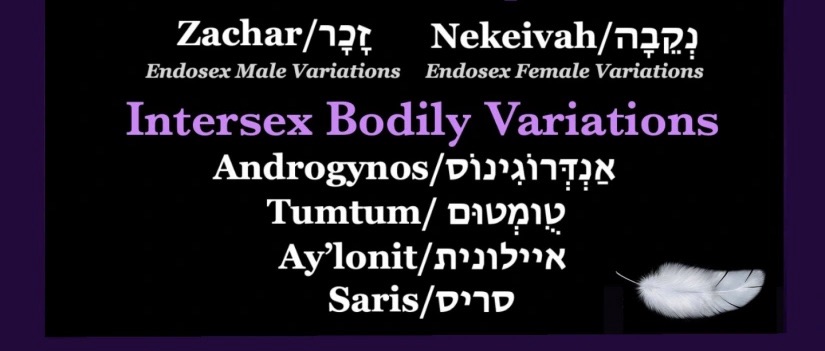
The first move takes place in the Mishnah (early 3rd century). Tractate Bikkurim 4.1 contains the assertion, “an Androginus (a hermaphrodite, who has both male and female reproductive organs) is similar to men in some ways and to women in other ways, in some ways to both and in some ways to neither”.

It is interesting that the term androginus, a Greek term, is simply transliterated in this Aramaic work, as אדדוגינוס. That’s a sign that the consideration of this issue encompassed more than just rabbinic scholars, as they were drawing on insights and the term androginus from the hellenised world.

The text of Bikkurim goes on to offer indications of the ways that an androginus person is similar to, and dissimilar to, each gender (4.2–3). Another passage in the Mishnah identifies people known as a saris, סריס (Yevamot 8.4). These are people we identify as eunuchs; whether these are “eunuchs who have been so from birth … eunuchs who have been made eunuchs by others … [or] eunuchs who have made themselves eunuchs” (as Matthew reports Jesus saying, Matt 19:12) is not relevant in this context.

Presumably, the rabbis refer to males with arrested sexual development who are unable to procreate.  The female term for such people is given as aiylonit, אילונית. The discussion that follows makes it clear that these people are women with arrested sexual development who cannot bear children.

So this means that rabbis recognised four genders: male, female, androgyne, and eunuch (saris). In the Babylonian Talmud (sixth century CE), Rabbi Ammi is quoted as stating that “Abraham and Sarah were originally tumtumim” (טומטמין). Here we find another gender identity term; this time, describing people a person whose sex was unknown because their genitalia were hidden, undeveloped, or difficult to determine. (Tumtum means “hidden”.)

Thus, Abraham and Sarah lived most of their life as infertile, as their sex was not clear; and then, in Rabbi Ammi’s explanation, miraculously turned into a fertile husband and wife in their old age. The Rabbi points to Isa 51:1–2, saying that the instruction to “look to the rock from where you were hewn, and to the hole of the pit from where you were dug […] look to Abraham your father and to Sarah who bore you” explains their genitals being uncovered and miraculously remade.

(Explaining one scripture passage by drawing on another passage, however distantly related—often through their sharing a common word or phrase—was a common rabbinic mode of scripture interpretation.)

Today, we would explain the phenomenon of a tumtum as being an intersex person, born with both male and female characteristics, including genitalia—although modern science would not go so far as to accept a miraculous reversal of the condition, as Rabbi Ammi proposed. 

There’s a quite accessible discussion of these issues in an article by Dr Rachel Scheinerman, entitled “The Eight Genders in the Talmud”, in the My Jewish Learning online resource.

The title reflects the fact that Dr Scheinerman divides both aylonit and saris into two, on the basis of birth identification. So she lists: (1) zachar, male; (2) nekevah, female; (3) androgynos, having both male and female characteristics; (4) tumtum, lacking sexual characteristics; (5) aylonit hamah, identified female at birth but later naturally developing male characteristics; (6) aylonit adam, identified female at birth but later developing male characteristics through human intervention; (7) saris hamah, identified male at birth but later naturally developing female characteristics; and (8) saris adam, identified male at birth and later developing female characteristics through human intervention.

Dr Scheinerman concludes, “In recent decades, queer Jews and allies have sought to reinterpret these eight genders of the Talmud as a way of reclaiming a positive space for nonbinary Jews in the tradition. The starting point is that while it is true that the Talmud understands gender to largely operate on a binary axis, the rabbis clearly understood that not everyone fits these categories.”

https://www.myjewishlearning.com/article/the-eight-genders-in-the-talmud/

Dr. Charlotte Elisheva Fonrobert, a Talmudic scholar in the Department of Religious Studies at Stanford University, California, has provided a much more detailed and technical discussion of the matter of gender identity, in the online resource the Jewish Women’s Archive. See 

https://jwa.org/encyclopedia/article/gender-identity-in-halakhic-discourse

The abstract of this article reads, “Jewish law is based on an assumption of gender duality, and fundamental mishnaic texts indicate that this halakhic duality is not conceived symmetrically (as seen through the gendered exemptions of some commandments). Rabbinic halakhic discourse institutes a functional gender duality, anchored in the need of reproduction of the Jewish collective body. As such, it aims to enforce and normalize a congruence between sexed bodies and gendered identities. Furthermore, the semiotics of body surfaces produces other different and seemingly more ambiguous gender possibilities, and rabbinic discourse has widely discussed the halakhic implications of these ambiguities.”

What that means, I think, is that whilst Torah prescriptions are based on a definite duality of gender (you are either male or female), later rabbinic discussions entertained the possibility of a range of gender identifications. In this regard, the rabbinic discussions prefigured the move in contemporary society to recognise the full spectrum of diversity amongst human beings: some men are gay, some women are lesbian; some people are bisexual, attracted to both genders, while others are asexual, having no sexual-attraction feelings at all. 

Biologically, we know that some are born intersex, with both male and female physical characteristics; whilst psychologically, some people are born into a body that is clearly one gender have an internal energy that leads them to identify with the opposite gender, and so they undergo a medical transition to that gender, and we identify them as transgender people. And so we have the now-widespread “alphabet soup” of LGBTIQA+ (where the plus sign indicates there may well be other permutations within this widely diverse spectrum).

So we would do well not to remain in a static state of assertion that the Genesis text is a prescription for how human beings should be identified (and a definition for marriage). I think it is preferable to add into the discussion both the rabbinic understandings,  contemporary medical understandings, and psychological insights that reveal a wide spectrum of gender identities; a dazzling kaleidoscope of “letters”, as it were. For this is how we human beings are made, in an image that reflects the diversity and all-encompassing nature of God. 

I believe it is important that, rather than misusing the Genesis/Mark text as a club to batter people into submission, we ought to rejoice in the diversity we see amongst humanity, and affirm that, no matter whether L or G, whether B or A, whether T or I, all people who are Q, and all who are straight, are “fearfully and wonderfully made” (Ps 139:14).

There is a helpful collection of the Jewish texts relating to this matter in the online resource, Sefaria, entitled “More Than Just Male and Female: The Six Genders in Ancient Jewish Thought”, collated by Rabbi Sarah Freidson of Temple Beth Shalom in Mahopac, NY, USA. See

https://www.sefaria.org/sheets/37225?lang=bi

And so, in the end, given the rabbinic midrashic exploration and exposition of this crucial text, I hope we can come to the same conclusion as the ancient priestly writers: “God saw everything that he had made [including the diversity of gender expressions within humanity], and indeed, it was very good”.


1 September: as the seasons change

Today, 1 September, is the day (in the southern hemisphere) which marks the beginning of Spring. My nose and eyes had already alerted me, some time ago, to this turn-of-the-seasons. But now, it’s official. And to further reinforce this moment, today in Australia is Wattle Day, in celebration of the golden wattle (Acacia pycnantha), whose bright yellows flowers are prolific from August through to January.

Of course, there’s are many other signs of the coming of Spring downunder. The days are lengthening, the warming sun is strengthening its heat, the grass and flowers—and weeds!—are returning from their wintry hibernation, and (at least in the town where I live) there is a string of local community events that are planned for these pleasantly warm weeks. We have already had Run Dungog and Sculpture on the Farm. Ahead, there lies the Dungog Tea Party, Ride Dungog social bike rides, a new art exhibition in one of the local galleries, the Dungog Rumble for hot rod cars, and then the Dungog Show early in November.

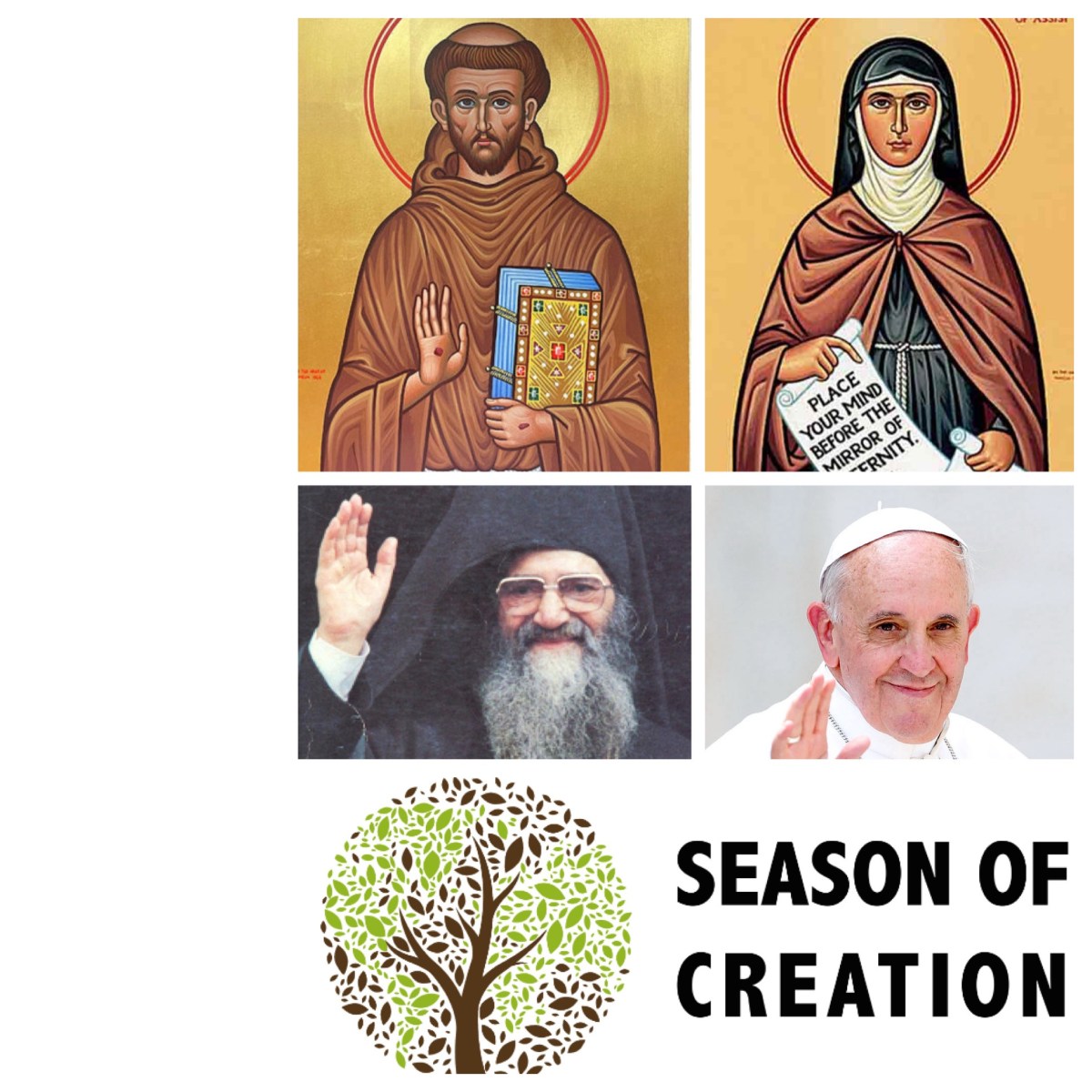
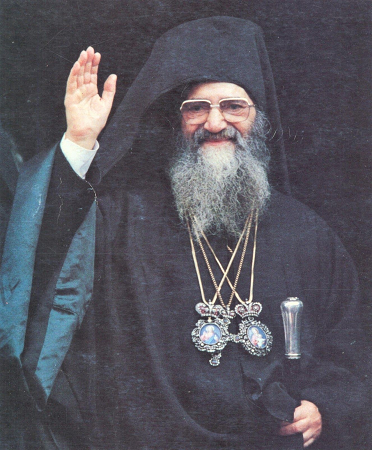
However, alongside the seasonal change, there’s also an ecclesial significance to today. In 1989, the Ecumenical Patriarch Dimitrios I (then head of the Eastern Orthodox Church, pictured) declared 1 September to be a day of prayer for the natural environment. In 2008, the World Council of Churches invited all churches to observe a Time for Creation from 1 September to 4 October—the day which had long been kept as the feast day for St Francis of Assisi

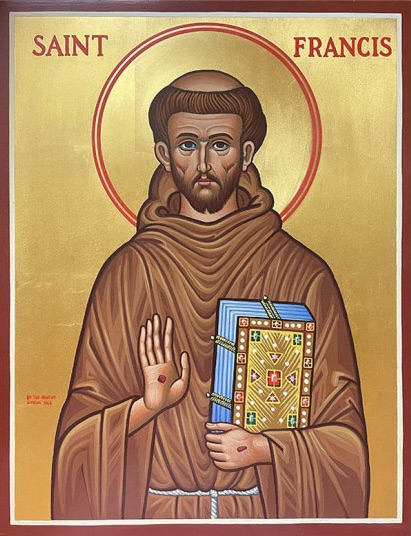
Francis, of course, is probably the most popular Catholic saint in the world. He is the one who preached to the birds; blessed fish that had been caught, releasing them back into the water; communicated with wolves, brokering an agreement between one famous ferocious wolf and the citizens of a town that were terrified of it; and used real animals when he created the very first, live, Christmas nativity scene. As a result of these, Francis is the patron saint of animals and the environment. And he is the inventor of the familiar nativity scene. 

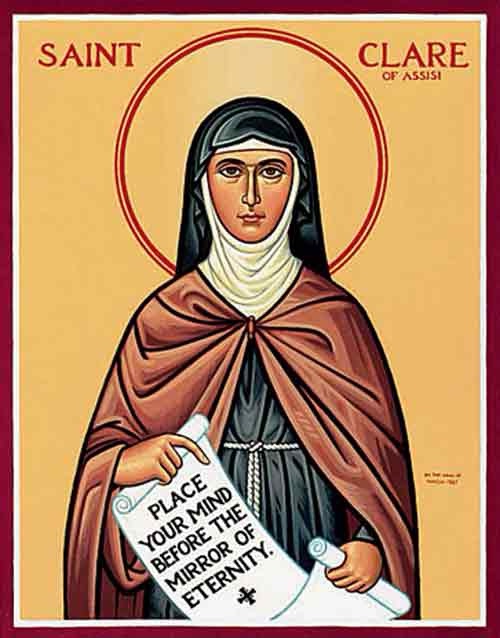
Every 4 October, Francis of Assisi is remembered in churches around the world—along with Clare of Assisi who, like Francis, came from a noble family, but decided to renounce it all to live a life of simplicity with Francis and his brothers. Unlike Francis, who was a mendicant, Clare lived an enclosed life of poverty and prayer, leading a community of women who shared the same vision.

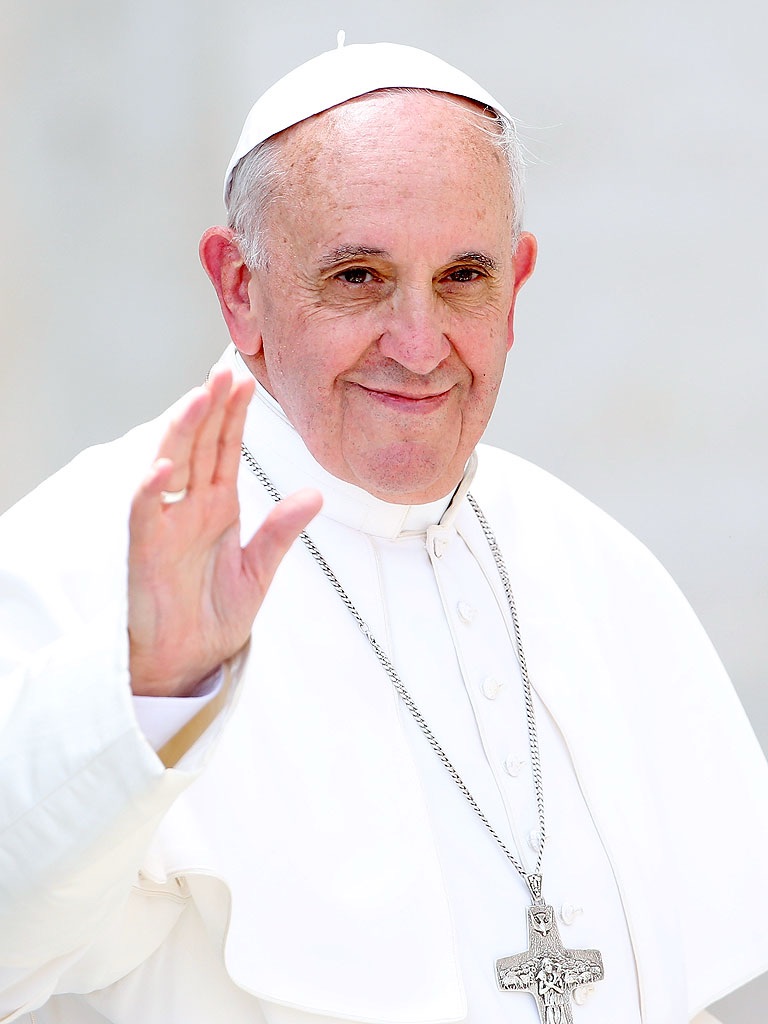
In 2019, Pope Francis (pictured) adopted the Season of Creation for Roman Catholic worship. It runs from 1 September to 4 October. And so, in many churches around the world, the whole of September is now designated as a time to focus on Creation—a truly ecumenical festive season, involving Eastern Orthodox, Roman Catholic, Anglican, and Protestant churches alike.

Recently the Rev. Dr Elizabeth Smith (Anglican priest and well-known hymn writer) attended an internal colloquium which was exploring the adoption of a Season of Creation by all mainstream denominations. She described the impetus for such a gathering in this way: “Christians have joined the growing chorus lamenting the climate crisis and its effects on nature and on vulnerable humanity, especially the poor. Energy is coalescing around liturgical acknowledgement of the value of ‘creation’—both God’s creative action and the universe it produces.” 

She then noted that “Ecumenical efforts are pressing toward a feast or season that raises both the act and fact of creation to the praise and thanksgiving of assemblies across denominations, from the Orthodox and Catholics where the initiatives began, to Anglican, Reformed, Lutheran, Methodist, and Pentecostal fellowships and associations.”

Let us hope that this initiative moves from “a good idea” to “a practical implementation” of that good idea! It will be good to have a formal liturgical accompaniment, ecumenical and international, to the signs of the change of season that is all around us.

The Uniting Church in Australia has produced resources to assist in the celebration of the Season of Creation at https://uniting.church/season-of-creation-2025/

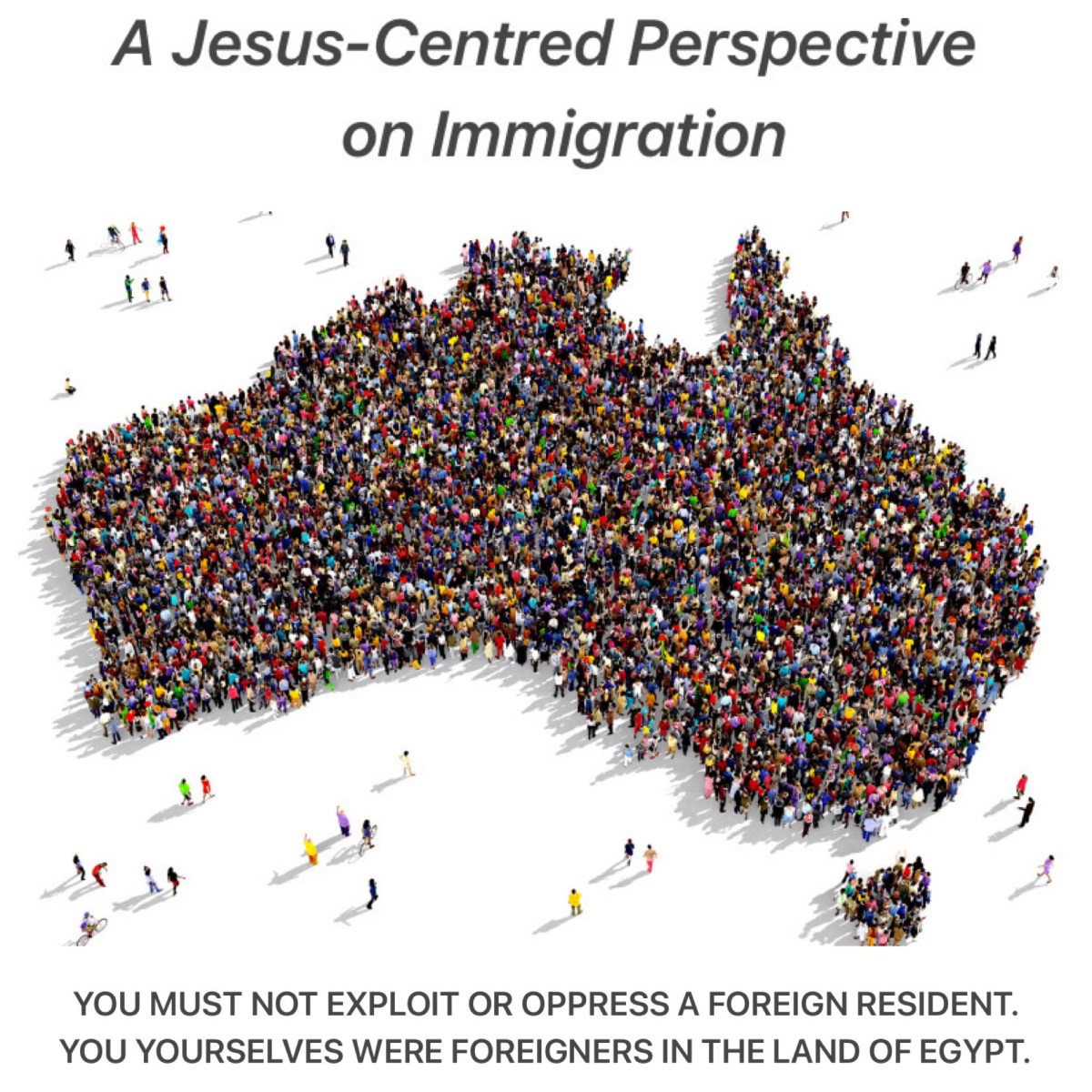
A Jesus-Centred Perspective on Immigration

This is a blog written by a guest blogger, the Rev. Pablo Nunez. Pablo is minister of the Ballina Uniting Church and Moderator-Elect of the NSW.ACT Synod of the Uniting Church in Australia. It is particularly pertinent for today, when xenophobic fascists are trying to mobilise people to “protest against immigration” in Australia. Thanks to Pablo for permission to reproduce his words here.

If you pause for a moment and look around Australia, what do you see? Beaches that take your breath away. Red dirt that stains your shoes and stretches your imagination. Cities alive with languages, smells, and flavours from all over the world. And at the heart of it all, the world’s oldest continuous culture, Aboriginal and Torres Strait Islander peoples, who have lived here, cared for this land, and told its stories for thousands of years.
That’s the starting point. Before we speak about immigration, we need to say out loud: every single non-Indigenous person in Australia is here because of migration. Some of us came by ship generations ago, some by plane more recently. Some came fleeing war, some chasing opportunity, some brought by chains, others by choice. But none of us, apart from our First Nations brothers and sisters, can truly call ourselves original to this land.

And if that’s true, then the way we talk about migration in Australia has to begin with humility.

*****

Jesus Was a Migrant

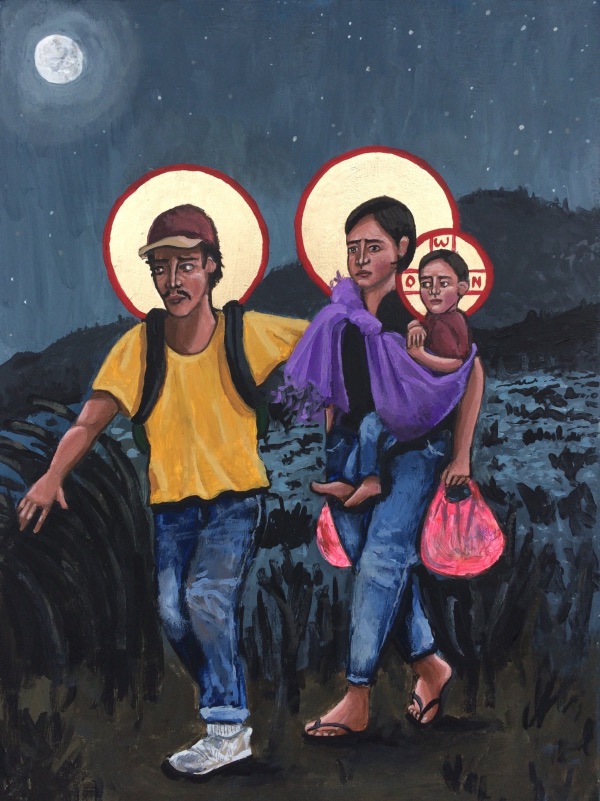
The story of Jesus is not a neat, polished tale of a man who lived in one safe place his whole life. From the beginning, his life was marked by displacement. Born in Bethlehem, raised in Nazareth, taken as a refugee to Egypt because a violent ruler wanted him dead. Jesus knew what it meant to live in a strange land. He knew what it was to flee under the cover of night, to live with uncertainty, to depend on the hospitality of others.


La Sagrada Familia by Kelly Latimore

Later, as an adult, Jesus would walk dusty roads from village to village, never truly at home, saying: “Foxes have dens and birds have nests, but the Son of Man has no place to lay his head” (Luke 9:58). He was, in every sense, a migrant—on the move, without fixed security, dependent on God and others.

So when Christians think about immigration, we don’t start with politics or economics. We start with Jesus. And Jesus says something radical: when you welcome the stranger, you welcome me (Matthew 25:35).

*****

Migration Is in Our Blood

Sometimes in Australia we talk about immigration as if it’s something unusual or threatening. But migration is the story of us all. Think about it:

  • The Irish came during the potato famine.
  • The Chinese came during the gold rush.
  • Italians and Greeks came after the war, bringing pasta, olives, and coffee that changed our food culture forever.
  • Pacific Islanders have brought love for family, music, faith and more than a few sports’ stars.
  • Vietnamese families arrived in the 1970s, rebuilding their lives after war and giving us the joy of pho and banh mi.
  • More recently, African communities have brought strength, music, and resilience born from hard journeys.
  • Latin Americans, like myself, came in different waves, some fleeing dictatorships, some chasing new opportunities, and we bring rhythms, faith, and fire for life.

Australia today is richer—economically, socially, culturally, spiritually—because of migrants. We wouldn’t be who we are without them. And the truth is, most of our favourite things—our food, our music, our sport—carry a migrant story. Even Vegemite was invented by a man whose parents came from Switzerland.

Migration is not an interruption to the Australian story—it is an essential part of the Australian story.

*****

The Gift of the Stranger

Here’s the thing about migrants: they don’t just bring their skills, their recipes, and their music. They also bring gifts we desperately need but often overlook.

Migrants remind us of courage—because leaving your homeland is never easy. They remind us of resilience—because starting again from scratch takes grit. They remind us of generosity—because most migrants know what it’s like to have little, and so they share what they have.

And, most profoundly, migrants remind us of God. Over and over in Scripture, God appears through the stranger. Abraham entertains three mysterious travellers and realises he’s been hosting God (Genesis 18). The Israelites are told: “Do not oppress the foreigner, because you yourselves were foreigners in Egypt” (Exodus 22:21). And then Jesus himself comes as the refugee child.

To welcome the stranger is to make room for God.

*****

A Personal Word

I carry this personally. I wasn’t born in Australia. My family story, like many of yours, is one of packing up, crossing borders, learning a new language, and trying to fit into a place where you don’t always feel you belong.

And yet, what I’ve discovered is that this tension—this experience of not quite belonging—actually brings me closer to the heart of God. Because faith is, at its core, a migrant journey. Hebrews 11 describes all the great heroes of faith as “foreigners and strangers on earth, longing for a better country—a heavenly one.”

In that sense, migration is not only Australia’s story, it’s the Christian story. We are all on the move, walking toward God’s promised future.

*****

A Challenge for the Church

But here’s the challenge: in Australia, conversations about immigration often get reduced to fear. Fear of boats. Fear of “the other.” Fear that there won’t be enough jobs or houses or space.

Jesus calls us to a different way. If every person is made in the image of God, then every migrant is not a threat but a gift. If Jesus himself was a refugee, then to reject the refugee is, in some sense, to reject Jesus. And if the Spirit of God is at work in every culture, then immigration is not about us “helping them,” but about recognising the Spirit who comes to us through them.

This means the Church in Australia has a prophetic role: to remind our nation of its migrant story, to model hospitality, and to show that love is bigger than fear.

What if every church treated migrants not as projects, but as partners? What if we saw multicultural worship not as a challenge, but as a glimpse of Revelation 7:9—a great multitude from every nation, tribe, people, and language worshipping before the throne? What if we stopped seeing immigration as a “problem” and started seeing it as a mirror of the kingdom of God?

*****

Building Our Legacy

Friends, Australia is at its best when it remembers its migrant heart. Our legacy will not be built on shutting doors, but on opening tables. On meals shared. On friendships made. On seeing the image of God in one another.

And the Church must lead the way. Because when we welcome the migrant, we are not only welcoming a neighbour—we are welcoming Christ into our lives in new perspectives and possibilities. A new life. A better life.
So let’s be people who celebrate our heritage, acknowledge our debt to First Nations peoples, and embrace the truth that every migrant—past, present, and future—brings a gift from God.

Australia’s modern story is migration. The Church’s story is migration. The Gospel’s story is migration. And in all of it, Jesus is the one who walks with us, the migrant Messiah, calling us to follow him into a kingdom where every tribe and tongue has a place at the table.

The Rev. Pablo Nunez, Moderator-Elect,
Synod of NSW.ACT, Uniting Church in Australia

Inscriptions as doorways into religion in antiquity

How do we know about religion in the ancient world? We get lots of information from writers of the time, who either write explicitly about the religions being practised, or include material in their work that offers insights. The Old Testament contains Torah and associated literature which tells us about the development of Israelite religion and then Judaism, while the New Testament tells us about the formative period of Christianity. 

Beyond those sacred texts Jewish literature continues into the rabbinic period, probing and exploring every dimension of Torah, while Christian writers of the centuries after Jesus write and debate, documenting liturgies and formulating doctrine. A whole host of pagan writers across all those time periods reveal insights into both of these religions as well into as the array of gods and goddesses who were worshipped in ancient times. We have a wealth of information!

Alongside these writers, however, there are many inscriptions from the ancient world which give us direct access into the religious world of the day. These are, by their nature, localised, individualised, focussed, even fragmentary; yet the collective set of insights from such inscriptions, alongside the written literature, deepens and widens our understanding. Here’s a brief glimpse of what we might learn.

Erecting a plaque in church is a modern phenomenon; the same was done back in antiquity. There are many instances of inscriptions found in archaeological sites in the Mediterranean region. Hellenistic inscriptions abound, serving a range of purposes—including the dedication of a holy space to a designated God, as well as a note indicating who the primary benefactor was for the erection of such a building. Letters were chiselled into a stone block before it was then attached to the wall of the temple. They were sturdy when made, and so have lasted over the centuries.

1. Temple Inscriptions

Inscriptions in pagan temples are useful for indicating the particular deity being worshipped. They usually include the name of the god or goddess who is worshipped in this space, and the name of the benefactor(s) who funded the erection of the inscription (or the whole building). In many cases, the deity is addressed with a twofold name—one indicating a Greek or Roman deity, the other either a name indicating function or a name of a local deity (in another language) who has become attached to the Greek or Roman deity.

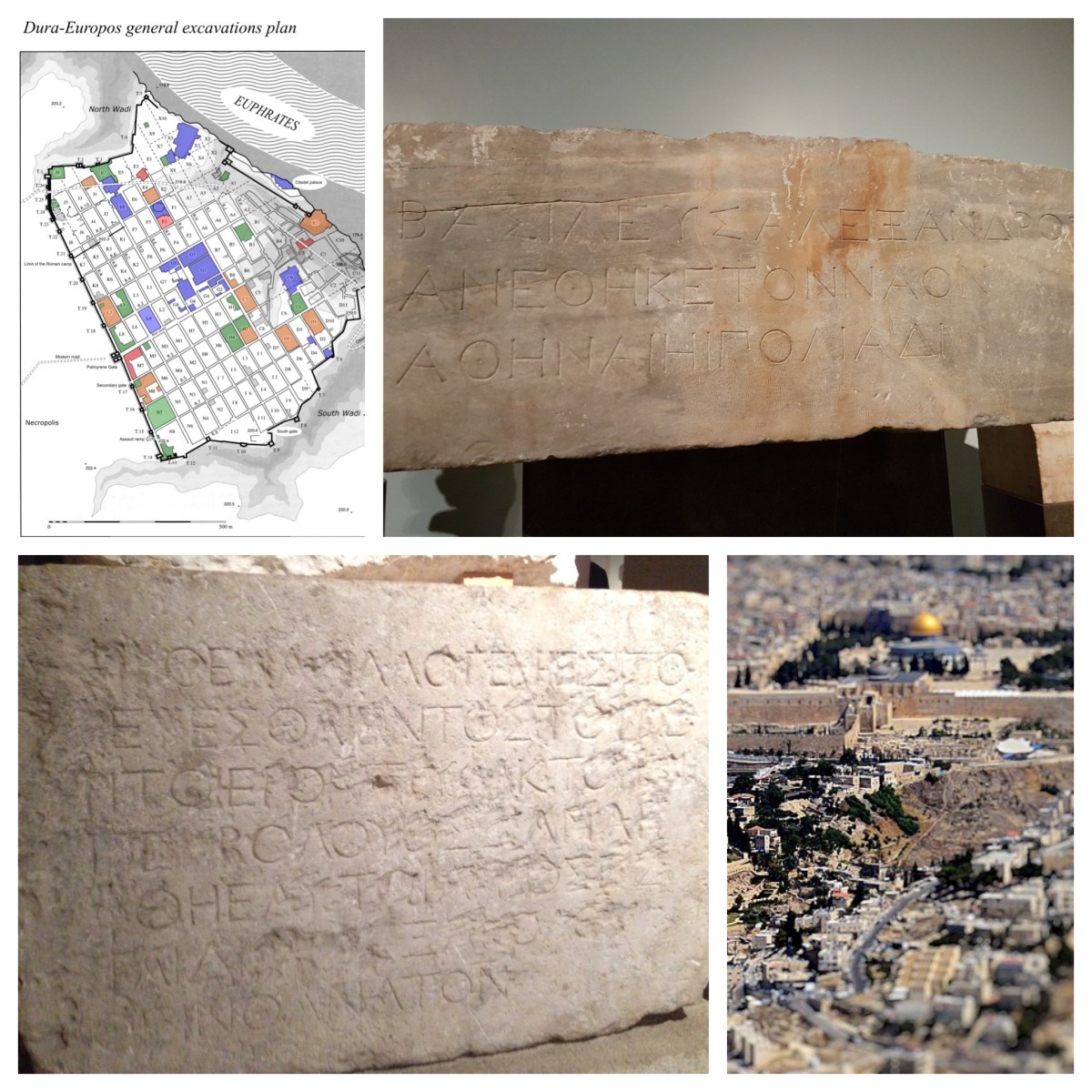
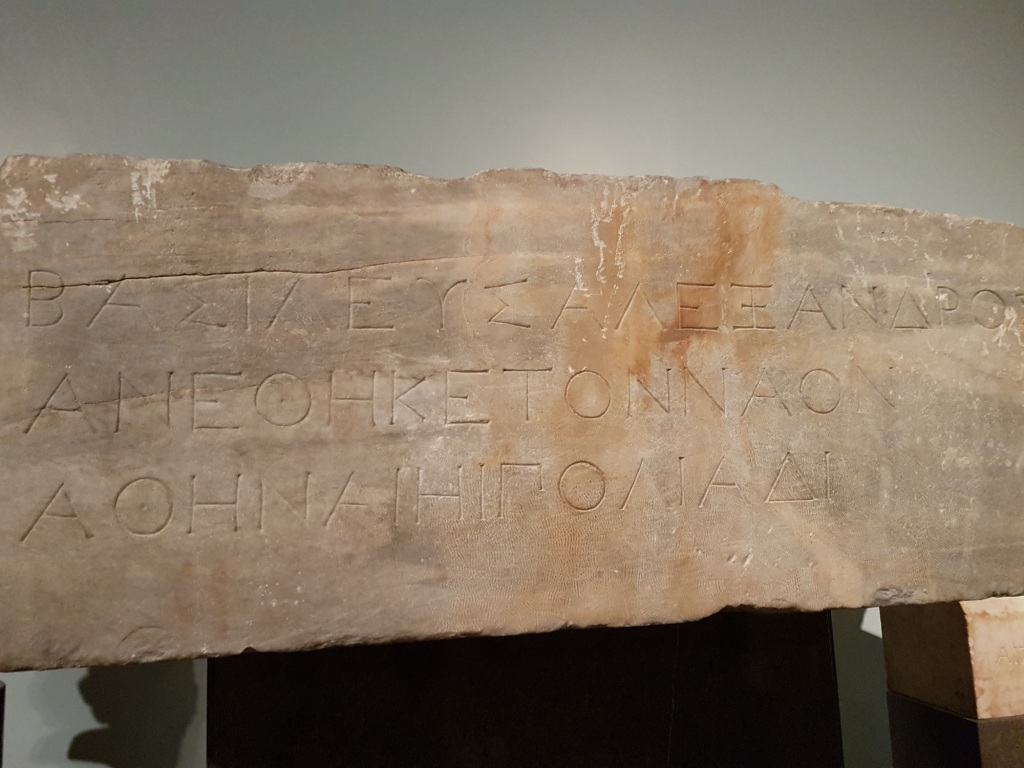
A simple example is the Priene Inscription of Alexander the Great. This is an early dedicatory inscription made by Alexander in about 330 BCE. It was discovered at the Temple of Athena Polias in Priene, in modern Turkey, during an 1868–69 archaeological exploration of Priene. It is inscribed on both sides. It reads, quite simply:

King Alexander dedicated the Temple to Athena Polias.

In this inscription, Polias is derived from polis, city, and so the dedication is most likely to Athena, protector of the city.

2. Inscriptions in Dura—Europos

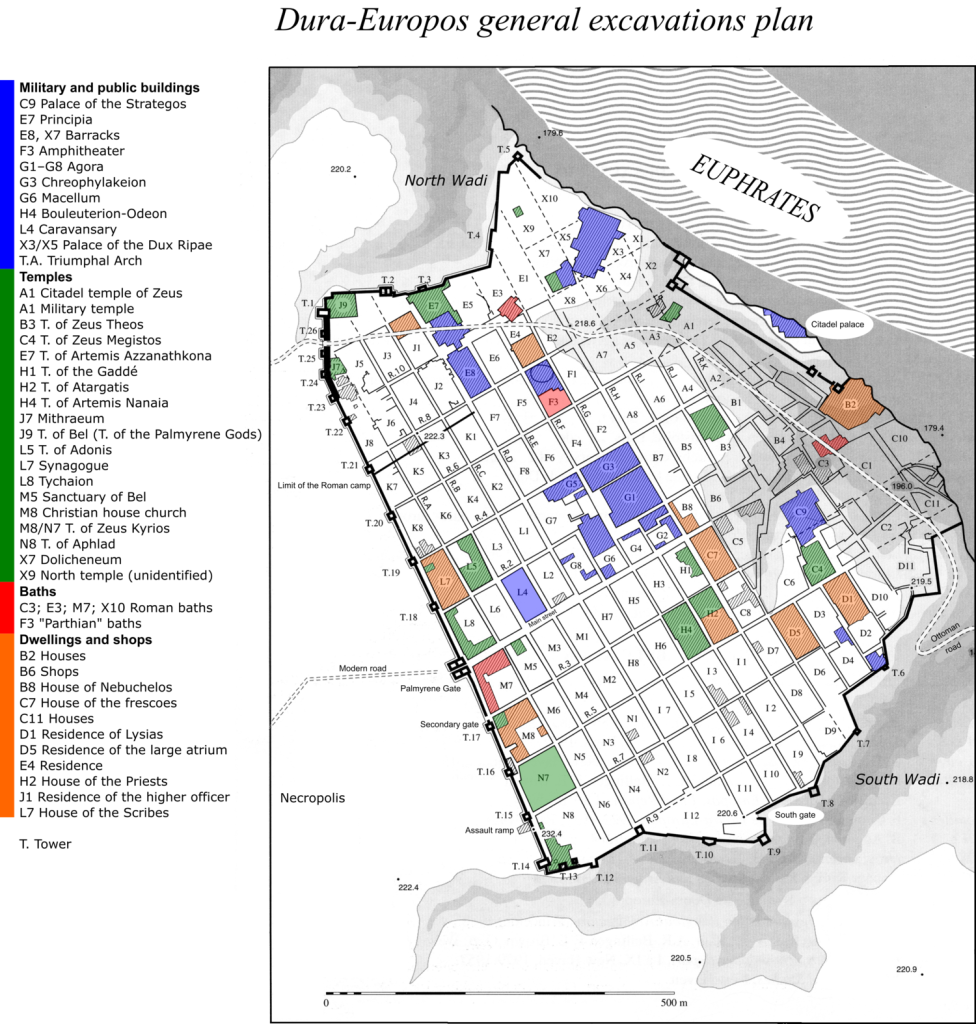
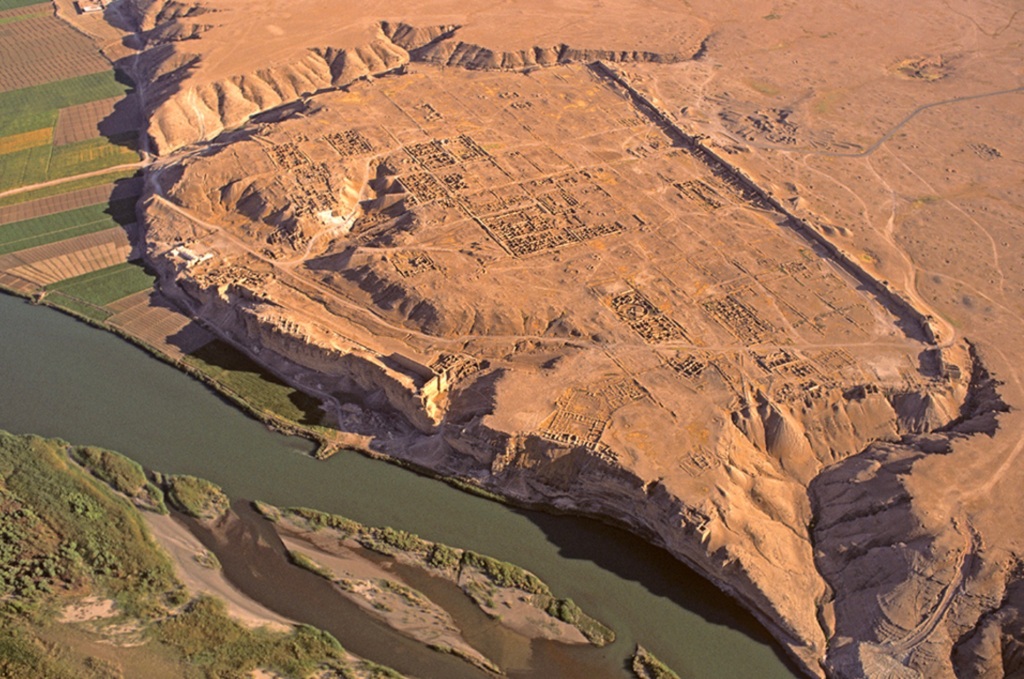
Dura—Europos was a Hellenistic settlement on the eastern edge of Alexander’s empire, in the middle Euphrates. Numerous archaeological remains were discovered in the 1920s and brought to Yale University, where a special room houses numerous inscriptions and building remains. (It was in this room that I did my graduate seminar in Epigraphy, learning how to document and translate Ancient Greek inscriptions.)

There are many temples in the city, with inscriptions dedicating those various buildings to a range of deities. It is because of these inscriptions that we know who was worshipped in each building: Zeus Theos, Zeus Megistos, Zeus Kyrios, Atargatis, Artemis Nanaia,  Artemis Azzanathkona, Adonis, Tychaios, Bel, and Aphlad. There was one other temple to an unidentified deity. People were very religious at that time! The twofold names on some inscriptions reflect either a function (Theos = god, Megistos = great, Kyrios = lord) or a local deity (Nanaia was the Mesopotamian goddess of fertility; Azzanathkona was a Semitic goddess, unknown in any place other than Dura—Europos).

There was also a Jewish synagogue (with highly decorated artwork on its walls), a temple co-dedicated to Jupiter Dolichenus )with one room dedicated to Turmasgade and another room dedicated to Juno Dolichena), a Mithraeum, place where Mithras was worshipped (a bull-shaped deity who was popular amongst Roman soldiers), and a Citadel Temple of Zeus, the official worship space for the Roman troops stationed there.

In the 2nd century BCE, while Dura—Europos was under Parthian control, a certain Alexander raised a dedicatory inscription in Greek for a renovated temple. His father had originally built it, but Roman soldiers had stolen its doors, thereby prompting Alexander to replace them and enlarge the temple itself. 

In this inscription Alexander initially described himself as Alexander, son of Epinikos, but he subsequently called himself Ammaios, this same Alexander. Alexander is a Greek name—presumably his birth name—whilst Ammaios is a Semitic name.

The dedication is to Artemis, Greek goddess of the hunt and sister of Apollo, who is also given the name Azzanathkona, a Semitic goddess otherwise unknown. One leading scholar identifies her with Atargatis, a fertility goddess in Syria. So it seems that this inscription indicates that Alexander, with origins in a Greek-speaking area, had been sent east to Dura (perhaps as a soldier?), become enculturated over time (maybe even married a local woman, as many soldiers did), and adopted a local name, Ammaios, as well as becoming a devotee of a local goddess, Azzanathkona. All this from one inscription!

Aerial view of Dura—Europos, taken from the east.
Yale University, 1997

3. Jerusalem Temple Inscription

Jews also made and erected inscriptions. In Jerusalem, there was an inscription of seven lines that was placed outside the sanctuary of the Second Temple, warning Gentiles not to proceed any further. It is dated between 23 BCE and 70 CE. It was found in 1871 just outside the Gate to the Temple Mount in Jerusalem. Some letters still contain traces of the red paint that would have highlighted the whole text.

No stranger is to enter /  within the balustrade round / 
the temple and / enclosure. Whoever is caught / 
will be himself responsible / for his ensuing / death.

4. Synagogue Inscriptions

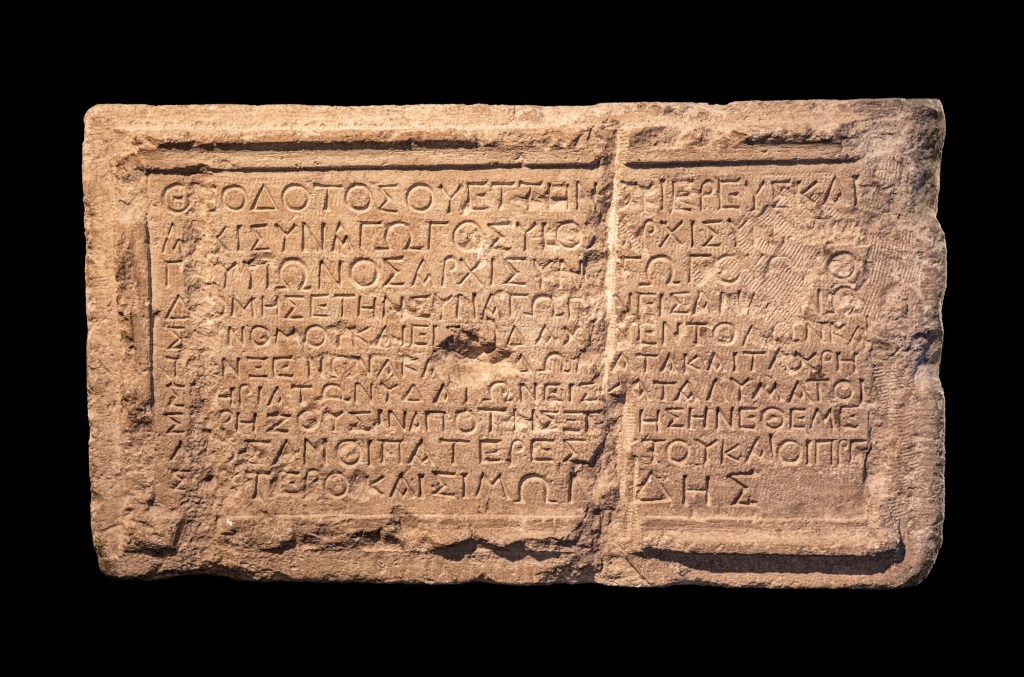
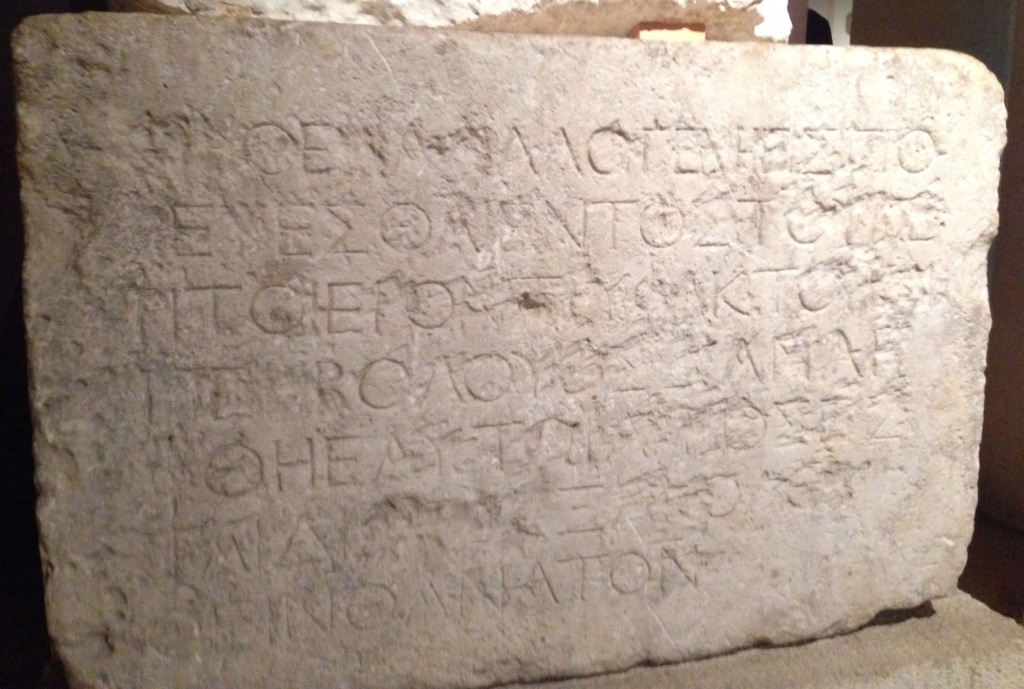
Synagogues also include inscriptions, some identifying the purpose of the building or the name of the benefactor who paid for its building. The Theodotus Inscription is a well-known example. It has ten lines, 75cm x 41cm, and was found in 1913 in a dig in Wadi Hilweh, in East Jerusalem. It was erected by Theodotus, the patron and leader of the synagogue. The inscription identifies him as benefactor and gives details of the whole building complex; it’s an important insight into the fact that ancient synagogues were not just places of worship and teaching, but also places of hospitality for visitors.

Theodotos son of Vettenus, priest /
and head of the synagogue (archisynágōgos), 
son of a head of the synagogue, / 
and grandson of a head of the synagogue, / 

built the synagogue / 
for the reading of the law and for

the teaching of the commandments, /
as well as the guest room, the chambers, /

and the water fittings as an inn /
for those in need from abroad,
the synagogue which his fathers / 
founded with the elders / and Simonides.

5. Christian inscriptions.

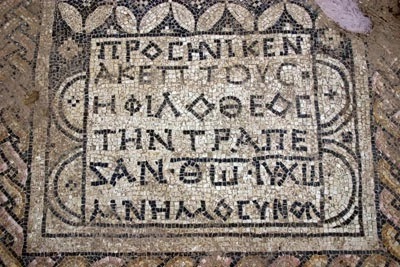
There are Christian inscriptions in church spaces that have been excavated, increasing in numbers over the centuries. The Akeptous Inscription is one of a number of inscriptions found in the mosaic floor of a 3rd century church. It was discovered in 2005 while digging inside the Megiddo Prison in Israel. There are six lines in this simple inscription: 

A gift / of Akeptous, /  she who loves God, / 
this table [is] / for God Jesus Christ, / a memorial.

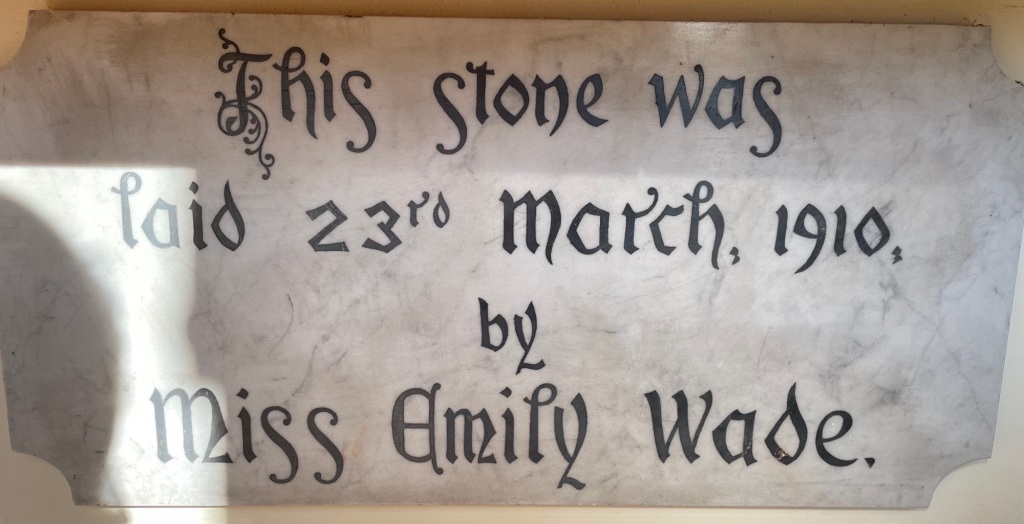
This reminds me of many churches where I have been, where a small plaque is placed outside the building, marking its opening.

There are also many churches that have plaques inside; such a plaque may indicate that it was erected in memory of a named person, and it can be attached to the the wall, the communion table, a chair in the sanctuary, a lectern, or even (as in the case where I currently worship) the light switch that turns on the light behind the central cross!

6. Women in Jewish synagogue inscriptions.

Scholar Bernadette Brootten wrote a groundbreaking book, Women Leaders in the Ancient Synagogue: Inscriptional Evidence and Background Issues (published in 1982). Brooten identified nineteen Greek and Latin inscriptions that name women with the titles “head of the synagogue,” “leader,” “elder,” “mother of the synagogue,” and “priestess”.

The inscriptions have been found by archaeologists in synagogues from the Roman and Byzantine periods; they range in date from 27 BCE to the sixth century CE and were found in Italy, Asia Minor, Egypt, and Palestine. So they cover a broad range of dates and locations. 

Brootten argues that in these inscriptions the women leaders are not simply “honorary” leaders (as some dismissively claim); she considers that they identify actual leaders, who had specific leadership functions. For instance, a white marble sepulchral plaque from Gortyn in Crete dating to the 4th or 5th century CE remembers Sofia:

Sofia of Gortyn, elder (presbytera)
and head of the synagogue (archisynagōgissa)
of Kissamos [lies] here.
The memory of the righteous one for ever. Amen. 

Centuries earlier, a second-century CE inscription from Smyrna mentions a woman named Rufina who was a synagogue ruler. The inscription reads: 

Rufina, a Jewess synagogue ruler (archisynagōgos),
built this tomb for her freed slaves
and the slaves raised in her household.
No one else has a right to bury anyone here.

In the inscriptions found and discussed by Brootten, there are three Greek inscriptions in which women have the title archisynagōgos or archisynagōgissa (arch– plus “an element formed from the institution over which the officer stands, in this case the synagogue”).

In another inscription, Peristeria is called archēgissa, “leader.” Six ancient Greek inscriptions have been found in which women carry the title “elder” (presbytera or presbyterēsa) and one in which a woman is called presbytis. Women are called “mothers of the synagogue” in six Greek and Latin inscriptions and “priest” (hierea or hierissa) in three Jewish inscriptions.

(Summary taken from a review of the digital [2020] edition of the book by Elizabeth Anne Willett, https://www.cbeinternational.org/resource/book-review-woman-leaders-in-the-ancient-synagogue/ )

Brootten also notes that various biblical references, as well as writings from Jewish historian Josephus and rabbinic teachings, indicate that Jewish women were present and often prominent in synagogues, and they did not sit separately from men. She reviews the reports of quite a number of archaeological sites where synagogues existed, and concludes that “the vast majority of ancient synagogues in Israel do not seem to have possessed a gallery, and there is no archaeological or literary reason to assume that side rooms were for women”.

Likewise, she notes that “there is no Diaspora synagogue in which a strong archaeological case can be made for a women’s gallery or a separate women’s section. The analogy of a separate room as a woman’s section in modern synagogues is anachronistic.” That puts paid to separation by gender in synagogues in antiquity.

Brootten’s work is important for understanding the biblical stories of Lydia, who appears to have been the leader of a synagogue (“place of prayer”) in Philippi (Acts 16:13–15) and quite a number of other women who are identified as leaders of faith communities in Acts: Priscilla in Ephesus (18:26), Tabitha in Joppa (9:36), Mary the mother of John Mark in Jerusalem (12:12), and possibly Damaris in Athens (17:34); as well as women so identified in the letters of Paul: Phoebe in Cenchraea (Rom 16:1–2), Prisca (and Aquila) in Ephesus (1 Cor 16:19) and also in Rome (Rom 16:3–5), Euodia and Syntyche in Philippi (Phil 4:2), Apphia (with Philemon and Archippus) in  Colossae (Phlm 1), Nympha in Colossae (Col 4:15), and possibly Chloe in Corinth (1 Cor 1:11) and Junia in Rome (Rom 16:7); and 2 John (“the elect lady”).

See more at https://margmowczko.com/new-testament-women-church-leaders/ 

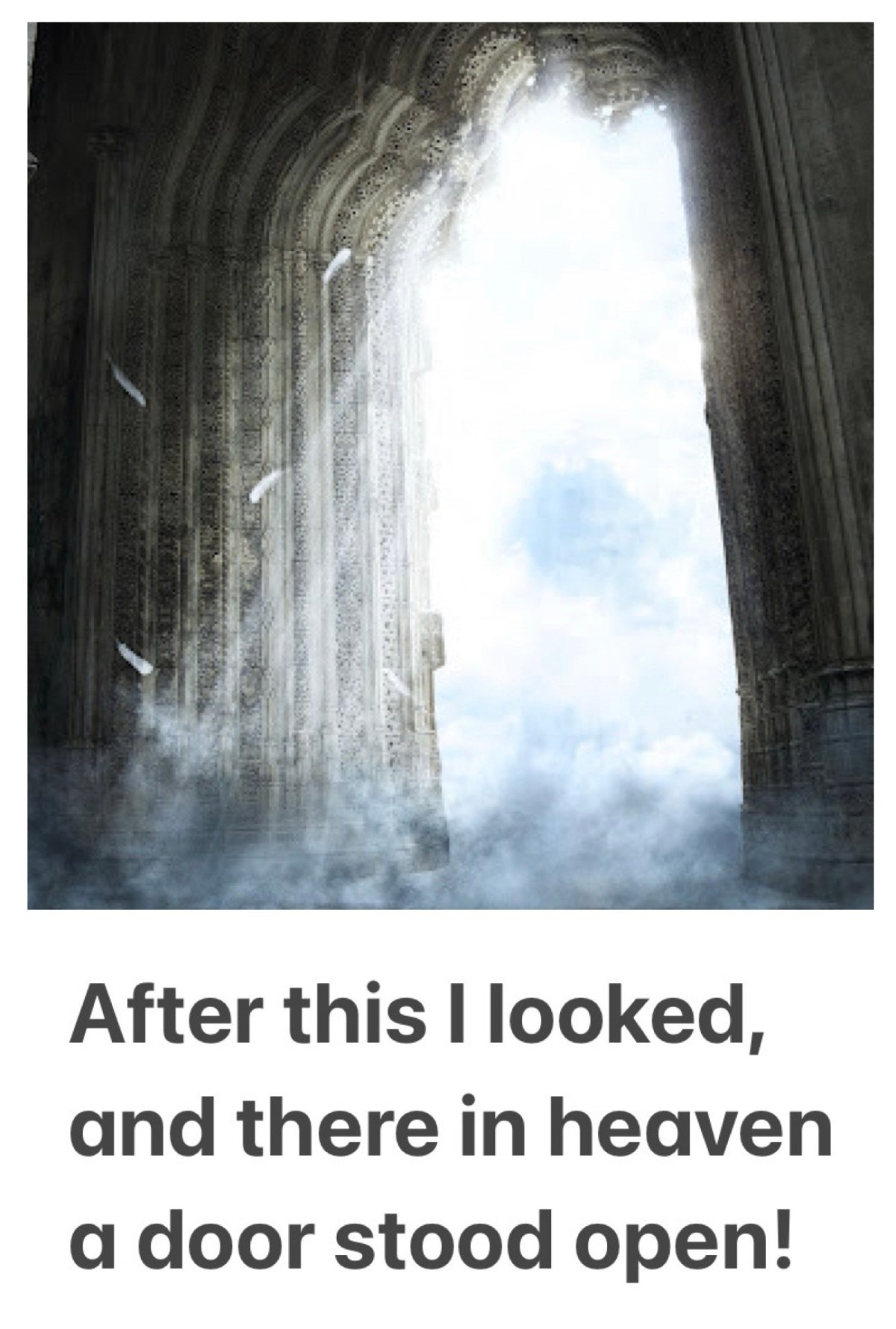
There in heaven a door stood open (Rev 4)

In the book of Revelation, we are invited into a world of unfettered imagination, with evocative imagery, enticing language, and disturbing rhetoric. The whole book comes from words spoken by “one like the Son of Man, clothed with a long robe and with a golden sash across his chest” (Rev 1:13). Clearly, it is a vision of the glorified Jesus Christ, now conveying his “revelations” to John, who is instructed to write letters to seven churches (in chapters 2—3) and then to detail a series of amazing visions (in chapter 4 onwards to the end of the book). 

Each vision contains graphic descriptions and dramatic happenings. The first of these visions (proposed for this coming Sunday in the Narrative Lectionary Summer Series for this year) sets the scene set for what will later be revealed as a colossal, cosmic battle between good and evil. 

It opens with the striking claim that the door into heaven is opened (4:1). A disturbing and increasingly detailed dramatization of “what must take place after this” is revealed. The vision comes to a climax with an image of a slaughtered lamb (5:11–14), which  is the passage set in the Narrative Lectionary for a week after this coming Sunday.

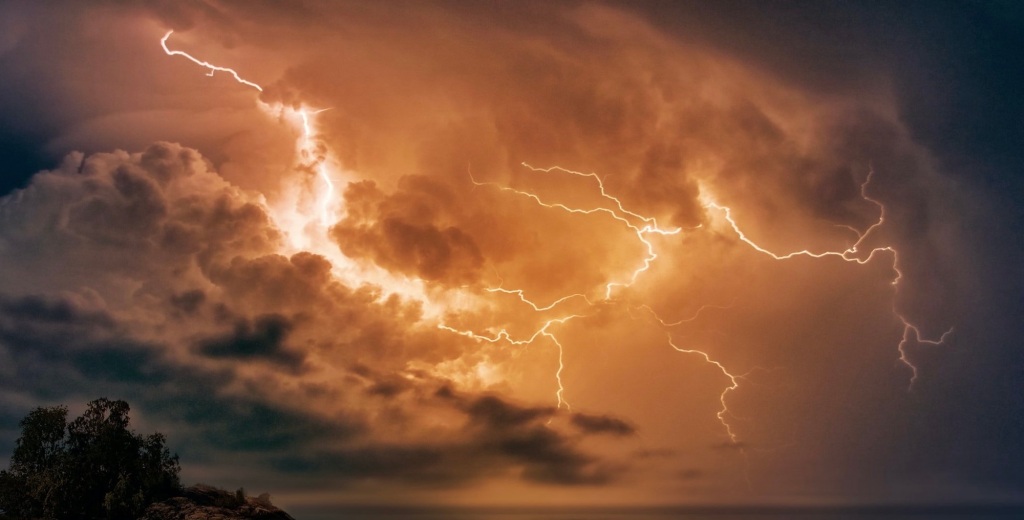
Gazing into heaven, the author views a magnificent scene of worship. The importance of this scene is signalled by gleaming jewels and a shining rainbow, golden crowns and white robes, thrones and torches of fire, a sea of glass, grumbling thunder and flashes of lightning (4:3–6).

Thunder and lightning were characteristic of the God of Israel. In the book of Job, Elihu praises God, describing “the thunder of his voice and the rumbling that comes from his mouth … his voice roars; he thunders with his majestic voice” (Job 37:1–5). The psalmist sings of  “voice of the Lord over the waters” which thunders with powerful and is “full of majesty” as it “breaks the cedars of Lebanon … flashes forth flames of fire … shakes the wilderness of Kadesh … causes the oaks to whirl, and strips the forest bare” (Ps 29:3–9).

Thunder and lightning were associated with the foundational event of Israel, in the Exodus from Egypt. David sang of how the Lord God “thundered from heaven; sent out arrows, and scattered them—lightning, and routed them; then the channels of the sea were seen, the foundations of the world were laid bare at the rebuke of the Lord, at the blast of the breath of his nostrils” (2 Sam 22:14–16; Ps 18:13–19). The same graphic descriptions occur at Ps 77:16–20. 

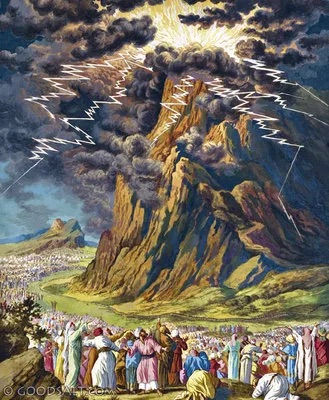
In the book of Exodus, the scene at Mount Sinai includes thunder and lightning, a thick cloud, the blast of a trumpet, the shaking of the mountain and a spreading haze of smoke from the burning fire, an intensifying of the trumpet blast and peals of thunder  (Exod 19:16–19). This was the setting for Moses’ encounter with the Lord, when (according to the story passed on through the generations) the foundation of Torah was laid. The biblical nature of the imagery is very clear; these are all associated with an encounter with the divine.

Twenty-four elders and four six-winged creatures sing praises to “one seated on the throne” (4:2–11), and to a slaughtered lamb “with seven horns and seven eyes” (5:1–14). The hymns they sing in chapters 4, 5, and 7 appear to combine attributes of God which feature in scriptural songs of praise (holy, worthy, glory, honour, power, creator) as well as elements familiar from other New Testament texts in which early Christian thinking is developing. The twenty-four elders, sitting on thrones (4:4), along with the seven spirits (4:5; see also 1:4; 3:1) represent numbers of great symbolism throughout scripture, if we consider the twenty-four to comprise two lots of twelve.

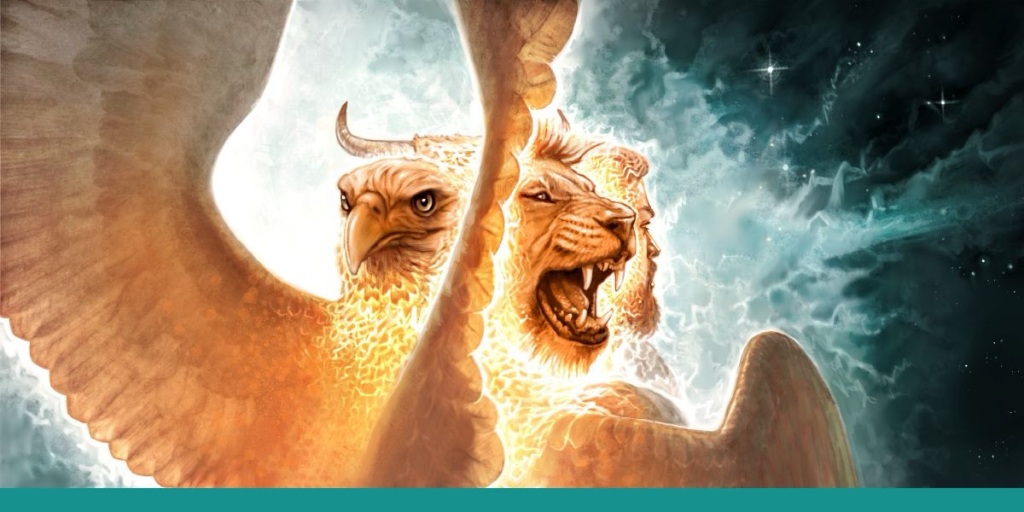
The four living creatures each have a distinctive facial feature: “the first living creature like a lion, the second living creature like an ox, the third living creature with a face like a human face, and the fourth living creature like a flying eagle” (4:7). These four creatures allude to the chariot vision which opens the book of Ezekiel, in which the prophet sees four such creatures, with “the face of a human being, the face of a lion on the right side, the face of an ox on the left side, and the face of an eagle” (Ezek 4:10). These creatures emerge out of the midst of “

“a great cloud with brightness around it and fire flashing forth continually, and in the middle of the fire, something like gleaming amber” (Ezek 4:4), later revealed to be a magnificent chariot (Ezek 4:15–28), on which sat “something that seemed like a human form” (v.26).

Jesus is depicted in this book as “one like the Son of Man, clothed with a long robe and with a golden sash across his chest” (Rev 1:13). He is the supreme authority, the one who has risen from the dead and is at one with God (1:18). Yet there is a stark counterpoint running throughout the whole book. Jesus is the one who has been pierced (1:7); perhaps this evokes the piercing of Jesus’ side as he hung on the cross (John 19:34–37, citing this as a fulfillment of Zech 12:10).

In this initial vision, the Lord God Almighty is seated on the throne, surrounded by four six-winged creatures (4:2–11), perhaps reminiscent also of the six-winged seraphim seen by Isaiah in his vision in the temple (Isa 6:1–2). The one on the throne is holding a scroll with seven seals, which no one was able to open (5:1–4). These seals form the basis for the sequence of visions in 6:1—8:1, culminating in the vision of seven angels holding seven trumpets (8:2), yet another angel burning incense (8:3–4), and the inevitable “peals of thunder, rumblings, flashes of lightning, and an earthquake” (8:5). The markers of the divine are evident once more.

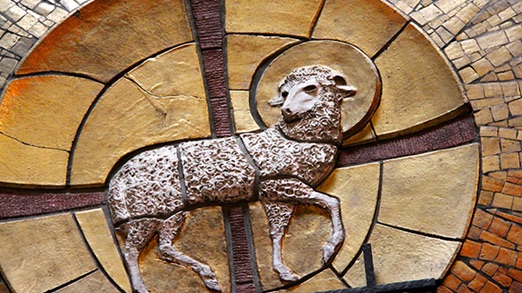
The author continues on, to introduce the one who has power to open the scroll: “the Lion of the tribe of Judah, the Root of David” (5:5)—phrases which clearly evoke the Davidic lineage of Jesus which the Gospel writers have so carefully claimed. (The same Davidic lineage is noted at 22:16.) Immediately, and despite the magnificent splendour of the scene being described, with its many dazzling jewels and angelic creatures, this “Lion” is described as a “Lamb standing as if it had been slaughtered” (5:6).

This paradoxical description of Jesus as “the Lamb that was slaughtered” recurs in hymns later in the book (5:9, 13; 13:8). His victory has been won, not through the power of force, but by submission to death. It seems that it is the fact that he has been slain which qualifies him to open the scroll. His power lies in his avoidance of violence, his submission to death.

This theme is the power that this strange book from a distant past offers us in the turmoil of the present. Our world today—as, indeed, the world time and time again over the centuries—is beset by conflict, aggression, and devastating warfare. Mass starvation and the killing of civilians in Gaza; a genocide, many now (rightly) say. Decades of terrorist activity and the exercise of military power in Israel, the West Bank, Gaza, and surrounding nations. An entrenched military battle on many fronts in the Ukraine, bogged down in the ego of a long-term tyrant. Ethnic violence and long-enduring civil warfare in the Sudan. Armed uprisings in the Congo. A civil war in Myanmar following the 2021 military coup. The list could go on to cover many–far too many–places.

The Geneva Academy of International Humanitarian Law (an institute of the University of Geneva) is monitoring more than 110 armed conflicts which are currently active across the globe. It’s a sad testimony to human greed for power, and to the seemingly endless capacity to inflict terrible damage on others.

The Way of the Lamb is a way that turns away from conflict as a means to resolve differences. In 1982, the National Assembly of my church (the Uniting Church in Australia) passed a resolution declaring “that God came in the crucified and risen Christ to make peace; that he calls all Christians to be peacemakers, to save life, to heal and to love their neighbours. The call of Christ to make peace is the norm, and the onus of proof rests on any who resort to military force as a means of solving international disputes.” 

It reiterated this affirmation some decades later, in 2003, when the Assembly further declared that “that the Church is committed to be a peacemaking body”. This is central to who we are as a faith community. Many other church denominations around the world have similar resolutions marking a similar commitment. Pope John XXIII had issued his encyclical “Pacem in Terris” in 1963. Yet wars snd conflicts have continued. More recently, Pope Francis issued a “Prayer for Peace” in which he invited the faithful to pray, “Renew our hearts and minds, so that the word which always brings us together will be “brother”, and our way of life will always be that of: Shalom, Peace, Salaam!”. Pope Leo XIV prayed for peace in the Middle East and in other conflicted areas. The church yearns for peace. Too many leaders perpetuate antagonism, foment conflict, engender wars.

We need to recapture the central element of the way of discipleship as a commitment to the way of peace, as we seek to follow Jesus in our contemporary world. This is the vision of Revelation. May it be that, as we hear again of the door in heaven standing open, and the vision of the “Lamb standing as if it had been slaughtered”, we recommit to praying for peace, living in a peaceable way, and writing to our political representatives urging them to withdraw support for any armed conflict (including the withdrawal of arms and financial support for those perpetrating aggression). 

In the sound of sheer silence (1 Kings 19; Pentecost 2C)

In the passage which the lectionary places before us this coming Sunday (from 1 Kings 19), we meet the first of a number of prophetic figures whose deeds are recounted in the books of the Kings or whose words are collected within the Hebrew Scriptures under the catch-all second section of Nevi’im (Prophets).

The first of these prophetic figures is the Elijah the Tishbite, who was introduced as coming from Tishbe in Gilead (1 Ki 17:1), a place whose precise location has occasioned some debate.  See https://www.biblegateway.com/resources/encyclopedia-of-the-bible/Tishbite

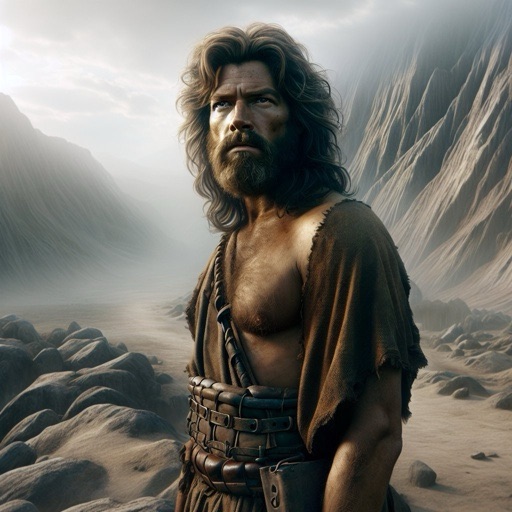
Elijah is later described as “a hairy man, with a leather belt around his waist” (2 Ki 1:8). This initial portrayal of Elijah is nested within the accounts of that long period of time when Israel was ruled by kings, when prophets functioned as the conscience of the king and the voice of integrity within society. The distinctive dress of Elijah perhaps sets him apart from the court of the kings, where a more “civilized” dress code was presumably operative. Nevertheless, Elijah does have some engagement with the kings who ruled at the time he was active: Ahab, and then Ahaziah. Indeed, his distinctive dress points to his emboldened attitude towards those kings.

Elijah operated during the period when Ahab ruled Israel; he figures in various incidents throughout the remainder of 1 Kings—most famously, in the conflict with the prophets of Baal which came to a showdown on Mount Carmel (1 Ki 18), and then later in his confrontation with Ahab and his wife Jezebel, over the matter of Naboth’s vineyard (1 Ki 21). Like Jesus, Elijah was no shrinking violet!

Elijah first appears in the narrative of the various kings, seemingly out of nowhere, just after King Ahab had taken as his wife Jezebel, daughter of King Ethbaal of the Sidonians, who presumably influenced him to begin his worship of Baal (1 Ki 17:31–33). In the same way, at the end of his time of prophetic activity, Elijah simply disappears from sight soon after Kong Ahaziah died. Elijah hands over his role to his successor, Elisha, and as “a chariot of fire and horses of fire separated the two of them”, Elijah ascends in a whirlwind into heaven (2 Ki 2:1–15).

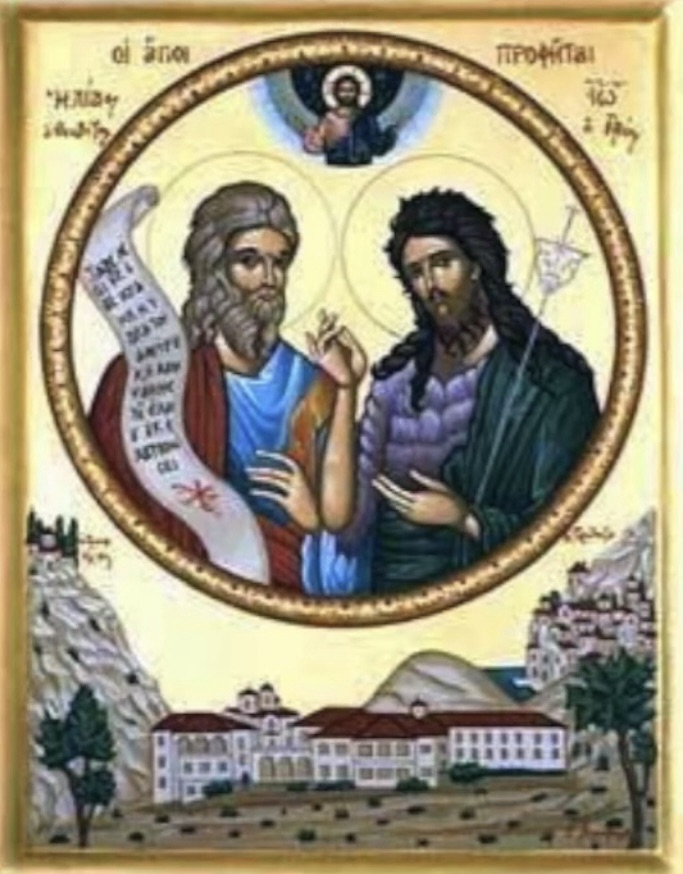
In the book we know as 1 Kings, the compiler of the Deuteronomic History reports many incidents which attest to the courage and power of Elijah. The boldness of Elijah is evident in the confrontations that he has with made clear, centuries later, to the followers of Jesus, in the earliest account of his life, when John the baptiser is depicted as a fiery desert preacher, calling for repentance, just as Elijah had called the kings to account (Mark 1:1–8). In a later account of Jesus, there is a clear inference connecting John with Elijah when Jesus notes, “Elijah is indeed coming and will restore all things; but I tell you that Elijah has already come, and they did not recognize him, but they did to him whatever they pleased” (Matt 17:11–12).

An icon of the Prophet Elijah and Saint John the Baptist from the Monastery of the Prophet Elias (Elijah) in Preveza, Greece

Then, in his sermon in Nazareth (Luke 4:16–30), Jesus refers to the first reported miracle of Elijah, when he provided a widow in Zarephath with food and oil that “did not fail”, even though the land was in drought (1 Ki 17:1–16). In subsequent incidents in 1 Kings, Elijah raises a dead son (17:17–24), directly confronts King Ahab with his sins (18:1–18), and famously stares down the prophets of Baal in a mountaintop showdown (18:19–40), leading to the breaking of the drought (18:41–46).

Elijah later condemns Ahab over his unjust seizure of the vineyard of Naboth (21:17–29) and then stands before Ahab’s son, King Ahaziah, to condemn him to death (2 Ki 1:2–16); a death “according to the words of of the Lord that Elijah had spoken” which is promptly reported (2 Ki 1:17). 

During the rule of Ahab, Elijah had also most famously heard the Lord God “not in the wind … not in the earthquake … not in the fire”—but rather in something else, which the NRSV renders as “the sound of sheer silence” (1 Ki 19:11–12). This incident is, as noted, the story set before us by the lectionary this coming Sunday. We need to ponder what is being conveyed through the symbols employed in this story. 

The three means by which God is said not to have appeared to Elijah reflect the very same means through which Moses, and the people of Israel, did experience the manifestation of the Lord God in their midst. When the escaping Israelites arrived at the Sea of Reeds, according to one version of this archetypal story, “the Lord God drove the sea back by a strong east wind all night, and turned the sea into dry land; and the waters were divided” (Exod 14:21). 

The people later celebrated the defeat of the Egyptians who were pursuing them: “you blew with your wind, the sea covered them; they sank like lead in the mighty waters” (Exod 15:10). The wind was a sign of God’s presence, and an agent of divine protection—indeed, it was the very same “wind from God” which “swept over the face of the waters” at the beginning of creation (Gen 1:2). But for Elijah, the Lord God was “not in the wind”.

Then, as they had travelled through the wilderness, the people were accompanied by a blazing fire, another sign of divine presence: “the Lord God went in front of them in a pillar of cloud by day, to lead them along the way, and in a pillar of fire by night, to give them light, so that they might travel by day and by night” (Exod 13:21). The fire signalled the divine presence.

Indeed, the very same flaming fire had been manifested to Moses when he was but a mere shepherd in Midian; “the angel of the Lord appeared to him in a flame of fire out of a bush; he looked, and the bush was blazing, yet it was not consumed” (Exod 3:2). What follows is the account of the call of Moses; God tells him “I will send you to Pharaoh to bring my people, the Israelites, out of Egypt” (Exod 3:10). The fire had been the assurance to Moses that it was the Lord God who was present.  But for Elijah, the Lord God was “not in the fire”.

The same element of fire was present when Moses and the people ultimately arrived at Mount Sinai in the wilderness of Sinai (Exod 19:1–2). “Mount Sinai”, so the account goes, “was wrapped in smoke, because the Lord had descended upon it in fire; the smoke went up like the smoke of a kiln, while the whole mountain shook violently” (Exod 19:18). Associated with this there was “thunder and lightning, as well as a thick cloud on the mountain, and a blast of a trumpet so loud that all the people who were in the camp trembled” (Exod 19:16). 

The scene at Sinai surely reflects the experience of an earthquake; the same phenomenon that prophets would later interpret as a sign of divine presence—indeed, divine judgement. “You will be visited by the Lord of hosts”, Isaiah subsequently tells the people of his time, “with thunder and earthquake and great noise, with whirlwind and tempest, and the flame of a devouring fire” (Isa 29:6). 

Still later, Zechariah describes how “the Mount of Olives shall be split in two from east to west by a very wide valley”, and instructs the people, “you shall flee as you fled from the earthquake in the days of King Uzziah of Judah; then the Lord my God will come, and all the holy ones with him” (Zech 14:4–5).

Nahum reflects on the jealous and avenging nature of God, declaring that “his way is in whirlwind and storm, and the clouds are the dust of his feet; he rebukes the sea and makes it dry, and he dries up all the rivers; the mountains quake before him, and the hills melt; the earth heaves before him, the world and all who live in it” (Nah 1:2–5). 

This dramatic motif continues on into later apocalyptic writings (Isa 64:1; 1 Esdras   4:36; 2 Esdras 16:12). The prophets and their apocalyptic heirs  knew clearly that this whole dramatic constellation of events revolving around an earthquake was a sign of divine presence.  But for Elijah, the Lord God was “not in the earthquake”. He was heard in something quite different.

What did Elijah hear? The Hebrew phrase found in verse 12 is qol d’mamah daqqah.

The King James Version translated this as “still small voice”.  More recent translations have provided variants on how these words might be translated. Alternatives that are found include “the sound of a low whisper” (ESV), “a gentle whisper” (NIV, NLT), “a soft whisper” (CSB), or “the sound of a gentle blowing” (NASB). These reflect variations on the kind of nuance that the KJV was offering. 

However, the NRSV option of translating this phrase as “the sound of sheer silence” is more confronting: the presence of God is sensed in the absence of sound; any communication from the deity comes, not in audible sounds, but in the utter absence of any sound. It is a striking paradox!

And in the context of the developing story of 1 Kings, the paradox is strong. Earlier, the prophet had stood firm against the might of Baal, the foreign god whom Ahab and Jezebel had prioritized in the life of Israel (1 Ki 18:17–40). When “the four hundred and fifty prophets of Baal and the four hundred prophets of Asherah who eat at Jezebel’s table” gathered on Mount Carmel, they failed to obtain any response from their god, the god of storms. No matter how intensely they raised their frenzied pleas, all they heard was “no voice, no answer, no response” (18:29).

Elijah, by contrast, prays to the Lord God and the fire of his god fell on the sacrificial altar; it consumed “the burnt offering, the wood, the stones, and the dust, and even licked up the water that was in the trench” (18:38). The victory was absolute and complete; the storm god had been defeated. And yet, the deity who accomplished this would communicate most personally and intimately with his chosen prophet, “not in the wind … not in the earthquake … not in the fire”, but rather in “a sound of sheer silence” (19:11–12). What a deliciously powerful irony!

Elijah was his own, distinctive man, with his own, distinctive encounter with God. He experienced God in a way quite different from what was experienced by Moses and the people of Israel. He experienced God in a way that stood apart from his contemporaries who were priests and prophets of Baal. For that reason, whilst the Lord God of Elijah stands over and against the Baal of Ahab and Jezebel, so too Elijah stands alongside and apart from Moses as a different, but equally great, leader of the people.

Alpha and Omega, bright morning star, water of life: final images in Revelation (Easter 7C; Rev 22)

During the season of Easter this year, we have read and heard passages from Revelation, the dramatic and vivid last book of scripture. We have encountered a number of creatively striking images: a white-haired, fiery-eyed figure like the Son of Man, a slaughtered lamb upon a throne, a multitude of white-robed people singing praises, a new heaven and new earth, and a city descending from the heavens. An amazing list, drawn from a book with even more amazing images in other chapters.

This Sunday, as the final Sunday in the seven-week season of Easter, we hear a passage which contains three striking images within the closing declarations and blessings that end the book (Rev 22:12–21). To give the creators of the lectionary their due, they have chosen not to excise a verse with a rather difficult message from the passage proposed—as they are wont to do at other times when dealing with other difficult verses.

So we will hear this Sunday the statement by John, as he concludes his long series of images, that whilst those who “wash their robes” will be firmly included within the holy city that has descended to earth (22:14; see 21:2, 10–26), those who are “dogs and sorcerers and fornicators and murderers and idolaters, and everyone who loves and practices falsehood” will remain outside, debarred from entry (22:15; see 21:27). The holy city will remain as the place which has “the glory of God and a radiance like a very rare jewel, like jasper, clear as crystal” (21:11). It’s a vibrant picture to bring to a close this year’s season of Easter, as we celebrate the risen Jesus in our midst.

In the midst of this exultant final vision of the book, we also hear this dire warning to all who read this book: “if anyone takes away from the words of the book of this prophecy, God will take away that person’s share in the tree of life and in the holy city, which are described in this book” (22:19). They are evocative of the instruction to Daniel, that the words of that book “are to remain secret and sealed until the time of the end” (Dan 12:9).

The book of Revelation has included many gruesome scenes where punishment—and, indeed, torture—are envisaged. As each of seven seals are broken and seven angels each blow their trumpet in turn (8:6–11:19), repeated scenes of destruction and devastation unfold across the earth. After the fifth seal is broken, locusts are sent to inflict on those who do not bear the seal of God on their foreheads five months of torture “like the torture of a scorpion when it stings someone” (9:3–5). After the sixth seal, “a third of humankind was killed by the fire and smoke and sulfur coming out of [the] mouths” of the four angels rampaging across the earth on their horses (9:15–19).

In subsequent visions, because of the evil that has infiltrated the whole world in multiple manifestations, a great red dragon threatens to consume the child born to a pregnant woman (12:1–4); a beast with ten horns and seven heads wages war “over every tribe and people and language and nation” (13:1–10); ad a group of seven angels pours out the wrath of God on earth, sea, rivers, sun, the throne of the beast, the great river, and into the air (15:1, 16:1–21). 

These visions climax with the vision of “the great whore”, Babylon, and “the beast with seven heads and ten horns that carries her” (17:1–8), who gatherers up all the sins of the world, whose sins “are heaped high as heaven, and God has remembered her iniquities” (18:5). Judgement comes upon her as  “plagues will come in a single day—pestilence and mourning and famine—and she will be burned with fire” (18:8, celebrated in song from v.10 to v.24). 

Then, in due course, the beast and the false prophet “were thrown alive into the lake of fire that burns with sulfur” (19:20), and last of all, after a millennium has passed, “the devil who had deceived them was thrown into the lake of fire and sulfur, where the beast and the false prophet were, and they will be tormented day and night forever and ever” (20:10).

These scenes of judgement, plagues, punishments, and torture, come to dominate the whole book. Yet none of these scenes appear in the passages selected for inclusion in the lectionary. The only negative notes in the passages included in the lectionary relate to the description of the lamb as one who has been slaughtered, but who now sits triumphant on the throne (5:6–14). So it is somewhat striking that this final passage includes these particular  negative notes. 

*****

In association with the celebratory notes attached to his vision of this holy city—the river of the water of life, the dazzling jewels of the city, the eternally-shining light from God, the celebrations around the throne of God and of the Lamb—John also offers striking statements about the figure whom he first described at the start of his book, the one “coming with the clouds” (1:7) whose face “was like the sun shining with full force” (1:16). This imposing figure is the one who is yet “coming soon” (22:12, 20). 

Three striking images characterise him in these final verses. None of these images should come as a surprise; they have each appeared earlier in Revelation, and indeed they tap into imagery in other books of scripture, in both testaments.

ALPHA AND OMEGA

The first striking image is one that was sounded at the very start of the book, when John was testifying “to the word of God and to the testimony of Jesus Christ, even to all that he saw” (1:2). Included in that early testimony is the claim that “the one who is pierced” is “coming with the clouds; every eye will see him” (1:7). At this, God himself speaks: “‘I am the Alpha and the Omega’, says the Lord God, who is and who was and who is to come, the Almighty” (1:8). 

Then, in the second of the seven letters to be sent to the seven churches (2:1—3:22), this claim is adopted by the author of the letter, “one like the Son of Man, clothed with a long robe and with a golden sash across his chest” (1:13). This figure adopts the words spoken by the Lord God as he declares “these are the words of the first and the last, who was dead and came to life” (2:8). It is a clear reference to Jesus, already identified as “the faithful witness, the firstborn of the dead, and the ruler of the kings of the earth”, the one who “loves us and freed us from our sins by his blood” (1:5–6).

The same claim recurs in the climactic closing vision of the book, when “the one who was seated on the throne” (21:5)—that is, the great white throne on which sat the judge of all humanity (20:11–16)—declared, “It is done! I am the Alpha and the Omega, the beginning and the end” (21:6). And then, after the vision concludes, the angelic figure seen by John reminds him, “I am the Alpha and the Omega, the first and the last, the beginning and the end” (Rev 22:13).

The words spoken by the Lord God, the one like a Son of Man, the judge on his throne, and his angelic messenger rekindle the image of God which had been described, centuries before, by the unnamed exilic prophet whose words are included as the second section of the book of Isaiah (Isa 40—55). “Who has performed and done this, calling the generations from the beginning?”, the prophet asks.”I, the Lord, am first, and will be with the last”, is the response (Isa 41:4). In a later oracle, the Lord God declares “I am the first and I am the last; besides me there is no god” (Isa 44:6); and still later, “Listen to me, O Jacob, and Israel, whom I called: I am He; I am the first, and I am the last” (Isa 48:12).

The significance of this claim is outlined in another prophecy: “Remember the former things of old; for I am God, and there is no other; I am God, and there is no one like me, declaring the end from the beginning and from ancient times things not yet done, saying, ‘My purpose shall stand, and I will fulfill my intention’” (Isa 46:8–10).

In the Revelation of John, these words are heard from the mouth of the one like a Son of Man, identified as Jesus (1:5; 22:16). Jesus is both Alpha and Omega, first and last; as the letter to the Hebrews declares in its idiosyncratic language, “without father, without mother, without genealogy, having neither beginning of days nor end of life, but resembling the Son of God, he remains a priest forever” (Heb 7:3).

BRIGHT MORNING STAR

A second striking image is that of the morning star, in the words of Jesus, “I am the root and the descendant of David, the bright morning star” (22:16). That image was first expressed early in this book, in one of the seven letters to the churches. In each of the seven letters included in this book, “those who conquer” are given a specific gift to signal their special status. To those in Thyatira, to signal the authority that is given to them “to rule [the nations] with an iron rod, as when clay pots are shattered”, the specific gift is “I will also give the morning star” (2:26–28).

The morning star is referenced in the book of Ecclesiasticus (Ben Sirach), in a poem which praises Simon son of Onias (high priest in the early C3rd BCE). After celebrating his work in repairing and fortifying the temple, the joy that he brought is described through a series of images: “How glorious he was, surrounded by the people, as he came out of the house of the curtain. Like the morning star among the clouds, like the full moon at the festal season; like the sun shining on the temple of the Most High, like the rainbow gleaming in splendid clouds” (Sirach 50:5–7, and continuing on for some verses). A similar use of the phrase appears in the second letter attributed to Peter, where “the prophetic message” is compared with “a lamp shining in a dark place, until the day dawns and the morning star rises in your hearts” (2 Pet 1:19).

It is the bright, dazzling quality of the star that rises early in the morning, before sunrise—the planet we know as Venus—that is in view here. We should note that there is no intention to allude to the words of Isaiah, who refers in one of his prophecies about the punishment that was imminent for the King of Babylon. The prophet warns, “Sheol beneath is stirred up to meet you when you come … you pomp is brought down to Sheol” (Isa 14:9, 11), before depicting this decline in poetic language: “How you are fallen from heaven, O Day Star, son of Dawn! How you are cut down to the ground, you who laid the nations low!” (Isa 14:12).

In the 17th century King James Version, “O Day Star” is rendered as Lucifer—since that is how “light-bringer” is expressed in Latin. This was the term used in the Vulgate, a late-4th century Latin translation of the Bible. This verse has been picked up in later theological developments and applied to the figure of the devil; it is probably also influenced by words attributed to Jesus in Luke 10:18, “I watched Satan fall from heaven like a flash of lightning”. 

However, this sense of the term does not relate at all to the way the imagery of “the morning star” appears in Revelation. In this book, the devil is depicted as “a great red dragon, with seven heads and ten horns, and seven diadems on his heads” (Rev 12:3; 20:2) who is “the deceiver of the whole world” (Rev 12:9) who is ultimately “thrown into the lake of fire and sulfur …[to be] tormented day and night forever and ever” (Rev 20:10).

WATER OF LIFE 

The third striking image in this final chapter of Revelation is “the water of life”. John had indicated that this water would be gifted to those who are thirsty (Rev 21:6). This gift comes from “the Lamb at the centre of the throne” who is the shepherd of “a great multitude that no one could count, from every nation, from all tribes and peoples and languages, standing before the throne and before the Lamb, robed in white, with palm branches in their hands” (7:9). This shepherd, says John, “will guide them to springs of the water of life, and God will wipe away every tear from their eyes” (7:17).

The imagery appears returns as integral part of the final climactic vision of “the holy city Jerusalem coming down out of heaven from God” (21:10). John writes that the angel showing him the vision of this city “showed me the river of the water of life, bright as crystal, flowing from the throne of God and of the Lamb” (22:1). 

The river brings water to nourish life, just as another John (compiling a Gospel narrative) attributes to Jesus words in which he offers water as the basis for life: “those who drink of the water that I will give them will never be thirsty; the water that I will give will become in them a spring of water gushing up to eternal life” (John 4:14). These words evoke the reality that all human beings know, that “the necessities of life are water, bread, and clothing, and also a house to assure privacy” (Sirach 29:21; see a similar, but expanded, list at Sirach 39:26).

The scene at the end of Revelation evokes the vision described centuries earlier by the prophet Ezekiel, in the final chapter of his book. Ezekiel details the water flowing from the temple, the abundant trees growing beside the river, and the food sources for the people (Ezek 47:1–12). It is a wonderful ecologically vibrant scene, as is the vision in Revelation, where “on either side of the river is the tree of life with its twelve kinds of fruit, producing its fruit each month; and the leaves of the tree are for the healing of the nations” (Rev 22:2).

So the book ends with words of grace: “The Spirit and the bride say, ‘Come’; and let everyone who hears say, ‘Come’, and let everyone who is thirsty come. Let anyone who wishes take the water of life as a gift” (22:17). It’s a nice closing note.