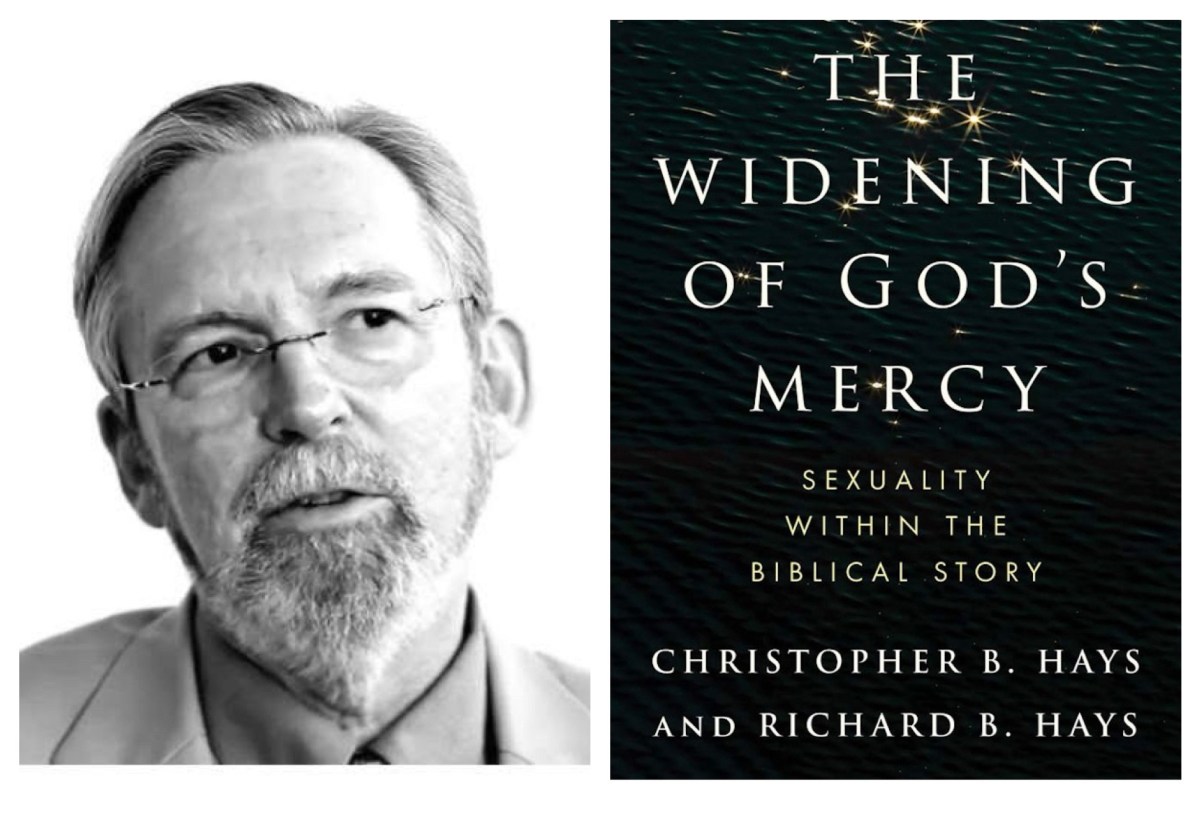
I’ve heard the sad news that New Testament scholar Prof. Richard Hays has died this week. He recently had a recurrence of an earlier pancreatic cancer and just last week entered hospice care. I remember him as a compassionate, insightful, and articulate person, and am sad to hear of his death.
Richard was a member of the Faculty at Yale University when I started my doctoral studies there in 1983. I got to know him through our mutual participation in the NT seminar each semester, and in 1984 I took a seminar course on “War and Peace in the Bible” with him one semester. We grappled with many relevant biblical texts and ethical issues as we engaged with interpreters through 2000 years of Christian history and tradition, across a range of perspectives, from “just war” advocates to Mennonite pacifists, including Reinhold Neibuhr and Roland Bainton, former Yale professors and eminent contributors to the debate. It was a vigorous semester-long exploration of ethics and hermeneutics in relation to the matter of war and peace. It was immensely stimulating!
The major paper that I wrote in this seminar (“Hermeneutical Issues in the Search for the Historical Political Jesus”) was most helpful for me in establishing and consolidating some key elements of my own hermeneutical practice. Then, in 1988, Richard was one of the three examiners of my PhD dissertation—and provided a number of pages of detailed commentary and critique of what I had written about. (He agreed that I should be awarded the degree, however!)
It’s sobering for me to reflect that all three of my examiners, Wayne Meeks, Richard Hays, and Rowan Greer, and my doctoral supervisor, Abraham Malherbe, are now deceased. I am grateful for the important roles that each had (along with other teachers) in preparing me for my subsequent years of teaching, research, and writing.
Just after the turn of the millennium, Richard visited Australia for a conference and spent some time at United Theological College, leading a seminar for interested members of the college community. Elizabeth and I were scheduled to take him out to dinner was, but she was then in her period of extended hospital stays, fighting recurrent lung infections, and so we couldn’t do that. In his typically gracious way, he came with me to RNSH and met with her and me for a meal in the private hospital cafeteria. We had a long, long exegetical discussion as Elizabeth had most recently been immersed in her controversial doctoral research into Matthew’s Gospel. It was not the kind of conversation that usually occurs in a hospital café! We were both very grateful for, and much energised by, this conversation!
Richard has been one of the most well-respected NT scholars in the world. He was the George Washington Ivey Professor Emeritus of New Testament at Duke University in the USA—a prestigious and important post. In an early work, he developed a technical argument that Paul was referring, not to our “faith IN Jesus Christ”, but rather to “the faith OF Jesus Christ” as the basis for salvation. It was a technical linguistic argument with huge theological consequences, and was debated, explored, for it grounded our salvation in Jesus, not in our own actions of believing. This understanding has been largely taken up by a number of leading scholars in subsequent years.
A decade after I had studied with him, Richard had famously argued *against* LGBTQ inclusion in his landmark ethics book, The Moral Vision of the New Testament (1996). In the book, he was seeking to develop a wider framework for ethical decision-making that was not simply pegged onto “proof texts”, but which was developed from the broad sweep of biblical and theological understandings. I realised on reading it that the 1984 seminar had provided the basis for one of the chapters in this book.
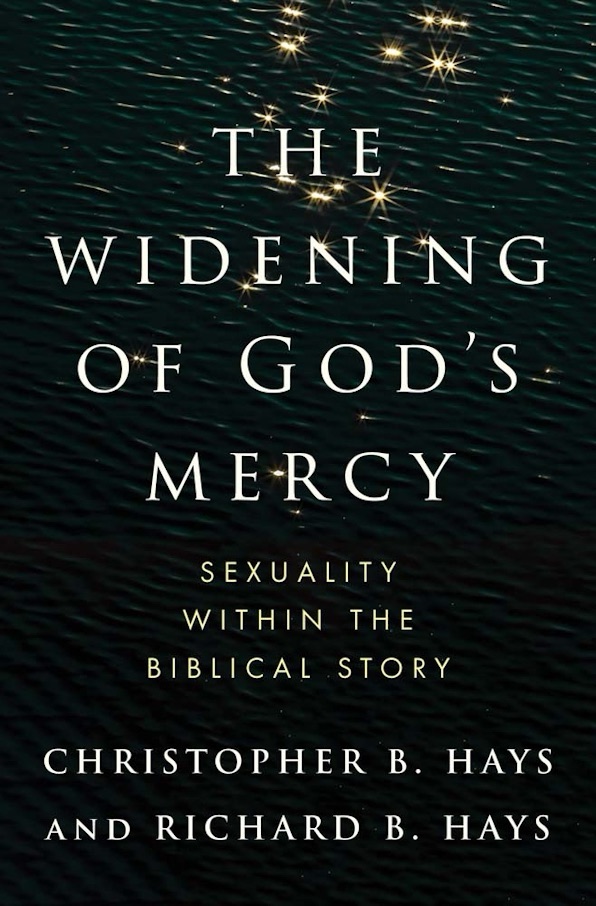
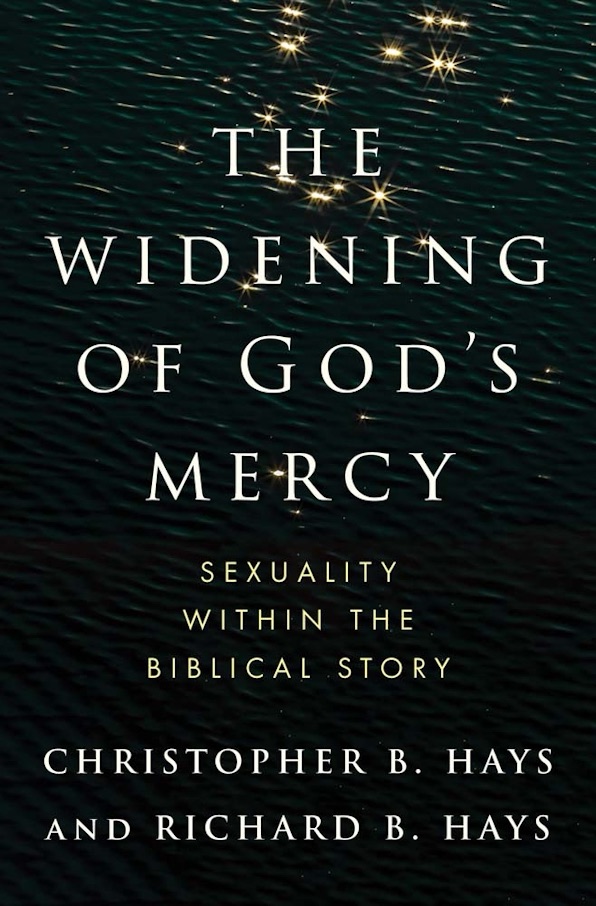
The search for a broad biblical-theological basis for ethics eventually led him, more recently, to become a proponent of affirming and inclusion of LGBTG people within the church. With his son, Christopher Hays, a well-respected OT/Ancient Near Eastern scholar at Fuller Seminary, he co-wrote The Widening of God’s Mercy: Sexuality Within the Biblical Story (2024).
The publisher’s blurb says that in this book, the authors write about “a dynamic and gracious God who is willing to change his mind, consistently broadening his grace to include more and more people. Those who were once outsiders find themselves surprisingly embraced within the people of God, while those who sought to enforce exclusive boundaries are challenged to rethink their understanding of God’s ways.”
In closing the last chapter, the father and son authorial team write, “This book is therefore not just an argument about the meaning of the Bible in the past, but an invitation to readers to make new meaning in the present by listening to the Spirit and joining God now in saying, “I will gather others to them besides those already gathered” (Isa 56:8) … We hope that this book offers encouragement to see that the inclusion of sexual minorities is not a rejection of the Bible’s message but a fuller embrace of its story of God’s expansive mercy.” Richard in particular offered his own declaration of repentance for his earlier writing.
It was an act of deep humility; and a wonderful “last word” from this great scholar and fine man.
The lectionary Gospel reading for this Sunday (Mark 10:2–16) reports an encounter between Jesus and some Pharisees—the first such encounter in Judea, as earlier encounters had been in Galilee. I have already explored this story in the context of the cultural and religious context of the time, in late Second Temple Judaism.
In the debate that takes place in this encounter, Jesus quotes from the first creation story, the grand priestly narrative that occupies pride of place at the start of Bereshith, the first scroll of Torah, and thus at the beginning also of the scriptures collected by the followers of Jesus that formed what we know as The Holy Bible.
Words in origin stories have a particular power—and origin stories, such as this one (Gen 1:1–2:4a), are chosen with care and deliberation. That is certainly the case with this particular verse. In debating the Pharisees, Jesus says, “from the beginning of creation, ‘God made them male and female’” (Mark 10:6).
Here Jesus uses the verse as the claim that seals his particular stance regarding divorce—that it was not part of the plan that God had for humanity, since the male—female gender structure is integral to our humanity, and underscores his conclusion regarding divorce, that “what God has joined together, let no one separate“ (Mark 10:9). This, in turn, is his deduction from what the second creation story sets forth about marriage, that “a man leaves his father and his mother and clings to his wife, and they become one flesh” (Gen 2:24; quoted at Mark 10:7–8a). See
The statement by Jesus that God made human beings as male and female sounds like a definitive declaration: this is the reality, this is who we are, there is nothing more to debate! Certainly, that’s the way this verse has been used in the “gender wars” that have swirled through western societies in recent times. “God made male and female” became “God made Adam and Eve, not Adam and Steve”, in an early salvo against the emerging number of people who were “outing” themselves as same-gender attracted. “Not so” was the sloganeers’ reply; two genders, each attracted to the opposite, is who we are. Definitively. Resolutely. Absolutely.
It’s worth going back to the quote from Genesis in its original context. What the priestly authors of the creation story wrote was “God created humankind in his image, in the image of God he created them; male and female he created them” (Gen 1:27). The emphasis is not so much on defining who we are are gendered people—but rather, the verse is reflecting on the amazing feature that, within humanity, signs of divinity are reflected. And in association with that, the statement indicates that the two genders familiar from humanity are somehow reflected in the very nature of God.
As God’s creatures, we are images of that creating being. The Hebrew word used, tselem (image), indicates a striking, detailed correlation between the human and the deity. This was the insight brought by the authors of this passage, perhaps shaped and honed over generations of telling and retelling the story, passing on through the oral tradition the insights of older generations.
My sense is that these ancients were not so much making a definite declaration about the nature of humanity—an early dogmatic assertion, if you like—as they were actually reflecting on their experience. They sensed that there was something within humanity that reaches out, beyond the material, into the unknown, beyond the tangible, into “the spiritual”. They surely knew the kind of experience that Celtic mystics have known, of coming to a place where “heaven meets earth”—what they call “a thin place”, where God can be sensed in the ordinariness of life. Indeed, such a “thin place” might well be being described in Gen 28:10–22, where Jacob comes to the realisation that “surely, the Lord is in this place” (Gen 28:16).
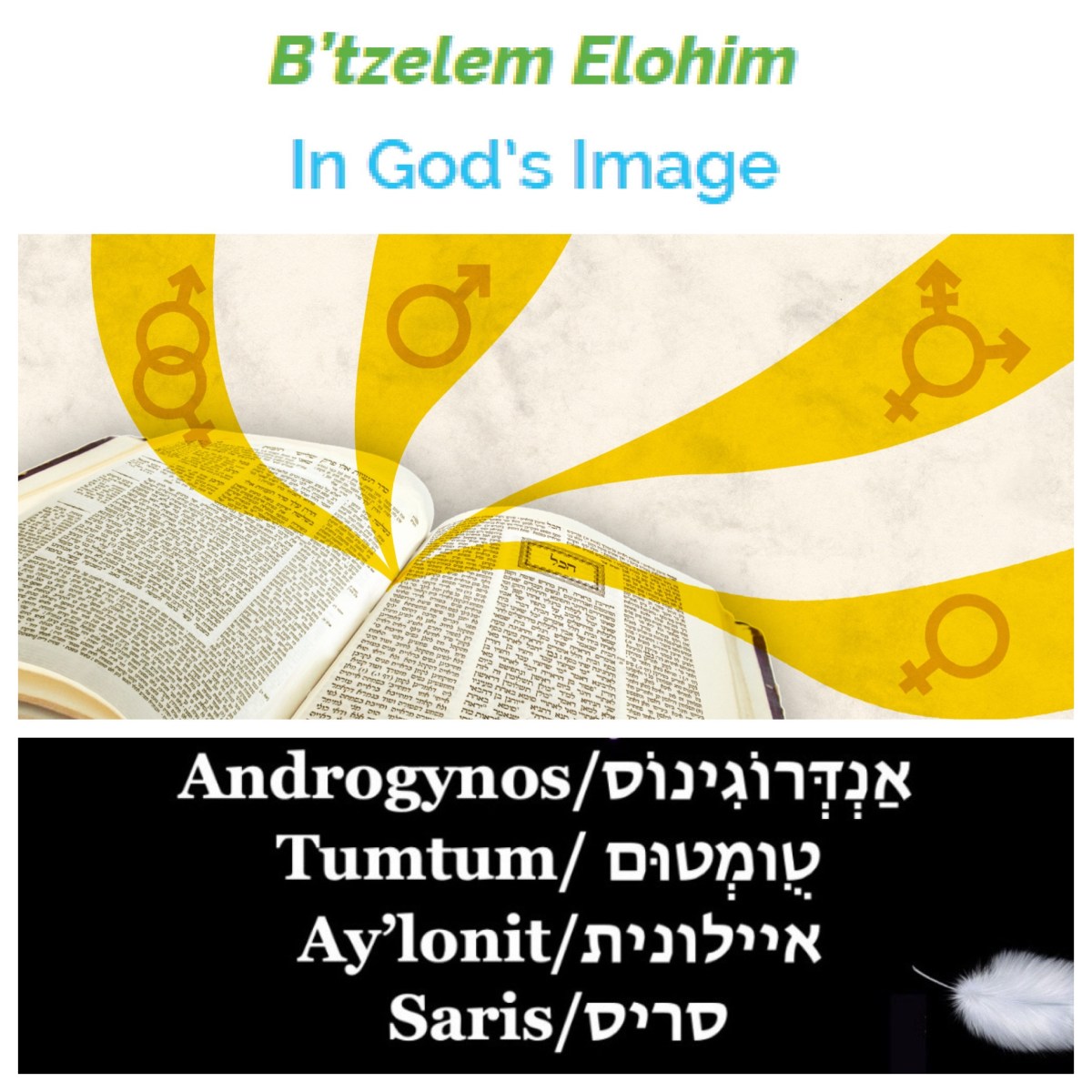
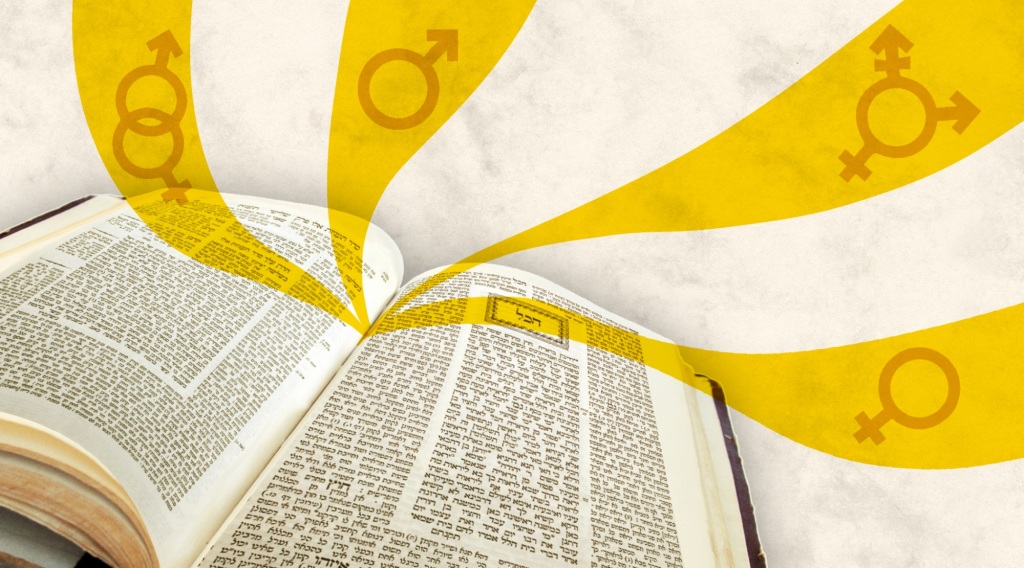
Indeed, as Jewish tradition developed over time, this fundamental duality of human gender—male and female—was questioned, probed, explored, and developed. Rabbis of late antiquity and the early medieval period (using the standard Western terminology) actually identified six genders. The first move takes place in the Mishnah (early 3rd century). Tractate Bikkurim 4.1 contains the assertion, “an Androginus (a hermaphrodite, who has both male and female reproductive organs) is similar to men in some ways and to women in other ways, in some ways to both and in some ways to neither”. It is interesting that the term androginus, a Greek term, is simply transliterated in this Aramaic work, as אדדוגינוס. That’s a sign that the consideration of this issue encompassed more than just rabbinic scholars, as they were drawing on insights and term androginus from the hellenised world.
The tractate Bikkurim (first fruits) is part of the first order of the Mishnah, entitled Zera’im (seeds).
The text of Bikkurim goes on to offer indications of the ways that an androginus person is similar to, and dissimilar to, each gender (4.2–3). Another passage in the Mishnah identifies people known as a saris, סריס (Yevamot 8.4). These are people we identify as eunuchs; whether these are “eunuchs who have been so from birth … eunuchs who have been made eunuchs by others … [or] eunuchs who have made themselves eunuchs” (as Matthew reports Jesus saying, Matt 19:12) is not relevant in this context; but we do meet such a person at Acts 8:27. Presumably, the rabbis refer to males with arrested sexual development who are unable to procreate. The female term for such people is given as aylonit, אילונית. The discussion that follows makes it clear that these people are women with arrested sexual development who cannot bear children.
So this means that rabbis recognised four genders: male, female, androgyne, and eunuch. In the Babylonian Talmud (sixth century CE), Rabbi Ammi is quoted as stating that “Abraham and Sarah were originally tumtumim” (טומטמין). Here we find another gender identity term; this time, describing people a person whose sex was unknown because their genitalia were hidden, undeveloped, or difficult to determine. (The Hebrew word tumtum means “hidden”.)
Thus, Abraham and Sarah lived most of their life as infertile, as their sex was not clear; and then, in Rabbi Ammi’s explanation, miraculously turned into a fertile husband and wife in their old age. The Rabbi points to Isa 51:1–2, saying that the instruction to “look to the rock from where you were hewn, and to the hole of the pit from where you were dug […] look to Abraham your father and to Sarah who bore you” explains their genitals being uncovered and miraculously remade.
(Explaining one scripture passage by drawing on another passage, however distantly related—often through their sharing a common word or phrase—was a common rabbinic mode of scripture interpretation.)
Today, we would explain the phenomenon of a tumtum as being an intersex person, born with both male and female characteristics, including genitalia—although modern science would not go so far as to accept a miraculous reversal of the condition, as Rabbi Ammi proposed.
There’s a quite accessible discussion of these issues in an article on My Jewish Learning by Dr Rachel Scheinerman, entitled “The Eight Genders in the Talmud”. The title reflects the fact that Dr Scheinerman divides both aylonit and saris into two, on the basis of birth identification. So she lists: (1) zachar, male; (2) nekevah, female; (3) androgynos, having both male and female characteristics; (4) tumtum, lacking sexual characteristics; (5) aylonit hamah, identified female at birth but later naturally developing male characteristics; (6) aylonit adam, identified female at birth but later developing male characteristics through human intervention; (7) saris hamah, identified male at birth but later naturally developing female characteristics; and (8) saris adam, identified male at birth and later developing female characteristics through human intervention.
Dr Scheinerman concludes, “In recent decades, queer Jews and allies have sought to reinterpret these eight genders of the Talmud as a way of reclaiming a positive space for nonbinary Jews in the tradition. The starting point is that while it is true that the Talmud understands gender to largely operate on a binary axis, the rabbis clearly understood that not everyone fits these categories.”
Dr. Charlotte Elisheva Fonrobert, a Talmudic scholar in the Department of Religious Studies at Stanford University, California, has provided a much more detailed and technical discussion of the matter of gender identity, in the online resource the Jewish Women’s Archive. See
“Jewish law is based on an assumption of gender duality, and fundamental mishnaic texts indicate that this halakhic duality is not conceived symmetrically (as seen through the gendered exemptions of some commandments). Rabbinic halakhic discourse institutes a functional gender duality, anchored in the need of reproduction of the Jewish collective body. As such, it aims to enforce and normalize a congruence between sexed bodies and gendered identities. Furthermore, the semiotics of body surfaces produces other different and seemingly more ambiguous gender possibilities, and rabbinic discourse has widely discussed the halakhic implications of these ambiguities.”
What that means, I think, is that whilst Torah prescriptions are based on a definite duality of gender (you re either male or female), later rabbinic discussions entertained the possibility of a range of gender identifications. In this regard, the rabbinic discussions prefigured the move in contemporary society to recognise the full spectrum of diversity amongst human beings: some men are gay, some women are lesbian; some people are bisexual, attracted to both genders, while others are asexual, having no sexual-attraction feelings at all.
Biologically, we know that some are born intersex, with both male and female physical characteristics; whilst psychologically, some people are born into a body that is clearly one gender have an internal energy that leads them to identify with the opposite gender, and so they undergo a medical transition to that gender, and we identify them as transgender people. And so, we have the now-widespread “alphabet soup” of LGBTIQA+ (where the plus sign indicates there may well be other permutations within this widely diverse spectrum).
So we would do well not to remain in a static state of assertion that the Genesis text is a prescription for how human beings should be identified (and a definition for marriage). I think it is preferable to add into the discussion both the rabbinic understandings, contemporary medical understandings, and psychological insights that reveal a wide spectrum of gender identities; a dazzling kaleidoscope of “letters”, as it were. For this is how we human beings are made, in an image that reflects the diversity and all-encompassing nature of God. Rather than misusing the Genesis/Mark text as a club to batter people into submission, let’s rejoice in the diversity we see amongst humanity, and affirm that, no matter whether L or G, whether B or A, whether T or I, all people who are Q, and all who are straight, are “fearfully and wonderfully made” (Ps 139:14).
There is a helpful collection of Jewish texts relating to this matter in the online resource, Sefaria, entitled “More Than Just Male and Female: The Six Genders in Ancient Jewish Thought”, collated by Rabbi Sarah Freidson of Temple Beth Shalom in Mahopac, NY, USA. See
There’s an interesting new book to be published in September: The Widening of God’s Mercy. Sexuality Within the Biblical Story. It is written by two eminent, conservative-ish American professors, Richard Hays and his son Christopher Hays.
Richard Hays is one of the most well-respected NT scholars in the world. He famously argued *against* LGBTQ inclusion in his landmark ethics book, The Moral Vision of the New Testament, 30 years ago. He teaches at Duke Divinity School. He now is a proponent of affirming and inclusion. His son, Christopher Hays, is one of the most well-respected OT/Ancient Near Eastern scholars in the world. He teaches at Fuller Seminary, an institution founded as a strongly conservative seminary, which has become less “conservative” in recent years.
In 1996, Richard Hays wrote about a range of ethical matters in his work The Moral Vision of the New Testament. A number of biblical scholars, theologians and ethicists provided positive reviews of the work, and it has been an important work for students in each of these disciplines.
In chapter 16 of this book, Hays discusses relevant New Testament passages and comes to a conclusion that homosexuality cannot be affirmed by any New Testament text. Reviewing that chapter, American scholar Dr Anna Sieges notes, “His careful argumentation and generous posture toward LGBTQ individuals (by 1996 standards, at least) made the chapter a fan favorite among those who wanted to respectfully and biblically exclude LGBTQ people from public spaces (religious or political) for what they deemed sexual immorality.”
Personally, I was surprised that Richard Hays had come to this conclusion about LGBTIQA+ people. I knew him in the 1980s when I was a doctoral student studying at Yale University, where he was a member of Faculty. I took a particularly lively seminar on “War and Peace in the Bible”, where we explored biblical texts and the full sweep of theological and ethical interpretations of this area.
Prof. Hays was consistently careful and compassionate as he explored key texts with critical acumen and a clear connection to contemporary thought. On that basis, as well as personal interactions with him in other contexts, the book was published, I had thought that he would have come to a different conclusion about the biblical texts relating to sexuality and gender. But he did not.
Thirty years later, he is publishing a work in which he argues differently. The book, we are told, will provide an argument for a theological and ethical position that supports, affirms, and encourages LGBTIQA+ people of faith as they exercise their ministries; and also in terms of how we relate to people of diverse secularities and gender indentures in society. It is an encouraging move.
The publisher’s blurb says:
“In this learned and beautifully written book, Richard and Christopher Hays explore a more expansive way of listening to the overarching story that scripture tells. They remind us of a dynamic and gracious God who is willing to change his mind, consistently broadening his grace to include more and more people. Those who were once outsiders find themselves surprisingly embraced within the people of God, while those who sought to enforce exclusive boundaries are challenged to rethink their understanding of God’s ways.
“The authors—a father and son—point out ongoing conversations within the Bible in which traditional rules, customs, and theologies are rethought. They argue that God has already gone on ahead of our debates and expanded his grace to people of different sexualities. If the Bible shows us a God who changes his mind, they say, perhaps today’s Christians should do the same. The book begins with the authors’ personal experiences of controversies over sexuality and closes with Richard Hays’s epilogue reflecting on his own change of heart and mind.”
“I think everyone in Hays’ circles in the 90s knew, to affirm gay people was career-suicide in their institutions. It still kinda is. I’m not suggesting it was deceptive or anything, but I think it’s very hard to imagine a theological conclusion when you subconsciously know you’re whole faith community will not go with you. Fear doesn’t inspire courageous thinking.”
Certainly, within the Uniting Church as a whole, and in formal decisions by councils of the church over the years, we have long accepted, affirmed, and encouraged LGBTIQA+ people within the life of the church.
And yes, I am aware that this has been seen as a slow and imperfect process by some, whilst others have fought tenaciously against each step with dogmatic aggression. But formally, and substantially, the Uniting Church has a position that would welcome the argument of Hays and Hays, when it is ultimately published.
*****
I need to note that Prof. Richard Hays was one of the examiners of my PhD thesis in 1988, while Karl Hand wrote a PhD under my supervision in the years 2008 to 2011.
*****
For my discussion of the “clobber texts” that feature so often in this area, see
Regular readers of my blog will know that, from time to time, I leave my natural environment of detailed exegetical exploration of biblical texts, and move into matters of church practice or issues of key concern in the wider society—even, at times, into politics.
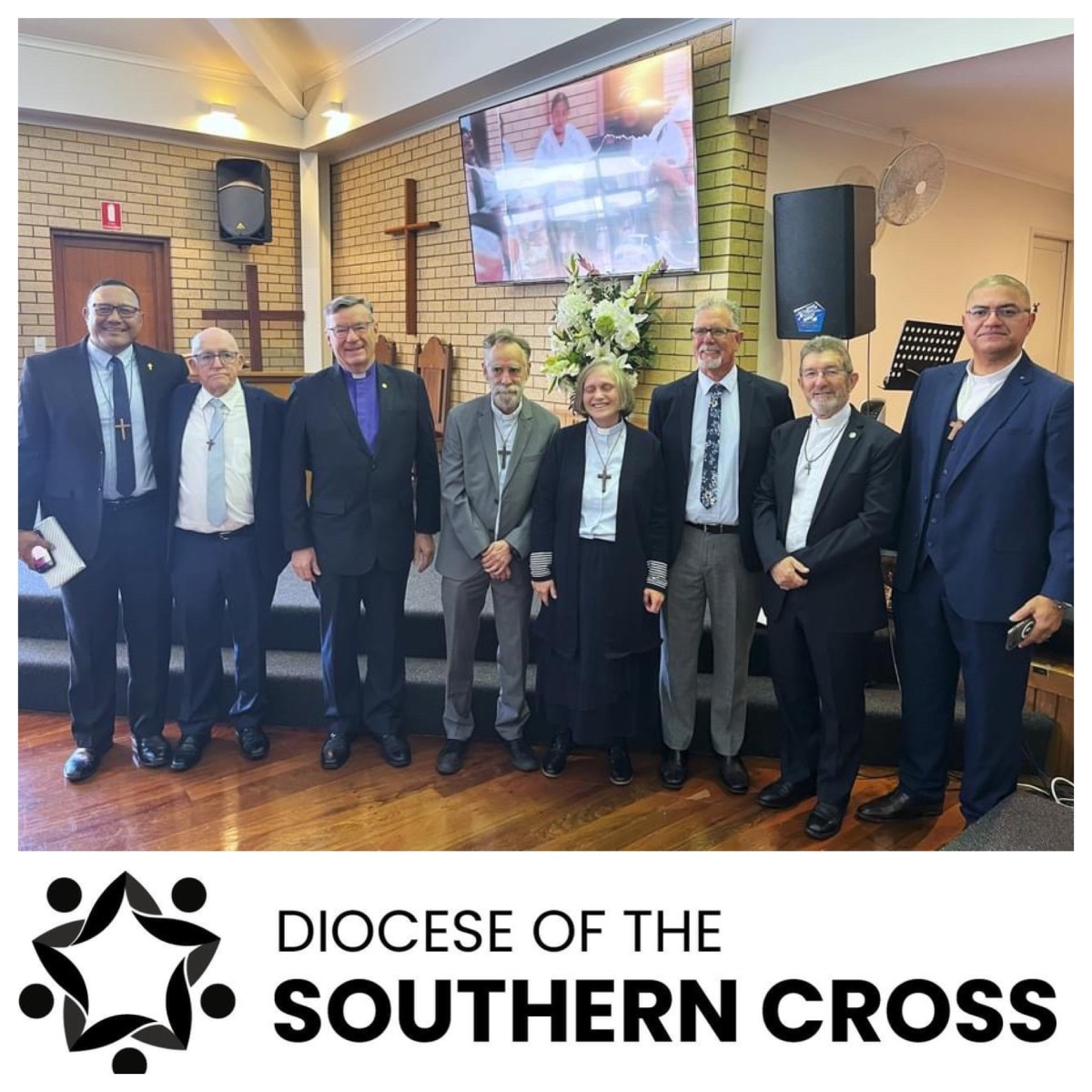
This blog is such a venture, written in response to the news that on 17 June 2023, eight people who had been ordained as Uniting Church ministers and who for years have exercised ministry in Uniting Churches, have now joined the Diocese of Southern Cross Inc. (I will refer to this as the DSC in what follows.) What follows is entirely my own point of view, and I do not claim to be speaking for any part of then Uniting Church in this blog.
That “Diocese”—to be precise, it is an incorporated company that has taken an ecclesiastically-sounding title—is related to GAFCON, the breakaway group of Anglicans who have grown increasingly dissatisfied with the worldwide Anglican Communion, headed by the Archbishop of Canterbury.
The critical issue for GAFCON (indeed, the only issue, it seems) is homosexuality. GAFCON (the Global Anglican Future Conference) has been vehement in its criticism of the Anglican Church as a collection of issues in this area have been considered. Some GAFCON leaders from African countries have indeed supported the introduction of the death penalty in that country in some instances of homosexual practice.
The eight “former Uniting Church ministers” who have joined the DSC are all firmly convinced that the practice of homosexual sex is abhorrent, that gay people (broadly understood) are perpetual sinners, and that the church needs to take a strong stand, condemning same-gender relationships and writing that point of view into the doctrine and practices of the church. (None of them, I should hasten to add, have called for the death penalty to be imposed.)
The Uniting Church has consistently refused to do as they have wished in relation to homosexuality; their most recent spectacular failure was the efforts to derail the national Assembly meeting in Melbourne in 2018. This was the meeting where, despite the blocking tactics and argumentative strategy of members of the Assembly of Confessing Congregations—what I have described as their “aggressive apologetic antagonism”—the UCA Assembly agreed that same gender couples could be married under the auspices of the Uniting Church.
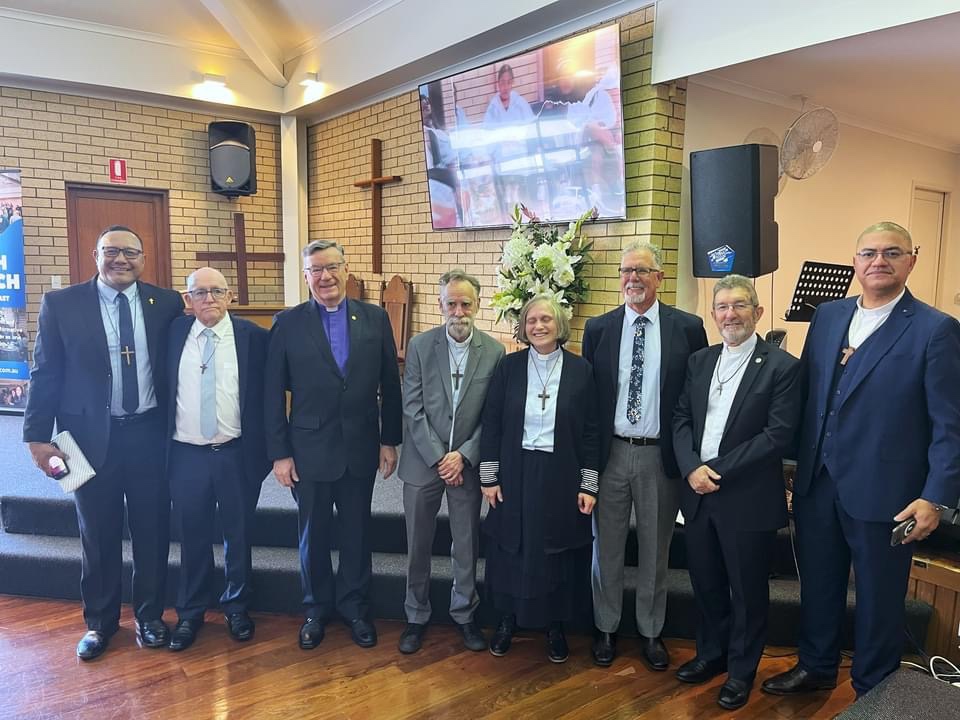
These eight people left the Uniting Church to join the DSC in a ceremony held at Mooloolaba, on the Sunshine Coast in Queensland, that “recognised” them as Pastors in the DSC. What precise status that gives them is unclear; they cannot be seen as ordained Anglican ministers, since Anglican ordination require connection to the episcopal line of tradition, which Uniting Church ordinations do not have, at least in their eyes.
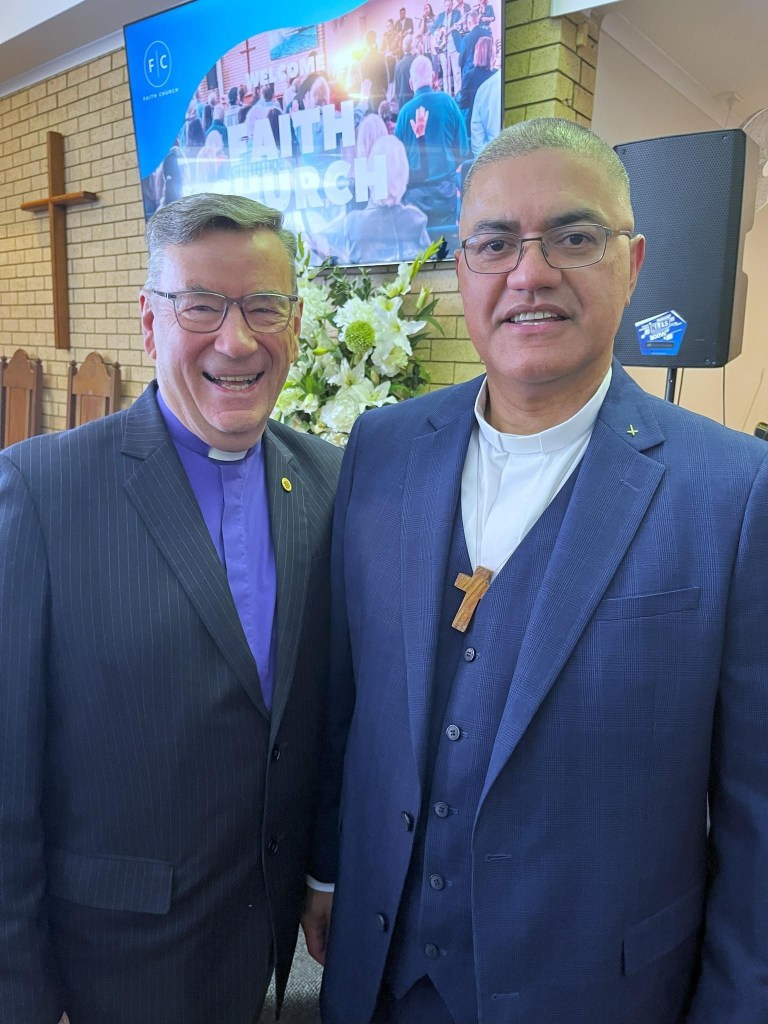
The Facebook page for the Diocese of Southern Cross proclaims that Faith Church Sunshine Coast and Hedley Fihaki were welcomed to the Diocese of the Southern Cross. Hedley Fihaki, of course, is the former chairperson of the Assembly of Confessing Congregations in the Uniting Church, which recently caved in on itself and closed. The ACC is no more. Hedley and his companions are seeking a new base.
Glenn Davies and Hedley Fihaki
So the Mooloolaba Eight left the Uniting Church. It is rather ironic that their service of “recognition” was presided over by Glenn Davies, the former Archbishop of the Anglican Diocese of Sydney. Whilst he was still Archbishop in Sydney, he had invited members of the Anglican Church who disagreed with Sydney Diocese policy about sexuality, to “please leave”. The Mooloolaba Eight left their church to join a breakaway group headed by the person who said “please leave”. How ironic!
The Facebook post continues: “As well as being commissioned as pastor of Faith Church, Hedley was formally recognised by Bishop Glenn Davies as a presbyter in the diocese along with seven other former Uniting Church ministers who have chosen to join us in the Diocese of the Southern Cross. Welcome to Philip Anderson, David Graham, Anne Hibbard, Roger Hibbard, Raymond McIlwraith, Lulu Senituli, and Harold Strong.”
I have to confess that I know and have had interactions with six of the eight people identified in this post—some as members of the same council of the church, some through online conversations, some as colleagues in ministry in placements in the same synod as me, and one who I taught whilst they were in theological college. (A wise colleague has helpfully reminded me that, in line with Ezekiel 18, the sins of the student should not be attributed to or visited on the teacher!)
Some of those who were “recognised” this past weekend have been aggressive in their pursuit of their homophobic agenda, for years, whilst in the Uniting Church. This has been a very bad thing for the Uniting Church, because much energy and effort has been diverted from the core matters of importance in the church, to attempt to placate and include those who prosecuted this strident line. Now that they have moved on, the UCA can hopefully return to key matters of mission and ministry unhindered by such regressive views and the associated intrusive aggressive tactics.
There are interesting questions of church order now to be explored. Presumably, the eight people have or will resigned from their status as ordained ministers within the Uniting Church. My understanding is that two of them have already been engaged in processes within the Uniting Church over the past year, in this regard. But the move to the DSC must surely mark the time when they each formally resign from the Uniting Church.
The DSC itself is a curious beast. There is debate amongst Anglicans as to whether this is “a real diocese” or not. I have seen a direct statement that “this is a real Anglican diocese”, but also a similarly definitive claim that “this is not an entity in fellowship with the Anglican Church in Australia”, and so not actually an Anglican diocese. That’s all a matter for Anglican polity nerds, though.
What interests me more is how the eight who were “formally recognised as presbyters” will portray themselves and act in ministry. Will they simply continue as if they remain ordained? If the DSC is acting like an Anglican entity, their ordination as Uniting Church ministers will not be recognised—no bishop, in the line of apostolic succession, laid hands on them at their ordination, and so they technically are not to be regarded as ordained. That’s how I understand it, from my non-Anglican standpoint; but it will be interesting to see what eventuates.
The other element is the curious fact, commented on by some of my Facebook friends, that the person who “recognised” the eight people at Mooloolaba on 17 June was Glenn Davies, who was previously Archbishop of the Sydney Diocese of the Anglican Church. This diocese has fought long and hard, over many years, to oppose the ordination of women.
Yet the former Archbishop of Sydney, who so strenuously opposed the ordination of women in that role, has seemingly validated the ordained ministry of the one woman in the Mooloolaba Eight. It will be interesting to see how this is dealt with.
Apparently the DSC, being affiliated with the schismatic GAFCON within the Anglican Church, is nevertheless open to women ministers. Indeed, the first GAFCON-affiliated congregation in Western Australia, New Beginnings Church in Mandurah, Western Australia, has an ordained female minister, the Rev. Linley MatthewsWant, who is an Anglican minister.
Glenn Davies with Linley MatthewsWant in Mandurah, WA
So the irony is that the former leader of the aggressively anti-women’s ordination push is now the leader of an organisation with ordained female in ministry. Isn’t that a telling revelation as to the ethics of Glenn Davies? Either he really believes in the ordination of women, but put this to one side while he was in the Sydney Diocese; or else he has shelved the firm commitment that he had in the past for entirely pragmatic reasons in the present. Neither option indicates a good grasp of ethical responsibility, in my view.
So what next for the Mooloolaba Eight? We will just have to see where this leads next …
**********
On the end of the Assembly of Confessing Congregations, see
Another step in the story of evangelical fundamentalism in the Uniting Church has come to a close. The Assembly of Confessing Congregations (ACC) has recently decided to close. It brings to an end a long process of various evangelical organisations within the life of the Uniting Church which have attempted to “correct” the theology and practice of the Uniting Church, since it was established in 1977. They said they were evangelical; I heard little of the Gospel in their words and saw only dogmatic fundamentalism in what they did.
The ACC has existed as an entity within the UCA since 2006. It took its name from the Confessing Church that formed in Nazi Germany in the 1930s—a name that has also been adopted by other conservative groups around the world, staking their claim for “the true Gospel”. Of course, looking back to the 1930s and 1940s, we can see that the German Confessing Church in Hitler’s Germany did, indeed, hold fast to the principles of the Gospel. For other movements that later took that name, making their stand over other issues does not appear to be as clear cut. At least, that is my take on them.
The ACC is the child of the Reforming Alliance (RA), which had been formed in 2003—the RA was a relatively short-lived entity, as it soon morphed into the ACC in 2006. RA itself was a child of the Evangelical Members of the Uniting Church (EMU), making the ACC the grandchild of EMU. EMU had been formed early in the life of the Uniting Church.
Each of these conservative splinter groups sought to enforce their narrow and retrograde understanding of matters pertaining particularly to sexuality on the whole UCA—with persistent, and increasing, failure. They each, in turn, failed in that enterprise.
The proponents of the conservative theological perspective articulated by these splinter organisations buttressed their claims with a particular way of reading scripture, and with a particular mode of theological argumentation that slots well into the field called Apologetics. That’s the name given to a way of arguing that sets out a collection of beliefs that are held by a certain group and advocates that this cluster of beliefs represents “right doctrine”, “the true faith”, “what Bible-believing Christians hold to”, or some other catchphrase that revolves around being right.
Apologetics at its best the craft of arguing your case, putting forward your point of view, in a way that engages constructively with the listener. It can be done in an irenic and reasoned way. But the way the ACC and its precursors argued was anything but irenic and reasoned. The implication from much of what they said has been that those who hold different viewpoints to the one they are proposing are just plain wrong. It’s a style of speaking and writing that often, in these kinds of situations, takes on a hard edge—moving from assertions about beliefs, to a much more aggressive manner of apologetic argumentation. We can see that throughout the years that these groups were in existence.
*****
Evangelical Members of the Uniting Church started as Evangelical Ministers of the Uniting Church, formed in South Australia out of a concern about the so-called “liberal” tendencies dominant in the newly-formed Uniting Church. Over time, the SA group grew with branches formed in other Synods, and then a national organisation emerged.
In the early years of the church, various evangelical members and ministers had opposed the church’s commitment to equality and mutuality, specifically arguing against female ministers. In my first parish, for instance, in 1981–1983, I worked hard to engage with members of my own parish, as well as members of other nearby UCA congregations, who held to that retrograde view and argued that the UCA was doing the wrong thing by ordaining women. They argued apologetically against me, and others. I think their apologetics were misguided.
I was a member of a Synod working group later in the 1980s that produced resources addressing the issue of mutuality in ministry, and the ordination of women, in direct response to evangelical members pushing the counter position. I know that women in ministry in the UCA have continued to experience discrimination and marginalisation into the 21st century. I have both heard from others, and witnessed for myself, some horror stories, unfortunately.
EMU was strongly focused on the issue of biblical authority. (This stance has been used to undergird the claim that the Bible does not support the ordination of women). The doctrinal statement crafted by EMU had strong resonances with the general conservative evangelical assertion that the Bible was inerrant, infallible, and completely authoritative, even though the founding documents of the UCA had explicitly not included such terminology. It’s almost fundamentalist, I think.
The Reforming Alliance was established in response to the 10th Assembly’s decision in 2003, not to make a statement opposing the ordination of people who are in a same-gender relationship.
RA had fought against the reasoned articulation of “an informed faith” in relation to scripture and sexuality. Its apologetic line was to advocate a conservative, perhaps even fundamentalist, approach to scripture, which although it had been the dominant paradigm in some denominations, had never been the way that the UCA had approached biblical interpretation.
The push by RA to have a ban placed on ordaining candidates who expressed an attraction to people of the same gender, whether or not they were in an active relationship of not, has failed spectacularly—there are now scores of ordained people who live in same gender relationships and, since 2019, have been married to a person of the same gender.
After the decision of the Assembly in 2003, there was a resurgence in rhetoric warning that the church would die, that this latest decision would mark the end of the Uniting Church. The rhetoric was steadily inflated. The apologetic took on an angry, aggressive tone. The strategy seemed to be to induce guilt about the future of the church, with the hope that this would result in an overturning of the decision. It did not. Some people left the UCA. Some congregations split. Ministry and Mission continued apace. The UCA continued on.
*****
After the 11th Assembly in 2006, a special summit of the remnants of EMU and the relatively new Reforming Alliance met, to establish a new organisation, the Assembly of Confessing Congregations (ACC) within the Uniting Church. The marriage was purely on the basis of sex—or, at least, on a common negative view of sexuality and a shared desire to combat anything that was perceived to be accepting of same-gender attracted people in ministry, and accepting also of same-gender relationships.
The battle waged by the ACC has continued into the present time. The appologetic rhetoric has continued, and intensified, as the obvious lack of impact in the strategy became more evident. The focus became narrower and narrower; more discriminatory, more homophobic. The furious attempts to generate guilt and build opposition was magnified, but to no avail. The move,ent began to dwindle. Meanwhile, the Uniting Church has continued on the path it has set years ago: a path of welcome and inclusion, and the valuing of all people.
So, what we have seen in recent years is playing out the four decades of the UCA where disenchanted conservative evangelical pietistic fundamentalists have resisted the moves towards “an informed faith” which thinking Methodists, Congregationalists, and Presbyterians all saw as a key commitment within the Uniting Church. The ACC has been waging an ongoing battle against this position for 15 years, but the majority of the UCA has always been engaged with the processes of critical thinking and fresh words and deeds which the Basis of Union holds as a key value.
In the last few years, the ACC has swerved even more to the hard right; it spoke in tones even harsher and unflinching, compared to RA and EMU. The extremes of the theological position of the ACC can be seen on their webpage at
It has only been in recent days that the ACC has “seen the light” and realised that continuing this battle is futile. An attempt earlier this year (2023) to negotiate a way for ACC congregations to leave the Uniting Church, but maintain the use of the property they inhabited and continue to use the funds they had accumulated, got nowhere.
Because the Uniting Church was set up with a structure in which the property is legally owned by the legal entity, the UCA Property Trust, established by law in each state and territory, no local congregation has legal ownership of their property. Each congregation enjoys “beneficial stewardship” of the property—they can use it, and look after it, but they do not own it in the strict legal sense. That has been the case for all of the 46 years during which the Uniting Church has been in existence.
So, after the ACC pitch for an amenable parting of the ways got nowhere—and after some key leaders of the ACC had their recognition as Uniting Church Ministers removed—the ACC national executive saw the writing on the wall, prepared a proposal to close the organisation, and then last week the national membership of the ACC voted to close.
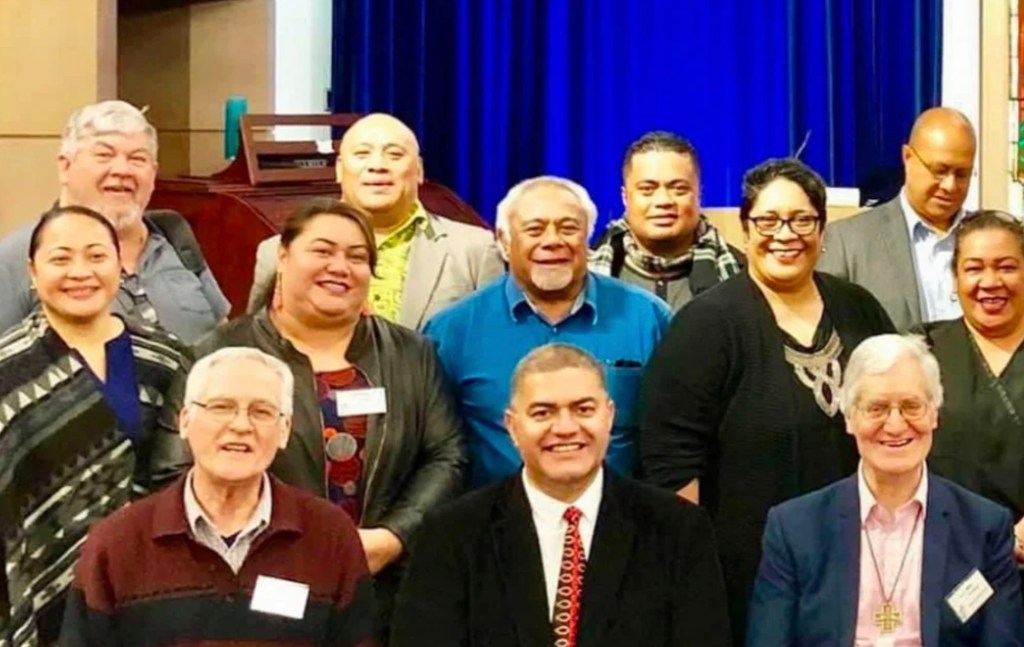
A recent group of ACC leaders
It has been a sad and sorry saga; not because we have come to a sad end result (on the contrary!), but because of the turmoil caused and the damage inflicted by rabid members of the ACC and their predecessors over the last four decades. The constant badgering of councils of the church to address matters which they saw as of primary importance—but which did not figure in most people’s view as warranting that amount of attention—has been frustrating, annoying, and counter-productive. The Gospel has actually been hindered by these tactics.
The regular antagonism, the growing negativity in rhetoric, and the incidences of specific vitriolic attacks on individuals within the church—undertaken by members of the ACC and their predecessors, and targeted largely at gay, lesbian, and transgender people—has been utterly shameful. I don’t know how many times I have heard people from within the LGBTIQA+ community recount how terribly they have been treated within church circles—including, but not limited to, the Uniting Church. And as far as I can tell, any ACC leader who was called to account for such behaviour failed to acknowledge any remorse, or show any compassion over such behaviour.
The regular response I have heard and read is that they are “standing up for the Gospel”, “declaring the truth to an apostate church”, and suchlike. There is no compassion, no empathy, no understanding—simply an aggressive prosecution of a rigid dogmatic line. I know this to be the case across the board; I know it especially since Elizabeth and I have each been targeted by a rogue ACC member, who is completely without understanding and completely without compassion in the way he goes about things. I don’t think he is an exception; I have heard and seen other instances of the same behaviour.
It is a well-known fact that members of the LGBTIQA+ community are much more likely to have suicidal ideation and at times to act on that, and also to develop other negative coping mechanisms that impinge upon their mental and physical health—simply because of the way that they are treated, the terrible negative comments and brutal attacks that they have to endure, simply because of who they are. That is completely unacceptable. The words and deeds of the ACC have fed into this dynamic; ACC leaders have fostered this negativity, persecution, and even irrational hatred. It is completely unChristian.
So that is why this has been a sad and sorry saga. I rejoice at the conclusion of the ACC. I lament that it did not come years early. I am sad that there was ever felt a need to create EMU, or RA, or ACC. I rejoice that the Uniting Church is committed to providing safe spaces for members of the LGBTIQA+ community, just as much as for straight people. We are all welcome, all included, all valued, and all honoured for being faithful followers of Jesus, across a wonderfully varied spectrum of identities.
*****
Today is a good day to reflect on these matters. Today is the Trans Day of Visibility—an annual international celebration of trans pride and awareness, recognising trans- and gender-diverse experiences and achievements. Gender diverse people right around Australia gather on this day to share stories, engaged in conversations, and attend trans-focusses events.
Trans Day of Visibility was started by activist Rachel Crandall in 2009 as a reaction to the lack of recognition of trans people, noting that the only well known gender-diversity centered day at that time was the Trans Day of Mourning, a day of mourning, on 20 November. So the j was created as a counterpoint to this; a day to acknowledge and celebrate living members of the transgender community. International Transgender Day of Visibility has been held on March 31 ever since.
In our current context in society, when trans people are the object of vitriolic verbal abuse as well as physical assault—simply for identifying as transgender—it is important for people of goodwill to speak out in support of trans people. Undergoing that journey in your life is a significant and challenging process; adding verbal and physical negativity on top of the challenges of the process is most unfair.
I have been blessed in recent years to get to know a number of trans people personally. In each case, they are people of integrity, who have quite a story to tell, who are committed to expressing in public “who they feel they really are, deep down”. It’s a journey and a commitment that I feel I have no right to criticise—I feel I should only be honouring them for their chosen pathway in life. Indeed, being true to yourself has been a virtue since the classical period of Greece and Rome, millennia ago.
We should honour and value those people in our midst who, facing a large challenge, knowing that they are walking into the active dislike and fear that other people have, still choose to walk the way of absolute inner integrity and complete honesty. That’s what this day offers us: we see trans people, we hear them, we honour them. They are valued.
*****
My previous posts on the various evangelical/fundamentalist groups in the UCA are at
Over the past week, I’ve been aware of a number of happenings that point to the continuing shifts within the Christian church relating to the matter of gender. Some of these events have been encouraging. Some have been disappointing. Some raise serious questions. Others offer occasion for great joy. Together, they point to the gender agenda, which continues to agitate the churches. It’s something that involves a multiplicity of matters.
This week has been Transgender Awareness Week. On Sunday evening, the Rainbow Christian Alliance met at Tuggeranong Uniting Church in Canberra. There was sharing, as there is always is, but with a particular focus at this meeting on the stories of transgender members of the group. It was a rich time, celebrating the way that people have been able to be “true to themselves” and express that inner reality in the ways that they dress, relate, and function within society—and, indeed, undertake the daunting process of hormone replacement therapy and even surgery to fully assume the actual gender identity as a manifestation of their inner, real person.
On the same weekend, the Baptist Union of NSW and the ACT held one of their regular gathering of representatives from across the state and territory, at which the issue of gender was to the fore. Specifically, discussion was held and then a decision was made, that Baptist pastors and churches which were agreeable to marrying couples of the same gender would be asked to affirm “the traditional understanding of marriage”—that is, that marriage involves always a male and a female—or that they leave the association of Baptist churches.
There is a blog by one Baptist pastor who feels that he is unable to affirm that “traditional understanding of marriage”; he has described the experience of that all-day meeting as being akin to “a casual crucifixion”—a searingly potent, and deeply saddening, description.
The Baptists, sadly, have taken an approach to this particular issue of same-gender marriage that has recently led to a split in the United Methodist Church; see my reflections at
I have also written a series of blogs exploring how such an aggressive approach to the gender agenda has been prosecuted—unsuccessfully, fortunately—within the Uniting Church in Australia.
It is sad to see the same divisive development taking place within the Baptist fellowship.
An event that took place during the week was the funeral of a Roman Catholic priest, Father Peter Maher. This was noteable for various reasons; for a start, there were three bishops and many priests in attendance. I’ve known Peter for five decades, and can attest to his valued ministry and important contribution to the consideration of the gender agenda within the Roman Catholic Church in Australia.
Peter was a strong advocate, throughout his ministry, for “the least and the lost”, and especially, in recent decades, for members of the LGBTIQA+ community. His weekly Mass for rainbow people, held at St Joseph’s Church in Newtown, attracted people and was the basis for the formation of a wonderfully extensive community of people of faith who identify with sexual or gender diversity.
Peter’s funeral signalled the lifetime of work devoted, in various ways, to the gender agenda—affirming, supporting, counselling, encouraging, and advocating for, the many people of faith (and of no faith) within the broad LGBTIQA+ community. There have been many tributes to Peter posted online, which I have canvassed in a blog post at
And then, on Friday night, a celebration of 30 years since the Anglican Church ordained women as priests was held in St John’s Anglican Cathedral in Brisbane. The issue of the ordination of women was a focus of intense debate and discussion throughout the Anglican Church for many years. Most dioceses throughout Australia came to a view that this was a most reasonable course of action; a few renegades, spurred on by the sectarian leadership in Sydney, dug their toes in and resisted at every step of the way.
But the truth of the Gospel shone through, and women were ordained in Goulburn—Canberra, Brisbane, and Perth Dioceses, in 1992, and the in many other places in the ensuing years. The celebration in Brisbane recognised an important step forward in addressing the gender agenda in the Anglican Church. An exhibition marking this step forward can be seen at
It would be tempting of me to end this review of recent events with a smug, self-satisfied comment about the ways that the Uniting Churchin Australia (and, indeed, its three predecessor denominations) has been a trailblazer in many ways relating to the overarching gender agenda—ordaining women, female quotas to ensure diversity, ordaining gay and lesbian ministers, marrying same-gender couples, and so on.
However, just this past week, I was part of a conversation in which I observed that the particular Uniting Church Congregation, throughout the whole 45 years of its existence, had had a string of white male ministers in placement with them. In that conversation, I was told that before the current minister was called, one key person in leadership in that Congregation advised the Presbytery, “we won’t accept any minister other than a white male”.
So we, too, have work still to be done. The gender agenda remains a live concern. The gender question remains firmly on our agenda in the Uniting Church. There is still much work to be done.
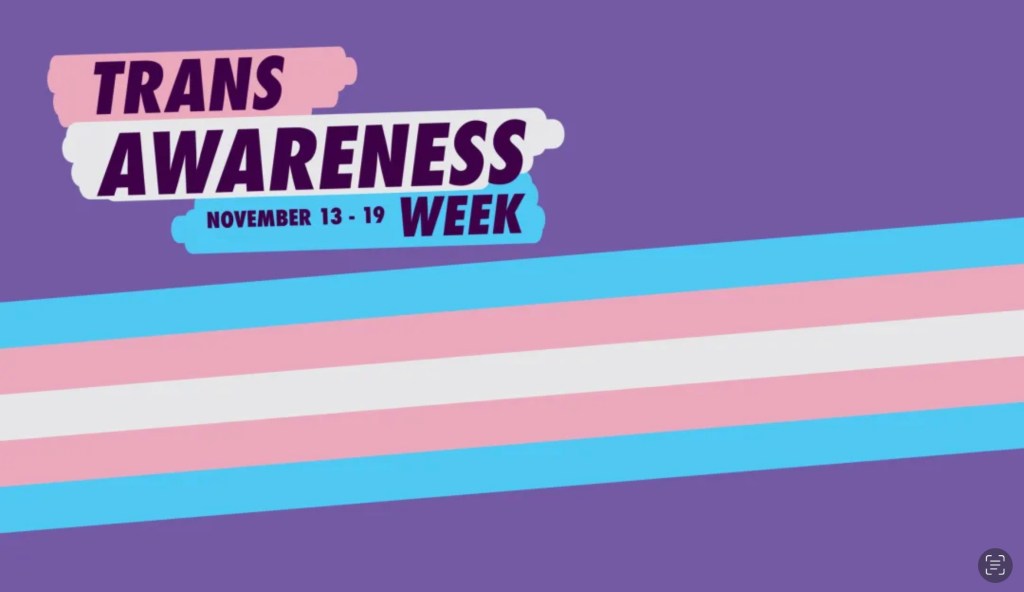
Every year on 20 November, we pause for the Transgender Day of Remembrance. The week before that day is designated as Transgender Awareness Week. Individuals and organizations participate in this week to help raise the visibility of transgender people and address issues members of the community face.
My own awareness of Transgender people (the T in LGBTIQA+) has been a slow and gradual process of increasing awareness and understanding. Whilst trans people have been a reality in humanity ever since when, the public discussion of such people has been slow to emerge, only picking up visibility in the public arena in recent years.
In considering the sexuality of people, we have become familiar with the terms “gay” and “lesbian”—male and female people, respectively, who are attracted sexually to people of the same gender as they are—as well as “bisexual” (attracted sexually to people of either gender) and “asexual” (people who have no feelings of sexual attraction to others).
Alongside the terms that relate to our sexuality, there are terms that relate to gender. To put it simply (perhaps to oversimplify), if sexuality is about how our feelings of attraction are expressed, then gender is about how we identify ourselves, in terms of being male or female, the traditional terminology used over the centuries.
Often the genitals found on a person determine how gender is assigned. Think the classic film scene of a woman giving birth—after the mandatory cry from the baby, to assure people present that the newborn is breathing, the next matter is, “is the baby a boy or girl?” A quick look at the genitals—is there a penis or a vagina?—usually provides the answer to that question. Although, these days, for an increasing number of births, the gender of the baby has been explored and determined by means of ultrasounds, so more and more, parents already know the gender of their child.
However, as we have become aware in recent times, not everybody is born as clearly identifiable as either male, or female. The vast majority of people are; but for a significant minority, they may have been born with both male and female genitals. A superficial inspection may mean that answering the question, “boy or girl?”, can’t be readily answered. Such people are identified under the letter I , LGBTIQA+, I being short for Intersex.
For other people, whilst the genital determination of their gender is straightforward, the actual sense that such individuals have of their own innate gender is more complex. The deepest meaning of gender, is that is describes who you really are; what you feel, inside yourself, that your actual identity is. It is far more internal than it is external.
For the majority of people, they are cis-gendered—that is, their assigned gender correlates exactly with their physical body and their innate sense of who they are. (The prefix cis- comes from the Latin word which means “on this side of”; it is the opposite of the Latin word trans, meaning “on the other side of”. ) However, for others, these feelings may not necessarily fall into the assumed, “natural” category that is conveyed by their genital configuration. These are people who are referred under the letter T, standing for transgender.
In short, someone who is transgender most likely does not feel that “who they are” on the inside matches their assigned gender on the outside. This is quite different from intersex; it is a matter of personal psychology and self-understanding. Indeed, more recent scientific studies indicate that there may be differences in the white matter tracts in the brain between cisgender (agreement between gender and sex) and transgender men and women. See https://www.jneurosci.org/content/34/46/15466
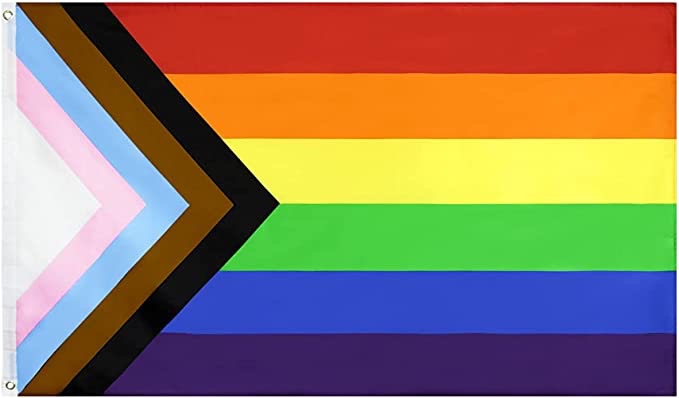
The transgender flag, created in 1999, uses the stereotypical colours, “blue for boys, pink for girls”, and splice in the colour white, signalling those undertaking transition from one gender to another. With the T and I colours, they have been added to the now-traditional rainbow flag, representing LGB people, along with black and brown stripes, to represent marginalized LGBTIQA+ communities of colour. It is an ever-evolving symbol!
One important aspect of the recent discussion about transgender people relates to the emotional cost that comes with living in a body that does not correlate with the realities of emotions and experiences that they have. This is often called “gender dysmorphia”; the Mayo Clinic defines this as “the feeling of discomfort or distress that might occur in people whose gender identity differs from their sex assigned at birth or sex-related physical characteristics”. See https://www.mayoclinic.org/diseases-conditions/gender-dysphoria/symptoms-causes/syc-20475255
Transgender people may choose to undertake a slow, lengthy, graduated process of transitioning from their assigned gender, into their innate gender. This may start with a time of sharing with people closest to them about their inner feelings. They may then adopt the clothing and grooming habits of their desired sex. Some may change their name at this point, or later.
The availability of hormone therapy means that transgender people who are transitioning are able to assist their bodies to take on the various characteristics of the gender to which they are transitioning. Likewise, they may decide to proceed with surgeries to modify their bodies to reach an external expression of the gender they are internally. Both hormone therapy and surgery are undertaken in close conjunction with counselling sessions from appropriately qualified people, to inform, guide, and support people through the transitioning process.
Such processes must, surely, be emotionally challenging and personally costly for transgender people. However, as I have been learning from friends that I know who are transitioning or who have transitioned, the deep-seated inner sense of “this is who I really am” is the primary factor that drives the complex process of transitioning. Empathic and patient listening, embedded within a non-judgemental attitude which is open to hearing and learning new things, is the best gift that a cis-gendered person can give to a person who is undergoing, or has competed, transitioning.
Being true to oneself is a virtue that has long been lauded in our society. “This above all: to thine own self be true, And it must follow, as the night the day, Thou canst not then be false to any man”, says Polonius in Shakespeare’s play, Hamlet. In Ancient Greece, a well-known saying connected with the Adelphi Oracle was “know thyself”. The famous existentialist philosopher, Sören Kierkegaard, advised that “Not to be one’s self, as God created you, is despair”. There is plenty of good philosophical and ethical consideration of the importance of being true to oneself.
For myself, there is a strong theological affirmation that also undergirds this issue. It comes from the opening story of scripture—the story of creation. When God created Adam from the earth, God breathed the breath of life into the human, and Adam became a nephesh, a living being (Gen 1:30; 2:7). All human beings—indeed, all living creatures—are given life by God’s spirit and share the essence of a nephesh (Ps 104:24–30; Job 12:7–10). That is the fundamental feature of all of God’s created beings.
This is what God first declared to be good (Gen 1:21, 24)—indeed, to be very good (Gen 1:31). So, as human beings, how we were made (straight or gay, identifying as male or female, or sensing that our biological gender does not match our inner sense of gender) is good; God made us that way, we are called to be true to ourselves, honest about our identity, comfortable in our own skin.
Transgender Awareness Week is a week when transgender people and their allies take action to bring attention to the community by educating the public about who transgender people are, sharing stories and experiences, and advancing advocacy around the issues of prejudice, discrimination, and violence that affect the transgender community. It is a good thing for each of us to make sure we are aware of the reality of Transgender people, and to ensure we relate sympathetically and encouragingly to such people when we uencounter them.
Over the last few weeks I have been watching yet another church engage in the painful and difficult process of disagreeing publically about matters that are held strongly by the various proponents involved, with the inevitable trajectory of increasing rancour and ultimate schism becoming clearer each day.
We have already seen the slow-burn amongst Methodists over recent years that has led to the formation of the so-called Global Methodist Church earlier this year. The GMC was launched as a sectarian schismatic movement, splitting from the United Methodist Church, on the basis of—you guessed it—sexuality.
I’ve already discussed the attempts over many years to do the same within the Uniting Church in Australia—from the early efforts of the Evangelical Members of the Uniting Church (EMU) through the Reforming Alliance (RA) and on into the self-styled Assembly of Confessing Churches (ACC). Each of these conservative splinter groups sought to enforce their narrow and retrograde understanding of matters pertaining sexuality on the whole UCA—with persistent, and increasing, failure.
As I’ve explored these two church contexts, one in Australia and the other in the USA, I have noticed how the proponents of the conservative theological perspective buttress their claims with a particular way of reading scripture, and with a particular mode of theological argumentation that slots well into the field called Apologetics.
That’s the name given to a way of arguing that sets out a collection of beliefs that are held by a certain group and advocates that this cluster of beliefs represents right doctrine, the true faith, what Bible-believing Christians hold to, or some other catchphrase that revolves around being right—and others, holding different viewpoints, being wrong. It’s a style of speaking and writing that often, in these kinds of situations, takes on a hard edge—moving from assertions about beliefs, to a much more aggressive manner of apologetic argumentation.
(I should indicate that I have nothing against Apologetics; done well, it can be a helpful process, and indeed, being able to engage apologetically ought to be a basic skill for anyone undertaking a missional engagement with people in society. And I should confess that the research that I did, many years ago, for my PhD thesis, was focussed on a set of ancient documents that are often described as being apologetic—including the writings of Flavius Josephus, and the two books in the New Testament attributed to Luke, namely, the Gospel of Luke, and the Acts of the Apostles—two fundamental apologetic works in the Christian canon.)
In recent weeks, I’ve been an interested observer “from the sidelines”, watching an aggressively dogmatic style of apologetic argumentation that has been taking place within the Anglican Communion. The holding of the recent Lambeth Conference in the UK was the focus for the surfacing in the public arena of this aggressive argumentative apologetics (which we know was always active under the surface).
Episcopal leaders from Anglican churches around the globe gathered (or, at least, were expected to gather—not all of them came) in Lambeth, hosted by the Archbishop of Canterbury, to discuss designated matters and to issue “Calls” to the Anglican Church around the world, relating to these topics.
Sexuality, of course, was the most contentious area to be discussed; and so it transpired, with some bishops refusing to attend, some bishops decrying the stance of other bishops, and some bishops seeking to find a way forward that all could hold to. It was a fraught, and ultimately failed, enterprise. The battle-lines, drawn so strongly before Lambeth 2022, remained in place; so much so that, this week, the head of the breakaway schismatics in Australia, GAFCON Australia, has announced the formation of a new Diocese, “an Anglican home for those who feel they need to leave their current Dioceses”. Doctrinal Apologetics are, in my mind, clearly driving this development.
I’m not making further substantive comment on the trench-warfare of my brothers and sisters in the Anglican Communion—I am most grateful to friends and colleagues who have posted numerous articles, commentaries, statements, and analyses, of what has happened before, during, and now after the Lambeth Conference. Nothing, it seems, was clarified, other than perpetual disagreement will continue.
The best that those of us outside that denomination can do is to offer prayerful and personal support to those who continue to press for a compassionate and relevant approach to matters of gender and sexual identity.
It is worth noting that there has been a local manifestation of this issue within Australia—it has, of course, been “alive and well” for many years, and has recently come strongly to the surface in the wake of the recent General Synod of the Anglican Church in Australia (ACA), and the formation of the Southern Cross Diocese, an action that has created, de facto, a new denomination in Australia, outside the formal structures of the ACA.
Alongside the experience of watching Anglicans agitate and argue about sexuality, I’m engaged in a parallel, but rather different, process, within my own denomination. It’s a process that also arises out of consideration of sexuality—well, both gender identity and sexual attraction and behaviour, to be perfectly clear. It is characterised, not by a process of apologetic argumentation, but rather by a process of listening, engaging in conversations, and developing resources that will be fit for a specific purpose.
I am referring to the fact that, within the Uniting Church, there is currently a Task Group which has been established by the Assembly Standing Committee, to prepare for the offering of an Apology to members of the LGBTIQA+ people in Australia.
A proposal to offer such an apology was presented to the National Assembly in 2018, as a result of which the Task Group was established, with a view to having a final report to give to the Assembly when it meets in 2024. (Yes, things move slowly in this church, as in other churches!) The Apology, it is envisaged, will apologise for the church’s role in the silence, rejection, discrimination and stereotyping of LGBTIQ people, couples and families.
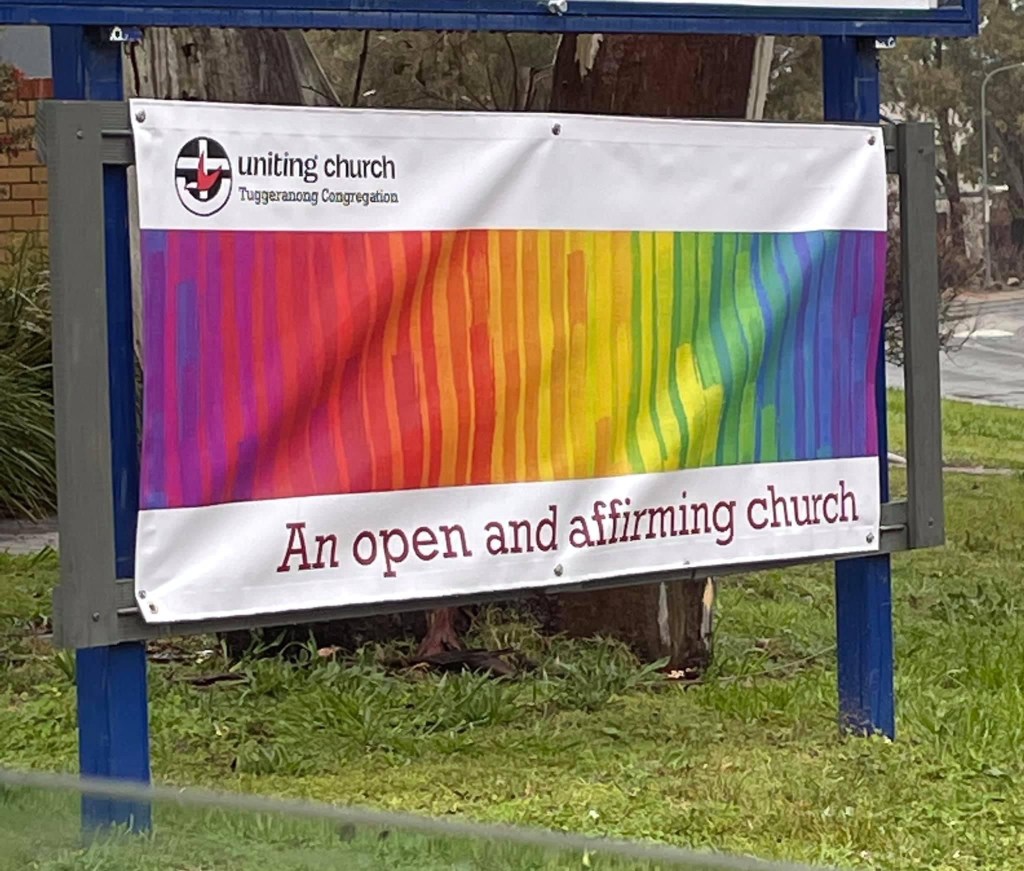
The Task Group is currently engaged in a series of listening encounters with members of the LGBTIQA+ community within the Uniting Church, to hear the views of such people about the proposed apology. I was present earlier this week as three members of the Task Group met with members of the Rainbow Christian Alliance, which meets monthly at Tuggeranong Uniting Church in Canberra, a congregation which is an open and affirming church.
The work of the Task Group was explained, and there was opportunity for LGBTIQA+ people who were present in person and online to make comments about their experiences in the church, and their hopes for the process of formulating and delivering the apology.
The conversation was respectful, caring, and person-centred. There was an indication that the Uniting Church had recognised how words and actions from many church people over many years have caused hurt, grief, and despair. There was a recognition that we need to demonstrate that we see, hear, acknowledge, value, and honour LGBTIQA+ people in their own right, as they are, without reservation, and certainly without in any way pressuring them to change.
It struck me during this time of conversation how different the two approaches are; those who take an aggressively apologetic stance towards people who hold a different point of view, and seek to prosecute their case through debate and argumentation, are presenting a very different model of church to that offered by the process of listening to LGBTIQA+ people in order to develop an apology to them.
(I’m not saying that we in the Uniting Church have got this right—not at all—just that we are aware of the need to take care in our stance, and to shape a careful and compassionate path; and that we are trying to do this with good intentions and in partnership with LGBTIQA+ people.)
Given all the negativity that currently exists in society in relation to “the church”, I think it is important that we carefully consider how we present ourselves to people in that wider society. A posture of compassionate listening and respectful conversation, and the offering of a deeply-felt apology, is surely what we need for our times.
*****
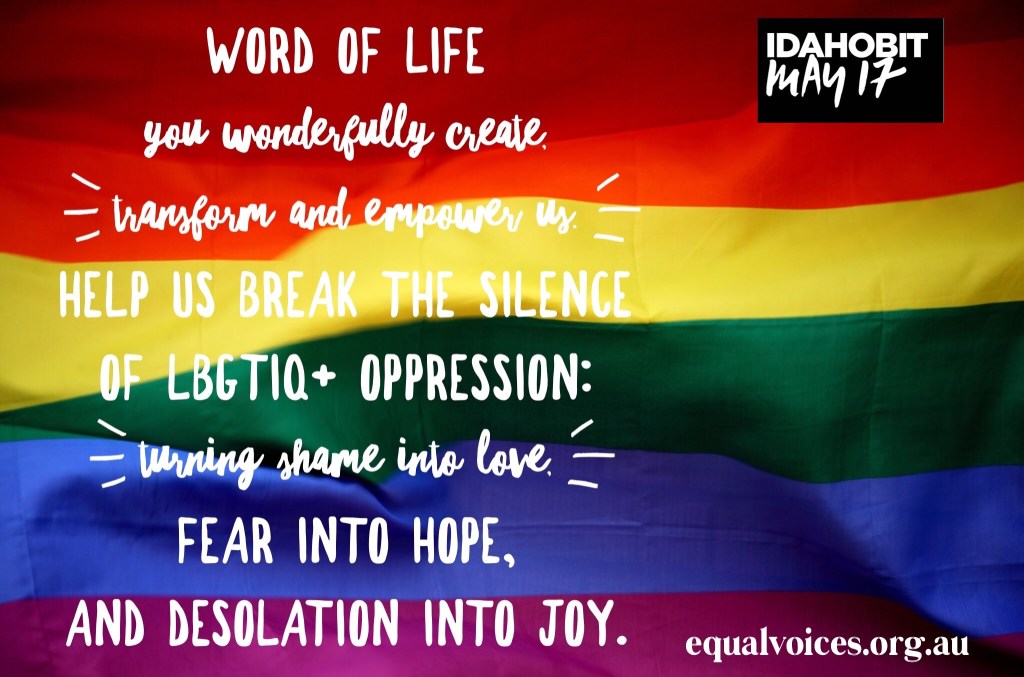
The ecumenical group Equal Voices has prepared an Apology for consideration by people of all denominations; see https://equalvoices.org.au/apologise/
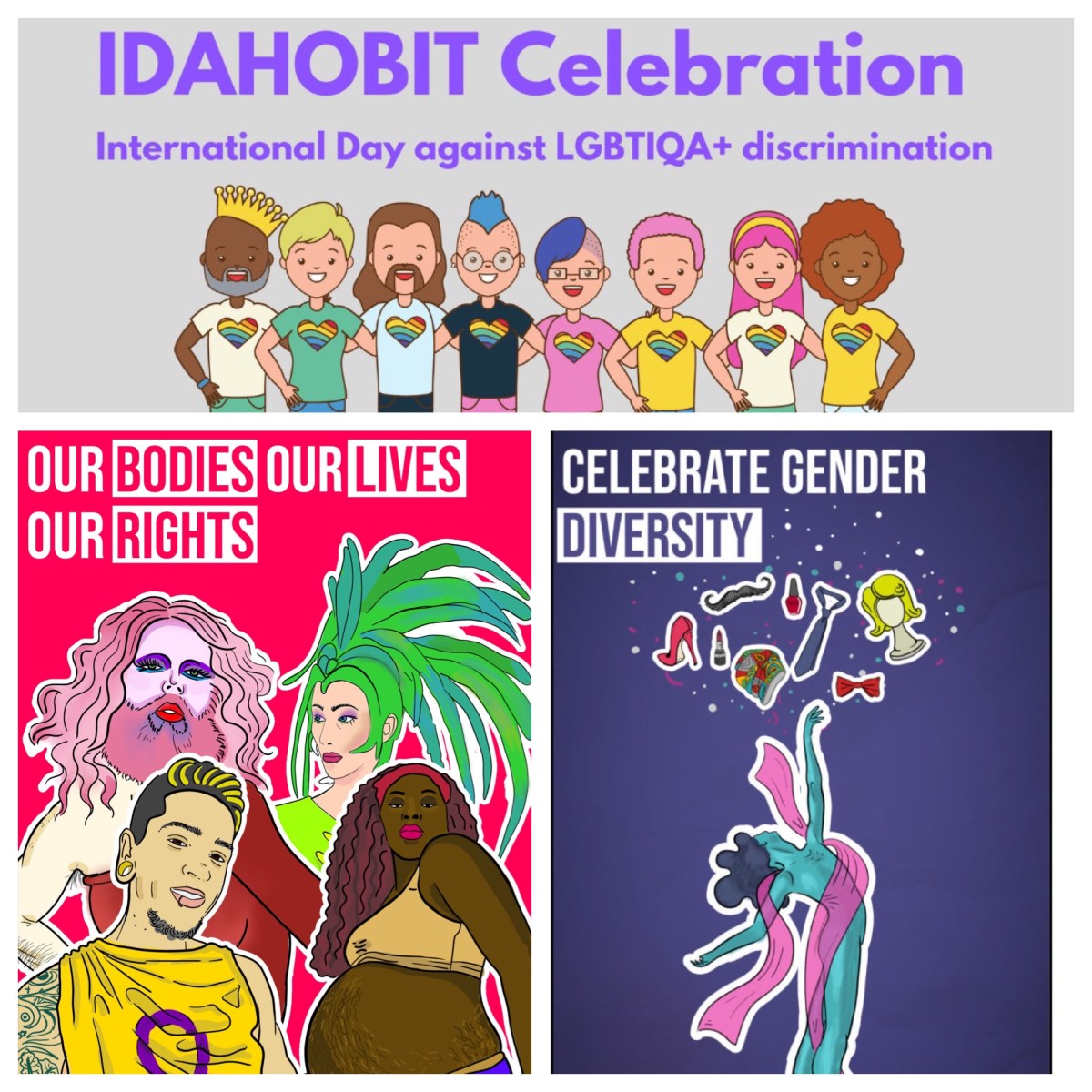
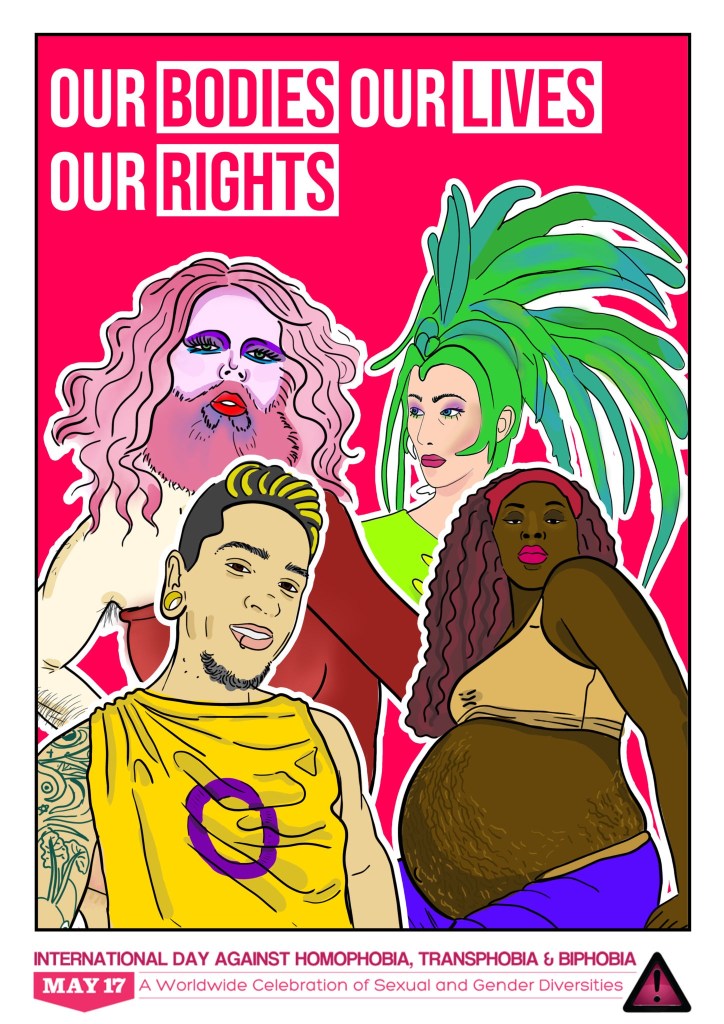
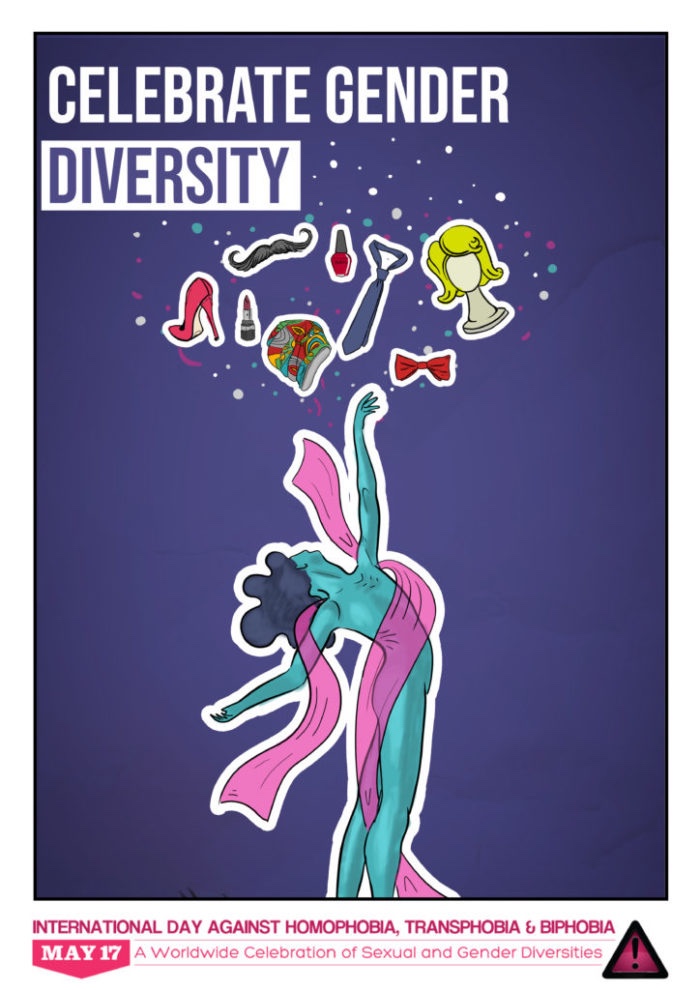
May 17 is IDAHoBiT, the International Day Against Homophobia, Biphobia and Transphobia. IDAHoBiT is a day to draw attention to the discrimination experienced by LGBTQI+ people internationally.
The day is marked worldwide in over 130 countries, including 37 countries where same-sex acts are still illegal. The first day was held in 2004 to raise awareness of the violence and discrimination faced by lesbian, gay, bisexual and transgender people, including all people who have diverse gender identities or sexual expressions.
The date of 17 May was chosen for IDAHoBiT as this was the date in 1990 when the World Health Organisation finally removed homosexuality from its list of mental illnesses. Despite this, LGBTQI+ people across the world continue to face hate, discrimination and violence.
The theme for IDAHoBiT 2022, adopted after consultation with LGBTQI+ organisations worldwide, is Our Bodies, Our Lives, Our Rights.
The theme claims the rights of sexually- and gender-diverse people to live their sexual identity and to express their gender freely. It also signals a desire for such people to be free from physical violence, free from conversion practices (mislabelled as “therapies”), able to access transition services for Trans people, and free from the forced sterilisation of Intersex people.
The website for this day (https://may17.org/) states that the theme provides a reminder that “many of us around the world live LGBTQI-phobias in their very flesh every day and that our bodies are being abused, ruining our lives. Our bodies are our lives. And we have a right to live free and in dignity!”
For myself, I do not identify with any of the letters in the LGBTIQA+ acronym. I have lived my life as a male who is heterosexual (experiencing sexual attraction to people of the opposite gender) and cis-gender (the gender assigned to me at my birth correlates with my sense of personal identity and gender)—in short, I am what is referred to as heteronormative. And, as a white male in the Western world, my life experience has certainly been privileged and sheltered from internal or external disturbances and challenges related to my sexuality or gender identity.
So I have no personal experience of the gender dysmorphia that others experience in their lives; nor have I had any experience of the prejudice or persecution experienced by people identifying as a member of the LGBTIQA+ community. My understanding of what such people have experienced has come through relationships, conversations, readings, and personal thinking through of the issues. It has required empathy and understanding, and I think that it’s clear that I haven’t done this perfectly; but hopefully I have done so at least adequately.
I’m also a person of faith, and thus embedded within a community that, sadly, has demonstrated a collection of failures in the way that sexually and gender diverse people have been seen and treated. The Christian Church has shown a persistent lack of understanding, a continual marginalising (or “othering”), an aggressive assertion about the sinfulness of the particular identity or lifestyle, and undertaking attempts to “change the protestation” or “reverse the gender” of some people. All of these attitudes and actions have been unloving, uncaring, and indeed (in my view) unChristian.
Recent events in a number of churches have indicated that these attitudes and actions remain, tragically, alive and well in churches today. The United Methodist Church has become the Untied Methodist Church, as the so-called Global Methodist Church splits off in schismatic separation from the UMC because of differences of opinion about sexuality issues.
The General Synod of the Anglican Church of Australia, this week, has been debating the definition of marriage, and has shown a continuing need by many within its ranks to condemn (once again) all manner of people living outside the narrow norms that are set up, by some, as being “biblical” requirements.
My own denomination, the Uniting Church in Australia, has struggled with these issues over decades; more intensely, and intentionally, in the last decade, addressing matters relating to gender identity and sexual attraction. Recently the National Assembly agreed to a proposal “that sexual orientation and gender identity change efforts (SOGICE) are harmful to people’s mental health and wellbeing”. The proposal cited the Uniting Church Statement, Dignity in Humanity, which states that “every person is precious and entitled to live with dignity because they are God’s children”.
How are privileged, cis-gender heterosexual people like myself to respond to a day like IDAHoBiT? I think we need to cultivate empathy and develop understanding. I think we need to seek out and develop respectful relationships in which we can hear stories, learn of experiences, articulate our own inadequacies and sorrow for how we have acted or interacted with people in the past. Most importantly, I believe we need to learn ways by which we can support survivors of gender identity change efforts and help prevent harm from the ideology and practices of such gender identity change efforts.
Underlying this is my own firm commitment to an understanding of human beings as intentionally created by God, exactly as we are, to be exactly who we are, without qualification or change. The “doctrine of sin” that the church has promulgated has impressed on us that we are all “fall short of the glory of God”, that we all do wrong things—and who would argue with that?
But this doctrine has also been used to identify and persecute specific sinfulness on the part of identifiable minority groups—gays, lesbians, bisexuals, intersex, and transgender people in particular—not recognising the nuances of differences that actually do exist across the spectrum of humanity. That’s a misuse of the doctrine, in my opinion. It should not be used to persecute someone on the basis of differences that are perceived.
What gender a person believes that they are, and what attraction an individual has to other people, is built into the very DNA of them as a person, wanting to force change in either of those matters is, to my mind, one of the greatest sins. I think it’s important for “allies” such as myself to remind others of this truth, and to stand in solidarity with “rainbow people” each and every day.
On this International Day Against Homophobia, Biphobia and Transphobia, let us ensure that each and every lesbian, gay, bisexual, transgender, intersex, queer, asexual, or otherwise identifying people knows that we accept them, value them, and love them, exactly as they are!
And let us be strong in calling out any sign of homophobia, biphobia, or transphobia, when we hear it expressed or see it enacted.
A new church was formed this month. The so-called Global Methodist Church (GNC) was launched as a new denomination—in effect, a sectarian schismatic movement, splitting from the United Methodist Church (UMC)—on the basis of, you guessed it, sexuality.
The GMC has placed to the fore a belief that marriage is between one man and one woman, and clergy must adhere to this in their ministry. This has been a point of persistent debate, dissension, and division in the UMC for decades. Many efforts have been made to hold the different points of view together under the one umbrella of the UMC. That fragile union cracked with a decision last year, and now the moment has been seized by the breakaway group, acting unilaterally, to set up its own structures.
Rev. Keith Boyette, chairman of the new denomination’s Transitional Leadership Council and until now a United Methodist minister in Virginia, complained that “some bishops are intentionally blocking churches from using certain processes for exiting the denomination”—a reference to the fact that the UMC’s Council of Bishops has twice delayed holding a General Conference that would enable a friendly parting of the church.
The COVID pandemic had been the reason for delaying the General Conference first set for 2020, and then for 2021; this year, the delay has been credited to the delays being experienced in the US of the processing of visa applications. The United Methodist Church currently claims 6.3 million members in the U.S. and 6.5 million overseas, so half the representatives would have been travelling into the US and would have needed visas.
Bishop Thomas Bickerton, who recently became the President of the UMC Council of Bishops, said that the continuing United Methodist Church was “not interested in continuing sexism, racism, homophobia, irrelevancy and decline … what we are interested in is a discovery of what God has in mind for us on the horizon as the next expression of who we are as United Methodists.”
Sadly, it seems to me that this is just another instance of people within a Christian church perpetuating actions that will impinge in negative ways on people in society—and, indeed, within the church. The discriminatory actions of the new schismatic denomination will have a negative impact on a small, but significant, minority group within society.
It’s simply a fact that the majority of the population identify as heterosexual (experiencing sexual attraction to people of the opposite gender) and cis-gender (the gender assigned to them at birth correlates with their sense of personal identity and gender). LGBTIQA+ people do not identify as either cis-gender, or as heterosexual, or as both. So whilst it is true that they are a minority in society, that should not affect the way that they are treated in society, and by churches.
However, the key plank in the formation of the GMC is a perpetuation of a discriminatory attitude towards same-gender attracted people who are seeking to be married in a service of Christian marriage. The GMC will not allow its ministers to marry such people. There are many denominations around the world who, sadly, share that attitude.
Up until 2018, my own denomination, the Uniting Church in Australia was one. All of this changed with a decision taken by the National Assembly in 2018, which meant that ministers now do have discretion to marry people of the same gender. That is part of a continuing trajectory within the Uniting Church, affirming and valuing the place of LGBTIQA+ people within the life of the church, and, indeed, within society.
It’s my hope that we can continue along that trajectory, continue to marry people regardless of their gender identity, and hopefully in due course issue an Apology to LGBTIQA+ people for how the church has treated such people in past years.
For an exploration of the forces that worked for so long against this, and earlier, enlightened moves relating to sexuality within the UCA, see my series of posts that are linked below.
For my series of blogs on the failed strategy of conservatives in the Uniting Church over the decades, see











 An Informed Faith