I have built you an exalted house, a place for you to dwell in forever (1 Kings 5, 8; Narrative Lectionary for Pentecost 20)

Discussion of the passages from 1 Kings 5, 8 offered by the Narrative Lectionary

Some weeks ago, the Narrative Lectionary offered the story of God calling Moses to lead his people out of slavery, into freedom (Exod 3–4), followed by another story about the way that Moses exercised this leadership during a testing time (Exod 16). Two weeks ago, we heard the story of God calling Samuel to be prophet (1 Sam 3)—the first of many who would be called to that role. Then last week, we moved on to hear the story of God calling David to be king. So we have had stories about a range of leaders in ancient Israel: the Liberator, the first Prophet, and the most beloved King. 

This coming Sunday we jump to another element that is foundational in the religion of ancient Israelite society. For many years—ever since the “wandering in the wilderness”—the people had a focal point for worshipping their God. The Tabernacle, created during the “wilderness story”, was a mobile sanctuary, travelling with the people (Exod 25:1–9). This sanctuary was faithfully served by the Levites, a group set apart for this priestly role (Num 1:48–54).

However, the central figure in this coming Sunday’s story is not a Priest, but rather a King—Solomon, one of the many offspring of David, and the one who, by all manner of machinations, succeeded his father on the throne. The lectionary deftly steps over all those stories, told with gruesome detail in the early chapters of 1 Kings.
Solomon was not first in line to ascend the throne; that would lie with the eldest of his brothers still living, Adonijah. Adonijah knows this; the first book of Kings opens with the revelation that, since “David was old and advanced in years … Adonijah son of Haggith exalted himself, saying, ‘I will be king’; he prepared for himself chariots and horsemen, and fifty men to run before him” (1 Ki 1:1,5).

However, Solomon plots with his mother Bathsheba and the palace prophet Nathan to arrange for the assassination of his older brother. In addition, a number of other people also had to be eliminated to establish Solomon’s firm grip on the monarchy, and to ensure there were no other possible legitimate claimants to the throne remaining. Such was the raw and vicious nature of “life at the top” those days. (Has anything much changed?)

In fairly quick succession, after Solomon had arranged for the death of his eldest brother Adonijah (2:13–25), he banished the high priest Abiathar who had supported Adonijah (2:26–27) and replaced him with another priest loyal to himself. Next he removed Joab, a cousin who was the commander in the former king’s army (2:28–34). He achieved this via a hit man, Benaniah, who became the general of his army (2:35). 

Then, Solomon had Shimei, who was a relative of Saul, the king before David, killed (2:36–46). In this way all potential contenders for the throne and their powerful supporters were removed, mostly by violent means. As the narrator curtly comments, “so the kingdom was established in the hand of Solomon” (2:46b).
Fortunately for preachers following this lectionary, there is no expectation that there will be any need to read, reflect on, and speak about these chapters during worship. They certainly reveal the depths of degraded humanity! Rather, in the manner that characterises the Narrative Lectionary, we move from high point to high point—and so, this coming Sunday (in 1 Ki 5:1–5), we hear about the beginning steps taken by Solomon in the preparations for erecting the building which would not only sit on the highest point in Jerusalem, but would stand as a symbolic representation of the highest elements—what was best, most valued, most important—in ancient Israelite society.

Solomon, King of Israel, consults with Hiram, King of Tyre (who has a large navy and workforce) regarding the materials and labour needed to undertake this major building project (1 Sam 5); as the narrator indicates, “Solomon’s builders and Hiram’s builders and the Gebalites did the stonecutting and prepared the timber and the stone to build the house” (1 Ki 5:18). And then, after seven years of intense work, the temple is complete (7:1). Here, the lectionary (wisely) skips over the tedious detail of the items made by the artisans and craftsmen of Solomon (6:1–38).

The second part of the reading offered by the lectionary for this coming Sunday tells of how, after thirteen years, King Solomon assembled “the elders of Israel and all the heads of the tribes, the leaders of the ancestral houses of the Israelites” (8:1). Again, the lectionary skips over the detailed account of the work of Solomon’s men in building his own house: the House of the Forest of Lebanon, the Hall of Pillars, the Hall of the Throne, and the house where he would live (7:1–12).

In like manner, the lectionary jumps over the detailed account of the work of Hiram the bronze worker: pillars, stands, basins, pots, and a whole host of items to be used in the sanctuary (7:13–50). Thank goodness the lectionary compilers jumped over all of those verses!
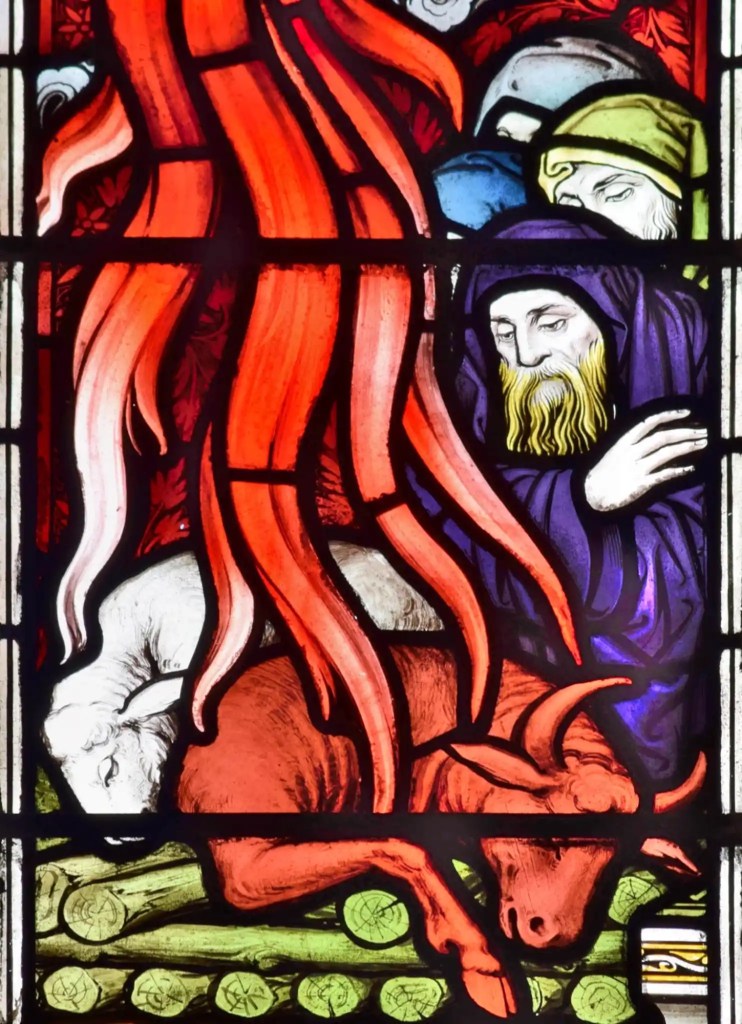
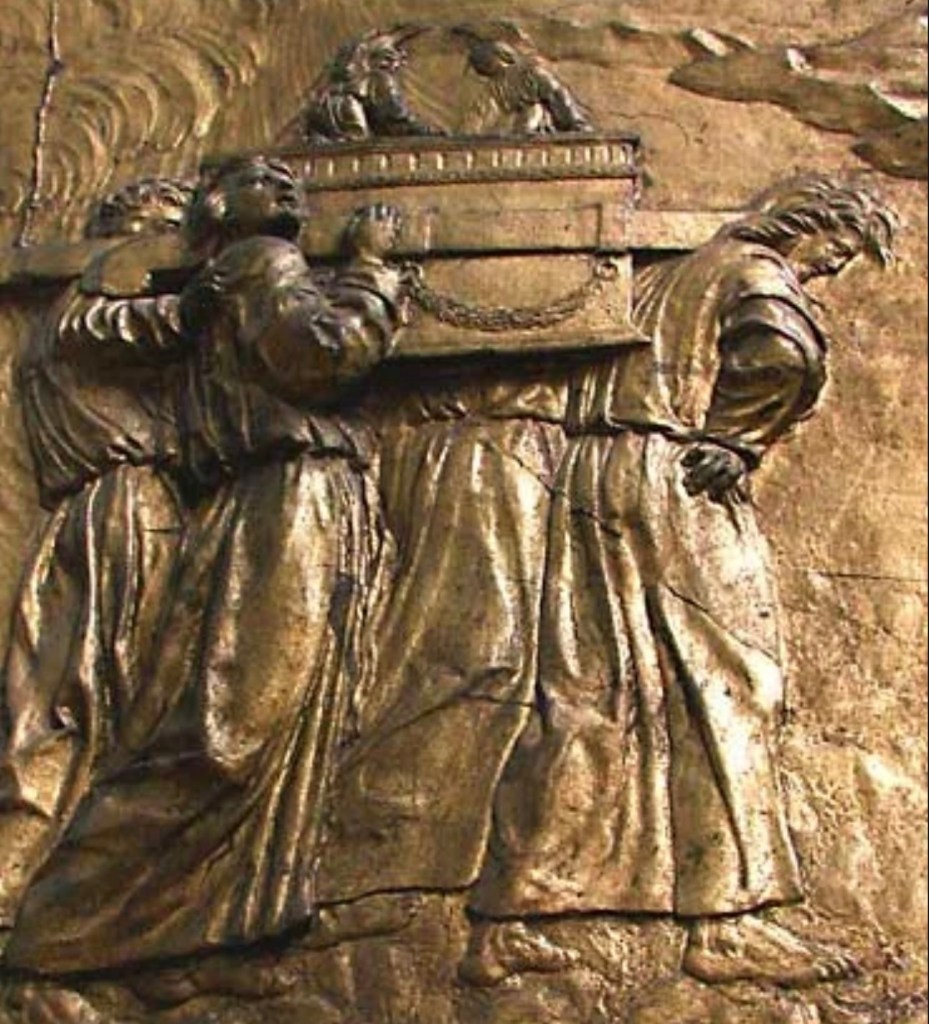
At any rate, when Solomon assembles the leaders of the nation, in the presence of “all the people of Israel” who had assembled, the priests and Levites bring forward the Ark of the Covenant, the Tent of Meeting which had housed the Ark for decades, and “all the holy vessels that were in the tent (8:1–4). It was surely an impressive majestic procession, followed by a scene of overflowing abundance, as the priests received and sacrificed “so many sheep and oxen that they could not be counted or numbered” (8:5). 

There’s no mention of the rivers of blood that must surely have flowed as these sacrifices took place. It may seem like a most unpleasant and unedifying scene to modern eyes and ears; however, the sacrificing of blood was an expression of the central Israelite belief that “the life of the flesh is in the blood … as life, it is the blood that makes atonement” (Lev 17:11). Each sacrifice of a chosen animal was a sacred offering of life that symbolised the obedience and dedication of the person, or people, who had brought the animal to be sacrificed. They were dedicating their whole life to the Lord God through this action, and in return, they were receiving atonement (the forgiveness of their sins) for all the misdeeds they had performed.
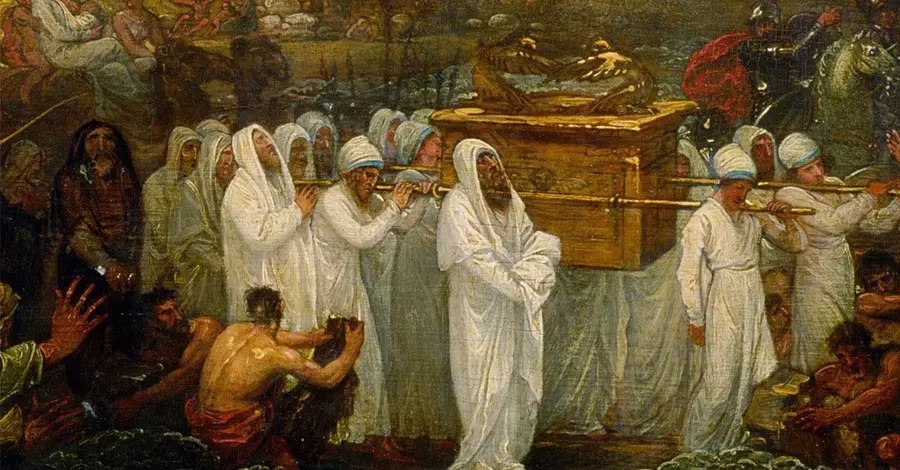
Finally, after the procession and sacrifices, the Ark was brought to “the most holy place” (8:6). The presence of the Ark evoked Solomon’s father, David, and his taking of the city from the Jebusites. Solomon was making clear that he was seen to be standing in that fine tradition.

The Ark was placed in the space known as “the Holy of Holies”, as a much later Jewish-Christian writer describes it (Heb 9:3). It was from that time to be set apart as holy for only the High Priest to enter, and at that but once a year (Heb 9:7).

The scene is presented as one of profound religious significance, for “when the priests came out of the holy place, a cloud filled the house of the Lord, so that the priests could not stand to minister because of the cloud; for the glory of the Lord filled the house of the Lord” (1 Ki 8:10–11). The Temple from that time became the fixed dwelling place of God; “O Lord, I love the house in which you dwell, and the place where your glory abides”, one psalmist sings (Ps 26:8); another sings, “bring an offering, and come into his courts; worship the Lord in holy splendour; tremble before him, all the earth” (Ps 96:8b-9). Other psalmists likewise assert the holiness of God in his temple (Ps 11:4; 24:3–4; 48:1; 99:1–5,9). 
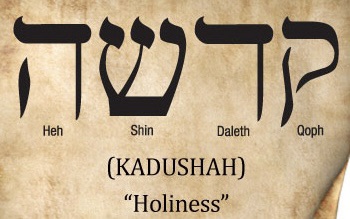
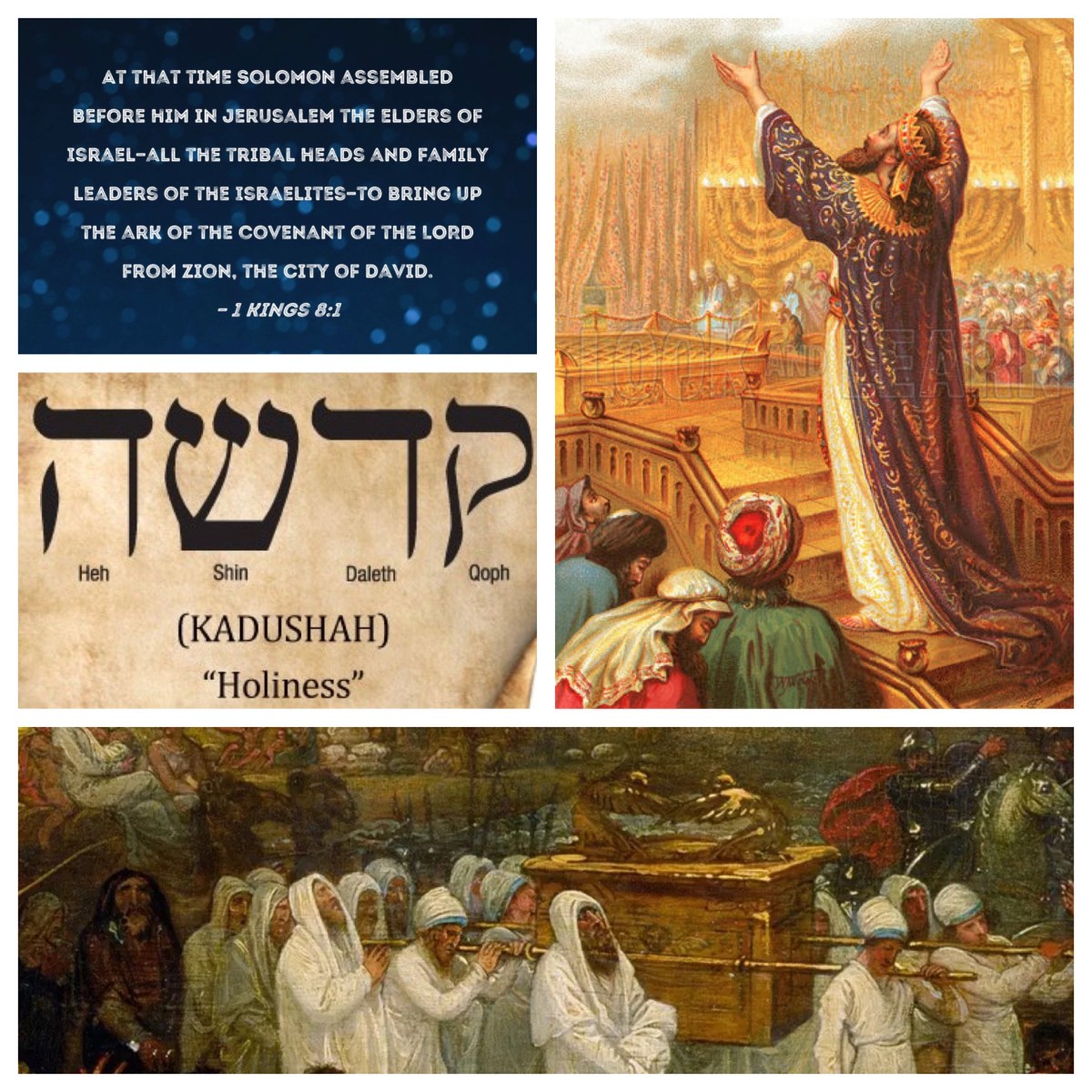
Holiness (kadushah) was central to the people of Israel. Those who ministered to God within the Temple, as priests, were to be especially concerned about holiness in their daily life and their regular activities  in the Temple (Exod 28–29; Lev 8–9). The priests oversaw the implementation of the Holiness Code, a large section of Leviticus (chapters 17–26), which explained the various applications of the word to Israel, that “you shall be holy, for I the Lord your God am holy” (Lev 19:2; also 20:7,26). The people were expected to be a holy people, dedicated to God, serving obediently by adhering to all the laws and commandments that Moses had received from the Lord God at Sinai (Exod 19:5–6).

As the glory of the Lord fills the Temple, Solomon makes the solemn declaration to his God that “I have built you an exalted house, a place for you to dwell in forever” (1 Ki 8:13). He then offers an extended prayer which stretches over the next 38 verses—another element of the whole story that the Narrative Lectionary, mercifully, does not prescribe for reading in worship!
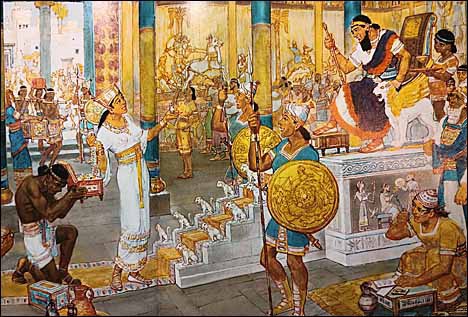

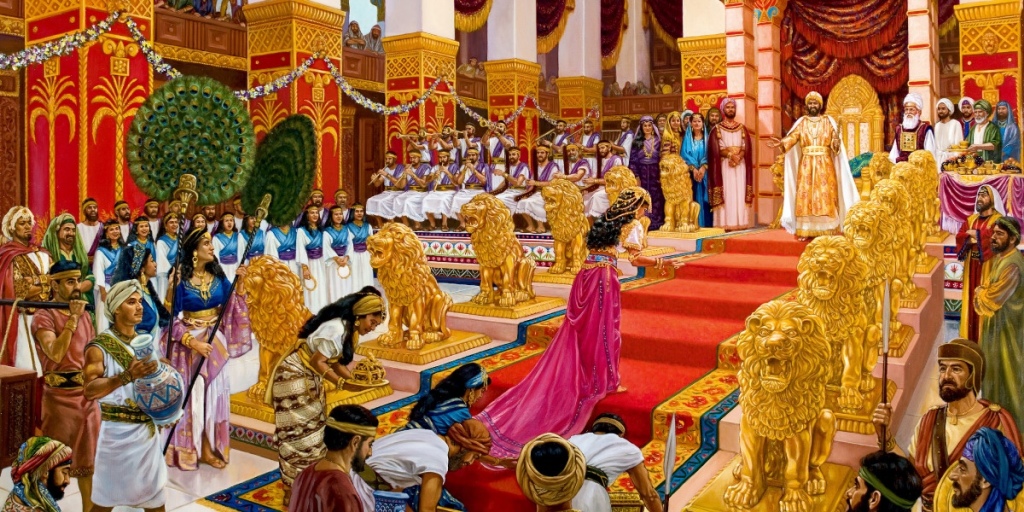
Henry J. Soulen, ‘Queen of Sheba Visits Solomon’ (1967), illustration in Everyday Life in Bible Times
(National Geographic Society, 1967), pp. 230-231

Solomon, I am sure you are thinking, is remembered as The Wise King. As the lectionary has offered this passage for this Sunday, it is worth our thinking further about Solomon. Next week we will jump forward a century or so, to the prophet Elijah. So we might, today, reflect on  the quality of Solomon he is best known for: his wisdom. In 2 Chronicles 1, God says to Solomon, “because you have asked for wisdom and knowledge for yourself … wisdom and knowledge are granted to you” (2 Chr 1:11). 

And later, King Solomon is said to have “excelled all the kings of the earth in riches and in wisdom. And all the kings of the earth sought the presence of Solomon to hear his wisdom, which God had put into his mind. Every one of [those kings] brought silver and gold, so much, year by year” (2 Chron 9:22–24). And so, Jesus relates how “the Queen of the south [the Queen of Sheba] came from the ends of the earth to hear the wisdom of Solomon” (Matt 12:42). 

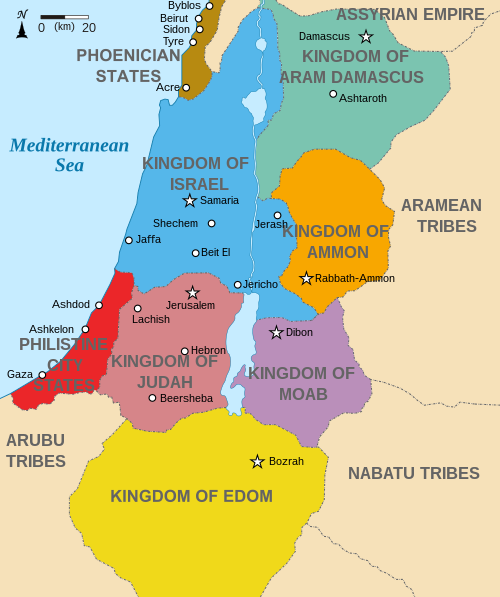
This wonderfully wise, insightful, discerning man, Solomon—bearing a name derived from the Hebrew for peace, “shalom”—became a powerhouse in the ancient world. But he did not always live as a man of peace, as we have seen in tracing his rise to the throne. Indeed, as ruler he used his 4,000 horses and chariots and 12,000 horsemen to good effect; we read that “he ruled over all the kings from the Euphrates to the land of the Philistines and to the border of Egypt” (2 Chron 9:26). 

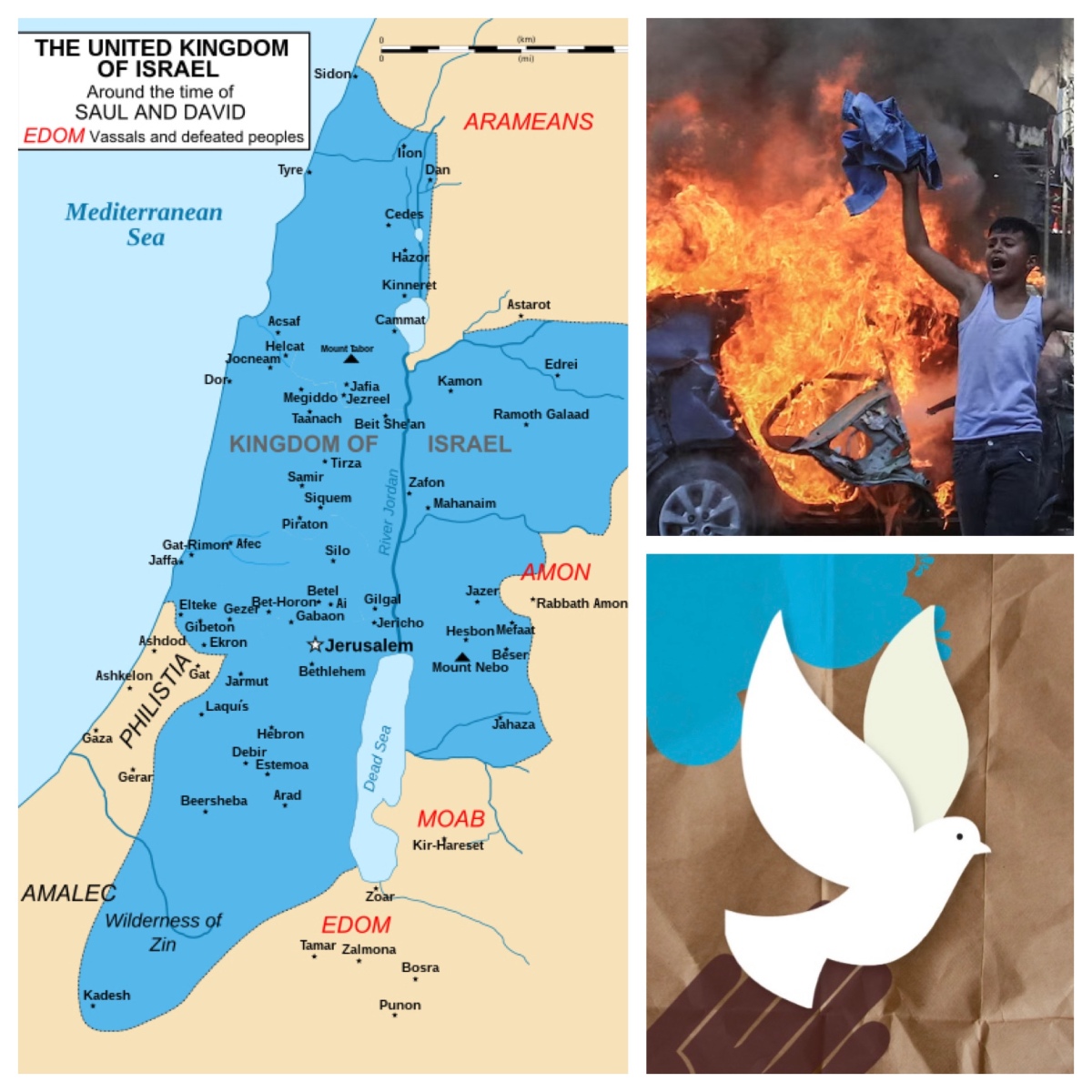
Solomon was remembered as king over the greatest expanse of land claimed by Israel in all of history. This large scope of territory noted in scripture forms the basis for the claims of zealous fundamentalist Zionists, in the 21st century, that Israel should run “from the river to the sea”. It’s a claim that has fuelled the building of illegal Jewish settlements on the West Bank and the erection by the modern state of Israel of The Wall which divides Israel from Palestinian Territories—but which divides families and friends as it seeks to separate Israelis from Palestinians.

Solomon, there can be no doubt, was a warrior. And warrior-kings were powerful, tyrannical in their exercise of power, ruthless in the way that they disposed of rivals for the throne and enemies on the battlefield alike. Think Alexander the Great. Think Charlemagne. Think Genghis Khan. Think William the Conqueror. Solomon reigned for 40 years—a long, wealthy, successful time. (Although 40 years, in Israelite time, is basically a way of saying “a heaps long time”.)

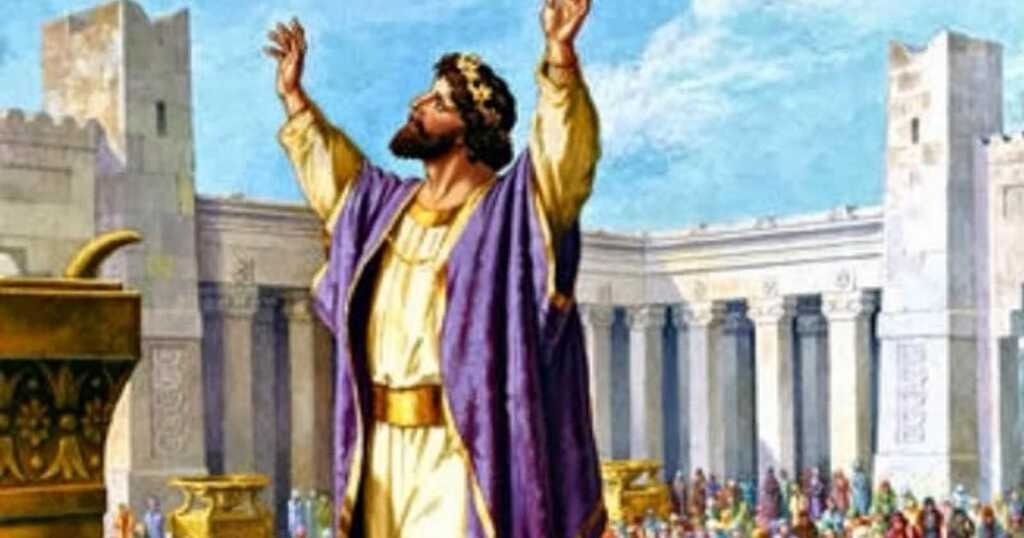
Yet in the passage we hear this Sunday Solomon appears not as a powerful king. Rather, he is a humble person of faith. He stands before all the people, raises his arms, and prays to the God who is to be worshipped in the Temple that he had erected. He is a person of faith, in the presence of his God, expressing his faith, exuding his piety.
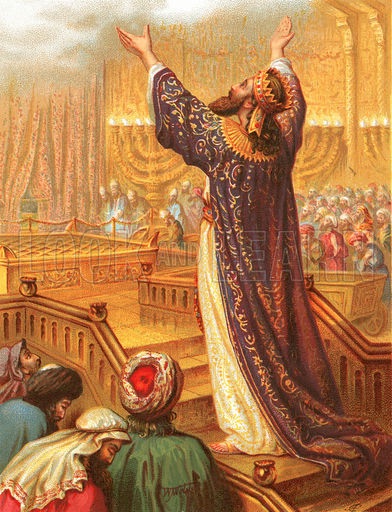
The prayer of Solomon goes for thirty-eight solid verses; there are eight different sections in this prayer. In the first two sections of this prayer, Solomon identifies two important features of the newly-erected Temple.  The first is that the fundamental reason for erecting this building is to provide a focal point, where people of faith can gather to pray to God (2 Ki 8:23–30). The second key element of Solomon’s prayer is that the Temple reaches beyond the people of Israel, covenant partners with the Lord God. He recognises that the Temple is also the place for the prayer of “a foreigner, who is not of your people Israel, [who] comes from a distant land because of your name” (2 Ki 8:41–43). 

This is a striking and dramatic element to include in this dedication prayer before all the people of Israel! Perhaps that is the best way we can remember Solomon: a man of his time, committed to his people, but open to receiving the gifts and the prayers of people from afar. Would that, in our present world of nationalistic fervour, militaristic aggression, and parochial bigotry, there were more rulers like that!

For more on the prayer of Solomon in 1 Kings 8, see
O hear in heaven, your dwelling place (1 Kings 5, 8; Narrative Lectionary for Pentecost 23C)

This blog draws heavily from a sermon that I preached at St Ninians Uniting Church in Canberra, ACT, on 22 August 2021.

*****

As we follow the Narrative Lectionary, we now come to Solomon’s prayer of dedication as the Temple is completed. The passage proposed by the lectionary begins with a short excerpt (1 Ki 5:1–5) reporting the intention that Solomon had, “to build a house for the name of the Lord my God”, referring to the instruction that God gave his father David, “your son, whom I will set on your throne in your place, shall build the house for my name” (1 Ki 5:5).

We then hear excerpts from Solomon’s long, long prayer of dedication which he offered at the opening of the temple ( 1 Kings 8:27–30, 41–43). If you have time (just a few extra minutes) it is worth reading the whole 61 verses of this chapter, which includes all of Solomon’s prayer. As you do, you might note the repeated address of Solomon to God, “O hear in heaven your dwelling place” (verses 30, 32, 36, 39, 43, 45, 49), his regular invoking of “your name” (verses 33, 35, 41–44, 48), and his petition to “forgive the sin of your people Israel” (verses 30, 34, 36, 39, 50). 

The narratives of the early decades of the United Kingdom began with Samuel in 1 Samuel; when we arrive at Solomon in 1 Kings, we have reached the zenith of this period in Israel’s history. The books of 1—2 Samuel have told about about Saul and David, the first two Kings of Israel; the prophets Samuel and Nathan; David’s battles with the Philistines, including the enemy giant Goliath, and his beloved companion Jonathan; and the unfortunate Absalom, one of David’s sons, as well as his wives Michal and Bathsheba. So this coming Sunday, we come to King Solomon, the third king of Israel.

These stories reveal the character of the leaders in Israel in telling ways. These stories reveal that these leaders were human; they acted in ways that were devious, unscrupulous, scheming, manipulative, emotional, hard-headed, self-serving, and deeply flawed. All of this, from these ancient texts—as if we didn’t already know this from our own observations of leaders in our own situation! 

When Solomon, son of David, was installed as king of Israel after the death of his father (1 Kings 2), God made a promise to Solomon: “I give you a wise and discerning mind; no one like you has been before you and no one like you shall arise after you” (1 Ki 3:12). And in the passage proposed for this coming Sunday, we see this wisdom displayed, as Solomon gathers people for the opening of the Temple (1 Ki 8).

Under Solomon, Israel was said to stretch from the Euphrates to Egypt (1 Ki 4:21), the largest amount of land of all kings (and the extent that is, controversially, claimed by extremist Zionists today). The lengthy prayer that Solomon prays is equally grand; he recalls the many acts of God and the response of God’s people, and repeatedly presses God to “hear in heaven” and forgive, judge, act, and maintain their cause. 

So this is a high, holy moment: the greatest king of Israel, Solomon, prays to dedicate the grand religious building, the Temple, on the top of the highest hill in Jerusalem, the capital city of the kingdom at the point of its greatest influence and power. At this moment of dedication “Solomon assembled the elders of Israel and all the heads of the tribes, the leaders of the ancestral houses of the Israelites, before King Solomon in Jerusalem, to bring up the ark of the covenant of the Lord out of the city of David, which is Zion” (1 Ki 8:1). The presence of then Ark evoked his father, David, and his taking of the city from the Jebusites. Solomon was making clear that he was seen to be standing in that fine tradition.

So “the priests brought the ark of the covenant of the Lord to its place, in the inner sanctuary of the house, in the most holy place, underneath the wings of the cherub. And when the priests came out of the holy place, a cloud filled the house of the Lord” (1 Ki 8:1–10). This is indeed serious stuff: the king, with all of his court, with all the elders, with the heads of each of the 12 tribes; and with the priests, with the ark of the covenant. All assembled at the place where Solomon, king in all his majesty and power, had arranged for a temple to be built. “Then Solomon stood before the altar of the Lord in the presence of all the assembly of Israel, and spread out his hands to heaven” (1 Ki 8:22), and prays a long prayer of blessing for the new edifice.

Now, Solomon, I am sure you are thinking, is remembered as the wise one. “The wisdom of Solomon”, we say. Jesus relates how “the Queen of the south [the Queen of Sheba] came from the ends of the earth to hear the wisdom of Solomon” (Matt 12:42). In 2 Chronicles 1, God says to Solomon, “because you have asked for wisdom and knowledge for yourself … wisdom and knowledge are granted to you” (2 Chr 1:11). 

And later, King Solomon is said to have “excelled all the kings of the earth in riches and in wisdom. And all the kings of the earth sought the presence of Solomon to hear his wisdom, which God had put into his mind. Every one of [those kings] brought silver and gold, so much, year by year” (2 Chron 9:22–24).

This wonderfully wise, insightful, discerning man, Solomon—bearing a name derived from the Hebrew for peace, “shalom”—became a powerhouse in the ancient world. But he did not always live as a man of peace. indeed, he used his 4,000 horses and chariots and 12,000 horsemen to good effect; we read that “he ruled over all the kings from the Euphrates to the land of the Philistines and to the border of Egypt” (2 Chron 9:26). 

Solomon was remembered as king over the greatest expanse of land claimed by Israel in all of history. Solomon was a warrior. And warrior-kings were powerful, tyrannical in their exercise of power, ruthless in the way that they disposed of rivals for the throne and enemies on the battlefield alike. Think Alexander the Great. Think Charlemagne. Think Genghis Khan. Think William the Conqueror. Solomon reigned for 40 years—a long, wealthy, successful time. 

Yet in the passage we hear this Sunday Solomon appears not as a powerful king. Rather, he is a humble person of faith. He stands before all the people, raises his arms, and prays to the God who is to be worshipped in the Temple that he had erected. He is a person of faith, in the presence of his God, expressing his faith, exuding his piety.

Now, the prayer of Solomon goes for thirty solid verses; there are eight different sections in this prayer. The lectionary has mercy on us this Sunday; we are offered just two of those sections, a mere seven of the thirty verses. We have heard the shortened version! In these two sections of this prayer, Solomon identifies two important features of the newly-erected Temple.  The first is that the fundamental reason for erecting this building is to provide a focal point, where people of faith can gather to pray to God (2 Ki 8:23–30).

Perhaps we may be used to hearing about the Temple in Jerusalem in fairly negative terms. Jesus cleared the Temple of the money changers and dove sellers who were exploring the people. He predicted the destruction of the Temple during the cataclysmic last days. For centuries, people from all over Israel were required to bring their sacrifices to the priests in the Temple, to offer up the firstborn of their animals and the firstfruits of their harvest. The Temple cult was seen as a harsh, primitive religious duty, imposing hardships on the people. The priests, the elites who ran the Temple, lived well off the benefits of all of these offerings. 

I could offer you a counter argument to each of these criticisms; but today I simply want to note that Solomon, in his prayer of dedication, makes it clear that the fundamental purpose of the Temple was to provide a house of prayer, a place where the people of God could gather, knowing that they were in the presence of God, knowing that the prayers that they offer would be heard by God and would lead to God’s offering of grace, forgiving them for their inadequacies and failures.

The Temple was to be a place of piety for the people. It was to foster the sense of connection with God. It was to deepen the life of faith of the people. It was to strengthen their covenant relationship with the Lord God.

All of which can be said for us, in our own times, about the building that we each come to each Sunday, to worship. The church is a place of piety and devotion for us, the people of God. It helps us to foster the sense of connection with God. It helps us to deepen our lives of faith. It encourages us to strengthen our covenant relationship with the Lord God through the new covenant offered in grace by Jesus. Ideally, that’s what the church is to be.

So we read in the first part of Solomon’s Temple prayer. For the people of ancient Israel, standing in the shadow of this wonderful new building, the prayer might encourage a strong sense of self identity, blessed to be part of the people of God. Of course, it could also develop narrow nationalism, a jingoistic praising of the greatness of Israel, extolling their identity as the chosen nation, the holy people, the elect of God. 

The Temple invited the people of God to meet the God of the people, to pray, to sing, to offer signs of gratitude and bring pleas and petitions—in short, to keep the covenant, to show that they are keeping the covenant, to be satisfied that they are keeping the covenant, as they worship. It had a strong, positive purpose for the people.

But that is not where the prayer ends. The second key element of Solomon’s prayer that the lectionary offers us today (2 Ki 8:41–43) is striking. It also relates to prayer. But it is not the prayer of the people of God, covenant partners with the Lord God. It is about the prayer of “a foreigner, who is not of your people Israel, [who] comes from a distant land because of your name”. This is a striking and dramatic element to include in this dedication prayer before all the people. 

Solomon prays to God, imploring God to “hear in heaven your dwelling place and do according to all for which the foreigner calls to you, in order that all the peoples of the earth may know your name and fear you, as do your people Israel, and that they may know that this house that I have built is called by your name.” 

Now that is an incredible prayer for the King of Israel to pray! It reflects an openness to the world beyond the nation, an engagement with the wider geopolitical and social relatives of the world at that time. Solomon was not an isolationist. He was not inwardly focussed on his nation. He had an outwards orientation. He did not want the Temple simply to foster a holy huddle, shut off from the world. He had other intentions. He wanted the Temple to be a holy place, a place of welcome and invitation, open to people from across the region, from far beyond the territory of Israel—a gathering place for all the peoples.

That was the vision that Solomon set forth for his people. That was not always the way that the Temple actually did function, we know. But that was the foundational vision—articulated by Solomon, remembered by the scribes, included in the narrative account of the kings, placed in a strategic position at the opening and dedication of the Temple. It is a vision which speaks, both to the people of Israel, but also to people of faith today, in the 21st century world.

So I have a whole cluster of questions in my mind, as a result of pondering this aspect of the prayer of Solomon. What happens in our temples? in our churches? How do we foster relationship with God in our prayers in this place? Who do we expect to find in our temples, our places of worship? Who would be most surprising to find in our places of worship? What prayers might come from those we least expect to come into our places of worship, when they do join with us in worship, to pray? How might we position ourselves, so that “foreigners”, people most unexpected to us, can feel welcomed to come into our church, be at home in our midst, make a connection with God? What do we need to do differently? What do we need to stop doing? What do we need to start doing?

We need to take seriously the claim that when we hear scripture read and expounded, we encounter God speaking to us. My own church has a Basis of Union in which it is stated that “The Word of God on whom salvation depends is to be heard and known from Scripture appropriated in the worshipping and witnessing life of the Church” (Uniting Church Basis of Union, para 5). That applies not only to Gospels and letters in the book of the new covenant, the New Testament, but also to narratives and psalms and prophetic works in Hebrew Scriptures, attesting to the earlier covenant. God speaks to us, as we hear and appropriate this scripture.

Our best response to this prayer of this discerning man of wisdom, warrior-king Solomon, offered as the Temple is dedicated, could well be for us to live our lives in response to that vision of what a place of worship and a community of worship might be—and shape a place open to all, a people welcoming of all who wish to come and make connection with God.

A good name, a generous life, an upright ethic (Proverbs 22; Pentecost 16B)

This Sunday we continue reading passages from the “Wisdom Literature” of the ancient Israelites, with an excerpt from the book of Proverbs. The lectionary offers a set of three paired sayings from a later chapter (Prov 22:1–2, 8–9, 22–23). Perhaps these are chosen to be reflective of the kind of proverbs that are included in the book of the same name.

Curiously, we read or hear a passage from near the beginning of the book in the selection proposed for the Sunday after next (1:20–33). After that, over two Sundays, we will focus on Wisdom (ch.8) and “the woman of valour” (ch.31)—two passages that provide strong, positive female role models.

Although this book claims Solomon as its author, it is probably a work which collates the words of multiple anonymous people. Most proverbs start their life in unheralded ways; they eventually enter folklore, and that’s what this book has collated. It is thought that the book was completed in the post-exilic period, long after the lifetime of Solomon, although it may well have material that could be pre-exilic. The attribution to Solomon (1:1; 10:1; 25:1) derives from traditional accounts of his legendary wisdom (1 Kings 4:29-34) and lends authority to the book. The style and language of many proverbs suggests an origin much later than the 10th century BCE, the time when Solomon is alleged to have existed.

The purpose of the book of Proverbs is to make suggestions as to how one might learn to cope with life: “learning about wisdom and instruction, for understanding words of insight, for gaining instruction in wise dealing, righteousness, justice, and equity; to teach shrewdness to the simple, knowledge and prudence to the young—let the wise also hear and gain in learning, and the discerning acquire skill, to understand a proverb and a figure, the words of the wise and their riddles” (1:2–6). 

Its emphasis is on teachings gathered from tradition of the elders: “when I was a son with my father, tender, and my mother’s favorite, he taught me, and said to me, Let your heart hold fast my words; keep my commandments, and live” (4:2–4). The basic instruction that is offered by the father is “get wisdom; get insight: do not forget, nor turn away from the words of my mouth” (4:5).

That injunction, “get wisdom” is repeated later (4:7; 16:16; 19:8), with further exhortations to “be attentive to my wisdom” (5:1), “listen to advice and accept instruction, that you may gain wisdom for the future” (19:20), and “buy truth, and do not sell it; buy wisdom, instruction, and understanding” (23:23).

Other proverbs affirm the value of wisdom: “how much better to get wisdom than gold!” (16:16), “the discerning person looks to wisdom” (17:24), “the fountain of wisdom is a gushing stream” (18:4), and “by wisdom a house is built, and by understanding it is established” (24:3). The praise of wisdom recurs in saying such as “happy are those who find wisdom, and those who get understanding” (3:13), “wisdom is with those who take advice” (13:10), and of course “the fear of the Lord is the beginning of wisdom” (9:10; see also Ps 111:10). The poems of chapters 1–3 and 8, where Wisdom is personifies, and the woman featured in ch.31 who “opens her mouth with wisdom” (31:26), particularly exemplify the value of attending to wisdom.

In contrast to many other books of the Hebrew Bible, major themes such as the Mosaic and Davidic covenants are absent; Temple worship and sacrifice are rarely mentioned. Most of the sayings are meant to inspire moral ideals. Guided by the principle that “the fear of the Lord is the beginning of wisdom” (9:10; 1:7; 15:33), many proverbs  emphasise values such as honesty, diligence, trustworthiness, self-restraint, and appropriate attitudes toward wealth and poverty. 

There are various indications that the original audience of Proverbs was primarily young men preparing for adult responsibilities; so, a male-centred perspective prevails in the book. There is intense interest in finding a “good wife”; one saying suggests that “a good wife is the crown of her husband” (12:4), another that “he who finds a wife finds a good thing, and obtains favour from the Lord” (18:22).

In chs 1–9, within a sequence of sayings presented as the instruction of a father to his son, the centre of attention is a vibrant feminine personification of divine Wisdom. She is opposed to the foolish woman (ch.9) and to the complex, threatening figure of the “strange woman” (chs.2,5,7). So the book itself contains a delightful undercutting of the male orientation that runs throughout.

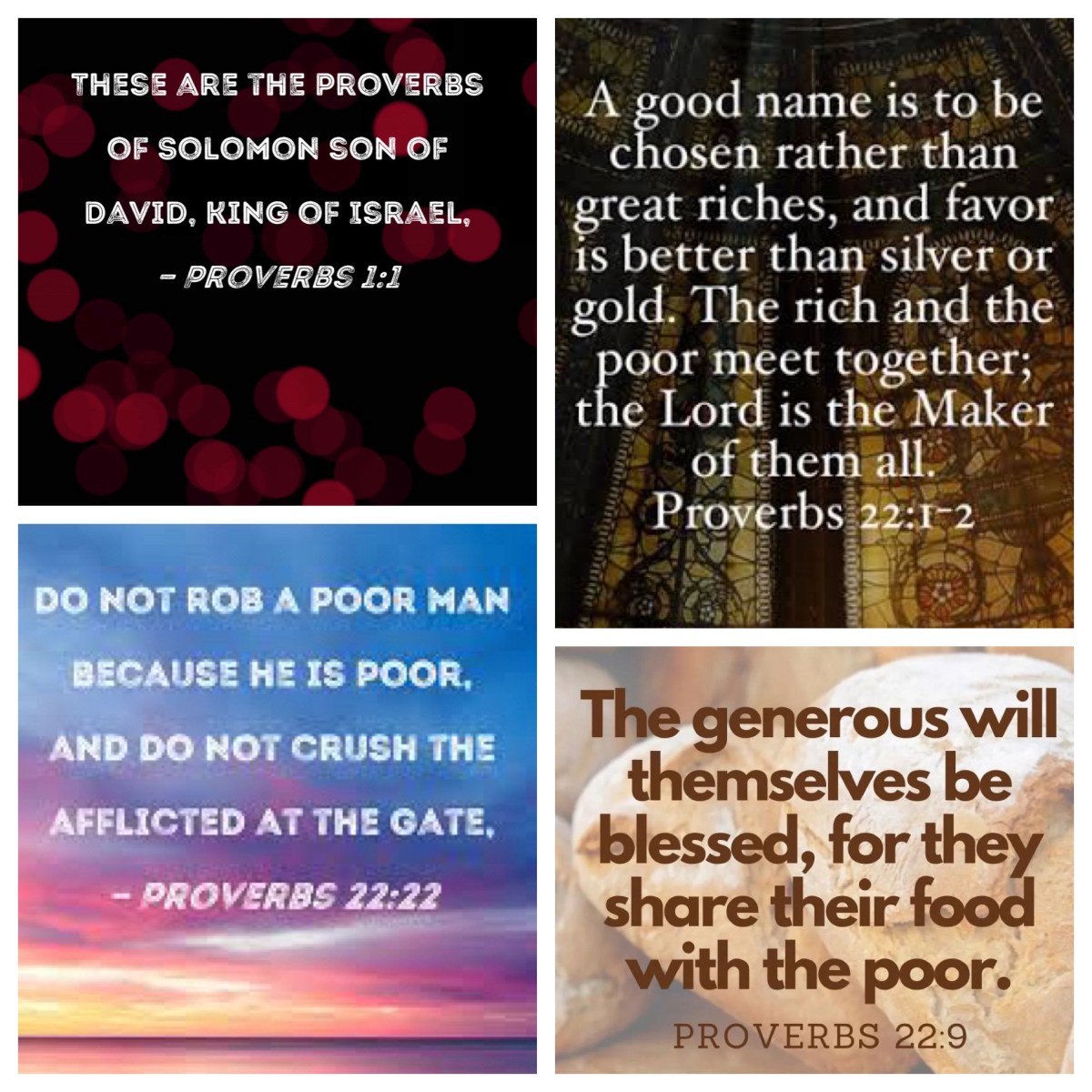
Proverbs invites the reader to an intellectual discipline as a life-giving pathway to ethical concern, righteousness and piety. Study of Torah undergirds the righteous life; “those who keep the law are wise children” (28:7), “happy are those who keep the law” (29:18), “the wise of heart will heed commandments” (10:8). The particular doublets chosen for this Sunday’s reading from ch.22 draw from the foundations of Torah to highlight the value of a good name (vv.1–2), a generous life (vv.8–9), and an upright ethic (vv.22–23).

“A good name is to be chosen rather than great riches”, the chapter begins, “and favour is better than silver or gold” (v.1). This resonates both with the affirmation that the person who listens to the teaching of Wisdom “will find favour and good repute in the sight of God and of people” (3:1,4), and, on the contrary, if a person discloses a secret in an argument, “someone who hears you will bring shame upon you, and your ill repute will have no end” (25:9–10). 

This reflects the fundamental ethos of an honour—shame society, such as ancient Israel was. A good reputation—a position of public honour—is to be desired and sought after. This honour is closely bound up with wisdom; “the wise will inherit honour, but stubborn fools, disgrace” (3:35), “whoever pursues righteousness and kindness will find life and honour” (21:21), for Wisdom holds honour in her left hand” (3:16; also 4:8;8:18). It is also connected with humility, for “a person’s pride will bring humiliation, but one who is lowly in spirit will obtain honour” (29:23), and just as “the fear of the Lord is instruction in wisdom”, so “humility goes before honour” (15:33). 

That the importance of honour and shame is carried through into the time of Jesus is evident in his words about “a prophet without honour” (Mark 6:4), those who choose “the best seats in the synagogues and places of honor at banquets” (Mark 12:39), and the dishonouring he experiences when he is called names in public (John 8:48–49). It is also clear through the way that Paul explicitly identifies the general expectations about honour in society (Rom 13:7), the ways that “the cross” brings shameful dishonour (1 Cor 1:26–29; 2 Cor 6:8–10), and the way that following Jesus turns a conventional attitude on its head (1 Cor 12:22–24).

For more on honour and shame, especially as it illuminates the story of Jesus, see 

and

Generosity is applauded in sayings such as “a generous person will be enriched, and one who gives water will get water” (11:25), “many seek the favour of the generous” (19:26), and the saying included in this Sunday’s selection, “those who are generous are blessed, for they share their bread with the poor” (22:9).

One of the psalmists notes that “the righteous are generous and keep giving” (Ps 37:21). Another psalmist connects generosity with ethical uprightness, singing that “all is well with those who deal generously and lend, who conduct their affairs with justice” (Ps 112:5).

Of course, sharing with “the poor” is a theme sounded by prophet after prophet. God’s care for “the poor” is announced by Hannah, as she sings how the Lord “raises up the poor from the dust; he lifts the needy from the ash heap” (1 Sam 28; also Ps 113:7). Amos famously berates Israel as they “trample the head of the poor into the dust of the earth, and push the afflicted out of the way” (Amos 2:7) before he turns his rhetoric towards “the cows of Bashan who are on Mount Samaria”, the ones “who oppress the poor, who crush the needy” (Amos 4:1). Judgement is coming upon both groups (Amos 2:13–16; 4:2–3).

Isaiah reports that God’s judgement will fall on the elders who are “crushing my people … grinding the face of the poor” (Isa 3:15; also 10:2) and Ezekiel berates those who “oppress the poor and needy” (Ezek 18:12; 22:29), for which they shall indeed die (Ezek 18:13). One psalm laments that “the wicked draw the sword and bend their bows to bring down the poor and needy, to kill those who walk uprightly” (Ps 37:14) 

Isaiah promised that a shoot from the stump of Jesse, embued with the spirit, “with righteousness … shall judge the poor, and decide with equity for the meek of the earth” (Isa 11:1, 4). In exile, Jeremiah remembered (perhaps rather idealistically) that it was the role of the king to “judge the cause of the poor and needy” (Jer 22:16); a psalmist also remined the king of his responsibility to “judge your people with righteousness, and your poor with justice … defend the cause of the poor of the people, give deliverance to the needy” (Ps 72:2, 4). The Lord, says psalmist, through David and his house “will abundantly bless [Israel’s] provisions [and] will satisfy its poor with bread” (Ps 132:15).

Then, as the exiles begin to return to Jerusalem, Zechariah reminded them of the Lord’s commands: “do not oppress the widow, the orphan, the alien, or the poor; and do not devise evil in your hearts against one another” (Zech 7:10). Various psalmists celebrated that “the poor shall eat and be satisfied” (Ps 22:26), that on “the day of trouble” the person who “considers the poor” will be delivered by the Lord (Ps 41:1), that “the Lord maintains the cause of the needy, and executes justice for the poor” (Ps 140:12). So it is that those “who fear the Lord, who greatly delight in his commandments” have “distributed freely, they have given to the poor” (Ps 112:1, 9).

We know that this theme is taken up with clarity and consistency by Jesus, who proclaims a message of “good news for the poor” (Luke 4:18; 7:22) and instructs his followers to “sell what you own, and give the money to the poor” (Mark 10:21). He advocates strongly that the kingdom of God belongs variously to the poor (Luke 6:20), the meek (Matt 5:5), and the humble (Luke  14:11; 18:14), to children (Mark 9:36–37; 10:15) and to sinners (Mark 2:15–17; Luke 15:1–2).

And so, this uprightness in life is advocated by the final two couplets included in this Sunday’s selection, instructing people “not [to] rob the poor because they are poor, or crush the afflicted at the gate”, and noting that, as a consequence, “the Lord pleads their cause and despoils of life those who despoil them” (22:22–23).

These instructions are fundamental to living by Torah, and they are reiterated by many prophets in Israel. So even within the wisdom literature, we find support for the coming punishment of the Lord of which the prophets spoke incessantly; this judgement is based on how faithfully a person adheres to the commandments of the Torah. Wisdom is integral to Torah; “those who keep the law are wise children” (28:7).

The winter is past, the rain is over and gone (Song of Songs 2; Pentecost 15B)

Over the past three months we have followed the stories about the first three kings of Israel—Saul, David, and Solomon—to the point where we heard Solomon praying for wisdom (1 Ki 3, two Sundays back) and then Solomon praying to dedicate the Temple (1 Ki 8, last Sunday). We also,saw how these two selections present Solomon in a very positive light, whilst other parts of the story reveal a scheming, power-hungry despot. The “nasty” Solomon has disappeared; we have heard only about them “nice” Solomon.

Now the lectionary takes us forward into a series of texts known collectively as “the Wisdom Literature”. Over the next three months, we will hear from a number of the books collected under this rubric in the Protestant Canon of the Old Testament (Song of Songs, Proverbs, Esther, Job, and Ruth). (If you use the lectionary readings for All Saints Day on 1 Nov, you will also encounter the Wisdom of Solomon, a book found in the Deuterocanonical works in the Roman Catholic Canon.)

The ongoing tradition has been very kind to Solomon. He is remembered much more for his wisdom than his warmongering. It is his gentle reflections on life that persist in popular imagination, not his aggressive actions towards family members that we saw a couple of weeks back. In 1 Kings 4:32, it is stated that Solomon “composed three thousand proverbs, and his songs numbered a thousand and five”. There are two psalms, Ps 72 and Ps 127, which are attributed to Solomon, while three whole books—Proverbs, Ecclesiastes, and Song of Songs—are claimed to have been written by Solomon. This is where his legendary wisdom can be accessed!

Proverbs begins “The proverbs of Solomon son of David, king of Israel: for learning about wisdom and instruction, for understanding words of insight …” (Prov 1:1–2). We will come to Proverbs in future weeks. Ecclesiastes begins, “The words of the Teacher, the son of David, king in Jerusalem: ‘I, the Teacher, when king over Israel in Jerusalem, applied my mind to seek and to search out by wisdom all that is done under heaven’” (Eccles 1:1). Unfortunately, Ecclesiastes is set only once by the lectionary, in another season.

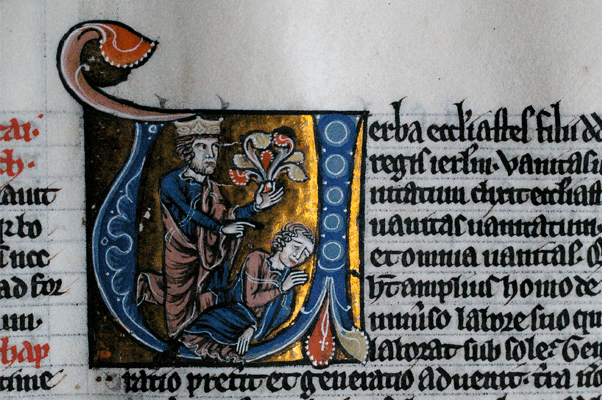
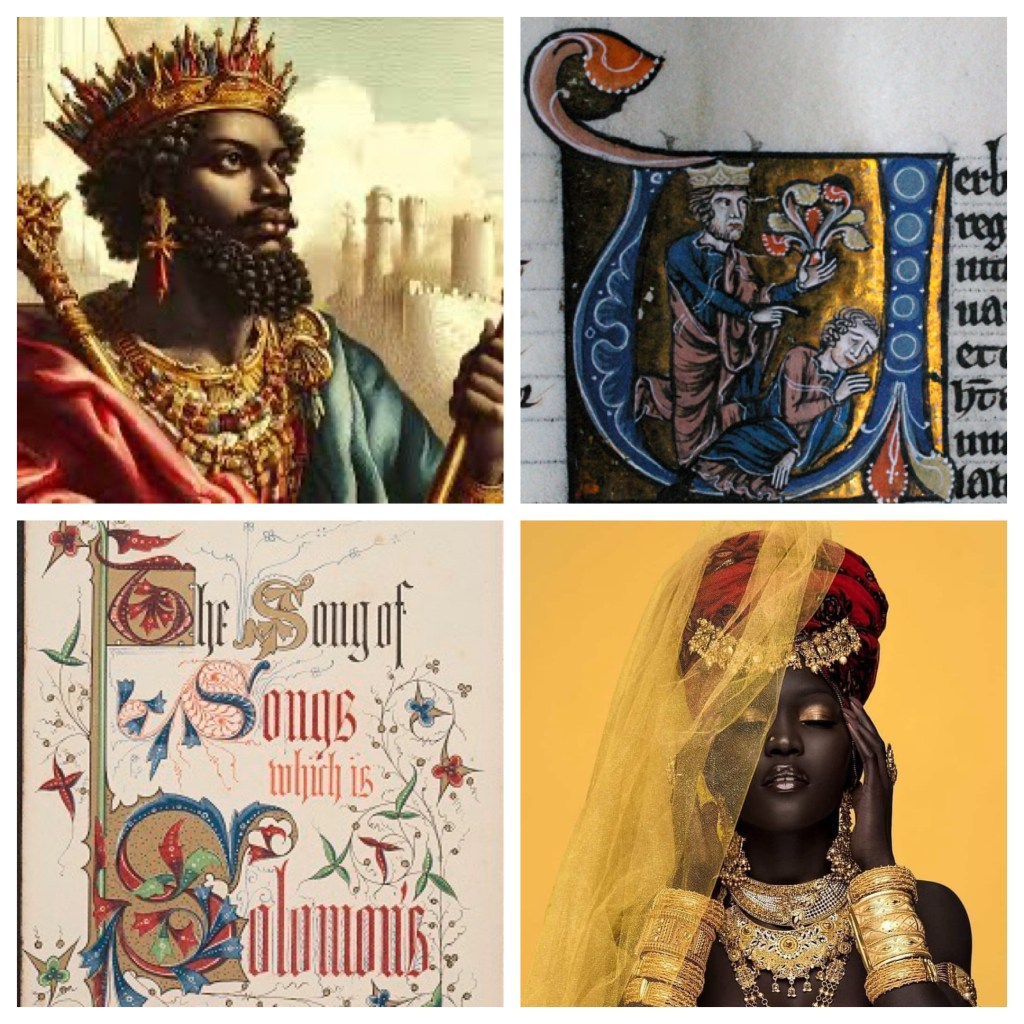
A picture of Solomon holding a flower and of a youth;
a miniature from the opening of Ecclesiastes (in Latin)
in the Bible of the Monastery of Santa Maria de Alcobaça, c. 1220s (National Library of Portugal ALC.455, fl.207).

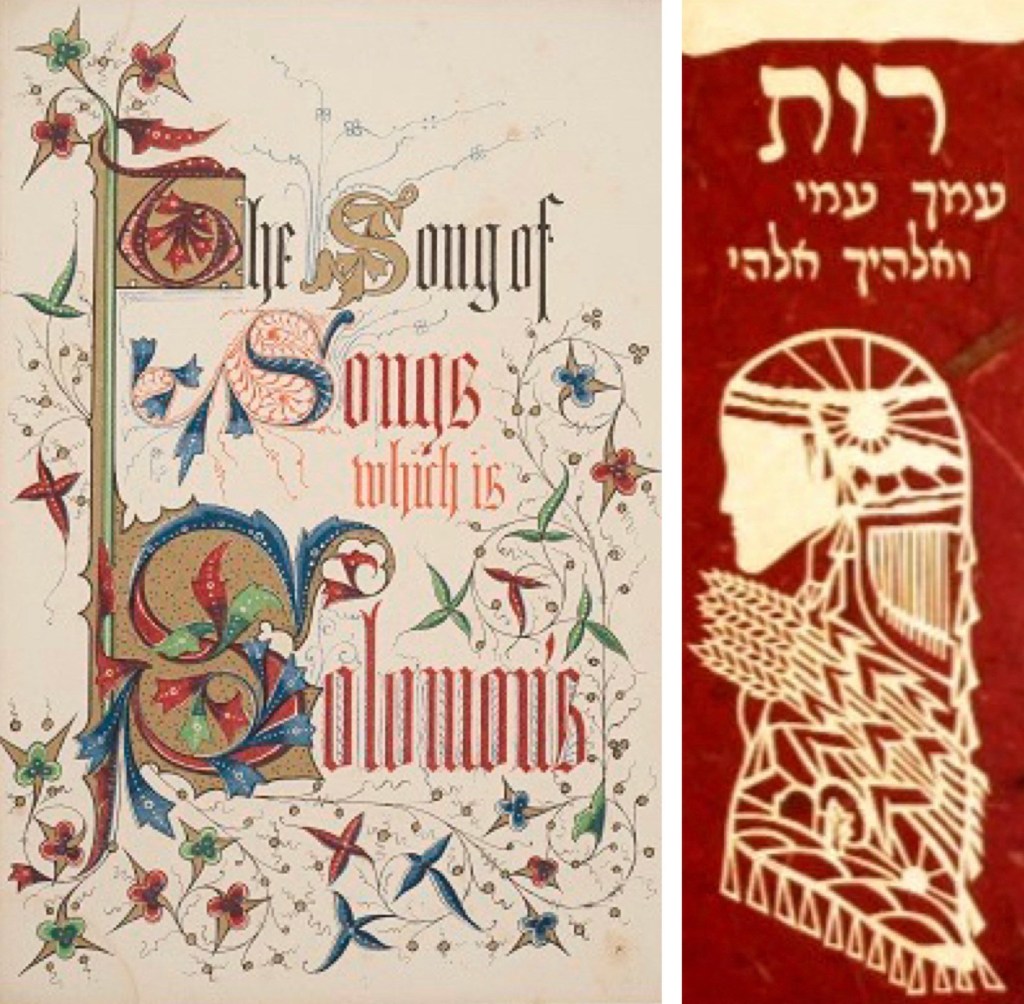
Songs of Songs has the heading, “The Song of Songs, which is Solomon’s” (Song 1:1). We hear one short passage from the Song this coming Sunday; but the work deserves a longer introduction. Elizabeth and I have taught sessions on this book over the years, and she has written material from which I have drawn to develop the following blog, so I am grateful to her for a number of insights into this book.

The Song of Songs (also known as Song of Solomon) is one of the Hebrew Bible’s most beautiful texts; it is also highly controversial. The name itself suggests something grand; in true Hebraic style, the repetition of a word simply intensifies and magnifies the word. When God completed creation “and saw everything that he had made, and indeed, it was very good” (Gen 1:31), the Hebrew is tov tov (literally, “good good”). So the first two words of this book, shir ha-shirim, could well mean “the best of songs”.

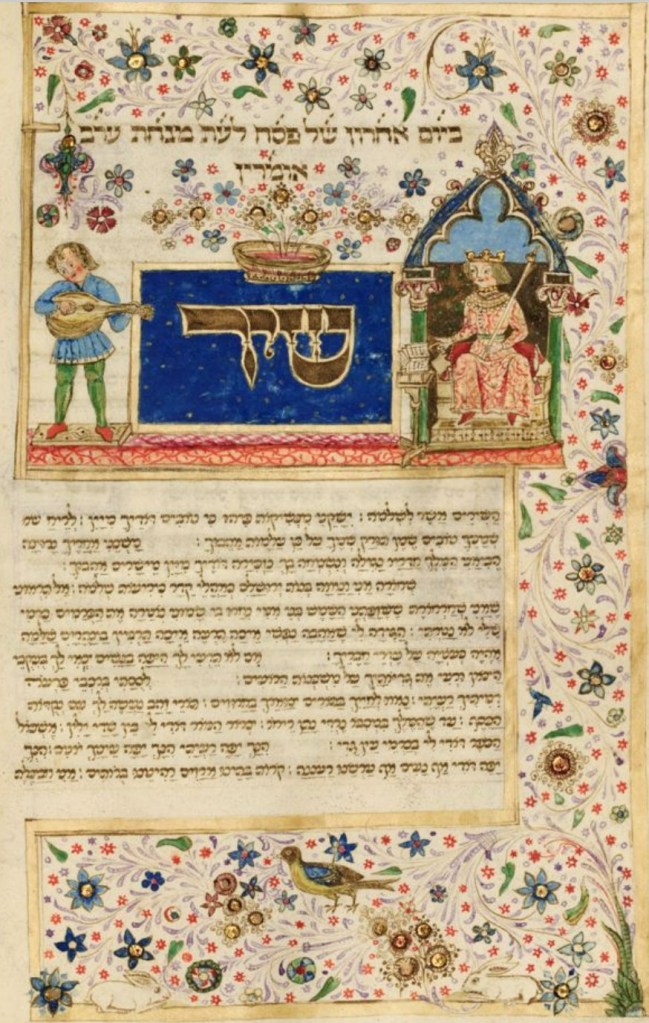
Illustration for the first verse of a medieval manuscript
of The Song of Songs;;a minstrel playing before Solomon
(15th century Rothschild Mahzor)

Of course, numerous commentators have noted that there is no mention of God anywhere in this book; so that has raised questions about why it was included as one of the Megilloth in Kethuvim, the third section of the Jewish Torah; from which, it has been included in the Christian Old Testament. We know the rabbis debated this very issue; it was Rabbi Akiba who most strenuously argued for its inclusion (in tractate Yadaim 3.5, in the Mishnah). Akiba concluded that “the whole world is not as worthy as the day on which the Song of Songs was given to Israel; for all the writings are holy but the Song of Songs is the holy of holies.”

For many church fathers, the physical sexuality present in the Song made them quite wary of the book. They generally cautioned against reading it until a “mature spirituality” had been obtained, so that the Song would not be misunderstood and lead the reader into temptation. Origen wrote a commentary on the Song, allegorising throughout. The carnal, fleshy references were all considered to be analogies (or allegories) referring directly to spiritual, heavenly things. Origen was the master of allegorical meaning—something along the lines of “the text says ‘this’, but ‘this’ points to ‘that’, which is its deeper and intended meaning”.

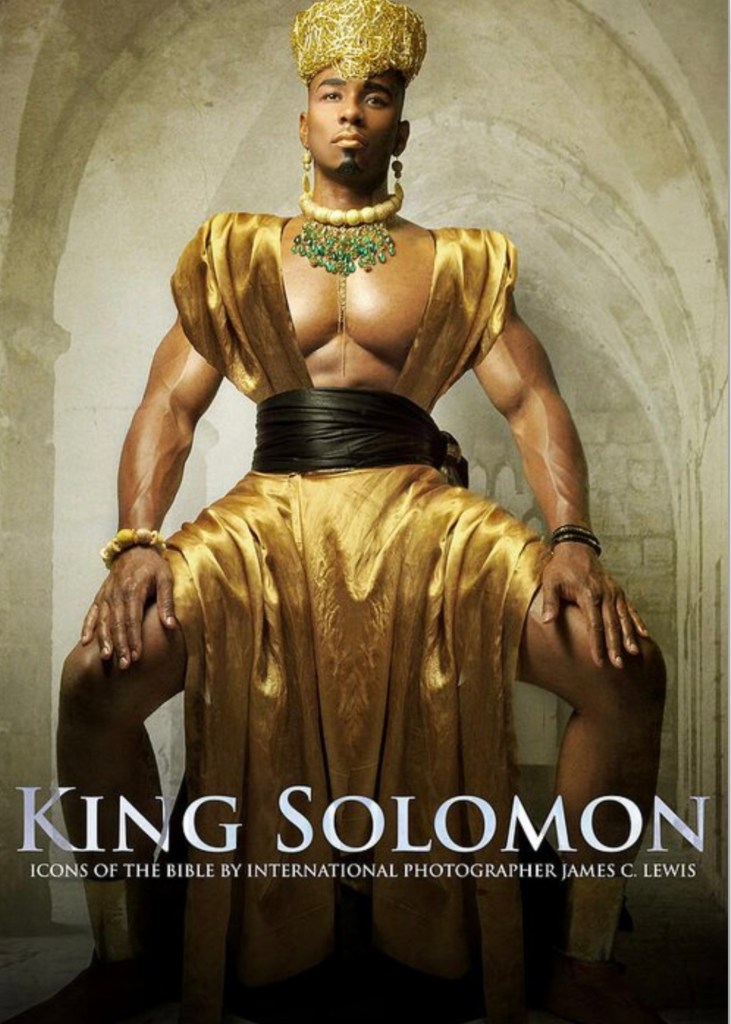
With God completely absent from the book, the two main characters are a man and a woman; the book contains a series of love songs between them, in which they express their love for one another in poetic  form. The man is identified early on as the King (1:4, 12), and then explicitly identified as Solomon (3:9–11). Accordingly, the book has traditionally been identified as being by Solomon himself. In this view, perhaps, the wisdom of God might be conveyed in some way through his words?

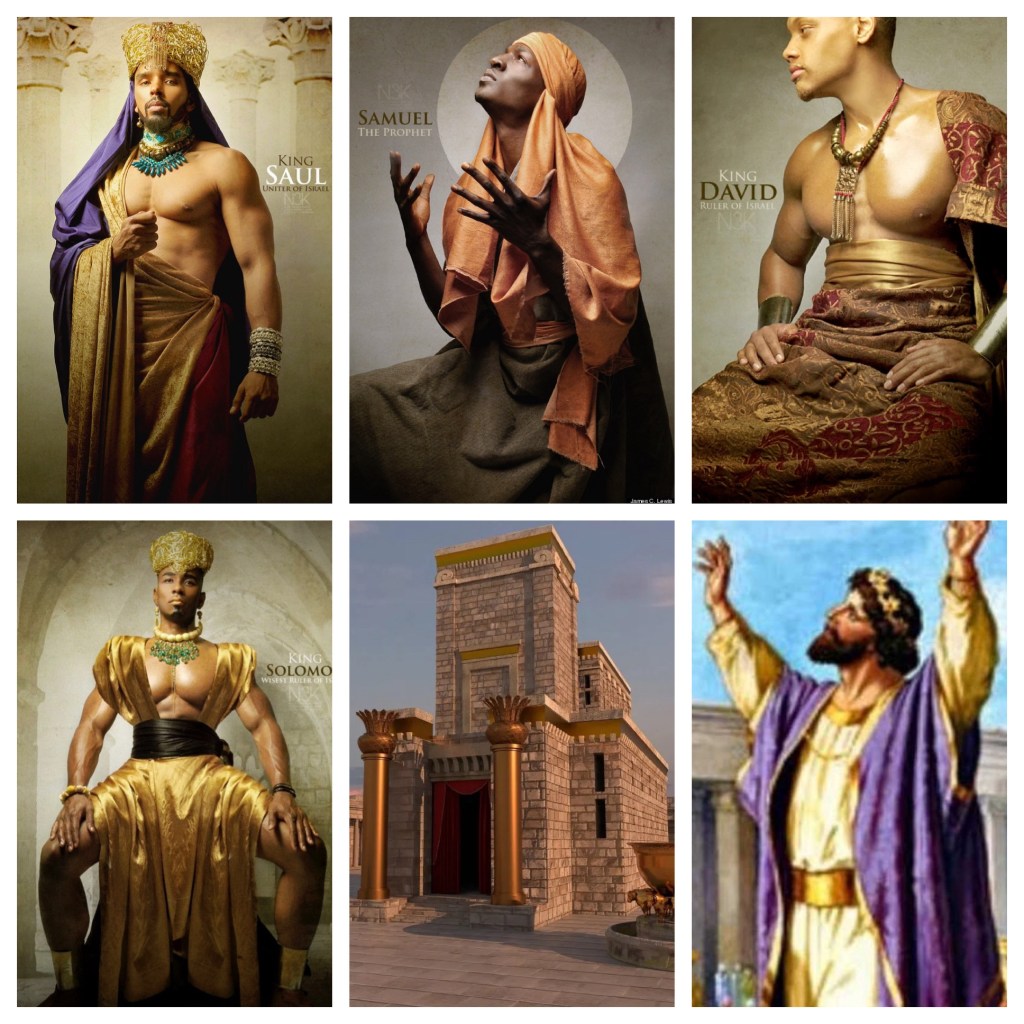
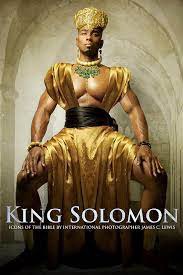
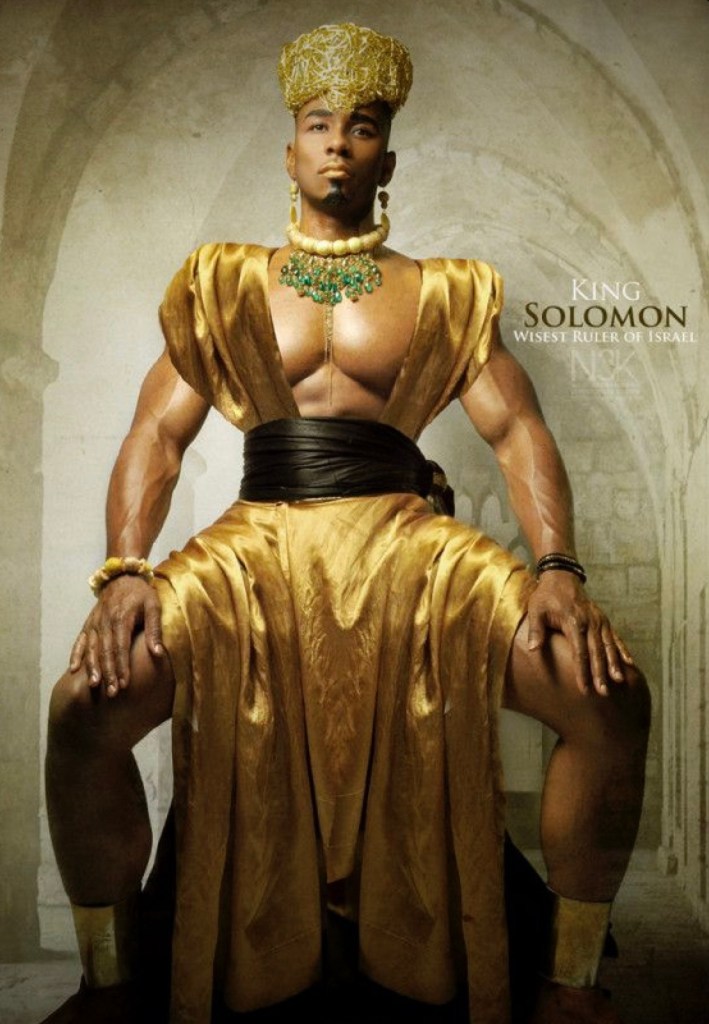
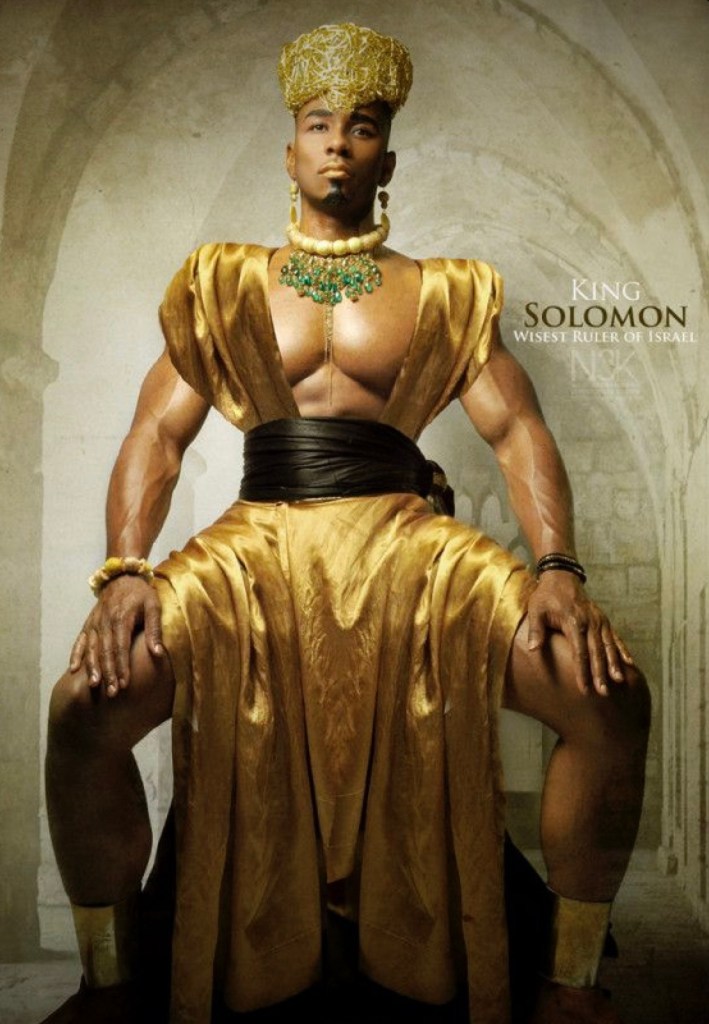
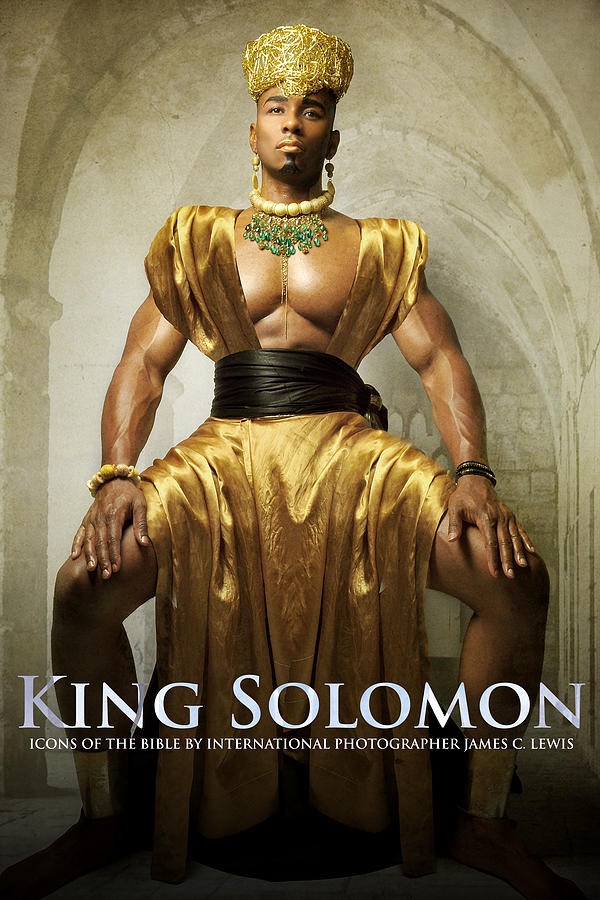
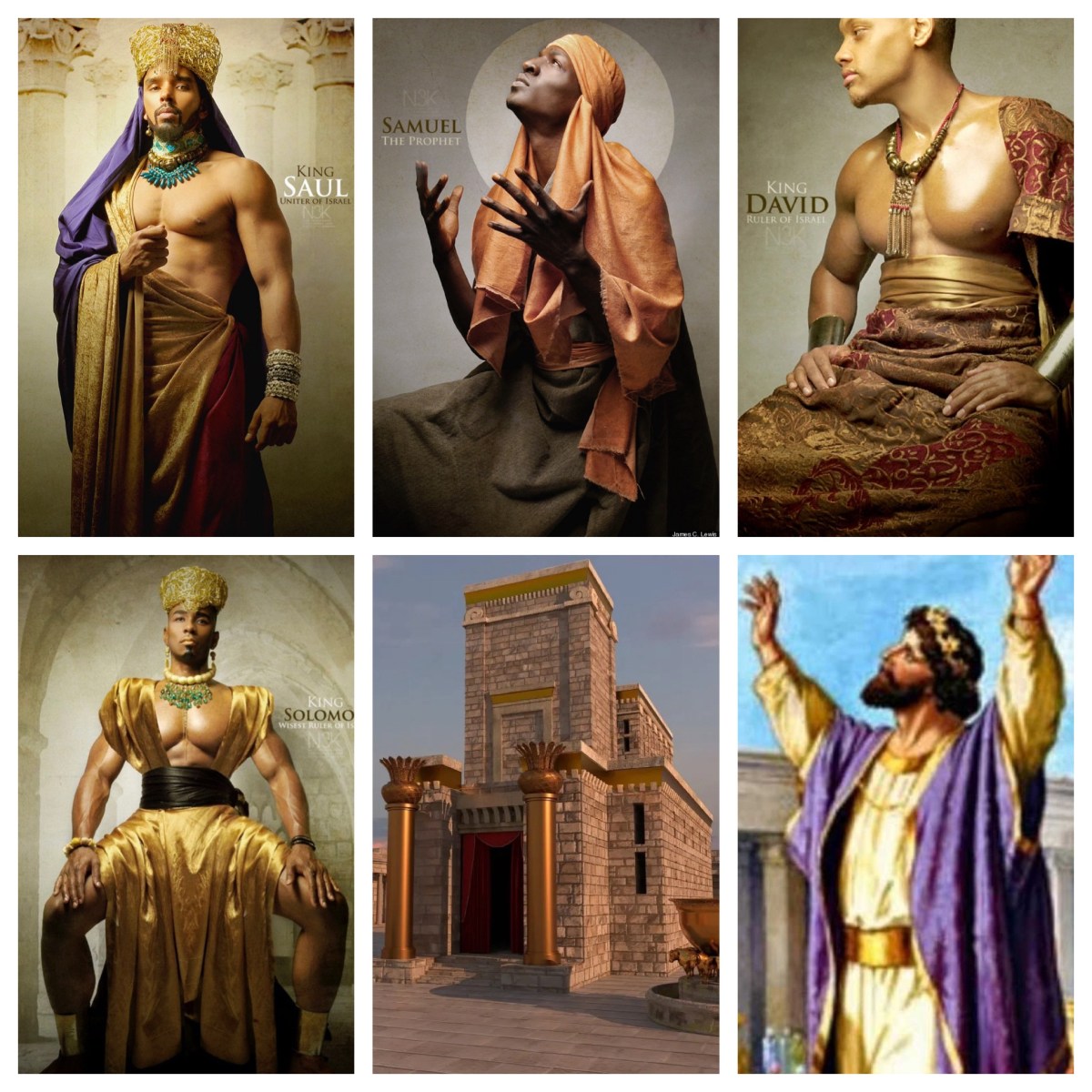
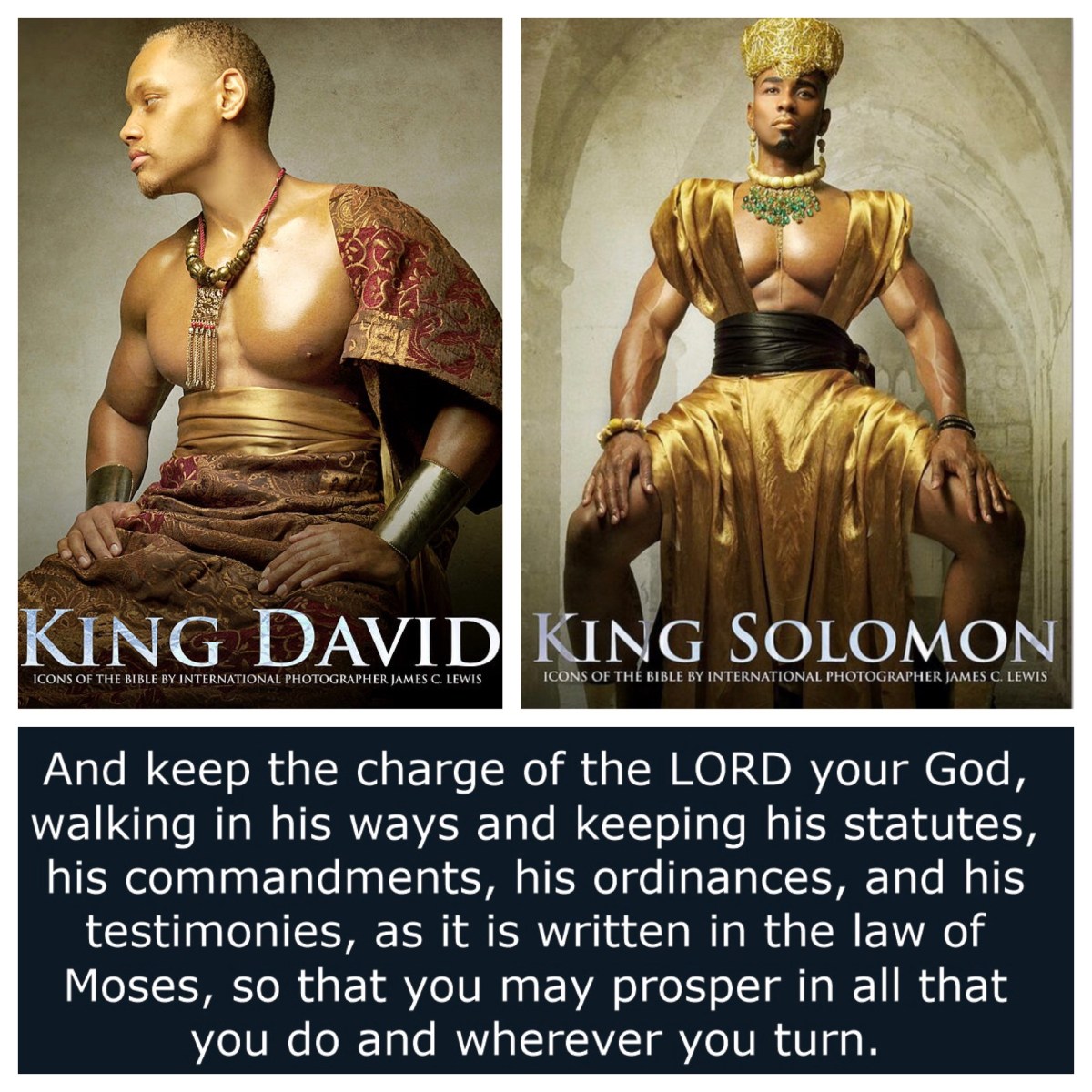
Solomon, by the photographer James C. Lewis

However, scholars attempting to date the book disagree about this authorship, and have offered a wide range of possible dates for its composition. Because the Song contains elements characteristic of poems written in the courts of Egypt and Mesopotamia, could it be quite old? Does the dominance of an oral culture in antiquity mean that songs composed long ago were remembered and passed on by word of mouth for centuries before being written down? Could this mean the Song came from Solomon, or from his court?

Do the number of words that reflect an Aramaic influence point to a later origin of the Song in the period of the Exile onwards (from the 6th century BCE)? Was it a compilation made even later, after the exiles had returned and were firmly resettled in the land, in the 3rd century BCE, when other compilations of wisdom were being made? The debate continues.

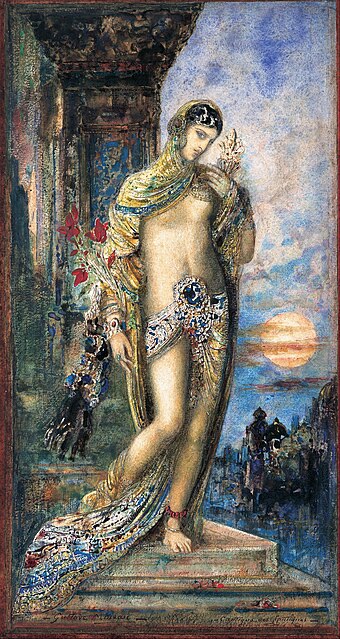
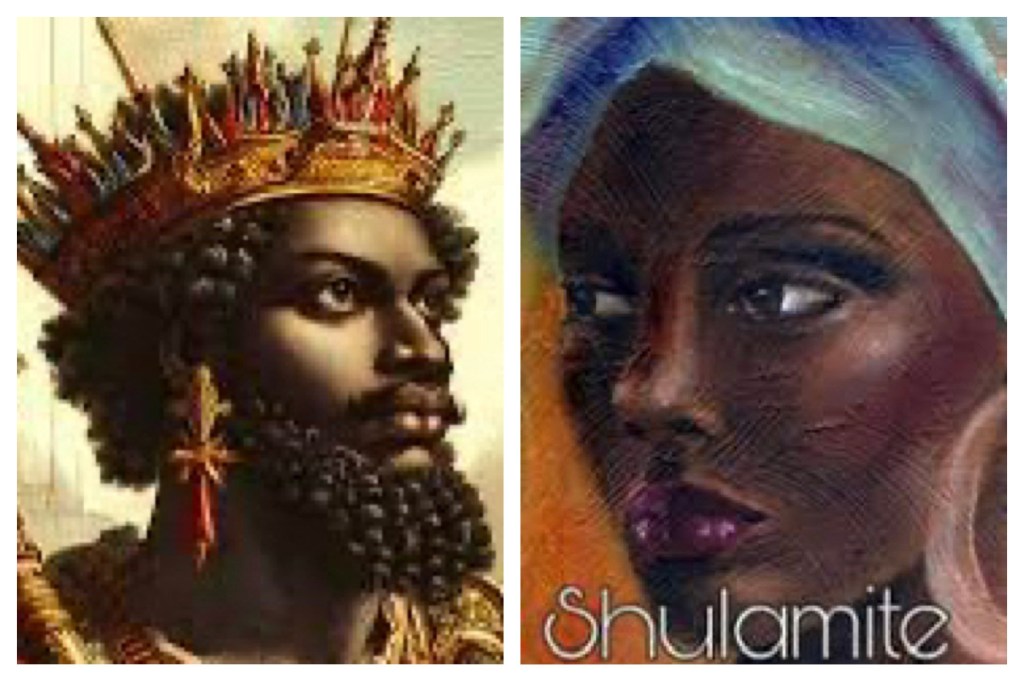
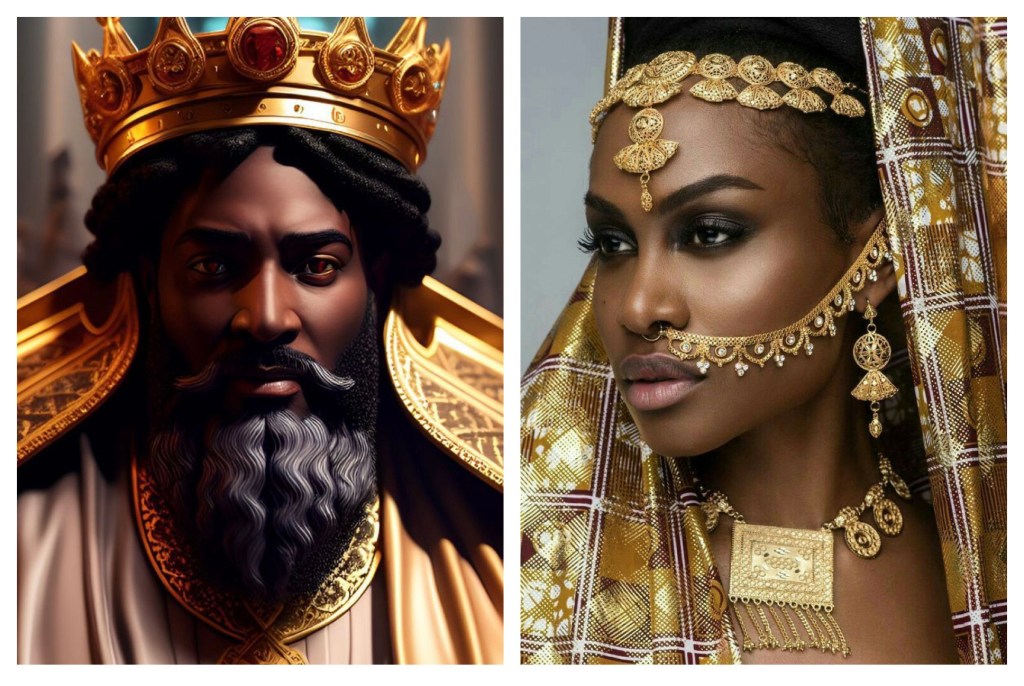
The woman character, described as “black and beautiful” (1:5), is later addressed as a Shulammite (6:13). Rabbinic interpreters, noting that her name means that she is “the one who brings peace” (8:10), relating her name either to shalom, peace (which is the basis for the name of Solomon himself). Other suggestions for her curious name identifies it with the village of Shunem or Shulem (the home of Abishag, King David’s beautiful attendant, 1 Ki 1:1–4); or the Mesopotamian war goddess Shulmanitu, who was perhaps also known as Ishtar. 

Song of Songs: The Shulammite Maiden
by Gustavo Moreau, a 19th century French artist

It is notable that the woman plays a prominent role in this book; does she, perhaps, represent the female Wisdom character that is found in Proverbs and later wisdom literature? There is a suggestion from more recent commentators that, just as the book of Job was included in scripture to present an alternative view to the theology of Deuteronomy (God blesses the righteous and punishes the wicked), so the Song was included in the Hebrew canon to counter the many prophetic references which portray the idolatrous choices of Israel through the image of an adulterous woman. It’s an enticing possibility.

“Let him kiss me with the kisses of his mouth”, the Song begins, as the female character sings of her deep love for the king; “your love is better than wine, your anointing oils are fragrant, your name is perfume poured out; therefore the maidens love you!” (Song of Songs 1:1–3). Immediately the direct physicality of the poetry is evident. This continues right throughout the book.

The passage proposed by the lectionary for this coming Sunday (Song 2:8–13) describes a wonderfully green scene, with springtime flowers reflecting the flowering of love that we can see in the poems. The lovers enjoy the beauty of Spring, which, for the young woman, is not unlike the beauty of her lover. The scene speaks of fertility, growth and beauty. Indeed, as one of the Megilloth (five short books, each read in full at a different Jewish festival), this book has been traditionally chanted by Jews each Passover, because of its thematic connection with springtime. 

Back in the opening verses of the song (1:1–8), we have met the Shulammite princess who is in love with King Solomon; she is “black and beautiful” (v.5). She desires her lover’s kisses (v.2) and regularly addresses him as “my beloved” (1:13–14, 16; 2:3, 8–10, 16–17; 4:16; 5:2, 4–10, 16; 6:2–3; 7:11, 13; 8:14). She boasts to her handmaidens of his physical desirability, which they obviously find attractive: “your love is better than wine, your anointing oils are fragrant, your name is perfume poured out” (vv.2–3). Later she boasts that “my beloved is all radiant and ruddy … his head is the finest gold, his locks are wavy, black as a raven” (5:10–11). She tenderly describes his eyes, his cheeks, his lips, his arms, his legs, his body, and his sweet speech (5:12–16). 

He, in turns, passionately admires his “fair one” (2:10, 13), describing her sweet voice and lovely face (2:14), telling her “how beautiful you are, my love, how very beautiful” (4:1) and exulting in her eyes, her hair, her teeth, her lips, her mouth, her cheeks, her neck, and her two breasts (4:1–5). Her love is “much better than wine” (4:10); he portrays her, modestly, as “a garden locked, a fountain sealed” (4:12) before more explicitly declaring, “your channel is an orchard of pomegranates with all choicest fruit” (4:13), “a garden fountain, a well of living water and flowing streams” (4:15). The language, poetic and lyrical, conveys a deep-seated erotic feeling.

The explicit nature of the relationship is continued in the ensuing poem of the princess; “I had put off my garment”, she says; “I had bathed my feet … my beloved thrust his hand into the opening and my inmost being yearned for him” (5:4). So, she says, with her fingers and hands dripping, “I opened to my beloved” (5:6). But he had disappeared; she was “faint with love” (5:8)—and then, “my beloved has gone down to his garden, to the bed of spices, to pasture his flock in the gardens and to gather lilies” (6:2). He flatters her; “you are beautiful as Tirzah, my love, comely as Jerusalem” (6:4), continuing with words of praise for her feet, her thighs, her navel, her belly, her two breasts, her neck, her eyes, her nose, and her hair (7:1–5). 

“How fair and pleasant you are, o loved one, delectable maiden” (7:6), he sings, returning again to her breasts and her kisses (7:8–9). So, at last, he invites her “into the fields, to the vineyards”, to see ”whether the vines have budded, whether the grapes blossoms have opened and the pomegranates are in bloom” (7:11–12). It is, finally, a scene of consummation; “there I will give you my love” (7:12).
The Song ends with a statement of complete and total commitment, when the woman says to the king, “set me as a seal upon your heart, as a seal upon your arm” (Song 8:6). This refers to the practice of stamping a seal over a document to show that it is legally enforceable. 

Hebrew Scripture refers to the seal of King Ahaz of Judah (1 Ki 21:8) and Ahasuerus, king of the Medes (Esther 8:8). A seal was the size of a fingertip, made of stone or bone, engraved with a figurative design. It was a precious personal item for people of high status; so the woman in these songs is indicating that she wishes to be a precious personal part of the king’s life. (Elizabeth and I used these words in our wedding vows to each other, to indicate the same thing.) 

The songs of this book end with the woman’s plea for the man to come quickly to her; “make haste, my beloved” (8:14) signals her aching desire for her lover. From beginning to end, this book is saturated with deep-seated longing, with unfettered desire, and unbounded hope. 

Are the words of this poetry to be interpreted literally; are they actual words of a king, yearning for his lover, and the responses of the lover of the king, yearning for his touch (and more)? Or is there another level of meaning? The explicit erotic language of this poetry has sent shivers of horror down the spines of interpreters, from antiquity through to modernity. How could such poetry be considered to be “the word of the Lord”?

Our response to that question, it seems to me, is governed by the way that we view this material world. Is it an evil, unredeemed prison, from which we must seek release? Or is it the creation of a deity who has embued all physical matter with a spark of divinity? If it is the former, then this earthy, sensual language must point beyond, to a spiritual dimension; we are to interpret it as symbolic of God’s heavenly realm. If it is the latter, we are to accept and rejoice in the literal meaning of the poetry.

My view is that there is nothing at any point throughout these Hebrew songs which gives any clue at all that we are to interpret them in a “spiritualised” manner, as so many have done. Throughout ancient Israelite texts, and on into Second Temple Judaism and then Rabbinic Judaism, material things are good, valued, and to be enjoyed. It is only the deep-seated teaching of hellenistically-inspired interpreters, schooled in the Platonic view that the spirit is good but the flesh is evil, that points in such a direction. Instead, we must surely accept that the abundantly erotic and exuberant language in these songs must be taken precisely in that fashion: as a celebration of earthly, material sexuality.

There is an abundance in the language used throughout the Song of Songs. Abundance was celebrated in ancient Israelite society—especially abundance in material, physical elements. The spirit-inspired Balaam forsees that for Israel, “water shall flow from his buckets, and his seed shall have abundant water, his king shall be higher than Agag, and his kingdom shall be exalted” (Num 24:7). When David’s troops came into Hebron to celebrate David’s accession to the throne, their neighbours  brought “abundant provisions of meal, cakes of figs, clusters of raisins, wine, oil, oxen, and sheep, for there was joy in Israel” (1 Chron 12:40). 

The prophet Ezekiel declares that God promises the exiles of Israel, “I will summon the grain and make it abundant and lay no famine upon you. I will make the fruit of the tree and the produce of the field abundant” (Ezek 36:29–30), while Joel rejoices, inviting the children of Zion to “be glad and rejoice in the Lord your God; for he has given the early rain for your vindication, he has poured down for you abundant rain, the early and the later rain, as before” (Joel 2:23). Speaking through a later prophet, the Lord invites people to “come to the waters … come, buy wine and milk without money and without price … eat what is good, and delight yourselves in rich food” (Isa 55:1–2).
The psalmists rejoice in God’s “abundant goodness” (Ps 31:19; 145:7), “abundant mercy” (Ps 51:1; 69:16), that God is “abundant in power” (Ps 147:5), promising that “the meek shall inherit the land and delight themselves in abundant prosperity” (Ps 37:11). One writer rejoices that, year after year, the Lord “crowns the year with [his] bounty”, singing that “you visit the earth and water it, you greatly enrich it; the river of God is full of water; you water its furrows abundantly, settling its ridges, softening it with showers, and blessing its growth” (Ps 65:9–11). 

This physical imagery of abundance is strongly evocative of the joyful Spring scene in Song of Songs that we hear this Sunday: “the flowers appear on the earth; the time of singing has come, and the voice of the turtledove is heard in our land; the fig tree puts forth its figs, and the vines are in blossom; they give forth fragrance” (Song 2:12–13).

In his exploration of this book, Tom Gledhill remarks on the imagery of the man bounding through the countryside and calling the woman out of her home to join him in the explosion of nature in springtime as part of a recurrent theme in the Song: “The rural countryside motif is an expression of untrammelled freedom and exhilaration, of energetic enthusiasm and adventure, travelling new and unexplored pathways, taking the risks that a new liberty entails.”

Gledhill notes that “the tiny spring flowers are sparkling forth amongst the new shoots of the undergrowth … there is a hint of future blessings in the references to the fig tree and the vines in blossom. Our lovers are part and parcel of this explosion of new life and new hope.” (The Message of the Song of Songs, IVP, 1994, pp. 132–133). Is this perhaps a pointer to the divinity that these poems are making? — a pointer to the deity who creates the world and oversees the cycles of fertility and abundance?

O hear in heaven, your dwelling place (1 Kings 8; Pentecost 14B)

This blog draws heavily from a sermon that I preached at St Ninians Uniting Church in Canberra, ACT, on 22 August 2021.

The narrative sequence of stories from the sagas of ancient Israel which we have been hearing week by week as we follow the lectionary comes to a head with a prayer of dedication as the Temple is completed. The passage proposed by the lectionary is 1 Kings 8:(1,6,10–11), 22–30, 41–43. 

If you have time (just a few extra minutes) it is worth reading the whole 61 verses of this chapter, which includes all of Solomon’s prayer. As you do, you might note the repeated address of Solomon to God, “O hear in heaven your dwelling place” (verses 30, 32, 36, 39, 43, 45, 49), his regular invoking of “your name” (verses 33, 35, 41–44, 48), and his petition to “forgive the sin of your people Israel” (verses 30, 34, 36, 39, 50). 

We began reading in 1 Samuel back in May with Samuel; we end this Sunday with Solomon in 1 Kings. In the course of these weeks, we have heard about Saul and David, the first two Kings of Israel; the prophets Samuel and Nathan; David’s battles with the Philistines, including the enemy giant Goliath, and his beloved companion Jonathan; the unfortunate Absalom, one of David’s sons, as well as his wives Michal and Bathsheba; and, this coming Sunday, King Solomon, the third king of Israel.

We have seen the character of the leaders in Israel. These stories reveal that these leaders were human; they acted in ways that were devious, unscrupulous, scheming, manipulative, emotional, hard-headed, self-serving, and deeply flawed. All of this, from these ancient texts—as if we didn’t already know this from our own observations of leaders in our own situation! 

In last Sunday’s passage, Solomon, son of David, was installed as king of Israel after the death of his father (1 Kings 2). God made a promise to Solomon: “I give you a wise and discerning mind; no one like you has been before you and no one like you shall arise after you” (1 Ki 3:12). And in the passage proposed for this coming Sunday, we see this wisdom displayed, as Solomon gathers people for the opening of the Temple (1 Ki 8).

Under Solomon, Israel was said to stretch from the Euphrates to Egypt (1 Ki 4:21), the largest amount of land of all kings (and the extent that is, controversially, claimed by extremist Zionists today). The lengthy prayer that Solomon prays is equally grand; he recalls the many acts of God and the response of God’s people, and repeatedly presses God to “hear in heaven” and forgive, judge, act, and maintain their cause. 

So this is a high, holy moment: the greatest king of Israel, Solomon, prays to dedicate the grand religious building, the Temple, on the top of the highest hill in Jerusalem, the capital city of the kingdom at the point of its greatest influence and power. (The readings in following weeks will move into the literature attributed to and inspired by Solomon, the wisdom literature.)

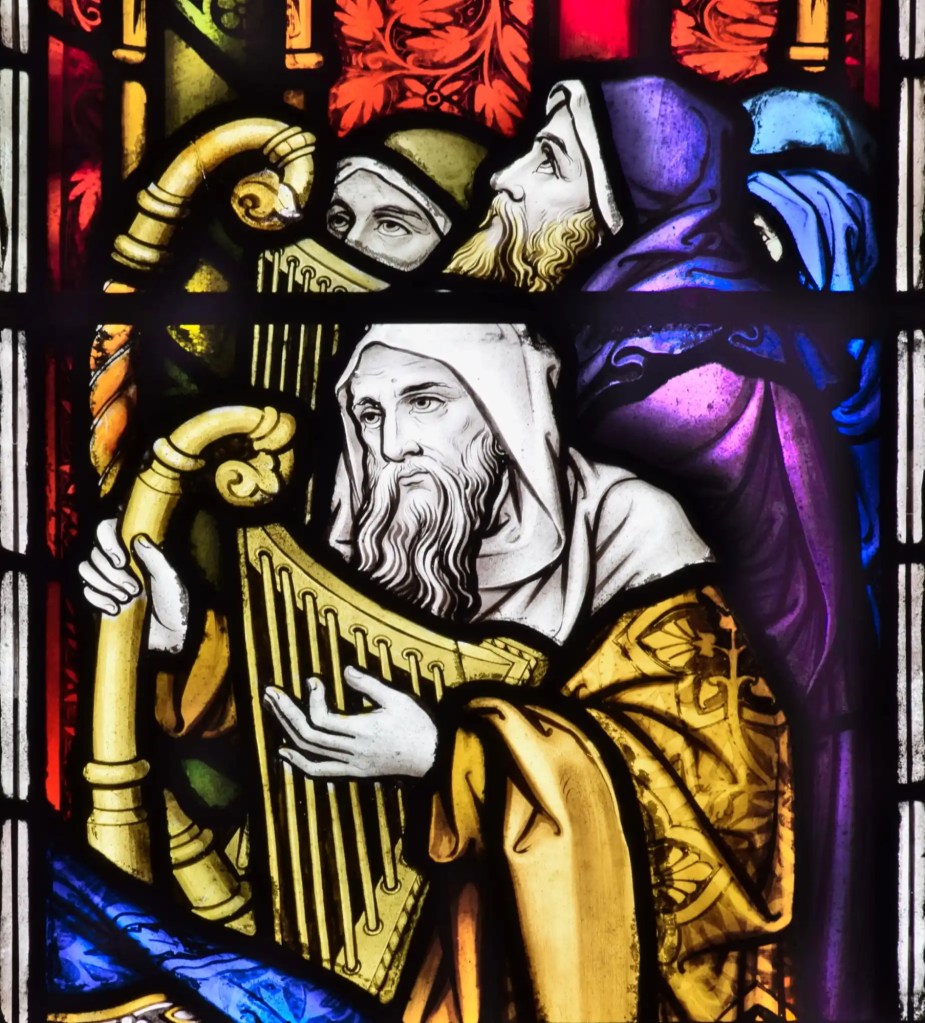
Detail from stained glass window,
King Solomon dedicates the Temple, Hardman &Co., 1897;
located in the Roman Catholic Church of English Martyrs
at Streatham, UK

At this moment of dedication “Solomon assembled the elders of Israel and all the heads of the tribes, the leaders of the ancestral houses of the Israelites, before King Solomon in Jerusalem, to bring up the ark of the covenant of the Lord out of the city of David, which is Zion” (1 Ki 8:1). The presence of then Ark evoked his father, David, and his taking of the city from the Jebusites. Solomon was making clear that he was seen to be standing in that fine tradition.

So “the priests brought the ark of the covenant of the Lord to its place, in the inner sanctuary of the house, in the most holy place, underneath the wings of the cherub. And when the priests came out of the holy place, a cloud filled the house of the Lord” (1 Ki 8:1–10).

Detail from stained glass window,
King Solomon dedicates the Temple, Hardman &Co., 1897;
located in the Roman Catholic Church of English Martyrs
at Streatham, UK

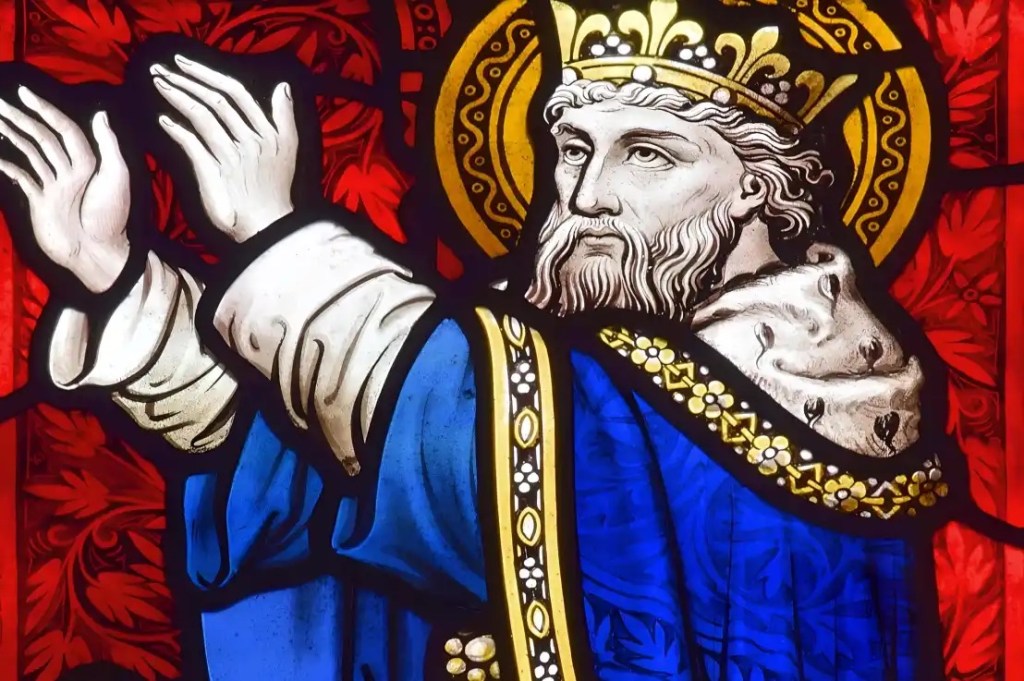
Man, this is serious stuff: heavy, important, serious. The king. With all of his court. With all the elders, and the heads of each of the 12 tribes. And the priests, with the ark of the covenant. All assembled at the place where Solomon, king in all his majesty and power, had arranged for a temple to be built. “Then Solomon stood before the altar of the Lord in the presence of all the assembly of Israel, and spread out his hands to heaven” (1 Ki 8:22), and prays a long prayer of blessing for the new edifice.

Detail from stained glass window,
King Solomon dedicates the Temple, Hardman &Co., 1897;
located in the Roman Catholic Church of English Martyrs
at Streatham, UK

Now, Solomon, I am sure you are thinking, is remembered as the wise one. “The wisdom of Solomon”, we say. Jesus relates how “the Queen of the south [the Queen of Sheba] came from the ends of the earth to hear the wisdom of Solomon” (Matt 12:42). In 2 Chronicles 1, God says to Solomon, “because you have asked for wisdom and knowledge for yourself … wisdom and knowledge are granted to you” (2 Chr 1:11). 

And later, King Solomon is said to have “excelled all the kings of the earth in riches and in wisdom. And all the kings of the earth sought the presence of Solomon to hear his wisdom, which God had put into his mind. Every one of [those kings] brought silver and gold, so much, year by year” (2 Chron 9:22–24).

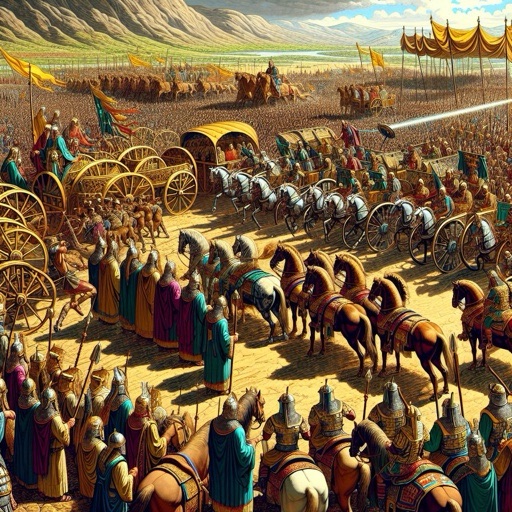
This wonderfully wise, insightful, discerning man, Solomon—bearing a name derived from the Hebrew for peace, “shalom”—became a powerhouse in the ancient world. But he did not always live as a man of peace. indeed, he used his 4,000 horses and chariots and 12,000 horsemen to good effect; we read that “he ruled over all the kings from the Euphrates to the land of the Philistines and to the border of Egypt” (2 Chron 9:26). 

An envisaging of part of Solomon’s army

Solomon was remembered as king over the greatest expanse of land claimed by Israel in all of history. Solomon was a warrior. And warrior-kings were powerful, tyrannical in their exercise of power, ruthless in the way that they disposed of rivals for the throne and enemies on the battlefield alike. Think Alexander the Great. Think Charlemagne. Think Genghis Khan. Think William the Conqueror. Solomon reigned for 40 years—a long, wealthy, successful time. 

Yet in the passage we hear this Sunday Solomon appears not as a powerful king. Rather, he is a humble person of faith. He stands before all the people, raises his arms, and prays to the God who is to be worshipped in the Temple that he had erected. He is a person of faith, in the presence of his God, expressing his faith, exuding his piety.

Now, the prayer of Solomon goes for thirty solid verses; there are eight different sections in this prayer. The lectionary has mercy on us this Sunday; we are offered just two of those sections, eleven of the thirty verses. We have heard the shortened version! In these two sections of this prayer, Solomon identifies two important features of the newly-erected Temple.  The first is that the fundamental reason for erecting this building is to provide a focal point, where people of faith can gather to pray to God (2 Ki 8:23–30).

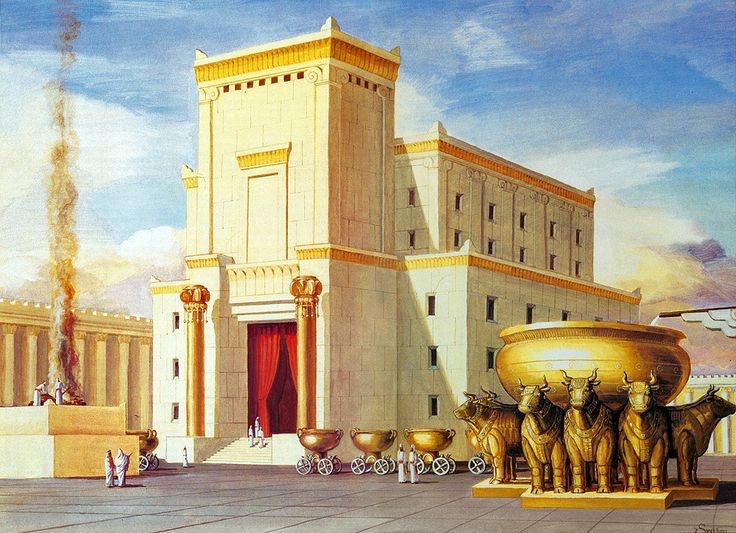
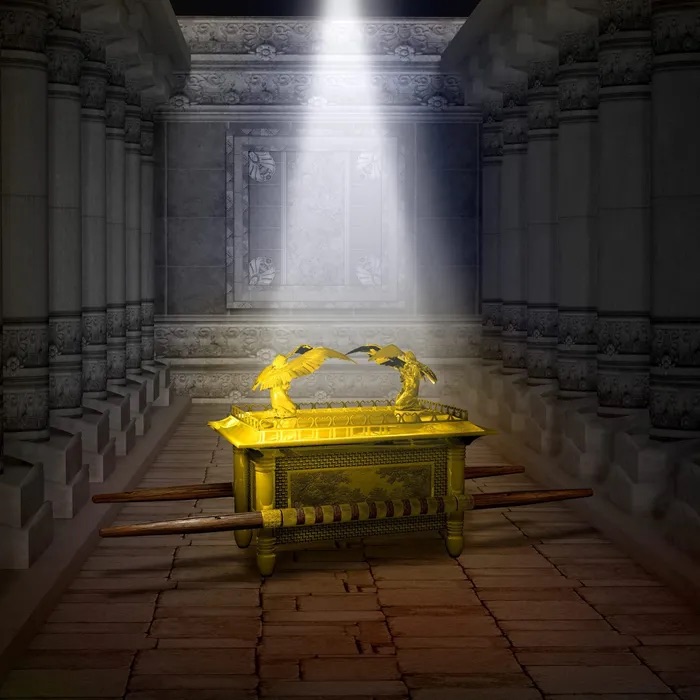
An imagining of Solomon’s Temple

Perhaps we may be used to hearing about the Temple in Jerusalem in fairly negative terms. Jesus cleared the Temple of the money changers and dove sellers who were exploring the people. He predicted the destruction of the Temple during the cataclysmic last days. For centuries, people from all over Israel were required to bring their sacrifices to the priests in the Temple, to offer up the firstborn of their animals and the firstfruits of their harvest. The Temple cult was seen as a harsh, primitive religious duty, imposing hardships on the people. The priests, the elites who ran the Temple, lived well off the benefits of all of these offerings. 

I could offer you a counter argument to each of these criticisms; but today I simply want to note that Solomon, in his prayer of dedication, makes it clear that the fundamental purpose of the Temple was to provide a house of prayer, a place where the people of God could gather, knowing that they were in the presence of God, knowing that the prayers that they offer would be heard by God and would lead to God’s offering of grace, forgiving them for their inadequacies and failures.

The Temple was to be a place of piety for the people. It was to foster the sense of connection with God. It was to deepen the life of faith of the people. It was to strengthen their covenant relationship with the Lord God.

All of which can be said for us, in our own times, about the building that we each come to each Sunday, to worship. The church is a place of piety and devotion for us, the people of God. It helps us to foster the sense of connection with God. It helps us to deepen our lives of faith. It encourages us to strengthen our covenant relationship with the Lord God through the new covenant offered in grace by Jesus. Ideally, that’s what the church is to be.

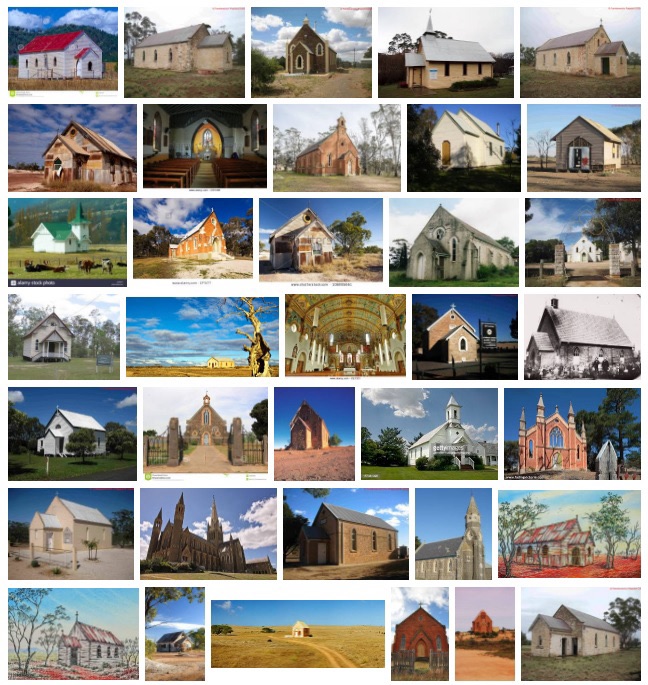
Churches in rural areas across Australia

So we read in the first part of Solomon’s Temple prayer. For the people of ancient Israel, standing in the shadow of this wonderful new building, the prayer might encourage a strong sense of self identity, blessed to be part of the people of God. Of course, it could also develop narrow nationalism, a jingoistic praising of the greatness of Israel, extolling their identity as the chosen nation, the holy people, the elect of God. 

The Temple invited the people of God to meet the God of the people, to pray, to sing, to offer signs of gratitude and bring pleas and petitions—in short, to keep the covenant, to show that they are keeping the covenant, to be satisfied that they are keeping the covenant, as they worship. It had a strong, positive purpose for the people.

But that is not where the prayer ends. The second key element of Solomon’s prayer that the lectionary offers us today (2 Ki 8:41–43) is striking. It also relates to prayer. But it is not the prayer of the people of God, covenant partners with the Lord God. It is about the prayer of “a foreigner, who is not of your people Israel, [who] comes from a distant land because of your name”. This is a striking and dramatic element to include in this dedication prayer before all the people. 

Solomon prays to God, imploring God to “hear in heaven your dwelling place and do according to all for which the foreigner calls to you, in order that all the peoples of the earth may know your name and fear you, as do your people Israel, and that they may know that this house that I have built is called by your name.” 

Now that is an incredible prayer for the King of Israel to pray! It reflects an openness to the world beyond the nation, an engagement with the wider geopolitical and social relatives of the world at that time. Solomon was not an isolationist. He was not inwardly focussed on his nation. He had an outwards orientation. He did not want the Temple simply to foster a holy huddle, shut off from the world. He had other intentions. He wanted the Temple to be a holy place, a place of welcome and invitation, open to people from across the region, from far beyond the territory of Israel—a gathering place for all the peoples.

That was the vision that Solomon set forth for his people. That was not always the way that the Temple actually did function, we know. But that was the foundational vision—articulated by Solomon, remembered by the scribes, included in the narrative account of the kings, placed in a strategic position at the opening and dedication of the Temple. It is a vision which speaks, both to the people of Israel, but also to people of faith today, in the 21st century world.

So I have a whole cluster of questions in my mind, as a result of pondering this aspect of the prayer of Solomon. What happens in our temples? in our churches? How do we foster relationship with God in our prayers in this place? Who do we expect to find in our temples, our places of worship? Who would be most surprising to find in our places of worship?

What prayers might come from those we least expect to come into our places of worship, when they do join with us in worship, to pray? How might we position ourselves, so that “foreigners”, people most unexpected to us, can feel welcomed to come into our church, be at home in our midst, make a connection with God? What do we need to do differently? What do we need to stop doing? What do we need to start doing?

We need to take seriously the claim that when we hear scripture read and expounded, we encounter God speaking to us. “The Word of God on whom salvation depends is to be heard and known from Scripture appropriated in the worshipping and witnessing life of the Church”, the Uniting Church Basis of Union affirms (para 5). That applies not only to Gospels and letters in the book of the new covenant, the New Testament, but also to narratives and psalms and prophetic works in Hebrew Scriptures, attesting to the earlier covenant. God speaks to us, as we hear and appropriate this scripture.

Our best response to this prayer of this discerning man of wisdom, warrior-king Solomon, offered as the Temple is dedicated, could well be for us to live our lives in response to that vision of what a place of worship and a community of worship might be—and shape a place open to all, a people welcoming of all who wish to come and make connection with God.

See also

A smooth transition? or a sequence of cruel calculations? (1 Kings 1–3; Pentecost 13B)

David had many sons—there are 19 who are named in the Bible, and two others unnamed. There are consolidated lists at 2 Sam 3:2–5 (those born at Hebron) and 2 Sam 5:13–15 (those born in Jerusalem). In following the story of 2 Samuel, we have already met Solomon, Absalom, and Amnon. We do not know how many daughters David had, except for Tamar (2 Sam 13:1). After travelling through the various incidents involving David that the lectionary has offered, today we come to the last days of the life of this famous king.

The passage offered by the lectionary this week (1 Ki 2:10–12, 3:3–14) portrays a smooth transition from David to his chosen son, Solomon. The narrator simply reports, “when David’s time to die drew near, he charged his son Solomon”, reporting the words he spoke to him; and then “David slept with his ancestors, and was buried in the city of David” (1 Ki 2:1, 10). 

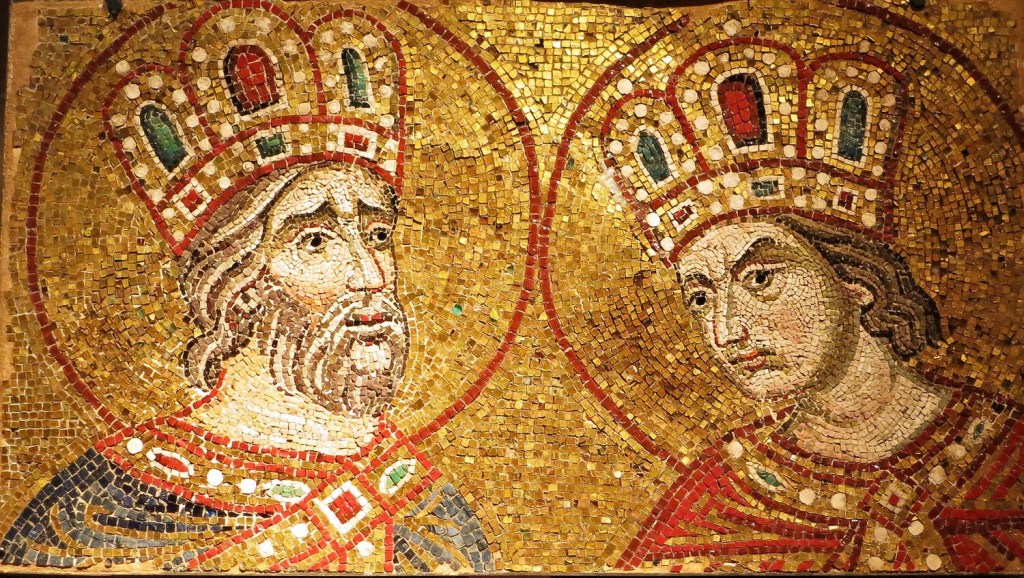
David and Solomon as depicted in a 14th century mosaic in the museum on the second floor of the Basilica di San Marco, Venice

However, the previous chapter tells of the plotting by Adonijah, and the next part of the story reports that David authorised the murders of his son Adonijah, his nephew Joab, and Shimei, a relative of Saul, to ensure that Solomon could reign! It’s a nasty story. (In what follows, I am drawing in part from a sermon preached by my wife, Elizabeth Raine.)

Living in a democracy where leadership is determined by popular vote, this narrative feels particularly unpleasant and unjust to us. Paradoxically, David charges Solomon to adhere to “the statutes, commandments, ordinances, and testimonies” that God has decreed (2:3). Subsequently, Solomon sensibly prays for “an understanding mind to govern your people” (3:9).

In the later rewriting of this long narrative saga, the Chronicler has David instruct his chosen successor, his son, Solomon, “set your mind and heart to seek the Lord your God” (1 Chron 22:19). He reinforces that in a later address, telling Solomon to “know God and serve [the Lord] with single mind and willing heart” (1 Chron 28:9).

The book of Proverbs (attributed by tradition to Solomon) then advocates both attending to the mind (Prov 22:17; 23:12, 19) and “inclining your heart” towards God (Prov 2:2; 3:1–6; 4:4, 20–23; 6:21; 7:3) as integral parts of the life of faith. And of course, much later, Jesus picks this up when he extends the traditional commandment to “love the Lord your God with all your heart, and with all your soul, and with all your might” (Deut 6:5), adding “and with all your mind” (Mark 12:30). 

A fully devoted heart (meaning, an all-of-person commitment) as well as an understanding mind (committed to critical reasoning about faith) is the essence of good leadership. It is a typical Hebraic parallelism that emphasises the importance of a whole-of-life commitment. See more on these terms at

However, it turns out that this is not really how Solomon lived in his life. His rule was littered with events that cast down on his great wisdom, and whether he did actually love God with all of his being.

Solomon was not first in line to ascend the throne; that would lie with the eldest of his brothers still living, Adonijah. Adonijah knows this; the first book of Kings opens with the revelation that, since “David was old and advanced in years … Adonijah son of Haggith exalted himself, saying, ‘I will be king’; he prepared for himself chariots and horsemen, and fifty men to run before him” (1 Ki 1:1,5).

However, Solomon plots with his mother Bathsheba and the palace prophet Nathan to arrange for the assassination of his older brother. In addition, a number of other people also had to be eliminated to establish Solomon’s firm grip on the monarchy, and to ensure there were no other possible legitimate claimants to the throne remaining. Such was the raw and vicious nature of “life at the top” those days. (Hastings anything much changed?)

In fairly quick succession, after Solomon had arranged for the death of his eldest brother Adonijah (2:13–25), he banished the high priest Abiathar who had supported Adonijah (2:26–27) and replaced him with another priest loyal to himself. Next he removed Joab, a cousin who was the commander in the former king’s army (2:28–34). He achieved this via a hit man, Benaniah, who became the general of his army (2:35). 

Then, Solomon had Shimei, who was a relative of Saul, the king before David, killed (2:36–46). In this way all potential contenders for the throne and their powerful supporters were removed, mostly by violent means. As the narrator curtly comments, “so the kingdom was established in the hand of Solomon” (2:46b).

In fact, Solomon meets all the criteria of the sort of king who was described by the prophet Samuel as one who would oppress Israel. Years before, Samuel had warned the people, “This is what the king who will reign over you will claim as his rights: He will take your sons and make them serve with his chariots and horses, and they will run in front of his chariots. Some he will assign to be commanders of thousands and commanders of fifties, and others to plow his ground and reap his harvest, and still others to make weapons of war and equipment for his chariots.” (1 Sam 8:11–12).

More than this, Samuel advised, “He will take your daughters to be perfumers and cooks and bakers. He will take the best of your fields and vineyards and olive groves and give them to his attendants. He will take a tenth of your grain and of your vintage and give it to his officials and attendants. Your male and female servants and the best of your cattle and donkeys he will take for his own use. He will take a tenth of your flocks, and you yourselves will become his slaves.” (1 Sam 8:13–17). 

So Samuel tells the people who were asking for a king, “when that day comes, you will cry out for relief from the king you have chosen, but the Lord will not answer you in that day” (1 Sam 8:18).

In addition to meeting these criteria, Solomon’s weakness for foreign women would lead him to abandon the God of Israel for other foreign gods. “Solomon loved many foreign women along with the daughter of Pharaoh: Moabite, Ammonite, Edomite, Sidonian, and Hittite women, from the nations concerning which the Lord had said to the Israelites, ‘You shall not enter into marriage with them, neither shall they with you; for they will surely incline your heart to follow their gods’; Solomon clung to these in love” (1 Ki 11:1–2). 

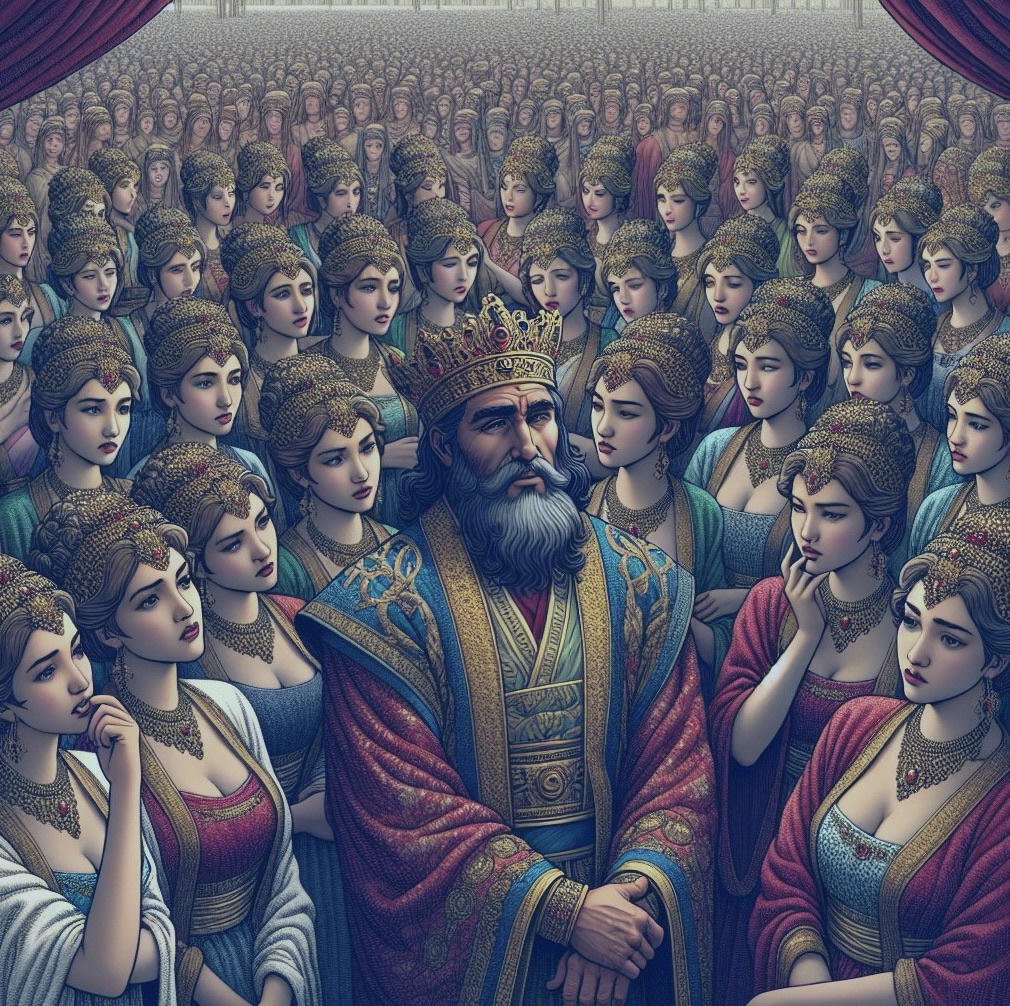
Solomon ignored this command and “clung to these in love; among his wives were seven hundred princesses and three hundred concubines; and his wives turned away his heart—for when Solomon was old, his wives turned away his heart after other gods; and his heart was not true to the Lord his God, as was the heart of his father David” (1 Ki 11:2b-4).

A stylized representation of Solomon and his “seven hundred princesses and three hundred concubines” whom he took to be his wives, who “turned away his heart” (1 Ki 11:3).

Eventually, in the view of the narrator of this long saga, this engagement with foreigners and their religious customs would lead to the breakdown of kingdom and would end in Israel being conquered by Assyria (2 Ki 17:5–12, 20) and then Judah being defeated by Babylon (2 Ki 17:19; 24:18–20). Their exile was precisely because, as the Lord tells Ezekiel, “you are living in the midst of a rebellious house, who have eyes to see but do not see, who have ears to they are a rebellious house; therefore, mortal, prepare for yourself an exile’s baggage, and go into exile by day in their sight; you shall go like an exile from your place to another place in their sight—perhaps they will understand, though they are a rebellious house” (Ezek 12:1–3).

Diana Edelman notes in the Jewish Women’s Archive that “Foreign women were considered a potential source of trouble because they might not always adopt the culture and values of their husbands and their new place of residence. If they chose to continue to practice their native customs and cults, they would pass these on to their children and might also influence their husbands to adopt some non-Israelite practices as well. Loyalty to and identity with Israelite tradition would be threatened.” See https://jwa.org/encyclopedia/article/women-of-solomon-bible

The story of Solomon is actually a bloody and violent narrative of infidelity, oppression, and sin. The path to the throne was a bloody and ruthless one for Solomon. But most often, people remember a heavily sanitised version of Solomon, one of Israel’s most famous kings.

******

How could this great king who had spoken with God go on to worship false gods? How could someone credited with so much wisdom ignore the basic laws of justice that his God required of him? Perhaps we might consider this long history, not so much a glorious account of the people flourishing under wise and good leadership, but rather a tragic story of oppressive leadership, split kingdoms, rivalry, and war, leading to the civil war that swirled around the last days of Solomon and the consequent division of the kingdom, with Israel being ruled by Jeroboam while Rehoboam ruled Judah.

So in considering how Solomon lived, we find a king who ruthlessly removed rivals, taxed his people heavily, and thought nothing of removing thousands of men to be his soldiers and his labourers. He thought nothing of loving many women who brought their foreign customs into the heart of Israel. He thought nothing of using the children of Israel as miners to procure the precious metals to make his gold cups. He thought nothing of taking food off the tables of his people. 

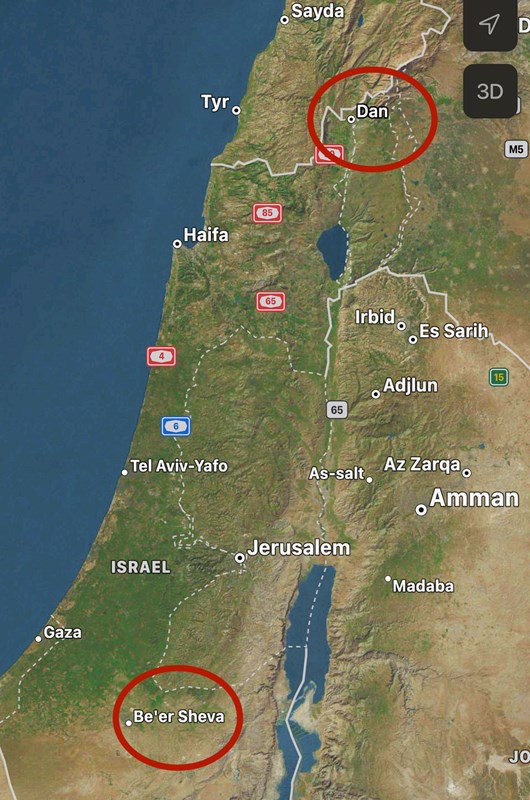
The narrator describes the daily provisions of Solomon in some detail: “thirty cors of the finest flour and sixty cors of meal, ten head of stall-fed cattle, twenty of pasture-fed cattle and a hundred sheep and goats, as well as deer, gazelles, roebucks and choice fowl” (1 Ki 4:23–24) and then claims that “during Solomon’s lifetime Judah and Israel, from Dan to Beersheba, lived in safety, everyone under their own vine and under their own fig tree” (4:25).

However, we know from Samuel’s earlier predictions that this is ‘spin’. How could such immense provisions and vast wealth be found in the ancient near east unless it was taken from the people? How would the families of those men who were taken for Solomon’s service fare, left to struggle on small land holdings without men to work the land?

While we might remember the wisdom and splendour of King Solomon’s rule to this day and admire it, we need to remember that there is another side to this story, that isn’t just or pretty or admirable. Solomon’s wisdom and rule was the wisdom and rule of the world. Solomon used his influence and power to acquire personal wealth and prestige. He thought nothing of splitting families, leaving women and children to struggle, and taking precious food resources for his own use. The mineral wealth of the land remained firmly under his control and he used it to decorate his vast palace – built at no expense by Hebrew men conscripted into what was essentially slavery. His immense army ensured he remained in power.

Who does this put you in mind of today? The Conversation has a page entitled “Articles on Dictatorship” which contains 81 articles—on Bangladesh, Venezuela, North Korea, Russia, Brazil, Argentina, Cambodia, Belarus, Saudi Arabia, China, Rwanda, Nicaragua, the Philippines, and more. Surely this is not the model of leadership that God desires? See https://theconversation.com/au/topics/dictatorship-1918

Writing in With Love to the World, Matthew Wilson reflects on this story. “Often our sense of justice is based more on retribution than on reconciliation. Mandatory sentencing, drug posession laws, racial profiling, and continuing failures in domestic violence and other abuse cases leave us wondering where justice really lies.” 

He notes an anecdote of his father, “He who has the deepest pockets wins”, and comments that, whilst God has a quite different sense of justice, sadly, “the God who forgives, who shows grace and mercy is, nevertheless, rather absent in today’s reading. Solomon will go on to be gifted with, and praised for, his wisdom. Here, political wisdom and the grace of a forgiving God seem a long way apart. In the love of Christ and the power of the Spirit, have we the strength to be different, to be Christ-like?”

*****

Some material in this blog was included in THE WAY OF WISDOM by Elizabeth Raine and John Squires (self-published 2012)

With Love to the World is a daily Bible reading resource, written and produced within the Uniting Church in Australia, following the Revised Common Lectionary. It offers Sunday worshippers the opportunity to prepare for hearing passages of scripture in the week leading to that day of worship. It seeks to foster “an informed faith” amongst the people of God.

You can subscribe on your phone or iPad via an App, for a subscription of $28 per year. Search for With Love to the World on the App Store, or UCA—With Love to the World on Google Play. For the hard copy resource, for just $28 for a year’s subscription, email Trevor at wlwuca@bigpond.com or phone +61 (2) 9747-1369.

King David and the Ark of the Covenant (2 Sam 6; Pentecost 8B)

For the passage from Hebrew Scripture this coming Sunday, the lectionary offers us selected verses from 2 Sam 6:1–19. Last week, we heard the brief account of how David, the king of Judah, took the city of Jerusalem from its inhabitants, the Jebusites, and was anointed as king of “all Israel” (5:1–10). Next week, we will hear of the promise that God makes to David, that “I will make for you a great name … your throne shall be established forever” (7:1–14).

In between these two pivotal events, establishing beyond doubt that David was both the conqueror supreme of the earlier inhabitants and the progenitor of a dynasty—“the house of David”—that would hold power for centuries to come, we have a curious, yet significant, account relating to The Ark of the Covenant (6:1–19). David uses the Ark to reinforce and undergird his authority; his intention in bringing into the city, Jerusalem, was to confirm absolutely that he was God’s anointed, in Jerusalem, ruling over all Israel.

The Ark of the Covenant had long been a focal point for people in Israel. It had travelled with them from the wilderness days (Num 10:33–36), being carried along the way by the Levites (Deut 10:8). In the book of Deuteronomy, it is important because it contained “the book of the law” which Moses had written, and which was to be read to the people of Israel every seven years (Deut 31:9–13; se also Exod 40:20).

Another perspective is offered in the priestly prescriptions relating to the complex system of sacrifices and offerings that was overseen by the priests, that are reported in excruciating detail in Exodus 25—30 and then again in Leviticus 1—7. Here, the significance of the Ark is primarily that it contained the Mercy Seat (Exod 25:17–22). It was the smearing of blood on the Mercy Seat, performed once a year by the High Priest on the Day of Atonement, that secured the forgiveness of all the sins of the people from the past year (Lev 16:1–34; see esp. vv.14–15).

The narrative of Numbers draws these two strands together, when it reports that “when Moses went into the tent of meeting to speak with the Lord, he would hear the voice speaking to him from above the mercy seat that was on the ark of the covenant from between the two cherubim; thus it spoke to him” (Num 7:89). So the significance of the Mercy Seat in the Ark of the Covenant is high.

Regardless of the significance invested in the Ark, its presence with the people during the 40 years in the wilderness was important. It appears at the end of that period of time, when Joshua prepares to lead the people into the land of Canaan. On the command of Joshua, “while all Israel were crossing over on dry ground, the priests who bore the ark of the covenant of the Lord stood on dry ground in the middle of the Jordan, until the entire nation finished crossing over the Jordan” (Josh 3:17). The miraculous power of the Ark is thus demonstrated.

What would it have looked like if there
was photography at the time???

It is referred to only once in the whole of Judges, in the closing scenes, after the abomination perpetrated by the Benjaminites in Gibeah (Judg 19). The Israelites had “inquired of the Lord (for the ark of the covenant of God was there in those days)”, and received the voice of God from the ark, “go up, for tomorrow I will give them into your hand” (Judg 20:27).

Soon after, in the very first battle with the Philistines in 1 Samuel, the Ark was captured. It had been in “the temple of the Lord” at Shiloh when Eli was priest (1 Sam 1:20, 24-28; 3:2–3), but after losing their encounter with the Philistines at Aphek, the Israelites decided to bring the Ark from Shiloh to the battlefield to reverse the result (4:1–4). The presence of the Ark, at first discomforting to the Philistines, was not able to turn the tide; “Israel was defeated, and they fled, … there was a very great slaughter, for there fell of Israel thirty thousand foot soldiers; the ark of God was captured” (4:10–11).

The Ark was sent first to Ashdod (5:1), then to Enron (5:10), before it was returned to Israel seven months later (6:1–16). They had placed inside the Ark “five gold tumours and five gold mice, according to the number of the lords of the Philistines” (6:4–5), “one for Ashdod, one for Gaza, one for Ashkelon, one for Gath, one for Ekron” (6:17). These images served as a guilt offering to the Lord God, in the hope that they would be “healed and ransomed” (6:3).

But the people of Beth-shemesh shied away from having this potent artefact in their village; after all, it has killed seventy descendants of Jeconiah who “did not rejoice with the people of Beth-shemesh when they greeted the ark of the Lord” (6:17). So it was sent on to Kiriath-jearim, where it remained without incident for 20 years (7:1–2).

The Ark then fades from the story during those years, as the narrative turns to the question of kingship (1 Sam 8—10) and Saul is eventually anointed as King (10:1). It remains absent from the accounts of Saul’s battles (1 Sam 11—14) until, out of the blue, Saul calls for the Ark to be brought to Gibeah, in the hill country of Ephraim, where he had made his base (1 Sam 14:16–18), and the particular battle being waged against the Philistines was won (14:23). Presumably it continues its travels with Saul; the next time it is mentioned is in the story we read this week in 2 Sam 6.

David bringing the Ark into Jerusalem: reproduction of a page
in an illuminated manuscript held by the J. Paul Getty Museum.

In this week’s story, David effects a change in the role played by the Ark. It is brought into Jerusalem and stays grounded there; in due course, a permanent temple will be built on the site under Solomon. When David is forced to flee the city (2 Sam 15:13–18), he takes the Ark with him to the edge of the wilderness (15:23–24), but then orders it to be sent back into the city (15:25–29). The Ark will remain as a symbol of his rule over the city and, indeed, the whole nation.

Writing in With Love to the World, Michael Brown reflects on the militaristic colonizing of King David, as he consolidates and reinforces his dominance. He observes that “David, the just-minted king of an expanded territory was starting something big and new. His royal city, permanent army, and large harem pointed to a very different reign. Yet those who prized the traditions might have queried whether this reign had legitimacy.”

This is where the Ark comes into play. Brown continues, observing that it was now “perfect timing for the ark, languishing in the back blocks but traditionally identified closely with God’s presence, to be brought by David to the new royal city as a symbol of God’s blessing.”

The Ark once again does not feature in the story told in the ensuing chapters, until after David has died (1 Ki 2:10). Once he is king, Solomon “came to Jerusalem where he stood before the ark of the covenant of the Lord; he offered up burnt offerings and offerings of well-being, and provided a feast for all his servants” (1 Ki 3:15). The Ark was due to be superseded by the Temple, in whose inner courtyard the Ark would be placed (1 Ki 6:19).

And so, at the dedication of the Temple, “the priests brought the ark of the covenant of the Lord to its place, in the inner sanctuary of the house, in the most holy place, underneath the wings of the cherubim” (1 Ki 8:6, 21). The narrator declares that “there was nothing in the ark except the two tablets of stone that Moses had placed there at Horeb, where the Lord made a covenant with the Israelites, when they came out of the land of Egypt” (1 Ki 8:9).

Transporting the Ark of the Covenant, gilded brass relief,
Cathedral of Sainte-Marie, Auch, France.

We hear nothing more of the Ark until centuries later when Jeremiah, in exile, reports the words of the Lord: “when you have multiplied and increased in the land, in those days, they shall no longer say, “The ark of the covenant of the Lord.” It shall not come to mind, or be remembered, or missed; nor shall another one be made.” (Jer 3:16). According to an even later report, Jeremiah himself had taken “the tent and the ark and the altar of incense” and his them in a cave on “the mountain where Moses had gone up and had seen the inheritance of God” (2 Macc 2:1–5, referring to Mount Sinai of Exod 19:16–25; 24:15–18).

Cue the movie featuring Indiana Jones and the raiders of the lost ark … … …

A critical issue for us, from the story of the Ark and how it was used in ancient Israel, is the interplay between political and religious leadership that is portrayed in the Hebrew Bible narratives.What might tgat mean for people of faith today, as we reflect on and live out our faith in the public life of society?

Throughout all ancient societies, religion was very closely linked to the political situation of the particular society. In the years leading up to the story that we hear this coming Sunday, the people of Israel had been engaged in one war after another. Even when the Israelites were settled in the land, they did not have control of the whole of the land of Israel. Only after he has won victory in a number of battles, could David claim to be king of Israel. The story we hear this Sunday was when the whole land had, at last, been placed under his control.

To celebrate, he declares that Jerusalem is to be the capital city, and to commemorate this event, the Ark is brought into the new capital city. From this point onwards, not only is Jerusalem the political capital of Israel, but it is also the place where God dwells, where God is to be found.

David knows that the ruling monarch must be seen to be favoured by God. What better way than to make his chosen capital the centre of the religion of Israel? Any disgruntled Jews from the northern kingdom cannot attack David’s city without seeming to attack God, so David has astutely consolidated his grip on the monarchical power.

In one way, it makes sense to link religious celebration with political victory. This is a natural connection that people have often made throughout history – thanking the god who they worship when a significant military victory is won.

But it is also a dangerous practice. It can lead to political leaders making claims about God being on their side and not on the other side. It can lead to arrogant actions. It can lead to a distortion of religion, when it is pressed into the service of the state. The kings of ancient Israel are not immune to these charges; from Samuel onwards, prophet after prophet had made it very clear that kings frequently put self and power before their obedience to God.

In today’s world there are many instances of corrupt governments and abuse of power, where human rights are ignored and God’s name is abused. Russia, China, Iran, Iraq, Afghanistan, various Middle Eastern countries, Myanmar and some other Asian nations, and quite a number of sub-Saharan African countries come to mind. And even democracies, heading by the United States of America, display indications of the abuse of power and the presence of corruption. The problem is endemic.

As people of faith, we need to be on our guard against the temptation to use our faith to claim superiority or act unethically. Rather, our faith should guide us to act in ways that influence for good the politics of the society in which we live. Only then can we expect the church to inspire and transform the society around us. Only then can we truly be called people of God.

See also

With Love to the World is a daily Bible reading resource, written and produced within the Uniting Church in Australia, following the Revised Common Lectionary. It offers Sunday worshippers the opportunity to prepare for hearing passages of scripture in the week leading to that day of worship. It seeks to foster “an informed faith” amongst the people of God.

You can subscribe on your phone or iPad via an App, for a subscription of $28 per year. Search for With Love to the World on the App Store, or UCA—With Love to the World on Google Play. For the hard copy resource, for just $28 for a year’s subscription, email Trevor at wlwuca@bigpond.com or phone +61 (2) 9747-1369.

Israel, the West Bank, and Hamas: a prayer for peace, and a yearning for justice

I am watching the events in Israel with deep sadness and high apprehension. The simmering hotspot of the Middle East has erupted, yet again, in a vicious and worrying way.

I am not a political expert, although I have watched the sequence of events in that region for decades, reading a lot at different times about what has been going on. I don’t really have any connection with Palestinians, but have had quite a lot to do with Jews in Australia over the decades of my ministry, from local contacts with rabbis in neighbouring synagogues through to membership of my church’s national dialogue group with the Jewish People.

I have also been a member of working groups that prepared resources for the national Assembly to consider as they reflected on the relationship that the Uniting Church has with Jewish people, including a paper presented to the 1997 Assembly and then further work which resulted in the Statement on Jews and Judaism which the 2009 Assembly adopted.

That 2009 Statement included an affirmation “that the State of Israel and a Palestinian State each have the right to live side by side in peace and security” (#15), and an encouragement to the members and councils of the UC “to pray and work for a just and lasting peace for both Israelis and Palestinians” (#24). Both of these clauses hold good in the current situation.

See https://ucaassembly.recollect.net.au/nodes/view/374?keywords=Jews%20judaism&highlights=eyIwIjoiamV3cyIsIjEiOiJqdWRhaXNtOiIsIjMiOiJqdWRhaXNtOyIsIjUiOiJqdWRhaXNtLCIsIjciOiJqdWRpYWlzbSIsIjkiOiJqdWRhaXNtIiwiMTIiOiJqZXdzLiIsIjEzIjoiamV3LCIsIjE5IjoiKGp1ZGFpc20ifQ==&lsk=ff2123f0fd56a80e39107599b0b2fbb7

Just over a decade ago, the then Assembly President, the Rev. Alistair Macrae, launched a set of resources, Prayer for Peace, which provided practical and prayerful ways of working for peace in the Middel East. He said, “The pursuit of peace is at the core of what it means to be a disciple of Jesus Christ. We echo his words when we share the greeting ‘peace be with you’ with members of our worshipping congregations each week. Jesus expresses the centrality of peacemaking in the Beatitudes; he preaches that peacemakers will be the children of God (Matt 5:9).”

The President continued, “Our commitment to being peacemakers takes us down many paths to peace. It’s our responsibility and imperative to explore all options that could bring about peace in our hearts, our homes, our communities and in our world.”

See https://ucaassembly.recollect.net.au/nodes/view/216?keywords=Prayer%20for%20peace&type=all&highlights=eyIwIjoicGVhY2UuIiwiMSI6InByYXllci4iLCIyIjoicHJheWVyIiwiMyI6InBlYWNlIiwiNCI6InByYXllcnMiLCIxMyI6InBlYWNlLCIsIjE3IjoicHJheSJ9&lsk=afa2a1ce65cd901b7aa99df5ad6a35ec

I think that many of the suggestions in this resource also hold good today, including the Prayer For Peace In Palestine which was provided by a National Working Group set up at that time:

“God of peace, we pray for peace in Palestine, the land where the Prince of Peace walked long ago; Let there be an end to the cycle of violence and vengeance that has prevailed there for so long; Let there be an end to the frequent killing and maiming of people, victims of hate and prejudice; Let there be an end to all political agendas that justify and prolong the conflict. God of peace, hear our prayer.

“Bring justice for all the people of Palestine regardless of race, culture or religion; Sustain the courage and determination of all those who work for peace and keep them strong in the face of threats and persecution; Establish such mutual respect and harmony between Christians and Muslims that they will live and work together for the sake of all. God of peace, hear our prayer.

“Keep our own hearts and minds free from fear and prejudice; Help us to be instruments of your peace where we are. God of peace, hear our prayer.

That is one thing that we can do, at this time: pray for peace.

There’s another dimension to the current situation that I think bears some consideration. That is the reality of the current political situation, that the lands in the region currently claimed as the modern state of Israel are contested lands, with both Palestinians and Jews laying claim to that area as their ancient ancestral lands.

Whilst there is contention about these claims, there is one matter that I believe merits thoughtful consideration. The claim made by the hard-line right in Israel—reflected in the boundaries of the current state of Israel, including the occupied territories of the West Bank, Gaza, and the Golan Heights—rests on certain biblical texts which, with an ideologically-based orientation, indicate that “God gave this land to the people of Israel”.

In particular, the large extent of land in view under this claim rests on the biblical description of the territory ruled under Solomon, the much-venerated and highly-valorised king of the United Kingdom of Israel around three millennia ago, in a number of texts in the so-called historical narratives of Hebrew Scripture. Whilst those books might look in many ways like historical narratives, we should take care not to assume that contemporary understandings of history can be easily applied to those passages from antiquity.

The land that the biblical texts claim was ruled by King Solomon,
from Egypt to the Euphrates

In considering these texts, we should begin by noting that the way that Solomon is presented in the Hebrew Scriptures can only be characterised by the term “hyperbolic exaggeration”. It is not an authentic historical depiction of the man; it is a hagiography. Indeed, the actual existence of Solomon in historical reality (in contrast to being a literary character in the Bible) is highly questionable. Israel Finkelstein and Neil Asher Silberman, writing in The Bible Unearthed: Archaeology’s New Vision of Ancient Israel and the Origin of Its Sacred Texts (Simon and Schuster, 2001), claim that “The glorious epic of the united monarchy was — like the stories of the patriarchs and the sagas of the Exodus and conquest — a brilliant composition that wove together ancient heroic tales and legends into a coherent and persuasive prophecy for the people of Israel in the seventh century BCE.” 

See https://www.thenotsoinnocentsabroad.com/blog/did-king-david-and-king-solomon-really-exist

In the story told in the biblical text, King Solomon was said to have “excelled all the kings of the earth in riches and in wisdom. And all the kings of the earth sought the presence of Solomon to hear his wisdom, which God had put into his mind. Every one of [those kings] brought silver and gold, so much, year by year.” (2 Chron 9:22–24). That’s quite a claim!

This wonderfully wise, insightful, discerning man, Solomon—bearing a name derived from the Hebrew for peace, “shalom”—became a powerhouse in the ancient world, we are told. But he did not always live as a “man of peace”. Indeed, the narrative indicates that he used his 4,000 horses and chariots and 12,000 horsemen to good effect; we read that “he ruled over all the kings from the Euphrates to the land of the Philistines and to the border of Egypt.” (2 Chron 9:26; also 1 Ki 4:21). This was the extent of land that had been promised to Abraham (Gen 15:18), and it was more than any other ruler of Israel, before or after him.

So Solomon was remembered as king over the greatest expanse of land claimed by Israel in all of history. Solomon was a warrior. And warrior-kings were powerful, tyrannical in their exercise of power, ruthless in the way that they disposed of rivals for the throne and enemies on the battlefield alike. Think Alexander the Great. Think Charlemagne. Think Genghis Khan. Think William the Conqueror. This is an integral part of the heritage that the story of Solomon bequeathed to Israel: the memory of an aggressive, dominating ruler, lording it over the region. Even though the modern state of Israel doesn’t have a king, this is an image that is being acted out today, in the politics of the region.

Solomon reigned for 40 years—a long, wealthy, successful time—although “forty years” in the biblical narrative should not be understood to be a precise time, but more a statement that this was “a long, extended time”. Solomon exemplifies the model of kingship which survives through into the modern era. We expect kings to rule. We expect them to invade and enforce and dominate, for that is the heritage passed on. (And I won’t comment on Solomon’s marital relationships; I will leave 1 Kings 11:3 to speak for itself!)

This exaggerated, idealised view of things is evident in so many ways in the portrayal of Solomon, who was seen to be filled with “wisdom and knowledge”, and granted “riches, possessions, and honour, such as none of the kings had who were before you, and none after you shall have the like” (2 Chron 1:7–12, especially verses 10 and 12).

It is also worth noting that the large reach of land that Solomon ruled over, even more extensive than the oft-cited phrase “from Dan to Beersheba” (Judg 20:1; 1 Sam 3:20; 2 Sam 3:10; 17:11; 24:2, 15; 1 Ki 4:25; 1 Chron 21:2; 2 Chron 30:5), did not continue past his death. The hagiographical exaggeration of territory under Solomon is not noted in the period after his death. The narrative books that recount the stories of the kingdoms of Israel, in the north, and Judah, in the south, in the centuries after Solomon, indicate that the scope of those kingdoms was more constrained.

In the light of this, I don’t think it is responsible to lay claim to the whole, extended territory of the land, from the biblical passages noted, as the scope for the modern state of Israel which was created in 1948. I therefore have sympathy for Palestinians who have lived on the land for thousands of years prior to 1948, as they understand this to be their ancestral land.

I also have sympathy for Jews, both those living in the land of Israel today, as well as those living in diaspora, for whom the land of Israel has a powerful symbolic significance—especially since the Shoah of 1933—1945 and the terrible genocide perpetrated by the Nazis against Jews in so many countries during that period. Granting them land in the area where their ancestors long ago had lived, a homeland that gives them security in the modern world, is important and necessary.

That said, I don’t agree that Palestinians should take matters into their own hands to seek vengeance against people in Israel in the way that they have done, once again, in recent days. In the same manner, nor do I think that the Israeli forces should respond in the aggressive and violent manner that they have done, once again, in recent days. Too many people are dying and being injured, making any possible progress towards peace with justice even more difficult each day.

We need to seek once more the peace of these peoples. And we need to find that peace on the basis of justice. Neither terrorist attacks nor military crackdowns will achieve this. They will simply exacerbate a dangerous situation.

“Depart from evil, and do good; seek peace, and pursue it.” (Psalm 34:14). “Blessed are the peacemakers, for they will be called children of God.” (Matt 5:9). “Justice, and only justice, you shall pursue, so that you may live and occupy the land that the Lord your God is giving you.” (Deut 16:20). “… the weightier matters of the law: justice and mercy and faith. It is these you ought to have practiced …” (Mat 23:23).