This coming Sunday and the following Sunday, the lectionary suggests that we read and hear a well-known section of Paul’s letter to the believers in Corinth. In this chapter (1 Cor 12:1–31), Paul addresses the nature of the community that has been formed by those who formerly were “pagans … led astray to idols” (12:2) and have now have come to believe that “Jesus is Lord” (v.3) and desire to follow his way in their lives through offering their gifts in service (vv.4–7).
What follows in this chapter—and in the subsequent ones that the lectionary proposes on the Sundays ahead—provides a good basis for considering fundamental matters of faith and discipleship throughout the season of Epiphany. It is, after all, a season focussed on revelation; and Paul’s words are quite revealing!
Actually, they are not just Paul’s words (although that is how we usually refer to them). Paul collaborated in the writing of many of his letters—of the seven agreed authentic letters, only two are written by Paul alone. The others are written in association with Timothy (2 Cor, Phil, 1 Thess and Phlm), Silvanus (1 Thess), and Sosthenes (1 Cor). So it is words from this last letter, co-written with Sosthenes, that the creators of the lectionary are offering us during the season of Epiphany.
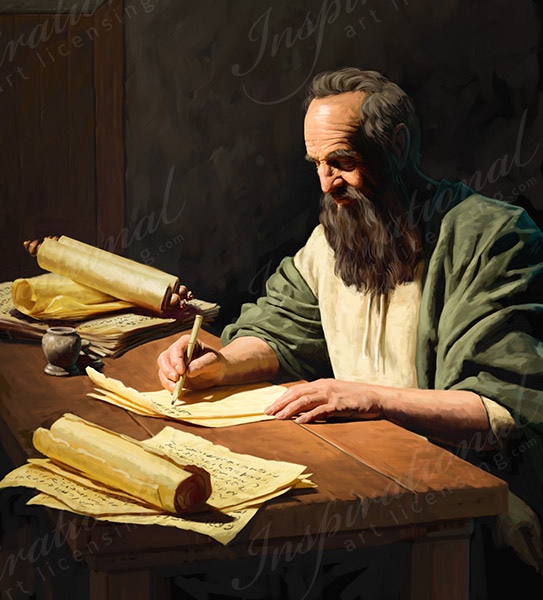
A depiction of Paul and Sosthenes
In opening this letter, Sosthenes and Paul tell the Corinthians that they write to “give thanks” (1:4) and also to “appeal to you” (1:10); and later, to “admonish you as my beloved children” (4:14). The constructive approach that they bring is made clear in the opening prayer of thanksgiving (1:4–9). Writing in chapter four, the author (here, presumably Paul) exhorts the Corinthians: “I appeal to you, then, be imitators of me” (1 Cor 4:16; see also 1 Thess 1:6). The letter contains many points of appeal, exhortation, encouragement—and also challenge, correction, and criticism!
This coming Sunday we focus on verses 1–11 of chapter 12. This is an instance of exhortation and encouragement (in the later part of the chapter, which we read and hear on the following Sunday, challenge and correction will occur). In these verses, Paul considers the diversity of expressions of faith that can be found in the faith community in Corinth—as, indeed, there are in many other communities of faith. He notes the diversity of gifts, the various ways of providing service, and the range of activities undertaken by “those who are sanctified in Christ Jesus, called to be saints” (1 Cor 1:2).
Each gift, service, or activity, however, has a common origin. It is “the same Spirit” who grants the diversity of gifts evident in the community (12:4), “the same Lord” who is the motivator for the array of offering service by those believers (v.5), and “the same God” who activates all of the activities that is evident in Corinth (v.6).
It is worth noting that an alternative way to translate this might be “the same God who energizes all of the expressions of energy”. The Greek words being translated as “activate” and “activities” relate to the central idea of energy; indeed, the foundational word is ἐνεργήμα, which when transliterated letter-for-letter results in “energēma”, from which we get the English word “energy”. So the Spirit is presented as an active, dynamic force, which is at work in a lively, tireless, and vital fashion.
In this passage, Paul places a particular emphasis on the unity that is—or at least, should be—a key feature of the group of people who are joined together by the common affirmation, “Jesus is Lord” (v.3). He affirms that the gifts, acts of service, and activities expressed by those people “are activated by one and the same Spirit” (v.11a). It is that Spirit who “allots to each one individually just as the Spirit chooses” (v.11b).
The irony, however, is that in the eleven chapters preceding this passage, there have been multiple signs of the many ways in which disagreement, conflict, division, and factionalism mark the community of believers in Corinth. There have been ethical breaches, instances of sexual misbehaviour, diverse views regarding marriage and related issues, and mistreatment of fellow members of the community who are seen as “weak” by some who perhaps regard themselves as “strong”. Has the Spirit be so energizing that the disruptions caused by the Spirit’s activity have promulgated all of these problems?
Further, the critical issues which Paul addresses in the chapters immediately following, in the later part of the letter (1 Cor 12–14), arise out of the highly spontaneous, seemingly chaotic situation that characterised worship in Corinth. How the Spirit was active—energizing—those who worship in this gathering! It was anything but a reverent gathering of people unified by their faith; it was a chaotic frenzy of activity and words, if Paul’s severe wording is to be believed.
Such worship had more the nature of a dialogue between conversation partners, rather than a monologue delivered by one person to a group of silent listeners. We can see this in a simple way, with the references to “interpreters” in what Paul writes to the Corinthians. Whilst there are people who contribute words of prophecy, pray in tongues, or speak in tongues (1 Cor 14), in each case there is the need for someone to interpret these phenomena. It seems that many things were happening simultaneously, creating a frenzied cacophony during worship. If we see the energizing of the Spirit as a disruptive force, then much disruption has occurred!
For my reflections on the disruptive work of the Spirit in Corinth, see
So in 1 Cor 12, Paul adapts an image which was extensively used in political discussions about the city state (“the body is one and has many members”, 12:12) as well as what may be a reference to a developing baptismal liturgy within the early church (“we were all baptised into one body”, 12:13) and a very early creedal statement (“Jesus is Lord”, 12:3).
The work of the Spirit was supposed to provide a range of gifts for the mutual benefit of all involved in the community. Paul provides a list of just such gifts in verses 8–10. He notes wisdom, knowledge, faith, healing, miracles, prophecy, discernment, tongues, and interpretation of tongues. This should not be taken as an exhaustive list; in other places, Paul refers to other gifts, such as teaching, exhorting, giving,leading, and offering compassion (Rom 12:7–8), as well as power and assistance later in this chapter (1 Cor 12:28).
He also identifies some offices exercised by people alongside gifts already noted, as he concludes this same discussion of gifts: “Are all apostles? Are all prophets? Are all teachers? Do all work miracles? Do all possess gifts of healing? Do all speak in tongues? Do all interpret?” (1 Cor 12:29–30). Similar offices are noted in a later letter written in the name of Paul: “apostles … prophets … evangelists … pastors … teachers”, all,of which are said to be “to equip the saints for the work of ministry” (Eph 4:11–12).
Nor should this list of 1 Cor 12:8–10 be regarded as a prioritising of such gifts by the order in which they are listed. In fact, the concluding comment of v.11 specifically places all of the gifts noted on the same level, each equally “activated by the one and the same Spirit” and “allocated … just as the Spirit chooses”. We should affirm that today; all gifts for service come from the same source.
As we continue in Advent, the Narrative Lectionary is continuing the sequence of passages from the prophets in ancient Israel. This coming Sunday, just four verses from the book of Joel are proposed (Joel 2:12–13, 28–29). The reason for these verses will become evident in my commentary that follows. But I think that the best approach is to begin with a consideration of the book as a whole; this gives the context (as best as we can determine) for those particular verses.
Joel speaks words of lament and calls for repentance amongst the people of Judah. Nothing in this book provides any clues as to the time when Joel was active. The identification of the prophet as “son of Pethuel” (Joel 1:1) gives no clue, as Pethuel appears nowhere else in the Hebrew Scriptures—indeed, the name Joel, itself appears nowhere else. The name appears to combine the divine names of Jah and El, suggesting that it may be a symbolic creation. Was Joel an historical person? or not?
Joel calls on the “ministers of God” to “put on sackcloth and lament” (1:13); this reminds us of the response of the pagans in Nineveh (Jonah 3), whilst his remonstrations that “the day of the Lord is near” (1:15) echoes the motif of “the day” already sounded by other prophets (Amos 5:18–20; Isa 2:12, 17; 13:6–8; 34:8; Zeph 1:7, 14–15; Jer 35:32–33; 46:10).
This day forms the centrepiece of Joel’s undated prophecies, as he describes that day as “a day of darkness and gloom, a day of clouds and thick darkness!” (Joel 2:2), when “the earth quakes before them, the heavens tremble, the sun and the moon are darkened, and the stars withdraw their shining” (2:10). He describes the response of the people “in anguish, all faces grow pale” (2:6).
However, Joel adheres to the constant thread running through Hebrew Scriptures, that the Lord is “gracious and merciful, slow to anger, and abounding in steadfast love, and relents from punishing” (2:13). Because of this, he yearns for the people to “turn with all your heart, with fasting, with weeping, and with mourning” (2:12), sensing that there might be hope of restitution for the people. (These two verses form the start of the excerpt proposed for this Sunday by the Narrative Lectionary.)
Joel calls for the people to gather (2:15–16); the oracle that follows paints a picture of abundance and blessing (2:18–27), affirming that “my people shall never again be put to shame” (2:27).
The prophet then speaks words which have been given a central place in the later story of the Christian church, when he foreshadows that the blessings of God will be manifest through the outpouring of the spirit: “your sons and your daughters shall prophesy, your old men shall dream dreams, and your young men shall see visions; even on the male and female slaves, in those days, I will pour out my spirit” (2:28–29).
The promise that is set forth here is specifically for “all flesh”; this universal vision informs the whole outward impulse of the movement of followers of Jesus, after the day of Pentecost, which Peter interprets as being a fulfilment of this prophecy (Acts 2:14–21). And that most likely explains why these two verses (2:28–29) form the concluding section of the passage proposed by the Narrative Lectionary.
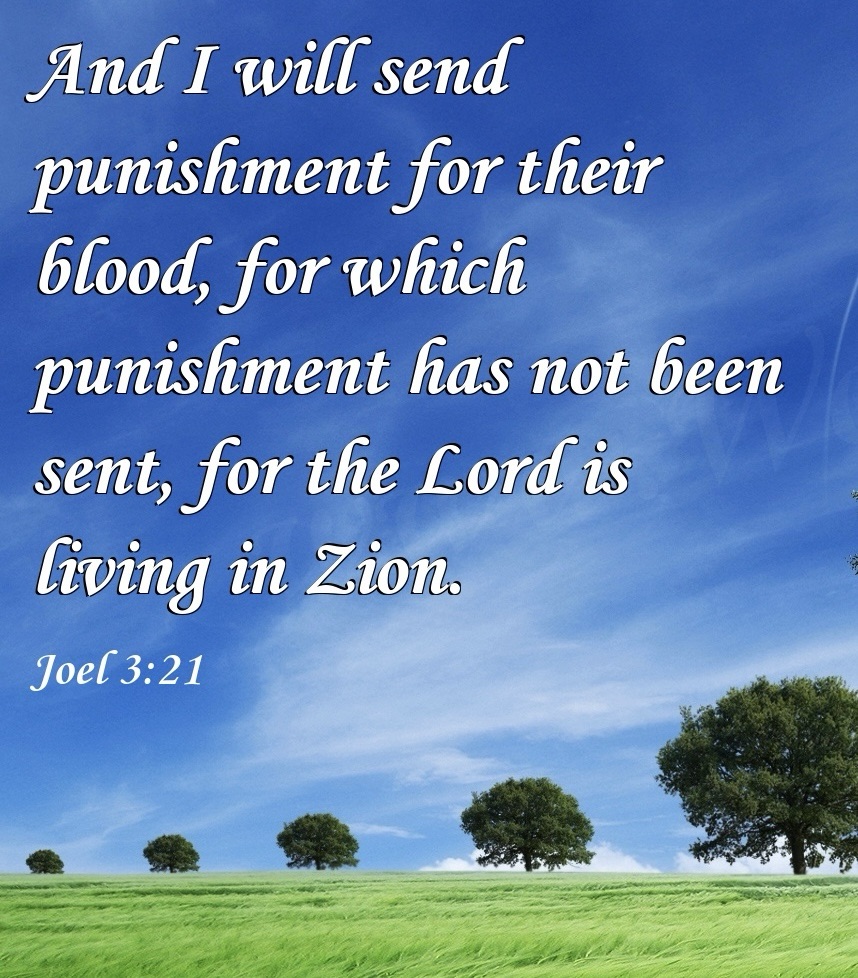
The day of the Lord that is then envisaged (2:31) will signal a significant reversal for Israel. The Lord laughs at other nations (3:1–8), a reversal that pivots on a turn from despair to hope, from the threats of judgement to a glorious future (3:9–21). Joel repeats the irenic vision of swords being beaten into ploughshares (3:10; see Isa 2:4; Mic 4:3); he sees a ripe harvest (3:13), the land will drip with sweet wine, and there will be milk and water in abundance (3:18). The voice of the Lord “roars from Zion, and utters his voice from Jerusalem, and the heavens and the earth shake” (3:16; cf the similar pronouncement of Amos at Am 1:2; 3:8).
The last word of this book, “the Lord dwells on Zion” (3:21), provides assurance and certainty for the future. These words of hope promises a peaceful future for the nation. When Joel might have been speaking these words cannot be definitively determined; it could have been under the Assyrian threat, during the Babylonian dominance, in the time of exile, or after the return to the land—whatever it was, the promise of hope holds good in each of these scenarios. As, indeed, we might well claim it for our present times.
In the alternate reading that the Revised Common Lectionary proposes for the festival of Pentecost, this coming Sunday, we find a section from the exilic prophet Ezekiel (Ezek 37:1–14). This is the famous prophecy covering the dead bones, to which the Lord (through Ezekiel) declares, “I will cause breath to enter you, and you shall live. I will lay sinews on you, and will cause flesh to come upon you, and cover you with skin, and put breath in you, and you shall live; and you shall know that I am the Lord” (Ezek 37:5–6).
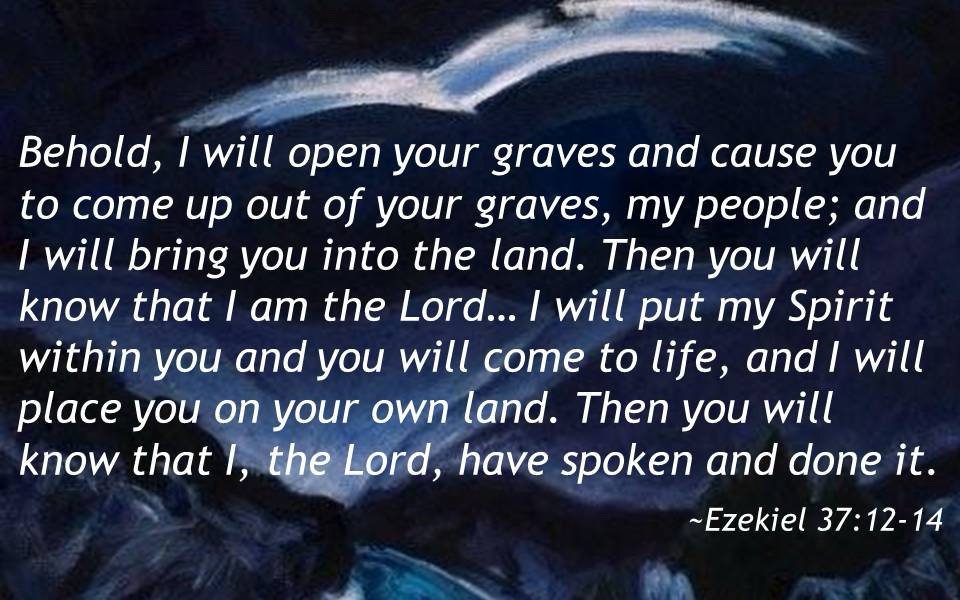
However, this passage also contains words which were filled with hope for the exiled people—but which, in the light of current events in the Middle East, and especially since the eruption of conflict on 7 October last year, are fraught with difficulties. God instructs Ezekiel, “prophesy, and say to them, Thus says the Lord God: I am going to open your graves, and bring you up from your graves, O my people; and I will bring you back to the land of Israel. … I will put my spirit within you, and you shall live, and I will place you on your own soil; then you shall know that I, the Lord, have spoken” (Ezek 37:12,14).
However, this passage also contains words which were filled with hope for the exiled people—but which, in the light of current events in the Middle East, and especially since the eruption of conflict on 7 October last year, are fraught with difficulties. God instructs Ezekiel, “prophesy, and say to them, Thus says the Lord God: I am going to open your graves, and bring you up from your graves, O my people; and I will bring you back to the land of Israel. … I will put my spirit within you, and you shall live, and I will place you on your own soil; then you shall know that I, the Lord, have spoken” (Ezek 37:12,14).
These words are fraught because of the long history of conflict relating to “the land of Israel”—the land to which the exiles would return under the decree of Cyrus of Persia; the land which today is the focus of such controversy and conflicted claims.
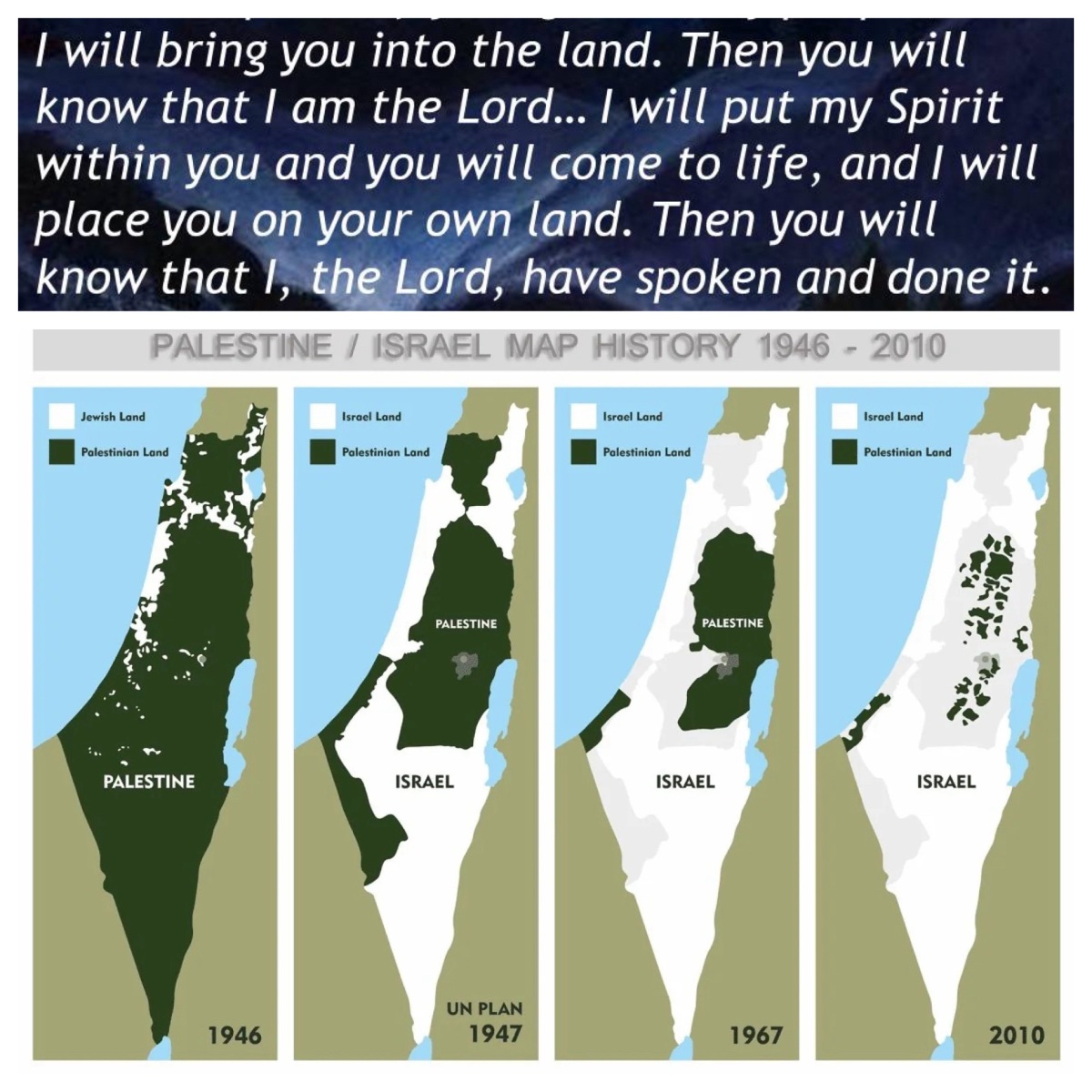
The land marked out for Israel was based on the historical reality that in ancient times Israelites/Jews had lived on that land for centuries until the scattering of all Jews under Roman rule first and second centuries of the Common Era. But since then, Arabs of various origins had held control of the land (see below), and those living there came to be known as Palestinians.
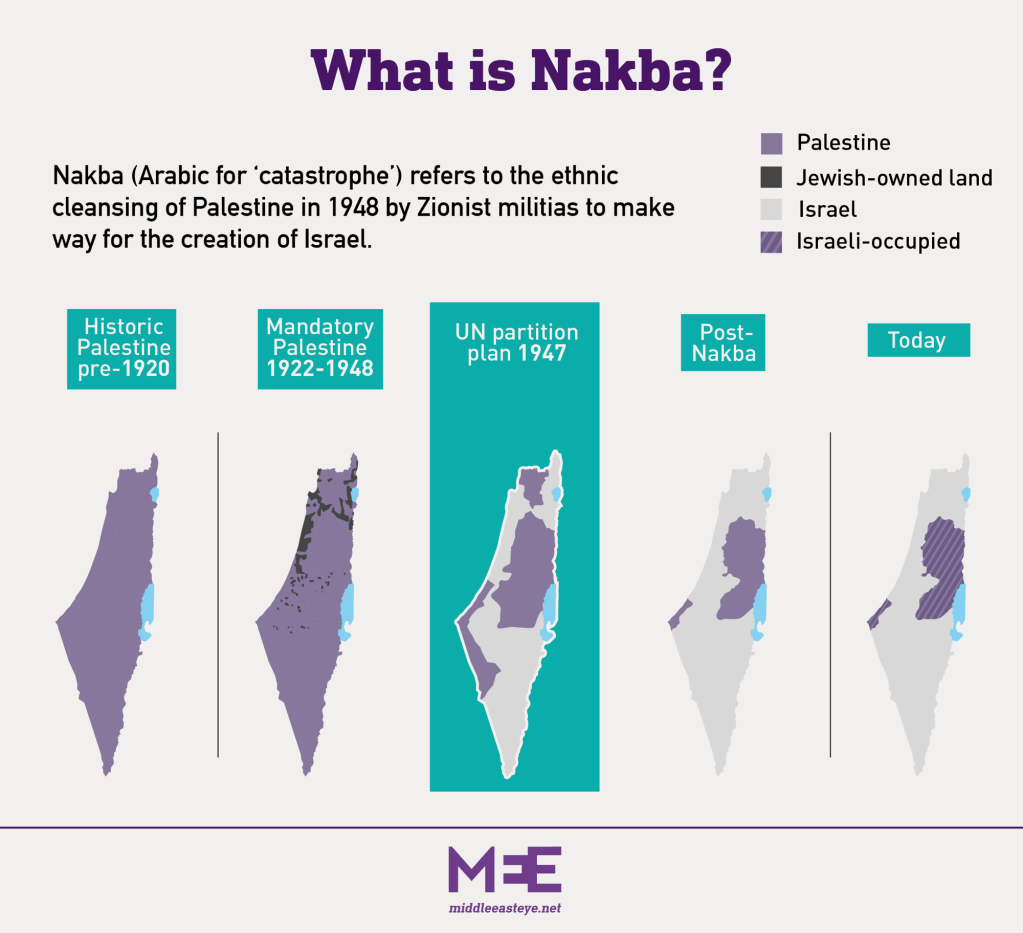
In the early 20th century, the place where Arabs who identified as Palestinians were living was decreed to be the British Mandate of Palestine (1920–1948). The ancient conflicts, it was hoped, would be well in the past. A place for Palestinians in the modern world was, it was thought, now settled. But this was not to be, as we well know today.
In part in response to the horrors of the Shoah, exposed by the ending of World War Two, the modern state of Israel was created in 1948. This was a hugely important, completely justified step to take, give the atrocities of genocide that had been inflicted on Jews in Europe by the Nazi regime of Germany.
The new nation of Israel took 78% of the area which had been provided for Palestinians in the British Mandate. That this was now Jewish territory was a blessing for Jews, but it was a huge and continuing irritant to Palestinian sensibilities, which is why the period from 1948 onwards is known as the Nakba, the Palestinian Catastrophe. A significant number of Palestinians fled the area declared as Israel, as (in one estimate) over 500 Palestinian villages were repopulated by Jews, becoming refugees with no national identity. That was indeed a catastrophe for those inhabitants.
The contested regions of the Gaza Strip (along the east coastline of the Mediterranean Sea) and the West Bank (land immediately to the west of the River Jordan) became known as the Palestinian Territories. They have been disputed territories ever since they were occupied by Israel, two decades later, in the Six-Day War of 1967. In the decades since then, continuing and increasingly aggressive expansion of Israeli settlements into areas where Palestinians were living has greatly exacerbated the situation.
And so those who were dispossessed—and offered the hope of return to “their land”—become the dispossessors of others, to whom that same land was also “their land”; and so the tragic cycle continues.
The biblical texts which claim that God gave land to a chosen people so long ago are not verbatim accounts of “what God said” long ago, nor are they historical reports of actual events. They were written by priests returning from Exile, trying to recapture the period when Israel had some autonomy, because of the strength of its army under various tribal leaders (presented as “kings”). The texts form aetiological tales—that is, they are written as stories at a point in time, purporting to be ancient records, laying the foundation for a claim such as “this is our land, God gave it to us”.
That same land, promised to Abraham, claimed by Moses, is in contention today. It has had a chequered history. The ancient land of Cana an eventually became the land of Israel, then (along with Judaea) part of the Roman province of Syria Palaestina (132–390), and then of the Diocese of the East in the Roman Empire (to 536). What followed the fall of the Roman Empire was a millennium and a half of Muslim rule of this land, first as a part of Bilad al-Sham, the Greater Syria region, under various Caliphates.
The region continued to be part of various organisational configurations under successive Muslim rule, on into the Ottoman Caliphate (from 1517) and then into the modern era, as already noted. (I am not an expert, by any means, of this ancient and medieval history; for this summary, I am dependent on what I read in what I consider to be reputable sources.)
An exaggerated, idealised view of the extent of the land claimed by modern-day Israelis is evident in so many ways in the portrayal of Solomon, who was seen to be filled with “wisdom and knowledge”, and granted “riches, possessions, and honour, such as none of the kings had who were before you, and none after you shall have the like” (2 Chron 1:7–12, especially verses 10 and 12). The biblical figure of Solomon is an exaggerated caricature, a description of an idealised ruler whose existence is actually still a matter of debate amongst ancient historians.
It is also worth noting that the large reach of land that Solomon ruled over, even more extensive than the oft-cited phrase “from Dan to Beersheba” (Judg 20:1; 1 Sam 3:20; 2 Sam 3:10; 17:11; 24:2, 15; 1 Ki 4:25; 1 Chron 21:2; 2 Chron 30:5), did not continue past his death. The hagiographical exaggeration of territory under Solomon is not noted in the period after his death. The narrative books that recount the stories of the kingdoms of Israel, in the north, and Judah, in the south, in the centuries after Solomon, indicate that the scope of those kingdoms was more constrained.
*****
In the light of this, we need to take care when we come across texts in the Hebrew Scriptures which dogmatically and definitively declare that this land belongs to the people of Israel. Indeed, even scripture itself tells the story of the invading colonisers who claimed this land for their own (in the book of Joshua).
So I don’t think it is responsible, today, to lay claim to the whole, extended territory of the land, from the biblical passages noted, as the scope for the modern state of Israel which was created in 1948. There is no justification for the continued aggressive expansion of Israeli settlements in Palestinian areas. So I have sympathy for Palestinians who have lived on the land for thousands of years prior to 1948, as they understand this to be their ancestral land. It has been a continuing Nakba, a catastrophe, for Palestinians over these decades.
I also have sympathy for Jews, both those living in the land of Israel today, as well as those living in diaspora, for whom the land of Israel has a powerful symbolic significance—especially since the Shoah of 1933—1945 and the terrible genocide perpetrated by the Nazis against Jews in so many countries during that period. Granting them land in the area where their ancestors long ago had lived, a homeland that gives them security in the modern world, is important and necessary.
That said, I don’t agree that Palestinians should take matters into their own hands to seek vengeance against people in Israel in the way that they have done, once again, in recent months. In the same manner, nor do I think that the Israeli forces should respond in the aggressive and violent manner that they have done, once again, in recent times, with deaths of women and children, and aid workers, noted on the news with dreadful persistence. Too many people—innocent people—are dying and being injured, making any possible progress towards peace with justice even more difficult each day.
We need to seek once more the peace of these peoples. And we need to find that peace on the basis of justice. Neither terrorist attacks nor military crackdowns will achieve this. They will simply exacerbate a dangerous situation.
How do we deal, today, with the promises of God made long ago? “I will bring you back to the land of Israel. … I will place you on your own soil” (Ezek 37:12,14). We need to tread with care. Perhaps some other texts from both Jewish scripture Christian scripture provide guidance.
“Depart from evil, and do good; seek peace, and pursue it.” (Psalm 34:14). “Blessed are the peacemakers, for they will be called children of God.” (Matt 5:9). “Justice, and only justice, you shall pursue, so that you may live and occupy the land that the Lord your God is giving you.” (Deut 16:20). “… the weightier matters of the law: justice and mercy and faith. It is these you ought to have practiced …” (Mat 23:23). May these be the principles that guide the leaders of the warring groups in Israel and Palestine today.
As we move on in the new year in the church’s calendar, this coming Sunday we celebrate the third Sunday in the season of Advent, and continue our preparations for Christmas—the coming of Jesus, Saviour, chosen one, and Lord (Luke 2:11). During Advent, the lectionary offers a selection of biblical passages designed to help us in our preparations, building to the climactic moment of Christmas Day, when we remember that “the Word became flesh and lived among us, and we have seen his glory, the glory as of a father’s only son, full of grace and truth” (John 1:14).
These scripture passages include a sequence of excerpts from the Hebrew Scriptures—largely from the book of Isaiah—which orient us to the saving work of God, experienced by faithful people in Israel through the ages. These scripture passages inform us to sense how God was at work in the story of Jesus.
The passage proposed by the lectionary for this third Sunday in Advent (Isa 61:1–11) is another very well-known one. It comes from the third main section of Isaiah (chs.56—66), recording the words spoken by an unnamed during the return to the land after exile in Babylon. This prophet is often called Third Isaiah.
This passage is best known because the opening few verses are the words read by Jesus when he was handed the scroll to read in his hometown synagogue (Luke 4:16–19). Following that story offered by Luke, we read that Jesus “rolled up the scroll, gave it back to the attendant, and sat down, and the declared, “Today this scripture has been fulfilled in your hearing” (Luke 4:20–21). That statement shapes the interpretive approach of Christians to the words in Isaiah 61; we are guided to read them as a prophetic declaration about Jesus.
However, we need to take care not to override and exclude the intention of the message (to the extent that we can assess it) of the original speaker and the faithful scribe in that ancient post-exilic context. To do so would be to perpetuate a supersessionist reading of scripture, which claims that “the old” is no longer relevant because “the new” has superseded it. This is poor interpretive practice and bad theology.
How might we best understand this passage? Understanding the dynamics at play at the time the words were spoken and then written down is instructive. For the returning exiles, preparing to re-establish their distinctive society in their much-loved land, the call of the prophet, through the gifting of the Spirit, was orienting them clearly to face the ethical issues of that society. Oppression and captivity had been the experience of past decades; liberty and joyful encouragement were now to be the markers of life in the land.
So central to the task of rebuilding society was the age-old commitment of care for the vulnerable and support for the needy. Prophets of times past had expressed this in terms of care for the widow, the orphan, and the foreigner in the land. Isaiah proclaims God’s judgement on those who “turn aside the needy from justice … and rob the poor of my people, that widows may be your spoil, and that you may make the orphans your prey!” (Isa 10:1–2).
Other prophets join their voices to Isaiah’s declaration. Ezekiel laments that “the sojourner suffers extortion in your midst; the fatherless and the widow are wronged in you” (Ezek 22:7). Jeremiah encourages the people of Jerusalem with a promise that God will allow them to continue to dwell in their land if they “do not oppress the sojourner, the fatherless, or the widow” (Jer 7:5–7).
The words of Third Isaiah continue in this prophetic stream. They also resonate with the psalmist, who praises “the God of Jacob … who executes justice for the oppressed; who gives food to the hungry … [who] sets the prisoners free, [who] opens the eyes of the blind, [who] lifts up those who are bowed down [and] loves the righteous, [who] watches over the strangers [and] upholds the orphan and the widow” (Ps 146:5, 7–9). See
The distinctive contribution of this particular prophet is to frame the task through the story of the Jubilee, “the year of the Lord’s favour” (v.2). That Jubilee year had, as its flip side, the ominous “day of vengeance of our God” for those who failed to follow the way of Jubilee justice. The Jubilee entailed the release of slaves and the cancelling of debts; it was meant to be practised in society every fifty years during the year of Jubilee (Lev 25:8–17; see esp. v.13).
Whilst these levitical prescriptions appear to be the ideal that the priests hoped for, actual evidence that this was ever implemented in Israelite society is lacking. Indeed, it is suggested that while the people were in Exile, the land of Israel would “lie desolate”, and “enjoy its sabbath years” (Lev 26:34), providing recompense for all those years when “it did not have on your sabbaths when you were living in it” (Lev 26:35).
The return to the land, as far as Third Isaiah is concerned, meant that these levitical prescriptions should indeed be adhered to, as the people promised “to walk in God’s law, which was given by Moses the servant of God, and to observe and do all the commandments of the Lord our Lord and his ordinances and his statutes” (Neh 10:29). In the way that Jesus cited this prophetic passage in his hometown synagogue (Luke 4:16), implementing the Jubilee prescriptions in his own time was also what he envisaged.
The prophet lays claim to the work of the Spirit in setting forth this programme for the people. “The spirit of the Lord is upon me”, he declares (Isa 61:1), placing himself in a long line of spirit- inspired leaders in Israel. The Spirit had guided Moses and was then gifted to chosen elders (Num 11:16–25). That Spirit was subsequently imparted to Joshua (Num 27:18; Deut 34:9) and then to a string of Judges: Othniel (Judg 3:10), Gideon (6:34), Jephthah (11:29), and Samson (13:24–25; 14:6,19; 15:14).
In later years, the Spirit guides Saul (1 Sam 10:6–7), David (2 Sam 23:2), Solomon (Wisd Sol 7:7), the line of prophets (Neh 9:30), the servant of the Lord (Isa 42:1), Ezekiel (Ezek 3:12, 14; 8:3; and many subsequent references), Daniel (Dan 5:12), Micah (Mic 3:8), and Zechariah (Zech 4:6). The activity that the Spirit undertook in these instances was invariably to provide guidance regarding the conduct of Israelite society, through these anointed leaders and inspired prophetic voices.
The oracle of the post-exilic prophet thus blends notes of celebration and justice, such that “righteousness and praise [will] spring up before all the nations” (v.11). There will be “a garland instead of ashes, the oil of gladness instead of mourning” (v.3), “everlasting joy” (v.7), with rejoicing and exultation akin to a wedding celebration (v.10). Society will be marked by righteousness (vv.3, 10, 11), to demonstrate that “I the Lord love justice, I hate robbery and wrongdoing” (v.8).
Jesus stands firmly in this line. His connection of Spirit with justice in society is drawn directly from Third Isaiah. The Jubilee he announces in his hometown (Luke 4:19) is explained in his series of blessing and woes (Luke 6:20–26), his welcome of and advocacy for poor and outsiders (Luke 7:34; 10:8–9; 15:1–2), and in a number of parables which prefigure reversals in society (for instance, 14:7–24; 16:19–31).
Alongside these sounds of justice, a note of joy runs through the public activities of Jesus (Luke 6:23; 8:13; 10:17; 15:6, 7, 9, 10, 32). It is in this sense that we can affirm that Jesus has “fulfilled this scripture”, and that this prophetic passage is a helpful guide for us during Advent.
Whenever Christians think about the Spirit—and specifically about the dynamic force that is displayed by the Holy Spirit—our attention goes most immediately to the story of the Day of Pentecost in Acts 2. That’s when the coming of the Spirit was experienced as “a sound like the rush of a violent wind [which] filled the entire house where they were sitting”, followed by “tongues, as of fire … resting on each of them” (vv.2–3). A disruptive and transformative experience, to be sure!
But that’s not all there is to say about the Holy Spirit. As I explored in my previous blogs on this topic, the Holy Spirit was already integral to the faith of the ancient Israelites; and then that same Spirit continued to play a key role for the early Christians. So the Spirit remains a force to be reckoned with in our own times, today.
Beyond the accounts of Jesus and of the first Pentecost, when the Spirit is in mind, we might immediately think of Corinth—the port city, renowned for its trade and for its promiscuity, the city where Paul founded a community of Jesus-followers, where he stayed teaching for what was, for Paul, a long time; the city where relationships in the growing faith community needed ongoing attention, encouragement—and even, because this is Paul we are taking about—correction.
Paul says much about the Spirit in his first letter to the Corinthians. He says that the Spirit searches “the depths of God” (1 Cor 2:10) and gives gifts “to those who are spiritual” (2:13). Those gifts are summarised under the term “spiritual things” (2:13). Accordingly, “those who are spiritual” are able to discern “all things” (2:15), such that they can be confident that they have “the mind of Christ” (2:16).
So confident were some of the Corinthians, that they mistreated others within that same faith community. Small as it was, divisions erupted within the community, and bad behaviour ensued. “All things are lawful”, some of the members maintained (10:23), claiming that they had carte blanche to behave as they wished.
Furthermore, because they maintained that “all of us possess knowledge” (8:1), when it came to the scruples about food shown by some members of the community (presumably Jewish members, reflecting their commitment to kosher food), the very diets of the members (and the source of the food they eat) became a highly contentious issue (8:4–13; 10:23–33). The claim, and the behaviour, of those who were assured that they had the Spirit, leads Paul to explode: “some of you, thinking that I am not coming to you, have become arrogant” (4:18; also 5:2; and compare 13:2).
Squashed by the arrogance of these claims, and the dominating behaviour that resulted, those in the community who felt marginalised were unable to take part in the same way in the community gatherings (11:17–21). Paul strengthens his criticism of those who behave with arrogance, accusing them directly through his characteristically blunt rhetorical questions: “what! do you not have homes to eat and drink in? or do you show contempt for the church of God and humiliat[ing] those who have nothing?” (11:22).
In Corinth, then, the gifting of the Spirit is claimed by some as a basis for unedifying behaviour which tears apart, rather than builds up, the community. This is manifested in another way in the worship of the Corinthian community, where, fuelled by their sense of being “the spiritual ones”, some people unleash chaos in the gathering, in contrast to Paul’s sense that in the gathering “all things should be done decently and in order” (14:40), as befits the God who is “a God not of disorder but of peace” (14:33).
Paul does affirm that tongues and prophecies, and other phenomena, are indeed gifts of the Spirit (12:7–11; 14:1, 5, 13, 18). Nevertheless, he observes that “in a gathering I would rather speak five words with my mind, in order to instruct others also, than ten thousand words in a tongue” (14:19). Paul’s discernment leads him to be critical of the way that these gifts of the Spirit have been utilised in this community.
Is the Spirit here disruptive? Yes, it is most certainly clear that the gifting of the Spirit has disrupted and disturbed the gatherings of the community. The firm assurance of spiritual leading, that has developed into arrogance amongst some, has ensured that there is a distinct lack of “good order and unhindered devotion to the Lord” (7:35).
Yet Paul himself will advise the Corinthians in a later communication, “the Lord is the Spirit, and where the Spirit of the Lord is, there is freedom” (2 Cor 3:17). In that freedom, the Spirit is able to work significant change; “all of us … are being transformed into the same image from one degree of glory to another; for this comes from the Lord, the Spirit” (2 Cor 3:18).
The only problem is, as we have seen, some within the community in Corinth appear to have been quite unaware of “the glory … that comes from the Lord”, to the extent that they inflicted damage—in worship, and in relationships—on others. The disruptive Spirit had not led to a positive transformative experience, but had a very negative impact on the community.
Be wary of how you utilise what the Spirit gives you, Paul advises; measure it, and temper it, against the primary importance of “building up the gathering” (1 Cor 14:4, 12). “Let all things be done for building up”, he advises (1 Cor 14:26). The Spirit needs to be harnessed, focussed, and channelled, so that it is not destructive disorder, but constructive progress, which results.
Whenever Christians think about the Spirit—and specifically about the dynamic force that is displayed by the Holy Spirit—our attention goes most immediately to the story of the Day of Pentecost in Acts 2. That’s when the coming of the Spirit was experienced as “a sound like the rush of a violent wind [which] filled the entire house where they were sitting”, followed by “tongues, as of fire … resting on each of them” (vv.2–3).
In the chaos that resulted—“all of them … began to speak in other languages”—the crowd that heard them were bewildered, amazed, astonished, and thought that they were drunk! That’s a disruptive event initiated and impelled by the Spirit right there. The story of Pentecost is a story about God intervening, overturning, and reshaping the people of God. The Spirit certainly was active at Pentecost.
As Luke tells the story of Pentecost, he is deliberately linking his second volume, not only to the activity of the Spirit in Hebrew Scriptures, but also to the way the Spirit overshadowed Mary (Luke 1:35), nurtured John, son of Zechariah and Elizabeth (1:80), descended upon Jesus at his baptism (3:22), led Jesus out into the Judean wilderness (4:1) and then back into Galilee (Luke 4:14) to sustain the activities and preaching of Jesus (4:18; 10:21).
Luke, of course, had received the account of the active role of the spirit in the baptism and testing of Jesus (Mark 1:10, 12) and developed it, just as Matthew had done likewise, introducing the saying of Jesus, “if it is by the Spirit of God that I cast out demons, then the kingdom of God has come to you” (Matt 12:28).
Certainly, the activities of Jesus can only be thought of as both disruptive—framed by the breach of the heavens at his baptism, the tearing of the temple curtain at his death—and as transformative—signalled by the transfiguration on the mountain top, as well as the change in the disciples effected by their time with Jesus.
Some interpreters have noted that the book of Acts is less about “the acts (deeds) of the apostles” than it is about “the acts of the Hoy Spirit”.
The author himself described the two-volumes work (Luke’s Gospel Acts) as “an orderly account of the things that have come to fulfilment amongst us”. The work highlights how the Holy Spirit plays a central, active role in what is being reported—and how the dual motifs of disruption and transformation continue apace in the movement that Jesus inspired.
The events reported in Acts are generated from the dramatic intervention of the Spirit into the early community formed by the followers of Jesus after his ascension. The story of that intervention reports that Jews came from around the eastern Mediterranean are gathered in Jerusalem for the annual festival (Acts 2:1–13), when the Spirit comes upon them. Each bursts out, “speaking about God’s deeds of power” (2:11). The joy and excitement is tangible even as we hear the story at two millennia’s distance.
Unthinkingly, the wider group of pilgrims hear the cacophony of Spirit-inspired voices, and assume that this is a sign of drunkenness (2:13, 15). Actually, as Luke has made clear, the tongues being heard are not the unintelligible gibberish evident in Corinth, but known languages from the various places of origin of those speaking. And the disruptive element is not from the tongues spoken, but from the actions undertaken by believers in the days, months, and years ahead—as the narrative of Acts conveys.
A second story of the coming of the Spirit is told at a later point in Acts—after Peter sees a vision in which God declares “all food is clean”, and he is summoned to the home of the Gentile centurion, Cornelius, in Caesarea (10:1–33). As Peter preaches to the Gentiles, the Spirit falls on them, “just as it had upon us [Jews] at the beginning (11:15). This event is specifically portrayed as a complementary event alongside the falling of the Spirit on Jews on the Day of Pentecost (2:1–4). It is a further disruptive action that the Spirit impels.
The activity of the Spirit is noted at various places in this sequence of events. The Spirit guides Peter to meet the men sent by Cornelius and travel with them to Caesarea (10:19; 11:12). In reporting to the church in Jerusalem about the arrival of messengers from Cornelius (11:11–12), Peter notes simply that “the spirit said to me to go with them without criticism” (11:12; cf. 10:19–20).
In this report to the Jerusalem church, Peter is short on factual reporting, as it were; he simply states that the spirit fell on them (11:15). His omission of many details (character traits, travel details, conversation and personnel; even, surprisingly, the name of Cornelius) places the focus on the role of the spirit. Once again, what the Spirit impels from this vision, visit, and sermon, is highly disruptive for the early communities of faith.
Jews had been used to eating separately from Gentiles and selectively in terms of food, in accordance with the prescriptions of Leviticus. Now, they are now invited—indeed, commanded—to share at table with Gentiles and to put aside the traditional dietary demarcations.
This is disruptive: just imagine being commanded by God to become vegan and eat meals with the family of your worst nightmares, for instance! And it is transformative: from this sequence there emerge inclusive communities of Jews and Gentiles across the Mediterranean basin, sharing at table and in all manner of ways. That becomes the way of the church.
The importance of the Spirit in Luke’s account of the early movement cannot be underestimated. The significance for the church today of the Spirit’s disruptive, empowering, transformative presence at Pentecost is likewise high. And that transformative activity continues on throughout Acts.
After Peter’s sermon in Caesarea and the gifting of the Spirit to the Gentiles (Acts 10—11), the Spirit guides Barnabas and Paul to Seleucia and onwards (13:2) and then later guides Paul away from Asia Minor, towards Macedonia (16:6–7). This latter move marks a critical stage in the story that Luke tells.
At this key moment of decision in Troas, three injunctions are given; each one is from a divine source. The first of these, an instruction not to speak in the southern region of Asia, comes from the Holy Spirit (16:6). The second direction, a prohibition against any attempt to head north and enter Bithynia, comes from the same spirit, here described as “the spirit of Jesus” (16:7). The third divine interjection takes place at Troas, where a vision is seen in the night with a petition to “come across into Macedonia” (16:9).
The new spirit-inspired direction of travel is disorienting; a serious disagreement between Paul and Barnabas had just occurred (15:39). But this disruption provides the springboard for Paul and Silas to undertake a new mission in Philippi, Thessalonica, and Beroea (16:11—17:15), before visiting the centre of Greek philosophy and politics, Athens (17:16–34), and then Corinth, where Paul stayed eighteen months (18:1–17). Indeed, all that takes place, as Paul travels relentlessly with various companions across many places (13:4—21:17), is driven by the Spirit (13:2, 4), a constantly disruptive and transformative presence.
Much later, Paul’s final visit to Jerusalem and his subsequent arrest takes place under the guidance of the Spirit (20:22-23; 21:11). That event had hugely disruptive consequences for Paul, of course, as he is arrested and spends the rest of his life as a prisoner under Roman guard.
The story of the early years of the movement initiated by Jesus, then, is of multiple events inspired and propelled by the Spirit over these years—intrusive, disruptive, yet transformative events. The Spirit who guides all of this is both disruptive and transform. We need, today, to be open to the same disruption and transformation today.
Whenever Christians think about the Spirit—and specifically about the dynamic force that is displayed by the Holy Spirit—our attention goes most immediately to the story of the Day of Pentecost in Acts 2. That’s when the coming of the Spirit was experienced as “a sound like the rush of a violent wind [which] filled the entire house where they were sitting”, followed by “tongues, as of fire … resting on each of them” (vv.2–3). And, of course, the chaos that resulted—“all of them … began to speak in other languages” meant that the crowd that heard them were bewildered, amazed, astonished, and thought that they were drunk!
That’s a disruptive event initiated and impelled by the Spirit right there. The story of Pentecost is a story about God intervening, overturning, and reshaping the people of God. The Spirit certainly was active at Pentecost; but this was not the first time that Jewish people had experienced the Spirit. Pentecost was far from being the first time that the Spirit came and caused upheaval!
Hebrew Scripture refers to the actions of the spirit at many places throughout the story of Israel. In the Exodus from Egypt, the foundational story of Israel—an incredibly disruptive and disturbing experience, to be sure!—the Spirit was at work. “You gave your good spirit to instruct them, and did not withhold your manna from their mouths, and gave them water for their thirst” is how Ezra recounts the story (Neh 9:20–22). It was the work of the Spirit to release the captives from Egypt, lead them through the challenges of the wilderness, and then bring them into the land promised to them.
The Spirit which had guided Moses and was then gifted to chosen elders (Num 11:16–25) was subsequently imparted to Joshua (Num 27:18; Deut 34:9) and then to a string of Judges: Othniel (Judg 3:10), Gideon (6:34), Jephthah (11:29), and Samson (13:24–25; 14:6,19; 15:14). Each of these men led their people through dangerous, challenging, and turbulent experiences, as they sought to impose Israelite domination on the peoples already living in Canaan.
We might justifiably have a different ethical assessment of this process today—invasion, colonisation, and massacre are familiar dynamics, unfortunately, in the Australian context—but for our present purposes we can note that the Spirit was the energising force in this long and disruptive process. It was disruptive for the inhabitants of the land, as they lost homes, families, and cultural heritage. It was disruptive for the invading Israelites, as they followed they call of their leaders to enter and inhabit the land that they believed God had long promised to them.
The Spirit was also active during the period of kingship in Israel. Saul, after he was anointed as king, was possessed by the Spirit and fell into “a prophetic frenzy” (1 Sam 10:6, 10). During his reign, the Spirit continued to operate through David (1 Sam 16:13; 2 Sam 23:2) and presumably gifted Solomon with “his very great wisdom, discernment, and breadth of understanding as vast as the sand on the seashore” (1 Ki 4:29–34; and see Prov 2:6–11). Perhaps Solomon was the model for the spirit-gifted wisdom exhibited by Joseph (Gen 41:33, 38–39), when the ancestral sagas were collected and compiled into the book of Genesis?
It was the Spirit seen in these first three kings who would be seen as the agent for God to be at work in subsequent rulers (Isaiah 11:2). In addition, the prophetic frenzy manifested by Saul might well be regarded as the prototype for later prophetic activity. It signals just how powerfully the work of the Spirit can disrupt and disturb individuals, and a collective group.
*****
The clearest example of this personally disruptive impact is found in the story of the priest Ezekiel, son of Buzi, who was dramatically called to be a prophet. After Ezekiel saw a striking and bizarre vision of a winged chariot, bearing four winged figures (Ezek 1:4–28), he fell on his face; but the Spirit grabbed hold of Ezekiel, entering into him and raising him up onto his feet (Ezek 2:2). Ezekiel has the same visceral experience many more times (Ezek 3:12, 14, 24; 8:3; 11:1, 24; 37:1; 43:5). The work of the Spirit was anything but calm and measured for Ezekiel.
In his prophecies, Ezekiel notes that the Lord God promised to mete out the same dramatic treatment to the Israelites during their exile (Ezek 11:19; 36:26–27; 37:14). Being seized by the Spirit would reorient the hearts and refashion the lives of the exiles, as they look to a return to the land. That is thoroughly disruptive!
Other prophets also look to the activity of the Spirit to be both disruptive and also transformative. The Spirit would inspire prophecies amidst dramatic portents (Joel 2:28–42); the Spirit would declare the way of justice in the midst of the injustices perpetrated by the people, which presages ruin for the land (Micah 3:8–12); and the Spirit would equip leadership during the return to the land, ahead of the tumult of God “shaking the heavens and the earth and the sea and the dry land” (Haggai 1:14—2:9).
The book of Isaiah contains various exilic oracles which point to the Spirit as the agent of declaring justice to the people (Isa 42:1–9; 61:1–11) and wreaking revenge on the enemies of Israel (Isa 48:14–16). Once again, the disruptive dimension of the Spirit’s work is evident.
In later texts in Hebrew Scripture, there are indications that the spirit inhabits human beings simply through the fact that they exist as the creations of God (Job 27:3; 32:18; 33:4; Zech 12:1). Indeed, all of creation came into being through the spirit of God (Ps 104:30). The act of creation itself was a fracturing of an existing state, a breaking-open of what was for it to become something other than what it had been. Creative activity is disruptive activity.
*****
So the last thing to note about the Spirit in Hebrew Scripture is the first thing that is said about it in the opening chapter of Genesis—the post-exilic priestly document which recounts the foundational creation myth of the Israelite peoples. As the story of creation is placed at the very beginning of the first scroll in the Hebrew Scriptures (Gen 1:1—2:4a), it is explicitly noted that it was by the spirit of God that the creation came into being (Gen 1:1-3).
That creative act began with complete chaos, and shaped and formed the “formless void and darkness” of the very beginning, to become an ordered, cohesive, complex system of inter-relating parts. The status quo of formless nothingness was disrupted, as the wondrously beautiful creation was shaped by “a wind from God [which] swept over the face of the waters” (Gen 1:2). Interpreters over the centuries have assumed that this wind was in fact the Spirit of God, active from the very beginning of God’s creative act.
The Holy Spirit was already integral to the faith of the ancient Israelites. The Holy Spirit continued to play a key role for the early Christians. The Holy Spirit remains a force to be reckoned with in our own times, today. The Spirit may well be how God is calling us to disrupt the status quo of the church today!
Two weeks ago, we considered the section of Paul’s letter to the Romans which the lectionary offered: Paul grappling within “the sin that lives within me” (Rom 7:14–25a). The following week, the lectionary continued following the argument developed by Paul, as he rejoices that “there is now no condemnation for those who are in Christ Jesus” (8:1–11). This week, we read the next passage in this letter, which reflects on “being led by the Spirit” and praying the prayer, “Abba, Father” (8:12–25).
In earlier weeks, we have been tracing the progression of Paul’s argument in this letter, as he sets out how he understudy the Gospel is “the power of God for salvation to everyone who has faith, to the Jew first and also to the Greek” (1:16). He has set out the way that “the righteousness of God is revealed, through faith for faith” (1:17), the way that “this righteousness of God has been disclosed, and is attested by the law and the prophets” (3:21).
He has noted that this has been effected through “the redemption that is in Christ Jesus, whom God put forward as a sacrifice of atonement by his blood, effective through faith” (3:24–25), and that this is consistent with the way that God had already acted, when “faith was reckoned to Abraham as righteousness” (4:9). This means, says Paul, that this same righteousness “will be reckoned to us who believe in him who raised Jesus our Lord from the dead” (4:24).
Accordingly, Paul tells the Romans that, “since we are justified by faith, we have peace with God through our Lord Jesus Christ, through whom we have obtained access to this grace in which we stand; and we boast in our hope of sharing the glory of God” (5:1–2). What follows is a detailed exploration of what this theologically rich affirmation entails: understanding the significance of the death of Jesus for believers (5:6–11); exploring the origin of sin and the parallel offering of being declared to be righteous (5:12–21); the life of faith with the risen Christ (6:1–11); the relationship between sin and grace (6:12–23); the place of sin, the law, and death in the life of faith (7:1–25); and life in the Spirit (8:1–11).
This is heavy going: Paul is entering into difficult areas for consideration—but he plunges in head-first, deploying the familiar techniques he has used in some of his earlier letters: vigorous debate using the techniques of diatribe, question-and-answer dialogues, with scriptural citation and exposition in the style of the rabbis (see especially Galatians and both letters to the Corinthians). This shows the complex, cross-cultural nature of Paul’s life, and the sophisticated way that he operated.
In the section of this letter that is offered this coming Sunday, then (8:12–17), Paul pauses the vigorous debating style of earlier sections, and here operates more by offering pastoral exhortation in the manner of moral philosophers, as he does especially in 1 Thessalonians and Philippians. In this instance, the focus is to offer encouragement regarding the present state of believers, reiterated in these words: “all who are led by the Sprit of God are children of God” (8:14), “you have received a spirit of adoption” (8:15), “we are children of God” (8:16).
Paul continues his dualistic perspective, here, by contrasting “to love according to the flesh” with being “led by the Spirit of God”, which means to “put to death the deeds of the body” (8:13–14). This dualism, from the strong Greek influence on Paul (and, indeed, on many of his hellenised Jewish contemporaries) drives his thoughts away from the integrated Hebraic view of the whole person, the nephesh, which is at the heart of how the Hebrew Scriptures regard humanity.
Those scriptures had clearly indicated that God created nepheshhayah, “living creatures”, in the seas (Gen 1:20, 21) and on the earth (Gen 1:24); indeed, in “every beast of the earth … every bird of the air … everything that creeps on the earth, everything that has the breath of life (nephesh hayah)” (Gen 1:30). The same phrase occurs in the second creation story, describing how God formed a man from the dust of the earth and breathed the breath of life into him, and “the man became a living being (nepheshhayah)” (Gen 2:7). The claim that each living creature is a nephesh is reiterated in the Holiness Code (Lev 11:10, 46; 17:11).
For Paul, however, flesh and spirit compete with one another within the same person; he has stated this conflict clearly at Rom 7:5–6, and developed his thinking further at 8:3–9. In an earlier letter, Paul has taken this flesh/spirit dichotomy as a primary lens for viewing the various conflicts and problems within the gatherings in Corinth (1 Cor 3:1–4; 6:16–17); a similar dynamic can be seen in the extended allegory of Sarah and Hagar (Gal 4:21–31; see esp. v.29). Concerning the dissension in Philippi, he is clear: “we who worship in the Spirit of God … have no confidence in the flesh” (Phil 3:3).
It is a shame that this adoption of Hellenistic dualism has overshadowed and then overwhelmed the rigorously wholistic approach to the human condition that is the gift of the Hebraic tradition. Paul’s words occupy much less space in our scriptures than do the material from the ancient scrolls of Israel, but we have allowed the writings of Paul (the seven authentic letters, as well as the later pseudonymous works) to take up so much more space than those earlier works—and, indeed, more space than the Gospels in the New Testament—in the thinking, writing, and doctrinal exposition of Christianity.
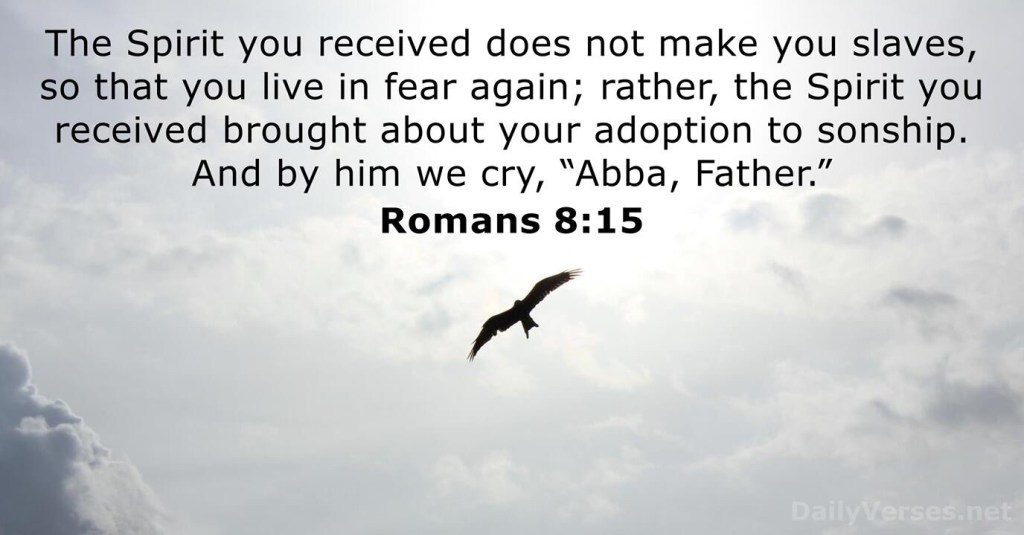
This dualistic dynamic that Paul has adopted and integrated into his way of thinking spills out into the further imagery that is used in Rom 8, where the flesh is entangled in “a spirit of slavery” which leads people to “fall back into fear”, but believers “have received a spirit of adoption” which attests that they are “children of God” (8:15–16).
That people can be considered to be “children of God” is a common point of view today; it is a way of recognising that we are all created by God and share the same characteristics as human beings. It is perhaps a point of view that has developed from the observation that Paul occasionally refers to “the children of God”.
He assures the Galatians that “in Christ Jesus you are all children of God through faith” (Gal 3:26), and encourages the Philippians to “do all things without murmuring and arguing, so that you may be blameless and innocent, children of God without blemish in the midst of a crooked and perverse generation, in which you shine like stars in the world” (Phil 2:14–15).
The term occurs five times in this immediate section of Romans (Rom 8:14, 16, 19, 21; 9:8), where Paul makes it clear that “all who are led by the Spirit of God are children of God” (8:14) and “it is not the children of the flesh who are the children of God, but the children of the promise are counted as descendants” (9:8). This usage is different from the contemporary sense that “we are all children of God because God has created us all”—for Paul, the children of God are birthed into that state by virtue of their faith, being led by the Spirit and finding themselves to be “in Christ”.
The phrase is used by the author of 1 John in a similar manner, comparing “the children of God and the children of the devil”—although in the rigorous view taken by this writer, the former “have been born of God [and] do not sin, because God’s seed abides in them” whilst the latter “do not do what is right [and] are not from God”, and indeed they “do not love their brothers and sisters” (1 John 3:9–10; see also 3:1; 5:2).
The phrase appears also in two sayings attributed to Jesus: a blessing of “the peacemakers” (Matt 5:9), and a discussion of those in “the age to come” who “cannot die anymore, because they are like angels and are children of God, being children of the resurrection” (Luke 20:36).
The phrase is also found in two narrative comments by the author of John’s Gospel, affirming that Jesus “gave power to become children of God” to “all who received him” (John 1:14), and in a summation of a high priestly prophecy that Jesus was “about to die for the nation, and not for the nation only, but to gather into one the dispersed children of God” (John 11:52). So this usage is diverse and generalised, rather than conveying a specific focus, which is what Paul clearly has in mind in Rom 8:12–25.
Those described as “children of God”, we have noted, are also described by Paul as having a “spirit of adoption”. This language appears as Paul encourages the Galatians, explaining the significance of Jesus in the short saying: “when the fullness of time had come, God sent his Son, born of a woman, born under the law, in order to redeem those who were under the law, so that we might receive adoption as children” (Gal 4:4–5). He continues that, “because you are children, God has sent the Spirit of his Son into our hearts, crying, ‘Abba! Father!’” (Gal 4:6), the very same prayer that he references in Rom 8.
The concept of adoption is taken up in the language of a post-Pauline letter, which declares that God “destined us for adoption as his children through Jesus Christ, according to the good pleasure of his will, to the praise of his glorious grace that he freely bestowed on us in the Beloved” (Eph 1:5).
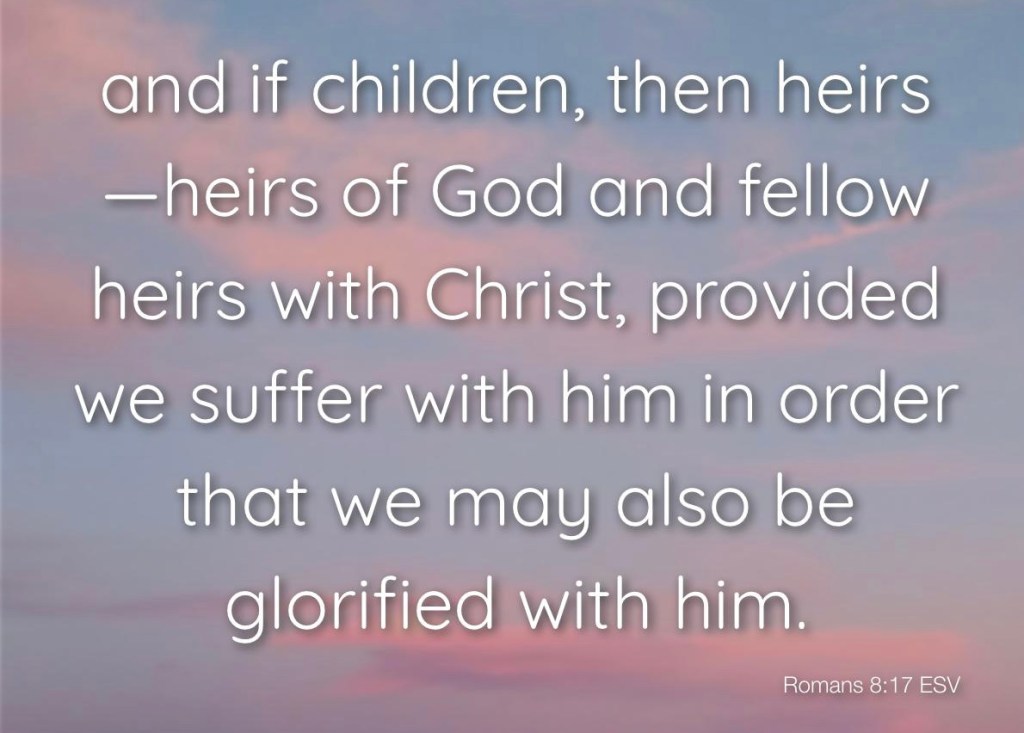
In his letter to the Romans, Paul equates this adoption with “the redemption of our bodies” (Rom 8:23), indicating that the concept fits neatly, in Paul’s thinking, within his adopted hellenistic dualistic worldview. The Spirit which gifts this adoption to believers as “children of God” is the Spirit which makes us to be “heirs, heirs of God and joint heirs with Christ” (8:17). The end result of this process is, as Paul then declares, that “we suffer with him [Christ] so that we may also be glorified with him” (8:17).
The idea that we are glorified with Christ is then reiterated later in this chapter, where Paul writes about the overarching providence of God, stating that “those whom he foreknew he also predestined to be conformed to the image of his Son”, using once again a family image to explain what this means: “in order that he might be the firstborn within a large family” (8:29). This process drives inexorably towards the moment of glorification: “those whom he predestined he also called; and those whom he called he also justified; and those whom he justified he also glorified” (8:30).
This is an unusual portrayal of what this means for believers. To “be glorified” in scriptural usage normally applies to God (Lev 10:3; 1 Chron 22:5; Isa 26:15; 44:23; 49:3; 60:21; 66:5; Sir 3:20; 38:6; 45:3; Mark 2:12; Matt 9:8; Luke 5:26; 7:16; John 12:28; 13:31–32; 14:13; 15:28; 17:4) or to Jesus (John 11:4; 12:16, 23; 13:31), although there are some late references to Israel being glorified (Isa 55:3–5), Moses being glorified (Sir 44:25–45:3), and then to David also being glorified (Sir 47:2–6). Paul is placing believers in Christ within that same stream of being glorified by their strong faith and good works.
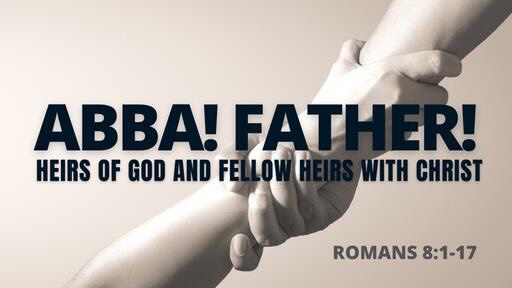
As he writes to the Romans, Paul refers to a prayer that we find on the lips of Jesus: “Abba! Father!” (Rom 8:15; Mark 14:36). Jesus prays this way in the Garden of Gethsemane, when he was “distressed and agitated” (Mark 4:33) as he grapples with what he now knows is in store for him: “the hour has come; the Son of Man is betrayed into the hands of sinners” (Mark 14:41). It is a reflexive prayer, coming almost automatically from within the depths of Jesus’ inner life, in his very being that is “deeply grieved, even to death” (Mark 14:34).
Paul has also referenced this prayer in a similar moment of encouragement in his letter to the Galatians, when he reminds them that Jesus had come “in order to redeem those who were under the law, so that we might receive adoption as children” (4:4–5). It is because of this state, as children of God, that “God has sent the Spirit into our hearts, crying ‘Abba! Father!’” (Gal 6:6).
Quite tellingly, Paul notes that this is a prayer that we “cry” (Rom 8:15), using the Greek word, kradzein, which is used both in Gospel accounts of casting out demons (Mark 1:23), but, more significantly, 40 times in the LXX translation of Psalms (Ps 3:4; 4:3; 8:6; 22:2, 5; etc). It indicates an intensity of focus in what is being said.
The psalmist “cries aloud to the Lord” (Ps 3:4; 27:7; 77:1) and the response is clear, for the Lord “fulfils the desire of all who fear him [and] hears their cry and saves them” (Ps 145:19), “he gives to the animals their food, and to the young ravens when they cry” (Ps 147:9), and as “I waited patiently for the Lord, he inclined to me and heard my cry” (Ps 40:1).
The Abba Prayer has come to have a life all of its own in contemporary spirituality. It is offered in scripture, both as words that Jesus prayed, and as words which Paul offers to believers for our prayers. It is a good foundation to foster our relationship with God in prayer.
In the final section of the reading that the lectionary offers us for this coming Sunday, Paul makes much of the promise that, since believers are “children of God” and thus “joint-heirs with Christ”, so they will “be glorified with him” (8:17). This theme continues on in the consideration that Paul gives to “the glory about to be revealed to us” (8:18), when “the creation will be set free from its bondage to decay and will obtain the freedom of the glory of the children of God” (8:21), and when “those whom he called he also justified”, such that “those whom he justified he also glorified” (8:30).
Earlier in this same chapter, Paul has reported to the Romans that “we boast in our hope of sharing the glory of God” (5:2). This boastful praise for the promised, soon-to-be realised glory, draws on a strong theme in Hebrew scripture. The glory of God is present in the stories that recount the formation of Israel, through the years in the wilderness (Exod 16:6–10; Num 14:22), on Mount Sinai (Exod 24:16–17; Deut 5:22–24), in the Tabernacle (Exod 40:34–35; Lev 9:23; Num 14:10; 16:19, 42; 20:16), and in the temple (1 Ki 8:1–11; 2 Chron 7:1–4).
The psalmists reinforce the notion that the glory resides in the sanctuary (Ps 26:8; 63:2; 102:16; Hag 2:3) and in the land of Israel (Ps 85:9). In some psalms the realm of God’s glory is extended to be “over the waters” (Ps 29:1–4), “over all the earth” (Ps 57:5; 72:19; 97:6; 102:15; 108:5; also Isa 6:3; 24:15–16; 60:1–2; Hab 2:14) and even to “the heavens” (Ps 19:1; 113:4; 148:13; and Hab 3:3).
This concept of God’s glory plays an important role in Paul’s argument in Romans. “All have sinned and fallen short of the glory of God”, Paul brazenly declares (Rom 3:23); some who claim to know God “exchanged the glory of the immortal God for images resembling a mortal human being” (1:23), in contrast to “those who by patiently doing good seek for glory and honour”, to whom “glory and honour and peace” will be given (2:7, 10).
To Abraham, who “grew strong in his faith as he gave glory to God”, his faith would be “reckoned as righteousness” (4:20–22). In God’s time, “the freedom of the glory of the children of God” will given to the creation (8:21). Within the communities of faith in Rome, the imperative of “welcoming one another” is to be done “for the glory of God” (15:7). This glory is God’s gift to people of faith, and indeed to the whole creation. It is this which Paul here yearns for and anticipates with confident hope.
However, it is imperative that we notice that when Paul writes about being glorified with Christ, he prefaces that with an important condition—“if, in fact, we suffer with him” (8:17). Sharing fully in the fruits of God’s glory, as joint-heirs with Christ, means sharing completely in the suffering that Christ experienced, in his betrayal, arrest, trials, and crucifixion.
It is, as Paul famously writes to the Philippians, to “suffer the loss of all things, and regard them as rubbish” (Phil 3:8); and to the Galatians, that “I have been crucified with Christ; it is no longer I who live, but Christ who lives in me” (Gal 2:19–20); and again, as he has written to the Romans, “we have been buried with Christ by baptism into his death, so that … we might walk in newness of life” (Rom 6:4), and accordingly, “you must consider yourselves dead to sin and alive to God in Christ Jesus” (Rom 6:11).
There is no easy path to that much-anticipated glory; rather, it requires that we enter completely into the passion, the sufferings, of Christ. And that is the challenge that stands before us from these words of Paul.
Next week, the lectionary brings to a close the sequence of passages from chapter 5 through to chapter 8, moving inexorably to Paul’s rhetorical climax of great power: “If God is for us, who is against us? … Who will separate us from the love of Christ? … [nothing] will be able to separate us from the love of God in Christ Jesus our Lord.” (8:31–39). It then thrusts us into chapters 9 to 11, where Paul sets out his complex arguments concerning Jews and Gentiles—which may, in fact, be the central purpose of the whole letter! (so, more blogs are coming …)
Last week, we considered the section of Paul’s letter to the Romans which the lectionary offered: Paul grappling within “the sin that lives within me” (Rom 7:14–25a). In probing that state, Paul came to a rather pessimistic conclusion: “wretched man that I am! who will rescue me from this body of death?” (7:24), before immediately switching to a grateful “thanks be to God through Jesus Christ our Lord!” (7:25). See
This week, the lectionary continues the argument that Paul is developing, as he presses on to rejoice that “there is now no condemnation for those who are in Christ Jesus” (8:1). The passage proposed by the lectionary (8:1–11) marks a dramatic change in tone. Whilst he still recognises that “the mind that is set on the flesh is hostile to God; it does not submit to God’s law” (8:7), the primary focus that Paul now has is on the claim that “the law of the Spirit of life in Christ Jesus has set you free from the law of sin and of death” (8:2).
Paul considers the state of humanity: “to set the mind on the flesh is death … the mind that is set on the flesh is hostile to God; it does not submit to God’s law—indeed it cannot, and those who are in the flesh cannot please God” (Rom 8:6–8). He has already grappled with this in the previous chapter. Here, he presses on to celebrate that, as he tells the believers in Rome, “you are not in the flesh; you are in the Spirit, since the Spirit of God dwells in you” (8:9).
Because of what the Spirit effects in the lives of believers, Paul is embued with great hope—a quality that he expresses in other letters he wrote. He rejoices with the Thessalonians that they share with him in “hope in our Lord Jesus Christ” (1 Thess 1:3) and tells the Galatians that “through the Spirit, by faith, we eagerly waits for the hope of righteousness” (Gal 5:5).
He reminds the Corinthians that “faith, hope and love abide” (1 Cor 13:13), and then in a subsequent letter to believers in Corinth, he asserts that “he who rescued us from so deadly a peril will continue to secure us; on him we have set our hope that he will rescue us again” (2 Cor 1:10)
Paul has already reported to the Romans that “we boast in our hope of sharing the glory of God” (Rom 4:2) and that “we boast in our hope of sharing the glory of God” (5:2). He will go on to refer to “the law of the Spirit of life in Christ Jesus” (8:2), and explain how the work of the Spirit gives hope to the whole creation, currently “in bondage to decay”, which will “obtain the freedom of the glory of the children of God” (8:21). And so, Paul declares, it is “in hope that we were saved” (8:24).
Towards the end of the letter, Paul offers a blessing to the Romans: “may the God of hope fill you with all joy and peace in believing, so that you may abound in hope by the power of the Holy Spirit” (15:13). That the Spirit produces this hope is a fundamental dynamic in the process of “setting [believers] free from the law of sin and of death” (8:2).
The Spirit is rarely mentioned in the first seven chapters of this letter. Paul does note that it was “according to the spirit of holiness by resurrection from the dead” that Jesus was “declare to be Son of God with power” (1:4), and that it was “through the Holy Spirit that has been given to us” that “God’s love has been poured into our hearts” (5:5). And he notes that it was by being “discharged from the law” that believers entered into “the new life of the Spirit” (7:6).
But from 8:1 onwards, the Spirit becomes an active presence in what Paul writes about. The Greek word pneuma appears 33 times in the letter to the Romans; most of these are referring to the Holy Spirit. Strikingly, 19 of these occurrences are in chapter 8; a further eight instances then occur in chapters 9–15.
We might contrast this with the word that is often seen to be the key to this letter, dikaiosunē, which appears 57 times in Romans—including the programmatic key verse of 1:17, 13 times in ch.3, 11 times in ch.4, nine times in ch.5, and then nine more times in chs.9–11. Whilst righteousness is indeed an important word, the Spirit is also of crucial significance in Paul’s argument throughout Romans.
Rom 8:1–11 makes a strategic contribution to what Paul is explaining in this letter—that in the Gospel, “the righteousness of God is revealed through faith for faith” (1:17), that “the righteousness of God has been disclosed, and is attested by the law and the prophets, the righteousness of God through faith in [or of] Jesus Christ for all who believe” (3:21–22).
As he develops his argument, drawing on the story of Abraham (Gen 15), Paul affirms that this righteousness “will be reckoned to us who believe in him who raised Jesus our Lord from the dead, who was handed over to death for our trespasses and was raised for our justification” (4:24–25), concluding that “since we have been made righteous by faith, we have peace with God through our Lord Jesus Christ” (5:1), and asserting that “if Christ is in you … the Spirit is life because of righteousness” (8:10).
Incidentally, when we look at the statistics of word occurrences in the seven authentic letters of Paul, we see that “righteousness” occurs a total of 87 times (57 of them in Romans, 13 in Galatians), whilst “spirit” can be found 117 times: as well as the 33 times in Romans, there are 39 occurrences in 1 Corinthians and a further 15 occurrences in 2 Corinthians, and then 19 more appearances in Galatians. Spirit is a fundamental component in Paul’s theology.
Paul believes that it is by the Spirit that the gift of righteousness is enlivened and activated within the believer. He hammers this point with a series of clear affirmations in this week’s passage (8:1–11): “there is no condemnation” (v.1), “the law of the Spirit has set me free” (v.2), “God has done what the law, weakened by the flesh, could not do: by sending his own Son in the likeness of sinful flesh, and to deal with sin” (v.3), “the Spirit of God dwells in you” (v.9), “the Spirit is life” (v.10), and “he who raised Christ from the dead will give life to your mortal bodies also through his Spirit that dwells in you” (v.11).
Important for Paul is for the believer to know that “you are in the Spirit, since the Spirit of God dwells in you” (8:9) and that “his Spirit … dwells in you” (8:11). This is an idea that Paul also articulates in his first letter to a Corinth, when he poses the rhetorical question, “do you not know that you are God’s temple and that God’s Spirit dwells in you?” (1 Cor 3:16). The answer to this rhetorical question which is expected (but not stated) is, of course, “yes, we do know that God’s Spirit dwells in us”.
A similar rhetorical strategy can be seen as Paul draws this section (Rom 8:1–11) to a close. He poses a matched pair of conditional possibilities: “if Christ is in you” (v.10), “if the Spirit dwells in you” (v.11). The possibility, in each case, is crystal clear: since Christ is in you, “the Spirit is life because of righteousness” (v.10), and since the Spirit dwells in you, “he who raised Christ from the dead will give life to your mortal bodies also through his Spirit that dwells in you” (8:11).
For Paul, then, the role of the Spirit in enlivening and energising the believer is crucial. That is the important contribution that this passage makes to Pauline theology, and to our understanding of the Christian life.
The Spirit is an important figure in Christian experience and in Christian theology. The festival of Pentecost, which is celebrated this coming Sunday, is an opportunity to focus on the Spirit in the worship life of the Church. Every year, at Pentecost, the story of “the first Pentecost” is proceed by the lectionary as the reading: an account of how the Spirit was experienced by believers gathered in Jerusalem, 50 days after the death and resurrection of Jesus.
Acts 2 forms a pivotal turning point in the story that Luke tells throughout his two-volume work, which we know as two separate books, The Gospel according to Luke, and the Acts of the Apostles. The Spirit plays a crucial role in both volumes, beginning before Jesus and his cousin John are born, and continuing right through until the final thing that Paul says, when he meets with the Jewish leadership in Rome while under house arrest.
Over the last few years, I have written quite a number of posts for this week, as we approach Pentecost. I’ve listed them below, as you may wish to dip into some of them in the lead up to Pentecost.
















 An Informed Faith