The Uniting Church Statement to the Nation (1977)

A sermon preached by the Rev. Elizabeth Raine in Sunday worship of the Tuggeranong Uniting Church on Sunday 18 June, the Sunday before the 46th Anniversary of the UCA (22 June). (Passages in italics are taken from the 1977 Statement to the Nation issued by the First Assembly.)

In a few days time it will be the 46th birthday of the Uniting Church in Australia. At the time, it was certainly a risky and brave adventure, combining three denominations to make one uniquely Australian church.

It seemed to me that the journey of the Uniting church reflected our readings this week – like Abraham, this church stepped out in faith on a journey where a lot was unknown but also where faith in God committed people to the journey. Like the disciples in Matthew, this church sought to go into the communities surrounding them with the good news to make the world a better place.

At the time of the UCA inauguration, a statement was issued to all of the Australian nation, unsurprisingly called the Statement to the Nation. How many of you know it exists? Have read it? Know what’s in it?
After 46 years, sometimes we need to be reminded of the vision of the Uniting Church in Australia, and to recognise that witnessing to this vision is still vital and attainable. This vision called the church to act with love, live with hope, witness in faith, and work for justice.

Today as we celebrate the UCA’s birthday, we are going to read this statement as I think it is one of the greatest and most enlightened documents ever produced by a church.

People of the Congregational, Methodist and Presbyterian Churches have united. A new church has been born. We, who are members of the first Assembly of the Uniting Church in Australia address the people of Australia in this historic moment. The path to unity has been long and at times difficult, but we believe this unity is a sign of the reconciliation we seek for the whole human race.

We acknowledge with gratitude that the churches from which we have come have contributed in various ways to the life and development of this nation. A Christian responsibility to society has always been regarded as fundamental to the mission of the Church. In the Uniting Church our response to the Christian gospel will continue to involve us in social and national affairs.

We are conscious of our responsibilities within and beyond this country. We particularly acknowledge our responsibilities as one branch of the Christian church within the region of South-East Asia and the Pacific. In these contexts we make certain affirmations at the time of our inauguration.

We affirm our eagerness to uphold basic Christian values and principles, such as the importance of every human being, the need for integrity in public life, the proclamation of truth and justice, the rights for each citizen to participate in decision-making in the community, religious liberty and personal dignity, and a concern for the welfare of the whole human race.

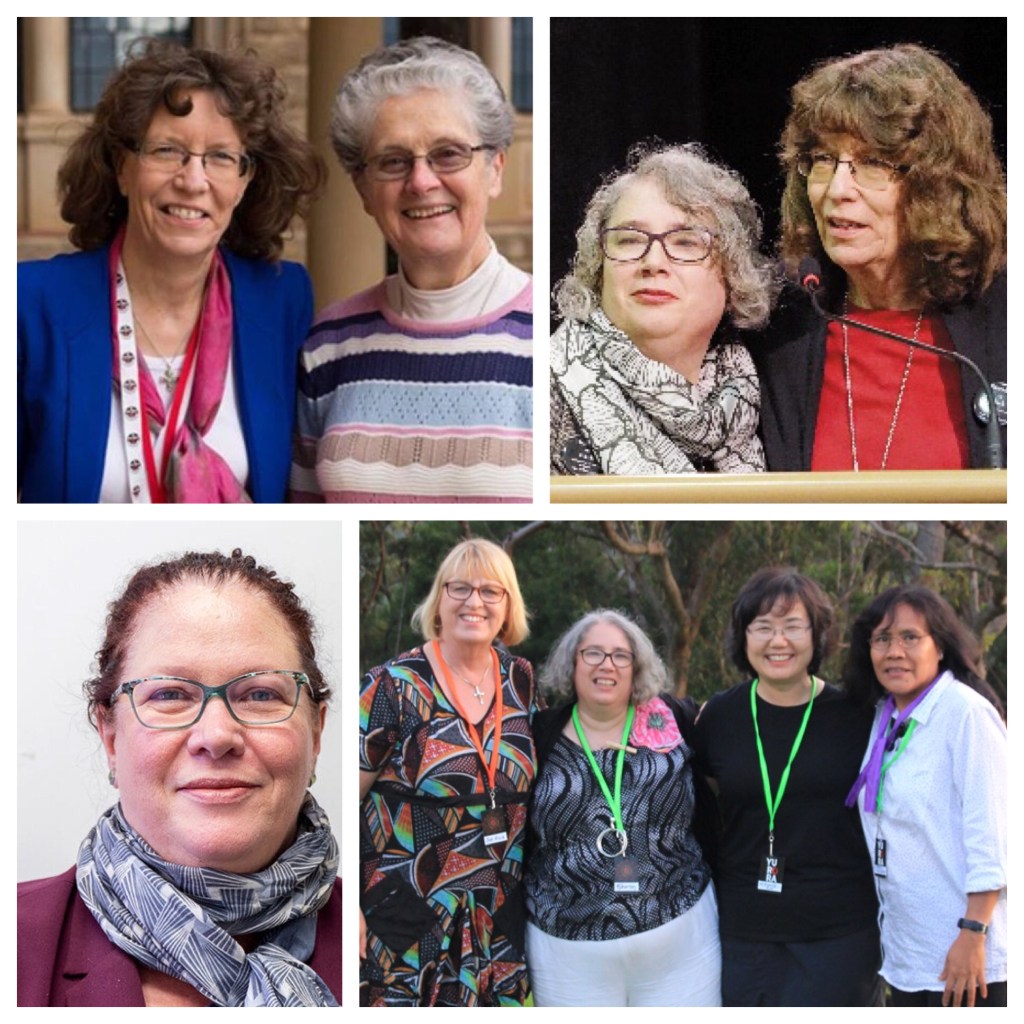
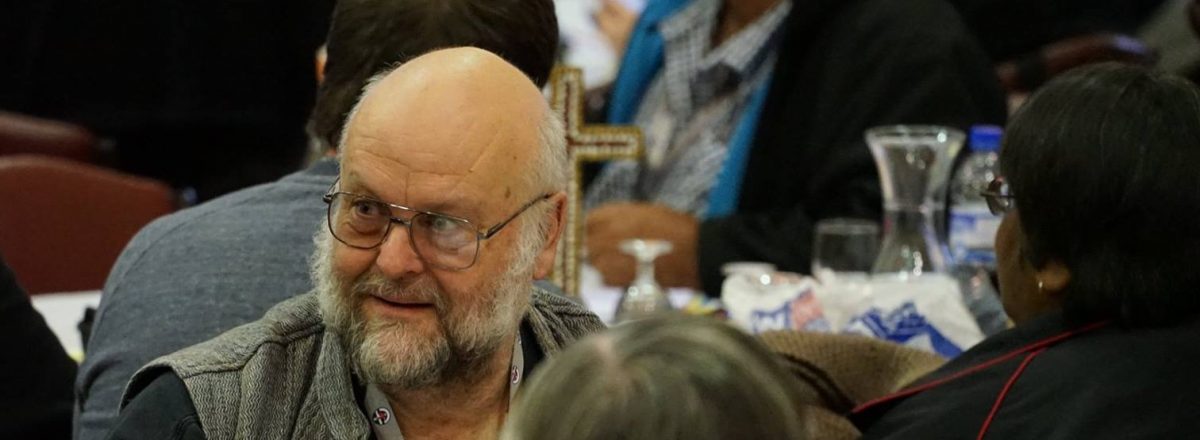
Assembly General Secretary, Colleen Geyer (bottom right),
along with Past President Dr Deidre Palmer (top left),
President (2022–2024) the Rev. Sharon Hollis (top right),
and President-Elect the Rev. Charissa Suli (bottom left)

Our Assembly General Secretary, Collen Geyer, has stated that every time [she] read[s] these words, she “feel[s] proud that, as a church, we had the guts to say these things, were courageous enough to set the bar high, and wanted there to be no doubt about what Australia could expect of us. Read these words and you will know how we’re intending to be true to who we are. Our unity, which is a sign of the reconciliation we seek for the whole human race, will look like this.”

What a wonderful aim for a church, to be an entity that embodies basic Christian values and principles, the importance of every human being, integrity in public life, truth and justice, democracy for all, religious freedom and personal dignity, and a concern for the welfare of the whole human race. Have we lived up to this? What do we need to do to make sure we do?

Did we realise as a church how extraordinary these words were? Did we understand what we were saying? These words tell of the great courage it took to make this announcement and embark on this journey of faith and justice. And since that time, we have seen that courage played out in the 46 years since Union as the Uniting church continues to stand with the voiceless, the marginalised and the poor, and continue to be activists for climate change reform. The Statement to the Nation commits us to acting in ways that are often considered political.
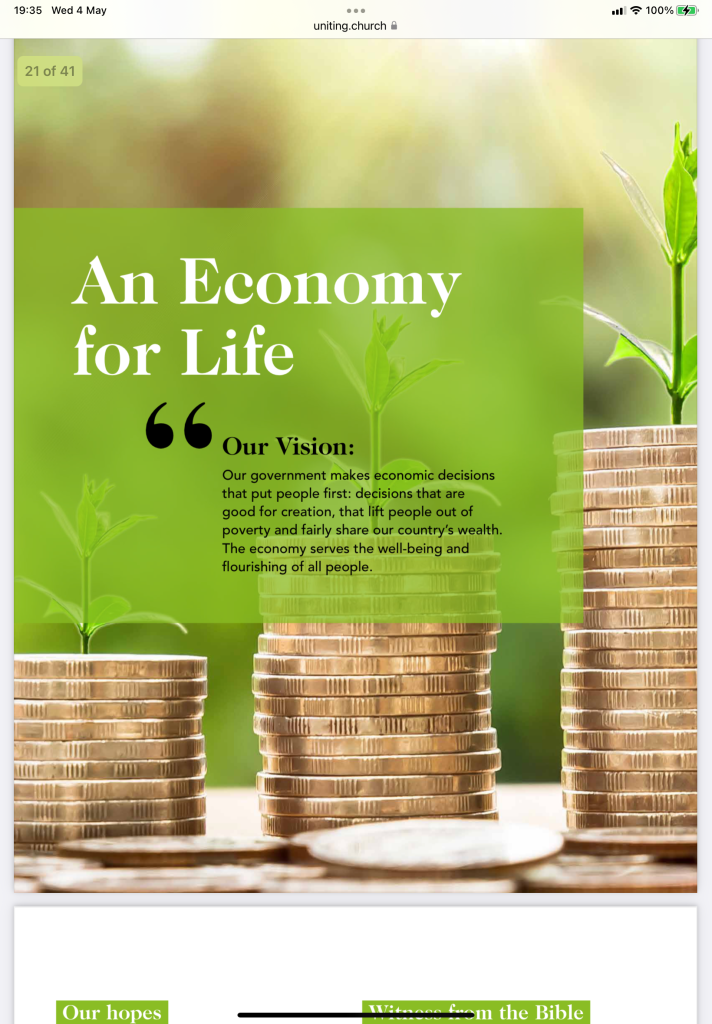
An Economy for Life is a later statement by the UCA Assembly which develops key themes that were articulated in the Statement to the Nation

We can see that such activities are built into the DNA in this church, yet sometimes we hesitate in implementing them. We lack the confidence in ourhomegrown models of mission and in ourselves. We can baulk at stepping out on new journeys. We have more trouble engaging around faith with our communities in an increasingly secular world. We shy away from being ‘political’ forgetting that Jesus also stood with the voiceless, the marginalised and the poor and was incredibly political.

We will challenge values which emphasise acquisitiveness and greed in disregard of the needs of others and which encourage a higher standard of living for the privileged in the face of the daily widening gap between the rich and poor.

In many churches, Western culture has created a culture of consumerism that permeates our congregations. Faith dwindles to “what’s in it for me” rather than homothumadon, discerning the common good. This leads to a reduced willingness to engage beyond the immediate and ourselves and look at ways in which various parts of the church can partner with others around us or how we can become the church of the future, a church still relevant, vital and life-giving not only to ourselves, but to the communities around us.

We are concerned with the basic human rights of future generations and will urge the wise use of energy, the protection of the environment and the replenishment of the earth’s resources for their use and enjoyment.

This small but direct statement let Australia know that as a church we weren’t just focused on the here and now but that we aim to be a future-focused church. We don’t want just to make a difference for the generations now, but we want to implement actions now that are “concerned with the basic human rights of future generations”. God’s love and commitment to humanity is not limited by time, space or matter and nor should ours be.
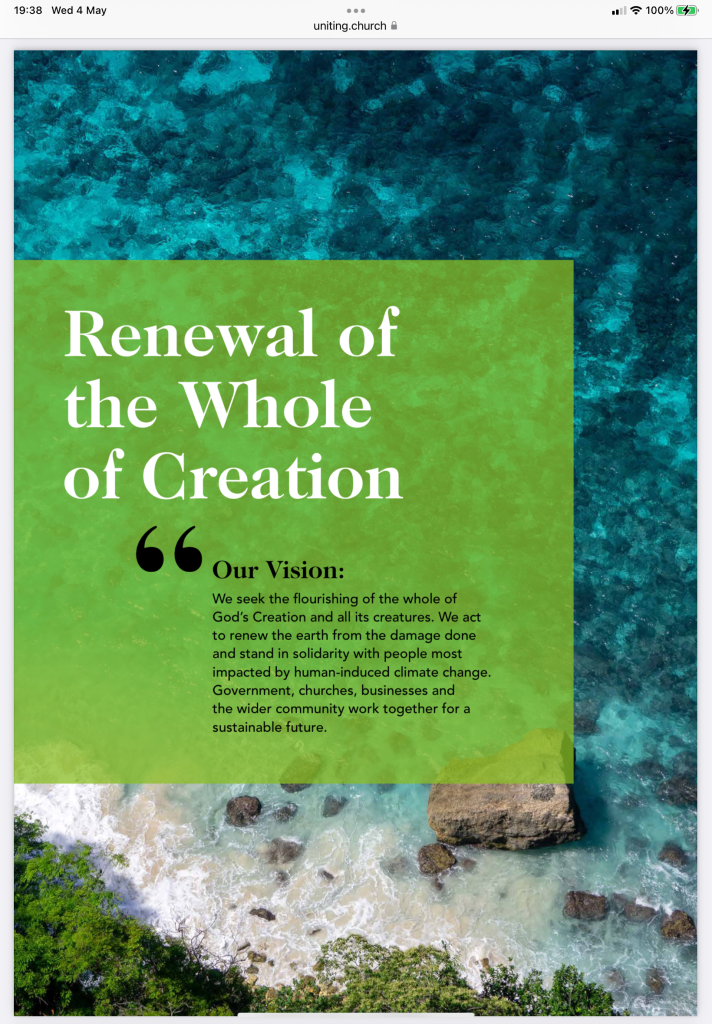
Renewal of the Whole Creation is a later statement by the UCA Assembly
which develops the brief sentence about the environment
that is found in the Statement to the Nation

This whole statement calls us to look now to identify injustices and at how we can influence change for the better and have improved outcomes for the future. It also acknowledges the impact of our actions for the future, particularly on our environment, God’s good creation that we are meant to be stewards of. Climate Change is a looming threat to most life on the planet, loss of biodiversity and loss of species are accelerating. This statement calls us into action now to prevent what may well be a very bleak future.

Finally we affirm that the first allegiance of Christians is God, under whose judgment the policies and actions of all nations must pass. We realise that sometimes this allegiance may bring us into conflict with the rulers of our day.

But our Uniting Church, as an institution within the nation, must constantly stress the universal values which must find expression in national policies if humanity is to survive.

We are clear about who we belong to – “the first allegiance of Christians is God”. As the Uniting Church, this is our foundation. It defines who we are and why we speak and act the way we do. Because of this belonging, we acknowledge that this may mean we could come into “conflict with the rulers of our day”, not because we want it, but because we will be speaking out for “the universal values which must find expression in national policies if humanity is to survive.” This isn’t a statement that holds back, and we should be proud of it as it leads us to live in the way of Jesus.

We pledge ourselves to hope and work for a nation whose goals are not guided by self-interest alone, but by concern for the welfare of all persons everywhere — the family of the One God — the God made known in Jesus of Nazareth the One who gave His life for others. In the spirit of His self-giving love we seek to go forward.

We pledge ourselves to hope … Can you think of anything better to pledge yourself to? Because of this hope, we pledge ourselves to work for our nation – a strong commitment which calls us to action. Our work however, is for a nation “whose goals are not guided by self-interest alone”. Everything that has come prior to this in the statement has been about being God’s church for others. Here, “all persons everywhere” are identified as “the family of the One God, through Jesus who “gave His life for others”. In this statement, we are called to be part of the work of God’s church in Australia.
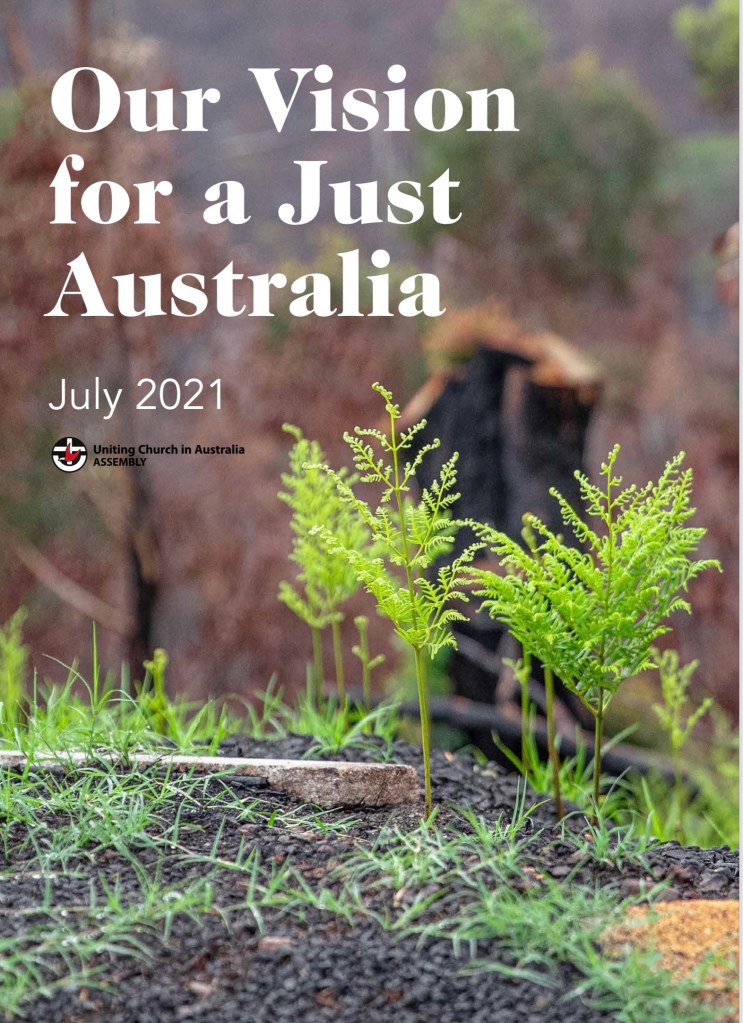
In 2021, the National Assembly of the UCA issued
Our Vision for a Just Australia, which develops and applies
many of the core commitments made in the Statement to the Nation

Today, how can we be more purposeful and intentional about how we achieve this vision? This is a question to ponder. We could start by reclaiming this statement, andbeing deliberate in our efforts to live into it.

As the Uniting Church, we can’t make these commitments and then be silent. Our voice has had to be loud and strong at points of justice, fairness and what is best for the common good. At times our voice has had to be a lone voice, a voice that isn’t popular, even amongst our own members and among other Christians.

I suggest this should remind you of someone, who also wasn’t popular within his own religion and who voice often howled across the wilderness of the white noise of religious self-interest and disregard for how others were treated, and championed the notion that the future kingdom embodied a place of justice and equity for all.

The Statement to the Nation draws us back to our foundations. It reminds us that like Abraham and the disciples, we too are sent by God in the now to prepare the futurefor all. To help us in this quest, I am closing with a prayer by the Rev. Dorothy McRae-McMahon.

Gracious God,
we believe in the wonder of life in you.
In every moment, we know that
you call us on towards creativity and hope,
never giving up on us, your church.

Christ Jesus, we celebrate
that you have journeyed with us
over these last 46 years together,
never leaving us alone in our humanness
and inviting us towards
fullness of life together.

Holy Spirit of Wisdom,
we believe that you will be discovered
in unexpected places around us,
your shining life emerging before us
and inspiring us to believe
that we can share in your power
to change the world
towards your goodness and grace.
This we believe, O God. Amen.


(Source: Dorothy McRae-McMahon, slightly adapted from a prayer for the WCC 70th anniversary)
 

Forty four years on …

After many years of careful conversation, three Protestant churches decided to join to form the Uniting Church in Australia—44 years ago, on 22 June 1977. The rhetoric was “we are a movement, not a denomination”. They were heady days. The new church issued a Statement to the Nation. There was front page newspaper coverage of the opening service of the new church. There was great optimism about what the future held.

44 years down the track, the Uniting Church has developed a clear identity and carved out a distinctive place within Australian society. We have made mistakes, followed some unhelpful paths leading to dead ends, and not always provided good, transparent, informed decisions. But we are human, flawed, striving, hopeful. We press on.

As the Uniting Church, we have a distinctively open and unconstricted theology, faithful to our reformed and catholic heritage, but contextualised to the contemporary Australian situation. We celebrate multicultural and linguistic diversity and exhibit a warm acceptance of LGBTIQ+ people. Across the church there is a clear and strong commitment to social justice, advocating for refugees, working to effect better housing policies, arguing against the excessive gambling addiction in society, decriminalising drug usage, and other issues.

We have a consistent and thoroughgoing commitment to living sustainably, honouring the creation, and working with community organisations devoted to environmental care. We have an enduring covenant with the First Peoples of the land, an openness to ecumenical and interfaith engagements, and a strong commitment to mission in other countries that means working carefully with partner churches and supporting local initiatives.

In each of these areas, we have ideals, goals, visions, and we have dashed hopes, failed enterprises, inadequate realisations. Yet we press on.

We still talk with orthodox, catholic, conservative, evangelical and pentecostal siblings, but don’t feel constrained by their dogmas or traditions, or by what we perceive to be their restrictions and limitations. We seek to set out in fresh directions, following untested pathways, sailing into unchartered waters, knowing that this means pushing the envelope, risking being criticised or unfriended or worse. Sometimes the fresh initiatives work well, sometimes they fail spectacularly. But at least we try—and we press on.

It’s a good place to be! We are appreciated by so many people in society. I can’t tell you how many times I have heard the comment, “If I went to church, it would be to a Uniting Church”. Well, it’s OK not to go to church, but it’s great that church folk can work with others in the community on projects of mutual interest, to the benefit of all. “Uniting for the Common Good” has been one of our catchcries in recent years. “Where the wild God is” is the current theme for our consideration—we go where God is already at work.

Earlier this year I had this piece on the identity of the Uniting Church posted to the Assembly website. I thought it was worth reposting today, the 44th anniversary of the formation of the Uniting Church in Australia. See https://johntsquires.com/2021/05/02/the-identity-of-the-uniting-church/

See also https://johntsquires.com/2018/08/15/what-i-really-like-about-the-basis-of-union/ and https://johntsquires.com/2018/08/20/alongside-the-basis-of-union-there-was-the-statement-to-the-nation/

The identity of the Uniting Church

The Uniting Church is part of the one holy catholic and apostolic church – we see ourselves as just one part of a much larger whole. We do the things that other denominations within the church do: we gather for worship, preach the Gospel, care for the needy, witness to our faith, and connect with communities.

We have many organisations that cater specifically for pre-schoolers, school students, people with disabilities, theological students, adult learners, Indigenous people and aged and infirm people. We have chaplains in hospitals, schools, industry, and the defence forces. And we have congregations in many places across the continent.

When we worship, we feel connected with the people of God of all denominations across the globe. When we witness, we bear testimony to the faith shared by Christians of many varieties. When we reach out in service, we act in solidarity with people of Christian faith, people of other faiths, and people of goodwill of any stripe, in our communities and across the globe.

We share in the call to be missional, universal, set apart, and unified, as God’s people together. Or in more traditional theological language, we are part of the ‘one, holy, catholic and apostolic’ church.

But we believe that we have some distinctive elements to contribute to that larger whole. Our identity as the Uniting Church in Australia is marked by ten distinctive features.

I In Ecumenical Relationship

When the Congregational, Methodist and Presbyterian churches joined together in 1977 to form the Uniting Church in Australia, they declared that this union was both in accord with the will of God, and that it was a gift of God to the people of God in Australia.

Since then, the Uniting Church has been a church which is committed to working ecumenically with other Christian denominations. That commitment is one very important aspect of our identity as a Uniting Church. We belong to the National Council of Churches in Australia and the World Council of Churches, where we co-operate with many denominations.

Nationally, we have participated in ongoing conversations with other denominations (Anglican, Lutheran, Greek Orthodox, and Roman Catholic). At the grassroots level, our ministers participate in local ministers’ associations in hundreds of towns and cities across the nation. Some Congregations share buildings with other denominations; some worship and serve together, especially in rural towns.

We are an ecumenical church.

II In Covenant with First Peoples

A very important dimension to being the church in this country is that we are a church in Covenant with the First Peoples of Australia. From its earliest years, the Uniting Church has been involved in actions which express our solidarity with the Aboriginal and Torres Strait Islander peoples. Older members will recall events at Noonkanbah Station in the Kimberley in 1980, when Uniting Church members stood in solidarity with the traditional owners, the Yungngora people, against the mining of their land.

The Uniting Aboriginal and Islander Christian Congress (UAICC) was established in 1985, and a Covenant between the UAICC and the UCA was implemented in 1994. This Covenant recognises that working for reconciliation amongst people is central to the Gospel. This gives expression to our commitment to shape a destiny together.

In 2009, the Preamble to the UCA Constitution was revised to recognise the difficult history of relationships between the First Peoples and the later arrivals, as Second Peoples. In 2018, we agreed to support a Makarrata process to give a clear national voice to First Peoples, and to support a national Treaty. Our present relationship is one which seeks to ensure that we commit to the destiny together which we share as Australians. The Assembly fosters ongoing work in this area through the Walking Together as First and Second Peoples Circle.

We stand in covenant relationship with the First Peoples.

III A Multicultural Church 

In the same year that the Congress was formed, the Uniting Church declared that it is a multicultural church, which rejoices in the diversity of cultures and languages which are found across Australia. The Basis of Union recognises that we share much, as Australians, with people of Asia and the Pacific. The Uniting Church has maintained strong relationships with churches from these regions, as well forging new links with churches in Africa and the Middle East.

The Statement to the Nation, issued in 1977, acknowledged that the Uniting Church seeks a unity that transcends cultural, economic and racial distinctions. Within Australia, there are at least 12 national conferences based on regional groupings and people from 193 language groups who belong to the Uniting Church.

Each Sunday, worship takes place in Uniting Churches in 26 languages from cultures beyond Australia, as well as many indigenous languages used in worship by first peoples across our church. We have learnt the importance of moving from “enjoying each other’s foods”, to conversing at a deep level about the hopes and expectations we bring from different cultural experiences. We have learnt that we need to be intercultural in our relationships.

Through UnitingWorld, we maintain partnerships with churches in Asia, the Pacific, Africa and the Middle East. We are truly a multicultural church. Through the Relations with Other Faiths Working Group and the Seeking Common Ground Circle, the Uniting Church has been active in developing relationships with other faith communities. We have had a long and fruitful Dialogue with the Jewish Community, and participate in a number of other interfaith Dialogue conversations. We are firmly committed to constructive interfaith relations.

We continue to develop as a church in deepening relationships with many cultures and faiths.

IV  All the people of God

The Uniting Church is a church which values the ministry of all the people of God and seeks to order itself in accordance with the will of God. Our Basis of Union affirms that every member of the church is engaged to confess Christ crucified, and every person is gifted by the Spirit to engage in ministry in their own particular way. We are a church that values the ministry of each and every person.

Throughout the life of the Uniting Church, we have held our structures and forms of ministry accountable to ongoing scrutiny. Alongside the Ministry of the Word, to nurture and guide Congregations, we have introduced the Ministry of Deacon, to focus attention on people living on the margins. We have introduced the Ministry of Pastor to recognise the giftedness of lay people, and that sits alongside the Ministry of Lay Preacher (which we have had since 1977), and the more recent accreditation of Lay Presiders in many locations.

We have also undertaken important conversations about membership and the relationship of Baptism to Holy Communion. We now have a clear commitment to an open table when we gather for The Lord’s Supper: all who are baptised (whether adult or child, whether confirmed or not) are welcome to share at this table.

We are a church which values the ministry of all the people of God.

V  Women and Men

The Basis of Union makes it very clear that we are a church which is committed to equality and mutuality of women and men in ministry. Even before 1977, the three previous denominations had ordained women to ministry. This is a very strong distinctive, especially in the Australian scene.

Since 1977, many women have stood on an equal basis alongside men, as Ministers of the Word, Deacons, Elders, Church Councillors, Lay Preachers, Lay Presiders, Chaplains, and Pastoral Carers. We value the insights and experience of women in each and every way that we seek to “be church”—as we gather to worship, as we witness to our faith, as we serve the wider community.

Women in leadership: Presidents Jill Tabart (1994–1997) and Deidre Palmer (2018–2021); Deidre Palmer and President-Elect Sharon Hollis (2021–2024);
Assembly General Secretary Colleen Geyer (2016– );
and Moderators Sue Ellis (SA), Sharon Hollis (VicTas),
Myung Hwa Park (NSW.ACT) and Thresi Mauboy (Northern Synod).

Both lay and ordained women have served in leadership positions across all councils of the Uniting Church, from Church Council Chairpersons to Presbytery Chairpersons, to Synod Moderators and Secretaries, to the Assembly General Secretary and President. Many couples minister together as husband and wife. Gender equality is most certainly part of our identity.

We are committed to mutuality and gender equality in every part of the church.

VI Discernment

Another contribution that the UCA has made has been to highlight the importance, when we gather in council, of being open to the Spirit, and seeking to discern the will of God. We live this out in our councils by practising a process of consensus decision-making. The Manual for Meetings sets out the various elements that are involved in making decisions by discernment: a time of information, a time of deliberation, and a time of decision-making.

The infamous “coloured cards” are only one small part of the whole. The focus is on listening to the Spirit before we speak, and striving to find a way forward that most, if not all, people can see as the will of God for the church. This way of decision-making, which originated in the UCA, has now been adopted by the World Council of Churches and a number of its member Churches.

We are a church which deliberately seeks to discern the movement of the Spirit in our midst.

VII Professional Standards

Over the last 20 years, the Uniting Church has developed a firm commitment to strong professional standards, for Ministers as well as for lay people who exercise leadership in the church. Our commitment to professional standards emerged initially in response to the problems of sexual misconduct within the church. A whole section of the Regulations is now devoted to this.

Since 1999, all Ministers have been expected to adhere to a Code of Ethics, and this has most recently been revised to provide a Code of Ethics Ministry Practice for Ministers and a Code of Conduct for Lay Leaders. Ministers and Pastors undertake regular training in aspects of this code, in ethical ministry workshops.

Since the Royal Commission into Institutional Responses to Child Sexual Abuse, we have intensified our efforts to ensure that our churches are Safe Places, valuing everybody, honouring integrity, avoiding negative and hurtful behaviours.

We are a church which values integrity and clarity about our ethical standards.

VIII  Open to explore difficult issues

Over 40 years, the Uniting Church has shown that it is a church which is prepared to engage in difficult discussions about contentious issues. Our Basis of Union commits us to learn from the insights of contemporary scientific and historical studies, and affirms that we remain open to correction by God in the way we order our life together.

In the early years of the Uniting Church, debates about Baptism were the focus of great controversy. Infant baptism had been an integral part of the worship practices of each denomination which joined the Uniting Church, but Ministers and Elders Councils were receiving regular requests for baptism by adults who had been baptised as infants but had come to a personal faith later in their lives. After debates stretching through the 1980s and 1990s, the Uniting Church has developed a clear set of protocols to cover such requests.

Another area of enduring controversy has been that of human sexuality. There is a wide diversity of opinion within society relating to such matters, and this diversity is present within the Uniting Church. Once again, from the 1980s though into the present era, lively debates regarding human sexuality have taken place in the various councils of the church. We have worked through difficult decisions about sexuality and leadership, and then about sexuality, gender, and marriage. We continue to learn, explore, and adapt.

In dealing with such issues, we have learned how to debate with respect and integrity with ongoing conversations looking to employ a “Space for Grace” process to encourage respectful, empowering, and inclusive decision-making.

We seek to be a church that engages in the difficult discussions with honesty, transparency, and hopefulness.

IX  Advocating for Justice

The Uniting Church inherited from its predecessor Churches a strong commitment to advocating for justice for all. Many Uniting Church congregations and members are actively committed to serving those people who find themselves on the margins of society. This commitment was clearly articulated in the 1977 Statement to the Nation and it has been evident in many actions undertaken by Uniting Church members over the decades.

The Uniting Church has joined in common cause with other groups and organisations in society, in advocating for a welcoming attitude towards refugees; in lobbying for a fair and just system of caring for people who are experiencing poverty and homelessness; in seeking equity for workers in their workplace; and in many other issues. The Assembly Working for Justice Circle, brings together people who are strongly committed to this avenue of ministry.

A regular stream of policy documents and public resolutions point to a clear and unbroken commitment to seeking justice for all. Each federal election, we are provided with resources that encourage us, as people of faith, to consider the implications of our votes in the life of the nation.

We are a church which is strongly committed to justice for all.

Environmental Sustainability

In like manner, the Uniting Church has always been a church which honours the environment and supports a sustainable lifestyle. Although such matters are firmly on the radar of the public now, they have long been integral to the identity of the UCA. Once again, the 1977 Statement to the Nation flagged such commitment. A series of subsequent documents attest to the ongoing determination of the church to live responsibly, in such a way that we minimise the damage we cause to the environment in which we live.

Our partnerships with Churches in the Pacific have intensified our awareness of the negative impacts that are resulting from climate change. We know that we need to act now, to reduce the threat. Each year, we experience catastrophic consequences from more regular and more intensified “natural disasters”—fires, floods, drought, cyclones. Just as we provide pastoral support in these situations through Disaster Response Chaplains, so too we maintain advocacy with governments, urging them to set policies which will turn us away from the trajectory of yet more environmental disasters.

Locally, many Congregations and individual members of the UCA are seeking to implement practices that will reduce their carbon footprint on the planet. We know that we owe it to future generations, to live responsibly in the present.

We are a church that lives, acts, and advocates for a sustainable environmental future.

*****

You may have some thoughts about what I have articulated above. You may have thought, “what about …?” – something that I have overlooked, that you see as important. You may have some questions about how I have described some of these elements. I encourage you to talk with others about how you respond. Together, we are the Uniting Church!

This discussion of identity is the first in a series of articles on this question on the Assembly website, at DNA of the UCA – Uniting Church Australia

The DNA of the UCA (part II)

Two years ago, for the fortieth anniversary of the formation of the Uniting Church in Australia, I prepared a resource exploring the key characteristics of this church. This week, for the 52nd anniversary, I am reposting those thoughts. Here is a second set of five key characteristics.

VI A very important dimension to being the church in this country is that we are a church in Covenant with the First Peoples of Australia. From its earliest years, the Uniting Church has been involved in actions which express our solidarity with the Aboriginal and Torres Strait Islander peoples. Older members will recall events at Noonkanbah Station in the Kimberley in 1980, when Uniting Church members stood in solidarity with the traditional owners, the Yungngora people, against the mining of their land.

The Uniting Aboriginal and Islander Christian Congress (UAICC) was established in 1985, and a Covenant between the UAICC and the UCA was implemented in 1994. This Covenant recognises that working for reconciliation amongst people is central to the Gospel.

In 2009, the Preamble to the UCA Constitution was revised to recognise the difficult history of relationships between the First Peoples and the later arrivals, as Second Peoples. Our present relationship is one which seeks to ensure that we commit to the destiny together which we share as Australians.

VII In the same year that the Congress was formed, the Uniting Church declared that it is a multicultural church, which rejoices in the diversity of cultures and languages which are found across Australia. The Basis of Union recognises that we share much, as Australians, with people of Asia and the Pacific. The Uniting Church has maintained strong relationships with churches from these regions, as well forging new links with churches in Africa and the Middle East.

The Statement to the Nation, issued in 1977, acknowledged that the Uniting Church seeks a unity that transcends cultural, economic and racial distinctions. Within Australia, there are currently 12 national conferences based on regional groupings and people from 193 language groups who belong to the Uniting Church.

Each Sunday, worship takes place in Uniting Churches in 26 different languages, not including the many indigenous languages used in worship by first peoples across our church.

Through UnitingWorld, we maintain partnerships with churches in Asia, the Pacific, Africa and the Middle East. We are truly a multicultural church. Through the Relations with Other Faiths Working Group, the Uniting Church has been active in developing relationships with other faith communities. We are firmly committed to constructive interfaith relations.

VIII Over 40 years, the Uniting Church has shown that it is a church which is prepared to engage in difficult discussions about contentious issues. Our Basis of Union commits us to learn from the insights of contemporary scientific and historical studies, and affirms that we remain open to correction by God in the way we order our life together.

In the early years of the Uniting Church, debates about Baptism were the focus of great controversy. Infant baptism had been an integral part of the worship practices of each denomination which joined the Uniting Church, but Ministers and Elders Councils were receiving regular requests for baptism by adults who had been baptised as infants but had come to a personal faith later in their lives. After debates stretching through the 1980s and 1990s, the Uniting Church has developed a clear set of protocols to cover such requests.

Another area of enduring controversy has been that of human sexuality. There is a wide diversity of opinion within society relating to such matters, and this diversity is present within the Uniting Church. Once again, from the 1980s though into the present era, lively debates regarding human sexuality have taken place in the various councils of the church. In dealing with such issues, we have learned how to debate with respect and integrity with ongoing conversations looking to employ a “Space for Grace” process to encourage respectful, empowering, and inclusive decision-making. Let us hope that this trait stays firmly embedded in the DNA of the UCA.

IX The Uniting Church inherited from its predecessor Churches a strong commitment to advocating for justice for all. Many Uniting Church congregations and members are actively committed to serving those people who find themselves on the margins of society. This commitment was clearly articulated in the 1977 Statement to the Nation and it has been evident in many actions undertaken by Uniting Church members over the decades.

The Uniting Church has joined in common cause with other groups and organisations in society, in advocating for a welcoming attitude towards refugees; in lobbying for a fair and just system of caring for people who are experiencing poverty and homelessness; in seeking equity for workers in their workplace; and in many other issues.

A regular stream of policy documents and public resolutions point to a clear and unbroken commitment to seeking justice for all.

X In like manner, the Uniting Church has always been a church which honours the environment and supports a sustainable lifestyle.

Although such matters are firmly on the radar of the public now, they have long been integral to the DNA of the UCA. Once again, the 1977 Statement to the Nation flagged such commitment. A series of subsequent documents attest to the ongoing determination of the church to live responsibly, in such a way that we minimise the damage we cause to the environment in which we live.

Our partnerships with Churches in the Pacific have intensified our awareness of the negative impacts that are resulting from climate change. We know that we need to act now, to reduce the threat.

So, many congregations and individual members of the UCA are seeking to implement practices that will reduce their carbon footprint on the planet. We know that we owe it to future generations, to live responsibly in the present.

For the first five key characteristics, see https://johntsquires.com/2019/06/18/the-dna-of-the-uca-part-i/

So: these are ten strands to our DNA, as far as my thinking is concerned. What about you?

Would you add anything? Take anything away?

What do you think are the essential aspects of our UCA DNA?

See also https://johntsquires.com/2018/08/15/what-i-really-like-about-the-basis-of-union/

https://johntsquires.com/2018/08/20/alongside-the-basis-of-union-there-was-the-statement-to-the-nation/

What is missing from the Basis of Union?

I’ve offered some reflections in an earlier post concerning the things about the Basis of Union that I really appreciate:

https://johntsquires.wordpress.com/2018/08/15/what-i-really-like-about-the-basis-of-union/

But I ended those reflections with the note that the First Peoples of this continent (and related islands) are not mentioned anywhere in the Basis of Union. This needs to be noted, first of all, as a striking (and unfortunate) deficit in the Basis. I want to think further about this, and some other matters, that are absent from the Basis of Union.

Continue reading “What is missing from the Basis of Union?”

Alongside the Basis of Union, there was the Statement to the Nation

I recently reflected on “what I like about the Basis of Union”. It was a visionary document for its time, and in many ways it stands us in good stead as we seek to be a pilgrim people, always on the way towards a promised goal (para 3). That affirmation has shaped our understanding that, as a church, we are undertaking a journey, during which we continue to look to the final reconciliation of humanity under God’s sovereign grace (para 17).

At the same time (1977) as this document provided a foundation for three denominations to come together as a new Church, the inaugural national meeting of that body issued a Statement to the Nation. This document has lived under the shadow of the Basis. We could do well to read and reflect on it regularly. You can read this Statement at https://assembly.uca.org.au/resources/introduction/item/134-statement-to-the-nation-inaugural-assembly-june-1977

Continue reading “Alongside the Basis of Union, there was the Statement to the Nation”