Forty days, led by the Spirit: Jesus in the wilderness (Mark 1)

This week we once more read and hear the beginning of the story that Mark tells, about the very early stages of the public activity of Jesus. We have already read about John the baptiser during Advent (Advent 2), and heard Mark’s account of the baptism of Jesus (Epiphany 1).

Now, in this week’s Gospel reading (Lent 1), Jesus is baptised, plunged deep into the water, from which he emerges changed (1:9–11), driven into the wilderness, with wild beasts and angels, to be tested (1:12–13), and then announces what his message and mission will be (1:15–15).

This baptism is sometimes regarded as Jesus attesting to a deeply personal religious experience that he had in his encounter with John, who had been preaching his message of repentance with some vigour (1:4-11). His encounter with John deepens his faith and sharpens his commitment.

The relationship between Jesus and John is interesting. In the orderly account of things being fulfilled, which we attribute to Luke, it is clear from the start that John is related to Jesus (Luke 1:36). By tradition, they are considered to be cousins–although the biblical text does not anywhere expressly state this.

It seems also that some of the early followers of Jesus had previously been followers of John himself. This is evidenced in the book of signs, which we attribute to the evangelist John. Andrew, later to be listed among the earliest group of followers of Jesus, appears initially as one of two followers of John (John 1:35-40). They express interest in what John is teaching (John 1:39).

Andrew is the brother of Simon Peter, later acknowledged as the leader of the disciples of Jesus. He tells his brother about Jesus. It is Peter who comes to a clear and definitive understanding of the significance of Jesus, even at this very early stage: “we have found the Messiah” (John 1:41). Andrew and John are thenceforth committed disciples of Jesus.

Was Jesus engaging in “sheep-stealing”? Certainly, the dynamic in the narrative is of a movement shifting away from John the baptiser towards Jesus the Messiah; the juxtaposition of these two religious figures can be seen at a number of points (John 1:20, 29-34, 35-36; see also 3:22-30).

See further thoughts on John the baptiser in John’s Gospel at

and

(And I am looking forward to reading more about John in the most recent book by James McGrath, Christmaker: a life of John the Baptist, published by Eerdmans.)

None of this story relating to John is in view in the account we read in this Sunday’s Gospel. The rapid-fire movement in this opening chapter simply takes us from John, baptising in the Jordan, to Jesus at the Jordan and then in the wilderness, and on into Galilee, beside the lake and in Capernaum (Mark 1:1–45).

See my comments on the character of Mark 1 at

Mark has no concern with exploring the relationship between Jesus and John. He wishes only to indicate that, at the critical moment of the beginning of the public activity of Jesus, it was through contact with John, his message and his actions, that Jesus was impelled into his mission.

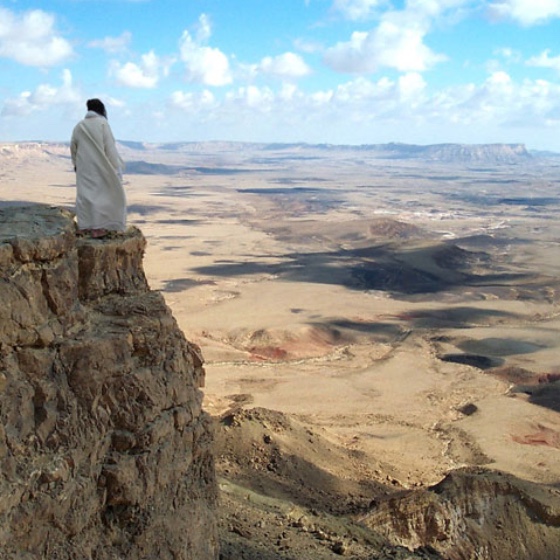
The Gospel account moves quickly on from the baptism, to a very different scene, set in the wilderness, where Jesus is tested, challenged about his call (1:12-15). The wilderness was the location of testing for Israel (Exod 17:1-7; Num 11:1-15; Deut 8:2). By the same token, the wilderness was also the place where “Israel tested God” (Num 14:20-23), when Israel grumbled and complained to God (see Exod 14-17, Num 11 and 14). Wilderness and testing go hand-in-hand.

The reference to Jesus being “forty days” in the wilderness evokes both the “forty years” of wilderness wandering for the people of Israel (Exod 16:35; Deut 2:7, 8:2, 29:5; Neh 9:21; Amos 2:10, 5:25), as well as the “forty days” that Moses spent fasting on Mount Sinai (Exod 34:28; Deut 9:9-11,18,25; 10:10).

Forty, however, should be regarded not as a strict chronological accounting, but as an expression indicating “an extended period of time”, whether that be in days or in years. It points to the symbolic nature of the account.

We see this usage of forty, for instance, in the comment in Judges, that “the land had rest forty years” (Judges 5:31, 8:28)–a statement that really means “for quite a long time”. Likewise, Israel was “given into the hands of the Philistines forty years” (Judges 13:1) and Eli the priest served for 40 years (1 Sam 4:18).

David the king reigned for 40 years (2 Sam 5:4, 1 Kings 2:11; 1 Chron 29:27), his son Solomon then reigned for another 40 years (1 Kings 11:42; 2 Chron 9:30), as also did Jehoash (2 Kings 12:1) and his son Jeroboam (2 Kings 14:23). If we take these as precise chronological periods, it is all very neat and tidy and orderly–and rather unbelievable!

Other instances of forty point to the same generalised sense of an extended time. Elijah journeyed from Mount Carmel to Mount Horeb “forty days and forty nights” (1 Kings 19:8), whilst the prophet Ezekiel’s announcement of punishments lasting forty years (Ezekiel 29:10-13) is intended to indicate “for a long time”, not for a precise chronological period. Jonah’s prophecy that there will be forty days until Nineveh is overthrown (Jonah 3:4) has the same force.

So the story of the testing of Jesus for “forty days in the wilderness” is not a precise accounting of exact days, but draws on a scriptural symbol for an extended, challenging period of time.

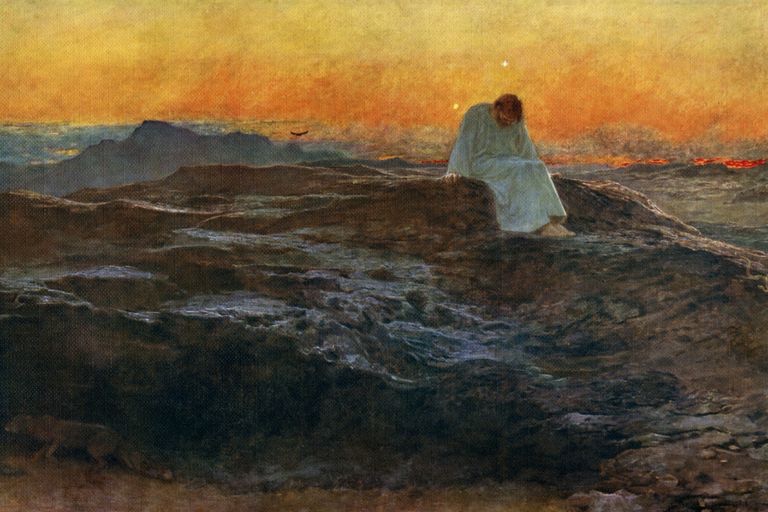
Details about the conversation that took place whilst Jesus was being tested in the wilderness are provided in the accounts in the Gospels attributed to Matthew (4:1-11) and Luke (4:1-13). This is not the case in Mark, where the much shorter account (1:12-13) focusses attention on the key elements of this experience: the wilderness, testing, wild beasts, angels–and the activity of the Spirit.

For more on Jesus in the wilderness, see

and

The Markan account of this period of testing is typically concise and focussed. The constituent elements in the story continue the symbolic character of the narrative.

The note that “he was with the wild beasts” sounds like the wilderness experience was a rugged time of conflict and tension for Jesus. However, commentators note that the particular Greek construction employed here is found elsewhere in this Gospel to describe companionship and friendly association: Jesus appointed twelve apostles “to be with him” (3:14); the disciples “took him [Jesus] with them onto the boat” (4:36); the man previously possessed by demons begged Jesus “that he might be with him” (5:14); and a servant girl declares to Peter that she saw “you also were with Jesus” (14:67).

If this Greek construction bears any weight, then it is pointing to the companionable, friendly association of the wild beasts with Jesus—a prefiguring of the eschatological harmony envisaged at the end of time, when animals and humans all live in harmony (Isaiah 11:6-9; Hosea 2:18). The wilderness scene has a symbolic resonance, then, with this vision.

Alongside the wild beasts, angels are present—and their function is quite specifically identified as “waiting on him” (1:13). The Greek word used here is most certainly significant. The word diakonein has the basic level of “waiting at table”, but in Markan usage it is connected with service, as we see in the descriptions of Peter’s healed mother-in-law (1:31), the women who followed Jesus as disciples from Galilee to the cross (15:41), and most clearly in the saying of Jesus that he came “not to be served, but to serve” (10:45). The service of the angels symbolises the ultimate role that Jesus will undertake.

Finally, we note that the whole scene of the testing of Jesus takes place under the impetus of the Spirit, which “drove him out into the wilderness” (1:12). This was the place that Jesus just had to be; the action of the Spirit, so soon after descending on him like a dove (1:11), reinforces the importance and essential nature of the testing that was to take place in the wilderness.

And the action of “driving out” is expressed in a word, ekballō, which contains strong elements of force—the word is used to describe the confrontational moment of exorcism (1:34, 39; 3:15, 22-23; 6:13; 9:18, 28, 38). The testing in the wilderness becomes a moment when Jesus comes face to face with his adversary, Satan—and casts his power aside. The more developed dialogues in Matthew and Luke expand on this understanding of the encounter.

Both of the key elements in this reading (baptism and testing) serve a key theological purpose in Mark’s narrative. They shape Jesus for what lies ahead. They signal that Jesus was dramatically commissioned by God, then rigorously equipped for the task he was then to undertake amongst his people. The two elements open the door to the activities of Jesus that follow in the ensuing 13 chapters, right up to the time when the long-planned plot against Jesus, initiated at 3:6, is put into action (14:1-2).

Of course, this story is offered in the lectionary each year on the first Sunday in the season of Lent. It serves as an introduction to the whole season. Jesus being tested in the wilderness points forward, to the series of events taking place in Jerusalem, that culminate in his crucifixion, death, and burial.

The narrative arc of Mark’s Gospel runs from the baptism and wilderness testing, through to death at Golgotha and burial in a tomb. The weekly pattern of Gospel readings during Lent follows a parallel path, from the wilderness testing of Lent 1, to the entry into Jerusalem on Lent 6, the farewell meal on Maundy Thursday, and the death and burial on Good Friday.

That is the path that Jesus trod. That is the way that he calls us to walk.

Scripture debate and disputation in the wilderness (Matt 4; Lent 1A)

My earlier contention was that the story we are offered by the lectionary for this coming Sunday, the first Sunday in Lent (Matt 4:1–1), should be read as a story of testing, not tempting. See

***

Which leads to the question, what is it, that Jesus is being tested about? How does this story contribute to our understanding of what God was wanting, and planning, to do through the public activities of Jesus, in Galilee and then in Jerusalem?

The devil, as “the tester”, utilised scripture as the basis for the trial that Jesus is undertaking. And this, it must be said, is thoroughly predictable—given that we are dealing with a text from the first century of the common era, emerging out of the context of faithful Judaism, telling the story of a faithful Jewish man, Jesus, and his earliest circle of followers, all Jewish men and women. They all express the piety and faith of the Judaism of the time, for that was their religion and their culture.

Scripture sits at the heart of Jewish life and faith. Young Jewish boys, like Jesus, were taught to read the Hebrew text of scripture, and to memorise it. They were grounded in Torah, the books of the Law, which set out the way of life, the way of faithful living, that they were to follow. They needed to know this, to have it deep within their hearts. That would have been the upbringing experienced by Jesus.

As they grew older, these Jewish boys were taught the next stage, the midrashim, the teachings which provided explanation and application of the laws and stories embedded in Torah. There were two types of midrashim. The first was haggadah, which was telling stories; the Jewish teachers, the Pharisees, who became acknowledged over time as the rabbis, were excellent at telling stories, and Jesus learnt well from their examples.

The second was halakah, which was discussion and debate about how best to interpret and apply the laws found in Torah. It is this latter form of teaching that we encounter, in the story of the forty days in the wilderness. The back and forth between the person on trial—Jesus—and the person charged with testing and probing his case—the accuser—is couched entirely in terms of sacred scripture. Each time an accusation is put before Jesus, the accuser quotes a passage of scripture. And each time the person on trial—Jesus—responds, another text from sacred scripture is quoted.

Think about that for a minute: both the accuser and the accused are citing scripture, arguing on the basis of what is found in the tradition and heritage and sacred story of the people of Israel. They are both engaged in this task, to get to the heart of the matter; to penetrate to the essence of the issue, through exploration of scripture and its relevance to Jesus and his mission.

This is typical Jewish midrashic argumentation. This is the way that, throughout the centuries, Jews have sought to encounter the truths of scripture—through discussion and debate, by one person posing a proposition and then another person arguing back in counter-proposition, through the adding of additional scripture passages into the argument, in a process of refining, sharpening, and clarifying the intent of the initial scripture text.

This was par for the course for ancient Jews. This is still the way that faithful Jews engage with scripture. My years as a member of the Uniting Church Dialogue with the Jewish Community immersed me into precisely this culture on a regular basis. It was quite an experience! To us polite, constrained Westerners, it seems like an unruly mess. To Jews, schooled in this process since their early years, it is natural, and results in deep and profound understandings of scripture.

*****

The specific scripture texts that are cited in the course of this testing are significant. They are the same in each extended version that we have (Matt 4, and Luke 4), albeit cited in a different order. And each of the three testing moments, with the associated scripture texts that are cited, relate to key moments in the story of Israel in the wilderness during their forty years of wandering. (I am indebted to my wife, the Rev. Elizabeth Raine, for this insight.)

Understanding the significance of each testing comes when we look more closely at the passages to which Jesus refers, and explore the resonances and connections that those texts have with other biblical passages. Just as Israel (the child of God) is tested during their forty years in the wilderness, so Jesus (the son of God) revisits those testings in his forty days in the wilderness.

The first moment of testing relates to bread: “command these stones to become loaves of bread”. The story evoked is that concerning the gift of manna which was given to the people of Israel as they sojourned in the wilderness. It is told in Numbers and referred to quite directly in Deut 8:3, the verse which is part-quoted by Jesus in the testing narrative, people do not live by bread alone. Could the mission of Jesus be diverted into concerns about sustenance and immediate survival, rather than longer-term strategies?

The second moment of testing, on the top of a mountain, relates to worship, and the recognition of the special and supreme place of the Lord God. The offer, “all these [kingdoms] I will give you”, is met by another quotation, by Jesus, from the same book: it is the Lord your God you shall fear; him you shall serve (Deut 6:13).

The story of the Golden Calf, told in detail in Exodus 32, sits behind this particular test. It is alluded to, perhaps not quite so directly this time, in Deut 6:14-15, the verses which come immediately after the verse quoted by Jesus. The incident involving the Golden Calf was when Israel “went off the rails”, developing an idol for the focus of their worship, rather than being focussed on God alone. The testing faced by Jesus was for him to gain power and authority in his own right, at the expense of serving the greater call that God had placed on his life.

The words of the tester in this second testing evoke the belief that God is able to allocate power and authority. The words of the tester explicitly resound with the claim made twice about the supreme authority of the Lord God, as reported in Jeremiah: “It was I who made the earth, human being and beast on the face of the earth, by my great power, with my outstretched arm; and I can give them to whomever I think fit” (Jer 27:5); and “Ah, my Lord God! You made the heavens and the earth with your great power and your outstretched arm; nothing is too difficult for you” (Jer 32:17).

The tempter has taken on the persona of God in this test. Jesus forcefully denies this test: it is the Lord your God you shall fear; him you shall serve.

The third and final test, placed on the pinnacle of the Temple, pits the possibility of testing God against the alternative of trusting absolutely in God. The tester’s challenge to Jesus, to “throw yourself down”, and the implication that God would save him (quoting Psalm 91) evokes the response from Jesus, quoting Deut 6:16, you shall not put the Lord your God to the test.

Test God … or Trust God? That was the age-old dilemma for Israel, noted at a number of points in the wilderness stories (for instance, Exod 17:2; Deut 6:16; Ps 106:14). It is one that Jesus himself encounters as the climax, in the Lukan version, of his wilderness testing.

The third Deuteronomy passage cited by Jesus, you shall not put the Lord your God to the test (Deut 6:16), comes immediately after the recital of The Ten Words which were given to Israel, through Moses, on Mount Sinai (Deut 5:1–21). As the scripture reports, Moses instructed the people to trust God by living in accordance with these words, for this was the way to life for them (Deut 5:27, 32–33).

So, to assist them in this enterprise, The Ten Words are then boiled down to One Great Commandment, love the Lord your God (Deut 6:5). This was a commandment which Jesus himself quoted and highlighted in debates with Jewish teachers (Mark 12:28–30; Matt 22:34–37; Luke 10:27). Indeed, in Matthew’s version of such a debate, Jesus identified this Word as “the greatest and first commandment” (Matt 22:38) on which “all the law and the prophets hang” (Matt 22:40).

This prime commitment, to God first and foremost, is what is alluded to by the citation that Jesus makes in his third testing. It is a test to see if he will divert from this singular focus.

This story of testing in the wilderness presents a communal challenge, and requires a communal commitment. The personal identity of Jesus, in the mission to which he is called, is found in the context of the communal identity of the people of Israel, who faced precisely these tests—and failed, in the accounts we have in Hebrew Scripture. The testings of Jesus are a reworking of those ancient testings; he is faced with the same tests—and passes them, in the accounts we have in Christian scriptures. That is the model we are offered through this story.

Testing (not temptation) in the wilderness (Matt 4; Lent 1A)

We start into the season of Lent, this Sunday, with the story of Jesus being “tempted in the wilderness” (Matt 4:1–11). This story is told early on in three canonical Gospels. The shortest and most focussed version is in the earliest of these Gospels—the account of “the good news of Jesus, the anointed one, the Son of God”, which we attribute to the evangelist Mark (Mark 1:12-13)

That account simply notes the bare minimum. The location is “the wilderness”. The duration is “forty days”. Present with Jesus throughout these days were both “wild beasts” and “angels”. What was the purpose of this challenging, difficult experience? Mark says that Jesus was there to be “tempted by Satan”. Under whose auspices did this all take place? The first line of the Markan account is, “the Spirit drove him out into the wilderness”.

So this short, succinct, concentrated version already gives us key pointers to the significance of this story. The forty days in the wilderness stand at the start of the public activity of Jesus, as a declaration of what he is on about. And these days are part of the intention that God has, for Jesus, to prepare for his role.

The story also appears in the “book of the origins of Jesus, the anointed one, the son of David, the son of Abraham”, which we attribute to Matthew, and is placed as the first Gospel in canonical order in our scriptures. But this wasn’t the first Gospel written; the author (by tradition, Matthew) quite clearly knew, and made use of, the earlier account of “the good news of Jesus” which we link with Mark.

So in this later work, the details of the story are expanded and the plot line is filled out (Matt 4:1-11). The forty days in the wilderness becomes a time when Jesus fasted (Matt 4:2; something not mentioned in the earlier Markan account). Here, Jesus engages in a disputation with “the tempter” (Matt 4:3, which uses the language already found in the Markan version). The back-and-forth of this disputation is recorded by Matthew.

Of course, the role that is enacted by this figure—the tempter, the devil, the tester, the Satan—is the role of divine advocate, the one we know from the book of Job as the prosecuting attorney, the accuser, the one who puts the case that Job needs to answer. The whole of that book demonstrates how such a courtroom setting plays out, as the argument is investigated, the evidence is explored, the case for a verdict is painstakingly built.

*****

Matthew’s account is the version that we are offered by the lectionary this coming Sunday, the first Sunday in Lent (Matt 4:1–11). Matthew also sets the encounter in the wilderness (4:1). In the biblical tradition, the wilderness plays a pivotal role in the story of the Israelites, freed from captivity in Egypt, yearning for the promise of land and safety still ahead of them. The wilderness is the place where Israel spends forty years—not forty periods of 365 days, measured precisely and carefully, but, in the way of the ancients, forty was the way of saying, a heaps long time, a lot of weeks and years, a period extending out into the unseeable future.

The wilderness experience, for Israel, was long, seemingly unending, and challenging. Yet, it was also the place where the character of Israel was forged. It was in the wilderness, throughout that long period of wandering, that they had encounters with the divine, that their identity was shaped, that their foundations as a nation were laid.

Indeed, so central is this period, that we find many references to it in Hebrew scripture, and lengthy narratives recounting incidents during that period. The story of Moses and the Israelites is narrated in Exodus 13:17–19:2 and 40:34–38, through the book of Numbers (where it is mentioned 44 times), and in Deuteronomy 1–2. There, we read of thirst and hunger in the wilderness, encounters with snakes and other trials—as well as the giving of the law, on Sinai, a mountain in the middle of the wilderness.

The journey through the wilderness figured in the songs of Israel. It is regularly recalled in the Psalms (68:7, 78:15–20, 40, 52; 95:8; 106:14–33; 136:16) as well as in various prophetic oracles and other narrative references. The exodus from Egypt and the subsequent wilderness wandering, provided the foundational story for Israel, from long ago, and still through into the present.

The wilderness was where Israel met God; where Israel’s commitment was tested; where Israel’s faith was shaped. So it is, also, for Jesus. In Hebrew Scriptures, the wilderness was not a god-forsaken place, full of temptations, but it was the place where God encounters the people, tests them, nurtures them, and equips them for their future. And so it, also, for Jesus.

*****

The forty days in the wilderness was undoubtedly an intense experience for Jesus. The role of “the tempter” in this story is not actually to tempt Jesus to stray into immoral or unethical or unrighteous actions. On the contrary, the role of “the tempter” is actually to test Jesus, to probe and analyse his understandings, in to hypothesise and offer alternative strategies, to help Jesus to clarify and focus on what is central for him. It is a test of his character, his core qualities, and of his commitment to the mission to which he has been called.

Indeed, the devil here fills the role more of “the tester” than “the tempter”—and the Greek word used here (peirasmos) is quite capable of this alternative translation. It is most often used in Greek literature to describe the process of testing as to whether something is viable or possible, and that is the way it is intended elsewhere in the Gospels when it occurs. It only gains the secondary sense of “tempting” or soliciting something that is sinful, in relatively few instances, mostly within the letters of Paul and James.

So this is what was happening in the story that our Gospels recount: a time of testing, a testing which was designed to cut through to the centre of the issue, to engage deeply with the heart of the matter. It wasn’t an attempt by the devil to get Jesus to go off the rails, to misbehave badly, to succumb to unrighteous behaviour, to sin. Rather, this was the way that ancient Jews sought to crystallise the issue and define key matters of faith and life. That’s what was going on for Jesus during those forty days in the wilderness.

Most versions of the Bible, today, put a heading at the beginning of this story: “The Temptation of Jesus”. I wouldn’t label it as such. I would prefer to call it, “The Testing of Jesus”. What is his mission all about? Is he clear about how he will carry out that mission? What strategy does he have, as he enters into the public proclamation of his good news about God’s kingdom? These are the issues that are at stake in this particular story.

*****

The Gospel writers believed that the forty days in the wilderness was a time for Jesus to face testing, and that this testing was mandated by God. This way of understanding the story is underlined when we look at the top-and-tail of each account. The shortest and earliest account states that “the Spirit drove him into the wilderness” (Mark 1:12). There is a violence, an aggression, in the term used here. But it is an action of the Spirit, forcing Jesus to enter this trial. It is something that he had to do, under the impulse of God’s direction.

One later account modifies this, and softens the verb to say that “Jesus was led up by the spirit into the wilderness” (Matt 4:1). We find this in Matthew; and that version ends with “the devil left him, and suddenly angels came and waited on him” (Matt 4:11). That picks up on what Mark had said, that “the angels waited on him” (Mark 1:13). So the story ends with an implicit approval, by the divine, through the vehicle of the angels, regarding what has transpired in the wilderness.

Another later account makes this quite clear and explicit. The version we attribute to Luke begins “Jesus, full of the Holy Spirit, returned from the Jordan, and was led by the Spirit in the wilderness” (Luke 4:1). That intensifies the sense of divine guidance and approval in what is about to take place. And the account ends with a similar note: “The devil departed from him … then Jesus, filled with the power of the Spirit, returned to Galilee” (Luke 4:13-14). Could it be any clearer?

Indeed, a still later account, which is not in the canon of New Testament books, but was revered by some in the early church, includes a section that reports on something from this story, placed onto the mouth of Jesus: “even so did my mother, the Holy Spirit, take me by one of my hairs and carry me to the great Mount Tabor”—a reflection of the section of the story that talks about Jesus being taken up to a high mountain (Matt 4:8). [That comes from the Gospel according to the Hebrews, and is quoted by Origen in his Commentary on John 2:12.] So in this version, the testing of Jesus is actually carried out, not by the devil, but by the Spirit!

My proposal is that, as we read this story, we need to banish thoughts of “temptation” and the notion that Jesus might choose a false and unrighteous pathway. What is actually taking place, is a strenuous and engaged encounter, in which Jesus is challenged to clarify his divine calling and better equipped to live out the mission that he has been given, by God, during his adult life.

In that sense, this story is not a remote, back-then, archaic account … it is a living, here-and-now, immediate insight into how we, ourselves are to live out our faith in the hustle and bustle of our own lives. That is precisely the pathway that we are encouraged to enter, as we stand at the start of the season of Lent, and as we experience our own time of re-evaluation and reassessment of our own walk of faith today. What is God calling us to do? Who is God calling us to be? How can we best live that out in our lives?

*****

See more at