
The Narrative Lectionary proposes a passage for this coming Sunday containing three distinct events. First, Jesus is engaged by some Pharisees while he “was going through the grainfields” (Luke 6:1–5). Next, after he “entered a synagogue and taught”, he healed “a man whose right hand was withered” (6:6–11). Then, after spending a night on a mountain in prayer, Jesus “called his disciples and chose twelve of them, whom he also named apostles” (6:12–16).
I have already reflected at length on the first two sections of this passage; see
In this blog I focus on the third section, in which Jesus chose twelve disciples “whom he named as apostles”, presumably in recognition of their role in representing his message to those whom they encounter.
“The disciples” in Luke’s account is a broad, inclusive group of followers. It’s a term applied to those who began following Jesus from early on.The Pharisees refer to “your disciples” (Luke 5:33); they are “going through the grainfields” (6:1); and it is from this group that Jesus specifically nominates twelve “who he also named as apostles” (6:13). Jesus evidently attracts “a great crowd of disciples” (6:17) and they follow Jesus where he journeys (7:11; 8:1, 22; 9:18, 43; 11:1; 12:1; 16:1; 17:1), hearing the parables and teachings of Jesus and witnessing the miracles he performs.
Time spent with Jesus involves not just learning from him—although this is the bedrock of the relationship—but also putting his ethic into practice. First, the group of twelve are commissioned by Jesus “to proclaim the kingdom of God and to heal” (9:1–2). Then, a larger group of seventy, having spent time with Jesus learning, are challenged to exercise leadership within the Jesus movement. They are sent out “like lambs into the midst of wolves” (10:3) to proclaim peace and declare that “the kingdom of God has come near” (10:4–11).
Eventually, the disciples follow Jesus into Jerusalem (19:29). As they enter the city, the noise made by “the whole multitude of the disciples” (19:37) caused the Pharisees to tell Jesus to order them to stop (19:39). There, the disciples share a final meal with Jesus (22:11). As it was a Passover meal, it would have been a larger group, presumably including the women who were with Jesus in Galilee (8:1–3), who shared in this meal; although Luke, surprisingly, says only that “the apostles” were present (22:14).
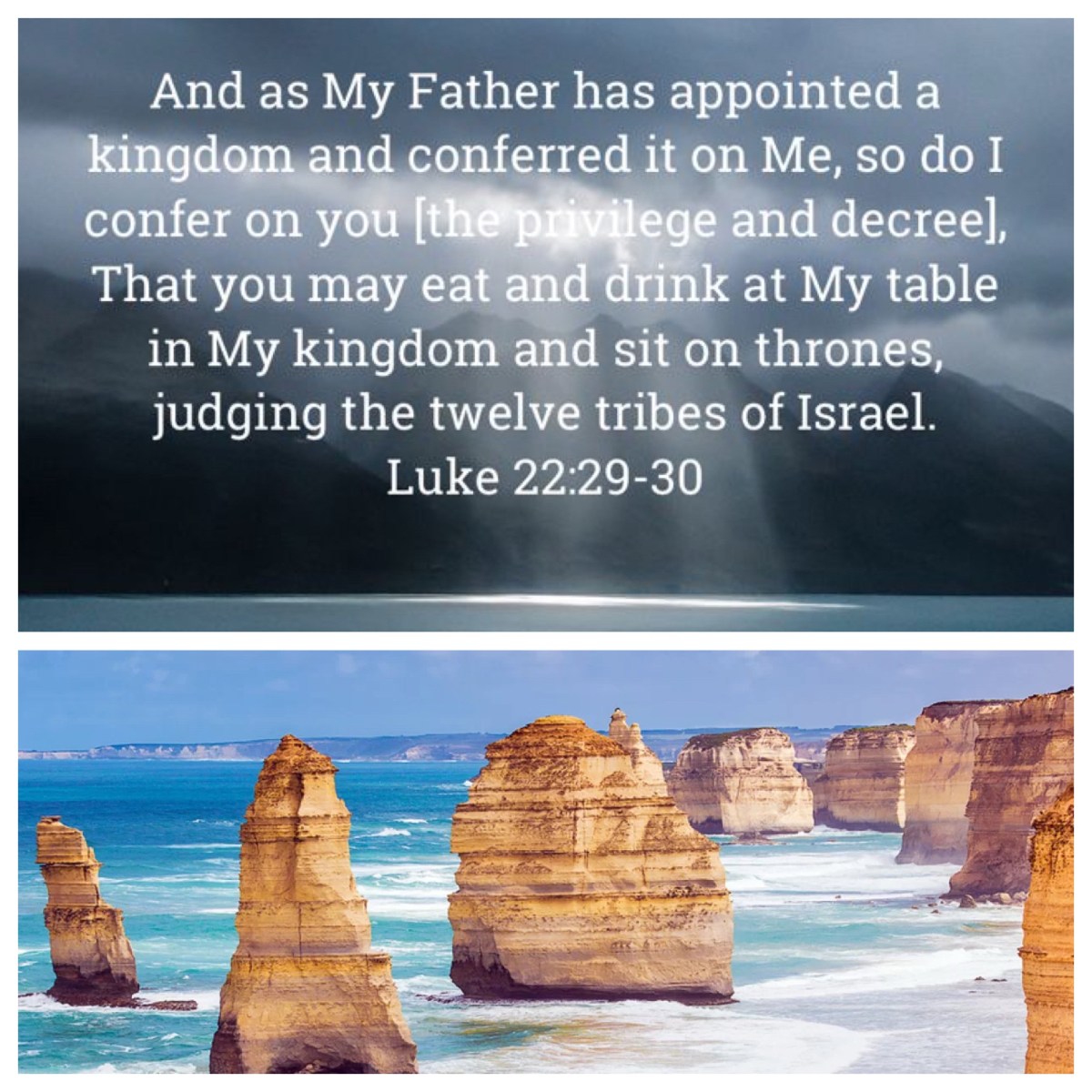
The reason for this may be that a few verses later, Jesus tells the disciples, “I confer on you, just as my Father has conferred on me, a kingdom, so that you may eat and drink at my table in my kingdom, and you will sit on thrones judging the twelve tribes of Israel” (Luke 22:29–30; a similar saying can be found at Matt 19:28). On the four occasions when “the twelve apostles” are designated (Mark 3:14; Luke 6:13; Matt 10:2; Rev 21:14) they are intended to mirror and replicate the twelve sons of Jacob, whose names were given to the twelve tribes of Israel.
In the traditions of the church, “The Twelve Apostles” has come to be a standard phrase. A non-canonical work setting out teachings of Jesus styles itself “The teaching of the Lord to the Gentiles by the twelve apostles” (Didache 1.1). This group appears to have ben known at some stage in the early period of the movement.
But there questions about who, exactly, makes up those twelve. Is Judas in “the twelve”? And if so, what about Matthias also (Acts 1:21–26)? Or is Matthias there in place of Judas? And what of poor Joseph Barsabbas, who like Matthias witnessed everything in the ministry of Jesus but missed out replacing Judas by a whisker? Are they not both apostles?
Paul indicates that Jesus appeared to “the twelve” (v.5) and “all the apostles” (v.8)—apparently alluding to narratives found in the later texts of three Gospels Matt 28:16–20, Luke 24:33–48; John 20:19–23, 24–29; 21:1–14. The appearances narrated in the shorter and longer endings of Mark, added after 16:8, are not relevant; these are later patristic additions based on the other three Gospels, designed to harmonise the ending of Mark with these others. Acts 1:6–11 might, however, be relevant here, for Jesus appears for the last time over the forty days since his resurrection (Acts 1:3) to an unnamed and uncounted group; Luke simply recounts that “they had come together” (1:6).
An interesting question is, how did Paul distinguish between these two groups—“the twelve” on the one hand, and “all the apostles” on the other. Indeed, these terms appear to be inherited by Paul from earlier traditions. This is the only place in all Pauline letters which refer to “the twelve”; and besides, the Gospel narratives noted above do not have Jesus appearing to “the twelve”, as Judas was absent from all of them, and so was Thomas in John 20:19–23.
As far as the word “apostle” is concerned, in 16 of the 18 occurrences in the Pauline corpus (including those not authentic to Paul) Paul explicitly apply the term to himself. Paul also acknowledges others as apostles besides himself: James (Gal 1:19), Peter (Gal 2:8), perhaps Barnabas (1 Cor 9:1, 5–6), and an unspecified number of believers who were given gifts to be apostles (1 Cor 12:28–29; see also Eph 4:11). Most strikingly of all , Paul describes Andronicus, a male, and Junia, a female, as “most esteemed amongst the apostles” (Rom 16:7). (And Jesus himself is called “the apostle and high priest of our confession” by the unknown writer to the Hebrews, at Heb 3:1).
Are any of these the people that Paul has in mind when he refers to “all the apostles” at 1 Cor 15:7? Or is this simply a phrase inherited from the tradition, which Paul has repeated? That seems the likely conclusion, to me. And did Paul have a picture of “the twelve apostles” in his mind? Again, I think that unlikely. He is simply using phrases from the tradition in what he writes to the Corinthians. And the origins of those phrases are now, to us, quite unclear.
So the conclusion that I hold to is that “the twelve apostles” was a theological construction devised at an early stage of the movement, that did not bear any relationship to any historical reality of which we are definitely aware.

off the coast of Victoria, Australia,
seen from The Great Ocean Road
 An Informed Faith