Depths and heights, sea and dry land (Psalm 95; Lent 3A)

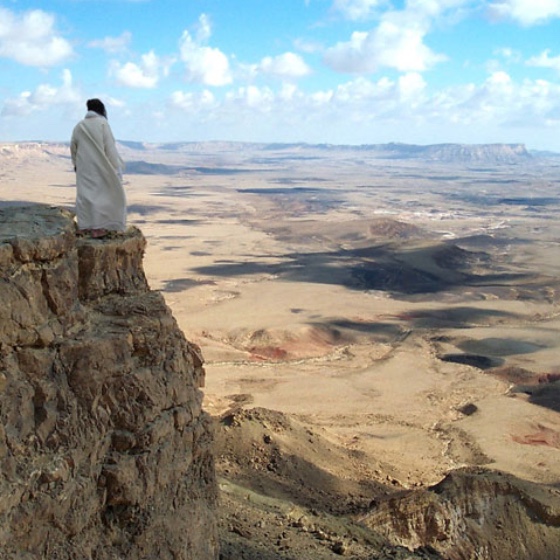
As we move through the season of Lent, in my own congregation we are meeting for daily prayers where the focus is on being “in the wilderness”. It’s a theme that is inspired by the Gospel from the First Sunday in Lent, when Jesus is led “into the wilderness” where he was tested. It is a story about becoming prepared for what lies ahead; Jesus would enter, after that wilderness time of engagement with The Tester, into the public ministry which is recorded in each of the Synoptic Gospels, when “he went throughout Galilee, proclaiming the message in their synagogues and casting out demons” (Mark 1:39).

As we journey through that (symbolic) wilderness during Lent, the scripture passages offered by the lectionary invite attention to key moments in the story of Israel (the Hebrew Scripture passages) and key encounters that Jesus had (the narratives from John’s Gospel), as well as a series of theological discussions from Paul (in his letter to the Romans).

And then we have the Psalms. This coming Sunday, Psalm 95 invites further reflection on God’s ways during this wilderness journey. It is a celebratory psalm, beginning “let us sing to the Lord; let us make a joyful noise … let us come into his presence with thanksgiving “ (Ps 95:1–2). The song continues in that same vein for a number of verses, celebrating God as “a great God” (v.3), creator of “the depths of the earth, the heights of the mountains … the sea … and the dry land” (vv.4–5), honouring him worshipfully as “our maker” (v.6) and inferring that God is the shepherd of all his people (v.7).
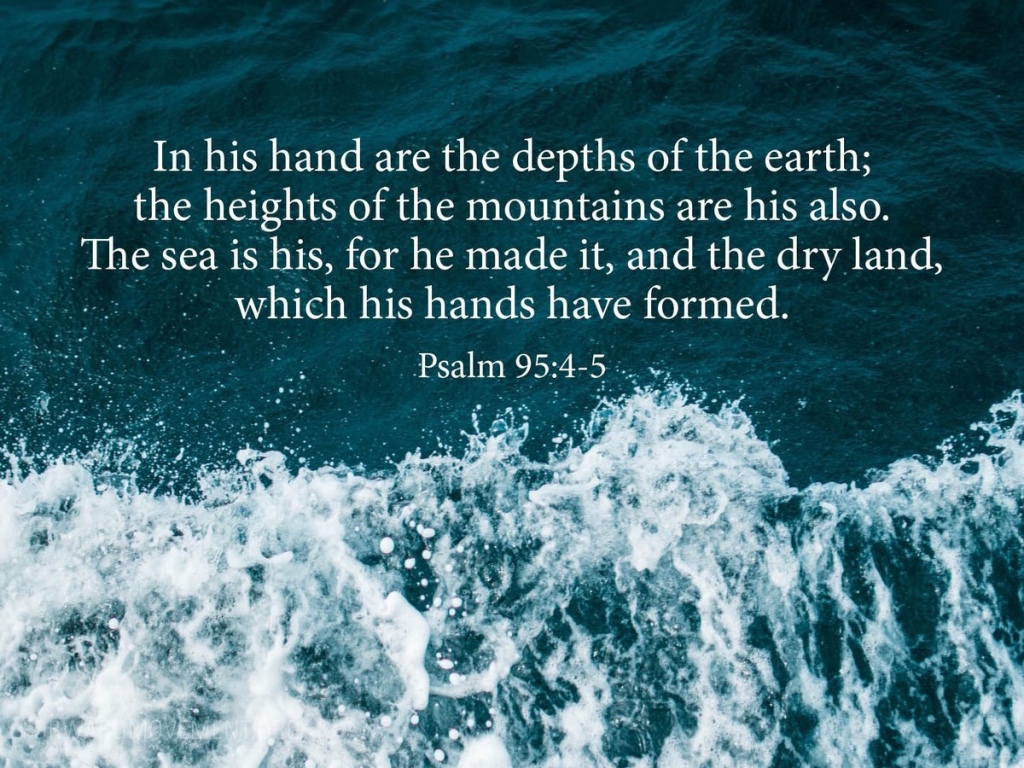
The celebration of God’s creative capacities in the the middle section of this psalm draws on themes which are regularly sounded by the Psalmist. God is celebrated as the “maker of heaven and earth” (Ps 134:3), the one who created “all mortals” (Ps 89:47), indeed all creatures (Ps 104:24–30), even “the north and the south” (Ps 89:12), “sun and moon, shining stars and highest heavens” (Ps 148:3–5). Second Isaiah evokes God as “creator of the ends of the earth” (Is 40:28) whilst Third Isaiah looks to God’s new creation, “new heavens and a new earth” (Isa 65:17–18).

In Proverbs, Wisdom marks off each of the elements noted in the psalm (depths and heights, sea and dry land) when she declares that “the Lord created me at the beginning of his work … when there were no depths, I was brought forth … before the mountains had been shaped … when he assigned to the sea its limit … when he marked out the foundations of the earth, then I was beside him, like a master worker” (Prov 8:22–30).

The depths of the earth were the place where sinful people went (Ps 63:9; Isa 14:15), following the lead of the Egyptians who pursued the Israelites and “went down into the depths like a stone” (Exod 5:4–5; Neh 9:11; Isa 63:11–13). There, in the depths, God’s anger burned (Deut 32:22). However, those banished to the depths were able to be brought back from the depths by God’s decree (Ps 68:22; 71:20; 86:13), so in one psalm we hear the cry, “out of the depths I cry to you, O Lord; Lord, hear my voice” (Ps 130:1), and the prophet Micah affirms that God “will cast all our sins into the depths of the sea” (Mic 7:19).

The heights are where the Lord God set the people once they had made their home in Israel, “atop the heights of the land … [where] he fed [them] with the produce of the land” (Deut 32:13; similarly, Isa 49:9; 58:14; Ezek 34:14). It is a place of security (2 Sam 22:34; Ps 18:33); indeed, “on the heights” is where Wisdom is to be found (Prov 8:2) and the Temple was built on the (relative) heights of Mount Zion, and so it is from “the holy height” that God looks down over the people (Ps 102:19).

However, for the prophet Jeremiah, “the bare heights” is the location for God’s judgement (Jer 12:12; 14:6). It is evident that, “on the heights”, the sinful people have “polluted the land” (Jer 3:2) and “perverted their way” (Jer 3:21). Accordingly, “a hot wind from me [comes] out of the bare heights in the desert … I speak in judgement against them” (Jer 4:11), for “on the bare heights the Lord has rejected and forsaken the generation that provoked his wrath” (Jer 7:29).

Just as the depths and the heights were parts of God’s good creation, so too the sea was integral to God’s creative works: “yonder is the sea, great and wide, creeping things innumerable are there, living things both small and great” (Ps 104:25). Yet the sea was a threatening place for the people of Israel, accustomed to life on the land, planting grapevines and herding sheep in “the land of milk and honey”. The sea of reeds was the place of destruction for Egypt (Ps 114:1–8), although it was also the location of salvation for Israel, as is celebrated in David’s song of praise (2 Sam 22:1–4, repeated at Ps 18:6, 12–19).

The dangers of the sea which the Israelites escaped are detailed in Psalm 124, recalling the threat of floods sweeping them away, torrents rising over them, raging waters submerging them. That psalm concludes, with a sigh of relief, “our help is in the name of the Lord, who made heaven and earth” (Ps 124:8). In the sea lurks the great sea monster, Leviathan (Job 3:8; Ps 104:26) of whom Job muses, “who can confront it and be safe” (Job 41:11). Only the Lord is able to subdue Leviathan (Ps 74:14; Isa 27:1).

For sailors, the sea could be a place of great danger (Ps 107:23–31)—the story of Jonah attests to this (Jon 1:4–17), as does the final trip of Paul as he is taken as a prisoner to Rome (Acts 27:14–20). Yet the power of the roaring sea, as majestic as it is, pales into insignificance beside the majesty of the Lord on high (Ps 93:3–4).

Just as the sea was a place of danger, so the dry land was a place of safety—as evidenced by the way the story of crossing the sea of reeds is told (Exod 14:21; Neh 9:11; Ps 66:6) and when Jonah is vomited up onto dry land by the fish (Jon 2:10). However, when the Psalmist finds themselves in “a dry and weary land where there is no water”, a prayer is offered to God because “my soul thirsts for you; my flesh faints for you” (Ps 63:1). When linked with “the wilderness”, “the dry land” receives blessing from God, who will “make the wilderness a pool of water, and the dry land springs of water” (Isa 41:18) and “pour water on the thirsty land, and streams on the dry ground” (Isa 44:3).

This opening section of the psalm might be seen to be a reworking of the creation narrative, crafted by the priests in the Exile, which is placed at the beginning of the Torah to signal its fundamental importance (Gen 1:1–2:4A). The deep” is initially covered by darkness, when “the earth was a formless void” (v.2), before God creates light. A dome is placed “in the midst of the waters” in order to separate the waters (v.6), and then God decrees, “let the waters under the dome be gathered together into one place, and let the dry land appear” (v.9). These were the fundamental building blocks for the intricate and complex creation which then evolved.

*****

After this celebration of creation—depths and heights, sea and dry land—there follows in Psalm 95 an exhortation directly to the people to “listen to his voice” (v.7b). The exhortation to listen is repeated often in Hebrew Scripture, in narratives (Exod 23:22; 1 Sam 15:1; 1 Ki 11:38), in works of wisdom (Job 37:2; Ps 81:11, 13; Prov 1:33; 8:32), and by various prophets (Isa 1:10; Jer 11:4; Ezek 40:4; Hos 4:1; 5:1; Joel 1:2; Amos 3:1; 4:1; 5:1; 7:16; 8:4; Mic 1:2; 3:9; 6:1; Mal 2:1–3).

The fundamental instruction to Israel throughout the long speech attributed to Moses in Deuteronomy is, “hear, O Israel” (Deut 5:1; 6:3; 9:1; 13:11; 20:3; 27:9); even the heavens and the earth are commanded to “give ear … hear the words of my mouth” (Deut 32:1). The Preacher advises, “to draw near to listen [to God] is better than sacrifice offered by fools” (Eccles 5:1), and The Sage instructs, “listen to advice and accept instruction, that you may gain wisdom for the future” (Prov 19:20).

Isaiah’s instruction to “listen to the teaching of our God” (Isa 1:10) is reiterated in both Second Isaiah (Isa 42:23; 46:3, 12; 48:12; 49:1; 51;1–7) and Third Isaiah (Isa 55:2–3; 66:6). Jeremiah is instructed to report God’s message to the people, “listen to my voice and do all that I command you” (Jer 11:4) recurs in later oracles (Jer 17:24–27; 26:1–6; 28:7).

The advice to Ezekiel, that “the house of Israel will not listen to you, for they are not willing to listen to me” (Ezek 3:7) leads to God’s severe warning, “I will act in wrath; my eye will not spare, nor will I have pity; and though they cry in my hearing with a loud voice, I will not listen to them” (Ezek 8:18; see also 13:19; 20:8; 20:39). Eventually, however, Ezekiel is commanded, “look closely and listen attentively … declare all that you see to the house of Israel” (Ezek 40:4)—which is precisely what he then does (Ezek 44:5–45:25; 46:1–18).

The instruction to listen is, of course, picked up by Jesus in his teachings (Mark 4:3, 9, 23; 7:14; 8:18; Matt 13:3, 16–17; 15:10; Luke 6:27; 8:8, 18, 21; 11:28; 13:32; 18:6; John 5:24; 8:47; 10:3, 16, 27; 14:24). At the Transfiguration, the disciples are instructed to “listen to him” (Mark 9:7; Matt 17:5; Luke 9:35).

The psalm as a whole ends on a sombre note, with a warning of God’s testing of Israel (vv.8–10) and a declaration that God’s punishment will stand (v.11). The note of exuberant celebration that marked the opening verses has dimmed. Yet the overall mood of the psalm is one of joyful appreciation of God’s creative works. It is a good reminder for us, to celebrate God’s creation, as we move though our (metaphorical) wilderness journey during Lent.

Reckoning what is right (Romans 4; Lent 2A) part two

In a previous post, I explored the first half of Romans 4, sections of which are offered by the lectionary as the Epistle reading for this coming Sunday, the Second Sunday in Lent (Rom 4:1–5, 13–17). See

There we noted that Paul quotes scripture texts, poses questions, and provides immediate answers to those questions, as he develops his argument. In this post, I will explore the origins of this style of developing an argument and continue on with an analysis of Paul’s argument in Romans 4.

What we see at work in the rhetorical style that Paul utilises in this letter is that he is not only functioning as a Pharisee, schooled in the methods of midrashic treatment of scriptural texts; but that, as a hellenised Jew (educated in Jerusalem, yes, but living in Tarsus in the diaspora, according to Acts 22:3), he utilises the rhetorical techniques of the diatribe. This was a way of speaking in public that had been created by Bion of Borysthenes in the 4th century BCE, and then developed and refined amongst Greek rhetoricians and utilised particularly by Cynic philosophers in the ensuing centuries.

We know that diatribes were well-known in Ancient Greece; the 4th century playwright Euripides commented that “the peculiarity of the diatribe as distinct from other forms of popular moralizing lies in the assumed presence of an opponent. He is not permitted to reply, but his position is indicated by statements or rhetorical questions put into his mouth by the speaker, and thus the introduction of an objection in the form of a question becomes one of the characteristic features of the diatribe.” It is clear that this is a development of the dialogue form, so its origin is usually traced to the dialogues of Plato.

The popularity of the long-used form of diatribe is well attested into the Common Era in the work entitled Diatribes (more commonly translated as Discourses), published in the early 2nd century CE by Arrian, reporting the diatribes of Epictetus, a first century slave who studied Stoic philosophy and, after he gained his freedom, taught in Rome until Domitian banished all philosophers from Rome in 93CE. (Epictetus moved to Nicopolis and established a school there where he continued to teach Stoic philosophy.)

This demonstrates the enduring character and the widespread know,edge of this particular form of rhetorical argumentation. That Paul was using it quite extensively and to good effect in his letter to Rome (and also at places in other letters he wrote, it must be said) cannot be gainsaid.

Biblical scholars have explored how Paul adapts and utilises the diatribe method. Stanley Stowers pioneered this analysis in his book A Rereading Romans: Justice, Jews, and Gentiles (Yale, 1997), and Douglas Campbell has developed this approach most extensively in The Deliverance of God: an Apocalyptic Rereading of Justification in Paul (Eerdmans, 2009).

Campbell offers a clear explanation of the style: “Ancient diatribe is essentially a distinctive mode of discourse built largely with apostrophe [addressing a fictitious person as if they were present] and speech-in-character (a figure of speech in which an absent or imaginary person is represented as speaking; the technical name for this is prosopopoeia].”

Campbell explains that “A constructed character is generally addressed by the discourse’s central protagonist—who is a broadly Socratic figure—by means of the literary technique of apostrophe, so much of the discourse unfolds through the use of second person singular grammar. And that interlocutor then responds, whether in brief or at length, through the literary technique of speech-in-character, so here the author puts words in this character’s mouth.”

Campbell concludes, “The result is a dramatic discourse mimicking the to and fro of debate and conversation, although slipping were necessary into more extended speeches by one or the other party.” (Campbell, The Deliverance of God, p.535)

We can see the resemblance of Paul’s style of argumentation in Romans, to this rhetorical strategy.

*****

In the second section of Romans 4, then, after having established the universal scope of God’s providential grace—for this is how God meets the universal spread of sinfulness amongst human beings—Paul focusses on the faith that Abraham showed, and it’s importance for believers in Rome( and elsewhere). The thesis for this part of the argument is immediately posed: the promise to Abraham (which he was given in Gen 12:1–3) was “not through the law but through the righteousness of faith” (4:13).

First, Paul indicates that the promise cannot be fulfilled only through “the adherents of the law”, for “the law brings wrath” (4:14–15; he expands on this in chapter 7). Then, he asserts that the promise must rest on faith, both to those who adhere to the law but also “to those who share the faith of Abraham” (4:16). Abraham is here described as “the father of all of us”, drawing on yet another scripture citation (Gen 17:5; Paul uses the same argument at Gal 3:15–18, and the phrase is also at play in the debate reported in John 8:41–59).

Then follows further explication of this scripture (Gen 17:5), particularly explaining how Abraham, “hoping against hope”, became “the father of many nations” (4:17b—21). Despite the barrenness of Sarah’s womb (4:19), Abraham “was fully convinced that God was able to do what he had promised” (4:21). To conclude this exegetical foray, Paul quotes, for the third time, the foundational text: “his faith ‘was reckoned to him as righteousness’” (4:22, quoting Gen 15:6).

Paul then explains that these words describe not only the situation of Abraham, long in the last, but also the situation of those to whom he writes (4:23–24). This is a foundational aspect of Paul’s hermeneutic; he restates it at Rom 15:4, declaring that the scripture “written in former days was written for our instruction”. See

And so the argument draws to a close, moving back into the heart of Paul’s concern, to expound the Gospel concerning God “who raised Jesus Christ from the dead” (4:24–25). The final verse is most likely a traditional formulaic expression; we find a similar pattern at 1 Cor 15:3–4, a midrashic-style reflection on this pattern at 1 Cor 15:42–44, a variant form at 2 Cor 5:14–15, and extended discussion using the pattern of Christ, dead and raised, as the model for believers, “buried with him by baptism into death, so that, just as Christ was raised from the dead by the glory of the Father, so we too might walk in newness of life” (Rom 6:4). Paul provides a fuller discussion of this paradigm at 6:3–11, and there is a similar discussion, albeit varied for the different context, at Col 3:11–15.

The extended argument of this chapter (represented, unfortunately, by truncated excerpts in the lectionary offering) takes us from an initial question about Abraham, through an exploration of the story of Abraham, and Sarah, to a conclusion about the life of those who place their trust in what God has done through Jesus Christ; namely, that God “will justify [or, reckon as righteous] the circumcised on the ground of faith and the uncircumcised through that same faith” (3:30), and so, in like manner, “it will be reckoned to us who believe in him who raised Jesus our Lord from the dead” (4:24). It is all about being reckoned as righteous on the basis of faith.

As Paul would say: Thanks be to God!

Reckoning what is right (Romans 4; Lent 2A) part one

For the next two Sundays, the Epistle reading offered by the lectionary comes from the longest and most theologically weighty letter written by Paul—that addressed “to all God’s beloved in Rome, who are called to be saints” (Rom 1:7). Although it has this specific, localised audience in view, the letter has become a declaration heard and taken up and studied carefully by Christians right around the world, across millennia of years.

It is generally regarded as the most explicit and detailed exposition of the theological commitments which had energised Saul of Tarsus to spend years of his life “to be a minister of Christ Jesus to the Gentiles in the priestly service of the gospel of God, so that the offering of the Gentiles may be acceptable, sanctified by the Holy Spirit” (Rom 15:16). For this enterprise, he is well-known as the “Apostle to the Gentiles”.

The passages on offer this coming Sunday (Rom 4:1–5, 13–17) and the following Sunday (Rom 5:1–11) come from the heart of the letter, the long section often described as presenting Paul’s key theological understanding of the grace of God by which people of faith are justified (reckoned as righteous, or put right with God). This theological understanding is set forth, initially, through a quotation from a short book in Hebrew Scripture, that of the prophet Habakkuk.

Habakkuk is a shadowy figure, known, really, for only one statement—just half of one verse. That is the short statement, “the righteous live by their faith [or faithfulness]” (2:4b), which stands as the text upon which Paul developed his important theological statement in Romans: “in it [the gospel] the righteousness of God is revealed through faith for faith; as it is written, ‘the one who is righteous will live by faith’” (Rom 1:17). As well, Paul quotes this verse in his letter to the Galatians (Gal 3:11) and the verse is cited in the “word of exhortation” sent to the Hebrews (Heb 10:38). So it appears in significant writings of the early Christian movement.

In the context of Habakkuk’s prophetic activity, the affirmation that “the righteous live by their faith [or faithfulness]” (2:4b) is the word that God gives to the prophet, responding to his complaints about what sufferings are taking place. Habakkuk’s complaints come because God is “rousing the Chaldeans, that fierce and impetuous nation, who march through the breadth of the earth to seize dwellings not their own” (1:6), and through their dreadful and fearsome activities, God is “destroying nations without mercy” (1:17).

That God is using foreigners to deal with Israel is a striking theological development—one that is at odds with the traditions that emphasise Israel as a chosen nation, holy and set apart, dedicated to the Lord; the nation alone through whom the Lord God works. That this God will use foreigners is a theme found also in the later writings of Deutero-Isaiah (Isa 40–55), where Cyrus, the Persian ruler, is acclaimed as the one chosen by God, the Messiah, to allow the people of Judah to return to their land (Isa 44:24–45:13).

That God is at work amongst people who are not of Israel resonates, of course, with the activity that Paul and his fellow-workers had been undertaking amongst the Gentiles (those not of the people of Israel)—although Paul is not working in a context of oppression and threatening invasion. So this brief citation from Habakkuk is entirely apposite for Paul’s work and his writings. And as the later chapters of Roman clearly show, God has indeed been at work amongst the Gentiles in Rome.

Paul quotes a string of scriptures to demonstrate “that the Gentiles might glorify God for his mercy” (Rom 15:9–12); he writes of his goal “to win obedience from the Gentiles, by word and deed, by the power of signs and wonders, by the power of the Spirit of God” (Rom 15:18–19); and he affirms “all the churches of the Gentiles” (Rom 16:4). The letter concludes with a prayer of thanks (although most likely not from the hand of Paul), celebrating that “the revelation of the mystery that was kept secret for long ages but is now disclosed, and through the prophetic writings is made known to all the Gentiles” (Rom 16:25–26).

Habakkuk laments and complains about the situation in Israel of his time (the years immediately before the Babylonian invasion of 587 BC). God instructs him to “look at the proud—their spirit is not right in them”, and to be assured that “the righteous live by their faith” (2:4). The theme of the faith of the righteous that is signalled here by the prophet is a central motif in Hebrew Scriptures. It appears in the ancestral stories concerning the key figures of Abraham (Gen 15:6), Saul (1 Sam 26:23), David (2 Sam 22:21–26; 1 Ki 3:6), and Solomon (1 Ki 10:9). It is the motif that Paul takes up for his magnum opus, his theological bequest to later believers.

*****

The theme articulated in Rom 1:17—the claim that it is in the Gospel that “the righteousness of God is revealed through faith for faith”—is set forth in more detail at 3:21–26. Paul declares that “the righteousness of God has been disclosed, and is attested by the law and the prophets, the righteousness of God through faith in Jesus Christ for all who believe”, and proceeds to explain that “they are now justified by his grace as a gift, through the redemption that is in Christ Jesus, whom God put forward as a sacrifice of atonement by his blood, effective through faith”. This was evident in the past (in the story of Israel), and is further evident in Paul’s time, demonstrating that God “himself is righteous and that he justifies the one who has faith in Jesus”.

This explanation is dense, compressed, and complex. Interestingly, the lectionary completely avoids this seminal theological passage, which has been so important for the development of the classic doctrine of the Atonement! (By contrast, portions of chapter 5 appear in the lectionary on four different occasions, and parts of chapter 8 on seven occasions.) There are many key theological terms in 3:21–26 which require unpacking and explanation. Paul proceeds to offer that in the chapters that follow.

Chapters 5–8 have classically been regarded as an extended exposition of what 3:21–26 has set out, climaxing in the doxology of 8:31-39 as the climactic moment of the letter (“[nothing] will be able to separate us from the love of God in Christ Jesus our Lord”). In more recent interpretation, chapters 9–11 have been seen, not as an addendum (as earlier interpreters argued), but as a flourishing of the argument set out from 3:21 onwards, heading steadfastly to the doxological prayer of 11:33–36 (“O the depth of the riches and wisdom and knowledge of God … to him be the glory forever. Amen.”)

My own reading is consistent with this latter line of interpretation. See

Before all of this, however, Paul starts with the example of Abraham—for in Paul’s mind, the words written about Abraham in Genesis 15, ‘it was reckoned to him as righteousness’, “were written not for his sake alone, but for ours also” (Rom 4:23–24; the citation is from Gen 15:6).

The argument develops—unsurprisingly—in typical Pharisaic/rabbinic midrashic style—by posing questions, drawing on biblical texts, exploring details, and concluding with the text that draws the argument together—Abraham’s faith “was reckoned to him as righteousness” (Gen 15:6).

So we find the argument containing, first a general reference to Abraham (4:1–2), set forth as a rhetorical question which Paul nevertheless processes to answer! He does this by first quoting the key verse in his argument (4:3, quoting Gen 15:6)—introduced with a second rhetorical question—and then discussing what it means to “reckon” or to “justify the ungodly” (4:4–5).

Next, a quotation from the Psalms, beginning “blessed are those whose iniquities are forgiven” (4:6–8, citing Ps 32:1–2), which occasions a third question, posed in order to be immediately explored: exactly who is forgiven (4:9a)? Is this blessedness only for those circumcised (Jews), or does it encompass those beyond (Gentiles)?

Gen 15:6 is cited, for a second time, at 4:9b, opening the way for a discussion of when Abraham was “reckoned as righteous”—was it before he was circumcised, or after? This matter is stated in two short rhetorical questions (4:10a), followed immediately by the answer (4:10). The answer is obvious from a straightforward reading of the Genesis narrative; it was after Abraham was blessed by Melchizedek (Gen 14:7–15:6), before he was circumcised, after the birth of Ishmael (Gen 16:15–17:27). Circumcision, says Paul, is “a seal of the righteousness that he had by faith” (4:11), thereby making Abraham “the ancestor of all who believe without being circumcised” (4:11), as well as “the ancestor of the circumcised” (4:12).

This conclusion will prove to be foundational for Paul’s subsequent argument in the letter, which he has already flagged in earlier chapters: the Gospel is “the power of God for salvation to everyone who has faith, to the Jew first and also to the Greek” (1:16), and then, “all, both Jews and Greeks, are under the power of sin” (3:9), and finally, “the righteousness of God [is available] through faith in [or, the faith of] Jesus Christ for all who believe” (3:22).

Accordingly, he declares (in typical style, with questions driving to the obvious answer), “is God the God of Jews only? is he not the God of Gentiles also? Yes, of Gentiles also, since God is one” (3:29–30). The universal scope of God’s providential grace is clear; this is how God meets the universal spread of sinfulness amongst human beings.

In a following post, I will explore the origins of this style of developing an argument (quoting sources, posing questions, immediately providing answers) and continue on with an analysis of Paul’s argument in Romans 4.

“How can anyone be born after having grown old?” The questions of Nicodemus (John 3; Lent 2A)

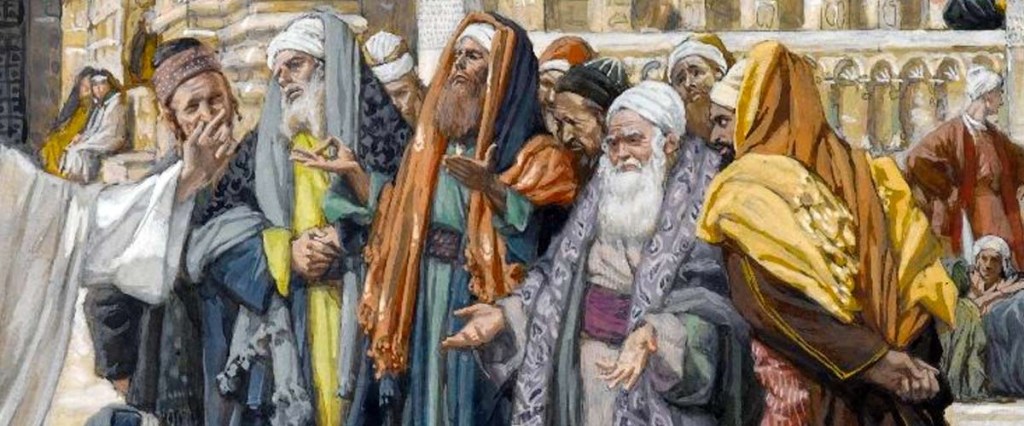
The Gospel reading for this coming Sunday (John 3:1–17) is set in a house in the dark at night, as a prominent named male member of the Jerusalem Sanhedrin engages in conversation with a teacher from Nazareth, discussing faith and life. As Jesus engages with him, the conversation moves through a series of phases, going deeper into the issues raised. It’s a carefully-crafted literary piece—as, indeed, are all the encounters that Jesus has in the first half of John’s book of signs.

The conversation proceeds by means of a standard narrative technique: a question is posed, an answer is offered, leading to a further question, another response, and still further question-answer interchanges. This is an age-old technique used in teaching and in story-telling. It was also a standard aspect of the way that teachers of the Law operated in ancient Israel.

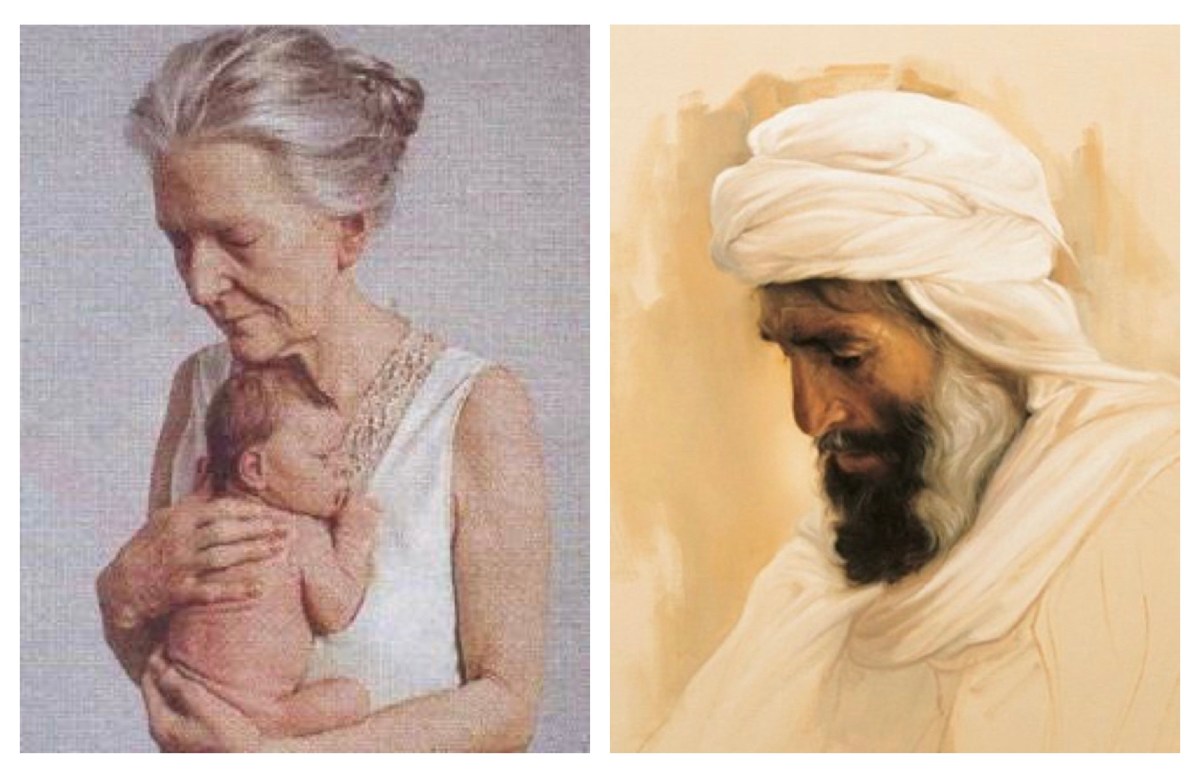
So the Pharisee of Jerusalem poses the question to the teacher from Nazareth: “How can anyone be born after having grown old?” and follows this immediately with a second question, “Can one enter a second time into the mother’s womb and be born?” (3:4). The reason for such a misunderstanding is that the Greek word used, anōthen, can be understood as “again” or “anew”, but can also be understood as “above”. In fact, “above” is by far the more common sense in which it was used. But the author has the teacher of Nazareth use this word, opening up a deliberate misunderstanding.

This misunderstanding, in turn, lead on to a response from the teacher (3:5) which digs deeper into the issues. Being born “from above” is akin to being born “of water and spirit”—or, it is possible to translate this, “of water and breath”. The Greek word placed on the lips of the teacher, pneuma, can refer to wind or breath—or spirit. Once again, a misunderstanding arises, giving opportunity for further exploration and instruction (3:5–8).

After the response from the teacher, the Pharisee asks a further question, “How can these things be?” (3:9)—to which the teacher from Nazareth responds, in the time honoured fashion (answer a question with another question), “Are you a teacher of Israel, and yet you do not understand these things?” (3:9-10). Touché!!

After this, the teacher from Nazareth launches into a longer explanation in response to the questions posed by the Pharisee of Jerusalem—an explanation which continues on for some time (3:11–21), leaving many commentators to wonder, just where does the conversation with the Pharisee from Jerusalem end, and where does the interpretive narrative of the evangelist take over? The Pharisee of Jerusalem has managed to draw from the man from Nazareth a teaching of some substance and significance.

This extended final section of the scene (3:11–21) contains clear evidence of the literary craft of the person who is telling the story. There are typical dualisms included in what the teacher says; he contrasts “earthly things” with “heavenly things”, “ascending into heaven” with “descending from heaven”, “perish” with “eternal life”, “condemn” with “save”—and, once again, “light” and “darkness”, a duality first expressed in the opening verses of the Gospel (1:4–9).

It also sets these dualisms into a pattern of parallel clauses, some of which provide a synonymous parallelism—two similar ideas placed in parallel (3:14; 3:19–20), some of which have antithetical parallelism—two contrasting ideas placed in parallel (3:12; 3:16–17; 3:18; and 3:20–21). Notice that this means that the final three verse of this section have an interweaving of both synonymous and antithetical parallelism, bringing the whole speech to a tight conclusion. “Coming to the light” is what Jesus desires, rather than “loving darkness”.

This is in fact the trajectory that Nicodemus has begun in this passage—the trajectory will continue on beyond into later sections of the Gospel. He has moved from an initial enquiry, through to a deeper pondering about what Jesus is saying. So this conversation has demonstrated a movement from the starting point, through a process that will ultimately lead to a clear expression of faith in in Jesus. We are left wondering, here in chapter 3: has the Pharisee become a disciple of the teacher from Nazareth?

The Pharisee of Jerusalem, we are told later in this Gospel, followed through after his initial conversation with the teacher (John 3)—in fact, he supported him in a debate in the Jerusalem council (John 7), and after the teacher had died, he publicly joined in the task of anointing his body and laying it to rest (John 19). His belief in what this teacher had taught, was now clear for all to see.

The Pharisee of Jerusalem had taken risks, explored his faith, and made significant changes in his life. He is a named high-status follower of Jesus, at least according to this particular Gospel, and his name is remembered throughout Christian history, by believers across the world: Nicodemus.

*****

In the Synoptic Gospels, it is Joseph of Arimathea who requests the body of Jesus from Pilate, and secures a safe place as the resting place for the body. In John’s Gospel, he does this in company with Nicodemus (John 19:39).

Joseph was “waiting expectantly for the kingdom of God” (Luke 23:51)—a phrase that recalls the discussion reported in John 3 (see verses 3 and 5). This “kingdom of God” was the very same phrase that is key to the preaching of Jesus in Mark and Luke. So Joseph was firmly aligned with Jesus and with his followers in Luke’s Gospel, whilst Matthew directly reports that he was “a disciple of Jesus” (Matt 27:57).

When Nicodemus first encounters Jesus, he had engaged in what might be characterised as an appreciative enquiry with Jesus, under the cover of night (3:2), presumably so that he didn’t “out” his interest in what Jesus was teaching. Some chapters later in John’s narrative, as Jesus experiences intensified opposition whilst in Jerusalem for the Festival of Booths (7:1–13), and the Pharisees and temple authorities join forces to send the temple police to arrest him (7:32), Nicodemus appears once more. The temple police return the temple, saying that they will not arrest him (7:45–46).

Nicodemus steps in; he is introduced as the one who “had gone to Jesus before, and who was one of them”—that is to say, one of the disciples (7:50). He speaks boldly: “our law does not judge people without first giving them a hearing to find out what they are doing, does it?” (7:51). The dismissive reply of the Pharisees further aligns him with Jesus; “surely you are not also from Galilee, are you?” is their rejoinder (7:52). His allegiance is clear, at least in the minds of the Pharisees, if not also the narrator of the Gospel.

Nicodemus returns a third time, after the death of Jesus, when the body of Jesus is requested by Joseph of Arimathaea, who is here clearly identified as being “a disciple of Jesus, but secretly, for fear of the Jews” (19:38). The fear of the Judean authorities has been a recurrent motif in John’s narrative (5:1; 7:13; 9:22; here, and 20:19). (The term I translate as “Judean authorities” is most commonly rendered as “Jews”, but this translation is too wide and does not accurately reflect the way the term is used in John’s Gospel.)

See further on “the Jews” at

Once again, Joseph is identified as a disciple of Jesus (John 19:38; so also Matt 27:57, and, as we have argued above, that is the implication in both Mark 15 and Luke 23). Both Joseph and Nicodemus, we might presume, were numbered among the “many, even of the authorities, [who] believed in him”, but who, “because of the Pharisees, did not confess it, for fear that they would be put out of the synagogue” (12:42).

The manner in which the body of Jesus is removed from the cross into the grave, anointed with an extravagantly large amount of spices, myrrh and aloes and wrapped in linen cloths “according to the burial custom of the Jews”, and placed in a previously unused tomb (19:38–40), reflects the tender, respectful approach of these two of Jesus’s disciples.

See more on Joseph at

So the Pharisee of Jerusalem is a character of some significance in John’s book of signs; he traces a pathway which the author hopes that those who hear his story or read his book will also follow, for “these are written so that you may come to believe that Jesus is the Messiah, the Son of God, and that through believing you may have life in his name” (20:31). It’s a most appropriate story, and relevant invitation, for the season of Lent.

*****

On what we know historically about the Pharisees, see

Blessings and greatness: a promise for the ages (Gen 12; Lent 2A)

This year during the season of Lent, the Gospel readings offer a series of narratives which describe encounters that Jesus had (largely from the Gospel according to John). In parallel to those stories, in the Hebrew Scripture readings, the lectionary offers a sequence of passages telling some of the key moments in the story of Israel (from Genesis, Exodus, 1 Samuel, and Ezekiel),

This sequence of key moments in the story of Israel offers a series of vignettes of faithful people from the past—our ancestors in the faith who stand as role models to encourage us, centuries later, in our own journey of faith. They are figures which are worth holding up for our reflection and consideration. These stories each have the function of an aetiology—that is, a mythic story which is told to explain the origins of something that is important in the time of the storyteller.

The online Oxford Classical Dictionary defines the term as follows: “Aetiology in religion and mythology refers to an explanation, normally in narrative form (hence ‘aetiological myth’), of a practice, epithet, monument, or similar.” Whilst telling of something that is presented as happening long back in the past, the focus is on present experiences and realities, for “such explanations elucidate something known in the contemporary world by reference to an event in the mythical past”.

See https://oxfordre.com/classics/display/10.1093/acrefore/9780199381135.001.0001/acrefore-9780199381135-e-7050;jsessionid=3DB38C42C54D01E1CBFA8682FB55DA4C

The ancestral narratives of Israel (Gen 12–50), as well as the series of books known as “the historical narratives” (Exodus to 2 Kings, Ezra—Nehemiah) are all written at a time much later that the presumed events which they narrate. The final form of the books as we have them most likely date to the Exile or post-exilic times, although pre-existing sources would have been used for many of these stories. (There are specific references to earlier written documents—now lost to us—scattered throughout 1—2 Kings.)

Those older stories were remembered, retold, and then written down, because they spoke into the present experiences of the writers. Common scholarly belief is that the stories found in Gen 12–50 were originally oral tales, that were collected together, told and retold over the years, and ultimately written down in one scroll, that we today call Genesis.

*****

For this coming Sunday, we are offered the account of the calling of Abram, who journeys into a new future (Gen 12:1–4a, Lent 2A). This has been a key passage for Jews throughout the centuries; Abram is remembered and honoured as “the father of the nation”—indeed, as “the father of all nations”; and this passage claims that it was God’s intention to grant the blessing of abundant descendants to Abram and his wife, to fulfil this promise.

The passage is found after the opening 11 chapters, which are often labelled the “Primeval History”, since they recount the creation of the world and the sequence of events which were fundamental for understanding human existence (such as human sinfulness and conflict, the expansion of humanity, the great flood, the growth of tribal entities, and the diversification of languages).

The passage also stands at the head of those stories, originally oral, which were collected because they revealed much about the nature of Israel as a people and as a nation. These chapters tell stories about the patriarchs and their wives (Abram and Sarai, Isaac and Rebekah, Jacob and Leah and Rachel). This particular passage introduces key themes for the people of Israel.

A word of caution: the lectionary stops in the middle of verse 4: “Abram went, as the LORD had told him; and Lot went with him”. To be fair, however, we need to read beyond the point where the lectionary ends this passage; that selection indicates that Abram took Lot with him, but the narrative actually continues, indicating that Abram travelled with his wife Sarai and his nephew Lot, “and all the possessions that they had gathered, and the persons whom they had acquired in Haran; and they set forth to go to the land of Canaan” (Gen 12:5).

The lectionary is, sadly, blatantly sexist at this point: it includes the names of the two leading males, Abram and Lot, but fails to note that they travelled with their spouses, Sarai and the (always unnamed) wife of Lot; and indeed there is reference to the presence of many others with them in their journey, which would undoubtedly have included both males and females within the extended family grouping. We need to read this ancient aetiology with a contemporary critical awareness. Certainly, the faith of Abram and Sarai and their extended family is a key message conveyed by this passage.

The story explains four important aspects of life and faith for the people of ancient Israel and on into contemporary Judaism: the land is given to this people, the people (of Israel) will become “a great nation”, the name (of Abram) will be blessed, and the descendants of Abram, “all the families of the earth”, will likewise be blessed. These four points—land, people, name, descendants—loom large throughout the history of Israel. Indeed, they maintain their potency into the present age—and need to be read and understood with political and cultural sensitivity today.

*****

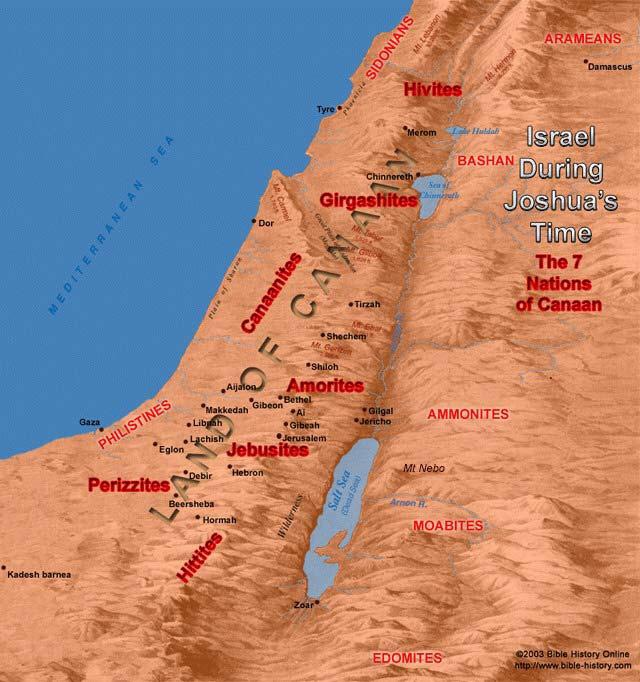
The story makes it clear that the land of Canaan was given by God to Abram and his descendants. As the story continues beyond the section offered by the lectionary, “they set forth to go to the land of Canaan. When they had come to the land of Canaan, Abram passed through the land to the place at Shechem, to the oak of Moreh. At that time the Canaanites were in the land. Then the LORD appeared to Abram, and said, ‘To your offspring I will give this land.’ So he built there an altar to the LORD, who had appeared to him.” (Gen 12:5–7).

Laying claim to the land of Canaan us a thread that runs through Hebrew Scripture. The promise of land is repeated in the covenant with Abram: “your descendants I give this land, from the river of Egypt to the great river, the river Euphrates, the land of the Kenites, the Kenizzites, the Kadmonites, the Hittites, the Perizzites, the Rephaim, the Amorites, the Canaanites, the Girgashites, and the Jebusites” (Gen 15:18–21). The long list of names of those inhabiting this land indicates the extent to which this promise would prove to be disruptive for these peoples.

The promise to Abraham was confirmed to Isaac (Gen 26:3) and to Jacob (Gen 28:13), and the full extent of the promised land was set out in Exodus 23:31, “from the Red Sea to the sea of the Philistines, and from the wilderness to the Euphrates”. By the time of the United Kingdom, it is said that “Solomon was sovereign over all the kingdoms from the Euphrates to the land of the Philistines, even to the border of Egypt” (1 Ki 4:21).

The disruption to the inhabitants from the invasion and colonisation by the incoming Israelites is told in detail through the book of Joshua, when the people enter the land and cause havoc for the inhabitants; and the book of Joshua, indicating how the “settlement” of the land required centuries of battles and conflicts.

When first the northern kingdom, then the southern kingdom each went into Exile, the yearning to return to the land was strong. When Jeremiah buys a field in his hometown of Anathoth from his cousin Hanamel (Jer 32:1–15), the purchase serves to provide assurance that the exiled people will indeed return to the land of Israel; “houses and fields and vineyards shall again be bought in this land” (Jer 32:15).

Ezekiel, speaking for God, declares that the people “shall know that I am the Lord their God because I sent them into exile among the nations, and then gathered them into their own land. I will leave none of them behind; and I will never again hide my face from them, when I pour out my spirit upon the house of Israel, says the Lord God” (Ezek 39:28–29).

As a sign of his confidence that God will maintain his commitment to Israel, Ezekiel tells in detail his vision of the new temple that would, he believed, be built in the land (40:1–43:27), as well as the role of the Levitical priests in that temple (44:15–31) and various provisions that would be in force after the return to the land (45:1–46:24).

Third Isaiah predicts that “your people shall all be righteous; they shall possess the land forever” (Isa 60:21); he speaks of a time when “they shall bring all your kindred from all the nations as an offering to the Lord, on horses, and in chariots, and in litters, and on mules, and on dromedaries, to my holy mountain Jerusalem, says the Lord” (Isa 66:20). The focus on the land is a strong thread running throughout Hebrew Scripture.

*****

The claim that the people of Israel have made for their land has been contentious throughout history—not least in the last 80 years, since the post-WWII settlement re-established the modern state of Israel in this precise area. This return of the Jews to their homeland after World War Two was implemented with little concern for what it would mean for the people who had long lived in the area—those now identified as the Palestinians.

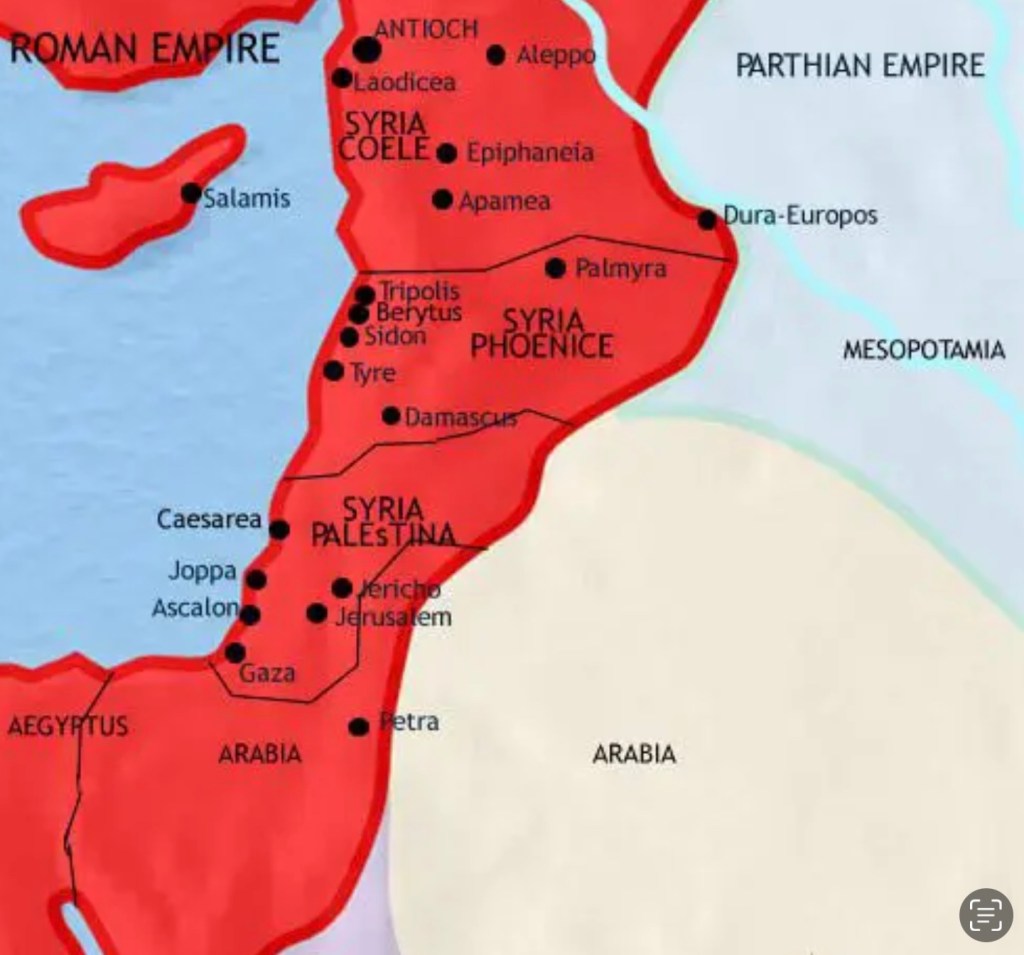
The term Palestinian is ancient term, being used by the Greek historian Herodotus five centuries before the common era (BCE) to designate “a district of Syria, called Palaistinê” between Phoenicia and Egypt” (Histories 1.105). The term was subsequently used by numerous Greek and Roman writers.

In the early 2nd century CE, the term “Syria Palestina” (literally, “Palestinian Syria”) was given to the Roman province of Judea, which had been the area ruled over by kings of the Southern Kingdom after the time of Solomon. This occurred after the uprising led by Bar Kochba—so the designation was for a land which no longer had many Jewish inhabitants.

Roman Provinces c.200CE

In putting down the Jewish uprising, the Romans had also removed Jews from Jerusalem and the surrounding rural areas, which they renamed Colonia Aelia Capitolina. Aelia came from Hadrian’s nomen designating his gens, Aelius, while Capitolina indicated that the city formerly known as Jerusalem was dedicated to Jupiter Capitolinus, to whom a newly-built temple was dedicated.

So the contest between ‘Israel’ and ‘Palestine’ was an ancient enmity which was revived and intensified from 1948 onwards. The homeland had been given to the Jews in the aftermath of the Shoah, also called the Holocaust, perpetrated by Nazi Germany and its sympathisers. For Palestinians, yet he establishment of the Nakba, a period in which the displacement of many local populations has taken place. Unfortunately, and unjustly, this continues even today under the Israeli Government’s policy of continuing to establish new settler areas.

So whilst the passage about Abram and Sarai setting off, exuding hope and demonstrating trust in God’s promise, is a fine reminder of the need to have trust in Hod and to set our in faith in new directions in our discipleship, it is also now a fraught and contested word, given how it has been used to justify events millennia later. Let us speak of this passage with care.

*****

I am so pleased that my own church, the Uniting Church in Australia, has been thinking about our relationship with the Jewish People for a number of decades now, a nd that has included giving careful consideration to issues surrounding the land—both historical claims and current realities.

In 1997, a working group (of which I was a member) had presented a Statement to the national body of the church, the Assembly, in which these matters had been canvassed. The Assembly agreed to invite Uniting Church bodies and members to give consideration to these matters:

7.9 that the Jewish people have a particular historical, cultural, emotional and spiritual bond with the land of Israel, which is a central element of the Jewish faith, and which is inextricably bound to the history of the Jewish People;

7.10 that the historic roots, rights and aspirations of the Palestinian people must be properly acknowledged;

7.11 that from a properly informed position, and in the light of the moral tradition of Christianity, it can be appropriate for the Uniting Church to have and express a view about both Israeli and Palestinian policies and actions;

7.12 that the search for a just and lasting peace for all states and peoples in the Middle East merits prayerful engagement on the part of all Christians

See https://www.jcrelations.net/statements/statement/inviting-the-members-of-the-uniting-church-in-australia-to-ongoing-dialogue.html

In obedience to that guidance, whilst I was a member and, for a time, co-convenor of the Uniting Church’s National Dialogue with the Jewish Community, I took part in many vigorous discussions relating to these issues. I listened and learnt, as well as speaking, in those discussions.

In 2009, the Assembly received and adopted a full Statement on Jews and Judaism in which it reiterated “that the State of Israel and a Palestinian State each have the right to live side by side in peace and security”. See https://assembly.uca.org.au/rof/resources/learn-more/item/download/1109_09f709cccf49d83607c92e31d650d581

In 2011, following the work of another working group (of which I was also a member), the President and General Secretary issued an invitation to Uniting Church members “to consider taking peaceful action toward a resolution to the conflict”; it included a comprehensive set of suggested actions, including prayers, advocating with MPs, inviting speakers, supporting a relief or development project in the West Bank or Gaza, and supporting a boycott of goods produced in the illegal Israeli settlements in the Occupied Palestinian Territories. This was published under the heading of A Prayer for Peace, at https://assembly.uca.org.au/images/Ministries/ROF/images/stories/A_Prayer_For_Peace_Information_PageED.pdf

*****

Abram and Sarai stepped out in faith. That is a wonderful role model for us to emulate. Where they went, and what their descendants did, has given us pause for consideration. How do we venture into the new in ways that do not damage others?

Gather—Dream—Amplify: World Pride 2023

World Pride 2023 is taking place in Sydney at the moment. It started on 17 February and runs through to 5 March, with a concentration of Pride-related events in Sydney, including a fine Pride Concert last night and the annual Gay and Lesbian Mardi Gras Parade that is taking place later today, Saturday 25 February. This is the first time that World Pride has taken place in the southern hemisphere.

The theme for World Pride 2023 is Gather—Dream—Amplify. The website describes the event as “A time to listen deeply, learn, take action, protest and party … A time to dream. Imagine the future we want and demand it … A time to step aside, making sure there is an abundance of space for everyone. New voices. New dreams. A time for new perspectives and possibilities.” It is a positive, optimistic, affirmation.

World Pride has been held since 2000, when it took place in Rome. It was next held six years later, in Jerusalem (2006), and then a further six years later, in London (2012). Momentum grew, as subsequent gatherings took place in Toronto (2014) and then Madrid (2017).

Two years later, in 2019, World Pride was held in New York City, commemorating the 50th anniversary of the Stonewall uprising, with five million spectators attending in Manhattan over the central Pride weekend. The Stonewall uprising is widely considered to mark the start of the modern Gay Rights Movement (now more commonly referred to as the fight for LGBTQIA+ rights).

In 2021, World Pride was shared between Copenhagen, Denmark, and Malmo, Sweden. The Crown Princess of Denmark was patron of the event, making her the first ever royal to serve as patron for a major LGBTQ event.

This year, in Sydney, the key events include a Fair Day on Sunday 19 Feb, the formal Opening Ceremony and Concert in the Sydney Domain on Friday 24 Feb, the annual Mardi Gras Parade and Party on Saturday 25 Feb; a Human Rights Conference from Wednesday 1 to Friday 3 March; a First Nations Gala Concert and a Mardi Gras International Arts Festival and Film Festival; and on the last day, Sunday 5 March, a Pride March over the Sydney Harbour Bridge and a grand Closing Ceremony.

Faith communities are actively involved in World Pride 2023, with a full listing of events at https://www.worldpridefaith.com.au/?mibextid=S66gvF&fbclid=IwAR15hAd9eTPZqO1QlU_o_XyEBD7n8-dtFSChxoMGLr3ILkEBgjHvG2kdar8

The Uniting Church is strongly supportive of the event, and a number of Sydney churches are involved. See https://uniting.church/uniting-churches-welcome-world-pride/

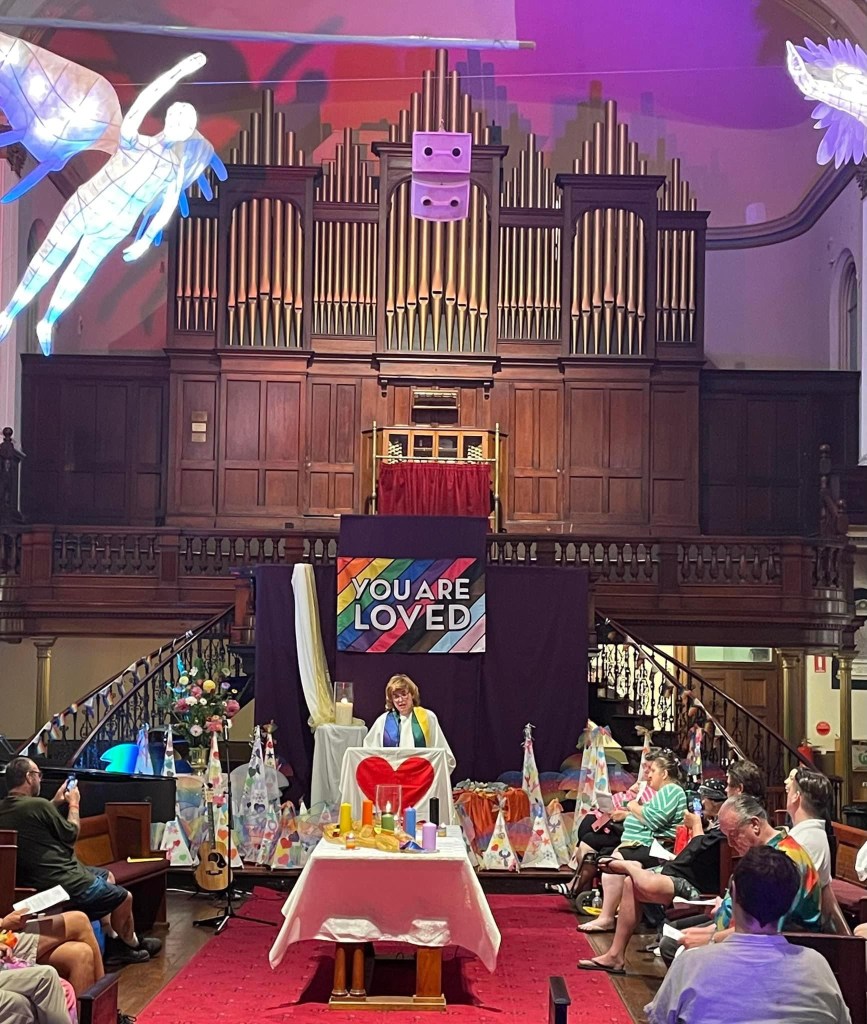
The Pitt St Uniting Church, located in the heart of Sydney, is actively involved in World Pride 2023, bringing a strong faith voice into the event. Pitt St is holding a photo exhibition, Queer Faces of Faith and providing a rehearsal space for the Out&Loud&Proud Choir rehearsals, as well as providing a safe and celebratory faith space and pastoral support to World Pride people in the heart of the CBD. A full program of prayer support for World Pride is operating as well. See https://pittstreetuniting.org.au/wp-content/uploads/2023/02/Diary-of-Praise-and-Prayer-for-World-Pride-2023.pdf

*****

Christians have had an unhappy relationship with LGBTIQA+ people. Sadly, far too many Christians hold a judgemental and discriminatory attitude towards people whom they regards as sinners, and many of these carry those negative attitudes through into discriminatory, oppressive, and damaging actions.

These negative attitudes were born long ago, in societies with different understandings of sexuality and gender. Many such societies of the past were centred around what they perceived as normality. “Normality” is what is most commonly found. “Normality” is also what is needed to ensure the ongoing survival of society. So regular reproduction of the species was essential in such societies, especially given the rate of deaths was much higher than in most modern societies.

The communities reflected in the Bible are no exceptions to this. Humanity is defined in Hebrew Scripture as needing to strive for perfection, so we see those who cannot see or hear, with missing limbs or those unable to speak, excluded from worship and community on the basis of how they differ from “perfection”. They are perceived as a threat to the good order and flourishing of society, because of their inherent “difference” from the norm. This is reflected in ancient Israelite law, and this continued on into in the understandings of the New Testament writers.

In modern times, our understanding of “normality” has broadened from such a binary understanding, to include now a spectrum of what is seen as “normal”. No longer do we exclude people on the basis that their physical appearance does not conform to the physical appearance of the majority of people, for instance. The understanding that the human brain operates on a spectrum has been well established, and we are now used to hearing regular references to the fact that neurodiversity in human beings has placed people at various points along a spectrum of neurological functioning.

The same applies to human sexuality. As further research is done, it has becoming increasingly clear that the way that people experience and express their sexuality, like the way that the brains of different people function differently, exists on a spectrum and is not confined to a binary state. Gender identity and sexual orientation both sit on such spectrums rather than existing in oppositional binary states.

Within such spectrums, there are “standard deviations” which we expect to find in any human population. This is a perfectly “normal” phenomenon. So, today we recognise that there is a range of gender identity along a spectrum of identities, and a range of sexual orientation along a range of sexual orientation.

Our Bible is an ancient document. It was written at a time when “normality” was seen as living within the divine favour and existing in a way that accords with the divine statutes. Those who failed to conform to the “normality” of those statues were seen as “abnormal”, incomplete and perhaps, at times, sinful. They occupied what we today call “the tails of the bell curve”. They were not seen as “normal”, since they were unable to promote the future of community.

In ancient times, sexual behaviour that fell into the expected variation of the tails of the bell curve was frequently perceived as “not normal” and threatening to the community, and an aberration that threatened the survival of the community. That is no longer the case for us, today.

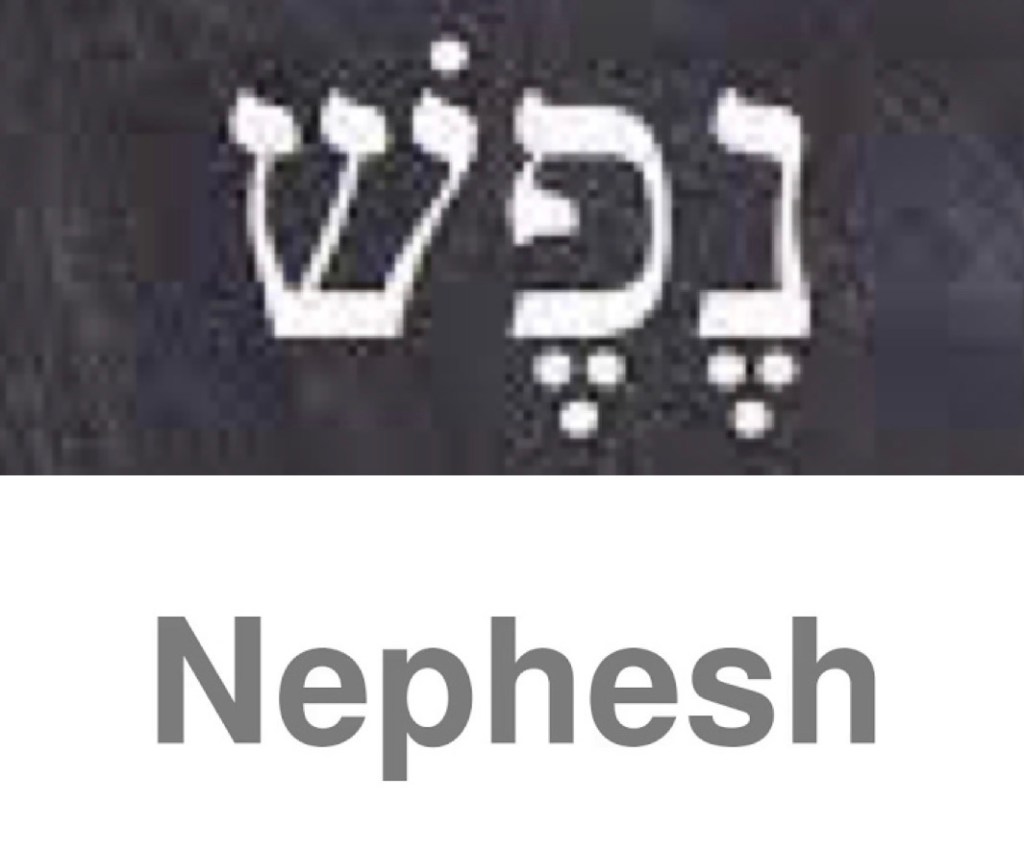
The Hebrew Scriptures use the word nephesh (נֶפֶש) to describe human beings (and, indeed, all other living creatures). It is a common Hebrew word, appearing 688 times in Hebrew Scripture. It is most commonly translated (238 times) as “soul”; the next most common translation is “life” (180 times). The word is a common descriptor for a human being, as a whole. (I have learnt much about nephesh in my discussions with my wife, the Rev. Elizabeth Raine.)

However, to use the English word “soul” to translate nephesh does it a disservice. We have become acclimatised to regarding the soul as but one part of the whole human being—that is the influence of dualistic Platonic thinking, where “body and soul” refer to the two complementary parts of a human being. In Hebrew, nephesh has a unified, whole-of-person reference, quite separate from the dualism that dominates a Greek way of thinking.

Nephesh appears a number of times in the first creation story in Hebrew scripture, where it refers to “living creatures” in the seas (Gen 1:20, 21), on the earth (Gen 1:24), and to “every beast of the earth, and to every bird of the air, and to everything that creeps on the earth, everything that has the breath of life (nephesh hayah)” (Gen 1:30).

It is found also in the second creation story, where it likewise describes how God formed a man from the dust of the earth and breathed the breath of life into him, and “the man became a living being (nephesh hayah)” (Gen 2:7). The claim that each living creature is a nephesh is reiterated in the priestly Holiness Code (Lev 11:10, 46; 17:11). So we human beings are part of a wide spectrum of creatures, all created by God, all seen to be “good”, a wonderful kaleidoscopic variety of beings.

Our theology of the human being needs to underline the claim that all people, no matter where they are located on the bell curve, are “nephesh” and are filled with the sprit of God. We are all part of the creation that, in Christian and Jewish mythological, God declared “very good” (Gen 1:31). We are, each and every one of us, “fearfully and wonderfully made”, as the psalmist sings (Ps 139:14a)—like the intricate, complex, and beautiful created world in which we live, each human being is, exactly as they are, one of the “wonderful works” of the Lord God (Ps 139:14b).

And that is exactly what World Pride 2023 is celebrating!

*****

See also

and for Canberra people, there is a safe space every Sunday morning at 9:30am and once a month on Sunday at 6:00pm (the 2nd Sunday of the month) at Tuggeranong Uniting Church, where Elizabeth Raine and Sharon Jacobs lead the ministry team. See

and for further biblical discussion, see

Original Sin? or Innate Goodness? (Genesis 2, Romans 5; Lent 1A)

In one of his most memorable sayings, repeated by many in the centuries since he wrote his letter to the Romans, Paul declares that “God proves his love for us in that while we still were sinners Christ died for us” (Rom 5:8). In the following verses, he goes on to discuss precisely how Jesus deals with sinfulness by drawing on his understanding of the second creation story (Gen 2:4b—3:24). Paul places Jesus alongside Adam, declaring that “just as one man’s trespass led to condemnation for all, so one man’s act of righteousness leads to justification and life for all” (Rom 5:18).

The argument forms the basis of the Epistle reading for this coming Sunday, the First Sunday in Lent (Rom 5:12–19).

Paul then restates this equation in the following paired affirmation, “just as by the one man’s disobedience the many were made sinners, so by the one man’s obedience the many will be made righteous” (Rom 5:19), before he concludes, “where sin increased, grace abounded all the more, so that, just as sin exercised dominion in death, so grace might also exercise dominion through justification leading to eternal life through Jesus Christ our Lord” (Rom 5:20b—21).

The reality of sinful behaviours amongst human beings cannot be denied. Throughout history, people have always experienced the selfishness, greed, manipulation, abuse, and hatred manifested by others (as well, of course, as loving, selfless, caring, supportive and encouraging behaviours and ways of relating). That this sinfulness needs to be addressed and dealt with cannot be ignored. That God, in Hebrew Scriptures, stands firm for justice and calls for covenant fidelity, is important. That Jesus, in turn, calls out unjust actions and invites sinful people to repent, is consistent with this earlier witness. As a society, we need to function in healthy ways that foster co-operation. Dealing with sin, which impedes this healthy functioning, is vitally important.

Where many people come unstuck in relation to sin, however, is when we consider the origin of that sinfulness. Are human beings born innately sinful? Or is this a way of behaving and relating to others that we learn as we grow and develop? Or, to put it in explicitly theological terms: are we human beings all caught in the grip of original sin?

*****

That is a view that was advocated centuries ago by Augustine of Hippo, and which has come to dominate theological understanding in the church of he ensuing centuries. Augustine read Paul’s words in Romans as a clear statement that every human being is born already scarred by sin. His view was that Paul understood the story in the early chapters of Genesis to be an explanation of this incontrovertible reality. As a result, Augustine declared that “the deliberate sin of the first man is the cause of original sin” (On Marriage and Concupisence, book 2, 26.43).

(Concupisence has a Latin origin: the root term is cupid, meaning desire or passion; it is given a suffix, –escere, used to change a noun into a verb and to signify entering into a particular state of being; and a prefix, con-, which serves to intensify the compound word. As a whole, it means “to desire strongly”; in theological usage, it usually refers to the innate tendency within human beings to sinfulness.)

Augustine based his view on a particular way of reading on Romans 5:12. The NRSV renders this verse as “just as sin came into the world through one man, and death came through sin, and so death spread to all because all have sinned”. A fair warning needs to be given: the argument about this verse is rather technical, because it depends on how we translate just two small words in the Greek original of this verse.

The two words in question are the preposition, epi, and the personal pronoun, ho, which comes immediately after it. Because the pronoun starts with an h sound (a “hard breathing” in Greek) and the preposition ends with a vowel, the natural inclination in Greek is that the preposition is modified so that it slides seamlessly into the pronoun. So epi hobecomes eph’ho.

But how to translate this short and seemingly simply phrase? Here’s where it really gets complicated! We need to take into account the phrase which comes before it, about sin, death, and one man, as well as the words which follow immediately after it, which are hugely significant: “all have sinned” (which of course goes to the heart of the idea of original sin).

Augustine wanted to read this text as stating that sin entered the world through Adam. Technically, he reads the Greek, eph’ho, as referring to the man, Adam. But scholars of Paul’s Greek have seen the problem with this interpretation: eph’ho [(ἐφ’ ᾧ)] as a reference to Adam is “both grammatically and exegetically impossible”, one says.

Rather, “eph’ho pantes hemarton [(ἐφ’ ᾧ πάντες ἥμαρτον)], can be safely interpreted as modifying the word, thanatos [(θάνατος)], which precedes it, and which grammatically is the only word which fits the context.” Each time the grammatical construction of the preposition epi [(ἐπί)] with the dative is used by Paul, it is always used as a relative pronoun which modifies a preceding noun (Rom 9:33; 10:19; 15:12; 2 Cor 5:4; Rom 6:21) or phrase (Phil 4:10).

So eph’ho [(ἐφ’ ᾧ)] is understood to modify thanatos [(θάνατος)]—kai houtos eis pantas anthropous ho thanatos dielthen eph’ho (thanato) pantes hemarton [(καὶ οὕτως εἰς πάντας ἀνθρώπους ὁ θάνατος διῆλθεν, ἐφ’ ᾧ (θάνατο) πάντες ἥμαρτον)]—”because of which” (death), or “on the basis of which” (death), or “for which (death) all have sinned.”

The quotes in the preceding paragraphs come from the technical discussion of this verse at https://hermeneutics.stackexchange.com/questions/14268/translation-of-romans-512

*****

Augustine bases his claim about original sin on his reading of the story of Genesis 2–3 (some of which appears in the lectionary for this coming Sunday, the First Sunday in Lent), which depicts the fall of Adam, from which all humans inherited innate sinfulness (original sin).

However, the problem is that the Genesis 1 account of creation which precedes this story (and which we read later in the year, on Trinity Sunday) makes it quite clear that the original state of humanity was that human beings, like all that God created, “was good”—indeed, that as the final act of that sequence of creation, humanity was “very good” (Gen 1:31). So much for original sin; humanity, according to this narrative, was part of a “very good” creation.

Indeed, Augustine was reading the sequence of early chapters in Genesis as historical narrative, and his understanding was that the consequences of “the fall” in Gen 3 was that every person born after Adam inherited that fallen state from the first human being. However, we know from a careful application of literary criticism, that the Adam story is myth which has an aetiological purpose, and that it is not an historical account.

That is, it does not give a realistic account of “things as they happened”, but rather, it is an imaginative story which tells of the reasons for the origin of things. It doesn’t answer the question, “what happened?”; rather, it responds to the question, “why are things like this?” So the Genesis story as a whole explains the good original state of humanity, before any decline or corruption took place. It is descriptive of how we find things, not prescriptive for how things should be.

In fact, we can see this nature of the story in the names given to these mythical first two human beings: the man, Adam (adam) was created “from the dust of the earth” (haadamah), and so his name signifies “the earth person” (Gen 2:7), whilst the woman, Eve (havah) was to be “the mother of all living creatures” (hay), and thus her name signifies “the giver of life” (Gen 3:20).

It’s not the case that what “occurs” with Adam and Eve has been passed on through human beings ever since; but, rather, it is the case that how we experience humanity has led to the creation of a story about Adam (the earth person) and Eve (the giver of life) as an explanation for the way that we experience ourselves, and other people on this earth.

*****

Augustine’s distinctive interpretation was his own initiative; most patristic writers prior to him who addressed this topic (Barnabas, Hermas, Justin Martyr, Origen of Alexandria, Clement of Rome, Ignatius of Antioch, Cyril of Jerusalem) offered explicitly different interpretations of the human state. By contrast, Clement of Alexandria accepted that sin was inherited from Adam, and Cyprian of Carthage argued for the necessity of infant baptism on the basis of a belief that humans were born sinful.

Augustine had developed his views in opposition to the view of his contemporary, Pelagius; the debates continued on into the medieval period, with significant contributions being made by the great theologians Anselm of Canterbury and Thomas Aquinas, as well as Franciscans such as Duns Scotus and William of Ockham. The Reformers, Martin Luther and Jean Calvin, adopted and developed the Augustinian view, which has held sway in the Western Church over subsequent centuries. Eastern Orthodoxy, by contrast, attributes the origin of sin to the Devil; what we humans have inherited from Adam is our mortality, but not any innate sinfulness.

This is all a long way, then, from prophetic fulminations against foolish, stupid, evil Israelites, caught in the error of their sinful ways, or the grace-filled encounters that Jesus had with sinners as he called “not the righteous but sinners”, or the formulaic affirmation of the first letter to Timothy, that “Christ Jesus came into the world to save sinners”, which has become the bedrock of certain contemporary theologies.

Whilst a recognition of sin is inherent in each of those texts, there is no indication in any way that such sinfulness is innate, inherited from birth, of the very essence of our human nature. The doctrine of original sin is not a biblical idea; it’s not something that we should be maintaining in our theological discourse and spiritual understanding.

But I think we are stuck with the scenario that Jesus ben Sirach described when he wrote his book, “pertaining to instruction and wisdom, so that … those who love learning might make even greater progress in living according to the law” (prelude to Sirach). He admonished his readers, “do not say, ‘His mercy is great, he will forgive the multitude of my sins,’ for both mercy and wrath are with him, and his anger will rest on sinners” (Sirach 5:6). That’s the paradox that sits, unresolved, throughout scripture, that we still need to grapple with for ourselves, when we think about human sinfulness.

*****

See also

Scripture debate and disputation in the wilderness (Matt 4; Lent 1A)

My earlier contention was that the story we are offered by the lectionary for this coming Sunday, the first Sunday in Lent (Matt 4:1–1), should be read as a story of testing, not tempting. See

***

Which leads to the question, what is it, that Jesus is being tested about? How does this story contribute to our understanding of what God was wanting, and planning, to do through the public activities of Jesus, in Galilee and then in Jerusalem?

The devil, as “the tester”, utilised scripture as the basis for the trial that Jesus is undertaking. And this, it must be said, is thoroughly predictable—given that we are dealing with a text from the first century of the common era, emerging out of the context of faithful Judaism, telling the story of a faithful Jewish man, Jesus, and his earliest circle of followers, all Jewish men and women. They all express the piety and faith of the Judaism of the time, for that was their religion and their culture.

Scripture sits at the heart of Jewish life and faith. Young Jewish boys, like Jesus, were taught to read the Hebrew text of scripture, and to memorise it. They were grounded in Torah, the books of the Law, which set out the way of life, the way of faithful living, that they were to follow. They needed to know this, to have it deep within their hearts. That would have been the upbringing experienced by Jesus.

As they grew older, these Jewish boys were taught the next stage, the midrashim, the teachings which provided explanation and application of the laws and stories embedded in Torah. There were two types of midrashim. The first was haggadah, which was telling stories; the Jewish teachers, the Pharisees, who became acknowledged over time as the rabbis, were excellent at telling stories, and Jesus learnt well from their examples.

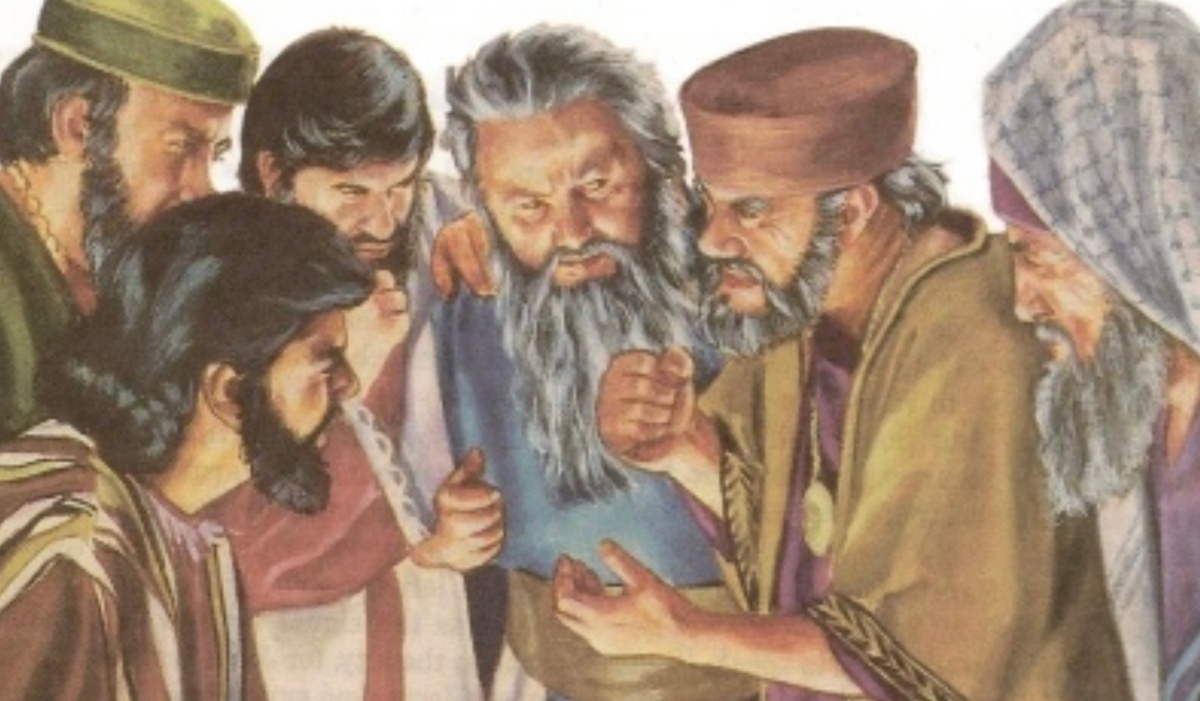
The second was halakah, which was discussion and debate about how best to interpret and apply the laws found in Torah. It is this latter form of teaching that we encounter, in the story of the forty days in the wilderness. The back and forth between the person on trial—Jesus—and the person charged with testing and probing his case—the accuser—is couched entirely in terms of sacred scripture. Each time an accusation is put before Jesus, the accuser quotes a passage of scripture. And each time the person on trial—Jesus—responds, another text from sacred scripture is quoted.

Think about that for a minute: both the accuser and the accused are citing scripture, arguing on the basis of what is found in the tradition and heritage and sacred story of the people of Israel. They are both engaged in this task, to get to the heart of the matter; to penetrate to the essence of the issue, through exploration of scripture and its relevance to Jesus and his mission.

This is typical Jewish midrashic argumentation. This is the way that, throughout the centuries, Jews have sought to encounter the truths of scripture—through discussion and debate, by one person posing a proposition and then another person arguing back in counter-proposition, through the adding of additional scripture passages into the argument, in a process of refining, sharpening, and clarifying the intent of the initial scripture text.

This was par for the course for ancient Jews. This is still the way that faithful Jews engage with scripture. My years as a member of the Uniting Church Dialogue with the Jewish Community immersed me into precisely this culture on a regular basis. It was quite an experience! To us polite, constrained Westerners, it seems like an unruly mess. To Jews, schooled in this process since their early years, it is natural, and results in deep and profound understandings of scripture.

*****

The specific scripture texts that are cited in the course of this testing are significant. They are the same in each extended version that we have (Matt 4, and Luke 4), albeit cited in a different order. And each of the three testing moments, with the associated scripture texts that are cited, relate to key moments in the story of Israel in the wilderness during their forty years of wandering. (I am indebted to my wife, the Rev. Elizabeth Raine, for this insight.)

Understanding the significance of each testing comes when we look more closely at the passages to which Jesus refers, and explore the resonances and connections that those texts have with other biblical passages. Just as Israel (the child of God) is tested during their forty years in the wilderness, so Jesus (the son of God) revisits those testings in his forty days in the wilderness.

The first moment of testing relates to bread: “command these stones to become loaves of bread”. The story evoked is that concerning the gift of manna which was given to the people of Israel as they sojourned in the wilderness. It is told in Numbers and referred to quite directly in Deut 8:3, the verse which is part-quoted by Jesus in the testing narrative, people do not live by bread alone. Could the mission of Jesus be diverted into concerns about sustenance and immediate survival, rather than longer-term strategies?

The second moment of testing, on the top of a mountain, relates to worship, and the recognition of the special and supreme place of the Lord God. The offer, “all these [kingdoms] I will give you”, is met by another quotation, by Jesus, from the same book: it is the Lord your God you shall fear; him you shall serve (Deut 6:13).

The story of the Golden Calf, told in detail in Exodus 32, sits behind this particular test. It is alluded to, perhaps not quite so directly this time, in Deut 6:14-15, the verses which come immediately after the verse quoted by Jesus. The incident involving the Golden Calf was when Israel “went off the rails”, developing an idol for the focus of their worship, rather than being focussed on God alone. The testing faced by Jesus was for him to gain power and authority in his own right, at the expense of serving the greater call that God had placed on his life.

The words of the tester in this second testing evoke the belief that God is able to allocate power and authority. The words of the tester explicitly resound with the claim made twice about the supreme authority of the Lord God, as reported in Jeremiah: “It was I who made the earth, human being and beast on the face of the earth, by my great power, with my outstretched arm; and I can give them to whomever I think fit” (Jer 27:5); and “Ah, my Lord God! You made the heavens and the earth with your great power and your outstretched arm; nothing is too difficult for you” (Jer 32:17).

The tempter has taken on the persona of God in this test. Jesus forcefully denies this test: it is the Lord your God you shall fear; him you shall serve.

The third and final test, placed on the pinnacle of the Temple, pits the possibility of testing God against the alternative of trusting absolutely in God. The tester’s challenge to Jesus, to “throw yourself down”, and the implication that God would save him (quoting Psalm 91) evokes the response from Jesus, quoting Deut 6:16, you shall not put the Lord your God to the test.

Test God … or Trust God? That was the age-old dilemma for Israel, noted at a number of points in the wilderness stories (for instance, Exod 17:2; Deut 6:16; Ps 106:14). It is one that Jesus himself encounters as the climax, in the Lukan version, of his wilderness testing.

The third Deuteronomy passage cited by Jesus, you shall not put the Lord your God to the test (Deut 6:16), comes immediately after the recital of The Ten Words which were given to Israel, through Moses, on Mount Sinai (Deut 5:1–21). As the scripture reports, Moses instructed the people to trust God by living in accordance with these words, for this was the way to life for them (Deut 5:27, 32–33).

So, to assist them in this enterprise, The Ten Words are then boiled down to One Great Commandment, love the Lord your God (Deut 6:5). This was a commandment which Jesus himself quoted and highlighted in debates with Jewish teachers (Mark 12:28–30; Matt 22:34–37; Luke 10:27). Indeed, in Matthew’s version of such a debate, Jesus identified this Word as “the greatest and first commandment” (Matt 22:38) on which “all the law and the prophets hang” (Matt 22:40).

This prime commitment, to God first and foremost, is what is alluded to by the citation that Jesus makes in his third testing. It is a test to see if he will divert from this singular focus.

This story of testing in the wilderness presents a communal challenge, and requires a communal commitment. The personal identity of Jesus, in the mission to which he is called, is found in the context of the communal identity of the people of Israel, who faced precisely these tests—and failed, in the accounts we have in Hebrew Scripture. The testings of Jesus are a reworking of those ancient testings; he is faced with the same tests—and passes them, in the accounts we have in Christian scriptures. That is the model we are offered through this story.

Tracing the saga of faithful people during Lent (Year A)

This year during the season of Lent, the Gospel readings offer a series of narratives which describe encounters that Jesus had (largely from the Gospel according to John). We hear of Jesus in dialogue with the devil in the desert (Matt 4, Lent 1), a Pharisee in Jerusalem (John 3, Lent 2), and a woman by a well in Samaria (John 4, Lent 3).

We then learn of a blind man to whom Jesus brings the gift of sight (John 9, Lent 4) and a dead man whom Jesus brings back to life (John 11, Lent 5), before we come to the annual retelling of the familiar story of Jesus, riding a donkey, entering the city of Jerusalem, to the cheers of the crowd (Matt 21, Lent 6 or Palm Sunday).

These stories tell of people who mostly, as a result of their encounters with Jesus, have their faith in God strengthened—the Pharisee, Nicodemus, at John 7:50 and 19:39; the woman of Samaria at 4:29, 39; the healed blind man at 9:17, 33; Martha, the sister of Lazarus at 11:27, and presumably Lazarus, as 12:10–11 may indicate; and the joyful crowd, at Matt 21:9–11. I am posting blogs on each of these readings as they come, in sequence, throughout Lent.

Alongside these well-known readings from the New Testament, the lectionary offers another sequence of rich readings from Hebrew Scripture. Starting with the story of the first man and first woman (Gen 2-3, Lent 1), we read in turn of four key moments in the story of Israel. This sequence begins with God’s call to Abram (Gen 12, Lent 2), followed the gift of water given to the Israelites as Moses leads them in the wilderness (Exod 17, Lent 3), and the story of the anointing of David as king (1 Sam 16, Lent 4).

The next moment is set during the Exile in Babylon (Ezek 37, Lent 5), when Ezekiel speaks a prophecy which assures Israel of a hopeful future: “I will put my spirit within you … and I will place you on your own soil” (Ezek 37:14). This reading sits neatly with the account of the raising of Lazarus (John 11) which appears alongside it on Lent 5.

For the celebration of Palm Sunday on Lent 6, there is only one Hebrew Scripture reading—Psalm 118, the psalm which the crowd is singing as Jesus enters Jerusalem: “blessed is the one who comes in the name of the Lord” (Ps 118:26; Matt 21:9). If, on the other hand, the Liturgy of the Passion is the focus of that Sunday, then the Hebrew Scripture passage is Isaiah 50:4–9a, the third of four songs attributed to The Servant, who declares that “the Lord has given me the tongue of a teacher, that I may know how to sustain the weary with a word” (Isa 50:4).

The sequence of key moments in the story of Israel offers a series of vignettes of faithful people from the last—our ancestors in the faith who stand as role models to encourage us, centuries later, in our own journey of faith. They are figures which are worth holding up for our reflection and consideration. These stories each have the function of an aetiology—that is, a mythic story which is told to explain the origins of something that is important in the time of the storyteller.

The online Oxford Classical Dictionary defines the term as follows: “Aetiology in religion and mythology refers to an explanation, normally in narrative form (hence ‘aetiological myth’), of a practice, epithet, monument, or similar.” Whilst telling of something that is presented as happening long back in the past, the focus is on present experiences and realities, for “such explanations elucidate something known in the contemporary world by reference to an event in the mythical past”.

See https://oxfordre.com/classics/display/10.1093/acrefore/9780199381135.001.0001/acrefore-9780199381135-e-7050;jsessionid=3DB38C42C54D01E1CBFA8682FB55DA4C

The ancestral narratives of Israel (Gen 12–50), as well as the series of books known as “the historical narratives” (Exodus to 2 Kings, Ezra—Nehemiah) are all written at a time much later that the presumed events which they narrate. The final form of the books as we have them most likely date to the Exile or post-exilic times, although pre-existing sources would have been used for many of these stories. Those older stories are remembered, retold, and then written, because they speak into the present experiences of the writers.

[Evidence for this is found, for instances, in references throughout the two books of Kings to “the Books of the Chronicles of the Kings of Israel” (1 Kings 14:19; 15:31; 16:5, 14, 20, 27; 22:39; 2 Kings 1:18; 10:34; 13:8, 12; 14:15, 28; 15:11, 15, 21, 26, 31), “the Books of Chronicles of the Kings of Judah” (1 Kings 14:29; 15:7, 23; 22:45; 2 Kings 8:23; 12:19; 14:18; 15:6, 36; 16:19; 20:20; 21:17, 25; 23:28; 24:5), and “the Book of the Chronicles of Solomon” (1 Kings 11:41). Many stories in other books may well be derived from oral tellings in past times.]

*****

The sequence of Hebrew Scripture readings in Lent begins with an aetiology which attempts to explain the place of humanity within God’s good creation, as well as offering an explanation for the presence of evil in the world (Gen 2:15–17; 3:1–7, Lent 1A). We need to read such a narrative with critical care; it is not an historical narrative, but it is a myth in the best sense of that word, a story told with creativity to explain aspects of contemporary life (for the writer) which may well hold good for later generations—but which need to be read with awareness of emerging insights in human knowledge over time.

Second in this sequence is the account of the calling of Abram, who journeys into a new future (Gen 12:1–4a, Lent 2A). We need to read beyond the point where the lectionary ends this passage; that selection indicates that Abram took Lot with him, but the narrative actually continues, indicating that Abram travelled with his wife Sarai and his nephew Lot, “and all the possessions that they had gathered, and the persons whom they had acquired in Haran; and they set forth to go to the land of Canaan” (Gen 12:5).

The lectionary is, sadly, blatantly sexist at this point: it includes the names of the two leading males, but omits noting that they travelled with their spouses, and indeed the reference to the presence of many others with them in their journey. We need to read this ancient aetiology with a contemporary critical awareness. Certainly, the faith of Abram and Sarai and their extended family is a key message conveyed by this passage.

The story explains four important aspects of life and faith for the people of ancient Israel and on into contemporary Judaism: the land is given to this people, the people (of Israel) will become “a great nation”, the name (of Abram) will be blessed, and the descendants of Abram, “all the families of the earth”, will likewise be blessed. These four points—land, people, name, descendants—loom large throughout the history of Israel. Indeed, they maintain their potency into the present age—and need to be read and understood with political and cultural sensitivity today.

After Abram and Sarai comes Moses and the people he is leading in the wilderness (Exod 17, Lent 3A). The long saga of the Exodus, the wanderings in the wilderness, the giving of the Law, and the understandings of the details of that Law, receives attention throughout four of the five books of the Torah (Exodus to Deuteronomy).

This particular incident in that long saga focusses on the providential care that the Lord God gives to the people of Israel during those “forty years in the wilderness”. The giving of water in the wilderness at Massah and Meribah (Exod 17) sits alongside the giving of manna and quails in the wilderness of Sin (Exod 16; Num 11). The model to emulate here is the faithful Moses, holding fast to the promise given to him by the Lord God, in the face of the complaining of the people (Exod 16:3, 6–7; 17:2–3, 7; Num 11:1–6; 14:27).

Next in the sequence of faithful people is David, chosen and anointed as king (1 Sam 16, Lent 4A). The passage offered by the lectionary tells of how David, the youngest of Jesse’s eight sons, was chosen by the prophet Samuel for the role of King, even while Saul was occupying that position. David will feature as a key player in the stories about the ensuing years, as “the house of David” is established and Jerusalem is developed as his capital city; and of course his place as the nominal author of the book of Psalms also ensures his leading role on Jewish tradition.

Next in order is the best-known prophecy of Ezekiel, the priest called to be prophet (Ezek 1:3). Ezekiel had been exiled to Babylon during the siege of Jerusalem by King Nebuchadnezzar II of Babylon (599 BCE; see 2 Kings 24:10–17). His prophetic activity was thus undertaken entirely in exile. He addresses both those in exile with him in Babylon, and also those left behind in Judah. His prophecies continue through the period when the people in Judah were conquered and taken to join Ezekiel in exile (587 BCE; see 2 Ki 25:1–21), and then for some time after that.

Ezekiel had declared that “the spirit entered me” (3:24), a process which he promises will be experienced by Israel as a whole (36:26–28)—for the Lord says he will “pour out my spirit upon the house of Israel” (39:29). This emphasis on the renewing spirit of God is seen, most dramatically, by Ezekiel when he is taken by the spirit into “the middle of a valley … full of bones” (37:1) and sees a vision that he conveys in what must be his most famous oracle (Ezek 37:1–14, Lent 5A). What Ezekiel sees in this valley of dry bones is the work of God, as God puts sinews and flesh and skin on the bones, and breathes into the bodies so created, so that they live (37:5–6, 8, 10).

The vision indicates what God will do: “I will put my spirit within you, and you shall live, and I will place you on your own soil” (37:14). The end of the exile, it seems, is in sight. This passage is often interpreted in a Christian context as a pointer both to the resurrection of Jesus, and also to the general resurrection; for Ezekiel, however, it is not a far-into-the-future prediction (foretelling), but a word of hope to the people in their immediate situation (forthtelling).

The sequence ends, of course, with the example of Jesus, riding steadfastly towards the city of Jerusalem (Matt 21:1–11, Lent 6A). That is the city where Jesus knows, and has already revealed, the fate in store for him: “see, we are going up to Jerusalem, and the Son of Man will be handed over to the chief priests and scribes, and they will condemn him to death; then they will hand him over to the Gentiles to be mocked and flogged and crucified; and on the third day he will be raised” (Matt 20:18–19).

Why did Jesus continue into the city, knowing this in advance? That’s a fascinating question, worthy of later consideration. For the moment, in this series of passages, we simply note his determined faithfulness and commitment to the task to which he had been called. He is the final figure of faithful commitment in the series that the lectionary takes us through during the season of Lent.