The second letter in the New Testament that is addressed to Timothy presents a scenario that sees Paul in prison (1:8; 2:9), where he is in contact with a group otherwise unknown from his letters—Phygelus and Hermogenes (1:15), Crescens (4:10), Carpus (4:13), Eubulus, Pudens, Linus and Claudia (4:21)—as well as with others known from letters of Paul and/or that narrative of Acts—Onesiphorus (1:16), Demas and Titus (4:10), Luke and Mark (4:11), Tychicus (4:12), Prisca and Aquila (4:19), Erastus (4:20), Trophimus (4:20), and Timothy himself (1:2).
We have already considered a number of these people connected with Paul; see
The next note is also brief, but reinforcing the mobility of the group: “I have sent Tychicus to Ephesus” (1 Tim 4:12). Tychicus is mentioned late in Acts, in a group which accompanied Paul as he returned to Greece and Macedonia: “Sopater son of Pyrrhus from Beroea, Aristarchus and Secundus from Thessalonica, Gaius from Derbe, and Timothy, as well as Tychicus and Trophimus from Asia” (Acts 20:4).
The author of Colossians (perhaps Paul, although I am not so sure) referred to Tychicus, indicating that he would “tell you all the news about me; he is a beloved brother, a faithful minister, and a fellow servant in the Lord (Col 4:7). These words are repeated almost verbatim in Ephesians (most likely a circular letter, drawing directly on Colossians at this point): “Tychicus will tell you everything; he is a dear brother and a faithful minister in the Lord” (Eph 6:21).
Yet another reference to Tychicus, but without any further description of him, occurs in the letter to Titus: “when I send Artemas to you, or Tychicus, do your best to come to me at Nicopolis, for I have decided to spend the winter there” (Titus 3:2).
Carpus and Alexander
Back to the second letter to Timothy; this letter moves towards a conclusion with further instructions to Timothy: “when you come, bring the cloak that I left with Carpus at Troas, also the books, and above all the parchments” (4:13). Of Carpus, the (temporary?) guardian of Paul’s cloak, we know nothing else.
Mention of Alexander the coppersmith introduces yet another figure into the Pauline circle—although this is the only mention of him, and like the note about Demas, this is not at all a positive note, for Alexander, the letter writer states, “did me great harm; the Lord will pay him back for his deeds” (4:14). Added to this comment is a warning to Timothy: “you also must beware of him, for he strongly opposed our message” (4:14). The polemical context in which Paul and his co-workers undertook their activities is evident at a number of places in Paul’s authentic letters, and the polemical aggravation of that time continued on, as is reflected in this and other comments in the matter Pauline letters.
*****
Further people named
In the verses beyond the section offered by the lectionary this Sunday, there are two more people named to be the recipients of greetings. “Greet Prisca and Aquila” (2 Tim 4:19)—a couple who are well known from Paul’s authentic letters (Rom 16:3; 1 Cor 16:19) as well as the account of Acts (Acts 18:2, 18, 26).
Then, “[greet] the household of Onesiphorus” (2 Tim 4:19)—also mentioned earlier in this letter, with quite some affection: “may the Lord grant mercy to the household of Onesiphorus, because he often refreshed me and was not ashamed of my chain” (2 Tim 1:16).
Then follows mention of what has happened to two individuals; first, “Erastus remained in Corinth” (2 Tim 4:20). Paul has identified Erastus as “the city treasurer” in Corinth, where he writes to the Romans (Rom 16:23); in Acts, we read that whilst in Ephesus, Paul “sent two of his helpers, Timothy and Erastus, to Macedonia, while he himself stayed for some time longer in Asia” (Acts 19:22).
Next, we read that “Trophimus I left ill in Miletus” (2 Tim 4:20). “Trophimus the Ephesian” is noted twice in Acts; the first time is in a list of people with Paul when he changed his travel plans in Greece. We learn that Paul “was accompanied by Sopater son of Pyrrhus from Beroea, by Aristarchus and Secundus from Thessalonica, by Gaius from Derbe, and by Timothy, as well as by Tychicus and Trophimus from Asia” (Acts 20:4). Trophimus is found here along with Aristarchus, Timothy, and Tychicus, already mentioned.
In the next chapter of the narrative of Acts, we encounter Paul in Jerusalem, and “Trophimus the Ephesian with him in the city, and they supposed that Paul had brought him [Trophimus] into the temple” (Acts 21:29), presumably as one of the “Greeks [he had brought] into the temple [who] defiled this holy place”, according to “the Jews from Asia” (Acts 21:27–28).
Finally, the letter ends with greetings being sent from a number of individuals who are not known elsewhere in the New Testament. “Eubulus sends greetings to you” and greetings were also given from “Pudens and Linus and Claudia and all the brothers and sisters” (4:21). Paul was nothing if not a networker supreme; the exchange of greetings in many letters indicate this quite clearly.
For a little over a year now, I have been editing a quarterly publication called With Love to the World. It provides short commentaries on the biblical passages offered in the Revised Common Lectionary, which is used by mainstream denominations of the Christian church around the world. The four passages offered each week are read in worship and one or more of them usually form the basis for the sermon in that service of worship. The publication seeks to prepare people to think about the passages in the week before they hear them in Sunday worship.
Recently, I have been working with material submitted by a group of contributors who have been working with the four lectionary passages, and an additional three biblical texts drawn from a recently-created lectionary, known as the Women’s Lectionary for the Whole Church. The contributions received form a special all-female issue of With Love to the World. (Well, all female, except for the Editor, yours truly!) This issue covers the seasons of Advent, Christmas, and Epiphany, and runs from mid November to mid February.
WLW has historically had more male contributors than females; in some issues, the ratio has been very one-sided. I have been seeking, since beginning as Editor, to have a better balance of gender amongst the contributors. So this issue is an attempt to provide a pendulum swing-to begin to redress the balance by having an all-female list of contributors.
Alongside that, I invited the contributors to “play” a little with the biblical texts offered each week. Amongst the seven passages each week, the four set lectionary readings need to be included; that is the staple of weekly reading for our many thousands of subscribers, and, of course, that is what is read and preached on in those churches which follow the Revised Common Lectionary.
The other three readings for each week come from the work of Professor Wilda C. Gafney, a Hebrew Bible scholar and Episcopal priest in the USA, who both serves in an AME Zion Church and teaches at Brite Divinity School. She has published a series of Women’s Lectionary for the Whole Church (Church Publishing, NY, 2021) in which she offers four readings for each week, following the usual pattern of Hebrew Bible, Psalm, Epistle, and Gospel.
The readings seek to offer the people of God “a lectionary centering women’s stories, chosen with womanist and feminist commitments in mind, fram[ing] the presentation of scriptures for proclamation and teaching” (Women’s Lectionary Year A, p.xxi). You can see the work that Prof. Gafney does at https://www.wilgafney.com/womenslectionary/
I’ve been enjoying the challenge, and the refreshing vitality, in the way that she highlights women in the texts, invites readers to imagine God in ways beyond the limited patriarchal understandings, and engages us with the creative imagination for understanding that we all possess.
She writes, “Part of what I want to accomplish is for people to know that even though the Bible is androcentric—parts of it are patriarchal, parts of it are paternalistic, and parts of it are misogynist—it’s possible to frame preaching texts around passages that include women and tell some new stories, while reckoning with how women are treated. If the gospel isn’t good news to the women in the passage, is it still good news? If it’s not good news to those who are enslaved in the passage, is it still good news?”
So, for the cover of this issue, Geraldine Wheeler has contributed a wonderful “Madonna and child”, contextualised to Australia, just as artists of other times and places have contextualised the story for their own settings (see below). Inside, Barbara Allen tells readers about her unusual spiritual discipline of writing haikus during Advent.
To start the series of commentaries, Anne Wright invites us to ponder, “if darkness, death, and despair have been defeated, how shall we live in the kingdom of light?” Continuing during the four weeks of Advent, Anita Monro meditates on “the way of the Womb of Life” as the theme for the season and explores “the responsibility we are given to act in and for” this way; and then Sarah Agnew ponders the paradox of a genealogy in which women “disrupt the male-dominated narrative of ancestry”, yet Mary is silenced and almost written out of the story of the birth of Jesus (Matt 1–2).
During the rather short Christmas season, Monica Melanchthon notes “the enormity of Israel’s need for a mothering God” (Isa 63); she observes how, in the Christmas story, “the divine mother changes grief into consolation” while “Joseph paves the way for a new understanding of masculinity”.
As we enter the season of Epiphany, Janice Mcrandal reflects on how we might read scripture in a way that “avoids simplistic readings and points us to a faith in Jesus that is not tied to idolatrous ideals of masculinity”, drawing from Elisabeth Schüssler Fiorenza’s critique of kyriarky. Kylie Crabbe then muses about what it might mean to read key biblical texts with an informed understanding of trauma, noting how “foreign occupation, violation, removal from country, and slavery” are narrated in Hebrew Scripture (and in the story of Jesus).
Elaine Ledgerwood follows the lead offered by Wilda Gafney by reading biblical texts, noting that “women’s voices were silenced in the patriarchal society of ancient cultures”, and inviting readers to replace male-focussed language with female-oriented terms; she asks, “what difference does this make for you?”
Reflecting on the image on the cover of the issue, Radhika Sukumar White comments “when a girl birthed the Saviour, they showed the world that the human body is not unclean, but holy, regardless of gender, orientation, ethnicity, and ability”. Alex Sangster concludes the issue with an invitation to “be in comfortable, curious contact with ‘negative’ emotions”, and then to “imagine Jesus holding your hand and saying, ‘you are my Beloved Child’”.
The second letter in the New Testament that is addressed to Timothy presents a scenario that sees Paul in prison (1:8; 2:9), where he is in contact with a group otherwise unknown from his letters—Phygelus and Hermogenes (1:15), Crescens (4:10), Carpus (4:13), Eubulus, Pudens, Linus and Claudia (4:21)—as well as with others known from letters of Paul and/or that narrative of Acts—Onesiphorus (1:16), Demas and Titus (4:10), Luke and Mark (4:11), Tychicus (4:12), Prisca and Aquila (4:19), Erastus (4:20), Trophimus (4:20), and Timothy himself (1:2).
In this post, we encounter two figures who are well-known in Christian history—because their names have been attached to two of the four Gospels that are included in the New Testament.
Luke
The author appears to have been a part of a larger group of co-workers, now somewhat diminished; “only Luke is with me” (4:11). There are two other mentions of Luke in Pauline material. One comes at the end of the personal letter to Philemon: “Epaphras, my fellow prisoner in Christ Jesus, sends greetings to you, and so do Mark, Aristarchus, Demas, and Luke, my fellow workers” (Phlm 23–24). So Luke was a real historical figure, and a fellow worker alongside Paul at some stage.
The other is in the letter to the Colossians, where the writer reports that “Luke, the beloved physician, and Demas greet you” (Col 4:14). This short note appears in a longer concluding section (Col 4:10–18) which shares many qualities with 2 Tim 4:9–22, since a number of individuals are identified as a way of strengthening relationships across the communities of faith as a way to conclude the letter.
The Colossians description of Luke as “the beloved physician” was swiftly adopted in the developing second century apologetic which sought to identify each of the four canonical Gospels with figures in the apostolic age. Matthew and John were attributed to individuals named within “the twelve”, whilst Mark was associated with Peter, another of “the twelve”. (Outside the canon, the same apologetic move is undertaken in relation to the Letter of Barnabas; similar apologetic claims are placed in opening verse of the Gospel of Thomas.)
The third Gospel was linked with Paul through the purported author, “Luke, the beloved physician, companion of Paul”—a description which collates the mentions of Luke in Philemon, Colossians, and 2 Timothy, into one person, claimed (with no supporting evidence in the actual manuscript texts) to have been the author of “the orderly account of the things being fulfilled” which was addressed to “most excellent Theophilus” (Luke 1:1–4).
The authorship of Colossians is debated; I see this as a letter written by a student of Paul after his life, evoking many of his ideas and using much of his familiar language, although reworked for the different context that was in view in that letter. (Others claim it as an authentic letter of the historical Paul). The description of Luke as a physician is thus, in my view, later than Paul’s time. Likewise, the notion that Luke, the companion of Paul, is reflected in the “we passages” in Acts, is based on a misreading of the purpose of those passages.
John Mark
Alongside Luke, the letter mentions Mark: “get Mark and bring him with you, for he is useful in my ministry” (4:11). The figure of Mark appears at various places in other New Testament documents. In Acts, where he is introduced as John Mark, he is accompanying Barnabas and Saul (as he was then known) as they return to Jerusalem (Acts 12:25) after the year they have spent in Antioch (Acts 11:25–26).
Some time later, we are told, after a meeting in Jerusalem concerning preaching activity amongst the Gentiles (Acts 15:1–36), as Paul invites Barnabas to revisit the places they had been previously, “Barnabas wanted to take with them John called Mark” (15:37), but Paul disagreed. “Paul decided not to take with them one who had deserted them in Pamphylia and had not accompanied them in the work” (15:38). This refers to the fact that John Mark left them in Perga, before they went on to Antioch in Pisidia (13:13–14).
“The disagreement became so sharp”, the author of Acts reports, “that they parted company; Barnabas took Mark with him and sailed away to Cyprus; Paul chose Silas and set out” through Syria and Cilicia (15:41), and eventually across into Macedonia (16:9-10). Why John Mark had decided to leave the group in Perga is never explained. Presumably Barnabas and Mark were active in Cyprus and other places, not reported in Acts.
Two documents dated to the 5th and 6th centuries respectively, the Acts of Barnabas and the Encomium of the Apostle St. Barnabas, do pick up from Acts 13:14, recounting the missionary journey and indeed the martyrdom of Barnabas in Cyprus. In the Encomium, John Mark continues on from Cyprus to Ephesus, and eventually writes the second Gospel. But none of this is evident in any New Testament text.
In both Philemon (1:24) and Colossians (4:10), Mark is mentioned along with Aristarchus; the latter reference identifies Aristarchus as “my fellow prisoner” and Mark as “the cousin of Barnabas” (4:10). Whatever breach had occurred between Paul and Mark appears not to have been enduring, as the directive to the Colossians concerning Mark is, “if he comes to you, welcome him”.
Mark is also mentioned at the end of the first letter attributed to Peter, where greetings are sent to “the exiles of the dispersion” from “your sister church in Babylon … and my son Mark” (1 Pet 5:13). The relationship evident here between Peter and Mark seems to have contributed to the second century perception, attributed to Papias of Heirapolis, who in turn claimed that “John the Elder … in his capacity as Peter’s interpreter, wrote down accurately as many things as he recalled from memory—though not in an ordered form—of the things either said or done by the Lord” (quoted by Eusebius of Caesarea in his EcclestiasticalHistory 3.39).
The second letter in the New Testament that is addressed to Timothy presents a scenario that sees Paul in prison (1:8; 2:9), where he is in contact with a group otherwise unknown from his letters—Phygelus and Hermogenes (1:15), Crescens (4:10), Carpus (4:13), Eubulus, Pudens, Linus and Claudia (4:21)—as well as with others known from letters of Paul and/or that narrative of Acts—Onesiphorus (1:16), Demas and Titus (4:10), Luke and Mark (4:11), Tychicus (4:12), Prisca and Aquila (4:19), Erastus (4:20), Trophimus (4:20), and Timothy himself (1:2).
The letter suggests that the writer was previously in Corinth and Miletus (4:20) and is in Rome as he writes (1:17); the posture within the letter suggests a mature believer, imparting wisdom to a younger co-worker, writing at a time near the end of his life. This some commentators date this to the latter stage of Paul’s life, while he was under house arrest in Rome (Acts 28:16).
The excerpt from 2 Timothy which is offered by the lectionary this coming Sunday includes reference to quite a number of named individuals. Careful study of this group can reveal quite a lot about the activities of Paul and those who were involved with him. This section of the letter is one of the parts of this letter that seem to reflect, very strongly, the historical figure of Paul.
The options for interpreting this are (1) the whole letter was actually written by Paul (a view that I don’t hold, for reasons explained elsewhere); (2) that the letter as a whole was written after the lifetime of Paul, but a scrap of papyrus with specific names and details from Paul’s lifetime was known to the writer, who skilfully integrated into the letter to give it the feel of an authentic letter; or (3) the late first century letter writer crafted this letter on the basis of his knowledge of Paul, drawing on letters that we know as well as other material no longer extant. My own choice is the middle option.
Timothy
We know from the authentic letters of Paul that he regarded Timothy as his “co-worker” (Rom 16:21) and fellow-preacher (2 Cor 1:19). Timothy provided an invaluable role as a regular intermediary between Paul and believers in Thessalonica (1 Thess 3:1–6), Corinth (1 Cor 4:17; 16:10) and Philippi (Phil 2:19–24). Timothy is described as the co-writer, with Paul, of three authentic letters (2 Cor 1:1; Phil 1:1; 1 Thess 1:1) as well as two debated letters (Col 1:1; 2 Thess 1:1). In Acts, he appears regularly as an associate of Paul (Acts 16:1–2, 14–15; 17:5; 19:22; 20:5).
The letter as a whole is addressed to Timothy, but he seems to stand as a cipher for those in leadership roles in the church, most likely later in the first century. The passage in this Sunday’s lectionary begins with a direct construction to Timothy: “do your best to come to me soon” (6:9), and later in the passage (just after the lectionary selection ends) there is a reiteration of this instruction with a timeframe added: “do your best to come before winter” (6:21).
Demas
The reference to Demas is not flattering; he is “in love with this present world, has deserted me and gone to Thessalonica” (4:10). Demas is mentioned also in a group of four men in the letter to Philemon, when Paul notes that “Mark, Aristarchus, Demas, and Luke, my fellow workers” send their greetings (Phlm 24). He is mentioned again in Col 4:14, sending greetings along with “Luke the beloved physician”. The negative description of Demas in 2 Tim 4:10 indicates that Paul did not have universal success in his missionary efforts. Demas appears to have parted ways from Paul and others in unhappy circumstances.
Crescens and Titus
The neutral note that “Crescens has gone to Galatia” (4:10) reveals little other than the fact of the mobility of the circle of believers associated with Paul. That is strengthened by the next clause, “Titus [has gone] to Dalmatia”. Titus, like Timothy, accompanied Paul during his ministry. He went with Paul and Barnabas to Jerusalem (Gal 2:1, 3) and was a fellow-worker with Paul in ministry to the Corinthians (2 Cor 2:13; 7:6, 13–15; 8:6, 16, 23; 12:18). The capacity for mobility, evidenced in these notes of Titus and Crescens, is reflected in the constant travels of Paul across his letters and Acts.
This Sunday, the lectionary invites us to hear a section of the prophet Joel. It is a passage which contains words well known to Christians, as the words about dreams and visions and prophesies (Joel 2:28–32) are quoted by Peter when speaking on the Day of Pentecost (Acts 2:14–21).
The words that Joel speaks to the people of his day begins with lament; he calls for repentance amongst the people of Judah as the day oft he Lord approaches. Nothing in this book provides any clues as to the time when Joel was active. The identification of the prophet as “son of Pethuel” (Joel 1:1) gives no clue, as Pethuel appears nowhere else in the Hebrew Scriptures—indeed, the name Joel, itself appears nowhere else. The name appears to combine the divine names of Jah and El, suggesting that it may be a symbolic creation. Was Joel an historical person?
Lament, as we have noted, is the opening note sounded by Joel, as he calls on the “ministers of God” to “put on sackcloth and lament” (1:13). This call reminds us of the response of the pagans in Nineveh (Jonah 3), whilst his remonstrations that “the day of the Lord is near” (1:15) echoes the motif of “the day” already sounded by other prophets (Amos 5:18–20; Isa 2:12, 17; 13:6–8; 34:8; Zeph 1:7, 14–15; Jer 35:32–33; 46:10).
This day forms the centrepiece of Joel’s undated prophecies, as he describes that day as “a day of darkness and gloom, a day of clouds and thick darkness!” (Joel 2:2), when “the earth quakes before them, the heavens tremble, the sun and the moon are darkened, and the stars withdraw their shining” (2:10). He describes the response of the people “in anguish, all faces grow pale” (2:6).
However, Joel adheres to the constant thread running through Hebrew Scriptures, that the Lord is “gracious and merciful, slow to anger, and abounding in steadfast love, and relents from punishing” (2:13). Because of this, he yearns for the people to “turn with all your heart, with fasting, with weeping, and with mourning” (2:12), sensing that there might be hope of restitution for the people.
Joel calls for the people to gather (2:15–16); the oracle that follows paints a picture of abundance and blessing (2:18–27), affirming that “my people shall never again be put to shame” (2:27).
The prophet then speaks the words which are offered to us in this Sunday’s first reading; words which have been given a central place in the later story of the Christian church. Here, the prophet foreshadows that the blessings of God will be manifest through the outpouring of the spirit: “your sons and your daughters shall prophesy, your old men shall dream dreams, and your young men shall see visions; even on the male and female slaves, in those days, I will pour out my spirit” (2:28–29).
This promise is specifically for “all flesh”; this universal vision informs the whole outward impulse of the movement of followers of Jesus, after the day of Pentecost, which Peter interprets as being a fulfilment of this prophecy (Acts 2:14–21). Events following on from that day, as recorded in Acts, show how those words come to be fulfilled in the movement initiated by Jesus and his followers. And in the early days of this movement, in a letter written by Paul, the promise that “everyone who calls on the name of the Lord shall be saved” is reiterated (Rom 10:13, quoting Joel 2:32; and note a different version quoted at 2 Tim 2:19).
The day of the Lord that is envisaged by Joel (2:31) will signal a significant reversal for Israel. The Lord laughs at other nations (3:1–8), a reversal that pivots on a turn from despair to hope, from the threats of judgement to a glorious future (3:9–21). Joel repeats the irenic vision of swords being beaten into ploughshares (3:10; see Isa 2:4; Mic 4:3); he sees a ripe harvest (3:13), the land will drip with sweet wine, and there will be milk and water in abundance (3:18). The voice of the Lord “roars from Zion, and utters his voice from Jerusalem, and the heavens and the earth shake” (3:16; cf the similar pronouncement of Amos at Am 1:2; 3:8).
The last word of this book, “the Lord dwells on Zion” (3:21), provides assurance and certainty for the future. These words of hope promises a peaceful future for the nation. When Joel might have been speaking these words cannot be definitively determined; it could have been under the Assyrian threat, during the Babylonian dominance, in the time of exile, or after the return to the land.
Whenever the prophet spoke these words, the promise of hope holds good in each of these scenarios. And that promise of hope has been taken up in the movement that was initiated by Jesus, in Peter’s Pentecost speech—which provides a programmatic announcement of what then takes place as the good news spreads from Jerusalem and Judea, into Samaria, and out to the ends of the earth. God’s Spirit continues to be active. And so, “everyone who calls on the name of the Lord shall be saved”.
Jeremiah lived at a turning point in the history of Israel. The northern kingdom had been conquered by the Assyrians in 721 BCE; the elite classes were taken into exile, the land was repopulated with people from other nations (2 Kings 17). The southern kingdom had been invaded by the Assyrians in 701 BCE, but they were repelled (2 Kings 18:13–19:37). King Hezekiah made a pact with the Babylonians, but the prophet Isaiah warned that the nation would eventually fall to the Babylonians (2 Kings 20:12–19). Babylon conquered Assyria in 607 BCE and pressed hard to the south; the southern kingdom fell in 587 BCE (2 Kings 24–25) and “Judah went into exile out of its land” (2 Ki 25:21).
Jeremiah lived in the latter years of the southern kingdom, through into the time of exile—although personally, he was sent into exile in Egypt, even though most of his fellow Judahites were taken to Babylon. The difficult experiences of Jeremiah as a prophet colour many of his pronouncements. He is rightly known as a prophet of doom and gloom.
And yet, in the midst of his despair, Jeremiah sees hope: “the days are surely coming, says the Lord, when I will restore the fortunes of my people, Israel and Judah, says the Lord, and I will bring them back to the land that I gave to their ancestors and they shall take possession of it” (30:3).
He goes on to report that the Lord says to the people, “I will be the God of all the families of Israel, and they shall be my people”, for “the people who survived the sword found grace in the wilderness; when Israel sought for rest, the Lord appeared to him from far away” (31:1–2).
This grace was made known to the people in the affirmation that God makes, “I have loved you with an everlasting love; therefore I have continued my faithfulness to you” (31:3).
In this context, Jeremiah indicates that the Lord “will make a new covenant with the house of Israel and the house of Judah … I will put my law within them, and I will write it on their hearts; and I will be their God, and they shall be my people” (31:31–34). This covenant will give expression to the love and faithfulness of the Lord, which is how God’s grace is to be known by the people. This renewal of covenant is offered in grace; the requirements of the covenant make clear and tangible the grace-filled relationship that the people have with their God.
Clear appreciation for the grace that is offered to the people by the laws which guide the people to keep the covenant can be seen in the affirmation of the Torah as “perfect, reviving the soul … sure, making wise the simple … right, rejoicing the heart … clear enlightening the eyes … pure, enduring forever … true and righteous altogether … more to be desired than gold … sweeter also than honey” (Ps 19:7–14), and then by the majestically grand affirmations of Torah in the 176 verses which are artistically-arranged into acrostic stanzas of Psalm 119 (“happy are those … who walk in the way of the Lord … I long for your salvation, O Lord, and your law is my delight”, vv.1, 174). The laws shape the way that the covenant is kept; the covenant gives expression to the steadfast love and grace of God.
*****
The renewal of the covenant was not a new idea in the story of Israel. God had entered into covenants with Abraham, the father of the nation (Gen 15:1–21) and before that, in the story of Noah, with “you and your descendants after you, and with every living creature that is with you … that never again shall all flesh be cut off by the waters of the flood” (Gen 9:8–11). The covenant given to Moses on Mount Sinai (Exod 19:1–6), accompanied by the giving of the law (Exod 20:1–23:33), is sealed in a ceremony by “the blood of the covenant” (Exod 24:1–8).
The covenant with the people that Moses brokered is renewed after the infamous incident of the golden bull (Exod 34:10–28), then it is renewed again under Joshua at Gilgal, as the people enter the land of Canaan after their decades of wilderness wandering (Josh 4:1–24). It is renewed yet again in the time of King Josiah, after the discovery of “a book of the law” and his consultation with the prophet Huldah (2 Chron 34:29–33).
The covenant will be renewed yet another time, after the lifetime of Jeremiah, when the exiled people of Judah return to the land under Nehemiah, when Ezra read from “the book of the law” for a full day (Neh 7:73b—8:12) and the leaders of the people made “a firm commitment in writing … in a sealed document” which they signed (Neh 9:38–10:39). So renewing the covenant, recalling the people to their fundamental commitments made in relationship with God, is not an unknown process in the story of ancient Israel.
However, the particular expression of renewal that Jeremiah articulates is significance, not only for the exiled Israelites, but also centuries later, for the followers of the man from Nazareth who came to be recognised as God’s Messiah. Jeremiah’s articulation of the promise of a “new covenant” will prove to be critical for the way that later writers portray the covenant renewal undertaken by Jesus of Nazareth (1 Cor 11:25; Luke 22:20; 2 Cor 3:6–18; Heb 8:8–12).
Especially significant is the claim that this renewed covenant “will not be like the covenant that I made with their ancestors when I took them by the hand to bring them out of the land of Egypt—a covenant that they broke” (Jer 31:32), for God “will put my law within them, and I will write it on their hearts; and I will be their God, and they shall be my people” (31:33). It is a covenant which has “the forgiveness of sins” at its heart (31:34)— precisely what is said of the “new covenant” effected by Jesus (Matt 26:28; and see Acts 5:31; 10:43; 13:38; 26:18).
*****
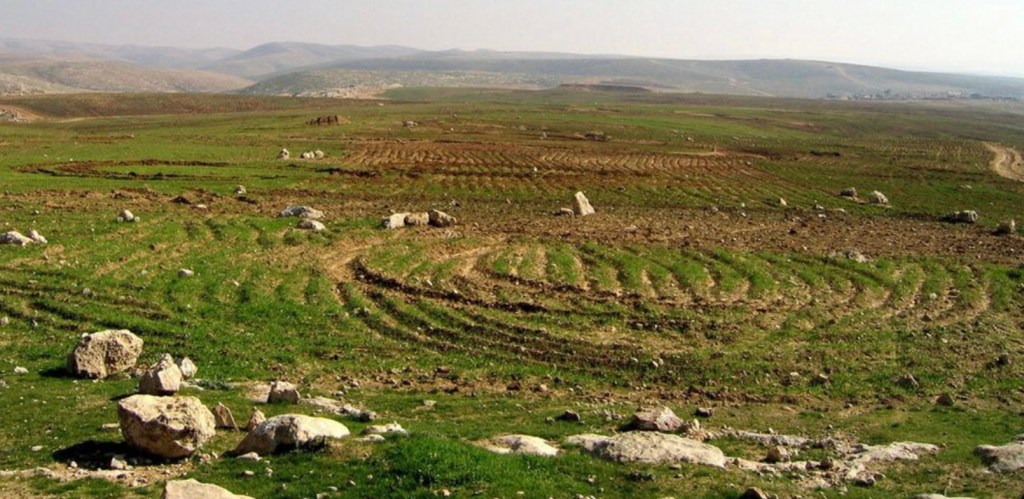
To signal his confidence in this promised return, Jeremiah buys a field in his hometown of Anathoth from his cousin Hanamel (32:1–15). the purchase serves to provide assurance that the exiled people will indeed return to the land of Israel; “houses and fields and vineyards shall again be bought in this land” (32:15).
Jeremiah exhorts the people to “give thanks to the Lord of hosts, for the Lord is good, for his steadfast love endures forever!” (33:11). Here, Jeremiah makes use of a phrase that recurs in key places throughout Hebrew Scripture, where it crystallises what the Israelites appreciated about the nature of God. The Lord is said, a number of times, to be “gracious and merciful, slow to anger and abounding in steadfast love” (Exod 34:6; 2 Chron 30:8–9; Neh 9:17, 32; Jonah 4:2; Joel 2:13; Ps 86:15; 103:8, 11; 111:4; 145:8–9). This is the Lord God who enters into covenant, time and time and again, with the people.
There is a strong sequence of affirming, hopeful oracles which characterise this section of Jeremiah, from “the days are surely coming … when I will restore the fortunes of my people, Israel and Judah, and I will bring them back to the land that I gave to their ancestors” (30:3) to “I will restore their fortunes, and will have mercy on them” (33:26). All of this is done because, as the Lord declares, “only if I had not established my covenant with day and night and the ordinances of heaven and earth, would I reject the offspring of Jacob and of my servant David” (33:25–26). It is the covenant which holds the Lord and the people together.
So Jeremiah offers a clear sign of hope for the future; in the places laid waste by the Babylonians, “in all its towns there shall again be pasture for shepherds resting their flocks … flocks shall again pass under the hands of the one who counts them, says the Lord” (33:12–13). As the people return to the land, the Lord “will cause a righteous Branch to spring up for David; and he shall execute justice and righteousness in the land” (33:15).
This oracle, also, is significant for the later community that developed from the followers of the man from Nazareth; the promise of a “righteous branch for David” becomes the title “Son of David”, which is then applied to Jesus in all three Synoptic Gospels (Mark 10:47–48; 12:35; Matt 1:1, 20; 9:27; 12:23; 15:22; 20:30, 31; 21:9, 15; 22:42; Luke 18:38–39). The whole sequence of oracles in this section of Jeremiah is of key significance for followers of Jesus in later ages.
The Hebrew Scripture reading which the lectionary offers this coming Sunday is largely a letter—from Jeremiah, to some fellow-Jews, but written in the name of Jeremiah’s God. It is this letter which invites us to consider some important aspects of how we live our faith.
Jeremiah wrote this letter twenty-five centuries ago, a long, long time ago. Does this letter still hold relevance to us, today? Jeremiah wrote in the ancient Hebrew language, running from right to left across the page. It is most likely that the letter was written on a scrap cut from a roll of papyrus, or possibly leather; but there was no neat sheet of paper with carefully-inscribed words, or neatly-typed paragraphs, carefully folded into an envelope, such as we would expect of a letter today.
And not only does it look different, this letter was written to a very specific group of people, who were quite different from us. It was addressed to people in a very different situation from most of us; a group of people who had grown up in Israel, but were now refugees, sent into exile, forcibly removed from their homeland, mourning all that they had lost, and now trying to come to grip with their new life in the faraway land of Babylon.
Do you remember Psalm 137? By the waters of Babylon, we sat down and wept? This would have been the way that many of these people responded when they arrived in Babylon. And the fact that this Psalm is still in our Bible tells us that the people sang this song, for a long time; it was not just a top-40 wonder for a few weeks or months, but it was sung over and over, and became one of the sacred songs of the people for generations—through into our own time, in fact!
So this letter seems a somewhat unusual choice for the focus of our attention today, as the way in which the word of the Lord might possibly address us, in our settled, comfortable lives. What could it possibly have to offer us, as we reflect on our faith in the world of the 21st century?
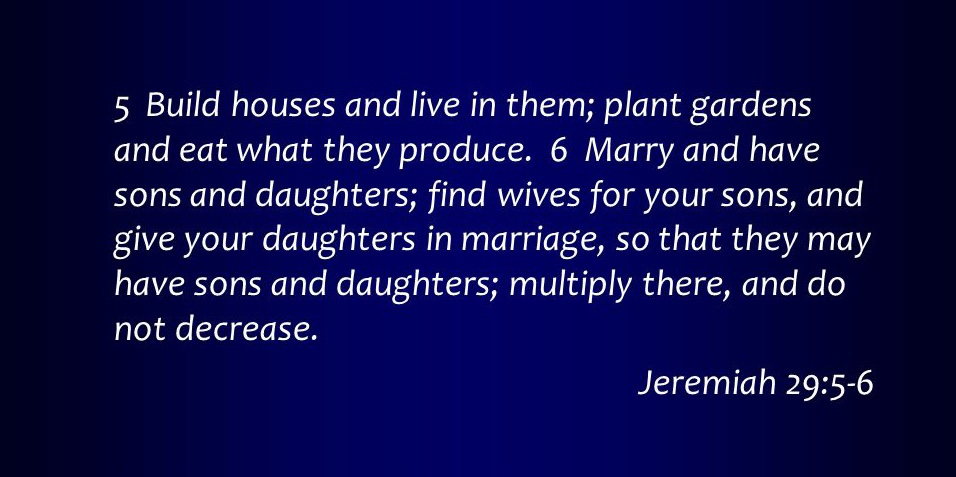
And yet, the words have a distinctively contemporary, relevant feel about them. They speak of ordinary life, of family and home, of a life which is comfortable, settled, and peaceable. They speak of building relationships, undertaking good, honest work, and living with responsibility for those under our care. Hear again the heart of the letter: Build houses and live in them; plant gardens and eat what they produce. Take wives and have sons and daughters; take wives for your sons, and give your daughters in marriage, that they may bear sons and daughters; multiply there, and do not decrease. But seek the welfare of the city where I have sent you into exile, and pray to the Lord on its behalf, for in its welfare you will find your welfare.
Perhaps the heart of Jeremiah’s letter is in this simple phrase: seek the welfare of the city. This was the word of the Lord which addressed the disturbed and dispossessed Israelites who had tearfully followed their deposed Israelite King Jeconiah and his court into exile under the Babylonian King Nebuchadnezzar, wondering what awaited them there in this strange land. Could it be that this is also the word of the Lord which addresses comfortable, settled Australians, enjoying the fruits of hard work over many years, living in a time of ongoing material prosperity?
Some knowledge of the original language of the letter might be relevant as we ponder this matter. In the last verse of the letter, Jeremiah three times uses the one Hebrew word that probably most of us have heard and would recognize: the word shalom. Each time the NRSV translates this word in this letter, it uses the English term welfare. We know this word, perhaps more familiarly, through the slightly different translation, peace.
And perhaps we are also aware that the ancient sense of shalom encompasses not just peace (the absence of conflict), but also wholeness, fulfillment, security, satisfaction, a co-operative spirit, a sense that all is well with the world. This is what the fearful exiles were being encouraged to work towards.
What would it have meant for those homesick Israelites, long ago, to have been prepared to seek the welfare [the shalom—the peace—the wholeness] of the city?
I think that it might have meant things like this: Get ready for a long period of time away from “home”; there will be no quick fixes, no easy answers, no instant gratification. You are here, in this strange land, for the long haul. Settle down, make your peace with the locals. Be prepared to make this the new “home” for yourselves and your descendants.
I wonder how would we feel if that were the situation we were facing? It could mean: Be prepared to work co-operatively and constructively with the very people who have inflicted pain and suffering on you and your people. They dragged you away from home and set you to work in this strange place. They are the ones who forced you into this bad situation. They are “the enemy”. But God is telling you to work with them. To co-operate with your enemies. To love your enemies, perhaps? To co-operate with those who hold different points of view from yourself—in precisely the way that various groups in our society are learning that they must do.
The word of the Lord presents a serious challenge, then, to the exiles in Babylon.
Even more than this; Jeremiah delivers God’s message to the people in very specific ways: Be prepared to marry and raise families with people from outside of your group … be prepared to marry these strange, alien, unfamiliar people. You won’t be able to keep on marrying your own people, those who have come with you from Israel; the gene pool is too small for that to work for too long. So get yourselves ready, to marry a foreigner. You are the ones who are going to create a multi-ethnic community, a multi-cultural society.
And perhaps, then, the challenge to the people of Israel, in exile, was for them to lift their eyes above their immediate grief and pain, and do what was good, what made for peace, for the whole city. Through Jeremiah, God was telling them: Set your goals, not on the basis of what is good for me as an individual, but rather on what is best for the whole community. Seek the shalom of the city; the whole collection of human beings who are gathered in this one sprawling metropolis.
What was this city, in which they found themselves? It has been estimated that Babylon was the largest city in the world in the 17th century BCE, and again between 612 and 320 BCE— and of course it is during this latter period that Jeremiah was writing. Babylon was probably the first city to reach a population above 200,000—a figure which seems relatively small to us when we think about cities, but which would have required complex administration and organization to ensure that, just as a start, all 200,000 inhabitants were fed each day. So seek the shalom of the city means that the Israelites were being challenged to immerse themselves in the largest population, the most vibrant and diverse community of people, at that time, in the ancient Near East.
And this is the point at which I believe this ancient Hebrew letter comes alive and speaks to us with a message of relevance for our own times and our own place. Seek the shalom of the city in which you live, work, relax, shop, and worship. How might we seek the welfare of our own cities?
City life, today, is marked by its diversity, its complexity, its ambiguities and uncertainties. This is particularly so as the nature of particular suburbs and areas change over time. Once quiet dormitory suburbs for people working in the city, in nearby business centres, can change, as different groups of people move in. As times change, the old certainties of suburban life no longer hold; the predictable patterns of comfortable middle-class lifestyle are challenged. We cannot ignore these changes; we cannot hide our faith from engagement in what is taking place around us.
Perhaps a different ethos emerges in the quiet dormitory suburb, as the area transforms into a regional transport hub, is filled with medium-density housing, caters to a greater concentration of students and aged people. All of these features can be gleaned from census material; all of these factors, and more, need to be part of the deliberations for a local Congregation as they consider those vital questions: who are we? what is our ministry? what might our ministry be? what sort of leadership is required for us to develop accordingly? These are questions that all Congregations should ask on a regular basis.
In the city, says Jeremiah, the people of God are to seek the welfare, the wholeness, the shalom, of the whole population. It is a charge that we ought to hear as a clear and direct word to each of us, and to the Congregation where we are active, as we seek to contribute to the welfare of the city. What do we have to offer, as the people of God in this time, in this place?
The Uniting Church is committed to being a church that takes seriously the context in which we are located. Our Basis of Union set out to ensure that we were formed as a church that was relevant to our Australian location—not simply a colonial copy of an English or Scottish church, but an authentically Australian church. I was privileged to be trained in theology in the early years of this church, when living out our faith in the Australian context was of paramount importance.
In past years, I have been part of Congregations that have sought to engage in active ways with people in their local communities: through a weekly School for Seniors programme; by offering a weekly meal at no cost to people in the local community who are poor, or lonely; by volunteering with the telephone ministry Lifeline; by engaging with local artists in a programme called Arts in Action; by fostering constructive relationships with Indigenous students and their families; by supporting partnerships with people in the third world and developing robust micro-businesses; by undertaking training in the Sydney Alliance and engaging with local community groups on specific, focussed projects; by being active in a local environmental advocacy group, Climate Change Australia. These are but some examples of the many ways that our church has long been committed to seeking the welfare of the city.
So we, today, face the challenge of responding to the changing circumstances of our time, when fewer people claim an active belief and participation rates in church activities are much less than in the “glory days” of decades past. We might well be seeking to create new ways of being communities of faith; looking for new opportunities to make connections with people in our immediate locality; exploring the means for ensuring that our city is one which is marked by fairness and justice; and shaping a church which is committed to finding new and creative ways of expressing our faith in our own locality.
The Uniting Church is a participatory church. At every level, there are opportunities for people to play all sorts of roles, in contributing to the work of the church. We are not dominated by one group, a clergy-led church, or a male-led church, as some other denominations might appear to be. We affirm the equal role of people, regardless of their gender—males and females can exercise leadership and offer ministry; regardless of their race; regardless of their age. We believe that the Spirit is at work amongst people who are striving for justice, seeking fairness, working to create equity in the lives of other people.
As a Uniting Church, we are an inclusive church that values the contribution that each and every individual can make. We are also a church that values the commitment of groups of people—that is why we meet together, act together, and share with other groups who also act together, in organisations such as Sydney Alliance or Climate Change Australia or other local enterprises. As we work alongside others, we offer a way of understanding life which is guided by moral principles, shaped by ethical commitments, and always informed by standards based on our faith commitment. That is something of a distinctive quality which we bring.
Whilst our faith does not solve every problem or resolve every dilemma, it does equip us to think carefully and to act with integrity as we engage with others. In these ways, we can surely attend to the challenge that Jeremiah provides, and seek the welfare of the city (or town, or village) where we are.
The Sydney Alliance is an organization which has been created in recent years, as one attempt to seek the welfare of the city of Sydney, to strive to make this city a better place to live for those who have lived here a long time, and for those who are recent arrivals to the city. It has a commitment to seek justice and fairness across the city. The Uniting Church is one of the foundation members of the Sydney Alliance, along with a number of community groups, trade unions, and other religious groups drawn from the Christian, Jewish, Muslim, Buddhist and Hindu faiths.
The website of this organization describes it in this way:
“The Sydney Alliance is a citizens’ coalition whose vision is to provide our community with a voice to express common values and aspirations for a fair and just Sydney. The Alliance is broadly based across religious organisations, community organisations and unions establishing relationships that respect diversity, while building a cohesive society. The Alliance is a non-party political organisation. Its primary purpose is the ability to act for the common good to achieve social change in our communities.”
The way that the Sydney Alliance operates is through building bridges, engaging in dialogue between organisations, and seeking to find opportunities for its members to participate in reshaping the society of which we are a part. Why should the Uniting Church join itself with other organisations in our society in this way? Why should we commit time and energy to involvement in this kind of coalition, with a wide range of people who live alongside us in the city? Some of these are people who seem familiar to us—Catholics, nurses, teachers, members of the Cancer Council, bus drivers, public servants.
Some are people of nodding familiarity, perhaps, although we don’t know many of them very well—Jews, Asian women, hotel employees, members of the climate action network. Some are perhaps strongly alien to our regular lives—people from the Indian community organization Bharatiya Vidya Bhavan Australia, from the United Muslim Womens Association (complete with traditional Islamic female attire), from the Federation of African Communities Council. These are the people with whom our church is joining in this new, emerging Alliance.
The lectionary reading for this Sunday contains selections from two acrostic poems in the book of Lamentations. The first reading is Lam 1:1–6, “how lonely sits the city that once was full of people”, a lament about the desecration of the city of Jerusalem by the Babylonian invaders. The psalm offered is Lam 3:19–26, probably because it contains a counterpoint to this lament in the famous words of hope, “the steadfast love of the Lord never ceases, his mercies never come to an end; they are new every morning; great is your faithfulness” (3:22–23).
An acrostic poem begins each line with each letter of the alphabet, in order, line after line. It is an aide-de-memoire for recalling the lines of the poem in order. Thus, in Hebrew, which has 22 letters in its alphabet, Lam 1 has 22 verses, each new verse beginning with the next letter of the Hebrew alphabet, in alphabetical order. There are 22 verses in chapters 1, 2, and 4 of Lamentations; chapter 3 has 66 verses, so each letter commences three verses before moving on to the next letter.
There are other acrostic poems in the Hebrew Scriptures, including Psalms 9 and 10 together, Psalms 25, 34, 37 (2 verses per letter), 111 (two letters per verse), 112 (also two letters per verse), 119 (which has 176 verses, meaning eight lines for each of the 22 letters!), and Psalm 145. There are also acrostic poems in praise of the eset chayil: “a woman of valour, who can find? she is far more precious than jewels” (Proverbs 31:10–31), and in the oracle of judgement at Nahum 1:1–9, “a jealous and avenging God is the Lord, the Lord is avenging and wrathful; the Lord takes vengeance on his adversaries and rages against his enemies”.
Psalm 34 in Hebrew, showing its acrostic structure
In recognition of the selections from acrostic poems that are provided by this Sunday’s lectionary, I have written my own attempt at an acrostic poem, including some of the key motifs that we encountered in the recent course on The Prophets.
This week, the lectionary takes us to the second letter addressed to Timothy (2 Timothy). This letter, one of three known collectively as the Pastoral Epistles, comes closest in form to the authentic letters of Paul amongst those three letters.
2 Timothy has an opening address (1:1–2) and thanksgiving (1:3–7) and closing greetings (4:19– 21) and benediction (4:22) which follow the pattern found in the letters that are widely accepted as authentic to the historical Paul. The body of the letter (1:8–4:18) contains exhortations to Timothy to follow the example of Paul (1:8–14; 3:10–4:5) and to carry out his role as a teacher (2:1–13), and warnings regarding false teachers (2:14–3:9).
There are personal notes from Paul (1:15–18; 3:10–11; 4:9–18), including a most notable mediation on his achievements and expression of hope regarding his future beyond death (4:6–8). These sections give the letter much more of an “authentic” feel than 1 Timothy and Titus, although there is debate about their origin and purpose.
Some scholars claim they were fragments of earlier authentic letters inserted into this framework late in the first century; others assert that they prove that Paul himself wrote this letter. See
Some features give the letter the quality of a “farewell testament”, in which the life and achievements of Paul are summarised for his followers. Compared with the other two “pastoral” letters, there are no instructions regarding church order, a greater frequency of personal comments, and a more personal tone throughout the letter.
The opening section of this letter, which forms the second reading in next Sunday’s lectionary offerings (1:1–14), exhorts Timothy to “hold to the standard of sound teaching that you have heard from me, in the faith and love that are in Christ Jesus” (1:13), and “guard the good treasure entrusted to you, with the help of the Holy Spirit living in us” (1:14). Sound teaching refers back to the reference in the earlier letter to Timothy, “the sound teaching that conforms to the glorious gospel of the blessed God” (1:Tim 1:10–11; also 4:6), as well as to “the word that is trustworthy in accordance with the teaching” that Titus is told will ensure “sound doctrine” (Tit 1:9).
Those other two letters advocate such “sound teaching” in polemical contexts. In 1 Timothy, it is to counter the influence of “the lawless and disobedient, the godless and sinful, the unholy and profane” (1 Tim 1:9); in Titus, it is to contradict “many rebellious people, idle talkers and deceivers, especially those of the circumcision” (Tit 1:9). In 2 Timothy, those being combatted by “sound teaching” are “those in Asia [who] have turned away from from me” (2 Tim 1:15), including two specifically named, Phygelus and Hermogenes; later in the letter, there is mention of “people of corrupt mind and counterfeit faith” who “oppose the truth” (3:8).
Each letter indicates that churches were involved in entrenched contested and argumentative situations; the need for “sound teaching” is clear in such situations. The articulation of formulaic statements, as well as the development of a more structured leadership, makes sense in these times.
It points to the way that the church will develop in the future, with more clearly defined leadership and authority structures, as well as clearly-articulated statements of doctrine which mark “what is right” and can then be used to exclude “those who are wrong”—what scholars have called the development of “ early Catholicism”.
So it is that the initial inclusive community ethos that Paul reflects (“all are one in Christ”) shifts to communities with increasingly demarcated boundaries. This is evidenced throughout 2 Timothy: “guard the good treasure” (1:14); “have nothing to do with stupid and senseless controversies” (2:23); beware of those who “can never arrive at a knowledge of the truth” and thus “oppose the truth” (3:7–8); shun those with “itching ears [who] will accumulate for themselves teachers to suit their own desires” (4:3).
So knowing who is inside, and thus who is outside, becomes increasingly important—in contrast to Paul’s own encouragement to his converts to engage with outsiders at every opportunity (1 Thess 4:9–12; 1 Cor 14:20–25; Col 4:5–6).
Jeremiah is usually associated with doom and gloom, as we saw in last week’s lectionary offering: “my joy is gone, grief is upon me, my heart is sick … is there no balm in Gilead?” (Jer 8:18, 22). In the reading for this week, however, offered by the lectionary (Jer 32:1–3a, 6–15), Jeremiah is optimistic. Even though he is being held under arrest in the royal court (Jer 32:1–3), he is planning for a future—a personal future, as well as a future for the besieged nation.
Jeremiah arranges, through Baruch, to purchase a field from his cousin Hamael, the son of his uncle, Shallum (32:7, 16). He is a child of Judah, and here is sending down his roots even deeper into the land that God had given his ancestors. He believes that, even though the Babylonian army was encircling Judah and he was unable to move about freely, nevertheless the time would come when God would ensure that ‘houses and fields and vineyards shall again be bought in this land’ (v.15). This attitude is thoroughly grounded in trust in God.
Jeremiah “serves as an examplar for exiles by acting with obedient hopefulness in the face of invasion and captivity”. The land purchase “begins the fulfilment of the visions of 30:1–31:40.” It is located at “the nadir of Judah’s story, during the bleakness of invasion” (587 to 586 BCE by our reckoning). (Quotations from Kathleen O’Connor, Oxford Bible Commentary, 515)
On the surface, the purchase appears futile, as Jeremiah foresees the dominance of the Babylonians, under Nebuchadnezzar, their king; this dominance shall remain, it seems, for some time, “until I attend to him, as the Lord declares” (32:5). So the prophet insists that the transaction take place, as a sign of hope in the future amidst the despair and devastation of his present.
This is what scholars call a “prophetic sign-act”, one of a number that Jeremiah enacts: wearing a linen loincloth, then hiding it, recovering it, and finding it “ruined, good for nothing” (13:1–7), a sign of the punishment to come on Judah (13:8–11); living as a celibate (16:1–2) as a sign of the exile to come (16:3–9); and pointing to the work of the potter, shaping a vessel, spoiling the vessel, and remaking it (18:1–4) as a sign of the way the Lord will treat Israel (18:5–11). Indeed, the last word of Jeremiah is to have his words written on a scroll which is thrown into the Euphrates River (51:59–63), to indicate that “Babylon shall sink, to rise no more”. (51:64).
The redemption of this parcel of land is a “prophetic sign-act” offering hope. It is reminder of the commands about the land found in Leviticus 25, where the Lord is said to have declared that “the land shall not be sold in perpetuity, for the land is mine; with me, you are but aliens and tenants” (Lev 25:23). The last concept is picked up in New Testament texts describing the people as aliens (1 Pet) and looking to the promise of a heavenly city (Heb 11).
The Levitical decree sits in the chapter concerning the Sabbatical Year (Lev 25:1–7) and the Year of Jublilee (Lev 25:8–55), a time of cancellation of debts and restitution of the land, a liberating sign of the liberating God who is to be worshipped; “the people of Israel are my servants whom I brought out from the land of Egypt; I am the Lord your God” (Lev 25:55). The redemption of the land by Jeremiah, acting through Baruch, signals an ongoing commitment to the covenant which the people had with the Lord God.
The purchase of land demonstrates a trust in the promise spoken in the preceding chapter. Jeremiah famously speaks about the new covenant; his words, however, are often spiritualised—the law is not written on stones, but written in the hearts of the people (Jer 31:31–33), the knowledge of God is not to be taught, but will be innate—“they shall all know me” (Jer 25:34).
By contrast to this common spiritualised interpretation, Jeremiah intends that this new covenant is to be lived in all of life; it is not simply a promise for an ethereal future, but it is to be a tangible reality in the immediacy of life in the present. So Jeremiah enfleshes the promise through the purchase of land. It is an incarnation of action some centuries before Jesus!
Interestingly, although the lectionary shifts the order of these passages, the purchase of land in Jer 32, signalling the promises made in the oracles of Jer 30–31, is placed immediately after the letter that Jeremiah wrote to the exiles in Babylon, urging them to come to terms with their situation in exile: “build houses and live in them, plant gardens and eat what they produce, take wives and have sons and daughters … multiply there [in Babylon] and do not decrease” (Jer 29:1–9). They, too, are to express their covenant faith in the realities of everyday life, even if they are in exile in a foreign land.
The details of this commercial transaction, involving money, property, and a deed of purchase (vv.9–12), are important; they indicate that how we treat our possessions, the land on which we live, the land which we own, reflects our faith. Jeremiah knows the trust of Lev 25:24; the land is of God—in this case, it has been given over to the family of Jeremiah as a trust, for them to care for. That trust is to “last for a long time” (v.14).
So the story invites us to consider how we exercise our responsibilities in property matters, how we live on the land, how we show that we believe that the land is of God. (It sits well alongside the Gospel passage offered in the lectionary, from Luke 16, which also emphasises the importance of responsible dealing with property and material things, in the life of faith.)
Our attitude to the land is actually a live current issue in Australia, as we mark the turning of an era (as the Queen dies, so the King reigns). Signs and symbols of British imperialism in this Great Southern Land remind us that, although the land was, and is, and will remain, central to the lives of the First Peoples of this continent, British colonisers have invaded, settled, massacred, and imposed a foreign way of life on those First Peoples. For them, being on country is being in spirit—connected with the spirit of the ancestors, living in harmony with the spirit of the creator God. There are resonances, surely, with the close connection to the land that Jeremiah here exhibits.
So in our context, the fact that Jeremiah buys the land is a challenge to our expectations that we can simply assume and take control of these lands. The fact that Jeremiah exchanges a contract for the land reinforces the importance of our dealings with real estate, property, finances, and people. His property transaction attests to the promise of the Lord to a besieged and soon-to-be exiled people, “ houses and fields and vineyards shall again be bought in this land” (32:15). The sign, to us, is clear: what we do with our material, physical lives ought to reflect the spiritual hopes and commitments that we have as people of faith.








 An Informed Faith