Appropriating prophetic passages in the season of Epiphany (Epiphany 4C to 7C)

Every Sunday throughout the Christian year (save for the six Sundays in the season of Easter), the Revised Common Lectionary provides a passage from Hebrew Scripture as the First Reading in the set of four readings for that Sunday. (During Easter, a passage from Acts stands as the First Reading, providing stories from the early years of the movement which Jesus founded.)

Each year, during the season of Epiphany, the First Readings relate to the prophetic figures of ancient Israel. In Year C (this year), they are drawn from the books of Isaiah and Jeremiah. I think we need to be wary how we hear and interpret these prophetic passages. There is often a temptation to hearvthesemoldermreadings and argue that, because of what the Gospel passage says, they have now been “ fulfilled” in Jesus. 

That’s a danger that we should work carefully to avoid—for if we simply take Hebrew Scriptures as providing the “set up” which is being “fulfilled” in Jesus, we are running the risk of an inappropriate appropriation of the older texts. It’s a path that can lead us to a supercessionist attitude towards Hebrew Scriptures and, by extension, to Judaism. (By supercessionism I mean “the belief that Christians have replaced Jews in the love and purpose of God”.) This post is designed to steer us in a different direction.

Each year, the Feast of Epiphany includes Isaiah 60:1–6 as the First Reading. In this passage, the prophet foresees that “nations shall come to your light, and kings to the brightness of your dawn” (Isa 60:3); he specifies that when they come to the light of the Lord, “they shall bring gold and frankincense, and shall proclaim the praise of the Lord” (Isa 60:6). The reason for reading this on Epiphany is obvious—it correlates well with the story in Matthew of when the magi came to visit Jesus, and “they offered him gifts of gold, frankincense, and myrrh” (Matt 2:11).

The first Sunday after the Feast of Epiphany is always the day on which the Baptism of Jesus is recalled. One year (Year B) places the beginnings of the priestly creation account (Gen 1:1–5) alongside this Gospel story. In the other two years, passages from Second Isaiah are offered; for this year, Year C, this is Isaiah 43:1–7, which includes the affirmation, “do not fear, for I have redeemed you; I have called you by name, you are mine; when you pass through the waters, I will be with you” (Isa 43:1b—2). The presence of water in both of these passages seems to be the reason for their linking with the baptism of Jesus.

The sequence of passages will continue with selections from Third Isaiah (Isa 62:1–5, Epiphany 2C), First Isaiah (Isa 6:1–13, Epiphany 5C), and two excerpts from Jeremiah (Jer 1:4–10, Epiphany 4C, and Jer 17:5–10, Epiphany 6C). A section of Nehemiah 8 is offered on Epiphany 3C, while the sequence concludes with a story recounting the moment when Joseph revealed himself to his brothers when they had come to Egypt (in Gen 45) on Epiphany 7C.

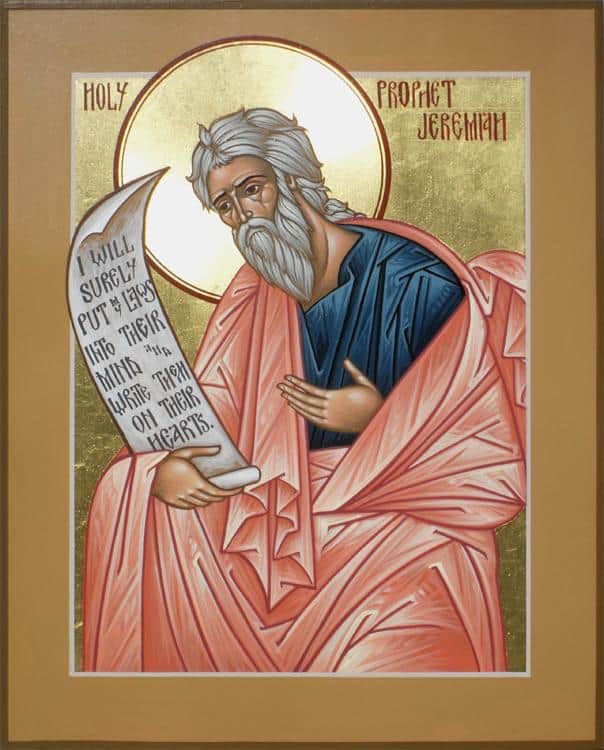
I think it is noteworthy that two of these passages relate specifically to “call”. For Epiphany 4C, the call of the young prophet Jeremiah is placed alongside the Lukan account of the reception accorded to the young(ish) Jesus when he spoke at the synagogue in his home town.  Jeremiah is told by the Lord that the message he will speak to his people will be about “to pluck up and to pull down, to destroy and to overthrow, to build and to plant” (Jer 1:10). It won’t be a straightforward task for Jeremiah—as the rest of the book reporting his oracles confirms.

In like manner, Jesus is initially met with amazement “at the gracious words that came from his mouth” (Luke 4:22). However, after he recounts older stories in which he commends the faith of outsiders (a widow of Zarephath, a leper of Syria), the people turn on him, “drove him out of the town, and led him to the brow of the hill on which their town was built, so that they might hurl him off the cliff” (Luke 4:29). The duality of positive and negative responses, evident throughout the ministry of Jesus, is signalled in this early, programmatic incident.

For Epiphany 5C, when the Gospel moves on the recount the call of Simon Peter and those who were fishing with him (Luke 5:1–11), the Hebrew Scripture passage placed alongside this is the narrative of the call of Isaiah (Isa 6:1–13). Simon and his fellow fishermen were beside the lake of Genessaret, while Isaiah was in the Temple in Jerusalem.  Both men, however, recognize that they are in the presence of an awesome power. Isaiah cries out, “Woe is me! I am lost, for I am a man of unclean lips, and I live among a people of unclean lips; yet my eyes have seen the King, the Lord of hosts!” (Isa 6:5). Simon Peter “fell down at Jesus’ knees, saying, ‘Go away from me, Lord, for I am a sinful man!’” (Luke 5:8). 

Isaiah’s commissioning alerts him to the reality that those to whom he speaks will be struck with incomprehension; they will “not look with their eyes, and listen with their ears, and comprehend with their minds, and turn and be healed” (Isa 6:10). His role will be to call for repentance from a sinful people. Simon Peter is given the charge, “from now on you will be catching people” (Luke 5:10).  That imagery also refers to the reality that in the prophetic rhetoric of years past, the metaphor of fishing for a human being has indicated the means of carrying out the judgement of God (Jer 16:16–18; Hab 1:14–17; Ezek 29:4–5). See 

The two Hebrew Scripture call narratives thus inform and enrich the Gospel passages that are heard alongside them on those days. A similar dynamic is at work on Epiphany 6C, when the Gospel offers a set of blessings and curses spoken by Jesus (Luke 6:20–26). Alongside this is a pair of sayings, a curse and a blessing, that Jeremiah spoke  to Israel: “cursed are those who trust in mere mortals … blessed are those who trust in the Lord” (Jer 17:5–8). Both Jeremiah and Jesus address their contemporaries with a challenge through their words. The challenge is to meet the testing of the Lord (Jer 17:10) and to receive the “great reward” awaiting in heaven (Luke 6:23).

And perhaps the tale of reconciliation told in Genesis 45 dramatically illustrates the central theme of the words of Jesus which are offered on Epiphany 7C: “love your enemies, do good, and lend, expecting nothing in return … be merciful, just as your Father is merciful” (Luke 6:35–36). Joseph exemplifies what Jesus teaches.

As I noted above,  I think there is always a temptation to hear a passage from the older scriptures, inherited from the ancient stories of Israel, as being “fulfilled” in a story told in the later scriptures, formed by the early Church. This pattern draws on a flat reading of the statement by Jesus that “everything written about me in the law of Moses, the prophets, and the psalms must be fulfilled” (Luke 24:44). It fosters a perspective that sees everything in Hebrew Scriptures as material that Jesus “brought to fulfilment”. It contains an implicit ideology that anything that took place in Judaism was “incomplete” and “in need of fulfilment”. The pathway into supercessionism is clear. For further discussion of supercessionism, see https://johntsquires.com/tag/supercessionism/

By contrast, I think that each of these paired passages can be read in a way that accords greater value to the Hebrew Scripture texts. I am reminded of what Richard B. Hays has written about in his book Echoes of Scripture in the Gospels (Baylor, 2017). Hays describes what he labels as figural reading, which is to read back from the Gospel into the older texts and see patterns and figures at work that may not have been evident at the time they were created.

The later texts in the New Testament can throw light on the passages in Hebrew Scripture, without insisting that hey “predict Jesus” and are “fulfilled” in Jesus. We can notice, not only how the NT writers shaped their words in ways that drew from Hebrew Scripture passages, but also how the internal dynamics in the later texts both utilise and illuminate those earlier passages, drawing forth from them new levels of meaning.

As the blurb for this book states, “He shows how each Gospel artfully uses scriptural echoes to re-narrate Israel’s story [and] to assert that Jesus is the embodiment of Israel’s God.” I think that is a really helpful way to think about how the paired passages work together, informing and enlightening each other. And that’s an appropriate thing to be looking for in those season of Epiphany—mutual understanding and enlightenment!

The greatest of these is love (1 Cor 13; Epiphany 4C)

For the passage to be read and heard this coming Sunday, the Lectionary has proposed what is perhaps the most well-known part of the first letter to the Corinthians that Paul wrote together with Sosthenes: the chapter on love (1 Cor 13:1–13). Paul and Sosthenes wax lyrical about love, telling the Corinthians that love “bears all things, believes all things, hopes all things, endures all things; love never ends” (13:7–8), and builds to a wonderful rhetorical climax in which he affirms that “faith, hope, and love abide, these three; and the greatest of these is love” (13:13).

As well as being a rhetorical tour de force, and the most beloved part of this letter of Paul, this chapter is also, in my view, the most misunderstood and misused chapter of this letter—as I will attempt to explain below.

It is clear from the description that is offered by Sosthenes and Paul that, when the community in Corinth gathered for worship, there was a high degree of disorder manifested. They devote four chapters of their letter to this issue (11:1—14:40). Throughout this section of the letter, Paul and Sosthenes write with a single focus in mind; they write to bring order and decency to this situation (14:40). 

The two letter writers begin their consideration of the disorder evident in the community by asserting the importance of maintaining “the traditions just as I handed them on to you” (11:2), reminding them of words that “I received from the Lord” and duly “handed on to you” (11:23). They instruct the Corinthians to seek to speak to others in worship “for their upbuilding and encouragement and consolation” (14:3). 

They advise them to exercise their spiritual gifts appropriately; to “strive to excel in them for building up the church” (14:12), to “not be children in your thinking … but in thinking be adults” (14:20). They continue, “let all things be done for building up” (14:26), noting that “all things should be done decently and in order” (14:40), for “God is a God not of disorder but of peace” (14:33). 

The hymn in chapter 13 is an integral part of that overarching purpose. As well as his reminder of “the traditions just as I handed them on to you” (11:1), Sosthenes and Paul assert that they must acknowledge that “what I am writing to you is a command of the Lord” (14:37). Drawing from various authorities, they allude to scriptural ideas (11:3, 7–9, 10; 14:4), directly cite Hebrew scripture (14:21, 25), refer to the words of Jesus (11:24–25), claim the precedent of nature (11:14) and church custom (11:16), and in a controversial passage, they refer to what takes place “in all the churches of the saints” (14:33b–34). 

Chapter 12 contains an adaptation of an image which was extensively used in political discussions about the city state (“the body is one and has many members”, 12:12) as well as what may be a reference to a developing baptismal liturgy within the early church (“we were all baptised into one body”, 12:13) and a very early creedal statement (“Jesus is Lord”, 12:3).


Throughout these chapters, those who are inclined to diverge from the commands given by Sosthenes and Paul are portrayed in negative terms: they are “contentious” (11:16), showing “contempt” (11:22), acting “in an unworthy manner” (11:27) and with “dissension” (12:25); their behaviour conveys dishonour (12:22–26) and shame (14:35). 

The selfish behaviour of some at the common meal warrants their condemnation (11:32) and justifies the illness and death that has occurred within the community (11:30). The individualistic participation of others in communal worship builds up themselves, but not others (14:4, 17); they are not intelligible in speech (14:9), but are unproductive in their minds (14:14) and childish in their thinking (14:20), leaving themselves open to the risk, “will they not say that you are out of your mind? (14:23).

In the centre of this section stands the famous “hymn to love” (12:31–13:13), now often treated in isolation and over-romanticised. In context, the passage provides a sharp, pointed polemic against the Corinthian community. The qualities they possess are consistently inadequate when measured against love. 

The speech of the Corinthians is like “a noisy gong or a clanging cymbal” (13:1), an allusion to the mayhem brought about by speaking in tongues in worship (1:5; 12:10, 28–30; 14:6–8). Whilst they readily express their “prophetic powers” in worship (11:4–5; 12:10, 28–30; 14:1, 4–5, 23–24, 29–32, 37, 39), for Paul and Sosthenes, these abilities are nothing without love (13:2). 

Likewise, they claim that they are able to understand mysteries (2:7; 4:1; 14:2, 23) and have knowledge (1:5; 8:1–3, 7, 10, 11; 12:8; 14:6) as well as faith (2:5; 12:9; 15:14, 17; 16:13); but Paul and Sosthenes insist that all of these are nothing in isolation from love (13:2). 

Elsewhere in this letter there are direct accusations to the Corinthians that they are precisely what love is not. Love does not boast (13:4), but the Corinthians are regarded as being boastful (1:29; 3:21; 4:7; 5:6). Love is not arrogant (13:4), but in the eyes of Sosthenes and Paul the Corinthians are arrogant or “puffed up” (translating the same Greek word in 4:6, 18–19; 5:2; 8:1). 

Love does not rejoice in wrongdoing (13:6), but Paul and Sosthenes berate the Corinthians for taking fellow-believers to court to seek redress for wrongs; indeed, “you yourselves wrong and defraud—and believers at that” (6:7–8). Love means that people do not insist on their own way (13:5), but they consider that the way that some behave in relation to meat offered to idols in the marketplace advantage; “do not seek your own advantage”, they advise them, “but that of the other” (10:24). 

In like manner, when they gather to celebrate the supper of the Lord, “when the time comes to eat, each of you goes ahead with your own supper, and one goes hungry and another becomes drunk” (11:21). Selfishness and acting without regard for the other characterises their common life. 

Love “hopes all things” (13:7), but some in the community at Corinth are accused of failing to share in the hope of the resurrection (15:12–19). The assertion that “we know only in part” (13:9–10) is directed squarely against the Corinthian claim to have full knowledge (8:1, 10–12) whilst the image of the child, not yet adult (13:11), reflects criticism levelled by Sosthenes and Paul against the Corinthians, whom they see as infants, not yet ready for solid food (3:1–2; 14:20). 

So the hymn alleged to be in praise of love is, more accurately, a polemical censure of the Corinthians’ shortcomings, in which every word used and every phrase shaped by Paul and his co-writer Sosthenes cuts to the heart of the inadequacies of the Corinthian community. Try preaching that at a wedding!!


Greater honour to the inferior member (1 Cor 12; Epiphany 3C)

We continue this week hearing from a well-known section of the letter that Paul and Sosthenes wrote to the believers in Corinth. In the chapter proposed in the lectionary passages last Sunday and this coming Sunday (1 Cor 12:1–31), Paul and Sosthenes address the nature of the community that has been formed by those who formerly were “pagans … led astray to idols” (12:2). They have now have come to believe that “Jesus is Lord” (v.3) and desire to follow his way in their lives through offering their gifts in service (vv.4–7).

Paul and Sosthenes

In Corinth, however, the gifting of the Spirit has been claimed by some as a basis for unedifying behaviour, which as Paul and Sosthenes say,  tears apart, rather than builds up, the community. This is manifested in various ways, including (as we noted last week) in the worship of the Corinthian community, where, fuelled by their sense of being “the spiritual ones”, some people unleash chaos in the gathering. This is in contrast to the desire of the letter writers that in this gathering “all things should be done decently and in order” (14:40), as befits the God who is “a God not of disorder but of peace” (14:33).

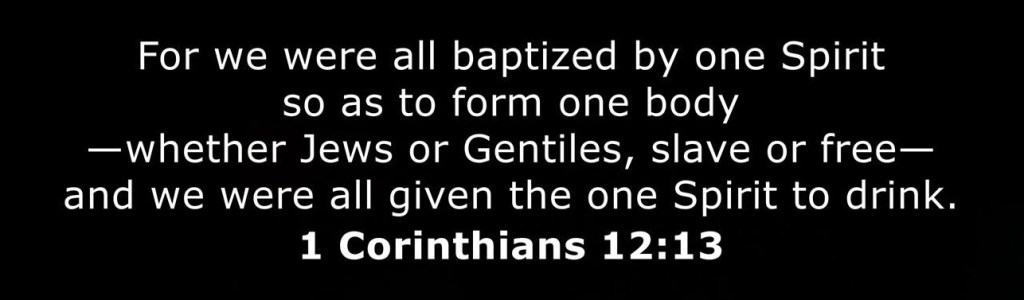
In the passage from 1 Cor 12 proposed as the Epistle for this coming Sunday (1 Cor 12:12–31), Paul and Sosthenes offer a strong affirmation to the Corinthians about the wide reach and inclusive invitation that characterises the work of the spirit: “For in the one Spirit we were all baptized into one body—Jews or Greeks, slaves or free—and we were all made to drink of one Spirit.” (1 Cor 12:13).

I rejoice that these words have been taken up in my church, the Uniting Church in Australia, as the basis for fostering a broad community of faith, across multiple social factors which could divide rather than unite (in paragraph 13 of the Basis of Union). Ministry is enabled by the gift of the spirit. To anyone. To everyone. It is a fine ideal.

That paragraph of the Basis affirms that “every member of the Church is engaged to confess the faith of Christ crucified and to be his faithful servant”. It continues with a declaration, grounded in the scriptural witness (1 Cor 12) that “the one Spirit has endowed the members of Christ’s Church with a diversity of gifts”. 

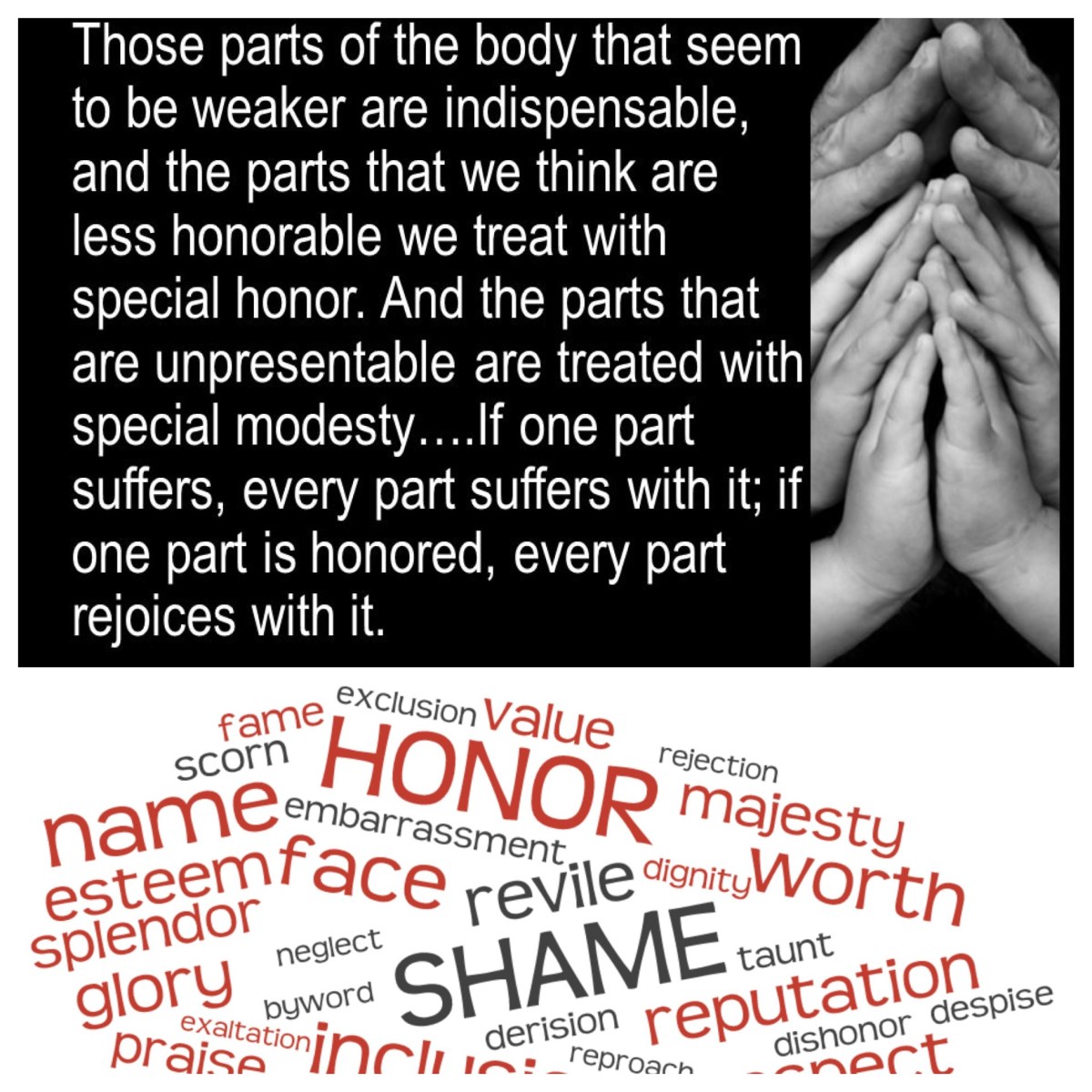
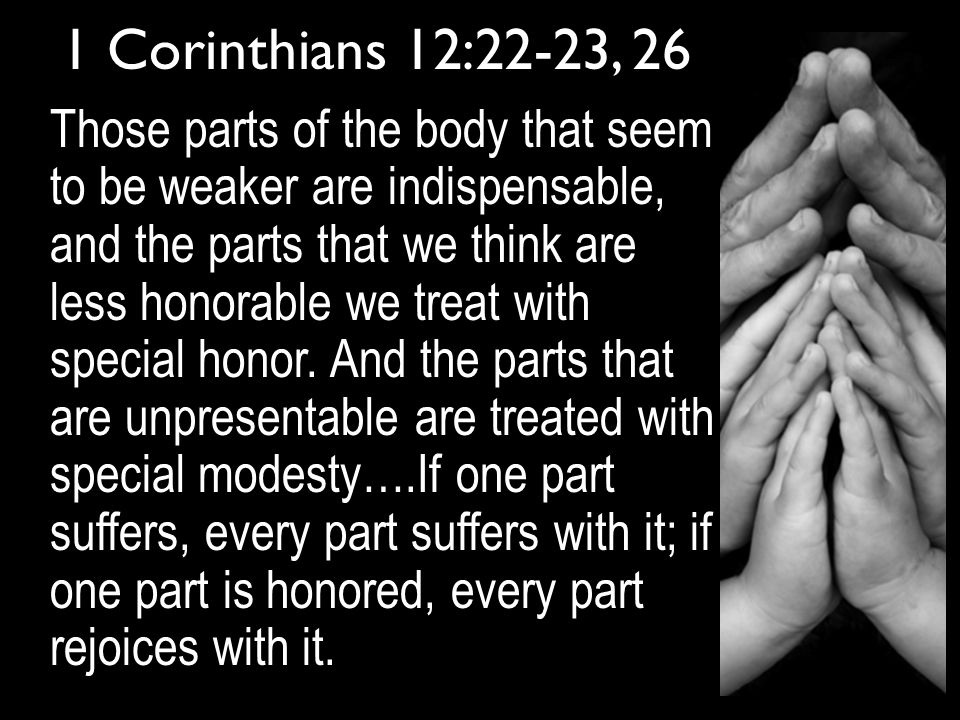
In writing to the Corinthians, Paul and Sosthenes first identified a range of gifts (1 Cor 12:8–10), and then emphasised the claim that “the body does not consist of one member, but of many” (1 Cor 12:14). As a result, each and every member plays an integral role in the whole. From this, they deduce that “the members of the body that seem to be weaker are indispensable … God has so arranged the body, giving the greater honour to the inferior member” (1 Cor 12:22–25). The context in Corinth has shaped the direction into which Paul develops this image.

Honour and shame were central features of ancient Mediterranean societies. Possessing much honour reflected a high social status; gathering much shame reflected low social status. Public debate amongst males was a key way in which honour was demonstrated; besting another person in such a debate was a means by which an increase in honour could be attained. Acting in a way that brought shame upon oneself meant that the amount of honour attributed to you would diminish. Women acting in ways that were not in accord with the patriarchal structures of the time would also be considered as shameful. A woman’s place was, literally, in the home.

Jesus did not shy away from the challenge to his honour and authority that public debating posed. He engaged in many debates, responding with confidence to challenges to his honour as various questions were posed to him, as is reported in Mark’s Gospel: “why does this fellow speak in this way? it is blasphemy! who can forgive sins but God alone?” (Mark 2:7); “why does he eat with tax collectors and sinners?” (2:16); “why do your disciples do not fast?” (2:18); “by what authority are you doing these things?” (11:28); “is it lawful to pay taxes to the emperor, or not?” (12:14). According to Mark, he bested his opponents on each of these occasions; he was a public debater of the first order. 

Honour was praised by the Greek philosopher Aristotle as “the greatest of all external goods” (Aristotle, Nic. Eth. 1), whilst Xenophon considered that honour was what differentiated humans from animals (Hiero 7.3). Philo of Alexandria, bridging both Jewish and Hellenistic worlds, affirmed that “fame and honour are a most precarious possession, tossed about on the reckless tempers and flighty words of careless men” (Abraham 264).

The honour—shame culture runs through the Hebrew Scriptures. The ancient Hebrews affirmed that honour belongs primarily to God (1 Chron 16:27), so that God could bestow honour on those who were faithful to his ways (Ps 92:14-15). The same idea is expressed in the version of Isa 28:16 which is cited at 1 Pet 2:6, which  modifies the ending to provide explicit reference to the claim that God will not shame believers. God can thus honour human beings (Ps 8:5), even those regarded as shameful (Zeph 3:19); and conversely, God could shame those accorded honour by humans (Isa 23:9). Paul later reflects this early in his first letter to Corinth (1 Cor 1:27).

And later in that letter, Paul and Sosthenes addressed the hierarchical ranking that is integral to the honour—shame culture, and offered a completely counter—cultural perspective. “The members of the body that seem to be weaker are indispensable”, he asserts; and so too, “those members of the body that we think less honourable we clothe with greater honour” (1 Cor 12:22–23). Accordingly, he advocates that “our less respectable members” should be “treated with greater respect; whereas our more respectable members do not need this” (12:23:—24). This is how this part of the letter upends the conventions of his time.

Then Paul and Sosthenes provide the theological rational that undergirds this perspective; “God has so arranged the body, giving the greater honour to the inferior member, that there may be no dissension within the body, but the members may have the same care for one another” (12:24–25). The pastoral conclusion that they draw from this—reinforcing the sense of equality that should mark the community of followers of Jesus—is that “if one member suffers, all suffer together with it; if one member is honoured, all rejoice together with it” (12:26). It is the fundamental lesson in standing firm against the culture because of the demands that the Gospel places on believers.

A Reflection for the Day of Mourning (19 January 2025)

Since 2019 the Uniting Church has marked a Day of Mourning on the Sunday before 26 January to reflect on the dispossession and ongoing injustices faced by Australia’s First Peoples, acknowledge our shared history and renew our commitment to justice and healing. The Uniting Church has acknowledged our nation’s history through its Preamble to the Constitution, Covenanting Statements, and at many other times through its covenanting journey.

I will be giving this reflection on Sunday 19 January 2025 at the Dungog Uniting Church.

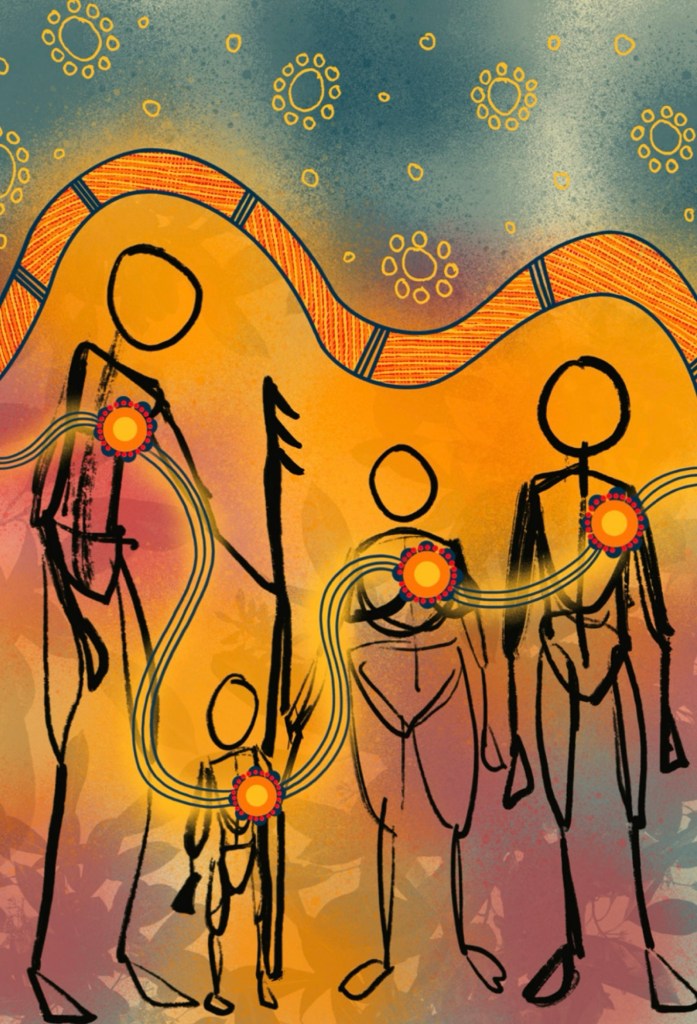
Artwork by Zoe Belle, Guwa Koa and Kuku Yalanji woman

Prayer of Confession

Merciful God, as Second Peoples of this land, whose ancestors travelled and settled in Australia, we acknowledge with sorrow the injustice and abuse that has so often marked the treatment of the First Peoples of this land.

We acknowledge with sorrow the way in which their land was taken from them; the way their their language, culture and spirituality was suppressed.

We acknowledge with sorrow that the Christian church was so often not only complicit in this process but actively involved in it.

We acknowledge with sorrow that in our own time the injustice and abuse has continued.

We have been indifferent when we should have been outraged, we have been apathetic when we should have been active, we have been silent when we should have spoken out.

Gracious God, forgive us for our failures, past and present. By your Spirit, transform our minds and hearts so that we may boldly speak your truth and courageously do your will. Through Jesus Christ our Lord. Amen.

Reading Isaiah 62:1–5

For Zion’s sake I will not keep silent,
and for Jerusalem’s sake I will not rest,
until her vindication shines out like the dawn,
and her salvation like a burning torch.
The nations shall see your vindication,
and all the kings your glory;
and you shall be called by a new name
that the mouth of the LORD will give.
You shall be a crown of beauty in the hand of the LORD,
and a royal diadem in the hand of your God.
You shall no more be termed Forsaken,
and your land shall no more be termed Desolate;
but you shall be called My Delight Is in Her,
and your land Married;
for the LORD delights in you,
and your land shall be married.
For as a young man marries a young woman,
so shall your builder marry you,
and as the bridegroom rejoices over the bride,
so shall your God rejoice over you.

Reflection

We all know, I expect, what it feels like to be deeply disappointed; let down, betrayed, forsaken, abandoned. The emotions felt at such a time—emotions of despair and desolation—are named in the reading from Isaiah 62 which we have heard today. 

This part of Isaiah comes from the time when the exiles from Israel were returning to their land, leaving behind the difficulties they experienced during their five decades of exile in the foreign land of Babylon. They had returned to a devastated city; it probably looked like the images we have seen on our TVs, from bombed residential areas in Syria and Gaza, to the devastation of mass destruction of buildings from tornadoes in Florida and Louisiana and fires in Los Angeles. 

In just such a setting, as the people laboured day and night to rebuild and restore their beloved city, an unnamed prophet speaks out, bringing a word of hope: “You shall no more be termed Forsaken, and your land shall no more be termed Desolate, but you shall be called My Delight Is in Her and your land Married.” The hope that the prophet offers is of a time when desolation is left behind, when the sense of being forsaken has been replaced by loving acceptance and care and belonging; the language of a marriage provides a good analogy.

There are people in our midst, in this town, across this country, who know that sense of desolation and being forsaken. Today we remember them, especially, on a day which the Uniting Church now names as the annual Day of Mourning. On this day, we remember that First Peoples, custodians of this land since time immemorial, caring for creation in their respectful lifestyle and customs, were invaded, colonised, massacred, marginalised, and demonised.

The massacres across the country that took place from the early years of British settlement into the second decade of the 20th century, and the shattering of families by the removal of the stolen children, which lasted well into the 1960s, have given the Gringai, Worimi, Biripi, Wonnarua, and many other peoples cause for ongoing lament and despair. Many still alive today remember what was done to them or to their parents and grandparents. The pain is live.

So on this Day of Mourning, we commit to standing with the First Peoples, acknowledging their pain, sharing their distress (to the extent that we can), treating them respectfully, and committing to work for justice for the First Peoples today. We should know that their pain is still real, present, and powerful. 

The referendum held last year offered a ray of hope across the country; fuelled by a campaign of disinformation that played on fears and prejudices, that hope was shattered. The Uniting Church had joined with many other Christian denominations, and leaders of a number of faith communities, to advocate a Yes vote. We have shared in the disappointment of First Peoples, and the sense that this is yet another hurt that they have to bear.

On Australia Day in 1938, a large group of protestors marched through the streets of Sydney, followed by a congress attended by over a thousand people. One of the first major civil rights gatherings in the world—decades before Martin Luther King Jr led massive rallies in the USA—it was known as the Day of Mourning. Following the congress, a deputation led by William Cooper presented Prime Minister Joseph Lyons with a proposed national policy for Aboriginal people. Unfortunately, this was rejected because the Government did not hold constitutional powers in relation to Aboriginal people. That changed in 1967.

From 1940 until 1955, the Day of Mourning was held annually on the Sunday before Australia Day and was known as Aborigines Day. In 1955 Aborigines Day was shifted to the first Sunday in July after it was decided the day should become not simply a protest day but also a celebration of Aboriginal culture. This led to the formation of the National Aborigines Day Observance Committee (NADOC), which later then became NAIDOC, the week in July focussed on remembering Aboriginal people and their heritage.

In 2018, At the Uniting Church Assembly in Melbourne—which Elizabeth and I attended—it was decided to reinstate an annual Day of Mounring on the Sunday before Australia Day. So we stand in a grand tradition, and we stand in solidarity with our brothers and sisters, people who have cared for this land over millennia—many, many thousands of years. 

This year, President Charissa Suli and Congress chairperson Mark Kickett invite us “to listen deeply and learn humbly, and bear one another’s burdens; to receive the outstretched hand of friendship offered in grace and hope, and to trust in Jesus, whose reconciling love continues to mend the brokenness within and among us.”

They remind us that “the same ancient Spirit of God which has always been present in these lands has given us ‘a destiny together’ as the body of Christ in this time and place”, and so invite us “to celebrate the immense gift we have in each other [as First and Second Peoples], giving thanks for the transformative and boundless love of Christ which holds us.”

Let us pray.

Gracious God, we know that reconciliation between First and Second Peoples is a challenge. We sense that this must begin with reconciling ourselves in truth and humility with you, our God.

We know that is then that we can do the work of being peacemakers and justice seekers.

So help us to act responsibly and respectfully, to care for one another and to support one another. Amen.

We sing The Aboriginal Lord’s Prayer

Artwork by Zoe Belle, Guwa Koa and Kuku Yalanji woman

Prayers adapted from the resources for the Day of Mourning 2025, https://uniting.church/wp-content/uploads/2024/12/Day-of-Mourning-2025_Final.pdf

Artwork by Zoe Belle, Guwa Koa and Kuku Yalanji woman. “The artworks depict the story of Christ’s presence being amongst First Peoples of these lands of his creation for generations. His teachings have long been displayed within the stories, songs, dances and ceremony First Peoples have used them to connect with God as great Creator and teacher for our communities.”

All are activated by the same Spirit (1 Cor 12; Epiphany 2C)

This coming Sunday and the following Sunday, the lectionary suggests that we read and hear a well-known section of Paul’s letter to the believers in Corinth. In this chapter (1 Cor 12:1–31), Paul addresses the nature of the community that has been formed by those who formerly were “pagans … led astray to idols” (12:2) and have now have come to believe that “Jesus is Lord” (v.3) and desire to follow his way in their lives through offering their gifts in service (vv.4–7). 

What follows in this chapter—and in the subsequent ones that the lectionary proposes on the Sundays ahead—provides a good basis for considering fundamental matters of faith and discipleship throughout the season of Epiphany. It is, after all, a season focussed on revelation; and Paul’s words are quite revealing!

Actually, they are not just Paul’s words (although that is how we usually refer to them). Paul collaborated in the writing of many of his letters—of the seven agreed authentic letters, only two are written by Paul alone. The others are written in association with Timothy (2 Cor, Phil, 1 Thess and Phlm), Silvanus (1 Thess), and Sosthenes (1 Cor). So it is words from this last letter, co-written with Sosthenes, that the creators of the lectionary are offering us during the season of Epiphany. 

A depiction of Paul and Sosthenes

In opening this letter, Sosthenes and Paul tell the Corinthians that they write to “give thanks” (1:4) and also to “appeal to you” (1:10); and later, to “admonish you as my beloved children” (4:14). The constructive approach that they bring is made clear in the opening prayer of thanksgiving (1:4–9). Writing in chapter four, the author (here, presumably Paul) exhorts the Corinthians: “I appeal to you, then, be imitators of me” (1 Cor 4:16; see also 1 Thess 1:6). The letter contains many points of appeal, exhortation, encouragement—and also challenge, correction, and criticism!

This coming Sunday we focus on verses 1–11 of chapter 12. This is an instance of exhortation and encouragement (in the later part of the chapter, which we read and hear on the following Sunday, challenge and correction will occur). In these verses, Paul considers the diversity of expressions of faith that can be found in the faith community in Corinth—as, indeed, there are in many other communities of faith. He notes the diversity of gifts, the various ways of providing service, and the range of activities undertaken by “those who are sanctified in Christ Jesus, called to be saints” (1 Cor 1:2). 

Each gift, service, or activity, however, has a common origin. It is “the same Spirit” who grants the diversity of gifts evident in the community (12:4), “the same Lord” who is the motivator for the array of offering service by those believers (v.5), and “the same God” who activates all of the activities that is evident in Corinth (v.6).

It is worth noting that an alternative way to translate this might be “the same God who energizes all of the expressions of energy”. The Greek words being translated as “activate” and “activities” relate to the central idea of energy; indeed, the foundational word is ἐνεργήμα, which when transliterated letter-for-letter results in “energēma”, from which we get the English word “energy”. So the Spirit is presented as an active, dynamic force, which is at work in a lively, tireless, and vital fashion. 

In this passage, Paul places a particular emphasis on the unity that is—or at least, should be—a key feature of the group of people who are joined together by the common affirmation, “Jesus is Lord” (v.3). He affirms that the gifts, acts of service, and activities expressed by those people “are activated by one and the same Spirit” (v.11a). It is that Spirit who “allots to each one individually just as the Spirit chooses” (v.11b).

The irony, however, is that in the eleven chapters preceding this passage, there have been multiple signs of the many ways in which disagreement, conflict, division, and factionalism mark the community of believers in Corinth. There have been ethical breaches, instances of sexual misbehaviour, diverse views regarding marriage and related issues, and mistreatment of fellow members of the community who are seen as “weak” by some who perhaps regard themselves as “strong”. Has the Spirit be so energizing that the disruptions caused by the Spirit’s activity have promulgated all of these problems?

Further, the critical issues which Paul addresses in the chapters immediately following, in the later part of the letter (1 Cor 12–14), arise out of the highly spontaneous, seemingly chaotic situation that characterised worship in Corinth. How the Spirit was active—energizing—those who worship in this gathering! It was anything but a reverent gathering of people unified by their faith; it was a chaotic frenzy of activity and words, if Paul’s severe wording is to be believed.

Such worship had more the nature of a dialogue between conversation partners, rather than a monologue delivered by one person to a group of silent listeners. We can see this in a simple way, with the references to “interpreters” in what Paul writes to the Corinthians. Whilst there are people who contribute words of prophecy, pray in tongues, or speak in tongues (1 Cor 14), in each case there is the need for someone to interpret these phenomena. It seems that many things were happening simultaneously, creating a frenzied cacophony during worship. If we see the energizing of the Spirit as a disruptive force, then much disruption has occurred!

For my reflections on the disruptive work of the Spirit in Corinth, see

So in 1 Cor 12, Paul adapts an image which was extensively used in political discussions about the city state (“the body is one and has many members”, 12:12) as well as what may be a reference to a developing baptismal liturgy within the early church (“we were all baptised into one body”, 12:13) and a very early creedal statement (“Jesus is Lord”, 12:3).

The work of the Spirit was supposed to provide a range of gifts for the mutual benefit of all involved in the community. Paul provides a list of just such gifts in verses 8–10. He notes wisdom, knowledge, faith, healing, miracles, prophecy, discernment, tongues, and interpretation of tongues. This should not be taken as an exhaustive list; in other places, Paul refers to other gifts, such as teaching, exhorting, giving,leading, and offering compassion (Rom 12:7–8), as well as power and assistance later in this chapter (1 Cor 12:28). 

He also identifies some offices exercised by people alongside gifts already noted, as he concludes this same discussion of gifts: “Are all apostles? Are all prophets? Are all teachers? Do all work miracles? Do all possess gifts of healing? Do all speak in tongues? Do all interpret?” (1 Cor 12:29–30). Similar offices are noted in a later letter written in the name of Paul: “apostles … prophets … evangelists … pastors … teachers”, all,of which are said to be “to equip the saints for the work of ministry” (Eph 4:11–12).

Nor should this list of 1 Cor 12:8–10 be regarded as a prioritising of such gifts by the order in which they are listed. In fact, the concluding comment of v.11 specifically places all of the gifts noted on the same level, each equally “activated by the one and the same Spirit” and “allocated … just as the Spirit chooses”. We should affirm that today; all gifts for service come from the same source.

A fine man, a great scholar: giving thanks for Richard Hays

I’ve heard the sad news that New Testament scholar Prof. Richard Hays has died this week. He recently had a recurrence of an earlier pancreatic cancer and just last week entered hospice care. I remember him as a compassionate, insightful, and articulate person, and am sad to hear of his death.

Richard was a member of the Faculty at Yale University when I started my doctoral studies there in 1983. I got to know him through our mutual participation in the NT seminar each semester, and in 1984 I took a seminar course on “War and Peace in the Bible” with him one semester. We grappled with many relevant biblical texts and ethical issues as we engaged with interpreters through 2000 years of Christian history and tradition, across a range of perspectives, from “just war” advocates to Mennonite pacifists, including Reinhold Neibuhr and Roland Bainton, former Yale professors and eminent contributors to the debate. It was a vigorous semester-long exploration of ethics and hermeneutics in relation to the matter of war and peace. It was immensely stimulating! 

The major paper that I wrote in this seminar (“Hermeneutical Issues in the Search for the Historical Political Jesus”) was most helpful for me in establishing and consolidating some key elements of my own hermeneutical practice. Then, in 1988, Richard was one of the three examiners of my PhD dissertation—and provided a number of pages of detailed commentary and critique of what I had written about. (He agreed that I should be awarded the degree, however!) 

It’s sobering for me to reflect that all three of my examiners, Wayne Meeks, Richard Hays, and Rowan Greer, and my doctoral supervisor, Abraham Malherbe, are now deceased. I am grateful for the important roles that each had (along with other teachers) in preparing me for my subsequent years of teaching, research, and writing.

Just after the turn of the millennium, Richard visited Australia for a conference and spent some time at United Theological College, leading a seminar for interested members of the college community. Elizabeth and I were scheduled to take him out to dinner was, but she was then in her period of extended hospital stays, fighting recurrent lung infections, and so we couldn’t do that. In his typically gracious way, he came with me to RNSH and met with her and me for a meal in the private hospital cafeteria. We had a long, long exegetical discussion as Elizabeth had most recently been immersed in her controversial doctoral research into Matthew’s Gospel. It was not the kind of conversation that usually occurs in a hospital café! We were both very grateful for, and much energised by, this conversation!

Richard has been one of the most well-respected NT scholars in the world. He was the George Washington Ivey Professor Emeritus of New Testament at Duke University in the USA—a prestigious and important post. In an early work, he developed a technical argument that Paul was referring, not to our “faith IN Jesus Christ”, but rather to “the faith OF Jesus Christ” as the basis for salvation. It was a technical linguistic argument with huge theological consequences, and was debated, explored, for it grounded our salvation in Jesus, not in our own actions of believing. This understanding has been largely taken up by a number of leading scholars in subsequent years.

A decade after I had studied with him, Richard had famously argued *against* LGBTQ inclusion in his landmark ethics book, The Moral Vision of the New Testament (1996). In the book, he was seeking to develop a wider framework for ethical decision-making that was not simply pegged onto “proof texts”, but which was developed from the broad sweep of biblical and theological understandings. I realised on reading it that the 1984 seminar had provided the basis for one of the chapters in this book. 

The search for a broad biblical-theological basis for ethics eventually led him, more recently, to become a proponent of affirming and inclusion of LGBTG people within the church. With his son, Christopher Hays, a well-respected OT/Ancient Near Eastern scholar at Fuller Seminary, he co-wrote The Widening of God’s Mercy: Sexuality Within the Biblical Story (2024).

The publisher’s blurb says that in this book, the authors write about “a dynamic and gracious God who is willing to change his mind, consistently broadening his grace to include more and more people. Those who were once outsiders find themselves surprisingly embraced within the people of God, while those who sought to enforce exclusive boundaries are challenged to rethink their understanding of God’s ways.” 

In closing the last chapter, the father and son authorial team write, “This book is therefore not just an argument about the meaning of the Bible in the past, but an invitation to readers to make new meaning in the present by listening to the Spirit and joining God now in saying, “I will gather others to them besides those already gathered” (Isa 56:8) … We hope that this book offers encouragement to see that the inclusion of sexual minorities is not a rejection of the Bible’s message but a fuller embrace of its story of God’s expansive mercy.” Richard in particular offered his own declaration of repentance for his earlier writing. 

It was an act of deep humility; and a wonderful “last word” from this great scholar and fine man. 

See also https://johntsquires.com/2024/04/07/affirming-the-kaleidoscopic-array-of-gender-identities-and-sexual-orientations-a-forthcoming-book/