Male and female he made them (Mark 10; Pentecost 20B)

The passage that is set forth by the lectionary for this Sunday (Mark 10:2–16) comes at a pivotal moment in the narrative that Mark narrates. For almost all of the nine chapters that have come before, Jesus has been in Galilee (see 1:14, 16–20, 28, 39; 3:7; 7:31; 9:30), including time in Capernaum (1:21; 2:1; 9:33) and Nazareth (6:1–6; Jesus was known as “Jesus of Nazareth”, see 1:9, 24; 10:47; 14:67; 16:6). Now he makes a decision to turn south and head to Jerusalem, the southern capital. 

Mark makes a very bare geographical report: “he left that place and went to the region of Judea and beyond the Jordan” (Mark 10:1). Luke, at the equivalent place in his narrative, declares “when the days drew near for him to be taken up, he set his face to go to Jerusalem” (Luke 9:51). For Luke, this is a momentous turning point; he uses  some weighty theological terms to mark the moment. When Jesus “set his face” to go to Jerusalem, he echoes the prophetic decision to pronounce judgement on Jerusalem (Isa 50:7; Jer 21:10; Ezek 4:3, 7; 6:2; 13:17; 14:8; 15:7; 20:46; 21:2; 25:2; 28:21; 29:2; 35:2; 38:2).

By noting that “the days drew near”, Luke uses a verb (symplērousthai) found also at Acts 2:1, to announce the coming of the Spirit at Pentecost. And the days that were drawing near were when he was “to be taken up”, looking ahead to the ascension (analēmpsin) which concludes Luke’s first volume (Luke 25:50–53)  and opens his second volume (Acts 1:6–11).

All of that is missing from the simple geographical comment of Mark 10:1. In this Gospel, the significant theological weighting that is inherent in the turn to Jerusalem that Jesus undertakes is invested in the scene where he has his followers find a donkey, and he rides into the city to the acclaim of the crowd: “Hosanna! Blessed is the one who comes in the name of the Lord! Blessed is the coming kingdom of our ancestor David! Hosanna in the highest heaven!” (Mark 11:9–10).

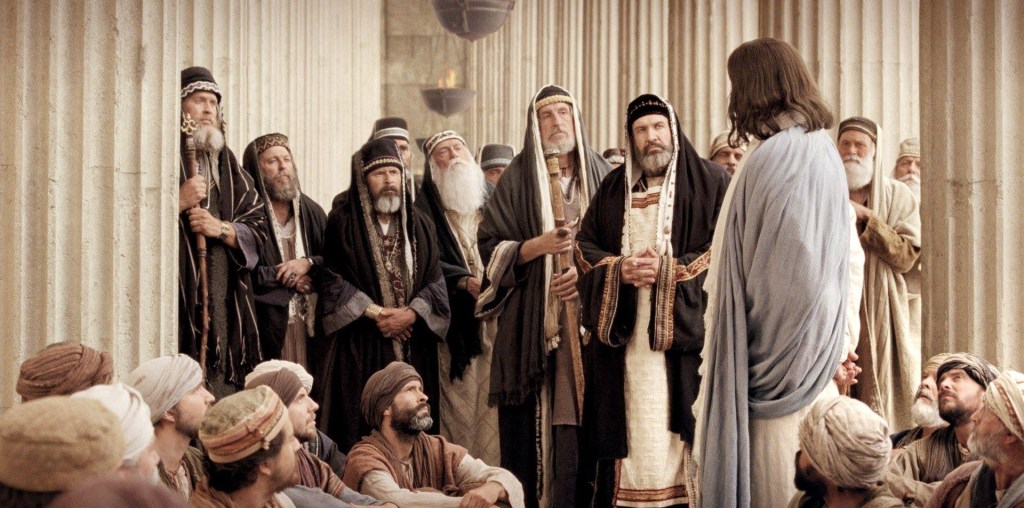
Before that, however, Jesus has to deal, yet again, with some Pharisees (10:2). He had previously had debates with northern Pharisees in Galilee a number of times (2:15–17, 18–22, 23–28; 3:1–6; 7:1–13; 8:11–12). This time, amidst the crowds gathered to hear Jesus in “the region of Judea and beyond the Jordan”, some southern Pharisees now come “to test him” (10:2), as their brothers had done earlier (8:11)—the same dynamic that Mark had reported at the very start of the public activity of Jesus, when the Spirit cast him out into the wilderness “being tested by Satan” (1:12–13).

The test set by the Pharisees relates to the matter of divorce. They had a clear cut point of view about this, although in typical Pharisaic—rabbinic style they begin by posing a question. We have seen this technique before. “Why do John’s disciples and the disciples of the Pharisees fast, but your disciples do not fast?” they ask in Galilee (2:18); and then, “Look, why are they doing what is not lawful on the sabbath?” in a grain field (2:24). 

After Jesus had returned from a trip across the Sea of Galilee to “the other side”, a group of Pharisees ask him, “Why do your disciples not live according to the tradition of the elders, but eat with defiled hands?” (7:5 ). In Dalmanutha, some Pharisees approached Jesus “and began to argue with him, asking him for a sign from heaven, to test him” (8:11). And then, in the passage before us this week, once Jesus is in Judea some Pharisees come “to test him” by asking this question, “Is it lawful for a man to divorce his wife?” (10:2).

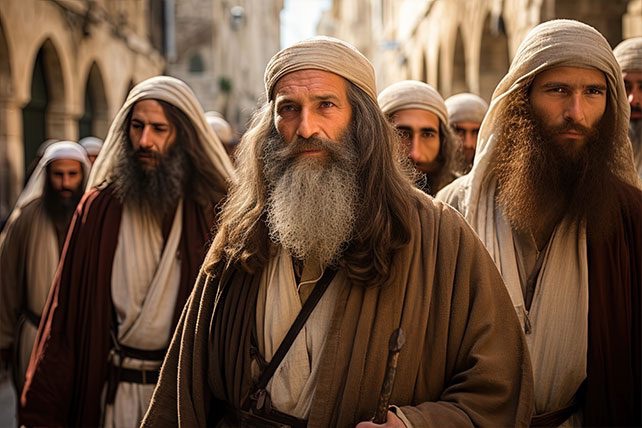
Jesus, of course—being well-schooled in the business of public disputation on matters of Torah—responds to their question with his own question: “What did Moses command you?” (10:3). This, of course, steers the discussion into the heart of the matter: the specific text from Torah which provided guidance on this matter. From here, the debate continues along a familiar pathway, with the Pharisees offering a scripture passage (10:4, referring to Deut 24:1), Jesus responding with an interpretation (10:5) followed by his proposing one scripture passage of relevance (10:6, quoting Gen 1:27) followed immediately by another passage (10:7–9, quoting Gen 2:24). The to-and-fro of scripture citation, interpretation, counter-proposal, and argumentation, is familiar ground for Jesus.

On the matter of divorce, there were different schools of thought amongst Jewish teachers. In biblical law, a husband has the right to divorce his wife, but a wife cannot initiate a divorce (Deut 24:1). A husband could initiate a divorce if he believes there is some uncleanness in his wife. Understandings as to what such uncleanness might varied. At one extreme was the narrow interpretation that divorce was possible only because of adultery. According to the Mishnah (Gittin 9.10), this view was articulated by Beit Shammai, those following the interpretation set forth by rabbi Shammai.

A much broader understanding was adopted within Beit Hillel, that almost any dissatisfaction with his wife’s behaviour could validate a man’s application for a divorce. The Mishnah tractate reports “he may divorce her … because she burned or over-salted his dish … even if he found another woman who is better looking than her and wishes to marry her” (Mishnah, Gittin 9.10).

The line that Jesus takes is to reject the wider understanding; he tells the Pharisees this was decreed by Moses “because of your hardness of heart” (Mark 10:5). That seems to indicate something contingent about the nature of this particular commandment. So Jesus here is practising the kind of evaluation of texts that we know various Torah interpreters practised. He does not simply quote the text and then say “that’s it, case closed”; he undertakes an evaluative interpretation of those older words.

This is a very rabbinic way to operate. A later rabbinic text, Makkot 23b—24a in the Babylonian Talmud (probably compiled in the 6th century CE) reports a debate between rabbis as to how many commandments were included in the Torah. Rebbi Simlai ventured a count of 613 (“two hundred and sixty five prohibtions in accordance with the days of the sun; and two hundred and forty eight positive commandments in accordance with the limbs of a person”). Rav Hamnunya then suggested that David had identified eleven commandments (citing Psalm 15), then Isaiah narrowed this to six (Isa 33:15), then Micah spoke the three key commandments (“do justly, and love mercy, and walk discreetly with your God”, Mic 6:8).

Next, Isaiah is cited once more, from the beginning of what we identify as Third Isaiah (“guard justice and do righteousness”, Isa 56:1). Finally, Amos is cited, with the singular command, “seek me and live” (Amos 5:4). To which Rav Nachman bar Yitzchak responded, saying “maybe it means to seek out the entire Torah?”—although he then proceeds to cite Hab 2:4, “the righteous shall live by his faith”, as the foundational commandment. (We know this obscure prophetic text because it forms the basis for Paul’s declaration of the Gospel to the saints in Rome at Rom 1:16–17). 

You can read the whole debate (in Aramaic, with English translation) on the website Sefaria:

https://www.sefaria.org/Makkot.24a.27?ven=Sefaria_Community_Translation&lang=bi

All of which is to say that, as we read and hear the passage from Mark 10 that is offered by the lectionary, we need to understand the context and apply our learnings from that to the text. The words of Jesus should not be plucked out of context, made to stand in bare isolation, and treated as an eternal, unchanging word of the Lord. That is to misunderstand what is going on in this passage.

Jesus and the Pharisees are setting forth their different understandings. Through this process of debate and discussion, deeper understanding emerges. Rabbis even to this day value vigorous debate and robust questioning, for this is the way that God’s truth emerges. I learnt this with a vengeance some decades ago, when ministering in a congregation set in the Eastern Suburbs of Sydney, where there was a high concentration of Jewish residents. 

Many of the Jewish residents came to the weekly School for Seniors that we ran in the church building, and quite a few Jews joined with Christians in the weekly Jewish—Christian Dialogue group that I ran. We had many Fridays of vigorous disputation and robust argumentation—all in a good cause, all as friends together. And the same congenial experience was repeated many times during my years on the National Uniting Church Dialogue with the Jewish Community!

So let us not read the declaration of Jesus about divorce as a set-in-stone decree, valid for all times. As a divorced and remarried person, I know all too well the dangers that are inherent in such a reading. For a time, some decades after my divorce, I was pursued online by a rabid fundamentalist who condemned me as “doomed to hell”, told me that I was an “apostate” who “has been deceived”, that I am “hell bound without repentance”, and offering the graphic description of my fate, that I was condemned to the eternal lake of burning sulphur (Rev 20:7–10 and 21:8). All because I was divorced and remarried!!!

Society changes, situations develop, understandings deepen and are reshaped by our contexts. We rightly, today, accept that divorce may be the best way ahead for some people, on pastoral and personal grounds. Our laws accept that, and my denomination, the Uniting Church in Australia, accepts that. We bring more factors into the discussion that were not being considered in the brief interaction that Mark reports in ch.10.

In like fashion, countless people have been hurt—many of them deeply hurt—by the fundamentalist insistence that, when he debated the Pharisees in this encounter, Jesus was setting forth “a biblical definition of marriage” that is immutable, when he said, “from the beginning of creation, ‘God made them male and female.’ ‘For this reason a man shall leave his father and mother and be joined to his wife, and the two shall become one flesh.’” (Mark 10:6–7).

Such people place the words of Jesus over and against those people who identify as “queer”—gay, lesbian, bisexual, and also now transgender—and whose love, deep and abiding, for a person of the same gender as they are. Forbidden by law to marry until recent years (2017 in Australia), these people are told “marriage is between a man and a woman”, citing the words of Jesus from this week’s Gospel passage. Again, the argument is simplistic: “Jesus said this, this is what it means, end of discussion, case closed”. It’s a hurtful and uninformed way to operate, in my opinion.

What would Jesus have done if confronted with scenarios of increased domestic violence and toxic masculinity feeding unhealthy and damaging relationships? Would he have replied as a fundamentalist: “that’s what Moses said, that’s it”? Or would he have offered a rabbinic explanation, offering different factors and exploring new pathways of understanding? I suspect the latter.

So let’s not use this passage as a word that is prescriptive—that says something like “this is what the text says, and it expresses exactly how God defines marriage and forbids divorce, and that stands for all times and all places”. The text, in my opinion, gives no indication that a general principle, prescribing human behaviour, is being set forth. Indeed, the Genesis passage about marriage that is cited by Jesus is not from a book that sets out Torah commandments; rather, it is from a narrative work. 

Rather, I see it as descriptive—that offers a description of how human beings behave and what should guide us as we navigate our way through life, based on our experiences and reflection on how things have been for us. Indeed, whilst the quote from Moses (in Deut 24) does have a legal tone to it, it needs to be understood within the back-and-forth that characterised rabbinic interpretation of Torah (an ethos shared by Jesus); and the Genesis quote, it should be noted, comes from a book that contains aetiological narratives (which I have explained in my earlier blogs on the Genesis narratives), describing the world and the place of humans in that world on the basis of observation and experience.

So let’s offer Jesus—and the Pharisees—the respect that they deserve as they discuss and debate, and not try to press their words in a direction that they never intended.

For more on this passage, see

For more on the matter of same-gender marriage, which has been permissible within my church since 2018, see

In praise of Torah (Psalm 19; Pentecost 17B)

The compilers of the Revised Common Lectionary have selected a psalm for each Sunday of the year. That chosen for this coming Sunday, Psalm 19, has two main parts; we will concentrate on the second part in this blog.

Creation is the focus in the first six verses of the psalm, where the psalmist’s view is fixed on “the heavens”, which are “telling the glory of God” (v.1). In those heavens the Lord “has set a tent for the sun, which comes out like a bridegroom from his wedding canopy, and like a strong man runs its course with joy” (v.4–5)—clearly a description of the daily movement of the sun across the sky (from our perspective), from east to west, as verse 6 then elucidates.

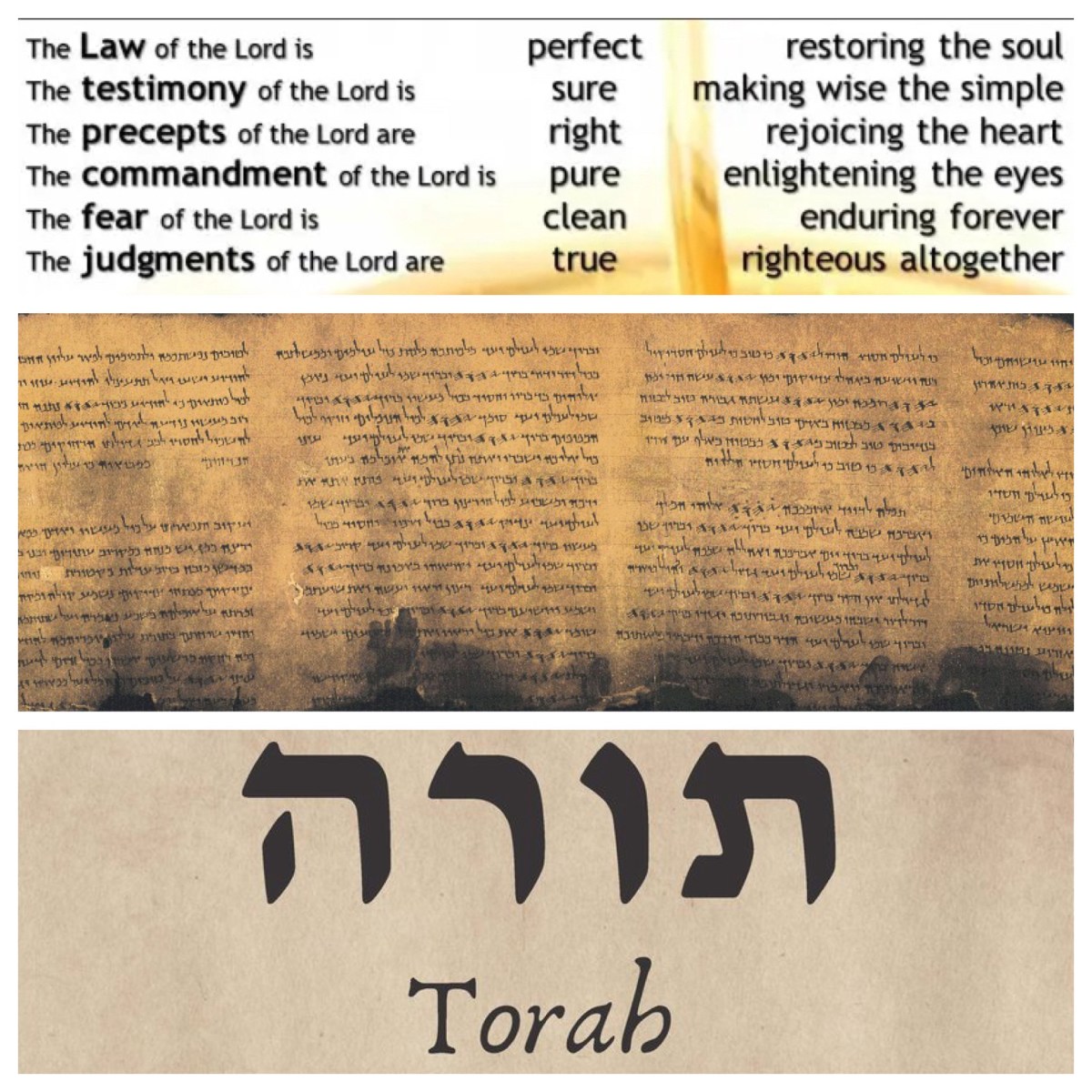
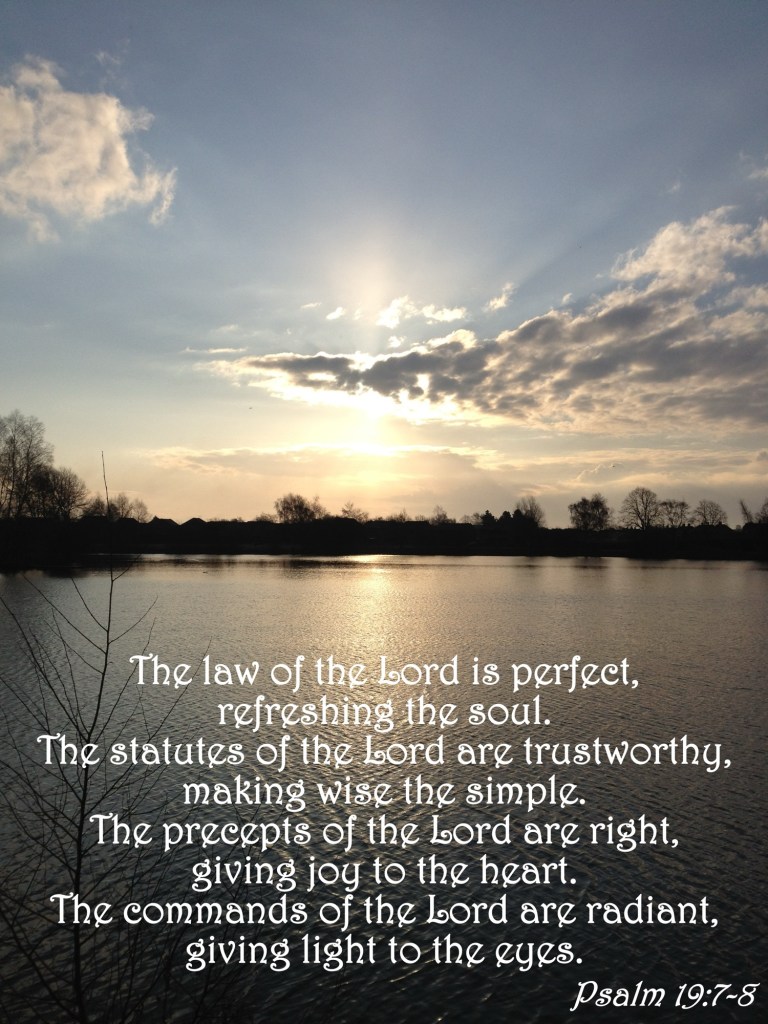
However, at this point the focus changes to Torah. The psalmist expresses a consistently positive attitude towards Torah in verses 7–14. Those verses contain a ringing affirmation of the Torah as “perfect, reviving the soul … sure, making wise the simple … right, rejoicing the heart … clear enlightening the eyes … pure, enduring forever … true and righteous altogether … more to be desired than gold … sweeter also than honey” (Ps 19:7–14).

The terms used here in parallel to describe Torah (law, decrees, precepts, commandment, fear, ordinances) are found regularly in the narrative books to describe the collection of laws (Deut 8:11; 11:1; 1 Ki 2:3; 6:12; 8:58; 2 Ki 17:34–37; 1 Chron 22:13; 28:17; Neh 9:13; 10:29) as well as right throughout Psalm 119. See

Such affirmations of Torah sound out insistently throughout the majestically grand doublets of the longest psalm, Psalm 119. The 176 verses of this psalm, artistically arranged into acrostic stanzas of eight verses at a time, are bracketed by delight and confidence (“happy are those … who walk in the way of the Lord … I long for your salvation, O Lord, and your law is my delight”, vv.1, 174). This psalm indicates that the Law shapes the way that the covenant is kept; and the covenant gives expression to the steadfast love and grace of God.

*****

So much is Torah valued, that it apparently offers perfection: “the law of the Lord is perfect” (Ps 19:7), which we might compare with “I have seen a limit to all perfection, but your commandment is exceedingly broad” (Ps 119:96). In this regard, the psalmist’s appreciation for Torah as perfection seems to reflect the priestly desire for people to offer perfect sacrifices, without blemish (Lev 22:21), and Solomon’s desire to build the Temple as a perfect house for God (1 Ki 6:22).

Indeed, such a conception of perfect Torah also resembles the sage’s musings regarding Wisdom: “to fix one’s thought on her is perfect understanding” (Wisdom 6:15), and thoughts found in a prayer attributed to Solomon: “even one who is perfect among human beings will be regarded as nothing without the wisdom that comes from you” (Wisdom 9:6).

Much value is accorded to these words of Torah. As well as calling the law “perfect”, we hear that “the decrees of the Lord are sure” (Ps 19:7), a claim echoed in another psalm (Ps 93:5). The precepts of the Lord that are right (Ps 19:8; see also 119:75, 137, 172) means that one who is faithful and obedient will be led “in right paths” (Ps 23:3) as they pray “put a new and right spirit within me” (Ps 51:10). “The commandment of the Lord is clear” (Ps 19:8) is a claim that informs the later portrayal of those who trace the course of Wisdom “from the beginning of creation … [who] make knowledge of her clear” (Wisd Sol 6:22).

The psalmist extends the adoration of the Law, declaring that “the fear of the Lord is pure” (Ps 19:9), a claim extended in another statement found in wisdom texts, “the fear of the Lord is the beginning of wisdom” (Ps 111:10; Prov 1:7; 9:10; 15:33; Sir 1:18, 27; 19:20). A further elaboration, “the ordinances of the Lord are true and righteous altogether” (Ps 19:9), is the way that Ezra describes the laws given to Moses on Mount Sinai (Neh 9:13). They are righteous (Ps 119:7, 62, 106, 160, 164), good (119:39), the basis of hope (119:43) and comfort (119:52).

The closing affirmation in this shorter psalm, “more to be desired are they than gold, even much fine gold; sweeter also than honey, and drippings of the honeycomb” (Ps 19:10), is echoed in the longest psalms, “how sweet are your words to my taste, sweeter than honey to my mouth!” (Ps 119:103).

By contrast, when Job asks, “where shall wisdom be found? and where is the place of understanding?”, he proposes that “gold and glass cannot equal it, nor can it be exchanged for jewels of fine gold” (Job 28:12–19), and concludes, “the fear of the Lord, that is wisdom; and to depart from evil is understanding” (Job 28:28).

Wisdom, love, the fear of the Lord, enlightenment, and rejoicing—these are the fruits of Torah, as the psalmist sings. These are the benefits of the law which are to be valued even into our own times, as this Sunday we hear again the words of this ancient psalm and affirm its relevance and importance in the contemporary world.

The priority of the Torah: love God, love neighbour (Mark 12; Narrative Lectionary for Lent 4)

“You shall love the Lord your God with all your heart, and with all your soul, and with all your strength, and with all your mind” (Deuteronomy 6:5). “You shall love your neighbour as yourself” (Leviticus 19:8). These two commandments are cited in a story about Jesus engaging in a discussion with a scribe, a teacher of the Law, which ends with Jesus saying, “there is no commandment greater than these” (Mark 12:31).

The Narrative Lectionary includes this story (Mark 12:28–34) as the opening section of a longer Gospel passage that is proposed for worship this coming Sunday (12:28–44). It’s a passage that takes us deep into the heart of Torah—those guidelines for living all of life in covenant faithfulness with God. Torah sits at the centre of Judaism. See more on this at

Of course, Jesus hasn’t answered the question precisely in the terms that it was asked; he doesn’t indicate what is “the first” commandment, but which two are “greatest”. It’s like a dead heat in an Olympic race: a race when even a finely-tuned system can’t differentiate between the two winners, even down to one thousandth of a second. Both love of God and love of neighbour are equally important. Joint winners—like that high jump competition a year or two back where the two leading jumpers just decided to share the gold medal, rather than keep competing—and risk not getting gold.

Both commands are biblical commands, found within the foundational books of scripture within Judaism. They were texts that Jewish people, such as Jesus and his earliest followers would have known very well. Each command appears in a significant place within the books of Torah, the first five books of Hebrew Scriptures.

The command to “love God” sits at the head of a long section in Deuteronomy, which reports a speech by Moses allegedly given to the people of Israel (Deut 5:1–26:19). The speech rehearses many of the laws that are reported in Exodus and Leviticus, framing them in terms of the repeated phrases, “the statutes and ordinances for you to observe” (4:1,5,14; 5:1; 6:1; 12:1; 26:16–17), “the statutes and ordinances that the Lord your God has commanded you” (6:20; 7:11; 8:11).

After proclaiming the Ten Commandments which God gave to Israel through Moses (Deut 5:1–21; cf. Exod 20:1–17) and rehearsing the scene on Mount Sinai and amongst the people below (5:22–33; cf. Exod 19:1–25; 20:18–21). Moses then delivers the word which sits at the head of all that follows: “Hear, O Israel: The LORD is our God, the LORD alone. You shall love the LORD your God with all your heart, and with all your soul, and with all your might. Keep these words that I am commanding you today in your heart” (Deut 6:4–6). This, it would seem, is the key commandment amongst all the statutes and ordinances.

These words are known in Jewish tradition as the Shema, a Hebrew word literally meaning “hear” or “listen”. It’s the first word in this key commandment; and more broadly than simply “hear” or “listen”, it caries a sense of “obey”. These words are important to Jews as the daily prayer, to be prayed twice a day—in keeping with the instruction to recite them “when you lie down and when you rise” (Deut 6:7). As these daily words, “love the Lord your God” with all of your being are said, they reinforce the centrality of God and the importance of commitment to God within the covenant people.

The command to “love your neighbour” in Leviticus 19 culminates a series of instructions regarding the way a person is to relate to their neighbours: “you shall not defraud your neighbour … with justice you shall judge your neighbour … you shall not profit by the blood of your neighbour … you shall not reprove your neighbour … you shall love your neighbour” (Lev 19:13–18).

These instructions sit within the section of the book which is often called The Holiness Code—a section which emphasises the word to Israel, that “you shall be holy, for I the Lord your God am holy” (Lev 19:2; also 20:7, 26). Being holy means treating others with respect. Loving your neighbour is a clear manifestation of that ethos. Loving your neighbour exemplifies the way to be a faithful person in covenant relationship with God.

So it is for very good reasons that Jesus extracts these two commandments from amongst the 613 commandments that are to be found within the pages of the Torah. (The rabbis counted them all up—there are 248 “positive commandments”, giving instructions to perform a particular act, and 365 “negative commandments”, requiring people to abstain from certain acts.)

Jesus, of course, was a Jew, instructed in the way of Torah. He knew his scriptures—he argued intensely with the teachers of the Law over a number of different issues. He frequented the synagogue, read from the scroll, prayed to God, and went on pilgrimage to Jerusalem and into the Temple—where, once again, he offered a critique of the practices that were taking place in the courtyard of the Temple (11:15–17).

Then he engaged in debate and disputation with scribes and priests (11:27), Pharisees and Herodians (12:13), and Sadducees (12:18). Each of those groups came to Jesus with a trick question, which they expected would trap Jesus (12:13). Jesus inevitably bests them with his responses (11:33; 12:12, 17, 27). It was at this point that the particular scribe in our passage approached Jesus, perhaps intending to set yet another trap for him (12:28).

So Jesus, good Jew that he was, is well able to reach into his knowledge of Torah in his answer to the scribe. The commandments that he selects have been chosen with a purpose. They contain the essence of the Torah. His answer draws forth the agreement of the scribe—there will be no robust debate now! In fact, in affirming Jesus, the scribe reflects the prophetic perspective, that keeping the covenant in daily life is more important that following the liturgical rituals of sacrifice in the Temple (see Amos 5:21–24; Micah 6:6–8; Isaiah 1:10–17).

The scene is similar to a Jewish tale that is reported in the Babylonian Talmud, a 6th century CE work. In Shabbat 31a, within a tractate on the sabbath, we read: “It happened that a certain non-Jew came before Shammai and said to him, ‘Make me a convert, on condition that you teach me the whole Torah while I stand on one foot.’ Thereupon he repulsed him with the builder’s cubit that was in his hand. When he went before Hillel, he said to him, ‘What is hateful to you, do not to your neighbour: that is the whole Torah, the rest is the commentary; go and learn it.’”

Hillel, of course, had provided the enquiring convert, not with one of the 613 commandments, but with one that summarised the intent of many of those commandments. We know it as the Golden Rule, and it appears in the Synoptic Gospels as a teaching of Jesus (Matt 7:12; Luke 6:31).

Some Jewish teachers claim that the full text of Lev 19:18 is actually an expression of this rule: “You shall not take vengeance or bear a grudge against any of your people, but you shall love your neighbour as yourself: I am the LORD.” Later Jewish writings closer to the time of Jesus reflect the Golden Rule in its negative form: “do to no one what you yourself dislike” (Tobit 4:15), and “recognise that your neighbour feels as you do, and keep in mind your own dislikes” (Sirach 31:15).

Paul clearly knows the command to love neighbours, for he quotes it to the Galatians: “the whole law is summed up in a single commandment, ‘You shall love your neighbour as yourself’” (Gal 5:14), and James also cites it: “you do well if you really fulfill the royal law according to the scripture, ‘You shall love your neighbour as yourself’” (James 2:8). Both writers reflect the fact that this was an instruction that stuck in people’s minds!

And I wonder … perhaps there’s a hint, in these two letters, that the greater of these two equally-important commandments is actually the instruction to “love your neighbour”?

*****

I have provided a more detailed technical discussion of the words used in this passage, and its Synoptic parallels, in this blog:

On the Pharisees and Torah, see

In praise of Torah (Psalm 19; Lent 3B)

The compilers of the Revised Common Lectionary have selected a psalm for each Sunday of the year, noting that this has normally been in order to provide a passage that complements the First Reading, which is most often a passage from Hebrew Scripture.

The psalm for this coming Sunday, Psalm 19, was obviously chosen as a companion reading alongside the Hebrew Scripture passage from Exodus 20, which recounts The Ten Words given to Israel, through Moses, when he met with the Lord on Mount Sinai (Exod 20:1–17). For that passage, see

Creation is the focus in the first six verses of the psalm, where the psalmist’s view is fixed on “the heavens”, which are “telling the glory of God” (v.1). In those heavens the Lord “has set a tent for the sun, which comes out like a bridegroom from his wedding canopy, and like a strong man runs its course with joy” (v.4–5)—clearly a description of the daily movement of the sun across the sky (from our perspective), from east to west, as verse 6 then elucidates.

However, at this point the focus changes to Torah. The psalmist expresses a consistently positive attitude towards Torah in verses 7–14. Those verses contain a ringing affirmation of the Torah as “perfect, reviving the soul … sure, making wise the simple … right, rejoicing the heart … clear enlightening the eyes … pure, enduring forever … true and righteous altogether … more to be desired than gold … sweeter also than honey” (Ps 19:7–14).

The terms used here in parallel to describe Torah (law, decrees, precepts, commandment, fear, ordinances) are found regularly in the narrative books to describe the collection of laws (Deut 8:11; 11:1; 1 Ki 2:3; 6:12; 8:58; 2 Ki 17:34–37; 1 Chron 22:13; 28:17; Neh 9:13; 10:29) as well as right throughout Psalm 119. See

Such affirmations of Torah sound out insistently throughout the majestically grand doublets of the longest psalm, Psalm 119. The 176 verses of this psalm, artistically arranged into acrostic stanzas of eight verses at a time, are bracketed by delight and confidence (“happy are those … who walk in the way of the Lord … I long for your salvation, O Lord, and your law is my delight”, vv.1, 174). This psalm indicates that the Law shapes the way that the covenant is kept; and the covenant gives expression to the steadfast love and grace of God.

*****

So much is Torah valued, that it apparently offers perfection: “the law of the Lord is perfect” (Ps 19:7), which we might compare with “I have seen a limit to all perfection, but your commandment is exceedingly broad” (Ps 119:96). In this regard, the psalmist’s appreciation for Torah as perfection seems to reflect the priestly desire for people to offer perfect sacrifices, without blemish (Lev 22:21), and Solomon’s desire to build the Temple as a perfect house for God (1 Ki 6:22).

Indeed, such a conception of perfect Torah also resembles the sage’s musings regarding Wisdom: “to fix one’s thought on her is perfect understanding” (Wisdom 6:15), and thoughts found in a prayer attributed to Solomon: “even one who is perfect among human beings will be regarded as nothing without the wisdom that comes from you” (Wisdom 9:6).

Much value is accorded to these words of Torah. As well as calling the law “perfect”, we hear that “the decrees of the Lord are sure” (Ps 19:7), a claim echoed in another psalm (Ps 93:5). The precepts of the Lord that are right (Ps 19:8; see also 119:75, 137, 172) means that one who is faithful and obedient will be led “in right paths” (Ps 23:3) as they pray “put a new and right spirit within me” (Ps 51:10). “The commandment of the Lord is clear” (Ps 19:8) is a claim that informs the later portrayal of those who trace the course of Wisdom “from the beginning of creation … [who] make knowledge of her clear” (Wisd Sol 6:22).

The psalmist extends the adoration of the Law, declaring that “the fear of the Lord is pure” (Ps 19:9), a claim extended in another statement found in wisdom texts, “the fear of the Lord is the beginning of wisdom” (Ps 111:10; Prov 1:7; 9:10; 15:33; Sir 1:18, 27; 19:20). A further elaboration, “the ordinances of the Lord are true and righteous altogether” (Ps 19:9), is the way that Ezra describes the laws given to Moses on Mount Sinai (Neh 9:13). They are righteous (Ps 119:7, 62, 106, 160, 164), good (119:39), the basis of hope (119:43) and comfort (119:52).

The closing affirmation in this shorter psalm, “more to be desired are they than gold, even much fine gold; sweeter also than honey, and drippings of the honeycomb” (Ps 19:10), is echoed in the longest psalms, “how sweet are your words to my taste, sweeter than honey to my mouth!” (Ps 119:103).

By contrast, when Job asks, “where shall wisdom be found? and where is the place of understanding?”, he proposes that “gold and glass cannot equal it, nor can it be exchanged for jewels of fine gold” (Job 28:12–19), and concludes, “the fear of the Lord, that is wisdom; and to depart from evil is understanding” (Job 28:28).

Wisdom, love, the fear of the Lord, enlightenment, and rejoicing—these are the fruits of Torah, as the psalmist sings. These are the benefits of the law which are to be valued even into our own times, as this Sunday we hear again the words of this ancient psalm and affirm its relevance and importance in the contemporary world.