Appropriating the words of an Israelite prophet for a Christian doctrine (Isaiah 6; Trinity B)

Trinity Sunday is one of the very few times in the Christian calendar that a Sunday is named for a doctrine, rather than for a biblical story (Easter, Pentecost, Christmas, and the like). The passages are chosen to encourage us to reflect on the doctrine of the Trinity, as a doctrine that is central to our faith, through selected biblical passages; this year, sections of Isaiah, John, and Romans (with a Psalm chosen to complement these selections).

So this Sunday we are being asked to approach scripture in a way quite different from many other Sundays, when biblical texts are offered for us to consider in their own right. Trinity Sunday, by contrast, pays scant attention to the historical and literary contexts of the chosen texts. Rather, they are selected as isolated “bites” that can be woven together to provide “a biblical basis” for a doctrine that was developed and expressed a number of centuries later.

In this regard, it has similarities with the way that we are encouraged to read selections from the prophets of ancient Israel—taking particular passages which are placed alongside certain Gospel stories because they “illuminate” or “complement” these later texts. The birth of Jesus at Christmas and the death of Jesus at Easter—and the weeks leading up to these days, in the seasons of Advent and Lent, respectively—are the times when this process is most evident.

So the choice of Isaiah 6:1–8 as the First Reading for this coming Sunday, Trinity Sunday, has both of those pressures running in parallel. First, this text is intended to speak from six centuries before Jesus about what people four centuries after Jesus thought about him, God, and the Spirit. That’s a leapfrog over a whole millennium!!

And second, this text is intended to focus our thoughts on the threefold nature of God—Father, Son, and Holy Spirit—through the somewhat fortuitous chanting of “holy, holy, holy” by seraphim in the smoke-filled temple atop Mount Zion (Isa 6:3). The only other place in scripture where this threefold acclamation of divine holiness appears is in the extravagantly symbolic visions of the spirit-infused prophet of Revelation, as he “sees things” in his old age (Rev 4:8).

The chanting of the seraphim in the former book, Isaiah, is the first articulation of a chant which, millennia later, became associated with the triune God, worshipped in Christian liturgies. In my own church, after the presiding minster prompts with the words: “And so we praise you with the faithful of every time and place, joining with the choirs of angels and the whole creation in the eternal hymn”, the people respond, “Holy, holy, holy Lord, God of power and might, heaven and earth are full of your glory. Hosanna in the highest. Blessed is he who comes in the name of the Lord. Hosanna in the highest.” (quoted from The Service of the Lord’s Day in Uniting in Worship 2; Assembly of the Uniting Church in Australia, 2005).

This song has an integral place in the liturgy, not just of the Uniting Church, but of numerous liturgical denominations around the world. It is sung or spoken in the Great Prayer of Thanksgiving, as people offer thanks to God and prepare to receive the sacrament. Its location within the Christian liturgy means that, in the minds of many believers, it is thoroughly Christianised.

And I suspect that the threefold expression, “holy, holy, holy”, is intended to evoke the three-in-one nature of God, as understood in classic Christian theology. Perhaps it is intended to be a subconscious evocation of “Holy God, Holy Son, Holy Spirit” — even though the song itself says nothing about the unity of those three elements?

The author of the latter book, Revelation, quotes this chant in the long sequence of visions that he reports in this book. He says that he was “in the spirit” (1:10; 4:2; 17:3; 21:10), hearing “the voice of many angels” (5:11–12), as four living creatures sing without ceasing, “Holy, holy, holy, the Lord God the Almighty, who was and is and is to come” (4:8). That’s a multiplying of the threefold aspect of God—three times holy, over three eras of time.

The creatures singing this song are “full of eyes in front and behind”, and they variously appear like a lion, an ox, a creature with a face like a human face, and a flying eagle (4:6–7). These strange creatures appear before the prophet then sees “a lamb standing as if it had been slaughtered, having seven horns and seven eyes” (5:6). The scene is quite fantastical.

There follows further, increasingly bizarre, visions: “the lamb” opens a series of seals with associated dramatic events (6:1–17; 8:1), angels are seen to be hold back nature (7:1), one angel speaks forth (7:2–3) and then seven angels each blow their trumpets (8:6—9:14) before another four angels who were “bound at the great river Euphrates” are released in order to wreak vengeance on the earth and on humanity (9:15–21). We are well and truly into the vividly creative inner mind of the prophet, surely.

After all of this, the prophet is offered a scroll by an angel “wrapped in a cloud, with a rainbow over his head; his face was like the sun, and his legs like pillars of fire” (10:1–2). The prophet takes the scroll and eats it (10:8–10); “it was sweet as honey in my mouth, but when I had eaten it, my stomach was made bitter” (10:10). That should hardly have been a surprise; the human digestive system is not intended for such a diet!

Then the prophet is instructed to “prophesy again about many peoples and nations and languages and kings” (10:11)—and he does so in a series of increasingly dramatic, vivid, and bizarre prophecies (chs. 11—22). It’s hardly the stuff that encourages me to think that the vision which included the threefold acclamation of God (4:8) was being considered in a rational way and employed in a constructive process of building a doctrine that would serve the church well over time!

Quite surprisingly, in the midst of this extravagant revelatory exotica, there is a little scene that is strongly reminiscent of the scene in the temple on Mount Zion that Isaiah had described centuries beforehand. An angel with a golden censer “came and stood at the altar; he was given a great quantity of incense to offer with the prayers of all the saints on the golden altar that is before the throne” (Rev 8:3). After this, “the smoke of the incense, with the prayers of the saints, rose before God from the hand of the angel” (8:4) before the angel took the censer and filled it with fire from the altar and “threw it on the earth; and there were peals of thunder, rumblings, flashes of lightning, and an earthquake” (8:5).

The scene that is narrated in Revelation, therefore, might have certain resonances with the scene when the thresholds of the doorway to the Temple building “shook at the voices of those who called, and the house filled with smoke” (Isa 6:4). However, the creative imagination of the later prophet on Patmos (Rev 1:9) has taken him far, far away from the scene of the earlier prophet, Isaiah, in Jerusalem. And he ends up even further away from the process of vigorous debate and philosophical disputation which was the context within which the doctrine of the Trinity was formulated.
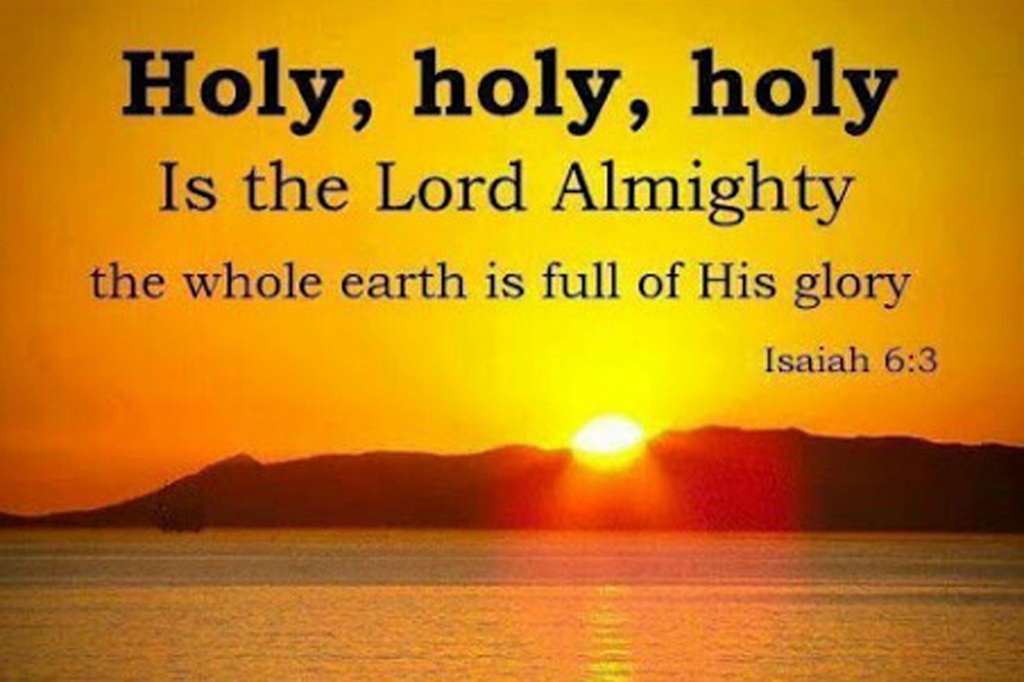
Isaiah locates the moment when he sensed his calling to be a prophet precisely when those seraphs sang their song, “holy, holy, holy” (Isa 6:3). “Woe is me”, he cries, explaining that “I am lost, for I am a man of unclean lips, and I live among a people of unclean lips” (6:5a). An intense sense of personal and communal inadequacy grips the prophet.

“Yet”, he continues, “my eyes have seen the King, the Lord of hosts!” (6:5b). This is far from an exposition of the inner nature of God; there is nothing to provide a hint of the doctrine of the Trinity, to be sure. In fact, this vision is similar to that seen by the prophets Amos during the time of Uzziah of Judah and Jeroboam of Israel (Amos 9:1) and Micaiah during the time of Jehoshaphat of Judah and Ahab of Israel (1 Ki 22:19; 2 Chron 18:18), when “coals of fire flamed forth” from the brightness before the Lord God.

In what Isaiah sees in this vision of “the King, the Lord of hosts”, he reports that “one of the seraphs flew to me, holding a live coal that had been taken from the altar with a pair of tongs; the seraph touched my mouth with it” (6:7) and uttered words of cleansing and forgiveness (6:8), followed by a word of commissioning (6:8). The coals are reminiscent of David’s vision of the Lord in his prayer calling for help, as “smoke went up from his nostrils, and devouring fire from his mouth; glowing coals flamed forth from him” (Ps 18:8, 12; 2 Sam 22:9, 13).

This moment during the visionary experience in the smoke-filled Temple grounds the prophet in the realities of his earthly life. The seraphs fly from the envisioned presence of the Lord God to touch the prophet directly in his physical state. There is nothing speculative or metaphysical involved in this sixth century BCE experience, such as we find in the expressions of Trinity that have been formulated since the fourth century CE.

It is noteworthy that the content of the commissioning that Isaiah then hears (6:9–13) is omitted from the verses suggested by the lectionary for Trinity Sunday. This severs the scene in the middle; the charge given to Isaiah is integral to the scene, and should not be omitted! Granted, the words which Isaiah hears are challenging and complex, for he is to “listen, but not comprehend; keep looking, but not understand” (6:9); indeed, he is to “make the mind of this people dull, and stop their ears, and shut their eyes, so that they may not look with their eyes, and listen with their ears, and comprehend with their minds, and turn and be healed” (6:10).

This is sobering. It is also material which could have been considered—indeed, should have been considered—in the process of exploring the essence of God, and articulating the nature of the divine—which is precisely what the doctrine of the Trinity is attempting to do. The God who cleanses and calls (6:7–8) is the same God who challenges and convicts (6:9–10), and who then judges with a ferocious intensity which is born out of a deep integrity (6:11–13).

How long is Isaiah to prophesy his words of challenge? “Until cities lie waste without inhabitant, and houses without people”, the answer comes (6:11); until “vast is the emptiness in the midst of the land” (6:12). For better or worse, we need to reckon with this dimension of God’s nature—and this coming Sunday would have been as good a time as any to ponder it!

So on Sunday during worship, ignore the lectionary, don’t stop at verse 8, and keep reading to the end of the chapter; and then reflect on who this God whom we worship really is.

See also

Forcing scripture to support doctrine: texts for Trinity Sunday (2 Cor 13, Matt 28; Trinity A)

This coming Sunday is one of those extremely rare moments in the course of the church year. It’s a Sunday that raises some difficulties for me. First, it’s one of the very few times in the Christian calendar that a Sunday is named for a doctrine, rather than for a biblical story (Easter, Pentecost, Christmas, and the like). And second, it is unusual in that it presents problems for the shapers of the lectionary, since (in my view) the Doctrine of the Trinity is not actually proclaimed in the biblical texts.

Indeed, we might well argue that the texts which are selected for this coming Sunday are actually being asked to undertake work that they weren’t intended to do, and that they can’t actually do without significant violence being done to them. I have already explored the two Hebrew Scripture passages (Genesis 1 and Psalm 8); see

In this post I turn to the two New Testament passages (2 Corinthians 13 and Matthew 28). What then, first, of Paul’s closing words of his second letter to the Corinthians? This provides one of the rare instances in the New Testament where Jesus, God, and the Holy Spirit appear in close proximity within the same sentence. Could this be an early statement of a three-in-one deity? Some interpreters would have us think so.

However, the blessing that is offered at the end of this letter is not Paul making a doctrinal declaration about the inner nature of God. It is, rather, a poetically-inspired literary variation and expansion of the typical closing words that we find at the end of his letters.

“The grace of the Lord Jesus be with you” is how he has ended his earlier letter to the Corinthians (1 Cor 16:23), a closure similar to “the grace of our Lord Jesus Christ be with you” (1 Thess 5:28), “the grace of the Lord Jesus Christ be with your spirit” (Phil 4:23 and also Phlmn 25), and “may the grace of our Lord Jesus Christ be with your spirit, brothers and sisters. Amen” (Gal 6:18). Each ending has a very minor stylistic variation.

Writing to the believers in Rome, where dissension had gripped the house gatherings in that city, Paul most likely ended his long letter with a different blessing, “the God of peace be with all of you. Amen” (Rom 15:33). At some point, the extended greetings of Rom 16:1–16 was added, leading to a later word of blessing, “the God of peace will shortly crush Satan under your feet; the grace of our Lord Jesus Christ be with you” (Rom 16:20), after which yet more greetings are offered (Rom 16:21–23) and then a quite uncharacteristically flowery closure is appended–most likely by a later scribe, wanting to give a grand finale to Paul’s longest letter (Rom 16:25–27). In place of that excessive ending, another scribe substituted the more typical Pauline blessing, “the grace of our Lord Jesus Christ be with all of you. Amen” (marked as Rom 16:24 in our numbering).

All of which indicates that the closing blessing in Paul’s authentic letters was both predictable, in that it offered grace, and also variable, in that it was occasionally nuanced and modified from the basic form. Such is the case in 2 Cor, where the standard blessing is extended.

The first phrase picks up Paul’s concerns in this letter for God’s grace, manifest to the Corinthians (2 Cor 1:12; 4:15; 6:1; 8:1; 9:14; 12:9). The second phrase adds God’s love, evident not only in Paul’s earlier words in 1 Cor 13, but also in this letter (2 Cor 5:14; 13:11). And the third phrase evokes the compassionate outpouring of the opening chapter of this letter, as Paul expresses his fellowship with the Corinthians by offering them consolation in their sufferings (2 Cor 1:3–11) and his fervent desire to visit them (2 Cor 1:15—2:4), culminating in his passionate expression, “I wrote you out of much distress and anguish of heart and with many tears, not to cause you pain, but to let you know the abundant love that I have for you” (2 Cor 2:4).

Indeed, it in in this letter that Paul most clearly articulated his understanding of, and commitment to, “the ministry of reconciliation ” (2 Cor 5:11–21). This understanding has surely come to fullest expression in the context of his relationship with the Corinthians, with whom he has certainly struggled, yet for whom he has a profound depth of compassion and love. He yearns to be held within “the communion of the Holy Spirit” with them.

The closing blessing at 2 Cor 13:13 is thus a personal, compassionate expression of his love and concern for the Corinthians-a fitting ending to a most passionate letter. It is far away from being a statement of the doctrine of God.

Which leaves, last of all, the closing words of Matthew’s Gospel (Matt 28:16–20), in which Jesus is said to have given a final command to his disciples, and assured them of his enduring ongoing presence with them “to the end of the age”? Here, embedded in the primary command to “go to all nations”, there is the subsidiary instruction to “make disciples”, as well as a further subsidiary instruction to “baptise in the name”. It is this last clause, of course, which motivates the offering of this passage for Trinity Sunday.

The focus of the passage which is commonly referred to as “the Great Commission” in Matthew’s Gospel (28:19–20) need to be read carefully. There are four key verbs (doing words) in these two verses: go, teach, baptise, teach. In strict syntactical analysis, the main verb is the one in the imperative (expressing a command): “make disciples”. Subsidiary to that are the other three verbs, each of which is in a participial form (indicating an action that is related to, or consequent from, that main verb). So making disciples is the key factor in this commission.

The act of making disciples is directed towards “the nations”—that is, to anyone with whom the followers of Jesus come into contact. It is to be expressed through two activities: baptising, and teaching. The act of making disciples is also to take place “as you are going”, that is, as followers of Jesus are making their way through the world in the days ahead.

Teaching orients the focus of the disciples back to the time that they spent with Jesus; they are to teach the people of the nations “to obey everything that I have commanded you”. As Matthew has taken great care to compile and collate the teachings of Jesus into five clear sections of his Gospel (chs. 5–7, 10, 13, 18, 23–25), the guidelines provided by Jesus are evident. What he has taught in his time with the disciples is to be passed on (in good rabbinic style) to those whom they then instruct. Teaching is an activity for life in this world, very clearly.

Baptising orients the focus of the disciples to the life of the church in the future. Belonging to Jesus involves submitting to the ritual of immersion into water, signalling the new life that is taken on through faith. So, when we look at each of these factors—the syntax, the content, the focus of the passage, we must conclude that thispassage is clearly directed towards the activity that the disciples of Jesus are to undertake from this time onwards. It is not offering a doctrinal definition.

The formula used in Matt 28:19 is, in fact, something that emerges only later in the life of the church (probably not until the time of Constantine, as far as we can tell from other Christian literature). Once again, life in community on this earth is the focus. There is no sense of being baptised (“christened” in the old language) into a mysteriously complex entity of a triune being in order to “get into heaven” in accordance with institutional theological dogma. The emphasis is on community building and discipleship development within the evolving faith communities of the Jesus movement.

The focus here is on what the disciples need to do in the earthly life that stretches ahead of them: bear witness, make disciples, teach and baptise, continue out amongst “the nations” the mission that the earthly Jesus has been undertaking amongst “the lost sheep of the house of Israel”. That is far removed from any abstract speculative hypothesising about the nature of a transcendent divine being.

Forcing scripture to support doctrine: texts for Trinity Sunday (Gen 1, Psalm 8; Trinity A)

This coming Sunday is one of those extremely rare moments in the course of the church year. It’s a Sunday that raises some difficulties for me. First, it’s one of the very few times in the Christian calendar that a Sunday is named for a doctrine, rather than for a biblical story (Easter, Pentecost, Christmas, and the like). And second, it is unusual in that it presents problems for the shapers of the lectionary, since (in my view) the Doctrine of the Trinity is not actually proclaimed in the biblical texts.

Indeed, we might well argue that the texts which are selected for this coming Sunday (Genesis 1, Psalm 8, 2 Corinthians 13, and Matthew 28) are actually being asked to undertake work that they weren’t intended to do, and that they can’t actually do without significant violence being done to them. None of them were created with a view to being foundations for a doctrine that was developed some centuries later (in the case of the New Testament texts) or, indeed, a millennium or more later (in the case of the Hebrew Scripture passages).

And further, the two passages from Hebrew Scripture were actually written well before the time of Jesus, long before the Church came into being, centuries before Christian doctrine was developed in the height of the neo-Platonic speculative theology of the late Roman Empire. They were not shaped with such doctrinal expressions in mind; in fact, they were, and are, sacred texts in another religious expression, Judaism—which, although we Christians claim it as the context from which our faith evolved, nevertheless is a distinct and separate faith tradition.

Setting these two passages of scripture in the lectionary for a Sunday when the focus is on a Christian doctrine is anachronistic and invites us, unless we think carefully, to do violence to the text in our interpretation of them within that doctrinal context. In the normal,course of events, placing a narrative or piece of poetry from ancient Israelite religion alongside texts from the New Testament makes some sense, insofar as our understanding of such passages must always be informed by the heritage bequeathed by Hebrew Scripture texts. But setting such ancient texts as resources to interpret the fourth- and fifth-century doctrinal perspective is quite unhelpful.

Perhaps we should have readings from Origen, Athanasius, and Augustine, for Trinity Sunday? But the fact is, that we have texts from Genesis, the Psalms, Paul, and a Gospel, for this Sunday. What do we make of them?

Genesis 1, the story of the creation of the world, is most likely offered for Trinity Sunday in Year A because the opening verses refer, in turn, to God, a wind, or breath, from God sweeping over the waters, and the activity of God speaking in order to bring forth elements of that creation (Gen 1:1–3). It is not too difficult to read that with Christian spectacles on, and see the presence of God the Creator, the Word of God, and the wind, or breath, as God’s spirit. So numerous Christian interpreters have pressed upon their people, for centuries.

However, arguing that this provides the foundation for the full Christian doctrine of the Triune God does severe damage to the intentions of the passage, at least as we may understand them if we read the text carefully. There is no suggestion that these three elements are persons who are interrelated into one being. There is no indication that they are related, other than the fact that the breath and the speaking are activities of God. That is in no way unusual or extraordinary.

Indeed, if we think some more about the God who is described in these opening few verses, we would recognise that there are a number of other activities undertaken by God, or manifestations of God’s being, that are reported in the various scrolls of the Hebrew Scriptures. As well as the voice (speaking) and the wind (breathing), there are other aspects of the person of God which are said to be active: the mouth, the hands, the fingers of God. Such quasi-independent activity is not limited to two entities alone. The notion of a three-in-one person is nowhere to be found in these scripture passages.

So we need to read Genesis 1 in that much broader context. In addition, we need to be aware of the other “personifications” of the deity that appear in Hebrew Scripture. The ruach—the spirit of God—is, of course, active in calling prophets (1 Sam 10:6, 16; Isa 42:1; 61:1; Ezek 2:2; Dan 5:14; Joel 2:28–29; Mic 3:8; Zech 7:12).

Alongside the spirit, Wisdom, Hochmah, takes on her own persona and role in the wisdom literature; she is the “master worker” who works with God to create the universe (Prov 8:22–31), so that “The Lord by wisdom founded the earth; by understanding he established the heavens; by his knowledge the deeps broke open, and the clouds drop down the dew” (Prov 4:19). It is Wisdom who “cries out in the street; in the squares she raises her voice”, teaching God’s ways to the people (Prov 1:20–23; also 8:1–9). The psalmist affirms that “the fear of the Lord is the beginning of wisdom” (Ps 111:10). Wisdom is God at work in creating and in teaching.

In the narratives telling of the years wandering in the wilderness, the Glory of God, the kabod, appears regularly. When the people arrived at the edge of the wilderness, “the Lord went in front of them in a pillar of cloud by day, to lead them along the way, and in a pillar of fire by night, to give them light, so that they might travel by day and by night; neither the pillar of cloud by day nor the pillar of fire by night left its place in front of the people” (Exod 13:21–22). This manifestation is identified as “the glory of the Lord” (Exod 16:10).

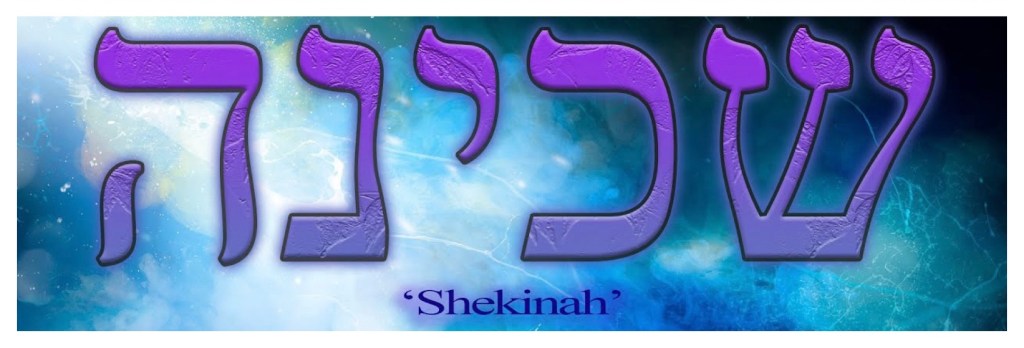
On arrival at Mount Sinai, “the glory of the Lord settled on Mount Sinai, and the cloud covered it for six days … the appearance of the glory of the Lord was like a devouring fire on the top of the mountain in the sight of the people of Israeli” (Exod 24:16–17). In rabbinic literature, this phenomenon is given the name shekinah—a further way of describing the manifestation of divine activity. The Shekinah is yet another manifestation of the divine which becomes personified over time in Jewish traditions; not a separate person, rather an expression of God’s being.

Yet another rabbinic term for divine manifestation is the Bat Qol, the voice of God. This takes the many statements in scripture about God speaking, and attributes quasi-personal firm to the voice of. God. The term Bat Qol literally means “the daughter of the voice”, as if simply by speaking, God generates a personality or a being from that process.

There is much discussion in rabbinic literature about the role and function of the Bat Qol. It was thought that the Bat Qol had been active in biblical times, even though there is no explicit statement of her activity in Hebrew Scripture. A common view in rabbinic literature is that the Bat Qol became the way that God communicated with humanity after the end of the prophetic era.

Also in later rabbinic discussions, even Torah itself—the teaching, or instruction, of God which was given in “the Law”—is personified and seen to be active in and of itself. So along with word and breath (or spirit), there is Wisdom (Hochmah), Glory (Shekinah), Bat Qol, and Torah, who are active expressions of God in the developing Jewish tradition.

Psalm 8 is also offered by the lectionary for Trinity Sunday in Year A; and it is also offered by the lectionary on this day in Year C, as well as for New Years Day in each of the three years. It is a logical companion piece with the Genesis story of creation, which is reflected in verses 1–2 and 7–9. In the middle of the psalm, the place of humanity is in focus; here the emphasis is on the relationship that humanity has with the deity (“a little lower than God, crowned with glory and honour”, v.5) and the responsibility of “dominion” that is given to humans over animals, birds, and fish (vv.7–8).

Perhaps the connection for this Sunday is with the element in the doctrine that lays claim to Jesus as not only human, but also divine; the connection point between the divine realm and the human world? But there is no specific pointer towards Jesus, naturally, in this psalm, and no indication that there was any need for any enhancement, so to speak, of the way that humans related to the divine, beyond that which is set out in this psalm. So it really doesn’t provide a biblical pointer towards understanding the doctrine of the Trinity.

*****

to be continued in a further post …