Mission and discipleship: training for the kingdom

This blog follows on from the earlier post, “Fostering a culture of ‘an informed faith’”. In that blog, I set out how the Uniting Church’s Basis of Union provides us with a stimulus to foster a culture of “an informed faith”. See https://johntsquires.com/2023/09/17/fostering-a-culture-of-an-informed-faith/

In this blog, I am focussing on an extrapolation from that basis, into an area that is of vital concern for the contemporary church—developing disciples who are well-equipped to engage in the mission of God.

Underlying this paper is an observation that my friend and colleague Craig Mitchell made last year: “When the ‘missional turn’ began to take hold in the UCA, we somehow made an either/or choice to resource mission instead of discipleship. We stopped resourcing local faith formation and education. Today most churches lack a plan for these, yet discipleship is one of the key aims of most councils. It’s like bemoaning the quality of preaching while cutting homiletics or biblical scholarship.”

Craig’s comment is undergirded by the important research he undertook in the course of completing his PhD, written up as (Re)forming Christian Education in Congregations as the Praxis of Growing Disciples for a Missional Church, PhD Thesis, Flinders University, 2018. See https://theses.flinders.edu.au/view/3da42e12-260f-4d92-b78a-51a9d193ee60/1

In this work, Craig explored a number of “intentional learning communities” within the Uniting Church. (The context where I was involved in team ministry with my wife, the Rev. Elizabeth Raine, was one of the “intentional learning communities” that Craig explored.) Craig has made available his conclusions and many resources relating to this research through his website; see https://craigmitchell.com.au/forming-disciples-in-mission/

I begin my own reflections with our current context. It is widely recognised that we are in a changing context for the church. The Christian Church now occupies a new position within society; no longer do we find that the church is considered to be at the centre of society. The old Christendom model of the village church in the centre of the marketplace, where people were to be found each day of the week, where the priest or vicar was the most educated person in the village, is no longer who we are as church.

Indeed, the view of church held by many in society is changing. There are various reasons for this. Certainly, the media has played a role, especially in the years when the Royal Commission has been in the spotlight, and many people in society have lumped all denominations together and tarred us all with the same brush as certain Roman Catholic and Anglican Dioceses and individuals. That’s not fair, to be sure, but it is a reality, unfortunately.

Such stereotyping is easy to do and proves to be the first port of call in many situations. Further steps have been taken by individuals and groups in society, who move from seeing the church as irrelevant, to taking a more antagonistic view of religion, and the church in particular. So we find ourselves in a changed and changing context.

The key questions for many congregations at this time, then, are these: what is the most faithful and most effective form of mission, today, in this changed and changing context? what is the way that we are being called, as the church, to demonstrate that God loves the world—the whole world—and that we are here to serve others at their points of need?

During the years that I served as Presbytery Minister—Wellbeing in the Canberra Region Presbytery, I worked to a set of five key commitments which the Presbytery had identified as key goals. The first two of these were Resourcing Congregations to function in healthy ways and Working with Congregations to discover new futures. Both of these proved to be important for developing a robust understanding and an effective practice of mission.

A fundamental element in the process of strengthening the mission of the church, is to encourage the development of a missional imagination amongst the leadership of each congregation. Such an imagination will approach the life of the congregation in two ways; it will enhance the existing missional commitments of congregations, but will also be working to ensure that local leadership pushes into new areas and adopts new methods of missional engagement.

To have missional imagination means to see, at every step, how the church can be on mission: in the traditional ways, in fresh expressions and new initiatives. This takes some work; I have found that I needed structured experiences to prompt me along the pathway of “developing a missional imagination”.

So I have learnt much about this by taking part in the Mission Shaped Ministry Course, developed in the UK but now widely applied in Australia. And I learnt more about God’s mission and fresh expressions of church as I prepared and led sessions designed to inform, challenge, and develop the missional imagination of those taking part in the course.

This course encourages the learning of new skills (community engagement, community development, creative missional activities). It also requires congregations to consider a re-prioritising away from the established paradigm of “being church”. In the current paradigm that is practised by many churches, Sunday worship and aged care worship enjoy high priority; maintaining established church groups and activities has a medium-high priority; and developing new initiatives is regularly perceived as too difficult and too threatening. This course challenges and invites people to re-order those priorities, and focus on developing new initiatives.

Teaching, they say, is the best way of learning. As a teacher, in tertiary contexts as well as with lay leaders of Congregations, I know that I have learnt much from all those times when I have undertaken preparation for, and then facilitation of, learning experiences for others. And the Uniting Church’s commitment for its ministers to be “lifelong learners” feeds directly into those experiences. I know that I learnt by teaching!

Experiencing, also, is a key element in learning. Reflective practice works best when a person is immersed in a experience, and then steps “outside” of that experience to consider what took place; to reflect on how they felt, how they acted, how they responded to others, what they did that was helpful, what they did that they might do differently next time.

I am grateful that I was taught long ago to be a “reflective practitioner”, and that I have been encouraged—and required—to practise those skills throughout my ministry. Regular supervision with a qualified professional supervisor is a great discipline for developing and extending those skills!

Alongside the importance of teaching and experiencing for the learning process, then, I want to place a further dimension, which encompasses both structured learning opportunities and reflection on experience. That dimension is one that ought to be familiar to anyone who listens regularly to the stories about Jesus that are collected in our Gospels: it is the matter of discipleship.

I fear, however, that the church today has “dropped the ball” with regard to discipleship. Worried about our declining numbers, our ageing buildings, our lack of outreach, our fixation on certain matters of doctrine and church practice, we have overlooked the fundamental element of being a follower of Jesus—a disciple.

The earliest written account of the life of Jesus, which we know as Mark’s Gospel, emphasises the necessity of following Jesus; “follow me” is an important refrain from the beginning of Mark’s story. In three early scenes, the command of Jesus, “follow me”, is met each time with an immediate response: Simon and Andrew follow him (1:17), then James and John follow him (1:19), and then Levi the tax collector follows him (2:14). Each leave what they are doing and follow Jesus.

What is involved in this “following”? The Gospel narratives make it clear that it involved walking along the dusty roadways alongside Jesus; sleeping in the homes offered to the wandering group by sympathetic villagers; eating at table with whomever happened to be present; witnessing the “deeds of power” that Jesus was equipped to undertake; and listening carefully as he taught in parables, offered succinct, pithy sayings, and gave extended discourses as opportunity presented.

“Have you understand all this?”, Jesus asked his followers, impertinently confronting them after having offered a series of parables (Matt 13:51). It’s my favourite question, amongst all the questions that Jesus asked. The response of the disciples (“Yes”) needs surely to be heard with a grain (or more) of salt. Clearly, there was more work for Jesus to do (see Matt 14:26; 15:23; 16:5–12, for subsequent examples of times when the disciples clearly did not understand).

How do we understand all that Jesus offers? The words he speaks after asking that impertinent question (Matt 13:51) contain a vital clue. He speaks about “every scribe who has been trained for the kingdom of heaven” in these words (Matt 13:52). The Greek word translated “trained” is mathēteutheis, from the root word manthanō, meaning “to be a disciple, to be a learner”. And that root word also morphs into the noun, mathētēs, which is regularly translated as “disciple”.

At the heart of discipleship is learning. This is why the first disciples were to follow Jesus—to learn. They learnt by listening (but we know that most learning doesn’t happen from simply listening). They learnt by watching (which has a better success rate—but is still not optimal). They learnt by being involved (which brings an even better result). And then, they learnt by doing, as Jesus sent them out, two by two, “to proclaim the kingdom of God and to heal” (Luke 9:2)—to do, for themselves, precisely those things that he had been doing, and they had been observing.

And, of course, after they returned from this practical experience, “they told Jesus all they had done, and he took them with him and withdrew privately to a city called Bethsaida” (Luke 9:10). I imagine that this was a very vigorous debriefing session as they recounted and reflected on their varied experiences during this period. This is precisely what we now recognise to be excellent pedagogical practice: some orientation, an immersion experience, and then in-depth reflection on what was learnt in that experience. (And then, repeat, and repeat, and repeat!)

Last year, I co-authored an article on mission with my wife, Elizabeth Raine (Minister at Tuggeranong Uniting Church in Canberra). The article was published in Uniting Church Studies vol.24 no.2, pp.43–51, and is available online at

https://drive.google.com/file/d/1QzokSsFEwU-sbrOb7e8DheQIEiw5-ngh/view?pli=1

In that article, we write as follows:

“We believe that mission is something that anyone can do, but it is not something that comes easily and naturally to most people. Training in mission is essential. Being prepared to step outside the familiar and comfortable “box” of church is an essential element—so the right mindset is the first step.

“After that, training can inspire, encourage, refine, and develop missional sensitivities and lead to strong missional practices. But without that commitment to do something different, to reach out of the predictable, to experiment and explore, no mission will occur. Business as usual is a big temptation to many church people; and business as usual can quickly stifle mission (unless mission itself is the “business as usual”).

“So, training in the “how-to” of Messy Church, Godly Play, Fresh Expressions, GodSend, and Mission Shaped Ministry, can indeed inspire and equip people to become missional in their orientation. These courses don’t provide any guarantee, but they do each offer a set of stimuli, challenges, and resources for people to consider how to “do church differently” and hopefully also “engage in mission”.

“There is a clear principle that is often articulated, with which we agree, and which we feel should be stated again and gain. Mission is about the world, not the church. Mission means knowing the community we live in, the society of which we are a part, and the culture(s) that shape(s) us, the expectations and patterns and customs of people.

“Mission means shaping and reshaping the way we “do church” in the light of these matters. The Mission of God is God doing things in the world, and we, as the people of God, joining with that activity. It means going out to others, not expecting others to come in to us. A missional church is not simply a church that opens the doors and expects people to flock in to the wonderful programmes that are on offer. A missional church is one that is always oriented outwards, a church whose people are dispersed, engaged in communities, actively involved in the various needs of people across these communities.”

In the context of the ACT-2 processes, and also in the light of what I have earlier written regarding the “culture of an informed faith”, I think it is imperative that we incorporate within our thinking and planning the essential element that each Congregation (re)commits to being an intentional learning community in which “the continuing witness and service of evangelist, of scholar, of prophet and of martyr” is valued, explores, and acted upon.

Learning from the voices of experience, alongside times of learning from being immersed into experiences and then reflecting on them, provide a rich way to develop discipleship and foster a missional imagination. May it be that one of the outcomes of the ACT-2 process is just such an outcome—a network of intentional learning communities in which missional imagination fostered, from which fresh expressions of church emerge, and through which the kingdom of God is proclaimed and enacted in contemporary Australian society.

*****

See also

Giving a Voice to First Peoples: the precedent within the Uniting Church

Note: this blog post contains images of Indigenous people who have passed away.

Giving a Voice to Aboriginal and Torres Strait Islander peoples is in the news. Recently we learnt that a referendum about this matter will be held (the talk is that mid-October is the preferred time). The Uniting Church Assembly has already indicated its strong support for a YES vote in this referendum, and our Presbytery decided this earlier this year at the March meeting at Melba.

But did you know that, within the Uniting Church, we have been giving a Voice to Aboriginal and Torres Strait Islander peoples for almost four decades? That Aboriginal and Torres Strait Islander peoples are guaranteed places as members of Synods and Assemblies whenever they meet? That an Aboriginal or Islander person will often sit beside the Moderator of a Synod or President of the Assembly, and serve as co-chair of that meeting? That Aboriginal and Islander voices have a permanent pathway to speak to the whole church, through the Uniting Aboriginal and Islander Christian Conference (Congress)?

In 1988—the year that Australia celebrated the Bicentenary of white settlement—the Assembly published a Statement to the Nation, which focussed on Aboriginal people, who had lived on and cared for the country we know as Australia for many thousands of years. You can read the full text of that 1988 Statement at https://www.assembly.uca.org.au/resources/introduction/item/133-statement-to-the-nation-australian-bicentennial-year-1988

That Statement noted that “the movements of history have brought together here in one nation … people of many cultures and races, both  Aboriginal and migrant”, and affirmed that within the Uniting Church, “Aboriginal and newer Australians have determined to stand together”. The Church was committing to a co-operative partnership with First Peoples—in 1988.

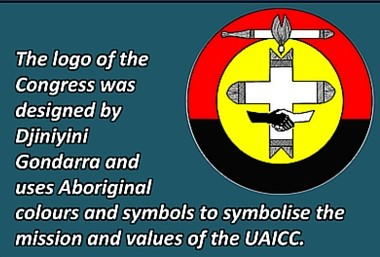
Before that Statement, in 1985, the Uniting Church had formed the Uniting Aboriginal and Islander Christian Conference (UAICC). The logo of the UAICC is depicted here. The Congress (as it is usually known) gave Aboriginal and Islander people a voice within the structures of the church—they are consulted about decisions and have a guaranteed number of members in the Synods and Assembly meetings of the church. The vision of the UAICC, in their own words, is:

  • We determine our own goals and objectives and decide policies and priorities;
  • We run our own programs and institutions;
  • We aim, in collaboration with other people, to bring to an end the injustices which hold Aboriginal and Islander people at the fringes of Australian society and to help Aboriginal and Islander people achieve spiritual, economic, social and cultural independence.

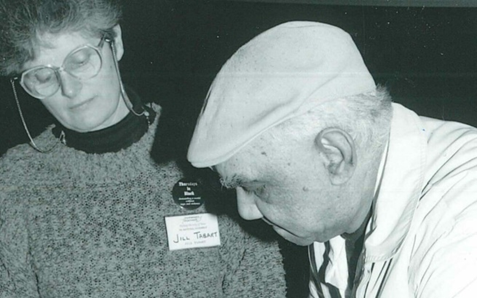
A decade later, in 1994, the President of the Uniting Church, Dr Jill Tabart, signed a Covenant Agreement with the Chairperson of the UAICC, Pastor Bill Hollingworth (pictured above). The Covenant expressed “our desire to work in solidarity … for the advancement of God’s kingdom of justice and righteousness in this land”. Since then, the church has really worked hard at putting this into practice.

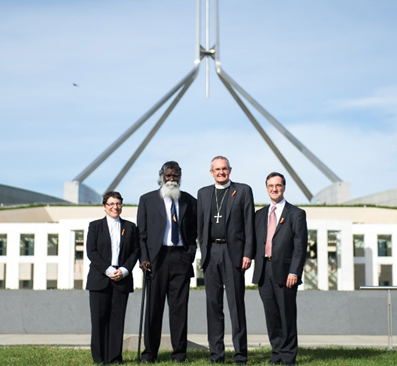
Then, in 2014, people from all over Australia travelled to Canberra to hold a prayer vigil for Our Destiny Together in front of Parliament House. Rev. Rronang Garrawurra, Chairperson of the Uniting Aboriginal and Islander Christian Congress (UAICC) and Assembly President, Rev. Prof. Andrew Dutney, led a service of worship. From remote communities in places like Arnhem Land and the Anangu Pitjantjatjara Yankunytjatjara (APY) Lands and from the centres of our big cities, people gathered to pray, pass the peace, and share in Holy Communion.

From left: the Rev. Elenie Poulus (Social Justice Director),
the Rev. Rronang Garrawurra, Chairperson of the Uniting Aboriginal and Islander Christian Congress (UAICC), the Rev. Prof. Andrew Dutney, President of the Assembly, and the Rev. Terence Corkin, General Secretary of the Assembly,
at Parliament House in 2014 for the A Destiny Together pilgrimage.

“It is enough for the disciple to be like the teacher”, Jesus says as he instructs his disciples about their mission (Matt 10:25). These developments within the Uniting Church show how we are striving to be like Jesus, sharing together with all people—especially the First Peoples of this continent (Aboriginal and Torres Strait Islander people).

And we know that it is possible—and, indeed, that it brings good value—for First Peoples to have a place in the councils of the church, discussing and deciding policy, and for their Voice, through the Congress, to be heard and responded to in appropriate ways.

That’s another good reason why we need to Vote YES in the referendum, surely. We need to ensure that, as well as recognising First Peoples in the Australian Constitution, we have a permanent Voice to Parliament in our ongoing structures.

The Mooloolaba Eight: sexuality, ethics, and church practice

Regular readers of my blog will know that, from time to time, I leave my natural environment of detailed exegetical exploration of biblical texts, and move into matters of church practice or issues of key concern in the wider society—even, at times, into politics.

This blog is such a venture, written in response to the news that on 17 June 2023, eight people who had been ordained as Uniting Church ministers and who for years have exercised ministry in Uniting Churches, have now joined the Diocese of Southern Cross Inc. (I will refer to this as the DSC in what follows.) What follows is entirely my own point of view, and I do not claim to be speaking for any part of then Uniting Church in this blog.

That “Diocese”—to be precise, it is an incorporated company that has taken an ecclesiastically-sounding title—is related to GAFCON, the breakaway group of Anglicans who have grown increasingly dissatisfied with the worldwide Anglican Communion, headed by the Archbishop of Canterbury.

The critical issue for GAFCON (indeed, the only issue, it seems) is homosexuality. GAFCON (the Global Anglican Future Conference) has been vehement in its criticism of the Anglican Church as a collection of issues in this area have been considered. Some GAFCON leaders from African countries have indeed supported the introduction of the death penalty in that country in some instances of homosexual practice.

The eight “former Uniting Church ministers” who have joined the DSC are all firmly convinced that the practice of homosexual sex is abhorrent, that gay people (broadly understood) are perpetual sinners, and that the church needs to take a strong stand, condemning same-gender relationships and writing that point of view into the doctrine and practices of the church. (None of them, I should hasten to add, have called for the death penalty to be imposed.)

The Uniting Church has consistently refused to do as they have wished in relation to homosexuality; their most recent spectacular failure was the efforts to derail the national Assembly meeting in Melbourne in 2018. This was the meeting where, despite the blocking tactics and argumentative strategy of members of the Assembly of Confessing Congregations—what I have described as their “aggressive apologetic antagonism”—the UCA Assembly agreed that same gender couples could be married under the auspices of the Uniting Church.

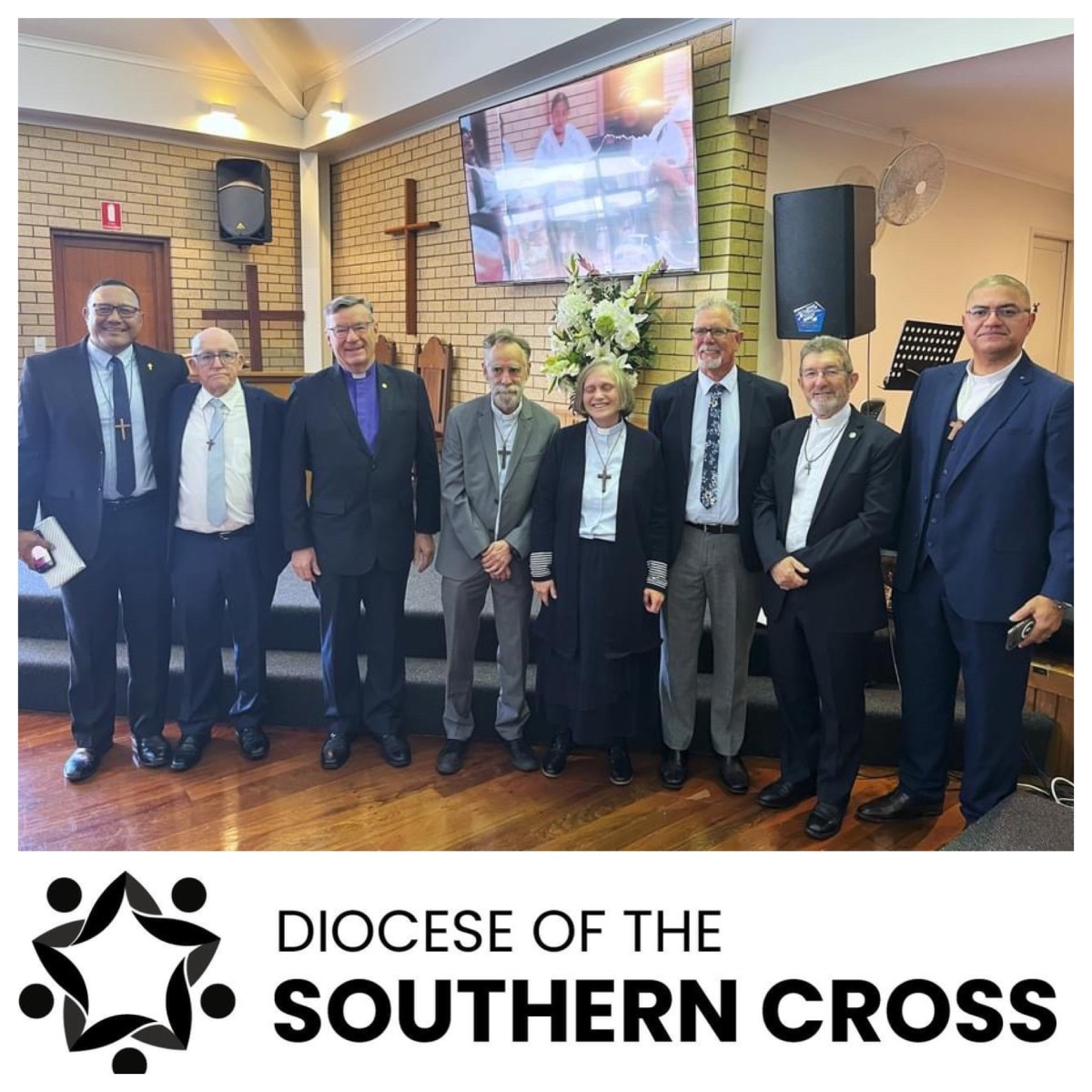
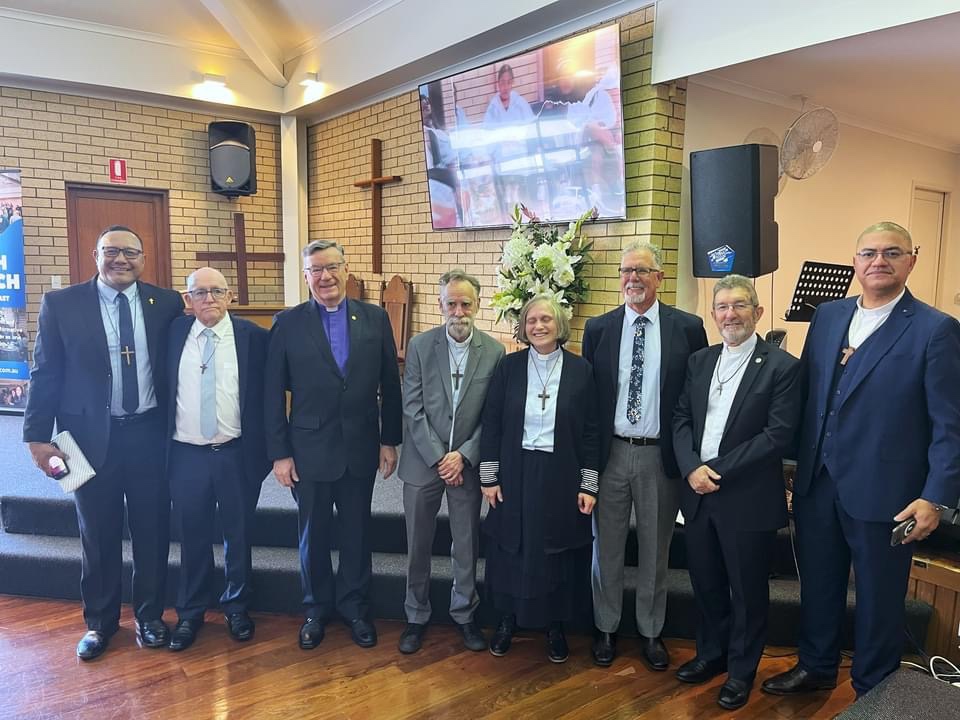
These eight people left the Uniting Church to join the DSC in a ceremony held at Mooloolaba, on the Sunshine Coast in Queensland, that “recognised” them as Pastors in the DSC. What precise status that gives them is unclear; they cannot be seen as ordained Anglican ministers, since Anglican ordination require connection to the episcopal line of tradition, which Uniting Church ordinations do not have, at least in their eyes.

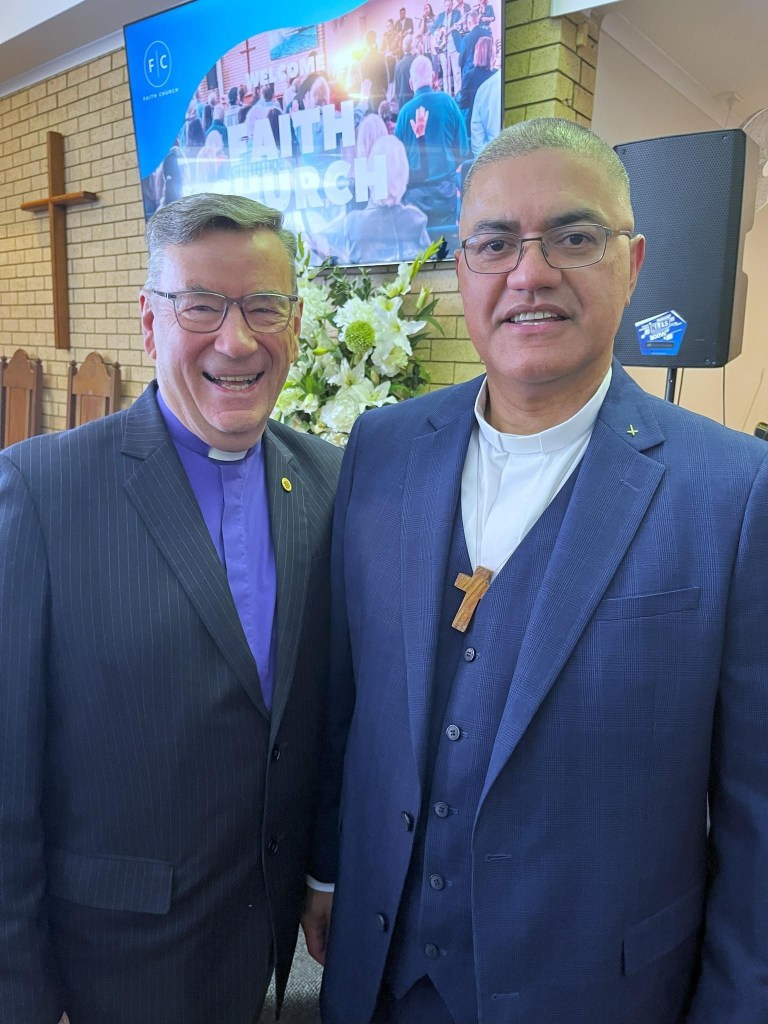
The Facebook page for the Diocese of Southern Cross proclaims that Faith Church Sunshine Coast and Hedley Fihaki were welcomed to the Diocese of the Southern Cross. Hedley Fihaki, of course, is the former chairperson of the Assembly of Confessing Congregations in the Uniting Church, which recently caved in on itself and closed. The ACC is no more. Hedley and his companions are seeking a new base.

Glenn Davies and Hedley Fihaki

So the Mooloolaba Eight left the Uniting Church. It is rather ironic that their service of “recognition” was presided over by Glenn Davies, the former Archbishop of the Anglican Diocese of Sydney. Whilst he was still Archbishop in Sydney, he had invited members of the Anglican Church who disagreed with Sydney Diocese policy about sexuality, to “please leave”. The Mooloolaba Eight left their church to join a breakaway group headed by the person who said “please leave”. How ironic!

The Facebook post continues: “As well as being commissioned as pastor of Faith Church, Hedley was formally recognised by Bishop Glenn Davies as a presbyter in the diocese along with seven other former Uniting Church ministers who have chosen to join us in the Diocese of the Southern Cross. Welcome to Philip Anderson, David Graham, Anne Hibbard, Roger Hibbard, Raymond McIlwraith, Lulu Senituli, and Harold Strong.”

I have to confess that I know and have had interactions with six of the eight people identified in this post—some as members of the same council of the church, some through online conversations, some as colleagues in ministry in placements in the same synod as me, and one who I taught whilst they were in theological college. (A wise colleague has helpfully reminded me that, in line with Ezekiel 18, the sins of the student should not be attributed to or visited on the teacher!)

Some of those who were “recognised” this past weekend have been aggressive in their pursuit of their homophobic agenda, for years, whilst in the Uniting Church. This has been a very bad thing for the Uniting Church, because much energy and effort has been diverted from the core matters of importance in the church, to attempt to placate and include those who prosecuted this strident line. Now that they have moved on, the UCA can hopefully return to key matters of mission and ministry unhindered by such regressive views and the associated intrusive aggressive tactics.

There are interesting questions of church order now to be explored. Presumably, the eight people have or will resigned from their status as ordained ministers within the Uniting Church. My understanding is that two of them have already been engaged in processes within the Uniting Church over the past year, in this regard. But the move to the DSC must surely mark the time when they each formally resign from the Uniting Church.

The DSC itself is a curious beast. There is debate amongst Anglicans as to whether this is “a real diocese” or not. I have seen a direct statement that “this is a real Anglican diocese”, but also a similarly definitive claim that “this is not an entity in fellowship with the Anglican Church in Australia”, and so not actually an Anglican diocese. That’s all a matter for Anglican polity nerds, though.

What interests me more is how the eight who were “formally recognised as presbyters” will portray themselves and act in ministry. Will they simply continue as if they remain ordained? If the DSC is acting like an Anglican entity, their ordination as Uniting Church ministers will not be recognised—no bishop, in the line of apostolic succession, laid hands on them at their ordination, and so they technically are not to be regarded as ordained. That’s how I understand it, from my non-Anglican standpoint; but it will be interesting to see what eventuates.

The other element is the curious fact, commented on by some of my Facebook friends, that the person who “recognised” the eight people at Mooloolaba on 17 June was Glenn Davies, who was previously Archbishop of the Sydney Diocese of the Anglican Church. This diocese has fought long and hard, over many years, to oppose the ordination of women.

Yet the former Archbishop of Sydney, who so strenuously opposed the ordination of women in that role, has seemingly validated the ordained ministry of the one woman in the Mooloolaba Eight. It will be interesting to see how this is dealt with.

Apparently the DSC, being affiliated with the schismatic GAFCON within the Anglican Church, is nevertheless open to women ministers. Indeed, the first GAFCON-affiliated congregation in Western Australia, New Beginnings Church in Mandurah, Western Australia, has an ordained female minister, the Rev. Linley MatthewsWant, who is an Anglican minister.

Glenn Davies with Linley MatthewsWant in Mandurah, WA

So the irony is that the former leader of the aggressively anti-women’s ordination push is now the leader of an organisation with ordained female in ministry. Isn’t that a telling revelation as to the ethics of Glenn Davies? Either he really believes in the ordination of women, but put this to one side while he was in the Sydney Diocese; or else he has shelved the firm commitment that he had in the past for entirely pragmatic reasons in the present. Neither option indicates a good grasp of ethical responsibility, in my view.

So what next for the Mooloolaba Eight? We will just have to see where this leads next …

**********

On the end of the Assembly of Confessing Congregations, see

My previous posts on the various evangelical/fundamentalist groups in the UCA are at

For the various affirmations that the Uniting Church Assembly has made that led the church to agree to the marriage of people of the same gender, see

The gender agenda: a multiplicity of matters

Over the past week, I’ve been aware of a number of happenings that point to the continuing shifts within the Christian church relating to the matter of gender. Some of these events have been encouraging. Some have been disappointing. Some raise serious questions. Others offer occasion for great joy. Together, they point to the gender agenda, which continues to agitate the churches. It’s something that involves a multiplicity of matters.

This week has been Transgender Awareness Week. On Sunday evening, the Rainbow Christian Alliance met at Tuggeranong Uniting Church in Canberra. There was sharing, as there is always is, but with a particular focus at this meeting on the stories of transgender members of the group. It was a rich time, celebrating the way that people have been able to be “true to themselves” and express that inner reality in the ways that they dress, relate, and function within society—and, indeed, undertake the daunting process of hormone replacement therapy and even surgery to fully assume the actual gender identity as a manifestation of their inner, real person.

I have reflected on the week in my blog, at

On the same weekend, the Baptist Union of NSW and the ACT held one of their regular gathering of representatives from across the state and territory, at which the issue of gender was to the fore. Specifically, discussion was held and then a decision was made, that Baptist pastors and churches which were agreeable to marrying couples of the same gender would be asked to affirm “the traditional understanding of marriage”—that is, that marriage involves always a male and a female—or that they leave the association of Baptist churches.

There is a blog by one Baptist pastor who feels that he is unable to affirm that “traditional understanding of marriage”; he has described the experience of that all-day meeting as being akin to “a casual crucifixion”—a searingly potent, and deeply saddening, description.

The blog by Will Small is at https://www.willsmall.com.au/words/a-casual-crucifixion-i-never-gave-a-shite-about-being-a-baptist-until-someone-else-decided-i-couldnt-be

There is also a fine article by Erin Martine Sessions, another member of the gathering, at https://www.abc.net.au/religion/have-baptists-just-sold-their-soul-over-same-sex-marriage/

The Baptists, sadly, have taken an approach to this particular issue of same-gender marriage that has recently led to a split in the United Methodist Church; see my reflections at

I have also written a series of blogs exploring how such an aggressive approach to the gender agenda has been prosecuted—unsuccessfully, fortunately—within the Uniting Church in Australia.

My posts on these various groups are at

and

It is sad to see the same divisive development taking place within the Baptist fellowship.

An event that took place during the week was the funeral of a Roman Catholic priest, Father Peter Maher. This was noteable for various reasons; for a start, there were three bishops and many priests in attendance. I’ve known Peter for five decades, and can attest to his valued ministry and important contribution to the consideration of the gender agenda within the Roman Catholic Church in Australia.

Peter was a strong advocate, throughout his ministry, for “the least and the lost”, and especially, in recent decades, for members of the LGBTIQA+ community. His weekly Mass for rainbow people, held at St Joseph’s Church in Newtown, attracted people and was the basis for the formation of a wonderfully extensive community of people of faith who identify with sexual or gender diversity.

Peter’s funeral signalled the lifetime of work devoted, in various ways, to the gender agenda—affirming, supporting, counselling, encouraging, and advocating for, the many people of faith (and of no faith) within the broad LGBTIQA+ community. There have been many tributes to Peter posted online, which I have canvassed in a blog post at

A fine tribute to Peter is at https://www.misacor.org.au/item/28929-rip-peter-maher-vigorous-priest-sydney-longtime-editor-of-the-swag

And then, on Friday night, a celebration of 30 years since the Anglican Church ordained women as priests was held in St John’s Anglican Cathedral in Brisbane. The issue of the ordination of women was a focus of intense debate and discussion throughout the Anglican Church for many years. Most dioceses throughout Australia came to a view that this was a most reasonable course of action; a few renegades, spurred on by the sectarian leadership in Sydney, dug their toes in and resisted at every step of the way.

But the truth of the Gospel shone through, and women were ordained in Goulburn—Canberra, Brisbane, and Perth Dioceses, in 1992, and the in many other places in the ensuing years. The celebration in Brisbane recognised an important step forward in addressing the gender agenda in the Anglican Church. An exhibition marking this step forward can be seen at

It would be tempting of me to end this review of recent events with a smug, self-satisfied comment about the ways that the Uniting Church in Australia (and, indeed, its three predecessor denominations) has been a trailblazer in many ways relating to the overarching gender agenda—ordaining women, female quotas to ensure diversity, ordaining gay and lesbian ministers, marrying same-gender couples, and so on.

However, just this past week, I was part of a conversation in which I observed that the particular Uniting Church Congregation, throughout the whole 45 years of its existence, had had a string of white male ministers in placement with them. In that conversation, I was told that before the current minister was called, one key person in leadership in that Congregation advised the Presbytery, “we won’t accept any minister other than a white male”.

So we, too, have work still to be done. The gender agenda remains a live concern. The gender question remains firmly on our agenda in the Uniting Church. There is still much work to be done.

See also