
During the season of Easter this year, we have read and heard passages from Revelation, the dramatic and vivid last book of scripture. We have encountered a number of creatively striking images: a white-haired, fiery-eyed figure like the Son of Man, a slaughtered lamb upon a throne, a multitude of white-robed people singing praises, a new heaven and new earth, and a city descending from the heavens. An amazing list, drawn from a book with even more amazing images in other chapters.
This Sunday, as the final Sunday in the seven-week season of Easter, we hear a passage which contains three striking images within the closing declarations and blessings that end the book (Rev 22:12–21). To give the creators of the lectionary their due, they have chosen not to excise a verse with a rather difficult message from the passage proposed—as they are wont to do at other times when dealing with other difficult verses.
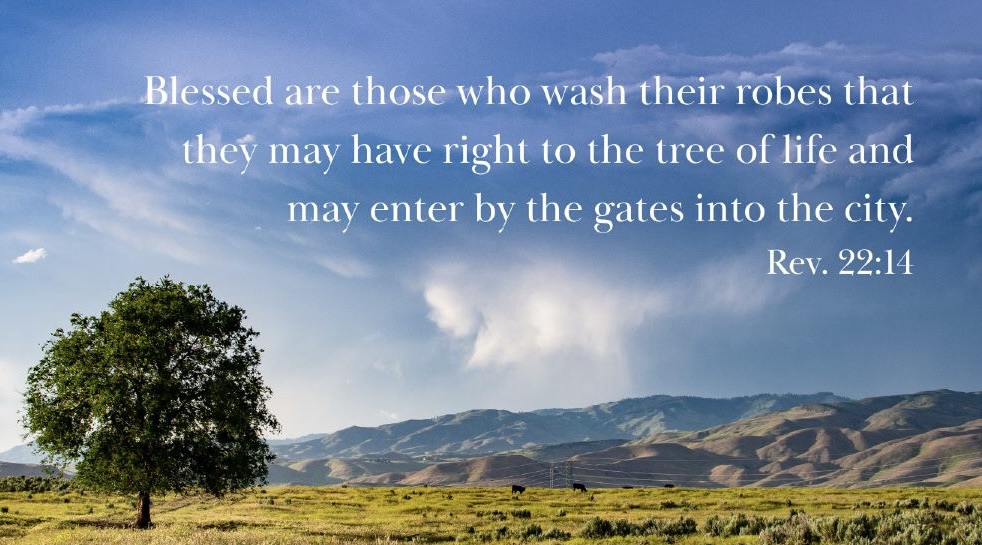
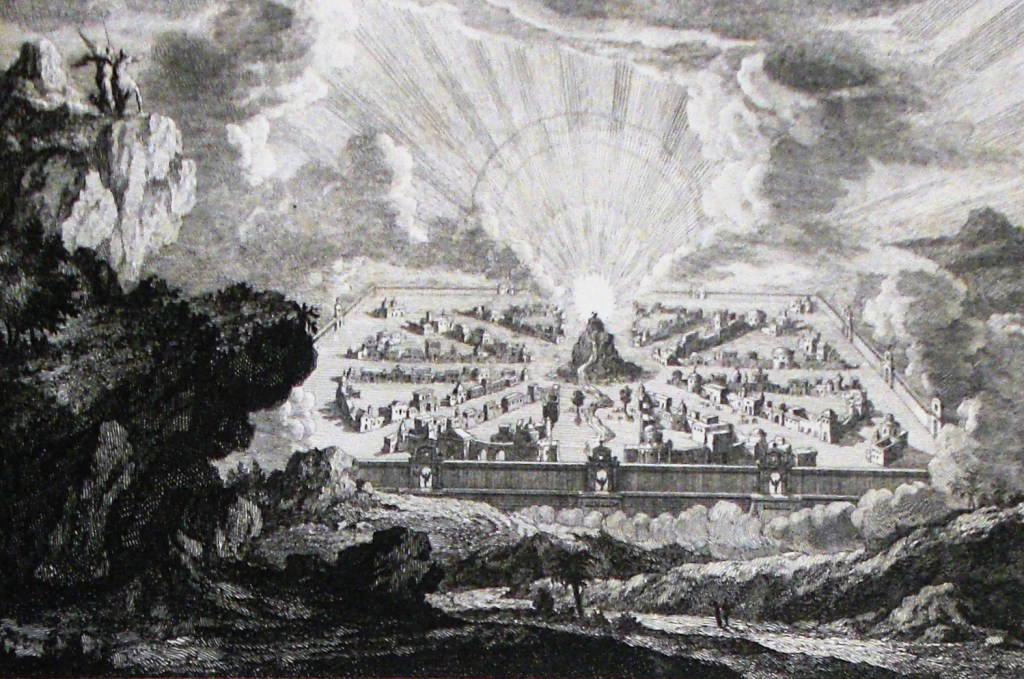
So we will hear this Sunday the statement by John, as he concludes his long series of images, that whilst those who “wash their robes” will be firmly included within the holy city that has descended to earth (22:14; see 21:2, 10–26), those who are “dogs and sorcerers and fornicators and murderers and idolaters, and everyone who loves and practices falsehood” will remain outside, debarred from entry (22:15; see 21:27). The holy city will remain as the place which has “the glory of God and a radiance like a very rare jewel, like jasper, clear as crystal” (21:11). It’s a vibrant picture to bring to a close this year’s season of Easter, as we celebrate the risen Jesus in our midst.
In the midst of this exultant final vision of the book, we also hear this dire warning to all who read this book: “if anyone takes away from the words of the book of this prophecy, God will take away that person’s share in the tree of life and in the holy city, which are described in this book” (22:19). They are evocative of the instruction to Daniel, that the words of that book “are to remain secret and sealed until the time of the end” (Dan 12:9).
The book of Revelation has included many gruesome scenes where punishment—and, indeed, torture—are envisaged. As each of seven seals are broken and seven angels each blow their trumpet in turn (8:6–11:19), repeated scenes of destruction and devastation unfold across the earth. After the fifth seal is broken, locusts are sent to inflict on those who do not bear the seal of God on their foreheads five months of torture “like the torture of a scorpion when it stings someone” (9:3–5). After the sixth seal, “a third of humankind was killed by the fire and smoke and sulfur coming out of [the] mouths” of the four angels rampaging across the earth on their horses (9:15–19).
In subsequent visions, because of the evil that has infiltrated the whole world in multiple manifestations, a great red dragon threatens to consume the child born to a pregnant woman (12:1–4); a beast with ten horns and seven heads wages war “over every tribe and people and language and nation” (13:1–10); ad a group of seven angels pours out the wrath of God on earth, sea, rivers, sun, the throne of the beast, the great river, and into the air (15:1, 16:1–21).
These visions climax with the vision of “the great whore”, Babylon, and “the beast with seven heads and ten horns that carries her” (17:1–8), who gatherers up all the sins of the world, whose sins “are heaped high as heaven, and God has remembered her iniquities” (18:5). Judgement comes upon her as “plagues will come in a single day—pestilence and mourning and famine—and she will be burned with fire” (18:8, celebrated in song from v.10 to v.24).
Then, in due course, the beast and the false prophet “were thrown alive into the lake of fire that burns with sulfur” (19:20), and last of all, after a millennium has passed, “the devil who had deceived them was thrown into the lake of fire and sulfur, where the beast and the false prophet were, and they will be tormented day and night forever and ever” (20:10).
These scenes of judgement, plagues, punishments, and torture, come to dominate the whole book. Yet none of these scenes appear in the passages selected for inclusion in the lectionary. The only negative notes in the passages included in the lectionary relate to the description of the lamb as one who has been slaughtered, but who now sits triumphant on the throne (5:6–14). So it is somewhat striking that this final passage includes these particular negative notes.
*****
In association with the celebratory notes attached to his vision of this holy city—the river of the water of life, the dazzling jewels of the city, the eternally-shining light from God, the celebrations around the throne of God and of the Lamb—John also offers striking statements about the figure whom he first described at the start of his book, the one “coming with the clouds” (1:7) whose face “was like the sun shining with full force” (1:16). This imposing figure is the one who is yet “coming soon” (22:12, 20).
Three striking images characterise him in these final verses. None of these images should come as a surprise; they have each appeared earlier in Revelation, and indeed they tap into imagery in other books of scripture, in both testaments.
ALPHA AND OMEGA
The first striking image is one that was sounded at the very start of the book, when John was testifying “to the word of God and to the testimony of Jesus Christ, even to all that he saw” (1:2). Included in that early testimony is the claim that “the one who is pierced” is “coming with the clouds; every eye will see him” (1:7). At this, God himself speaks: “‘I am the Alpha and the Omega’, says the Lord God, who is and who was and who is to come, the Almighty” (1:8).
Then, in the second of the seven letters to be sent to the seven churches (2:1—3:22), this claim is adopted by the author of the letter, “one like the Son of Man, clothed with a long robe and with a golden sash across his chest” (1:13). This figure adopts the words spoken by the Lord God as he declares “these are the words of the first and the last, who was dead and came to life” (2:8). It is a clear reference to Jesus, already identified as “the faithful witness, the firstborn of the dead, and the ruler of the kings of the earth”, the one who “loves us and freed us from our sins by his blood” (1:5–6).

The same claim recurs in the climactic closing vision of the book, when “the one who was seated on the throne” (21:5)—that is, the great white throne on which sat the judge of all humanity (20:11–16)—declared, “It is done! I am the Alpha and the Omega, the beginning and the end” (21:6). And then, after the vision concludes, the angelic figure seen by John reminds him, “I am the Alpha and the Omega, the first and the last, the beginning and the end” (Rev 22:13).
The words spoken by the Lord God, the one like a Son of Man, the judge on his throne, and his angelic messenger rekindle the image of God which had been described, centuries before, by the unnamed exilic prophet whose words are included as the second section of the book of Isaiah (Isa 40—55). “Who has performed and done this, calling the generations from the beginning?”, the prophet asks.”I, the Lord, am first, and will be with the last”, is the response (Isa 41:4). In a later oracle, the Lord God declares “I am the first and I am the last; besides me there is no god” (Isa 44:6); and still later, “Listen to me, O Jacob, and Israel, whom I called: I am He; I am the first, and I am the last” (Isa 48:12).
The significance of this claim is outlined in another prophecy: “Remember the former things of old; for I am God, and there is no other; I am God, and there is no one like me, declaring the end from the beginning and from ancient times things not yet done, saying, ‘My purpose shall stand, and I will fulfill my intention’” (Isa 46:8–10).
In the Revelation of John, these words are heard from the mouth of the one like a Son of Man, identified as Jesus (1:5; 22:16). Jesus is both Alpha and Omega, first and last; as the letter to the Hebrews declares in its idiosyncratic language, “without father, without mother, without genealogy, having neither beginning of days nor end of life, but resembling the Son of God, he remains a priest forever” (Heb 7:3).
BRIGHT MORNING STAR
A second striking image is that of the morning star, in the words of Jesus, “I am the root and the descendant of David, the bright morning star” (22:16). That image was first expressed early in this book, in one of the seven letters to the churches. In each of the seven letters included in this book, “those who conquer” are given a specific gift to signal their special status. To those in Thyatira, to signal the authority that is given to them “to rule [the nations] with an iron rod, as when clay pots are shattered”, the specific gift is “I will also give the morning star” (2:26–28).

The morning star is referenced in the book of Ecclesiasticus (Ben Sirach), in a poem which praises Simon son of Onias (high priest in the early C3rd BCE). After celebrating his work in repairing and fortifying the temple, the joy that he brought is described through a series of images: “How glorious he was, surrounded by the people, as he came out of the house of the curtain. Like the morning star among the clouds, like the full moon at the festal season; like the sun shining on the temple of the Most High, like the rainbow gleaming in splendid clouds” (Sirach 50:5–7, and continuing on for some verses). A similar use of the phrase appears in the second letter attributed to Peter, where “the prophetic message” is compared with “a lamp shining in a dark place, until the day dawns and the morning star rises in your hearts” (2 Pet 1:19).
It is the bright, dazzling quality of the star that rises early in the morning, before sunrise—the planet we know as Venus—that is in view here. We should note that there is no intention to allude to the words of Isaiah, who refers in one of his prophecies about the punishment that was imminent for the King of Babylon. The prophet warns, “Sheol beneath is stirred up to meet you when you come … you pomp is brought down to Sheol” (Isa 14:9, 11), before depicting this decline in poetic language: “How you are fallen from heaven, O Day Star, son of Dawn! How you are cut down to the ground, you who laid the nations low!” (Isa 14:12).
In the 17th century King James Version, “O Day Star” is rendered as Lucifer—since that is how “light-bringer” is expressed in Latin. This was the term used in the Vulgate, a late-4th century Latin translation of the Bible. This verse has been picked up in later theological developments and applied to the figure of the devil; it is probably also influenced by words attributed to Jesus in Luke 10:18, “I watched Satan fall from heaven like a flash of lightning”.
However, this sense of the term does not relate at all to the way the imagery of “the morning star” appears in Revelation. In this book, the devil is depicted as “a great red dragon, with seven heads and ten horns, and seven diadems on his heads” (Rev 12:3; 20:2) who is “the deceiver of the whole world” (Rev 12:9) who is ultimately “thrown into the lake of fire and sulfur …[to be] tormented day and night forever and ever” (Rev 20:10).
WATER OF LIFE
The third striking image in this final chapter of Revelation is “the water of life”. John had indicated that this water would be gifted to those who are thirsty (Rev 21:6). This gift comes from “the Lamb at the centre of the throne” who is the shepherd of “a great multitude that no one could count, from every nation, from all tribes and peoples and languages, standing before the throne and before the Lamb, robed in white, with palm branches in their hands” (7:9). This shepherd, says John, “will guide them to springs of the water of life, and God will wipe away every tear from their eyes” (7:17).
The imagery appears returns as integral part of the final climactic vision of “the holy city Jerusalem coming down out of heaven from God” (21:10). John writes that the angel showing him the vision of this city “showed me the river of the water of life, bright as crystal, flowing from the throne of God and of the Lamb” (22:1).

The river brings water to nourish life, just as another John (compiling a Gospel narrative) attributes to Jesus words in which he offers water as the basis for life: “those who drink of the water that I will give them will never be thirsty; the water that I will give will become in them a spring of water gushing up to eternal life” (John 4:14). These words evoke the reality that all human beings know, that “the necessities of life are water, bread, and clothing, and also a house to assure privacy” (Sirach 29:21; see a similar, but expanded, list at Sirach 39:26).
The scene at the end of Revelation evokes the vision described centuries earlier by the prophet Ezekiel, in the final chapter of his book. Ezekiel details the water flowing from the temple, the abundant trees growing beside the river, and the food sources for the people (Ezek 47:1–12). It is a wonderful ecologically vibrant scene, as is the vision in Revelation, where “on either side of the river is the tree of life with its twelve kinds of fruit, producing its fruit each month; and the leaves of the tree are for the healing of the nations” (Rev 22:2).
So the book ends with words of grace: “The Spirit and the bride say, ‘Come’; and let everyone who hears say, ‘Come’, and let everyone who is thirsty come. Let anyone who wishes take the water of life as a gift” (22:17). It’s a nice closing note.
 An Informed Faith