Celebrating Fifty Years of a unique Australian resource

Celebrating 50 years of With Love to the World, a unique Australian-produced daily Bible reading resource

A celebratory service of worship was held on Sunday 8 March in the Carrington Ave Uniting Church in Strathfield, to recognise that With Love to the World (WLW) has been in existence for 50 years. It is a unique Australian resource—written and produced by people within the Uniting Church in Australia, for people of faith in Australia and surrounding countries. It reflects a “southern hemisphere” take on matters of faith and life.

The first issue of WLW was printed in March 1976. It was written by Bob Maddox and Gordon Dicker, two lecturers at Leigh College, Enfield, the Methodist Church theological college, then printed, collated, and distributed by volunteers from seven local churches in the Strathfield—Homebush area. 

The college soon became part of United Theological College, while the seven churches (Methodist, Congregational, and Presbyterian) formed the Strathfield—Homebush Parish of the Uniting Church in 1977. Since then, WLW has been operated by a partnership of UTC and the Strathfield—Homebush UCA, under the auspices of the Synod of NSW.ACT.
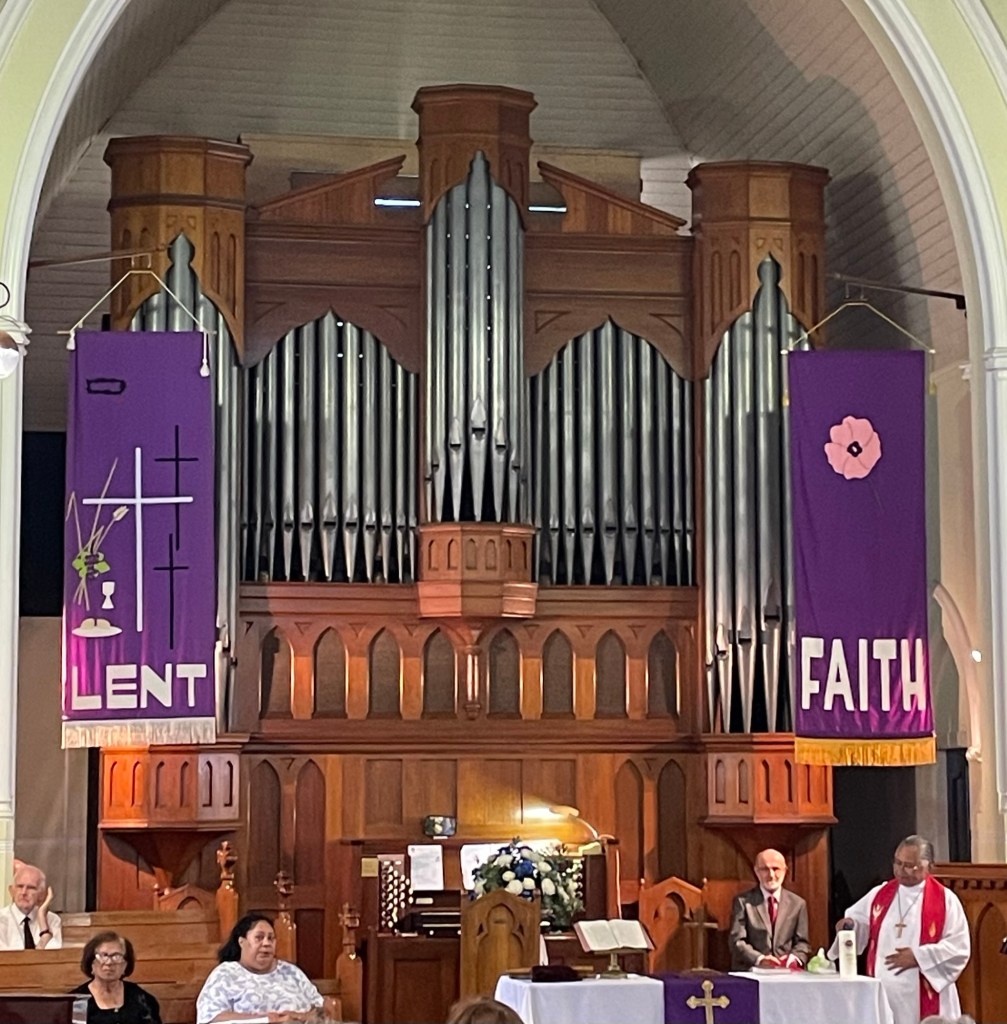
The service of worship was conducted by the Rev. Fololeni Tafokitau, minister of the Strathfield—Homebush Uniting Church. After an Acknowledgement of Country, a Welcome was given by William Emilsen, who reminded those present of the twofold purpose of WLW: (i) to produce a high quality and accessible commentary on the lectionary passages for the coming Sunday; and (ii) to support the research and writing of Uniting Church postgraduate students. It has done the former since 1976, and the latter since the first scholarship was granted in 1982. Since then, 65 people have received scholarship support.

The congregation then joined in a responsive version of Psalm 95, adapted for the occasion, and joyfully sang the Doxology. Music remained a feature of the service as people sang a number of favourite hymns, and the Tongan Choir led in a characteristically rich presentation of a song highlighting the importance of our scriptures.

Words from scripture were read by Seneti Katoa (Secretary of the WLW Committee) and the Rev. Dr Peter Walker (Secretary of the Synod of NSW.ACT). Peter had, until recently, been the Principal of United Theological College; the two readers represent the two bodies who have been in partnership since the beginning of WLW in 1976.
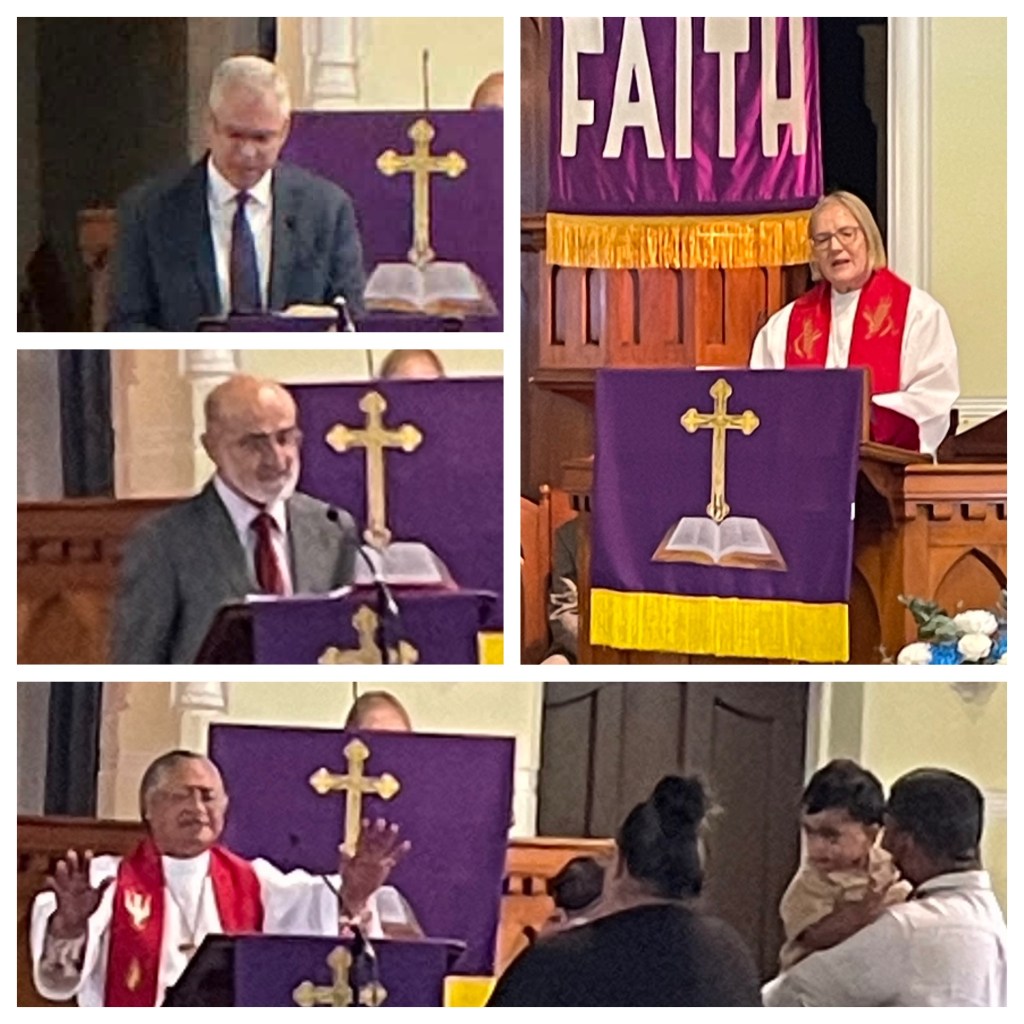
On the left: Peter Walker, William Emilsen, Fololeni Tafokitau.
On the right: Vicky Balabanski.

The guest preacher for this occasion was the Rev. Professor Vicky Balabanski, Principal of the Uniting College of Leadership and Theology in Adelaide, SA. Vicky (like William, Peter, and current Editor John Squires) had received scholarship support from WLW to undertake doctoral research. Indeed, the very first recipient of a scholarship, the Rev. Professor Howard Wallace, was in attendance on the day., as were a number of other scholarship recipients.

Vicky set the lectionary passage from John 4 into the context of today’s world, beset by warfare, famine, and distress. She noted that we had on the screen at the front of the church a depiction of “the woman of Samaria”—known in the Orthodox tradition as Photini, “the enlightened one”. Vicky then went on to reflect on three themes found in the story: living, flowing water; worship in Spirit and truth; and a fruitful harvest. Each, she observed, relates well to the purposes of WLW.
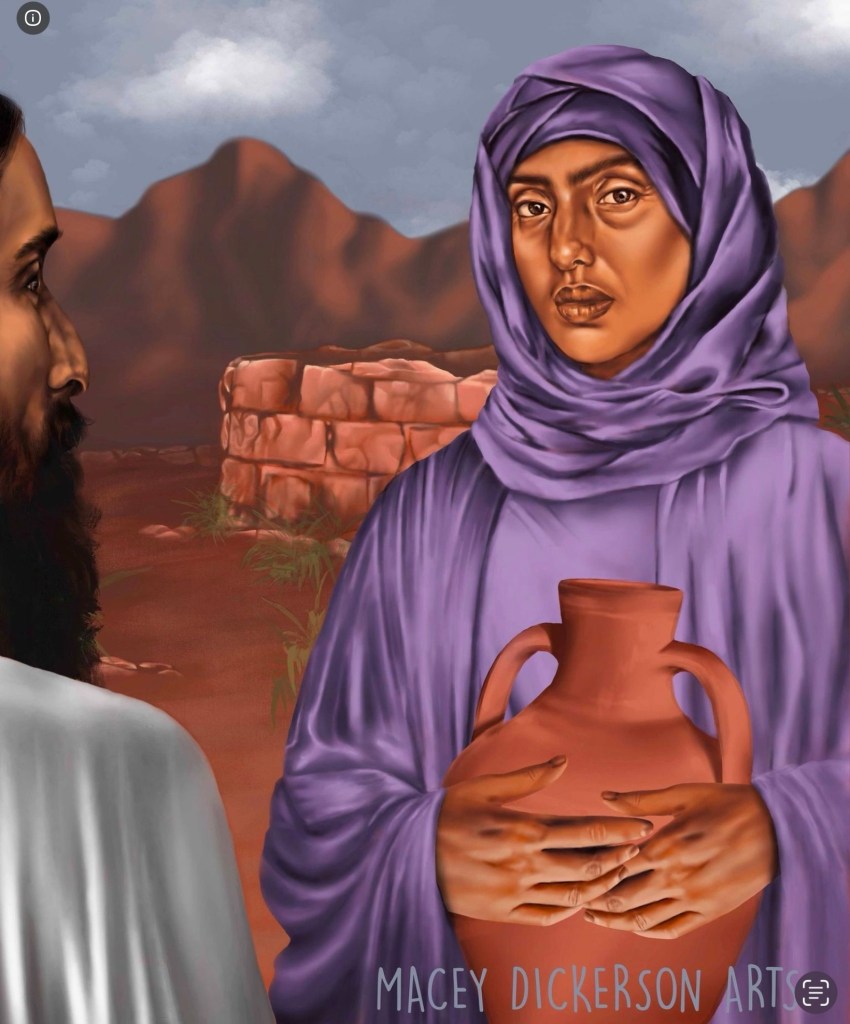
A depiction of “the woman of Samaria” by American artist
Macey Dickerson. Image reproduced by permission.
https://maceydickerson.com

Water runs (as it were) right through John’s Gospel, as it is found in many of the stories recorded in it: from the water in which Jesus was baptised (ch.1), through the streams of living water (ch.7), the water with which Jesus washed the feet of his disciples (ch.13), the water that flowed from the side of the crucified Jesus (ch19), to the water of the sea where the risen Jesus appeared to the disciples (ch.21). 

Jesus expresses his need for water—living, flowing water. Such water rises up from the shaft of Jacob’s well, a cistern storing water, bubbling up and flowing out as a spring of living water in the encounter between Jesus and the woman. The water in this encounter reflects the changes taking place in how the woman understands Jesus—from suspicion (4:9) to recognition (4:19) to ultimate confession (4:25–26, 29) and bearing testimony about him (4:39–42). The imagery of this living, transformative water also symbolises how writers in WLW takes words of scripture and reflect on their relevance and significance in today’s world.
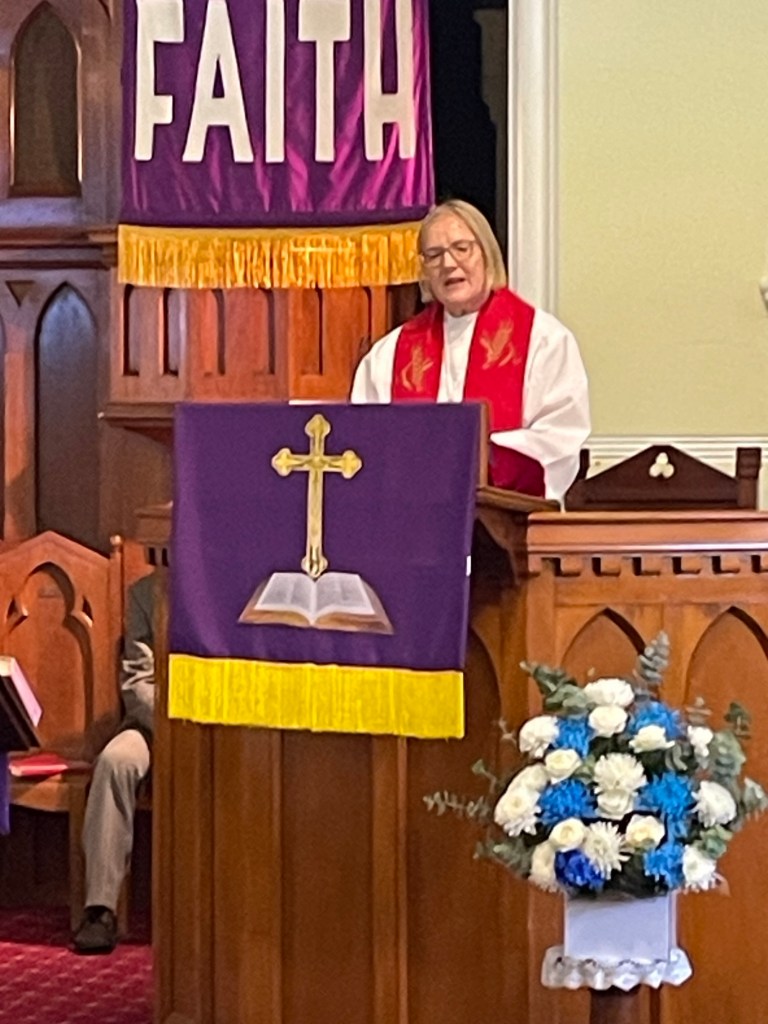
Vicky Balabanski, speaking on John 4

Worship is also a theme receiving attention in the story told by John. Ancient rivalries about the appropriate site for worship—a conflicted, but typical human question—are less significant. What matters more is how God is at work in the world, and especially how worshippers are spiritually attuned to what God is doing. The identity of the Samaritan woman had been shaped by the conflict over the sacred site; it is transformed into an openness to the ways that God’s Spirit is alive and active in the world. 

That is expressed also in the title of the resource; as Vicky noted, it is not With Love to the Church, nor With Love to the Believing Christian—but With Love to the World. It is truthful, prayerful, and reflective, leading towards openness in worship.

Then, the story tells that the sowers and reapers of the harvest rejoice at the fruits they have found in the teaching of the woman amongst them. There is a big picture that we are invited to imagine, and indeed to enter. We are part of a much larger whole reflecting God’s enterprise. So today, WLW sows the seed and encourages participation in the harvesting process. “We have heard, and we know”, the villagers say; may that be the experience of those we encounter today as we share the good news. 
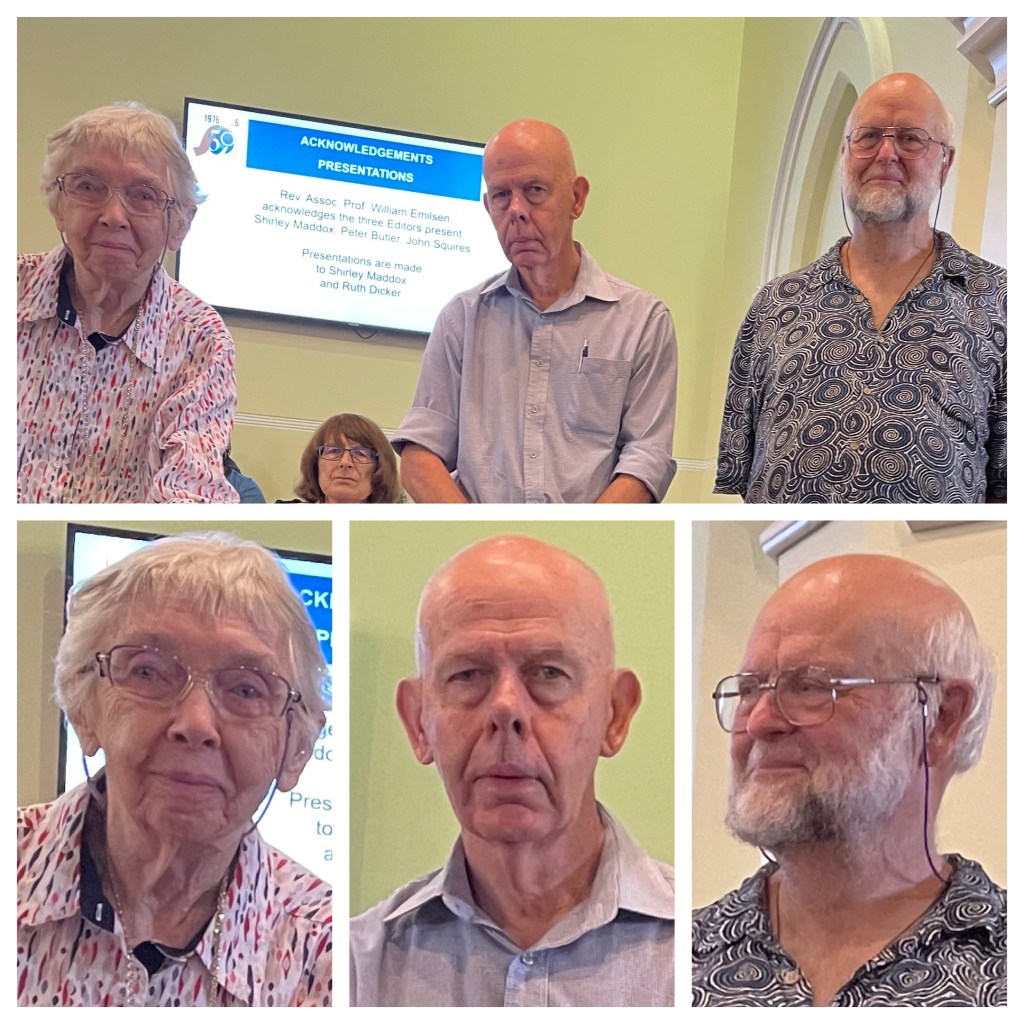
Three of the Editors of WLW

After another rousing hymn, William Emilsen acknowledged the three people who have been Editors of the resource over 47 of the past 50 years: Shirley Maddox (1979–2006), Peter Butler (2006–2021), and John Squires (since 2021). Fololeni then presented bouquets of flowers to Shirley Maddox and Ruth Dicker. As the spouses of the foundation editors, Rev. Dr Bob Maddox and Rev. Dr Gordon Dicker, and as two people always actively involved in WLW over the decades, they represent the “apostolic tradition” that continues with WLW.
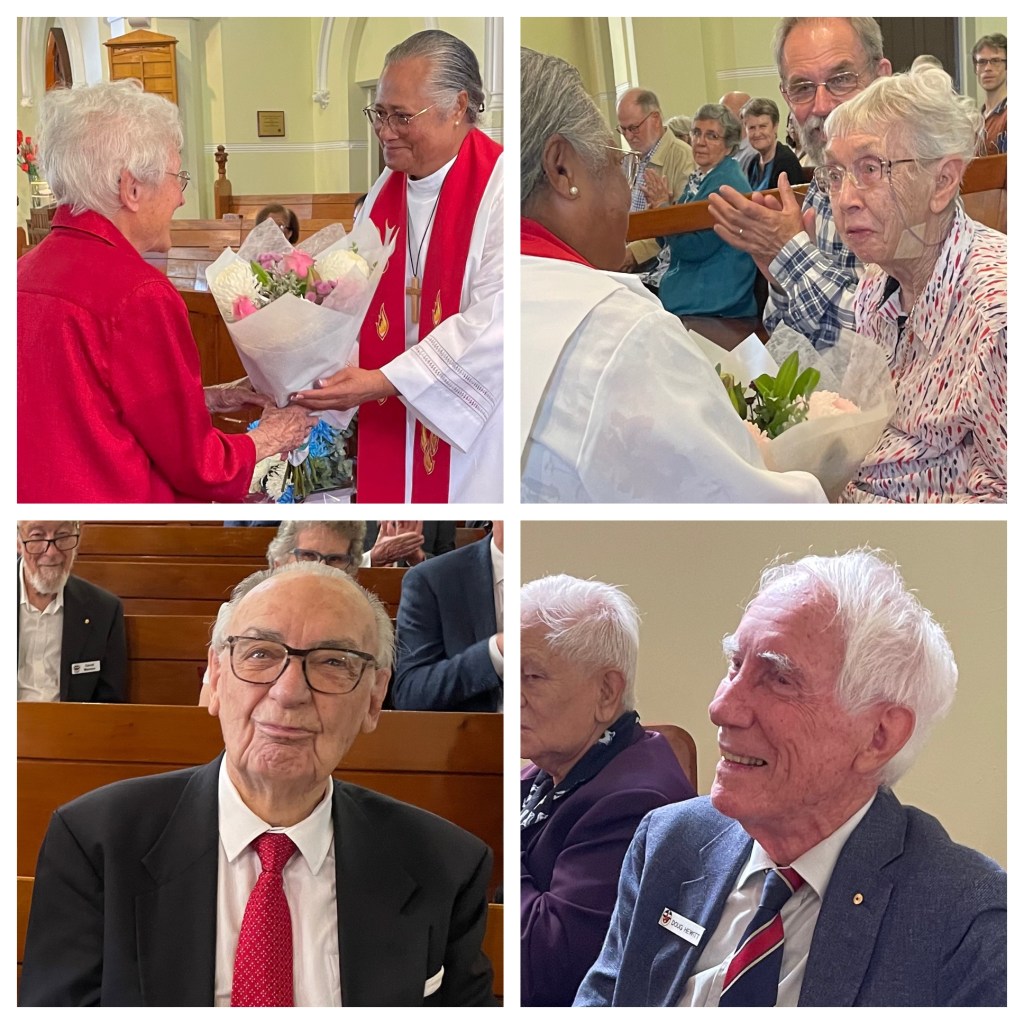
Flowers for Ruth Dicker (top left) and Shirley Maddox (top right). Bottom row shows longtime supporters and subscribers to WLW, Bill Ives (left) and Doug Hewitt (right).

Ruth then led the Prayers of the People, offering thanks for all involved in the writing and distribution of WLW, before then praying earnestly for the peace and justice we so desperate need in the world today. The service ended with a closing hymn and benediction, followed by a postlude played by the fine organist, Hugh Knight.

The congregation then moved to the hall, where a fine morning tea was enjoyed. Doug Hewitt, a member of the Strathfield church in 1976, reminisced about the very beginnings of WLW. He remembered especially the Sunday evening conversation about the lectionary passages that Bob Maddox and Gordon Dicker offered each week in “the early days”.
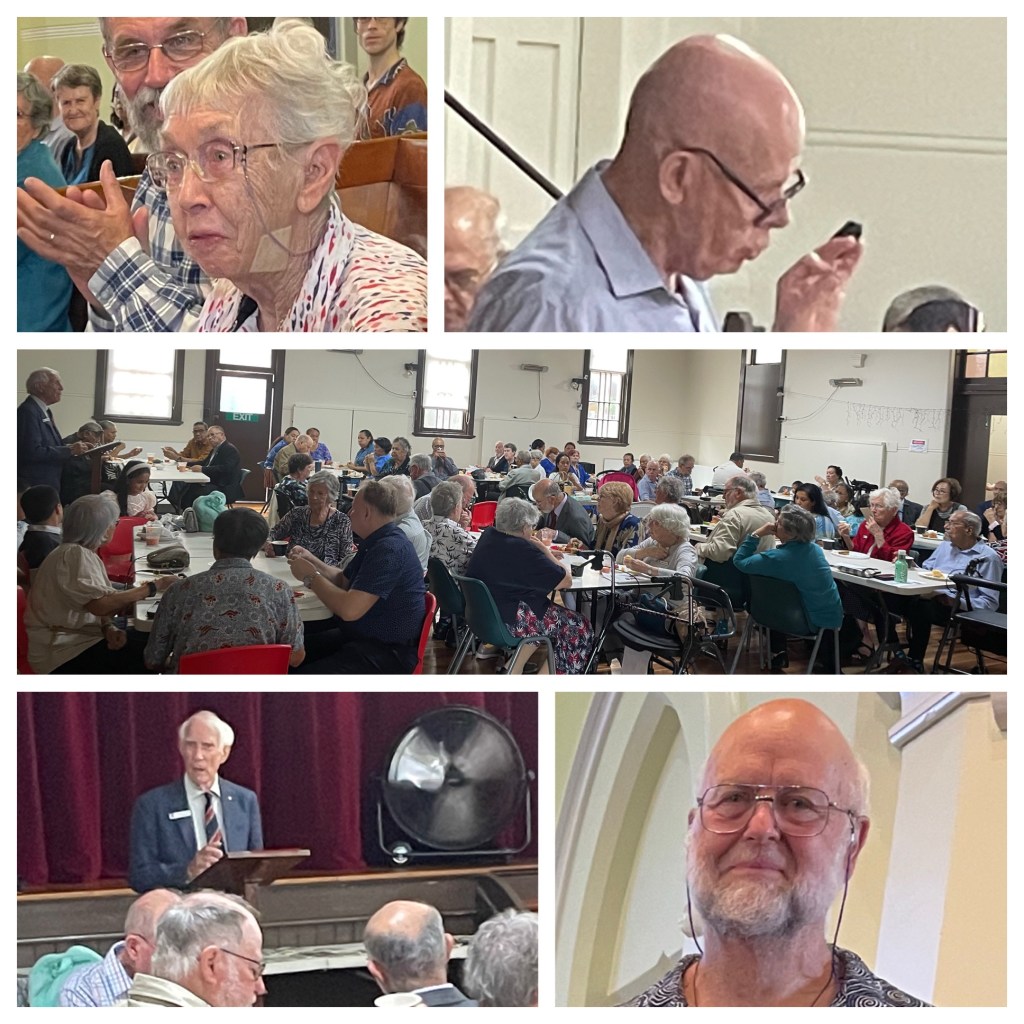
Shirley Maddox and Peter Butler (top);
the gathering in the hall (centre);
Doug Hewitt and John Squires (bottom).

Two previous Editors then spoke. Shirley Maddox gave her greetings to the people; then Peter Butler explained his commitment to ensure that WLW always spoke to the everyday needs of people. Every day, he noted, someone reading WLW will be grieving, another will be hurting, another will be hoping, and yet another will be joyfully celebrating. WLW, he noted, needs to be connecting with all such people every day.
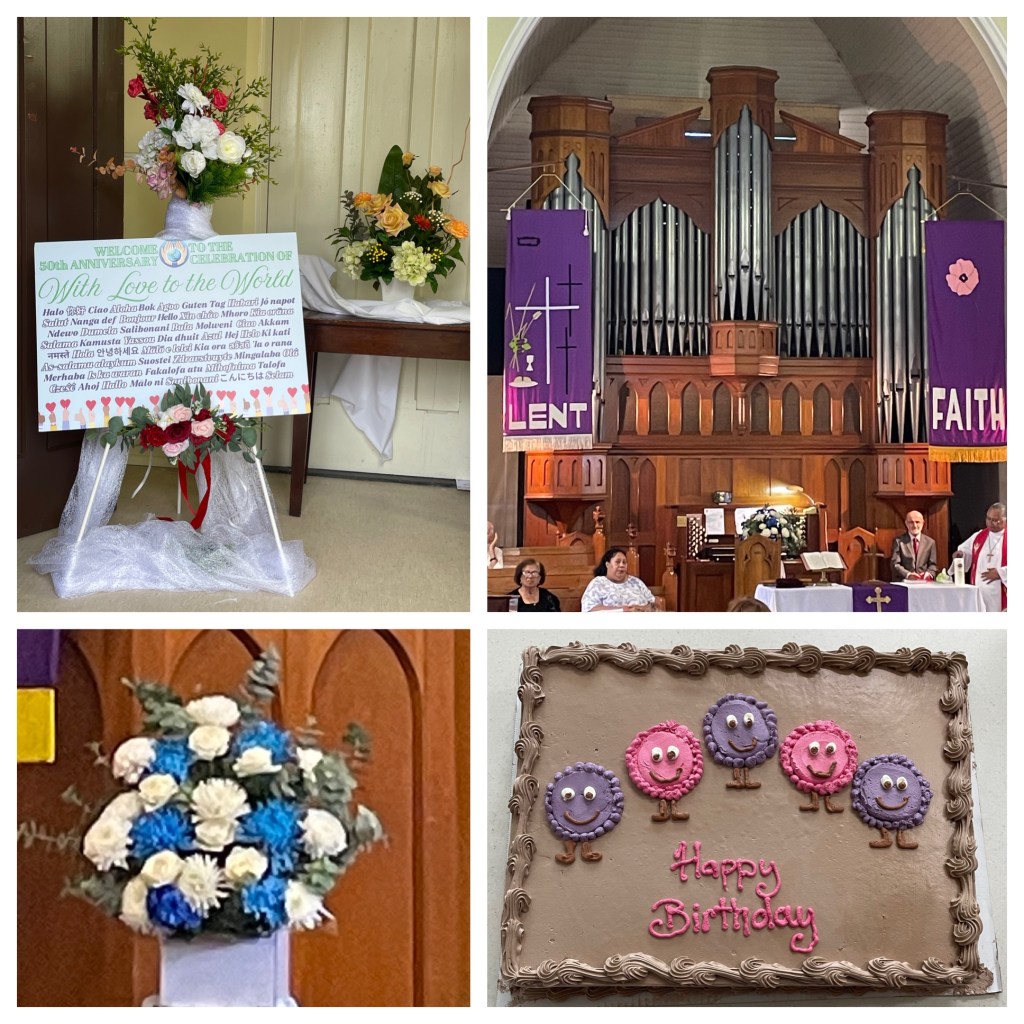
A large birthday cake was then presented; as Shirley Maddox blew out the candles, the people sang “happy birthday”—first to WLW, then again to Ruth Dicker, whose 93rd birthday occurs in the coming week. Current Editor John Squires drew the proceedings to a close with a thanks to those who had provided the sumptuous morning tea, and a reminder of his three-word commitment to ensure that With Love to the World is Inclusive—Collaborative— Diverse. And so the celebrations ended.

A WLW subscription is $28 per year. To subscribe to the hard copy booklet of With Love to the World, contact Trevor Naylor at the WLW Office on (02) 9747 1369, or email him at wlwuca@bigpond.com. To subscribe to the electronic version, download the App on your device from the App Store or Google Play.
With Love to the World at Pentecost and beyond

The next issue of With Love to the World is currently being distributed to subscribers across Australia, and overseas. The issue provides resources for personal use, as well as in church groups, for thirteen weeks, starting with the week that leads to Pentecost, in mid-May, and stretching through to mid-August.

With Love to the World is a resource published by the Uniting Church in Australia, although it is used by many UCA people as well as people from many denominations in a number of countries. I have been editing it for three years, now. It is based on the Revised Common Lectionary that is used in churches around the world. It is a resource which exhibits a core commitment of the Uniting Church: to present “an informed faith”.

This commitment was articulated in the Basis of Union for the UCA, which “gives thanks for the knowledge of God’s ways with humanity which are open to an informed faith” and thus commits the church “to sharpen its understanding of the will and purpose of God by contact with contemporary thought” (para. 13).

Each contributor to With Love to the World offers a reflection on daily biblical passage which is informed by their theological training as well as their engagement in pastoral ministry. The resource seeks to assist worshippers to come to Sunday worship with an awareness of the Bible passages they will hear read and proclaimed.

With Love to the World also seeks to be faithful to the UCA commitment to diversity in our common life, and especially to shape “a destiny together” with the First Nations Peoples of Australia. The period covered in this issue includes a week of commentaries by a First Nations person, as well as people with Tongan, Korean, and Anglo heritages.

The President-Elect, the Rev. Charissa Suli, has written the commentaries for the week leading to Trinity Sunday. For the first time, this issue of With Love to the World will include a week of commentaries from a South Sudanese Uniting Church minister, the Rev. Amel Manyon.

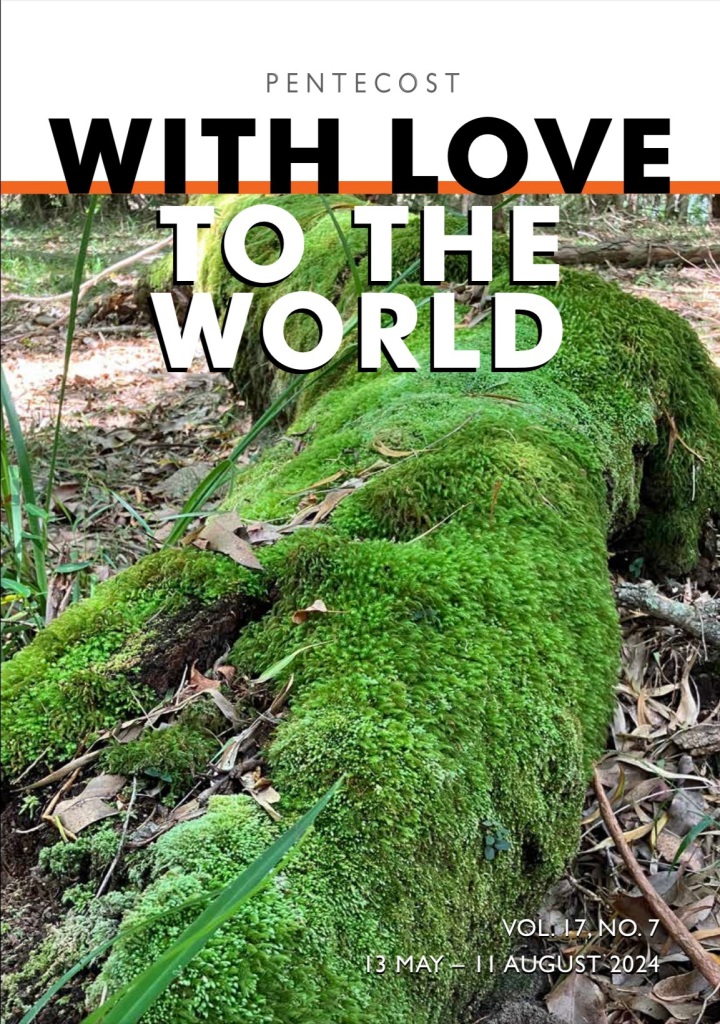
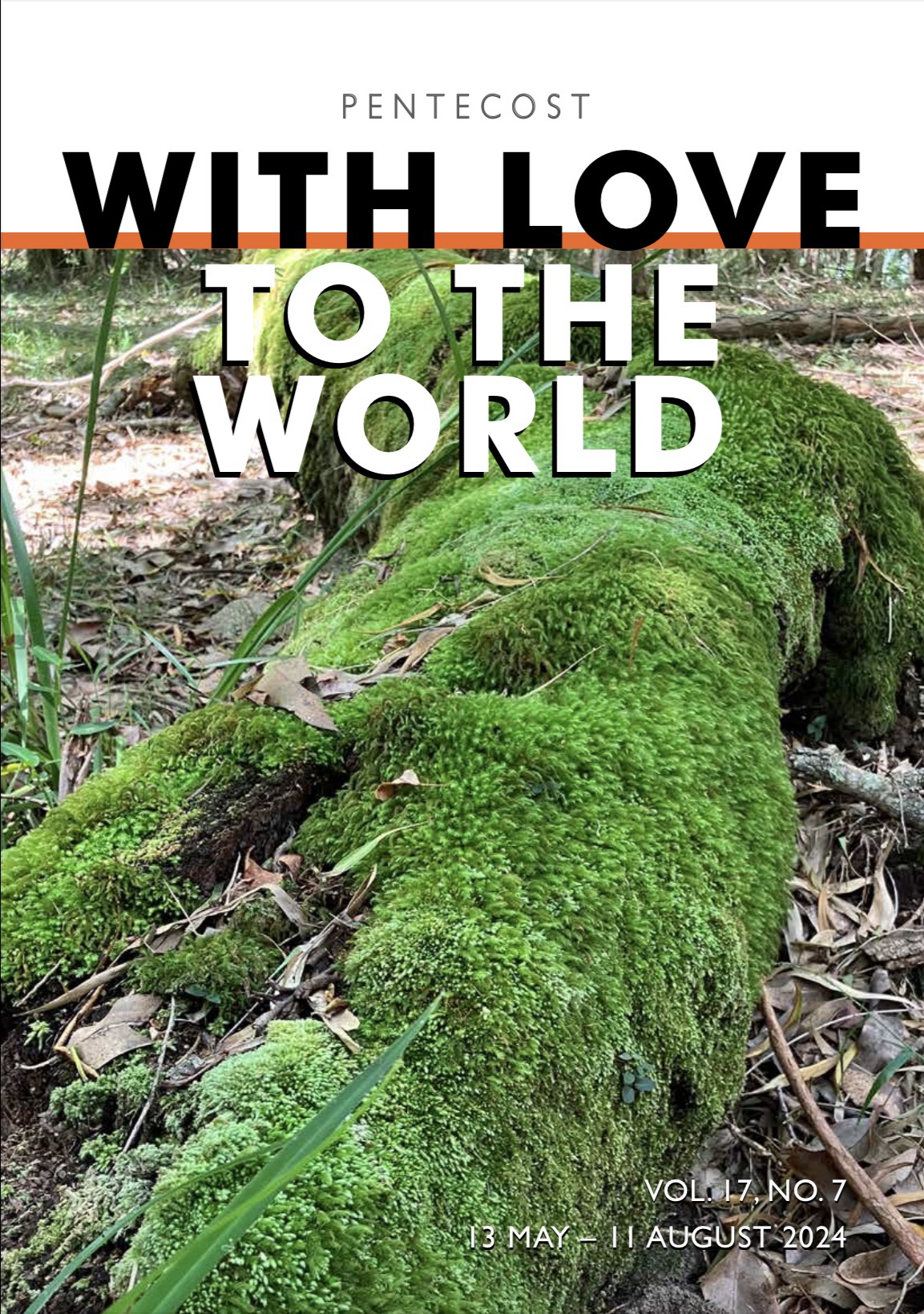
There is a succinct article on “Ten Things about Pentecost”, and an introduction to the sequence of Hebrew Scripture passages from Samuel and Kings that will be read and explored each week during this issue. The striking cover image for this issue is a photo taken by one of the contributors, Michael Brown, during a series of day-long walks that he recently undertook along the full extent of the south coast of New South Wales.

Michael reflects on the way that the image, a long-fallen tree in the Seven Mile Beach National Park between Gerroa and Shoalhaven Heads, signals a central dynamic of the biblical story: “In its death this log supports a vast network of life: mosses, small plants, fungi, insects, and small animals. Most of these lives would not have happened without the tree dying. They in turn will die, and in death will support further life.”

You can subscribe to With Love to the World on your phone or iPad via an App, for a subscription of $28 per year; just search for With Love to the World on the App Store, or UCA—With Love to the World on Google Play. For the printed hard copy resource, for just $28 for a year’s subscription, email Trevor at wlwuca@bigpond.com or phone +61 (2) 9747-1369. Or I am happy to supply a complimentary copy if you would like to sample the resource; send me your details by direct message.

With Love to the World for Lent and Easter 2024

The latest issue of the daily Bible reading resource, With Love to the World, is currently being distributed tcsubscribers. It features a stunning wraparound cover photograph of “Reflection at Circular Pool”, taken at Walpole, WA, by Steph Waters of Perth.

Steph offers her own reflection on the significance of the seasons of Lent and Easter, which are the focus of this particular issue. I’ve included an introduction to each season in the opening pages of this issue, and the issue concludes with a wonderful poem on resurrection, “Seasons gone south”, by Alison Bleyerveen of Sydney.

With Love to the World has always sought to provide a resource which assists worshippers to come to Sunday worship with an awareness of the Bible passages they will hear read and proclaimed. So each day has not only a succinct commentary on a biblical passage, but also a prayer, a song, and a question for discussion, all related to the day’s passage. This means that Sunday worshippers will hear more acutely and respond more directly to the scripture in focus.

The writers of these commentaries in this issue are all experienced in pastoral ministry, and so as they reflect on the daily passage, they bring their theological training as well as their engagement in pastoral ministry to bear on what the passage is saying. In keeping with the commitment of With Love to the World, the writers are drawn from Asian, Pasifika, Maori, South African, and Anglo-Australian heritages.

Yvonne, Peter, Radhika, Simon, Jason, Alimoni, and Rob (and yours truly) each write with the intention of drawing from scripture ideas and provocations that are expressed in an accessible way. They write so that the the faith of their readers is deepened and their discipleship is strengthened.

As always, as Editor, I have a number of complimentary copies to distribute to encourage new subscribers. Please send me a direct message if you (a) would like to sample With Love to the World for yourself, or (b) know of a friend or someone in your congregation who might be interested in sampling an issue. I can mail them direct to you or to the person you nominate. (Please include your mailing address in your message to me.)

In addition, you can take out an annual subscription to With Love to the World on your phone or iPad via an App, for just $28 per year. (That’s just 54 cents a week, or seven and a half cents a day!) Search for With Love to the World on the App Store, or UCA—With Love to the World on Google Play. For the hard copy resource, for just $28 for a year’s subscription, email Trevor at wlwuca@bigpond.com or phone +61 (2) 9747-1369.

Informed, Collaborative, Diverse: With Love to the World

The next issue of With Love to the World, which I edit, is currently being distributed. The issue covers half of the season of Pentecost, from mid-May through until mid-August. There are commentaries on biblical passages for each day (with the four “lectionary passages” included), along with a prayer, a song, a psalm, and a discussion question for each passage.

The resource is published by the Uniting Church in Australia, but is used by people of many denominations in a number of countries. As always, the resource exhibits a core commitment of the Uniting Church: to present “an informed faith”. This commitment was articulated in the Basis of Union for the UCA. Each contributor offers a reflection on the daily passage which is informed by their theological training as well as their engagement in pastoral ministry. The resource seeks to assist worshippers to come to Sunday worship with an awareness of the Bible passages they will hear read and proclaimed.

With Love to the World also seeks to be faithful to the UCA commitment to shape “a destiny together” with the First Nations Peoples of Australia. The period covered in this issue includes Reconciliation Week (in late May) and NAIDOC Week (in late June—early July), so the commentaries for those weeks are by a number of First Nations People, reflecting on the interplay between their cultural heritage and the Christian faith.

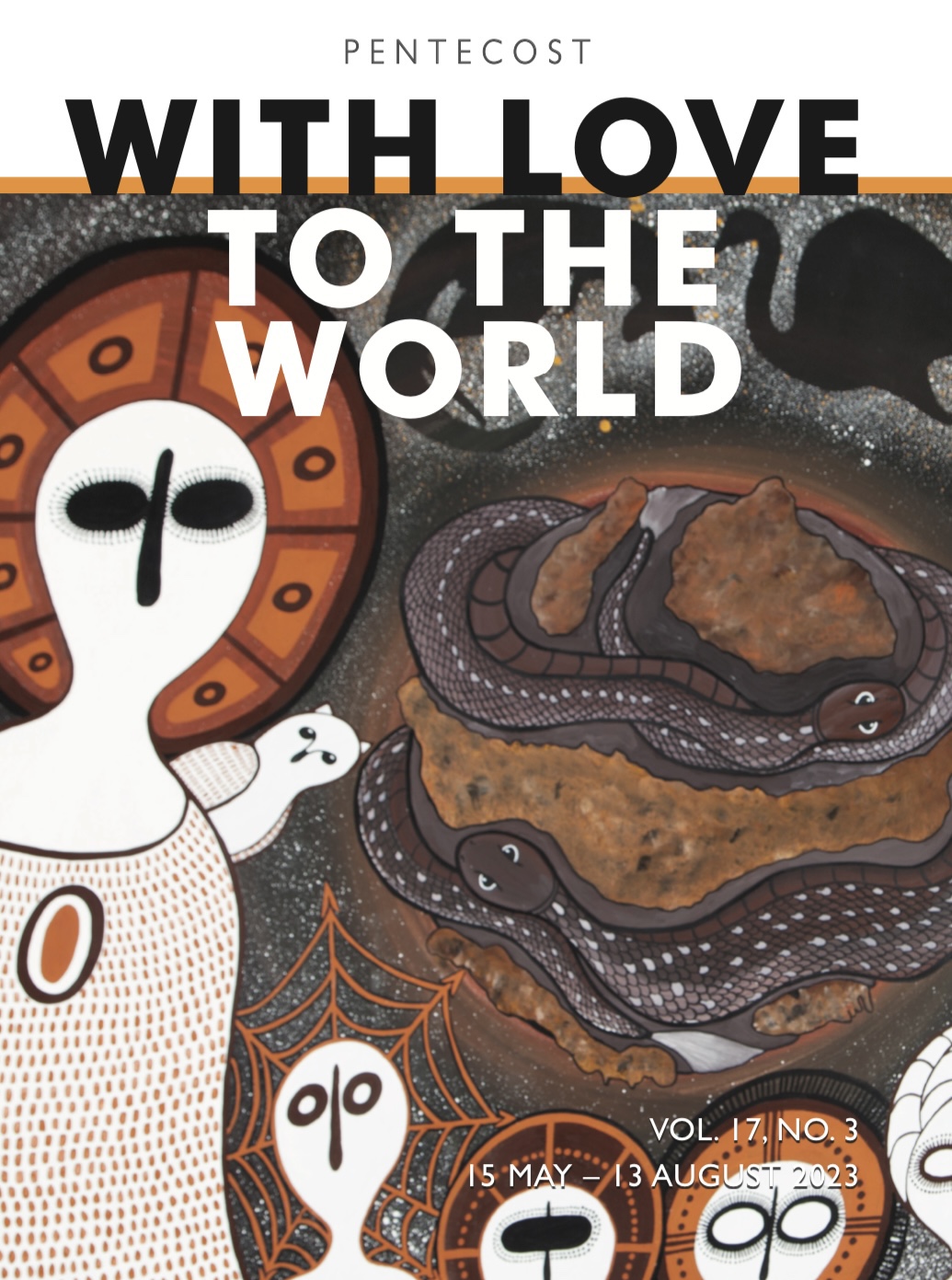
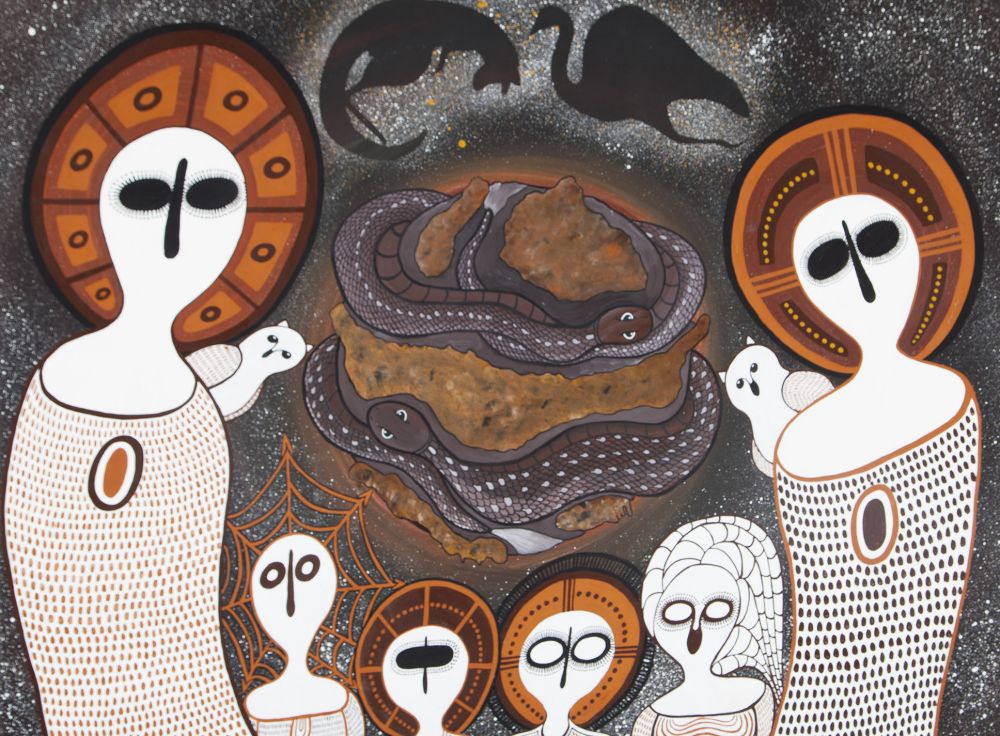
The striking cover of the issue is from a painting by one of those contributors, Kirsty Burgu, from Mowanjum in WA, who offers an interpretation of the artwork in her commentaries. There is also a powerful reflection on Mother Earth, from a First Peoples’ perspective, by Alison Overeem, from Muwinina country in Tasmania.

The other commentaries in this issue of the resource are provided largely by Australian Uniting Church people with Asian heritage, who know at first hand the complexities of living as a Christian in Australia with awareness of their own heritage. There are Korean, Filipino, Indonesian, Chinese, Sri Lankan, and Malaysian Chinese voices which can be heard and considered in this issue. This reflects the commitment made by the Uniting Church in 1985, to be “a multicultural church”.

In the following issue, which will have a Creation focus, each week will begin with a psalm which brings a creation focus. The writers in this issue will largely be Australians with a Pasifika heritage, including contributors from Fiji, Samoa, Tonga, Niue, and Tuvalu. As with the Asian-focussed issue, they have each been asked to invite readers into an exploration of the biblical passages from their distinctive cultural perspectives. We can expect many new insights to be offered!

Finally, the contributors to this issue—as, now, with each issue—include equal numbers of male and female writers, reflecting also the UCA ethos that the Spirit has gifted all people and that women and men equally take their place in ministry and leadership within the church.

With Love to the World can be ordered as a printed resource for just $28 for a year’s subscription (see http://www.withlovetotheworld.org.au/wp-content/uploads/2020/07/Ordering-and-paying-for-Website-7.vii_.2020.pdf). It can also be accessed on phones and iPads via an App, for a subscription of $24.49 per year (go to the App Store or Google Play).

If you are not a subscriber and would like to sample the resource, I can send you a copy of this issue; contact me at editorwlw@bigpond.com or text me on 0408 024 642, providing your postal address.

A focus on discipleship in With Love to the World

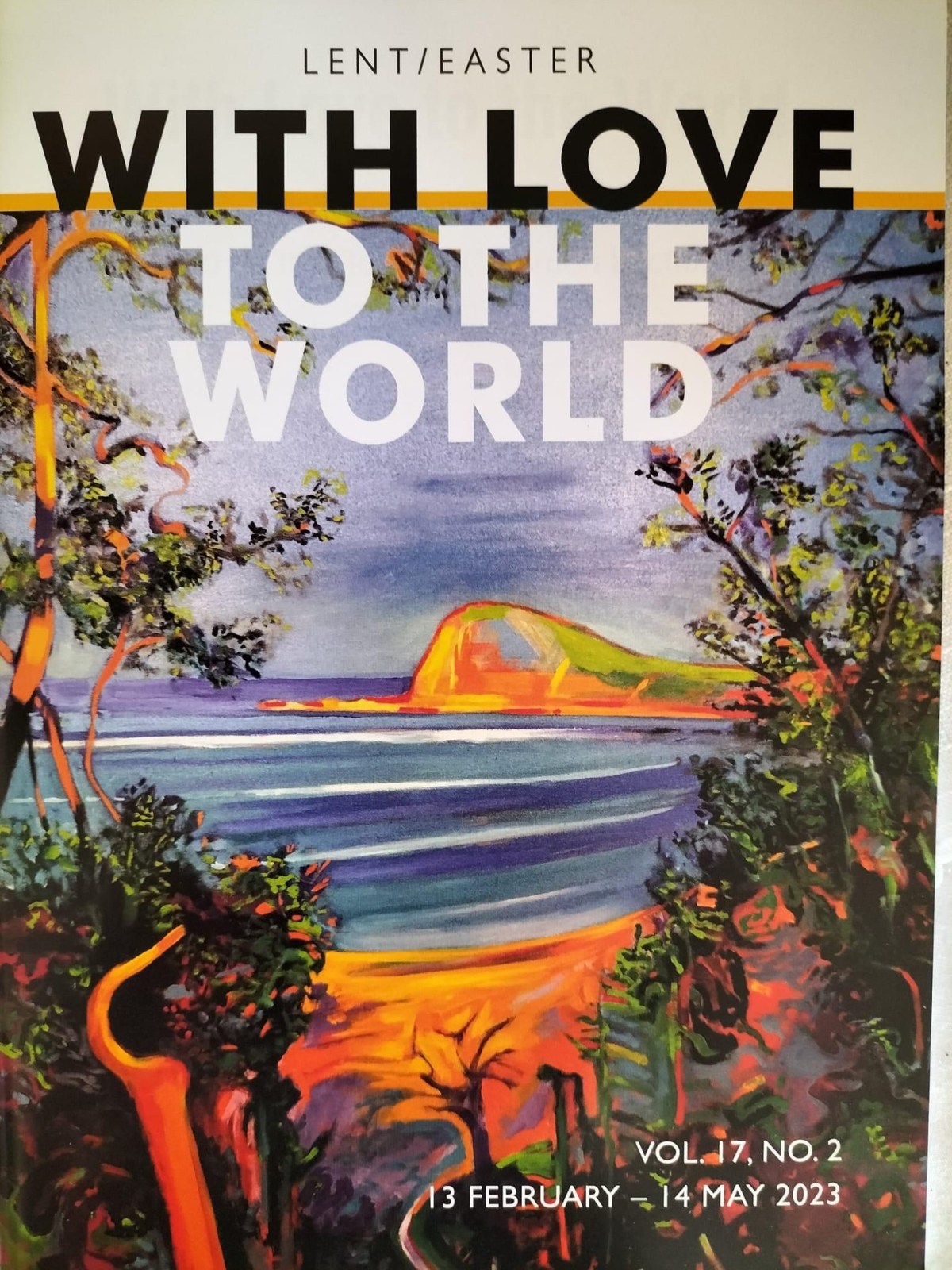
The next issue of the Bible-reading resource With Love to the World is now available. The issue covers the seasons of Lent and Easter (from mid-February to mid-May).

I edit this resource, which is produced by the Uniting Church in Australia and follows the Revised Common Lectionary. That lectionary provides four readings for each Sunday. These are the readings which are heard in worship each Sunday in many churches around the world. The resource includes short devotional commentaries on these four Bible passages, as well as an additional three readings each week.

That means that there is a passage with commentary each day of the week. In addition, for each passage there is a short prayer, a relevant song or hymn, and a discussion question relating to that passage. Whilst designed for personal use, many small groups also use the resource for their weekly discussion group.

The resource helps people who are preparing to lead worship and preach. My own view is that proclamation in sermons should encompass both the good news of the Gospel and the cares and concerns of our daily life. It’s about how we live out our discipleship each day. That’s the focus in the issue which has just been published.

This issue has contributions from writers in Western Australia, Victoria, the Australian Capital Territory, New South Wales and Tasmania. During Lent, a number of cherished stories told in John’s Gospel are read and considered each week, whilst in the season of Easter many stories of the early church from Acts are in focus.

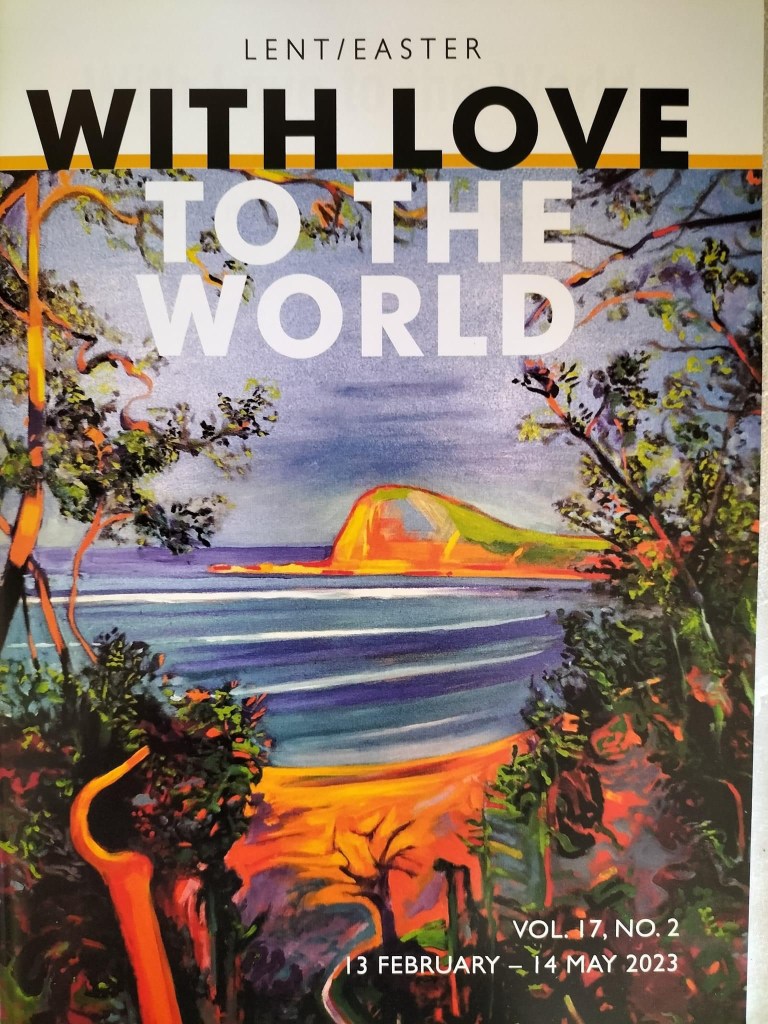
One week of commentaries reflects on the passages from a First Nations perspective, contributed by Alison Overeem. The cover is a striking Australian coastal scene painted by artist, art historian and Uniting Church minister Rod Pattenden. The issue includes a reflection on the artwork by Rod.

Subscriptions for With Love to the World are easy to arrange. The printed resource is available for just $24 for a year’s subscription (see http://www.withlovetotheworld.org.au/wp-content/uploads/2020/07/Ordering-and-paying-for-Website-7.vii_.2020.pdf) or the resource can be accessed on phones and iPads via an App, for a subscription of $24.49 per year (go to the App Store or Google Play).

Artworks by Rod Pattenden can be viewed at https://www.rodpattenden.id.au

I have some copies available at no cost if you would like to sample the current issue of this resource in the coming weeks. Send me a direct message, or contact me on 0408 024 642 or editorwlw@bigpond.com and I can arrange postage.

Women’s voices speaking with love to the world this Christmas

For a little over a year now, I have been editing a quarterly publication called With Love to the World. It provides short commentaries on the biblical passages offered in the Revised Common Lectionary, which is used by mainstream denominations of the Christian church around the world. The four passages offered each week are read in worship and one or more of them usually form the basis for the sermon in that service of worship. The publication seeks to prepare people to think about the passages in the week before they hear them in Sunday worship.

Recently, I have been working with material submitted by a group of contributors who have been working with the four lectionary passages, and an additional three biblical texts drawn from a recently-created lectionary, known as the Women’s Lectionary for the Whole Church. The contributions received form a special all-female issue of With Love to the World. (Well, all female, except for the Editor, yours truly!) This issue covers the seasons of Advent, Christmas, and Epiphany, and runs from mid November to mid February.

WLW has historically had more male contributors than females; in some issues, the ratio has been very one-sided. I have been seeking, since beginning as Editor, to have a better balance of gender amongst the contributors. So this issue is an attempt to provide a pendulum swing-to begin to redress the balance by having an all-female list of contributors.

Alongside that, I invited the contributors to “play” a little with the biblical texts offered each week. Amongst the seven passages each week, the four set lectionary readings need to be included; that is the staple of weekly reading for our many thousands of subscribers, and, of course, that is what is read and preached on in those churches which follow the Revised Common Lectionary.

The other three readings for each week come from the work of Professor Wilda C. Gafney, a Hebrew Bible scholar and Episcopal priest in the USA, who both serves in an AME Zion Church and teaches at Brite Divinity School. She has published a series of Women’s Lectionary for the Whole Church (Church Publishing, NY, 2021) in which she offers four readings for each week, following the usual pattern of Hebrew Bible, Psalm, Epistle, and Gospel.

The readings seek to offer the people of God “a lectionary centering women’s stories, chosen with womanist and feminist commitments in mind, fram[ing] the presentation of scriptures for proclamation and teaching” (Women’s Lectionary Year A, p.xxi). You can see the work that Prof. Gafney does at https://www.wilgafney.com/womenslectionary/

In a recent interview, published in Christian Century, she explains the theological and hermeneutical aspects of her approach; see https://www.christiancentury.org/article/interview/new-lectionary-centers-women

I’ve been enjoying the challenge, and the refreshing vitality, in the way that she highlights women in the texts, invites readers to imagine God in ways beyond the limited patriarchal understandings, and engages us with the creative imagination for understanding that we all possess.

She writes, “Part of what I want to accomplish is for people to know that even though the Bible is androcentric—parts of it are patriarchal, parts of it are paternalistic, and parts of it are misogynist—it’s possible to frame preaching texts around passages that include women and tell some new stories, while reckoning with how women are treated. If the gospel isn’t good news to the women in the passage, is it still good news? If it’s not good news to those who are enslaved in the passage, is it still good news?”

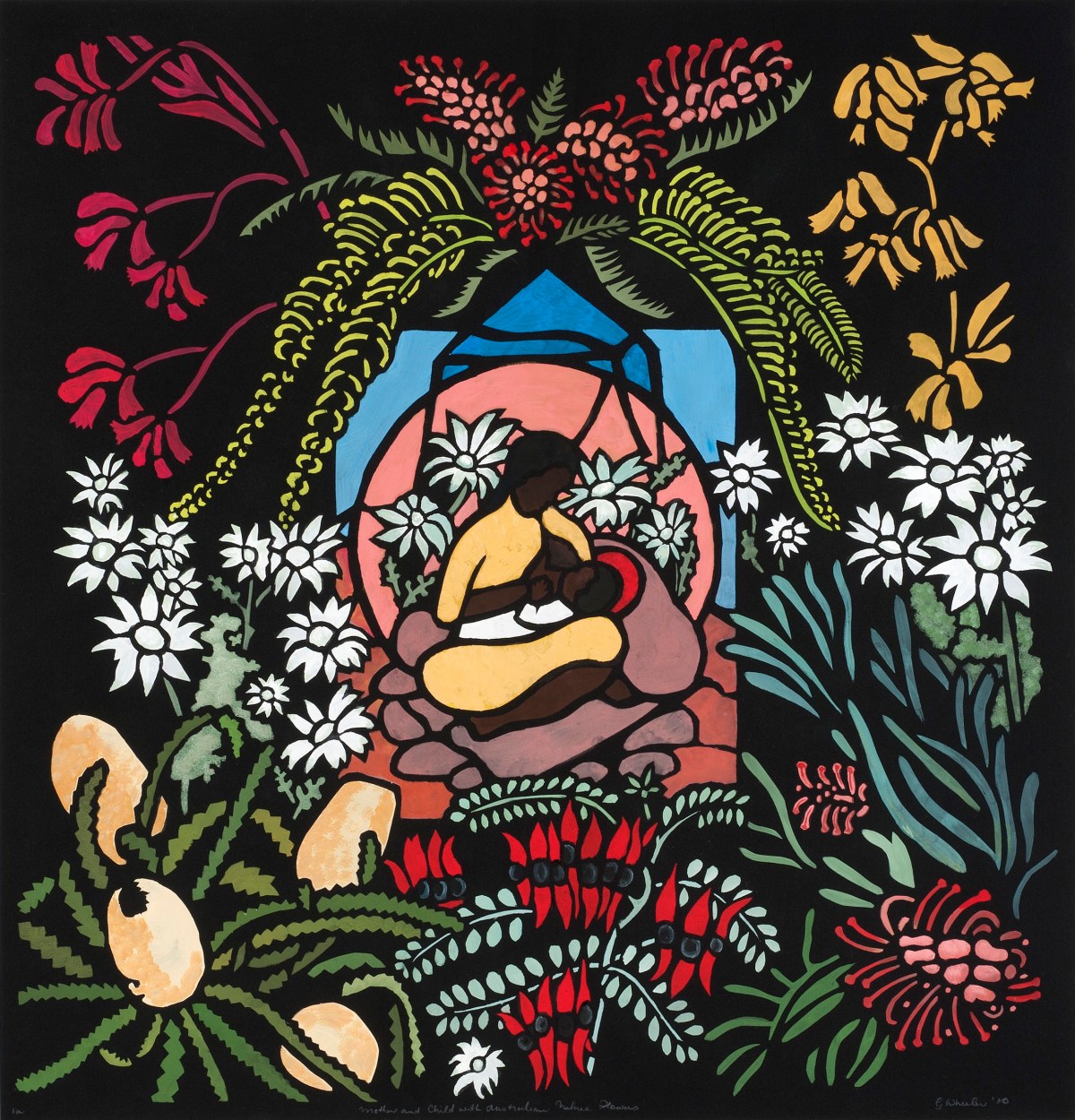
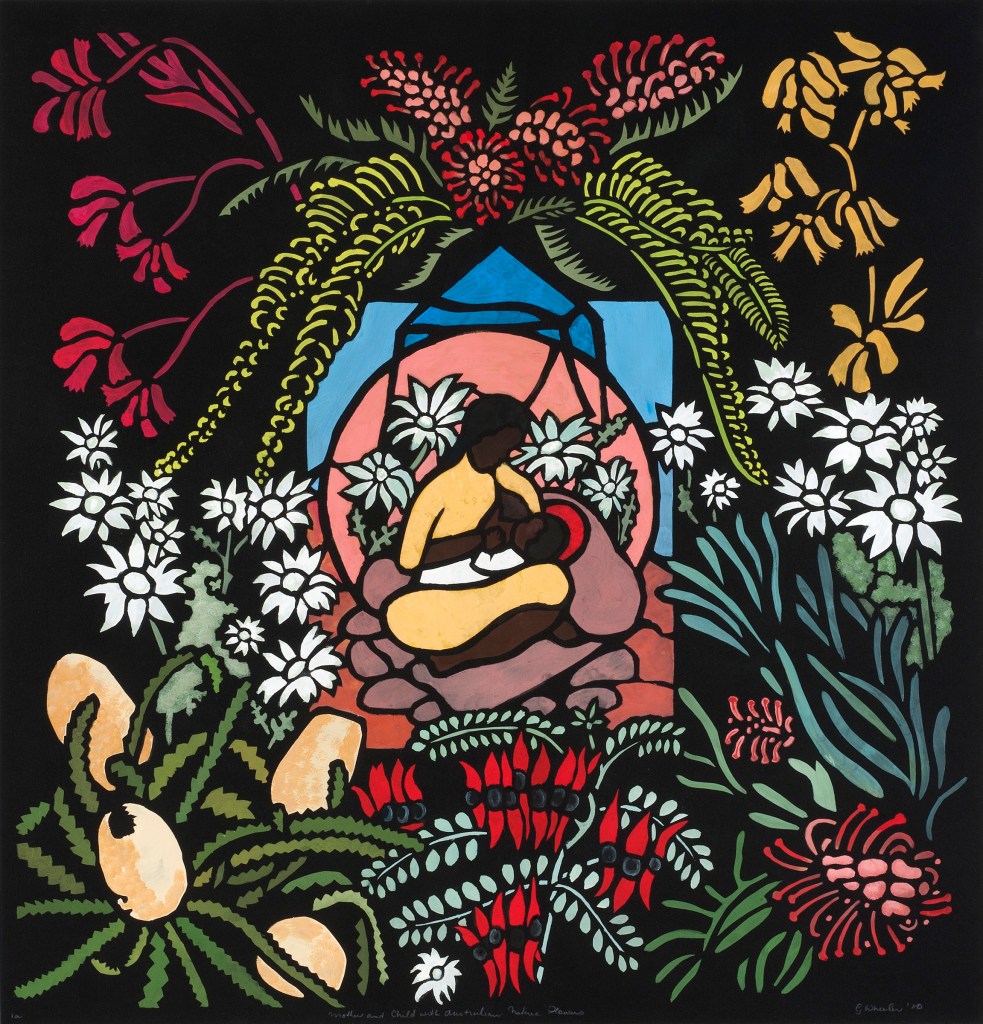
So, for the cover of this issue, Geraldine Wheeler has contributed a wonderful “Madonna and child”, contextualised to Australia, just as artists of other times and places have contextualised the story for their own settings (see below). Inside, Barbara Allen tells readers about her unusual spiritual discipline of writing haikus during Advent.

To start the series of commentaries, Anne Wright invites us to ponder, “if darkness, death, and despair have been defeated, how shall we live in the kingdom of light?” Continuing during the four weeks of Advent, Anita Monro meditates on “the way of the Womb of Life” as the theme for the season and explores “the responsibility we are given to act in and for” this way; and then Sarah Agnew ponders the paradox of a genealogy in which women “disrupt the male-dominated narrative of ancestry”, yet Mary is silenced and almost written out of the story of the birth of Jesus (Matt 1–2).

During the rather short Christmas season, Monica Melanchthon notes “the enormity of Israel’s need for a mothering God” (Isa 63); she observes how, in the Christmas story, “the divine mother changes grief into consolation” while “Joseph paves the way for a new understanding of masculinity”.

As we enter the season of Epiphany, Janice Mcrandal reflects on how we might read scripture in a way that “avoids simplistic readings and points us to a faith in Jesus that is not tied to idolatrous ideals of masculinity”, drawing from Elisabeth Schüssler Fiorenza’s critique of kyriarky. Kylie Crabbe then muses about what it might mean to read key biblical texts with an informed understanding of trauma, noting how “foreign occupation, violation, removal from country, and slavery” are narrated in Hebrew Scripture (and in the story of Jesus).

Elaine Ledgerwood follows the lead offered by Wilda Gafney by reading biblical texts, noting that “women’s voices were silenced in the patriarchal society of ancient cultures”, and inviting readers to replace male-focussed language with female-oriented terms; she asks, “what difference does this make for you?”

Reflecting on the image on the cover of the issue, Radhika Sukumar White comments “when a girl birthed the Saviour, they showed the world that the human body is not unclean, but holy, regardless of gender, orientation, ethnicity, and ability”. Alex Sangster concludes the issue with an invitation to “be in comfortable, curious contact with ‘negative’ emotions”, and then to “imagine Jesus holding your hand and saying, ‘you are my Beloved Child’”.

This issue of With Love to the World is now available. It can be ordered as a printed resource for just $24 for a year’s subscription (see http://www.withlovetotheworld.org.au/wp-content/uploads/2020/07/Ordering-and-paying-for-Website-7.vii_.2020.pdf) or it can be accessed on phones and iPads via an App, for a subscription of $24.49 per year (go to the App Store or Google Play).