“Here comes this dreamer. Come now, let us kill him and throw him into one of the pits; then we shall say that a wild animal has devoured him, and we shall see what will become of his dreams” (Gen 37:19–20). There it is: “brotherly love” on display, for everyone to see!
The sons of Jacob, who became the sons of Israel, and then gave their names to “the twelve tribes of Israel”, as we saw in an earlier blog, are terrible role models. They show us fraternal jealousy and hatred at its worst. The story offered by the lectionary for this coming Sunday, Pentecost 11A, pulls no punches (37:1–4, 12–28). These sons could be mean!
We have left behind the stories of the three patriarchs of Israel, Abraham, Isaac, and Jacob, and their wives, the four matriarchs Sarah, Rebekah, Leah, and Rachel—although Jacob is still alive, and he will figure in some of the final scenes of Genesis in chapters 46 and 48—50. We turn our attention to Joseph, who had been born to Jacob’s wife Rachel, after years of waiting.
Only after his first wife Leah had given birth to six sons and a daughter, did Rachel give birth, as God “heeded Rachel and opened her womb” (Gen 30:22). As a sign of the passing of her barren state, Rachel declared, ‘God has taken away my reproach’; and we read that “she named him Joseph, saying, ‘May the LORD add to me another son!’ (Gen 30:23). That son, Benjamin, came years later, although Rachel tragically died giving birth (Gen 35:16–20).
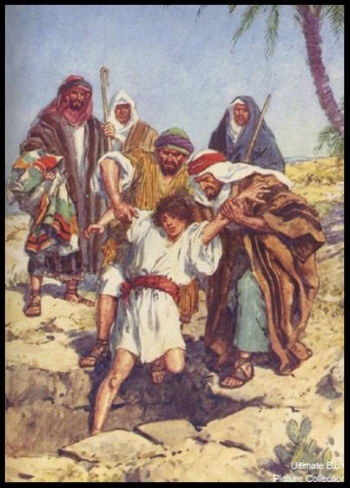
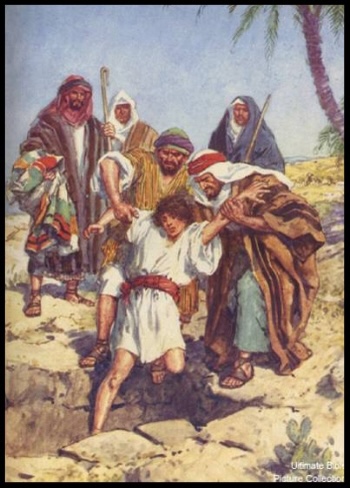
We meet Joseph in the passage offered by the lectionary, which notes that, as he grew, Joseph was the favoured son (Gen 37:3). Of course, this fostered the jealousy of his brothers, who “hated him, and could not speak peaceably to him” (Gen 37:4). And so the scene is set for the problematic sequence of events that ensues, as his brothers initially plot to kill him (Gen 37:19–20), before Reuben intervenes (Gen 37:21–23).
We have already seen that the ethical standards of the people in these ancestral stories leaves something to be desired. Cheating, stealing, rape, incest, murder, and double dealing appear to be par for the course. Yet these brothers who plot to kill Joseph are the men who give their names to the tribes of Israel—names that are given pride of place in the priestly garments (Exod 1:1–4; 28:9–12, 21, 29; 39:6–7, 14) and in the later history of the people (1 Chron 2:1–2).
That these stories of their murky ways of operating have been preserved, passed on, and preached on with regularity, is quite remarkable! Perhaps we should reflect that human beings have always been flawed? Or that we should well expect that the ethical standards and cultural practices of our time are different from what held sway in past eras?
And perhaps we need also to note—and take caution from the observation—that this particular incident, selling Joseph for twenty pieces of silver, has fed into the unhelpful stereotype of the Jews who are always and in every way concerned about money. It’s a stereotype that has fed the burgeoning antisemitic attitude and actions of people throughout the Middle Ages, past the Enlightenment on into the modern age—culminating, of course, in the horrors of the Shoah (Holocaust) in Nazi Germany.
Back to the story of Genesis 37. That the brothers plot to kill Joseph, and are only dissuaded by the intervention of Reuben (Gen 37:21–23), is clearly a mark against them. That Judah then suggests that they sell him to a passing caravan of Ishmaelites (Gen 37:25–28), whilst it saves the life of Joseph, is yet another mark against the brothers.
Christian readers will perhaps compare the “twenty pieces of silver” that was paid for Joseph (Gen 37:28) with the thirty pieces of silver paid to Judas for handing Jesus over to the authorities (Matt 26:15). However, a number of passages in Hebrew Scriptures provide a more fitting contrast to the price paid for Joseph.
Abimelech, in his unsuccessful attempt to install himself as king in Israel, took “seventy pieces of silver out of the temple of Baal-berith with which [he] hired worthless and reckless fellows, who followed him” (Judg 9:4). So twenty pieces are significantly less.
And the story is told in Judges about when the lords of the Philistines bribed Delilah with eleven hundred pieces of silver to hand over Samson to them (Judg 16:5; 17:1–5), and in the Song of Songs the (poetically-exaggerated) claim is made that Solomon expected a thousand pieces of silver from each of the keepers of his vineyard (Song 8:11). So twenty pieces pales into utter significance, by comparison. Was Joseph worth so little.
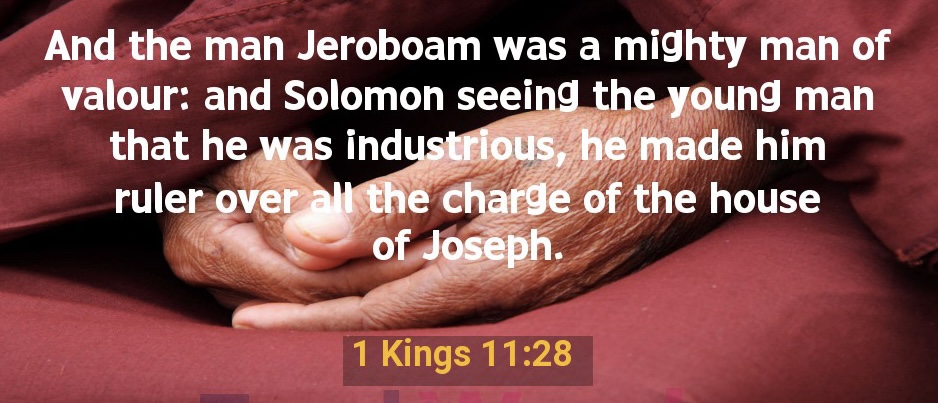
The irony is that Israel as a whole is identified with reference to Joseph at a number of places in the Hebrew Scriptures. Both narrative texts and prophets refer to the whole nation as “the house of Joseph” (Josh 17:17; 18:5; Judg 1:22–23, 35; 2 Sam 19:20; 1 Ki 11:28; Amos 5:6; Obad 1:18; Zech 10:6).
The psalms sing of “the descendants of Jacob and Joseph” (Ps 77:15) and bring petitions to God, “Shepherd of Israel, you who lead Joseph like a flock” (Ps 80:1). Psalm 81 places Joseph alongside Jacob and Israel: “it is a statute for Israel, an ordinance of the God of Jacob, he made it a decree in Joseph, when he went out over the land of Egypt” (Ps 81:4–5). The name of Joseph was revered in the ongoing traditions of Israel.
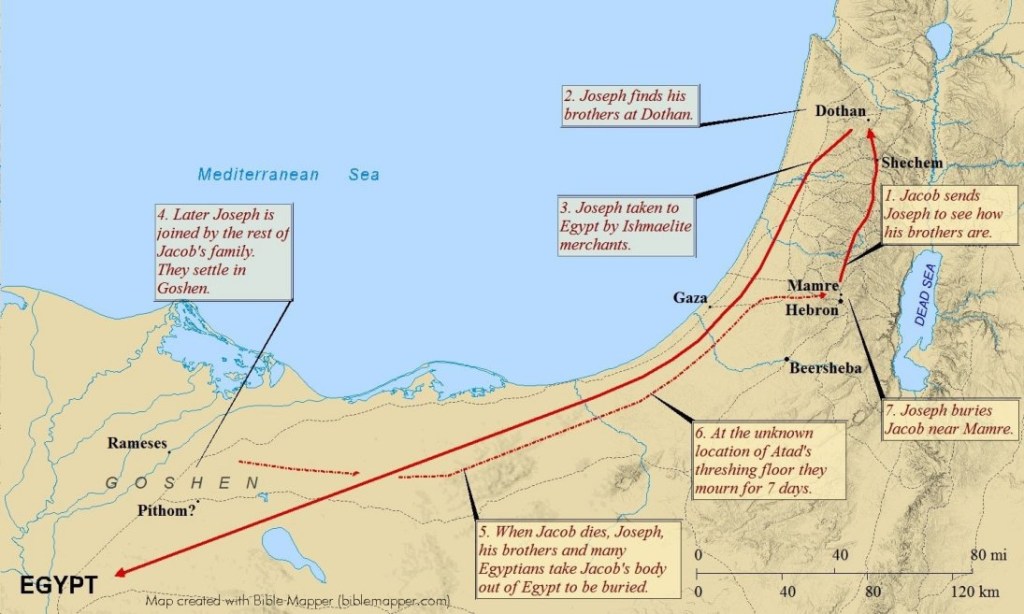
So let us treasure and reflect on this story, in which Joseph is sold off to foreign travellers. His life had been saved from the plotting of his brothers by a compassionate intervention by one of their number; but he is taken off into Egypt—for what fate?
*****
Reading the story chapter-by-chapter, as it appears in Genesis, we don’t yet know the significance of Egypt (other than the account of the time that Abram and Sarai spent in Egypt in Gen 12:10–13:12). But people hearing the story when it was written into the scrolls, after the return from Exile, would know of the time of slavery spent by their ancestors in Egypt, when “the Egyptians became ruthless in imposing tasks on the Israelites, and made their lives bitter with hard service” (Exod 1:13–14). They know the ominous threat that lies over Joseph at the end of this week’s story: “they took Joseph to Egypt” (Gen 37:28).
That fate is symbolised by the note in the immediately following verses, that the brothers of Joseph dipped his coat into the blood of a slaughtered goat and brought it back to Jacob. When Jacob recognized the coat, he concluded that “a wild animal has devoured him; Joseph is without doubt torn to pieces” (Gen 37:33). Jacob mourned for many days; despite the best efforts of his family, “he refused to be comforted, and said, ‘I shall go down to Sheol to my son, mourning” (Gen 37:35).
The narrative leaves Joseph with the tantalising comment that he was sold by the Midianites to Potiphar, one of Pharaoh’s officials (Gen 37:36), before veering off to tell a long story about Judah and Tamar (Gen 38). The question remains: what fate awaits Joseph?
The book of Genesis is dominated by people whose stories are told because they have shaped the self-understanding and identity of the ancient nation of Israel. Written in the form that we now have them by the priests who had held the stories of Israel through the decades of Exile, those stories comprise oral tales, told and retold over centuries before that Exile, remembered and passed on because they offered insights into who the people of Israel had become—committed, resilient, crafty, and faithful.
The stories are dominated by the men—Adam and Noah, Abraham and Isaac, Jacob, and his twelve sons, most notably Joseph. Indeed, the closing chapters of Genesis contain a series of poetic blessings on those twelve men, who are remembered as “the twelve tribes of Israel” (Gen 49), before recounting a key familial reconciliation, the death of the great partriarch Jacob, and then the death of his son Joseph (Gen 50). We have heard these stories, from the second Sunday after Pentecost (Gen 12) through to the tenth Sunday after Pentecost (Gen 32).
In these stories, the men dominate. There are, to be sure, women who also play key roles in the stories that are collected into this first narrative book. Sarah and Hagar get a place in the story alongside Abraham. Rebekah is there, with Isaac; and Leah and Rachel too, with the manipulation of their father Laban and the lust of their husband Jacob. Here we have the four great matriarchs of Judaism, arrayed alongside their husbands: Abraham and Sarah, Isaac and Rebekah, Jacob with Leah and Rachel. The stories told give insight into the characters of these women; they serve as role models in the ongoing story of Israel.
There are also servants co-opted to produce children when the matriarch looked like she would not reproduce: Hagar, Zilpah, and Bilhah—important women, but not included in the traditional list of matriarchs. They take their place in the story largely because of the male offspring they produced. And when we come to the twelve sons of Jacob, there are wives who are noted, but nothing further is revealed about them—except for Asenath, the wife of Joseph.
But who have we missed, in the stories from Genesis which have been offered by lectionary over the past few months? Seven women, or groups of women, should be noted. In this post, I will deal with those who appear in the section of Genesis which is dominated by Abraham and Isaac (Gen 12:1—28:9). The women in the chapters beyond this, which tell the story of Jacob and his sons, and especially of Joseph, that will be considered in a later post.
1 The wife and daughters of Lot
First, there is reference to the wife and two daughters of Abraham’s son-in-law, Lot. Lot is noted in the genealogical material listing the descendants of Terah, his grandfather (Gen 11:31). Lot accompanies Abram and Sarai and “all the possessions that they had gathered, and the persons whom they had acquired in Haran” as they journeyed to Canaan (Gen 12:5); he then moves with them into the Negeb, en route to Egypt (Gen 13:1).
We learn that “Lot chose for himself all the plain of the Jordan, and Lot journeyed eastward”, and so “Lot settled among the cities of the Plain and moved his tent as far as Sodom” (Gen 13:11–12). There is no mention of any female associated with Lot in any of these instances. However, after Abraham entertains visitors who stay with him at Mamre, as they are travelling to Sodom (Gen 18:1–16), and then after Abraham debates with God about the threat to destroy Sodom and Gomorrah (Gen 18:17–33), Lot is visited by “two angels” (Gen 19:4).
He offers them hospitality; but the people of Sodom call for Lot to release those two people “so that we may know them” (Gen 19:5). So Lot offers, in their place, his “two daughters who have not known a man” (Gen 19:8). This is the first indication that Lot was married with children; and the way his virgin daughters are offered as sexual objects for the people of Sodom is a horrifying introduction to them!
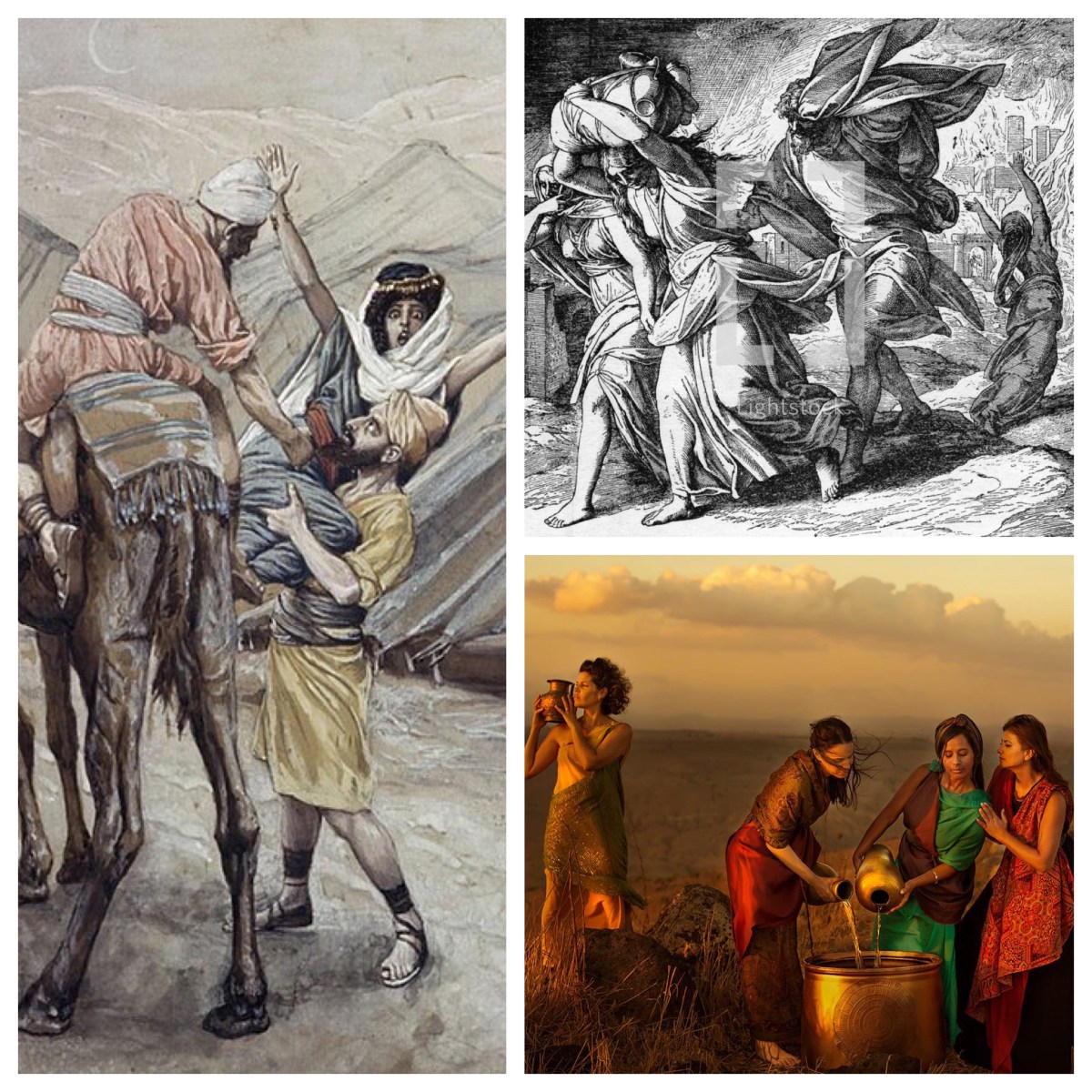
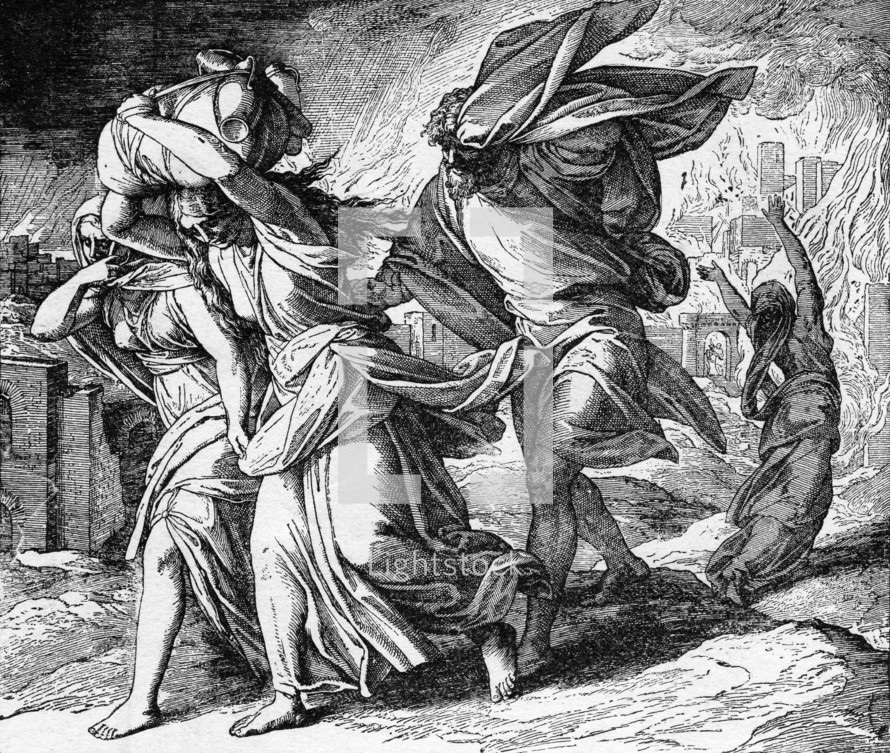
So, warned by these “two angels” to leave the area, Lot hesitates (Gen 19:15–16). What they say to Lot is the first reference to his wife: “get up, take your wife and your two daughters who are here, or else you will be consumed in the punishment of the city” (Gen 19:15). They also advise him, “do not look back or stop anywhere in the Plain; flee to the hills, or else you will be consumed” (Gen 19:17). Lot leaves Sodom, but “Lot’s wife, behind him, looked back, and she became a pillar of salt” (Gen 19:26). And that is how she is best known—not by her name, not as the daughter of her father, but as Lot’s wife, who was turned into a pillar of salt.
Dr Tamar Kadari, writing in the Jewish Women’s Archive, notes that in a later rabbinic text, this woman is given the name Idit, and a story is told about her reluctance to obtain salt from her neighbours, as Lot has requested. This becomes the reason for her punishment, being turned into a pillar of salt. Another text she cites, attributed to Rabbi Eliezer, says that Lot and his wife were actually saved from the destruction of the city; but there were two married daughters who had remained in Sodom, so she looked behind her to see them for the last time. When she did this, she saw the back of the Shekhinah (the Divine Presence), and so she was transformed into a pillar of salt.
Lot’s daughters went with Lot into the hills nearby; the biblical text describes their devious acts of making their father drunk and both having sexual intercourse with him, thereby producing two sons, Moab and Ben-ammi (Gen 19:30–38). From these two children of incestual rape (of a man, by his daughters, no less!), the despised Moabites and Ammonites descended. Of these people, none are permitted to enter God’s assembly (Deut 23:3; Neh 13:1–2) and good Israelites were later forbidden to marry them (Ezra 9:1–2). Those prohibitions explain the awful nature of these aetiological tales about Lot’s family.
Lot, his disobedient wife, and his aggressively incestual daughters, certainly provides a stark tale (none of which is included in any lectionary offering!). The anonymous women in the story are certainly strong characters. Their actions are told to explain the character of near neighbours with whom the Israelites later had difficult relationships. We remember these women, but perhaps not for the usual reason we seek to remember characters in the biblical text.
Next, there is the sombre tale of Dinah, the sole female child of Jacob, birthed by Leah after the six sons she had produced (Gen 30:21). This story is told in Gen 34, after Jacob, after he had left Laban in Paddan-aram, had encountered his brother Esau, after a long period of separation (Gen 33:1–17). Jacob and his family settled in Shechem in Canaan, where he bought land and erected an altar (Gen 33:18–20).
Dinah was raped by a man who bore the name of the town, Shechem (Gen 34:2)—but immediately “his soul was drawn to Dinah … he loved the girl and spoke tenderly to her”, and asked his father to be married to her (Gen 34:3–4). Was it possible that a relationship that was formed on the basis of crass selfishness and the forceful expression of power could develop into one shaped by love and respect? The text seems to hint …
However, what ensues is a tale of family revenge for the dishonouring of Dinah. When the sons of Jacob came in from their work in the fields, they were, quite rightly it would seem, “indignant and very angry, because [Shechem] had committed an outrage in Israel by lying with Jacob’s daughter, for such a thing ought not to be done” (Gen 34:7).
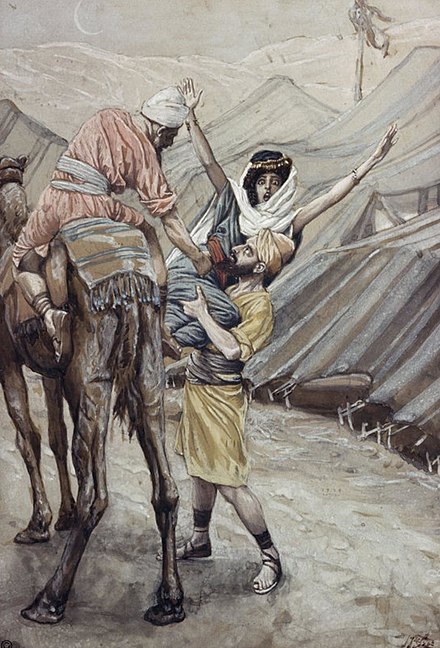
Shechem’s princely father, Hamor, attempted to negotiate, but the words of the brothers were deceptive (Gen 34:13–19). They convinced Hamor that they were “friendly with us” and he, in turn, persuaded “the men of the city … at the gates of the city” to “agree with them, and they will live among us” in peace (Gen 34:20–23), on condition that the men of the city be circumcised—which they were (Gen 34:21).
But the sons of Jacob (remember, these are the men who are honoured in ongoing Israelite and Jewish traditions as the venerable men who have their name to the twelve tribes of Israel) then pounce: “two of the sons of Jacob, Simeon and Levi, Dinah’s brothers, took their swords and came against the city unawares, and killed all the males”, including Hamor and Shechem (Gen 34:25). They “took Dinah out of Shechem’s house, and went away” (Gen 34:26).
Then, “the other sons of Jacob came upon the slain, and plundered the city … they took their flocks and their herds, their donkeys, and whatever was in the city and in the field” (Gen 34:27–30). This massive over-reaction was to avenge the fact that “their sister had been defiled” (Gen 34:27). Their father, Jacob, was unimpressed; “you have brought trouble on me”, he said, “by making me odious to the inhabitants of the land”, lamenting that “my numbers are few, and if they gather themselves against me and attack me, I shall be destroyed, both I and my household” (Gen 34:30).
What did Dinah make of this wholescale, and out-of-proportion, revenge attack? She is silent—indeed, she is absent from the text from verse 26, when her brothers removed her from the house of Shechem. In contrast, we hear their voice loud and clear, in their riposte to their father: “should our sister be treated like a whore?” (Gen 34:31). Nothing will dissuade them of the “rightness” of their actions. Men, standing up for women, by acts of violence and destruction; women, absent from the story, as their honour is defended. It is a sorry tale.
Writing on the biblical text in the Jewish Women’s Archive, Professor Rachel Adelman observes that the narrative “is rife with gaps and ambiguities, in which Dinah’s silence and the divide between father and brothers loom large”. The story, she posits, presents “the impossibility of integration with the Canaanites in the land”—the story of Dinah and Shechem demonstrates that this produces disastrous results.
Furthermore, Dr Adelman notes that “boundaries of identity are forged through negotiations over the destiny of the young woman’s body”—in other words, the silent, debased, raped female is the fulcrum around which the identity of the nation of Israel is shaped. “In the context of the honor-shame socio-cultural milieu, the daughter’s voice hardly matters. Even when the Hivites are willing to remove the Israelite symbol of “disgrace” (the foreskin) from their male bodies in order to intermarry with Jacob’s family, their status as the tainted ineluctable “other” remains.”
Then, Dr Adelman observes that “contemporary feminist readers seek to reclaim the voice of the silenced Dinah, to reassert her own agency and even desire to be with Shechem … alternatively, if she was raped, her own pain and anguish must be heard over the violent clamor in defense of male honor.” Dare we listen carefully, to hear that silent female pain, over the noise of male revenge?
Dr Tamar Kadari, also writing in the Jewish Women’s Archive, observes of Dinah that “the Rabbis present her as possessing many positive qualities, as was fitting for the daughter of the progenitors of the Israelite nation.” They attempt to rehabilitate Dinah by recounting her later marriage—one account has her married to Job, because she is a “shameless woman [ha-nevalot]” (Job 2:10), which they connect with the shame [nevalah] of Dinah (Gen 34:7).
Another explanation is that Dinah married her brother, Simeon. Dr Kadari explains the rabbinic midrash: “a son was born from this union, “Saul the son of a Canaanite woman” (Gen 46:10); Dinah was the ‘Canaanite woman’, because her behavior was like that of the Canaanites.” A final claim is that Dinah, impregnated by Shechem, gave birth to Asenath, who was transported to Egypt and raised by the barren wife of Potiphar. And then, along came Joseph!
But that is skipping ahead; more on Asenath in the next blog on this topic.
A group of women are noted and indeed named in association with Esau, the brother of Jacob. The narrative first notes that “when Esau was forty years old, he married Judith daughter of Beeri the Hittite, and Basemath daughter of Elon the Hittite; and they made life bitter for Isaac and Rebekah” (Gen 26:34–35). The note of family discord is not unusual in these ancestral narratives! But who is the “they” in this comment? Just those wives of Esau? Or is Esau himself included? It depends on how patriarchal and sexist we think the text is.
Next, we are told that “when Esau saw that the Canaanite women did not please his father Isaac, Esau went to Ishmael and took Mahalath daughter of Abraham’s son Ishmael, and sister of Nebaioth, to be his wife in addition to the wives he had” (Gen 28:9). So Mahalath joins Judith and Basemath as named wives of Esau.
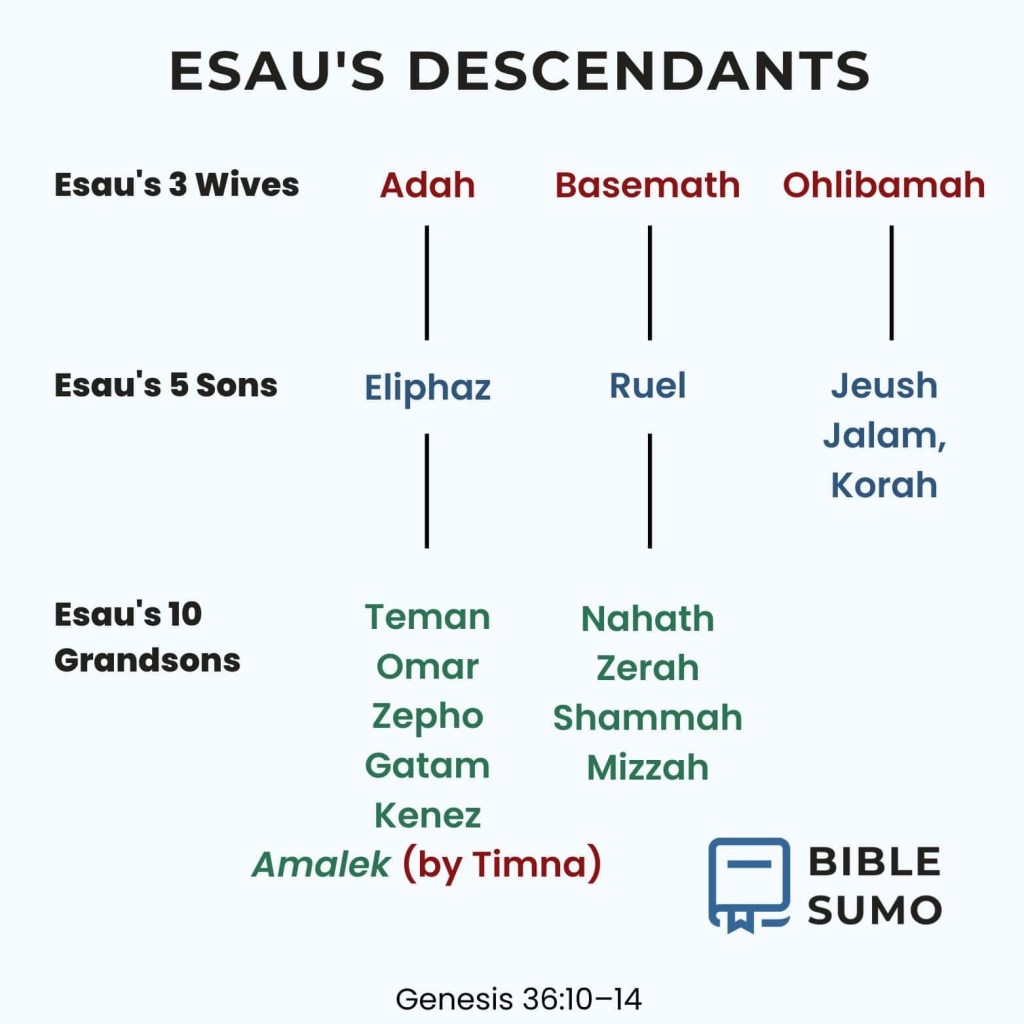
Later genealogical listings offer the names of Adah, Oholibamah, and Basemath, but not Judith. First, we learn that “Esau took his wives from the Canaanites: Adah daughter of Elon the Hittite, Oholibamah daughter of Anah son of Zibeon the Hivite, and Basemath, Ishmael’s daughter, sister of Nebaioth. Adah bore Eliphaz to Esau; Basemath bore Reuel; and Oholibamah bore Jeush, Jalam, and Korah. These are the sons of Esau who were born to him in the land of Canaan.” (Gen 36:1–5).
Then, after Esau took his family and “settled in the hill country of Seir; Esau is Edom” (Gen 36:8), we learn that “these are the names of Esau’s sons: Eliphaz son of Adah the wife of Esau; Reuel, the son of Esau’s wife Basemath” (Gen 36:10). Only two wives are noted at this point.
The text continues, “the sons of Eliphaz were Teman, Omar, Zepho, Gatam, and Kenaz. (Timna was a concubine of Eliphaz, Esau’s son; she bore Amalek to Eliphaz.) These were the sons of Adah, Esau’s wife. These were the sons of Reuel: Nahath, Zerah, Shammah, and Mizzah. These were the sons of Esau’s wife, Basemath. These were the sons of Esau’s wife Oholibamah, daughter of Anah son of Zibeon: she bore to Esau Jeush, Jalam, and Korah.” (Gen 36:10–14). So three wives are named in this final passage.
Sadly—as is often the case—these genealogical listings focus on the male descendants. Whether any daughters were born, or survived beyond birth, is not stated. The gender bias is clear; we hear only about the sons. And we know nothing about the life of most of these men in the subsequent generation—and in association with them, the women married to them or any sisters they had; nothing is revealed by the text. So many questions; so little information!!
As a family historian, this is a familiar problem: tracing the male line is easier than connecting in the females, men are mentioned more frequently in published sources, many women remain mute and invisible in the family story. It takes effort and intention to retrieve even a little of them for our attention. Let us at least attend to the women included in the stories that are told, and honour them for the roles they played and the contribution they made to the larger story.



 An Informed Faith