

Last week we saw Paul pivoting from complex theological argumentation into encouraging ethical instruction (Rom 12:1–8). This week, the lectionary offers us a section of Romans (12:9–21) in which all of the convoluted syntactical constructions and flowery rhetorical declarations of those preceding 11 chapters have faded into the distance. In this passage, we have a sequence of twenty-one short, precise, punchy phrases through which Paul offers advice and guidance to the believers in Rome.
Paul never lost an opportunity to provide advice and instruction to people in the churches to whom he wrote letters. In many of those letters, there are sections where he peppers his communications with short, sharp, direct instructions. In 1 Thess 5:12–22, he shoots off a string of seventeen mostly staccato-short instructions: “admonish the idlers, encourage the fainthearted, help the weak, be patient …”.
In Phil 4:8–9 he encourages the Philippians to “think about” the eight qualities that he lists in rapid-fire order: “whatever is true, whatever is honorable, whatever is just, whatever is pure, whatever is pleasing, whatever is commendable, if there is any excellence, if there is anything worthy of praise”.
In his letter to the believers in Galatia, he gives both a list of fifteen “works of the flesh” and then of nine qualities that comprise “the fruit of the Spirit” (Gal 5:16–26), while near the end of his first letter to the Corinthians, he provides a more modest list of five commands: “keep alert, stand firm, be courageous, be strong, let all you do be done in love” (1 Cor 16:13–14).
Here in Romans 12, he excels himself, with a sequence of twenty commands, the first of which (“let love be genuine”, v.9) stands as a heading for the section; and the last of which (“never avenge yourselves”, v.19) is extended into a brief excursus about “the wrath of God”, before a final two-part concluding instruction, “do not be overcome by evil, but overcome evil with good” (v.21).

The go-to commentaries on my bookshelf which deal with Romans are the two-volume (976 pages) Word Commentary by James D.G. Dunn, and the even larger (1140 pages) Hermeneia Commentary by Robert Jewett. I had the privilege of spending a sabbatical year at Durham in the UK while Jimmy Dunn was Professor there (he was supervising the doctoral research into Matthew’s Gospel being undertaken by my wife, Elizabeth Raine) and also of being one of the respondents to the commentary of Jewett when he was a visiting scholar at Macquarie University in Sydney, Australia.
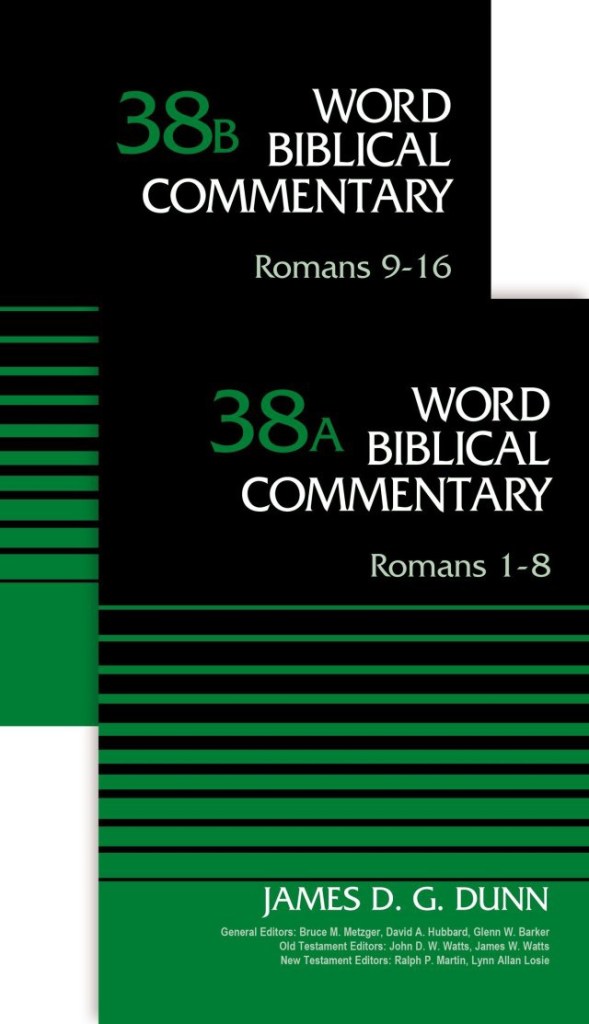
Dunn follows the typical scholarly description of this passage as “the most loosely constructed of all the paragraphs, consisting mainly of individual exhortations (stringing pearls) held together in part by particular words and thematic links (especially love … bad … and good)” (Romans, Word, p.737). Jewett demurs, arguing that this passage “is artfully constructed for rhetorical impact and closely related to the tensions between Christian groups in Rome” (Romans, Hermeneia, p.756).

I can see that the links suggested by Jewett are evident in the words that Dunn has suggested. “Let love be genuine” (v.9) functions as a heading; the motif is repeated with “love one another with mutual affection” (v.10) and then explained in a series of practical instructions: “contribute to the needs of the saints; extend hospitality to strangers; bless those who persecute you; bless and do not curse them; rejoice with those who rejoice, weep with those who weep; live in harmony with one another; do not be haughty, but associate with the lowly; do not claim to be wiser than you are” (vv.12–16).
These words apply directly, it would seem, to the situation in Rome, where tensions between groups are evident. The points of view that are reflected in the phrases “those who are weak in faith” (14:1) and those who “believe in eating anything” (14:2), for instance, appear to reflect the same disagreement that is dealt with in more detail in 1 Cor 8—10.
In that context, “the weak” is regularly interpreted to be a Gentile portrayal of Jews within the Roman conglomerate of faith communities, who refrain from eating meat that had previously been offered to idols and then sold on in the marketplace. “The strong” would thus be the Gentile self-description of those who are not troubled by this, since they know that “no idol in the world really exists” since “there is no God but one” (1 Cor 8:4).
*****
Could a similar dynamic be at work regarding the same issue in Rome? It seems to me to be a reasonable line of interpretation—in which case, the exhortations grouped together under the heading of love (Rom 12:9–10, 13–17) would undergird the later teachings about love as “the fulfilling of the law” (13:8–10) and the direct command to “welcome one another” (15:7). They would also,seem to relate to the specific directions that the believers “no longer pass judgement on one another” (14:13, drawing together all of 14:1–23) and the clear admonition that “each of us must please our neighbour for the good purpose of building up the neighbour” (15:2, summing up 15:1–13).
Indeed, I find myself strongly persuaded by a line of scholarship which Jewett summarises and develops in his hugely-detailed Hermeneia commentary, which sees the list of names to whom Paul sends greetings in Rom 16:3–16 offers clear indications of different “house church” groups which were meeting in Rome. Phrases such as “the church in their house” (v.5), “the family of Aristobulus” (v.10), “those in the Lord who belong to the family of Narcissus” (v.11), “the brothers and sisters who are with them” (v.14), and “all the saints who are with them” (v.15) indicate various potential groupings.
Jewett distinguishes three types of people being addressed—close personal friends and coworkers of Paul, leaders of house churches known only by hearsay (since Paul had not yet visited Rome when he wrote this letter), and five house or tenement churches (identified by some of those phrases already noted in the previous paragraph). The rhetorical function of this closing section of the letter is, in part, to strengthen “emotional and affectional bonds … across barriers erected by previous conflicts”. (See Jewett, Romans, Hermeneia, pp.952–954).
In similar fashion, the instructions “hate what is evil, hold fast to what is good” (v.9) and “do not be overcome by evil, but overcome evil with good” (v.21) enclose the passage as markers of a related key theme, in which the opposites of evil (bad) and good are in view. In this regard, the instruction, “do not repay anyone evil for evil, but take thought for what is noble in the sight of all” (v.17) is also related, and it shows the connection with the “love” motif already noted. It is yet another indication that the cohesiveness of the community is what Paul has in mind as he writes.
What follows immediately after that instruction adds to this theme: “if it is possible, so far as it depends on you, live peaceably with all” (v.18) is clearly aimed at ensuring mutual respect amongst those drawn together by their common faith in Jesus as “the righteousness of God”. And perhaps, then, the mention of God’s wrath (v.19a) and the following instructions (vv.19b—20) fit within this framework. God’s vengeance (noted in the short quote from Deut 32:25) requires behaviour that is ethical and other-oriented. That is how to live as those who have been “transformed by the renewing of your minds” (Rom 12:2).
That behaviour—feeding the hungry, giving a drink to the thirsty—points quite directly to the teaching of Jesus, which we find expressed in the succinct word, “whoever gives you a cup of water to drink because you bear the name of Christ will by no means lose the reward” (Mark 10:41) and embedded in the more extended parable of the final judgement (Matt 25:31–46).
In like fashion, the exhortation to “bless those who persecute you; bless and do not curse them; rejoice with those who rejoice, weep with those who weep” (Rom 12:14–15) resonates with the blessing offered by Jesus to those who weep (Luke 6:21b) and the subsequent exhortation to “do good to those who hate you, bless those who curse you, pray for those who abuse you” (Luke 6:27b—28).
*****
That Paul was aware of the ethical stance of Jesus, and indeed of some of his specific teachings, may well be indicated by his clear referencing of them in these words at this point in his letter to the Romans. Dunn certainly believes this to be the case; “the probability that the Pauline paraenesis does reflect the exhortation of Jesus must be judged to be very strong” (Dunn, Romans, Word, p.745).
Jewett takes a broader view, noting “close Hebraic parallels to this exhortation concerning emotional responsiveness”, citing Sir 7:34 (“do not withdraw yourself from weepers—mourn with the weepers”) as well Testament of Joseph 17:7–8 (“their life was my life, all their suffering was my suffering, all their sickness was my infirmity … my land was all their land, and their counsel my counsel”).
Jewett also references a Greek maxim by Menander (“return grief for grief, and more than love for love”, Sent. Byz. 448), and a dictum by Epictetus (“where a man rejoices with good reason, there others may rejoice with him”, Diss. 2.5.23). (See Jewett, Romans, Hermeneia, p.767.)
So the wider existence of this ethical stance needs to be noted; Paul—and indeed Jesus—was not alone in recognising the virtue of fostering a sympathetic understanding of others, and of working collaboratively towards a cohesive and cordial communal life. Indeed, it can be no accident that this string of ethical exhortations which Paul collected in 12:9–21 follows immediately after his use of the image of the body as a metaphor for the interconnected and interdependent life of the community, in 12:3–8.
So the various injunctions collected in this passage—“live in harmony with one another”, “contribute to the needs of the saints”, even “extend hospitality to strangers” and indeed “live peaceably with all”—stand as important guides for the communities of faith in Rome, and indeed prove to be wise guides for life in any community, at any time, through into the present day. Faith calls us into relationship with others, and those relationships are to be marked by respect and integrity. May it be so!


 An Informed Faith