
The Disruptive, Transforming Spirit (part three): the Spirit in Corinth

Whenever Christians think about the Spirit—and specifically about the dynamic force that is displayed by the Holy Spirit—our attention goes most immediately to the story of the Day of Pentecost in Acts 2. That’s when the coming of the Spirit was experienced as “a sound like the rush of a violent wind [which] filled the entire house where they were sitting”, followed by “tongues, as of fire … resting on each of them” (vv.2–3). A disruptive and transformative experience, to be sure!

But that’s not all there is to say about the Holy Spirit. As I explored in my previous blogs on this topic, the Holy Spirit was already integral to the faith of the ancient Israelites; and then that same Spirit continued to play a key role for the early Christians. So the Spirit remains a force to be reckoned with in our own times, today.

Beyond the accounts of Jesus and of the first Pentecost, when the Spirit is in mind, we might immediately think of Corinth—the port city, renowned for its trade and for its promiscuity, the city where Paul founded a community of Jesus-followers, where he stayed teaching for what was, for Paul, a long time; the city where relationships in the growing faith community needed ongoing attention, encouragement—and even, because this is Paul we are taking about—correction.

Paul says much about the Spirit in his first letter to the Corinthians. He says that the Spirit searches “the depths of God” (1 Cor 2:10) and gives gifts “to those who are spiritual” (2:13). Those gifts are summarised under the term “spiritual things” (2:13). Accordingly, “those who are spiritual” are able to discern “all things” (2:15), such that they can be confident that they have “the mind of Christ” (2:16).

So confident were some of the Corinthians, that they mistreated others within that same faith community. Small as it was, divisions erupted within the community, and bad behaviour ensued. “All things are lawful”, some of the members maintained (10:23), claiming that they had carte blanche to behave as they wished.

Furthermore, because they maintained that “all of us possess knowledge” (8:1), when it came to the scruples about food shown by some members of the community (presumably Jewish members, reflecting their commitment to kosher food), the very diets of the members (and the source of the food they eat) became a highly contentious issue (8:4–13; 10:23–33). The claim, and the behaviour, of those who were assured that they had the Spirit, leads Paul to explode: “some of you, thinking that I am not coming to you, have become arrogant” (4:18; also 5:2; and compare 13:2).

Squashed by the arrogance of these claims, and the dominating behaviour that resulted, those in the community who felt marginalised were unable to take part in the same way in the community gatherings (11:17–21). Paul strengthens his criticism of those who behave with arrogance, accusing them directly through his characteristically blunt rhetorical questions: “what! do you not have homes to eat and drink in? or do you show contempt for the church of God and humiliat[ing] those who have nothing?” (11:22).

In Corinth, then, the gifting of the Spirit is claimed by some as a basis for unedifying behaviour which tears apart, rather than builds up, the community. This is manifested in another way in the worship of the Corinthian community, where, fuelled by their sense of being “the spiritual ones”, some people unleash chaos in the gathering, in contrast to Paul’s sense that in the gathering “all things should be done decently and in order” (14:40), as befits the God who is “a God not of disorder but of peace” (14:33).

Paul does affirm that tongues and prophecies, and other phenomena, are indeed gifts of the Spirit (12:7–11; 14:1, 5, 13, 18). Nevertheless, he observes that “in a gathering I would rather speak five words with my mind, in order to instruct others also, than ten thousand words in a tongue” (14:19). Paul’s discernment leads him to be critical of the way that these gifts of the Spirit have been utilised in this community.

Is the Spirit here disruptive? Yes, it is most certainly clear that the gifting of the Spirit has disrupted and disturbed the gatherings of the community. The firm assurance of spiritual leading, that has developed into arrogance amongst some, has ensured that there is a distinct lack of “good order and unhindered devotion to the Lord” (7:35).

Yet Paul himself will advise the Corinthians in a later communication, “the Lord is the Spirit, and where the Spirit of the Lord is, there is freedom” (2 Cor 3:17). In that freedom, the Spirit is able to work significant change; “all of us … are being transformed into the same image from one degree of glory to another; for this comes from the Lord, the Spirit” (2 Cor 3:18).

The only problem is, as we have seen, some within the community in Corinth appear to have been quite unaware of “the glory … that comes from the Lord”, to the extent that they inflicted damage—in worship, and in relationships—on others. The disruptive Spirit had not led to a positive transformative experience, but had a very negative impact on the community.

Be wary of how you utilise what the Spirit gives you, Paul advises; measure it, and temper it, against the primary importance of “building up the gathering” (1 Cor 14:4, 12). “Let all things be done for building up”, he advises (1 Cor 14:26). The Spirit needs to be harnessed, focussed, and channelled, so that it is not destructive disorder, but constructive progress, which results.


Sing a new song to the Lord (Psalm 149; Pentecost 15A)

Many psalms in the later sections of the Book of Psalms begin with the exclamation, “praise the Lord!” (106:1; 111:1; 112:1; 117:1; 135:1; 146:1; 147:1; 148:1; 149:1; 150:1), whilst some end with that same exclamation (105:45; 106:48; 115:18; 117:2; 135:21; 146:10; 147:20; 148:14; 149:9; 150:6). We find this phrase at the beginning and at the end of Psalm 149, which is offered by the lectionary as the psalm for this coming Sunday.

Singing (v.1) is mentioned often in the psalms: “how good it is to sing praise to our God” (147:1), “with my song I give thanks to him” (28:7), “I will praise the name of God with a song” (69:30), and so the people of Israel are encouraged to “sing to God … lift up a song to him who rides on the clouds” (68:4), “raise a song, sound the tambourine, the west lyre with the harp” (81:2). A whole sequence of “songs of ascent” are included in this book, reflecting the journey of pilgrims as the approach the temple to bring their offerings (psalms 120—134).

, was a staple part of the temple liturgy. The Chronicler regularly reports the role that “the singers” had in the Temple, where “they were on duty [to sing] day and night” (1 Chron 9:33). They were to “play on musical instruments, on harps and lyres and cymbals, to raise loud sounds of joy” (1 Chron 15:16; see also 2 Chron 5:12–13; 9:11; 23:13; 29:28; 35:15).

In the return of the people to the city after the Exile, singers take their place alongside “the gatekeepers and the temple servants” (Ezra 2:70; 7:7; 7:24; Neh 7:1, 73; 10:28, 39; 12:45–47; 13:5). Often in these passages they are mentioned in association with the Levites. It was the descendants of Levi who had been appointed to take care of the Tabernacle (Num 1:51–53; 1 Sam 6:15; 2 Sam 5:24; 1 Ki 8:4) and then the Temple (1 Chron 6:48), “living in the chambers of the temple free from other service” (1 Chron 9:33–34).

Psalms are often communal. This particular psalm which we hear this coming Sunday is set “in the assembly of the faithful” (Ps 149:1), as others seem to be (Ps 7:7; 89:5; 107:32). Still other psalms reflect a setting in “the sanctuary of the Lord” (Ps 60:6; 68:35; 96:6; 108:7; 150:1). Sing “a new song” is often enjoined by the psalmists (33:3; 40:3; 96:1; 98:1; 144:9; and here, 149:1). This refrain is picked up by the four living creatures and the twenty-four elders in heaven (Rev 5:9) and then “the one hundred and forty-four thousand who had [the Lamb’s] name and his Father’s name written on their foreheads” (Rev 14:1–2). These latter texts have occasioned much interest in what, exactly, that “new song” was. But who knows?

The instruction to “let them praise his name … making melody to him with tambourine and lyre” (v.3) is repeated in “praise the Lord with the lyre, make melody to him with the harp of ten strings” (Ps 33:2) and further expanded in the complete orchestral array that is mentioned in Ps 150:1–6, as well as in narrative texts concerning the band of prophets coming to meet Samuel and Saul (1 Sam 10:5) and the sons of Jeduthun (1 Chron 25:1–8). Job notes that faithful people “sing to the tambourine and the lyre” (Job 21:12) and David, of course, was recognised for his skill with the lyre (1 Sam 16:14–16, 23; 18:10).

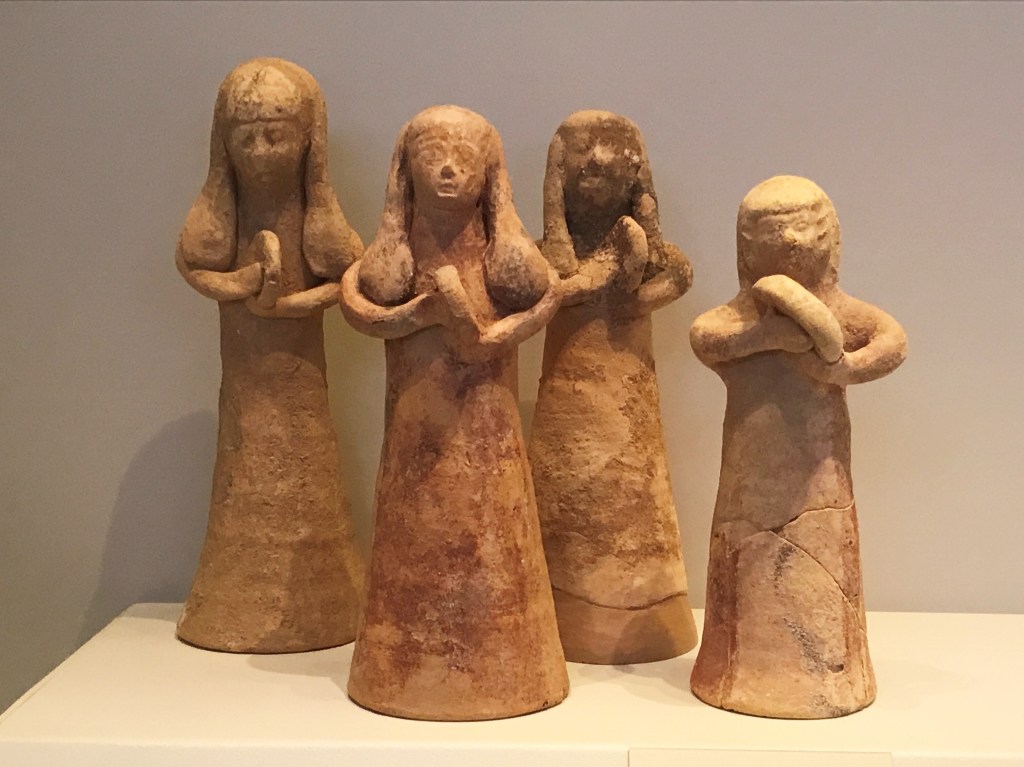
The role of playing the tambourine appears to have been linked with young girls (Ps 68:25) and women (1 Sam 18:6), following the example of “the prophet Miriam, Aaron’s sister” (Exod 15:20). There are tambourines in the instrumental array in the time of David (2 Sam 6:5; 1 Chron 13:8) and they are noted by Jeremiah (Jer 31:4) and in Judith’s “new psalm” of praise to God (Judith 16:1).

Their presence at weddings is reflected in the sad tale of the wedding of the family of Jambri, where weapons concealed amongst “the tambourines and musicians” are used to perpetrate a huge slaughter, such that “the wedding was turned into mourning and the voice of their musicians into a funeral dirge” (1 Mac 9:37–41).

A group of terracotta figurines dating to the eight-seventh century BCE.
These small figurines, six–eight inches tall, represent female figures playing the hand-drum, which was probably a woman’s instrument in ancient Israel.
These terracottas are in the collection of the Israel Museum in Jerusalem. Photo by Carol Meyers, Duke University; from
https://jwa.org/encyclopedia/article/women-with-hand-drums-dancing-bible

Dancing in temple worship (v.3) is also noted in other psalms; on Zion “singers and dancers alike say, ‘all my springs are in you’” (Ps 87:7), and praising God “with tambourine and dance” is encouraged in the great final psalm of praise (Ps 150:4). Dancing appears also in the narrative texts concerning Miriam (Exod 15:20), the daughter of Jephthah (Judg 11:34), Saul (1 Sam 8:6), and David (2 Sam 6:5; 1 Chron 13:8; 15:29).

The psalm ends with a celebration of the ways that God’s justice will be implemented (Ps 149:6–9), which is bracketed by reference to “the faithful” who “exult in glory” (v.5) and the closing affirmation, “this is glory for all his faithful ones” (v.9). These “faithful ones” are active in offering praise in other psalms (Ps 30:4), for they are valued by God. The psalmists affirm that the Lord “will not forsake his faithful ones” (Ps 37:28) and that their death is “precious … in the sight of the Lord” (Ps 116:15).

Yet regarding God’s just actions as the “glory” which God grants to these “faithful ones” is a reminder of the realities of the world in which the Israelites lived. It was marked by conflicts and battles, by bloodshed and killings, by invasions and deportations, so the judgement of God was sought by the “faithful ones” in brutal terms. With “two-edged swords”, with fetters and chains of iron, so “the judgement decreed” by the Lord God will take place (vv.6–9).

After which, the psalmist takes breath, and concludes, “Praise the Lord!” Indeed!