The Golden Calf and the repentance of God (Exodus 32; Narrative Lectionary for Pentecost 20C)

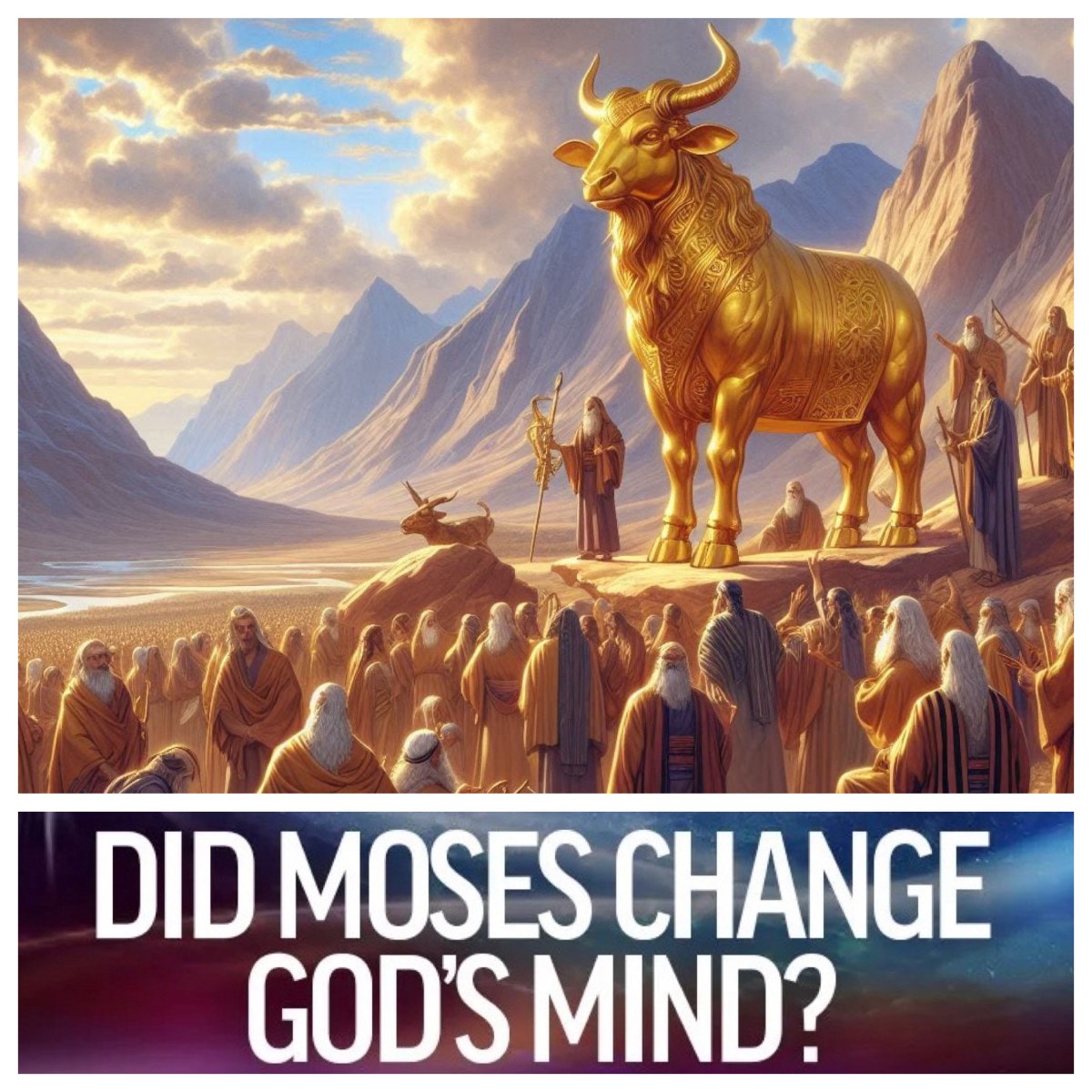
The passage which is offered by the Narrative Lectionary for this coming Sunday (Exod 32:1–14) recounts the famous episode of sinful behaviour by Israel, known popularly as “the Golden Calf episode”. 

This story most likely relates to the god who was regarded as the head of the gods amongst the Canaanites—El, who was often depicted as a bull. The bull was the strongest animal in the ancient farmyard, and thus a fitting symbol for a powerful god. The Israelites chose to imitate that god through their golden construction. 

The story told in Exodus 32 (and also summarised in Ps 106:19–23) mocks the Canaanite god, depicting him as more like a calf. By adopting a Canaanite symbol, the Israelites had turned from God (v.21). It seems they would deserve their fate—although Moses interceded and saved them from divine wrath (v.23). 

Moses is the hero who stands in the breach, to convince God to change God’s mind. This is a difficult statement, worth pondering further. What sort of god wishes to wreak savage wrath on people? And also, what kind of god is one who changes their mind in response to human petition? Both aspects challenge elements of classic theological understandings of God.

The language of the wrath of God “burning hot” (vv.10, 11, 22) resonates with the constant prophetic warning that God will use fire to destroy people and places because of their sinfulness (Isa 1:7; 5:24; 30:27–28, 30, 33 18–19; Jer 4:4; 6:27–30; 20:47–48; Hos 8:14; Joel 2:1–3; Amos 1:4—2:5; Nah 1:15). Zephaniah portrays utter devastation through divine judgement: “neither their silver nor their gold will be able to save them on the day of the Lord’s wrath; in the fire of his passion the whole earth shall be consumed” (Zeph 1:18). That is an intense fire indeed!

However, the final prophet in the Christian Old Testament, Malachi, reworks this imagery, offering some hope; God’s messenger on The Day of the Lord “is like a refiner’s fire and like fullers’ soap; he will sit as a refiner and purifier of silver, and he will purify the descendants of Levi and refine them like gold and silver, until they present offerings to the Lord in righteousness” (Mal 3:1–4). 

The references to good and silver in these prophetic oracles sits interestingly in juxtaposition to the Exodus story, in which Aaron “took the gold [from the ears of the people], formed it in a mold, and cast an image of a calf” (Exod 32:4), before he “built an altar before it” and proclaimed, “Tomorrow shall be a festival to the Lord” (v.5). 

So the people gladly “offered burnt offerings and brought sacrifices of well-being” on that altar. The burnt offerings mimick the daily burnt offerings (Exod 29:42), where the Lord God promises “I will meet with you, to speak to you there; I will meet with the Israelites there, and it shall be sanctified by my glory” (Exod 29:42–43). The sacrifices of well-being recall “the burnt offerings and sacrificed oxen as offerings of well-being to the Lord” made during the ceremony to ratify the covenant (Exod 24:5).

The people, under the leadership of Aaron, are deliberately imitating key components of the worship of the Lord God, but in this instance, they are worshipping an idol made with their own hands—in direct disobedience to the commandment “not [to] make for yourself an idol, whether in the form of anything that is in heaven above, or that is on the earth beneath, or that is in the water under the earth” (Exod 20:4).

And so, having offered their sacrifices, “the people sat down to eat and drink, and rose up to revel” (v.6). But not so God, for as he had warned the people, “I the Lord your God am a jealous God, punishing children for the iniquity of parents, to the third and the fourth generation of those who reject me” (Exod 20:5). God will not let this transgression pass; as he says to Moses, “I have seen this people, how stiff-necked they are; now let me alone, so that my wrath may burn hot against them and I may consume them” (Exod 32:10).
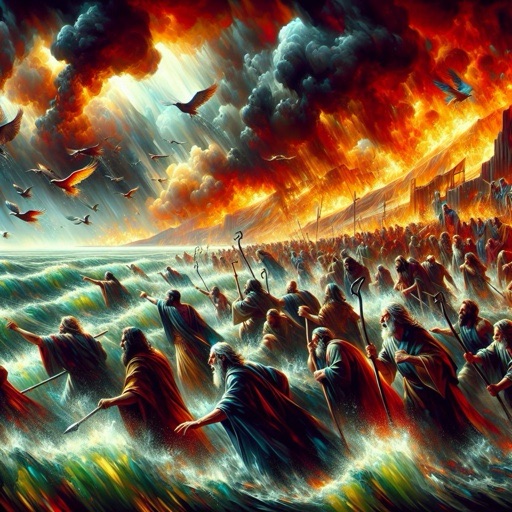
A number of psalms reflect the desire for God to punish evildoers severely; “pour out your indignation upon them, and let your burning anger overtake them” is the cry of one psalm (Ps 69:24). Another psalm notes the vengeance of God—“in your hearts you devise wrongs; your hands deal out violence on earth” (Ps 58:2)—and suggests that “the righteous will rejoice when they see vengeance done; they will bathe their feet in the blood of the wicked” (Ps 58:10). The graphic picture of a furious God intent on wreaking damage raises difficult theological questions for us as we read such passages.

The image of fiery punishment comes from the story of Daniel (Dan 3:1–30) and appears again in the last book of the New Testament, where the prophet describes his visions of “the lake of fire that burns with sulfur” (Rev 19:20; 20:10, 14–15), also described as “the second death” (Rev 20:14; 21:8). It is there that the devil, the beast, and the false prophet “will be tormented day and night forever and ever” (Rev 20:10). 

In the Gospel of Matthew, in particular, eternal punishment in a fiery furnace features also in the words of Jesus, as he threatens sinners with “the furnace of fire” (Matt 13:43, 50; 25:41), a place of “eternal fire” (Matt 18:8; 25:41), “the hell of fire” (Matt 5:22; 18:9). This builds on the warnings found in Mark’s Gospel about the punishment in store for those who put stumbling blocks in the way of “these little ones”—they will be condemned to “the unquenchable fire” (Mark 9:42–48). These warnings are repeated by Jesus in Matt 18:6–9. 

So Jesus follows the prophetic and narrative insistence, in Hebrew Scripture, on the judgement of God being rightly expressed when sinfulness abounds. And the story of Aaron and the golden calf is a clear demonstration of God’s intent to exact punishment.

But the story takes a turn, when Moses mounts a passionate plea to God, asking for the divine fury to be turned away from the sinful people. Invoking the covenant made with Abraham, Isaac, and Jacob, Moses implores, “turn from your fierce wrath; change your mind and do not bring disaster on your people” (Exod 32:12–13).

Last year, writing a commentary on this passage in With Love to the World, my friend Jione Havea offered an incisive insight into this story as recounted in Exodus 32. He writes as follows:

The plot is straightforward: Israel complained to Aaron that Moses has disappeared for too long, Aaron organized a golden calf as their God, the Lord became angry and decided to wipe Israel off, Moses appealed for Israel’s sake, and “the Lord changed his mind about the disaster that he planned to bring on his people” (32:14). The Lord reconsidered, and changed their mind. 

Previously, in Exodus 2:23–25, God had changed their mind and re-membered the covenant with Abraham, Isaac, and Jacob. In that instance, God responded to the groans and cries of the people. There is a comparable event in Nineveh: “When God saw what they did, how they turned from their evil ways, God changed his mind about the calamity that he had said he would bring upon them” (Jonah 3:10). 
In the case of Nineveh, the people changed God’s mind on the basis of their own actions (Jonah 3:5) and agenda (Jonah 3:9); in the golden calf episode, Moses interceded on behalf of Israel. The story line is the same: God changed their mind. Change of mind (read: repentance) is not evidence of weakness in the character of God. Rather, it is evidence of being present, and of honouring the Tongan quality of va (relationship) over against immutable doctrines. We are called to do likewise.

And so, in the story, as he saw the golden calf at base camp, Moses burned in anger—because of the people, and because his own brother Aaron played a key role in their going astray. He was so angry that he broke the tablets of the covenant that the Lord godself wrote. The Lord repented (v.14) but Moses revenged (vv.19–20). He burned and grounded the golden calf into water, and made the people drink it. And he ordered the sons of Levi to kill people—whether “your brother, your friend, and[or] your neighbour”—who were NOT on the Lord’s side (v.27). 

The Lord changed their mind—but to the opposite effect. This time, the Lord decided to blot out the people who sinned against the Lord (v.33). Because of the golden calf sinners, the Lord sent a plague (v.35). This time, divine repentance led to destruction—echoing the divine repentance that led to the flood (see Gen 6:5–7). 

These stories show that the Lord’s book may have been written (cf. Exod 32:33), but it has not been closed. The Lord may still change their mind, and there is no guarantee that it will be for the reparation of covenant or for the destruction of people. Caveat emptor.

With Love to the World is a daily Bible reading resource, written and produced within the Uniting Church in Australia, following the Revised Common Lectionary. It offers Sunday worshippers the opportunity to prepare for hearing passages of scripture in the week leading to that day of worship. It seeks to foster “an informed faith” amongst the people of God.

You can subscribe on your phone or iPad via an App, for a subscription of $28 per year. Search for With Love to the World on the App Store, or UCA—With Love to the World on Google Play. For the hard copy resource, for just $28 for a year’s subscription, email Trevor at wlwuca@bigpond.com or phone +61 (2) 9747-1369.


An interview with Dr Jonathan Foye on communications in the church

Over the past decade or so, I have been interviewed a number of times by Jonathan Foye, in his journalistic role with the Uniting Church Synod Communications Team. As Jonathan has recently concluded his time as Editor of Insights, our news magazine, I thought I would turn the tables on him and interview him on his experiences over the years.

He has graciously agreed to being interviewed by this journalistic novice. I’ve always enjoyed my interviews with Jonathan, and appreciated the care and respect that he has shown in the questions he posed and the writeup that eventuated. So I have tried to show that same care and respect towards him in this interview.

Jonathan began working in communications as an intern with the church in early 2007. Later that year he started freelancing, providing articles on assorted issues, and then he did some studies in journalism and communications at Western Sydney University. He has written many articles for Insights over the 17 years since then.

During those years, Jonathan experienced a number of significant life events. In 2012, he was married, and in 2019 he and his wife became parents. “I was lucky enough to have parental leave shortly before the pandemic”, he reports, “so there was plenty of time with my son in his earliest years”.

At the same time, whilst initially writing for Insights as a freelancer, he completed a PhD in Communications (2011–2016) at Western Sydney University. The PhD included a significant element of theological analysis, blended with a distinctive form of literary analysis known as discourse analysis. I’ve read the thesis and thoroughly enjoyed it; I have learnt much from Dr Foye about discourse analysis as well as benefiting from his theological analysis of Sydney Anglicanism in the period 2001–2013.

Jonathan noted that while he was freelancing for Insights, in 2013 the comms team at the time was made redundant. “It was a very controversial time, and very sad to see a talented team almost all leave”, he said. “Stephen Webb and Marjorie Lewis Jones are heroes of mine. Adrian Drayton did a lot of work to reestablish Insights and I got a bunch of opportunities.” Out of that transition period, eventually, Jonathan was appointed as Editor of Insights in October 2017. “It was on Halloween”, he noted; “that might have been an omen”. 

The first question I put to Jonathan was, What have you most enjoyed about the job? He replied that there was a lot that he enjoyed. “The opportunity to write for a living, to explore aspects of the faith that I found under-covered, getting to the occasional event and covering them. Above all though was the chance to give young writers the platform and opportunity to get published and to edit their work (usually a matter of small tweaks).”

He particularly noted a recent article on “Jesus within Islam” by Aditee Vora; “that was my favourite piece from Insights this year”, he commented, before continuing, “There was also a sense of comradery in the Comms team and with some members of the wider church that was amazing”. 

What is the most unexpected story that you have covered? was my next question. He immediately a story in 2019 about “technology that helps people deal with grief, and the ethics of how we represent the deceased. It sent me down a rabbit hole and I learnt a lot about things that I didn’t know about grief and loss.” Jonathan also noted that at the start of the pandemic in 2020, the team started covering what church congregations were doing at the start of the pandemic, and they had no idea how long that line of reporting would turn out to be.  

Then, my question Who is the most interesting person you have interviewed? drew the following response. “I interviewed a lot of amazing people. One was a Palestinian activist who has worked to get stories out there. Another was Mark Russell, an American comic book writer who wrote a satirical comic called Second Coming. There were countless Uniting Church ministers, lay preachers, and people doing big things in their communities. There were also theologians whose work was of interest to me.”

 On another note, I asked, What is the most difficult story that you have reported on? Jonathan observed that “there were a few stories where I had to write about people who had passed away who had contributed to the life of our church.” The hardest for him to write was a piece about his friend Chris Hargraves, who died at the beginning of the pandemic in early 2020. Jonathan says, “Chris is never too far from my thoughts and I’m not sure if I nailed that piece or not. Ultimately, I would have been happier to have never had to write it.” That’s quite understandable.

So next I asked Jonathan, What are you looking forward to in the next few years? He says that he is teaching some courses at UNSW, diving back into freelance writing, and working on some academic journal articles. “I’ve also got two books to finish”, he commented, “so there’s a lot that I’m looking forward to”. He has already published some books on a rather niche subject area, All-Japan Pro Wrestling (Ganbaru, 2021, and The Muto Years, 2022).

As Jonathan has always done in his interviews with me—and with many others, judging from those articles—I concluded by asking him, Is there anything else you would like to say? His succinct reply: “I’ve finished as Insights’ Editor but I’m far from done with the magazine, or the church for that matter. I’m worshipping at Glenbrook Uniting Church nowadays”. So although Dr Foye will no longer serve as Editor of Insights—and I for one will miss his regular contributions—we will undoubtedly be able to read more of his insights on various subjects in the months and years to come.

John Squires, 30 Sept 2024

For an interview with Jonathan relating to Ganbaru, see

https://www.bluemountainsgazette.com.au/story/7654335/blaxland-resident-brings-wrestling-underdog-story-to-life-in-new-book/

and on The Muto Years, see

https://www.voicesofwrestling.com/2023/10/02/vow-book-review-the-muto-years-by-jonathan-foye/

Days of feasting and gladness, days for sending gifts (part two) (Esther; Pentecost 19B)

This coming Sunday, the lectionary offers the one and only chance in three years to hear from the book of Esther. (The passages offered are Esther 7:1–6, 9–10; 9:20–22.) There is a lot to note in considering this story, so I am devoting two blogs to it. In Part One I considered the historical and social context. Part Two (this blog) now explores theological issues which are embedded in this story.

This material was originally developed by my wife Elizabeth Raine and myself in the course of teaching a whole course on the Wisdom Literature; you can watch videos of the various sessions at

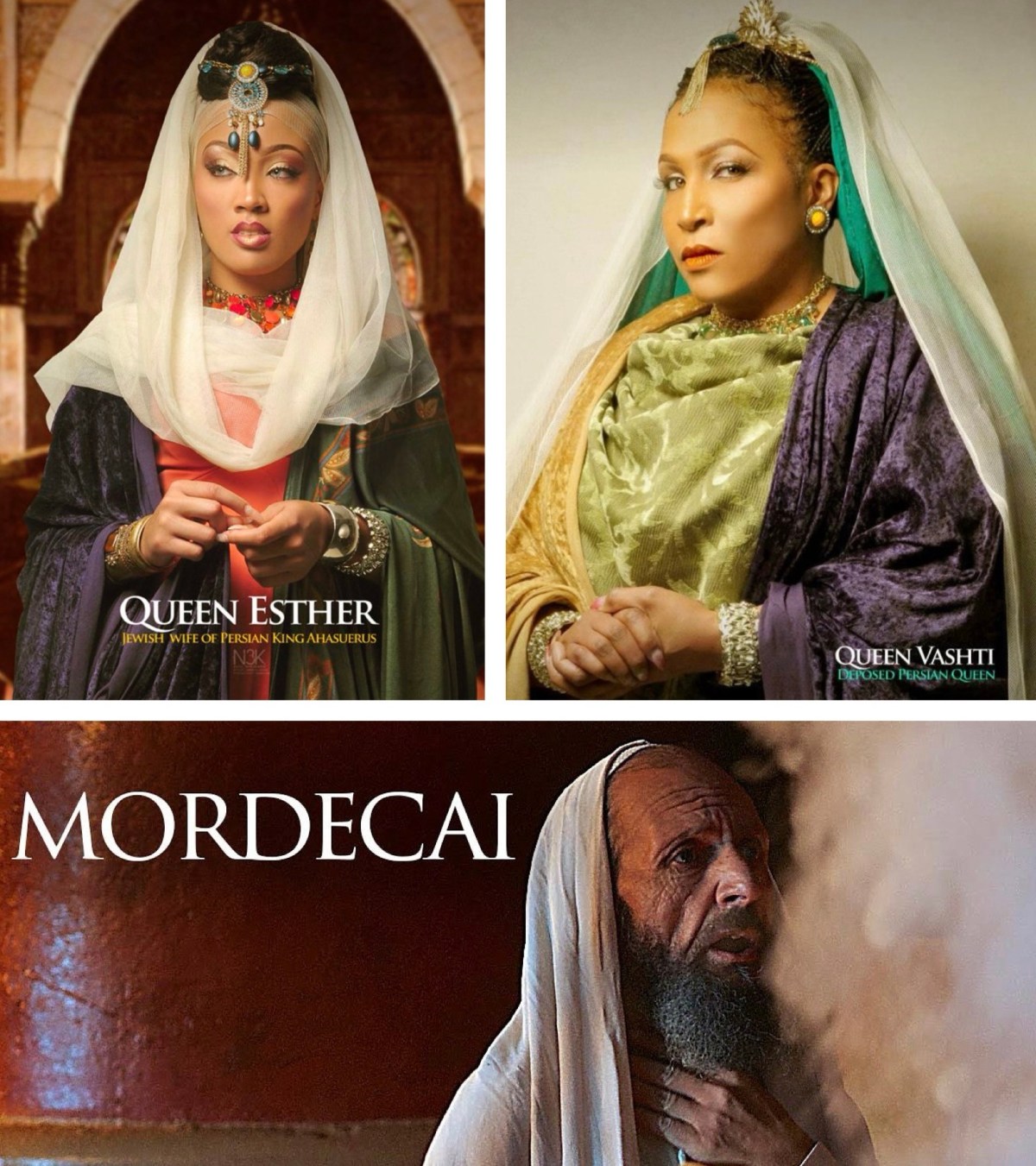
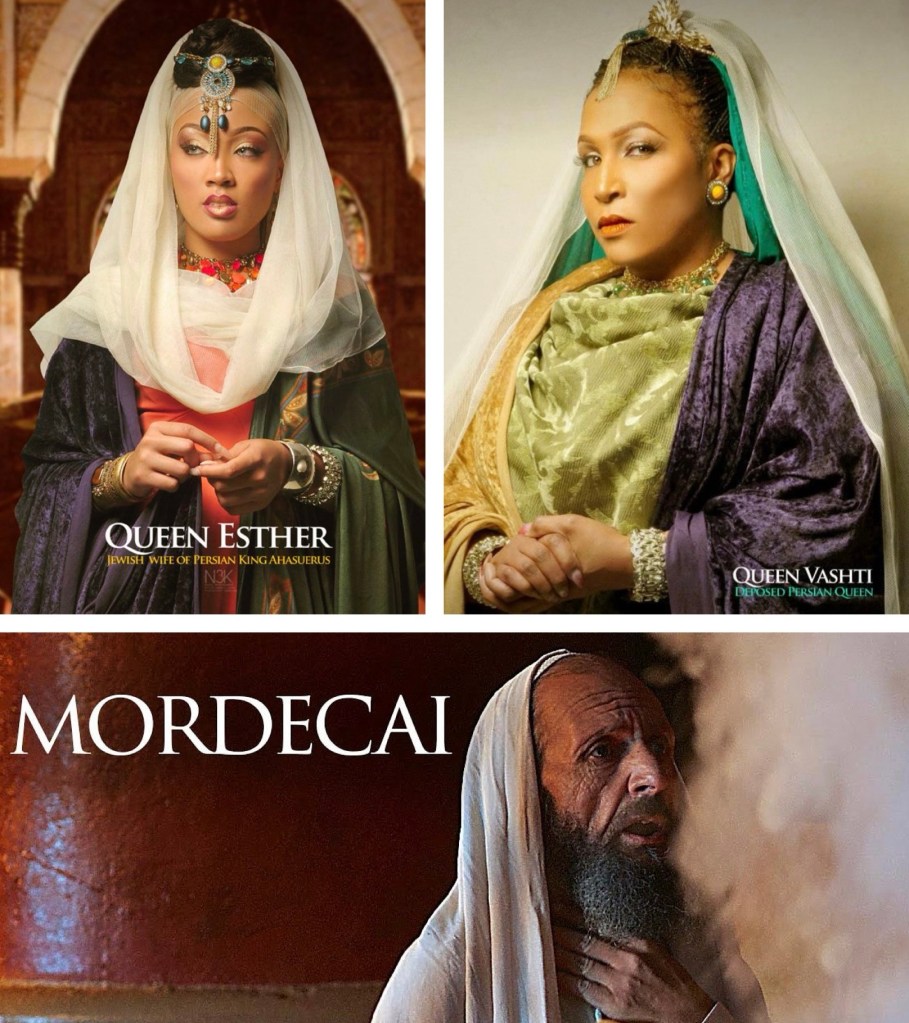
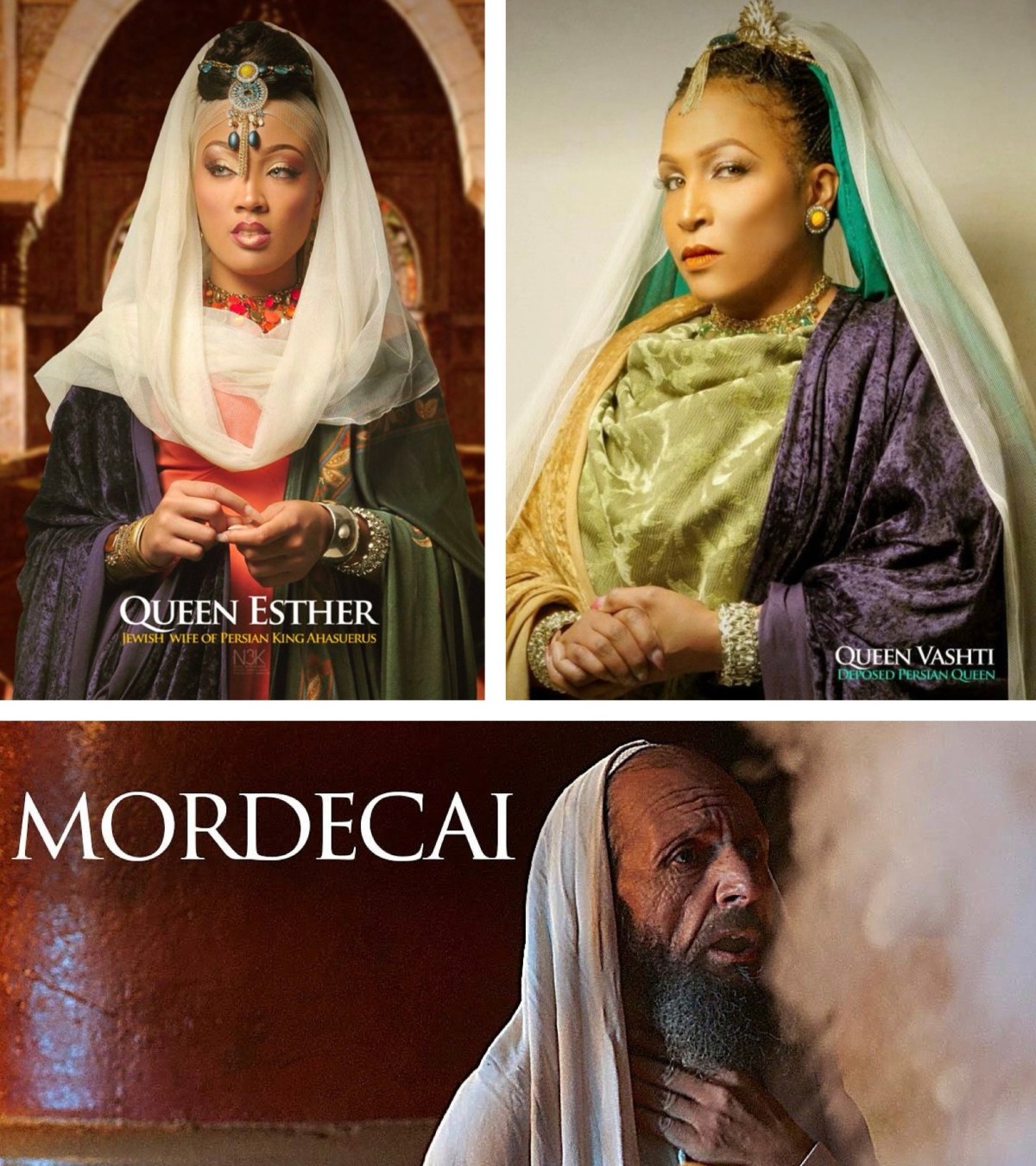
The book of Esther tells the story of how two wise and courageous Jews, Mordecai and Queen Esther, aided by the providential hand of fate, foil the genocidal schemes of Haman, the “enemy of the Jews”. 

Jewish identity is a key issue in this story. Vashti refuses to appear before Ahasueris “wearing the royal crown, in order to show her beauty” (1:11). The rabbis later interpret this to mean “wearing only the royal crown”—that is, stark naked except for the crown! Esther then takes part in a “beauty contest” (2:1—4) which involves not only parading before the king, but “pleasing the king” (2:4)—an explicitly sexual activity (see 2:13—14). Esther is chosen to be the Queen (2:17). But there is a crucial element in the story that occurs when Esther, taking the advice of Mordecai, decides to hide the fact that she is Jewish (2:20).

So Esther stands as a symbol of Jews who lived successfully in an alien culture. As a woman, she was not in a position of power, just as Diaspora Jews were not members of the power elite (although when she marries the King, and becomes Queen, she does acquire power). As an orphan, she was separated from her parents, as Diaspora Jews are separated from their mother-country. With these handicaps, she had to use every skill and advantage she had, as Diaspora Jews did. They, like Esther, had to adapt themselves to the situation.

Israelites and Canaanites are each signalled within this story. Haman, an Agagite, is a descendant of the people of Canaan (3:1), later described as “the enemy of all the Jews” (3:10; 9:24). He is descended from Agar, King of the Amalekites, whom the men of Saul (an ancestor of Mordecai) had defeated (1 Sam 15:1—9), in obedience to the word of the Lord, “attack Amalek, and utterly destroy all that they have; do not spare them” (1 Sam 15:3).

The bad behaviour of Haman in the story of Esther (chs.3—5) is met by the resolute intransigence of Mordecai. He is not going to give way; when Haman presses the point, Mordecai stands up to him. Just as his ancestor, Saul, had fought against the Amalekites, so Mordecai opposes Haman. He will not let him have his way.

The story offers a striking portrayal of just how the Israelites perceived the Canaanites. It offers food for thought in the conflicted and increasingly difficult situation in modern Israel, where the “Canaanites” or “Amelakites”—modern- day Palestinians—are viewed with intense suspicion. Indeed, the government of the modern state of Israel appears utterly focussed on “extermination” as the fundamental policy with regard to the Palestinians. (I note that last year, Prime Minister Netanyahu was reported to have said that Israel is “committed to completely eliminating this evil from the world,” adding “you must remember what Amalek has done to you, says our Holy Bible. And we do remember.”)

In the Additions to Esther, Haman is further described as “Haman son of Hammedatha, a Bougean” (3:1; 12:6).  Bougean is believed to be a term of shame and disgrace (its precise origin is unknown.) A variant text calls him a “a Macedonian”, clearly reflecting the dominance of the empire established by Alexander the great, a Macedonian, from 334 BCE onwards.


Haman

Kingship is also an issue in this story. The absolute power of kings in the ancient world seems strange to us, accustomed as we are to the democratic rule of law. But in many parts of the ancient world a king was thought of as a living god. He was a sacred person who embodied, in his person, the state or kingdom that he governed. His physical body was clearly not immortal, but he was thought of as someone who was more than human, with a special and unique connection with the immortal gods. Because of this, he could do what he wanted even when, as in this case, it was clearly unjust.

It is true that Israel had kings. However, they believed that the King served God, who was the true King; and every King was held to account by a Prophet, who declared “the word of the Lord” to the King. When it did have great kings like David or Solomon, it emphasized their humanity. In the Israelite mind, kingship was very close to tyranny, and had to be constantly hedged around with precautions to stop it becoming despotic.

Esther as comedy?  This is a serious suggestion! The story told in Esther contains many of the stereotypical characters that appear in vaudeville, burlesque, or farce—there is a hero, a fool, a beautiful heroine, and a bad guy.  One commentator says, “all the characters are types; the largest interpretative problems melt away if the story is taken as a comedy associated with a carnival-like festival” (A. Berlin, Esther, JPS, 2001). What do you think about characterising this book as a comedy?

Finding where God is at work is another theological issue that this story addresses. God is not explicitly mentioned in the story of Esther. There may be some places where you might think that God is at work in what transpires (for example: “the roll of the dice”, the fasting of the Jews, and the many coincidences in the story). But this is implied, not explicitly stated. As you read the story, how might you hear the invitation to “find ways that God is at work in what happens”? (There are resonances, perhaps, with the claim that is often made today, that “God’s mission is in the world” and so the call to the church is to “seek out ways that God is at work in the world and join with God in that work”.)

So why is Esther in the canon?  We might note some problems: There is no mention of God—Neither Esther nor Mordecai seem to follow Jewish Law—Esther is married to a Gentile—Esther does not follow the food laws of Leviticus (she eats non-kosher food)—The account of Purim does not mention prayers, sacrifices, or any religious ceremony

But there are also some positives: The story is set in the Dispersion, outside of Israel—Esther appears powerless but is able to achieve her goal—Esther offers a positive role model for living successfully in the Dispersion—Purim celebrates the ingenuity of a wise woman in a foreign place

So do you think it is a good thing that Esther is in the canon of scripture??


The Additions to Esther. The book of Esther exists in Hebrew Scriptures in its Hebrew original. In the Roman Catholic scriptures, there is a longer version of Esther which contains six so-called Additions. This version is written in Greek and is 150 verses longer. This longer version ends, “In the fourth year of the reign of Ptolemy and Cleopatra, Dositheus, who said that he was a priest and a Levite, and his son Ptolemy brought to Egypt the preceding Letter about Purim, which they said was authentic and had been translated by Lysimachus son of Ptolemy, one of the residents of Jerusalem.” (11:1).

In the Additions to Esther, the extra verses provide more character development, supply information missing from the Hebrew text, and add an explicit religious dimension—God is mentioned at 2:20; 4:8; 6:1, 13. It is clear that the Jews are saved by God. God works primarily through Mordecai. Esther becomes the romantic heroine of the sideline plot, not the centre-stage star.

Finally: how might Esther relate to Lady Wisdom?  The book of Proverbs portrays Wisdom in ways that show she can operate well in “ordinary, everyday life”. Esther and Mordecai operate in the messy circumstances of the royal court of Persia. They manage to find a way through the situations they face which works out well in the end. Is this a valid connection? 

Looking back over the story, we can see that the book tells a story that is not located in Israel, about morally compromised people, with no active involvement in the story by God. How do we understand it?

From the point of view of a Jew living in the Diaspora, the story ends on a positive note. Mordecai has an influential position (10:3). Persian records include positive references to the Jews (10:2). Future generations of Jews celebrate Purim (9:26-32). It assures the people of Israel that God is with them, even when they are living in exile, even when they are acting in morally compromised ways.

From the point of view of a Jew living in Israel, there are no references to the rebuilding of Zion (Ps 102:16), no indication that the nations will come to Zion to worship the God of Israel (Isa 60:1-3). The future of the Jews appears to lie in the capricious and untrustworthy hands of the Persian Empire. It displays the precarious nature of Jewish identity, and the fact that the fate of being a Jew lies in foreign control.

What do you think?

Days of feasting and gladness, days for sending gifts (part one) (Esther; Pentecost 19B)

This coming Sunday, the lectionary offers the one and only chance in three years to hear from the book of Esther. (The passages offered are Esther 7:1–6, 9–10; 9:20–22.) There is a lot to note in considering this story, so I am devoting two blogs to it. Part One (this blog) considers the historical and social context. Part Two will explore theological issues which are embedded in this story. 

This material was originally developed by my wife Elizabeth Raine and myself in the course of teaching a whole course on the Wisdom Literature; you can watch videos of the various sessions at 

This short book sits oddly within the body of wisdom literature. It is not like Proverbs (poetic songs and short proverbs), nor Ecclesiastes (musings on the meaning of life), nor the Song of Songs (love poetry). There is no clear moral teaching in this book; rather, it tells a story which has twists and turns in the plot to keep us entertained. 

So this book of nine chapters is more like the “short story” books in the Bible—Ruth (four chapters), Tobit (a little longer, at 14 chapters), and Judith (the longest, at 16 chapters). However, whilst Ruth and Judith are set within Israel, Tobit and Esther are located outside of Israel. And whilst Ruth, Judith, and Tobit all tell of people who faithfully keep the laws of Israel (even though Ruth is from Moab), there is barely any reference to the Law, or to Jewish matters, in the story of Esther.

Yet Esther has its place as one of the five scrolls (in Hebrew, Megilloth) in the third section of the Hebrew Bible (the Writings, or Kethuvim), along with Song of Songs, Ruth, Lamentations, and Ecclesiastes. Each of these books is associated with a key Jewish Festival and the book is read in synagogue worship on that day: Song of Songs at Pesach (Passover), Ruth at Shavuot (the Feast of Weeks, or Pentecost), Lamentations on Tish B’Av (the Ninth of Av, the saddest day in the calendar marking the destruction of both Temples), Ecclesiastes at Sukkot (Tabernacles), and Esther at Purim.


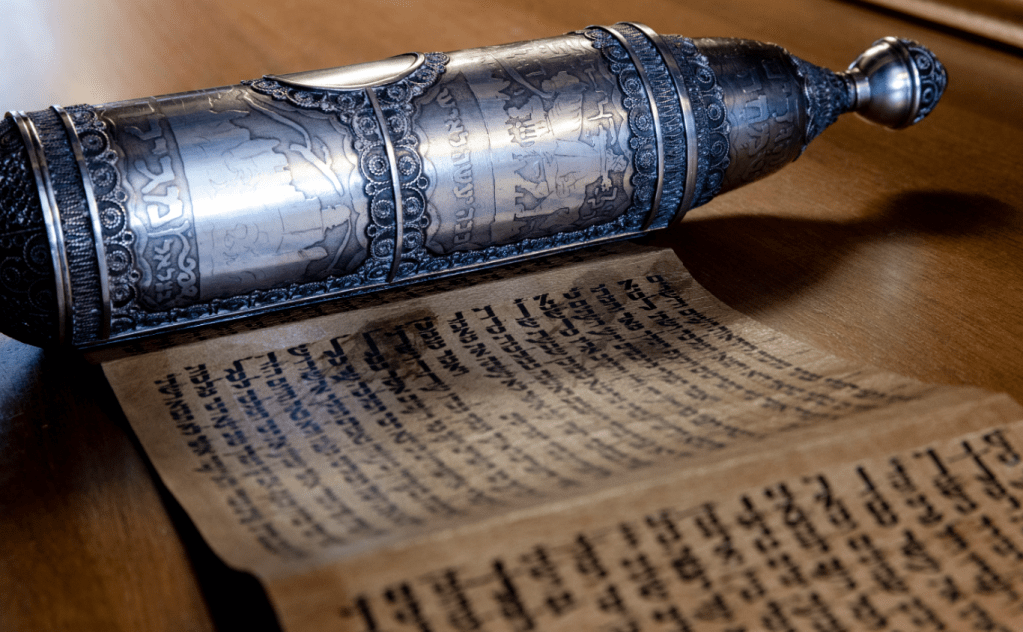
A scroll of Esther, made at the Bezalel Academy of Art
in Jerusalem in the early 20th century,
held in the Library of Congress in Washington DC, USA

This book tells a rollicking tale, a story with goodies and baddies, twists and turns, drama and suspense … it seems that it was not intended to be “a factual account of a real person”, but rather it tells a dramatic story designed to draw right into the plot those who hear the story—a story filled with tension, drama, and potential disaster—a story that tells of the survival of the people of Israel, through their exile and on into the life in Diaspora.

Esther tells a story of a faithful Israelite women, living in the dispersion (in exile from the land of Israel) in Persia. Israelites were taken into exile in two major waves. The first was in the northern kingdom, when invaded by the Assyrians in 721 BCE. Israelites from the north were taken away to live in various lands under Assyrian control. Some people were permitted to return to the land; but most stayed in exile. (2 Kings 17 gives a southern perspective on what took place.) 

The second was in the southern kingdom, when invaded by the Babylonians in 587 BCE. People of Judah were taken away to live in Babylon. Adapting to foreign customs, learning a foreign language, and becoming a part of another culture, was challenging. (Psalm 137 reflects the bitterness of those in exile.) 

However, a large number of such exiles were permitted to return to the land when the Persians took control of Babylonian territories. Cyrus of Persia decreed that the people could return; he was hailed as “the Lord’s anointed” (Isaiah 44:28, 45:1-13).

Living in exile was a challenge that called forth different responses from the people of Israel. Some felt the difficulties of living in a foreign land, and yearned to return ‘home’. They jumped at the chance to return. Some adapted more easily into life in exile, married local people, and became settled in this new land as their new ‘home’. It is for this latter group that the story of Esther was told. Esther’s story takes place in Persia, in around 483—473 BCE, when Ahasuerus was king. (Ahasuerus is a Hebrew name; he is identified with the Persian king Xerxes, grandson of Cyrus.)

The book of Esther tells the story of how two wise and courageous Jews, Mordecai and Queen Esther, aided by the providential hand of fate, foil the genocidal schemes of Haman, the “enemy of the Jews”. The ensuing victory celebration of the fourteenth and fifteenth of the month of Adar (February-March) becomes the occasion for inaugurating a new Jewish festival, Purim. It is a very entertaining story. It illustrates how the Jews survived whilst living in exile.

There are a string of banquets in Esther. They start in the opening scenes: a banquet of 180 days (1:2-4), a banquet of 7 days (1:5), the banquet of Queen Vashti (1:9). Then the king throws a great banquet (2:18), after which Esther holds a banquet (5:4-5, 6:14—7:1). 

After this, the establishment of an annual banquet to celebrate Purim is told (8:17, 9:16-19, 9:24). This banquet is named after the lots that were cast (3:17)—the Hebrew for “lots” is purim. These banquets are contrasted with the fast undertaken by the Jewish people (4:16—17).

What do Jews do at the feast of Purim? They read the story of Esther (The Megillah), once on Purim Eve, once on the morning of Purim—give money or food to needy people—send gifts of food to their friends—fast in the daylight hours on Purim Eve—get dressed up in costumes for the synagogue service—hold The Feast of Purim on Purim itself—eat special dishes: a large challah with raisins, meals made with beans and peas, and hamantashen, triangular cookies filled with jelly or fruit—and wish each other “chag Purim sameach” ( חג פורים שמח ).

One Jewish website says, “When Haman’s name is mentioned you can twirl graggers  (noisemakers) or stamp your feet to eradicate his evil name. Tell your kids that Purim is the only time when it’s encouraged to make noise during services!” You can watch videos of celebrations at Purim:  https://www.youtube.com/watch?v=6mmZDYogjCk

I will pass through the land (Exod 12, 13; Narrative Lectionary for Pentecost 19C)

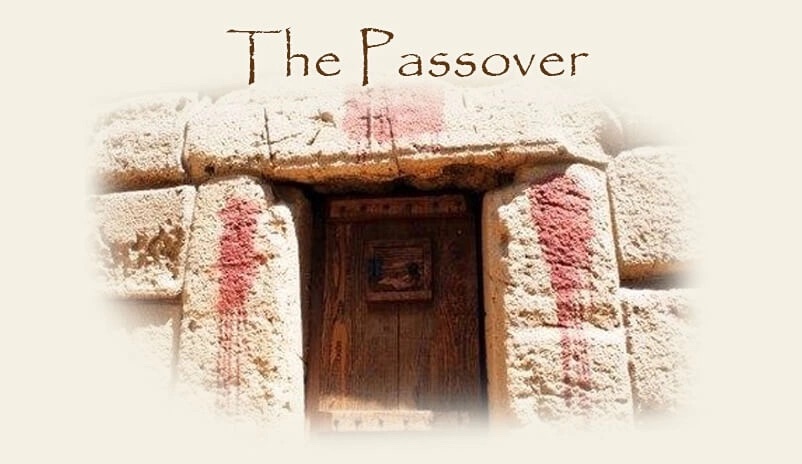
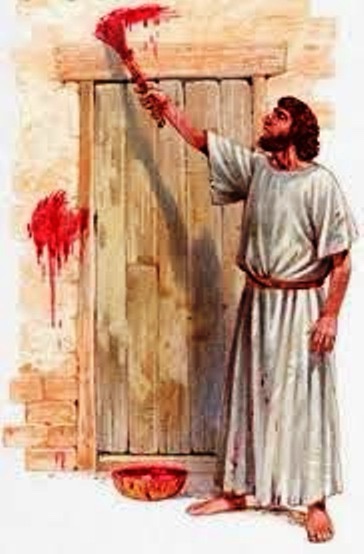
The instructions are clear: “take some of the blood and put it on the two doorposts and the lintel of the houses in which they eat it” (Exod 12:7). The explanation is also clear: “I will pass through the land of Egypt that night, and I will strike down every firstborn in the land of Egypt, both human beings and animals … the blood shall be a sign for you on the houses where you live: when I see the blood, I will pass over you, and no plague shall destroy you when I strike the land of Egypt” (Exod 12:12–13).

It’s a story of hope, expressed in joy; and it’s a story about death, filled with despair. We will hear it this Sunday, as it is offered as the Narrative Lectionary reading for Pentecost 19 (Exodus 12:1–13; 13:1–8). It all depends on where you stand as you hear the story. Are you in the shoes of the escaping Hebrews? Or in the shoes of the Egyptians who saw their beloved children slaughtered?

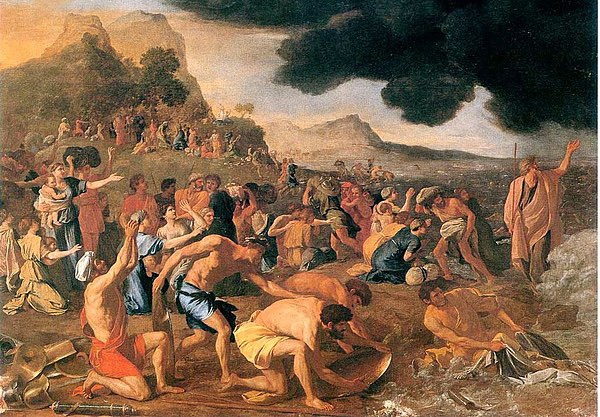
The story that is told about the Exodus in the Hebrew Scriptures is a story filled with hope. It tells of the liberation of an oppressed people, suffering under the burdens of forced labour; it recounts the sequence of events that led to the miraculous escape from slavery, crossing through the Sea of Reeds, travelling unhindered through the wilderness, into a land which the story claims was promised by God—a promised land, gifted to a chosen people by a holy God.

The story that is told in the Hebrew Bible about the Exodus is also a story filled with violence. There is the violence executed in Pharaoh’s actions in having the young boys murdered. There is the violence that is threatened by the Egyptian army as their chariots and horses thunder in hot pursuit of the escaping Israelites. 

Worse, there is the insistent violence in the series of increasingly damaging plagues which God is said to have sent against the Egyptians. And finally, there is the climactic and catastrophic violence of the surging of waters over the army and their horses, as they as swamped and drowned in the middle of the Sea of Reeds.

It is a difficult story to take at face value; what sort of people remember such a tale of incessant violence? and what sort of a God takes sides with one group of people and acts in such a vicious way against their opponents? Furthermore, how can we accept this story as part of our canon of scripture, when it is so filled with violent act after violent act?

This is not the only place that we encounter violence in the Hebrew Scriptures; as the story goes on, it proves to be one of invasion, massacre, colonisation, and dispossession of people in the land of Canaan; and then, a string of battles take place in various locations, as the invading Israelites gradually exert their dominance over the indigenous people of the land. 

All of this violence is indeed of deep concern, and it can be seen to place the whole of those scriptures under a cloud. However, I don’t want to fall into the supercessionist trap, the approach taken in the second century by Marcion of Sinope, who discarded the whole of the Old Testament—and, indeed, a significant part of the New Testament! We have these stories as part of our scriptures, and we need to hear them, ponder them, and engage critically with them.

Nor do I want to gloss over the fact that acts of violence, both those committed by human beings, and those attributed to the Lord God, can be found in many parts of the New Testament. It is a ubiquitous problem. Violence is expressed in many texts in scripture—both Jewish and Christian—and, indeed, is found in the texts of many other religious traditions. Human beings live, and die, by violence. We can never escape it, it seems.

If we take these texts as a literal account of historical events, we have significant theological issues to address. And there are a number of difficult historical questions that must be addressed, if we want to hold to the claim that Exodus is reporting an historical “as it really happened”. Where is the evidence for the escape of a huge number of people at that time? (There is none.) Who was the Pharaoh of the time? (There are two very different suggestions about this.) 

What about the evidence for the huge crowd that spent 40 years in the desert? Where are the bones of the dead, the remains of campsites, from that crowd, if that is accepted to be the massive crowd 600,000 males (plus their women and children) that would set forth into the wilderness (see Exod 12:37) and then their descendants? There is absolutely no evidence for these archaeological remains, at all.

But such a forensic historical interrogation is not my approach to the story of the Exodus, nor to other parts of Hebrew Scripture, nor, indeed, to the narratives found in the New Testament.

So my approach to these texts has been to undertake an appreciative enquiry approach: what is this text saying? what drives the energy of the writer? what issues of concern do I read and hear—explicitly in the words used, and implicitly, in between and under what is said? what elements can I affirm, as contributing constructively to the Hebrew Scriptures’ understandings of God? and, as a consequence of that, to the New Testament’s understandings of God?

To begin, we need to recognise that the Exodus was seen as the paradigm for liberation—political, cultural, social, religious—which has shaped Jewish life for millennia. It is no wonder that it was picked up as a key motif for early followers of Jesus, to describe his significance: preaching the kingdom of God, the righteous-justice of a compassionate God, a challenge to the collective political, social, and religious status quo, and a liberating way of being for those following him.

A group of priests in the exile in Babylon collected and collated materials from earlier traditions, and developed a series of stories that conveyed in saga form the key elements of their national story. Symbolism and poetry were the paramount features of these stories, originally oral, later written on scrolls.

In the latter stages of the Exile or perhaps in the early stages of return to the land and rebuilding society, the stories and sagas were drawn into the set of scrolls we know as the Torah, the first part of the TaNaK. Symbolism featured prominently in these poetic stories and narrative rehearsals of the past.

The Passover occupies a central place in the long, sweeping narrative that is told in Hebrew Scripture. As well as the story of the Passover which led to the exodus from Egypt (Exod 12–15) and the thrice-documented priestly regulations governing the annual celebration (Lev 23:4–8; Num 28:16–25; Deut 16:1–8), the story is told of celebrating Passover at key moments in that ongoing narrative: at the foot of Mount Sinai (Num 9:1–14), at Gilgal when about to enter the land of Canaan  (Josh 5:10–12), when the Temple worship was restored under Hezekiah (2 Chron 30:1–27), and during the great reformation that took place under Josiah (2 Ki 23:21–23).

The priest-prophet Ezekiel, in his vision of the restored land and new Temple, seen during the Exile, insists that the Passover be celebrated on a recurring annual basis (Ezek 45:21–25). Even though the Temple that was eventually rebuilt was of a different size and shape, when the Exiles returned under Darius, the Passover was celebrated at the dedication of the rebuilt Temple (Ezra 6:19–22).

Over time, interpreters under influence from later developments in thinking began to “reify” and “historicise” these symbolic sagas and develop the idea that they reported “events that actually happened”. They didn’t—as we have noted, there is no evidence outside the Bible for the sequence of events found in the Exodus saga. But the story had a potency for these priestly writers as the land was restored, the Temple rebuilt, society reconstructed.

The Passover story, leading up to the escape of the Exodus, that Jews recall and relive each year and which Christians remember on a regular basis in the eucharistic celebration, tells the age-old scapegoat dynamic in a dramatic story filled with symbolism. It too was not an historical event, but a story developed to explain the special significance of the people of Israel and their faith in a god who took extraordinary steps to secure their freedom.

Of course, within the emerging Jewish movement that had a focus on Jesus as an authoritative teacher of the Torah, a key way of grappling with the fact that Jesus was put to death as a criminal, hung on a cross under the orders of the Roman Governor, was to draw on this story of blood shed, lambs sacrificed, and salvation gained.

The timing of the death of Jesus is placed within the Passover festival by all four canonical Gospels. That is the festival that remembers the story of what happened to Israel, long ago—and that passes on the story that this happens year-in, year-out, as the faithful people of Israel remember and relive their national salvation.

One Gospel even locates the actual hour when Jesus dies on the cross as being “on the day of preparation for the Passover” (John 19:14, 31). Jesus, already identified in this Gospel as “the lamb of God who takes away the sins of the world” (John 1:29, 36), dies when the Passover lambs are being slaughtered in preparation for the Passover meal that evening. (The other three Gospels, of course, place the last meal of Jesus with his disciples at the Passover meal—Mark 14:12–25 and parallels—and thus, in their chronology, he dies on the day after Passover.)

Jesus is remembered as the “paschal lamb … who has been sacrificed” (1 Cor 5:7); it is by the shedding of his blood that atonement with God takes place (Rom 3:25), that faithful people are justified (Rom 5:9), that peace is achieved (Col 1:20), that redemption occurs (Eph 1:7). One writer makes much of this, emphasising that this redemption is eternal (Heb 9:12; 13:20), opening up “a new and living way” (Heb 10:19–20). It is his shed (sprinkled) blood makes Jesus “the mediator of a new covenant” (Heb 12:24) and that his faithful people are sanctified (Heb 13:12).

So this ancient story, passed down by word of mouth and then written in scrolls that themselves were passed down for reading and understanding, sits deeply within the self-understanding of both Jewish and Christian people. It is a story we cannot avoid.

The International Day of Peace (21 September)

Today, 21 September, is the International Day of Peace (“Peace Day“). This day was established in 1981 by a resolution of the United Nations resolution, supported unanimously by all representatives who voted. So Peace Day is a globally-shared date for all humanity to commit to Peace above all differences and work to ensure that Peace predominates over the conflicts raging in the world.

One of the myths of the 20th century is that there were two great wars (the two “World Wars”). That puts the focus on conflicts that involved many nations around the world, coalescing together in alliances to fight “the other side”. However, the terrible reality is that in every year of the 20th century, in country after country, Peace was absent. Civil wars, border disputes, regional conflicts, and terrorist insurgencies against unjust dictatorships, all attest to the continuing reality of the Lack of Peace around the world. 

And at the moment, we really need some signs of Peace in our world, as the media has focussed in recent times on the Russian invasion of Ukraine and, for the past 11 months, the atrocities being committed in Gaza, and now Lebanon. Where is Peace? When will it ever come? It is more important than ever that we recommit to seeking Peace in our world, and press our leaders to work towards peace in national life and International relations. 

The theme for the 2024 International Day of Peace is Cultivating a Culture of Peace. 2024 marks the 25th anniversary of the United Nations General Assembly’s adoption of the Declaration and Programme of Action on a Culture of Peace. In that declaration, the United Nations recognises that peace “not only is the absence of conflict but also requires a positive, dynamic participatory process where dialogue is encouraged, and conflicts are solved in a spirit of mutual understanding and cooperation.”

The Justice and International Cluster of the Uniting Church in the Synod of Victoria and Tasmania has produced a fine resource for this day. In this resource, it notes that early in the life of the Uniting Church, the National Assembly has made a clear and unequivocal commitment, on behalf of the whole church, to support peace-building and reject the idea that the world can be made a better place by killing people.

In 1982, the Assembly meeting passed a resolution declaring “that God came in the crucified and risen Christ to make peace; that he calls all Christians to be peacemakers, to save life, to heal and to love their neighbours. The call of Christ to make peace is the norm, and the onus of proof rests on any who resort to military force as a means of solving international disputes.” (res. 85.26)

It called for action “to interact and collaborate with local communities, secular movements, and people of other living faiths towards cultivating a culture of peace” and to work to “empower people who are systemically oppressed by violence, and to act in solidarity with all struggling for justice, peace, and the integrity of creation”. It also identified the need “to repent together for our complicity in violence, and to engage in theological reflection to overcome the spirit, logic, and practice of violence”. 

The Justice and International Cluster resource quoted Rev. Martin Luther King, in Strength to Love (Fontana, 1969), who wrote, “Returning hate for hate multiples hate, adding deeper darkness to a night already devoid of stars. Darkness cannot drive out darkness; only light can do that. Hate cannot drive out hate; only love can do that… So when Jesus says, ‘Love your enemies’, he is setting forth a profound and ultimately inescapable admonition. Have we not come to such an impasse in the modern world that we must love our enemies—or else? The chain reaction of evil—hate begetting hate, wars producing wars—must be broken, or we shall be plunged into darkness of annihilation.” How true those words still are, today.

The resource can be found at https://justact.org.au/wp-content/uploads/2024/08/240704-eLM-PFA-International-Day-of-Peace-Digital.pdf

For more of my thoughts on Peace, see

and also https://unitingforpeacewa.org/2018/11/28/perth-peacemaking-conference-statement/

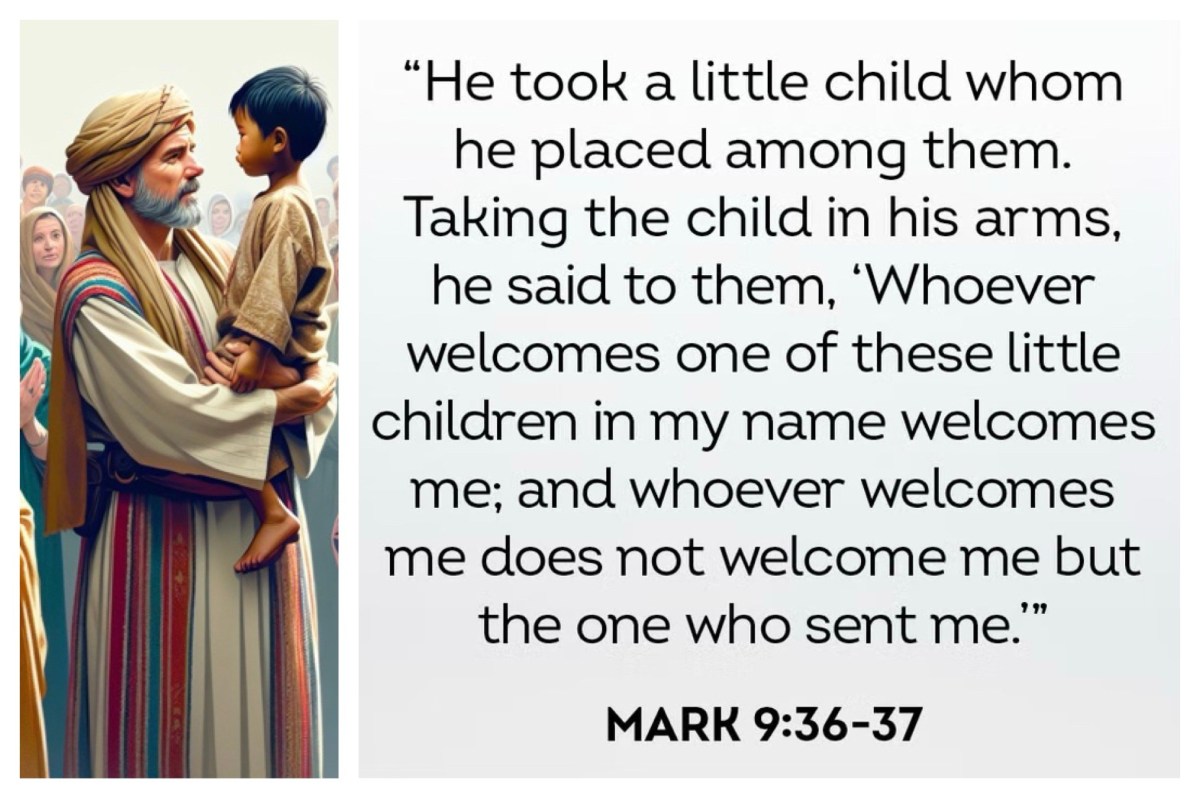
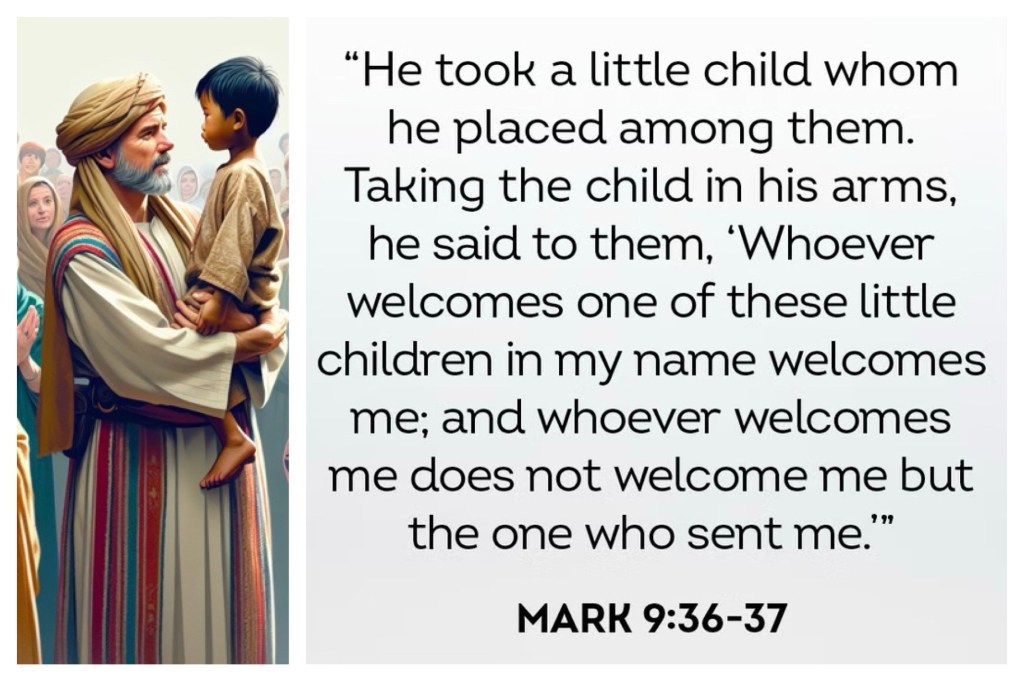
He took a little child … and taking it in his arms … (Mark 9; Pentecost 18B)

“Whoever welcomes one such child in my name welcomes me, and whoever welcomes me welcomes not me but the one who sent me.” In this striking statement, which occurs in the lectionary Gospel passage we hear this coming Sunday (Mark 9:30–37), Jesus does two important things.

The first is that he prioritises one of the least important figures in ancient society—a child—and puts them forth as a representative of him The second is that he then uses this affirmation as the basis for making a statement about his relationship to God.

First, Jesus affirms the central significance of a child in his consideration of this issue. Mark notes that Jesus “took a little child and put it among them” (9:36), using the presence of this child to undergird his statement about welcoming such a child (9:37). Still earlier, Jesus had placed the health of a child at the centre of his focus, when approached by a synagogue leader, who pleads with Jesus, “my little daughter is at the point of death; come and lay your hands on her, so that she may be made well, and live” (5:23).

In ancient times, a child was inevitably a person with no authority, no status, no prestige or power, in the society of the day; yet the low-status, not-important child is the exemplar, not only of Jesus, but of God, “the one who sent me” (9:37). Welcoming the  child is a clear manifestation of the paradox that lies at the heart of the Gospel. Jesus is the one who will walk resolutely towards death (8:31: 9:31: 10:34), becoming “the slave of all” (10:44) who will “give his life a ransom for many” (10:45). Along this pathway, it is the child who best exemplifies the simplicity of this sacrificial service; it is the child who best prefigures the fullness of life promised in the coming age.

Interestingly, in the Hebrew Scriptures which formed the context for Jesus’ faith development, there are some fascinating examples of the value and power of younger people. Young Isaac questions his father Abraham, who is about to sacrifice him, asking him, “where is the lamb for a burnt offering?” (Gen 22:7). 17-year-old Joseph boldly shares his dreams with his brothers, taking the risk of alienating himself from them (Gen 37:1–11). The young boy Samuel hears God’s call in the temple (1 Sam 3:1–18); he grows to become “a trustworthy prophet of the Lord” (1 Sam 3:20) who will play a pivotal role in events leading to the establishment of a king in Israel. And before he became one of those kings, a youthful David enters the battlefield and, against all the odds, slays the giant Goliath (1 Sam 17). 

Alongside these young men in scripture, there are girls who also have significant roles to play. An adolescent Rebekah eagerly offers hospitality to visitors and ultimately receives the blessing of “thousands of myriads” of descendants (Gen 24:15–60). The young Miriam bravely negotiates with Pharaoh’s daughter to ensure the safety of her newly-born brother Moses (Exod 2:1–10). A young princess Tamar speaks eloquently to Amnon; ultimately, she is unsuccessful in resisting his sexual assault, but this is the beginning of his downfall (2 Sam 13:1–20). Then, at the end of his life, it is the young Abishag who faithfully serves the ageing king, David (1 Kgs 1:1–4).

Jesus has many role models of children, young people, to draw on from his heritage. He knows that they are able to speak the truth and act with integrity. So he happily receives children as they come to him and highlights them as models of the kind of life that is needed to enter the kingdom of God. Those who follow Jesus on his pathway to that kingdom will need to take up their crosses (8:34), lose their lives (8:35), be “last of all and servant of all” (9:35), “receive the kingdom of God as a little child” (10:15), sell all that they possess (10:21), leave their families (10:29), and become “last of all” (10:31). (See https://johntsquires.com/2021/09/06/the-paradoxes-of-discipleship-mark-8-pentecost-16b/)

So, the children show how Jesus is in relationship with God; “whoever welcomes one such child in my name welcomes me, and whoever welcomes me welcomes not me but the one who sent me” (Mark 9:37). In this saying, Jesus offers a description of God as “the one who sent me”. This Markan saying is found also in a Lukan form, with the same words followed by the tag, “for the least among all of you is the greatest” (Luke 9:48).

A related version of this saying appears in the Q tradition, which lacks direct reference to the child (Matt 10:40 and Luke 10:16), although the context in Matt 10 does develop the central idea of the saying, and adds a further saying about giving “a cup of cold water to one of these little ones” (Matt 10:42).

The saying has close links with a turn of phrase found in another strand of the tradition—that found in John’s Gospel. Identifying God as “the one who sent me” first appears in this Gospel on the mouth of John, who refers to “the one who sent me to baptize with water” (John 1:33). This phrase is picked up by the Johannine Jesus, who uses it no less than 22 times to refer to God. It is an interesting overlap of the streams of tradition that are usually considered in isolation from one another, as if they never overlapped. Yet here, Johannine tradition bears similarities with Markan tradition and Q material.

In John’s Gospel, Jesus declares that “my food is to do the will of him who sent me and to complete his work” (4:34; 9:4) and “I seek to do not my own will but the will of him who sent me” (5:30; 6:38–39). The Johannine Jesus refers to God as the one who sent him as he declares that “my teaching is not mine but his who sent me” (7:16) and notes that “the Father who sent me has himself given me a commandment about what to say and what to speak” (12:49; 14:24).

As Jesus affirms that “the one who sent me is true” (7:28; 8:26), he looks to his return to be with God in sayings that use this phrase: “I will be with you a little while longer, and then I am going to him who sent me” (7:33; 16:5). Indeed, Jesus asserts that “the one who sent me is with me; he has not left me alone, for I always do what is pleasing to him” (8:29). 

Because of this belief, in the first farewell discourse at his last meal with his disciples, Jesus speaks the same word that we have heard in Mark 9:37, namely, “whoever receives one whom I send receives me; and whoever receives me receives him who sent me” (John 13:20). The phrase is integral to the Johannine concept of the Union of Father and Son, most famously expressed as “the Father and I are one” (10:20). 

That intimate relationship that Jesus has with God is emphasised in the final High Priestly Prayer of the Johannine Jesus, where Jesus prays “you, Father, are in me and I am in you” (17:21), for the Father has given him his glory (17:22). This intimacy provides the basis for the charge that Jesus gives his disciples: “as the Father has sent me, so I send you” (20:21); as he has prayed for them, “the glory that you have given me I have given them, so that they may be one, as we are one, I in them and you in me, that they may become completely one, so that the world may know that you have sent me and have loved them even as you have loved me” (17:22–23).

This rich and extensive theological understanding of the relationship between Jesus as Son and God as Father is developed throughout John’s Gospel. It is hinted at in the saying found at Mark 9:37 and its synoptic parallels, but receives no development in those three Gospels. There, Jesus is chosen by God for a purpose—sent, if you will—but no thought of organic unity of the two persons is ventured in those works. 

Jesus is the messenger of God, telling in his words and showing in his life how God wishes people to live. And most powerfully of all, Jesus declares, this life that he, the special child of God, advocates, is seen simply in “a little child” from within our midst.

“Here comes this dreamer” (Gen 37, 50; Narrative Lectionary for Pentecost 18C)

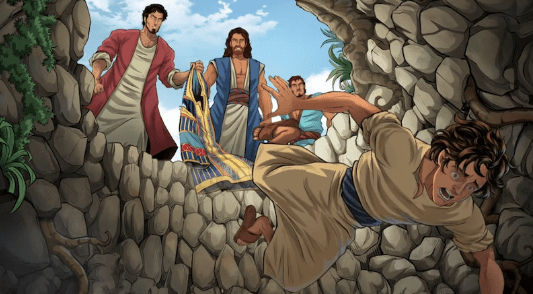
“Here comes this dreamer. Come now, let us kill him and throw him into one of the pits; then we shall say that a wild animal has devoured him, and we shall see what will become of his dreams” (Gen 37:19–20). There it is: “brotherly love” on display, for everyone to see! 

The sons of Jacob, who became the sons of Israel, and then gave their names to “the twelve tribes of Israel”, as we saw in an earlier blog, are terrible role models. They show us fraternal jealousy and hatred at its worst. The first part of the story offered by the lectionary for this coming Sunday pulls no punches (Gen 37:3–8, 17b—22). These sons could be mean!

The chapters before this have told the stories of the three patriarchs of Israel, Abraham, Isaac, and Jacob, and their wives, the four matriarchs Sarah, Rebekah, Leah, and Rachel—although Jacob is still alive, and he will figure in some of the final scenes of Genesis in chapters 46 and 48—50. We turn our attention to Joseph, who had been born to Jacob’s wife Rachel, after years of waiting. 

Only after his first wife Leah had given birth to six sons and a daughter, did Rachel give birth, as God “heeded Rachel and opened her womb” (Gen 30:22). As a sign of the passing of her barren state, Rachel declared, ‘God has taken away my reproach’; and we read that “she named him Joseph, saying, ‘May the Lord add to me another son!’ (Gen 30:23). That son, Benjamin, came years later, although Rachel tragically died giving birth (Gen 35:16–20).

We meet Joseph in the passage offered by the lectionary, which notes that, as he grew, Joseph was the favoured son (Gen 37:3). Of course, this fostered the jealousy of his brothers, who “hated him, and could not speak peaceably to him” (Gen 37:4). And so the scene is set for the problematic sequence of events that ensues, as his brothers initially plot to kill him (Gen 37:19–20), before Reuben intervenes (Gen 37:21–23).

We should note that the ethical standards of the people in these ancestral stories leaves something to be desired for us,with our modern sense of ethical standards.  Cheating, stealing, rape, incest, murder, and double dealing appear to be par for the course. Yet these brothers who plot to kill Joseph are the men who give their names to the tribes of Israel—names that are given pride of place in the priestly garments (Exod 1:1–4; 28:9–12, 21, 29; 39:6–7, 14) and in the later history of the people (1 Chron 2:1–2). 

That these stories of their murky ways of operating have been preserved, passed on, and preached on with regularity, is quite remarkable! Perhaps we should reflect that human beings have always been flawed? Or that we should well expect that the ethical standards and cultural practices of our time are different from what held sway in past eras?

And perhaps we need also to note—and take caution from the observation—that this particular incident, selling Joseph for twenty pieces of silver, has fed into the unhelpful stereotype of the Jews who are always and in every way concerned about money. It’s a stereotype that has fed the burgeoning antisemitic attitude and actions of people throughout the Middle Ages, past the Enlightenment on into the modern age—culminating, of course, in the horrors of the Shoah (Holocaust) in Nazi Germany. See

https://antisemitism.adl.org/greed/

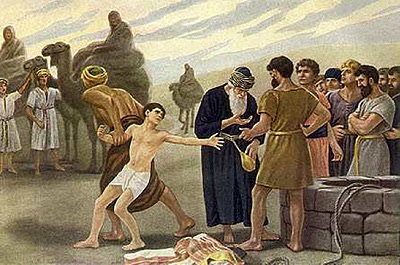
Back to the story of Genesis 37. That the brothers plot to kill Joseph, and are only dissuaded by the intervention of Reuben (Gen 37:21–23), is clearly a mark against them. That Judah then suggests that they sell him to a passing caravan of Ishmaelites (Gen 37:25–28), whilst it saves the life of Joseph, is yet another mark against the brothers.

Christian readers will perhaps compare the “twenty pieces of silver” that was paid for Joseph (Gen 37:28) with the thirty pieces of silver paid to Judas for handing Jesus over to the authorities (Matt 26:15). However, a number of passages in Hebrew Scriptures provide a more fitting contrast to the price paid for Joseph. 

Abimelech, in his unsuccessful attempt to install himself as king in Israel, took “seventy pieces of silver out of the temple of Baal-berith with which [he] hired worthless and reckless fellows, who followed him” (Judg 9:4). So twenty pieces are significantly less. 

And the story is told in Judges about when the lords of the Philistines bribed Delilah with eleven hundred pieces of silver to hand over Samson to them (Judg 16:5; 17:1–5), and in the Song of Songs the (poetically-exaggerated) claim is made that Solomon expected a thousand pieces of silver from each of the keepers of his vineyard (Song 8:11). So twenty pieces pales into utter significance, by comparison. Was Joseph worth so little.

The irony is that Israel as a whole is identified with reference to Joseph at a number of places in the Hebrew Scriptures. Both narrative texts and prophets refer to the whole nation as “the house of Joseph” (Josh 17:17; 18:5; Judg 1:22–23, 35; 2 Sam 19:20; 1 Ki 11:28; Amos 5:6; Obad 1:18; Zech 10:6). 

The psalms sing of “the descendants of Jacob and Joseph” (Ps 77:15) and bring petitions to God, “Shepherd of Israel, you who lead Joseph like a flock” (Ps 80:1). Psalm 81 places Joseph alongside Jacob and Israel: “it is a statute for Israel, an ordinance of the God of Jacob, he made it a decree in Joseph, when he went out over the land of Egypt” (Ps 81:4–5). The name of Joseph was revered in the ongoing traditions of Israel.

So let us treasure and reflect on this story, in which Joseph is sold off to foreign travellers. His life had been saved from the plotting of his brothers by a compassionate intervention by one of their number; but he is taken off into Egypt—for what fate? 

Reading the story chapter-by-chapter, as it appears in Genesis, we don’t yet know the significance of Egypt (other than the account of the time that Abram and Sarai spent in Egypt in Gen 12:10—13:12). But people hearing the story when it was written into the scrolls, after the return from Exile, would know of the time of slavery spent by their ancestors in Egypt, when “the Egyptians became ruthless in imposing tasks on the Israelites, and made their lives bitter with hard service” (Exod 1:13–14). They know the ominous threat that lies over Joseph at the end of this week’s story: “they took Joseph to Egypt” (Gen 37:28).

That fate is symbolised by the note in the immediately following verses, that the brothers of Joseph dipped his coat into the blood of a slaughtered goat and brought it back to Jacob. When Jacob recognized the coat, he concluded that “a wild animal has devoured him; Joseph is without doubt torn to pieces” (Gen 37:33). Jacob mourned for many days; despite the best efforts of his family, “he refused to be comforted, and said, ‘I shall go down to Sheol to my son, mourning” (Gen 37:35).

The narrative leaves Joseph with the tantalising comment that he was sold by the Midianites to Potiphar, one of Pharaoh’s officials (Gen 37:36), before veering off to tell a long story about Judah and Tamar (Gen 38). The question remains: what fate awaits Joseph?

After Joseph is sold off to the Egyptians (Gen 37), much happens that the lectionary skips over. Potiphar makes Joseph his personal attendant; he was in charge of the entire household. There is a subplot concerning Potiphar’s wife and Joseph, resulting in Joseph being imprisoned (Gen 39). However, the chief gaoler liked Joseph and put him in charge of all the other prisoners, including Pharaoh’s butler and baker. One night both the butler and the baker had strange dreams, which Joseph interpreted in ways that soon came true. Joseph gained a reputation as a dream interpreter (Gen 40).

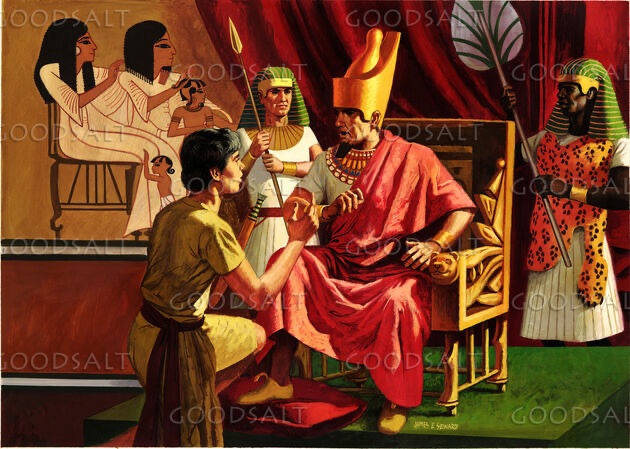
Two years later, Pharaoh had two dreams that his magicians could not interpret. Joseph was summoned and told Pharaoh that the dreams forecasted seven years of plentiful crops followed by seven years of famine. Following Joseph’s advice, Pharaoh made Joseph his second-in-command. He gave Joseph his ring and dressed him in robes of linen with a gold chain around his neck. Pharaoh gave him the Egyptian name Zaphenath-paneah and found him a wife named Asenath, daughter of Poti-phera the priest of On (Gen 41).

Joseph traveled throughout Egypt, gathering and storing enormous amounts of grain from each city. During these years, Asenath and Joseph had two sons: Manasseh, meaning, “God has made me forget (nashani) completely my hardship and my parental home, and Ephraim, meaning, “God has made me fertile (hiprani) in the land of my affliction”. These sons, grandsons to Jacob, would later have a key role (but the lectionary doesn’t include this part of the story).

After seven years, a famine spread throughout the world, and Egypt was the only country that had food. Joseph was in charge of rationing grain to the Egyptians and to all who came to Egypt. The famine affected Canaan, so Jacob sent ten of his sons to Egypt. He kept back Benjamin, Rachel’s second son and Jacob’s youngest child, the son who had intervened to save Joseph years earlier (Gen 42). 

The story assumes a rollicking-good-yarn feeling, as Joseph recognises the brothers but does not let on, and sends them back to Canaan. He kept Simeon in jail pending their return with Benjamin, as instructed, despite Jacob’s misgivings (Gen 43).

The brothers return to Egypt with Benjamin, along with a gift for Joseph as well as double the necessary money to repay the money that was returned to them. Again, there is a comedy-of-errors feel, as Joseph acts is if he does not know the brothers when they actually do; in the end he instructed his servant to fill the brothers’ bags with food, return each one’s money a second time, and put his own silver goblet in Benjamin’s bag. Then he sends his servant after them, to accuse them of theft. Benjamin is detained; Judah pleads with Joseph to release him (Gen 44). Will he do so?

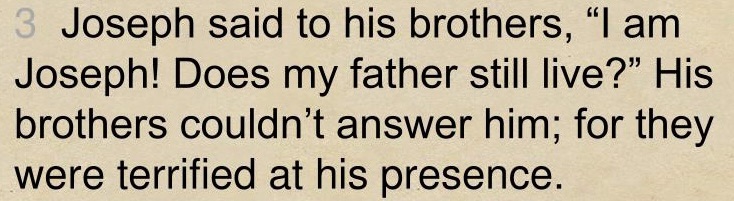
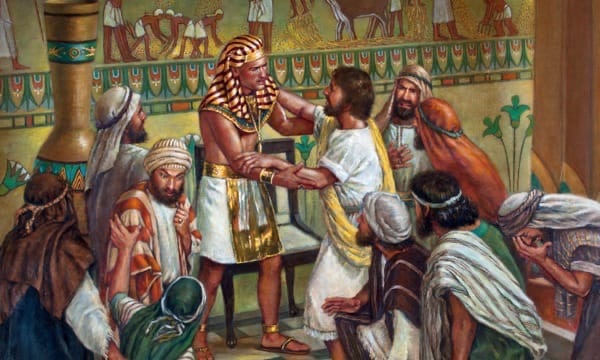
At this point in the story, Joseph reveals his true identity to his brothers (Gen 45:3). The narrative is fraught with emotion: Joseph could no longer control himself (v.1), he wept loudly (v.2), his brothers are dumbstruck and dismayed (v.3). After a lengthy speech of explanation (vv.4–13), Joseph bursts into tears, as does Benjamin (v.14), and then Joseph “kissed all his brothers and wept upon them” (v.15). The emotions are deep-seated and visceral; the physical actions described signal the profound effect that the experiences have had on Joseph and his brothers.

The narrative of this meeting ends in a very prosaic manner: “and after that his brothers talked with him” (Gen 45:15). The fractured relationships amongst the twelve has been repaired; the lines of communication between estranged individuals have been restored. It just remains for this to be communicated to Jacob—which is done in the rest of chapter 45. Jacob and his whole family, sixty-six persons in all, relocate to Egypt (Gen 46), but famine eventually strikes even Egypt (Gen 47).

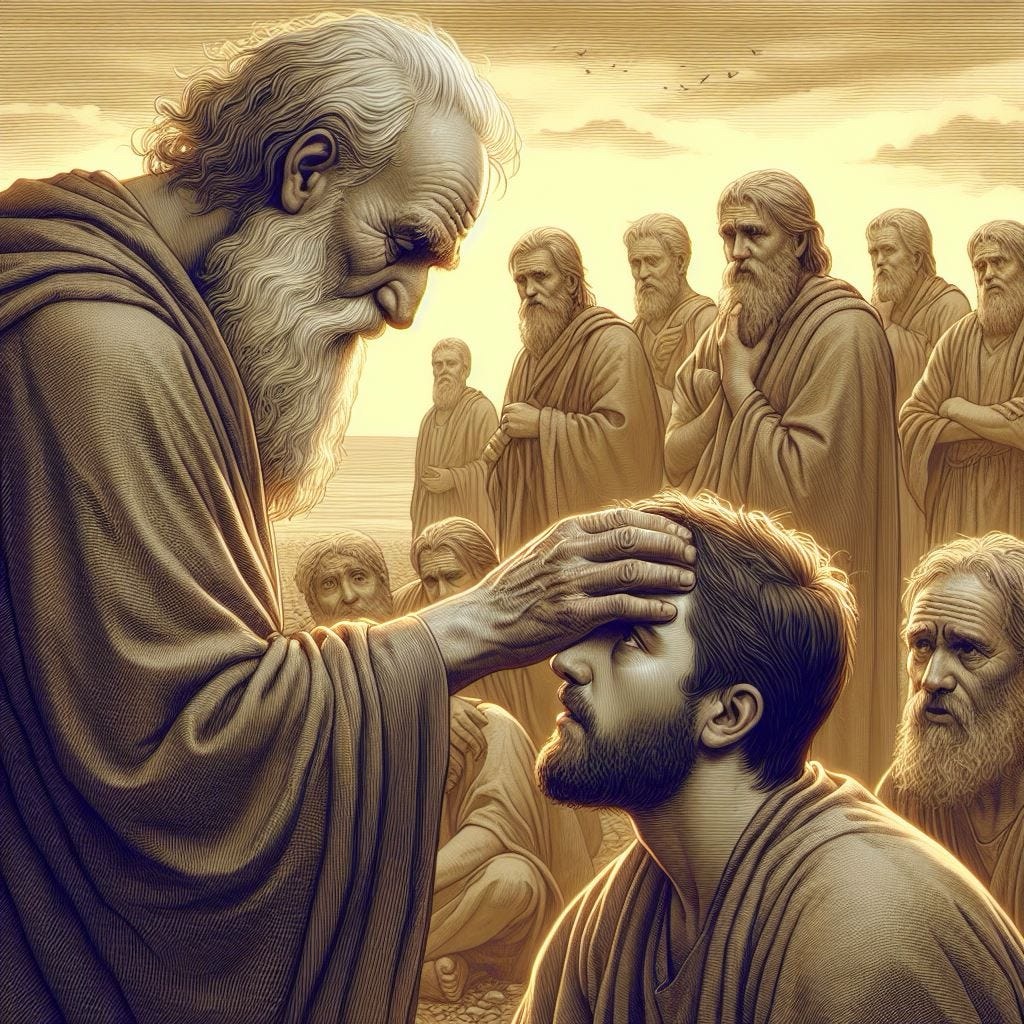
The book concludes with grand scenes of blessing and farewell. Jacob blesses Joseph (Gen 48:15–16), Joseph’s sons Ephraim and Manasseh (Gen 48:17–22), and then the full  complement of his twelve sons (Gen 49:1–28), before Jacob dies and is buried (Gen 49:29—50:14). 

The closing scenes are touching; Joseph’s brothers fear that he may still bear a grudge against them (50:15), but Joseph, highly emotional once again (50:17), reassures his equally emotional brothers, “have no fear; I myself will provide for you and your little ones”; final attitude towards his brothers is one of kindness (50:21). And so, in due time, Joseph himself comes to the end of his earthly life; aged 110, he was “embalmed and placed in a coffin in Egypt” (Gen 50:26).

There is a longer summary of the full saga that is told in the Joseph section of Genesis (chapters 37–40) in the Jewish Virtual Library at https://www.jewishvirtuallibrary.org/joseph-jewish-virtual-library

In praise of Torah (Psalm 19; Pentecost 17B)

The compilers of the Revised Common Lectionary have selected a psalm for each Sunday of the year. That chosen for this coming Sunday, Psalm 19, has two main parts; we will concentrate on the second part in this blog.

Creation is the focus in the first six verses of the psalm, where the psalmist’s view is fixed on “the heavens”, which are “telling the glory of God” (v.1). In those heavens the Lord “has set a tent for the sun, which comes out like a bridegroom from his wedding canopy, and like a strong man runs its course with joy” (v.4–5)—clearly a description of the daily movement of the sun across the sky (from our perspective), from east to west, as verse 6 then elucidates.

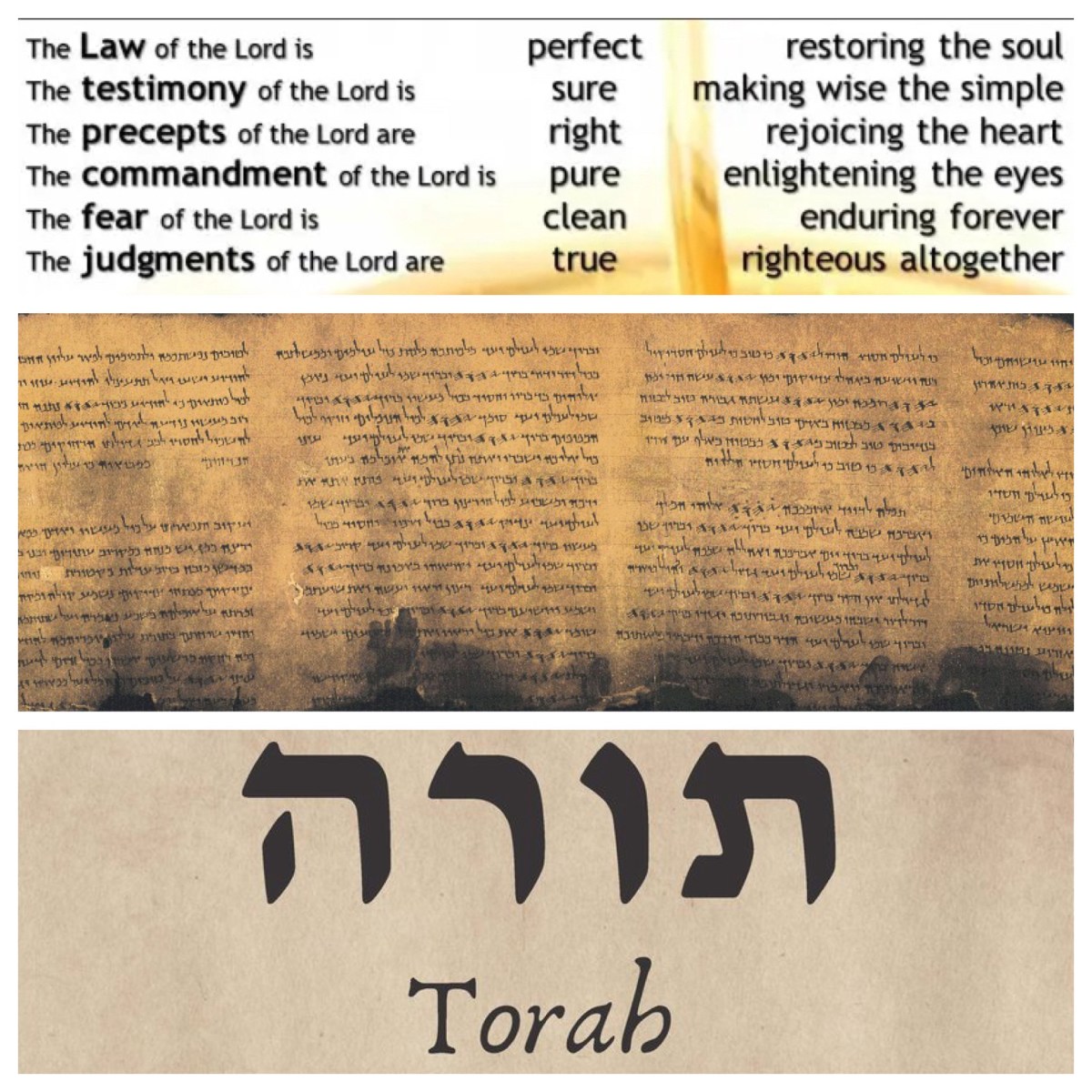
However, at this point the focus changes to Torah. The psalmist expresses a consistently positive attitude towards Torah in verses 7–14. Those verses contain a ringing affirmation of the Torah as “perfect, reviving the soul … sure, making wise the simple … right, rejoicing the heart … clear enlightening the eyes … pure, enduring forever … true and righteous altogether … more to be desired than gold … sweeter also than honey” (Ps 19:7–14).

The terms used here in parallel to describe Torah (law, decrees, precepts, commandment, fear, ordinances) are found regularly in the narrative books to describe the collection of laws (Deut 8:11; 11:1; 1 Ki 2:3; 6:12; 8:58; 2 Ki 17:34–37; 1 Chron 22:13; 28:17; Neh 9:13; 10:29) as well as right throughout Psalm 119. See

Such affirmations of Torah sound out insistently throughout the majestically grand doublets of the longest psalm, Psalm 119. The 176 verses of this psalm, artistically arranged into acrostic stanzas of eight verses at a time, are bracketed by delight and confidence (“happy are those … who walk in the way of the Lord … I long for your salvation, O Lord, and your law is my delight”, vv.1, 174). This psalm indicates that the Law shapes the way that the covenant is kept; and the covenant gives expression to the steadfast love and grace of God.

*****

So much is Torah valued, that it apparently offers perfection: “the law of the Lord is perfect” (Ps 19:7), which we might compare with “I have seen a limit to all perfection, but your commandment is exceedingly broad” (Ps 119:96). In this regard, the psalmist’s appreciation for Torah as perfection seems to reflect the priestly desire for people to offer perfect sacrifices, without blemish (Lev 22:21), and Solomon’s desire to build the Temple as a perfect house for God (1 Ki 6:22).

Indeed, such a conception of perfect Torah also resembles the sage’s musings regarding Wisdom: “to fix one’s thought on her is perfect understanding” (Wisdom 6:15), and thoughts found in a prayer attributed to Solomon: “even one who is perfect among human beings will be regarded as nothing without the wisdom that comes from you” (Wisdom 9:6).

Much value is accorded to these words of Torah. As well as calling the law “perfect”, we hear that “the decrees of the Lord are sure” (Ps 19:7), a claim echoed in another psalm (Ps 93:5). The precepts of the Lord that are right (Ps 19:8; see also 119:75, 137, 172) means that one who is faithful and obedient will be led “in right paths” (Ps 23:3) as they pray “put a new and right spirit within me” (Ps 51:10). “The commandment of the Lord is clear” (Ps 19:8) is a claim that informs the later portrayal of those who trace the course of Wisdom “from the beginning of creation … [who] make knowledge of her clear” (Wisd Sol 6:22).

The psalmist extends the adoration of the Law, declaring that “the fear of the Lord is pure” (Ps 19:9), a claim extended in another statement found in wisdom texts, “the fear of the Lord is the beginning of wisdom” (Ps 111:10; Prov 1:7; 9:10; 15:33; Sir 1:18, 27; 19:20). A further elaboration, “the ordinances of the Lord are true and righteous altogether” (Ps 19:9), is the way that Ezra describes the laws given to Moses on Mount Sinai (Neh 9:13). They are righteous (Ps 119:7, 62, 106, 160, 164), good (119:39), the basis of hope (119:43) and comfort (119:52).

The closing affirmation in this shorter psalm, “more to be desired are they than gold, even much fine gold; sweeter also than honey, and drippings of the honeycomb” (Ps 19:10), is echoed in the longest psalms, “how sweet are your words to my taste, sweeter than honey to my mouth!” (Ps 119:103).

By contrast, when Job asks, “where shall wisdom be found? and where is the place of understanding?”, he proposes that “gold and glass cannot equal it, nor can it be exchanged for jewels of fine gold” (Job 28:12–19), and concludes, “the fear of the Lord, that is wisdom; and to depart from evil is understanding” (Job 28:28).

Wisdom, love, the fear of the Lord, enlightenment, and rejoicing—these are the fruits of Torah, as the psalmist sings. These are the benefits of the law which are to be valued even into our own times, as this Sunday we hear again the words of this ancient psalm and affirm its relevance and importance in the contemporary world.

A small member which boasts of great exploits (James 3; Pentecost 17B)

Warning! Warning! As we follow the lead of the lectionary and come to this Sunday’s passage from chapter 3 of James, people like me are immediately put on alert. “Not many of you should become teachers, my brothers and sisters, for you know that we who teach will be judged with greater strictness” (James 3:1). So there!

I have never trained as a teacher; however, the church, in its wisdom, saw fit to invite me to learn the craft of teaching at the very beginning of my ministry as an ordained person. I served as a Tutor assisting Robert Maddox in his university teaching, taking over his course when his brain tumour developed.

Then I was encouraged to apply for doctoral studies in New Testament and Early Christianity, learning more of the craft of teaching whilst undertaking the coursework and research of that degree, as I worked as Teaching Assistant for various professors: in Old Testament, Brevard Childs and then Robert Wilson; in Early Church, the Gnostic specialist Bentley Layton; and then Abraham Malherbe, who then was the primary supervisor of my thesis, completed in 1987.

After that I taught courses at Sydney University and United Theological college, before accepting a call in 1990 to the Faculty of UTC, where I taught Biblical Studies for two decades. Then, moving into other ministry roles, I shared with my wife Elizabeth Raine in teaching lay leaders in the Mid North Coast in a range of subjects; spent two years as Principal of Perth Theological Hall; and then moved to Canberra, where again Elizabeth and I were involved in teaching lay people (and some ministers doing their continuing education) for five years. So my career over 45 years has regularly involved teaching!

Therefore, I take the opening words of James 3 with utter seriousness. They are striking: both discouraging people from becoming teachers (although we do need teachers!) and then warning that who teach “will be judged with greater strictness”. That’s worth considering. Why are teachers to be held to a higher level of accountability than people in other professions? than doctors and nurses? or judges and lawyers? or police officers and prison guards? Don’t all of them need to have the highest of standards to which they need to be held accountable? 

The reason that James makes this curious claim is, of course, “the tongue”. “The tongue is a small member”, James writes, “yet it boasts of great exploits” (3:5). And that is what underlies this whole passage. The author uses a series of analogies to indicate how such a small member, the tongue, has great power. The tongue is compared to a bridle guiding a horse  (v.3), a ship’s rudder (v.4), a spark lighting a fire (vv.4b-5), as something that “stains the whole body” (v.6) and a spring from which water pours forth (v.11).

In each case, the analogy is of something small which contains immense power to control something much larger—to guide a warhorse or steer a cargo ship, to set in motion the train of events that leads to a damaging fire or an infection of the whole person or widespread flooding. The tongue is potent—and so it needs to be used with great care.

Earlier in this letter, James has implored those listening to this letter to “be quick to listen, slow to speak, slow to anger” (1:19). Left unchecked, it seems, the tongue can rapidly run to anger—and this is unhelpful, since “anger does not produce God’s righteousness” (1:20), and it is this righteousness which is most desired for those who are wise, “those who make peace” (3:13–18). Indeed, as the theological argumentation that James offers indicates, Abraham was made righteous (justified) “by works”, and it was those works which ensured that “it was reckoned to him as righteousness” (2:18–26, with the key scriptural verse in this argument being Gen 15:6).

“Be quick to listen, slow to speak” is advice which the older brother of James would have been happy to support. Indeed, we may perhaps speculate that James shapes this instruction under the influence of the words of Jesus, “let anyone with ears to hear listen!” (Mark 4:9, 23)—words repeated by others who told the story of his life (Matt 11:15; 13:9, 15, 43; Luke 8:8; 14:35). Jesus exhorts his followers to prioritise listening; brother James follows his lead and includes this direction. “You have two ears and only one tongue; so you should listen twice as long as you speak” is a saying that I have often heard over the years, nd it seems to resonate with what Jesus is saying.

Early in my time of teaching, I learnt this lesson very well. Fresh from the heady environment of doctoral research and plunged into the midst of making revisions of my dissertation ahead of publication (which came, in due course, in 1993), I taught a course which was shaped almost entirely around my thesis chapters. I had so much to say, and only 13 weeks to say it to the students! I still remember the sobering set of “course evaluations” that I received at the end of that semester. 

The next time I taught that subject I made sure to incorporate regular opportunities for small-group “buzz groups” within each lecture, posing questions which students were expected to discuss and decide for themselves—rather than just listen to me talk ad nauseum. I had learnt the value of my listening to students, and wanted to encourage them to practice “active listening” to inform their own thinking. The tongue was put into its place; one tongue, but two ears!

The tongue plays an interesting role in scripture. The “speech of the angels” produced in the unruly worship times at Corinth (1 Cor 12–14) has attracted much attention; then there are also the”native languages” of the Jews gathered in Jerusalem for the feast of Pentecost,when then spirit fell upon them (Acts 2). These were active tongues which contributed to the faith of those speaking (in Corinth) and to the development of the mission of the early Jesus movement (in Acts). These tongues were carrying out important duties.

But the tongue is also what holds back Moses from accepting his call; “I am slow of speech and slow of tongue”, he protests (Exod 4:10). Likewise, Jeremiah attempts to divert God from calling him; “Truly I do not know how to speak, for I am only a boy”, he protests (Jer 1:6). Not so reticent was David, who at the end of his life declared, “the spirit of the Lord speaks through me, his word is upon my tongue” (2 Sam 23:2); in some of the psalms also the psalmists make similar claims (Ps 35:28; 51:14; 66:17; 71:24; 119:172; 126:2). And, of course, many of the prophets followed in this tradition, boldly speaking words which they prefaced, “Thus says the Lord God”. 

Yet other psalms reflect the reality of damaging words spoken by a “deceitful tongue” (Ps 52:4; 120:2–3), spoken by those who slander (Ps 15:3), deceive (Ps 34:13; 50:19), plot treachery (Ps 52:2) and scheme “secret plots” (Ps 64:1–8). Such people “make their tongue sharp as a snake’s, and under their lips is the venom of vipers” (Ps 140:3); this is  what Job calls “the tongue of the crafty” (Job 15:5). Such words provoke the plea for vengeance from one psalmist: “let the mischief of their lips overwhelm them! let burning coals fall on them! let them be flung into pits, no more to rise!” (Ps 140:9–10). 

Many proverbs contrast the good which a tongue can do when it is used well, with the evil that results when the tongue is used for ill. “Rash words are like sword thrusts, but the tongue of the wise brings healing” (Prov 12:18) is one such comparison; another is “Truthful lips endure forever, but a lying tongue lasts only a moment” (Prov 12:19). Another proverb states “the tongue of the wise dispenses knowledge, but the mouths of fools pour out folly” (Prov 15:2); with a different approach, another proverb advises “whoever rebukes a person will afterward find more favour than one who flatters with the tongue” (Prov 28:23).

It seems that James is as aware as both the psalmists and the collators of these proverbs are of the damage that misuse of the tongue can cause. One striking proverb claims that “death and life are in the power of the tongue, and those who love it will eat its fruits” (Prov 18:21). That surely makes the tongue a most powerful thing. And just as these books of a wisdom reflect the good that the tongue can do when used wisely, so James knows of the value of the tongue and the power it can impart.

One of the proverbs that still contains an incredibly potent sting in the tail for me is this: “the mouth of the righteous brings forth wisdom, but the perverse tongue will be cut off” (Prov 10:31). The language is metaphorical, as is the case with some many proverbs—and with the analogies of the tongue as a horse’s bridle, a ship’s rudder, a spark lighting a fire (vv.4b-5), and a spring from which water pours forth, which James employs. The language is powerful, evocative, dramatic—but not at all to the taken literally.

The reason this particular proverb holds such a power for me, is that many years ago something similar was spoken to me: “don’t tell anyone or I will cut your tongue out”. The adult person saying this to me had incredible power over my small 6-year-old self; I was utterly terrified and for decades I did not dare to tell anyone about what he had done to me. I believed that he would actually, physically do this, if I disobeyed him and talked to anyone about this. 

So I kept the knowledge of what had happened hidden deep within myself; it was almost four decades later that I started the slow and incredibly difficult task of coming to grips with this. I have eventually been able to talk with others about this experience, but it has been a complex process (which is still incomplete in various ways). I have shared more recently in a podcast with a friend and colleague. 

For my own story, see 

and for the podcast in which I talk about this, go to

https://open.spotify.com/episode/5feSJb2qyVAhzBEfoeHj1x?si=29983b58d694477d

The power of the tongue: I know this well—both the positive, upbuilding capacity of the tongue to convey knowledge, invite learning, and deepen faith; and the negative, destructive capacity of the tongue when it is used to threaten and distort reality. James rightly observes that, with the very same tongue “we bless the Lord and Father, and with it we curse those who are made in the likeness of God; from the same mouth come blessing and cursing” (James 3:9–10). The wise and understanding, he advises, will use their tongue judiciously and constructively, so that it is “by your good life that your works are done with gentleness born of wisdom” (3:13).

The tongue. It is powerful. Take care how you use it!