
I guess those with diligent true loves are busy, today, trying to feed the seven partridges, twelve turtle doves, fifteen French hens, sixteen colly birds, twelve laying geese, and seven swimming swans that their true loves have delivered to them (thus far) to commemorate the twelve days of Christmas. And I hope they have their fifteen gold rings locked away securely!
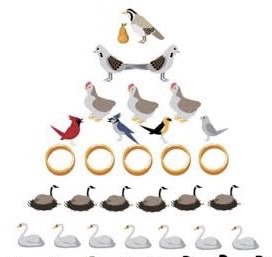
For my part, I am offering a further carol for The Season of Christmas: another one from the early centuries of Christianity, when theologians wrote the words of songs for the faithful to sing—thereby providing them with meaty teaching in the faith (at least as they understood it). Today, it is one by the forth century theologian Ambrose, who was Bishop of Milan from 374 until his death in 397.
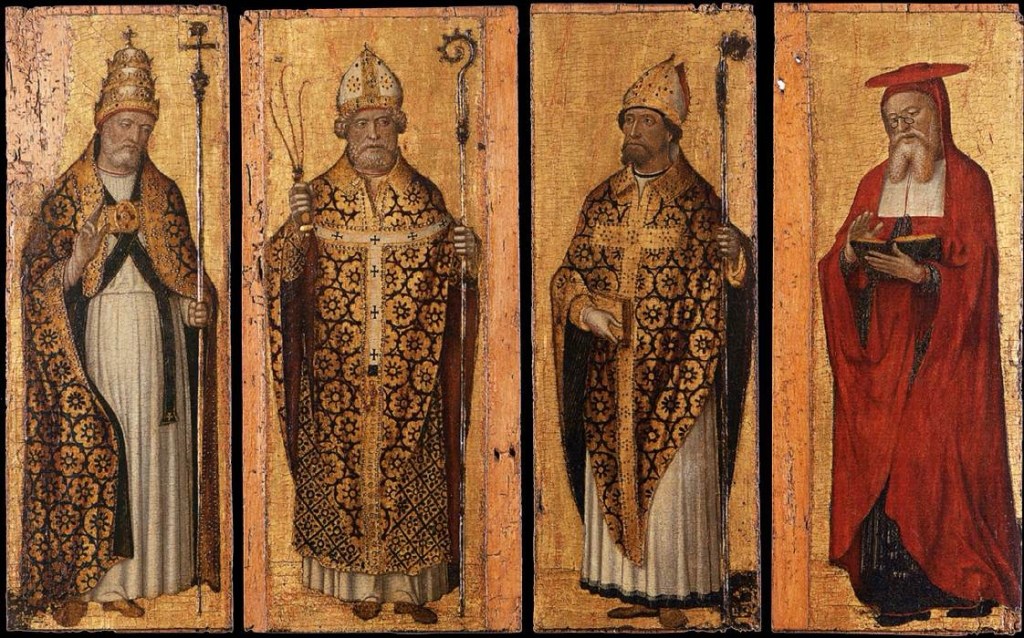
Four panels from a partially-preserved polyptych, dated c. 1495, and attributed to Galleria Franchetti, Ca’ d’Oro, Venice
Amongst the western church, dominated by Roman Catholicism, Ambrose of Milan (339—397) is counted as one of the four Doctors of the Church, along with his contemporaries Augustine of Hippo (354—430) and Jerome of Stridon (342—420). Pope Gregory the Great (540—604) is accounted as the fourth Doctor. All four had the title Doctor attributed to them, in the true sense of the word (it comes from the Latin word for Teacher).
In the eyes of many theological writers, the fourth century was critical in the development of classic orthodoxy, for this was when the various disputes about the nature of Jesus took place. Those who were leading the theological argumentation—including Ambrose, Augustine, and Jerome—contributed to the development of orthodox dogmas which were confirmed by various church councils: Nicea in 325, Constantinople in 381, Ephesus in 431, Chalcedon in 451, and others in subsequent centuries.
Those whose arguments failed to persuade—or who were condemned by decree of one of the councils—are known to us as “heretics”; they include Theodotius of Byzantium, Nestorian of Constantinople, Paul of Samosata, Apollinaris of Laodicea, Eutyches of Constantinople, and perhaps most famously of all, Arius of Alexandria. Legend has it that at the Council of Nicea, Arius slapped Nicholas of Myra (the historical figure who later morphed into Saint Nicholas and then Santa Claus) and so was temporarily defrocked and imprisoned.
Although their writings were instrumental in developing orthodox theology, such men have long been denigrated as heretics—although, in my mind, a number of these “heretics” offered wise and helpful insights. But the verdict of history stands, cemented now by centuries of church tradition and theological dogma.
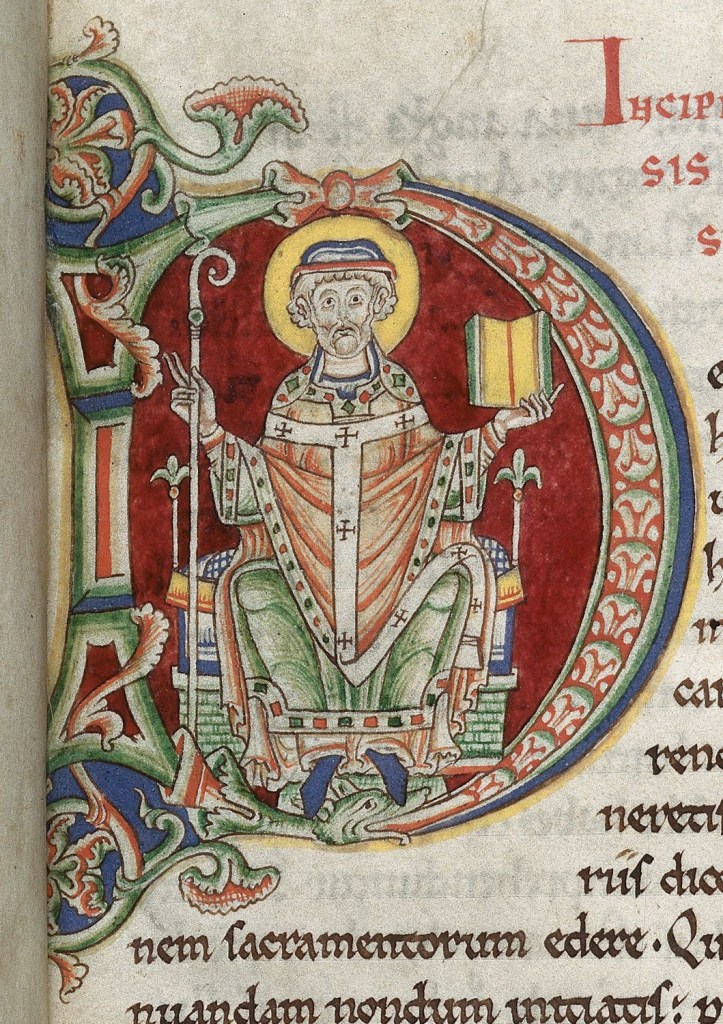
It is in this context of debate, disputation, denigration, and entrenched doctrinal disagreements, that Ambrose penned this carol, Veni redemptor gentium (Come, Redeemer of Nations). It is filled with patristic theologising, reflecting the debates of the day, depicting Jesus as “a giant in twofold substance in one” and “equal to the Father”, whilst also affirming his mother as having “virgin honour all unstained”, a “royal home of purity”. These are the seeds for the theological affirmations about Jesus in some of the much later Christmas carols that we sing today!
Here is the hymn of Ambrose in a translation of the original Latin by John Mason Neale (whom we noted a few days ago provided us with the English of Good King Wenceslas).
1. Come, Thou Redeemer of the earth,
And manifest Thy virgin birth:
Let every age adoring fall;
Such birth befits the God of all.
2. Begotten of no human will,
But of the Spirit, Thou art still
The Word of God in flesh arrayed,
The promised Fruit to man displayed.
3. The virgin womb that burden gained
With virgin honour all unstained;
The banners there of virtue glow;
God in His temple dwells below.
4. Forth from His chamber goeth He,
That royal home of purity,
A giant in twofold substance one,
Rejoicing now His course to run.
5. From God the Father He proceeds,
To God the Father back He speeds;
His course He runs to death and hell,
Returning on God’s throne to dwell.
6. O equal to the Father, Thou!
Gird on Thy fleshly mantle now;
The weakness of our mortal state
With deathless might invigorate.
7. Thy cradle here shall glitter bright,
And darkness breathe a newer light,
Where endless faith shall shine serene,
And twilight never intervene.
8. All laud to God the Father be,
All praise, eternal Son, to Thee;
All glory, as is ever meet,
To God the Holy Paraclete.
Trans. J. M. Neale.
https://www.preces-latinae.org/thesaurus/Hymni/VeniRedemptorG.html
Closely related to this carol, there is another carol in a 15th century manuscript, the Selden Carol Book, a document which contains music and words for thirty carols of the day. (The manuscript is held in Oxford at the Bodleian Library.)
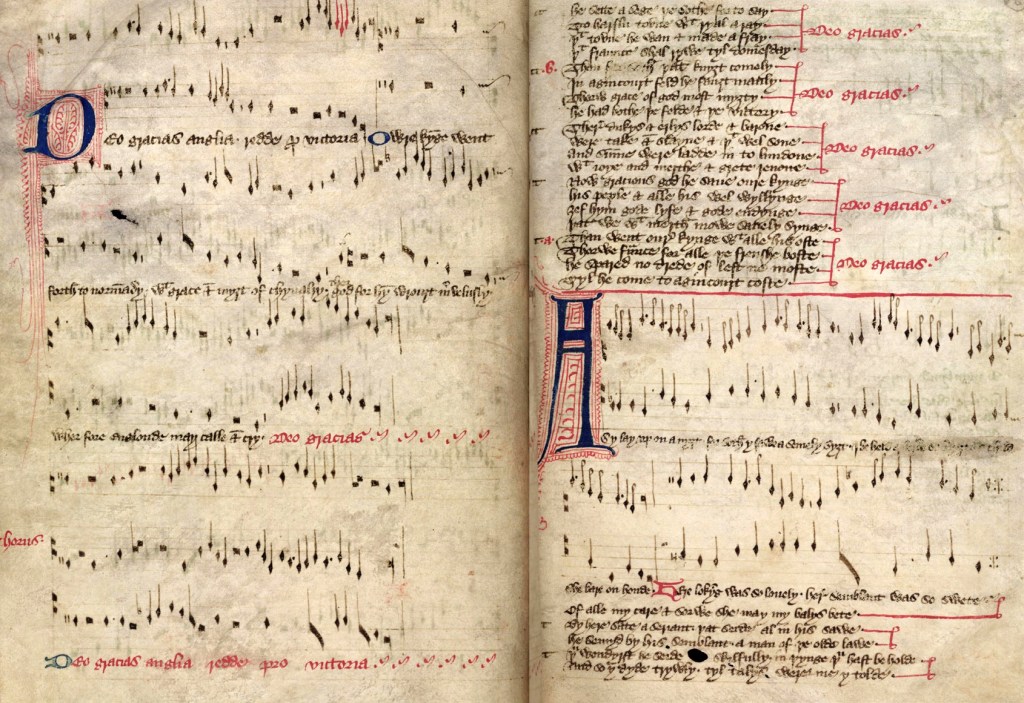
This carol, number 28 in the collection, both uses the refrain of Ambrose’s original, and, in verse 3, refers directly to the work by Ambrose. Its author, as with all the carols in the Selden manuscript, is unknown.
Veni, redemptor gencium, Veni, redemptor gencium.
This worle wondreth of all thynge
Howe a maide conceyved a kynge;
To yeue us al therof shewynge,
Veni, redemptor gencium.
Whan Gabriel come with his gretynge
To Mary moder, that swete thynge,
He graunted and saide with grete lykynge,
Veni, redemptor gencium.
Ambrose saide in his writynge
Cryst sholde be in a maide dwellynge;
To make sothe alle that syngynge,
Veni, redemptor gencium.
And Davyd saide in his spellynge
That truthe sholde be in erthe growynge
To us, byer of alle thynge,
Veni, redemptor gencium.
Cryst, ycrowned at oure begynnynge,
Be with us at oure endynge
Us to thy ioye for to brynge,
Veni, redemptor gencium.
The text is from Richard Greene, The Early English Carols (Oxford, 1977), p.36. A version in modern English is offered at
http://aclerkofoxford.blogspot.com.au/2013/12/veni-redemptor-gentium-this-world.html

 An Informed Faith