

How many stories about Jesus are told in all four Gospels? Apart from the trials and crucifixion of Jesus (Mark 14–15 and parallels), not very many. The passage which is put forward in the Narrative Lectionary for this coming Sunday is one such story—an account of a woman who anoints Jesus during a meal (Luke 7:36–50).
The earliest version of this incident is in the Markan account of the beginning of the good news of Jesus, chosen one (Mark 14:3–9). This version is repeated almost the same in Matthew’s book of origins (Matt 26:6–13). A similar account is included in the fourth Gospel, the book of signs (John 12:1–8).
All three accounts are placed at a key place in the narrative arc of each Gospel; the story forms the hinge between the public activities of Jesus and the events that take place in the last week of his life. All three accounts offer a symbolic looking-forward to the fate that lies in store for Jesus—his betrayal, arrest, trials, crucifixion, and burial.

Two Synoptic accounts specifically state that the anointing of Jesus prefigures the anointing of his dead body (Mark 14:8; Matt 26:12). The unnamed woman in the Markan account is honoured for her symbolic action: “what she has done will be told in remembrance of her” (Mark 14:9; so also Matt 26:13). She performs a valuable and deeply spiritual role, signifying in advance the death of Jesus.
As this unnamed woman expends “an alabaster jar of very costly ointment of nard” in anointing the head of Jesus, she is doing in advance what a group of women will later attempt to do early on the morning after the Sabbath, as they “bought spices so that they might go and anoint [Jesus]” in the tomb where his body lay (Mark 16:1). The women likewise “prepared spices and ointments” in Luke’s account (Luke 23:56–24:1). The parallel in Matt 28:1 simply states that the women “went to see the tomb” (28:1); there is no mention of perfumes for anointing the body in this account.
The Johannine account of this anointing at a household meal is more subtle; Jesus indicates that the perfume had always been intended for “the day of my burial” (John 12:7); it would appear that this day now draws near. In fact, in John’s narrative, rather than the women, it is curiously Joseph of Arimathea and Nicodemus who “took the body of Jesus and wrapped it with the spices in linen cloths, according to the burial customs of the Jews” (John 19:38–41). They perform the actions traditionally ascribed to females by Jewish custom.
The story of the anointing of Jesus is substantially reworked by the author of the orderly account of the things being fulfilled, to produce a quite different account—the one we hear this coming Sunday. In this version (Luke 7:36–50), it is a different woman (unnamed, but identified as “a woman in the city, who was a sinner”), who anoints the feet of Jesus, rather than his head (as in Mark and Matthew).
In Luke’s version, rather than pointing towards his death, the anointing of the feet of Jesus appears to express the respect and deep veneration that the “sinful woman” has for him (Luke 7:38). The point of the story is not to prefigure the death of Jesus, but to focus on the gracious forgiveness of sins which characterises the ministry of Jesus (Luke 7:39–50).
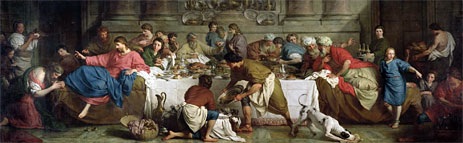
The story is set in a different location, in the house of “Simon the Pharisee” rather than “Simon the leper” of the Mark and Matthew version. And the story, set in Bethany in Judea by Mark, Matthew, and John, is placed in a different location in the narrative flow of Luke’s story—much earlier, in Galilee (Luke 4:14 appears to set the general geographical location for all of chapters 4 to 9).
The woman, anonymous in the other three accounts, is named in the book of signs as Mary, sister of Martha and Lazarus. (There is nothing here, or in other Gospel accounts, that in any way identifies her as Mary Magdalene.) In John’s telling of the story, the meal is linked with the previous story of the raising of Lazarus (11:1–44). That was the incident, according to John, which propelled the opposition to Jesus to crystallise into a fully-fledged plot to arrest and kill Jesus (11:45–57). So the narrative flow is clear: Jesus raises Lazarus, the chief priests and Pharisees order the arrest of Jesus, the woman anoints Jesus, the chief priests plan to kill Lazarus also, and Jesus then enters Jerusalem to the shouts of “Hosanna!” (John 11–12).
This is in contrast to the Synoptic narratives, in which dissension regarding Jesus, evident from early times (Mark 3:6) is later crystallised into a full scale plot to arrest him and have him put to death. The camel that broke the straw’s back in those narratives was the politicised way Jesus entered the city and caused havoc in the Temple courtyard (Mark 11:18; Luke 19:47–48; Matthew softens this immediate impact at Matt 21:15, but describes the full plot at 26:3–5). The debates that Jesus undertakes with various Jewish figures whilst teaching in the Temple precincts (Mark 11:27–13:1; Matt 21:23–24:1; Luke 19:47–21:38) simply aggravates the dissension and accelerates the plot to arrest and kill him (Luke 21:37–2:2).
Perhaps the extravagant amount of perfume used to anoint the feet of Jesus, as was also the case in Luke’s account (not his head, as in Mark and Matthew) reflects the joy of the household in Bethany, as Mary and Martha rejoice that their recently-deceased brother, Lazarus, was now once more alive? Surely extravagant celebration was acceptable after such an event.
But that is not the focus in the Lukan version of this story. In fact, there is no reference at all to the large amount or the lavish expense of the ointment being used. Rather, the Lukan version turns our attention to the matter of the forgiveness of sins—an important theme that has already been sounded in this Gospel in words of Jesus (5:24, 31–32), the proclamation of John (3:3), and the song of Zechariah (1:76–77). That message of forgiveness becomes an integral part of the message that the followers of Jesus were commissioned to share “to all nations” (24:45–47).
The theme is highlighted in the middle of the scene, when Jesus responds to the criticism of the host, Simon the Pharisee, about the woman who has anointed Jesus. He tells, as is typical, a short parable-story about a creditor dealing with two debtors—one who owed owed five hundred denarii, the other who owed fifty. The creditor, presumably modelling the unlimited grace of God, cancelled both debts. The parable then ends, typically, with a pointed question: “which of them will love him more?” (7:42).
The parable uses significant language in discussing the cancelling of debts. First, the verb ὀφείλω (7:41) which appears also in the wording of the prayer which Jesus gave to his followers (11:4), is a clear statement of owing something to someone else. It has a specific material sense. Second, the verb ἀφίημι (7:47,48), which also appears in that prayer (11:4), refers to the forgiving, remitting, or cancelling of such a debt.
Whilst this language can be applied in a “spiritualised” sense to apply to the “forgiveness of sins”, it also has a far more “realist, material” sense in applying to the “cancelling of debts”. So whilst the initial use of the language is in a realist context of the cancelling debts, the conclusion to the story is that Jesus applies it in the spiritualised sense of forgiving sins. And it is this climactic saying of Jesus to the woman, “your faith has saved you; go in peace” (7:50), which sets the scene for viewing “forgiveness of sins” as a key motif in the ministry of Jesus (1:77; 5:24; 11:4; 24:53).


 An Informed Faith