
This post is written by a guest blogger, Nathan Tyson. Nathan is of Anaiwon and Gomeroi descent who has lived in Gadigal land all his adult life. He is a lawyer who worked for government for years before being employed by the Uniting Church as Director of First Peoples Strategy and Engagement, implementing the state-wide strategy that the UCA Synod of NSW.ACT approved about a decade ago.
I acknowledge the custodians of the country we are on today. Of course, when I say “country” I’m talking about Aboriginal “country” not Australia.
For over 60,000 years this continent was cared for by Aboriginal peoples. Aboriginal peoples assumed the role and responsibilities of custodians, and took these responsibilities very seriously as part of long-established law and cultural protocols.
The continent was divided up into territories, which in the modern vernacular we describe as Nations—much like the European continent. The difference being it was many nations of dark skinned Aboriginal peoples, not many nations of white people—but otherwise a similar situation. There were borders, trade, gatherings for ceremonial purposes including weddings and funerals, and occasionally conflicts.
However contrary to popular myth, Aboriginal people didn’t spend all day everyday warring with other Aboriginal people. If we had, we wouldn’t have survived for so long with so many different groups or nations on the continent at the time of British colonisation. If Aboriginal peoples were about conquest and land acquisition for power and profit, history and logic suggest is likely there would have only been 4 or 5 large groups left, the more powerful groups having conquered or killed smaller groups that refused to cede their lands and join the larger group. But we know that is not the case.
The reality is that Aboriginal peoples knew their country. They knew their boundaries and their significant sites. People knew where to go, and where not to go. I have been reliably informed by a senior law person, that by the time an Aboriginal child was around 9 years old they were completely proficient at surviving in the bush—which would have included knowledge of the boundaries of their country, and who was on the other side.
As Aboriginal peoples had everything they needed within the bounds of their country—food, water, ceremonial and religious sites, and so on, there was usually no need to seek to invade or otherwise take somebody else’s country. Each mob had their special places of ceremony—men’s sites and women’s sites, and community spaces for corroboree and celebration. Each country was a self-contained living environment.
Country held all that was needed to sustain life and community. Law maintained social relationships and guided behaviours. Law was about care and respect for the land and its creatures, and about care for each other. Interestingly, I’ve been told that no Aboriginal language had a word for “hate”. We know through various dreaming stories, like Tiddalick the Frog, that greed was frowned upon and there can be serious consequences for the greedy.
Aboriginal stories and oral traditions are deeply rooted in values of reciprocity, kinship, and looking after one another, often connecting these human actions to the care of the land (Caring for Country. These stories highlight the importance of sharing, cooperation, and the responsibilities family members have toward each other.
I will share some examples of Aboriginal stories and themes that focus on caring for each other:
- The Cockatoo Sisters and the Magic Digging Stick: Told by Nyikina Warrwa woman Dr. Anne Poelina, this story follows two sisters, Walibun and Yaranari, who have the responsibility of caring for their grandfather. It highlights the importance of responsibility and the consequences of selfish actions.
- The Koala Brothers (Dunggirr Gagu): A Gumbaynggirr story from the mid-North Coast of NSW, this narrative tells of brothers who used their long intestines to create a bridge, reuniting their people after rising seas separated them.
- How the Kangaroo Got its Pouch: When a dingo chased a baby joey, an Ancestor Being gifted the mother kangaroo a pouch to protect her young, demonstrating a theme of providing care and safety for family.
- The Seven Sisters: This Dreamtime story, while covering themes of pursuit, also emphasizes strong family bonds and the necessity of following traditional lore to maintain balance. (link to “3 Sisters” of the Blue Mountains – there are actually 7 sisters, with this story being told across the continent by many mobs.).
- The Emu and the Jabiru: A story that emphasizes the necessity of cooperation and the negative repercussions of selfishness, teaching the value of sharing.
- The Lyrebird and the Frog (Joolah and Googarty): A story about a creator who corrects a frog for inciting arguments among animals, teaching that caring for one another involves harmony and not spreading discord
These stories contain the following themes:
- Charina and Community: Stories often emphasize that taking only what vou need and sharing resources such as water, fire, and food ensures that there is enough for everyone.
- Intergenerational Care: Stories often feature Elders passing down knowledge to children to ensure their safety and the continuation of culture.
- Kinship and Protection: The concept of “kinship” means looking after family and community, which is often depicted through stories of protecting one another, especially children.
- Caring for Country: The belief that all things are connected means that caring for the land is directly linked to caring for people and keeping everything in
balance.
When I read or hear these stories, and wisdom from Elders, it strikes me that Aboriginal peoples lived in a manner that both honoured the Creator (through ceremony, and through honouring and caring for creation), and also ensured that the least were well cared for. Everybody was included, everyone had a meaningful role in community, and everyone was cared for.
Does that sound familiar? Yep, it sounds a lot like the way Jesus taught us we should live – in right relationship with the Creator, and right relationship with each other.
Yes, sometimes conflicts would arise, either within a mob, or between mobs. Humans are still humans, and poor decisions can sometimes be made. However conflicts were resolved according to law, usually through discussion and agreement on punishment and/or restitution. Discussions could take days, weeks or longer if necessary. Aboriginal peoples were perhaps the first to contemplate a formal process of alternative dispute resolution! In any event, physical conflict would usually only occur if discussions failed to resolve the disagreement. Fortunately, there was only infrequent physical conflict between groups due to the effectiveness of the law and recognised importance of relationships.
To be clear, Aboriginal communities were inclusive, and caring. Everyone was looked after. Everyone had a role and everyone had responsibilities. Our culture tends to be focussed on “obligations”, not “rights”. Because if everyone took care of their obligations, everyone was cared for, safe and healthy… people didn’t need to demand their “rights” as they were already being cared for, included and loved.
When we look at the Western world, and the impact of capitalism and currency, and the lust for wealth and power they create, we can see that we are heading in a direction where humans will be lucky to exist on this planet in a few hundred years, let alone in 60,000 years time.
But rather than seek and value the wisdom of the oldest continuing culture on the planet, in the hope of caring for the planet and living sustainably, wealthy non-Indigenous people tend to focus on building spaceships on the assumption we will need to leave this planet at some point – I suspect to find a whole new planet to exploit for power and profit.
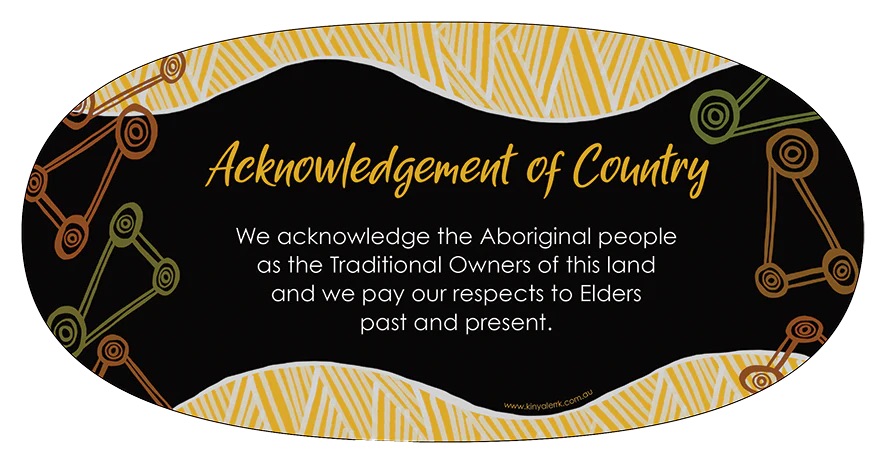
So when we acknowledge country, we are acknowledging both the people of that place, as well as the complex system of law and relationships that is intrinsically connected to the particular country we are on. Being on somebody else’s country is a privilege, and we should be respectful of the law and protocols of that place.


