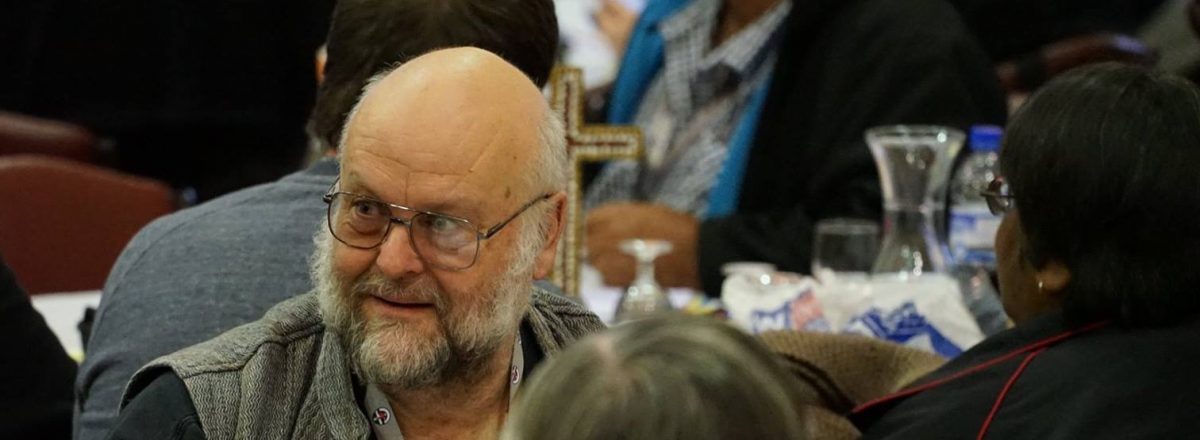
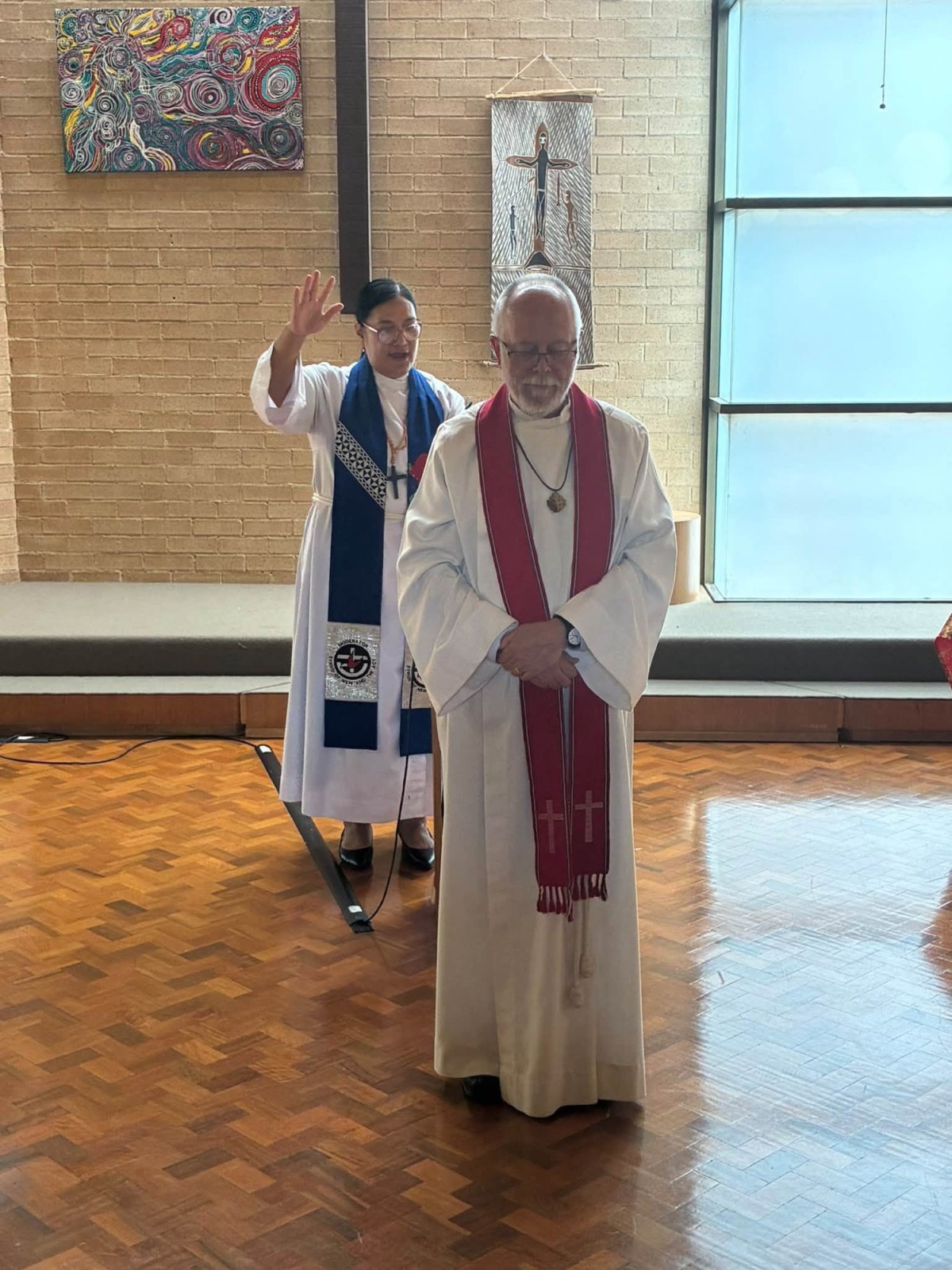
“Can I invite you to imagine a scene? It’s a Saturday night in Sydney in January 1983. A group of friends from uni have gathered for an evening of partying, drinking together and either celebrating the end of uni or preparing to go back again for another year.” It’s not the usual way most sermons start; but it was the way that this sermon started. It introduced a report of a fairly mundane interaction between two early 20-year olds, four decades ago, meeting “to do all the fun things that made sense for young people in 1983”, as the preacher explained.
Except that the interaction turns out not to have been quite so mundane. For the two early 20-year olds having this conversation each turned out to become mature adults whose working lives offered faithful, committed, insightful—and even radical—ways of leadership. The preacher was Michael Thomas, who ultimately has served both as a Uniting Church Minister in a series of four urban congregations: Corrimal, Normanhurst, Willoughby, and Crows Nest.
Alongside that series of local ministries, however, Michael also offered important leadership in a less public way as convenor of a committee dealing with “broken trust, betrayal of call, and deep pain for innocent and vulnerable people, families, friends and congregations”. Michael was a young radical in the 1980s (he featured in a front page newspaper photo which allegedly comprised “lesbians and communists” protesting the visit of a prominent American televangelist of the time). As his long hair shortened and greyed, his wisdom, insight, and compassion grew. His capacity for knowing the radical call of the Gospel, as it turns out, has not dimmed over the years. But more on that a little later.
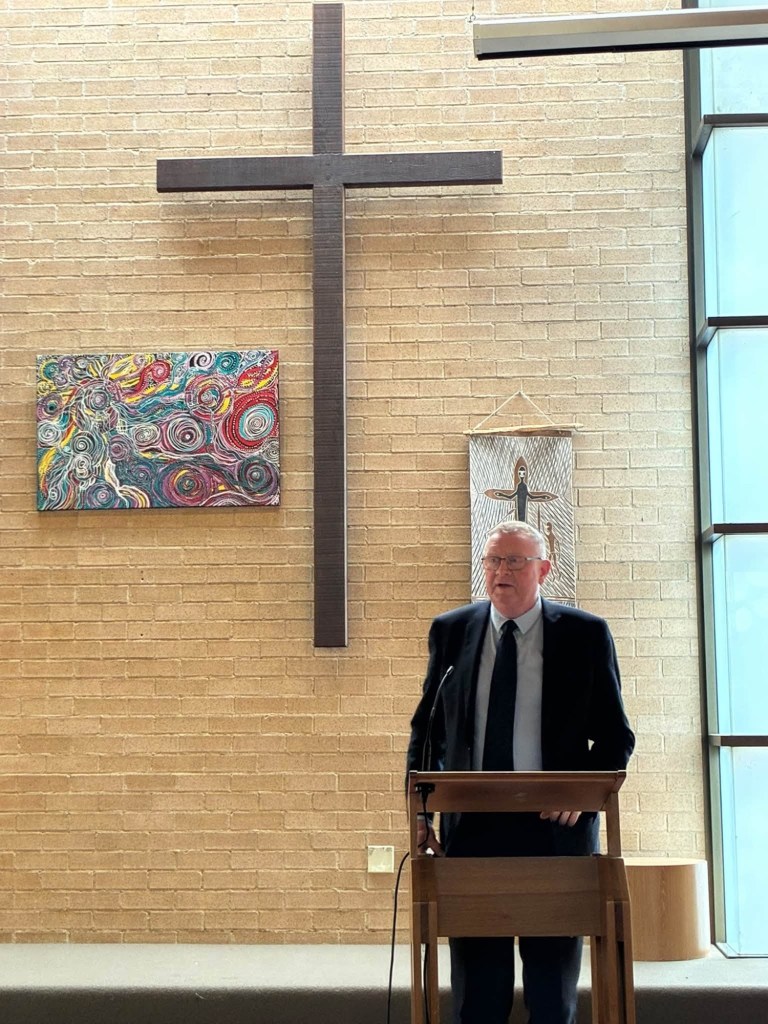
in the Chapel of St Andrew at the Centre for Ministry
in North Parramatta, on Burramattagal land
The other person involved in that 1983 conversation was Rob McFarlane; young, eager, and launching into theological studies with a view to ordination, which did indeed happen on the very last Sunday of 1985. Rob would go on to offer an incredibly rich and varied ministry over 41 years, across two Synods and five Presbyteries of the Uniting Church, including not only congregational ministry and educational ministry for lay people and candidates preparing for ordination, but also strategic leadership roles in Presbytery and Synod roles, as well as work in national commissions and task groups of the Assembly.
Now, radical is perhaps not the word that his friends and colleagues would apply to Rob. But just as Michael has pressed the radical call of the Gospel, so Rob has patiently and consistently advocated for the church—and especially for those in ministry exercising leadership in the church—to grasp the changing nature of contemporary society, and the changing place of the church that is intimately associated with that. The church needs to understand the dynamics of transition, as old certainties fail, changes swirl, and new possibilities are glimpsed. And in that process, radical change is surely essential.
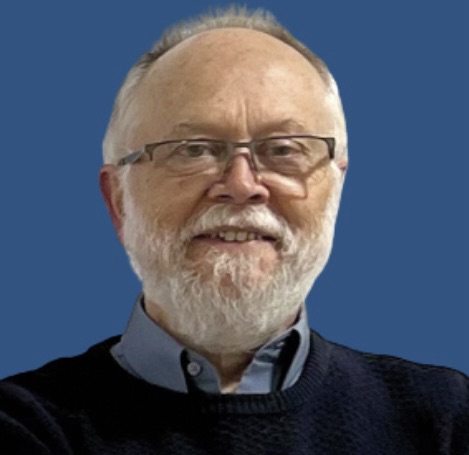
GradCert University Teaching & Learning, MEd Leadership
Transitional Ministry became a key focus for Rob, as he himself trained as an Intentional Interim Minister, then took on the role of Australian Director of IIM training, and then in turn developed the Foundations of Transitional Ministry module which, now, all candidates for ministry must complete before ordination. And over a number of decades, Rob equipped hundreds of church folk, in many states and across a number of denominations, to grapple with the challenges inherent in this situation of change.
His own studies, first in foundational theology, then in advanced biblical studies (gaining a PhD with an innovative perspective on Mark’s Gospel), then in transitional ministry, as well as in educational methodology and practice, all fed into the growing richness of the ministries he offered.
Here I need to note that my own interactions with Rob have been many and varied over the years. True, he and I were both accepted as candidates for ministry at the very same meeting in mid-1978; but I confess I have no memory at all of Rob from that night. (Sorry, Rob.) Rather, I recall the crusty former Presbyterian minister who scowled at me, “you youngster” (even though I was six years older than Rob!!) and the genial former Methodist minister who pressed me that I had “little life experience” (years later, a much-appreciated colleague working from the office next door to mine).
A decade after that candidature meeting, I did meet Rob, and I recall that meeting at Neutral Bay, at the church just down the road from where I had once attended school. I was to join Rob as a visiting lecturer teaching in New Testament at the theological college. It was the beginning of 25 years of collaborative teaching, as I became a member of the UTC Faculty, and Rob continued to teach Greek and biblical exegesis, as well as in other areas, in the midst of his various ministry roles.
As Director of Continuing Education, Rob was charged with planning an annual Seminar Week at the Centre for Ministry at North Parramatta. Faculty members took turns to work with Rob on this task. Some years were more successful than others. Elizabeth and I had a wonderfully fruitful collaboration with Rob in the early 2000s, when Elizabeth’s doctoral supervisor, J.D.G. Dunn, was the keynote speaker. The auditorium was filled to overflowing every day! A few years later, Elizabeth convinced another eminent New Testament scholar, Donald Hagner, from the US, to be our keynote speaker. Another good year working with Rob.
Subsequently, Rob himself became my teacher, as I took the course in Intentional Interim Ministry (IIM) which my wife Elizabeth had previously completed under Rob’s tutelage a few years earlier. Rob has often, very kindly, referred to Elizabeth as “the Synod’s most experienced IIM” because of the multiple transitional placements she has had. Later, the three of us co-taught many IIM modules to ministers from various Synods.
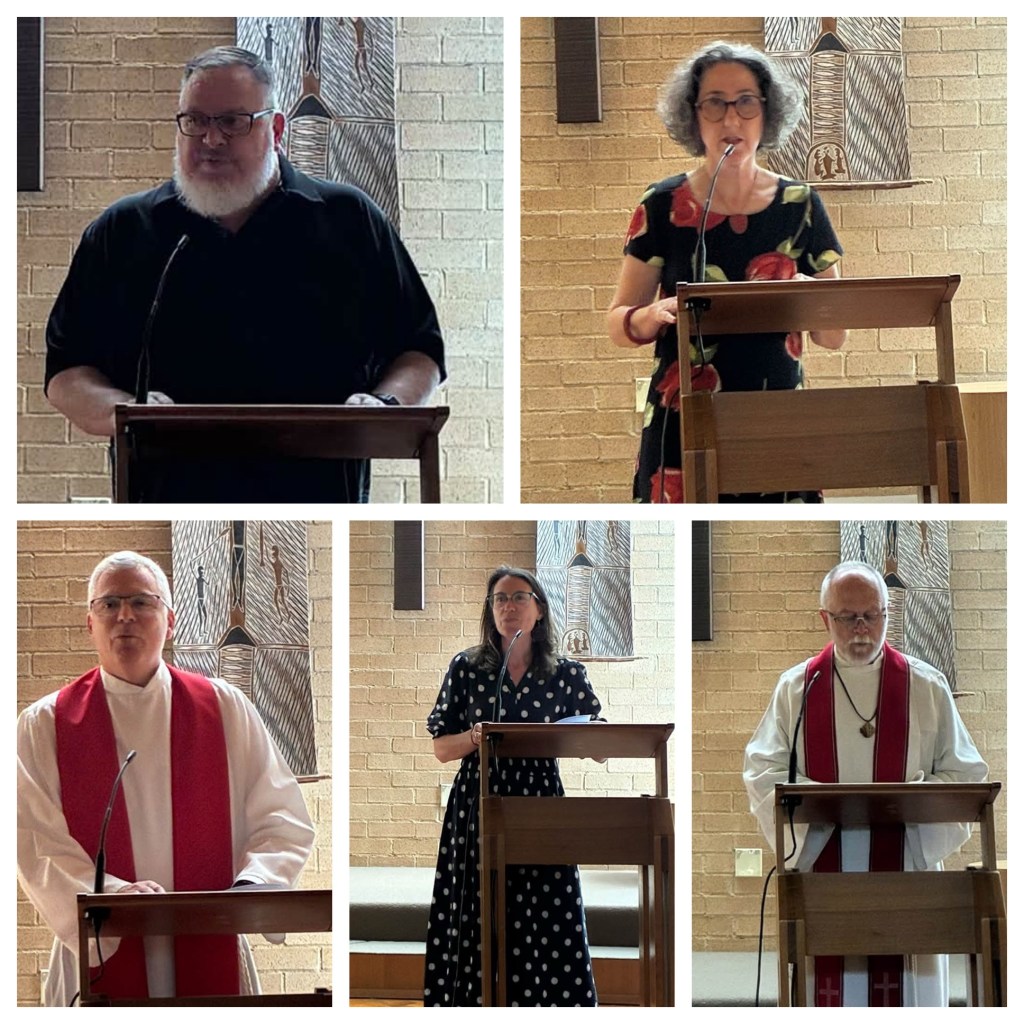
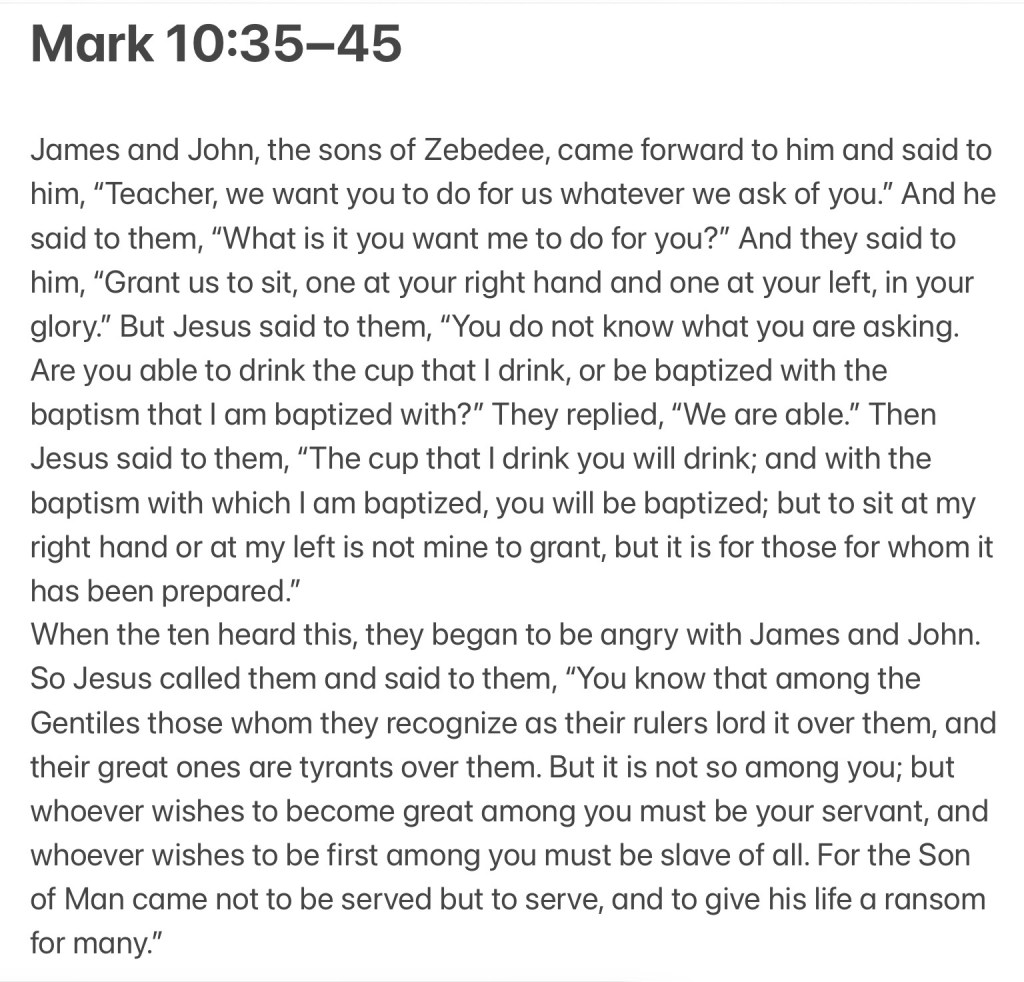
It was, indeed, at the formal Closure of Ministry service for Rob McFarlane that Michael Thomas was speaking, in keeping both with his own undying passion for the radical nature of the Gospel, and also with the persistent work of Rob to equip church leadership that would nurture and support transitions in church life. In his sermon, Michael set the foundation as the penetrating comment of Jesus recorded in Mark’s Gospel, instructing his followers that “whoever wishes to be great among you must be your servant and whoever wishes to be first among you must be slave of all” (Mark 10:43–44). From that basis, Michael posed the question, “how has the church done in its attempts to live out the values of Jesus, so that the mighty do not lord it over those at the bottom of the heap?”
The sermon which the once-radical longhaired young adult offered, now arrayed in his smart suit and tie, with neatly trimmed hair, to the middle-aged-to-elderly faithful of the Uniting Church gathered in the Chapel of St Andrew, was a hard-hitting call to accountability for the church in which he was ordained, in 1987, and in which he served for almost four decades: the Uniting Church in Australia. “We had joined a progressive movement that we truly believed was going to change this country. We believed in the dream, and in what we hoped was the intelligence of the Australian community”, he declared. He cited an early action in which the Uniting Church stood up for Land Rights, when “the Bulletin magazine famously alleged that the church had been taken over by Marxists”. He also adduced the 1977 “Statement to the Nation”, which “directly addressed the Australian public rather than just its own members”. The church was outward-oriented, action-focussed, enthusiastic.
“I personally was convinced the Uniting Church would become the dominant denomination in this ‘Great Southland of the Holy Spirit’”, he continued. “Instead, Pentecostalism flourished (and flamed out), Cardinal George Pell led the Catholic Church back to the 1950s, and Sydney Anglican churches emptied Uniting churches up and down our North Shore with simple answers to life’s complex questions.”
The promise of the newly-formed church of the 1970s failed to materialise, in the analysis of Michael Thomas. Initially, “the Uniting Church avoided the practices of other parts of Christianity that had a hierarchical ministry structure, with bosses and associates and pay scales that improved with rank”, he noted. And yet, he continued, “the Uniting Church hasn’t turned into what we believed it would. I have been disappointed to see it become a frightened, inward-looking, control-oriented, top-down, hierarchical shadow of its former self.”

With the current “hierarchy” of Synod Moderator, Synod Secretary, Synod Associate Secretary, and UTC Principal all sitting in the very front row, he referred to a lack of egalitarianism that has been evident, he felt, in various ways in recent times. Michael saw the church “in a losing battle to keep the values of our culture and the practices of managerialism out of our once-idealistic denomination”.
But this was no whinging, complaining sermon without any resolution. Rather, as he noted that “the Christian church to whom Mark’s Gospel was addressed was a beacon of light and hope [which] demonstrated that countercultural role through its love ethic and the way it organised itself”, Michael observed that the early believers in this community “found themselves part of a growing movement was that at least tried to honour the words of Jesus. They did their best to resist the thinking of James and John, who imagined that a place at the heart of the Christian movement would give them a seat of glory on the right and left hand of the Father. They did their best to resist the claims of empire.”
So he offered the optimistic assessment that “thanks to the efforts of Rob and other like-minded people in this room and elsewhere, the same can be said of our part of the Christian church today”. He then issued all present with a challenge: “Of all the dangers facing the church in this time of transition and change, the worst would be to give in to our fears. A fearful Uniting Church parks the wagons in a circle. It imagines our message is irrelevant to our times and retreats into itself.” And then, “Today is a good time to remind ourselves that we do, actually, have a clear and winsome message for society. Church done well powerfully models servant leadership and humility. If only we have the clarity of thought, the theological confidence, and the energy and vigour to claim our rightful place, and honour the servant king.”
His closing words drew together his respect for Rob’s ministry—“your intellectual strength, your work ethic and your doggedness have endeavoured to keep the church true to the vision for which we signed up”—with a call that deserves to be heard beyond the group of people gathered for this celebratory occasion: “May the church that we have served and love live out this countercultural vision and continue to work for justice and peace in God’s world.” Amen!
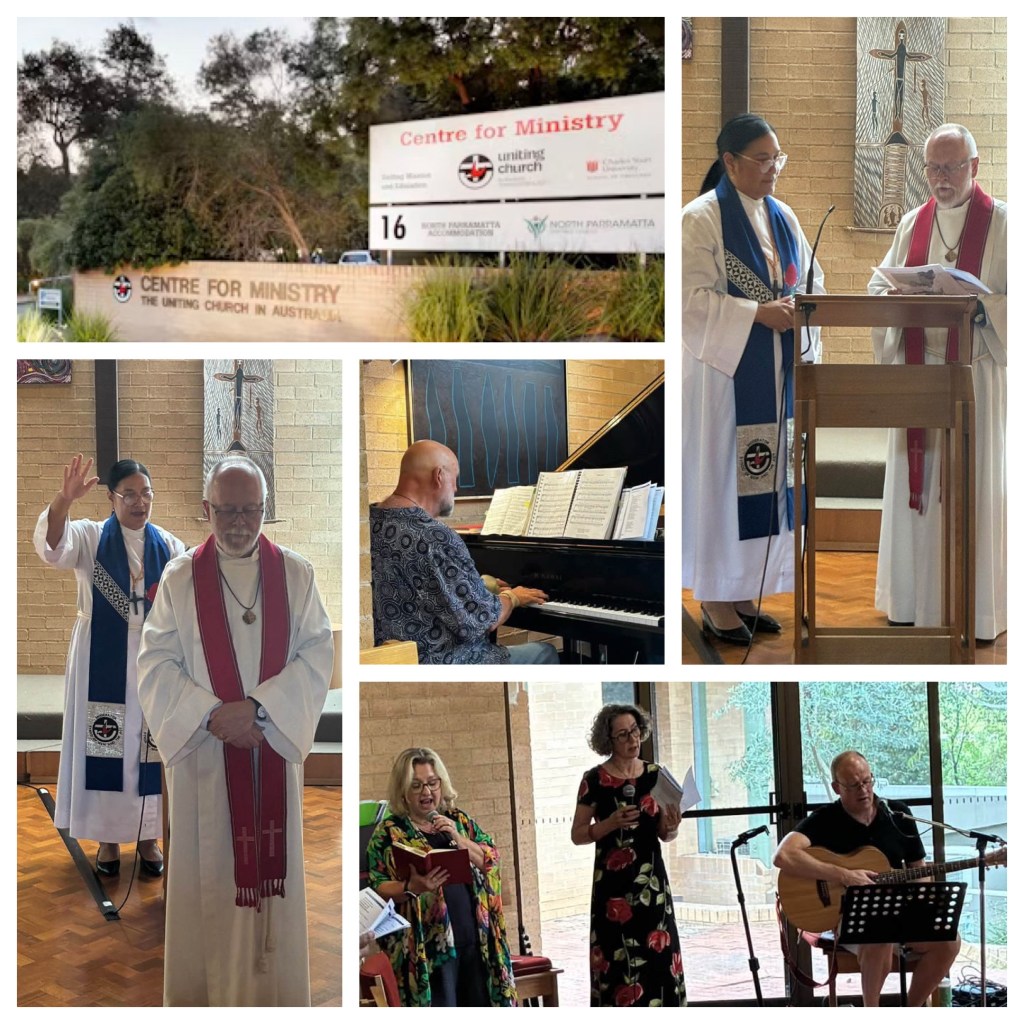
Occasions such as this are solemn formal events. The Moderator of Synod formally released Rob from his most recent placement—overseeing a major transitional phase for the structures of the Synod of NSW and the ACT, as twelve Presbyteries (some no longer able to function effectively) were brought together, by common agreement, into a new “3P structure”: Northern Presbytery, Central Presbytery, and, you guessed it, Southern Presbytery. But the whole occasion was permeated by good spirit and joyful celebration.
Rob offered his “formal response”, showing once again his typically wry humour amidst the lengthy commentary. Longterm friend Graham Perry took on the persona of a wannabe stand-up comedian, relating a string of anecdotes designed to entertain and relax us all. Peter Overton and Pablo Nunez each spoke words of appreciation for how they had experienced the ministry of Rob.
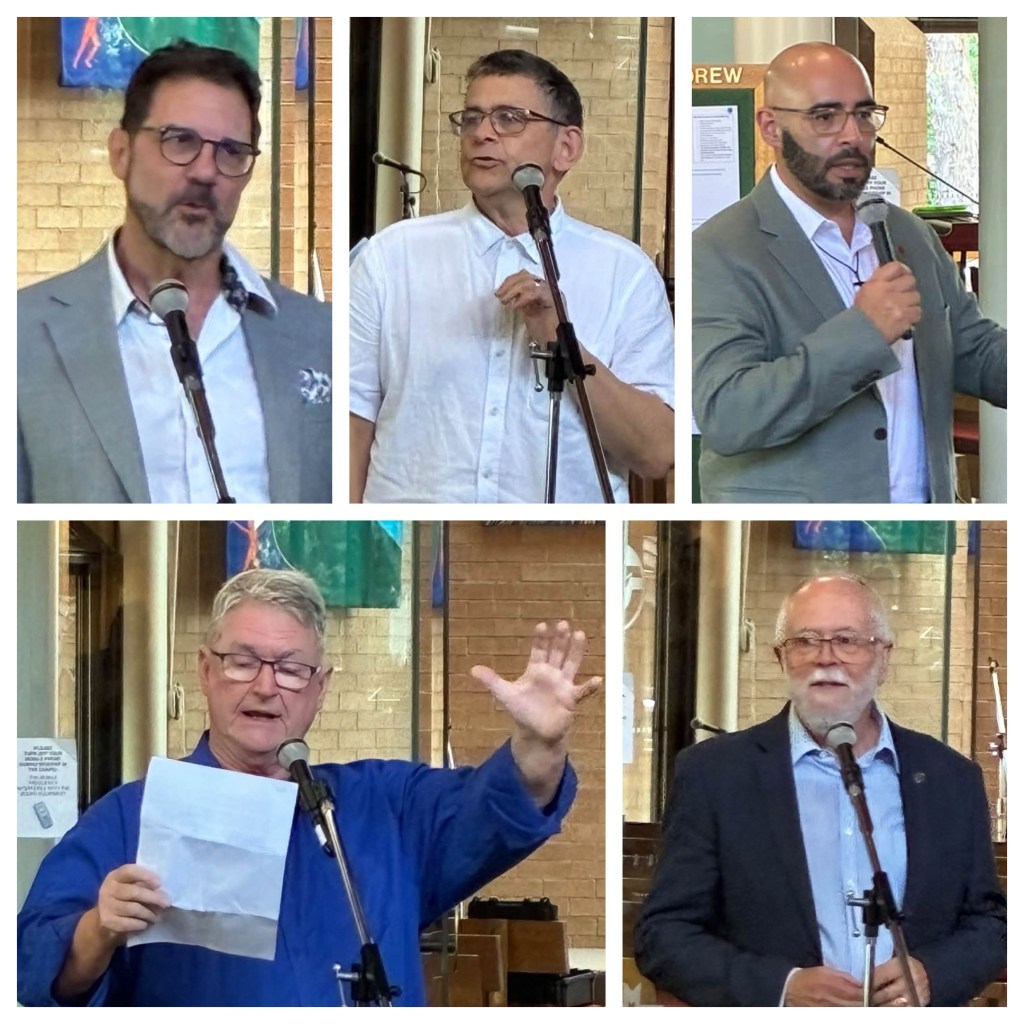
Bottom row: Peter Willey, Rob making his final comments.
Then, one of the other early 20-year old Macquarie University students from that 1983 conversation beside Sydney Harbour, Peter Willey, brought the evening to a close with a rendition of Craig Mitchell’s bush ballad, The Day McFarlane Preached, followed by his own balled “about the tedium of a preaching contest, featuring Michael and Rob as protagonists”—although Michael insists the ballad was actually “celebrating our oratory skills and our economy of language”. Those of you who know them both: you be the judge!
*****
You can read Rob’s own reflections on his years in ministry at
https://insights.uca.org.au/articles/i-was-ordained-in-december-1985/
The words of Craig Mitchell’s ballad (inspired by an actual historical preaching event, but surely greatly reinterpreted in the poem) are at

