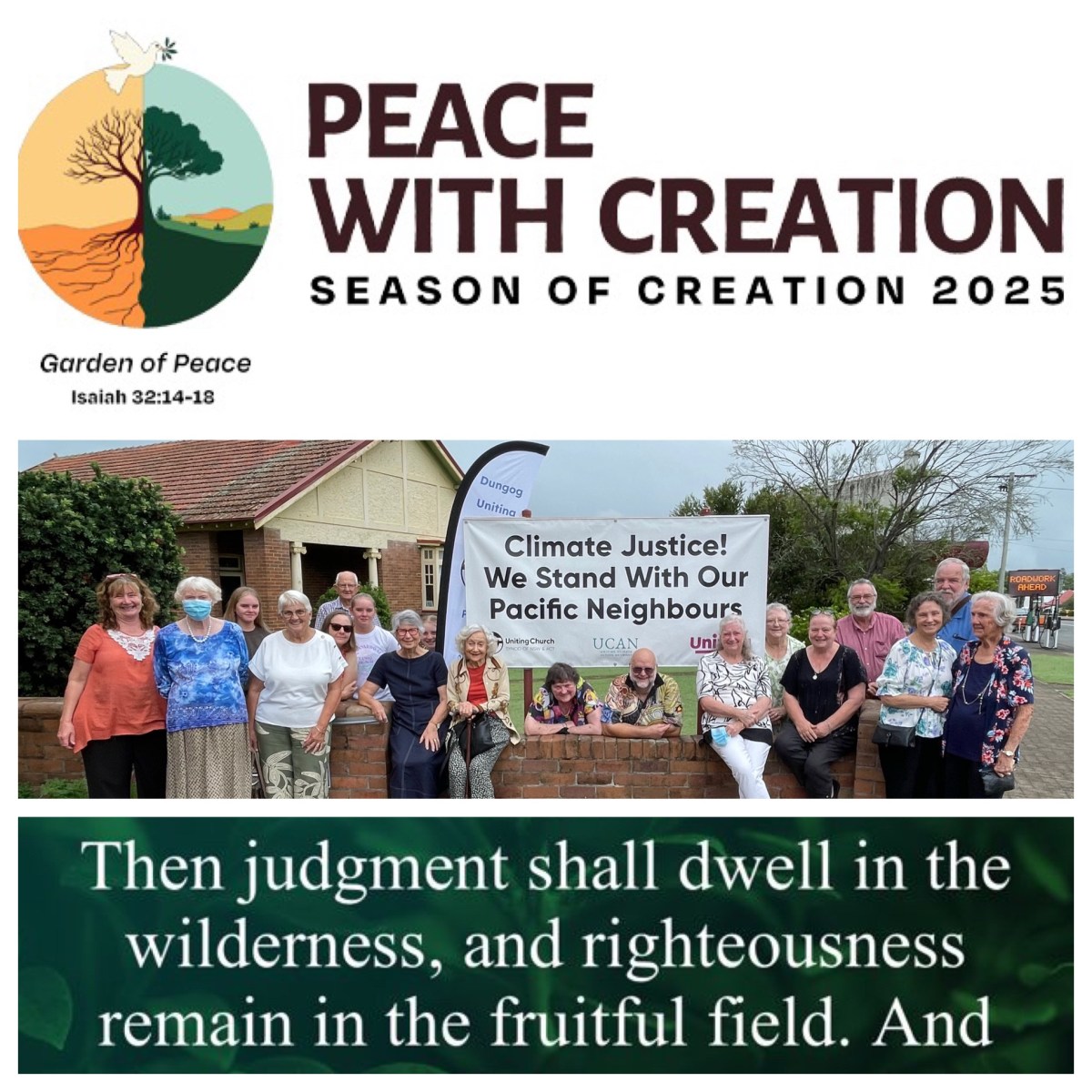
Standing on holy ground (Exodus 2–4; Narrative Lectionary for Pentecost 16)

Discussion of the Narrative Lectionary passage from Exodus 2–4

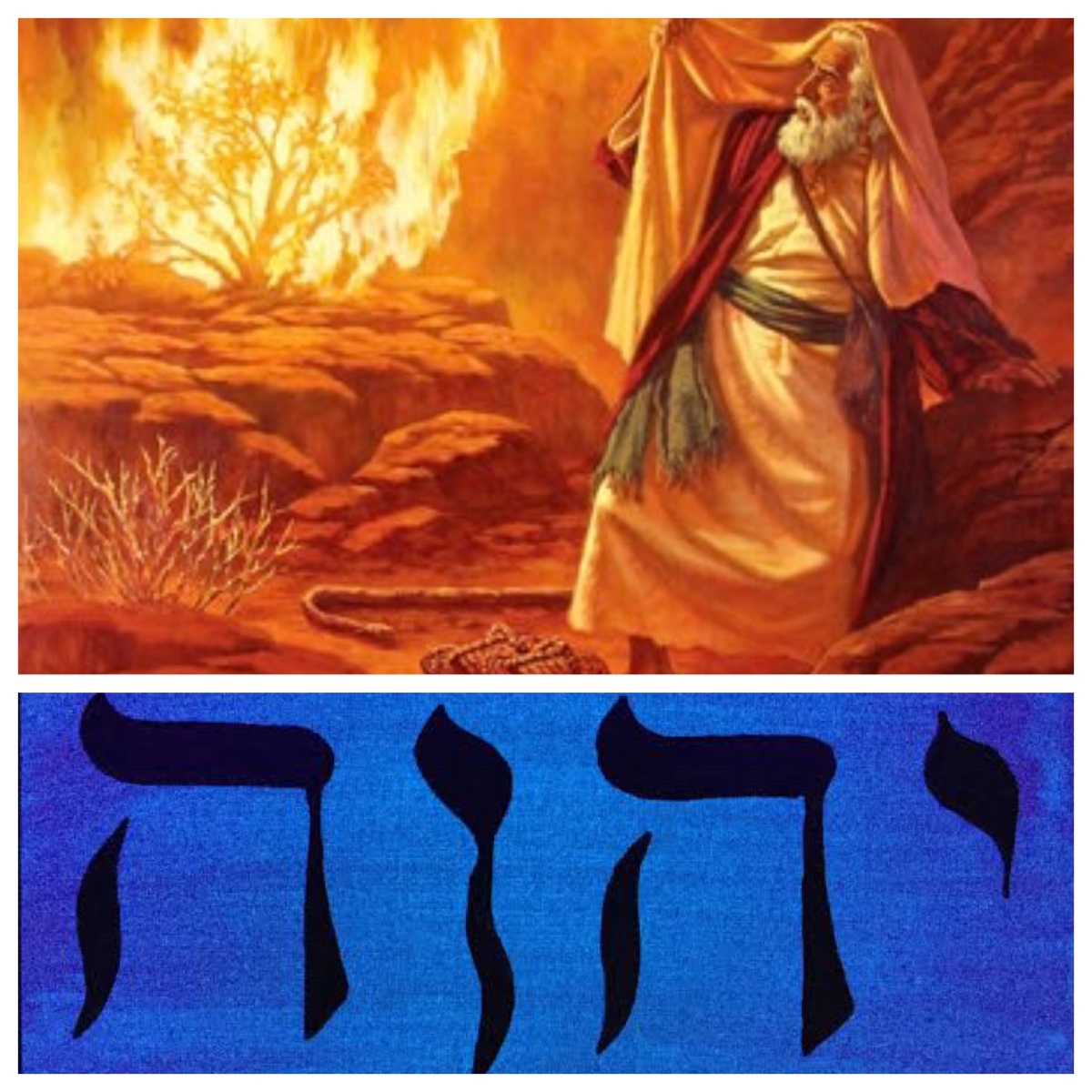
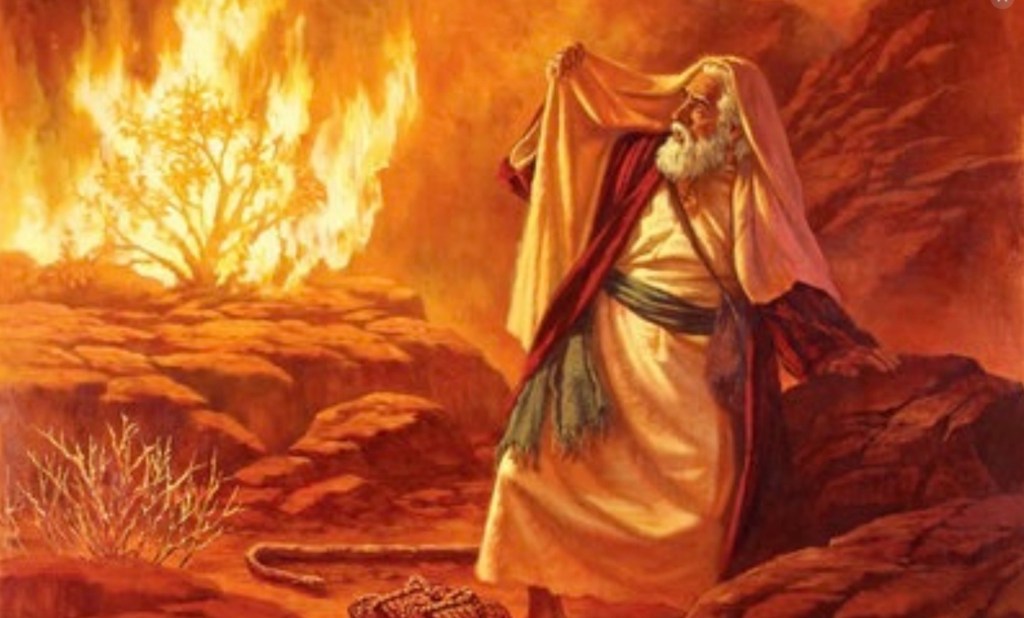
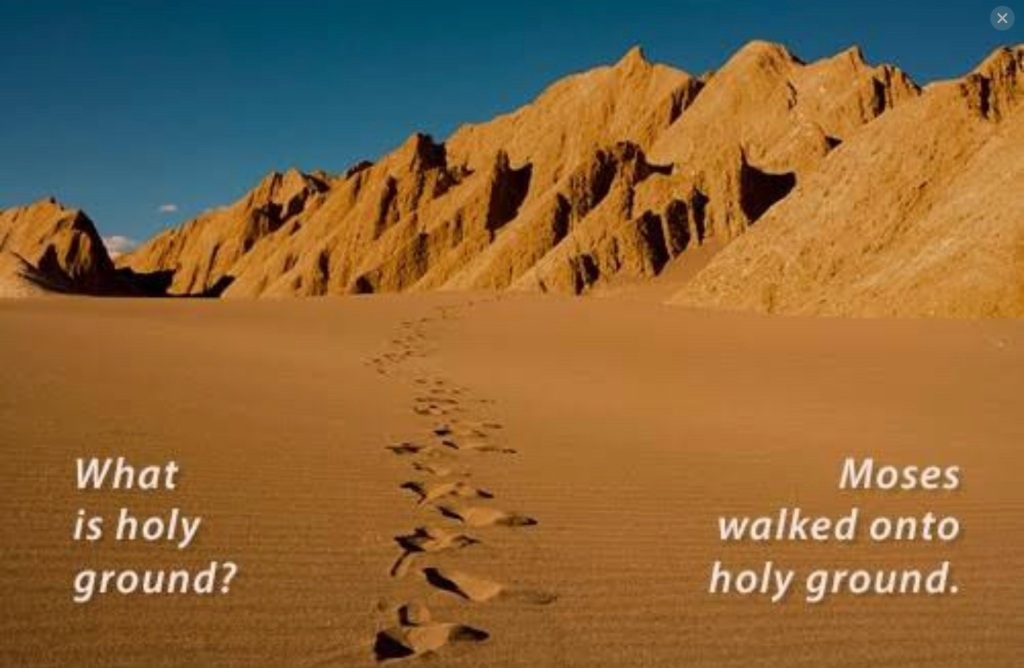
“The angel of the Lord appeared to [Moses] in a flame of fire out of a bush; he looked, and the bush was blazing, yet it was not consumed. Then Moses said, ‘I must turn aside and look at this great sight’ … and  [when] the Lord saw that he had turned aside to see, God called to him out of the bush, ‘Moses, Moses!’ And he said, ‘Here I am.’ Then he said, ‘Come no closer! Remove the sandals from your feet, for the place on which you are standing is holy ground.’” (Exod 3:2–5)

The story of the burning bush is well-known; it is the moment when Moses, the murderer who has fled from Egypt (2:11–15), is galvanised by a striking event to become Moses the liberator, the one who will “go [back] to Pharaoh to bring my people, the Israelites, out of Egypt” (3:10). The transformation is striking—although perhaps the transformation is not quite as dramatic as many envisage.

It may well be the case for Moses that a strong sense of justice undergirds both his act of killing the Egyptian who was beating a Hebrew (2:11), and his commitment to deliver the Israelites from “the misery of Egypt” (3:17). Moses was passionate about the need for justice in society. Paradoxically, this passion led him to say NO to a man he witnessed committing a crime, and YES to a body of people who were suffering oppression in a foreign land. 

Of course, common sense says that Moses should not have taken things into his own hands when he saw that Egyptian man beating one of his fellow-Israelites. But the passion within him—passion for fairness and justice—boiled up inside him and overflowed into unjust actions. This was in keeping with the charge given to the father of his people, when God mused about Abraham, “I have chosen him, that he may charge his children and his household after him to keep the way of the Lord by doing righteousness and justice” (Gen 18:19).

No wonder Moses fled, escaping the wrath of Pharaoh, travelling east across the desert areas of the Sinai Peninsula, all the way to Midian! (Exod 2:15). His action, out of proportion with the crime he saw being committed, was unjust. It is not a very propitious start for Moses, the man who towers over the story of the people,of Israel—ironically, best remembered as Moses the lawgiver!

Mind you, throughout Genesis, we have been regaled by tales of men behaving badly—Abraham lying about his wife Sarah as his sister (Gen 12 and again in Gen 20) and threatening to sacrifice his own son (Gen 22); Isaac, who also lied that his wife Rebekah was his sister (Gen 26); and Jacob, the deceiver, who stole his birthright from his twin brother Esau (Gen 27) and then deceived his father-in-law Laban and profited from his flock (Gen 30–31). And let’s not go into the treatment of Joseph by his brothers, throwing him into a pit in the desert, and then selling him off to some passing Midianite traders (Gen 37). And there are more; they are not exactly wonderful role models!

Yet the story about Moses that we are offered by the Narrative Lectionary this week presents Moses in a much more positive light, and it contains two fundamental elements in the story of Israel: the declaration that Moses stands on holy ground, and the revelation of the name of God. 

Holy ground

God’s word to Moses, after calling for his attention, is to declare that “the place on which you are standing is holy ground” (Exod 3:5). This is the first occurrence of the concept of holiness in the Torah—the word is absent from all of the narratives in Genesis. And it is fascinating that this “holy ground” is in Midian, both far away from Egypt and far away from Canaan, the land that would subsequently be decreed as holy (Exod 15:13; Jer 21:23; Zech 2:12). This God is now able to appear in places far away from Canaan, and declare them holy.

A central motif in Hebrew Scripture is that holiness was a defining character of the people of Israel. A section of Leviticus (chapters 17—26) is known as “The Holiness Code”; its main purpose was to set out laws to mark Israel as different from the surrounding cultures. “You shall not do as they do in the land of Egypt, where you lived”, God told Moses, “and you shall not do as they do in the land of Canaan, to which I am bringing you” (Lev 18:2). 

The rules of Leviticus were meant to set the Israelites apart from the Canaanites and Egyptians, who at that time had customs and rituals that were not to be adopted by the Israelites. Moses is instructed to relay to the people, “you shall be holy, for I the Lord your God am holy” (Lev 19:2), and to remind them to “consecrate yourselves therefore, and be holy; for I am the Lord your God. Keep my statutes, and observe them; I am the Lord; I sanctify you” (Lev 20:7). The whole book details those many statutes and commandments, all designed to keep the practices of the Israelites “holy to the Lord” (Lev 19:8; 23:20; 27:14–24).

Once the Temple was constructed, as a holy place within that holy land, those who ministered to God within the Temple, as priests, were to be especially concerned about holiness, both in their daily life and in their regular activities in the Temple (Exod 28–29; Lev 8–9). The priests oversaw the implementation of the Holiness Code, explaining the various applications of the word to Israel, that “you shall be holy, for I the Lord your God am holy” (Lev 19:2; also 20:7, 26). 

In the years before and during the exile, a number of prophets took to addressing the Lord God as “the Holy One of Israel” (Hos 11:9, 12; Isa 1:4; 5:9, 24; 10:20; 12:6; 17:7; 29:19; 30:11–15; 31:1; 37:23; 41:14–20; 43:3, 14; 45:11; 47:4; 48:17; 49:7; 54:5–6; 60:9, 14; Jer 50:29; 51:5; Ezek 39:7; Hab 1:12; 3:3). The psalmists also pick up this phrase (Ps 71:22; 78:41; 89:18), reflecting the affirmation made by Hannah, “there is no Holy One like the Lord, no one besides you; there is no Rock like our God” (1 Sam 2:2).

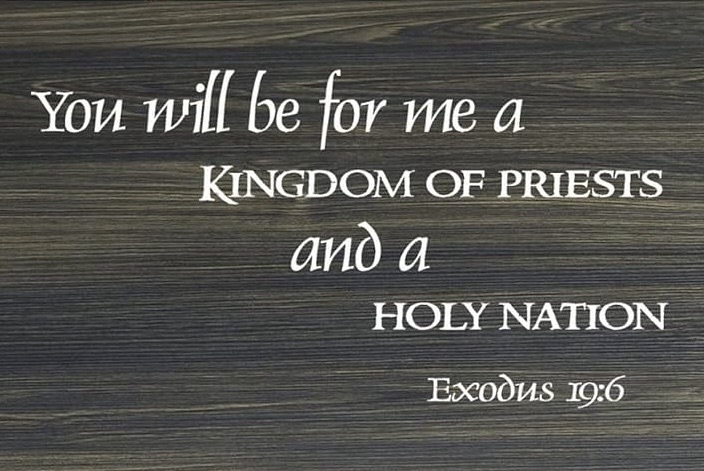
As a consequence, Israel is regularly assured that the whole nation is a “chosen people” (Deut 7:6–8, 14:2; Ps 33:12; Isa 41:8–10, 65:9), set apart as “a kingdom of priests, a holy nation” (Exod 19:4–6), called to be “a light to the nations” (Isa 42:6, 49:6). So in the towns and villages of Israel, by contrast to the centralised priests, the scribes and Pharisees provided guidance in the interpretation of Torah and in the application of Torah to ensure that holiness was observed in daily living of all people in Israel.

These dispersed teachers undertook the highly significant task of showing how the Torah was relevant to the daily life of Jewish people. It was possible, they argued, to live as God’s holy people at every point of one’s life, quite apart from any pilgrimages made to the Temple in Jerusalem. These figures, scribes and Pharisees, are evident in a number of interactions with Jesus that are reported in the Gospels—interactions focussed on interpreting the Torah (Mark 7:1–23 and Matt 15:1–20 exemplify such encounters).

Perhaps the origins of this localised interpretive role are told in the post-Exilic narrative of Nehemiah, when “the priest Ezra brought the law before the assembly, both men and women and all who could hear with understanding”, ably assisted by men who “helped the people to understand the law, while the people remained in their places”, explaining the significance of “this holy day” and other matters (Neh 7:73b—8:12). The story explains the modus operandi of these teachers.

Certainly, the culture and religion of the Israelites was to be marked by a concern for holiness. This is read back into the foundational narrative of the call given to Moses, “to bring my people, the Israelites, out of Egypt” (Exod 3:10, 17). When he hears this call in Midian, Moses is standing on holy ground (3:1-12).

Name of God

Although he is in Midian, far away from Canaan (later to become Israel), Moses encounters the God who is most firmly identified with that land. It is “the Lord, the God of your ancestors, the God of Abraham, of Isaac, and of Jacob” who appeared to Moses (Exod 3:6, 16). This is the first occurrence of this characteristic linkage of the Lord God with the three patriarchs (see also Exod 3:15–16; 4:5; 6:3, 8; 33:1; Lev 26:42; Num 32:11; Deut 1:8; 6:10; 9:5, 27; 29:13; 30:20; 34:4; 2 Ki 13:23; Jer 33:26).

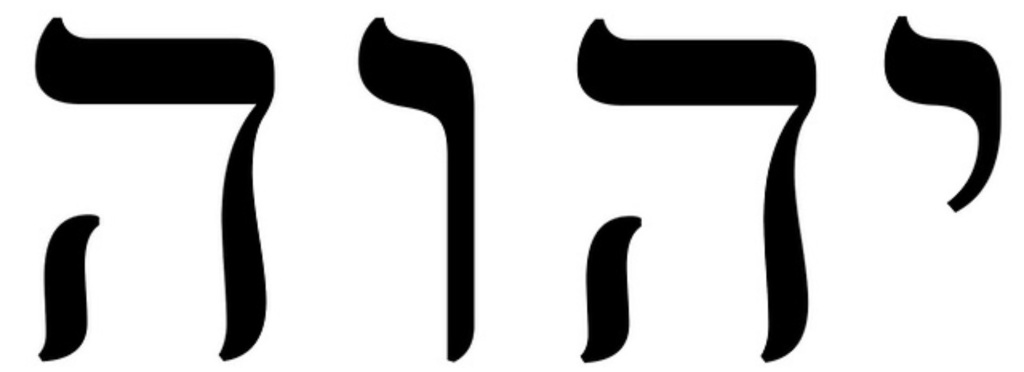
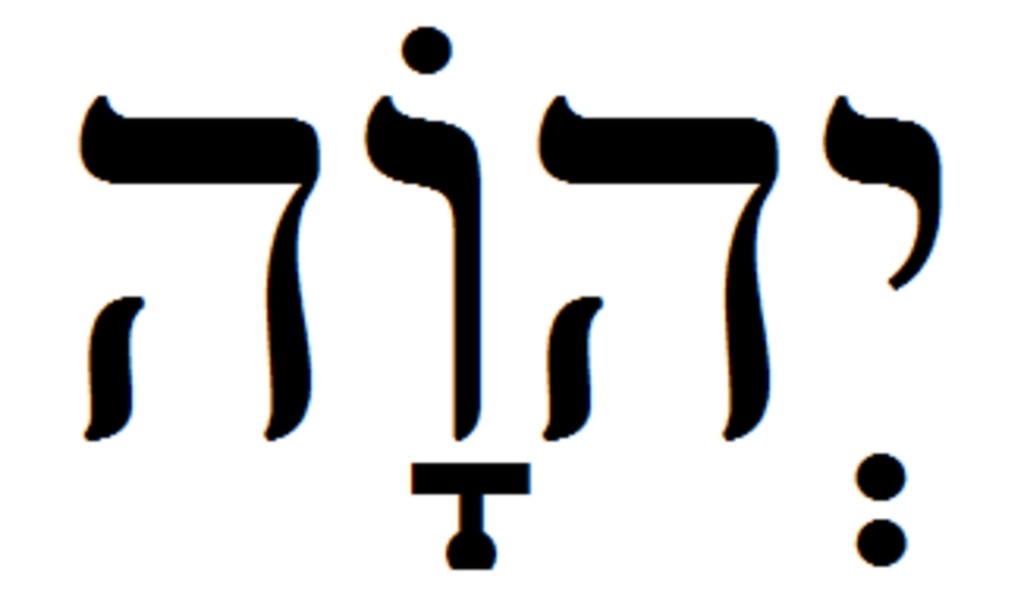
Identified, therefore, as “the God of your ancestors” (in Hebrew, elohe abotekem) (3:15, 16; 4:5), a distinctive term is added into the mix, and highlighted by God as “my name forever … my title for all generations” (3:15). The term is regularly translated as Lord, and is often capitalised to indicate its distinctive nature. In fact, the name comprises just four consonants (transliterated as yhvh or yhwh). 

Despite its apparent simplicity, the meaning of the word has occasioned intense discussion amongst interpreters over the centuries. First, we should note that many Jews today adhere to the age-old prohibition and do not speak the name of God. This is based on the third of the Ten Commandments, “You shall not take his name in vain” (Exod 20:7; Deut 5:11).

Rabbi Baruch Davidson, writing on the website chabad.org, explains: “Although this verse is classically interpreted as referring to a senseless oath using G‑d’s name, the avoidance of saying G‑d’s name extends to all expressions, except prayer and Torah study. In the words of Maimonides, the great Jewish codifier: ‘It is not only a false oath that is forbidden. Instead, it is forbidden to mention even one of the names designated for G‑d in vain, although one does not take an oath. For the verse commands us, saying: “To fear the glorious and awesome name. Included in fearing it is not to mention it in vain.’” See

https://www.chabad.org/library/article_cdo/aid/1443443/jewish/Why-Dont-Jews-Say-Gds-Name.htm#footnote2a1443443

The name of God that is given to Moses in this story is often referred to as the Tetragrammaton (meaning “four letters”), because it is a four-letter word, yud-hey-vav-hey (יהוה). This name is derived from the verb “to be”, which has led to speculation that it could be translated as “I am who I am” or “I will be whom I will be”—revealing nothing, really, about the nature of this divine being, other than the existence of God. It is a curious “revelation”. What has Moses actually learnt about God in this encounter??

Since Hebrew words are constructed with a set of consonants as the base, to which a variety of vowels can be added, this short word is often expanded to either Jehovah or Yahweh. The former places the vowels of the word Adonai (meaning “lord”) to form the artificial term Jehovah, a title that has been popularised by the Jehovah Witnesses. The latter is a more accurate rendition of the blending of these consonants with the vowels of the verb to be, hayah, forming Yahweh.

This name is certainly mysterious. What does it mean to say, “I am who I am”? or “I will be who I will be”? The mystery of each phrase invites the listener or reader to pause, ponder, and consider what is being conveyed. This is not a direct propositional statement, declaring a closed statement along the lines of, “God is love”, or “God is all-knowing”, or “God desires justice”, or other such statements. It is, rather, mystical, evocative, inviting, something that is invitational and encouraging exploration. Perhaps that, in itself, is enough of a basis for our considering as to who God is and what God desires?

Jewish mystical literature actually teaches that there are seventy names for God; and if you explore the biblical texts (the Torah), the developing rabbinic literature (Mishnah, Talmud, and Midrash) and then the proliferation of Jewish mystical terms, God is referred to by almost more names than can be counted. 

Rabbi Stephen Carr Reuben asks “Why so many names, and why does God tell Moses that the name he knows God by is different from that of Abraham, Isaac, and Jacob?” As he explores this question, he notes that “Every name reflects a quality in relation to human beings that each of us can choose to emulate in our own lives. Thus in Jewish mysticism, the ideal state is to be in harmony with the Divine by emulating the attributes reflected in the great diversity of divine names.”

The rabbi offers some examples: “As God is called, ‘The Compassionate One’ (HARAKHAMAN in Hebrew), so each of us can strive to be compassionate in our behavior toward others. As God is called EL SHADDAI (The Nurturer), so we can be nurturing of the dreams and longings of others. As God is called The Righteous Judge (DAYAN EMET), so we can express righteousness and stand up for justice in our lives.”

What, then, of the revelation to Moses? Rabbi Carr Reuben suggests that “when God tells Moses that he was known by a different name to the patriarchs, it is because every moment in history, and every challenge we face personally demands that we draw upon a different quality of holiness to emulate in our lives. We must choose the name of God that captures the essence of the attributes of Godliness that is appropriate to the moment, and up to the challenge of the day.” See 

and also https://www.myjewishlearning.com/article/the-tetragrammaton/

Act Now for a Peaceful World: the International Day of Peace 2025

A post for the International Day of Peace, 21 September 2025

Over its lifetime, the United Nations has been proactive in identifying issues of concern in the world and designating specific “days of” and “weeks of”: World Environment Day, World AIDS Day, World Mental Health Day, World Diabetes Day, World Poetry Day,  Day for the Elimination of Violence  against Women, Interfaith Harmony Week, World Immunization Week, World Space Week, and more … 

Today, 21 September, is one of those days: it is the International Day of Peace (Peace Day). This day was established in 1981 by a resolution of the United Nations resolution, supported unanimously by all representatives who voted. So Peace Day is a globally-shared date for all humanity to commit to Peace above all differences and work to ensure that Peace predominates over the conflicts raging in the world.

There is perhaps no more acute time, in 2025, for such a day to be highlighted. Our world today is beset by conflict, aggression, and devastating warfare. Mass starvation and the killing of civilians in Gaza; a genocide, many now (rightly) say. Decades of terrorist activity and the exercise of military power in Israel, the West Bank, Gaza, and surrounding nations. An entrenched military battle on many fronts in the Ukraine, bogged down in the ego of a long-term tyrant. Ethnic violence and long-enduring civil warfare in the Sudan. Armed uprisings in the Congo. A civil war in Myanmar following the 2021 military coup. The list could go on to cover many—far too many—places.

One of the myths of the 20th century is that there were two great wars (the two “World Wars”). That puts the focus on conflicts that involved many nations around the world, coalescing together in alliances to fight “the other side”. However, the terrible reality is that in every year of the 20th century, in country after country, Peace was absent. Civil wars, border disputes, regional conflicts, and terrorist insurgencies against unjust dictatorships, all attest to the continuing reality of the Lack of Peace around the world. 

And at the moment, we really need some signs of Peace in our world.  Where is Peace? When will it ever come? It is more important than ever that we recommit to seeking Peace in our world, and press our leaders to work towards peace in national life and International relations. 

The theme for the 2025 International Day of Peace is Act Now for a Peaceful World. UN Secretary-General António Guterres has rightly said, “Around the world lives are being ripped apart, childhoods extinguished, and basic human dignity discarded, amidst the cruelty and degradations of war.”  

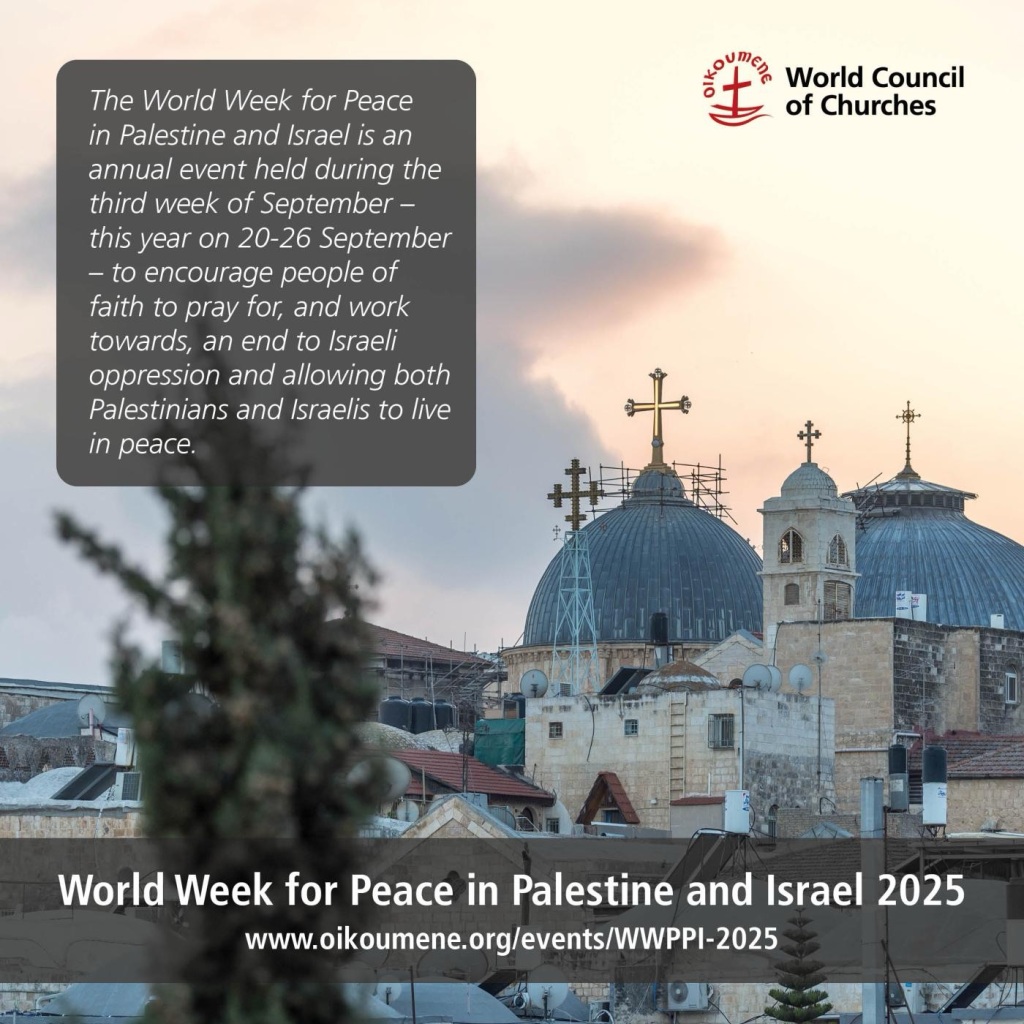
Coinciding with the UN’s International Day of Peace is the World Week for Peace in Palestine and Israel, an event established by the World Council of Churches (WCC) and held each year during the third week of September. This year that week runs from Saturday 20 to Friday 26 September.

The week aims to encourage people of faith to pray for, and work towards, an end to Israeli oppression and allowing both Palestinians and Israelis to live in peace. A fine set of resources has been prepared by the WCC, containing testimonies, a Christian liturgy, a reflective poem, and a “concept note” that sets out the situation in Gaza, the focus of the week, and a set of steps that can be taken locally. See

https://www.oikoumene.org/events/WWPPI-2025?

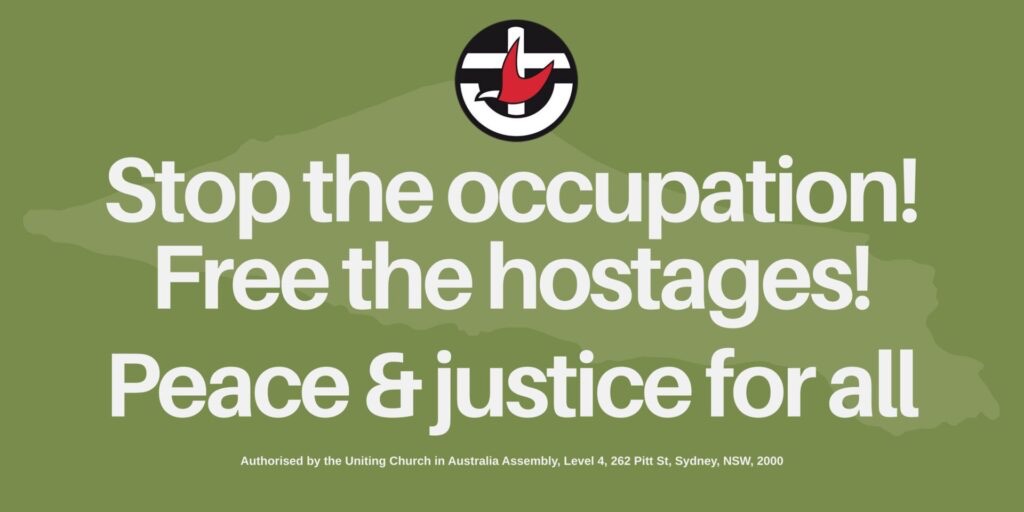
The Uniting Church has long been a strong supporter of initiatives building towards Peace. Early in the life of the Uniting Church, the National Assembly made a clear and unequivocal commitment, on behalf of the whole church, to support peace-building and reject the idea that the world can be made a better place by killing people.

In 1982, that Assembly declared “that God came in the crucified and risen Christ to make peace; that he calls all Christians to be peacemakers, to save life, to heal and to love their neighbours. The call of Christ to make peace is the norm, and the onus of proof rests on any who resort to military force as a means of solving international disputes.” 

It called for action “to interact and collaborate with local communities, secular movements, and people of other living faiths towards cultivating a culture of peace” and to work to “empower people who are systemically oppressed by violence, and to act in solidarity with all struggling for justice, peace, and the integrity of creation”. It also identified the need “to repent together for our complicity in violence, and to engage in theological reflection to overcome the spirit, logic, and practice of violence”. 

Since the horrific attack on Israel by Hamas militants on 7 October 2023, and the devastating military retaliation by Israel in Gaza, the Uniting Church in Australia Assembly has sought to respond to a worsening conflict situation with a commitment to justice and peace. It has published a number of statements, which can be read at https://uniting.church/palestine-and-israel/

At the moment, the church is encouraging Uniting Church communities to take practical action on Palestine and engage with the World Council of Churches Statement on Palestine and Israel: A Call to End Apartheid, Occupation, and Impunity in Palestine and Israel. This statement has recently been affirmed and adopted by the Uniting Church Assembly.

In the statement, the WCC has declared that “the Government of Israel’s military campaign in Gaza has entailed grave breaches of the Fourth Geneva Convention which may constitute genocide and/or other crimes under the Rome Statute of the International Criminal Court (ICC)”. The WCC calls for churches “to witness, to speak out, and to act” in this matter.

See https://www.oikoumene.org/resources/documents/statement-on-palestine-and-israel-a-call-to-end-apartheid-occupation-and-impunity-in-palestine-and-israel

*****

For more of my blogs on Peace, see

and see also

https://unitingforpeacewa.org/2018/11/28/perth-peacemaking-conference-statement/

I had a dream (Genesis 27–28; Narrative Lectionary for Pentecost 15) 

A discussion of the passage in the Narrative Lectionary for Pentecost 15

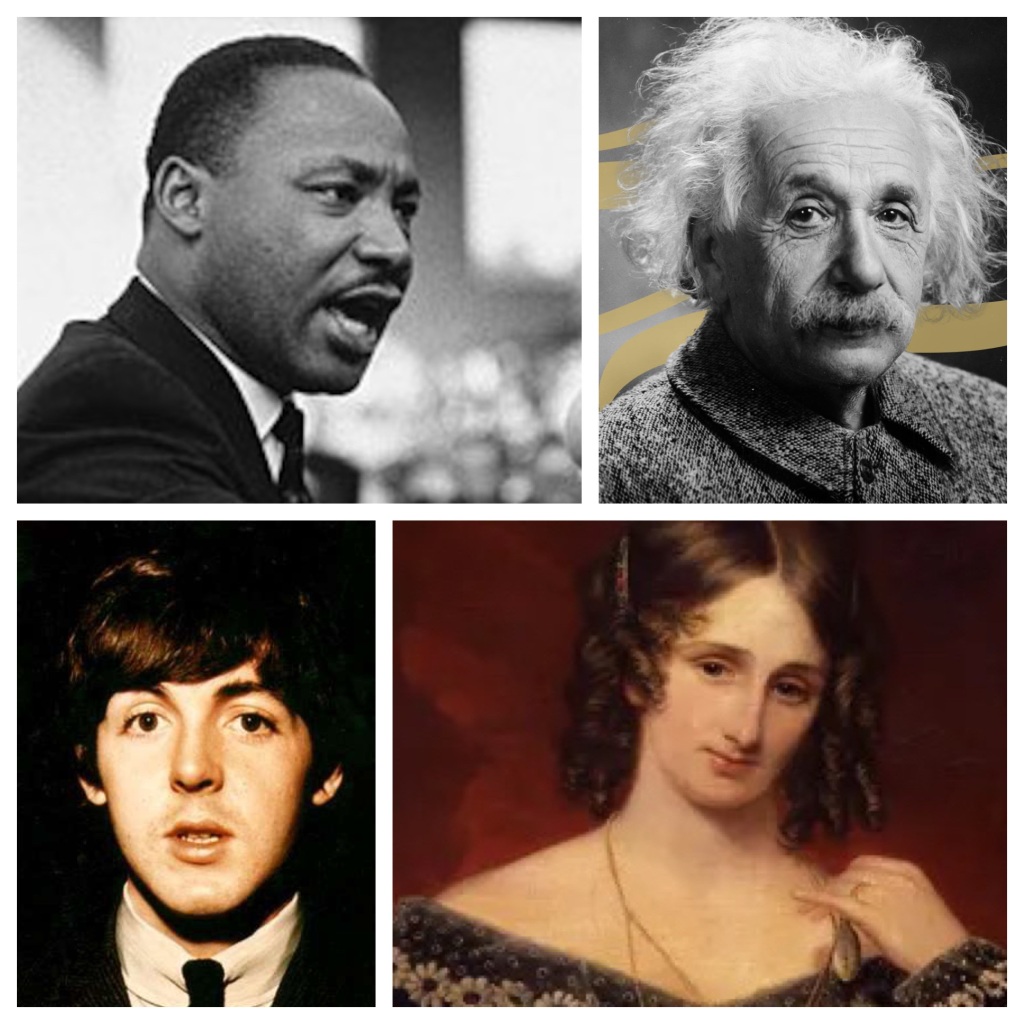
There are some famous dreams throughout history. “I have a dream”, said the Rev. Martin Luther King Jr, speaking in Washington on 28 August 1963, “a dream that my four little children will one day live in a nation where they will not be judged by the color of their skin but by the content of their character. I have a dream today.” That may be the most famous dream in the 20th century.

There have been other significant dreams in modern times. Paul McCartney woke from a dream and wrote the whole score of “Yesterday”. Mary Shelley’s novel “Frankenstein” was inspired by a nightmare. Niels Bohr had a dream in which he saw “the nucleus of the atom, with electrons spinning around it, much as planets spin around their sun”; and thus he developed his theory of atomic structure—a theory later proven by experimental investigation.

In like manner, Albert Einstein is said to have posed his theory of relativity in a dream in which “he was sledding down a steep mountainside, going so fast that eventually he approached the speed of light … at this moment, the stars in his dream changed their appearance in relation to him”; while it was a dream that led Frederick Banting to develop insulin as a drug to treat diabetes.

I found these and other significant modern dreams described at

https://www.world-of-lucid-dreaming.com/10-dreams-that-changed-the-course-of-human-history.html

*****

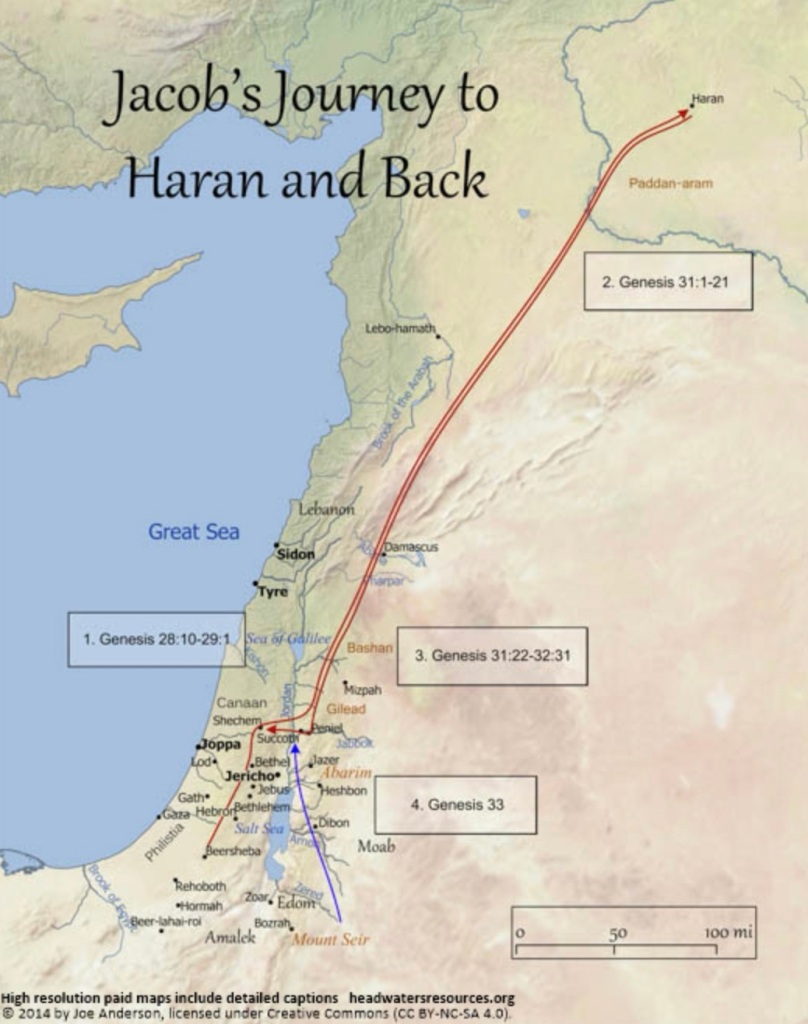
A part of the Hebrew Scripture readings that are offered by the Narrative Lectionary for this coming Sunday (Gen 28:10–17) includes a dream that Jacob had, as he slept one night. He was journeying from Beer-sheba, in the Negeb desert in the south of Israel, which is where he had received a blessing from his father, Isaac. This blessing, as we hear in the other section of scripture offered for this Sunday, was won by trickery,as he took the blessing that was intended for Esau  (Gen 27:1–4, 15–23). Which explains the name given to Jacob: he is “the one who supplants” (see Hos 12:3).

Isaac was travelling north towards Haran, the place from which Abram and Sarai had left on their journey towards the land of Canaan, the land which God had promised to him (12:1, 4–5). So the journey that Jacob is undertaking is a reversal, in direction and orientation, of the earlier journey that his grandfather had undertaken. 

He was travelling to escape the anger of his brother Esau, after he had tricked their father Isaac into blessing him, Jacob, gifting him with the inheritance that was rightly owed to Esau (27:41). Abraham had travelled south in order to receive God’s blessing. Jacob travels in the other direction after having deceitfully gained his father’s blessing.

We are told that, understandably, “Esau hated Jacob because of the blessing with which his father had blessed him” (27:41), and that he threatens to murder his brother, once “the days of mourning for my father” are completed (27:42). Learning of this hatred, Rebekah advises her son, “flee at once to my brother Laban in Haran, and stay with him a while, until your brother’s fury turns away” (27:43–44).

Whether he had been tipped off about this by Rebekah, or not, Isaac commissions his son to journey back to the homeland—in another case of “don’t marry one of these folks, go back to our homeland and marry one of our own” (as we saw with Abraham and Isaac). Isaac says to Jacob, “you shall not marry one of the Canaanite women; go at once to Paddan-aram to the house of Bethuel, your mother’s father; and take as wife from there one of the daughters of Laban, your mother’s brother” (28:1–2). So Jacob obeys him. 

It is on this journey of escape that Jacob has his striking dream. Jacob is not the first to have encountered God in a dream, in these ancestral sagas. Abimelech of Gerar heard from God in a dream (20:3–7). After Jacob’s dream at Bethel (28:12–15), Jacob has a further dream regarding a flock of goats, relating to his inheritance, urging him to return to Isaac in the land of Canaan (31:10–16). At the same time, God appeared in a dream to Laban (31:24), conveying instructions which he disobeyed. 

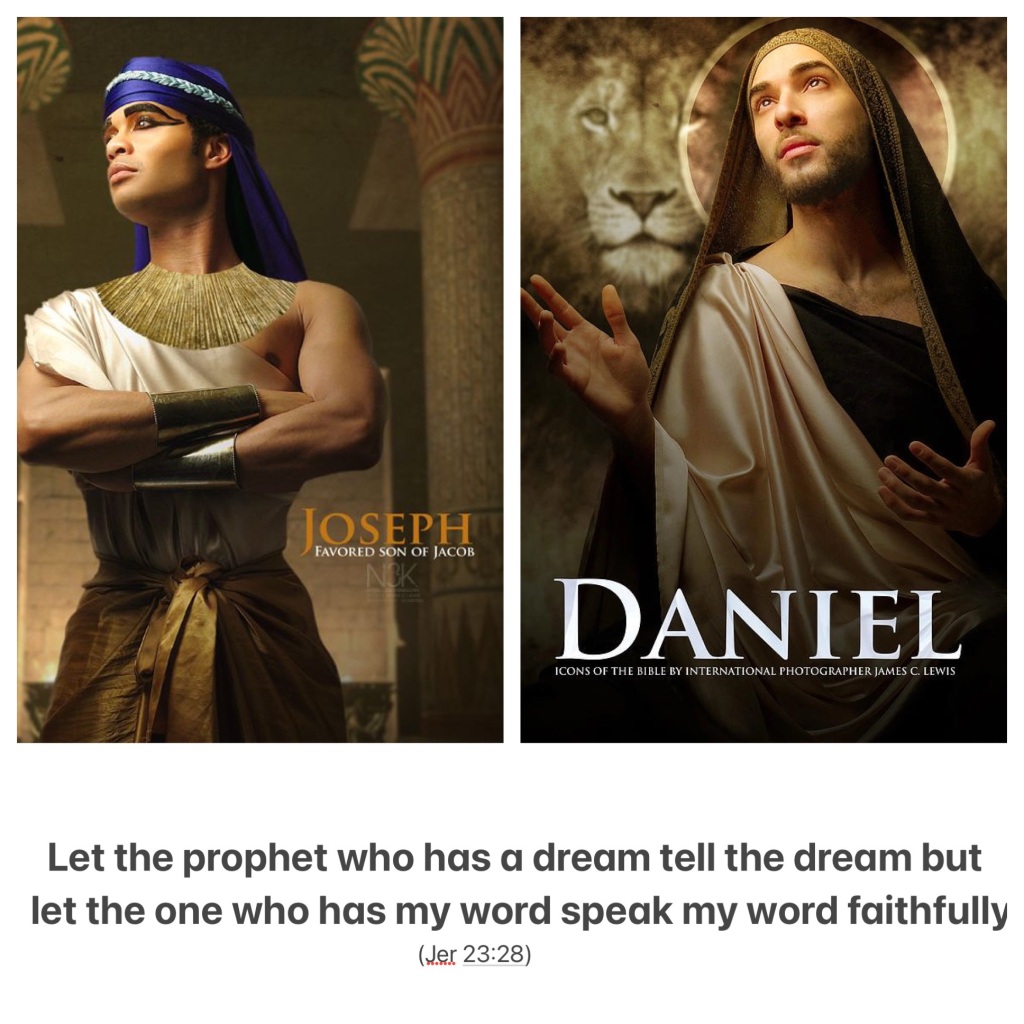
The two great “dreamers” in Hebrew Scripture are, of course, Joseph, one of the sons of Jacob, and Daniel, one of the courtiers of Nebuchadnezzar of Babylon, many centuries later. Both men not only dream dreams, but offer interpretations—and interpret dreams that have been dreamt by others. Jeremiah, too, knew of those who claimed that they encountered God in dreams, but warns that understanding those dreams correctly is important (Jer 23:28; 29:8–9). 

And dreams as the vehicle for divine communication is found in an important New Testament story, when Joseph learns of the pregnancy of Mary, in Matt 1–2. “Dreaming dreams” is actually an activity inspired by the Spirit, as Joel prophesied (Joel 2:28) and Peter reminds the crowd on the day of Pentecost (Acts 2:17).

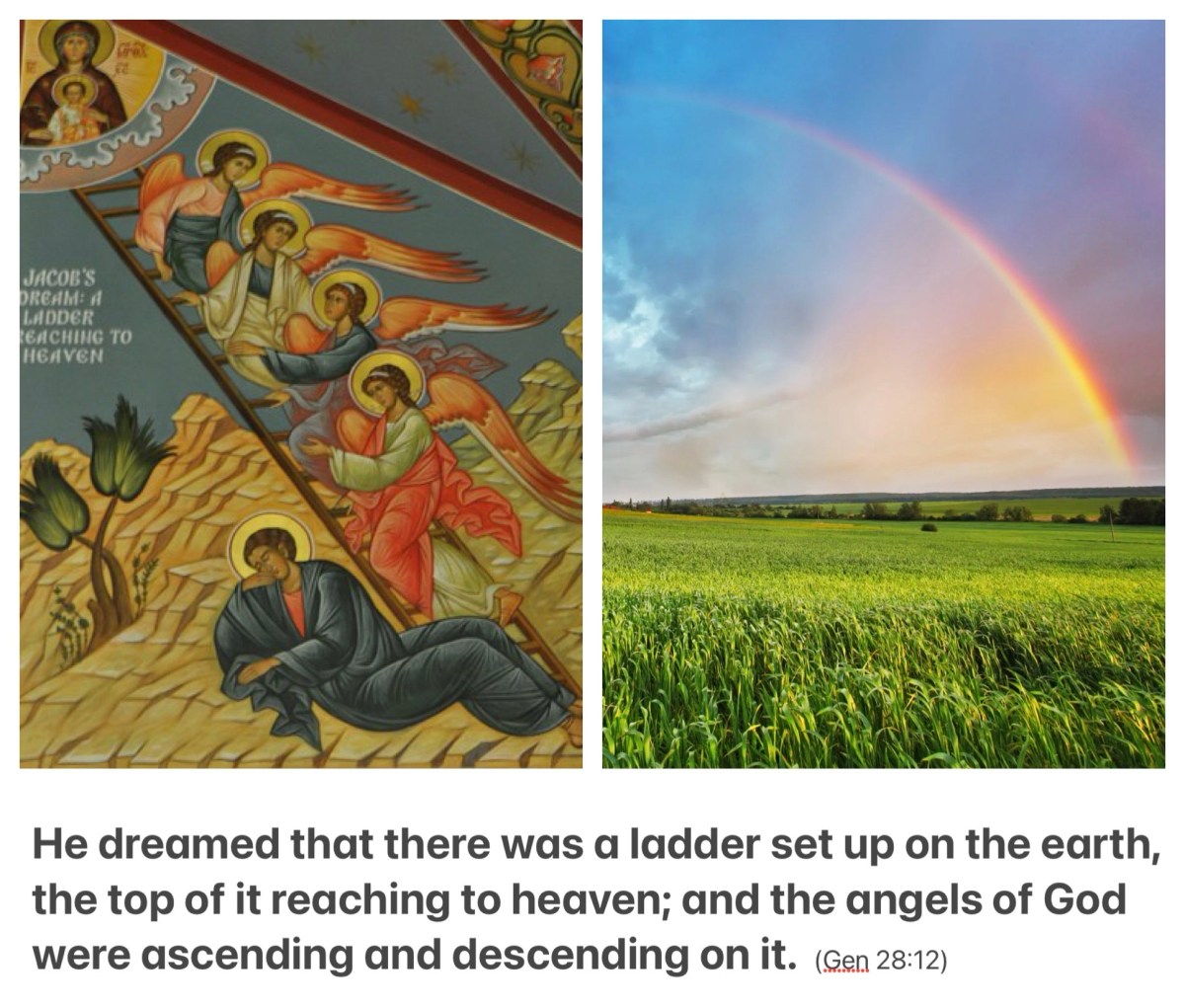
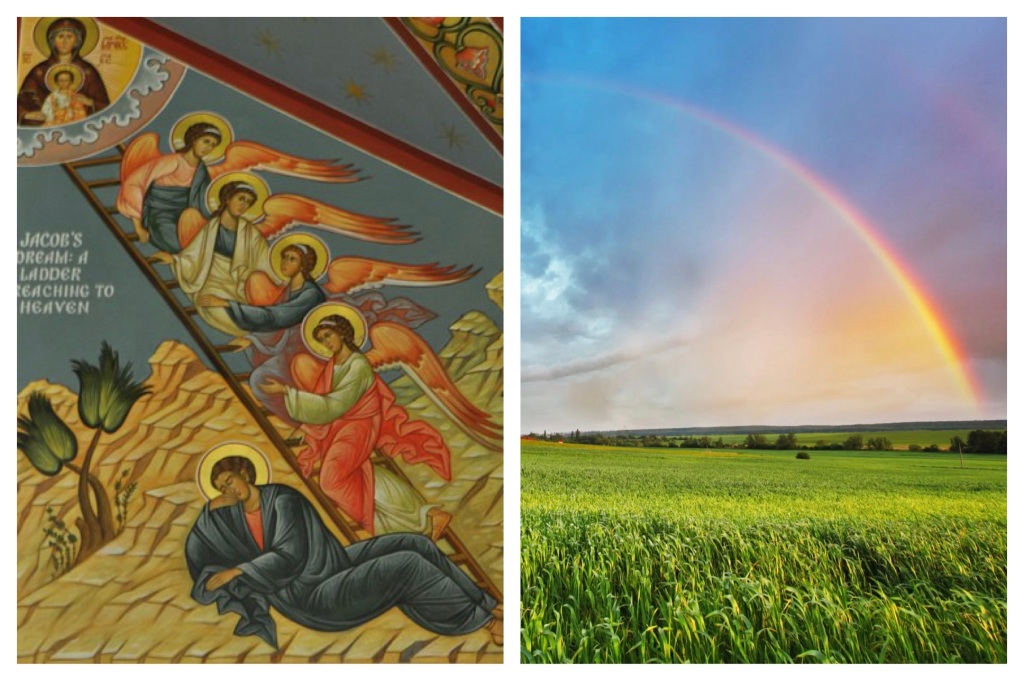
In the story we hear this coming Sunday, Jacob sleeps. As he does, he dreams that “there was a ladder set up on the earth, the top of it reaching to heaven; and the angels of God were ascending and descending on it” (28:12). What do we make of that dream?

In My Jewish Learning, Pinchas Leiser quotes from a book entitled Ruah Chaim (“the breath of life”), by Rabbi Haim of Volozhin. The Rabbi, who lived from 1749 to 1821, was a student of the Vilna Gaon (1695–1785), the pre-eminent sage of Lithuanian Jewry whose ideas were fundamental for the development of modern Jewry. Rabbi Haim writes:

“Our sages come to teach us that we ought not think that, because of our base material, we are truly despicable, like mere plaster on a wall. About this it says, a ladder stationed on the earth–that is Sinai; and its top reaches the heaven–which represents our soul’s life, which is in the highest sphere. There are even souls that see God, and they are the highest of the high, higher than ministering angels, and by this status can the soul cleave to Torah . A whole person is like a tree whose roots are above, and whose trunk extends downward, which is the body, and which is fastened to its supernal roots.”

Pinchas Leiser, a Jewish psychologist and educator, comments: “Thus, Rabbi Haim of Volozhin views Torah learning as a Sinaitic event, since Torah is what connects the heavens and the earth. With Torah, one can ascend and descend between the two spheres. The people who do so are angel-like.” 

This is a penetrating insight into the nature of human beings. We are not spiritual beings, trapped in the prison of the material world, as Plato imagined (and as many writers, including Paul, who were influenced by his philosophy, wrote). Rather, we are fully nephesh, creatures of God containing both material and spiritual characteristics. We belong both to earth and to heaven.

The ladder which Jacob saw reveals this true nature, and tells us that we can transport ourselves between the two places, if we would only open ourselves to the possibility. Jacob’s dream was archetypal—it illustrated exactly who we are and how we can live!

And for me, as a Christian reader, it is important to note that this story (and, indeed, many others in Hebrew Scripture) undermines the crass stereotyping of ancient Israelites—and modern Jews—as alienated from God, crushed under unbearable burdens, far from the grace of God. For this ancient story, told orally for many years before it was ever written down, portrays the possibility of a close and enduring relationship with God, accessible from the patriarch Jacob onwards.

Accompanying the dream of Jacob is a sense of the presence of God; the divine speaks to Jacob, assuring him that God will never leave him. Jacob could never go beyond God’s keeping; angels accompany him on his onward journey to northern Mesopotamia, which was his destination (Gen 29:1). These angels keep going up and coming down on the ladder during this journey; more than this, they continue to accompany him for the twenty years he spends in Haran and then travel with him on his return to the land of Canaan (Gen 31:11; 32:1). The story has a strong sense of the enduring, faithful nature of God’s accompaniment of people of faith throughout their lives.

God’s grace is at work in this story. Jacob was an outcast who had deceived his father and lost friends. Seeking God was probably far from his mind; human company was probably what he yearned for. Nevertheless, he was guided by God at this point of need, offering him revealed care and an assurance for the future. Even though he was not expecting grace, grace was unleashed upon Jacob with no word of blame.

So there is a sign of God’s grace in this story—the ladder connecting heaven and earth, on which “angels” ascend and descend at will. God meets Jacob, even as he is running away from family, and perhaps also running away from God; God meets Jacob in a dream. Jacob was fleeing the consequences of his deception of his father. He wanted to be far away from Isaac, whom he deceived, and Esau, from whom he stole the birthright. And in the midst of that journey, God offers a sign of acceptance and grace in this dream.

Indeed, scripture had offered an earlier sign of God’s grace, in the story of Noah. This is a terrible story—God deliberately and intentionally destroys the world, and “starts all over again”. Only Noah and his family, and the animals on his ark, are saved. The rainbow in the sky is the sign of God’s grace for those who have survived, signalling that God will never again destroy the creation.

The ladder represents the commitment that God has, to an enduring connection with human beings, no matter what their situation. It is a sign of God’s grace—for which we can be thankful.

Judging Israel; undoing creation (Jer 4; Pentecost 14C)

“A hot wind comes from me out of the bare heights in the desert toward my poor people, not to winnow or cleanse— a wind too strong for that. Now it is I who speak in judgment against them.” (Jer 4:11–12)

We’ve been following the words of Jeremiah over the last three weeks. He has had some very stern messages to deliver. Perhaps this helps us to see the origins of the term “Jeremiad”. The Oxford Dictionary of Literary Terms defines it as “either a prolonged lamentation or a prophetic warning against the evil habits of a nation, foretelling disaster”. The second sense (a prophetic warning) comes directly from the way that the prophet Jeremiah spoke about, and to, the people of Israel in his time.

Jeremiah was, indeed, a voice of doom and gloom. At his calling, the Lord God informed him, “I will utter my judgments against them, for all their wickedness in forsaking me; they have made offerings to other gods, and worshiped the works of their own hands”. He then admonished the young Jeremiah, telling him to “gird up your loins; stand up and tell them everything that I command you”, before putting the very fear of God into him with the warning, “do not break down before them, or I will break you before them” (Jer 1:16–17). That’s stern stuff!

But is this going too far? I think today we would want to call to account the speaker of these words, to remind them not to abuse the power that they have in this relationship, and to be mindful of the vulnerability of the young person to whom they are speaking! (A friend who worked for the then Department of Community Services said years ago that Yahweh would these days be notified to the department if he spoke and acted in this way!)

So Jeremiah remains faithful to his call, through all the challenges and difficulties this brought him. For four decades he is relentless is calling the people of his day to account for their sins: “the house of Israel and the house of Judah have broken the covenant that I made with their ancestors” (11:10); “we have sinned against the Lord our God, we and our ancestors, from our youth even to this day; and we have not obeyed the voice of the Lord our God” (3:25). 

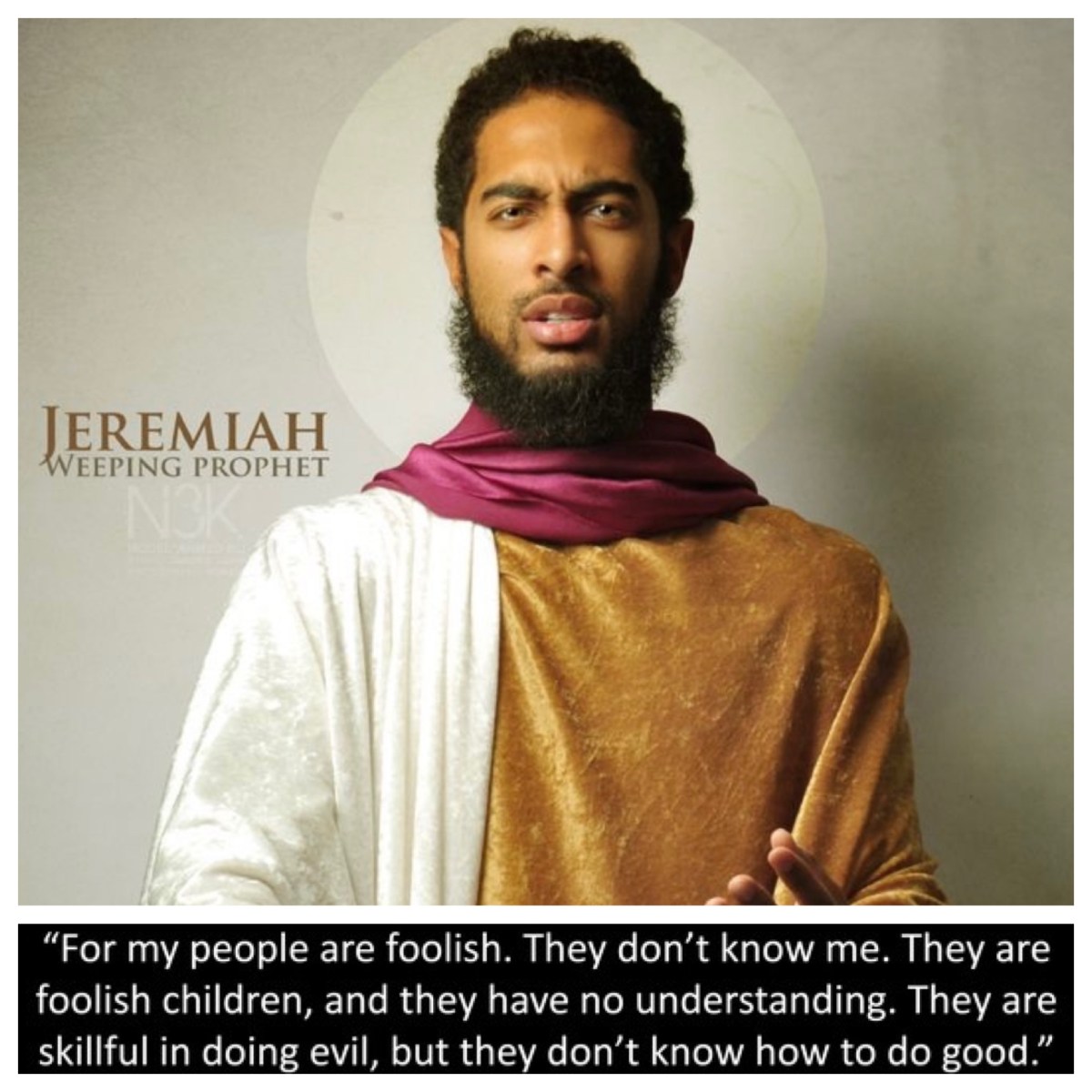
In the passage set before us by the lectionary for this coming Sunday, the prophet reports God’s anguish about Israel: “my people are foolish, they do not know me; they are stupid children, they have no understanding; they are skilled in doing evil, but do not know how to do good” (4:22). In despair, God decides to use a foreign power to bring Israel to their senses. He tells the prophet, “I am now making my words in your mouth a fire, and this people wood, and the fire shall devour them. I am going to bring upon you a nation from far away, O house of Israel, says the Lord” (5:14–15). Thus Jeremiah foretells the invasion of the Babylonians (see 2 Ki 25).

Jeremiah senses that God has fixed the course to be taken: “they have taught their tongues to speak lies; they commit iniquity and are too weary to repent. Oppression upon oppression, deceit upon deceit! They refuse to know me, says the Lord … Shall I not punish them for these things? says the Lord; and shall I not bring retribution on a nation such as this?” (9:5–6, 9). National disgrace awaits them, as they submit to a foreign power.

Eventually, from his exile in Egypt, and as others from his nation are taken north into exile by the invading Babylonians, Jeremiah tells the Israelites, “It is because you burned offerings, and because you sinned against the Lord and did not obey the voice of the Lord or walk in his law and in his statutes and in his decrees, that this disaster has befallen you, as is still evident today” (44:23). He has been resolute in his condemnation of the sinful people. He is now, sadly, vindicated. And so God decrees, “I am going to watch over them for harm and not for good; all the people of Judah who are in the land of Egypt shall perish by the sword and by famine, until not one is left” (44:27).

I must confess that it seems quite easy, at the moment, to slip into a simplistic interpretive pattern and apply these words—spoken long again against a sinful nation—to the very nation, today, who still bears the same name as those ancient people: Israel. The sins of the modern nation of Israel are manifold. Established as a refuge for a persecuted people, the nation has turned persecutor. Given land in recognition of the way they had been disposed and dispersed, the landholders sought more and more land, building settlements on Palestinian land, erecting a strong, impenetrable wall to keep “them” from “us”.

In a series of battles, they have waged war to ensure their safety and security. Besieged by leaders of organisations arrayed against them, they have continued to shoot, bomb, and destabilise such “terrorist” groups. Yet what is happening in Gaza today is no longer able to be distinguished from genocide—the very same genocidal actions that the Jewish people experienced almost a century ago. The sins of the nation appear (at least to me) to be clear, persistent, and utterly repugnant. Jeremiah’s words to ancient Israel—“I am determined to bring disaster on you, to bring all Judah to an end” (44:11) could well be the words of God to the modern nation of Israel.

Can we simply apply to condemnation of Jeremiah to modern Israel? It’s tempting; but it’s not responsible interpretation. And it leaves open the door to the accusation—repeated often, now—that this is antisemitic. I don’t believe it is antisemitic, because such criticisms are directed against the policies and practices of the modern nation-state of Israel, and what they result in, and not against all Jews everywhere, simply for being Jewish. So we need to steer clear of this kind of simplistic equation. The criticisms are political and pragmatic, not based on religion or ethnicity. 

For my analysis of the current situation involving Israel, Hamas, Gaza, and Palestine, see

and

All of this is in the book of Jeremiah: denunciation after denunciation of the people, warnings of divine punishment, and oracles portending imminent exile and absolute destruction. We can’t get away from that.

However: the passage that the lectionary offers for this coming Sunday raises the stakes even higher. In this passage (Jer 4:11–12, 22–28), the wrath of God is directed not just to Israel, but to all creation. The looming catastrophe is not just national; it is global, cosmic in its scope.

To be sure, the passage reports God’s anguish about Israel, as we have noted: “my people are foolish, they do not know me; they are stupid children, they have no understanding; they are skilled in doing evil, but do not know how to do good” (4:22).

But then comes a most remarkable sequence of sentences, in which the whole of creation seems to be in view. “I looked on the earth, and lo, it was waste and void; and to the heavens, and they had no light”, God is saying. “I looked on the mountains, and lo, they were quaking, and all the hills moved to and fro. I looked, and lo, there was no one at all, and all the birds of the air had fled. I looked, and lo, the fruitful land was a desert, and all its cities were laid in ruins before the Lord, before his fierce anger” (4:23–26).

Writing on this Jeremiah passage in With Love to the World, the Rev Dr Anthony Rees, Associate Professor of Old Testament in the School of Theology, Charles Sturt University, notes: “This is a remarkably evocative passage. It begins with a hot wind, a symbol of judgement (as in Jonah 4). It moves quickly to a promise of destruction from the North (Dan and Ephraim); it almost seems that God is cheering on those who would do Judah harm.”

But there is more than just evocative poetry here. It seems to me that the words of Jeremiah might be describing the end result of a process that is happening in our own time. Since the start of the Industrial Revolution, and continuing apace into the 21st century, the damage that human beings have been causing to the planet has been increasing with noticeable impacts seen in so many areas: global warming, more intense extreme weather events, more frequent extreme weather events,  the diminishing of the ice caps at the poles of the earth, the warming of the oceans’ temperature, rising sea levels impacting particularly islands in the Pacific, the bleaching of the Great Barrier Reef, and so many more things that can be attributed to human-generated climate change. 

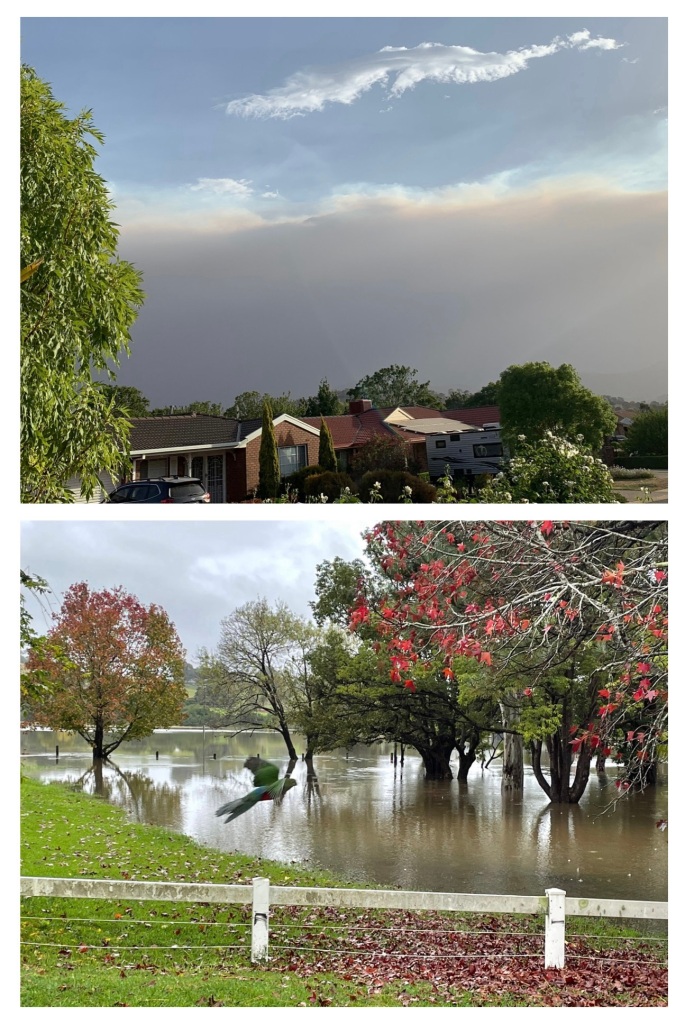
In our own household, in just the past five years, we have seen a searing bushfire come within a few kilometres of our suburb, and then a massive downpour lead to rising floodwaters that reached the other side of the road on which we live. Climate change is real, and close. We are well on track, as many scientists are saying, to see a planet with a radically altered ecosystem. 

The view from our front yard:
Gordon, ACT, January 2020 (top),
during the severe bushfire in the ACT;
Dungog, NSW, May 2025 (bottom),
during the east coast flooding

Anthony Rees continues his reflections on Jer 4: “Judah is destroyed, the people and land laid waste on account of childish stupidity and ignorance. A remarkable image is then seen: the earth is described as waste and void, the very same description given of the earth in Gen 1:2 before God’s creative activity begins.”

The passage in Jeremiah has God narrating his view of the systematic undoing of his work as the Creator, as that has been set out in the narratives of Gen 1 and Gen 2, and in the poetry of Psalms 8, 19, 65, 104, and 148. God sees that the earth was once again “waste and void” (Jer 4:23a), as it was in the beginning (Gen 1:2). All that the landscape showed was a ravaged wilderness, for no longer did the earth bring forth vegetation: “plants yielding seed of every kind, and trees of every kind bearing fruit with the seed in it” (Gen 1:12; 2:8–9; and see Ps 65:11–13; 104:14–15, 27 –28). Rather, what God sees is that “the fruitful land was a desert, and all its cities were laid in ruins” (Jer 4:26).

In the heavens there is no light (Jer 4:23b), thus undoing God’s early creative work (Gen 1:3, “let there be light”; and Ps 8:3; 19:4b—6; 148:3). Hills and mountains were shaking (Jer 4:24); the stability they provided, the unshakeable foundation of the earth, has been undone (Ps 65:6; 104:5, 8; 148:9). All the birds have fled (Jer 4:25), undoing the work of God reported at Gen 1:21–22 (and see Ps 8:8; 104:12; 148:10b).

Anthony Rees notes, “Jeremiah looks to the heavens and the light is gone. God’s creative work has been undone on account of human failure. And again, human failure has consequences that go beyond our species: mountains sway, birds flee, arable land is turned to desert. What good news is there to be found here? What image of hope?”

The relevance for today of Jeremiah’s poetic “vision” that undoes the vision of creation expressed long ago by priests and poets is striking. And his perception that it is human sinfulness that is at the root of this is noteable. We know what we need to do to slow the rate of change, so that the climate remains within an inhabitable range. We know what we need to do to stop pumping gases into the air that are changing the way the planet works. We know what changes we need to make to our way of living—a whole host of changes, large and small—but we lack the will to do so. Our national policies continue to favour the industries that contribute most to the degradation of our environment. Our daily practices show minimal change, if that, in so many households.

Anthony Rees concludes, “Perhaps we might best read this text as a warning, and commit ourselves to working in ways that maintain relationship with God, our neigbours, and the rest of the created order.” It is certainly a timely word, given our critical situation. How do you respond to Jeremiah’s mournful poetry? What changes can you make? What lobbying can you undertake? What advocacy can you commit to do? Are we always going to be condemned to be, like ancient Israel, those who “are skilled in doing evil, but do not know how to do good”?

https://www.withlovetotheworld.org.au

On the mount of the Lord it shall be provided (Genesis 21–22; Narrative Lectionary for Pentecost 14)

Discussion of the passages from Genesis 21–22 for the Narrative Lectionary.

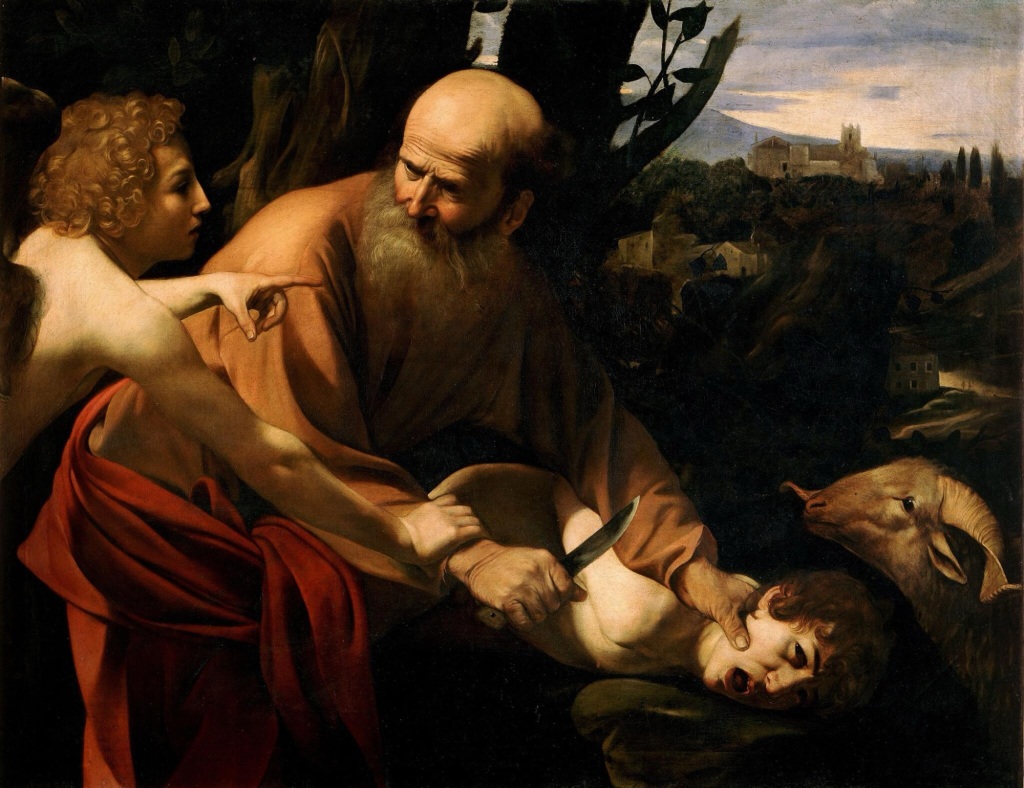
The pair of passages from Genesis proposed by the Narrative Lectionary for this coming Sunday contain a paradox. On the one hand, after years of Abraham and Sarah yearning in vain for a son, “the Lord did for Sarah as he had promised; Sarah conceived and bore Abraham a son in his old age” (Gen 21:1–2). The son was named Isaac, meaning laughter; as Sarah, aged 100, declares, “God has brought laughter for me; everyone who hears will laugh with me” (21:6).

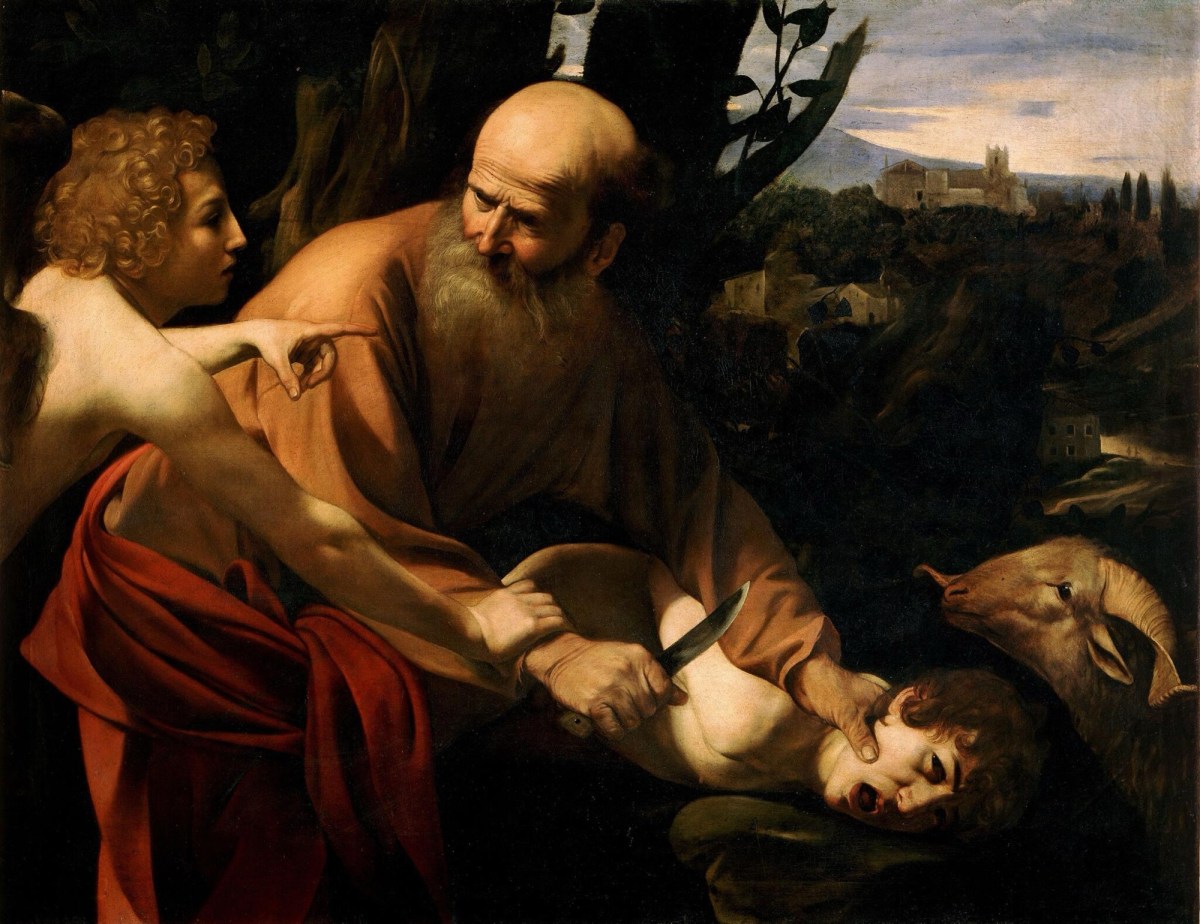
Yet in the second passage offered by the lectionary, we read some chilling words: “Abraham reached out his hand and took the knife to kill his son” (Gen 22:10). How does this relate to the joy seen at the birth of Isaac? There is no laughter in this story. It’s a horrifying story. How is this edifying material for hearing in worship?

Questions abound. Who is this God who calls Abraham to take his “only son” up the mountain and “offer him there as a burnt offering” (22:2)? Where is the God who, it is said, has shown “steadfast love” to the people of Israel (Exod 15:13), and before that to Joseph (Gen 39:21), to Jacob (Gen 32:9–19), and indeed to Abraham himself (Gen 24:27)? Why has God acted in a way that Is seemingly so out of character in this incident in Gen 22? Or is this the real nature of God, and these later displays of “steadfast love” are simply for show?

This story is indeed troubling: it presents a God who demands a father to kill his beloved son, with no questions asked. It is not just the knife in Abraham’s hand which is raised (22:10)—there are many questions raised by this seemingly callous story. 

My wife, Elizabeth Raine, has a cracker of a sermon in which she compares this story with the account of Jephthah and his daughter (Judg 11:29–40). Whilst the Lord commands Abraham to kill his son as a burnt offering, it is the vow made by Jephthah to sacrifice “whoever comes out of the doors of my house to meet me, when I return victorious from the Ammonites” as a burnt offering (Judg 11:30).

And whilst the Lord intervenes in what Abraham is planning to do at the very last moment, sending an angel to command him, “do not lay your hand on the boy or do anything to him” (Gen 22:11–12), Jephthah is held to the vow he has made—by his very own daughter, who knows that she will be the victim of this vow (Judg 11:39). There is no divine intervention in this story. 

And worse, whilst Abraham had carefully prepared for the sacrifice, taking his donkey, two servants, and the wood for the fire up the mountain with him (Gen 22:3–6), Jephthah’s vow was made on the spur of the moment (Judg 11:30–31), and when his daughter insisted that he must carry through with this vow, he gives her, as requested, two full months for her to spend with her companions before he sacrificed her (Judg 11:37–39). Surely he might have had time in those two months to reconsider his vow and turn away from sacrificing his daughter?

It would seem, then, that the daughter was dispensable; the son, the much loved only son of Sarah and Abraham, was clearly indispensable. That would clearly reflect the values of the patriarchal society of the day, in which “sons are indeed a heritage from the Lord, the fruit of the womb a reward” (Ps 127:3). 

And Abraham would have followed the same pathway, sacrificing his only son, had not the Lord intervened. Neither father is looking very appealing in these two stories! Which makes it hard to see how the story of the sacrifice told in Judg 11, and the story of the almost-sacrifice told in Gen 22, can be “the word of the Lord” for us, today, in the 21st century. Indeed, the story of Abraham and Isaac comes perilously close to being a story of child abuser—if not physical abuse, by the end of the story, at least emotional and spiritual abuse.

Situations of abuse destroy trust. After such an experience, how could Isaac ever trust his father again? And as we hear the story, how can we trust God? How could we ever believe that his commands to us are what we should follow?—if he follows the pattern of this story, and changes his mind at the last minute, after pushing us to the very brink of existence? How could we trust a God like this?

Or, if the story involving poor Isaac is really about God providing, as Abraham intimates early on (22:8), and then concludes at the end (22:14), then it is a rather malicious way for God to go about showing how he is able to “provide”. Provision, and providence, should be something positive—not perilous and threatening, as in this story.

Or yet again, if the story is about testing Abraham’s faith, as many interpreters conclude, then it is a particularly nasty and confronting way for God to do this—and that points to a nasty streak in the character of God. Is this really what we want to sit with? Was there not some other way for God to push Abraham to test his faith? 

What do we do with such a story within our shared sacred scriptures?

The Jewish site, My Jewish Learning, states that “although the story itself is quite troubling, it does contain a message of hope for Rosh Hashanah. In the liturgy we ask God to “remember us for life.”  The binding of Isaac concludes with his life being spared, and he too is “remembered for life.”  Abraham’s devotion results in hope for life.”

How does the message of hope for life emerge from this story? Clearly, the life of Isaac is spared; but this is a terrible way to teach that message!

James Goodman, writing in My Jewish Learning, explains how he was taught to understand this story. “I learned that the story was God’s way of proclaiming his opposition to human sacrifice”, Goodman writes. 

He refers to the way his Hebrew-school teacher explained this story: “God had brought Abraham to a new land. A good and fertile land, where it was common for pagan tribes, hoping to keep the crops and flocks coming, to sacrifice first-born sons to God. Then one day, God commanded Abraham to sacrifice Isaac, the beloved son of his old age. 

“Abraham set out to do it, and was about to, when God stopped him. He sacrificed a ram instead. In the end, Abraham had ‘demonstrated his—and the Jews’—heroic willingness to accept God and His law,’ and God had ‘proclaimed’ that ‘He could not accept human blood, that He rejected all human sacrifices’.”
See https://www.myjewishlearning.com/2013/09/11/understanding-genesis-22-god-and-child-sacrifice/

Setting the story in the broader context of the practice of child sacrifice is a way of accepting that this terrible story might indeed have some value. Seeing the story is a dramatised version of God’s command not to sacrifice children can be a way to deal with it. “Do not lay your hand on the boy or do anything to him”, the angel says; so Abraham obeys, finds a ram, offers the ram as a burnt offering (22:12–13). And so, the name of the place is given: “the Lord will provide”(22:14).

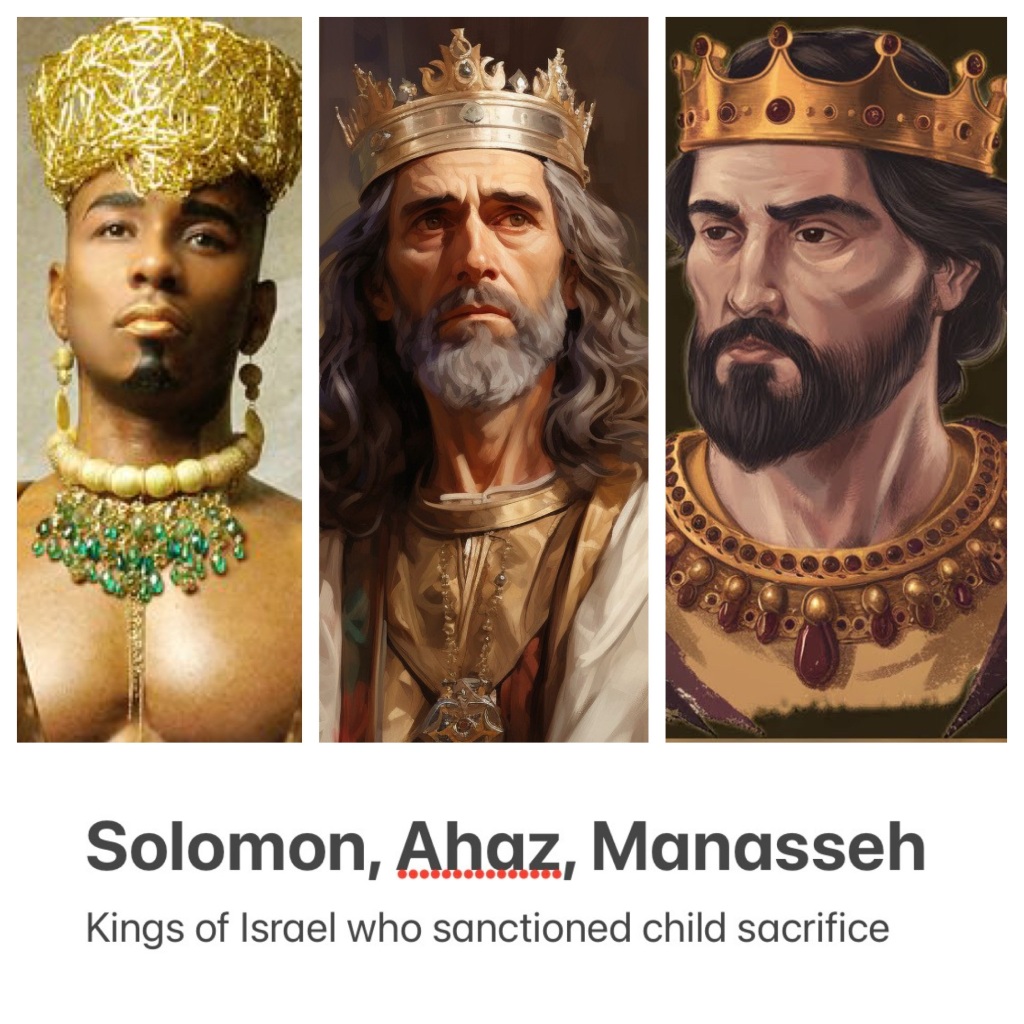
Three kings of Israel, at different times in the history of Israel, are said to have practised child sacrifice, as they turned to practices found in nations other than Israel. Solomon in his old age is said to have turned to the worship of Molech (1 Ki 11:7); this practice was subsequently adopted by Ahaz, who “made offerings in the valley of the son of Hinnom, and made his sons pass through fire, according to the abominable practices of the nations whom the Lord drove out before the people of Israel” (2 Chron 28:3). Likewise, Manasseh “made his son pass through fire; he practiced soothsaying and augury, and dealt with mediums and with wizards” (2 Ki 21:6). 

Direct commands not to sacrifice children are found in two books of Torah in the scriptural texts. Most direct is “you shall not give any of your offspring to sacrifice them to Molech, and so profane the name of your God: I am the Lord” (Lev 20:18). In Deuteronomy, other nations are condemned as they “burn their sons and their daughters in the fire to their gods” (Deut 12:31), so the command is “no one shall be found among you who makes a son or daughter pass through fire” (Deut 18:10). The prophet Jeremiah also asserts that this practice is not something that the Lord God had thought of (Jer 7:31). 

So the passage we have in the lectionary responds to this practice by telling a tale which has, as its punchline, the command “do not lay your hand on the boy or do anything to him” (22:12). Might this be the one redeeming feature of this passage? 

But if that is the case, the story belongs back in the days when child sacrifice was, apparently, widely practised. What, then, does it say to us today??

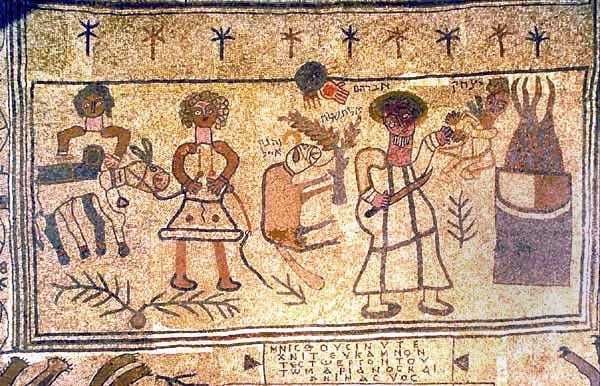
A sixth-century CE floor mosaic from the Beth Alpha synagogue, in Israel’s Jezreel Valley. The mosaic lay near the door, so that anyone who entered was confronted by the scene. In this mosaic, Abraham and Isaac are identified in Hebrew. The hand of God extends from heaven to prevent Abraham from proceeding. Below the hand are the Hebrew words, “Lay not [your hand].” Next to the ram are the words, “Behold a ram.”

I am a potter shaping evil against you (Jer 18; Pentecost 13C) 

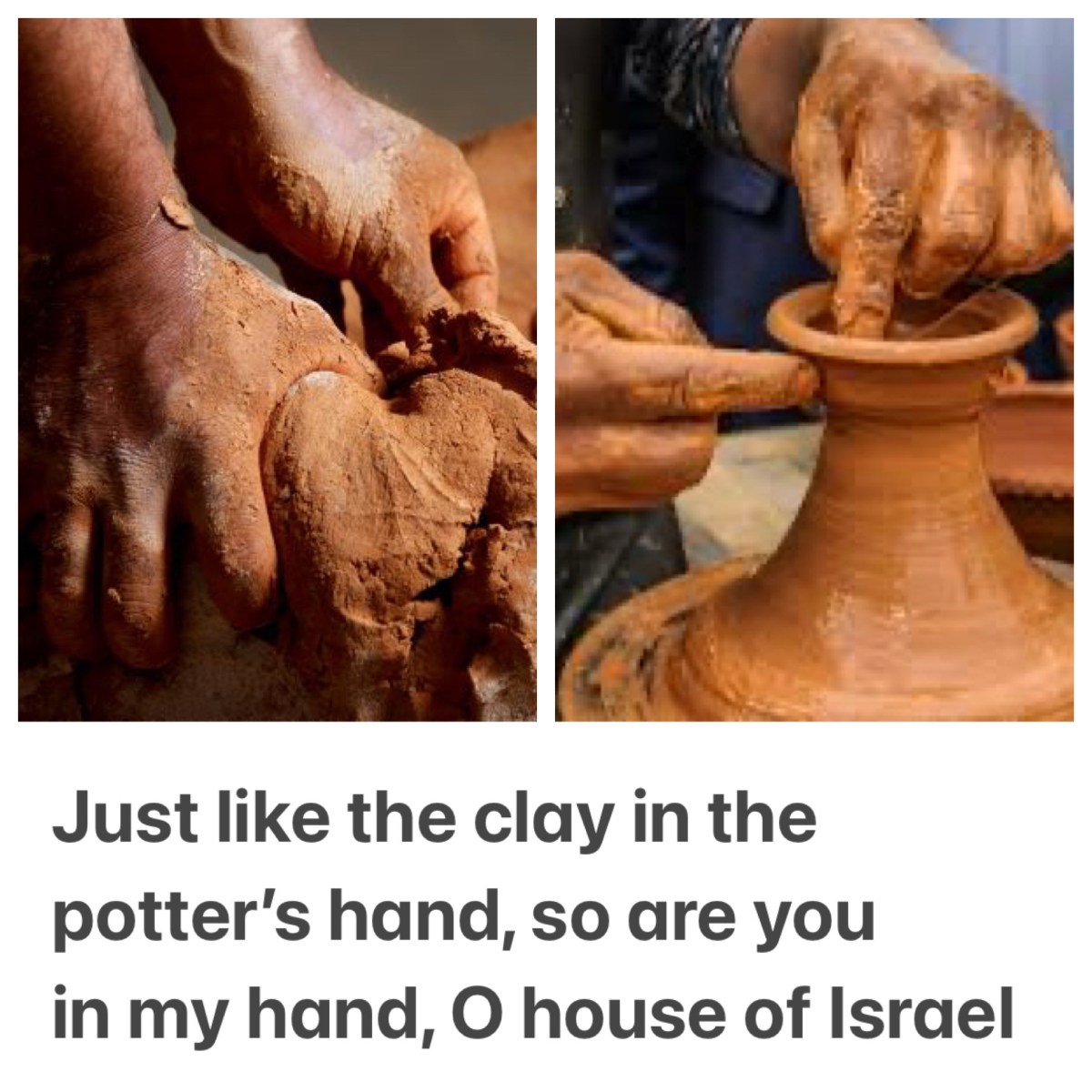
The passage from Jeremiah proposed by the lectionary for this coming Sunday (Jer 18:1–11) is the third in a series of eight passages, taken from various sections of the work, that we read and hear during this long season “after Pentecost”. It’s a well-known passage because of the way it uses the common figure of a potter working his clay to form a vessel for domestic use. The potter spoils his work, so he starts again and works another vessel (vv.1–4). 

The image of a potter is used elsewhere in Hebrew Scripture. It appears in an oracle by the prophet Isaiah (Isa 29:13–16). He poses a question to God: “You turn things upside down! Shall the potter be regarded as the clay?” (29:16). This is the very oracle whose words are used by Paul in his words to the Corinthians: “the wisdom of their wise shall perish, and the discernment of the discerning shall be hidden” (Isa 29:13; 1 Cor 1:18–19).

Paul also uses the clay element of the imagery when he later tells the Corinthians that “we have this treasure in clay jars, so that it may be made clear that this extraordinary power belongs to God and does not come from us” (2 Cor 4:7). Paul is referring to his preaching of the message about Jesus, who gives “the light of the knowledge of the glory of God” in his face (2 Cor 4:6).

We also find the potter—clay imagery used by the later unnamed prophet whose words are included in the second section of the book of Isaiah. He speaks of “the one coming from the north” who “shall trample on rulers as on mortar, as the potter treads clay” (Isa 41:21–29, see v.25). He later instructs the people not to question the intentions of God. Those who do so should remember they are “earthen vessels with the potter”; he warns them, “does the clay say to the one who fashions it, ‘What are you making’? or ‘your work has no handles’?” (45:9–13, see v.9). The image of the potter represents the sovereign power of God to act as God wishes and intends. That’s how Paul also understands it in 1 Cor 1.

In the passage offered to us for this coming Sunday, the prophet Jeremiah uses this image specifically to warn Israel that, since the people have become, in effect, “spoiled goods” because of their entrenched idolatry (Jer 18:8), the Lord God can be of a mind to discard them as unwanted. As the potter, God has unfettered freedom to mould and shape the clay exactly how he wills.

Mixing metaphors, Jeremiah then turns to the horticultural imagery employed in the opening scene of the book (“I appoint you over nations and over kingdoms, to pluck up and to pull down, to destroy and to overthrow, to build and to plant”, 1:10). So, he declares, God can decide to “pluck up and break down and destroy” the sinful nation (18:7), just as God may decide on another occasion to “build and plant” a nation (18:9).

In both instances, however, the Lord God retains the sovereign right to exercise a change of mind. If an evil nation repents, “I will change my mind about the disaster that I intended to bring on it” (18:8). Conversely, if a faithful nation, planted by God, turns to evil, “I will change my mind about the good that I had intended to do to it” (18:10). Although Christians have been taught to think of God as unchangeable, eternally the same—under the influence of the stark declaration of Heb 13:8—the testimony of Hebrew Scripture is actually that God can, and did, and will, change God’s mind.

See 

So the message for Israel is clear: “I am a potter shaping evil against you and devising a plan against you”, says God; and so the plea to the people is “turn now, all of you from your evil way, and amend your ways and your doings” (18:11). The notion that God can act with evil intent is perhaps a claim that later Christian theology reacts against; after all, don’t we have the devil, Satan himself, to be responsible for all that is evil intent the world? 

Yet in the world of ancient Israel, a near-contemporary of Jeremiah articulates the twofold nature of God’s sovereign actions. It comes with the territory of claiming that the Lord God is the only God—the beginnings of monotheism. “I am the Lord, and there is no other; besides me there is no god”, says the unnamed prophet of Second Isaiah. As a consequence, he reports the claim of God: “I form light and create darkness, I make weal and create woe; I the Lord do all these things” (Isa 45:5–7). There is no hiding behind Satan as the instigator of evil; for this prophet, as for Jeremiah, the Lord himself is able to act with evil intent. 

Yet God does call for Israel to repent (Jer 18:11). However, their stubborn refusal to repent (18:12) leads to more recriminations from God (18:13–17), and their plotting against the prophet (18:18) leads him to plead with God (18:19–23), culminating in his strident words, “Do not forgive their iniquity, do not blot out their sin from your sight; let them be tripped up before you; deal with them while you are angry” (18:23). 

The prophet’s anger matches—and perhaps even inflames—the divine wrath. So God commands the prophet to “buy a potter’s earthenware jug …. go out to the valley of the son of Hinnom at the entry of the Potsherd Gate … break the jug in the sight of those who go with you … [and declare] so will I break this people and this city, as one breaks a potter’s vessel, so that it can never be mended” (19:1–13). In this way the Lord God stands resolute against the sinful nation, who have “stiffened their necks, refusing to hear my words” (19:15). And so the scene that has begun with a command to go to the potter’s house ends with a smashed pot and wrathful words of vengeance.

On the thread of divine wrath running through scripture, see

and

A good question to ponder, though, is this: God calls Israel to repent. They need to remain faithful to the covenant. Yet Israel refuses to repent. They depart from their covenant commitment. So God acts as God has promised, to bring punishment upon them. Is this acting in an “evil” way? Or is God simply being good to God’s word?

Writing about this passage and others offered on other days this week in the daily Bible study guide, With Love to the World, the Rev. Dr Anthony Rees, Associate Professor of Old Testament in the School of Theology, Charles Sturt University, comments that “the readings this week demonstrate something of the complexity inherent in reading Jeremiah. Emerging from a chaotic, traumatic world, the texts shows the wounds of that experience, so that hope and hopelessness exist side by side. Chronology breaks down, suggestive of the challenge presented by the trauma of being unable to ‘think straight’”.

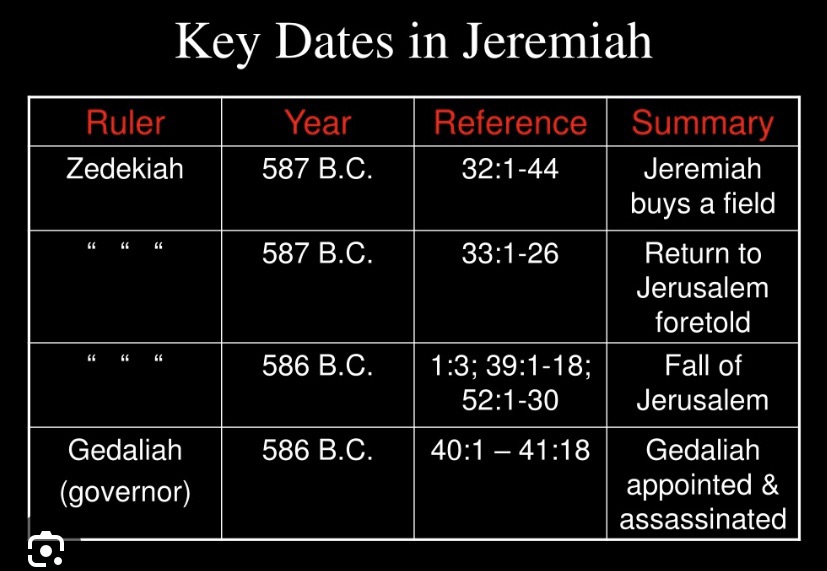
The disrupted nature of this book as a whole is well-documented. The chronological disjunctures throughout the 52 chapters can be seen when we trace the references to various kings of Judah: in order, we have Josiah in 627 BCE (Jer 1:2), jumping later to Zedekiah in 587 BCE (21:1), then back earlier to Shallum (i.e. Jehoahaz) in 609 BCE (22:11), Jehoiakim from 609 to 598 BCE (22:18), and Jeconiah in 597 BCE (22:24).

The book then returns to Zedekiah in 597 BCE (24:8), then back even earlier to Jehoiakim in April 604 BCE, “the first year of King Nebuchadrezzar of Babylon” (25:1)—and then further haphazard leaps between Zedekiah (chs. 27, 32-34, 37–38, and 51:59) and Jehoiakim (chs. 26, 35, 45) as well as the period in 587 after the fall of Jerusalem when Gedaliah was Governor (chs. 40–44). It is certainly an erratic trajectory if we plot the historical landmarks!

Rather than a straightforward chronological progression, the arrangement of the book is more topical, since oracles on the same topic are grouped together even though they may have been delivered at different times. This topical arrangement is easy to trace: 25 chapters of prophecies in poetic form about Israel, 20 chapters of narrative prose, and six chapters of prophecies against foreign nations. 

Early in the opening chapters, as Jeremiah prophesies against Israel, he reports that God muses, “you have played the whore with many lovers; and would you return to me?” (3:1). The idolatry and injustices practised by the people of Israel have caused God concern. Throughout the poetry of the prophetic oracles in chapters 1—25, God cajoles, encourages, warns, and threatens the people. The passage proposed for this Sunday sits within this opening section of oracles.

There are various theories as to how the book was put together; most scholars believe that someone after the lifetime of Jeremiah has brought together material from collections that were originally separate.

Indeed, A.R. Pete Diamond concludes that “like it or not, we have no direct access to the historical figure of Jeremiah or his cultural matrix”; we have “interpretative representations rather than raw cultural transcripts”, and thus he argues that the way we read this book should be informed by insights from contemporary literary theory, and especially by reading this book alongside the book of Deuteronomy, as it offers a counterpoint to the Deuteronomic view of “the myth of Israel and its patron deity, Yahweh” (Jeremiah, pp. 544–545 in the Eerdman’s Commentary on the Bible, 2003). 

So whereas Deuteronomy advocates a nationalistic God, Jeremiah conceives of an international involvement of Israel’s God. Commenting on this, Anthony Rees observes: “In this famous passage the covenant obligations which govern Judah’s relationship with God are given a broader understanding. Any nation can avoid divine punishment by turning from evil. Likewise, a nation that turns to evil stands condemned by God.”

Prof. Rees then draws an interesting conclusion. “Perhaps this relativizes Judah’s relationship with their God”, he proposes. “However, they maintain something the other nations lack: knowledge. Repeatedly God affirms that they are the only people amongst the nations who have been known by God and know God.”

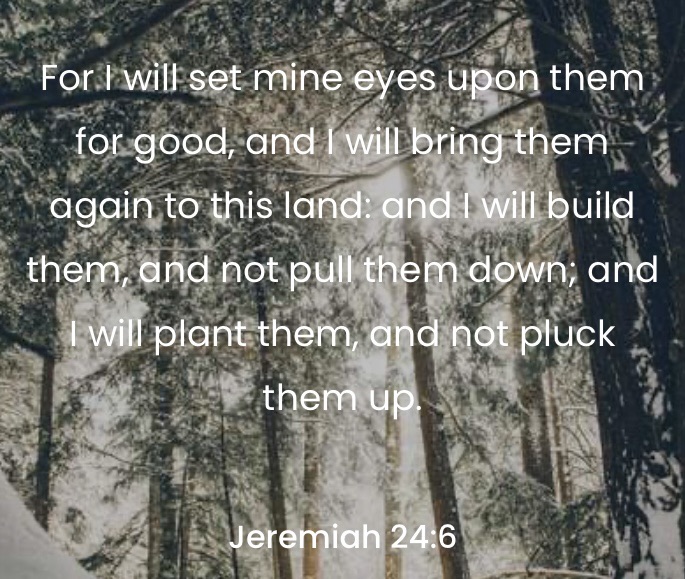
In a later oracle, when God is considering to bring Israel back out of exile, into their land, he says, using familiar imagery, “I will build them up, and not tear them down; I will plant them, and not pluck them up” (Jer 24:6).

He continues, “I will give them a heart to know that I am the Lord; and they shall be my people and I will be their God, for they shall return to me with their whole heart” (24:7). This is the fruit of knowledge: to be completely faithful to the Lord God.

And then, in yet another oracle—and this one so well-known because of how it is used in the New Testament—the prophet reports God’s intention to make “a new covenant” and to “put my law within them and … write it on their heart”. In this situation, “no longer shall they teach one another, or say to each other, ‘Know the Lord’, for they shall all know me, from the least of them to the greatest” (Jer 31:31–34). This knowledge is at the heart of the covenant. As the psalmist sings, “this I know, that God is for me” (Ps 56:9b). Or, as the Sunday school song goes, “Jesus loves me, this I know”.

So Prof. Rees concludes: “This is the great tragedy of [Israel’s] failure, and our own, that we know, and yet still follow our own plans that run contrary to the desires of God. Still, here we have the prophetic call to turn, to amend our ways and to live into that which, and whom, we know.” It is a call that stands, still, in our own time. How do we respond?

Screenshot

Seven days and one pair: and God saw that it was good (Genesis 1; Narrative Lectionary for Pentecost 13)

Discussion of Gen 1:1–2:4a for the Narrative Lectionary

The lectionary Gospel reading for the first Sunday in this fourth year of the Narrative Lectionary cycle takes us back to the very beginning of the Bible, to the poetic priestly account of the creation of the world (Gen 1:1—2:4a). There is so much to say about this foundational text; I will be selective!

The story serves as an origin story—for ancient Israel, for the canon of scripture, for Christian thinkers. Words used in origin stories like this have a particular power—and origin stories are always created with care and deliberation, and passed on with love as explaining the essence of being. Each element reflects something of significance in the experience of ancient Israel, and indeed of contemporary humanity.

The first two verses introduce the key characters: God, first described as the one who creates; a formless void, which is how the earth is first described; darkness, an entity in and of itself (not defined in any further way); and the breath of God, sweeping over the waters of the void. 

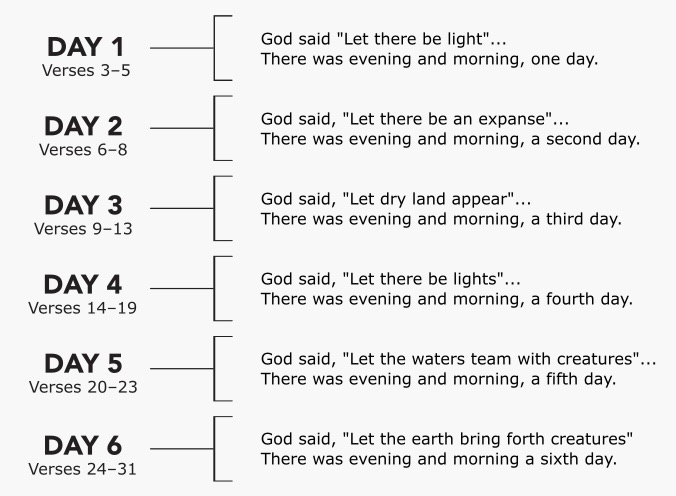
The story that follows in Gen 1 places the creation of light, the first act of creation, at the head of the story. All that happens after that is bathed in the light of God’s creation. Telling of the creation of light (1:3–5) establishes a pattern which is then repeated, five more times, for each of the various elements whose creation is noted in this narrative: the dome, or firmament, separating the waters (1:6–8); waters and dry land, with vegetation (1:9–13); lights in the sky and seasons (1:14–19); swarms of living creatures in sea and sky (1:20–23); living creatures on the earth (1:24–25); and humankind, male and female, in the image of God (1:26–31).

The third verse introduces light, which comes into existence through a single word of command. Then God said, “Let there be light”; and there was light (1:3). Light is the key entity in the creation story, signalling the creative process which then ensues. Each subsequent creative action results from something that God said (verses 6, 9, 11, 14, 20, 24, 26). And each creation is affirmed with the phrase, and it was so (verses 7, 9, 11, 15, 24, and then verse 30).

The fourth verse tells of God’s approval of what had been created: And God saw that the light was good (1:4). Likewise, God then affirms as good the creation of earth and seas (1:10), vegetation (1:12), the sun for the day and the moon for the night (1:18), all living creatures in the seas and in the sky (1:21), then the living creatures on the earth (1:25). Finally, after the creation of humanity in the image of God, there comes the climactic approval: God saw everything that he had made, and indeed, it was very good (1:31).

In a number of the six main sections of the narrative, God explicitly names what has been created: he called the light Day, and the darkness he called Night (1:5), then God called the dome Sky (1:8), God called the dry land Earth, and the waters that were gathered together he called Seas (1:10), followed by plants yielding seed of every kind, and trees of every kind bearing fruit with the seed in it (1:12), and the greater light to rule the day and the lesser light to rule the night—and the stars (1:16). 

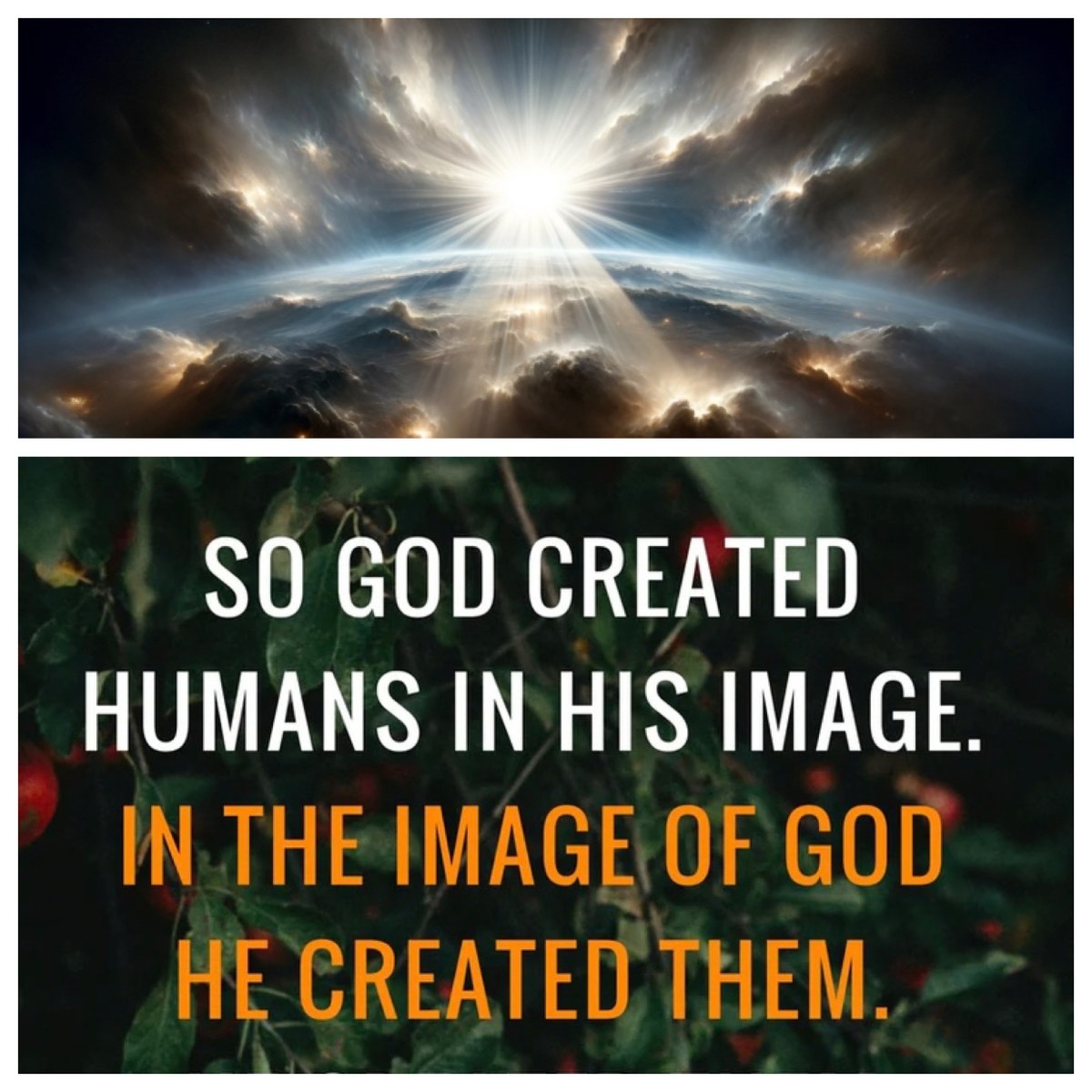
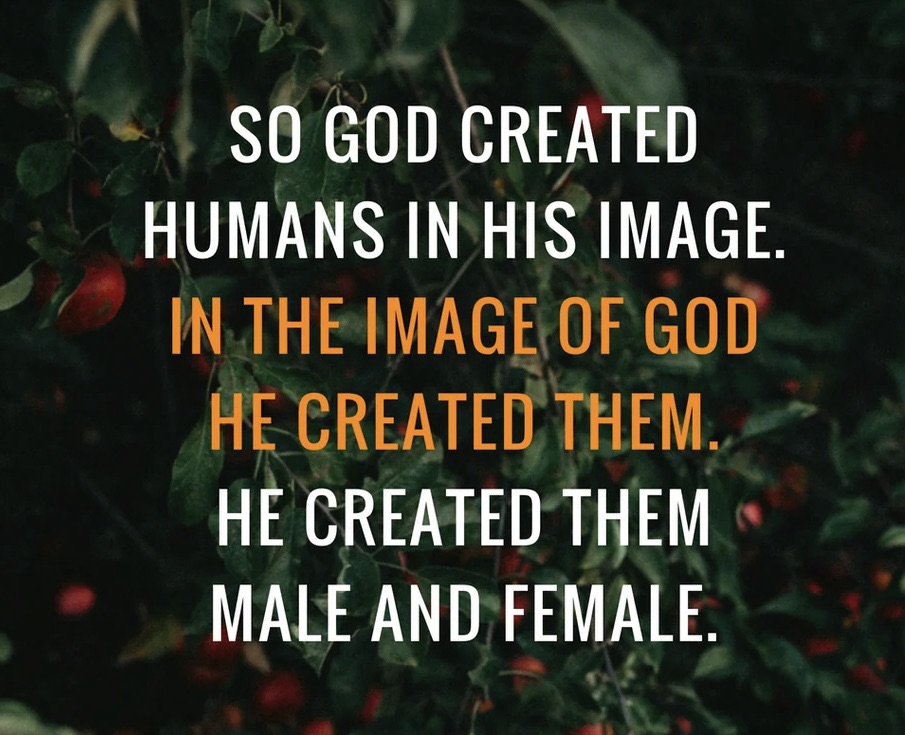
After this, the categories of living creatures are identified (1:21, 25), before the climax of creation is identified: “So God created humankind in his image, in the image of God he created them; male and female he created them” (1:27), and then God’s blessing is narrated (1:28).

Finally, each section concludes with another formulaic note: and there was evening and there was morning, the first day (1:5; likewise, at verses 8, 13, 19, 23, 31), before the whole narrative draws to a close with the note that on the seventh day God finished the work that he had done, and he rested on the seventh day from all the work that he had done (2:2). Of course, it is from this demarcation of the sections of the creative process as “days” that there came the traditional notion that “creation took place over seven days”. 

The notation of “days”, however, is simply to give the story a shape that we can appreciate—they are not literal 24-hour periods, but a literary technique for the story, much like we find that some jokes, some children’s songs, and some fairy stories are constructed around threes (“three men went into a pub …”, or “three blind mice”, or “Goldilocks and the three bears”, etc).

The story is thus told with a set of simple, repetitive phrases, but arranged with sufficient variation to give aesthetic pleasure, and with a growing sense of building towards a climax, to shape the narrative arc towards the culmination of creation (humanity, 1:26) and the completion of the creative task (sabbath rest, 2:2–3).

*****

One verse in this stylised poetic account of creation has attracted much attention over the decades. It is a verse that is most famously quoted by Jesus in an encounter he has with some Pharisees—and so it forms a foundational idea for Christians, as well as Jews. And it is a verse that has particular relevance and importance in the immediate contemporary context, when matters of gender identity and sexuality are regularly in the public discourse.

The story told in Mark 10:2–16 reports this encounter; as they debate the matter of divorce, Jesus offers the Pharisees a quote from a key verse in Genesis, “from the beginning of creation, ‘God made them male and female’” (Gen 1:27).

This verse needs attention; here I want to notes the rabbinic exploration of this text and associated matters. A warning in advance: this will lead to the conclusion that the strict binary understanding of human gender is inadequate. The rabbis clearly understood that not everyone fits these categories. That has important implications for our current understandings of human sexuality and gender.

The quotation from Genesis made by Jesus, that God made human beings as male and female, sounds like a definitive declaration: this is the reality, this is who we are, there is nothing more to debate! Certainly, that’s the way this verse has been used in the “gender wars” that have swirled through western societies in recent times. “God made male and female” became “God made Adam and Eve, not Adam and Steve”, in an early salvo against the emerging number of people who were “outing” themselves as same-gender attracted. “Not so” was the sloganeers’ reply; two genders, each attracted to the opposite, is who we are. Definitively. Resolutely. Absolutely.

It’s worth noting some aspects of this statement in its original context in Genesis. What the priestly authors of the creation story wrote was “God created humankind in his image, in the image of God he created them; male and female he created them” (Gen 1:27). The emphasis is not so much on defining who we are are gendered people—but rather, the verse is reflecting on the amazing feature that, within humanity, signs of divinity are reflected. And in association with that, the statement indicates that the two genders familiar from humanity are somehow reflected in the very nature of God. 

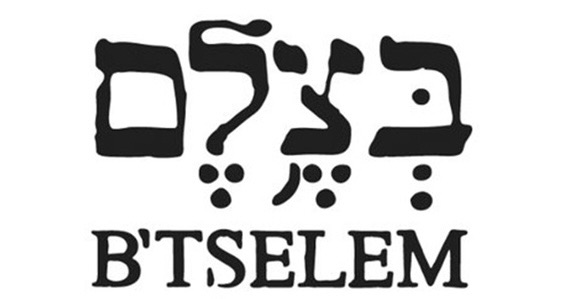
As God’s creatures, we are images of that creating being. The Hebrew word used, tselem (image), indicates a striking, detailed correlation between the human and the deity. This was the insight brought by the authors of this passage, perhaps shaped and honed over generations of telling and retelling the story, passing on through the oral tradition the insights of older generations.

My sense is that these ancients were not so much making a definite declaration about the nature of humanity—an early dogmatic assertion, if you like—as they were actually reflecting on their experience. They sensed that there was something within humanity that reaches out, beyond the material, into the unknown, beyond the tangible, into “the spiritual”. They surely knew the kind of experience that Celtic mystics have known, of coming to a place where “heaven meets earth”—what they call “a thin place”, where God can be sensed in the ordinariness of life. Indeed, such a “thin place” might well be being described in Gen 28:10–22, where Jacob comes to the realisation that “surely, the Lord is in this place” (Gen 28:16).

Indeed, as Jewish tradition developed over time, this fundamental duality of human gender—male and female—was questioned, probed, explored, and developed. Rabbis of late antiquity and the early medieval period (using the standard Western terminology) actually identified six genders.

The first move takes place in the Mishnah (early 3rd century). Tractate Bikkurim 4.1 contains the assertion, “an Androginus (a hermaphrodite, who has both male and female reproductive organs) is similar to men in some ways and to women in other ways, in some ways to both and in some ways to neither”.

It is interesting that the term androginus, a Greek term, is simply transliterated in this Aramaic work, as אדדוגינוס. That’s a sign that the consideration of this issue encompassed more than just rabbinic scholars, as they were drawing on insights and the term androginus from the hellenised world.

The text of Bikkurim goes on to offer indications of the ways that an androginus person is similar to, and dissimilar to, each gender (4.2–3). Another passage in the Mishnah identifies people known as a saris, סריס (Yevamot 8.4). These are people we identify as eunuchs; whether these are “eunuchs who have been so from birth … eunuchs who have been made eunuchs by others … [or] eunuchs who have made themselves eunuchs” (as Matthew reports Jesus saying, Matt 19:12) is not relevant in this context.

Presumably, the rabbis refer to males with arrested sexual development who are unable to procreate.  The female term for such people is given as aiylonit, אילונית. The discussion that follows makes it clear that these people are women with arrested sexual development who cannot bear children.

So this means that rabbis recognised four genders: male, female, androgyne, and eunuch (saris). In the Babylonian Talmud (sixth century CE), Rabbi Ammi is quoted as stating that “Abraham and Sarah were originally tumtumim” (טומטמין). Here we find another gender identity term; this time, describing people a person whose sex was unknown because their genitalia were hidden, undeveloped, or difficult to determine. (Tumtum means “hidden”.)

Thus, Abraham and Sarah lived most of their life as infertile, as their sex was not clear; and then, in Rabbi Ammi’s explanation, miraculously turned into a fertile husband and wife in their old age. The Rabbi points to Isa 51:1–2, saying that the instruction to “look to the rock from where you were hewn, and to the hole of the pit from where you were dug […] look to Abraham your father and to Sarah who bore you” explains their genitals being uncovered and miraculously remade.

(Explaining one scripture passage by drawing on another passage, however distantly related—often through their sharing a common word or phrase—was a common rabbinic mode of scripture interpretation.)

Today, we would explain the phenomenon of a tumtum as being an intersex person, born with both male and female characteristics, including genitalia—although modern science would not go so far as to accept a miraculous reversal of the condition, as Rabbi Ammi proposed. 

There’s a quite accessible discussion of these issues in an article by Dr Rachel Scheinerman, entitled “The Eight Genders in the Talmud”, in the My Jewish Learning online resource.

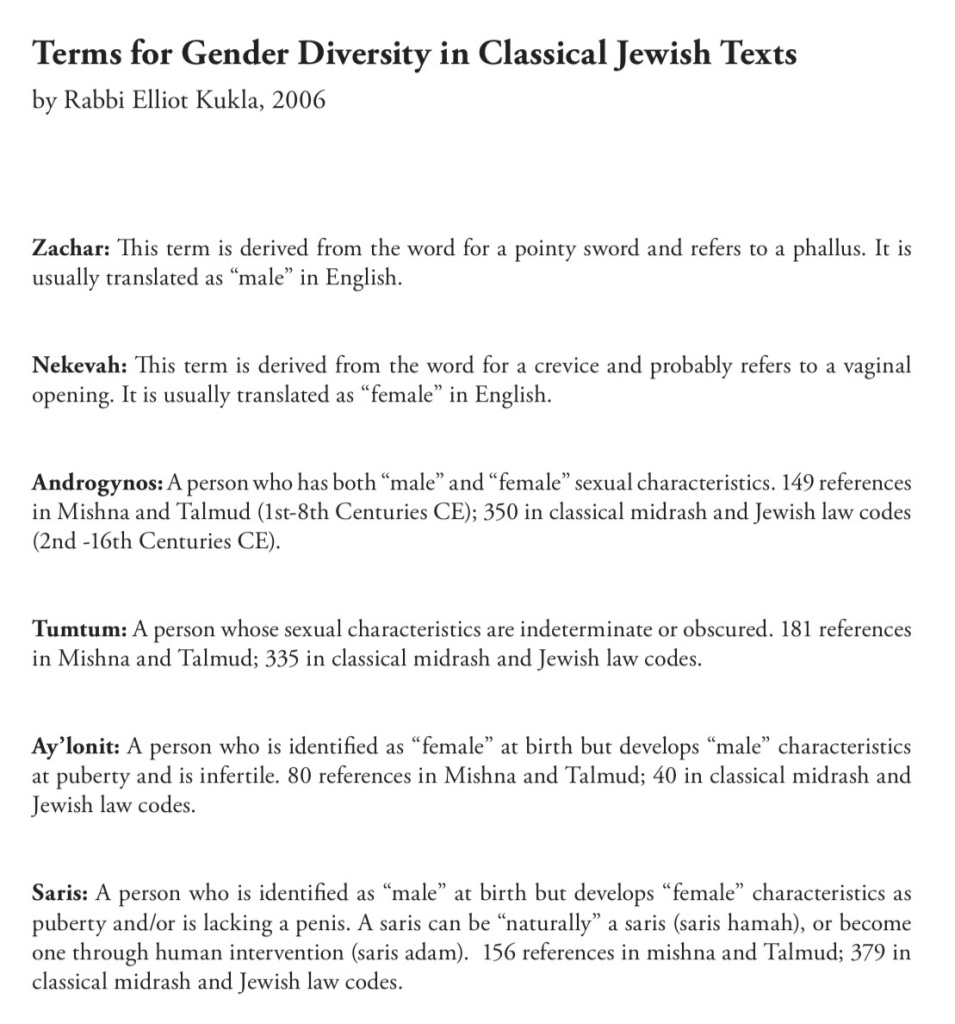
The title reflects the fact that Dr Scheinerman divides both aylonit and saris into two, on the basis of birth identification. So she lists: (1) zachar, male; (2) nekevah, female; (3) androgynos, having both male and female characteristics; (4) tumtum, lacking sexual characteristics; (5) aylonit hamah, identified female at birth but later naturally developing male characteristics; (6) aylonit adam, identified female at birth but later developing male characteristics through human intervention; (7) saris hamah, identified male at birth but later naturally developing female characteristics; and (8) saris adam, identified male at birth and later developing female characteristics through human intervention.

Dr Scheinerman concludes, “In recent decades, queer Jews and allies have sought to reinterpret these eight genders of the Talmud as a way of reclaiming a positive space for nonbinary Jews in the tradition. The starting point is that while it is true that the Talmud understands gender to largely operate on a binary axis, the rabbis clearly understood that not everyone fits these categories.”

https://www.myjewishlearning.com/article/the-eight-genders-in-the-talmud/

Dr. Charlotte Elisheva Fonrobert, a Talmudic scholar in the Department of Religious Studies at Stanford University, California, has provided a much more detailed and technical discussion of the matter of gender identity, in the online resource the Jewish Women’s Archive. See 

https://jwa.org/encyclopedia/article/gender-identity-in-halakhic-discourse

The abstract of this article reads, “Jewish law is based on an assumption of gender duality, and fundamental mishnaic texts indicate that this halakhic duality is not conceived symmetrically (as seen through the gendered exemptions of some commandments). Rabbinic halakhic discourse institutes a functional gender duality, anchored in the need of reproduction of the Jewish collective body. As such, it aims to enforce and normalize a congruence between sexed bodies and gendered identities. Furthermore, the semiotics of body surfaces produces other different and seemingly more ambiguous gender possibilities, and rabbinic discourse has widely discussed the halakhic implications of these ambiguities.”

What that means, I think, is that whilst Torah prescriptions are based on a definite duality of gender (you are either male or female), later rabbinic discussions entertained the possibility of a range of gender identifications. In this regard, the rabbinic discussions prefigured the move in contemporary society to recognise the full spectrum of diversity amongst human beings: some men are gay, some women are lesbian; some people are bisexual, attracted to both genders, while others are asexual, having no sexual-attraction feelings at all. 

Biologically, we know that some are born intersex, with both male and female physical characteristics; whilst psychologically, some people are born into a body that is clearly one gender have an internal energy that leads them to identify with the opposite gender, and so they undergo a medical transition to that gender, and we identify them as transgender people. And so we have the now-widespread “alphabet soup” of LGBTIQA+ (where the plus sign indicates there may well be other permutations within this widely diverse spectrum).

So we would do well not to remain in a static state of assertion that the Genesis text is a prescription for how human beings should be identified (and a definition for marriage). I think it is preferable to add into the discussion both the rabbinic understandings,  contemporary medical understandings, and psychological insights that reveal a wide spectrum of gender identities; a dazzling kaleidoscope of “letters”, as it were. For this is how we human beings are made, in an image that reflects the diversity and all-encompassing nature of God. 

I believe it is important that, rather than misusing the Genesis/Mark text as a club to batter people into submission, we ought to rejoice in the diversity we see amongst humanity, and affirm that, no matter whether L or G, whether B or A, whether T or I, all people who are Q, and all who are straight, are “fearfully and wonderfully made” (Ps 139:14).

There is a helpful collection of the Jewish texts relating to this matter in the online resource, Sefaria, entitled “More Than Just Male and Female: The Six Genders in Ancient Jewish Thought”, collated by Rabbi Sarah Freidson of Temple Beth Shalom in Mahopac, NY, USA. See

https://www.sefaria.org/sheets/37225?lang=bi

And so, in the end, given the rabbinic midrashic exploration and exposition of this crucial text, I hope we can come to the same conclusion as the ancient priestly writers: “God saw everything that he had made [including the diversity of gender expressions within humanity], and indeed, it was very good”.


1 September: as the seasons change

Today, 1 September, is the day (in the southern hemisphere) which marks the beginning of Spring. My nose and eyes had already alerted me, some time ago, to this turn-of-the-seasons. But now, it’s official. And to further reinforce this moment, today in Australia is Wattle Day, in celebration of the golden wattle (Acacia pycnantha), whose bright yellows flowers are prolific from August through to January.

Of course, there’s are many other signs of the coming of Spring downunder. The days are lengthening, the warming sun is strengthening its heat, the grass and flowers—and weeds!—are returning from their wintry hibernation, and (at least in the town where I live) there is a string of local community events that are planned for these pleasantly warm weeks. We have already had Run Dungog and Sculpture on the Farm. Ahead, there lies the Dungog Tea Party, Ride Dungog social bike rides, a new art exhibition in one of the local galleries, the Dungog Rumble for hot rod cars, and then the Dungog Show early in November.

However, alongside the seasonal change, there’s also an ecclesial significance to today. In 1989, the Ecumenical Patriarch Dimitrios I (then head of the Eastern Orthodox Church, pictured) declared 1 September to be a day of prayer for the natural environment. In 2008, the World Council of Churches invited all churches to observe a Time for Creation from 1 September to 4 October—the day which had long been kept as the feast day for St Francis of Assisi

Francis, of course, is probably the most popular Catholic saint in the world. He is the one who preached to the birds; blessed fish that had been caught, releasing them back into the water; communicated with wolves, brokering an agreement between one famous ferocious wolf and the citizens of a town that were terrified of it; and used real animals when he created the very first, live, Christmas nativity scene. As a result of these, Francis is the patron saint of animals and the environment. And he is the inventor of the familiar nativity scene. 

Every 4 October, Francis of Assisi is remembered in churches around the world—along with Clare of Assisi who, like Francis, came from a noble family, but decided to renounce it all to live a life of simplicity with Francis and his brothers. Unlike Francis, who was a mendicant, Clare lived an enclosed life of poverty and prayer, leading a community of women who shared the same vision.

In 2019, Pope Francis (pictured) adopted the Season of Creation for Roman Catholic worship. It runs from 1 September to 4 October. And so, in many churches around the world, the whole of September is now designated as a time to focus on Creation—a truly ecumenical festive season, involving Eastern Orthodox, Roman Catholic, Anglican, and Protestant churches alike.

Recently the Rev. Dr Elizabeth Smith (Anglican priest and well-known hymn writer) attended an internal colloquium which was exploring the adoption of a Season of Creation by all mainstream denominations. She described the impetus for such a gathering in this way: “Christians have joined the growing chorus lamenting the climate crisis and its effects on nature and on vulnerable humanity, especially the poor. Energy is coalescing around liturgical acknowledgement of the value of ‘creation’—both God’s creative action and the universe it produces.” 

She then noted that “Ecumenical efforts are pressing toward a feast or season that raises both the act and fact of creation to the praise and thanksgiving of assemblies across denominations, from the Orthodox and Catholics where the initiatives began, to Anglican, Reformed, Lutheran, Methodist, and Pentecostal fellowships and associations.”

Let us hope that this initiative moves from “a good idea” to “a practical implementation” of that good idea! It will be good to have a formal liturgical accompaniment, ecumenical and international, to the signs of the change of season that is all around us.

The Uniting Church in Australia has produced resources to assist in the celebration of the Season of Creation at https://uniting.church/season-of-creation-2025/

A Jesus-Centred Perspective on Immigration

This is a blog written by a guest blogger, the Rev. Pablo Nunez. Pablo is minister of the Ballina Uniting Church and Moderator-Elect of the NSW.ACT Synod of the Uniting Church in Australia. It is particularly pertinent for today, when xenophobic fascists are trying to mobilise people to “protest against immigration” in Australia. Thanks to Pablo for permission to reproduce his words here.

If you pause for a moment and look around Australia, what do you see? Beaches that take your breath away. Red dirt that stains your shoes and stretches your imagination. Cities alive with languages, smells, and flavours from all over the world. And at the heart of it all, the world’s oldest continuous culture, Aboriginal and Torres Strait Islander peoples, who have lived here, cared for this land, and told its stories for thousands of years.

That’s the starting point. Before we speak about immigration, we need to say out loud: every single non-Indigenous person in Australia is here because of migration. Some of us came by ship generations ago, some by plane more recently. Some came fleeing war, some chasing opportunity, some brought by chains, others by choice. But none of us, apart from our First Nations brothers and sisters, can truly call ourselves original to this land.

And if that’s true, then the way we talk about migration in Australia has to begin with humility.

*****

Jesus Was a Migrant

The story of Jesus is not a neat, polished tale of a man who lived in one safe place his whole life. From the beginning, his life was marked by displacement. Born in Bethlehem, raised in Nazareth, taken as a refugee to Egypt because a violent ruler wanted him dead. Jesus knew what it meant to live in a strange land. He knew what it was to flee under the cover of night, to live with uncertainty, to depend on the hospitality of others.


La Sagrada Familia by Kelly Latimore

Later, as an adult, Jesus would walk dusty roads from village to village, never truly at home, saying: “Foxes have dens and birds have nests, but the Son of Man has no place to lay his head” (Luke 9:58). He was, in every sense, a migrant—on the move, without fixed security, dependent on God and others.

So when Christians think about immigration, we don’t start with politics or economics. We start with Jesus. And Jesus says something radical: when you welcome the stranger, you welcome me (Matthew 25:35).

*****

Migration Is in Our Blood

Sometimes in Australia we talk about immigration as if it’s something unusual or threatening. But migration is the story of us all. Think about it:

  • The Irish came during the potato famine.
  • The Chinese came during the gold rush.
  • Italians and Greeks came after the war, bringing pasta, olives, and coffee that changed our food culture forever.
  • Pacific Islanders have brought love for family, music, faith and more than a few sports’ stars.
  • Vietnamese families arrived in the 1970s, rebuilding their lives after war and giving us the joy of pho and banh mi.
  • More recently, African communities have brought strength, music, and resilience born from hard journeys.
  • Latin Americans, like myself, came in different waves, some fleeing dictatorships, some chasing new opportunities, and we bring rhythms, faith, and fire for life.

Australia today is richer—economically, socially, culturally, spiritually—because of migrants. We wouldn’t be who we are without them. And the truth is, most of our favourite things—our food, our music, our sport—carry a migrant story. Even Vegemite was invented by a man whose parents came from Switzerland.

Migration is not an interruption to the Australian story—it is an essential part of the Australian story.

*****

The Gift of the Stranger

Here’s the thing about migrants: they don’t just bring their skills, their recipes, and their music. They also bring gifts we desperately need but often overlook.

Migrants remind us of courage—because leaving your homeland is never easy. They remind us of resilience—because starting again from scratch takes grit. They remind us of generosity—because most migrants know what it’s like to have little, and so they share what they have.

And, most profoundly, migrants remind us of God. Over and over in Scripture, God appears through the stranger. Abraham entertains three mysterious travellers and realises he’s been hosting God (Genesis 18). The Israelites are told: “Do not oppress the foreigner, because you yourselves were foreigners in Egypt” (Exodus 22:21). And then Jesus himself comes as the refugee child.

To welcome the stranger is to make room for God.

*****

A Personal Word

I carry this personally. I wasn’t born in Australia. My family story, like many of yours, is one of packing up, crossing borders, learning a new language, and trying to fit into a place where you don’t always feel you belong.

And yet, what I’ve discovered is that this tension—this experience of not quite belonging—actually brings me closer to the heart of God. Because faith is, at its core, a migrant journey. Hebrews 11 describes all the great heroes of faith as “foreigners and strangers on earth, longing for a better country—a heavenly one.”

In that sense, migration is not only Australia’s story, it’s the Christian story. We are all on the move, walking toward God’s promised future.

*****

A Challenge for the Church

But here’s the challenge: in Australia, conversations about immigration often get reduced to fear. Fear of boats. Fear of “the other.” Fear that there won’t be enough jobs or houses or space.

Jesus calls us to a different way. If every person is made in the image of God, then every migrant is not a threat but a gift. If Jesus himself was a refugee, then to reject the refugee is, in some sense, to reject Jesus. And if the Spirit of God is at work in every culture, then immigration is not about us “helping them,” but about recognising the Spirit who comes to us through them.

This means the Church in Australia has a prophetic role: to remind our nation of its migrant story, to model hospitality, and to show that love is bigger than fear.

What if every church treated migrants not as projects, but as partners? What if we saw multicultural worship not as a challenge, but as a glimpse of Revelation 7:9—a great multitude from every nation, tribe, people, and language worshipping before the throne? What if we stopped seeing immigration as a “problem” and started seeing it as a mirror of the kingdom of God?

*****

Building Our Legacy

Friends, Australia is at its best when it remembers its migrant heart. Our legacy will not be built on shutting doors, but on opening tables. On meals shared. On friendships made. On seeing the image of God in one another.

And the Church must lead the way. Because when we welcome the migrant, we are not only welcoming a neighbour—we are welcoming Christ into our lives in new perspectives and possibilities. A new life. A better life.
So let’s be people who celebrate our heritage, acknowledge our debt to First Nations peoples, and embrace the truth that every migrant—past, present, and future—brings a gift from God.

Australia’s modern story is migration. The Church’s story is migration. The Gospel’s story is migration. And in all of it, Jesus is the one who walks with us, the migrant Messiah, calling us to follow him into a kingdom where every tribe and tongue has a place at the table.

The Rev. Pablo Nunez, Moderator-Elect,
Synod of NSW.ACT, Uniting Church in Australia

You defiled my land and made my heritage an abomination (Jer 2; Pentecost 12C)

Last week we began reading and hearing sections of the long book of Jeremiah. Of the first three major prophets, First Isaiah (the actual Isaiah the prophet) fills 39 chapters. The book of the exilic prophet Ezekiel is 48 chapters long; Jeremiah’s book has a mammoth 52 chapters. (The only book longer is Psalms, with an unbeatable 150 chapters.)

Jeremiah makes a most substantial contribution to Israelite society and Hebrew Scripture. It is good, I believe, that we have eight consecutive weeks, no less, to consider what he had to say. (And in the middle of that, the lectionary inserts Lamentations—a work traditionally associated with Jeremiah, even if not actually written by him.)

A depiction of the prophet Jeremiah, from the Icons of the Bible collection by photographer James C. Lewis
see https://elizabethokoh.com/in-conversation-with-james-c-lewis-international-photographer-awakening-a-generation/

We need to allow Jeremiah and his fellow prophets to speak their prophetic words without rushing all-too-quickly to say that they are “predicting Jesus” in what they say (a common misuse of Hebrew Scripture texts); or, indeed, that we say something like, “well that’s how it was back then, but things changed when Jesus came, and it’s now all different—we don’t need these texts any more”. That is the bad heresy of supercessionism (which the church, sadly, has perpetrate and advocated for at various times in its history).

On supercessionism, see https://johntsquires.com/tag/supersessionism/

So it’s best that we hear each passage, week by week, and seek to understand each of them in their own own integrity, paying due attention to the particular historical, cultural, religious, and sociological contexts in which it was first spoken and/or written. So my commentary on each Jeremiah passage will seek to focus in this way as we explore what is offered by the lectionary.

Jeremiah 2 comes immediately after the narrative of the call of the young Jeremiah (1:4–10) and the initial words of the Lord that he hears, pointing to the disaster that is looming as the Assyrians press down from the north onto the kingdom of Israel (1:11–19). Jeremiah reports the stern condemnation of the Lord God, who makes note of “all their wickedness in forsaking me”; he cites, in particular, making offerings to other gods and worshipping idols (“the works of their own hands”) (1:16).

Into this situation, the prophet is commanded to speak three oracles (2:1–3; 4–9; 10–13), perhaps originating at different times, but brought together here for a strongly theological purpose. The lectionary chooses to offer just the second and the third oracles; the first, a brief reminiscence of how disaster has come upon the once-faithful nation (2:1–3), sets the scene for the fiercer words of the following two oracles.

“I remember the devotion of your youth, your love as a bride”, the Lord God has sung (2:2); yet “your ancestors … went far from me”, he accuses, noting that “they went after worthless things, and became worthless themselves” (2:2, 5). Israel has not exhibited the fidelity expected; they have not kept the marital vow to “love and cherish”, in our modern terms. 

So in this second oracle (2:4–9), the Lord condemns Israel in the strongest of terms; even though he brought them “into a plentiful land to eat its fruits and its good things”, their transgressions were such that, as he declares, “you defiled my land, and made my heritage an abomination” (2:7). An abomination!—strong words, indeed.

For more on “abominations” in Hebrew Scripture, see

All knowledge of the Law which was given to guide the people has been lost (2:8). There is, it seems, no longer any hope that the people can maintain their part of the covenant agreement. Their lives are lived in disdain and rejection of all God has hoped for them—all that their ancestors had committed to in the covenant.

We might well infer, then, that judgement is inevitable. The stridency of punishment for such an “abomination” is reminiscent of the punishments promised when the “abominations” of sexual misconduct are canvassed in Torah (see Lev 18:1–23). There, any such actions will have the result that “the land will vomit you out for defiling it” (18:28) and “whoever commits any of these abominations shall be cut off from their people” (18:29).

In these two results—the loss of the land and disconnection from the people—we see the severing of two of the foundational promises recorded in the ancestral saga, when Abraham was promised both a land, and a great nation, in response to his obedience (Gen 12:1–2).

With no land, and a fractured people, this ancestral promise is in tatters. For many more verses, words of condemnation of the idolatrous state of Israel pour forth: “have you not brought this upon yourself by forsaking the Lord your God, while he led you in the way?” (2:17); “on every high hill and under every green tree you sprawled and played the whore” (2:20); “where are your gods that you made for yourself?” (2:28); “on your skirts is found the lifeblood of the innocent poor” (2:34); “you have played the whore with many lovers” (3:1); “you have the forehead of a whore, you refuse to be ashamed” (3:3). The Lord God is incessant in his denunciations.

Yet God does not wish for this situation to continue. At the end of this lengthy tirade, the prophet poses the question of God: “will he be angry forever, will he be indignant to the end?” (3:5). The answer to this comes in the very next oracle: a call for repentance, with the divine assurance that “I will not look on you in anger, for I am merciful, says the Lord; I will not be angry forever” (3:12), followed by the promise that “I will give you shepherds after my own heart, who will feed you with knowledge and understanding” (3:15). The lengthy oracle of judgment does indeed lead to the possibility of forgiveness and restoration (3:15–18). 

And so the fundamental dynamic of the whole long book of oracles spoken by Jeremiah is set forth. Intense, persistent, excoriating condemnation; followed by soothing, loving assurances of grace. For chapter after chapter. Decade after decade. Through all manner of trials. Until the prophet words of the prophet cease (Jer 51:64). 

By offering this passage for preachers in the 21st century, the lectionary invites us to consider how these ancient words from so long ago, in such a different cultural context, might yet still speak to us as “the word of the Lord”. In writing in With Love to the World about the passages from Jeremiah in the lectionary, the Rev. Dr Monica Melanchthon, Associate Professor of Hebrew Bible at Pilgrim Theological College in the University of Divinity, asks some pertinent questions:

How do you go about applying the role of the ancient Israelite prophet to your own life and experience? 

What aspects of Jeremiah’s call speak to you the most? Why?

How might the sins of the Israelites in Jeremiah 2 be parallel to modern day Christian living?

and then, How might this text guide your reactions to prophetic warnings in the current world?