My name is John Squires. I live in the Hunter Valley in rural New South Wales, on land which has been cared for since time immemorial by the Gringai people (one of the First Nations of the island continent now known as Australia). I have been an active participant in the Uniting Church in Australia (UCA) since it was formed in 1977, and was ordained as a Minister of the Word in this church in 1980. I have had the privilege to serve in rural, regional, and urban congregations and as a Presbytery Resource Minister and Intentional Interim Minister. For two decades I taught Biblical Studies at United Theological College at North Parramatta in Sydney, and more recently I was Director of Education and Formation and Principal of the Perth Theological Hall. I've studied the scriptures in depth; I hold a number of degrees, including a PhD in early Christian literature. I am committed to providing the best opportunities for education within the church, so that people can hold to “an informed faith”, which is how the UCA Basis of Union describes it. This blog is one contribution to that ongoing task.
Over the last few months, Elizabeth and I have, once again, been teaching a course on “Exploring the Old Testament”. We have connected online each week with two cohorts of keen, active lay leaders in the church, drawn from across our own region in the ACT and southern NSW, as well as the southwestern region and some urban locations of NSW.
It has been a stimulating time. We have spent fourteen sessions with each group, investigating the various books of the Hebrew Scriptures, following the key themes, asking questions about the meaning of various passages, and pondering how we might preach on texts from these books within the worship of the Christian church.
The Old Testament has quite a chequered history in the church. In the early centuries of the church, there was a strong movement that advocated having nothing at all to do with any of the books in the Old Testament. This view was particularly prosecuted by Marcion of Sinope (a seaport on the southern coast of the Black Sea, northern Turkey), a teacher in the second century.
Marcion even prepared a version of the New Testament in which he excised all the Jewish references. He removed three of the Gospels, retained a heavily-edited version of Luke, and created a compilation of Paul’s letters, focussing on the places where he attacked those in the early churches who advocated for the Jewish Law (the so-called “Judaisers”). Not only did his Bible have no Old Testament, but also no Jewish elements in the New Testament!
In more recent times, the Old Testament has been criticised as being irrelevant, containing a host of laws that come from an ancient and very different society, bearing no relevance to contemporary life. The God of the Old Testament is often criticised as being a thoroughly vengeful creature, who is quite different from the loving God we encounter in the New Testament, and thus not worthy to be part of Christian faith. That claim, I believe, is most unfair; there are expressions of God’s love in both testaments, just as there is violence and retribution portrayed in each testament.
Another criticism often voiced is that all of the cultic (worship) provisions set out in the Old Testament are totally irrelevant to worship in the Christian church; only the moral prescriptions (the Ten Commandments and other select laws) remain relevant. Inevitably, this involves a large amount of cherry-picking, to select those passages that reinforce an already-existing point of view. It’s not really a very fair way to operate.
Underlying these criticisms is, undoubtedly, a supercessionist attitude towards Jews and the sacred texts of Judaism. There are signs of this attitude developing throughout the Middle Ages, and it certainly was fostered by key figures in the Reformation. Supercessionism came to its fullest flowering in the blatant antisemitism found most starkly in the brutal policies implemented by the Nazi regime in the middle of the 20th century, leading to the genocide of 6 million Jews in the tragedy of the Holocaust (the Shoah).
Supercessionism (a form of replacement theology) claims that Christianity has replaced Judaism; that Jesus Christ has abolished the Law; that the new covenant of Jesus replaces the old covenant of Moses; and that the chosen people of God are no longer the Jews, but Christians. It is a view that is no longer accepted within Roman Catholicism and Anglicanism and all mainstream Protestant denominations—although many of the “people in the pew” still articulate points of view that are fuelled by supercessionist ideas.
Yet, alongside this negative and destructive attitude within the church, there are a number of striking facts to observe. First, the 39 books of the Old Testament remain an integral part of the sacred scriptures of the church. They are still in our Bibles! (Indeed, there are additional books contained with the Roman Catholic Old Testament.)
Second, the Psalms, which are part of the Old Testament, hold a central and beloved place within within the communal worship life and the personal devotional life of Christians all around the world. Any thought of banishing these poems from our spiritual life would be anathema to millions upon millions of faithful people!
Third, the Revised Common Lectionary which is widely used amongst many denominations of the Christian church (Roman Catholic, Anglican, and many Protestant churches) explicitly provides two readings from the Old Testament alongside two readings from the New Testament, for use in communal worship. There is a Psalm for each Sunday, and another reading drawn from other parts of the Old Testament each Sunday. These texts are intended to nourish the religious life of the faithful as equally and as constructively as the Gospels and Epistles.
Fourth, when we read and reflect on the New Testament, it should be clear that every one of those 27 books is, in some way, dependent on the Old Testament. Jesus quotes many passages from Hebrew Scripture; his distillation of “the two greatest commandments” draws directly from scripture, as he urges his followers to “love God” (Deut 6:4–5) and to “love your neighbour” (Lev 19:18).
Paul infuses most of his letters with scriptural citations; his theological legacy, set out in his letter to the Romans, is based on a single scripture text (Hab 2:4b, quoted at Rom 1:16-17), and a plethora of scripture texts are cited during the argument advanced in Rom 9–11, for instance. We can’t pretend to understand the New Testament if we ignore and sideline the Old Testament.
Finally, we need to note that there are a number of key themes in the books of the Old Testament that resonate strongly within the pages of the New Testament. Take away any one of these key themes, and the New Testament would be impoverished, and our Christian faith would be less enriched. We need these Old Testament themes from the times of the patriarchs and matriarchs, the judges and sages, the prophets and kings, to make sense of the story of Jesus and the early church!
I’ll offer further posts that provide more detailed consideration of these key themes. Suffice it to say, at the moment, that if we eliminate all concern for the Old Testament, we will have an impoverished understanding of the New Testament, a flawed perception of spiritual realities, and an inadequate expression of faithful discipleship as a follower of Jesus. That’s a big claim; I hope to substantiate it in the series of posts that follow.
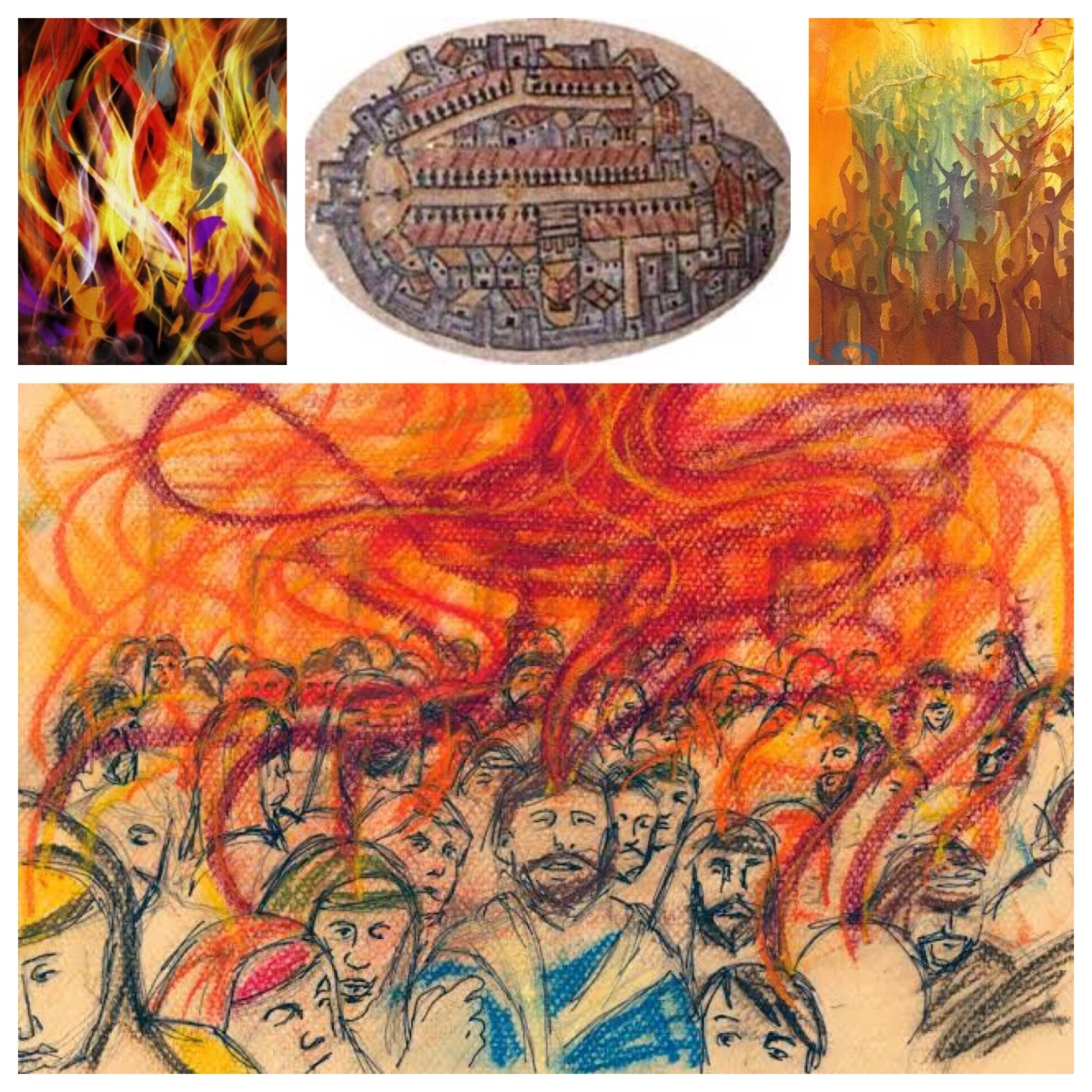
Pentecost is about the Spirit. That is the focus in the Christian Church, where this festival day provides the most concentrated occasion for celebrating the work of the Holy Spirit. However, often this focus on the spirit leads people to think that this was the first appearance of the spirit—on the day of Pentecost, the beginning of the church.
And let us not forget that Pentecost itself was already a well-established Jewish festival day, for the Feast of Weeks, or the Feast of Ingathering (Exod 23:16). Provisions for this festival are set out in Leviticus 23:15-22, Numbers 28:26-31, and Deuteronomy 16:9-12. The name Pentecost (meaning the fiftieth day) is used at Tobit 2:1 and 2 Maccabees 12:32, two books included in the Old Testament in the Roman Catholic Deuteroncanonical books.
The spirit was not a new entity arriving for the first time on the first day of Pentecost. The spirit had been active throughout the life of the people of Israel. In fact, the spirit is mentioned very early in Hebrew Scripture, in the opening verses. The Priestly writer attributed the spirit with a key role in creation. The story of creation which opens the scriptures of the Hebrew people affirms that creation took place when “the spirit moved over the face of the waters” (Gen 1:1-2; see also Job 33:4).
Later, the Psalmist envisioned the spirit as playing an eschatological role at the end of time (Ps 104:30). The spirit bookends history, as understood in the biblical texts, being noted both at the very beginning and at the very end. So, the spirit joins with “the bride” (that is, Jesus), to utter the closing invitation at the end of the scriptures of the Christians: “the spirit and the bride say, ‘Come’ … let everyone who is thirsty, come; let anyone who wishes take the water of life as a gift” (Rev 22:17).
The spirit was an important element in the ancient Jewish worldview. Moses and the elders whom he appointed as judges were filled with the spirit (Num 11:25), and subsequently the spirit was given to Joshua (Deut 34:9). Various prophets were anointed by the Spirit to declare “the word of the Lord” for the people of their time; the former prophets (Zech 7:12); the prophets Micah (Micah 3:8) and Zechariah (Zec 4:6); the prophet Ezekiel (Ezek 2:2, 3:24, 11:1, 36:26-27, 37:1, 14); and the later prophet speaking in the name of Isaiah (Isa 61:1-3), who most famously declares “the spirit of the Lord is upon me”.
The promise is given that the spirit will rest upon the future Davidic leader (Isa 11:2-5), the servant whom God has chosen (Isa 42:1), and still later, on Daniel (Dan 4:8-18). Wisdom promises to give the spirit to those who listen to her (Prov 1:23) and Joel prophesies that the spirit will be poured out on “all flesh … your sons and your daughters … your old men … and your young men … even on the male and female servants” (Joel 2:28-29).
In a time of difficulty, Isaiah declares that the spirit will be poured out on the people of Israel, to turn their wilderness into a fruitful field (Isa 32:15, 44:3). So the promise that God makes through the prophets is striking: “my spirit abides among you; do not fear” (Haggai 2:5); and “my spirit that is upon you, and my words that I have put in your mouth, shall not depart out of your mouth, or out of the mouths of your children, or out of the mouths of your children’s children, says the Lord, from now on and forever” (Isa 59:21).
The spirit was an important element in the ancient Jewish worldview. In the process of creating “the heavens and the earth”, God “gives breath to the people upon [the earth] and spirit to those who walk in it” (Isa 42:5). All human beings are created with the spirit of God within us (Gen 1:20, 21, 24, 30, 2:7). Job affirms this belief unreservedly and extends it to all creatures, not just human beings: “in [God’s] hand is the life of every living thing, and the breath of every human being” (Job 12:7-10).
That is an incredibly important affirmation for human beings to make. Perhaps the sense of this divine in-breathing has led humans to reinforce our sense of human beings as being at the pinnacle of the order of animals, birds, and fish. However, we need to remember that we share this creative force with all of them; we sit on the spectrum of existence alongside all of them, each of us equally God-breathed at our conception.
Certainly, our human identity is grounded in the creative work of God’s spirit. Who we are is how God has made us to be—each human being is made in God’s image (Gen 1:27; Sir 17:3). The breath we breathe is an expression of the divine spirit implanted within us at creation. These words also provide every human being with an affirmation of each of us as exactly who we are, however we identify within the spectrum of LGBTIQA+ identities, for instance. We are as we are, just as God made us and intended us to be. We can each rejoice in our unique individual identity.
The same goes when we consider ethnicity. The Black Lives Matter movement has reminded us that we need to especially value the lives of people who have experienced intense persecution, marginalisation, and oppression, over many centuries. The colour of a person’s skin and the cultural patterns of their ethnicity do not diminish their worth. God has made each of us just as we are, and we can celebrate that fact.
*****
When the story is told of the spirit coming on the Day of Pentecost (Acts 2:1-4), any Jew who had listened carefully to the stories in their scriptures would have known that “the coming of the spirit” had happened before, and that it would happen again, as the story of Acts continues. This is not the first manifestation of the spirit; nor would it be the last. The spirit of Hebrew scriptures continues as a dynamic force at work amongst the earliest followers of Jesus.
Yet, there is something striking and significance about this Pentecost story of the coming of the spirit. This spirit has already twice filled the messianic community gathered in the Jewish capital, Jerusalem. The first occasion is the best-known of all the times that the spirit came: on the day of Pentecost (2:1-4), and subsequently (4:31). The spirit gifts people with the capacity to hear and understand across the barriers of human language (2:5-13), enabling the followers of Jesus to speak with unfettered boldness (4:31).
Later, it was the spirit who had been gifted to believers in Samaria (8:17), and then the spirit who took Philip from Samaria to Caesarea (8:40). This latter city, of course, is where Peter preaches and the Spirit moves amongst Gentiles (10:44-48; 11:15-18). When the spirit is poured out on the Gentiles in Caesarea, the gentile capital (10:45), it is clear that this is an act of God (2:17; 11:15-18).
Caesarea is a pivotal location in the overarching story of Acts. This is where God provokes the leadership of this movement to reach out and encompass new people, different people, into the community of faith. The sequence of events narrated in Acts 10:1-48 (and immediately reported to the believers in Jerusalem, 11:1-18) is replete with many important consequences for this fledgling movement.
Being filled with the spirit, or having the spirit poured out, to enable particular activities, had been a regular biblical refrain in the stories of the Hebrews. That emphasis comes to the fore, particularly, in the two-volume narrative that Luke constructs. He signals the strategic role of the spirit in the lives of Jesus (Luke 4:1) and John the baptiser (Luke 1:15), as well as of John’s parents (Elizabeth, Luke 1:41; Zechariah, Luke 1:67).
The traditional hopes and expectations of the people are articulated in spirit-inspired hymns sung by Mary (1:46–55, known as the Magnificat), Zechariah (1:67–79, known as the Benedictus), and Simeon the righteous (2:29–32, known as the Nunc dimittis, or the Song of Simeon). Mary is “overshadowed” by the Spirit (1:35), Zechariah and Elizabeth are both “filled” with the Spirit (1:41, 1:67). Simeon is “righteous and devout” (2:25); the Spirit “rested on him” (2:25), then “revealed to him” the words he then speaks (2:26) before “guiding him … into the temple” (2:27).
The words of Anna, although unreported in detail by Luke (2:38), are likewise spirit-inspired (as are all prophetic utterances). The children who are born—Jesus and John—bear the weight of these traditional hopes and expectations as they come into being. They, too, are “filled with the Spirit” (John, 1:15; Jesus, 4:1, 14). This is the same Spirit which, according to old traditions in the Hebrew Scriptures, has been active since the time of creation (Gen 1:2) and which is still at work in the creation of every living creature (Ps 104:30).
The giving of the spirit at Pentecost thus stands in continuity with God’s actions in Israel; it also prefigures the state of many individuals later in the narrative of Acts. Peter is the first individual who is so filled (4:8); after him will come Stephen (6:3,5; 7:55), Saul (9:17; 13:9) and Barnabas (11:24).(4:8; 6:3,5; 7:55; 9:17; 11:24; 13:9; and cf. 18:25). Indeed, all the members of this community in Jerusalem were “filled with the spirit” (4:31). That comment, along with the Pentecost narrative (2:1-4), signals that the spirit is to be an integral factor in leadership of this messianic movement of followers of Jesus.
Being “filled with the Spirit” is then referenced in a number of the letters attributed to Paul that are collated in the New Testament: Rom 5:5; 1 Cor 2:9-13, 12:1-13; Gal 4:6, 5:22-26; 1 Thess 1:5; Eph 5:18. The anonymous author of Hebrews indicates that the spirit has distributed gifts to those who follow the way of Jesus (Heb 2:1-4). “Life in the spirit” receives detailed attention for Paul (Rom 8:1-17) and his discussion of “all creation groaning” along with the groaning of the spirit (Rom 8:18-27) is a crucial passage.
So the celebration of the coming of the spirit on the Day of Pentecost is indeed a “filling up to overflowing” of the promises of God, coming to expression as fulfilment of ancient hopes. (That is my translation of the single Greek word in Acts 2:1, sumplerousthai, which the NRSV rather lamely renders as “when the day had come”. It needs to convey the sense of rich, deep fulfilment, coming to pass in this narrative.)
The same Spirit which has been active since the time of creation (Gen 1:2), been active throughout the stories recounted about the people of Israel, and which is still at work in the creation of every living creature (Ps 104:30), continues to enliven and enrich the lives of the faithful people of God.
Today, the calendar of the church year marks the Feast of the Ascension. It’s a day that is celebrated within Roman Catholic and Anglican churches, but not so much in Protestant churches.
Of course, the story of the ascension of Jesus is premised on the ancient worldview, which saw heaven “in there” and earth “down here”; as Jesus leaves his earthly followers to return to his Heavenly Father, then of course, he was ascending, rising upwards!
The ascension is an event in the story of Jesus that is referred to only in one Gospel—that of Luke. This Gospel reports the ascension of Jesus into heaven (24:50–53) as the climax of the whole Gospel. This brings the whole Jesus saga to a head. Yet it’s not narrated in John’s Gospel (although there appears to be a hint of it in the words of Jesus in John 20:17).
Nor is it told in Matthew’s Gospel where the ending explicitly affirms “I am with you always” (Matt 28:20). And no sign, of course, in Mark, whose account ends at the empty tomb, even before the resurrection (Mark 16:8). And Paul (who barely refers to any of the key moments in the life of Jesus) may well be alluding to it in his letter to the Romans (Rom 10:5–13), but not in a direct and unequivocal way.
For Luke, it is also an important pivotal event, for it is repeated at the start of the second volume (Acts 1:6–11). This second version provides more details; it fills out the story in narrative form, and appears to incorporate details that have significance for the author of the work.
Also crucial is to note Luke’s version of the commission which the risen Jesus gives as a parting word to his disciples: in the Gospel, he declares that repentance and forgiveness of sins is to be proclaimed in his name to all nations, “beginning from Jerusalem” (24:47).
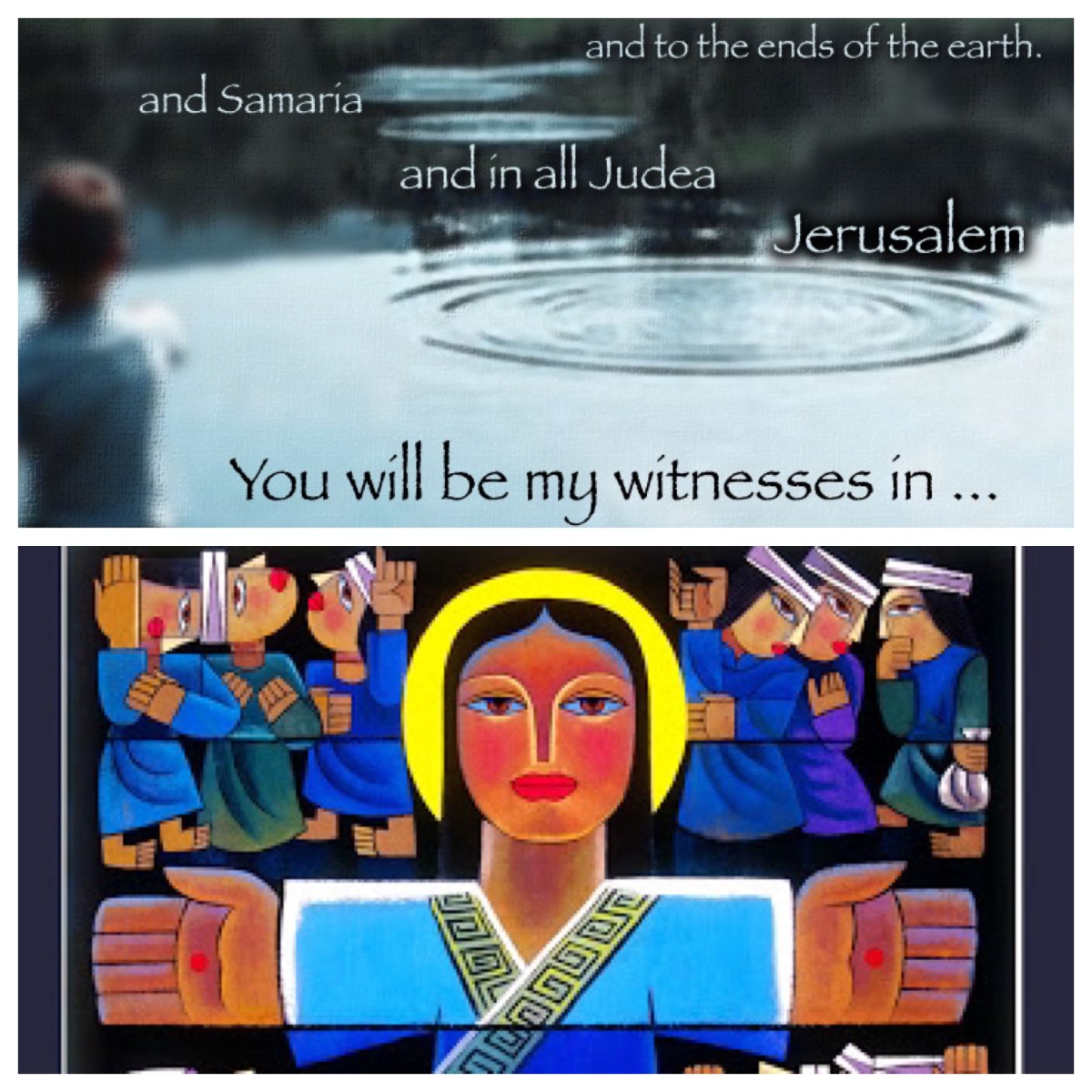
Another version of this commission introduces the second volume (Acts 1:8): “You will be my witnesses in Jerusalem, in all Judea and Samaria, and to the ends of the earth.” This verse sets out the programme for the rest of this volume.
Immediately after this, Jesus ascends into heaven (Acts 1:9-11). This is the pivot from the earthly period of Jesus into the time when the movement of those who followed Jesus in that time will begin to form the customs and practices that led to the creation of the church.
Luke presents the whole sequence of the death, resurrection and ascension of Jesus as both the climax to his earthly life and the foundation for the time of the church.
That final point is what we really ought to take from this doubly-offered story: the departure of Jesus by means of his ascension into heaven is actually the moment when Jesus charges his followers to be engaged in mission. The departure of Jesus heralds the start of the church. The (physical) absence of the Saviour brings in the impetus for engaging wholeheartedly with the world which he has (physically) left.
Every year, at Easter time, people of faith recount the story of the earth and resurrection of Jesus. The key days of Easter are constructed so that we focus, step by step, on the main elements in the story: the poignant last meal that Jesus shared with his followers (Thursday evening), the tragedy of trials and committal to crucifixion and death (Friday morning); the waiting in the quiet (Saturday, the sabbath day); the sombre early morning visit to the tomb, found to be empty (Sunday morning); and the joyous stories of encountering the risen Jesus (Sunday evening).
So many parts to the familiar story; so many opportunities to recall, retell, and reflect on these seminal events, the centre of our Christian faith.
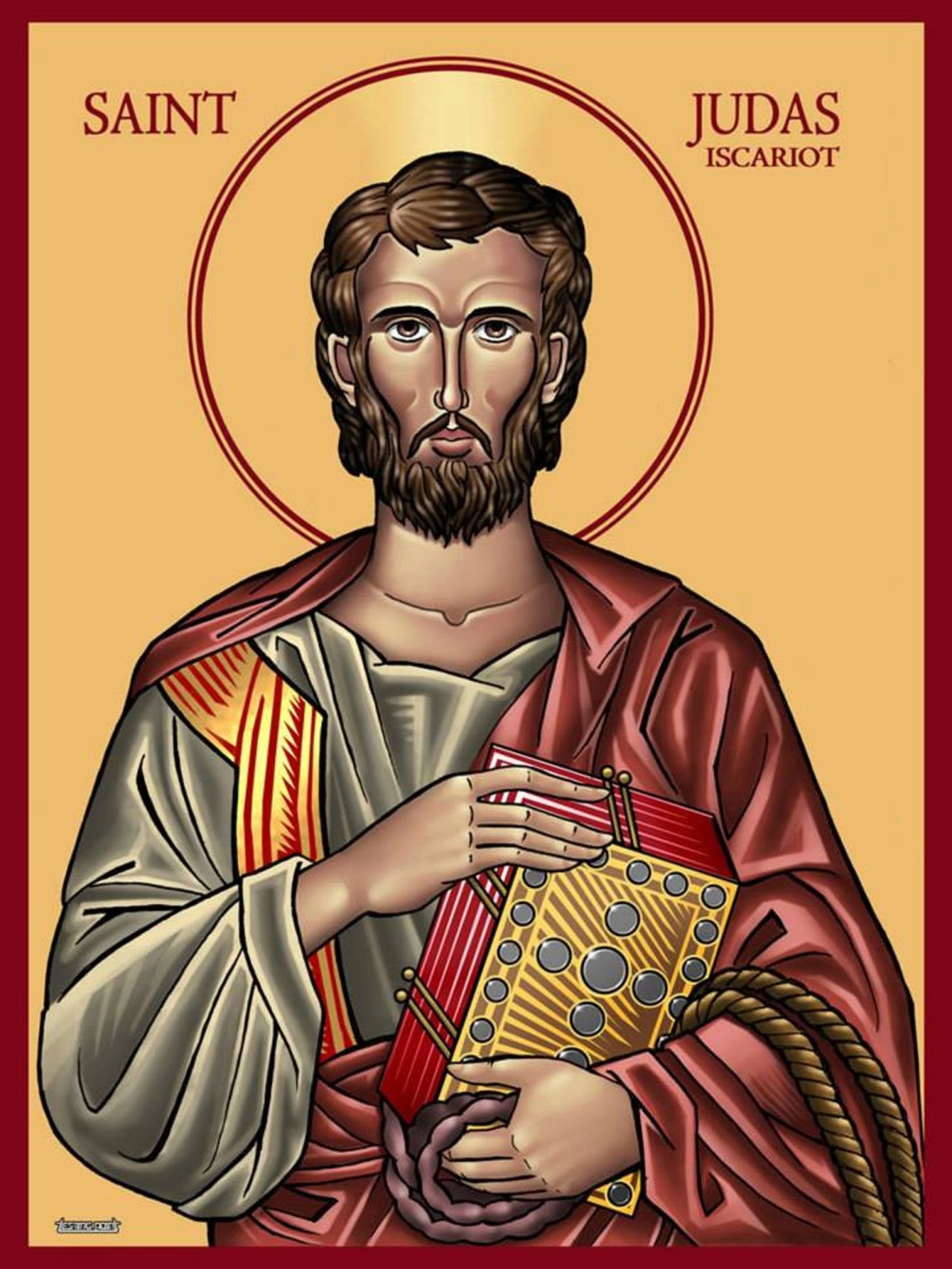
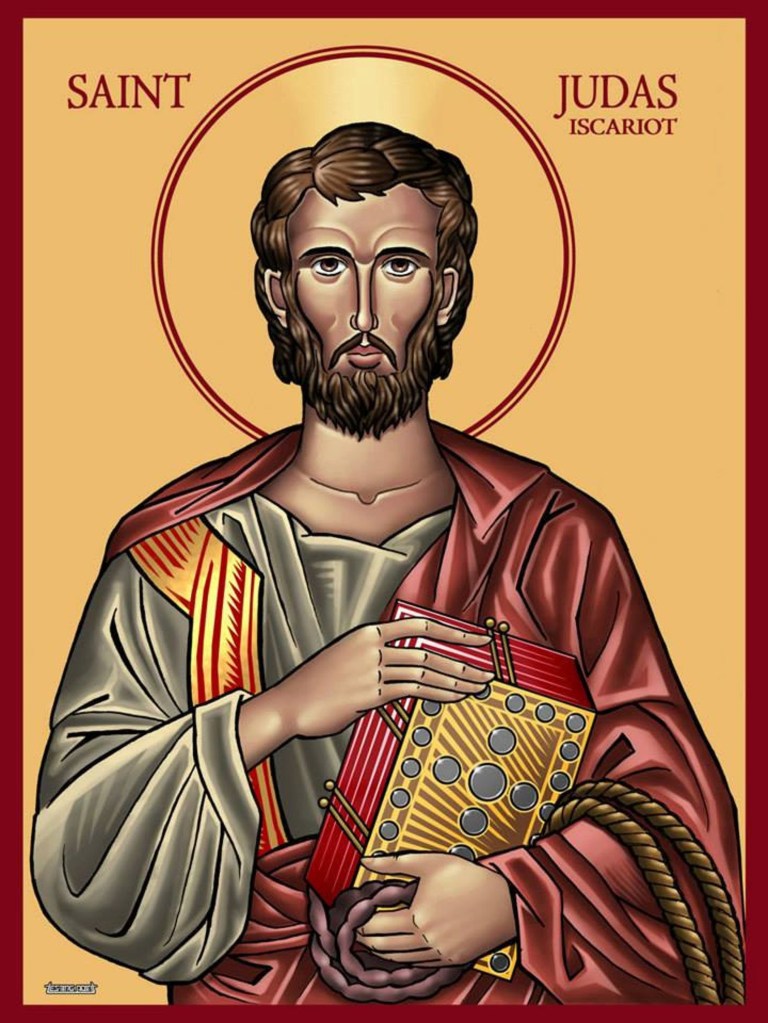
And yet: there are other parts of the story which do not often (if at all) take their place in this retelling of the story. Other parts, which may surprise, confront, or challenge, if we hear them, explore them, and ponder their significance for us. There is the story of the Roman soldiers and their corrupt collusion with Jewish authorities (Matt 27:62–66, 28:11–15). There are the two dramatic earthquakes that are linked with the appearances of resurrected ones (Matt 27:50–54, 28:2–4). And there is the tragic figure of Judas: apostle, betrayer, sinner, apostate.
The last part of the story of Judas is told in the final reading from Acts that we are offered in the sequence that has been provided for this season of Easter. (The season runs from 4 April, Easter Sunday, to 23 May, the Day of Pentecost. Acts replaces the Hebrew Scripture passages throughout this season.) The fate of Judas is told during the narrative about the choice of the twelfth disciple to replace Judas (Acts 1:15–26).
In what follows, I a, indebted to discussions about these passages with my wife, the Rev. Elizabeth Raine, who has thought much about how Judas is portrayed in these early texts.
There are three versions of how Judas died. This account in Acts reports that Judas bought a field with the moment he had gained from his betrayal of Jesus, and subsequently died there. This part of the passage is actually omitted by the lectionary, so here it is for good measure:
“This man acquired a field with the reward of his wickedness, and falling headlong he burst open in the middle and all his bowels gushed out. And it became known to all the inhabitants of Jerusalem, so that the field was called in their own language Akeldama, that is, Field of Blood.” (1:18-19).
The author of Acts, just for good measure, quotes two passages from “the Book of Psalms” (1:20) which, in his eyes, validate what has taken place in the death of Judas. That’s a common strategy in the Gospel narratives in the New Testament—reporting a passage from scripture, either inferring, or—more clearly—directly stating that this old text was now fulfilled in the event being narrated.
Even though the psalms that are quoted are not prophecies, they are treated as if their words, “may his camp become desolate” (Ps 69:25) and “let another take his office” (Ps 109:8), were prophetic words waiting to be fulfilled. Both the actions of Judas, in dying in the field that he had bought (1:18–19), and the subsequent election, by casting lots, of Matthias as replacement for Judas (1:26), fulfil these two psalm verses.
That replacement of Judas, it seems, is the main point the way that the lectionary has edited this passages for use in Sunday worship. And the edited version avoids disturbing the congregation with the gory details of his suicide: “he burst open in the middle and all his bowels gushed out” (1:18). Propriety and decorum is maintained.
A second account of the death of Judas is attributed to Papias of Hierapolis, a second century bishop whose works are no longer extant—but who is quoted in the writings of later church leaders. His account of Judas is reported by Apollinaris of Laodicea, a fourth century bishop, who writes:
“Judas did not die by hanging, but lived on, having been cut down before choking. And this the Acts of the Apostles makes clear, that falling headlong his middle burst and his bowels poured forth. And Papias the disciple of John records this most clearly, saying thus in the fourth of the Exegeses of the Words of the Lord:
“Judas walked about as an example of godlessness in this world, having been bloated so much in the flesh that he could not go through where a chariot goes easily, indeed not even his swollen head by itself. For the lids of his eyes, they say, were so puffed up that he could not see the light, and his own eyes could not be seen, not even by a physician with optics, such depth had they from the outer apparent surface. And his genitalia appeared more disgusting and greater than all formlessness, and he bore through them from his whole body flowing pus and worms, and to his shame these things alone were forced [out].
“And after many tortures and torments, they say, when he had come to his end in his own place, from then the place became deserted and uninhabited until now from the stench, but not even to this day can anyone go by that place unless they pinch their nostrils with their hands, so great did the outflow from his body spread out upon the earth.”
In this version, Judas did not die immediately as he tried to he hang himself on the field he had bought. He survived that suicide attempt. He lived on, in pain and agony, for some (unspecified) time, tortured by his swollen, bloated, stinking, putrified body.
It is very clear in both passages, from Acts and from Papias via Apollinaris, that Judas was known for his wickedness and godlessness. The Greek word used in Acts 1:18 is ἀδικία, which is the negated version of δικία, meaning righteousness or justice. Judas was perceived as having acted unjustly, unfairly, in betraying Jesus. Indeed, the canonical Gospels regularly refer to him simply as “Judas who betrayed Jesus” (Mark 3:19; Matt 10:4; John 18:2, 5), or as “the betrayer” (Mark 14:42, 44; Matt 26:25, 46, 48, 27:3; Luke 6:16; John 6:71, 12:4, 13:2, 11).
Judas has forever since then been known in this strongly negative manner: the betrayer. And, to add fuel to the fire, it is asserted that “Satan entered into Judas” (Luke 22:3), that “the devil had already put it into the heart of Judas Iscariot, Simon’s son, to betray him” (John 13:2). Judas is a marked man, infiltrated, recruited, and persuaded by the enemy.
Matthew provides the third account of the death of Judas. This account differs from Luke and Papias. There is no field that was purchased. There is no planning or scheming in order to obtain the field. Rather, there is a sense of deep,remorse, guilt for what he has done, which leads Judas to the decision to end his life. He threw down the pieces of silver, rushed out, and committed suicide. The priests had instructed him to take responsibility for his actions. He knew that Torah mandated death for what he had done, but the priests were not interested in applying that punishment. so Judas obeyed the law and took his own life.
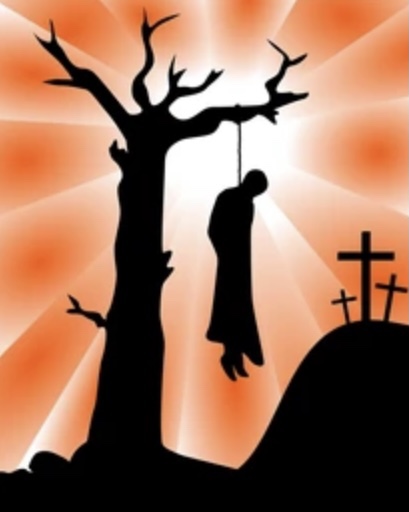
As Matthew reports: “Then when Judas, his betrayer, saw that Jesus was condemned, he changed his mind and brought back the thirty pieces of silver to the chief priests and the elders, saying, “I have sinned by betraying innocent blood.” They said, “What is that to us? See to it yourself.” And throwing down the pieces of silver into the temple, he departed, and he went and hanged himself.” (Matt 27:1-3)
That is short and simple. “He hanged himself.” No gory details, no extended descriptions. Just the simple statement, “he hanged himself”.
The fate of Judas is grim. Jesus had said “woe to the man who betrays the Son of Man”. That woe is enacted in his hanging. Judas, according to the traditional way that this narrative has been taken, went and hung himself in the depths of guilt. In one discussion that I had about this story, a friend claimed that the notion that Judas repented was speculative—that Jesus had given Judas a chance to change his mind at the Last Supper. But he didn’t, so he died with the enduring reputation as “the one who betrayed Jesus” as his enduring legacy.
However, such a claim overlooks one important word. It is found only in Matthew’s account of Judas, after he had betrayed Jesus. It was my wife Elizabeth who drew my attention to this aspect of Matthew’s version of events. It’s an important detail that merits careful attention.
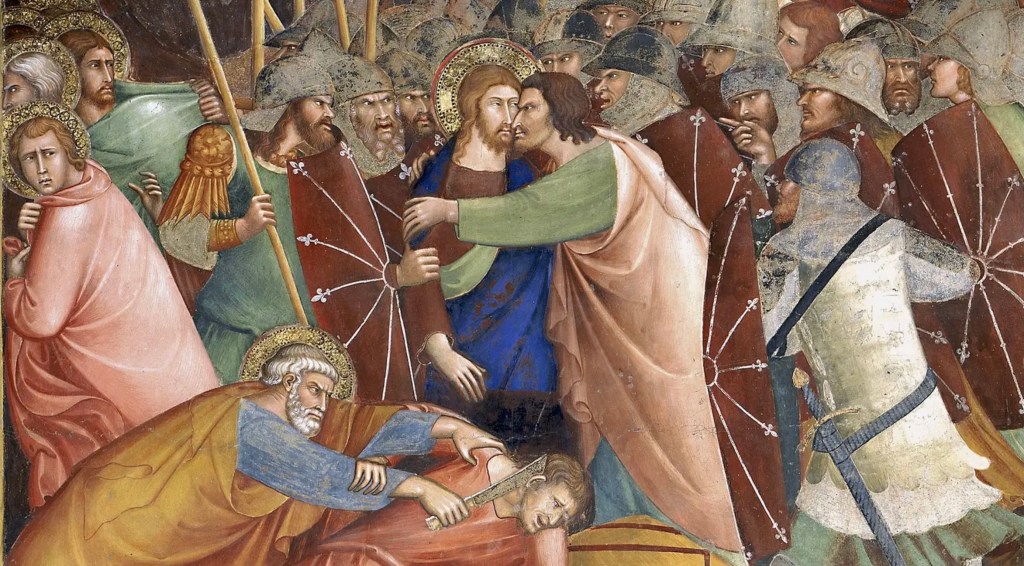
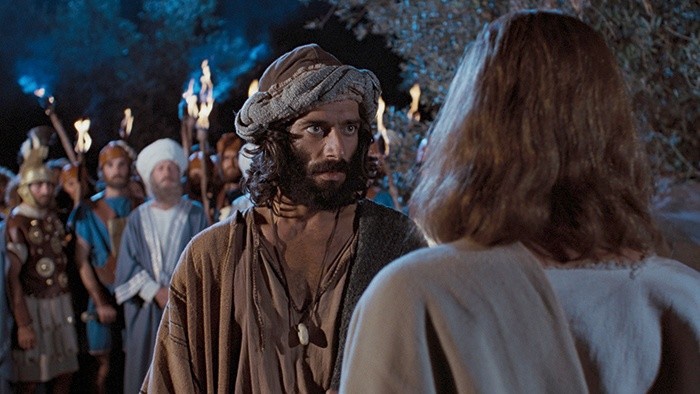
In the immediate aftermath of the sequence of events that unfolded from that potent kiss in the garden (reported in Mark 14:45 and Matt 26:49, and hinted at in Luke 22:48), Matthew asserts that “when Judas, his betrayer, saw that Jesus was condemned, he changed his mind and brought back the thirty pieces of silver to the chief priests and the elders” (Matt 27:3).
Judas had a change of mind about what he had done. The Greek participle used is μεταμεληθεὶς. That comes from a root word which is defined by James Strong as “to regret, repent”. Strong’s Dictionary indicates that this can mean “I change one care or interest for another, I change my mind (generally for the better), I repent, I regret.”
And, in fact, Matthew grounds this in the words that Judas spoke to the chief priests and elders: “I have sinned by betraying innocent blood” (Matt 27:4). That is a clear confession of sinfulness, which—we are assured elsewhere in scripture—will evoke a response of forgiveness (1 John 1:9)—a claim that carries over into traditional Christian liturgy even to this day. Why is Judas thus not forgiven? He has confessed and repented.
Christian theology has overlooked this indication of repentance. Judas did hang himself in deep remorse, with an impetuous action that proved to be fatal. And yet—he did this, not as a sign of his depression, but as a signal of his heartfelt repentance. Judas changed his mind. He repented of the evil that he had done.
And yet, we continue to remember him as the Satan-inspired betrayer of Jesus.
Elsewhere in scripture, Luke indicates that divine retribution is the immediate result for those people who undertake serious sinful actions. Acts has a sequence of events involving divine retribution, with people not being able to get away with their bad actions; they need to face up to the lethal consequences of their sin. We see this for Judas (Acts 1:1); for Ananias and Sapphira (Acts 5:1-11); and then for Herod Agrippa I (Acts 12:20-23).
For Luke, this can all be explained in terms of his ideology of divine providence. All that transpired in what is found in the two volumes authored by Luke was part of The Plan of God, including the betrayal by Judas. Peter states this most clearly in his speech on the day of Pentecost: “this Jesus, delivered up according to the definite plan and foreknowledge of God, you crucified and killed by the hands of lawless men” (Acts 2:23).
The verb translated as “delivered up” is closely related to the verb that is often used in the Gospel narratives, to describe the action of Judas. Jesus was betrayed, or handed over, by Judas. This verse directly refers to the actions of Judas. And his deed of handing over (or betrayal) was an integral part of the plan of God for his chosen one, Jesus.
That, of course, raises huge theological and pastoral issues: if something is done as part of the divine plan, does that provide moral justification for the actions of the human being involved? Can we therefore excuse Judas for his action of betrayal, given that he did that as one part of the overall divine plan (as least, as Luke portrays it)?
And what does it say about the nature of God? What are we to make of a God who recruits a human being to carry out a part of the divine plan, and then sends divine retribution upon that person for what they have done? Is this sheer arbitrary fun? Is this moral turpitude?
And, most pointedly of all: if Judas WAS doing God’s will, why do we still paint him as evil and beyond redemption? Especially if, as Matthew declares, he repented of what he had done.
*****
And perhaps, on a lighter note, one last word on Judas: he offers us a salutary lesson on how NOT to read the Bible. We need to beware of the arbitrary method putting two verses from different contexts together to produce a specific teaching. Such as: “Judas … went and hanged himself. Go and do likewise.” (Matthew 27.5 combined with Luke 10.37.) Just don’t do it!!
*****
With thanks to Elizabeth Raine for her insights into the stories told bout Judas in early Christian texts.
Bill Loader is widely-known, much-consulted, and greatly loved across the Uniting Church. He has had a fine career as a leading biblical scholar, teaching for decades at Murdoch University and publishing prolifically with prestigious international publishers.
This academic career has sat alongside an active involvement in the Uniting Church, preaching in local Congregations, teaching regular sessions with lay leaders, and forming ministers and deacons for their ministries. His website with its scholarly yet accessible discussions of lectionary texts (http://wwwstaff.murdoch.edu.au/~loader/home.html) attracts regular readership, not only from Uniting Church people, but from preachers right around the world
Out of this wealth of experience comes this slim but rich offering: ten succinct chapters (most only ten to twelve pages long) on topics of key theological import: the significance of Jesus, the good news for the poor, how to understand the cross, the place of other faiths, God’s wrath and God’s justice, the place of the Law, miracles and faith, God and love–and, of course, marriage and sexuality. All in 110 pages.
Each chapter ends with a focused “question for reflection”, to encourage ongoing consideration of the topic at hand. The book itself ends with a bonus afterword, setting out Bill’s personal journey “from fundamentalism to fundamentals”. The afterword concludes, “we all walk with some grit in our shoes in religious and cultural contexts where its awareness is possible even if, by and large, its removal is not” (p.130).
Loader seeks to work with the irritants provided by this “grit” in a constructive and hope-filled way, to indicate how, in the midst of contentious discussions, people of faith are able to discern “what brings life and health”. In Chapter 5, whose title also provides the title of the book, he concludes that we ought “to be a just and caring society that is inclusive and to care for the world and its future inhabitants” (p.46).
It’s no surprise that the enduringly contentious issue of marriage and sexuality is addressed (in chapter 10, the longest chapter). Bill Loader has made many contributions to the long-running discussions of these matters–leading workshops and producing resources pitched at a popular level, undergirded especially by the academic research and writing undertaken during his five years as a professorial fellow with Australian Research Council funding.
This chapter makes clear the two key pillars of his well-considered views: one, that Paul reflects the common first century belief that “all people are heterosexual”, so anyone identifying as homosexual is “in an unnatural state of being as a result of sin” (p.111); and two, that in some circumstances “it is not appropriate, indeed it is irresponsible, to apply what Paul says” to contemporary situations (also p.111).
Thus, Loader affirms that “the Bible does not tell it all on these matters any more than it did on matters of women and divorce” (p.112). Such honesty about matters hermeneutical is to be commended. As is the case in each chapter, the reader is invited to give serious personal consideration to how biblical passages are to be brought into engagement with contemporary situations and considerations.
But the book is not just about marriage and sexuality. There is much more that is explored in its pages.
Chapter 5 (whose title, as we have noted, provides the title for the whole book) begins with a further observation about the process of interpretation: “There is a 2,000-year gap between believers in today’s twenty-first-century world and those of the first century”, such that “to engage the writings of the New Testament is to engage in a cross-cultural encounter with all the respect and opportunity for learning and enrichment which that entails” (p.35).
Starting with the fact that New Testament texts expect a return of Jesus within the lifetime of those then alive, the chapter canvasses the eschatological vision of the kingdom, various parables of Jesus, the function of the risen Jesus, and the resurrection body, leading to the conclusion that we, today, are to “reconfigure our approach to hope, retaining the central [first century] substance, but not their notions of timing and manner of its achievement” (p.45).
In this way, Loader models the task of the interpreter, be they preacher, Bible study leader, scholar, or individual disciple. Immersion into the culture, customs, languages, perspectives of the ancient texts is as important as thoughtful, reflective consideration of what is heard and seen in the text, in the light of contemporary understandings, insights, and perspectives. (Somewhat like what paragraphs 5 and 11 of the UCA Basis of Union affirms.)
There is much more to be said about this delightful book; but only one comment needs to be made here. This is a book worth buying, reading, studying (alone or with others), and engaging with wholeheartedly.
In recent weeks, the Revised Common Lectionary has offered passages from Acts which narrate the expansion of the early movement of followers of Jesus. The author of Acts provides a clear schematic account of how the good news spread out from the centre of the Jewish nation, Jerusalem, to the edges of Samaria and beyond (starting with a court official from Ethiopia), and into the widespread Gentile world (starting with a Roman soldier based in Caesarea).
In a couple of weeks, we will read the story of Pentecost, with Mews gathered in Jerusalem from many of the surrounding regions and nations. Encountering God in a dramatic new way, they return to their homes with good news bubbling over in joyful ways.
The Iona Community has a fine Affirmation which fits well within the context of these readings, reflecting God’s openness to the outsider, welcoming the diversity of humanity, affirming grace at work . Here it is:
Affirming the Global Church
We believe in God,
who befriended a wandering people,
calling them from slavery into freedom,
yet who in Rahab, Tamar, Ruth, Bathsheba,
Cyrus, Darius and many others,
called outsiders to be agents of God’s purpose.
We believe in Jesus,
who was revered by Persian sages,
sought and found asylum in Egypt,
preached the love of God to Syrians,
attracted Greeks to his cause,
found his first evangelist in a Samaritan,
saw incomparable faith in a Roman,
had his cross shouldered by a Libyan,
and ascended to his native land
that he might be present in all places.
We believe in the Holy Spirit,
who at Pentecost proved
that heaven has no mother tongue;
who, in the baptism of an Ethiopian,
denied racism a foothold in faith;
and who, in the ancient and modern worlds,
founded churches in different cultures.
We believe that God is supremely known in Jesus,
yet we affirm that the love of God is beyond our understanding.
Therefore we celebrate
that God’s ways are not our ways,
that God knows whom God chooses,
and reserves the right to surpass all human expectation.
From A Wee Worship Book, 2015, from Wild Goose Publications (page 105)
The book we know as 1 John is unlikely, as we have seen, to have been a letter. It is more likely that it came into being as a sermon, which was later collected alongside some other works attributed to John, which were actual letters (2 John and 3 John), themselves placed alongside letters by other leaders (Peter, James, Jude—and, of course, Paul).
This sermon-letter is intended to encourage believers, who are to live in light, not in darkness, to love, and not to hate (1:5–10; 2:9–11; 3:11–15; 4:20–21), and to strive to ensure that their love reaches “perfection” (2:5; 4:12, 17–18) in their lives.
Set in stark contrast to these believers is “the world”, which is full of desire (2:16); those in “the world” do not help a person who is in need (3:17); they hate the believers (3:13) and do not know God (3:1; 4:3–6).
A striking feature of this sermon-letter occurs towards its end, in a compact sentence (5:13) which contains both a description of the recipients (“you who believe in the name of the Son of God”) and a declaration of the purpose of the letter (“so that you may know that you have eternal life”). The key terms in this sentence are immediately reminiscent of a similar declaration of purpose towards the end of John’s Gospel (John 20:31).
Each work is “written” concerning “eternal life”, granted to people who “believe” in Jesus as “the Son of God”. The similarities suggest either common authorship, or an intentional allusion to the Gospel by the author of the sermon-letter. The differences in style and theology between the two works are subtle, but they do reinforce the latter option as preferable.
One clear difference to be noted is that, whilst the Gospel makes frequent references to Hebrew Scripture (both in quotations and by allusion), the sermon-letter betrays little awareness of these scriptures, other than what had already been mediated through the Gospel. The strong Jewish context of the Gospel is not evident in this later work. Other points of differentiation are noted below.
There are many signs of the common theological standpoint shared by letter and Gospel. The opening of the sermon-letter is reminiscent of the grand poem which begins John’s Gospel, and three important themes of this Gospel are flagged in both prologues. Central to each is the revelation of God (1 Jn 1:2; John 1:14, 18) which occurs through speaking (1 Jn 1:1, 3; compare “the Word” of John 1:1, 14) and conveys the message of eternal life (1 Jn 1:2; John 1:4).
Another important motif in the prologue to the sermon-letter is the believer’s fellowship with God and Jesus (1 Jn 1:3), which may be compared with the Gospel terminology of “abiding in” (John 14:17; 15:1–11). The sense of testimony which permeates 1 Jn 1:1–4 resonates with the frequent emphasis on testimony, or witness, in the Gospel (John 1:6–8, 15, 19, 32– 34; 3:31–34; 5:31–32, 36–39; 8:17–19; 10:25–27; 19:35). The note of joy which ends the prologue (1 Jn 1:4) reflects similar expressions in the Gospel (John 15:11; 16:20–24; 17:13).
Beyond the sermon-letter’s prologue, other themes also point towards the Gospel of John, with some observable differences. The language of light and darkness (1 John 1:5–7; 2:8–10) is a reminder of the Gospel’s use of similar imagery (John 1:4–9; 3:19–21; 12:46), although there is a change in attribution, from Jesus as “the light of the world” (John 8:12; 9:5), to the affirmation that “God is light” (1 Jn 1:5).
The author of 1 John asserts that “we are from the truth” (3:19) and “we know the spirit of truth” (4:6); this is reminiscent of the claim of the Johannine Jesus that “I am the truth” (John 14:6) and his promise that “if you continue in my word…you will know the truth” (John 8:32).
Indeed, a consistent emphasis on adherence to the truth runs through the sermon-letter (1 John 1:6, 8; 2:4, 8, 21, 27; 3:18–19; 4:6; 5:6, 20) as through the Gospel (John 1:9, 14, 16; 3:21; 4:23–24; 6:55; 7:18; 8:32; 14:6, 17; 16:13; 17:17–19; 19:37–38).
We have already noted the occurrence of the phrase eternal life in the sermon-letter’s prologue (1 John 1:2); it occurs elsewhere in ensuing chapters (2:25; 3:15; 5:11, 13, 20). This is a recurrent theme in the Gospel, for it characterises the offer which Jesus makes to his followers (John 3:15–16, 36; 4:14; 5:24; 6:27, 40, 47, 54, 68; 12:25, 50; 17:1–3).
Again, as we have seen, the attribute of love is highly prized within 1 John; the command to love, which issues from God (1 John 2:7–8; 3:23– 24; 4:21; 5:1–5), looks back to the Johannine Jesus, who is twice reported as delivering this commandment (John 13:34–35; 15:12–17) and whose death exemplifies such love (John 15:13; see also 10:11–18; 12:23–26).
However, the notion that love can be perfectly expressed (1 John 4:17) and the opposition between love and fear (1 John 4:18) go beyond the Gospel’s exposition of love, as does the claim that God is love (1 John 4:8).
Knowledge is a key concern of this sermon-letter (1 John 2:4, 13–14, 21; 3:1, 19; 4:2, 6–8, 16; 5:13); likewise, in the Johannine account of the life of Jesus, knowing Jesus is crucial (John 10:4–5, 14–15, 27; 14:1–7; 16:29–30; 17:3, 7, 25–26). The assertion to the sermon-letter’s recipients that “all of you have knowledge” (1 John 2:20) reflects the Gospel’s concern for people to know Jesus; this is especially important in the early chapters (John 1:10, 18, 26, 31, 33, 48; 3:2, 11; 4:22, 25, 42).
The emphasis on knowledge in this sermon-letter has led interpreters to the view that the writer is combating a Gnostic development in the Jesus movement, which places great weight on knowing in contrast to believing. (The Greek word for knowledge is gnosis.) We can see a similar debate taking place in Corinth (1 Cor 2:6–3:4). The letter-writer assures the recipients that the anointing they have received provides them with knowledge about all things (1 John 2:20, 27).
The substance of this knowledge, in the Gospel, is that Father and Son are one (John 10:30; related expressions are found at 14:7 and 16:32); a similar discussion in the sermon-letter treats Father and Son as a unity (1 John 2:22– 24). The characteristic Johannine language of Father and Son, in intimate and reciprocal relationship with one another (given fullest expression in John 17), also runs throughout this work (1 John 1:3, 7; 2:22–24; 3:8, 23; 4:9–10, 14–15; 5:9–12, 13, 20).
The Spirit is given by the Father (1 John 3:24; 4:13) and is described as the spirit of truth (1 John 4:6), reflecting the most frequent Gospel portrayal of the Spirit (John 14:17; 15:26; 16:13). The Spirit is not yet a personal entity, as envisaged in the doctrine of the Trinity, but plays a role as a witness (1 John 5:6–9), as is noted of the Spirit in the Gospel (John 15:26; 16:13).
The negative attitude towards the world in this sermon-letter is consistent with the polemics of the Gospel (John 1:10; 7:7; 8:23; 15:18–19; 17:14–19). Jesus has distinguished himself as being “from above…not of this world” (John 18:23) and stated that his kingdom “is not of this world” (John 18:36); as a result, he observes, the world hates him and his followers (John 15:18– 19).
The same antagonism is clearly evident, as we have noted, in the sermon-letter; the world hates believers (1 John 3:13) and is “under the power of the evil one” (1 John 5:20). The role of the devil in this struggle is clear, both in the letter (1 John 3:8–10) and in the Gospel (John 6:70; 8:44; 13:2).
The sermon-letter articulates an apocalyptic view that “it is the last hour” (1 Jn 2:18), but anticipates a moment of full revelation in the future (1 Jn 2:28– 3:3). Presumably this is equivalent to “the last day” which is anticipated at points in the Gospel (John 6:39–40, 44, 54; 11:24; 12:47–49), although much of the Gospel does convey the sense that this day has already arrived.
Jesus asserts, “now is the judgment of this world; now the ruler of this world will be driven out” (John 12:31); “from now on, you know him [the Father] and have seen him” (John 14:7). This perspective is often labelled realised eschatology; it is a clear point of difference between sermon-letter and Gospel.
However, the connections between sermon-letter and Gospel are more complex than can be indicated simply by a comparison of the occurrence of key words.
There is a high degree of what is now called intertextuality exhibited by these two books. This term refers to the level of cross-referencing which can be seen when the two books are read together; such cross-referencing may be intentional, by means of direct word-for- word citation and clear allusions to dominant ideas or motifs, or it may take place through more tangential and suggestive means. There is a synergy which arises when the interaction of the two books is allowed to “speak”, as it were, in its own right.
Many parts of 1 John contain words or ideas which sound very much like the Gospel, but which have their own enhancement or development, so that there is both similarity and difference. The same kind of relationship, incidentally, can be seen when other New Testament books are read with a view to their relationship with passages from Hebrew Scripture. There is both direct citation and specific allusion, as well as more general intimations of scriptural thinking.
Some parts of the Gospel have been the focus of such creative rewriting by the author of 1 John; the prologue (John 1:1–18) and the final chapter (John 20:1–31) are two clear examples.
This sermon-letter, then, reflects the ongoing development of thinking within the Jesus movement. Stories of Jesus and reflections on his significance give rise, over time, to creative and insightful reworkings of these stories, applied to new situations, resulting in an expanding discernment about the importance of Jesus and of following his way. In this respect, the first letter of John provides a model for thoughtfully contextual, faithful discipleship along the way of Jesus.
This blog draws on material in IN THE NAME OF … an exploration of writings attributed to the apostles, by Elizabeth Raine and John Squires (self-published 2014).
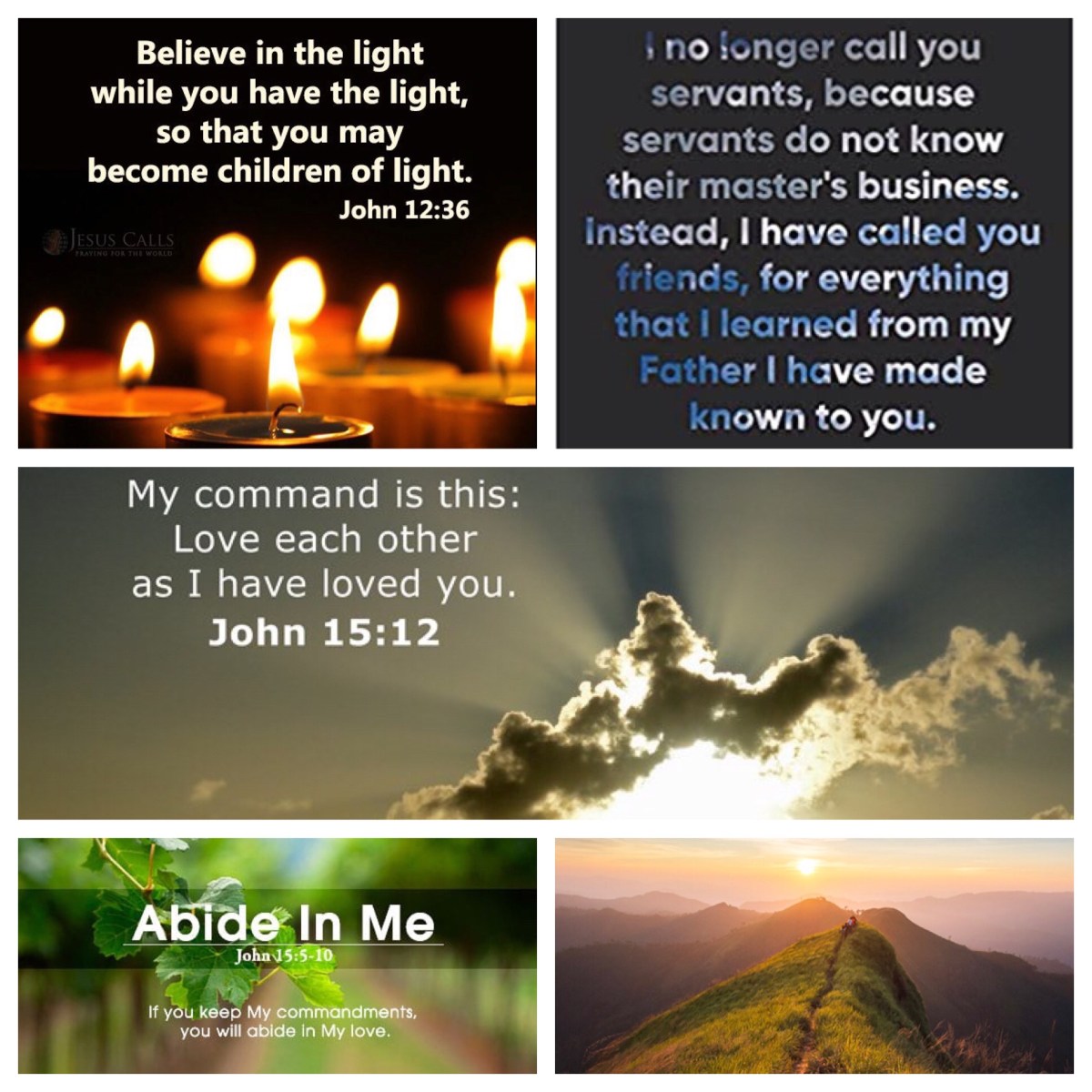
The Gospel passage set for the coming Sunday offers us a short and succinct summation of the ethics of Jesus: “This is my commandment, that you love one another as I have loved you. No one has greater love than this, to lay down one’s life for one’s friends” (John 15:12–13).
Nevertheless, we should note that there is little more I n the way of explicit ethical instruction in John’s Gospel. In keeping with the emphasis on the presentation of Jesus as the authoritative teacher, revealing God to those who have already been chosen, the basic position with regard to ethics is that those who know Jesus, will do as God wills; they will love, as he has loved. As for those who do not know him, they are condemned to the darkness.
As a result, there is no urgency about instructing believers how to behave; for they will know what to do. Rather than providing believers with guidelines and resources for living faithfully in the world, the Johannine Jesus assures his followers, “I have chosen you out of the world” (16:19). Following Jesus is not a pathway to faithful living in the world, but rather a journey towards the cosmic Christ, who leads believers into mystical unity with God.
Nevertheless there are some pointers, in this Gospel, to what is required of believers. The Synoptic Gospels report that Jesus commanded his disciples to perform various actions, including those which subsequently became sacramental (communion, Luke 22:19; baptism, Matt 28:19).
In John’s Gospel, at his last meal, Jesus commands his disciples to wash one another’s feet, following his own example (John 13:14–15). The ethics of the Johannine Jesus are summed up in similar fashion: “just as I have loved you, so you should love one another” (13:34b).
This commandment is repeated in this Sunday’s passage (15:12). This “new commandment” sits at the centre of this Gospel (13:34–35; 15:12–17) and will inspire subsequent literature in the Johannine tradition (1 Jn 2:7–11; 3:11, 23; 4:7–11, 16–21; 5:3; 2 Jn 5–6).
Yet in contrast to the scriptural commands to love God and neighbour, cited by the Synoptic Jesus (Mark 12:28–31) and Paul (Rom 13:8–10), the command of the Johannine Jesus focuses on love of God and love of “one another”. It is limited to those within the faith community, and does not include “neighbours” (let alone love of “enemies”, as in Luke 6:27).
Another Synoptic instruction which is echoed in this Gospel is the command to serve, but once again with a narrower scope. Jesus instructs his disciples to follow his example and serve one another (Mark 10:42–45; Luke 22:24–27), but the Johannine Jesus exhorts them simply to serve him (John 12:26). Later, he informs them that they are no longer to be called servants, but friends, for they know all that God intends them to know (15:15). Even this ethical category is now obsolete.
In John’s Gospel, there appears to be little need for specific instruction about particular ethical situations, such as we find in the letters of Paul, James, Peter, and the teachings of the Synoptic Jesus (Matt 5–7; Luke 6; and so on). Rather, belief in Jesus brings with it an inherent sense of what must be done for the good.
This is expounded, not through ethical instructions, but by means of images which offer glimpses into how the central quality of love is made possible. In the image of the vine and the branches (15:1–11), Jesus portrays the foundations of ethical awareness (as we saw in last week’s Gospel passage).
Because believers abide in the Son, he is then able to bear fruit in their lives and “become my disciples” (15:8). So, love is made possible for those who believe, because they abide in the love of Jesus (15:10).
Employing another image, Jesus declares that he comes as “the light of the world” (9:5), inviting those who believe in him to follow the light (8:12), walk in the light (11:9–10), and thus become “children of light” (12:36).
A third image with potential for much ethical exposition is the statement by Jesus that “I am the way” (14:5). This image has been developed in other New Testament books, and in the Dead Sea Scrolls, in this direction. However, the Johannine Jesus appears to see “the way” simply as the way to intimacy with God (14:6–7).
Each of these images provides a sense of certainty for the believer—who abides in Jesus, who walks in his light, who follows his way—without having to spell out particular attitudes or behaviours which must be followed. In the end, the Jesus of this Gospel invites his followers to walk into unity with him, and thus unity with the Father. Right behaviour, it is assumed, will simply follow on.
This blog draws on material in JOURNEYING WITH JOHN: an exploration of the Johannine writings, by Elizabeth Raine and John Squires (self-published 2014)
The scene from Acts which is offered by the lectionary this coming Sunday (Acts 10:44–48) reports what occurred in Caesarea after an impassioned speech to Gentiles, by the Jewish man, Peter (10:34-43). What takes place in this scene needs to be understood in the context of the speech just given, and indeed in terms of the whole span of events recounted in this volume.
As its particular theme, it employs “the impartiality of God” (10:34), a scriptural theme (Deut 10:17; Job 34:19; Wisd 6:7; Sir 35:13-15). This theme reinforces the message of the vision (10:11-16) which rebutted the levitical holiness motif and validated table-fellowship as being consistent with divine impartiality, a key aspect of God’s nature.
This divine impartiality is especially evident in Jesus, who can be affirmed as Lord of all (10:36). Peter interprets the life of Jesus as the action of God, who anointed him, was with him, raised him and made him manifest (10:37-43).
Peter affirms the apostolic witness (10:39,41; see 2:32, 3:15, 5:32) and the prophetic witness (10:43; see 2:25-31,33-35, 3:18,21-25, 4:25-26); once again, Luke has him make the exaggerated claim that “all the prophets testify about him” (10:43; see 3:24). These prophets testify to “the forgiveness of sins” which is essential to the proclamation (2:38, 5:31, 13:38).
Jesus has been “ordained by God” to be the eschatological “judge of the living and the dead” (10:42), a concept which Paul will later express (17:31; cf. 24:15). The speech thus comprises a consistent exposition of God’s activities in Jesus, extensively in the past as well as (briefly) in the future.
2 Spirit, come!
The response to this speech is both unequivocal and not unfamiliar when the spirit falls on the Gentiles (10:44-48). At the beginning the spirit had instructed Peter to accompany the messengers from Cornelius (10:19-20) and initiate contact with this household of the Gentiles in Caesarea; at the conclusion of the speech to this group “the holy spirit fell upon all who heard the word” (10:44).
The spirit, of course, was an important element in the ancient Jewish worldview. The creation story of the Hebrews affirmed that creation took place when “the spirit moved over the face of the waters” (Gen 1:1–3). Moses and the elders whom he appointed as judges were filled with the spirit (Num 11:16–17, 25) and judges were filled with the spirit (3:10; 6:34; 11:29; 13:25; 14:6, 19; 15:14).
Prophets were anointed by the spirit to declare “the word of the Lord” for the people of their time (1 Sam 19:20, 23; Isa 11:2; 59:21; 61:1; Ezek 2:2; Joel 2:28–29; Micah 3:8; Zech 7:12, referring to “the former prophets”). Indeed, the servant of the Lord himself is guided by the spirit (Isa 42:1).
This coming of the Spirit had happened before, and it will happen again, as the story of Acts continues. But there is something striking and significance about this story of the coming of the spirit.
This has happened before. The spirit has twice filled the messianic community gathered in the Jewish capital, Jerusalem (at Pentecost, 2:1-4, and subsequently, 4:31). When the spirit is poured out on the Gentiles (10:45) in this gentile capital, it is already known that this is an act of God (2:17).
In both previous cases, God had acted through the spirit in relation to Jews. That this current outpouring of the spirit, outside of Judaea, amongst Gentiles, is still an act of God, is emphasised by a series of narrative comments. The Jewish believers present express surprise at “the gift of the holy spirit” (10:45), but the reader already knows that such a gift is from God (2:38, 8:18).
They hear the Gentiles “speaking in tongues” (10:46), a phenomenon already experienced as a divine event in Jerusalem (2:11). Peter draws this connection when he interprets the event: they “received the spirit as we also [did]” (10:47; see 2:38). Peter and his fellow Jews thus “exulted God” (10:47; see 5:13).
Indeed, the Spirit had come to these Gentiles after a striking sequence of events had taken place. Peter had a vision whilst praying in Joppa, that he was no longer to keep separate at table (10:9-16). No longer were Jews to eat separated from Gentiles. God had declared all foods clean (10:15), so separate table fellowship was now overturned. Peter receives this dramatic change to the status quo—and he faithfully acts on it.
Peter and his companions in Joppa share at table with the men from Cornelius (10:23; 11:4-11) and then, when they have travelled to Caesarea, with the household of Cornelius and those who were baptised with him (10:48; 11:12-18). Indeed, the very point of the vision seen by Peter is to establish an inclusive, all-embracing table fellowship in the Jesus movement, open to both Jews and Gentiles, from this point onwards (11:3).
This is a moment when the old is overturned, and the new is implemented. It is a strong moment of transition for the early church. From this time, the good news spreads amongst Gentiles; to the extent that it does, indeed, reach “to the ends of the earth”.
Baptism ensues (10:48; cf. 2:38). The deepest significance of this moment for Luke is identified as being that “the gift of the holy spirit had been poured out even on the Gentiles” (10:45). That God has acted even on the Gentiles signals that the ‘turn’ which has been anticipated since 8:4 has come about in a fulsome way.
*****
The author’s interpretation of the events that have taken place in Caesarea draws them into close relationship with the interpretation of Jesus which Peter has given (here, and in earlier speeches in Acts). The impartial God who has acted through Jesus (10:34-43) is the same God who declares all things clean (10:15), who shows this to Peter (10:28), who gifts Gentiles by pouring out the spirit (10:45), and who is exulted by the people (10:46). It is language about God which interprets the significance of the narrative at each key moment.
The consequence of this dramatic event is noted briefly: “they invited him to remain for some days” (10:48b). Table-fellowship with Gentiles and the breach of the food rules was considered to be the inevitable result of God’s actions (see also 11:15–18). Such hospitality continues to be one of the key markers of the church.
This blog is based on a section of my commentary on Acts in the Eerdmans Commentary on the Bible, ed. Dunn and Rogerson (Eerdmans, 2003). I have also explored the theme of the plan of God at greater depth in my doctoral research, which was published in 1993 by Cambridge University Press as The plan of God in Luke-Acts (SNTSM 76).
The Uniting Church is part of the one holy catholic and apostolic church – we see ourselves as just one part of a much larger whole. We do the things that other denominations within the church do: we gather for worship, preach the Gospel, care for the needy, witness to our faith, and connect with communities.
We have many organisations that cater specifically for pre-schoolers, school students, people with disabilities, theological students, adult learners, Indigenous people and aged and infirm people. We have chaplains in hospitals, schools, industry, and the defence forces. And we have congregations in many places across the continent.
When we worship, we feel connected with the people of God of all denominations across the globe. When we witness, we bear testimony to the faith shared by Christians of many varieties. When we reach out in service, we act in solidarity with people of Christian faith, people of other faiths, and people of goodwill of any stripe, in our communities and across the globe.
We share in the call to be missional, universal, set apart, and unified, as God’s people together. Or in more traditional theological language, we are part of the ‘one, holy, catholic and apostolic’ church.
But we believe that we have some distinctive elements to contribute to that larger whole. Our identity as the Uniting Church in Australia is marked by ten distinctive features.
I In Ecumenical Relationship
When the Congregational, Methodist and Presbyterian churches joined together in 1977 to form the Uniting Church in Australia, they declared that this union was both in accord with the will of God, and that it was a gift of God to the people of God in Australia.
Since then, the Uniting Church has been a church which is committed to working ecumenically with other Christian denominations. That commitment is one very important aspect of our identity as a Uniting Church. We belong to the National Council of Churches in Australia and the World Council of Churches, where we co-operate with many denominations.
Nationally, we have participated in ongoing conversations with other denominations (Anglican, Lutheran, Greek Orthodox, and Roman Catholic). At the grassroots level, our ministers participate in local ministers’ associations in hundreds of towns and cities across the nation. Some Congregations share buildings with other denominations; some worship and serve together, especially in rural towns.
We are an ecumenical church.
II In Covenant with First Peoples
A very important dimension to being the church in this country is that we are a church in Covenant with the First Peoples of Australia. From its earliest years, the Uniting Church has been involved in actions which express our solidarity with the Aboriginal and Torres Strait Islander peoples. Older members will recall events at Noonkanbah Station in the Kimberley in 1980, when Uniting Church members stood in solidarity with the traditional owners, the Yungngora people, against the mining of their land.
The Uniting Aboriginal and Islander Christian Congress (UAICC) was established in 1985, and a Covenant between the UAICC and the UCA was implemented in 1994. This Covenant recognises that working for reconciliation amongst people is central to the Gospel. This gives expression to our commitment to shape a destiny together.
In 2009, the Preamble to the UCA Constitution was revised to recognise the difficult history of relationships between the First Peoples and the later arrivals, as Second Peoples. In 2018, we agreed to support a Makarrata process to give a clear national voice to First Peoples, and to support a national Treaty. Our present relationship is one which seeks to ensure that we commit to the destiny together which we share as Australians. The Assembly fosters ongoing work in this area through the Walking Together as First and Second Peoples Circle.
We stand in covenant relationship with the First Peoples.
III A Multicultural Church
In the same year that the Congress was formed, the Uniting Church declared that it is a multicultural church, which rejoices in the diversity of cultures and languages which are found across Australia. The Basis of Union recognises that we share much, as Australians, with people of Asia and the Pacific. The Uniting Church has maintained strong relationships with churches from these regions, as well forging new links with churches in Africa and the Middle East.
The Statement to the Nation, issued in 1977, acknowledged that the Uniting Church seeks a unity that transcends cultural, economic and racial distinctions. Within Australia, there are at least 12 national conferences based on regional groupings and people from 193 language groups who belong to the Uniting Church.
Each Sunday, worship takes place in Uniting Churches in 26 languages from cultures beyond Australia, as well as many indigenous languages used in worship by first peoples across our church. We have learnt the importance of moving from “enjoying each other’s foods”, to conversing at a deep level about the hopes and expectations we bring from different cultural experiences. We have learnt that we need to be intercultural in our relationships.
Through UnitingWorld, we maintain partnerships with churches in Asia, the Pacific, Africa and the Middle East. We are truly a multicultural church. Through the Relations with Other Faiths Working Group and the Seeking Common Ground Circle, the Uniting Church has been active in developing relationships with other faith communities. We have had a long and fruitful Dialogue with the Jewish Community, and participate in a number of other interfaith Dialogue conversations. We are firmly committed to constructive interfaith relations.
We continue to develop as a church in deepening relationships with many cultures and faiths.
IV All the people of God
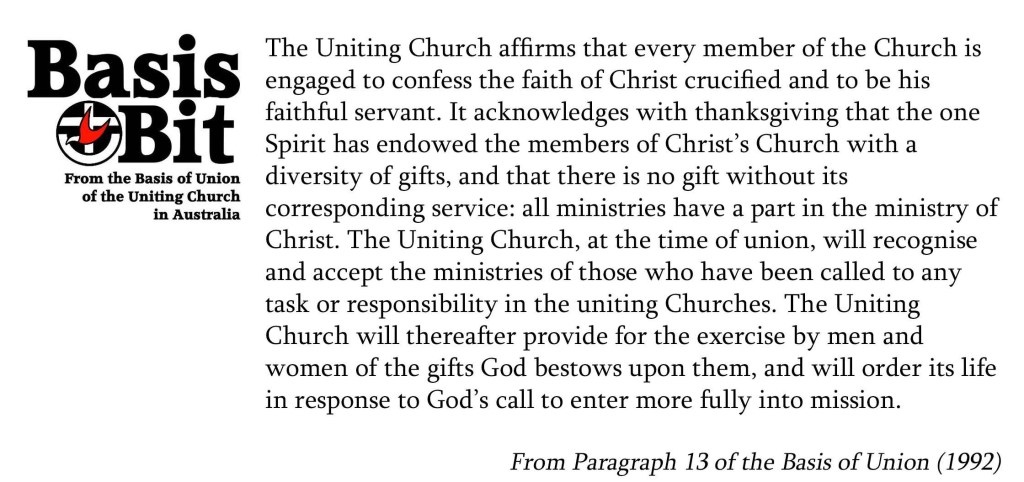
The Uniting Church is a church which values the ministry of all the people of God and seeks to order itself in accordance with the will of God. Our Basis of Union affirms that every member of the church is engaged to confess Christ crucified, and every person is gifted by the Spirit to engage in ministry in their own particular way. We are a church that values the ministry of each and every person.
Throughout the life of the Uniting Church, we have held our structures and forms of ministry accountable to ongoing scrutiny. Alongside the Ministry of the Word, to nurture and guide Congregations, we have introduced the Ministry of Deacon, to focus attention on people living on the margins. We have introduced the Ministry of Pastor to recognise the giftedness of lay people, and that sits alongside the Ministry of Lay Preacher (which we have had since 1977), and the more recent accreditation of Lay Presiders in many locations.
We have also undertaken important conversations about membership and the relationship of Baptism to Holy Communion. We now have a clear commitment to an open table when we gather for The Lord’s Supper: all who are baptised (whether adult or child, whether confirmed or not) are welcome to share at this table.
We are a church which values the ministry of all the people of God.
V Women and Men
The Basis of Union makes it very clear that we are a church which is committed to equality and mutuality of women and men in ministry. Even before 1977, the three previous denominations had ordained women to ministry. This is a very strong distinctive, especially in the Australian scene.
Since 1977, many women have stood on an equal basis alongside men, as Ministers of the Word, Deacons, Elders, Church Councillors, Lay Preachers, Lay Presiders, Chaplains, and Pastoral Carers. We value the insights and experience of women in each and every way that we seek to “be church”—as we gather to worship, as we witness to our faith, as we serve the wider community.
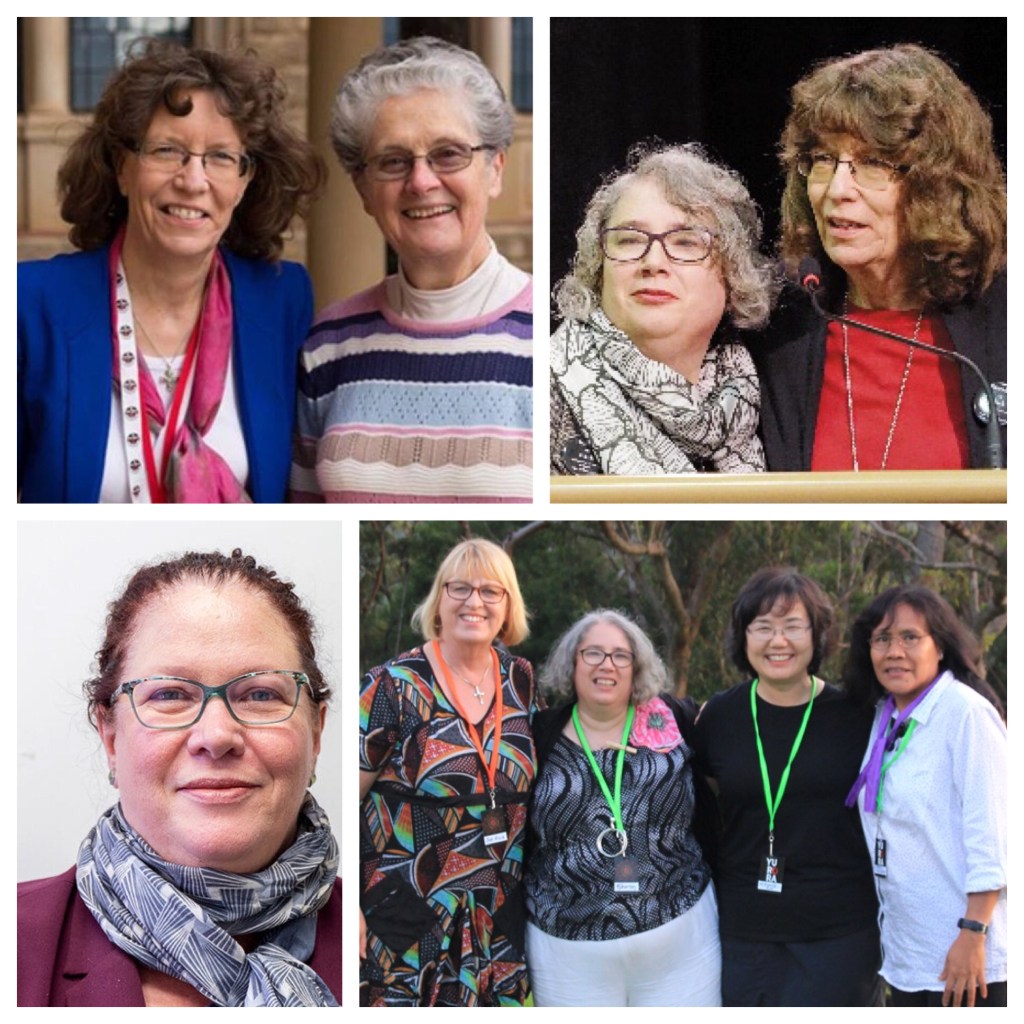
Women in leadership: Presidents Jill Tabart (1994–1997) and Deidre Palmer (2018–2021); Deidre Palmer and President-Elect Sharon Hollis (2021–2024); Assembly General Secretary Colleen Geyer (2016– ); and Moderators Sue Ellis (SA), Sharon Hollis (VicTas), Myung Hwa Park (NSW.ACT) and Thresi Mauboy (Northern Synod).
Both lay and ordained women have served in leadership positions across all councils of the Uniting Church, from Church Council Chairpersons to Presbytery Chairpersons, to Synod Moderators and Secretaries, to the Assembly General Secretary and President. Many couples minister together as husband and wife. Gender equality is most certainly part of our identity.
We are committed to mutuality and gender equality in every part of the church.
VI Discernment
Another contribution that the UCA has made has been to highlight the importance, when we gather in council, of being open to the Spirit, and seeking to discern the will of God. We live this out in our councils by practising a process of consensus decision-making. The Manual for Meetings sets out the various elements that are involved in making decisions by discernment: a time of information, a time of deliberation, and a time of decision-making.
The infamous “coloured cards” are only one small part of the whole. The focus is on listening to the Spirit before we speak, and striving to find a way forward that most, if not all, people can see as the will of God for the church. This way of decision-making, which originated in the UCA, has now been adopted by the World Council of Churches and a number of its member Churches.
We are a church which deliberately seeks to discern the movement of the Spirit in our midst.
VII Professional Standards
Over the last 20 years, the Uniting Church has developed a firm commitment to strong professional standards, for Ministers as well as for lay people who exercise leadership in the church. Our commitment to professional standards emerged initially in response to the problems of sexual misconduct within the church. A whole section of the Regulations is now devoted to this.
Since 1999, all Ministers have been expected to adhere to a Code of Ethics, and this has most recently been revised to provide a Code of Ethics Ministry Practice for Ministers and a Code of Conduct for Lay Leaders. Ministers and Pastors undertake regular training in aspects of this code, in ethical ministry workshops.
Since the Royal Commission into Institutional Responses to Child Sexual Abuse, we have intensified our efforts to ensure that our churches are Safe Places, valuing everybody, honouring integrity, avoiding negative and hurtful behaviours.
We are a church which values integrity and clarity about our ethical standards.
VIII Open to explore difficult issues
Over 40 years, the Uniting Church has shown that it is a church which is prepared to engage in difficult discussions about contentious issues. Our Basis of Union commits us to learn from the insights of contemporary scientific and historical studies, and affirms that we remain open to correction by God in the way we order our life together.
In the early years of the Uniting Church, debates about Baptism were the focus of great controversy. Infant baptism had been an integral part of the worship practices of each denomination which joined the Uniting Church, but Ministers and Elders Councils were receiving regular requests for baptism by adults who had been baptised as infants but had come to a personal faith later in their lives. After debates stretching through the 1980s and 1990s, the Uniting Church has developed a clear set of protocols to cover such requests.
Another area of enduring controversy has been that of human sexuality. There is a wide diversity of opinion within society relating to such matters, and this diversity is present within the Uniting Church. Once again, from the 1980s though into the present era, lively debates regarding human sexuality have taken place in the various councils of the church. We have worked through difficult decisions about sexuality and leadership, and then about sexuality, gender, and marriage. We continue to learn, explore, and adapt.
In dealing with such issues, we have learned how to debate with respect and integrity with ongoing conversations looking to employ a “Space for Grace” process to encourage respectful, empowering, and inclusive decision-making.
We seek to be a church that engages in the difficult discussions with honesty, transparency, and hopefulness.
IX Advocating for Justice
The Uniting Church inherited from its predecessor Churches a strong commitment to advocating for justice for all. Many Uniting Church congregations and members are actively committed to serving those people who find themselves on the margins of society. This commitment was clearly articulated in the 1977 Statement to the Nation and it has been evident in many actions undertaken by Uniting Church members over the decades.
The Uniting Church has joined in common cause with other groups and organisations in society, in advocating for a welcoming attitude towards refugees; in lobbying for a fair and just system of caring for people who are experiencing poverty and homelessness; in seeking equity for workers in their workplace; and in many other issues. The Assembly Working for JusticeCircle, brings together people who are strongly committed to this avenue of ministry.
A regular stream of policy documents and public resolutions point to a clear and unbroken commitment to seeking justice for all. Each federal election, we are provided with resources that encourage us, as people of faith, to consider the implications of our votes in the life of the nation.
We are a church which is strongly committed to justice for all.
X Environmental Sustainability
In like manner, the Uniting Church has always been a church which honours the environment and supports a sustainable lifestyle. Although such matters are firmly on the radar of the public now, they have long been integral to the identity of the UCA. Once again, the 1977 Statement to the Nation flagged such commitment. A series of subsequent documents attest to the ongoing determination of the church to live responsibly, in such a way that we minimise the damage we cause to the environment in which we live.
Our partnerships with Churches in the Pacific have intensified our awareness of the negative impacts that are resulting from climate change. We know that we need to act now, to reduce the threat. Each year, we experience catastrophic consequences from more regular and more intensified “natural disasters”—fires, floods, drought, cyclones. Just as we provide pastoral support in these situations through Disaster Response Chaplains, so too we maintain advocacy with governments, urging them to set policies which will turn us away from the trajectory of yet more environmental disasters.
Locally, many Congregations and individual members of the UCA are seeking to implement practices that will reduce their carbon footprint on the planet. We know that we owe it to future generations, to live responsibly in the present.
We are a church that lives, acts, and advocates for a sustainable environmental future.
*****
You may have some thoughts about what I have articulated above. You may have thought, “what about …?” – something that I have overlooked, that you see as important. You may have some questions about how I have described some of these elements. I encourage you to talk with others about how you respond. Together, we are the Uniting Church!



























 An Informed Faith