My name is John Squires. I live in the Hunter Valley in rural New South Wales, on land which has been cared for since time immemorial by the Gringai people (one of the First Nations of the island continent now known as Australia). I have been an active participant in the Uniting Church in Australia (UCA) since it was formed in 1977, and was ordained as a Minister of the Word in this church in 1980. I have had the privilege to serve in rural, regional, and urban congregations and as a Presbytery Resource Minister and Intentional Interim Minister. For two decades I taught Biblical Studies at United Theological College at North Parramatta in Sydney, and more recently I was Director of Education and Formation and Principal of the Perth Theological Hall. I've studied the scriptures in depth; I hold a number of degrees, including a PhD in early Christian literature. I am committed to providing the best opportunities for education within the church, so that people can hold to “an informed faith”, which is how the UCA Basis of Union describes it. This blog is one contribution to that ongoing task.
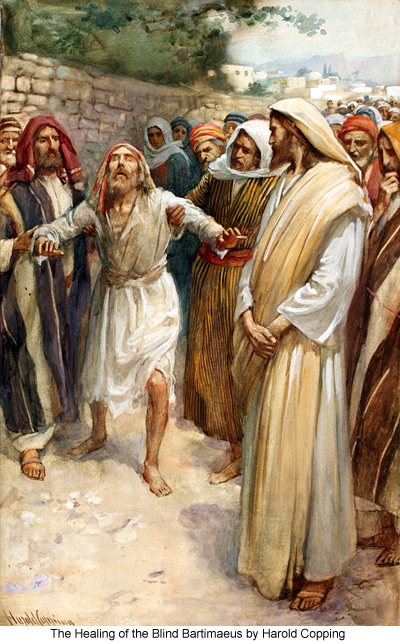
• Represent your interests not party or big business interests
• Collaborate across party lines and take the best of both views
• Prioritise practical solutions over party driven agendas
• Speak up on important issues as they’re not silenced by party interests
• Reflect your values and concerns, not the party platform
True Representation of Local Interests Independent candidates are not bound by party lines, meaning they can focus entirely on the needs and concerns of their local community. This ensures that your voice is heard without the influence of national party politics.
Greater Accountability Independent MPs are directly accountable to their constituents, not a political party. They must work to earn your trust and support with every decision, giving you more direct influence over the political process.
Less Partisan Gridlock With no allegiance to a political party, an Independent can work across party lines, pushing for policies that benefit the community rather than getting caught up in party politics. This leads to more practical and effective solutions for pressing issues.
Freedom to Speak Up on Important Issues Without the constraints of party policies or backroom deals, Independent MPs can speak freely on important matters, advocating for change and challenging both sides of the political spectrum when necessary to improve local and national outcomes.
Focus on Practical Solutions Independents often bring a more pragmatic approach to governance, focusing on tangible solutions to local problems. This means they are more likely to push for policies that address real issues such as housing, healthcare, and cost of living without getting bogged down by political agendas.
Empowering the Voter Voting for an Independent candidate allows voters to have more control over their representation. It encourages a shift away from the traditional two-party system, giving individuals the power to choose someone who best reflects their values and concerns, not just a party platform.
Authorised by Jeremy Miller, Independent for Lyne 224 Dowling St Dungog NSW 2420
I have been exploring just how it is that my federal electorate of Lyne has been “represented” National Party incumbent in recent times. It’s quite revealing.
The member who “represented” the people of Lyne in Canberra for the past three years has consistently voted
AGAINST increasing support for rural and regional Australia
AGAINST improving housing affordability
AGAINST growing our investment in renewable energy
AGAINST increasing workplace protection for women
AGAINST a transition plan for people working in the coal industry, whose jobs will become obsolete in the future
AGAINST treating the COVID vaccine rollout as a matter of urgency
But the voting record for our representative is not always NO; unfortunately, it is sometimes YES. In the same period of time, our member has voted
FOR getting rid of penalty rates on Sundays and public holidays
FOR political intervention into research funding grants
FOR privatising more government services
FOR banning mobile devices in immigration centres
FOR decreasing the availability of welfare payments
FOR putting welfare payments onto a “cashless card” system
Is this really how we want to be represented in parliament? These issues are all central to the commitments that the National Party has—all their members voted the same way. They showed little concern for local issues, but were focussed on “following the party line”.
As the saying goes, “if you want things to change, you need to change the way you vote”. A vote FOR Jeremy Miller will ensure that the concerns of people in the electorate are heard and considered, and that there will be strong advocacy about what really matters to you.
The man sits on the ground, beside the road leading into Jericho. Sensing what was happening, who was passing by, what was being spoken about; unable to use his eyes, he was undoubtedly attentive through his listening ears, through the sounds he could hear, as well as the fragrances he could smell. Because of this, he knew the identity of the person passing by, so he calls out with confidence, “Jesus, Son of David, have mercy on me” (Luke 18:38).
Jesus pauses, engages with the man, and responds to his plea. “Receive your sight; your faith has saved” (18:42). The man, all of a sudden, could see; all was clear, so he took his place among those following Jesus on the way (18:43).
This incident takes place towards the conclusion of the lengthy journey that Jesus undertook with his disciples, from Galilee in the north (4:14, 31; 5:17; 8:1, 26, 40), through Samaria (9:51–56; 17:11–19) and into Jericho (18:35; 19:1) en route to Jerusalem (19:11, 28, 41). That journey had I commenced soon after Jesus had been transfigured on the top of a mountain (9:28–36). This striking event, at which Moses and Elijah appeared, pointed towards the exodon (NRSV, “departure”) which Jesus “was about to accomplish at Jerusalem” (9:31).
The essence of that exodon is revealed by Jesus in the words he speaks to his disciples both immediately prior to, and soon after, his transfiguration. Before, he declares “the Son of Man must undergo great suffering, and be rejected by the elders, chief priests, and scribes, and be killed, and on the third day be raised” (9:22). After, he provides a brief summary: “the Son of Man is going to be betrayed into human hands” (9:45). The journey to Jerusalem would be a journey to his death. When this journey is almost at an end, Jesus returns to this teaching, reminding them “we are going up to Jerusalem, and everything that is written about the Son of Man by the prophets will be accomplished” (18:31).
At the start of the journey, the disciples had exhibited a thorough and complete lack of understanding at the teaching of Jesus. Luke provides a succinct threefold declaration that “they did not understand this saying; its meaning was concealed from them, so that they could not perceive it”, before noting that “they were afraid to ask him about this saying” (9:45).
Over the course of the journey, Jesus has taught, healed, told parables, and cast out demons, all of which (we might imagine) could have alerted the disciples to the true nature of the mission of Jesus. So, when the group approaches Jericho, Jesus reminded them of his earlier words, giving more extensive details about what this entails: “he will be handed over to the Gentiles; and he will be mocked and insulted and spat upon; after they have flogged him, they will kill him, and on the third day he will rise again” (18:32–33).
Whilst the disciples were completely ignorant at the start of the journey—at the end, sadly, they were apparently none the wiser. Luke again offers a succinct threefold exposé of the continued ignorance of this group: “they understood nothing about all these things; in fact, what he said was hidden from them, and they did not grasp what was said” (18:34).
So the healing of the blind man functions as an enacting of the teaching of Jesus; it is a moment of revealing that Jesus was, no doubt, hoping would become evident to his followers. As the blind man hear the noise of a nearby crowd, he enquires and is told, “Jesus of Nazareth is passing by” (18:37). The man, it seems, does not share the ignorance or hesitancy of the disciples; he immediately reaches out to the man passing by, calling out “Jesus, Son of David, have mercy on me!” (18:38), and then repeating the plea when he was told to be quite (18:39).
The request, “have mercy on me”, sounds much like a prayer to God; it exactly echoes the prayer in a psalm attributed to the penitent adulterer-murderer, David (“have mercy on me, O God, according to your steadfast love”; Ps 51:1) as well as the cry of the pilgrim travellers heading towards Jerusalem (“have mercy upon us, O Lord, have mercy upon us”; Ps 123:3) and another psalm ascribed to the time “when David fled from Saul in a cave” (“be merciful to me, O God, be merciful to me, for in you my soul takes refuge”; Ps 57:1). This phrase has, of course, become the basis of a much-repeated prayer amongst pious Christians: “Lord, have mercy on me”.
Indeed, God’s mercy is acknowledged in many psalms—most notably in the well-known affirmation, “surely goodness and mercy shall follow me all the days of my life” (Ps 23:6), but also in another dozen places (Ps 25:6; 40:11; 69:16; 79:1; 86:15; 103:4; 111:4; 116:5; 119:77, 156; 123:2–3; 145:8). God’s mercy is integral to the repeated biblical affirmation, “the Lord is merciful and gracious, slow to anger and abounding in steadfast love” (Ps 103:8; see also Exod 34:6; Neh 9:17; Ps 86:15; 145:8; Joel 2:13; Jon 4:2).
The man by the road knows of this divine mercy, and believes he will receive it from Jesus. He stands as a striking contrast to those walking with Jesus along the road who, despite an extended time of learning from Jesus, fail to understand him. This man knows exactly what Jesus offers, and he pleads for it. And the immediate response from Jesus was to restore his sight, affirming “your faith has saved you”(18:42)—the same affirmation given to the woman who, before he had set out on this journey, had anointed his feet (7:50).
The conclusion to the story is clear and impactful: “he regained his sight and followed him, glorifying God; and all the people, when they saw it, praised God” (18:43). This man responds to the actions of Jesus as he “followedm him”; he joins those already following him, his committed disciples (5:11, 27–28; 7:9; 9:11, 23, 57–62; 14:27; 18:22, 28), as they walk into Jerusalem.
The man’s response of “glorifying God” shows that he knows the source of the power that Jesus had to heal. It replicates the response of the paralytic man who had been healed by Jesus (5:25). The response of the crowd, “praising God”, echoes the words of Simeon over the infant Jesus soon after his birth (2:28), and anticipates the response of the centurion at the very moment of the death of Jesus (23:47). It also resonates with the responses of the crippled woman (13:13) and the Samaritan leper (17:15), each of whom recognises the divine source of the power manifested by Jesus.
One of the questions that is often put to Independent candidates relates to the issue of funding. “Where is your funding coming from?” “Your candidate is on the Climate 200 website—that means they’re a Teal, doesn’t it?” Some basic figures might be helpful here.
In the 2022 election, Climate 200 donated a total of $6.5 million, distributed amongst 19 candidates. This money had come from 6,750 donors—including Simon and Karina Holmes à Court, but obviously including so many more than them. That indicates widespread support for Independents amongst the community; the vast majority of C200 donors were individual supporters of the community-backed Independents.
However, the $6.5 million from Climate 200 for community-backed Independents pales into insignificance when we note the donations received by the two major parties. For the 2022 election, Labor raised $124 million to spend on its electioneering, and the Coalition raised $115 million. Together, that’s 36 times more money than was provided by Climate 200.
And the bulk of these donations come from a small number of well-heeled individuals: the top 5% of donors provided 82% of the donations to the major parties. The Centre for Public Integrity reports that the top 5 individual donors to the ALP contributed $205.4 million, (that’s 34.5% of their total donations), while the top 5 donors to the Coalition contributed $118.8 million (22.6% of their total donations). So who is calling the shots? Just a few very rich people.
Many of the community-supported Independent candidates ran strong grassroots campaigns in the 2022 election, attracting much more of their funding support from donations made by community members. For example, Monique Ryan raised $1.8 million from 3,762 donors for her successful campaign to unseat former treasurer Josh Frydenberg in the Melbourne seat of Kooyong. This clearly reflects the higher socio-economic level of the population in this electorate, compared with western Melbourne or western Sydney seats, where support at such a level would not be able to materialise.
Climate 200 has been completely transparent about the individual donors whose money is them distributed amongst community-nominated Independent campaigns that they supported. They are listed by name on their website:
These donors support C200 in its platform of assisting Independent candidates with community support, who are each committed to the three basic areas of responsible climate policies, integrity in government, and gender equity. These three areas are designed to ensure a focus on equity within society. Our federal members need to represent us all.
By contrast, the fossil fuel industry has provided strong support for the major parties in an attempt to further their environmentally damaging projects, which bring financial benefit to their businesses. Their intense lobbying and continued financial support is intended to get these parties to support their businesses enterprises, and to slow or stall the support given to renewable sources of energy,which are much more environmentally responsible.
The Australian Electoral Commission has published the figures of where donations came from in the 2022 election, and it shows that:
Fossil fuel industry sources gave more than $2.3 million to the major political parties ($1.4 million to Labor and over $900,000 to the Coalition parties).
The mining and energy division of the CFMEU union ($500,000) and industry lobby group the Minerals Council ($105,000) were the biggest fossil fuel interest donors to Labor, while oil and gas lobby group APPEA ($56,700) was also a big contributor.
Tamboran Resources, the company that plans to extract gas from the Beetaloo Basin, donated a combined total of $200,000 to Labor, Liberal and National parties.
Oil and gas giant Woodside donated a total of $109,930 to Labor, Liberal and Nationals.
Mineral Resources Limited ($135,000) and gas giant Santos ($77,310) were the biggest individual fossil fuel company donors to Labor.
Coal miner Adani donated $100,000 to the Liberal-National Party in Queensland.
Climate 200 estimates that if the proposed changes to electoral funding are in place for the 2028 election, the two parties could expect to receive 2.44 times as much as in 2025, with the forecast windfall increasing by $82.66m to $140.01m. This includes an estimated $16.53m in new administrative support funding.
These calculations are based on the Reserve Bank of Australia’s inflation projections, the current trajectory of first-preference voting for the two biggest parties and the proposed rate of public funding per eligible vote.
So any criticism of the support given to community-nominated and community-supported Independents should be placed alongside these figures!
******
Declaration of interest: for the 2025 federal election I am an active and committed member of the campaign team for Jeremy Miller,who is the community-supported Independent candidate in the seat of Lyne.
This blog relates to the parable in Luke 15 offered in the Narrative Lectionary this coming Sunday, Lent 3. It also appears in the Revised Common Lectionary for the following Sunday, Lent 4.
At the beginning of the season of Lent, some 26 days ago, we heard again of the time that Jesus spent in the wilderness. Sometimes, when I have been in a placement where I was responsible for leading worship each Sunday throughout Lent, I have shaped the weeks around the theme of a Wilderness Journey. As well as the Sunday services, there were offerings of Bible Study groups that meet each week, designed to focus, specifically, on aspects of that theme, Wilderness Journey. It is a good way—one way among many ways—to foster an intentional Lenten discipline.
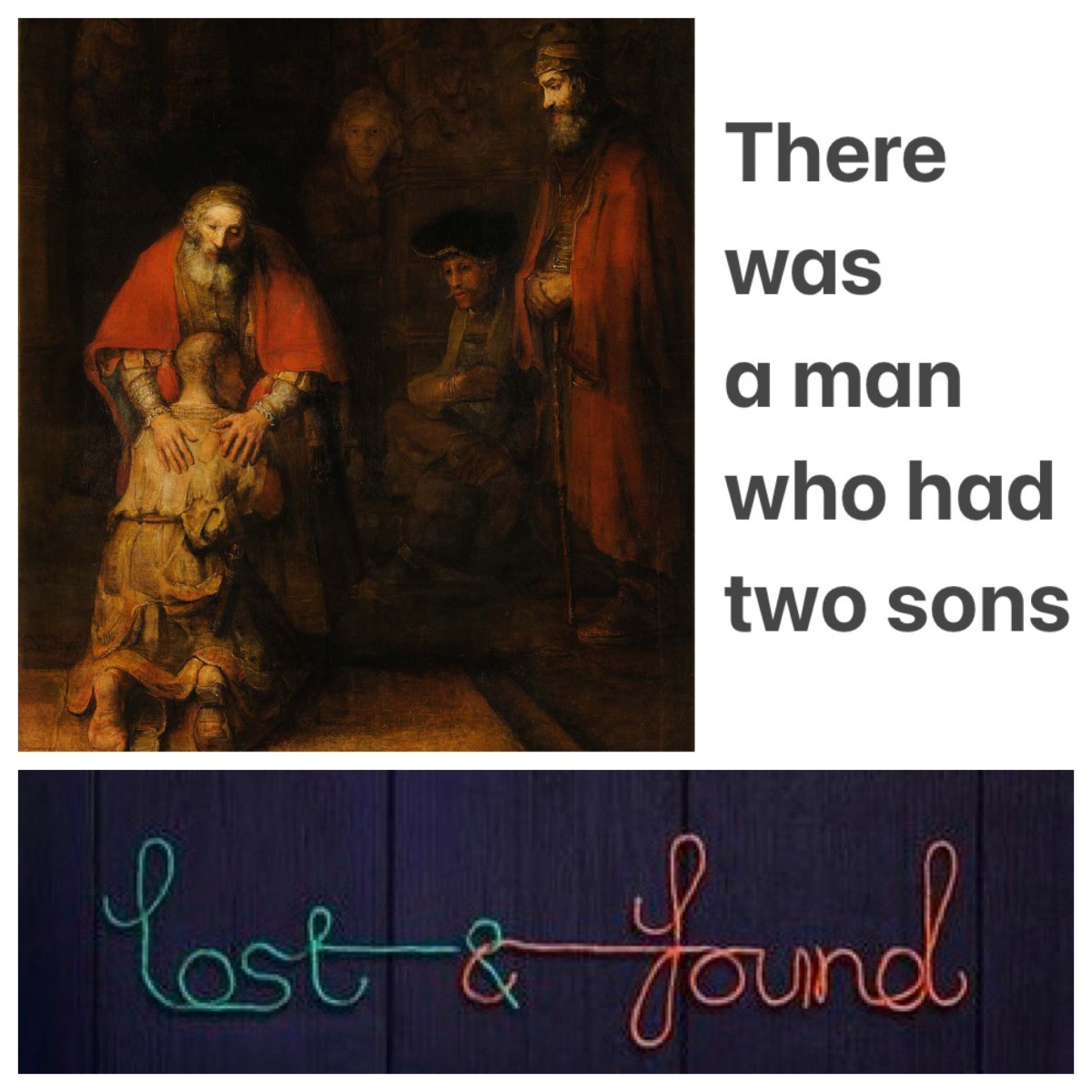
This theme continues, this coming Sunday, as the Gospel passage proposed by the lectionary invites us to consider the notion of being lost—an entirely understandable element in a Wilderness Journey! In this passage (Luke 15:11–32) we hear a much-loved and very familiar story. It’s a story about losing; but also about finding. About the wandering away of a much loved son; but also about the wondrous returning home of that once-was-lost son.
Often, taking this particular focus of “the one who was lost is now found” (v.24), this story is called The Parable of the Prodigal Son. (The adjective “prodigal” seeks to capture the “dissolute living” on the younger son, as described in vv.13–16.) The focus is on the character regarded as central—the younger of the two sons, whose decisions in life are seen to reflect the innate human sinfulness that a dominant stream in orthodox theology has attributed to all human beings. The younger son is a symbol for every one of us.
However, this is a story that has more than one character in it; more than just this one “prodigal son” who so often gives his name to the parable. Sometimes, I wonder whether it might be better to rename The Parable of the Prodigal Son, and call it The Parable of the Two Prodigal Sons, recovering the emphasis on both sons in the latter part of the parable.Or perhaps, The Parable of the Gracious Father, reorienting the focus to the acts of kindness and compassion displayed by the father as he welcomes one son back home. How would you name it?
Of course, this parable sits in a chapter where there are three stories in a row, focussed on the same dynamic: what was once lost, is now found. The sheep, once lost, now found (v.6). The coin, once lost, now found (v.9). And the son, once lost, now found (v.24). Or, is that, the two sons, each lost: one, a runaway who came to his senses and returned; the other, a stay-at-home that came to his senses without ever having to leave home (v.32). In each case, joy is the central motif of the parable that is told (vv.7, 10, 32).
Whatever you call it, this parable is a story that invites us to reflect on our own journeys. In those journeys, there are moments of being lost, as well as moments of being found, within our own lives. Moments when we ventured afar; moments when we realise that we are lost; moments when we set out back home to be with the family; and (hopefully) moments of joyful reconciliation on our return.
Can you remember a time when you wandered off from your faith? And a time when you returned to the community of faith? Perhaps a time when you felt alone, rejected, sitting in poverty in the midst of a pen of swine, as it were? Or perhaps the time when you were met by the loving embrace and joyous celebration of the community, rejoicing as you returned into the family, to share in the feast that had been prepared?
This parable invites us to think about the experiences of losing, and finding—or being found—not only within our own lives, but also within this community of faith. Think about the community of faith to which you belong. What have you lost as a community, together? And what have you found, together, in that community? Found, for the very first time—or perhaps a rediscovery of something that was once lovingly held?
A little while ago I ministered for an agreed period of time (12 months) as an Intentional Interim Minister (IIM). It was a community which had been through a process of loss. I knew that, within such a community, a group of people gathered around a common cause, there would be many who have felt the experience of loss quite acutely. But there would also have been some for whom the loss was less-intensely felt. The experiences of loss felt by individuals would be quite varied. That is certainly what I encountered in the particular community where I was ministering.
Some had experienced the loss of a beloved and respected minister. Their thinking was along the lines of “We had an opportunity to move in new directions, but we haven’t done so. We had the experience of many new people joining us to participate in our common life, but they have now gone. We were given different ways of understanding our faith, but that is no longer offered to us each Sunday. We have experienced loss”
Others, I found, had experienced loss in a different way: the disruptions of previous years had led, in their view, to a loss of a familiar pattern of worship, a familiar way of understanding God, a familiar set of practices and customs on a week-by-week basis. I suspect they were thinking: “We have lost a sense of reverence in church. We no longer have a large and flourishing youth group. We seem more oriented to doing particular works in our community, less oriented to praying and studying scripture together. We have experienced loss.”
But although there were different ways in which that loss was felt and understood, it was an experience held in common across virtually all the congregation. I spent some time encouraging people to name their loss, and to know that “if you are experiencing this sense of loss, you are not alone; you, and your neighbour, and the people who regularly sit on the other side of the church, are also experiencing that sense of loss. It may be in relation to different issues. But you are all experiencing loss.”
Bear with me. I will come (back) to the story of the gracious father and his two sons, for that is the focus of this post. But first, a little more theory.
An important factor that helped to guide me in the situation in which I was ministering, a few years ago, was a theory was something known as Transition Theory. This had formed an integral part of the training I had received in preparation for serving as an Intentional Interim Minister (IIM); it was one plank in the foundation that undergirded the work I undertook with the people of the congregation in the transitional process that I guided them through during the course of the year.
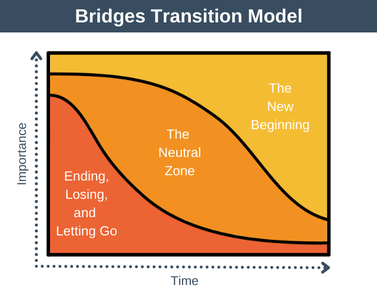
The particular form of Transition Theory that I used was developed by William Bridges, in a book he wrote, entitled Managing Transitions (2009). In this book, Bridges talks about transitions in terms of three stages: first, there is the letting go; then there is the neutral zone of being in-between; and finally, the connection into a new place, a new way of being. In that neutral, in-between zone, there is a need for us to nurture and develop a capacity to live within the discomfort of ambiguity which arises during the experience of loss, as we move away from the familiar.
What Bridges calls the neutral zone, is actually akin to what appears in the biblical story, time and time again, as the wilderness. Moving through the neutral zone, is the journey that is undertaken through the wilderness. That is what Jesus did for those “forty days” in the wilderness, that we reflected on in the first Sunday of Lent. That is what the people of Israel had done for those “forty years” in the wilderness, which ended with the story told in Joshua 4, which is offered by the lectionary as the Hebrew Scripture passage for this coming Sunday, Lent 4.
In Hebrew, the word we translate as wilderness (midbar) means literally, “land uninhabited by humans”, or “land in between the places where human beings live”. It can be a dangerous, threatening place to be. Remember that when Jesus was tested in the wilderness, he was without human company, but the wild beasts were present with him in that wilderness.
(And let’s also note that the length of time—40 days, or 40 years—is not an exact chronological period. Rather, it reflects the ancient Israelite way of expressing “a long, long period of time” in each case. Jesus spent a long time in the wilderness. Israel had spent a heaps long time in the wilderness!)
Bridges proposes that, if we are able to sit within the neutral zone, the wilderness, and engage with the discomfort of ambiguity, then it need not be a threatening, dangerous place. If we engage with the wilderness constructively, as Jesus did when he was tested, then we can experience change and transition as a constructive and life-giving experience. If we can emerge from the wilderness with a plan and a hope for the future, as Israel did, that ambiguous place will have prepared us well. The wilderness can become a pivot away from the past, into the future. That is the best outcome of a process of transition.
If we are not able to sit within that zone of ambiguity, feeling completely dislocated and wanting to move out of that wilderness zone, then we will experience change and transition as threatening, disruptive, and even destructive. We will be stuck in the wilderness, moving neither forwards nor backwards, hankering for the past, yet unable to move on into the future. Or, worse, we will retreat back into the past, seeking security in familiarities which may not any longer be realities.
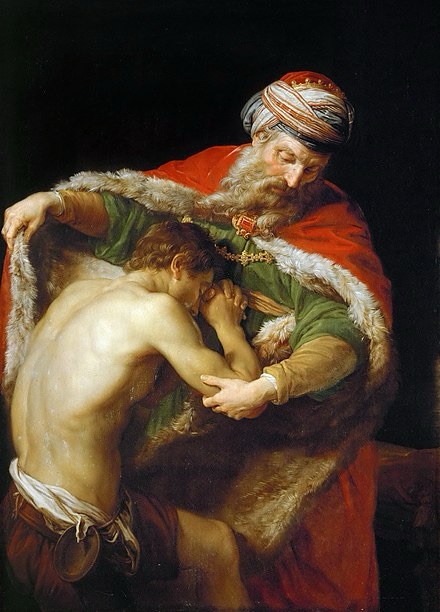
The Return of the Prodigal Son (1773) by Pompeo Batoni (1708–1787)
So, then: back to the Gospel passage. How might this insight of a Bridges relates to the story told in the Parable which forms our Gospel reading for the week (Luke 15:11–32)? In the parable of the prodigal son—or should that be the parable of the two prodigal sons—or perhaps even the parable of the gracious father—there are a number of key, pivotal moments; moments where characters enter that neutral, in-between zone; the wilderness; moments that can well be described as having the discomfort of ambiguity for one or more of the characters involved.
The younger son, unhappy at home, launches out on his own—proud, confident, self-assured; yet perhaps he has some anxiety, some ambiguity, about what lies ahead for him? Some slight discomfort, perhaps.
The father, seeing his younger son departing, undoubtedly considers whether, or not, he will provide him with his share of the property; but this is a fleeting moment of ambiguity, a brief sense of discomfort, which he apparently readily resolves in the affirmative.
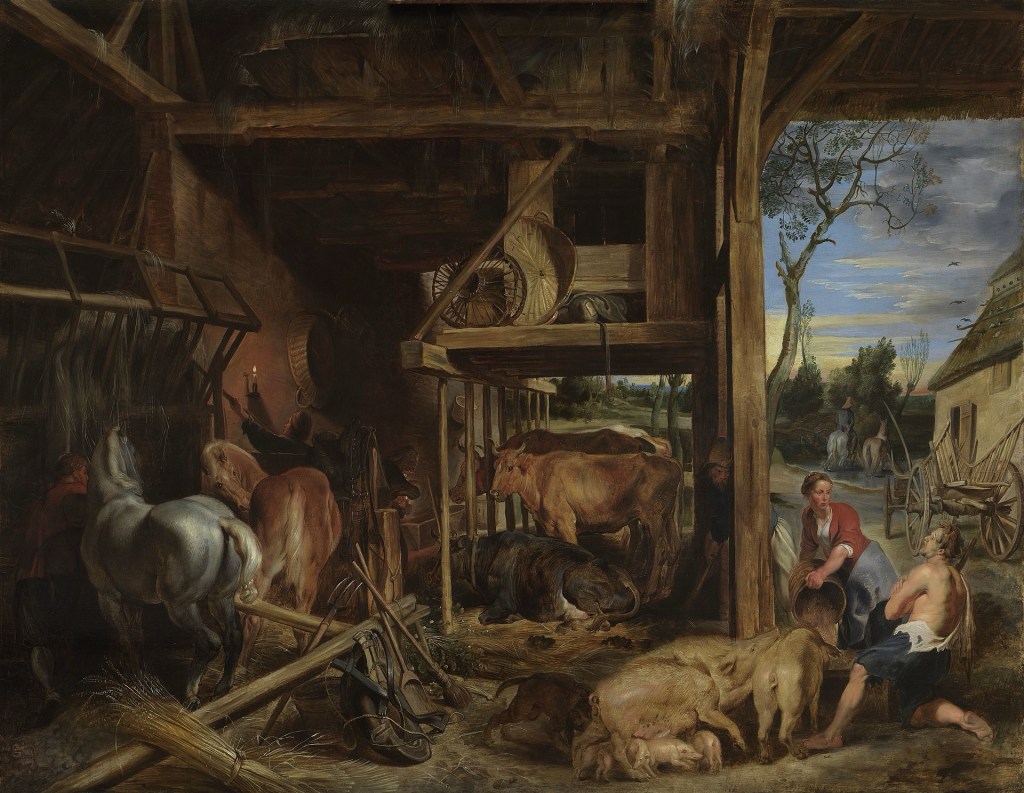
The younger son, some time later on, having run through all that he had been given and in the midst of a serious famine, looks at his impoverished state and considers: “am I doomed to this life of poverty, or do I put my tail between my legs, and return home in humility?” Uncertain, highly anxious, this is the place of deep discomfort in ambiguity. That is the wilderness experience.
The Prodigal Son (1618) by Peter Paul Rubens (1577–1640)
The son decides to remove this discomfort, and resolve the ambiguity, by turning to head home. He wants to leave the wilderness behind. He does not know how he will be received when he returns. But he commits to the journey back home, and looks to transition into a new place, a new status.
The elder son is happy to stay at home, enjoying all the benefits … and yet, perhaps he is wondering, “what if I asked for my share of the property, like my brother did? Could I make it good out there in the big wide world?” More ambiguity, some measure of discomfort, for him.
But that bursts into full-on, large-scale ambiguity, and intense discomfort, at the moment he sees his brother returning. “What will I do? Should I be glad to see him? Will he be welcomed back? Will I be happy that he comes back into his privileges as a son, even though he has spent his inheritance? Or will he be put with the servants, accepted back, but put into his place? Will I be happy to have him back here, again? Will he be a son, or a servant?” In this moment, he feels with intensity the discomfort of ambiguity.
And the father, now consumed by the swirling, seething rush of hope, experiences his own moment of the discomfort of ambiguity: “should I ignore him? Should I rush to welcome him? Will he expect to return as a son? Could I simply offer him a role, here, as a servant? What should I do.” The discomfort of ambiguity. The in-between, uncertain and destabilising experience, of being in an emotional wilderness.
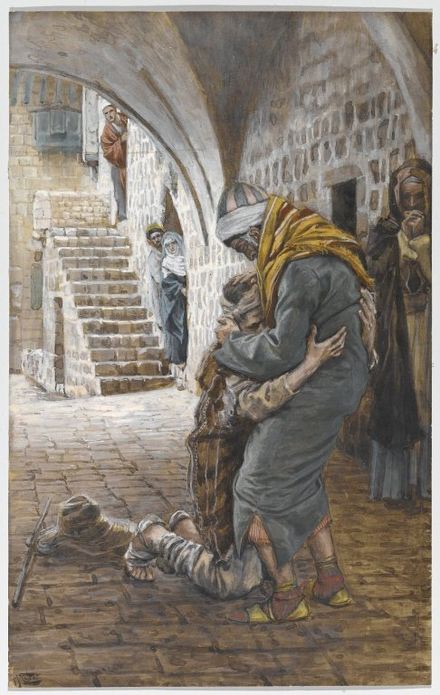
The Return of the Prodigal Son (Le retour de l’enfant prodigue) by James Tissot (1836–1902)
And so the father runs, joyously, to greet his son. He remains in the zone of discomfort and ambiguity; there is no certainty about what will happen next; but he is able to step into the future, to rebuild his relationship with his son, because he has embraced the ambiguity and recognised the discomfort that he was feeling, as an opportunity to grow, change, and transform. The pressure of ambiguity is not completely resolved, but the father is able to move on with hope into this future. He is stepping out of the wilderness, into the future.
Accepting and valuing the ambiguity is a key element in the transition into the future zone. It is the key as to how we move on in our wilderness journey.
And yet, at this moment, the discomfort intensifies for the older son. “Now that my brother is back, I cannot abide this. Stand firm. Stay put. Do not greet him, do not celebrate with him, let them have their fatted calf without me!” And surely there is ambiguity, discomforting ambiguity, in this moment, for him? The future is uncertain. What will it hold? What will his relationship be with his brother? What will it be with his father? The ambiguity remains. The parable ends with the elder son still caught, discomforted, in the wilderness of uncertainty and ambiguity.
This is a story of being lost, and being found. The parable contains a sense of discomfort in multiple moments of decision. The ambiguity of belonging, detaching, reconnecting; farewelling, welcoming, reconnecting; deciding.
We all face moments that are filled with the discomfort of ambiguity. William Bridges, as I have noted, writes about the capacity that we each have—and that we need to nurture and develop—the capacity to live within the discomfort of ambiguity. We need to embrace the wilderness. We cannot escape it by running away. We need to explore our wilderness experience to the fullest.
If we stay within the wilderness, the zone of ambiguity, then we can experience change and transition as a constructive and life-giving experience. If we are not able to sit within that zone of ambiguity, and are always wanting to move out of that zone, then we will experience change and transition as threatening, disruptive, and even destructive.
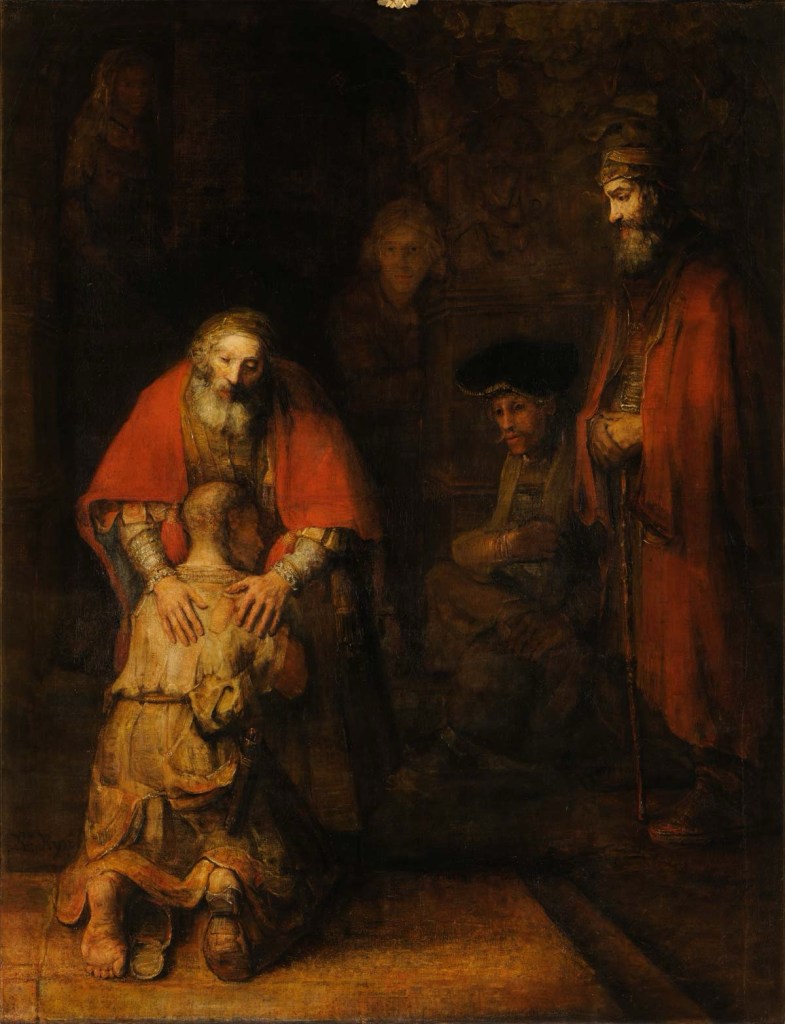
Perhaps the most widely-known depiction of the parable: The Return of the Prodigal Son (1662–1669) by Rembrandt Harmenszoon van Rijn (1606–1669)
I am left with many questions from this parable of Jesus. How might we move through our own sense of being lost, in whatever way that is manifesting, to the assurance of being found? What steps do we need to take? Whose path are we following in this process?—the younger son, or the older son?
How can we take our steps towards the God who runs to meet us, “filled with compassion ([who] puts his arms around [us] and kisses [us] … [and cries out] bring out a robe—the best one—and put it on him; put a ring on his finger and sandals on his feet; and get the fatted calf and kill it, and let us eat and celebrate; for this [child] of mine was dead and is alive again; [they were] lost and is [now] found!”?
*****
I close with a prayer for the week, from the mystic, Thomas Merton, which appears on a regular cycle in my daily devotions (with the Northumbria Community), and which is pertinent to these reflections.
My Lord God, I have no idea where I am going.
I do not see the road ahead of me.
I cannot know for certain where it will end.
Nor do I really know myself,
and the fact that I think that I am following your will
does not mean that I am actually doing so.
But I believe that the desire to please you does in fact please you.
And I hope I have that desire in all that I am doing.
I hope that I will never do anything apart from that desire.
And I know that if I do this you will lead me by the right road,
though I may know nothing about it.
Therefore will I trust you always,
though I may seem to be lost and in the shadow of death.
I will not fear, for you are ever with me,
and you will never leave me to face my perils alone.
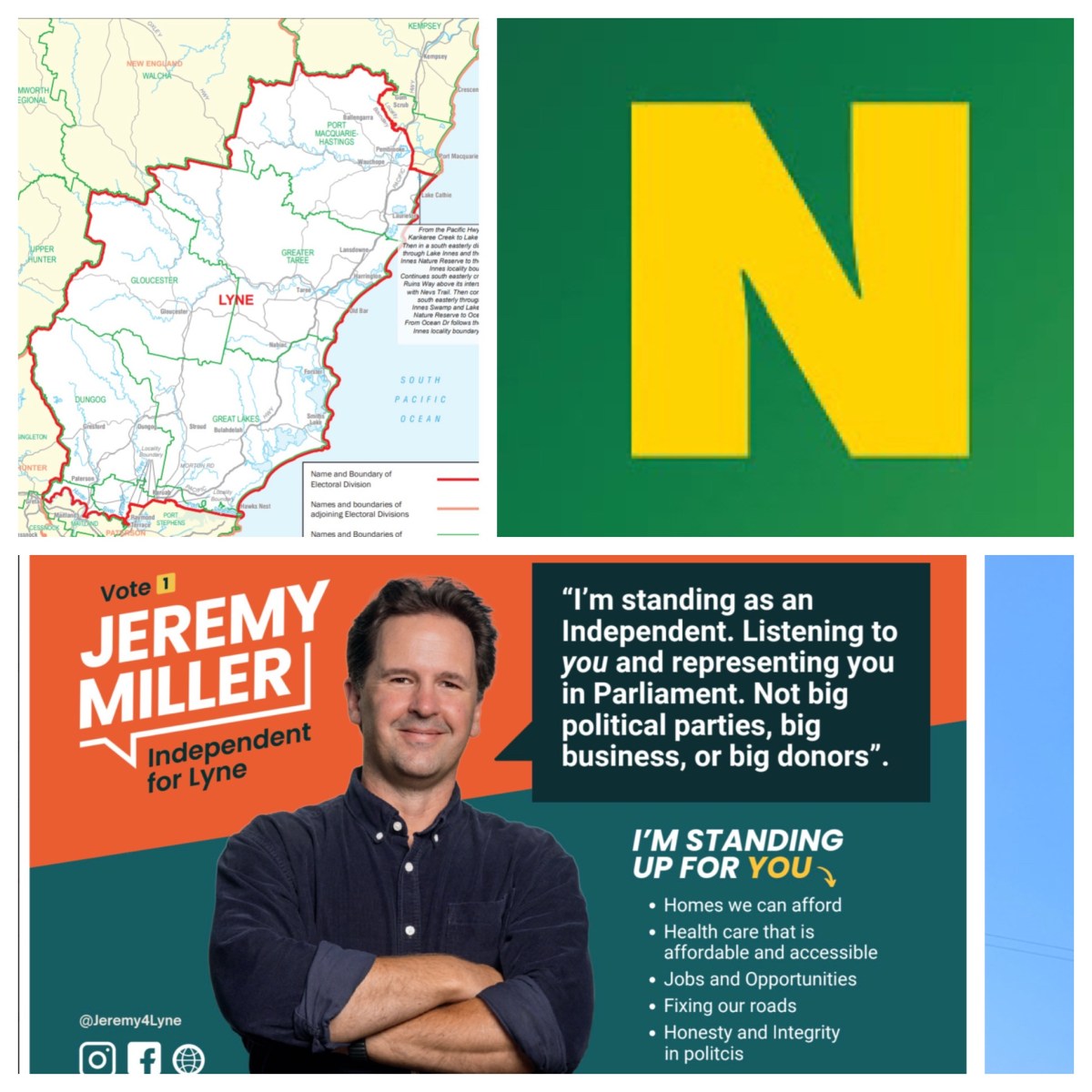
Since the middle of last year, Elizabeth and I have been involved in a process that has led to the selection of a Community Independent to stand as a candidate for the seat we live in, Lyne, and then into the forming of a team to run the campaign for JeremyMiller4Lyne. It has been a most interesting experience! See
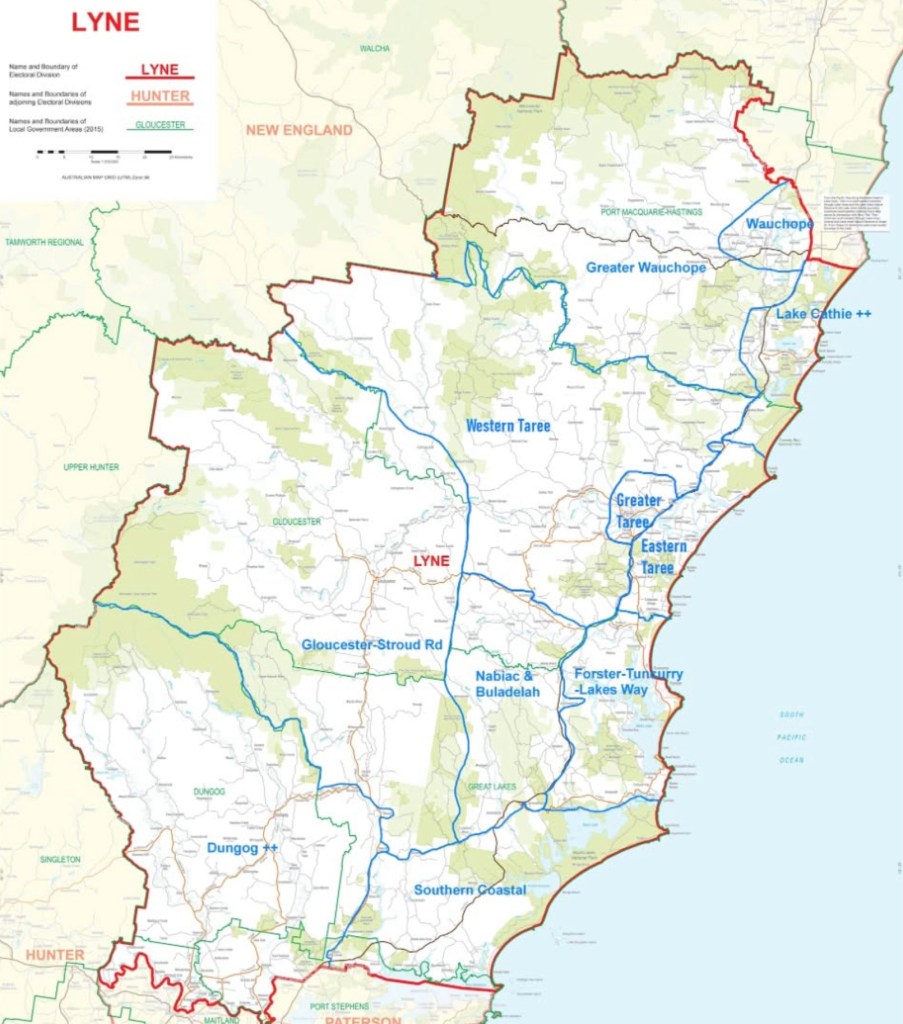
The federal electorate of Lyne is large. It is about 230km in length and over 100km in width. It takes about two and a half hours to drive it south to north, although there are very few roads that run east to west as there are wonderful areas of natural beauty in national parks, nature reserves, and state forests through much of the inland area. The electorate includes the magnificent rainforests of the Barrington Tops National Park, just north of where we live in Dungog.
The electorate stretches from the northern suburbs of Maitland on the banks of the Hunter River, across to Tea Gardens and Hawks Nest, and then north all the way to the southern suburbs of Port Macquarie near the Hastings River, and inland to the west to our old stomping ground of Wauchope. It includes significant urban areas on the coast—Taree, Forster, and Tuncurry—as well as a string of smaller coastal towns and villages.
There are some key rural hubs inland—Wauchope, Gloucester, and Dungog—as well many other smaller towns and villages in the hinterlands, and widely dispersed farmland areas through many river valleys. It is an area with wonderful scenery along the coastline as well in the mountain areas inland, and many natural features that attract visitors throughout the year.
To cover all of these diverse locations, the campaign team has sent up Hubs (see above). Each Hub is running its own events locally. Each Hub has a local leader—Elizabeth has taken on this role for the Dungog Hub, which includes the whole of Dungog Shire (Dungog, Clarence Town, Paterson, Vacy, and Gresford) as well as the northern suburbs of Maitland (Lorn, Largs, and Bolworra Heights).
Elizabeth has marshalled a team of volunteers, mostly living in Dungog itself. We have started a weekly street stall in the Main Street of Dungog, to let people know about Jeremy. Three of us set up a stall at Clarence Town Markets some weeks back, with the same purpose. Volunteers in other hubs have been at stalls for markets in Taree, Forster, Gloucester, and other places where monthly markets are held. We have started putting up Corflutes in our various hubs. Some hubs are now starting Corflutes Marches in the main towns. There’s lots of activity happening.
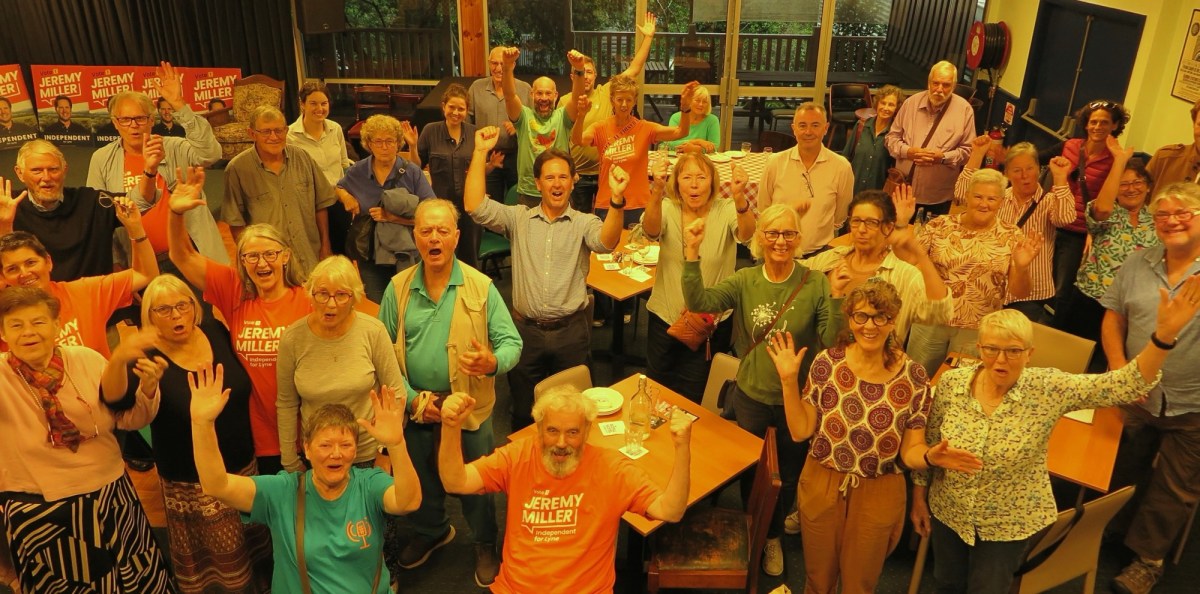
Jeremy Miller (in the centre) with Dungog supporters
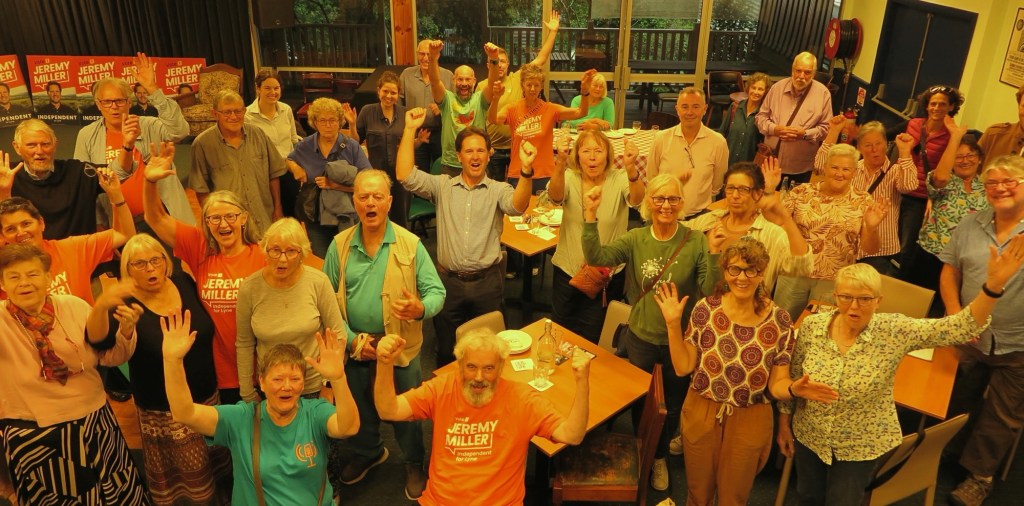
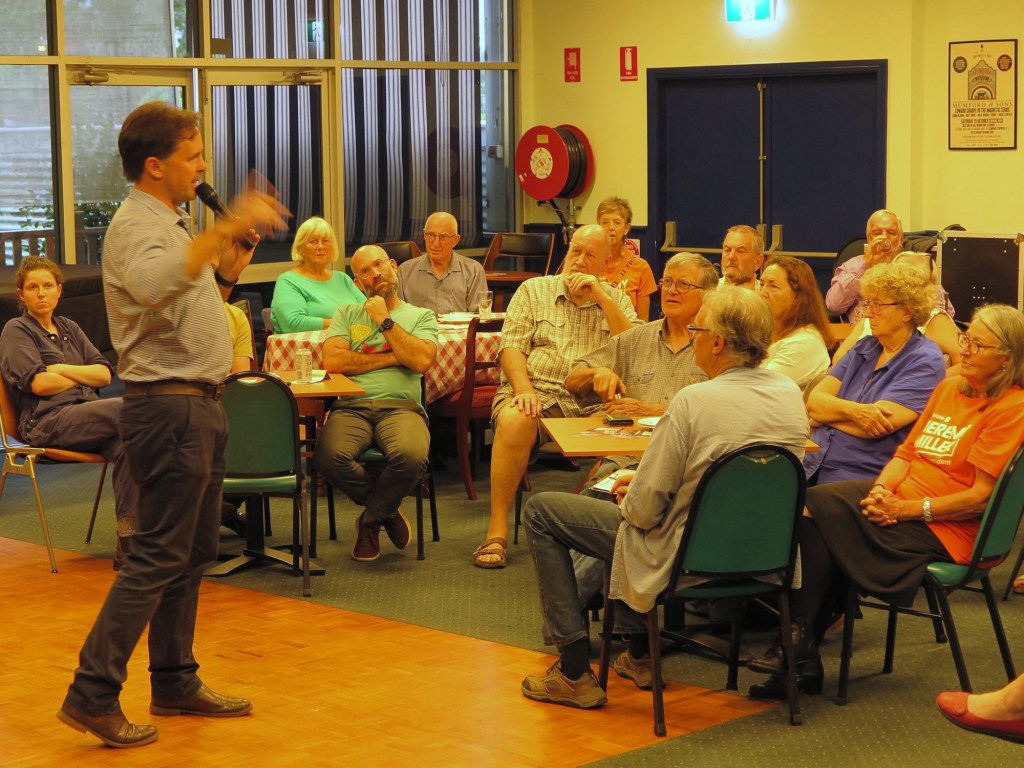
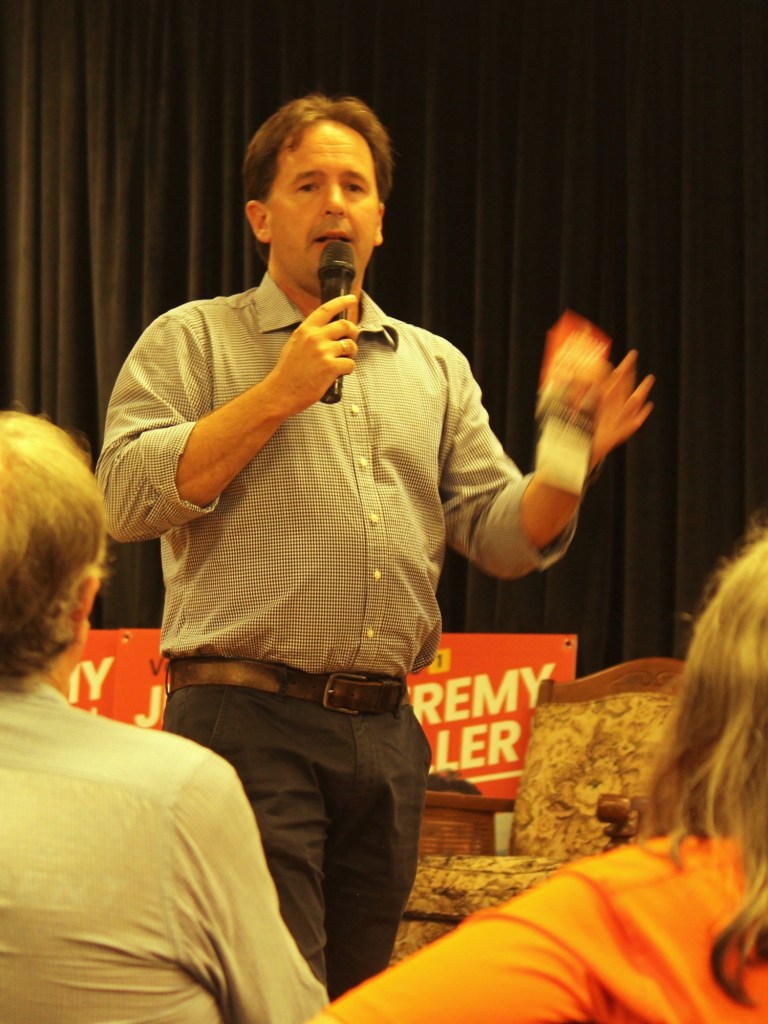
As a team, we decided not to have a “campaign launch”, but to have a series of “Meet the Candidate” events in key locations. The first one was held this week at Dungog, in the heart of the southern part of the electorate. A crowd of over 40 locals gathered at the Royal Hotel to hear Jeremy speak about his candidature. He spoke a little about his own life and outlined how he would serve as the member for Lyne. “As your Independent representative”, he declared, “my only loyalty is to our community. I’ll work with anyone who helps our region and stand up to anyone who doesn’t”.
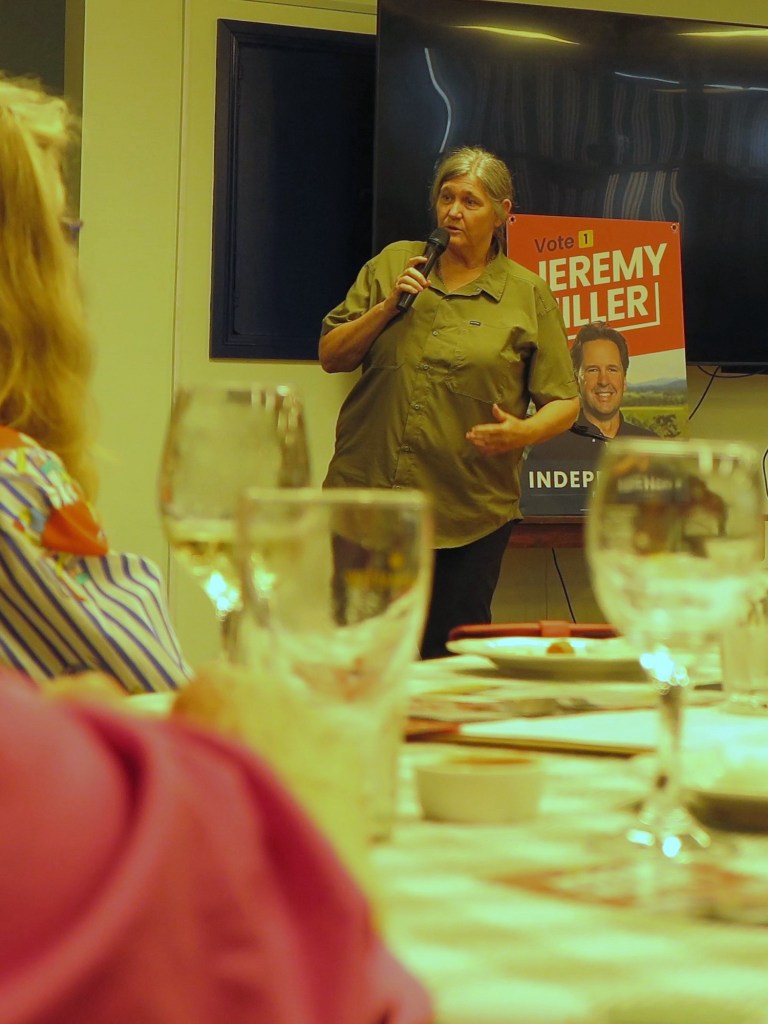
The room was decked out with Corflutes and Banners in support of Jeremy’s visit. Local volunteer Janine Atkin served as the MC for the evening. Former Dungog Shire Mayor Tracey Norman spoke enthusiastically about what Jeremy would bring to federal parliament. The pub provided a fine spread of finger food for people to eat as they listened intently to what Jeremy had to say.
Former Mayor of Dungog Shire Council, Tracey Norman, introducing Jeremy Miller
David Smith and Libby Doolan made sure that everyone who attended was invited to sign up as a supporter. In the audience were some Dungog Shire Councillors, including the current Mayor of Dungog, Digby Rayward. Jeremy had met with Cr Rayward some days earlier in order to gain a better understanding of the current priorities of the Dungog Shire Council.
The whole event ran smoothly, due largely to the careful planning of Elizabeth as the Dungog local leader and her persistence in inviting people from a wide range of local community groups in Dungog. We believe that offers a fine model for how other “Meet the Candidate” events in other parts of the electorate could run. There’s one scheduled for Tea Gardens today and Forster tomorrow.
Answering questions about key issues
Questions were asked about Jeremy’s environmental commitment and his stance on nuclear power and large-scale renewable energy installations. He said that community consultation was really important in setting up such things. He said that each project needs to be assessed on its own merits, and that there are too many unknown factors relating to nuclear power installations. “The Government shouldn’t be running large-scale risky businesses” such as nuclear power. Other questions asked related to tertiary education, tax reform, and truth-telling and treaty.
One good question was about what principles guided his ethics. Jeremy said he will always seek to do “what is right” for the people of the electorate. He noted that, according to the ABC’s votecompass, he was “socially left, economically a little right, overall pretty much in the centre”. What he would most like to achieve whilst in parliament would be “to change the mindset that things can’t change for the better”.
One person who attended commented that Jeremy “reeked of integrity”—an interesting turn of phrase! Another observed that he was up front and honest; perhaps a rare quality in public life? A number of people had come wondering “who is Jeremy Miller?” and “what does he stand for?” As they left, quite a number took Corflutes and signed up to volunteer to support Jeremy in his campaign in the coming days. It was a great evening!
Much of Jeremy’s funding is from donations by individuals. He also has received funding from Climate 200 and the Community Independents Project; see https://www.communityindependentsproject.org
This blog relates to a part of the passage from Luke 13 offered in the Narrative Lectionary this coming Sunday, Lent 2. It also appears in the Revised Common Lectionary for the following Sunday, Lent 3.
In John’s Gospel, there is an extended narrative that concerns a resident of Jerusalem who was born blind, and lived his life into adulthood as a blind man. John reports that this man sat every day, begging for assistance, beside the pool of Siloam (John 9:1-41).
In this story, when Jesus encounters the man, he spat onto the ground to make mud, rubbed it on the man’s eyes, and told him to “wash in the pool of Siloam (which means ‘sent’)” (9:6–7a). The man obeyed Jesus, “he went and washed and came back able to see” (9:7b). This healing formed the basis for the controversy that ensued.
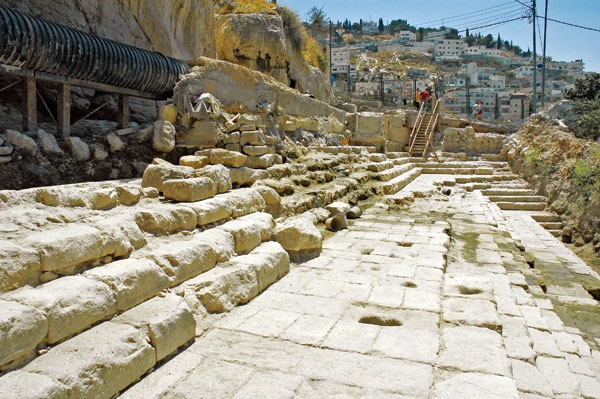
The site believed to be of the Pool of Siloam, in a recently-opened site in Jerusalem
The Pool of Siloam is said to have had a significant history dating back to King Hezekiah’s reign in the late 8th century BCE. Hezekiah was worried that the water supply to Jerusalem would be interrupted during the seige of the city that was expected from the Assyrians that were pressing south (2 Ki 18:13; Isa 36:1). Hezekiah needed to act. He did so by commissioning a long tunnel (over 500 metres) to take water underground from the Gihon Spring, the main source of water for the city, all the way to the city’s southern end.
At the end of his life, his death is recorded in this manner: “The rest of the deeds of Hezekiah, all his power, how he made the pool and the conduit and brought water into the city, are they not written in the Book of the Annals of the Kings of Judah?” (2 Ki 20:20). This conduit and the pool that it fed were his crowning achievement. The pool is the Pool of Siloam.
The Pool of Siloam takes its place in Christian tradition because of the story of John 9. It was neglected, however, after the Romans destroyed Jerusalem in 70 CE. Centuries later, Byzantine-era Christians built a commemorative church at what they believed was the pool’s location, near the City of David’s southern end. Yet, in 2004, sewer construction unexpectedly revealed the actual Second Temple period pool, about 200 meters south of the Byzantine site. The whole structure was “225 feet long, with corners that are slightly greater than 90 degrees, indicating a trapezoidal shape, with the widening end oriented toward Tyropoeon valley”, according to the Biblical Archaeology Society. See
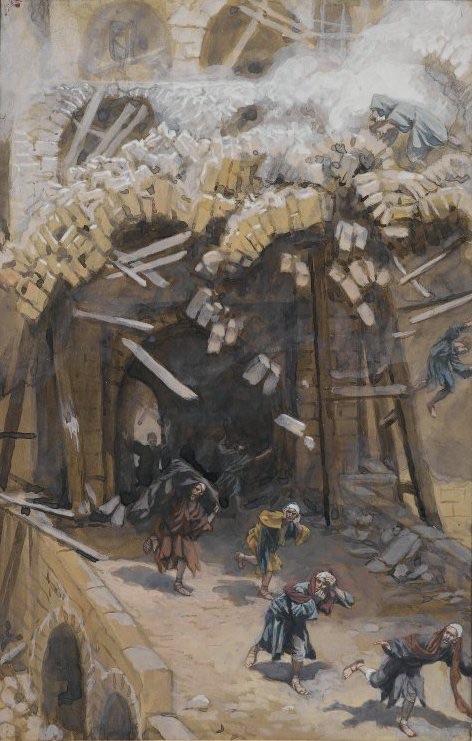
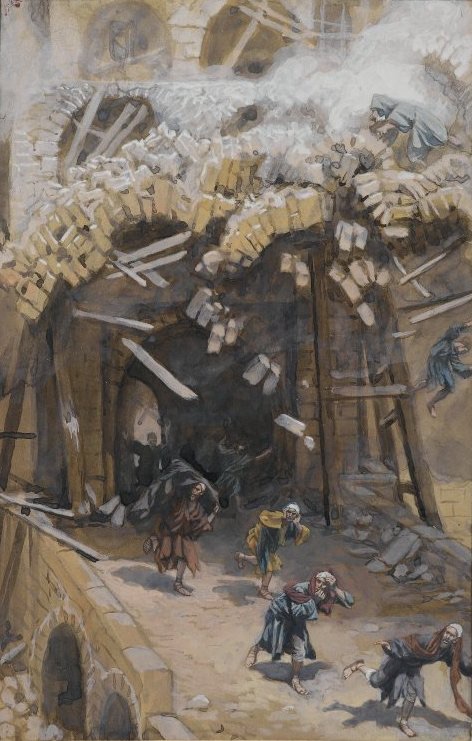
We find in Luke’s Gospel a reference to a Tower of Siloam (Luke 13:4). This is the only reference in the New Testament—indeed, the only reference in any ancient document—to this tower. Speculation as to its location, height, and function have abounded: was it part,of the aqueduct built to,transport the water? a pillar supporting a porch beside the pool? a fortress built by the Romans as part of their defensive network around the city? I suspect the definitive answer will never be known.
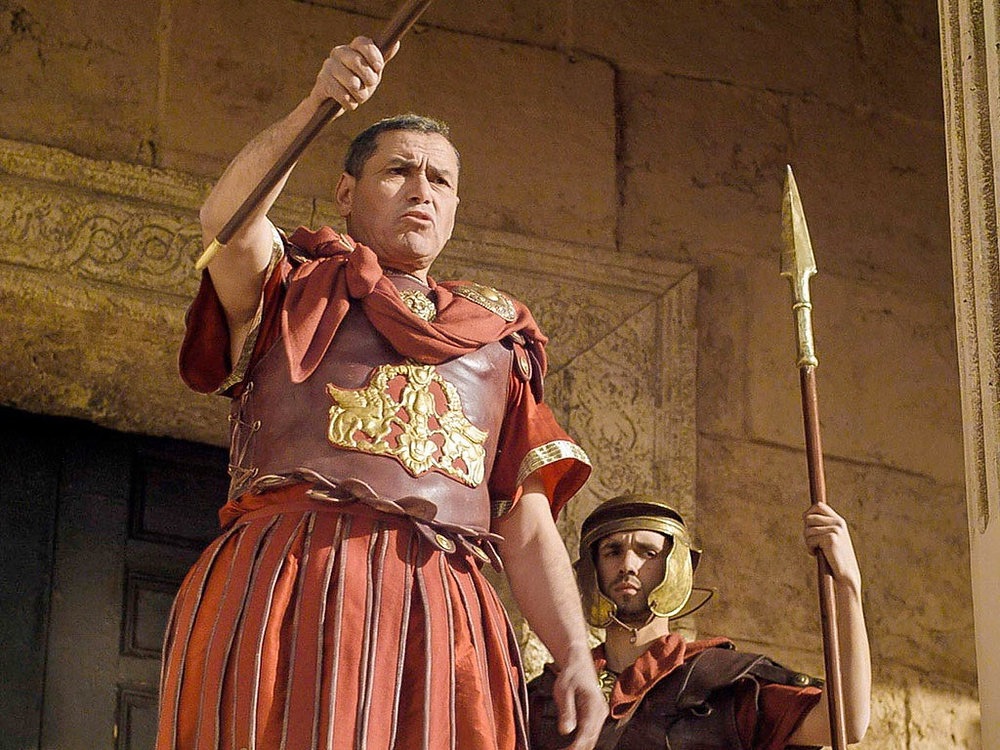
Other elements mentioned by Jesus in the passage, however, are plausibly historical: the existence of Pontius Pilate, of course, and his mistreatment of people under his charge—in this case, the Galileans whom he had slaughtered and whose blood was then mixed with the sacrifices they were offering (Luke 13:1). Pilate’s regular cruelty towards the Jews places him in the company of other Roman governors of the region who consistently acted against any local discontent with imperial military force. Josephus provides evidence for the actions of various governors.
Coponius acted against an uprising led by Judas in 6 CE; CuspiusFadus was involved in an incident involving the vestments of the high priest (in the mid-40s CE). VentidiusCumanus was embroiled in a series of incidents (48–52 CE) while Antonius Felix regularly deployed his soldiers to disperse Jewish gatherings because of the emergence of the Sicarii (52–60 CE). Of Albinus (62–64 CE) Josephus declared “there was no form of wickedness which he omitted”, Jewish War 2.272; 62–64 CE). This sequence of Jewish—Roman antagonism culminated under GessiusFlorus (mid-60s CE), with Josephus scathingly noting that Albinus seemed “a most excellent man by comparison” with Florus (Jewish War 2.277).
Because Pilate was governor for a full decade (26–36 CE), he was involved in a number of documented actions against Jewish people. On Pilate and the incident with the ensigns, see Josephus, Jewish War 2.169–174; Antiquities of the Jews 18.55–59. On Pilate’s refusal to remove some dedicated gilt shields, see Philo, Legatioad Gaium, 38. On the time when Pilate appropriated Temple funds for the construction of an aqueduct, see Josephus, Jewish War 2.175–177; Antiquities of the Jews 18.60–62.
American scholar Bart Ehrman argues that Pilate “was a brutal, ruthless ruler with no concerns at all for what the people he governed thought about him or his policies. He was violent, mean-spirited, and hardheaded. He used his soldiers as thugs to beat the people into submission, and he ruled Judea with an iron fist.” (See https://www.patheos.com/blogs/rationaldoubt/2019/05/pilate-released-barabbas-really/) The claim that on one occasion he mixed the blood of murdered Galileans with sacrificial blood thus appears to be quite plausible.
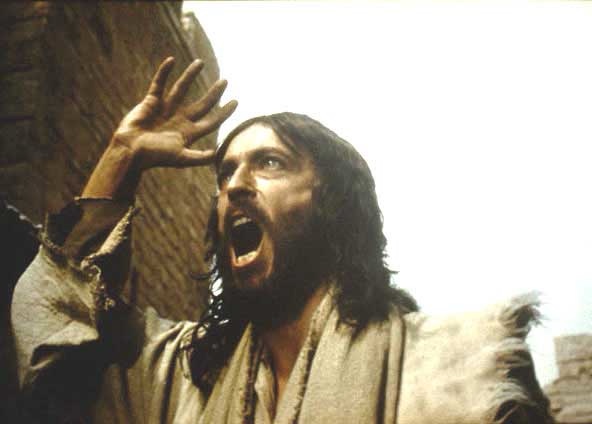
The other historical element in this passage is surely the warning of Jesus: “unless you repent, you will all perish just as they did” (13:3,5). Although the popularised caricature of Jesus today is that of “gentle Jesus, meek and mild”, the historical reality was surely that Jesus was a fierce apocalyptic-style preacher, calling people to repentance in the light of the imminent coming of the kingdom of God.
This portrayal of Jesus is clear from the start of Mark’s Gospel (“the time is fulfilled, and the kingdom of God has come near; repent, and believe in the good news”, Mark 1:15) to its end (“they will see ‘the Son of Man coming in clouds’ with great power and glory; then he will send out the angels, and gather his elect from the four winds, from the ends of the earth to the ends of heaven”, Mark 13:26–27; and then “beware, keep alert; for you do not know when the time will come”, Mark 13:33).
It is picked up with persistence through Luke’s narrative. Jesus declares “I have come to call not the righteous but sinners to repentance” (Luke 5:32) and rejoices that “there is joy in the presence of the angels of God over one sinner who repents” (15:10). He tells a powerful parable about the importance of repenting (16:19–31; see v.30) and shares in table fellowship with a prominent sinner, Zacchaeus, who publicly declares exactly how he has repented and changed his ways (19:1–10; see v.8).
Preaching repentance and calling the people to seek forgiveness from the Lord is the central task in the commission given to so many prophets. “Come, let us return to the Lord”, cries Hosea (Hos 6:1), “put on sackcloth and lament, you priests”, Joel demands (Joel 1:13). “You did not return to me” is the consistent accusation raised against Israel by Amos (Amos3:6,8,9,10,11), and so he called the people to “seek good and not evil … hate evil and love good, and establish justice in the gate;” (Amos 5:14–15).
“Zion shall be redeemed by justice, and those in her who repent, by righteousness”, says Isaiah (Isa 1:27), declaring that “[the Lord] expected justice, but saw bloodshed; righteousness, but heard a cry!” (Isa 5:7). The same message of repentance is echoed by Jeremiah (Jer 3:12–14; 22:1–5), Ezekiel (Ezek 14:6–8; 18:30–32), and Zechariah (Zech 1:1–6). And the whole farcical story of Jonah is told to underline the importance of the prophet holding fast to the charge to “cry out against [the city], for their wickedness has come up before me” (Jonah 1:2; and see 3:3–5).
Jesus stands in this long line of prophetic voices. He declares the need for repentance, and says that forgiveness will be offered to those who repent. Repentance, in turn, brings salvation. This is the heart of the mission of Jesus; “the Son of Man came to seek out and to save the lost” (Luke 19:10).
The declaration that salvation has come to the house of Zacchaeus (19:9) indicates how what we prophesied of Jesus before his birth is now being fulfilled: “the Lord God of Israel … has looked favorably on his people and redeemed them”, the people has been “saved from our enemies”, they have been given “the knowledge of salvation … by the forgiveness of their sin”, and so “the dawn from on high [has broken] upon us” (1:68–79).
So this passage of the two incidents—mingled blood and a collapsed tower—although found only in Luke’s Gospel, nevertheless sounds some key elements in the story of Jesus. The call to repentance is highlighted by these two dramatic stories. It is a clear warning to those following Jesus and listening to him: “unless you repent, you will all perish”. It is a warning to us, today, as well. Preaching on this passage requires fortitude; hearing and receiving it in faith requires obedience and commitment.
The Tower of Siloam by C19th French artist James Tissot (from the Brooklyn Museum collection)
During Lent, the lectionary sets before us a string of passages that canvass key theological elements in the story of Israel. These stories, of course, also resonate also with the story of Jesus and his followers (and that is largely why they have been selected, I assume). We begin this coming Sunday with the promise of the land (Deut 26), and then follows passages focussed on the covenant with Israel (Gen 15), the provisions of God for the people (Isa 55), the renewing moment at Gilgal (Josh 5), the promise of “a new thing” (Isa 43), and the gift of The Servant (Isa 50). It is a stirring and inspiring sequence!
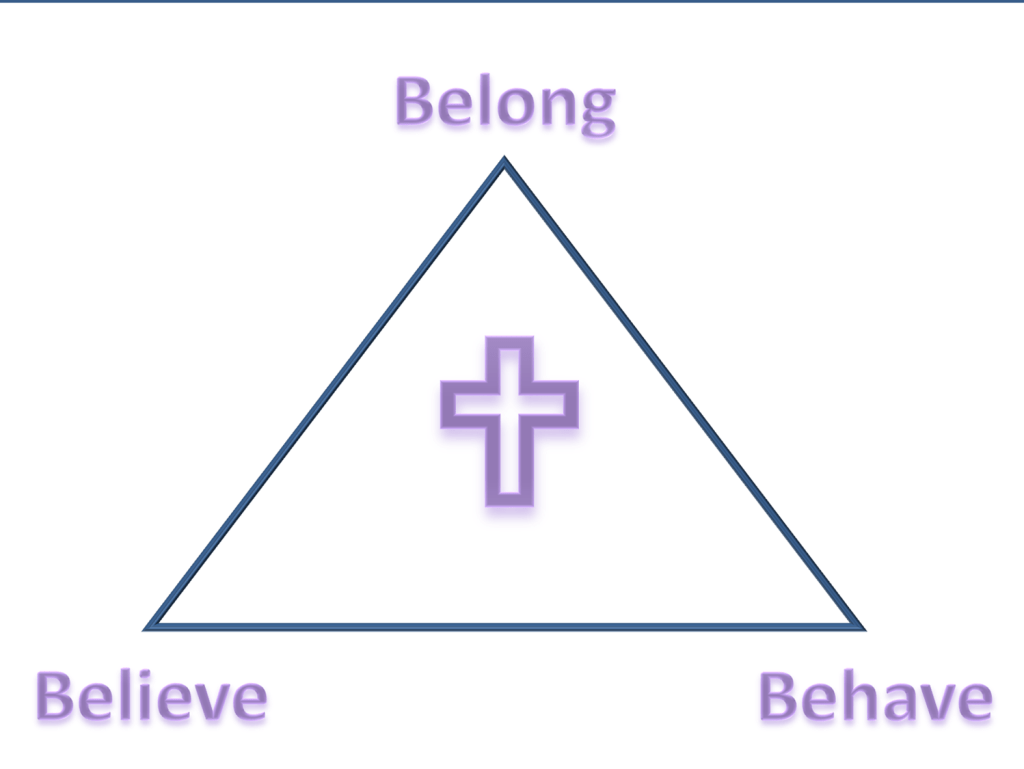
There is much debate amongst Christian thinkers, these days, about what comes first as we invite people to be a part of the church. Do we say, “this is what we believe, expressing our fundamental understanding of life; do you want to sign up to show you have the same beliefs?” Or do we say, “this is how we behave, guided by our fundamental ethical principles; would you like to act the same way and join us?” Or perhaps the invitation is simply, “come along, join in with us, see what we believe, what we are on about, and soon you’ll feel like you belong”?
Is it believe first? Or behave? Or simply, belong? The tendency to put a creed at the forefront of our invitations—to show that we are a people who believe, first and foremost—is widespread and deeply ingrained. Whether it be affirming The Apostles Creed in baptism, or saying The Believer’s Prayer at conversion, or working out a new Mission Statement for the Congregation, giving priority to belief is a very familiar pattern for us. We tend to think that, whatever formula we are repeating, that is exactly what declares and confirms our identity as people of faith.
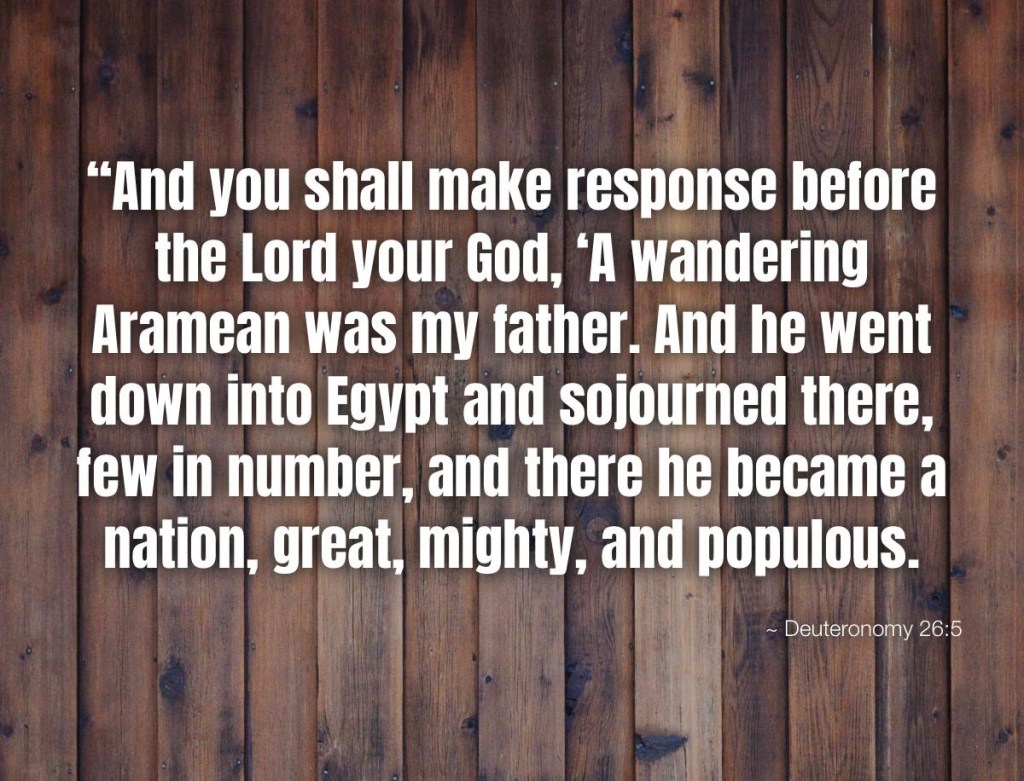
So it’s no surprise that when we read Deuteronomy 26 (the Hebrew Scripture passage in next Sunday’s lectionary), we gravitate to the middle part of the passage, and lay claim to what looks to be an early affirmation of faith that sets out the identity of the people of Israel: “A wandering Aramean was my ancestor; he went down into Egypt and lived there as an alien, few in number, and there he became a great nation, mighty and populous” (Deut 26:5). This affirmation seems to go right back to the start, affirming what sets the people of Israel apart as a distinctive entity.
This way of reading this passage gained influence from the analysis of Gerhard von Rad, a German scholar of the 20th century. Von Rad claimed that the credal statement in verses 5 following was most likely a formula much older than the era when the book of Deuteronomy was written. And the origins of this creed, he claims, most likely lay in ancient cultic remembrances of the origins of the people. The wandering Aramean (Jacob, grandson of Abraham of Aramn) and the time in Egypt (leading up to Moses) reflect those times of origin.
*****
But the whole of this “creed” is not actually a “statement of faith”. It is more a narrative that tells a story. Such was the way of the ancient world; central beliefs were not articulated in crisp propositional statements (for this is the way of the post-Enlightenment western world); rather, a story was told, in the course of which key events pointed to central affirmations for the people. The ancients were story-tellers, more concerned to tell the story than state the faith. This is the story of the people; it is their saga.
God is important in the story that is told, nevertheless. God is the one who “heard our voice and saw our affliction, our toil, and our oppression … who brought us out of Egypt with a mighty hand and an outstretched arm, with a terrifying display of power, and with signs and wonders” (26:7–8). The rescue of the people by their powerful God is central to the story. This, of course, if the story of the Exodus, which stands at the heart of Israelite identity and later Jewish identity. It is the central story of the people of Israel.
More than this, God is the one who “brought us into this place and gave us this land, a land flowing with milk and honey” (26:9). The land of Israel is the second aspect of ancient Israelite life that is central and fundamental; and so it continues to be, in the 20th and 21st centuries, in which the land of Israel has been one of the most contested pieces of land in the world.
The story is told, however, for a purpose. Not just to remember—although remembering is important, for it recurs as a regular refrain in the book of Deuteronomy (7:18: 8:2, 18: 9:7, 27; 11:2; 15:15; 16:12; 24:9, 18, 22; 25:17; 32:7). The story is told, also, to inculcate the ethos, the values, the very identity of the people. And central to that ethos, taking prime place amongst the things that were seen to be important to affirm about who the people of Israel were, is this: giving back to God the first fruits produced by the land.
“So now I bring the first of the fruit of the ground that you, O LORD, have given me”, are the words that the people are to say, each time a harvest is produced. “You shall set it down before the LORD your God and bow down before the LORD your God”, the instruction declares (26:10). Gratitude is to the fore; gifting back the beginnings of “the fruit of the ground” to the God who gave the people the land to grow this fruit.
*****
Of course, there is a dark story submerged, for the most part, underneath that celebratory action. The land was “given” by God over the resistance of the people who were already IN the land, producing fruit, settled and content with their lot in life. The battles recounted in the book of Joshua—most likely not actual historical events, but reflecting a reality of submission to the Hebrews who took control of the land—reflect this dark story.
This dark story does not figure in the “received tradition” and “authorised affirmation” that we read in Deut 26. Nor do we find this in the affirmation of Deut 6:20–24, which begins “we were Pharaoh’s slaves in Egypt, but the Lord brought us out …”. Mention of the Exodus jumps straight across to life in the land—no mention of the conquest that (in other biblical texts) is reported in detail.
This conquest is part, by contrast, of the larger recitation of Josh 24:2–13, “I brought you out of Egypt … and I handed the Amorites over to you, and you took possession of their land, and I destroyed them before you … and also the Amorites, the Perizzites, the Canaanites, the Hittites, the Girgashites, the Hivites, and the Jebusites; and I handed them over to you … I gave you a land on which you had not labored, and towns that you had not built, and you live in them; you eat the fruit of vineyards and oliveyards that you did not plant.” At least this version of the affirmation is honest about the cost to the earlier inhabitants, and the benefits enjoyed with relative ease by the invading Hebrews.
*****
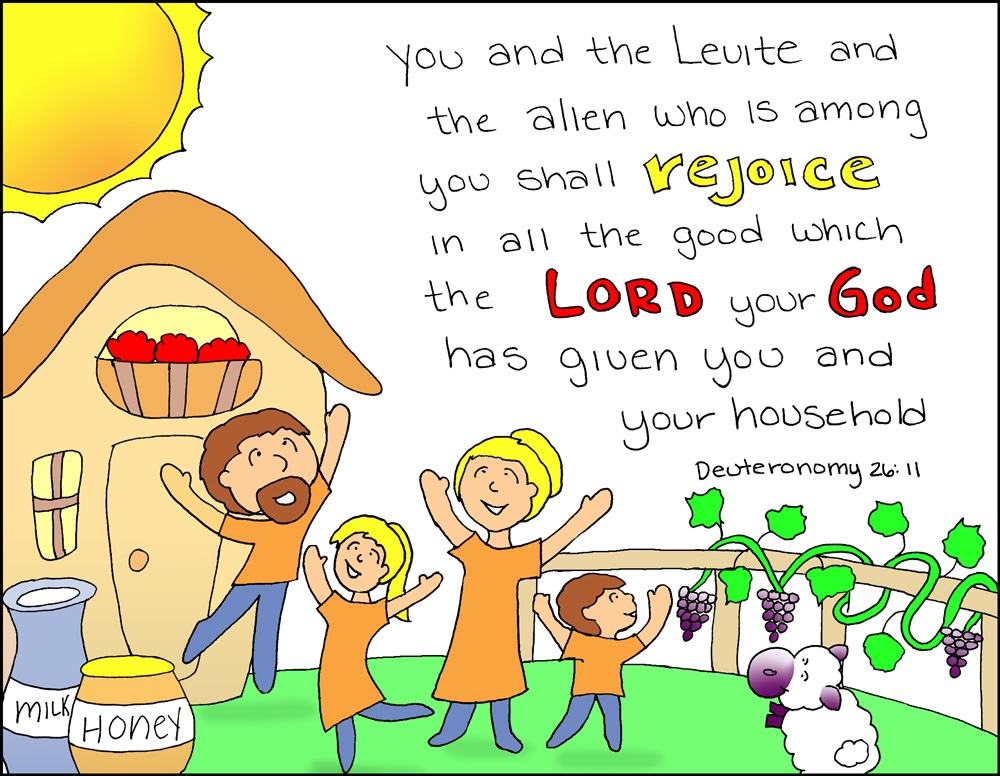
Yet the affirmation of Deut 26 highlights the central importance of gratitude for the gift of the land; and not only that, for it especially indicates the importance of making this celebration inclusive: “you, together with the Levites and the aliens [or, sojourners] who reside among you, shall celebrate with all the bounty that the LORD your God has given to you and to your house” (26:11). So the instructions for the annual festival of the first fruits provide.
The inclusion of the aliens in this annual festival reflected a gracious openness to others in the developing people of Israel. These texts differ from the xenophobic antagonism of earlier texts, recounting the conquest of Israel. They reflect a later understanding of the identity of the people, as they were collated during and after the Exile, centuries after the formation of Israel. People designated as aliens (non-Israelites), sojourners in the land, were welcome to bring offerings to the Lord (Lev 22:18), to adhere to Israelite food prescriptions (Lev 17:12), to keep the Sabbath (Exod 20:8–11; 23:12), to have gleaning rights (Lev 23:22), and to join in the annual process of atonement (Lev 16:29–31; Num 15:29).
The foundational Passover narrative indicates that aliens, or sojourners, were able to join (under certain conditions) in the Passover celebrations (Exod 12:47–49); a second narrative (Num 9:14) is much less restrictive. Aliens were to be subject to the same laws regarding murder (Lev 24:17–22), able to have right of access to cities of refuge (Num 35:13–15), and indeed to enter into the covenant at the annual covenant renewal ceremony (Deut 29:10–13; see also 31:10–13). The voice of the alien even sounds appreciation for the Law: “I live as an alien in the land; do not hide your commandments from me” (Ps 119:19).
Because Israelites were once “an alien residing in the land” of Egypt, the people were instructed, “you shall not abhor any of the Edomites, for they are your kin; you shall not abhor any of the Egyptians” (Deut 23:7); by the third generation, the children of aliens “may be admitted to the assembly of the Lord” (Deut 23:8).
This meant that “the alien who resides with you shall be to you as the citizen among you; you shall love the alien as yourself, for you were aliens in the land of Egypt: I am the LORD your God” (Lev 19:34; a similar affirmation is made at Num 15:14–16).
The principle of equality is clear: “you shall not deprive a resident alien or an orphan of justice; you shall not take a widow’s garment in pledge” (Deut 24:17; see also Jer 7:5–7; 23:5–7; Zech 7:9–10; Mal 3:5). The alien, or sojourner, deserves the same measure of justice as all residents of Israel.
Accordingly, amongst the curses at the end of Deuteronomy, we read, “cursed be anyone who deprives the alien, the orphan, and the widow of justice. All the people shall say, ‘Amen!'” (Deut 27:19). The curse outlines the negative consequences from not adhering to the positive principle of welcoming and including those sojourning for a time innIsrael, the “alien”. That is integral to the celebrations each year, when the harvest produces its fruit from the land.
Gratitude. Belonging. Celebration. Inclusion. All of this is embedded in the story; and all of this comes before believing, repeating doctrinal claims, affirming credal statements. We are a people of welcome, including, belonging. This much is embedded in the ancient Hebrew tradition. This much should be living, still, in Christianity today.
“You have established equity; you have executed justice and righteousness in Jacob” (Ps 99:4). So the psalmist sings, in the psalm offered by the lectionary for this coming Sunday, The Feast of the Transfiguration. Perhaps it has been selected for this festival because it depicts the Lord sitting “enthroned upon the cherubim” as the earth quakes (v.1), that he spoke to Israel “in the pillar of cloud” (v.7)—images that resonate with the stories of Moses and Jesusnthatnwe have heard this week.
Noting that leaders of the past have called out to God and been answered—Moses, Aaron, and Samuel (99:6)—the psalmist praises God, “you answered them; you were a forgiving God to them, but an avenger of their wrongdoings” (99:8).
In this psalm it is the king, the “Mighty King, lover of justice [who has] established equity” (99:4), whose “royal scepter is a scepter of equity” (Ps 45:6), modelled on the Lord God himself, who “judges the world with righteousness [and] judges the peoples with equity” (Ps 9:8; see also 67:4; 75:2; 96:10; 98:9). Accordingly, King David is remembered as the one who “administered justice and equity to all his people” (2 Sam 8:15; 1 Chron 18:14), and the opening words of the book of wisdom attributed to King Solomon are “love righteousness, you rulers of the earth, think of the Lord in goodness and seek him with sincerity of heart” (Wisd Sol 1:1).
Divine justice is regularly noted in tandem with God’s mercy forgiveness. “Great is your mercy, O Lord; give me life according to your justice” (Ps 119:156); and “in your steadfast love hear my voice; O Lord, in your justice preserve my life” (Ps 119:149). The prophet Isaiah tells the rebellious people of his day, “the Lord waits to be gracious to you; therefore he will rise up to show mercy to you—for the Lord is a God of justice; blessed are all those who wait for him” (Isa 30:18).
Likewise, through the prophet Hosea, the Lord God promises to Israel, “I will take you for my wife in righteousness and in justice, in steadfast love, and in mercy” (Hos 2:19), whilst centuries later, Ezekiel reminds the exiles of God’s pledge: “I say to the righteous that they shall surely live, yet if they trust in their righteousness and commit iniquity, none of their righteous deeds shall be remembered; but in the iniquity that they have committed they shall die” (Ezek 33:13). Justice and mercy belong hand-in-hand, as yet another prophetic voice declares as the exiles are returning to the land: “in my wrath I struck you down, but in my favour I have had mercy on you” (Isa 60:10).
God’s mercy sat at the heart of the covenant made with Israel; the Lord affirms to Moses, “I will be gracious to whom I will be gracious, and will show mercy on whom I will show mercy” (Exod 33:19). So in the longest psalm, declaring persistent praise of the Law, the psalmist offers the petition, “let your mercy come to me, that I may live, for your law is my delight” (Ps 119:77). A number of other psalms likewise contain petitions God to show mercy (Ps 25:6; 40:11; 51:1; 69:16; 123:3).
Jesus, centuries later, brings together mercy and justice when he accuses the scribes and the Pharisees of hypocrisy, as they “neglect the weightier matters of the law: justice and mercy and faith” (Matt 23:23).
Justice, of course, is at the heart of the covenant that God made with Israel. Moses is said to have instructed, “justice, and only justice, you shall pursue” (Deut 16:20), the king is charged with exhibiting justice (Ps 72:1–2; Isa 32:1), whilst many prophets advocate for justice (Isa 1:17; 5:7; 30:18; 42:1–4; 51:4; 56:1; Jer 9:24; 22:3; 23:5; 33:15; Ezek 18:5–9; 34:16; Dan 4:37; Hos 12:6; Amos 5:15, 24; Mic 3:1–8; 6:8).
That God is righteous is likewise declared in scripture (Deut 32:4; Ps 145:7; Job 34:17). The psalmists regularly thank God for God’s righteousness (Ps 5:8; 7:17; 9:8; 33:5; 35:24, 28; 36:6; 50:6; etc) and note the importance of humans living in that same way of righteousness (Ps 18:20, 24; 85:10–13; 106:3, 31; 112:1–3, 9).
The book of Proverbs advises that the wisdom it offers is “for gaining instruction in wise dealing, righteousness, justice, and equity” (Prov 1:3) and the prophets consistently advocated for Israel to live in accordance with righteousness (Hos 10:12; Amos 5:24; Isa 1:22; 5:7; 28:17; 32:16–17; 54:14; Jer 22:3; Ezek 18:19–29; Dan 9:24; 12:3; Zeph 2:3; Mal 4:1–3; Hab 2:1–4).
This psalm thus focusses some important elements in the Israelite understanding of God, summarising notes from many places elsewhere in Hebrew Scriptures. These recurring notes of the nature of God then form the basis for a Christian understanding of Jesus, who affirms mercy (Matt 23:23), teaches righteousness (Matt 5:6, 10, 20; 6:33), offers forgiveness (Mark 2:10; Luke 23:34; 1 John 1:9), and exudes grace (John 1:14–18). The affirmation made in this ancient Jewish psalm is one that we Christians can joyfully sing and affirm this Transfiguration!
*****
The situation in the Middle East continues to be volatile. My reflections in the early stages of the present inflammation of that conflict is at
The letter which we call 2 Corinthians is comprised of three main sections, each of which has its own distinctive focus. In the first section of the letter (1:1–7:16), Paul and Timothy write to offer consolation and hope to the people who are part of the community of followers of Jesus in Corinth. It is clear that members of the community have undergone some difficult times; Paul empathises with them, drawing on his own experiences, as a way of offering a message of hope to the believers in Corinth.
In a second main section (8:1–9:15), Paul addresses a very practical matter—the collection of money which he was making amongst the churches of Achaia and Macedonia, which he was planning to take to Jerusalem for the benefit of the believers there who had been experiencing difficulties. Then, in a third main section (10:1–13:13), Paul’s tone is markedly apologetic, as he writes in severe tones to defend himself in the face of criticisms which have been levelled against him in Corinth.
The lectionary offers us an excerpt from the first main section (3:12—4:2) for the Festival of the Transfiguration, this coming Sunday. It is obvious why this excerpt is suggested, since the argument includes a reference to the passage from Exodus which will also be read and reflected upon this Sunday. “The people of Israel could not gaze at Moses’ face”, Paul and Timothy note, “ because of the glory of his face” (3:7).
They go on to contrast this with the consequences of that one scene in the life of Jesus that the Synoptic Gospel writers later tell in narrative detail, arguing that “all of us, with unveiled faces, seeing the glory of the Lord as though reflected in a mirror, are being transformed into the same image from one degree of glory to another” (3:18). That is, whilst the transformation of Moses was not able to be witnessed by the people of Israel, the transformation of Jesus is shared in abundance with the followers of Jesus. It’s a stark contrast.
The fundamental point in what Paul and Timothy argue here is thoroughly polemical. They press, again and again, on the difference between the Exodus scene and the scene that we know as the Transfiguration of Jesus. They use the typical juxtaposition of two opposites that characterized the rhetorical style of the diatribe (and which we find in a number of other letters of Paul).
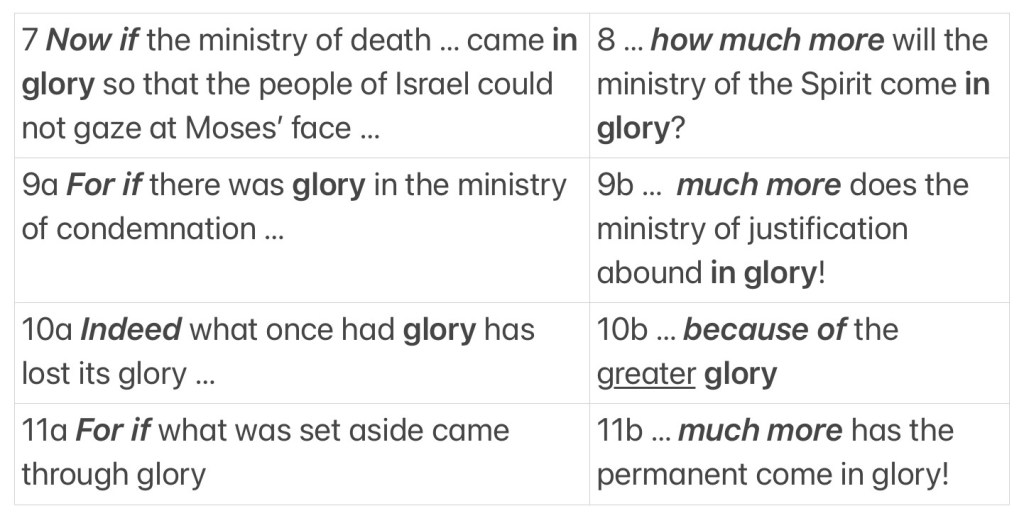
The juxtapositions have begun in the preceding verses. In full polemical flight, Paul presents himself and Timothy as a “ministers of a new covenant”, which defines as “not of letter but of spirit”, continuing with the explanation “the letter kills, but the Spirit gives life” (3:6). He then contrasts “the ministry of death” with “the ministry of the Spirit” (3:7–8). The former is “chiseled in letters on stone tablets”, whilst the latter brings “glory”. It is clear where Paul’s preference lies.
This leads to two new, snappy slogans: “the ministry of condemnation” and “the ministry of justification”, which are then contrasted (3:9–11). The former did have its element of glory—the face of Moses shone with God’s glory—but “what once had glory has lost its glory”. Paul and Timothy advance the argument through a series of direct contrasts.
How this “loss of glory” occurred, it seems, was “because of the greater glory; for if what was set aside came through glory, much more has the permanent come in glory!”. The argument, somewhat convoluted, seems to be that the former, seemingly inadequate, glory is completely overshadowed by the later, far more powerful glory.
Paul launches then into an attack on that former ministry which becomes quite vindictive. Moses is criticized for covering his face so that the people of Israel could not “gaze at the glory” that he was concealing (v.13). The minds of the people thus were “hardened”; indeed, even “to this very day”, he says, that hardening of heart remains when they hear “the reading of the old covenant” (3:14). In contrast to this deadly scenario, “in Christ” that veil is lifted, that hardening of heart is softened “when one turns to the Lord” (3:16). The exultant conclusion is that “all of us, with unveiled faces, seeing the glory of the Lord as though reflected in a mirror, are being transformed into the same image from one degree of glory to another” (3:18).
There is great danger in these words. The danger is that we absolutise them as validating any criticism, all criticism, of Judaism as a religion; that we value Christianity by demeaning and dismissing Judaism. To do this would mean that we would ignore the reality that these words were written in a context quite different from our own, addressing a situation which may (or may not) have had little do with our own situation. That wider context and that specific situation are very important as we interpret this passage (and, indeed, any passage in the Bible).
We are witnessing today, both in Australia and in many places around the world, a rise in antisemitic words and actions. To be sure, the violent and illegal actions ordered by the current Israeli government against the residents of Gaza (the most recent in a long and tragic sequence of similarly illegal and aggressive actions over decades) has probably inflamed such antisemitism.
But criticism of the policies of one nation state should not be used to foment hatred against a whole people, whether they live in that nation or in other places around the world. Yet antisemitism is growing. (So, too, is Islamophobia—for other reasons, relating both to the Middle East and to other factors. It is equally unacceptable.)
So to the specific context of the passage from 2 Cor. Paul, of course, was a Jew; he writes that he was “circumcised on the eighth day, a member of the people of Israel, of the tribe of Benjamin, a Hebrew born of Hebrews” (Phil 3:5) and boast that “I advanced in Judaism beyond many among my people of the same age, for I was far more zealous for the traditions of my ancestors” (Gal 1:14). Luke reports him as telling Jews in Jerusalem that “I am a Jew, born in Tarsus in Cilicia, but brought up in this city at the feet of Gamaliel, educated strictly according to our ancestral law, being zealous for God, just as all of you are today” (Acts 22:3).
Paul’s writings and his faith are permeated with his Jewish heritage; in almost every letter he quotes Hebrew Scripture and the argument in his most significant letter, to the Romans, is grounded in a prophetic verse from scripture (Hab 2:4a, cited at Rom 1:17b). He is able to declare that “the law [Torah] is holy, and the commandment is holy and just and good” (Rom 7:12) and in great anguish he writes, “my heart’s desire and prayer to God for them [i.e. Israel] is that they may be saved”, noting that “they have a zeal for God” (Rom 10:1–2).
Yet each time he affirms his Jewish heritage and the faith of his fellow Jews, he places a critical comment against this affirmation. Of his own heritage and upbringing, “I regard everything as loss … I regard them as rubbish” (Phil 3:8; the translation of the last word is a very polite rendering of a crass swear word). Of the law, he says “I was once alive apart from the law, but when the commandment came, sin revived and I died, and the very commandment that promised life proved to be death to me” (Rom 7:9).
Of the fate of Israel, a “disobedient and contrary people” (Rom 10:21, citing Isa 65:2), he declares, “Israel failed to obtain what it was seeking; the elect obtained it, but the rest were hardened” (Rom11:7)—and yet, “they have now been disobedient in order that, by the mercy shown to you, they too may now receive mercy” (Rom 11:31). There is a glimmer of hope.
Yet still his rhetoric can be violently abusive: “beware of the dogs, beware of the evil workers, beware of those who mutilate the flesh!” (Phnil 3:2, referring to circumcision); and “anyone proclaims to you a gospel contrary to what you received, let that one be accursed!” (Gal 1:9); and even, “the Jews, who killed both the Lord Jesus and the prophets, and drove us out; they displease God and oppose everyone … they have constantly been filling up the measure of their sins; but God’s wrath has overtaken them at last” (1 Thess 2:14–16).
Paul is nothing if not polemical in his letters. And as a Jew, when he writes such criticisms of other Jews, we cannot describe him as being antisemitic; rather, he is being critical of those who hold to Jewish traditions and resist adapting to the changes and modifications that the good news brings. We have seen Paul use this kind of polemical argumentation in other letters, when he uses stridently aggressive statements to articulate his opposition to a view. (Look at Gal 3:1–14, or parts of 2 Cor 10–13, or Rom 5:12—6:23.)
Such polemic was used in ancient rhetoric to refine and develop an understanding of a matter; the back-and-forth of the argument serves to sift and sort ideas, so that the kernel that remains at the end can be rigorously held. Paul knew this style of argument, and used it to good effect in his letters.
So when he writes disparagingly about Moses to the Corinthians, he is not being antisemitic, and we have no justification for using these words to criticize and attack Jewish ideas, or even Jewish people. Paul is using the techniques of his day to argue a point. We should not extract his words from their context and use them to validate criticisms of “all Jews” or of Judaism per se. What he says should be used with care and respect.
As we read on beyond 2 Cor 3:12–4:2, we find Paul writing about the transformation that takes place “from one degree of glory to another” (3:18), explaining that “this extraordinary power belongs to God and does not come from us” (4:7). It results in “an eternal weight of glory beyond all measure” (4:17), such that “we regard no one from a human point of view” (5:16). It is, in the end, “the God who said, ‘Let light shine out of darkness,’ who has shone in our hearts to give the light of the knowledge of the glory of God in the face of Jesus Christ” (4:6).
So Paul concludes this extended message of hope about this promised glory with a reminder that God has “reconciled us to himself through Christ”, and accordingly God “has given us the ministry of reconciliation” (2 Cor 5:18). It is in this spirit that we should reflect on the passage proposed by the lectionary for this Transfiguration Sunday.
For more on glory in Paul and elsewhere in scripture, see