Skip to content

An Informed Faith

John T Squires

An Informed Faith

Category: An Orderly Account: Gospel of Luke

Witnesses in Jerusalem, in all Judea and Samaria, and to the ends of the earth (Acts 1; Narrative Lectionary for Easter 2)

Witnesses in Jerusalem, in all Judea and Samaria, and to the ends of the earth (Acts 1; Narrative Lectionary for Easter 2)

This week we move on from the Gospel story, into the narrative of “the things fulfilled among us” that is attributed, by tradition, to Luke, the author of a Gospel and a sequel that we call the Acts of the Apostles. We will hear four excerpts from this second volume in the coming weeks.
Luke, of course, is never identified as the author in either volume; the traditional ascription arises from a combination of factors: Pauline references to “Luke, the beloved physician” (Col 4:14), said to be present with Paul at one point (Phlmn 24, reflected again at 2 Tim 4:11), the references to “we” in the latter chapters of the narrative, and the developing patristic speculation which insisted that each canonical Gosepl needed to be either by one of the apostles or by someone closely associated with one,of the apostles.

The opening verse of this Sunday’s passage links back to the “first volume” (Acts 1:1), naming the same addressee, Theophilus (see Luke 1: 3), and summarising the earlier volume as being about “all that Jesus did and taught from the beginning” (presumably Luke 4:15 onwards) until “the day when he was taken up to heaven” (Luke 24:50–51). The intention for continuity is clear; the volume that follows will trace the development and spread of the movement that Jesus had initiated in Galilee (Luke 6:13–16; 8:1–3; 9:1–6, 10; 10:1–12, 17–20) and which he had then launched on a broader scale in Jerusalem, stretching out “to all nations” (Luke 24:44–49).

The author sets the scene for recounting various incidents in the life of the community of followers of Jesus who had gathered in Jerusalem. The author—writing a number of decades after the incidents which he reports, and most likely far removed from Jerusalem—tells of how these earliest followers established a pattern of faithful living through their common life, their public witness, and their persistent adherence to their Jewish traditions. The whole section of the second volume is located entirely within Jerusalem (1:4,8,12; 2:5; 4:5; 5:16; 6:7; 8:1) and is concentrated on incidents occurring in that city.

Ten days separate the ascension of Jesus (forty days after Passover, 1:3) from the coming of the Spirit on the day of Pentecost, which is told in the second chapter of volume 2 (2:1, fifty days after Passover). Initially, Jesus instructs the apostles not to depart from Jerusalem (1:4). This instruction keeps Luke’s geographic focus on Jerusalem, in contrast to other traditions concerning the post-resurrection departure of the apostles to Galilee which are inferred (Mark 14:28; 16:7; Matt 26:32) or explicitly told (Matt 28:7,10; John 21).

Remaining in Jerusalem is required so that the apos­tles might receive the promise (1:4), which is immediately explained as being the holy spirit spoken of by John (1:5; evoking Luke 3:16). The fulfilment of this promise in Jerusalem is, of course, narrated in detail in Acts 2.

Only two things are told of these ten days; already the process of selectivity which shaped the creation of Luke’s Gospel can be seen in this second volume. The first of these is an expanded retelling of the ascension (1:6–11), an event already reported in brief at Luke 24:50–53.

The ascension forms the pivotal moment in Luke’s narrative; it is the hinge between volume 1 (Luke) and volume 2 (Acts), and attention is drawn to the ascension and exaltation of Jesus at a number of points elsewhere (Luke 9:51; 22:69; Acts 2:33; 3:21; 5:31; 7:56). Luke expands this second narrative account of the ascension through the explicit recording of words spoken on that occasion. Key to this version are the last words of Jesus to his followers: a sequence of three clauses which stand as his last words before he ascends into heaven.

The first clause of Jesus’s words in 1:8 turns the question away from Israel, back to the primary theme of God’s sovereignty, with the clear declaration that the times and seasons are under the sovereignty of God who has “set them by his own authority” (1:7). Rather than the political independence of Israel, it is God’s unfettered freedom to act in history which is crucial to his enterprise.

The next clause, “you will receive power when the holy spirit has come upon you” (1:8), is a promise which reinforces the key role of the spirit, as divine agent, throughout this volume (beginning with the events of 2:1–4).

The third clause introduces the important motif of witness (1:22; 2:32; 3:15; 4:33; 5:32; 10:39,41,43; 13:31; 22:15,18,20; 23:11; 26:11,22) and provides a condensed geographical summation of the course of the ensuing events: “in Jerusalem [1:12–8:3] and in all Judaea and Samaria [8:4–12:25] and to the end of the earth [13:1 onwards]”.
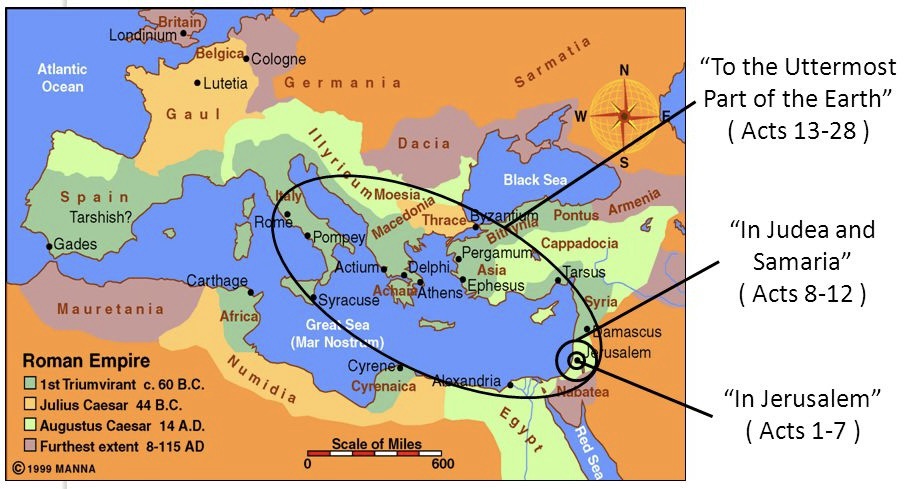
The precise referrent of “the end of the earth” is debated. Although Psalms of Solomon 8:15 may suggest that it refers to Rome, it is preferable to see the reference as drawn from Isa 49:6, a verse cited at Luke 2:32 and Acts 13:47. It is thus a poetic statement about the extensive scope of the ensuing events.

These departing words of the Lukan Jesus neatly conjoin the geographical pattern and theological foundation of Acts: from Jerusalem outwards, the divine spirit will enable followers of Jesus to bear witness to the sovereignty of God.

As Jesus ascends into heaven (Acts 1:9–11), the story pivots from the earthly period of Jesus into the time when the movement of those who followed Jesus in that time will begin to form the customs and practices that led to the creation of the church. Luke presents the whole sequence of the death, resurrection and ascension of Jesus as both the climax to his earthly life and the foundation for the time of the church.

This is the issue in focus here: the departure of Jesus by means of his ascension into heaven is actually the moment when Jesus charges his followers to be engaged in mission. The departure of Jesus heralds the start of the church. The (physical) absence of the Saviour brings in the impetus for engaging wholeheartedly with the world which he has (physically) left.

….. to be continued …..

This blog is based on a section of my commentary on Acts in the Eerdmans Commentary on the Bible, ed. Dunn and Rogerson (Eerdmans, 2003). I have also explored the theme of the plan of God at greater depth in my doctoral research, which was published in 1993 by Cambridge University Press as The plan of God in Luke-Acts (SNTSM 76).

Unknown's avatarAuthor John T SquiresPosted on April 1, 2024April 1, 2024Categories An Orderly Account: Gospel of Luke, Scripture and TheologyTags scripture; theology; Luke; Acts; spirit; mission

God has looked with favour on the lowliness of his servant (Luke 1; Advent 4B)

As the psalm for the Fourth Sunday in Advent this year, the lectionary proposes the song sung by a young, pregnant Mary—the song that is best known as “the Magnificat” (Luke 1:46b—55).

(Magnificat is the first word of the Latin version of this song. It makes sense, does it not, for a song that Mary most likely sang in Aramaic, and which is known to us from a Greek text, to be given a Latin title??? Such is the power of the western Roman Catholic Church, whose liturgy was in Latin for many centuries.)

The writer of the Gospel of Luke places this song in a scene that takes place after the pregnant Mary travels to visit a town in the hill country of Judaea. Mary is in the house of Zechariah and his wife Elizabeth, an elderly relative of Mary, who is also pregnant with child (Luke 1:39–45). This scene is rich with scriptural resonances.

I

Providing the Magnificat as the Psalm for the week has a certain poetic justice. Although this is part of the New Testament, this hymn is certainly a song in the mode of the psalms, as they are found in the book of that name in Hebrew Scripture. Indeed, such psalms are found not only in the book of Psalms, but in other places in those scriptures. Songs in the manner of psalms are scattered throughout the stories of the lives of the people of Israel—including into the century we identify as “the first century” (CE).

Included in these psalms are some striking songs. The Song of Miriam and the Song of Moses, both sung after the crossing of the Red Sea, are psalms of thanksgiving (Exod 15:21, and 15:1–18), whilst the Song of Moses at the end of his life recounts the story of the people (Deut 32:1–43). The Song of Deborah celebrates the defeat of Sisera of Canaan (Judges 5), whilst there are two Songs of David outside the book of Psalms: a psalm of thanksgiving after a series of battles with the Philistines (2 Sam 22) and another thanksgiving psalm after the ark was set inside the Tabernacle in Jerusalem (1 Chron 16:8–36).

Some prophetic books include psalms, such as a psalm of Hezekiah after he had recovered from illness (Isa 38:9-20), a psalm sung by Jonah from the belly of the fish that had swallowed him (Jon 2:1–10), and a prayer of praise sung by Habakkuk (Hab 3).

And then, at the beginning of the story of Samuel, his mother, Hannah, offers a long prayer in the manner of psalms of thanksgiving (1 Sam 2:1–10). We heard this song just a few weeks ago, on the penultimate Sunday of Year B (Pentecost 33). This particular psalm is most important when we come to consider the song sung about a later prophet, Jesus, by his mother, Mary (Luke 1:46–55).

II

We know that Jesus is intensely Jewish in the Synoptic Gospels. The story about Jesus begins in the heart of Jewish piety, and continues apace within the life of the people of Israel through his lifetime.

The opening scene of the orderly account of the things fulfilled among us (Luke’s Gospel), set in Jerusalem in the Temple precincts, reveals a pair of righteous Jews who faithfully keep the commandments of God (Luke 1:5–6). The first person we meet, Zechariah the priest, is devoted to the service of God in the Temple (1:8–9).

His wife, Elizabeth, expresses an attitude of deep faith in God, accepting her surprise pregnancy as “what the Lord has done for me” (1:25). They are both described as “righteous before God” (1:6). Elizabeth’s relative, Mary, demonstrates a similar faith as she submits to a similar fate, bearing a child, with the words, “here am I, the servant of the Lord” (1:38).

In turn, the traditional hopes and expectations of the people are articulated in spirit-inspired hymns sung by Mary (1:46–55, known as the Magnificat), Zechariah (1:67–79, known as the Benedictus), and Simeon the righteous (2:29–32, known as the Nunc dimittis, or the Song of Simeon). These songs set the strongly Jewish tone of the opening chapters.

The key characters operate as people of deep faith. God’s Spirit is active in these scenes; Mary is “overshadowed” by the Spirit (1:35), whilst Zechariah and Elizabeth are both “filled” with the Spirit (1:41, 1:67). Simeon is “righteous and devout” (2:25); the Spirit “rested on him” (2:25), then “revealed to him” the words he then speaks (2:26) before “guiding him … into the temple” (2:27).

This is the same Spirit that has been active since the moment of creation (Gen 1:2), that was breathed into human beings (Gen 2:7), and that infuses every one of the creatures brought into being in God’s wonderful creation (Ps 104:24–30). It is this Spirit that has endowed individuals with leadership (Exod 31:2–3; Num 11:25–26; Deut 34:9; and a number of judges) and which has inspired prophets to proclaim the word of the Lord (Isa 61:1; Ezek 2:2; Joel 2:28–29).

See https://johntsquires.com/2020/12/27/a-light-for-revelation-to-the-gentiles-and-for-glory-to-your-people-israel-luke-2/

III

Mary stands in the long Jewish tradition of female singers. The story of the Exodus culminates in the shirt song sung by Miriam (Exod 15:21). Other females singing songs of salvation at key moments in the story include Deborah (Judges 5:1–31), Hannah (1 Sam 2:1–10), and Judith (Judith 16:1–17). These are the victory songs of the oppressed.

The two scenes involving Hannah and Mary have a number of parallels. The language and the events resonate with each other across the centuries. It seems to me that the author of this orderly account (by tradition, Luke) is well-read and very capable in his writing style. This whole section is shaped to read like a Hebrew Scripture narrative. So, in my understanding of Luke 1–2, the author has been influenced by the story of Hannah as he tells the story of Mary.

Indeed, we note this in the way the two songs begin. Hannah commences by singing out “my heart exults in the Lord; my strength is exalted in my God” (1 Sam 2:1). This is deliberately echoed in Mary’s song, where she begins “my soul magnifies the Lord, and my spirit rejoices in God my Saviour” (Luke 1:46).

Hannah describes God as the Holy One (2:2) and the Most High (2:10). Holy One is a term applied to God in the Writings (Ps 71:22; 78:41; 89:18; Prov 9:10; Job 6:10; Sir 4:14; 23:9; 53:10; 47:8; 48:20) and by the Prophets (Is 1:4; 5:19, 24; and a further 24 times; Jer 50:29; Ezek 8:13; Hos 11:9, 12; Hab 1:12; 3:3). Of course, Holiness was a central element of piety in ancient Israel, exemplified by the Holiness Code of Leviticus (Lev 11:44–45; 19:2; 20:7–8; see also Deut 7:6; 14:2, 21; 28:9). The followers of Jesus are instructed to consider themselves as God’s holy people (1 Cor 3:17; 6:19; Eph 5:25–27; Col 1:22; 3:12; Heb 3:1; 1 Pet 1:13–16; 2:5, 9) and to live accordingly.

Most High is also a very common way that God is described and addressed—23 times in the Psalms (Ps 7:17; 9:2; 18:13; etc) and a number of times elsewhere (Gen 14:17–24; Num 24:16; Deut 32:8; 1 Sam 2:10; 2 Sam 22:14; Isa 14:14; Lam 3:35, 38; Dan 3:26; 4:2, 17, 24, 25 and more; Hos 11:7; and also Wis Sol 5:15; 6:3; and 45 times in Sirach—4:10; 7:9, 15; 9:15, etc). It appears as a description of God in early Christian writings (Mark 5:7; Luke 1:32, 35, 76; 6:35: 8:28; Acts 7:48: 16:17).

Mary uses a similarly-familiar term, the Mighty One (1:49), which also is a biblical name for God (Gen 49:24; Ps 45:3; 50:1: 52:1; 132:2, 5; Isa 1:24; 49:26; 60:16; Sir 46:5–6, 16; 51:12), and then she goes on to affirm, “holy is his name”, alluding directly to the title of Holy One that Hannah has used.

Hannah’s declaration that “my strength is exalted in my God” (2:1) is echoed in Mary’s affirmation that “he has shown strength with his arm” (1:51). That strength is demonstrated in a series of claims made by Mary, regarding the proud, the powerful, and the rich, in contrast to the lowly and the hungry (1:51–53).

The clear juxtaposition of these categories, and God’s obvious preference for the latter group, is another way in which Mary’s song echoes and replicates Hannah’s song. Hannah’s “he brings low, he also exalts” (2:7) is expanded by Mary, “he has brought down the powerful, he has lifted up the lowly” (1:52). “He raises up the poor from the dust, lifts the needy from the ash heap, to make them sit with princes and inherit a seat of honour” (2:8) is reworked by Mary into her note that God “has filled the hungry with good things and sent the rich away empty” (1:53).

In these ways, it is clear that the righteous-justice desired by God for the people of God will in fact be evident; “the Lord will judge the ends of the earth” (2:10), sings Hannah; “he has helped his servant Israel in remembrance of his mercy” (1:54) is how Mary sings it. Both justice and mercy are fundamental aspects of the being of God which are worked out in the ways that God engages with the people of Israel. God is envisaged and experienced in the same way in each of these songs. The God of Hannah continues to be the God of Mary. These two songs strongly confirm that reality.

IV

What Hannah is celebrating is that God will be at work in the events of her time. In particular, despite her barren state (1 Sam 1:2, 5–8), Hannah prayed regularly for a son (1 Sam 2:10–18) and was blessed with just such a child: “in due time Hannah conceived and bore a son” (1 Sam 2:20, 27). Likewise, what Mary anticipates is that God will demonstrate the ongoing fulfilment of the promises made to Israel in the birth of her child given to her, despite her state as a virgin (Luke 1:27, 34).

Both newborn sons are dedicated to the Lord: Hannah’s son was dedicated as a nazirite (1 Sam 2:11, 22, 24–28), Mary’s son is recognised as the one who will have “the throne of David given to him” and who will “reign over the house of Jacob forever” (Luke 1:32–33). The son of Hannah is dedicated in “the house of the Lord at Shiloh” (1 Sam 2:24); the son of Mary is circumcised (Luke 1:21) and then taken “to Jerusalem to present him to the Lord” (Luke 1:22). The two stories mirror each other in the same way that the two songs run in parallel to each other.

So Mary affirms that “all generations will call me blessed” (1:48), in the same way that Leah exclaimed, “blessed am I! for the women will call me blessed” (Gen 30:13). Her song ends with the claim that the promise being fulfilled is made “to Abraham and to his descendants forever” (1:55), evoking the prayer of David, that the Lord “shows steadfast love to his anointed, to David and his descendants forever” (2 Sam 22:50). The exalting of the anointed is also noted at the very end of the song sung by Hannah (1 Sam 2:10).

V

Dietrich Bonhoeffer, a German pastor and theologian who was executed by the Nazis, declared that the Magnificat, this song of Mary, “is at once the most passionate, the wildest, one might even say the most revolutionary advent hymn ever sung. This is not the gentle, tender, dreamy Mary whom we sometimes see in paintings … This song has none of the sweet, nostalgic, or even playful tones of some of our Christmas carols. It is instead a hard, strong, inexorable song about the power of God and the powerlessness of humankind.” (From a sermon during Advent on December 17, 1933; see http://cdn.bakerpublishinggroup.com/processed/esource-assets/files/1780/original/8.40.Luke_1.46-55__The_World%27s_First_Advent_Hymn.pdf?1524151427)

Martin Luther echoed Mary’s perspective when he declared, “the mightier you are, the more must you fear; the lowlier you are, the more must you take comfort.” Pope John Paul II noted the scholarly view that this song, as well as the songs by Zechariah and Simeon, are songs of the anawim (the faithful poor), whose songs offer “glorious praise of God … thanksgiving for the great things done by the Mighty One, the battle against the forces of evil, solidarity with the poor and fidelity to the God of the Covenant” (in a general audience on Psalm 149 on Wednesday 23 May 2001; see https://www.vatican.va/content/john-paul-ii/en/audiences/2001/documents/hf_jp-ii_aud_20010523.html)

Sister Elizabeth Johnson sums it up well,

“The Magnificat is a revolutionary song of salvation whose political, economic, and social dimensions cannot be blunted. People in need in every society hear a blessing in this canticle. The battered woman, the single parent without resources, those without food on the table or without even a table, the homeless family, the young abandoned to their own devices, the old who are discarded: all are encompassed in the hope Mary proclaims”.

See https://uscatholic.org/articles/201101/mary-mary-quite-contrary/ and http://compassreview.org/summer14/3.pdf

Unknown's avatarAuthor John T SquiresPosted on December 18, 2023December 2, 2023Categories An Orderly Account: Gospel of Luke, Psalms, Scripture and TheologyTags justice, Luke, Psalms, scripture, theology

Three Christmas Options: the Revised Common Lectionary at Christmas

Three Christmas Options: the Revised Common Lectionary at Christmas

Every year at Christmas, in the Revised Common Lectionary, three full sets of readings are provided for “Christmas Eve, Morn, or Mid-Day”. The three sets of readings are provided for the Nativity of the Lord under the headings Proper I, Proper II, and Proper III.

Why are there three different sets of readings for the “Nativity of the Lord” (aka Christmas)? I hunted through some church web sites, and found that it is because of developments way back before the so-called Middle Ages … back in the days when Christianity was still developing and evolving and finding its place in society.

What follows is asked on what I found at https://www.catholicculture.org/culture/library/view.cfm?recnum=7399, so I am assuming that this is accurate!

The simple explanation is that three different services of worship relating to “the nativity of the Lord” developed over time within Rome, and, rather than one replacing another, each was added, each having its own focus and also being held at a different location.

Catholic Culture says that “the first Mass originally was connected with the vigil service at the chapel of the manger in the church of St. Mary Major in Rome”; it was a small service at midnight which Pope Sixtus III began in 440CE. This has continued as the first service, Proper I in the Revised Common Lectionary.

The second Mass, we are advised, was “the public and official celebration of the feast, held on Christmas Day at the church of St. Peter, where immense crowds attended the pope’s Mass and received Communion”. That continues to this day, when the Pope appears on a balcony overlooking the packed square outside St Peter’s.

Catholic Culture advises, however, that “under Pope Gregory VII (1085) the place of this Mass was changed from St. Peter’s to St. Mary Major, because that church was nearer to the Lateran Palace (where the popes lived). It forms Proper III in the Revised Common Lectionary.

The third service to develop is actually the “middle service”, or Proper II in the Revised Common Lectionary. Catholic Culture explains: “In the fifth century, the popes started the custom of visiting at dawn, between these two services, the palace church of the Byzantine governor. There they conducted a service in honor of Saint Anastasia, a highly venerated martyr whose body had been transferred from Constantinople about 465 and rested in this church which bore her name.”

This was a popular service, because Saint Anastasia was widely venerated in the Roman Empire; in later centuries, as the empire dissolved and Anastasia receded in significance, this middle service was still retained, and another Mass of the Nativity was held. This became the second of the three Masses on Christmas Day.

The Roman Missal has shaped the liturgy for each of these services to highlight different elements of the Christmas story. Thus, “the first Mass honors the eternal generation of the Son from the Father, the second celebrates His incarnation and birth into the world, the third His birth, through love and grace, in the hearts of men [sic.]”.

The Gospel passage set for each Mass—reflected in the Gospel passages proposed by the Revised Common Lectionary—has led to the popular name for each service. Proper I offers Luke 2:1–14, which tells of the birth of Jesus and the angelic announcement to the shepherds in the fields; thus, people came to call the first Mass “Angels’ Mass”. Proper II proposes Luke 2:8–20, when the shepherds visit the newborn child and his parents; accordingly, it became known as the “Shepherds’ Mass”.

Proper III takes us to the majestic prologue to John’s Gospel, John 1:1–14, which tells in beautiful poetry of the coming of The Word, who takes on human flesh to live amongst us; this then characterises this service as the “Mass of the Divine Word”.

The three readings from the Epistles contain excerpts with short credal-like affirmations: “the manifestation of the glory of our great God and Saviour” (Titus 2:11–14), “when the goodness and lovingkindness of God our Saviour appeared” (Titus 3:4–7), and the statement that “in these last days [God] has spoken to us by a Son”, whose nature is explicated by a string of Hebrew Scripture citations (Heb 1:1–12). Each of these fits well for Christmas celebrations.

Likewise, the three Hebrew Scripture passages themselves orient us towards God’s actions within human history. For Proper I, First Isaiah speaks about the child to be born, to be named “Wonderful Counsellor, Mighty God, Everlasting Father, Prince of Peace” (Isaiah 9:2–7). For Proper II, Third Isaiah declares, “the Lord has proclaimed to the ends of the earth, ‘see, your salvation comes’” (Isaiah 62:6–12). And for Proper III, Second Isaiah rejoices in “the messenger who brings good news, who announces salvation”, through whom “all the ends of the earth shall see the salvation of our God” (Isaiah 52:7–10).

Each prophetic passage, seen through the eyes of Christian faith, reflects the divine intention, made clear through Jesus, to offer salvation to every person on earth—prefiguring the good news of Jesus out of the different contexts of pre-exiling Israel (Isa 9), the hard years of Exile (Isa 52), and the time of rebuilding after that exile experience (Isa 62).

Finally, the Psalms selected for these three services (Psalms 96, 97, and 98) contribute strongly to the joyful ethos of the Christmas celebrations, with the injunction to “sing to the Lord a new song” (96:1, 98:1) and “worship the Lord in the splendour of holiness” (96:9), singing praises (98:4–6) and rejoicing (96:11–12; 97:8, 12; 98:8), celebrating that “the Lord is king” (97:1) and “exalted overall gods” (97:9) and rejoicing that “the Lord, he is coming, coming to judge the earth … with righteousness, and with truth” (96:13; 97:2; 98:9). These are notes that are entirely appropriate and fitting for the joyful celebrations of Christmas!

See also

Justice and joy: a sequence of Psalms for Christmas

and

Promise and proclamation: passages from the Prophets at Christmas
Unknown's avatarAuthor John T SquiresPosted on December 16, 2023December 22, 2023Categories An Orderly Account: Gospel of Luke, Hebrew Scripture, Psalms, Scripture and Theology, The Hebrew ProphetsTags Epistles, Gospels, lectionary, prophets, Psalms, scripture, theology

People of Israel, listen to me: the speech of Stephen (Acts 7; Easter 5A) part 3

People of Israel, listen to me: the speech of Stephen (Acts 7; Easter 5A) part 3

As we prepare for this coming Sunday, when we will hear about the fate of Stephen, the first martyr in the movement initiated by Jesus, we continue our considerations of the longest speech in Acts, which also reveals significant elements of the theological commitments held by the author of Acts—by tradition, named as Luke.

The reading offered by the lectionary (Acts 7:55–60) comes from one of the longest chapters in that book. That chapter records in great detail the speech made by Stephen, when he was brought before the council, charged with “saying things against this holy place and the law” (Acts 6:13). However, we are really shortchanged, because although this is the longest of all the speeches in Acts, we are given only the final comment by Stephen—just one verse (7:56)—before he is stoned, and he dies saying “Lord Jesus, receive my spirit” (7:59).

So in a series of blogs this week, I have been considering the whole of this speech in some detail. Let’s not undervalue the contribution of this Lukan-created speech, attributed to Stephen, in the theology of the two-volume work, Luke-Acts. (My analysis is based on what I wrote in my commentary on Acts in the Eerdman’s Commentary on the Bible (2003).)

After recounting the ancestral sagas of Israel, and the story of Moses (7:1–43), Stephen then summarises how God was at work in the conquest of Israel and the early monarchy. The presence of the tent of testimony fulfils what God commanded to Moses (7:44; cf. Exod 25:40); Joshua leads the conquest of the nations “whom God drove out” (7:45; cf. Josh 21:43-45; 23:9; 24:18); the tent remains in the land until the time of David, who “had grace before God” (7:46; on grace, see 2:47).

The speech ends with Solomon’s action of building a house for God (7:47). According to Stephen, this inverts the typical relationship seen in Israel’s history. The Deuteronomic explanation for the building of the temple was that it was done in fulfilment of God’s promise to David (1 Kgs 8:14-21). By contrast, Stephen announces that, by building the temple, Solomon acted in a way that God has not sanctioned. Solomon thus repeats the error made under Moses, when the Israelites made an idol and “revelled in the works of their hands” (7:39-41).

The argument leads us to expect that Solomon would incur the same wrath as exhibited to the people under Moses (7:42-43). Indeed, God’s opposition to Solomon’s building is evident in that it is not in the temple built by human hands (7:48) but in the world which “my [God’s] hand made” (7:50) that God is to be found. Stephen here quotes a prophetic text (Isa 66:1-2), but the message resonates with the way that Cynic philosophers mounted their critiques of idols.

The climactic moment of this speech provides a foundation for understanding the subsequent shift of focus away from the temple, and towards the house-based communities that will be established during the ‘turn to the Gentiles’ in chapters 8–12. The language about God in the latter part of this speech thus establishes a parallel set of antagonisms: between God and Israel under Moses, and between God and Israel under Solomon.

A further parallel can be drawn from the surrounding narrative: there is antagonism between God and the Jewish authorities who have brought Stephen (God’s agent) to trial. This antagonism mirrors both the antagonism which the apostles (God’s agents) have experienced from the same Jewish authorities (chapters 3–5), and the antagonism mounted against Jesus (another of God’s agents) by those authorities (Luke 19:47 onwards; Acts 4:27). Paul (yet another of Gods agents) will subsequently experience similar antagonism in his encounters with Jewish groups in the Diaspora (9:23; chapters 13–18) and in Jerusalem (9:29, 21:27-28).

In concluding the speech, Luke has Stephen turn his focus directly onto his accusers; he levels his own charges against them, depicting them as “resisting the holy spirit” (7:51). At this point Ananias and Sapphira come to mind; for a similar antagonism towards the spirit, they were killed (5:1-11). However, the tables are turned on Stephen, for those listening to his speech interrupt him at this point.

*****

And so we come to the Lukan narrative about the fate of Stephen, the first martyr in the movement initiated by Jesus. After the long account of the story of Israel, Stephen’s martyrdom (7:54-8:1a) is told. There is reinforcement of the validity of his point of view which comes through language about the divine. in what is narrated, in typical Lukan style.

Stephen is once again described as “filled with the spirit” (7:55, evoking 6:3,5). He experiences an epiphany in which he sees “the glory of God” (7:55), which aligns him with Abraham (7:2), as well as “Jesus standing at the right hand of God” (7:55-56). Stephen is also aligned with Jesus; in 7:56, his description of the heavens opening evokes the Lukan account of Jesus’ baptism (Luke 3:21), and his vision of the Son of Man is similar to the apocalyptic vision which Jesus paints at his trial (Luke 22:69).

Stephen’s two cries “in a great voice” (7:57,60) are reminiscent of the death of Jesus (Luke 23:46), and his dying words, “receive my spirit” (7:59), are patterned on the final words of the Lukan Jesus (Luke 23:46, citing Ps 31:6). Stephen’s last cry, a petition that the Lord overlook this sin (7:60), is similarly evocative of the Lukan Jesus’ forgiveness of those who crucified him (Luke 23:34). As Luke clearly interprets the death of Jesus as God’s predetermined action (2:23, 4:28), this similar description of Stephen’s death has at least overtones of divine authorisation, even if they are not explicit.

Later in his narrative, Luke has Paul describe Stephen as God’s “witness” (22:20). As already noted, the task of bearing witness is enabled by the gift of the spirit (1:8). There follows the seventh summary description of the community (8:1b-3), the final one of this first section, in which the opposition experienced by Peter and John, and more dramatically by Stephen, is broadened to include the persecution of everyone in the Jerusalem assembly except the apostles (8:1).

This leads to the scattering of the community (8:1b), an adversity which will come to be the primary means by which the promise of 1:8 is fulfilled—beginning here with Judaea and Samaria. The summary description also notes the role played by Saul in this persecution of the assembly (8:3).

See also

People of Israel, listen to me: the speech of Stephen (Acts 7; Easter 5A) part 1
People of Israel, listen to me: the speech of Stephen (Acts 7; Easter 5A) part 2

*****

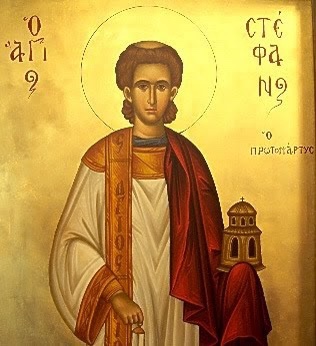
Stephen is an important figure in the narrative that is offered in the Book of Acts. He is the pivot on which the storyline shifts from “in Jerusalem” (chs. 1–7), beginning to turn “to the Gentiles” (chs. 8–12) and then on into the missionary activities of Paul and his companions (chs. 13 onwards). The early church recognised the significance of Stephen, declaring him to be a saint, and honouring him as the first Christian martyr.

See

Stephen: deacon and prophet, martyr and disciple
Unknown's avatarAuthor John T SquiresPosted on May 4, 2023May 4, 2023Categories An Orderly Account: Gospel of LukeTags Acts, Easter, martyr, scripture, Stephen, testimony, theology

People of Israel, listen to me: the speech of Stephen (Acts 7; Easter 5A) part 2

People of Israel, listen to me: the speech of Stephen (Acts 7; Easter 5A) part 2

As we prepare for this coming Sunday, when we will hear about the fate of Stephen, the first martyr in the movement initiated by Jesus (Acts 7:55–60), we continue our considerations of the longest speech in Acts, Stephen’s speech (7:1-53). By means of this speech, Luke matches the divinely-given qualities of Stephen (6:3,5,8,10) with his testimony to the acts of God in the history of Israel.

This Lukan-created speech, attributed to Stephen, makes a critical contribution to the theology of the two-volume work, Luke-Acts. (My analysis is based on what I wrote in my commentary on Acts in the Eerdman’s Commentary on the Bible (2003).) It is the longest speech of all of the speeches in Acts, and thus deserves our attention, even if the lectionary fails to include it!

The speech begins in typical Lukan fashion by defining the subject as God (7:2; cf. 2:17; 3:13; 5:30); the phrase used here, “the God of glory”, is drawn from scripture (Ps 29:3). The speech which follows rebuts the charges laid against Stephen; it demonstrates that, far from speaking “blasphemous words against God” (6:11), Stephen has a fulsome understanding of God’s place in Israel’s history.

At the end of his speech, Stephen takes up the charge that he spoke “against the holy place” (6:13). Luke has Stephen quote scripture, “Heaven is my throne, and the earth is my footstool. What kind of house will you build for me, says the Lord, or what is the place of my rest? Did not my hand make all these things?’” (Acts 49-50, citing Isa 66:1-2), in order to show that his criticism of the temple (God’s “place of rest”, 7:49) arises from within Jewish tradition itself.

Stephen makes numerous scriptural allusions and quotations in this speech. In general, this seems similar to the earlier speeches by Peter, although the precise function of these scriptural elements is somewhat distinctive in this speech. Here, scripture functions as historical narrative, whereas elsewhere in Acts it provides prophecies to be fulfilled. (The exceptions within the speech are the prophecies of 7:6,7 which are fulfilled at 7:9-16 and 7:36 respec­tively.)

Luke has Stephen provide a detailed rehearsal of significant parts of Israel’s history, by focussing in turn on Abraham (7:2-8), Joseph (7:9-16) and Moses (7:17-44). Then, after making brief mention of Joshua (7:45a), David (7:45b-46) and Solomon (7:47), Stephen moves to the climactic claim of the speech (7:48-53). This is an ancient Jewish practice; lengthy recitals of key features of Israel’s history are already found in Hebrew Scripture (Deut 26; Josh 24; Neh 9; Pss 78; 105; 106; 135; 136; Ezek 20).

In the present instance, the effect of the long recital of the earlier part of Israel’s history is twofold. First, the historical recital reinforces Stephen’s Jewish credentials. When he begins to speak critically of the temple, and of the Jerusalem authorities, it is clear that he does so from within the Jewish tradition. Stephen is not an outsider, but an insider, offering a prophetic critique.

Second, the historical recital provides insight into a further layer of God’s providential activity. Earlier speeches by Peter have interpreted the events of the life, death, resurrection and ascension of Jesus as being within the divine providence (see 2:14-41). Various features of the narrative of Acts have revealed the active involvement of God in the events that take place in the Jerusalem community. Now, the undergirding plan of God is revealed within the long history of Israel. The line of continuity is strengthened between each layer; just as God is at work in the Jerusalem community, so God is at work in the life of Jesus, and God is at work in the history of Israel. There is a strong line of continuity being drawn by Luke.

Each of the leaders of Israel is interpreted in typically Lukan style to present them as the vehicles through whom God was working in history. It was to Abraham (7:2-8) that God appeared, speaking to him the promise of a land (“God … said to him”, 7:2-3; cf. Gen 12:1). His move from Haran to Canaan was at the initiative of God (7:4; cf. Gen 11:35–12:5), but the fact that his descendants did not inherit this land was also God’s intention (7:5; cf. Gen 17:8). Subsequently God spoke to Abraham of the promise of the covenant of circumcision (“God spoke thus … and God said”, 7:6-8; cf. Gen 17:9-14).

Of Joseph (7:9-16), Luke has Stephen say that “God was with him” (7:9; cf. Gen 39:1-3,21), the same phrase as is later used of Jesus (10:38). God’s presence enables Joseph to exhibit grace and wisdom (7:10), characteristics with which God had also endowed Stephen (6:3,8,10) and Jesus (Luke 1:40,52). As a result of his wisdom, Joseph is given authority by Pharaoh (7:10; cf. Gen 41:37-45). Joseph is brought through afflictions and is rescued by God (7:10); the same term describes God’s rescue of Israel under Moses (7:34, quoting Exod 3:7-8) and of Paul (26:17).

The events which follow are reported without explicit reference to God, but demonstrate the outworking of Joseph’s wisdom. The ensuing famine (7:11; cf. Gen 41:53-54) leads to the two visits of Joseph’s brothers (7:12-13; cf. Gen 42:1-28; 43:1-44:34). The family settle in Egypt (7:14-15; cf. Gen 45:1-47:12); subsequently Jacob and others are returned to the family grave at Schechem in Canaan (7:16; cf. Gen 49:29-32; 50:13, where the grave is located in Hebron).

After recounting the ancestral sagas of Israel, Stephen moves on to the “time of the promise which God confessed to Abraham”, which comes to fruition under Moses (7:17-43). During the time between Joseph and Moses, the people “increased and multiplied” (7:17), the same phrase used to describe the expanding community in Jerusalem (“the number of disciples increased and multiplied greatly”, 6:7) and elsewhere (12:24; 19:20).

At his birth, Moses is “beautiful before God” (7:20; cf. Exod 2:2). As he grows, he is trained in wisdom in Egypt and becomes “powerful in his words and deeds” (7:22). These qualities evoke the divine enabling seen in Luke’s accounts of Stephen, the apostles, and Jesus, and are in direct contrast with the scriptural description of Moses as “slow of speech and slow of tongue” (Exod 4:10).

Luke has Stephen demonstrate that Moses shares other similarities with those chosen by God in later ages, especially Jesus. Despite the rejection he experiences from his kinsfolk (7:23-29; cf. Exod 2:11-22), “God through his hand gave salvation” to Israel (7:25), just as God later gives salvation through Jesus (Luke 1:69; 2:11,30; 3:6; Acts 5:31; 13:23,26). When this salvation takes place under Moses it is accompanied by divinely-enabled wonders and signs (7:36; cf. Exod 7:3), as it does through Jesus (2:22). This fulfils the command given to Moses (7:34) when an angel appeared to him in the burning bush (7:30) and God spoke to him (7:32,33-34; cf. Exod 3:1-10).

Stephen omits entirely the series of objections raised by Moses when he is called (Exod 3:11-4:17); his portrayal of Moses is that of a person who is immediately obedient to the divine call. This sequence of call (7:30-34) and obedient response (7:36) repeats the pattern seen with Abraham (call, 7:2-3; obedient response, 7:4). It is replicated in the narrative of Acts, especially with regard to Saul (call, 9:15; obedient response, 9:19b-20).

Stephen tells of Moses being mocked by his kinsfolk, who could not conceive of him as ruler and judge (7:27,35; cf. Exod 2:14). Stephen affirms that he is rightly called ruler, infers that he is correctly regarded as judge, and adds the further title of liberator (7:35). The functions of two of these titles are attributed to Jesus (judgement at 10:42; 17:31; liberation at Luke 1:68; 2:38; 21:28; 24:21). The third function, of leader, is not directly attributed to Jesus by Luke; however, he does use the related term archegos at 3:15; 5:31.

A further title applied to Moses is the scriptural one of prophet (7:37; cf. Deut 18:15), which has also been applied to Jesus (Luke 7:16; 9:8,19; 24:19) as well as to numerous individuals in the narrative of the Gospel (Luke 1:67,76; 2:36; 7:26) and Acts (11:27; 15:32; 21:9). That it is a divinely-bestowed function is already evident from Peter’s Pentecost speech: “I will pour out my Spirit upon all flesh, and your sons and your daughters shall prophesy, and your young men shall see visions, and your old men shall dream dreams” (2:17-18).

Stephen’s depiction of Moses thus resonates strongly with the Lukan understanding of Jesus, the prophet, ruler and judge through whom God was at work enabling signs and wonders and bringing liberation and salvation for the people of Israel.

As prophet, Moses is given living oracles by yet another angel (7:38; see 7:53; cf. Exod 19:1-2:21; Deut 5:1-33). The idea that the law was mediated by angels is not found in Hebrew Scripture; it is mentioned at Gal 3:17; Heb 2:2. Moses in turn passes on these oracles to Israel, but they refuse to accept them and commit idolatry by making a golden calf (7:39-43; cf. Exod 32:1-35). The description of the golden calf introduces the theme of idolatry which will undergird Stephen’s critique of the temple in 7:48-51. A prophetic citation (Amos 5:25-27) provides justification for God’s abandonment of Israel (7:42); they had been idolators in the wilderness (7:42-43).

*****

See more at

https://johntsquires.com/2023/05/02/people-of-israel-listen-to-me-the-speech-of-stephen-acts-7-easter-5a-part-1/
https://johntsquires.com/2023/05/04/people-of-israel-listen-to-me-the-speech-of-stephen-acts-7-easter-5a-part-3/

*****

Stephen is an important figure in the narrative that is offered in the Book of Acts. He is the pivot on which the storyline shifts from “in Jerusalem” (chs. 1–7), beginning to turn “to the Gentiles” (chs. 8–12) and then on into the missionary activities of Paul and his companions (chs. 13 onwards). The early church recognised the significance of Stephen, declaring him to be a saint, and honouring him as the first Christian martyr.

See

https://johntsquires.com/2022/12/26/stephen-deacon-and-prophet-martyr-and-disciple-2/
Unknown's avatarAuthor John T SquiresPosted on May 3, 2023May 4, 2023Categories An Orderly Account: Gospel of LukeTags Acts, Easter, scripture, Stephen, testimony, theology

People of Israel, listen to me: the speech of Stephen (Acts 7; Easter 5A) part 1

People of Israel, listen to me: the speech of Stephen (Acts 7; Easter 5A) part 1

The lectionary really shortchanges us this coming Sunday. As is the custom during the season of Easter, the First Reading comes from the book of Acts, rather than from Hebrew Scriptures. And this week, the Fifth Sunday of Easter, that reading comes from one of the longest chapters in that book. That chapter records in great detail the speech made by Stephen, when he was brought before the council, charged with “saying things against this holy place and the law” (Acts 6:13).

However, we are really shortchanged, because although this is the longest of all the speeches in Acts, in the passage offered by the lectionary (Acts 7:55–60), we are given only the final comment by Stephen—just one verse (7:56)—before he is stoned, and he dies saying “Lord Jesus, receive my spirit” (7:59).

So in a series of blogs this week, I will consider the setting as well as the content of this speech, and the consequence that followed from it for Stephen—namely, his death as a martyr. Let’s not undervalue the contribution of this Lukan-created speech, attributed to Stephen, in the theology of the two-volume work, Luke-Acts. (My analysis is based on what I wrote in my commentary on Acts in the Eerdman’s Commentary on the Bible (2003).)

The setting of the speech. After chapters telling of the gathering of the early community in Jerusalem (1:6-26), events on the day of Pentecost (2:1-47), the activities of Peter and John in the Temple and before the Council (3:1-5:42), and the establishment of a diaconal role to meet the material needs of the community (6:1-6), Luke (the person attributed in tradition as the author of the Book of Acts) provides the sixth in a series of summary descriptions of the community: “the word of God continued to spread; the number of the disciples increased greatly in Jerusalem, and a great many of the priests became obedient to the faith” (6:7; see earlier at 1:14; 2:42-47; 4:32-35; 5:12; 5:42).

This summary repeats key phrases from the narrative of the scene which has just concluded. “The word of God” (6:2) is now used to describe the community itself, rather than an activity of its leadership; “disciple” (6:1,2) now becomes the standard term for members of the messianic community (6:7; and a further 25 times in chapters 9-21).

The increasing numbers in the community (6:1) forms the basis for the comment that “the number of disciples increased and multiplied greatly” (6:7); the two verbs that are used here recur with the word of God in subsequent summary descriptions (12:24; 19:20; similar ideas are expressed at 9:31; 16:5). The membership of the community now comprises “a great many of the priests”—a surprising comment, in light both of the constant opposition shown by the priests to this point (4:1,6; 5:17,21,24,27) and of the role that the priests will soon play in Stephen’s death (7:1; as members of the council, 6:12).

The fate of Stephen is now told. Out of the seven just appointed, Luke focuses first on Stephen, who is described in familiar terms as a person empowered by God. Stephen is full of grace (6:8), a mark of the community at 2:47, 4:33, and of power, a divine gift (2:22) exhibited by the apostles (4:33); he is able to perform wonders and signs (6:8), a divinely-inspired capacity (2:19) exhibited by Jesus (2:22) and the apostles (2:43; 5:12). Luke notes again that he speaks with wisdom and spirit (6:10), attributes already noted as divine in origin (see 6:3); here they are qualified as being unable to be withstood by humans.

This description introduces the account of the arrest of Stephen (6:8-15). This is a stylised account which draws from familiar Lukan themes. Those in conflict with Stephen are Diaspora Jews who have returned to Jerusalem, where they worship in a synagogue (6:9). However, they do not make the front running against Stephen, but they conscript agitators to stir up the crowd (6:11-12). This is reminiscent of a detail in the trial of Jesus (Mark 15:11; Matt 27:20) which Luke omits, transferring it to Stephen’s trial. Similar agitation of the crowd will later be encountered by Paul (13:50; 14:19; 17:5,13).

Likewise, the “false witnesses” who accuse Stephen of speaking against the temple (6:13) recall the false witnesses who charge Jesus with the claim that he would destroy the temple (Mark 14:55-58; Matt 26:59-61), another detail which Luke transfers to Stephen’s trial. Later, Luke will consciously model Stephen’s death on the death scene of Jesus (7:54-60; cf. Luke 23:34,44-46).

Stephen is charged with uttering “blasphemous words against Moses and God” (6:11) which are manifest in his allegedly speaking against “this holy place and the law” (6:13). Similar charges are later brought against Paul (21:28). The charges against Stephen turn out to be ironic, since in the speech which follows, he will speak at length and with deep conviction about the people of Israel, to whom the law was given, and with penetrating insight about the role of the holy place of Israel.

It is worth remembering that Stephen, venerated as the first Christian martyr, was fervent in his adherence to the Jewish faith into which he was born. How tragic that his strong advocacy for what he saw as the most faithful way to live out his commitment led to his death. How ironic that the first Christian martyr died for being a deeply devout Messianic Jew!

*****

See further posts …

https://johntsquires.com/2023/05/03/people-of-israel-listen-to-me-the-speech-of-stephen-acts-7-easter-5a-part-2/
https://johntsquires.com/2023/05/04/people-of-israel-listen-to-me-the-speech-of-stephen-acts-7-easter-5a-part-3/

*****

Stephen is an important figure in the narrative that is offered in the Book of Acts. He is the pivot on which the storyline shifts from “in Jerusalem” (chs. 1–7), beginning to turn “to the Gentiles” (chs. 8–12) and then on into the missionary activities of Paul and his companions (chs. 13 onwards). He is also an important figure in the developing movement that began with Jesus. The early church recognised the significance of Stephen, declaring him to be a saint, and honouring him as the first Christian martyr. See more at

https://johntsquires.com/2022/12/26/stephen-deacon-and-prophet-martyr-and-disciple-2/
Unknown's avatarAuthor John T SquiresPosted on May 2, 2023May 4, 2023Categories An Orderly Account: Gospel of LukeTags Acts, Easter, martyr, scripture, Stephen, testimony, theologyLeave a comment on People of Israel, listen to me: the speech of Stephen (Acts 7; Easter 5A) part 1

Hands and fingers: the work of God (John 20; Easter 2A)

Hands and fingers: the work of God (John 20; Easter 2A)

“Unless I see the mark of the nails in his hands, and put my finger in the mark of the nails and my hand in his side, I will not believe” (John 20:25). So Thomas says to the other disciples, gathered in Jerusalem after Jesus had been crucified and buried. In two Gospels, we have a report of Jesus appearing to the disciples (Luke 24:36–49; John 20:19–23).

In Luke’s account, Jesus had invited the disciples to “look at my hands and my feet; see that it is I myself. Touch me and see; for a ghost does not have flesh and bones as you see that I have” (Luke 24:39). In some manuscripts, it is then reported that “when he had said this, he showed them his hands and his feet” (Luke 24:40). That may be the same incident that John reports, although only he notes that “Thomas (who was called the Twin), one of the twelve, was not with them when Jesus came” (John 20:24).

It is later, when the other disciples tell him of the appearance of Jesus to them, that Thomas expresses the doubt for which he is infamous. A week later, he responds to the invitation from Jesus to “put your finger here and see my hands; reach out your hand and put it in my side; do not doubt but believe”, with the words, “my Lord and my God!” (John 20:27–28). From the swirl of doubt emerges the clarity of belief.

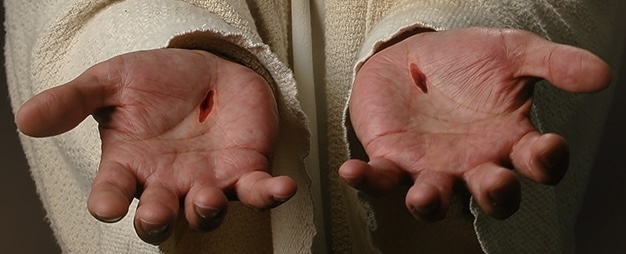
Those hands which bore “the mark of the nails” merit some consideration. Bruised and bloodied, scarred forever by the barbarity of crucifixion—what had those hands done? Where had they touched others? How had they been instrumental in the ministry of Jesus?

The one story that specifically reports Jesus using his finger is the “floating” narrative concerning a woman caught in adultery, a group of scribes and Pharisees, and Jesus. (It is a “floating” story because it appears in some version of John’s Gospel, but not in others; and in yet more ancient manuscripts, at three different places in Luke’s Gospel.) The text reports that, when the scribes and Pharisees made their accusation against the woman, “Jesus bent down and wrote with his finger on the ground” (John 8:6).

Whilst “the dust of the ground” was the source for God’s creation of humanity (Gen 2:7), the ground on which Jesus, the woman, and those bringing her to be stoned would have been a dusty, dirty ground. That ground had endured the tramping of feet, in sandals, or unshod, and the tramping of animals. That ground would have been the receptacle for excreta from those animals, and perhaps also from humans. It would not necessarily be a clean, swept, healthy environment like we might imagine. And yet, Jesus places his finger in that ground, and writes, amidst the detritus of the earth. A small parable of incarnation?

*****

Not only the fingers of Jesus, but also the hands of Jesus would also come into contact with a number of individuals deemed unclean, or at least regarded as “on the edge” within the Jewish purity system that held sway in his culture. When Jesus encountered a leper in Galilee, he “stretched out his hand and touched him” (Mark 1:41; Matt 8:3; Luke 5:13). According to Lev 13:45–46, the leper should have remained outside the town, at a distance from, and not in contact with, the general population.

When Jesus approaches Jericho, in Luke’s narrative, he is asked by a blind man to heal him (Luke 18:38–39). Jesus does so, although there is no mention of direct physical contact in this account. In Matthew’s reworking of this story, it is two blind men outside Jericho who beg Jesus, “Lord, let our eyes be opened”, and we are told that “moved with compassion, Jesus touched their eyes” and they were healed (Matt 20:33–33). Likewise, in Luke’s distinctive journey narrative (Luke 9–19), Jesus encounters a bent-over woman in a synagogue; “when he laid his hands on her, immediately she stood up straight and began praising God” (Luke 13:13).

In the Decapolis, the disciples of Jesus brought to him “a deaf man who had an impediment in his speech; and they begged him to lay his hand on him” (Mark 7:32). Mark reports that Jesus “took him aside in private, away from the crowd, and put his fingers into his ears, and he spat and touched his tongue; then looking up to heaven, he sighed and said to him, ‘Ephphatha’, that is, ‘be opened’” (Mark 7:33–34). This was the typical way of operating for healers in the ancient world; Mark reports that Jesus followed this pattern, and “immediately his ears were opened, his tongue was released, and he spoke plainly” (Mark 7:35). Matthew and Luke have no reference to this incident; the thought of Jesus operating like a commonplace healer was not amenable to them (you might say, they couldn’t handle that).

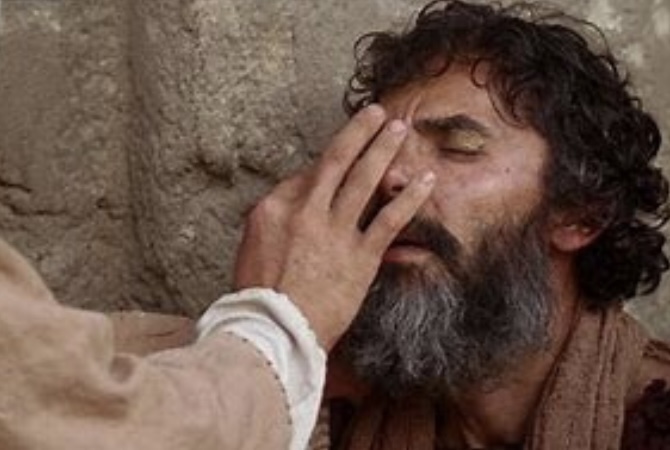
In an incident told only in Mark’s Gospel, a similar way of operating is in evidence. At Bethsaida, “some people brought a blind man to [Jesus] and begged him to touch him” (Mark 8:22). In this encounter, we are told that Jesus “took the blind man by the hand and led him out of the village … put saliva on his eyes and laid his hands on him” (Mark 8:23). Jesus does not shy away from touching the man, and even from placing his saliva on his hand to rub onto the blind man’s eyes, as was the custom of healers. Touch was important.

The same action occurs in a story told only in John’s Gospel, set in Jerusalem; a blind man is healed by Jesus as he “spat on the ground and made mud with the saliva and spread the mud on the man’s eyes” (John 9:6). Jesus was not afraid to breach the boundaries that had been set in place to distinguish clean from unclean. (Saliva, as a bodily discharge, would render a person unclean, according to Lev 22:4–6, 22; and by analogy with the far more detailed prescriptions in Lev 15.) Following the pattern of the healers of the day meant also that the perception of what is clean and what is unclean that Jesus held presented a challenge to these clear boundaries.

The fingers, and hands, of Jesus move across those boundaries, to connect, reassure, and heal. The Lukan Jesus regards his work as being of God; “if it is by the finger of God that I cast out the demons, then the kingdom of God has come to you” (Luke 11:20). The finger of God was the means by which the plague of gnats took place in Egypt (Exod 8:19), and also the means by which the two tablets of the covenant, tablets of stone, given to Moses on Mount Sinai, had been written (Exod 31:18; Deut 9:10). Jesus claims divine power through the finger of God, as he works to bring in the kingdom of God.

*****

The use of the image of “the finger of God” in the saying of Jesus brings to mind the role that the finger of the priest played in the rituals that took place in the Temple. The priest was to “take some of its blood with his finger and sprinkle it seven times towards the front of the tent of meeting” (Num 19:4; the same instruction is given at Exod 29:12; Lev 4:30, 34; 8:15; 9:9; 14:16, 27; 16:14, 19). The finger of the priest was used to ensure the offering of blood, conveyed directly through touch, that would secure the forgiveness being sought from God.

Whilst Jesus was in the synagogue in his home town of Nazareth, Mark reports that many listening to him were exclaiming, “Where did this man get all this? What is this wisdom that has been given to him? What deeds of power are being done by his hands!” (Mark 6:2). Just as the hands of the priest mediated forgiveness, so the hands of Jesus were instrumental in his healing ministry.

A pattern of regular and direct physical contact with those who were ill was evident: “wherever he went, into villages or cities or farms, they laid the sick in the marketplaces, and begged him that they might touch even the fringe of his cloak; and all who touched it were healed” (Mark 6:56). Matthew changes this observation, noting that “they brought all who were sick to him, and begged him that they might touch even the fringe of his cloak; and all who touched it were healed” (Matt 14:35–36). The initiative in reaching out to touch is reversed in this narrative; Matthew generally preserves a more orthodox Jesus, adhering more carefully to Torah, avoiding direct touch where he can.

Not so for Luke. Early on in his narrative, Luke reports that whilst in Capernaum, as the sun was setting, “all those who had any who were sick with various kinds of diseases brought them to [Jesus]; and he laid his hands on each of them and cured them” (Luke 4:40); and then, a little later, in Galilee, he notes that “a great multitude of people … had come to hear [Jesus] and to be healed of their diseases; and those who were troubled with unclean spirits were cured; and all in the crowd were trying to touch him, for power came out from him and healed all of them” (Luke 6:18–19).

In one incident, Luke claims that “Pharisees and teachers of the law were sitting near by (they had come from every village of Galilee and Judea and from Jerusalem); and the power of the Lord was with him to heal” (Luke 5:17). That explains the transactional significance of direct touch in stories about Jesus as healer; this was the means by which healing power was transmitted between people. Even in Nazareth, where the crowd noted “deeds of power are being done by his hands” (Mark 6:2), and despite their unbelief and offence, “he laid his hands on a few sick people and cured them” (Mark 6:5).

The hands which Thomas later saw—battered and bruised, bloodied by nails being driven through them—were the very hands which mediated the power of God through healings. They were also the hands that were laid on children, as they were brought to Jesus and he blessed them (Mark 10:16, Matt 19:13; Luke 18:15). They were the hands that blessed the disciples, gathered at Bethany after the risen Jesus had been seen, just before “he withdrew from them and was carried up into heaven” (Luke 24:50–51). And these same hands were the hands that were grabbed and bound at his arrest and, later, savagely nailed in preparation for his crucifixion.

*****

There are other hands in the Gospel narratives: the hands of those who attempt to seize Jesus (Luke 20:19; John 7:30, 44; 10:39); the hands of the betrayer and then those who arrest Jesus (Mark 14:41, 46; Matt 26:45, 50; Luke 22:53); the hands of the council members who struck Jesus (Mark 14:65; Matt 26:67; 27:31); the hands of the soldiers who whipped and scourged Jesus (Mark 15:15; Matt 27:26; Luke 22:63; 23:16, 22; John 19:1); the hands of the soldiers who stripped Jesus of his cloak (Mark 15:20; Matt 27:31) and divided his garments, rolling the dice to decide who took which piece (Mark 15:24; Matt 27:35). And the hands of Pilate, blood-soaked, but washed to declare his innocence of that blood (Matt 27:24).

But the focus is on the hands of Jesus in the stories told in the Gospels. The author of the fourth Gospel attests that “the Father loves the Son and has placed all things in his hands” (John 3:35). Later in this Gospel, Jesus says that “the sheep hear my voice; I know them, and they follow me; I give them eternal life, and they will never perish—no one will snatch them out of my hand” (John 10:27–28). The climax to the story in this Gospel is foreshadowed when Jesus, “knowing that the Father had given all things into his hands, and that he had come from God and was going to God” (John 13:3), gathers his disciples for their last meal together.

The author of Luke’s Gospel ends his account of Jesus dying on the cross with Jesus crying out, “Father, into your hands I commend my spirit”, quoting from Psalm 31. Those hands are the ones that the psalmist praises, “long ago you laid the foundation of the earth, and the heavens are the work of your hands” (Ps 102:25, quoted at Heb 1:10; see also Ps 95:4–5); they are the same hands that the psalmist also notes “have made and fashioned me” (Ps 119:73).

The story has traced the full circle, from the hands of God which created all creatures, sent his son into the world, and placed all things into his hands; to the dying son, with hands arms spread wide and his bloodied hands extended, handing back his spirit to God. As Graham Kendrick writes in The Servant King, “hands that flung stars into space, to cruel nails surrendered”.

These hands: reaching out and blessing, touching and healing, wounded and bloodied, scarred, yet offering love; these hands are what Thomas sees.

Unknown's avatarAuthor John T SquiresPosted on April 13, 2023April 13, 2023Categories A Book of Origins: Gospel of Matthew, An Orderly Account: Gospel of Luke, Scripture and Theology, The Beginning of the Good News: Mark, The Book of Signs: the Gospel of JohnTags bless, Easter, hands, John, Luke, Mark, Matthew, scripture, theology, Thomas

Peter proclaims the risen Jesus (Acts 10; Easter Sunday Year A)

Peter proclaims the risen Jesus (Acts 10; Easter Sunday Year A)

The passage from Acts which is offered by the lectionary this coming Sunday (Acts 10:34–43) is an impassioned speech to Gentiles, by the Jewish man, Peter. It is one of a number of speeches that are found throughout the first two thirds of the book of Acts, in which one of the leaders in the movement that was initiated by Jesus (and would later become “the church”) spoke to others, declaring “the good news about the kingdom of God and the name of Jesus Christ” (8:12; see also 8:25, 35, 40; 13:32; 14:7, 15, 21; 15:7; 16:10; 17:18; 20:24).

These speeches, of course, all come to us from the pen of one person, the author of this work; although they are, in good speech-writing style, shaped to the particular situation at hand, there is nevertheless a consistency of themes, ideas, and language that runs through the speeches which have what me might call an evangelistic purpose—declaring the good news (the evangel) to those who have not yet heard it. Whether it is Peter, Stephen, Philip, or Paul who is speaking, the message is consistent and focussed on Jesus and how he relates to God’s intention for the people being addressed.

So Peter has come, by a sequence of events that Luke wants us to understand were quite miraculous, from Joppa to Caesarea; from the house of the Jewish man Simon, a tanner, with whom he was staying in Joppa (9:43), to the house of Cornelius, a centurion—and thus most likely a Gentile—in Caesarea (10:1–2). That movement, in itself, is quite significant, as Peter moves from his fellow-Jews to the Gentiles. Cornelius was sympathetic to Judaism; he is described as “a devout man who feared God … who gave alms and payed constantly” (10:2), he was, nevertheless, a Gentile; and those of his household were, likewise, Gentiles.

What Peter says in this speech in the Gentile household of Cornelius needs to be understood in the context of the events that have just taken place, and indeed in terms of the whole span of events recounted in this volume. Peter had been called to Caesarea by a vision, in which God spoke directly to Peter (10:9–15)—and Luke,reports that this took place, not once, but three times (10:16). In what God said, Peter was given a message, to declare to others who were part of the movement that he had been leading since Jesus had ascended into heaven (1:6–14).

That message, “what God has made clean, you must not call profane” (10:15) was, in effect a call to Peter to speak to that movement as a prophet. Prophets were anointed by the spirit to declare “the word of the Lord” for the people of their time (1 Sam 19:20, 23; Isa 11:2; 59:21; 61:1; Ezek 2:2; Joel 2:28–29; Micah 3:8; Zech 7:12, referring to “the former prophets”). Indeed, the servant of the Lord himself is guided by the spirit (Isa 42:1). The Spirit actually calls Peter to go with three men who have come searching for him (10:19–20); they lead him to Caesarea, to the house of Cornelius, where he duly delivers this message (10:24–29).

Subsequently, as he speaks in more details to the assembled household, the Spirit falls on all present, as they listen to Peter’s words (10:44). This coming of the Spirit had happened before, and it will happen again, as the story of Acts continues. But there is something striking and significance about this story of the coming of the spirit.

This has happened before. The spirit has twice filled the messianic community gathered in the Jewish capital, Jerusalem (at Pentecost, 2:1-4, and subsequently, 4:31). When the spirit is poured out on the Gentiles (10:45) in this gentile capital, it is already known that this is an act of God; “God declares, I will pour out my Spirit upon all flesh, and your sons and your daughters shall prophesy, and your young men shall see visions, and your old men shall dream dreams” (2:17).

In both previous cases, God had acted through the spirit in relation to Jews. That this current outpouring of the spirit, outside of Judaea, amongst Gentiles, is still an act of God, is emphasised by a series of narrative comments. The Jewish believers present express surprise at “the gift of the holy spirit” (10:45), but the reader already knows that such a gift is from God (2:38, 8:18).

They hear the Gentiles “speaking in tongues” (10:46), a phenomenon already experienced as a divine event in Jerusalem (2:11). Peter draws this connection when he interprets the event: they “received the spirit as we also [did]” (10:47; see 2:38). Peter and his fellow Jews thus “exulted God” (10:47; see 5:13).

Indeed, the Spirit had come to these Gentiles after a striking sequence of events had taken place. Peter had a vision whilst praying in Joppa, that he was no longer to keep separate at table (10:9–16). No longer were Jews to eat separated from Gentiles. God had declared all foods clean (10:15), so separate table fellowship was now overturned. Peter receives this dramatic change to the status quo—and he faithfully acts on it.

Peter and his companions in Joppa share at table with the men from Cornelius (10:23; 11:4–11) and then, when they have travelled to Caesarea, with the household of Cornelius and those who were baptised with him (10:48; 11:12–18). Indeed, the very point of the vision seen by Peter is to establish an inclusive, all-embracing table fellowship in the Jesus movement, open to both Jews and Gentiles, from this point onwards (11:3).

This is a moment when the old is overturned, and the new is implemented. It is a strong moment of transition for the early church. From this time, the good news spreads amongst Gentiles; to the extent that it does, indeed, reach “to the ends of the earth” (see 1:8) by the end of the book. (In saying this, I take the arrival of Paul into Rome in Ch.28 to be a symbol of the fact that, as the good news becomes known in Rome, the centre of the dominant empire of the day, so that message will then be taken out from the city into all the far-flung reaches of the empire—in a sense, “to the ends of the earth”.)

So the story of Peter and Cornelius, narrated in detail in chapter 10 and then reported in summary to the gathering in Jerusalem in chapter 11, is a key turning point in the overall story being told in Acts. (In my research, I describe Acts 8–12 as “the turn to the Gentiles”, the pivot on which the whole story turns.) it is in this dramatic and pivotal context that Peter speaks the words which are offered by the lectionary for the First Reading on Easter Sunday. This speech is worth attending to in some detail.

*****

This speech by Peter begins in the characteristic style of previous speeches, by announcing God as its subject (see 2:16–21, 22; 3:13; 4:24; 5:29–30; 7:2; and see subsequently at 13:16–17; 14:15–17; 15:7, 13–17; 17:23–25; and as a summary, 20:24, 27). I have explored this in other blogs at

https://johntsquires.com/2020/04/16/what-god-did-through-him-peters-testimony-to-jesus-acts-2/

and

https://johntsquires.com/2020/04/14/what-god-did-through-him-proclaiming-faith-in-the-public-square-acts-2/

The key theme of this speech is the impartiality of God (10:34), an important theme, especially in later scriptural writings. “The Lord your God is God of gods and Lord of lords, the great God, mighty and awesome, who is not partial and takes no bribe”, Moses declares (Deut 10:17). God is one “who shows no partiality to nobles, nor regards the rich more than the poor—for they are all the work of his hands”, Elihu advises Job (Job 34:19).

Later writings concur: “the Lord of all will not stand in awe of anyone, or show deference to greatness … he takes thought for all alike” (Wisd 6:7), and “do not offer [the Lord] a bribe, for he will not accept it … the Lord is the judge, and with him there is no partiality; he will not show partiality to the poor, but he will listen to the prayer of the one who is wronged; he will not ignore the supplication of the orphan, or the widow when she pours out her complaint” (Sir 35:13–17).

This theme of divine impartiality thus reinforces and confirms the message of the vision (10:11–16). Even though the prescriptions of the levitical holiness code where being adhered to by faithful Jews, the vision speaks over those regulations and invites that who see it and hear God’s words into a new manner of being community. Specifically, that vision validated table-fellowship as being consistent with divine impartiality, a key aspect of God’s nature. Things would be different from now on!

Peter explains that this divine impartiality is especially evident in Jesus, whom he affirms as Lord of all (10:36). Peter interprets the whole life of Jesus as the action of God, who anointed him, was with him, raised him and made him manifest (10:37–43). For Peter, the significance of what Jesus did and said was that he was addressing not only Jews, but also Gentiles.

Peter affirms both the apostolic witness: “we are witnesses to all that he did” (10:39,41; see 2:32, 3:15, 5:32) and also the prophetic witness: “all the prophets testify about him” (10:43; see 2:25-31,33–35, 3:18,21–25, 4:25–26). We see here a rhetorical strategy typical of Luke, who has Peter make the exaggerated claim that “all the prophets testify about him” (10:43; see 3:24). These prophets testify to “the forgiveness of sins” which is essential to this proclamation (2:38, 5:31, 13:38).

Peter continues, that Jesus has been “ordained by God” to be the eschatological “judge of the living and the dead” (10:42), a concept which Paul will later express (17:31; cf. 24:15). The speech thus comprises a consistent exposition of God’s activities in Jesus, extensively in the past as well as (briefly) in the future. When we read what Peter says here, alongside what he says in other evangelistic speeches in Acts (chs. 2, 3, 4, 5, and 13), as well as what Stephen says in his long speech (Ch.7) and what Paul says to Jews (Ch.13) and to Gentiles (chs. 14 and 17), we end up with a most comprehensive statement of the Gospel and how it relates to the ways that God had long been at work in Israel.

The author’s interpretation of the events that have taken place in Caesarea draws them into close relationship with the interpretation of Jesus which Peter has given (here, and in earlier speeches in Acts). That is not surprising, since it is the one person (Luke, the alleged author of this work) who has reported all of these speeches—and, in my opinion, has actually created each speech.

Certainly, the speech itself relates to key features in the surrounding scenes involving Peter, a Jewish man, with the Gentile Cornelius, and his Gentile household. The impartial God who has acted through Jesus (10:34–43) is the same God who declares all things clean (10:15), who shows this to Peter (10:28), who gifts Gentiles by pouring out the spirit (10:45), and who is exulted by the people (10:46). It is language about God which interprets the significance of the narrative at each key moment.

The consequence of this dramatic event is noted briefly: “they invited him to remain for some days” (10:48b). Table-fellowship with Gentiles and the breach of the food rules was considered to be the inevitable result of God’s actions (see also 11:15–18). Such hospitality continues to be one of the key markers of the church today. That is the good news which is declared by the Easter event, when we remember that “God raised Jesus from the dead” and we testify that “everyone who believes in him receives forgiveness of sins through his name”.

*****

In this blog I have developed themes, ideas, and analysis that I wrote in my commentary on Acts in the Eerdmans Commentary on the Bible, ed. Dunn and Rogerson (Eerdmans, 2003). I have also explored the theme of the plan of God throughout Luke and Acts in the doctoral research that I undertook in the 1980s, which was published in 1993 by Cambridge University Press as The plan of God in Luke-Acts (SNTSM 76).

Unknown's avatarAuthor John T SquiresPosted on April 3, 2023April 3, 2023Categories An Orderly Account: Gospel of Luke, Scripture and TheologyTags Acts, Gentiles, Luke, mission, scripture, spirit, theology

Why Jesus never did, and never would, ride a horse! (for Palm Sunday, Lent 6)

Why Jesus never did, and never would, ride a horse! (for Palm Sunday, Lent 6)

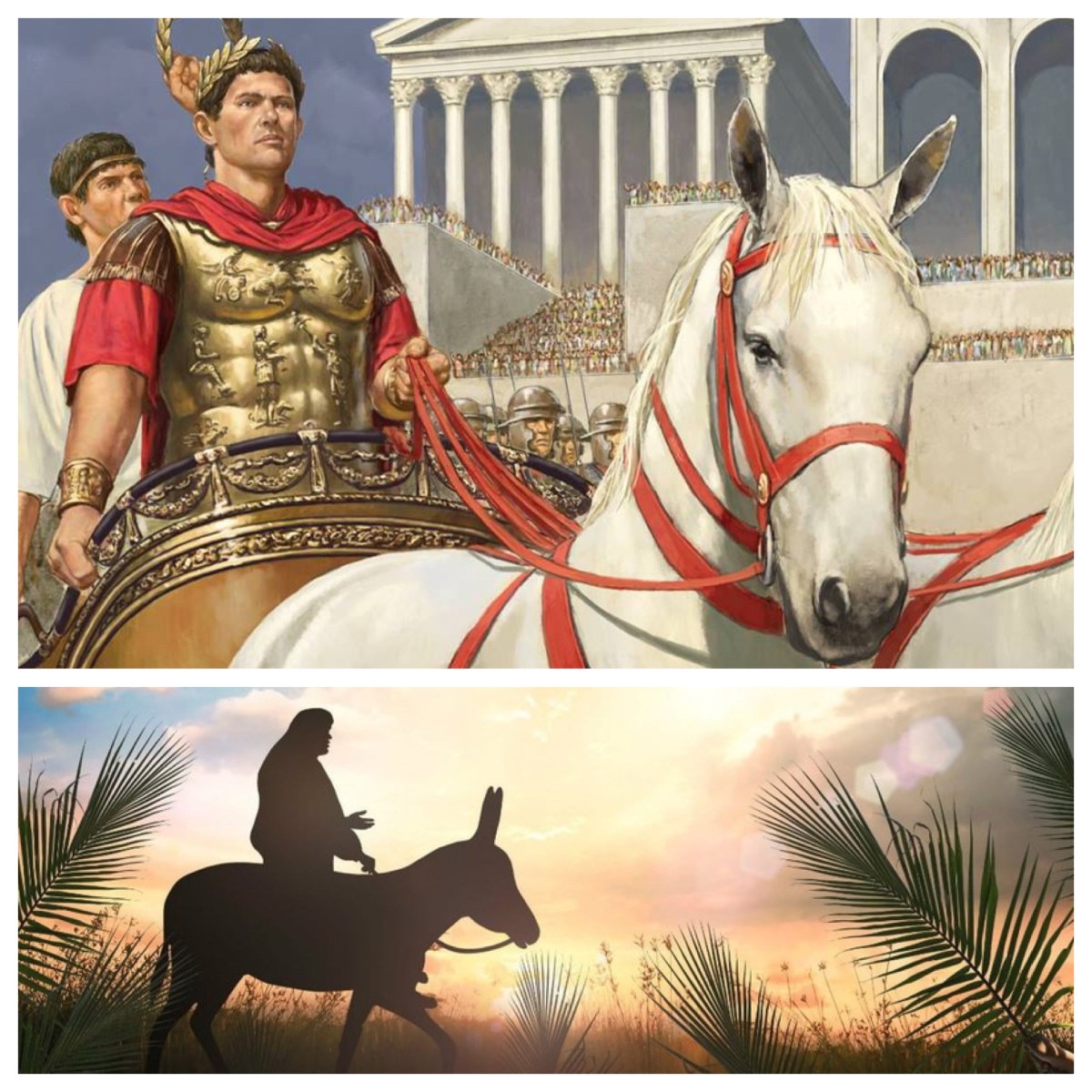
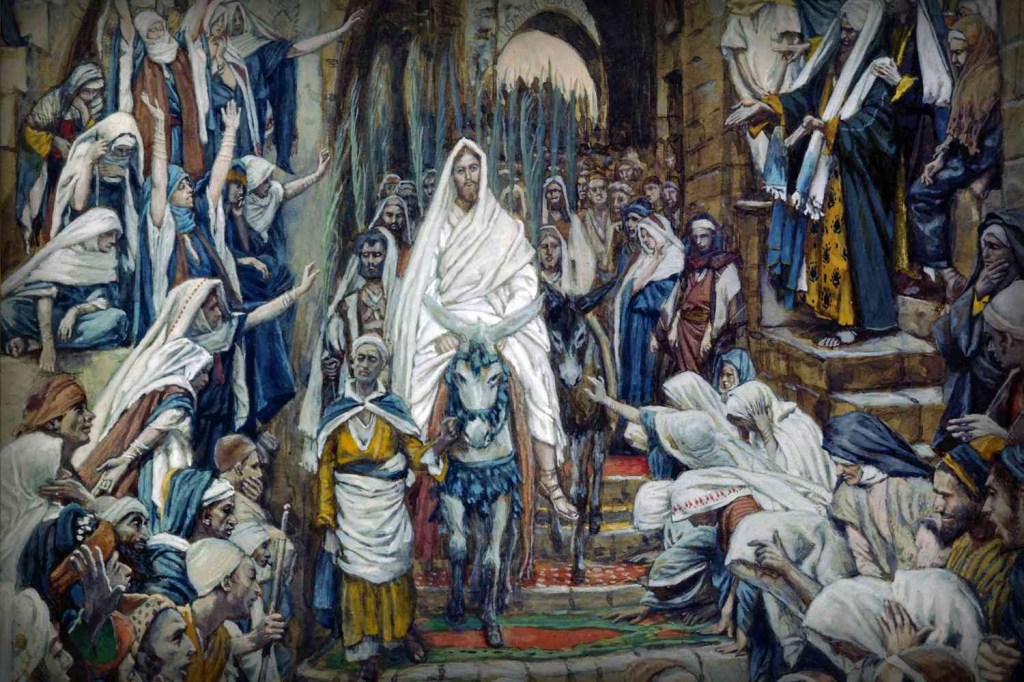
It’s a good guess that you, like me, would have heard it said, on more than one occasion, that “Jesus rode a donkey into Jerusalem to protest against the Jews, to tell them that he would not be the military king that they desired”. According to this view, Jesus chose to ride into Jerusalem on a donkey, rather than a horse, to signal that he was a man of peace, and also that he would not be acting in the way that the Jews were expecting the Messiah to act.

I’ve discussed this claim quite a lot with my wife, Elizabeth Raine, whose knowledge of classical and Jewish texts has been most helpful in informing this blogpost. In what follows, I want to demolish that claim. Jesus never did, and never would, ride a horse. Nor would the Messiah, in Jewish thinking, be expected to ride a horse, a mighty weapon of war.

Horses were highly valued in the Roman Empire, which was the dominant power in the region at the time when Jesus lived. Horses were valuable both in warfare and in domestic life. They provide efficient and (relatively) quick means of communication along the extensive road system that the Romans built to link all the parts of their Empire, both for the upper classes who could afford them, and within the imperial communications system operating from Rome.

Horses were used for entertainment, in chariot races. And they were important animals in the military strategy that the Romans had developed, as a second line of attack behind the infantry. The foot-and-horseback nstrategies developed by the Romans enabled them to conquer far-flung regions and add them to their burgeoning Empire.

See

Horses in ancient Rome

and

Famous Horses in Rome’s Chariot Races

Within Israelite society, we encounter a different approach to horses. The hilly, rocky terrain of Israel must have contributed to this; but there are more factors at work. The Psalmist sets out the basic problem: “Do not be like a horse or a mule, without understanding, whose temper must be curbed with bit and bridle, else it will not stay near you” (Ps 32:9). The horse is wild, unruly, unstable. Indeed, in the foundational story of Israel, the horse is enmeshed with the enemy, Egypt; “I will sing to the Lord, for he has triumphed gloriously; horse and rider he has thrown into the sea” is the song of both the prophet Miriam (Exod 15:21) and her brother Moses (Exod 15:1).

Accordingly, the Psalmist sings, “Some take pride in chariots and some in horses, but our pride is in the name of the Lord our God” (Ps 20:7), and indicates that “a king is not saved by his great army; a warrior is not delivered by his great strength; the war horse is a vain hope for victory, and by its great might it cannot save” (Ps 33:16–17). The story of the Exodus hovers not far away from each of these assertions. And it begs the question: with this heritage and tradition, why would Jesus even consider riding on a horse to enter Jerusalem?

In the long historical saga of Israel, the great King Solomon is praised for his wisdom; the Lord God grants him “a wise and discerning mind; no one like you has been before you and no one like you shall arise after you” (1 Ki 3:12). However, in that same speech by God, we hear also that “I give you also what you have not asked, both riches and honour all your life; no other king shall compare with you” (1 Ki 3:13). So as the story continues, Solomon is revealed as a man who appointed a large administrate infrastructure, accrued immense wealth, raised a huge army, and built a lavish Temple for the Lord God, as well as a grand Palace for himself (1 Ki 4—7).

To support this grandeur, Solomon, we are told, “had forty thousand stalls of horses for his chariots, and twelve thousand horsemen” (1 Ki 4:26). In a later story, it was noted that “King Solomon excelled all the kings of the earth in riches and in wisdom”, that “the whole earth sought the presence of Solomon to hear his wisdom”, and that “every one of them brought a present”, including horses and mules (1 Ki 10:23–25).

The effect of this was that Solomon had accumulated “fourteen hundred chariots and twelve thousand horses” (1 Ki 10:26), and a note is made that “Solomon’s import of horses was from Egypt and Kure”, at a price of 600 shekels of silver for a chariot and 150 shekels for a horse (1 Ki 10:29; also 2 Chron 1:17). As the work of a labourer was paid with between two and ten shekels per month, both chariots and horses were very expensive commodities.

These descriptions of Solomon demonstrate the grandeur of his court and the profligate nature of his spending. Horses were integral to his means of gaining and holding power, even though a word of the Lord commands that the one set as king over the people “must not acquire many horses for himself, or return the people to Egypt to acquire more horses” (Deut 17:16). Solomon, in his wisdom, disobeyed this word of the Lord—although we recognise, of course, that whilst the speeches in Deuteronomy are placed on the lips of Moses, the actual scroll dates from a much later time—perhaps the time of Josiah (Solomon’s 13th great-grandson!).

*****

Horses were obviously crucial in Solomon’s grand expansionary venture, enlarging the extent of Israel through his military and political nous. The value of horses in warfare is clear from the way that the Lord God describes them in his “speech from the whirlwind” in Job (chapters 38–39). The horse is known for its might; it leaps “like the locust” and snorts majestically; “it paws violently, exults mightily, and goes out to meet the weapons”, all the while being fearless, raging fiercely, as it smells the battle and hears “the thunder of the captains” (Job 39:19–25).

When the trumpet sounds, calling the army into battle, the horse exclaims heach, a Hebrew word regularly translated simply as “aha!” (Job 39:25). Brown, Driver and Briggs note that this word is an “interjection (onomatopoetic) expressing joy”. Perhaps the horse thrives on the battle! But this a somewhat ironic use of the term, which generally has a pejorative sense. When the word appears in psalms, it clearly expresses ridicule, being used as a taunt of derision (Ps 35:21; 40:15; 70:3).

Nahum describes with poetic vigour “the crack of whip and rumble of wheel, galloping horse and bounding chariot, horsemen charging, flashing sword and glittering spear, piles of dead, heaps of corpses, dead bodies without end” (Nah 3:2–3). However, to the Psalmist, “the horse is without understanding”, for “its temper must be curbed with bit and bridle” (Ps 32:9), and the rider must always be ready with a whip (Prov 26:3). A later writer noted wistfully that, just as an “unbroken horse turns out stubborn, [so] an unchecked son turns out headstrong” (Sir 30:8).

As we have noted, in Israelite piety, “the war horse is a vain hope for victory” (Ps 33:17); although “the horse is made ready for the day of battle, the victory belongs to the Lord” (Prov 21:31) and the delight of the Lord “is not in the strength of the horse” (Ps 147:10). The horse exemplifies the folly of sinful Israel—those who “turn away in perpetual backsliding … do not speak honestly … no one repents of wickedness … all turn to their own course, like a horse plunging headlong into battle” (Jer 8:5–6). Such behaviour clearly undergirds the divine lament that “my people do not know the ordinance of the Lord” (Jer 8:7).

Indeed, a story told of the time when the people were in Exile in Persia, the scroll of Esther, has a scene in which a Jew, Mordecai, is clothed with royal robes and a royal crown and, seated on a horse from the royal stables, is led through the open square of the city, with a proclamation that he is to be obeyed (Esther 6:6–11).

*****

Earlier in the saga of Israel, recounting how the people of Israel came to take control of the land of Canaan, the “very many horses and chariots” of King Jabin of Hazor and the alliance of kings which he had gathered to stand against Joshua (Josh 11:1–5) proved not to be a barrier to the forces assembled by Joshua. The instructions to “hamstring their horses and burn their chariots with fire” are, it is said, executed precisely by Joshua and his “fighting force”, as he takes Hazor, “the head of all those kingdoms” (Josh 11:6–15)—a strategic victory in the conquest of the land.

Nevertheless, prophets employ references to horses both to indicate the power of the Lord (Isa 43:16–17; Jer 51:20–23). It is a horse bearing a rider “of frightening mien” who vanquished Heliopolis as he prepares to sack the Temple (2 Mac 3:25–28), thereby demonstrating “the sovereign power of God (2 Mac 3:28). Much later, in a Christian apocalypse, a series of horses appear to deliver vivid messages: a white horse “to conquer”; a red horse with “a great sword”, to wage war; a black horse, whose rider “held a pair of scales in his hand”; and a pale green horse “whose rider’s name was Death, and Hades followed with him” (Rev 6:1–8).

Later still, another white horse appears, whose rider leads an army to do battle with “the beast and the kings of the earth with their armies” (Rev 19:19). This climactic battle ends with “the beast” and “the false prophet” thrown into “the lackey of fire that burns with sulfur” and the others slaughtered to provide carrion for the hovering birds (Rev 19:20–21). The imagery is potent; the account is not, of course, intended to be either literal history or specific predictive prophecy.

It is a prophecy of Zechariah, writing during the period of return to the land of Israel after Exile in Babylon, that is then applied to Jesus by the writer of two of the Gospels, as he enters Jerusalem. In this prophecy, the victorious ruler does not ride a horse; he comes riding on a donkey. Zechariah, centuries earlier than Jesus, had informed the exiles returning to Judah that a ruler would soon come to usher in universal peace; “his dominion shall be from sea to sea, and from the River to the ends of the earth” (Zech 9:10). This ruler arrives, “triumphant and victorious … humble and riding on a donkey, on a colt, the foal of a donkey” (Zech 9:9).

Indeed, the prophet declares that the king riding on a donkey “will cut off the chariot from Ephraim and the war-horse from Jerusalem” (Zech 9:10). The peaceful ruler will use force to rebut and destroy the weapons of warfare—chariots and horses. Thus the prophecy is seen to be particularly applicable to Jesus; it is cited at Matt 21:4–5 and John 12:14. So under no circumstances would Jesus, wishing to fulfil this prophecy, intending to place himself as the one chosen by God to bring in the kingdom, give consideration to riding on a horse. That would send all the wrong signals.

So we should not think that he considered this as an option. Nor would his followers, or the faithful people of Israel in the crowd that welcomed him as he enters the city, have thought that Jesus would appear riding on a horse. Not at all!!! So I hope this speculative idea doesn’t find its way into any sermons, this Palm Sunday!

*****

For further posts on the Palm Sunday story, see

Why Jesus never was, and never should be called, “meek and mild” (Lent 6; Palm Sunday)
Towards Palm Sunday (Matt 21): Riding on a donkey (or two) as the crowd shouts ‘Hosanna’
Towards Palm Sunday (Matt 21): Waving branches, spreading cloaks
Towards Palm Sunday (Matt 21): Acclaiming the king, anticipating the kingdom
Unknown's avatarAuthor John T SquiresPosted on March 27, 2023March 20, 2024Categories A Book of Origins: Gospel of Matthew, An Orderly Account: Gospel of Luke, Hebrew Scripture, The Beginning of the Good News: Mark, The Book of Signs: the Gospel of JohnTags donkey, horse, Lent, Palm Sunday, scripture, theology3 Comments on Why Jesus never did, and never would, ride a horse! (for Palm Sunday, Lent 6)

On the Pharisees: “to help the people to understand the Law”

On the Pharisees: “to help the people to understand the Law”

History has been rather unfair to the Pharisees, and our view of them has been coloured by the way they are presented in the Gospels. Most of the evidence we have from New Testament times outside of the bible does suggest that the Pharisees on the whole did live as they taught, and that they were holy, compassionate and righteous men.

Flavius Josephus, a first century Jewish writer in the Roman court, describes the Pharisees as “affectionate to each other” and people who “cultivate harmonious relations with the community.” (Josephus, Jewish War book 2, with references to the Pharisees at 9-10, 122, 137–42, 152–53, 162–66). He has a positive appreciation of their function—and particularly contrasts them with the priestly Sadducees, whom he saw as boorish and elitist (as, indeed, many of his contemporaries might well also have thought).

It was not uncommon for the laws to be interpreted in various ways. The Pharisees had one interpretation, Jesus had another. This was normal Jewish behaviour. The Pharisees participated actively in this process through the roles that they had in towns and villages. Indeed, in later Jewish writings (such as the Mishnah and then the Talmud), there are many examples of one rabbi disputing with another in very vigorous ways. This was par for the course for the Pharisees and their successors, the rabbis.

Christianity has inherited a tradition of regarding the Pharisees as ‘legalistic’ or ‘hard-hearted’ (and many other stereotyped names in common use in the church). This tradition does not take into account the context in which the Gospels were written, and the tense relationship that existed between the early Christians and the various Jewish factions from which many of their numbers came. Originally, these early groups considered themselves as part of Judaism, which was a many-faceted faith. Many problems faced the early Christian communities, who were often persecuted by both gentile and Jewish authorities.

To understand the Pharisees, we need to understand that the central story of the people of Israel—the Exodus from Egypt—revolves around the holiness of God. Moses encountered God on holy ground (Exod 3:1–6); after he led the people through the parted waters, Miriam sang in praise of God’s holiness (Exod 15:11) and Moses then brokered the establishment of a covenant which recognised Israel as “a priestly kingdom and a holy nation” (Exod 19:5-6).

The various books of law which follow next in the Torah state that, just as God is holy, so the people of Israel are to be holy people (Lev 11:44–45; 19:2; Num 15:40-41; Deut 7:6; 14:2; 26:18-19; 28:9). One of these, the book of Leviticus, provides many specific details regarding what it means to live in accord with the Holiness Code of Israel (Lev 17—26). Many of these chapters detail the requirements necessary to ensure holiness at table, in eating food in accordance with the regulations provided; this was to be a regular and consistent sign of the holiness of Israel at each and every meal (Lev 11).

The oldest surviving copy of the Holiness Code,
found in the scroll known as the Paleo—Hebrew Leviticus scroll.

Central to this code was the building of a Temple to worship God; it was in the Holy of Holies within this Temple that God was believed to reside (Exod 26:31–37; Lev 16:1–2) and all activities associated with the Temple required preparation that ensured that the holiness of the place would not be breached. The prophet Isaiah, whilst in the Temple, experienced a vision of God: “holy, holy, holy is the Lord of hosts” (Isa 6:3), and the Psalms often assert the holiness of God in his temple (Ps 11:4; 24:3–4; 48:1; 99:1–5,9).

Those who ministered to God within the Temple, as priests, were to be especially concerned about holiness in their daily life and regular activities (Exod 28—29; Lev 8—9). Another way in which a commitment to holiness was regularly demonstrated by the people of Israel was in the practice of Sabbath rest—a practice uncommon in other societies of the day. The seventh day was to be a day of rest in remembrance of God’s rest after six days of creation (Exod 20:8–11); it was a holy day (Exod 31:12–17; Lev 23:1–3).

The scribal Pharisees specialised in the interpretation of Torah and in the application of Torah to ensure that holiness was observed in daily living. In contrast to the Sadducees, the Pharisees were very popular amongst the ordinary Jewish folk. This may well have been because they undertook the highly significant task of showing how the Torah was relevant to the daily life of Jewish people. The story of Ezra, told in Nehemiah 8, gives an example of this in practice, referring especially those who “helped the people to understand the law” (Neh 8:7).

Whilst the priests upheld the Torah as the ultimate set of rules for operating the Temple, the Pharisees showed how the Torah could be applied to every aspect of daily life as a Jew. Most Jews went to the Temple only rarely—and found it to be an expensive enterprise when they got there! But in seeking guidance for daily life, the people were greatly helped by those skilled interpreters of Torah, the scribes and the Pharisees. Josephus comments that the Pharisees were usually held in high regard by the ordinary people of the day.

Since nine out of every ten persons could not read, the importance of scribes—literate, educated, and sympathetic—could not be underestimated. Whilst the Pharisees clustered around towns in Judea, the scribes were to be found in the synagogues of villages throughout greater Israel, and indeed in any place where Jews were settled. Their task was to educate the people as to the ways of holiness that were commanded in the Torah. It was possible, they argued, to live as God’s holy people at every point of one’s life, quite apart from any pilgrimages made to the Temple in Jerusalem.

Over time, the Pharisees and scribes developed particular methods for interpreting the Torah; many of these methods are reflected within the New Testament, as it seems that Paul, each of the Gospel writers, and even Jesus himself, were familiar with such methods of interpretation. Associated with this, the Pharisees and scribes devoted much time to verbal discussion of the written texts of Torah. Later written accounts of these oral debates reflect the intensity of fervent debate that apparently took place; so, too, do many accounts of Jesus in debate with the scribes and Pharisees (see especially Luke 11:37–54; Matt 23:1–36).

Thus, the accumulated body of these oral discussions and debates was accorded a certain authority in its own right. Eventually, the claim was made that the oral teachings were of similar importance to the written text; the Pharisees were said to have had an “oral Torah” alongside the written Torah. Debate over this matter is reflected in texts such as Mark 7 and Matt 15.

*****

Remember, it is unfair to continue the stereotype found in both older academic Christian scholarship and in popular Christian tradition—the stereotype that the Judaism of the time of Jesus was a harsh, legalistic, rigid religion—precisely because of the claimed “hardness of heart” of the Pharisees in their debates with Jesus. This stereotype was particularly developed by German scholars in the midst of the growing antisemitism in 19th and early 20th century Germany, culminating in the Shoah or Holocaust.

This stereotype has been heightened by an unquestioning acceptance of the New Testament caricature of the Pharisees as hypocritical legalists who made heavy demands but had no soul commitment to their faith. It was claimed that they were the leaders of a static, dying religion. This stereotype has been completely demolished in recent decades—both through the growing interaction between Christian and Jewish scholarship, and also through a more critical reading of the relevant primary texts.

Unknown's avatarAuthor John T SquiresPosted on February 28, 2023February 28, 2023Categories A Book of Origins: Gospel of Matthew, An Orderly Account: Gospel of Luke, Hebrew Scripture, The Beginning of the Good News: MarkTags interpretation, Law, Pharisees, scripture, theologyLeave a comment on On the Pharisees: “to help the people to understand the Law”

Posts pagination

Previous page Page 1 … Page 4 Page 5 Page 6 … Page 22 Next page

The Book of Origins

  • Leaving Luke . . . Meeting Matthew
  • Matthew: tax collector, disciple, apostle, evangelist—and “scribe trained for the kingdom”? (Matt 9; Pentecost 2A)
  • For our instruction … that we might have hope (Rom 15, Isa 11, Matt 3; Advent 2A)
  • The origins of Jesus in the book of origins: Matthew 1 (Advent Year A)
  • Now the birth of Jesus the Messiah took place in this way (Matthew 1; Advent 4A)
  • Descended from David according to the flesh (Rom 1; Advent 4A)
  • A young woman? A virgin? Pregnant? About to give birth? (Isa 7:14 in Matt 1:23; Advent 4A)
  • More on Mary (from the Protoevangelium of James)
  • Tales from the Magi (the Revelation of the Magi)
  • Herod waiting, Herod watching, Herod grasping, holding power (Matt 2; Christmas 1A)
  • Herod was infuriated, and he sent and killed all the children (Matt 2; Christmas 1A)
  • Repentance for the kingdom (Matt 4; Epiphany 3A)
  • Proclaiming the good news of the kingdom (Matt 4; Epiphany 3A)
  • Teaching in “their synagogues” (Matt 4; Epiphany 3A)
  • Teaching the disciples (Matt 5; Epiphany 4A)
  • Blessed are you: the Beatitudes of Matthew 5 (Epiphany 4A)
  • An excess of righteous-justice (Matt 5; Epiphany 5A)
  • You have heard it said … but I say to you … (Matt 5; Epiphany 6A)
  • The missing parts of the Sermon on the Mount (Matt 6 and 7; Epiphany Year A)
  • Our Father in heaven: a pattern for prayer (Luke 11, Matt 6) part III
  • Our Father in heaven: a pattern for prayer (Luke 11, Matt 6) part II
  • Our Father in heaven: a pattern for prayer (Luke 11, Matt 6) part I
  • “Go nowhere among the Gentiles” (Matt 10:5): the mission of Jesus in the book of origins (Pentecost 3A)
  • “Even the hairs of your head are all counted.” (Matt 10:30; Pentecost 4A)
  • Come to me, take my yoke, I will give you rest (Matt 11; Pentecost 6A)
  • Parables: the craft of storytelling in the book of origins (Matt 13; Pentecost 7A)
  • The righteous-justice of God, a gift to all humanity (Romans; Year A)
  • Let anyone with ears, hear! (Matt 13; Pentecost 8A)
  • Chopping and changing: what the lectionary does to the parables of Matthew (Pentecost 7–9A)
  • Nothing but five loaves and two fish (Matt 14; Pentecost 10A)
  • Liminal experiences and thin places (Matt 14; Pentecost 11A)
  • It’s all in the geography. Jesus, the Canaanite woman, and border restrictions (Matt 15; Pentecost 12A)
  • A rock, some keys, and a binding: clues to the identity of Jesus (Matt 16; Pentecost 13A)
  • An invitation that you just cannot … accept! (Pentecost 19A)
  • Towards Palm Sunday (Matt 21): Passover and politics
  • Towards Palm Sunday (Matt 21): Riding on a donkey (or two) as the crowd shouts ‘Hosanna’
  • Towards Palm Sunday (Matt 21): Waving branches, spreading cloaks
  • Towards Palm Sunday (Matt 21): Acclaiming the king, anticipating the kingdom
  • Producing the fruits of the kingdom (Matt 21; Pentecost 19A)
  • Darkness, weeping, and gnashing of teeth: the scene of judgement (Matt 22; Pentecost 20A)
  • The greatest and first commandment … and a second, like it (Matt 22)
  • On these two commandments hang all the law and the prophets (Matt 22; Pentecost 22A)
  • Sitting on the seat of Moses, teaching the Law—but “they do not practice what they teach” (Matt 23; Pentecost 23A)
  • Discipleship in an apocalyptic framework (Matt 23–25; Pentecost 23–26A)
  • A final parable from the book of origins: on sheep and goats, on judgement and righteous-justice (Matt 25; Pentecost 26A)
  • Scripture debate and disputation in the wilderness (Matt 4; Lent 1A)
  • Testing (not temptation) in the wilderness (Matt 4; Lent 1A)
  • Practising righteous-justice: alms, prayer, and fasting (Ash Wednesday)
  • Forcing scripture to support doctrine: texts for Trinity Sunday (2 Cor 13, Matt 28; Trinity A)

An Orderly Account: Luke and Acts

  • “An orderly account”: a quick guide to Luke and Acts
  • Costly discipleship, according to Luke
  • Did Luke write the first “orderly account” about Jesus?
  • With one eye looking back, the other looking forward: turning to Luke’s Gospel I (Year C)
  • Leaving out key moments, so they can appear later in the story: turning to Luke’s Gospel III (Year C)
  • “A light for the Gentiles, salvation to the ends of the earth”: turning to Luke’s Gospel II (Year C)
  • The scriptural resonances in the Annunciation (Luke 1; Advent 4B)
  • Magnificat: the God of Mary (Luke 1) is the God of Hannah (1 Sam 2) (Advent 4C)
  • “To give knowledge of salvation”: Luke’s portrayal of John the baptiser (Luke 3; Advent 2C)
  • On angels and virgins at Christmastime (Luke 2; Christmas Day B)
  • A light for revelation to the Gentiles and for glory to your people Israel (Luke 2; Christmas 1B)
  • John the baptiser’s call for ethical, faithful living (Luke 3; Advent 3C)
  • A Testing Time: forty days in the wilderness (Luke 4)
  • Sacred place and sacred scripture: forty days in the wilderness (2)
  • Scripture fulfilled in your hearing (Luke 4:16-30; Epiphany 3C, 4C)
  • Jesus and conventional Jewish piety (Luke 4:16; Epiphany 3C)
  • Jesus, scripture and experience (Luke 4:17, 21; Epiphany 3C)
  • The holistic spirit-inspired mission of Jesus (Luke 4:18–19; Epiphany 3C)
  • Jesus, the widow of Sidon and the soldier of Syria: representatives of the community of faith (Luke 4:25–27; Epiphany 4C)
  • Two prophets of Israel, the widow of Sidon and the soldier of Syria: an inclusive community of Jews and Gentiles (Luke 4:25–27; Epiphany 4C)
  • Leave everything, follow Jesus (Luke 5:1-11; Epiphany 5C)
  • On a level place, with a great crowd (Luke 6; Epiphany 6C)
  • Blessed are you … poor, hungry, weeping … (Luke 6; Epiphany
  • The plain, the synagogue, and the village (Luke 6, 4 and 1; Epiphany 6C)
  • Bless—Love—Forgive—and more. The teachings of Jesus (Luke 6; Epiphany 6C, 7C)
  • The beloved physician, the lover of God, and loving our enemies (Luke 6; Epiphany 7C)
  • Perfect, or merciful? The challenge Jesus poses (Matt 5, Epiphany 7A; Luke 6, Epiphany 7C)
  • Jesus and his followers at table in Luke’s “orderly account”
  • Before Transfiguration Sunday, the stories of the dying slave and the grieving widow (Luke 7; Epiphany 9C; Proper 4C)
  • What have you to do with me, Jesus? (Luke 8; Pentecost 2C)
  • Bringing his ‘exodos’ to fulfilment (Luke 9; Transfiguration C)
  • Setting his face to go to Jerusalem (Luke 9:51, 13:33, 17:11, 19:11; Lent 2C)
  • Through Samaria, heading to Jerusalem (Luke 9; Pentecost 3C)
  • Sent out in Samaria, proclaiming the kingdom (Luke 10; Pentecost 4C)
  • Listening and learning at the feet of Jesus (Luke 10; Pentecost 6C)
  • Mary and Martha: models of women following and learning from Jesus (Luke 10; Pentecost 6C)
  • There is need of only one thing. Or, maybe, two. (Luke 10; Pentecost 6C)
  • Where have all the women gone? Women in the movement initiated by Jesus (Luke 10; Pentecost 6C)
  • On earth, as in heaven: the key to The Lord’s Prayer (Luke 11; Pentecost 7C)
  • Sins or trespasses? Trial or temptation? Thine or yours? The prayer that Jesus taught (Luke 11; Pentecost 8C)
  • “Where your treasure is, there your heart will be also” (Luke 12; Pentecost 8C)
  • Coming to grips with the judgement of God (Luke 12 and Isaiah 5; Pentecost 10C)
  • She stood up straight and they were put to shame (Luke 13; Pentecost 11C)
  • Jerusalem, Jerusalem: holy city, holy calling (Luke 13; Lent 2C)
  • Disturbing discipleship: exploring the teachings of Jesus in Luke 14 (Pentecost 12C to 13C)
  • Disreputable outsiders invited inside: parables in Luke 14 (Pentecost 12C, 13C)
  • The discomfort of ambiguity (Luke 15; Lent 4C)
  • Human sinfulness and divine grace (Jeremiah 4; Luke 15; 1 Timothy 1; Pentecost 14C)
  • Shrewd? dishonest? manipulative? or contributing to the common good? (Luke 16; Pentecost 15C)
  • Lazarus and the rich man (Luke 16; Pentecost 16C)
  • Faith the size of a mustard seed (Luke 17; Pentecost 17C)
  • Was none of them found to return and give praise to God except this foreigner? (Luke 17; Pentecost 18C)
  • Unjust judge, shameless widow (Luke 18; Pentecost 19C)
  • In defence of the Pharisees: on humility and righteousness (Luke 18; Pentecost 20C)
  • Zacchæus: patron saint of change and transition (Luke 19; Pentecost 21C)
  • “When these things begin to take place … your redemption is drawing near” (Luke 21; Advent 1C)
  • “Be alert at all times, praying that you may have the strength … to stand before the Son of Man” (Luke 21; Advent 1C)
  • Look up to the sky? Look down to your feet! (Luke 20; Pentecost 22C)
  • Don’t take it at face value: on former things and new things
  • Don’t take it at face value: on what lies behind and what lies ahead (Lent 2C)
  • The death, resurrection and ascension of Jesus in Luke’s “orderly account”
  • What do you see? What do you hear? (Luke 19; Palm Sunday C)
  • Holy Week: the week leading up to Easter
  • Sacrificial death and liberating life: at the heart of Easter
  • Ministry and Mission in the midst of change and transition (Luke 21:13; Pentecost 23C)
  • Easter in Christian tradition and its relation to Jewish tradition
  • A time in-between the times, a space in no-space.
  • The tomb is empty. He is not here. He is risen. (Luke 24; Easter Sunday)
  • He Is Not Here Day
  • Discovering new futures … letting go of the old
  • The moment of recognition: walking … talking … listening … understanding … (Luke 24; Easter evening; Easter 3A)
  • Ten things about Pentecost (Acts 2)
  • The cross-cultural nature of the early Jesus movement
  • From Learners to Leaders: deepening discipleship in Luke’s “orderly account”
  • Constantly devoting themselves to prayer (Acts 1; Easter 7A)
  • You will be my witnesses (Acts 1; Easter 7A)
  • Judas: reconsidering his part in the Easter story (Acts 1; Easter 7B)
  • Pentecost, the Spirit, and the people of God (Acts 2; Pentecost B)
  • What God did through him: Peter’s testimony to Jesus (Acts 2; Easter 2A)
  • What God did through him: proclaiming faith in the public square (Acts 2; Easter 2A)
  • Repent and be baptised: Peter’s Pentecost proclamation (Acts 2; Easter 3A)
  • The church in Acts: Times of refreshing (Acts 3; Easter 3B)
  • Boldly proclaiming “no other name” (Acts 4; Easter 4 B)
  • The church in Acts: Unity, testimony, and grace (Acts 4; Easter 2B)
  • We must obey God rather than human authority (Acts 5; Easter 2C)
  • Edging away from the centre (Acts 8; Easter 5B)
  • What happened after Philip met the Ethiopian? (Acts 8; Easter 5B)
  • The calling of Saul and the turn to the Gentiles: modelling the missional imperative (Acts 8—12; Easter 3C)
  • People of ‘The Way’ (Acts 9; Easter 3C)
  • You will be told what you are to do (Acts 9; Easter 3C)
  • Resurrection life, economic responsibility, and inclusive hospitality: markers of the Gospel (Acts 9)
  • Another resurrection! (Acts 9; Easter 4C)
  • Even to the Gentiles! (Acts 10; Easter 6B)
  • Even to the Gentiles (Acts 11; Easter 5C)
  • On literary devices and narrative development (Acts 16; Easter 7C)
  • The unknown God, your own poets, and the man God chose: Paul on the Areopagus (Acts 17; Easter 6A)
  • Paul, Demetrius and Damaris: an encounter in Athens (Acts 17:16-17,22–34)
  • Lydia, Dorcas, and Phoebe: three significant strategic leaders in the early church
  • An Affirmation for Our Times
  • I make prayers on your behalf (Letters to Luke #1; Year C)
  • I rejoice in the gift of writing (Letters to Luke #2; Year C)
  • How exciting it was! (Letters to Luke #3; Year C)
  • I write briefly (Letters to Luke #4; Year C)
  • I am happy to report that we have held another reading (Letters to Luke #5; Year C)
  • I was astonished to receive your brief note (Letters to Luke #6; Year C)
  • Leaving Luke . . . Meeting Matthew

Scripture and Theology

  • The Word of God, Scripture, and Jesus Christ
  • Marrying same-gender people: a biblical rationale
  • Discernment
  • Interpreting the creeds “in a later age”
  • Affirming the Teachings of Jesus
  • To articulate faith contextually
  • Let your gentleness be known to everyone
  • What can we know about the birth of Jesus?
  • “An orderly account”: a quick guide to Luke and Acts
  • Costly discipleship, according to Luke
  • In the wake of the verdict about Pell …
  • Another Time, Another Place: towards an Australian Church
  • Holy Week: the week leading up to Easter
  • Sacrificial death and liberating life: at the heart of Easter
  • The death, resurrection and ascension of Jesus in Luke’s “orderly account”
  • Easter in Christian tradition and its relation to Jewish tradition
  • The cross-cultural nature of the early Jesus movement
  • Jesus and his followers at table in Luke’s “orderly account”
  • Once again: affirming our diversity, celebrating joyous marriages
  • Ten things about Pentecost (Acts 2)
  • The Paraclete in John’s Gospel: exploring the array of translation options (John 14, 15, 16)
  • “Do you believe in the Triune God?”
  • The DNA of the UCA (part I)
  • The DNA of the UCA (part II)
  • Harness the passion, but restrain the rhetoric. Musing on the role model which Paul offers in Galatians.
  • Providing for the exercise by men and women of the gifts God bestows upon them: lay people presiding at the sacraments in the Uniting Church
  • Freedom and unity: themes in Galatians
  • Australian Religious Leaders support renewable energy
  • Human sexuality and the Bible
  • Dividing the unity, splintering the connections: more ACC agitation
  • Giving Voice, Telling Truth, Talking Treaty: NAIDOC 2019
  • Advocacy and Climate Change, Growth and Formation, Treaty with First Peoples: Synod 2019
  • Climate Change: a central concern in contemporary ministry
  • On earth, as in heaven: the key to The Lord’s Prayer (Luke 11; Pentecost 7C)
  • Ramping up the rhetoric, generating guilt and provoking panic: the failed strategy of conservatives in the UCA (part I)
  • Ramping up the rhetoric, generating guilt and provoking panic: the failed strategy of conservatives in the UCA (part II)
  • Ramping up the rhetoric, generating guilt and provoking panic: the failed strategy of conservatives in the UCA (part III)
  • International Day of the World’s Indigenous Peoples
  • In the wake of the verdict (and appeal decision) relating to Pell …
  • Where will we find hope? When will we see justice?
  • Supporting the Climate Strike
  • Gracious openness and active discipleship as key characteristics of church membership
  • Please Leave ?? No — Please Stay !!
  • Stones singing and rivers vibrating … a liturgy for Holy Communion
  • Faith in Action: a religious response to the Climate Emergency (Part One)
  • Faith in Action: a religious response to the Climate Emergency (Part Two)
  • Faith in Action: a religious response to the Climate Emergency (Part Three)
  • Celebrating Transitions: into a strange and graceful ease … (part one)
  • Celebrating Transitions: into a strange and graceful ease … (part two)
  • We wait, and hope, and grieve, anticipating …
  • On the move. A reflection on Christmas.
  • Reflecting on faith amidst the firestorms
  • This is the world we live in, this is the Gospel we believe in
  • Giving up? Or going deep? The opportunity of Lent
  • Passing the peace, sharing the elements, greeting the minister
  • When you come together … reflections on community in the midst of a pandemic
  • Holy Week: a week set apart, in a time set apart.
  • It was on that night that everything came to a head. Maundy Thursday Reflections.
  • Sacrificial Death: to give his life. Good Friday Reflections
  • Liminal Space: waiting and not knowing. Holy Saturday Reflections
  • Liberating Life: a new way of being. Easter Sunday Reflections
  • It’s been just over a month—but there have been lots of learnings!
  • Not this year. So what about next year?
  • The times, they are are a-changin’.
  • When we come together (2) … values and principles in the midst of a pandemic
  • It’s been two months under restrictions—what will our future look like? (1)
  • It’s been two months under restrictions—what will our future look like? (2)
  • Saying sorry, seeking justice, walking together, working for reconciliation
  • Worship like the first Christians. What will our future look like? (3)
  • Pentecost: the spirit is for anyone, for everyone.
  • Racism and Reconciliation
  • Paul’s vision of “One in Christ Jesus” (Gal 3:28) and the Uniting Church
  • In memory of James Dunn (1939–2020)
  • Black Lives Matter. Now—and Then.
  • Hiroshima and Nagasaki (1945), and the commitment to seek peace (2020)
  • Sexuality and Gender Identity Conversion Practices Bill: A Christian Perspective
  • Always Was, Always Will Be. #NAIDOC2020
  • The Lectionary: ordering the liberty of the preacher
  • Women in the New Testament (1): the positive practices of Jesus and the early church
  • Women in the New Testament (2): six problem passages
  • Reflections on a significant anniversary
  • What do we know about who wrote the New Testament Gospels? (1)
  • What do we know about who wrote the New Testament Gospels? (2)
  • What do we know about who wrote the letters attributed to Paul? (3)
  • What do we know about who wrote the letters in the name of the apostles? (4)
  • Revelation: a complex and intricate world of heavenly beings and exotic creatures
  • Why the Christmas story is not history (1): the “nativity scene” and the Gospels
  • Why “the Christmas story” is not history (2): Luke 1-2 and Matthew 1-2
  • Advent Greetings from Canberra Region Presbytery
  • Honours. Honestly?
  • Celebrations in Canberra (in the Uniting Church Presbytery)
  • Enough is Enough!
  • Earth Day 2021
  • From BC (Before COVID) to AD (After the Disruption)
  • The identity of the Uniting Church
  • #IBelieveHer: hearing the voice of women (Easter Day; John 20)
  • An Affirmation for Our Times
  • The missional opportunity of Trinity Sunday
  • The Murugappans of Biloela
  • World Refugee Day 2021: “when I was a stranger, you welcomed me”
  • The climate is changing; the planet is suffering; humanity is challenged.
  • 20 years on, and the shame continues: the Palapa, the Tampa, and “children overboard”
  • Rosh Hashanah: Jewish New Year
  • Remembering John Shelby Spong (1931–2021)
  • International Day of Indigenous Peoples
  • A Safe Place for Rainbow Christians
  • Working with First Peoples and advocating for them
  • Jesus, growing, learning: a review of ‘What Jesus Learned from Women’
  • “The exercise by men and women of the gifts God bestows upon them”: celebrating women in leadership in the Uniting Church
  • On vaccinations, restrictions, and fundamentalism
  • We are buying more debt, pain, and death: a case against nuclear-powered submarines
  • World Rivers Day (27 September)
  • Affirming and inclusive passages from scripture
  • The challenge of COVID-19 to Social Ethics as we know them
  • Mental Health Day, 10 October
  • The shame continues: SIEV X after 20 years
  • What does it mean to be Protestant in the Contemporary World?
  • Eye of the Heart Enlightened: words for the opening of the Parliamentary Year (2023)
  • Saltiness restored: the need for innovation. An Ordination Celebration.
  • God of all the tribes and nations
  • A Day of Mourning, ahead of Invasion Day (26 January)

Life during COVID 19

  • Passing the peace, sharing the elements, greeting the minister
  • When you come together … reflections on community in the midst of a pandemic
  • Pastoral Letter to Canberra Region Presbytery on COVID-19 pandemic
  • Pastoral Letter to the Canberra Region Presbytery of the Uniting Church in Australia. 31 March 2020
  • Liminal Space: waiting and not knowing. Holy Saturday Reflections
  • It’s been just over a month—but there have been lots of learnings!
  • Not this year. So what about next year?
  • The times, they are are a-changin’.
  • When we come together (2) … values and principles in the midst of a pandemic
  • It’s been two months under restrictions—what will our future look like? (1)
  • It’s been two months under restrictions—what will our future look like? (2)
  • Worship like the first Christians. What will our future look like? (3)
  • Pastoral Letter to Canberra Region Presbytery: June 2020
  • “Greet one another” (2 Cor 13). But no holy kissing. And no joyful singing. (Trinity Sunday A)
  • When you come together (3) … wait for one another (1 Cor 11)
  • Going “back” to church—what will our future look like? (4)
  • Minimising risks in the ongoing reality of COVID-19
  • Pastoral Letter to Canberra Region Presbytery—September 2020
  • Reimagining—the spirit of our times
  • Coping in the aftermath of COVID-19: a global perspective, a local response
  • From BC (Before COVID) to AD (After the Disruption)
  • Values and Principles in the context of a pandemic (revisited)

The First Peoples of Australia

  • The sovereignty of the First Peoples of Australia
  • Affirming the Sovereignty of First Peoples: undoing the Doctrine of Discovery
  • On Covenant, Reconciliation, and Sovereignty
  • Learning of the land (1): Eora, Biripi, Whadjuk Noongar
  • Learning of the land (2): Ngunnawal, Namadgi and Ngarigo
  • The profound effect of invasion and colonisation
  • “Endeavour by every possible means … to conciliate their affections”
  • “We never saw one inch of cultivated land in the whole country”
  • “They stood like Statues, without motion, but grinn’d like so many Monkies.”
  • “Resembling the park lands [of a] gentleman’s residence in England”
  • On Remembering: Cook and Flinders (and Trim), Bungaree and Yemmerrawanne
  • “They are to be hanged up on trees … to strike the survivors with the greater terror.”
  • So, change the date—to what?
  • Learning of the land (3): Tuggeranong, Queanbeyan, and other Canberra place names
  • Learning from the land (4): Naiame’s Nghunnhu—fishtraps at Brewarrina
  • We are sorry, we recognise your rights, we seek to be reconciled
  • Reconciliation on the land of Australia: learning from the past
  • Reconciliation on the land of Australia: Bennelong and Yemmerrawanne
  • Reconciliation on the land of Australia: Bungaree and Mahroot
  • Reconciliation on the land of Australia: Cora Gooseberry and Biddy Giles
  • Reconciliation on the land of Australia: “these are my people … this is my land”.
  • Reconciliation on the land of Australia: living together with respect
  • Dark deeds in a sunny land: the exposé offered by John B. Gribble
  • This is the proper way: no climbing
  • “They appear’d to be of a very dark or black colour”. Cook, HMS Endeavour, and the Yuin people and country.
  • “Three canoes lay upon the beach—the worst I think I ever saw.” James Cook at Botany Bay, 29 April 1770
  • Saying sorry, seeking justice, walking together, working for reconciliation
  • Racism and Reconciliation
  • “We weigh’d and run into the Harbour”. Cook, the Endeavour, and the Guugu Yimithirr
  • Black Lives Matter. Now—and Then.
  • James Cook, the Endeavour, twelve turtles and the Guugu Yimithirr (3)
  • James Cook: Captain? Discoverer? Invader? Coloniser? Cook, the Endeavour, and Possession Island.
  • Always Was, Always Will Be. #NAIDOC2020
  • Invasion and colonisation, Joshua 3 and contemporary Australia (Pentecost 23A)
  • This whispering in our hearts: potent stories from Henry Reynolds
  • A vision, a Congress, and a struggle for justice
  • What’s in a name? Reconciliation ruminations
  • NAIDOC WEEK 2021
  • Heal Country: the heart of the Gospel (for NAIDOC WEEK 2021)
  • The Spirit was already in the land. Looking back on NAIDOC WEEK (2017–2021)
  • Working with First Peoples and advocating for them
  • World Rivers Day (27 September)
  • Eye of the Heart Enlightened: words for the opening of the Parliamentary Year (2023)
  • God of all the tribes and nations
  • A Day of Mourning, ahead of Invasion Day (26 January)

Paul

  • The calling of Saul and the turn to the Gentiles: modelling the missional imperative (Acts 8—12; Easter 3C)
  • The unknown God, your own poets, and the man God chose: Paul on the Areopagus (Acts 17; Easter 6A)
  • Freedom and unity: themes in Galatians
  • Paul’s vision of “One in Christ Jesus” (Gal 3:28) and the Uniting Church
  • Descended from David according to the flesh (Rom 1; Advent 4A)
  • Reckoning what is right (Romans 4; Lent 2A) part one
  • Reckoning what is right (Romans 4; Lent 2A) part two
  • Original Sin? or Innate Goodness? (Genesis 2, Romans 5; Lent 1A)
  • We have obtained access to this grace (Romans 5, Pentecost 3A)
  • Dead to sin and alive to God (Romans 6; Pentecost 4A)
  • The best theology is contextual: learning from Paul’s letter to the Romans (Year A)
  • The righteous-justice of God, a gift to all humanity (Romans; Year A)
  • Paul and the Law, sin and the self (Rom 7; Pentecost 6A)
  • Paul, the law of the Spirit, and life in the Spirit (Rom 8; Pentecost 7A)
  • Paul, the spirit of adoption, and the “Abba, Father” prayer (Rom 8; Pentecost 8A)
  • Sighs too deep for words: Spirit and Scripture in Romans (Rom 8; Pentecost 9A)
  • Praying to be cursed: Paul, the passionate partisan for the cause (Rom 9:3; Pentecost 10A)
  • A deeper understanding of God, through dialogue with “the other” (Romans 10; Pentecost 11A)
  • God has not rejected his people. All Israel will be saved. (Rom 11; Pentecost 12A)
  • The rhetoric of the cross (1 Cor 1; Epiphany 3A)
  • The paradox of “the word of the cross” in Corinth (1 Cor 1; Epiphany 4A)
  • Who has known the mind of the Lord? (1 Cor 2; Epiphany 5A)
  • “We do not lose hope” (2 Corinthians; Pentecost 3B—6B)
  • For our instruction … that we might have hope (Rom 15, Isa 11, Matt 3; Advent 2A)
  • When you come together (3) … wait for one another (1 Cor 11)
  • A new creation: the promise articulated by Paul (2 Cor 5; Pentecost 6B)
  • “Greet one another” (2 Cor 13). But no holy kissing. And no joyful singing. (Trinity Sunday A)
  • Paul the travelling philosopher (1 Thessalonians; Pentecost 21–25A)
  • The sincerest form of flattery? Or a later, imperfect imitation? (2 Thessalonians; Pentecost 21C to 23C)
  • To the saints [not just in Ephesus] who are faithful (Ephesians 1; Pentecost 7B)
  • Declare boldly the gospel of peace, put on the armour of God (Ephesians 6; Pentecost 13B)
  • To the saints [not just in Ephesus] who are faithful (Ephesians 1; Pentecost 7B)
  • Making (some) sense of the death of Jesus (Colossians 2; Pentecost 7C)
  • No longer as a slave: Paul, to Philemon, about Onesimus (Pentecost 13C)
  • An example to those who come to believe (1 Timothy 1; Pentecost 14C)
  • Human sinfulness and divine grace (Jeremiah 4; Luke 15; 1 Timothy 1; Pentecost 14C)
  • A ransom for all: a formulaic claim (1 Tim 2; Pentecost 15C)
  • On godliness, dignity, and purity: the life of faith in 1 Timothy (Epiphany 16C)
  • In the name of the apostle … (2 Timothy, Pentecost 17B to 21B)
  • Rightly explaining the word of truth (2 Tim 2:15; Pentecost 18C)
  • Guard the good treasure entrusted to you (2 Tim 1; Pentecost 17C)
  • What does it mean to say that the Bible is inspired? (2 Tim 3:16; Pentecost 19C)
  • On care for orphans and widows (James 1; Pentecost 14B)
  • Fulfilling the Law (James 2; Pentecost 16B)
  • Wisdom from ages past for the present times (Leviticus, Jesus, James, and Paul) (Pentecost 15B, 23B)
  • The wisdom from above (James 3; Pentecost 18B)
  • The ‘word of exhortation’ that exults Jesus as superior (Hebrews 1; Pentecost 20B)
  • A great high priest who “has passed through the heavens” (Hebrews 4; Pentecost 23B)
  • A priest forever, “after the order of Melchizedek” (Hebrews 5; Pentecost 21B)
  • The perfect high priest who mediates “a better covenant” (Hebrews 9; Pentecost 23B)
  • The superior high priest who provides “the better sacrifices” (Hebrews 9; Pentecost 24B)
  • The assurance of hope in “the word of exhortation” (Hebrews 10: Pentecost 25B)
  • Strangers and foreigners on the earth (Hebrews 11; Pentecost 9C)
  • Jesus, the pioneer and perfecter of faith (Hebrews 11–12; Pentecost 10C)
  • Jesus, justice, and joy (Hebrews 12; Pentecost 11C)
  • I will not be afraid; what can anyone do to me? (Hebrews 13; Pentecost 12C)
  • A new birth into a living hope (1 Peter 1; Easter 2A)
  • The living and enduring word of God (1 Peter 1; Easter 3A)
  • ‘Christ died for us’: reflections on sacrifice and atonement
  • Christ suffered for you, leaving you an example (1 Peter 2; Easter 4A)
  • On suffering as a virtue (1 Peter 3; Easter 6A)
  • The spirit of glory is resting on you (1 Peter 4–5; Easter 7A)

The Beginning of the Good News: Mark

  • The Lectionary: ordering the liberty of the preacher
  • Forty days, led by the Spirit: Jesus in the wilderness (Mark 1; Lent 1B)
  • The kingdom is at hand; so follow me. The Gospel according to Mark (Year B)
  • The more powerful one who is coming (Mark 1; Advent 2B)
  • The whole city? (Mark 1; Year B). Let’s take that with a grain of salt
  • “Let’s get down to business”: beginning the story of Jesus (Mark 1; Epiphany 3B)
  • Textual interplay: stories of Jesus in Mark 1 and the prophets of Israel (Year B)
  • 1: Where has Mark gone ?
  • 2 Mark: collector of stories, author of the passion narrative
  • 3 Mark: placing suffering and death at the heart of the Gospel
  • 4 The structure of the passion narrative in Mark
  • Reading the crucifixion as a scene of public shaming
  • In his house, out of his mind (Mark 3; Pentecost 2B)
  • The kingdom, God’s justice, an invitation to all (Mark 4; Pentecost 3B)
  • Mark: a Gospel full of questions (Mark 4; Pentecost 4B)
  • On ‘twelve’ in the stories of the bleeding woman and the dying child (Mark 5; Pentecost 5B)
  • On not stereotyping Judaism when reading the Gospels (Mark 5; Pentecost 5B)
  • Just sandals and a staff—and only one tunic (Mark 6; Pentecost 6B)
  • Shake off the dust that is on your feet (Mark 6; Pentecost 6B)
  • What’s in, and what’s out (Mark 6; Pentecost 8B)
  • Stretching the boundaries of the people of God (Mark 7; Pentecost 15B, 16B)
  • Wash your hands (Mark 7; Pentecost 14B)
  • On Jesus and Justa, Tyre and Decapolis (Mark 7; Pentecost 16B)
  • Disturbance, disruption, and destabilising words (Mark 8; Lent 2B)
  • Transfigured lives—in the here and now (Mark 9 and 1 Kings 2; Epiphany 6B)
  • The paradoxes of discipleship (Mark 8; Pentecost 17B)
  • Giving priority to “one of these little ones” (Mark 9; Pentecost 19B)
  • Boundary lines and the kingdom of God (Mark 9–10; Pentecost 18B to 20B)
  • Not to be served, but to serve: the model provided by Jesus (Mark 10; Pentecost 21B)
  • A ransom for many: a hint of atonement theology? (Mark 10; Pentecost 21B)
  • Seeing and believing as Jesus passes by (Mark 10; Pentecost 22B)
  • Love God, love neighbour: prioritising the Law (Mark 12; Pentecost 23B)
  • Love with all that you are—heart and soul, completely and entirely (Deut 6 in Mark 12; Pentecost 23B)
  • Jesus, the widow, and the two small coins (Mark 12; Pentecost 24B)
  • The beginnings of the birth pangs (Mark 13; Pentecost 25B)
  • Towards the Coming (Mark 13; Advent 1B)

The Book of Signs

  • In the beginning … the Prologue and the book of signs (John 1; Christmas 2B)
  • Living our faith in the realities of our own times … hearing the message of “the book of signs”
  • John (the baptizer) and Jesus (the anointed) in the book of signs (the Gospel of John; Epiphany 2A)
  • Righteous anger and zealous piety: the incident in the Temple (John 2; Lent 3B)
  • Raise up a (new) temple: Jesus and “the Jews” in the fourth Gospel (John 2; Lent 3B)
  • The serpent in the wilderness (John 3, Num 21; Lent 4B)
  • The complex and rich world of scriptural imagery in ‘the book of signs’ (John 3; Lent 4B)
  • The Pharisee of Jerusalem and the woman of Samaria (John 3 and 4; Lent 2–3A)
  • “How can anyone be born after having grown old?” The questions of Nicodemus (John 3; Lent 2A)
  • On the Pharisees: “to help the people to understand the Law”
  • From the woman at the well to a Byzantine saint: John 4, St Photini, and the path to enlightenment (Lent 3A)
  • A well, two mountains, and five husbands (John 4; Lent 3A)
  • Speaking out for equality: a sermon for Lent 3A
  • Misunderstanding Jesus: “they came to make him a king” (John 6; Pentecost 9B)
  • Claims about the Christ: affirming the centrality of Jesus (John 6; Pentecost 9B—13B)
  • In the most unlikely company: confessing faith in Jesus (John 9; Lent 4A)
  • In the most unlikely way … touching the untouchable (John 9; Lent 4A)
  • We do not know how it is that he now sees (John 9; Lent 4A)
  • Perception is everything: a sermon on John 9 (Lent 4A)
  • I am the gate for the sheep (John 10; Easter 4A)
  • The Father and I are one (John 10; Easter 4C)
  • Reading scripture with attention to its context (John 11, Year A)
  • Flesh and bones, spirit and life (Ezek 37, Psalm 130, Rom 8, John 11, Lent 5A)
  • Holding out for hope in the midst of turmoil (John 11; Lent 5A)
  • Yes, Lord, I believe—even in the midst of all of this! (John 11; Lent 5A)
  • We wish to see Jesus (John 12; Lent 5B)
  • Love one another: by this everyone will know (John 13; Easter 5C)
  • “I am the way” (John 14): from elitist exclusivism to gracious friendship? (Easter 5A)
  • The Paraclete in John’s Gospel: exploring the array of translation options (John 14, 15, 16)
  • Father, Son, and Disciples (I): the *real* trinity in John’s Gospel (John 17; Easter 7A,B,C)
  • Father, Son, and Disciples (II): the *real* trinity in John’s Gospel (John 17; Easter 7A,B,C)
  • #IBelieveHer: hearing the voice of women (Easter Day; John 20)
  • In defence of Thomas: a doubting sceptic? or a passionate firebrand? (Easter Sunday)
  • Hands and fingers: the work of God (John 20; Easter 2A)
  • The third time that Jesus appeared to the disciples (John 21; Easter 3C)
  • Back to the lake, back to fishing: a late resurrection story (John 21; Easter 3C)
  • “See what love the Father has given us”: the nature of 1 John (1 John 3; Easter 3B)
  • “We know love by this, that he laid down his life for us” (1 John 3; Easter 4B)
  • “In this is love: that God sent his son” (1 John 4; Easter 5B)
  • “The one who believes that Jesus is the Son of God” (1 John 5; Easter 6B)
  • Images drawn from the past, looking to the future, as a message for the present (Revelation; Easter, Year C)
  • “Worthy is the lamb that was slaughtered”: a paradoxical vision (Rev 5; Easter 3C)
  • With regard to Revelation … and the “great multitude that no one could count” in Rev 7 (Easter 4C)
  • With regard to Revelation … and the “great multitude that no one could count” in Rev 7 (Easter 4C)
  • A new heaven and a new earth … musing on Revelation 21 (Easter 5C, 6C)
  • I will offer a sacrifice and call on the name of the Lord (Psalm 116; Easter 3A)

The Basis of Union

  • What I really like about the Basis of Union
  • What is missing from the Basis of Union?
  • Alongside the Basis of Union, there was the Statement to the Nation
  • Fresh words and deeds
  • The Word of God, Scripture, and Jesus Christ
  • The sovereignty of the First Peoples of Australia
  • Affirming the Sovereignty of First Peoples: undoing the Doctrine of Discovery
  • On Covenant, Reconciliation, and Sovereignty
  • Forty four years on …

Marriage and the Uniting Church

  • Marrying same-gender people: a biblical rationale
  • A diversity of religious beliefs and ethical understandings
  • Marriage and the matter of being vital to the life of the church
  • Seven Affirmations
  • Recognising Pain, Working for Reconciliation
  • The “additional marriage liturgy” for Uniting Churches
  • An Explainer, in nine easy steps
  • Marriage of same gender people: a gift to the whole Church
  • Let your gentleness be known to everyone
  • The Uniting Church is not a political democracy
  • So, what just happened? (An Explainer, Updated)
  • A Prayer for the Uniting Church in Australia
  • “When you suffer, the whole body of Christ suffers”
  • Affirmations we can make together
  • Once again: affirming our diversity, celebrating joyous marriages

Archives

  • December 2025
  • November 2025
  • October 2025
  • September 2025
  • August 2025
  • July 2025
  • June 2025
  • May 2025
  • April 2025
  • March 2025
  • February 2025
  • January 2025
  • December 2024
  • November 2024
  • October 2024
  • September 2024
  • August 2024
  • July 2024
  • June 2024
  • May 2024
  • April 2024
  • March 2024
  • February 2024
  • January 2024
  • December 2023
  • November 2023
  • October 2023
  • September 2023
  • August 2023
  • July 2023
  • June 2023
  • May 2023
  • April 2023
  • March 2023
  • February 2023
  • January 2023
  • December 2022
  • November 2022
  • October 2022
  • September 2022
  • August 2022
  • July 2022
  • June 2022
  • May 2022
  • April 2022
  • March 2022
  • February 2022
  • January 2022
  • December 2021
  • November 2021
  • October 2021
  • September 2021
  • August 2021
  • July 2021
  • June 2021
  • May 2021
  • April 2021
  • March 2021
  • February 2021
  • January 2021
  • December 2020
  • November 2020
  • October 2020
  • September 2020
  • August 2020
  • July 2020
  • June 2020
  • May 2020
  • April 2020
  • March 2020
  • February 2020
  • January 2020
  • December 2019
  • November 2019
  • October 2019
  • September 2019
  • August 2019
  • July 2019
  • June 2019
  • May 2019
  • April 2019
  • March 2019
  • February 2019
  • January 2019
  • December 2018
  • November 2018
  • October 2018
  • September 2018
  • August 2018
  • July 2018

Archives

Recent Comments

Karen M Brown O.A.M.'s avatarKaren M Brown O.A.M. on Wisdom from ages past for the…
John T Squires's avatarJohn T Squires on Controversy, Context, and Crea…
No Perfect Witnesses… on Controversy, Context, and Crea…
What the Nicene Cree… on Building towards the Creed (6)…
karencj's avatarkarencj on In the squares she raises her…

Posts

January 2026
M T W T F S S
 1234
567891011
12131415161718
19202122232425
262728293031  
« Dec    

Recent Posts

  • “The young woman will conceive and bear a son”: a sign that is vague, nebulous, and longterm
  • Antisemitism: yes, it’s about legislation—but more, it’s about our culture
  • They are part of the whole of us
  • Truly God and truly human: the reason for the season
  • Expectations: a key theme for Advent

Recent Comments

Karen M Brown O.A.M.'s avatarKaren M Brown O.A.M. on Wisdom from ages past for the…
John T Squires's avatarJohn T Squires on Controversy, Context, and Crea…
No Perfect Witnesses… on Controversy, Context, and Crea…
What the Nicene Cree… on Building towards the Creed (6)…
karencj's avatarkarencj on In the squares she raises her…

Archives

  • December 2025
  • November 2025
  • October 2025
  • September 2025
  • August 2025
  • July 2025
  • June 2025
  • May 2025
  • April 2025
  • March 2025
  • February 2025
  • January 2025
  • December 2024
  • November 2024
  • October 2024
  • September 2024
  • August 2024
  • July 2024
  • June 2024
  • May 2024
  • April 2024
  • March 2024
  • February 2024
  • January 2024
  • December 2023
  • November 2023
  • October 2023
  • September 2023
  • August 2023
  • July 2023
  • June 2023
  • May 2023
  • April 2023
  • March 2023
  • February 2023
  • January 2023
  • December 2022
  • November 2022
  • October 2022
  • September 2022
  • August 2022
  • July 2022
  • June 2022
  • May 2022
  • April 2022
  • March 2022
  • February 2022
  • January 2022
  • December 2021
  • November 2021
  • October 2021
  • September 2021
  • August 2021
  • July 2021
  • June 2021
  • May 2021
  • April 2021
  • March 2021
  • February 2021
  • January 2021
  • December 2020
  • November 2020
  • October 2020
  • September 2020
  • August 2020
  • July 2020
  • June 2020
  • May 2020
  • April 2020
  • March 2020
  • February 2020
  • January 2020
  • December 2019
  • November 2019
  • October 2019
  • September 2019
  • August 2019
  • July 2019
  • June 2019
  • May 2019
  • April 2019
  • March 2019
  • February 2019
  • January 2019
  • December 2018
  • November 2018
  • October 2018
  • September 2018
  • August 2018
  • July 2018

Categories

  • 15th Assembly
  • A Book of Origins: Gospel of Matthew
  • An Orderly Account: Gospel of Luke
  • Australian society
  • Convicted: Convict Ancestors
  • Environment
  • Family History
  • First Peoples in Australia
  • Hebrew Scripture
  • Hebrews
  • James
  • Living in Canberra
  • Narrative Lectionary
  • Paul
  • Peace with Justice
  • Psalms
  • Scripture and Theology
  • The Beginning of the Good News: Mark
  • The Book of Signs: the Gospel of John
  • The Hebrew Prophets
  • Uncategorized

Meta

  • Create account
  • Log in
  • Entries feed
  • Comments feed
  • WordPress.com
An Informed Faith Start a Blog at WordPress.com.
An Informed Faith
Start a Blog at WordPress.com.
  • Subscribe Subscribed
    • An Informed Faith
    • Join 259 other subscribers
    • Already have a WordPress.com account? Log in now.
    • An Informed Faith
    • Subscribe Subscribed
    • Sign up
    • Log in
    • Report this content
    • View site in Reader
    • Manage subscriptions
    • Collapse this bar
 

Loading Comments...