“The Lord God has given me the tongue of a teacher, that I may know how to sustain the weary with a word” (Isa 50:4). So begins this Sunday’s Hebrew Scripture selection that is offered by the lectionary—yet another passage from the section of Isaiah which is set in the period when Israel was in exile in Babylon. We have read other passages from this section of Isaiah on Lent 3 and Lent 5.
In considering those passages (Isa 43 and Isa 55), we noted that the experience of exile was experienced as a time of great difficulty for the people of Israel. The hope for a return to the land of Israel was strong and insistent throughout those years of exile. The imagery in the verses immediately before this passage (50:2–3) clearly convey this bitter sense. Hope is waning amongst the people. There is a need for strong leadership.
In this section of the text, the anonymous prophet speaks of an unnamed figure who will take on this function. He is known as the Servant (50:10).
In this song, the Servant specifically identifies himself as a Teacher, to encourage the weary and offer them hope (50:4). The Teacher is resolute, determined, fully committed. Yet he encounters opposition, resistance, aggression. He is called to stand up for what is right in the face of opposition (50:8) as well as to endure the negativity and abuse from those opponents (50:6). The call he has received is not an easy task. It requires resilience, being able to see the long view in the midst of immediate setbacks. The Servant, says the prophet, has “set my face like flint” (50:7).
The use of the term Servant at 50:10 (as well as at 42:1; 49:3, 5, 6; 52:13; 53:11) means that this passage is one of four songs known collectively as The Servant Songs (42:1–9; 49:1–7; 50:4–11; and 52:13–53:12). The identification of the Servant is contested. Do the songs refer to an individual? Or is the term intended to refer to the collective experience of Israel, as a nation? Certainly the hardships and oppression of life under various empires—Egyptian, Assyrian, and Babylonian—would attest to this latter identification.
Another aspect which points to a collective understanding (the whole nation as the Servant of the Lord) is the occurrence of the imagery of light. Israel as “a light to the nations” (42:6; 49:6) reflects a national understanding, developing and extending the earlier sense that nations would come to Zion to worship God (Isa 2:2–4; Mic 4:1–4).
Both of these elements feed into the later Christian interpretation that these song provide a prefiguring of the person of Jesus, “the servant of the Lord” (Acts 3:13, 4:27). The way that Jesus was treated in his trials and on the cross resemble the mistreatment of the Servant—and worse. The insistent description of suffering in 52:13–53:12 particularly correlates with the sufferings of Jesus in his passion (Acts 8:32–33; 1 Peter 2:21–25).
And the universal extent of the “light to the nations” image is also deliberately applied to the way the message about Jesus spread across the world (Luke 2:29–32; Acts 13:47; 26:23). In Christian interpretation, the songs of the Servant are usually taken to provide a pointer to the fate of Jesus—dedicated to God, committed to his calling, speaking forth with passion, enduring opposition, being utterly humiliated and thoroughly abused, and dying an abject death. Yet the power of the figure of the Servant was such that—for Israel, and for followers of Jesus—the message and example of the Servant (be that Israel, or Jesus) lived on for centuries.
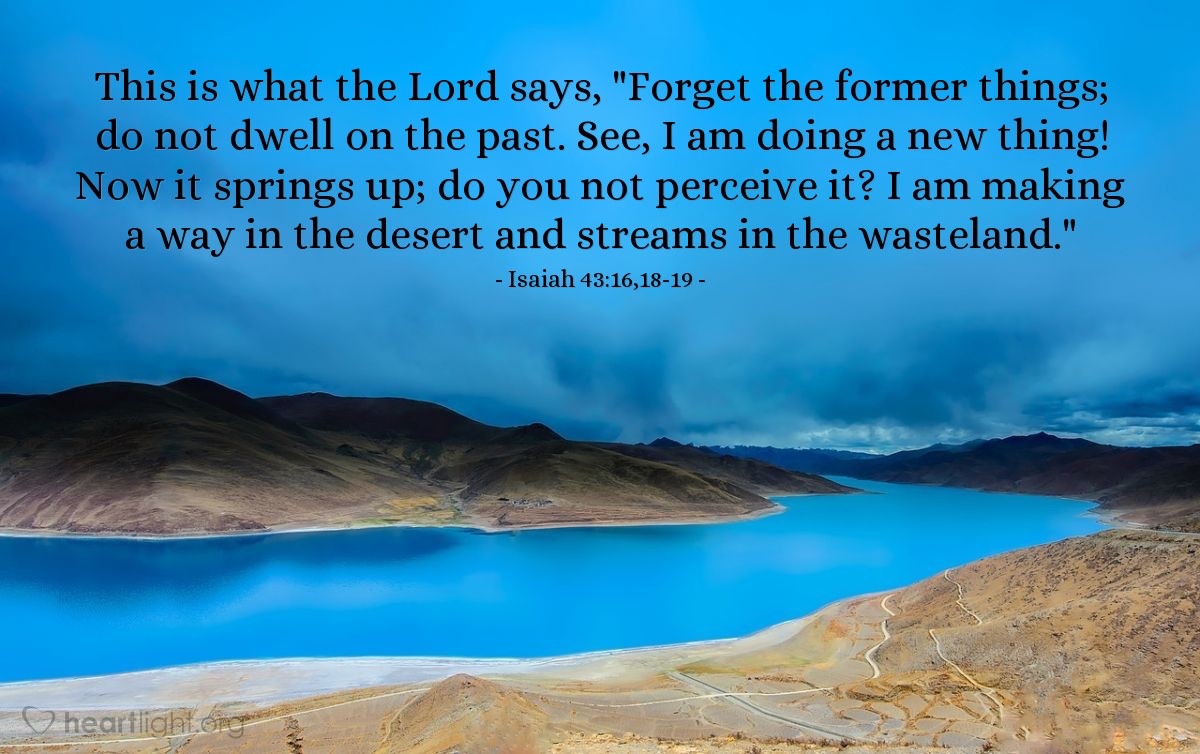
“Do not remember the former things, or consider the things of old. I am about to do a new thing; now it springs forth, do you not perceive it?” (Isa 43:18–19).
These words are attributed to the prophet Isaiah, who lived in the southern kingdom of Judea eight centuries before Jesus, serving as a “court prophet” during times of abundance. Isaiah was active a time when the southern kingdom of Judah was flourishing. He became active in the last years of the reign of Uzziah, who, it was said, ruled as king for fifty-two years (788–736). He lived through the reigns of Jotham and Ahaz (16 years each), and died towards the end of the reign of Hezekiah, who himself enjoyed 29 years on the throne.
The year of Isaiah’s death is uncertain; he may well have been alive, still, when the Assyrian army of Sennacherib laid waste to the northern kingdom (722–721) and deported the northerners to clear the land. In such a context of stability, however, the promise that God would do “a new thing” sits somewhat uneasily in the situation we can reconstruct.
This is one reason why many scholars maintain that the section of the book of Isaiah where we find this passage (Isaiah 40–55) is set some centuries later, after the southern kingdom itself had been conquered by the Babylonians (587–586), and the people taken into exile in Babylon. This became the pivotal event in the history of Israel, the people as a whole—at least in terms of the stories that we have gathered in the scrolls of the Hebrew Scriptures.
The first 39 chapters of the book of Isaiah focus on Jerusalem and Judah (2:1; 3:1; 5:3; 11:12-16; 22:5-8, 20-25; 26:1) and Assyria (7:10–25; 8:1–10; 10:5–12; 14:24–27); 19:23–25; 20:1–6; 30:29–33). The final section of the book (chs. 36—39) is clearly the describing events of the 720s which led to the Assyrian invasion and conquest of the northern kingdom, Israel.
By contrast, second section of the book of Isaiah has a primary concern for the power which had taken the people of Judah into exile—Babylon (43:14–21; 47:1–15; 48:14, 20–21). The prophet promises a return to Jerusalem (40:1–2), but it is identified as Zion (40:9; 41:27; 46:13; 49:14; 51:3, 11, 16; 52:1-2, 7-8).
There are many stories in Isa 1—39 relating to the personal life of the prophet, but no such personal connections in Isa 40—55. By contrast, a very direct historical reference, in a section referring to Cyrus, King of Persia (44:24–45:19), indicates a later setting. Cyrus ruled the Achaemenid Empire from 559 to 530 BCE and, after defeating the Babylonians in 539, issued a decree permitting the exiled Israelites to return to their homeland.
We have already reflected on one passage from this section of Isaiah (55:1–12, Lent 3), noting how it differs from the worldview and understanding of God from earlier periods in the life of Israel.
This passage thus comes from a time when the Israelites were in exile in Babylon. It was not a happy time for many of the people of Israel. (Psalm 137 is the classic expression of this; note especially the anger expressed in verses 8–9.) The people of Israel yearned to return home (Jer 29:10–14; 30:1–31:26). They looked back on the past with longing eyes. They remembered their years in the land which God had given to them. Now, they were living among Babylonians—foreigners, conquerors.
Soon, they would leave behind these memories, and grasp hold of the future that God has for them. God would “send to Babylon and break down all the bars” (43:14). God, the prophet declares, is doing a new thing! (43:19).
And yet, that “new thing” is informed by the past. The people once travelled out of slavery in Egypt, into freedom in Canaan, leaving behind the Egyptian “chariot and horse, army and warrior”, stuck in the waters of the sea that suddenly swamped them—“extinguished, quenched like a wick” (43:17; cf. Exod 14:26–31, 15:4–12, 19, 21). In the time of the prophet, “the shouting of the Chaldeans will be turned to lamentation” as the people depart (43:14).
In like manner, now, the people will take the journey back home, pass through the desert, and return to their land. The one who made “a way in the sea, a path in the mighty waters” (43:16) during the Exodus from Egypt (Exod 15), will now “make a way in the wilderness” (43:19) for the people to follow, leading them right back to the land from which they had been forcibly removed decades earlier (2 Kings 25:1–21; 2 Chron 35:15–21).
As they were sustained in that desert journey long ago, so God now will give “rivers in the desert” (43:19) which will provide “water in the wilderness … to give drink to my chosen people” (43:20) as they travel on that way. That caled for shouts of praise to God! (43:21).
The Exodus imagery was potent for Israel; not only was the story developed over centuries to provide a story of origins for Israel, but it was also co-opted into the prophecies predicting the return to the land, providing those oracles with greater strength and rigour. (And, of course, the story continued on into the feast of Passover, the annual celebrations which continue amongst Jews right through until the present day.)
The Exodus imagery also undergirds the Christian story. Jesus, declared by John the Baptist to be the lamb of God (John 1:29, 36), affirmed by Paul as the new Passover lamb (1 Cor 5:7), envisaged by the ageing prophet on Patmos to be the slaughtered lamb (Rev 5:6–14), is believed to enact a new Passover for his followers, according to the developing Christian tradition.
Just as the shedding of the blood smeared on the doorposts of the Israelites was their salvation (Exod 12:7, 13, 22–23), so the shedding of Christ’s blood is understood to effect salvation (Rom 5:8–10; 1 Pet 1:18–21). So the age-old imagery and symbolism is reworked by the early Christian writers, continuing the process seen in the words of the prophet speaking during the return from Exile (Isa 43:16–21).
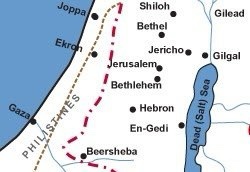
The Hebrew Scripture offered for this coming Sunday passage (Joshua 5:9-12) occurs at the end of the period of Wilderness Wanderings that the Israelites experienced. It takes place at Gilgal, to the east of Jericho, just inside the land of Canaan, which has been the destination in view throughout those forty long years of their wilderness journey.
At Gilgal, things start to change. There, the manna and the quails that had consistently been provided throughout their Wilderness Journey (Exod 16; Num 11), now ceased. The people had to leave behind that aspect of their past. And many of us would know that changing habits after forty years is difficult, is it not?
At Gilgal, the place of transition, the Israelites are now in the land of the Canaanites. Their diet would change. The Israelites would start to eat from the produce of the land. They would enculturate with the people already living in the land. Over time, they would marry Canaanites. They would adopt new customs. Their language would change. They would become, not wanderers in the wilderness, but settlers in the towns and villages of the land. Changes would happen. A very significant transition would take place.
This all begins at the place called Gilgal. Gilgal is a Hebrew word meaning “circle”. It was adopted as the name for the place in this story where Israel marked their transition from fugitives fleeing the slavery of Egypt, to invaders conquering the land that they believed they had been given. At Gilgal, a gilgal (circle) of stones was set up (Josh 4:1–9). The circle in this place marked the moment of transition, as the people cross the Jordan into the land.
The Hebrew offers a neat word play: where the circle is (Gilgal), the Lord rolled away (gallowti) the reproach of Egypt. The reproach was the fact that Israelite boys were not circumcised during the wilderness wandering (5:5)—the covenant which was signalled by the mark of circumcision (Gen 17) had been forgotten (Josh 5:1–5). So, Joshua ordered that circumcisions should be carried out on the Israelite males at this place (5:3). Once they had adhered to the forgotten covenant, and reinstitute the overlooked sign of that covenant, the people were able to live in the land that had been promised (5:6–9).
The Passover meal that is shared at Gilgal (Josh 5:10–12) recalls the swift departure from Egypt (Exod 14). Entry into the land means that the wilderness provision of manna ceases; “the land flowing with milk and honey” (5:6) would provide abundant nourishment. So it is, that both Passover and Gilgal signal transition—the liminal space of crossing over into a new experience. Stepping into the river, and then out on the other side, would effect a transformation in the people of Israel.
We talk about Lent as a season when we prepare for the annual Easter celebrations. During this time of preparation, we are encouraged to pay attention to what is important in our faith. Through this season, as we pray, read scripture, and share with one another, we are able to grow in our faith, deepen in our understanding, and strengthen our discipleship.
During this time, it could be possible that we grow in understanding of God. The Hebrew Scripture passage for this coming Sunday invites us to consider exactly that process of growth. Isaiah 55:1-13 offers insights into this process of development.
Early in the times of Israel, the relationship God was understood in very material, tangible ways. God brought the rain and the sunshine that enabled the crops to grow—a key focus for an agricultural people living off the land. Eliphaz, the friend of Job, advised him that God “gives rain on the earth and sends waters on the fields” (Job 5:10).
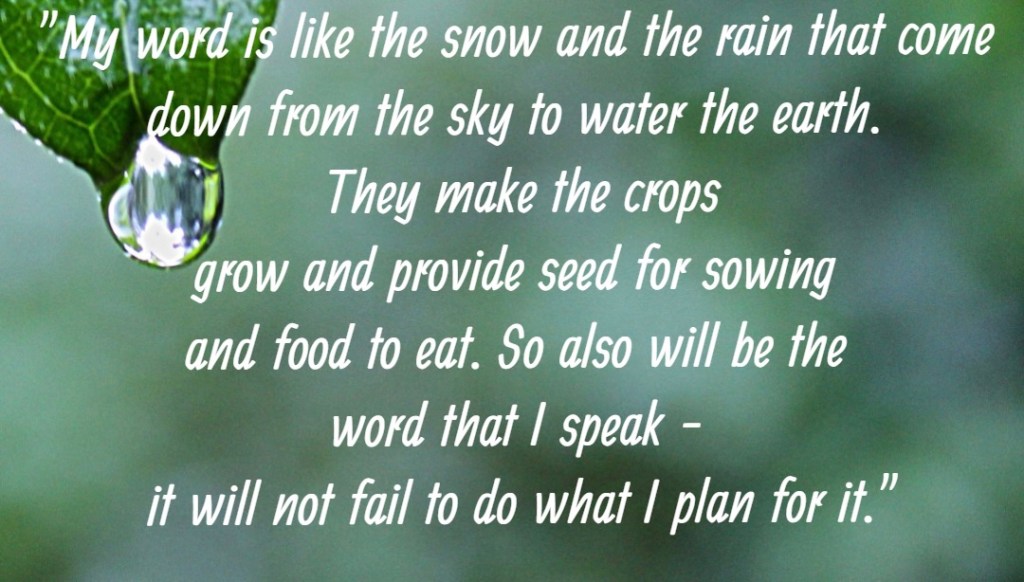
The psalmist affirms this traditional understanding, affirming that “rain in abundance, O God, you showered abroad” (Ps 68:9), and rejoicing, “sing to the Lord with thanksgiving … he covers the heavens with clouds, prepares rain for the earth, makes grass grow on the hills” (Ps 147:7–8). In like manner, this passage from Isaiah declares that, “as the rain and the snow come down from heaven, and do not return there until they have watered the earth” (Isa 55:10).
Jesus repeats this ancient agricultural belief about God: “he makes his sun rise on the evil and on the good, and sends rain on the righteous and on the unrighteous” (Matt 5:45). It still held good for the largely agricultural society of his day. At that time, as for centuries past, there had been a clear understanding that God was intimately related to the land of Israel.
“I am the Lord who brought you up from the land of Egypt, to be your God; you shall be holy, for I am holy”, God is reported as saying (Lev 11:45). The holy God chose a holy people, who are then led into a holy place, the land of Canaan. In a story told about “once when Joshua was by Jericho”, Joshua encountered “a man standing before him with a drawn sword in his hand” who reveals himself as “a commander of the army of the Lord” (Josh 5:13–15).
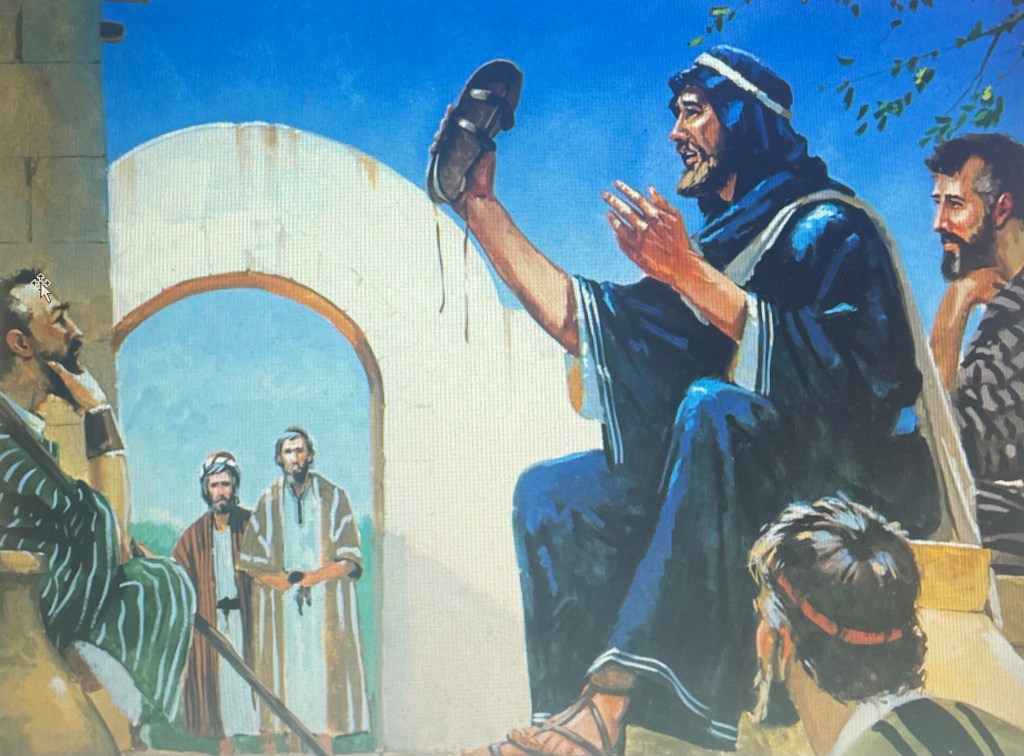
The story indicates that God said to Joshua, “Remove the sandals from your feet, for the place where you stand is holy” (Josh 5:13–15). From this story, this verse, Israel becomes known, even to today, as The Holy Land. Holy God, holy people, holy land, all intimately linked with one another.
And in that holy land, King Solomon built “the most holy place” (1 Kings 7:50), and “the priests brought the ark of the covenant of the LORD to its place, in the inner sanctuary of the house, in the most holy place, underneath the wings of the cherubim” (1 Kings 8:6). The holy land had the most holy place at its heart.
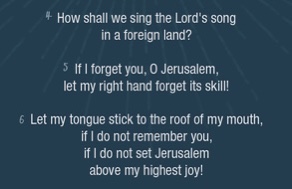
Being sent into exile in Babylon after this period of consolidation and growth in their “holy land” was a shock to the people. Life in exile was quite different from life in the land. “How could we sing the Lord’s song in a foreign land?”, the psalmist laments (Ps 137:4).
Life in Jerusalem was still what they yearned for, in exile (Ps 137:5–6); indeed, the intense anguish (and unhealthy hatred) expressed in the final verse of this psalm is striking: “happy shall they be who take your little ones and dash them against the rock!” (Ps 137:9). It was not a happy time, at least for some.
However, it is not surprising that, after a period in exile, ideas about God were changing. The Israelites in exile in Babylon had maintained faith in God, even though they were no longer living off the land where God had placed them. The Exile had severed their connection with the land, and thus a loss of connection with God was feared. Surely God would not abandon them?
Indeed, the people developed an understanding that God had not abandoned them as they left the holy land; God had, in fact, travelled with them into Exile, and back into the land on their return. The passage from Isaiah 55 demonstrates this. Although it is in a book under the name of an 8th century prophet, is in a later section of that book, most likely put together with the earlier sections some time after the return from Exile in the 6th century. It reflects the changes in circumstances and understandings of the people who lived through those challenging circumstances, over a number of decades in Exile, before they returned to the land.
The covenant which they had entered into long ago (see last week’s passage, Gen 15), was still in force and to be honoured: “listen, so that you may live. I will make with you an everlasting covenant, my steadfast, sure love for David” (Isa 55:3). Even in their exile, “the LORD your God, the Holy One of Israel, he has glorified you” (Isa 55:5).
As a result, how they understood God had changed. God was not tied to the land of Israel—and particularly, not to the Temple in Jerusalem. God had become “mobile” once again, just as he had been in the period of the wilderness wanderings, the Judges, and the early years of the monarchy, when the Ark was the place where God was to be found (and the Ark was, of course, quite logically travelling with the people during those decades).
Their belief developed to incorporate an understanding that God was not intimately bound to the land. People from Israel continued to live on in the lands of exile, even after they were able to return to their “holy land”. They had married, planted vineyards, established roots in those dispersed communities (Jer 29:4–7). God remained faithful to the covenant, but God’s ways were not the ways of tradition and convention. God was understood to be a dynamic entity, changing and developing as the situation required.
The people were invited into a different form of relationship with God, nourished by a different type of bread, which the post-exile prophet identifies in this oracle. From the Exile experience, it was the sense of God’s word that had become primary for the people: “listen carefully to me, and eat what is good, and delight yourselves in rich food” (55:2).
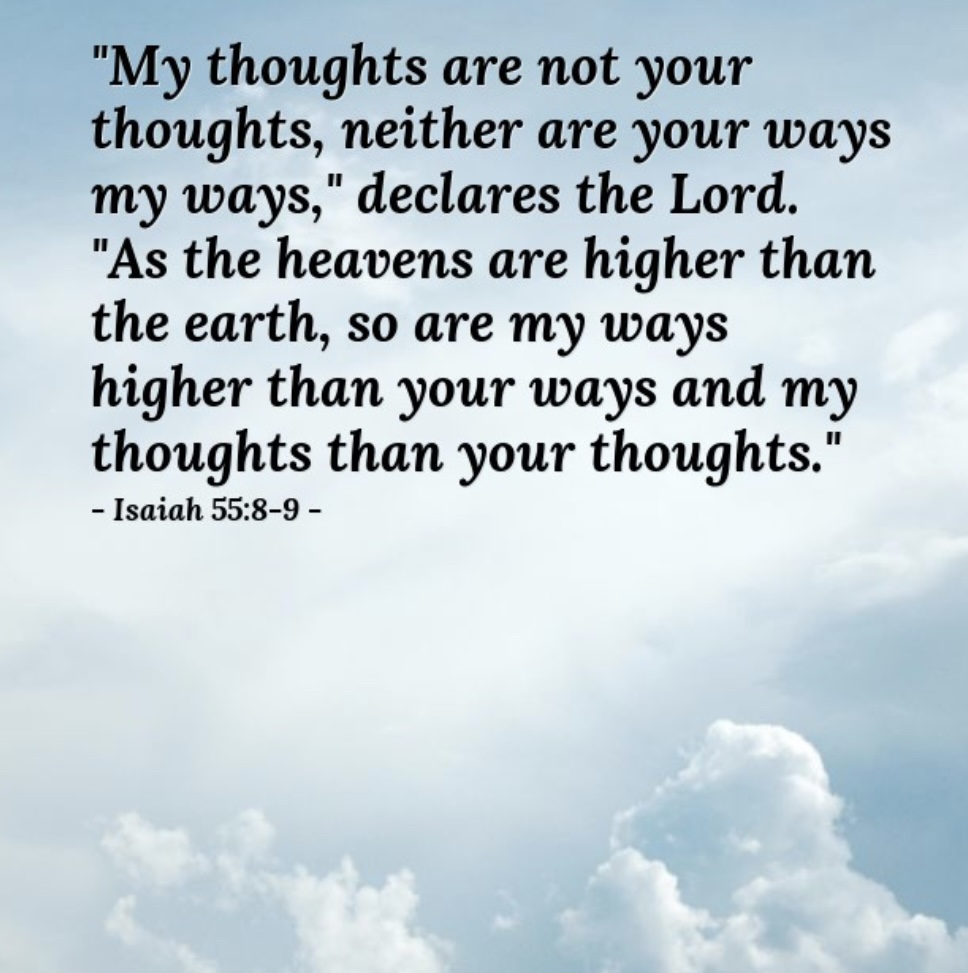
And in being nourished by this new form of food, God’s word, the people will discover new things about God: “my thoughts are not your thoughts, nor are your ways my ways, says the Lord; my ways are higher than your ways and my thoughts [are higher] than your thoughts” (55:8–9). A new way of understanding God, and God’s ways, was opening up before the people.
Understandings of God develop and change—as then, in post-exilic Israel, so too, now, in the post-modern contemporary world. May this be our experience, this Lent, as we dig deep into the resources of scripture and tradition in this special time.
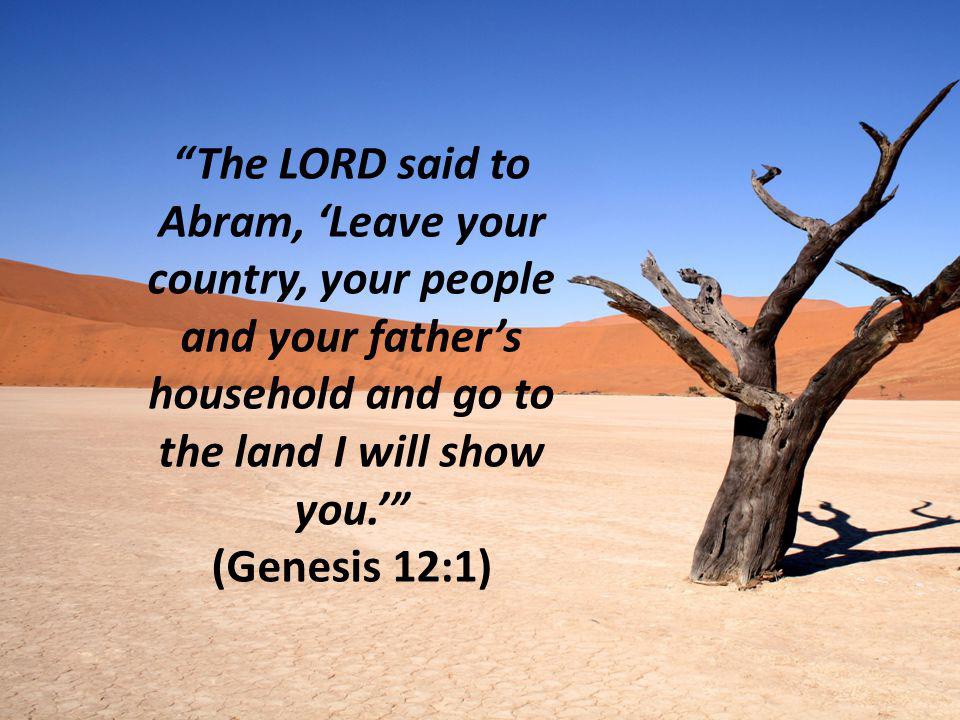
The saga of Israel begins with stories about the ancestors held in highest regard as the mother and father of the nation: Sarai and Abram. The command that they heard is set out at the beginning of their story: “Go from your country and your kindred and your father’s house to the land that I will show you” (Gen 12:1). The saga of this couple will reach fulfilment, many chapters and many centuries later, when their descendants enter the land and settle in Canaan (Joshua 1–6).
For the moment, Abram set off, with his extended family: “his wife Sarai and his brother’s son Lot, and all the possessions that they had gathered, and the persons whom they had acquired in Haran” (12:5). Haran was a strategic city in the upper reaches of the area we know as the Fertile Crescent, far from the land of Canaan (over 12,000km). The call was to travel that distance, to Canaan.
That call, to enter the journey and remain persistent along the way, is a call that we do well to recall each Lent, as we navigate the journey of this season, calling us towards the climactic story of the Christian faith, in the death and resurrection of Jesus.
For support and sustenance along the way, Abram and Sarai were called into covenant relationship with God. The formalising of the covenant is reported later in this chapter, at 15:18, with a promise that the descendants of Abram and Sarah will indeed have the land that is specified. That, I would argue, resonates also with the Lenten journey; these current weeks of preparation for Easter beckon us to re-commit to our covenant, the one that we ourselves have with God. So these later verses are included in our reading for this Sunday.
(The question about the people already living in the land—those specifically identified in 15:19–21, merits separate consideration. The invasion of Canaan and conquering of these people by the people of Israel raises difficult questions.)
Abram and Sarah had left their homeland with some assured promises from God; they would be parents of a great nation, blessed by God, remembered as having a great name, and that all the nations of the earth would be blessed through them (12:1–3). Those promises were intended to hold Sarai and Abram to the journey, despite all that they might encounter. The end result would make the travails along the way bearable.
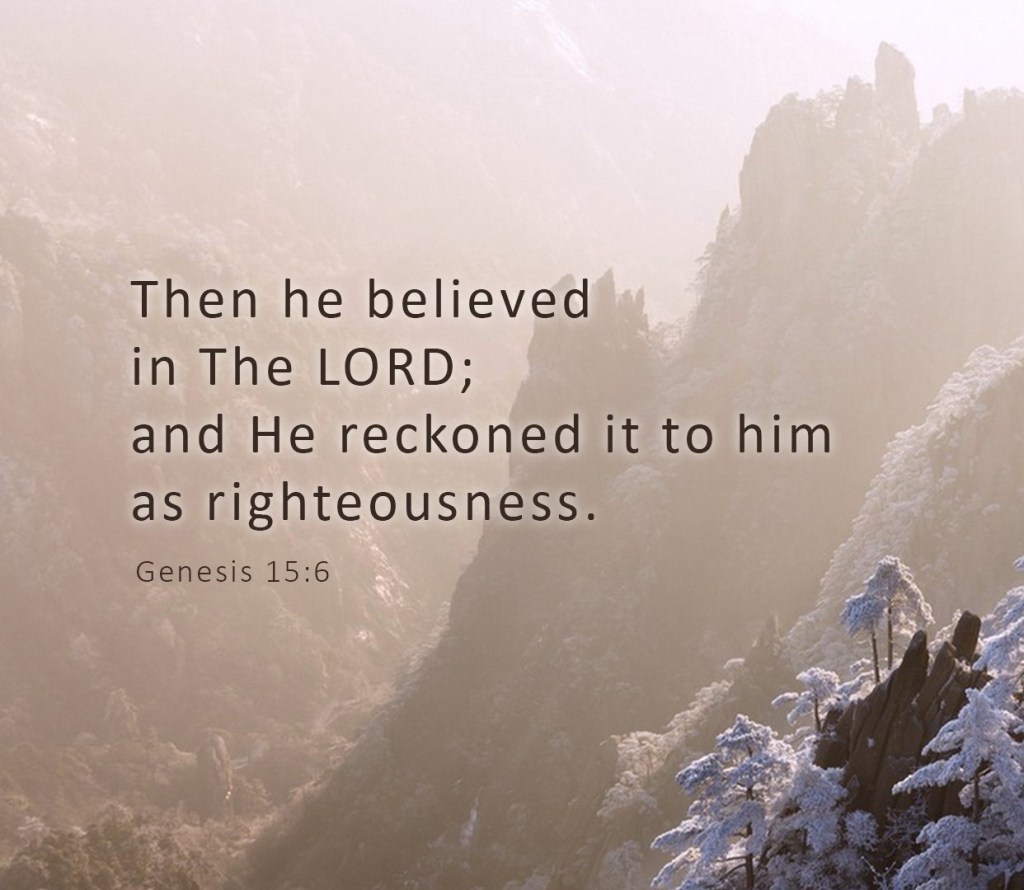
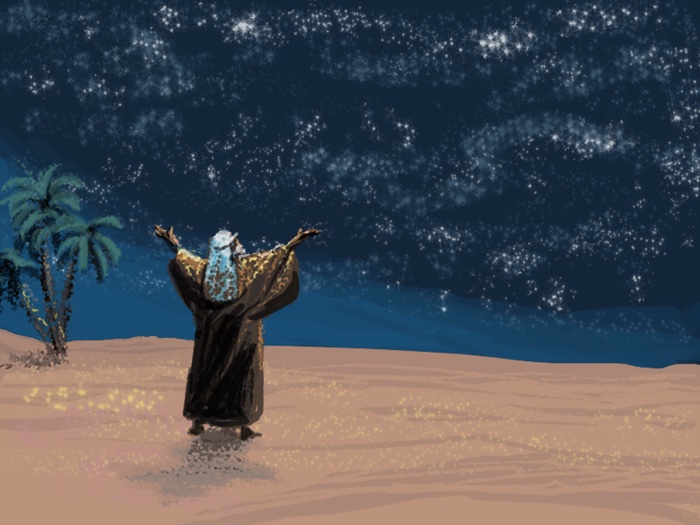
However, Abram expresses some doubt that the promises made by God would come to pass (15:2-3). God’s response is to provide further reassurance; the multitude of stars in the sky is testimony to that (15:5). Abraham’s resulting affirmation of faith leads to the famous phrase, so central to Paul’s later argument about righteousness: “he believed the Lord; and the Lord reckoned it to him as righteousness” (15:6; see Rom 4:3, 9, 22). In a way, this story sets the foundations for later Christian faith, as we see the grace of God at work in relating to Abraham.
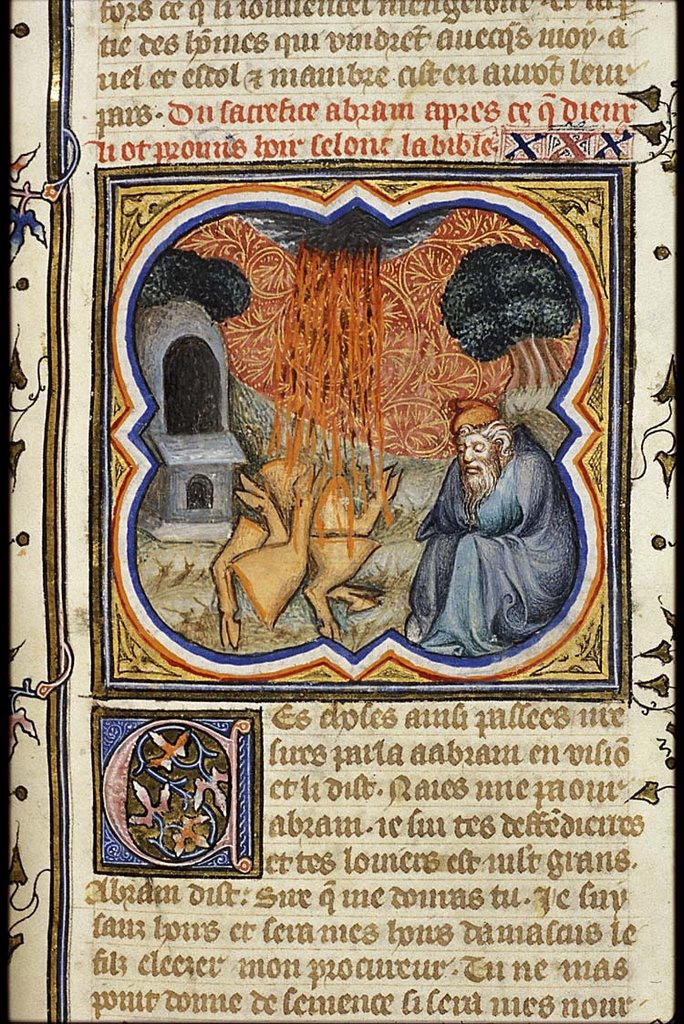
The ceremony that follows adheres to the traditional cultic practices of the time. A collection of sacrificial victims, two animals and two birds, are offered and slaughtered, and the animals are cut in two (15:9–11). (The phrase, “to make a covenant” in Hebrew, can literally be rendered as ”to cut a covenant”.) Such practices signal the seriousness of the moment and send the message that each party will keep their word on pain of death.
Indeed, the prophet Jeremiah later alludes to this specific provision, when he warns recalcitrant Israelites that “those who transgressed my covenant and did not keep the terms of the covenant that they made before me, I will make like the calf when they cut it in two and passed between its parts” (Jer 34:18, referring to Gen 15:10). The prophet continues, “their corpses shall become food for the birds of the air and the wild animals of the earth” (Jer 34:20, an allusion to Gen 15:11).
This ancient cultic sacrificial practice of cutting animals does not reflect modern practices and is, in fact, distasteful to contemporary sensitivities. That might prod current readers to dismiss this passage as archaic, irrelevant, obsolete. That would be a shame. It remains relevant to us in a striking way.
Abram and Sarai reveal both trust in the promises they have been given, but also articulate some uncertainty about whether God would continue to be faithful to those promises. How human this is! In this regard, they reflect the somewhat ambivalent way that each of us relate to the promises of God: living out our trust and hope in the midst of the challenges, changes, and obstacles along the way, yet still holding back, somewhat dubious, about the ultimate reality this all.
It’s a perfect vignette for Lent, for the period when we reconsider how God had been at work in our midst, when we reconsider our commitment to the covenant we have made with God, and how live out that covenant in the realities of discipleship. It reminds us of the call to full-blooded, whole-scale, all-of-life commitment to the covenant that we have with God through Jesus.
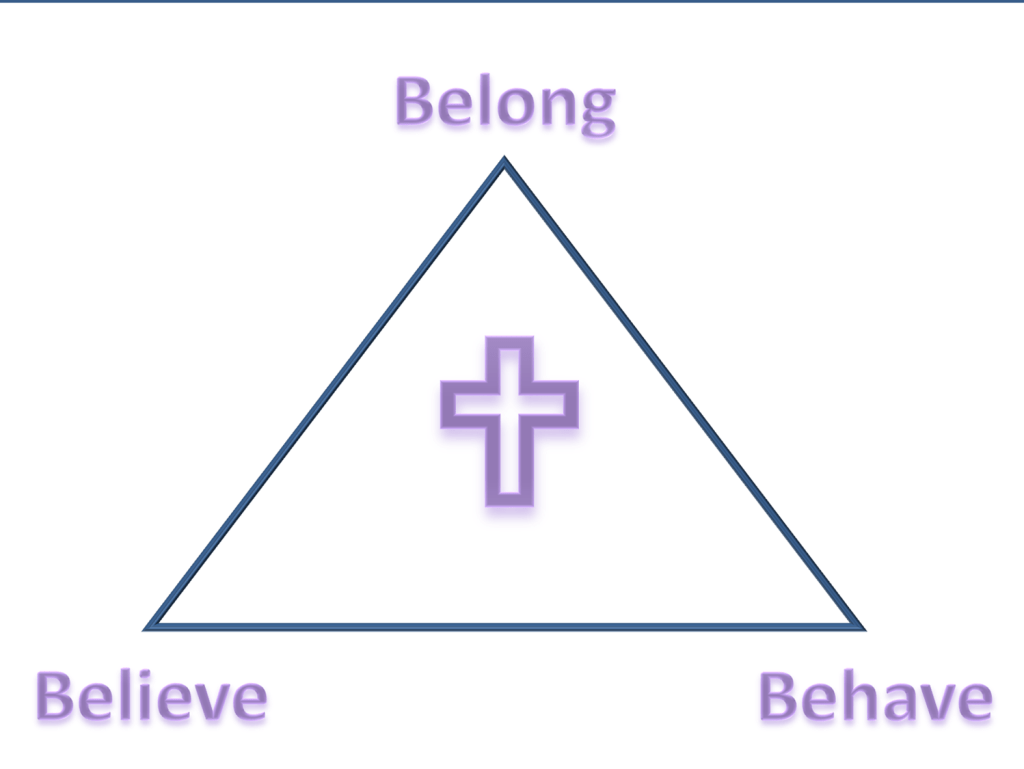
There is much debate amongst Christian thinkers, these days, about what comes first as we invite people to be a part of the church. Do we say, “this is what we believe, expressing our fundamental understanding of life; do you want to sign up to show you have the same beliefs?” Or do we say, “this is how we behave, guided by our fundamental ethical principles; would you like to act the same way and join us?” Or perhaps the invitation is simply, “come along, join in with us, see what we believe, what we are on about, and soon you’ll feel like you belong”?
Is it believe first? Or behave? Or simply, belong? The tendency to put a creed at the forefront of our invitations—to show that we are a people who believe, first and foremost—is widespread and deeply ingrained. Whether it be affirming The Apostles Creed in baptism, or saying The Believer’s Prayer at conversion, or working out a new Mission Statement for the Congregation, giving priority to belief is a very familiar pattern for us. We tend to think that, whatever formula we are repeating, that is exactly what declares and confirms our identity as people of faith.
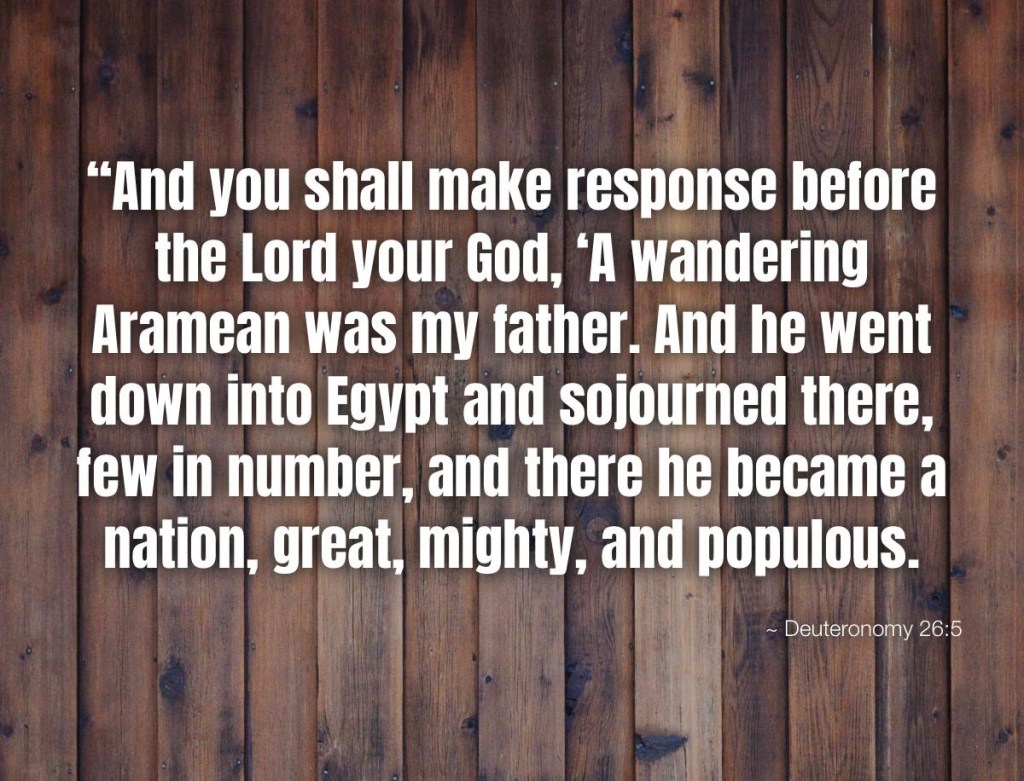
So it’s no surprise that when we read Deuteronomy 26 (the Hebrew Scripture passage in next Sunday’s lectionary), we gravitate to the middle part of the passage, and lay claim to what looks to be an early affirmation of faith that sets out the identity of the people of Israel: “A wandering Aramean was my ancestor; he went down into Egypt and lived there as an alien, few in number, and there he became a great nation, mighty and populous” (Deut 26:5). This affirmation seems to go right back to the start, affirming what sets the people of Israel apart as a distinctive entity.
This way of reading this passage gained influence from the analysis of Gerhard von Rad, a German scholar of the 20th century. Von Rad claimed that the credal statement in verses 5 following was most likely a formula much older than the era when the book of Deuteronomy was written. And the origins of this creed, he claims, most likely lay in ancient cultic remembrances of the origins of the people. The wandering Aramean (Jacob, grandson of Abraham of Aramn) and the time in Egypt (leading up to Moses) reflect those times of origin.
*****
But the whole of this “creed” is not actually a “statement of faith”. It is more a narrative that tells a story. Such was the way of the ancient world; central beliefs were not articulated in crisp propositional statements (for this is the way of the post-Enlightenment western world); rather, a story was told, in the course of which key events pointed to central affirmations for the people. The ancients were story-tellers, more concerned to tell the story than state the faith. This is the story of the people; it is their saga.
God is important in the story that is told, nevertheless. God is the one who “heard our voice and saw our affliction, our toil, and our oppression … who brought us out of Egypt with a mighty hand and an outstretched arm, with a terrifying display of power, and with signs and wonders” (26:7–8). The rescue of the people by their powerful God is central to the story. This, of course, if the story of the Exodus, which stands at the heart of Israelite identity and later Jewish identity. It is the central story of the people of Israel.
More than this, God is the one who “brought us into this place and gave us this land, a land flowing with milk and honey” (26:9). The land of Israel is the second aspect of ancient Israelite life that is central and fundamental; and so it continues to be, in the 20th and 21st centuries, in which the land of Israel has been one of the most contested pieces of land in the world.
The story is told, however, for a purpose. Not just to remember—although remembering is important, for it recurs as a regular refrain in the book of Deuteronomy (7:18: 8:2, 18: 9:7, 27; 11:2; 15:15; 16:12; 24:9, 18, 22; 25:17; 32:7). The story is told, also, to inculcate the ethos, the values, the very identity of the people. And central to that ethos, taking prime place amongst the things that were seen to be important to affirm about who the people of Israel were, is this: giving back to God the first fruits produced by the land.
“So now I bring the first of the fruit of the ground that you, O LORD, have given me”, are the words that the people are to say, each time a harvest is produced. “You shall set it down before the LORD your God and bow down before the LORD your God”, the instruction declares (26:10). Gratitude is to the fore; gifting back the beginnings of “the fruit of the ground” to the God who gave the people the land to grow this fruit.
*****
Of course, there is a dark story submerged, for the most part, underneath that celebratory action. The land was “given” by God over the resistance of the people who were already IN the land, producing fruit, settled and content with their lot in life. The battles recounted in the book of Joshua—most likely not actual historical events, but reflecting a reality of submission to the Hebrews who took control of the land—reflect this dark story.
This dark story does not figure in the “received tradition” and “authorised affirmation” that we read in Deut 26. Nor do we find this in the affirmation of Deut 6:20–24, which begins “we were Pharaoh’s slaves in Egypt, but the Lord brought us out …”. Mention of the Exodus jumps straight across to life in the land—no mention of the conquest that (in other biblical texts) is reported in detail.
This conquest is part, by contrast, of the larger recitation of Josh 24:2–13, “I brought you out of Egypt … and I handed the Amorites over to you, and you took possession of their land, and I destroyed them before you … and also the Amorites, the Perizzites, the Canaanites, the Hittites, the Girgashites, the Hivites, and the Jebusites; and I handed them over to you … I gave you a land on which you had not labored, and towns that you had not built, and you live in them; you eat the fruit of vineyards and oliveyards that you did not plant.” At least this version of the affirmation is honest about the cost to the earlier inhabitants, and the benefits enjoyed with relative ease by the invading Hebrews.
*****
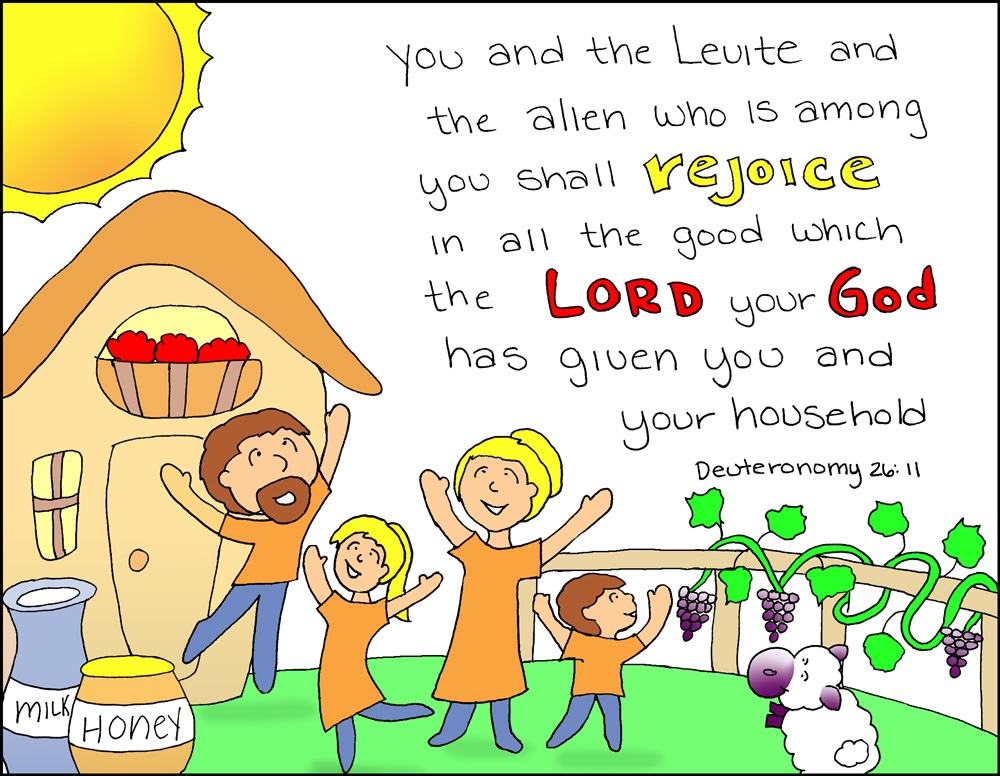
Yet the affirmation of Deut 26 highlights the central importance of gratitude for the gift of the land; and not only that, for it especially indicates the importance of making this celebration inclusive: “you, together with the Levites and the aliens [or, sojourners] who reside among you, shall celebrate with all the bounty that the LORD your God has given to you and to your house” (26:11). So the instructions for the annual festival of the first fruits provide.
The inclusion of the aliens in this annual festival reflected a gracious openness to others in the developing people of Israel. These texts differ from the xenophobic antagonism of earlier texts, recounting the conquest of Israel. They reflect a later understanding of the identity of the people, as they were collated during and after the Exile, centuries after the formation of Israel. People designated as aliens (non-Israelites), sojourners in the land, were welcome to bring offerings to the Lord (Lev 22:18), to adhere to Israelite food prescriptions (Lev 17:12), to keep the Sabbath (Exod 20:8–11; 23:12), to have gleaning rights (Lev 23:22), and to join in the annual process of atonement (Lev 16:29–31; Num 15:29).
The foundational Passover narrative indicates that aliens, or sojourners, were able to join (under certain conditions) in the Passover celebrations (Exod 12:47–49); a second narrative (Num 9:14) is much less restrictive. Aliens were to be subject to the same laws regarding murder (Lev 24:17–22), able to have right of access to cities of refuge (Num 35:13–15), and indeed to enter into the covenant at the annual covenant renewal ceremony (Deut 29:10–13; see also 31:10–13). The voice of the alien even sounds appreciation for the Law: “I live as an alien in the land; do not hide your commandments from me” (Ps 119:19).
Because Israelites were once “an alien residing in the land” of Egypt, the people were instructed, “you shall not abhor any of the Edomites, for they are your kin; you shall not abhor any of the Egyptians” (Deut 23:7); by the third generation, the children of aliens “may be admitted to the assembly of the Lord” (Deut 23:8).
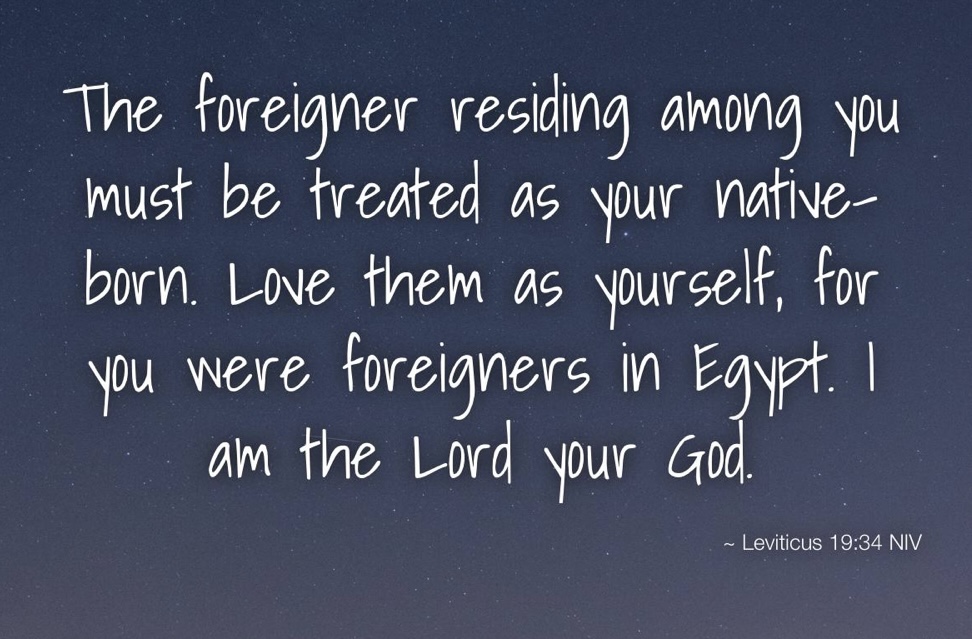
This meant that “the alien who resides with you shall be to you as the citizen among you; you shall love the alien as yourself, for you were aliens in the land of Egypt: I am the LORD your God” (Lev 19:34; a similar affirmation is made at Num 15:14–16).
The principle of equality is clear: “you shall not deprive a resident alien or an orphan of justice; you shall not take a widow’s garment in pledge” (Deut 24:17; see also Jer 7:5–7; 23:5–7; Zech 7:9–10; Mal 3:5). The alien, or sojourner, deserves the same measure of justice as all residents of Israel.
Accordingly, amongst the curses at the end of Deuteronomy, we read, “cursed be anyone who deprives the alien, the orphan, and the widow of justice. All the people shall say, ‘Amen!'” (Deut 27:19). The curse outlines the negative consequences from not adhering to the positive principle of welcoming and including those sojourning for a time innIsrael, the “alien”. That is integral to the celebrations each year, when the harvest produces its fruit from the land.
Gratitude. Belonging. Celebration. Inclusion. All of this is embedded in the story; and all of this comes before believing, repeating doctrinal claims, affirming credal statements. We are a people of welcome, including, belonging. This much is embedded in the ancient Hebrew tradition. This much should be living, still, in Christianity today.
A sermon preached by the Rev. Elizabeth Raine at Tuggeranong Uniting Church on Sunday 7 November 2021
*****
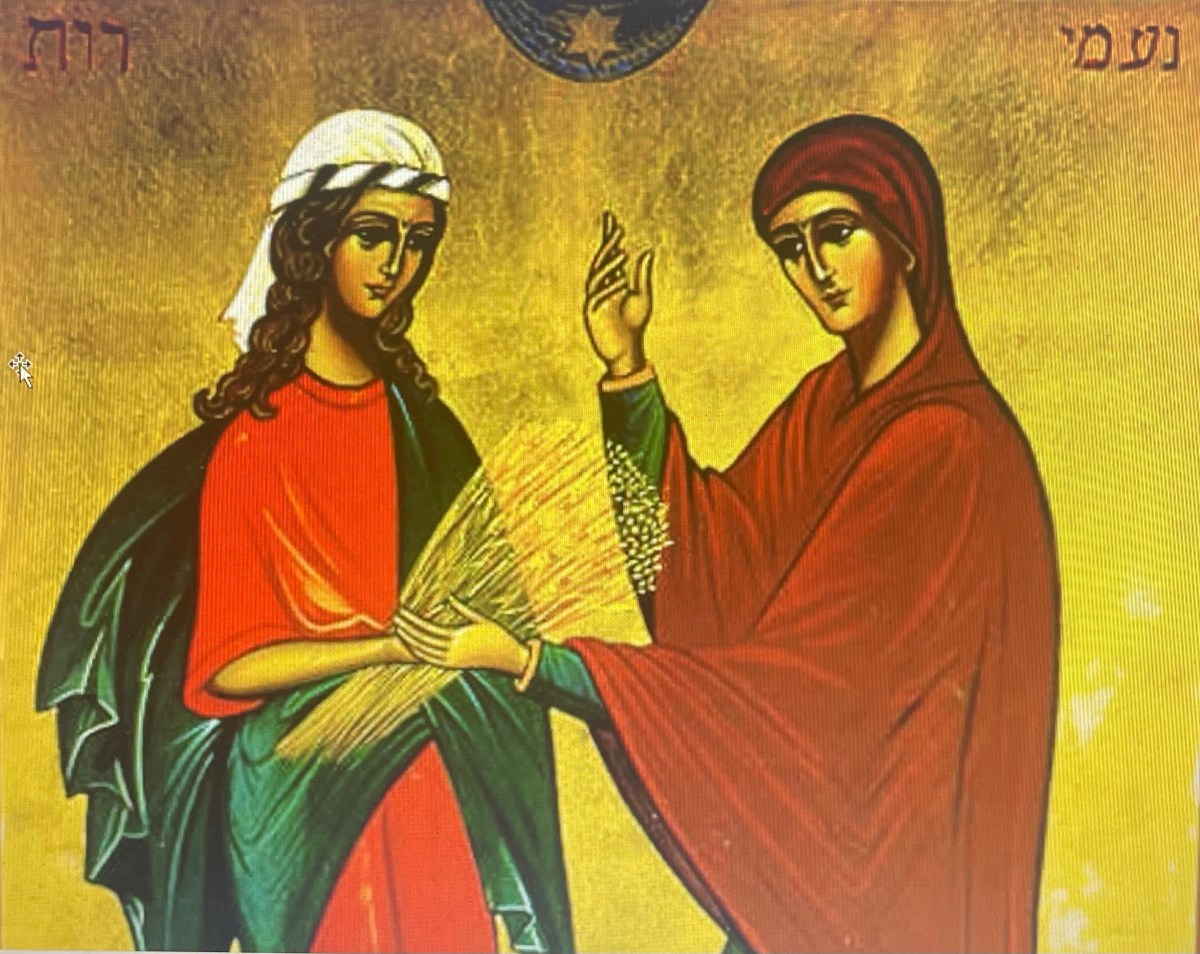
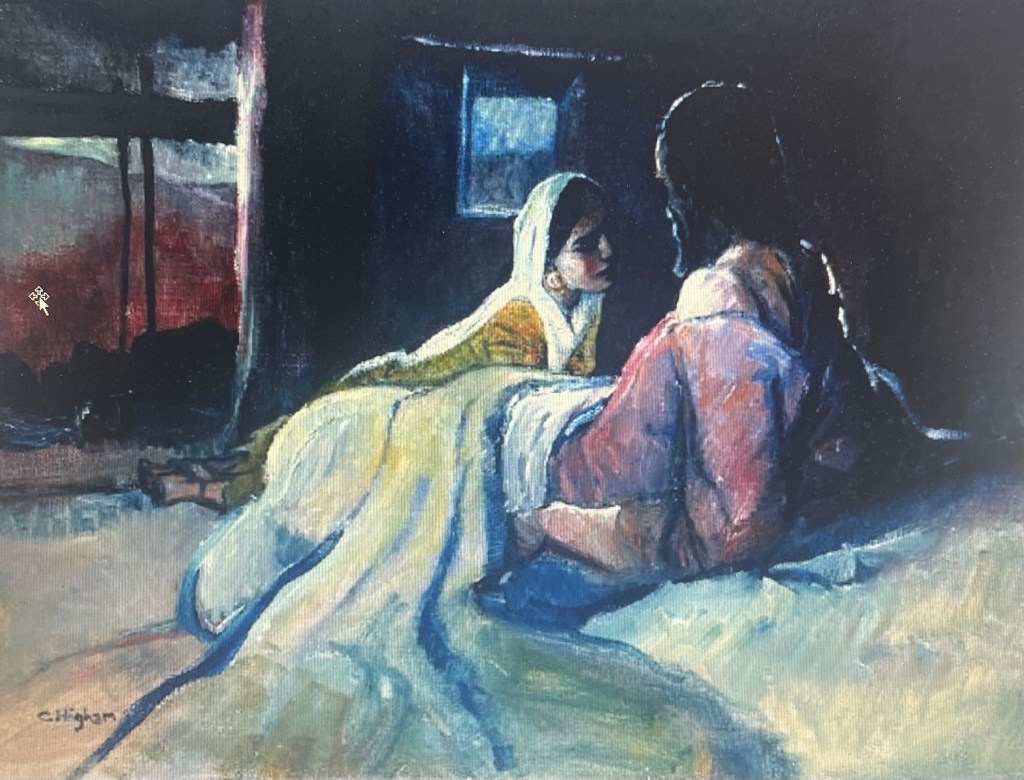
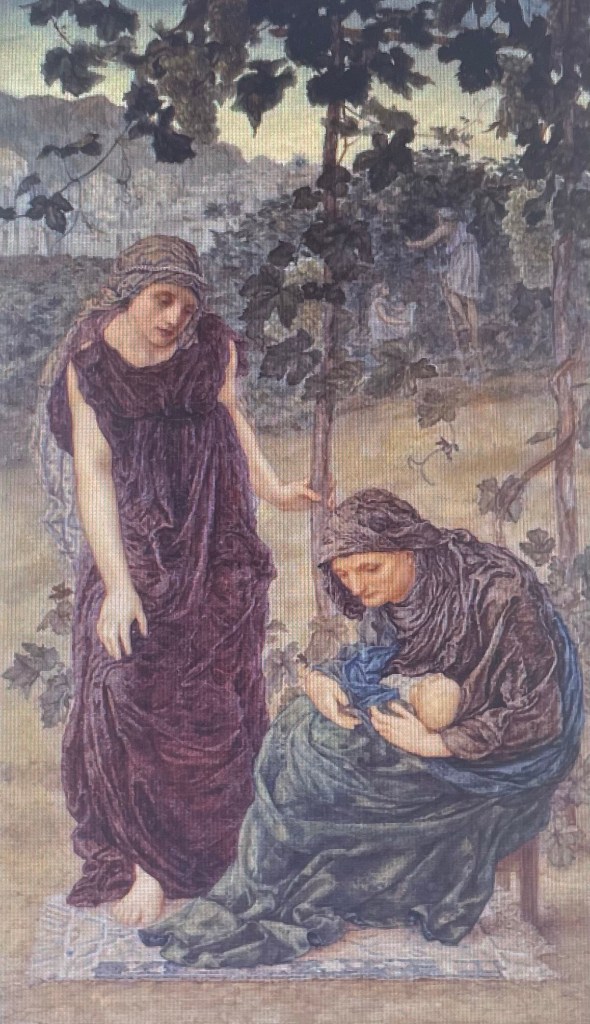
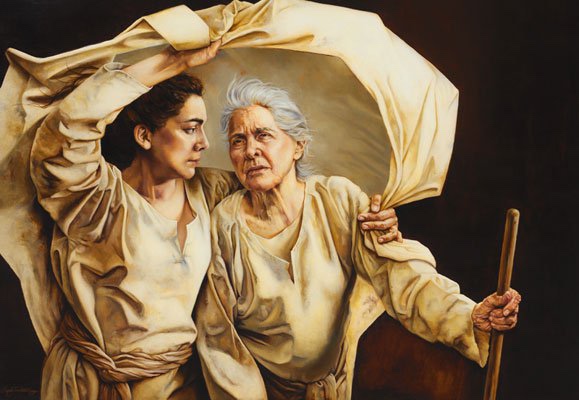
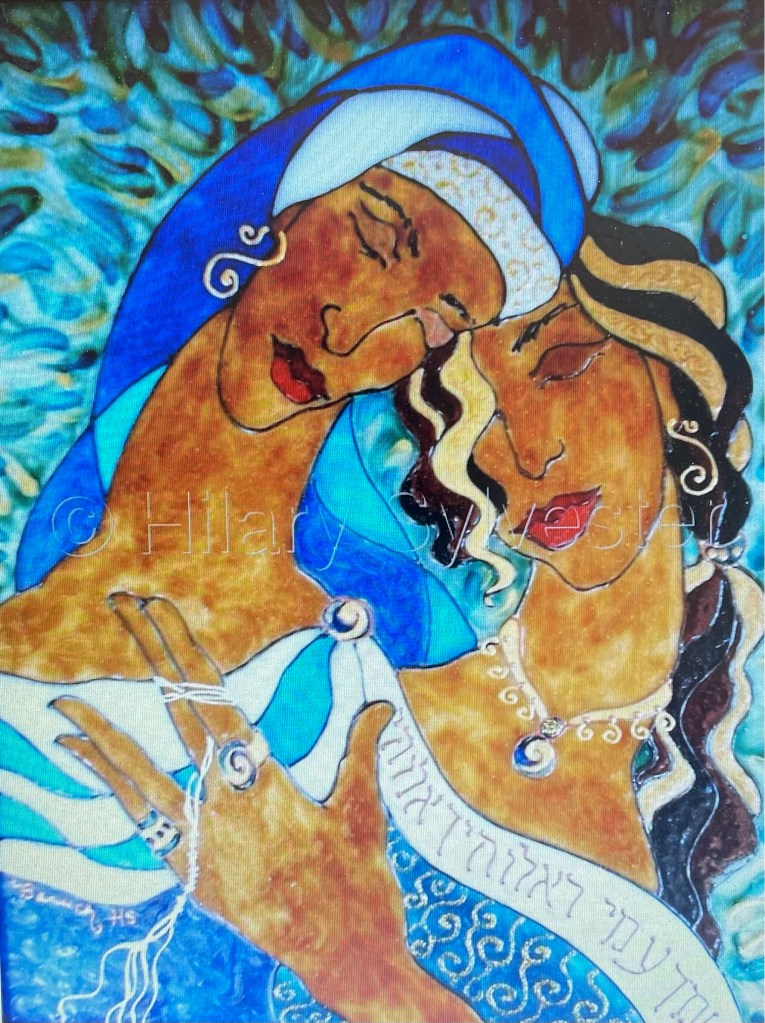
We rejoin Ruth and Naomi in chapter 3, where Naomi takes the initiative to securethe future for herself and Ruth, a future that centres around Boaz as a potential husband for Ruth. Naomi issues detailed instructions to Ruth in regard to staging an encounter with Boaz at the threshing floor, a place with a poor reputation in Hebrew scritpure, where Boaz is working late.
Ruth is instructed to bathe, put onher best clothes, and apply perfume, all which signifies romantic intent. Despite the risk, Ruth dutifully obeys, informing Boaz when she accosts him on the threshing floor that she is “Ruth, your servant; spread your cloak over your servant, for you are next-of-kin.” ‘Spread your cloak’ is a Hebrew euhphenism for sexual intercourse, and Ruth is not only signifying her availability for marriage but her desire that Boaz carry out his duty as next of kin according to the Levirite law.
This law required the next of kin of a deceased husband to father a child for the deadman so that his lineage could continue. Boaz takes the hint, and tells Ruth that though there is a nearer next of kin, he will sort this out tomorrow with that closer family member.
In chapter 2 we noted a number of contrasts: male and female, foreigner and Israelite rich and poor, etc. In this chapter we also find contrasts. Boaz and Ruth had met during the day, in a public place, where the social custom for such encounters were maintained. Here they meet in private under the cover of darkness, and unrestrained by custom, their interaction is quite different. We are now in the private domain of women, signified by the night. Boaz’s prominence, riches and public profile are not as important here. It is both a time of danger and a time of potential promise and blessing.
Despite Ruth’s bold initiative, she and Naomi still live in a world that does not value its widowed women, and their fate rests in the hands of a man with wealth and status. Boaz needs now to fulfill his part of the plan in the public, male sphere of lifein chapter 4.
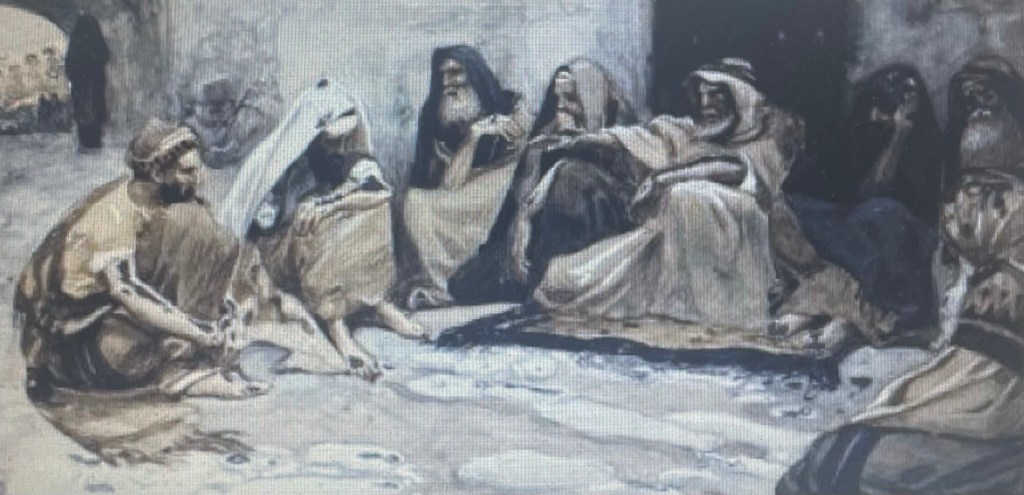
We now return to daylight and the male) domain. The focus shifts from Ruth to Boaz, and from the private to public sphere. Boaz is here to wait for the nearer next of kin, or goel. It is Boaz’s interests that dictate how the exchange between the two men will go, and we can tell this because the Hebrew passage here begins and ends with Boaz’s name. Further, despite the bible translation of ‘friend’, the other goel is called peloni almoni, Hebrew rhyming slang that basically means “old what’s his name”, or “Mr such and such”. Again we see the sense of humour of the author of this book at work.
Boaz is shown to have authority in this society as “Mr what’s his name” and the ten elders do what he tells them to. None of the men he addresses challenges his authority or his right to order them around.
In the ancient Hebrew world, decisions about law, property and finances were made at the town gates, where the men and elders would gather to discuss aspects of law and to enact judgment.
Boaz constructs an elaborate legal argument around an alleged piece of land we haven’t heard of before that Naomi apparently wants to sell. Her nearest kinsman has first right of refusal under Hebrew law. This begs the question: why did Naomi need Ruth to glean if she had land to redeem? Is Boaz resorting to an imaginery piece of land to cover his real aim – which is to acquire Ruth as a wife? It would certainly give him the legal cover he needs for such a proceeding – for even in this rather enlightened book, for someone of Boaz’s social standing to enter into marriage with a Moabite, a foreigner, would be risky if no legal duty is involved.
So while Boaz is apparently concerned with the noble duty of redeeming his kinswoman Naomi’s land, he can just slip in that Ruth is part of the deal as well. Mr “what’s his name” decide that the risk of redeeming the alleged land is too great to him, as if Ruth were to have a child that child could legally claim the land in the future, even if he had paid for it now. So he refuses, and Boaz is free to marry Ruth.
The outcome of this chapter presents a very different family picture from that in the first chapter. Life has replaced death, abundance has replaced famine, fullness of life and fertility has replaced emptiness and barrenness. Amidst the rejoicing of the community, God finally appears as an active character, causing Ruth to conceive a son to Boaz.
Despite this intervention of God, the story is not about divine manipulation or a system where God directly rewards and punishes. The important thing in this story is the role of human action and intervention. God’s grace is bestowed only when such action is taken by the people concerned, and when it concerns all people.
Ruth’s story ultimately has a happy ending because the community decide to accept and welcome her despite being a foreigner.
The book of Ruth challenges us to look more closely at our own cultural context, and how the poor and the foreigner are welcomed and provided for in our community. Even in a world where prosperity has become available for some on a ridiculous scale, many still die of starvation. Many flee countries where food supplies are insufficient, and where opression is rife.
It is clear that true community in our world is broken. Gleaning has been replaced by our welfare system, which is often inadequate to address the real issues facing the poor. If nothing else, the story of Ruth here should challenge us to work for cultural change, to transform the brokeness into a society where all are equally valued.
The little genealogy at the end probably strikes the modern reader as a rather oddaddition, but it has a special function. If further proof is needed by the reader of Ruth that God favours the inclusion of the foreigner, this is it. The gift of children was regarded as a sure sign that God’s blessing was resting upon a person. Ruth is the great grandmother of King David, the most famous of Israel’s kings in the biblical record. The genealogy shows that by accepting the foreigner, Israel goes on to beextraordinarily blessed.
Many generations later, some people in Israel became followers of the one whom they believed had been chosen by God to be the Messiah. They claimed that this man from Nazareth was a descendant of the great King David; this claim would be crucial to establishing his credentials amongst his Jewish contemporaries. And since the man from Nazareth was descended from David, he was also descended from Ruth, the Moabite and foreigner. Without this story of the refugee and the foreigner, who married across ethnic boundaries and became part of a new family, there would be no David – and thus, no Jesus.
From the simple act of welcoming and giving hospitality to the stranger and foreigner, and building a new life with new relationships and new hopes, new outcomes and consequences can happen that were never imagined at the outset.
Lead us, O God, in the way of Christ, the servant, who opened his arms to the poor and the foreigner.
Lead us, O God, in the way of welcoming the stranger caring for the neglected, feeding the hungry, housing the homeless, and challenging the powerful,
Lead us, O God, in the foolish way of the Gospel, which turns the world upside down to bring salvation to all.
A sermon by the Rev. Elizabeth Raine, preached at Tuggeranong Uniting Church on Sunday 31 October 2021.
*****
The book of Ruth stands as an island of peace and goodwill in the middle of a sea of wars, treachery, unfaithfulness and violence, as characterised by the preceeding book of Judges, and the following books of Kings and Samuel which follow.
The central characters appear to care for each other, the community generally acts well towards each other, and God’s providence is made available to the most vulnerable in society. It tells the story of a remarkable woman, a foreigner who gave up everything to devote herself to her Israelite mother-in-law Naomi.
The author also has a good sense of humour. The names of Mahlon and Chilion, the two sons that die, which in the Hebrew mean “sickness” and “consumption” respectively. Naomi’s home city, Bethlehem, literally means “house of bread”. So we find at the start that Bethlehem, the “house of bread” was in the grip of a famine, and that Naomi’s husband has to go to Moab, a land where the people are specifically excluded from the congregation of Israel because they refused to give bread to the Israelites fleeing Egpyt.
So Bethlehem, the house of bread, is starving its people, and the land of Moab where food was withheld from the Israelites, now has plenty to share with them. This reversal of the expected puts the reader on notice that this is no ordinary book and no straightforward story.
Although the story is set “in the days when the judges ruled” (ca. 1200-1025 BCE), the date of Ruth’s composition is probably much later. The story’s frequent reminders that its heroine is not an Israelite provides the best clue, and the storyteller is suggesting that Boaz’s gracious treatment of a Moabite woman in this way is unusual. This insistence on an inclusive attitude toward foreigners suggests a composition date in the fifth century BCE, when the issue of intermarriage between the Israelites and non-Israelites had become extremely controversial.
This short story therefore is composed to remind a nationalistic and post-exilic people who are keen on eliminating “foreigners” and people of mixed heritage that their most fondly remembered king, David, was the great-grandson of a Moabite woman.
Ruth 1
In the first speech of the book, Naomi counts herself as among the dead – her husband and sons are dead and she may as well be dead herself. She now sees her worth measured solely by the ability to produce sons. With some irony on the part of the author, Naomi recommends that her 2 daughters in law find security in a husband’s house, apparently forgetting that the house of a husband to date has provided neither safety or security for any of them.
Ruth counters with a speech that is brief and to the point, and pledges a commitment and loyalty far beyond what is required. Few of us today can really appreciate how great this commitment really is. To abandon one’s ancestral homeland, family and gods in favour of those of a foreigner was an enormous risk, and acceptance by the new community was by no means assured. It meant learning new customs, preparing new foods, a new language and a new folklore. That Ruth is constantly referred to as a ‘Moabite’ suggests that she (and the narrator) are aware that her ethnicity is an immense barrier to her full inclusion in the new community.
When we read this story, we forget that racism and nationalism were as rampant in ancient times as they are now. We may unconsciously view Judaism as the ‘right’ religion, and thus a natural and desirable course of action for Ruth. The truth is that inter-ethnic relationships were complex and often viewed very unfavourably by the ruling elite of Israel, as the books of Ezra and Nehemiah make very clear. For example, in chapter 9 of Ezra, the officials refer to the “abomination” of inter marriage with Moabites and other races, and state that this “pollutes” the holy seed of Israel. Integration was not easy; acceptance not guaranteed.
Naomi does not seem convinced by Ruth’s speech, but allows her to continue with her whilst the more obedient Orpah returns to her homeland. For Naomi to be burdened with even one Moabite woman in her homeland of Israel may have lowered her status as a poor widow further and stretched her already meagre means. In other words, where we are easily impressed with Ruth’s speech of devotion, it is questionable if Naomi was. The narrator merely states that seeing “how determined” Ruth was, Naomi “stopped speaking to her”. The rest of the journey is not mentioned, and no further conversation recorded.
Naomi’s final lament that she wants to be known as “Mara”, meaning bitterness, rather than Naomi, meaning sweetness, suggests that she is not yet grateful for Ruth’s exceptional gesture of solidarity and loyalty with her. She laments that she returns empty, her daughter in law’s devotion is ignored.
It is also worthy of note that while Naomi is recognised by the women of Bethlehem, Ruth has been rendered invisible. Neither the townsfolk nor Naomi refer to her presence. The narrator alone makes reference to her, reminding us that not only is she Ruth the Moabite, but also Naomi’s daughter in law.
Ruth 2
The first chapter of Ruth was intended to challenge the reader’s or hearer’s stereotypes about women, loyalties, and national origin by the use of humour and irony. The relationship of Naomi and Ruth is meant confront hearers about what they thought they knew and invites them to ask new questions that help them begin to rethink their view of “the world as it should be.”
By this strategy and others that keep the hearer/reader guessing throughout the chapter, the book of Ruth has begun by turning expectations upside down and subverting the dominant world vision.
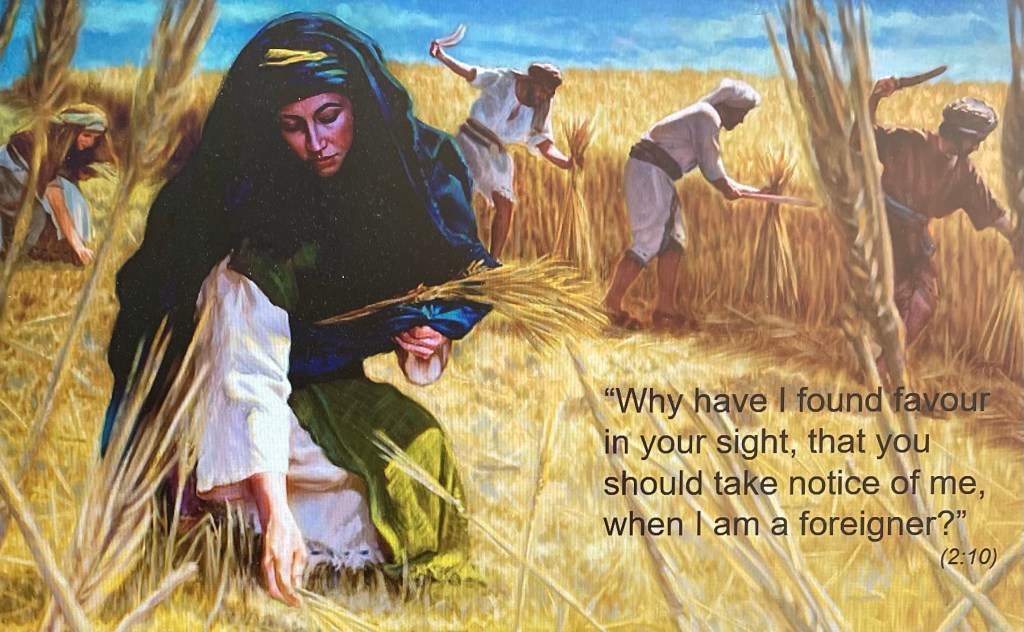
Chapter 2 picks up the story of Ruth and Naomi as they settle into life at Bethlehem. Though the famine which drove Naomi and her family from Israel has ended, action is required so that food might be put on the table. Ruth therefore proposes that she go and glean in the fields. As a poor foreign widow, this is Ruth’s only means of survival, as gleaning was the main means of support for the poor in Israelite law. Up to this point, the story has been about two widowed women supporting each other.
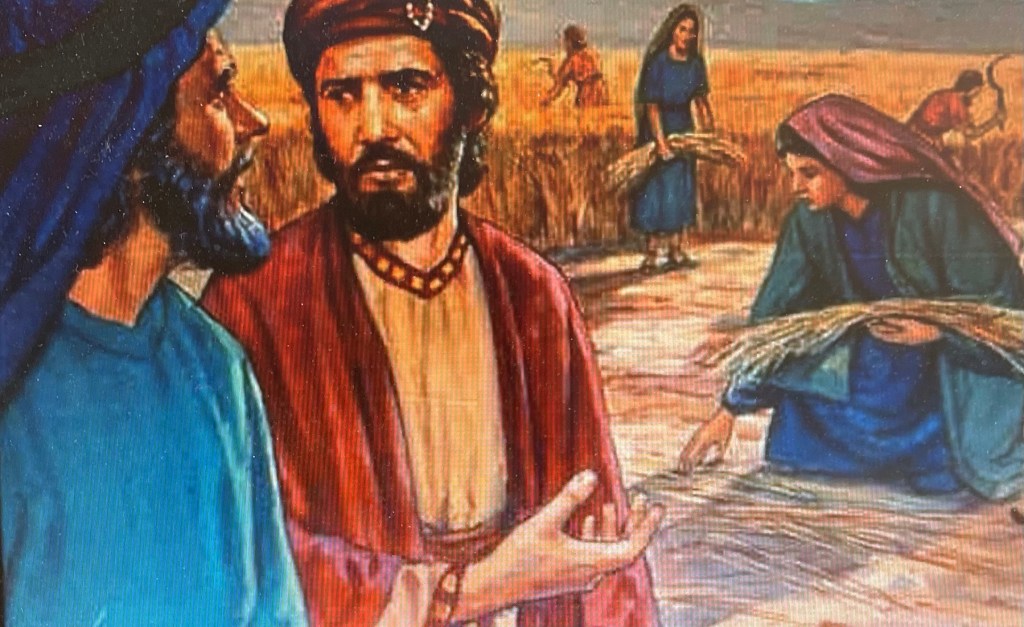
Ruth’s industrious activities draw the attention of Boaz, the owner of the field in which she gleans. Despite being poor, female and a Moabite, Ruth finds favour in the eyes of Boaz, rich, male and Jewish. By strange coincidence, Boaz is the kinsman of Naomi. A good translation of his Hebrew name is ‘pillar of the community’.
On Boaz’ appearance, the Hebrew reader is likely to be asking some serious questions. Why isn’t he helping Naomi as Israelite familial duty would dictatehe should – especially seeing he is so upright in the community and so obviously rich? Why has she been left to fend for herself, facing deprivation and possible starvation? Why does Boaz only take an interest in Naomi’s fate after he sightedRuth?
The chapter has a lot of complex interplays going on, between foreigner and Israelite, male and female; old and young; rich and poor; powerful and powerless. The author subverts most of the prevailing stereotypes as the story progresses.
Ruth stated at the beginning of the chapter to Naomi that she hoped to ‘find favour’in someone’s eyes. “Finding favour” in the Hebrew Bible generally means that a woman is desirable in the eyes of men. Coupled with the pervasive Israelite belief that Moabite women were sexually immoral (Gen 19 and Numbers 25 allude to this), the author is stressing both Ruth’s vulnerability – and her desirability.
We turn now to Boaz. His first question is “To whom does this young woman belong?”, a most irrelevant question as far as his interests as a landowner are concerned. The author is communicating Boaz’s very keen interest in Ruth.
The foreman identifies Ruth as the young Moabite woman who returned with Naomi. There is a conversation between Ruth, and Boaz. She has fallen prostrate at his feet. Such deference is usually reserved for God. Ruth twice uses the phrase “found favour in your sight”, the phrase that indicates a love interest. Boaz evokes the name of the Lord. Apart from her speech in chapter one, Ruth shows no interest in the Lord, the God of Israel. Instead she makes it clear her fate is going to lie with Boaz, not the God of Israel.
This is emphasised by her saying that Boaz has ‘spoken to her heart’ (mistranslated as ‘spoken kindly’ by the NRSV), another phrase frequently used in the Hebrew bible to indicate a love interest. Ruth is signalling her availability and interest in Boaz, but she has also shown she will not be bullied into an inequitable relationship.
Back at home, Naomi undergoes quite a transformation in relation to Ruth when she sees the amount of grain Ruth has gleaned. Naomi is no fool either, andknows by the cooked food Ruth has given her, and by the huge amount of barley, that something unusual is afoot and that there is a man involved. Hence her first questions “Where did you glean today?” Where did you work?” are quickly followed by “Blessed be the man who took notice of you”. One does not come across large portions of cooked food or ephahs of grain in the normal course of gleaning.
Naomi’s response is to initially call down a blessing on Boaz, in a reference to herself and her late husband. Again, the discerning Hebrew reader must be wondering here why Boaz has failed to act for Naomi before this time. For the first time Naomi reveals the familial connection to Boaz, and calls him goel, or redeemer. This term indicates a close family member with an assigned role in family legal matters, usually financial. To date Boaz has proved a rather unreliable goel, and Naomi is quick to capitalise on his apparent interest in Ruth by warning her against gleaning in another field “lest she be bothered”.
Despite being poor, female and a Moabite, Ruth has reversed the normal social order to find favour in the eyes of Boaz, rich, male and Israelite. The harvest scenes evoke themes of life and fertility that point towards blessings to come. But for the moment, life is still difficult, and the women’s future needs to be secured.
Despite Ruth’s resourcefulness, she and Naomi are still in a category of people whose well-being depends on the actions of others. The shortcomings of Israelite society that the book highlights challenge us to look more closely at our own cultural context, and how the poor and the foreigner are welcomed and provided for in our community.
Even in a world where prosperity has become available for some on a ridiculous scale, many still die of starvation. Many flee countries where food supplies are insufficient, and where opression is rife. It is clear that true community in our world is broken. While gleaning may be unknown to us, it has been replaced by our welfare system, which is often inadequate to address the real issues facing the poor.
If nothing else, the story of Ruth here should challenge us to work for cultural change, to a society where all are equally valued.
The author of Ruth is a political commentator of the times. He or she disagrees with the extreme nationalistic sentiments of Ezra and Nehemiah, and wants to offer another point of view, a point of view where personal qualities of faith, love and loyalty are placed ahead of race and country of origin. So be with us next week, as we see how this unfolds in the remaining two chapters.
A sermon preached by the Rev. Elizabeth Raine at Tuggeranong Uniting Church on Sunday 24 October 2021.
*****
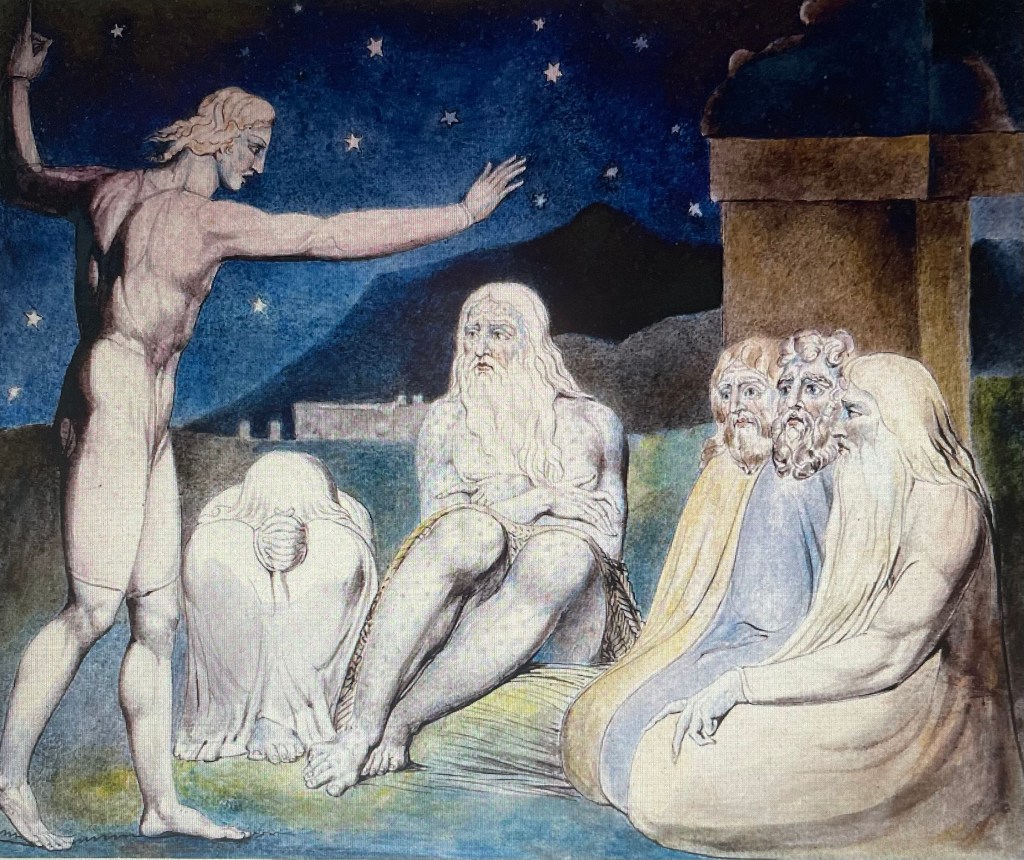
Last time we were with Job, he and his three friends had reached an impasse. Job believed them to see blindly and listen deafly. They, on the other hand, cannot understand Job’s stubbornness. Enter the fourth friend, Elihu.
Elihu, whose name means ‘My God is He’, and whose nose is burning in anger in regard to the conversation to date, strongly condemns the approach taken by the three friends and argues that Job is misrepresenting God’s justice and discrediting God’s character. In his speech, Elihu describes God as mighty, yet just, and quick to warn but also quick to forgive. Elihu is almost cast into a prophetic role, and prepares the way for the appearance of God, who finally shows up.
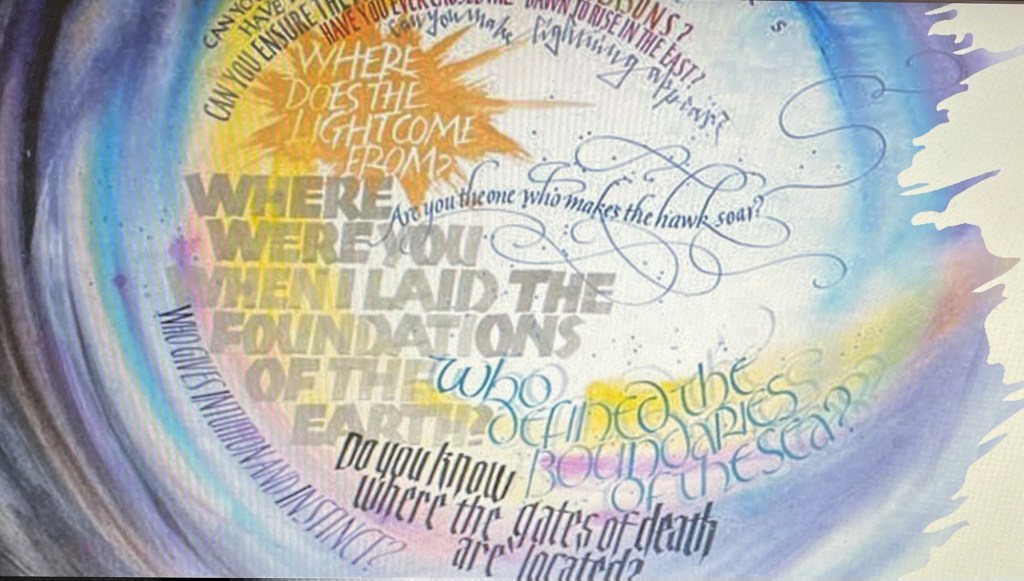
God has arrived in a whirlwind, and to compensate for his long silence of 35 chapters he now responds to Job with a flood of rather sarcastic questions. There is a touch of irony here in God’s chosen vehicle – in 9:17 Job had said If I summoned him and he answered me, I do not believe he would listen to my voice, for he tramples me down with a whirlwind, enlarges my wounds for no reason and will not let me get my breath.
God appears to do just this, his intent apparently being to adjust Job’s attitude by telling him a few things, including some pretty prolonged boasting about his cosmic power, culminating in the description of the monstrous Leviathan and Behemoth. By this God therefore puts cosmic matters – including Job’s smallness and frailness when compared to these two monstrous creations – into their true perspective.
Twice he reminds Job to gird your loins like a real man. I will ask questions, and you instruct me (38:2; 40:7).
To “gird the loins” is usually used as a metaphor for preparing for battle. It is hard to conceive that the unfortunate Job, who has just been told he “darkens counsel” with “ignorant” words, who has a whirlwind of cosmic proportions roaring around him, is in any position to instruct the deity or do battle with him. The deck is stacked, and this is a contest that we know God must win.
The response God gives Job is not the expected one. God’s words are not what the friends have imagined that God would say, nor are they the vindication that Job had hoped for. God has reversed the scenario that Job had earlier envisaged. Instead of Job challenging God in court about the justice of God’s actions, God counters with his own case, asking Job to reveal his wisdom. Instead of the divine actions being interpreted by a powerless human, they are now presented from God’s point of view.
The speech of God to Job is the climax of the book but it offers no explanation for Job’s suffering. The question: where was Job when God created the world? is an unsatisfactory ‘answer’, and we are left with the uncomfortable possibility that God acts in capricious ways, an unsympathetic deity who would allow the life of a man, his family and his servants and animals to be tormented or cut short for no better reason than to prove a point to the Adversary.
The meaning and significance of this divine speech of God continues to be a widely debated issue. Some interpret God’s words as a negation of a human being’s right to question God. Others see them as a correction to Job’s limited understanding of good and evil. Still others believe this scene shows Job’s faith and humility. Yet others believe that the words of God avoid Job’s questions, suggesting that there is doubt cast over God’s justice and compassion.
To answer God’s somewhat sarcastic questions would require the knowledge of a god, not a human. Job’s limitations are exposed, and the workings of God are declared to be a mystery beyond Job’s understanding. Instead of being offered comfort, Job is reminded of his ignorance and frailty. What are we to make of this disconcerting picture of God, especially since the questions Job asks may also be our own?
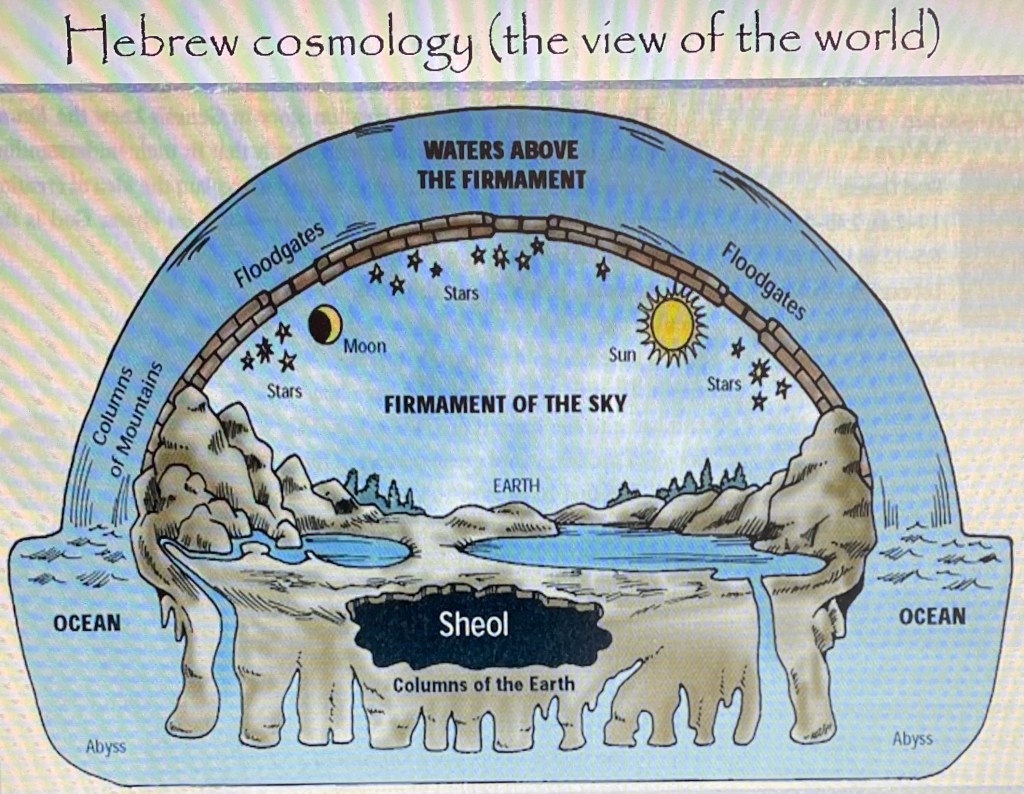
The speeches of God to Job illustrate the world according to Hebrew cosmology. The world is seemingly ordered, and everything has its place. The sea has its limits, cosmic darkness is behind gates, the sky has statutes and the clouds are numbered. But there are disorderly elements as well. The wild beasts have both hunter and prey among their numbers, yet God provides for both, giving to one the freedom to eat and another to be eaten.
In his ignorance, Job has imagined a black and white world where evil and good, reward and punishment are clearly defined. Hence his insistence that he be shown justice. But here he is presented with a world of moral ambiguity, where the wild ass is just as likely or not to be eaten by the lion in search of food.
The world as God has created it is presented as full opposing forces such as life and death, chaos and order, freedom and control, wisdom and foolishness, ordinary and bizarre, evil and good, and Job’s assumption that in a just universe his piety should have been rewarded with prosperity, is rendered meaningless. The world is not ordered according to guilt or innocence so there is no easy answer to the problem of innocent suffering.
Creatures die so others may survive. Chaos and death are not eliminated by God but operate within the boundaries of his design and the world’s complexity means it is not possible for a simple and mechanical law of reward and punishment to operate. The various aspects of human morality that Job and his friends have discussed at length are not the way the universe works. God presents a universe which is independent of such human belief systems. As Job’s beliefs fall about him in ruins, he is faced with a deity whose ways are outside of human comprehension and wisdom.
The book of Job began with deprivation and tragedy. In the final verses though, we find abundant restoration, with Job receiving back his house and family and twice as much as he had lost. Job wisely acknowledges the supreme power of God, his own ignorance, and renounces his dust and ashes.
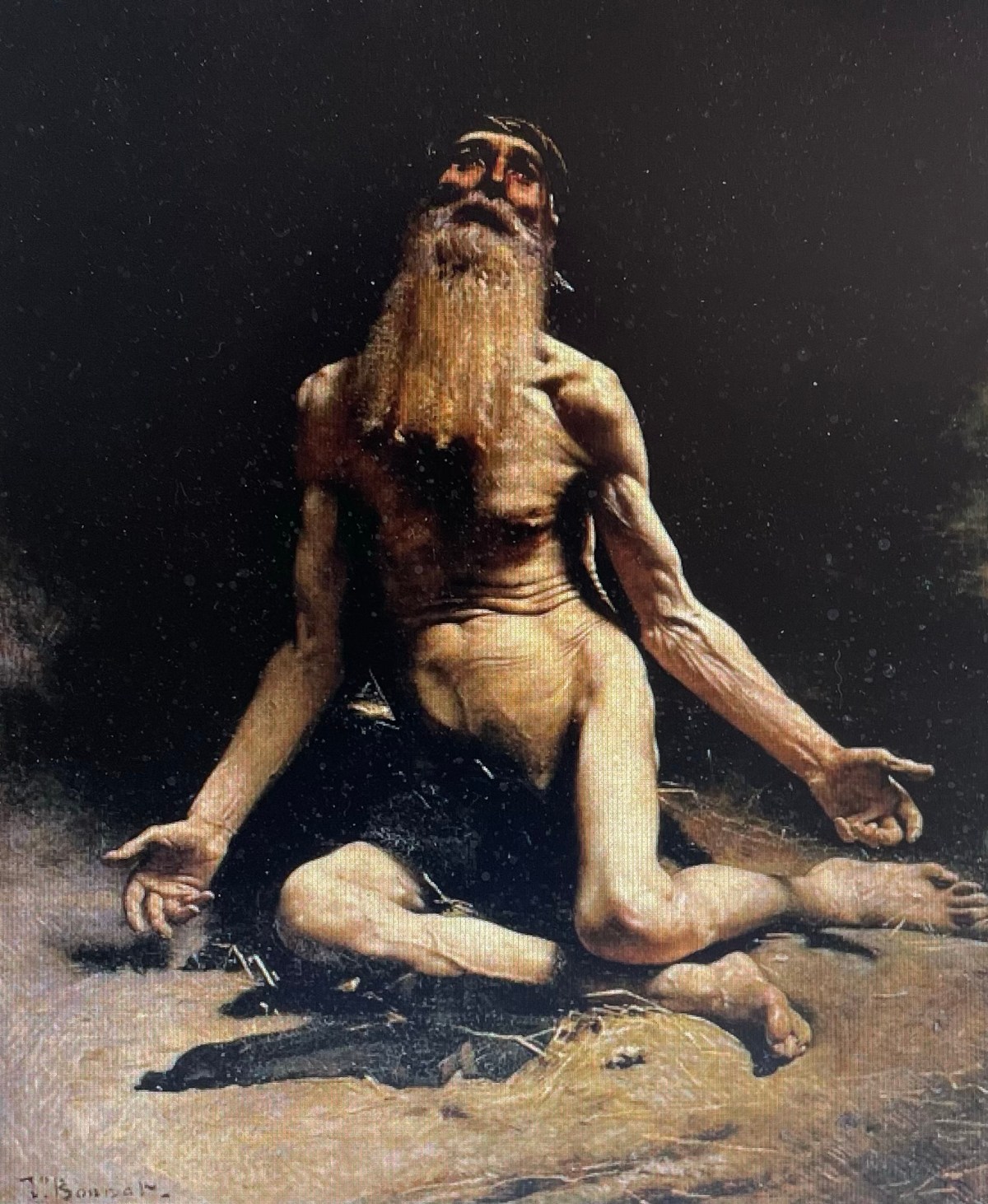
Note that Job does not repent in sackcloth and ashes but repents of them. This suggests that he is still a touch defiant, but he has learnt he is not the centre of the universe and it is now time to resume normal life again in the verses that follow. And with a final touch of irony, the friends who wanted Job to plead for God’s mercy for himself now find themselves in need of Job’s intercessions on their behalf.
It seems a happy ending, but despite its complex setting and arguments, the book of Job has presented us with more problems than solutions. Curiously, verse 42:10 states that restoration is made to Job because he prayed for his friends, not because he repents. Even more surprisingly, Job’s friends and relatives then console him about the evil that God had brought upon him, a statement that lays the blame for Job’s suffering directly with God, and not the Adversary. They offer gold and silver as a token of their goodwill. The implication is that God does cause innocent suffering, as part of the cosmic design.
So where do we go from here? Do we dwell on a dangerous universe where God doesn’t answer the questions of Job and where justice seems questionable? Or is there another way forward in this rather dark story?
Professor Kathryn Schifferdecker[1], in her commentary on Job on Working Preacher, notes the details of this restoration have some unusual features. She states that
Job’s three daughters are the most beautiful women in the land, and Job gives them an inheritance along with their brothers, an unheard-of act in the ancient Near East. He also gives them unusually sensual names: Dove (Jemimah), Cinnamon (Keziah) and Rouge-Pot (Keren-happuch).
Schifferdecker believes that Job has “learned to govern his world as God does.” What does she mean by that?
The cautious father of the prologue who offered sacrifices for his children in case they had sinned now has become a parent modelled on God’s own creation. By giving them their inheritance, he is giving his children the same freedom to live and grow and learn that God gives God’s creation, and, like God, he delights in their freedom and in their beauty.4
Ellen Davis, in her book Getting Involved with God: Rediscovering the Old Testament[2] writes, “The great question that God’s speech out of the whirlwind poses for Job and every other person of integrity is this: Can you love what you do not control?”
It is a question, says Schifferdecker, that is worth pondering. “Can you love what you do not control: this wild and beautiful creation, its wild and beautiful Creator, your own children?” she asks? [3]
Davis also puts forward the case that we should not be concentrating on why or how much it costs God to restore Job’s fortunes, as it obviously costs God nothing. “The real question is how much it costs Job to become a father again.”[4]
I really like this perspective. Job, says Schifferdecker, resembles a Holocaust survivor whose greatest act of courage may have been to start again and bear children. Yet despite the potential risks, Job chooses to enter life again. Job and his wife, despite their terrible experiences, choose to again “bring children into a world full of heart-rending beauty and heart-breaking pain. Job chooses to love again, even when he knows the cost of such love”. (Schifferdecker, 2012)[5].
Having cited so much of her, I am going to give the last words to Professor Schifferdecker, as I think she sums it up beautifully:
Living again after unspeakable pain is a kind of resurrection. The book of Job does not espouse an explicit belief in resurrection. Nevertheless, the trajectory of the whole book participates in that profound biblical movement from death to life. It is not surprising, therefore, that the translators of the Septuagint add this verse to the book of Job: “And Job died, old and full of days. And it is written that he will rise again with those whom the Lord raises up.”
And perhaps that is an appropriate place to leave this story of Job, waiting with God’s other servants for the world to come. This complex work, the book of Job, plumbs the depths of despair and comes out on the other side into life again. In this movement, it testifies not only to the reality of inexplicable suffering but also to the possibility of new life — life lived out in relationship with the God of Israel, the God of resurrection, who, as both synagogue and church proclaim, is faithful even until death, and beyond.[6]
The book of Job is a challenging and disturbing book. It takes us to a central dilemma that we all face in our lives. It provides us with a stimulus to undertake an exploration that is eminently suited to the time that we have been experiencing over the past few months in lockdown—indeed, since early in 2020. The book poses the question: why is this happening?
That’s a question many are asking about the pandemic. Why has it come upon us? Or, to be more theological about it: why are innocent people suffering? why are we caught in this current spiral? do those without a moral compass appear to prosper? why do those who seek to do good find themselves beset by problem after problem?
The question is acute for us each personally, during this time of restrictions because of a global pandemic. After all, we had nothing to do with the cause of the pandemic. Why should we suffer the frustrations of lockdowns, if we are innocent of causing the virus to spread? Why should we endure the hardships of reduced interpersonal interactions, if we have been behaving with due care? Why should we not be able to gather for worship, since we have not been in places where infections have been found?
The question is also pertinent and pressing in our current global context. For a start, the pandemic has inflicted suffering and death on millions of people around the world—suffering far more invasive than what we are experiencing in the current lockdown. How many millions of people have died? And how many millions of family members have suffered the grief and despair of not being able to say farewell to their loved ones as they die in hospital wards? And how many medical and nursing professionals have been stressed beyond limit by the incessant demands they have faced during the pandemic? And how fair is all of this?
The question also presses in terms of the climate. We have long known that the climate is changing, the high temperature averages are claiming, the arctic glaciers are melting, the sea levels are rising, the intensity and frequency of catastrophic weather events are climbing—and people around the globe are suffering. All of this presents a challenge to the way we live. We may even think that we are suffering unfairly in such a scenario.
It is clear that the science has come to a conclusive decision: we human beings have been contributing in a major way to the changes in the climate for over two centuries, now. We actually can’t lament that we are suffering unfairly, since our comfortable lifestyles in the well-to-do Western world undoubtedly mean that our carbon footprints are much larger than they should be. We are contributing to climate change, so can’t expect to be exempt from its ravages.
But what of those whose carbon footprint is minuscule, in comparison to our own? There are 16 African countries whose CO2 emissions per year are 0.15 tons per person or less. As you trace the names of countries as the figure rises, there are many more African and Asian countries, long before any European countries are noted.
By contrast, the figure is 17.10 tons per person for Australia, 15.52 for the USA, and 18.58 for Canada. That is a completely inequitable output. Should we not be suffering more deeply, in the western world, than people in Africa and Asia are? And yet the reality is that the comfortable, even extravagant, lifestyle of the western world is what is driving the incessant rate of increased CO2 in the atmosphere. And the whole world—humans, animals, fish and bird, and vegetation—suffers as a result. The questions raised by Job are acutely relevant to this issue.
And the question remains hanging as we reflect on levels of malnutrition and access to food in the current world. The World Food Programme of the United Nations estimates that one in three people around the world. Even before the current pandemic, each and every day of the year, 820 million people were seriously underfed and hungry.
Children bear the brunt of this inequity. 149 million children under 5 are estimated to be stunted (too short for age), 45 million are estimated to be wasted (too thin for height), and 38.9 million are overweight or obese. That is a situation that is utterly unjust. The questions press even harder on us.
We have the means, we are told, to distributefood equitably around the world. And yet up to one third of food is dumped everyday in the USA—a shocking waste of resources and a completely inequitable state of affairs. So those who happen to have been born in certain areas of the world where circumstances beyond their control mean that they are suffering far more than is warranted. Injustice abounds. The questions from Job resonate—how is that fair?
And then, there are survivors of domestic violence, and—still—survivors of child sexual abuse, and those suddenly facing homelessness, and those in the long enduring grip of mental illness, and those fleeing violence and persecution in their home countries, seeking refuge and asylum in a welcoming place … and many other situations where the innocent are suffering unjustly. The list could be very long, indeed, if we give careful thought to it.
So, reflecting on these matters, in the light of the discussions that are recorded in the story of Job, we have much pause for thought. How do we reconcile our faith in God—God who is loving, God who is just, God who is overseeing all that takes place—given these terrible realities? Is the image of God that we have accurate? If God can act to change any of these terrible situations that we are facing, why does God not so act? Is God uncaring? Is God unable to act? Is God not concerned with justice?
These are the questions that Job explores. It is a book which provides us with deep resources for thinking about such matters. It is a tale that resonates with so much in the experience of contemporary people. It is a take for our times.












 An Informed Faith