Do not judge by appearances (1 Sam 15–16; Pentecost 4B)

In the lectionary during the weeks after Pentecost, we hear stories from the period of time when Israel was ruled by a king. The story of the choosing of the first king, Saul, is told in 1 Samuel 9; his rule runs through the narratives told from this chapter until the last chapter of this book, namely, 1 Samuel 31.

As I have noted before, although these narratives have the appearance of being historical, they are actually ancient tales which were told and retold, passed on by word of mouth and then written down, because of their enduring significance for the people of ancient Israel. Scholars call such stories “myths”, meaning that they convey something of fundamental importance. (We might best define myth as “a traditional story, usually associated with the time of origins, of paradigmatic significance for the society in which it is told”.)

See more on the nature of these stories at

The picture of Saul, the first man chosen to be king in Israel, demonstrates the flaws of this system of leadership. His reign was characterised by turbulence and opposition; as early as chapter 13 there are signs of the problems that there were in his leadership.

After defeating the Philistines, and being impatient for the prophet Samuel to arrive, he went ahead with a burnt offering, in contradiction to the command of God. “You have done foolishly; you have not kept the commandment of the Lord your God, which he commanded you”, Samuel berates the king (1 Sam 13:13). This is not the behaviour expected of a person leading the chosen people of God!

The prophet Samuel foreshadows the coming turmoil under Saul’s leadership, telling him that “the Lord would have established your kingdom over Israel forever, but now your kingdom will not continue” (1 Sam 13:14). The passage offered by the lectionary for this coming Sunday, 1 Sam 15:34—16:13, follows soon after. Here, we learn that because the rule of Saul is fraught with difficulties, a significant change is on the cards.

Pushed by the words of the prophet Samuel, Saul confesses his sin (1 Sam 15:24, 30). Samuel announces to him that “the Lord has rejected you from being king over Israel” (15:26) and declares, quite dramatically, “the Lord has torn the kingdom of Israel from you this very day, and has given it to a neighbour of yours, who is better than you” (15:28).

The narrator of this story engages in an interesting theological exploration at this point. Samuel is clear about God’s intentions: “the Glory of Israel will not recant or change his mind; for he is not a mortal, that he should change his mind” (15:29). This God had explicitly chosen Saul, who said he was “only a Benjaminite, from the least of the tribes of Israel, and my family is the humblest of all the families of the tribe of Benjamin” (9:21).

God had chosen David, this least and most humble person, to serve as ruler over the people, to “save my people from the hand of the Philistines” (9:16). He would rule for 40 years—the biblical way of saying “for an awfully long time”—and exert great power. We might note that this “least-become-greatest” dynamic prefigures some of the teaching of Jesus, a descendant of David, a millennia later. (See Mark 9:33– 37; Matt 11:11; 18:1–5; 23:11–12; Luke 7:28; 9:48; 22:24–27).

Samuel, exercising his prophetic leadership, had assured the people, “there is no one like him among all the people” (10:24); but some in the crowd were doubtful, saying, “how can this man save us?”, and they despised him (10:27). Paradoxically, these men had insight into the character of Saul which the Lord God himself failed to perceive at this time.

However, a little later, the narrator of this story muses that “the Lord was sorry that he had made Saul king over Israel” (15:35). This is regret, but seemingly not quite a full change-of-mind. It does, however, paint the divine in a rather human way; an action undertaken that does not bear fruit for us as anticipated can indeed generate regret.

Elsewhere in Hebrew Scriptures, the matter of a change-of-mind by the divine is explored. Jeremiah instructs the people, “amend your ways and your doings, and obey the voice of the Lord your God, and the Lord will change his mind about the disaster that he has pronounced against you” (Jer 26:13). In the tale of Jonah, when God saw the repentance of the people of Nineveh, “God changed his mind about the calamity that he had said he would bring upon them; and he did not do it” (Jon 3:10).

The prophet Amos petitions God, such that “the Lord relented concerning this; ‘it shall not be,’ said the Lord” (Amos 7:3, 6). And in the story of the Golden Bull, Moses implores God to “turn from your fierce wrath; change your mind and do not bring disaster on your people”, and so the Lord repents (Exod 32:12–14).

We might wonder: is the regret that the narrator perceives in the divine (1 Sam 15:35) strong enough to chasten God in future actions, so that there will be no need for a divine change-of-mind?

For more on this topic, see

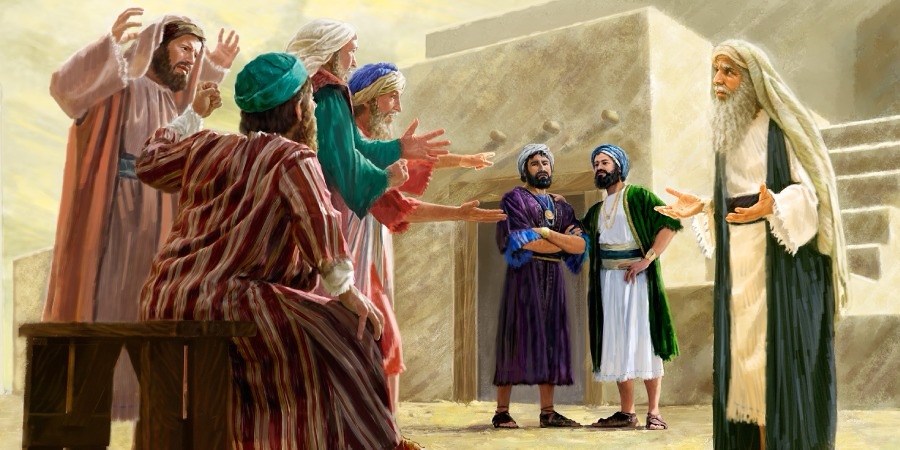
As Saul relinquishes his role, Jesse steps onto the stage; one of his eight sons will sit on the throne. It has been a bitterly-fought transition, and Samuel was saddened by the course of events. But the voice of God pushes him on, to step into his role in the transition taking place; and so the prophet faithfully anoints Saul’s successor.

We should remember that, in the a Christian canon, the two books that tell of the rule of Saul and then David are named, not after those kings, but after the prophet, Samuel—who held and exercised great power, as the story shows, in that he is attuned to God’s voice and speaks God’s words to the people. We saw this dynamic clearly articulated in the earlier narrative (1 Sam 3) on the Sunday after Trinity Sunday (Pentecost 2).

So Samuel follows God’s advice: “do not look on his appearance or on the height of his stature, because I have rejected him; for the Lord does not see as mortals see; they look on the outward appearance, but the Lord looks on the heart” (1 Sam 16:7). This verse is often quoted by people of faith when reflecting on the importance of inner conviction and commitment to God.

Writing in With Love to the World, Sione Leaaetoa says, “behind the narrative is a God who sees and deals with the heart of human beings (v.7). The condition of our hearts is more important to God than what we do for God outwardly. Our heart is important to God because it can very much affect everything we are and do, as stated in Luke 6:45, “the good person out of the good treasure of his heart produces good, and the evil person out of his evil treasure produces evil, for out of the abundance of the heart his mouth speaks”. In similar vein, Proverbs 4:23 states ‘keep your heart with all vigilance, for from it flow the springs of life’.”

There is a danger here, of course; the outward actions of people are indeed important, and the claim that God’s focus is solely on our “heart” can be deceptive. Both our inner nature and our outer actions are significant; they each point to our faith and express our discipleship.

Indeed, it is worth remembering that, in the Hebrew language—the language in which this narrative was written—the word translated as heart is לֵבָב, lebab. It’s a common word in Hebrew Scripture, and is understood to refer to the mind, will, or heart of a person—words which seek to describe the essence of the person. It is sometimes described as referring to “the inner person”. The word appears 248 times in the scriptures, of which well over half (185) are translated as “heart”. It has a strong connotation of indication “the whole of a person’s being”. That’s what God is focussed on; that’s where faith is shown and discipleship is lived out.

For more on this, see

So Jesse brings his sons before Samuel. But which son is it to be? Samuel first offers a sacrifice to God (15:2–5), in the expectation that what he does next will be in accord with the will of God. Samuel had his own ideas, based on appearances; God reprimands him, now telling him to focus on the heart—the very core of the being of the chosen one, the whole of that person’s being (16:7). After receiving all of Jesse’s sons in order (16:8–10), Samuel exercises his prophetic discernment, selecting the youngest son, David, to be the new king (16:11–13).

Of course, this is an often-encountered dynamic in the Hebrew Scriptures: Abel’s offering was preferred over his older brother Cain; the younger of twins, Jacob was chosen over Esau; Joseph was favoured over his 11 older brothers; Ephraim was favoured over his older brother Manasseh; and the younger Moses took the lead over Aaron.

God then confirms this choice by gifting David with the spirit: “the spirit of the Lord came mightily upon David from that day forward” (16:13). Openness to new ways and new possibilities has led to this defining moment.

Ironically, when Samuel first sees David, the narrator introduces him with the description, “he was ruddy, and had beautiful eyes, and was handsome” (16:12)—precisely the elements of “outward appearance” that we were told earlier that the Lord does not consider. Even the careful crafter of this story gets caught!!

Screenshot

With Love to the World is a daily Bible reading resource, written and produced within the Uniting Church in Australia, following the Revised Common Lectionary. It offers Sunday worshippers the opportunity to prepare for hearing passages of scripture in the week leading to that day of worship. It seeks to foster “an informed faith” amongst the people of God.

You can subscribe on your phone or iPad via an App, for a subscription of $28 per year. Search for With Love to the World on the App Store, or UCA—With Love to the World on Google Play. For the hard copy resource, for just $28 for a year’s subscription, email Trevor at wlwuca@bigpond.com or phone +61 (2) 9747-1369.

Give us a King, like other nations (1 Sam 8–10; Pentecost 3B)

1 Samuel 8:4–20 is the passage offered by the lectionary for this coming Sunday. It is the second in the sequence of Hebrew Scripture passages that we are reading through the first half of the long “season after Pentecost”, from May to August. The passage addresses an issue that was important in ancient Israel; that is important in modern-day Israel/Palestine; and that is important, also, in all nations around the world today.

This Sunday we will hear the beginning of a process—debate about having a king as a ruler—that culminates, at the end of August, with an account of Solomon, the wisest, most powerful, and perhaps most damaging king of all. That makes this ancient text potent in the contemporary situation, where Israel is engaged in a life- and-death struggle with Hamas, where megalomania amongst leaders in Russia, North Korea, China, and even the USA predominates, and where too many countries around the globe suffer under dictatorial, repressive regimes.

The passages selected today focus on the issue of power. Precisely: what kind of power in leadership is acceptable in Israel? should Israel be ruled by a king? For centuries, judges had led the people, determining what was right and what was wrong. The book of Judges tells of a string of such judges, men who worked hard to recall the people to their covenant with the Lord God: Othniel (Judg 3:9), Ehud (3:15), Shamgar (3:31), an unnamed prophet (6:8), Gideon (6:11–18), Tola (10:1), Jair (10:3), Jephthah (11:1; 12:7), Ibzan, Elon, and Abdon (12:8–15), and Samson (13:24–25; 16:28–31).

And, of course, it most famously tells of Deborah, “a prophetess, wife of Lappidoth, [who] was judging Israel; she used to sit under the palm of Deborah between Ramah and Bethel in the hill country of Ephraim; and the Israelites came up to her for judgment” (Judg 4:4–5).

However, the impact of the efforts of these various judges was merely transitory; the people returned again and again to their sinful, idolatrous ways. “The Israelites did what was evil in the sight of the Lord” (initially at 2:11, repeated at 3:7) is a recurring refrain throughout the book of Judges. It signals that the people reverted to their evil ways after Othniel (3:12), Shamgar (4:1), Deborah (6:1), Jair (9:6), and Abdon (13:1).

As a result, we are told that the people were “given into the hands” of their enemies on each of these occasions (3:8; 4:2; 6:1, 13; 10:7; 13:1). The horror perpetrated by Jephthah, offering his own daughter as a burnt offering (11:29–40), and the deceit and arrogance of Samson (16:1–31) exemplify this sinful streak.

In the final chapters of the book, details are given of the evil deeds of various people: the mother of Micah, who made an idol of cast metal (17:1–6); the men of Gibeah, who raped the Levite’s concubine (19:22–25); the Levite himself, who cut his concubine into twelve pieces (19:27–30); and then the attacks on the Bejaminites by the other tribes of Israel (20:1–48). The book draws to its end with the mournful conclusion, “in those days there was no king in Israel; all the people did what was right in their own eyes” (21:25).

So it is made clear in the narrative constructed in the book of Judges, that Israel’s downfall was that it was not ruled by a king, as other nations surrounding Israel were. A king could maintain justice and ensure equity within the society of Israel. And a king could marshal the forces needed to repel invaders and stand resolute against the sinful ways that would be imposed upon the nation by those who did not fear the Lord God.

So the elders of Israel press for change; we can understand why. However, the prophet who has been called by God, Samuel, is attuned to God’s voice on this matter, and so he rejects this request. But the people persist with their request—their demand, even. And so it is that God, in a striking reversal of opinion, decides to have a change of mind about kingship. God pushes Samuel to accept this change.

The lectionary this coming Sunday offers us excerpts from the lengthy section of 1 Samuel where this matter is considered (1 Sam 8—11). The matter is first raised in the request made of Samuel by the people: “appoint for us, then, a king to govern us, like other nations” (1 Sam 8:5). The revolution comes, chapters later, after various points of view have been canvassed.

The lectionary selection for this Sunday offers us “A Dummies Guide to Kings in Israel”—that is, a series of “bites” [1 Samuel 8:4-11, (12-15), 16-20, (11:14-15)], some of which are optional (placed in parentheses). After the initial request, it includes the resistance of Samuel to this proposal (8:12–18) and the persistence of the people in pressing their request: “the people refused to listen to the voice of Samuel; they said “No! but we are determined to have a king over us” (8:19–20).

The full text of 1 Samuel provides reports of the back-and-forth that transpires, which the lectionary omits. It skips to a final optional reading of a further short section (11:14–15) which reports the outcome: “all the people went to Gilgal, and there they made Saul king before the Lord in Gilgal”.

The appointment of a king was obviously a matter of some controversy in ancient Israel; the compiler of the Deuteronomistic History (of which 1 Samuel is a part) devoted a significant amount of space to it, taking pains to include conflicting views about this matter. And, as we read these texts with the benefit of hindsight, we know that a king was ultimately appointed. This led to the later establishment of the Davidic dynasty, which became important in the claims later made about Jesus of Nazareth, recognised as Son of David.

So, of course, the person (or persons) chronicling the history of Israel in what scholars now call the Deuteronomistic history will tell the story with this outcome in view. The end result shapes how the story is told.

Writing in With Love to the World, Elizabeth Raine observes that “Israel looks for a leader to win battles and guarantee their security. It is a black-and-white understanding of the King; a figure military strength and political power. This is not the same as the way the prophet saw the role of King”. The people want power. The prophet warns of corruption. The people want victory. The prophet warns of failing to ensure justice.

And a clear thread in Hebrew Scripture would come to be that the king was called by God and anointed by God’s prophet to ensure that justice and righteousness were found in the land of Israel (Ps 72:1; 99:4; 1 Ki 3:28, 10:9; Isa 11:1–9; 32:1). That, at least, became the ideology for kingship in Israel; the reality, as we see in the stories selected for future weeks, was often different.

Elizabeth continues, “The story calls us to examine where we are placing our allegiances, and move to transformation, that process of repentance and renewal in which we turn back to God in every area. Whilst such self-examination is no doubt painful, it is also the only way to ensure we remain connected with God’s life-giving Spirit. As more and more people make the shift to a faithful allegiance that ensures that God’s Kingdom will be realised here on earth, we will hopefully see the reality of justice, peace, and love spreading in our world.”

To close, I offer two reflections on how this ancient story might speak to us today. The first perspective is that this story, about the desire for a powerful leader, and the dangers of pushing an agenda of power over all other matters, is a direct challenge to the way that the leaders of the modern state of Israel are conducting themselves in the long-enduring conflict with the Palestinians, who share an equally just claim to the land that was bequeathed to Jews in 1948. I have reflected at more length on this matter at

and my colleague Chris Budden has offered good insights into this conflict at

The second perspective is that this story is the first in a series of stories from ancient days which address a pressing contemporary issue: how to bring about effective change within the community of faith. It is something we all know about today, as society changes and the church occupies a different place in that society. How do we listen for God’s voice in this context? How do we advocate for effective change? I have written further on this dynamic at

and

With Love to the World is a daily Bible reading resource, written and produced within the Uniting Church in Australia, following the Revised Common Lectionary. It offers Sunday worshippers the opportunity to prepare for hearing passages of scripture in the week leading to that day of worship. It seeks to foster “an informed faith” amongst the people of God.

Speak, for your servant is listening (1 Sam 3; Pentecost 2B)

For three months—the first half of the long season “after Pentecost”—the lectionary offers a sequence of passages which comprise some key narratives from the books of Samuel and the early chapters of Kings. These stories recount the development of the monarchy in Israel, with stories of Saul, David, and Solomon, the first three men charged with the responsibility of leading Israel and ensuring that there was justice in the land. “Give the king your justice, O God”, the psalmist sings (Ps 72:1), so that they might rule with justice and righteousness (Ps 99:4; Prov 29:4; Isa 32:1; Jer 23:5). That is what these kings, and their successors, were charged with ensuring.

These stories also engage us with the lives of prophets, Samuel and Nathan—men who were called to speak the word of God. We are told that as the young Samuel grew up, “the Lord was with him and let none of his words fall to the ground; and all Israel from Dan to Beer-sheba knew that Samuel was a trustworthy prophet of the Lord” (1 Sam 3:20–21). Years later, Nathan is commissioned by “the word of the Lord” to “go and tell my servant David, ‘thus says the Lord’” (2 Sam 7:4–5). That is the role of the prophet—to listen to what God says to them, and then to speak forth the word of the Lord to the people of their society.

Samuel, Nathan, and other prophets were particularly called to speak truth to the king and to recall them to the centrality of their role, to ensure that God’s justice was a reality in Israelite society (Isa 42:1–4; 61:1–2; Mic 3:8). We see this when Nathan confronts David (2:Sam 12), when Elijah confronts Ahab and the priests of Baal (1:Ki 18), when Isaiah advises Hezekiah (2 Ki 20), and when Josiah consults Huldah (2 Ki 22; 2 Chron 34).

As we pay attention to the details of the stories, let us remember that these stories are not “history” as we know it today. Rather, they are ancient tales told and retold, passed on by word of mouth and then written down, because of their enduring significance for the people of ancient Israel. Scholars call such stories “myths”, meaning that they convey something of fundamental importance. (We might best define myth as “a traditional story, usually associated with the time of origins, of paradigmatic significance for the society in which it is told”.)

See more on the nature of these stories at

and on the sequence of stories told in Genesis and Exodus, at

Identifying the stories in the narrative books of the Hebrew Scriptures doesn’t mean they are “not true”—rather, it means that we need to read them, not as historically accurate accounts, but as stories which convey fundamentally important ideas. These stories were valued by people of ancient times. They may well offer us, in our own times, insights and guidance of value.

So we read and ponder these stories from old once again, in our time, because we believe that there is wisdom and guidance in the dynamics we see at work in this ancient society. We pay attention to them because we believe that the same Spirit who anointed the kings, and who called and equipped the prophets, is the very Spirit who today meets us, calls us, and equips us.

We begin with a narrative that recounts the call of the young boy, Samuel, to the role of prophet (1 Sam 3:1–10). This series of narratives from Samuel and Kings provide insights into the leadership of the people of Israel in the crucial years when a key transition was taking place, moving from a group of invading tribes, consolidating into a coherent kingdom. Prophets and Kings provided leadership in challenging times.

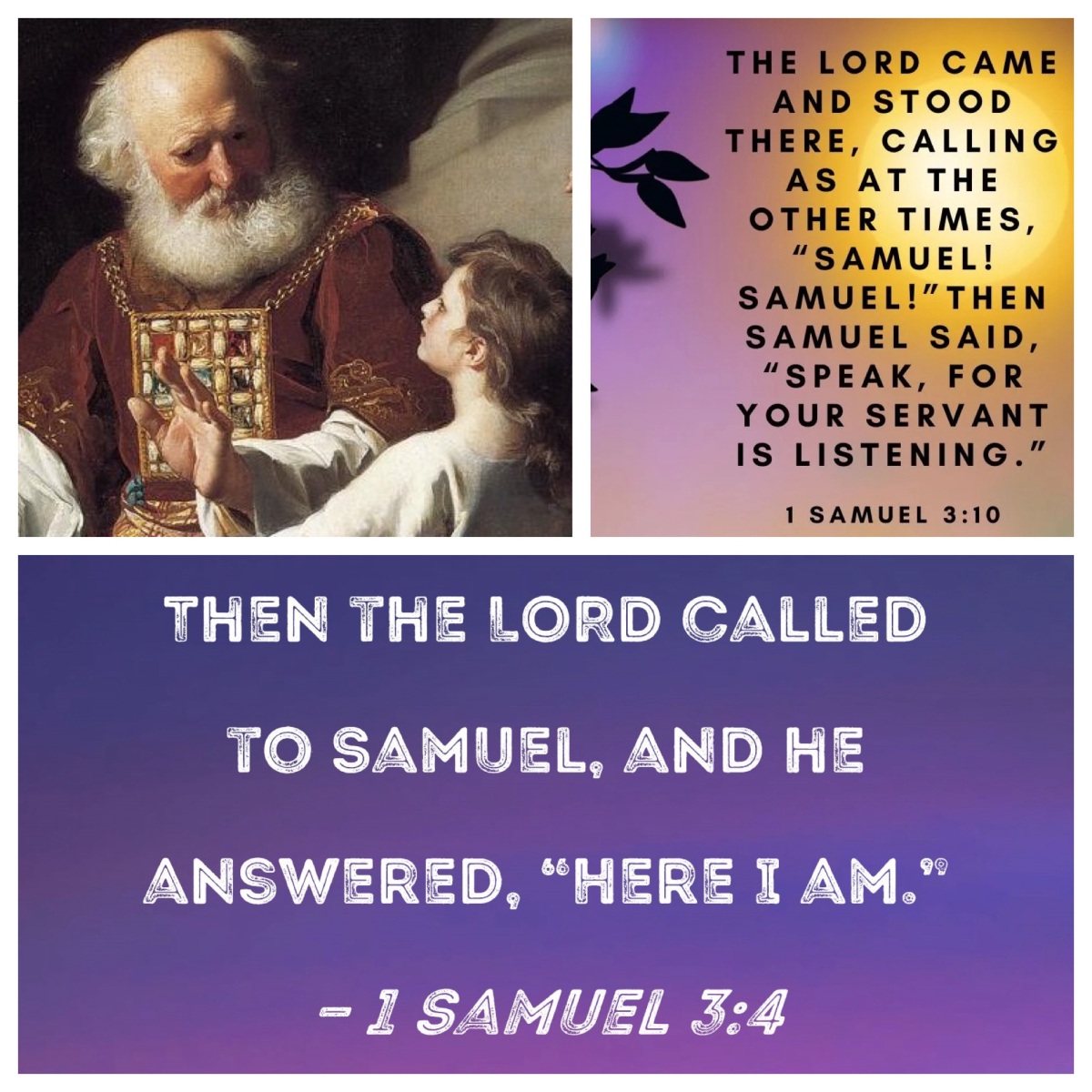
Samuel was the designated prophet whose wisdom guided the people in the early period of the monarchy. This story from the early years of Samuel’s life instructs us as we hear it in later times, to listen to God’s voice, and to respond with obedience. Young Samuel was in the temple, where the elderly Eli was priest. In the evening, while the lamp was still burning, Samuel hears a voice. The voice simply calls his name. “Here I am”, Samuel responds when he hears that voice. He is sure that it is Samuel who is speaking to him—there is nobody else around. Three times, he hears “Samuel”; and three times, he responds “here I am” (vv.4,6,8).

Samuel had been thinking that it was Eli speaking to him; but it was not the priest, it was the voice of the Lord. The story conveys a sense of confusion and unknowing. This reflects something of the uncertainty that people of faith often have with regard to “hearing the voice of the Lord”.

Indeed, the fragility of living by faith without clear and obvious demonstration of he presence of God is signalled in the opening verse: “the word of the Lord was rare in those days; visions were not widespread” (v.1). The poor vision of the elderly priest, Eli (v.2), is a second signal of this uncertainty. The priest cannot see; the child hears but does not understand.

Paying attention to the voice of the Lord is a persistent refrain in Hebrew Scriptures. Indeed, the psalmist rejoices in the clarity of God’s voice: “the voice of the Lord is over the waters; the God of glory thunders, the Lord, over mighty waters; the voice of the Lord is powerful; the voice of the Lord is full of majesty” (Ps 29:3–4). Yet another psalmist recalls the time, in the wilderness, when the people of Israel “grumbled in their tents, and did not obey the voice of the Lord” (Ps 106:25). The people were not always faithful, even though the voice sounded with clarity. They needed reminders of that voice.

In the foundational saga of Israel, Moses is called by the voice of God while tending sheep on Mount Horeb (Exod 3:4). In obedience, he leads the people to freedom—and then informs the people, “if you will listen carefully to the voice of the Lord your God, and do what is right in his sight, and give heed to his commandments and keep all his statutes”, then God promises not to inflict them with disease (Exod 15:26). Later, when Moses has delivered to them “all the words of the Lord and all the ordinances”, the response of the people is an affirmative “all the words that the Lord has spoken we will do” (Exod 24:3).

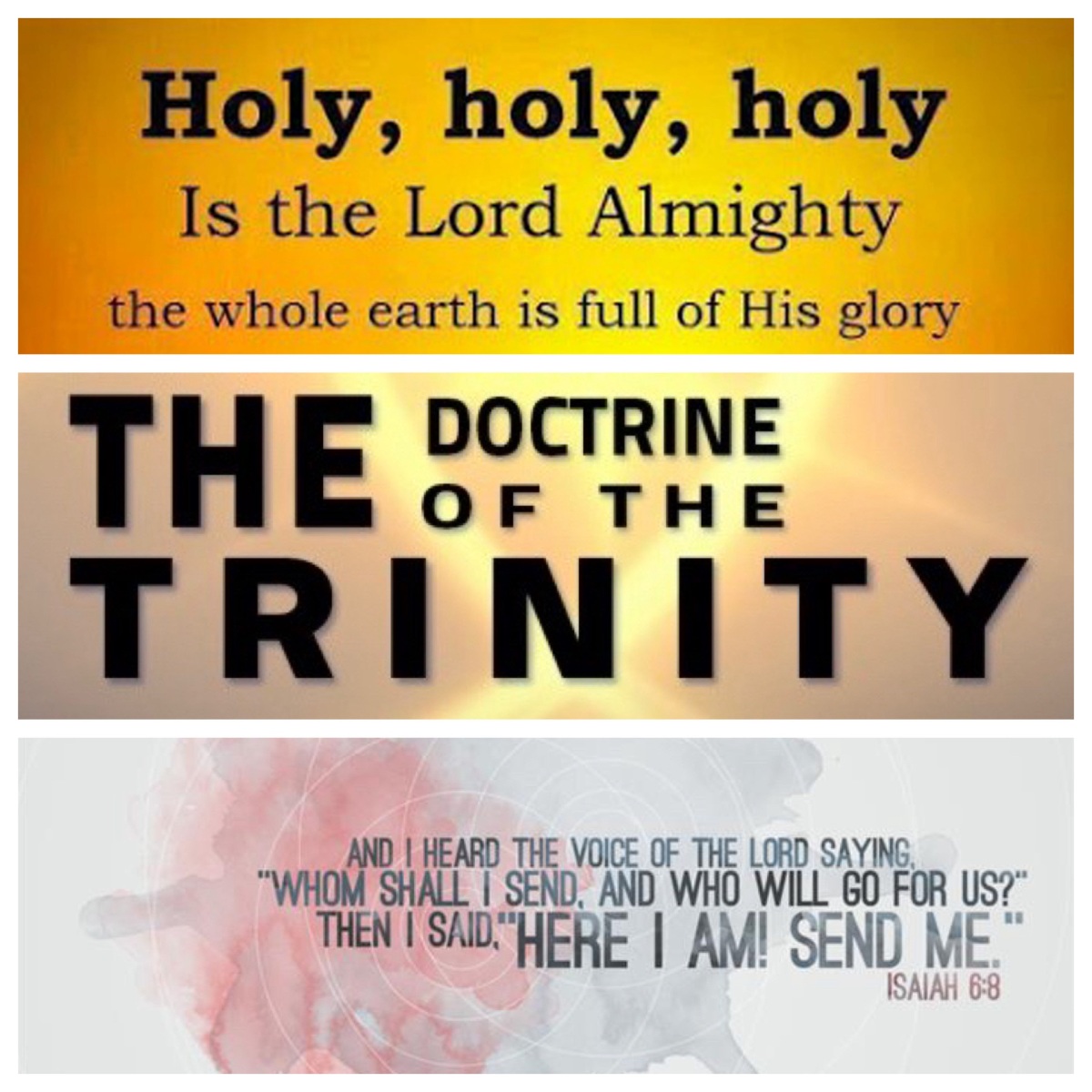
A number of the prophets indicate that they are impelled to declare “the word of the Lord” to a sinful people because they have heard, and are obedient to, “the voice of the Lord”. Isaiah hears the voice of the Lord calling him: “whom shall I send, and who will go for us?” (Isa 6:8). Isaiah is given words of woe to pronounce over the people (Isa 6:9–13); he warns the leaders of Israel, “listen, and hear my voice; pay attention, and hear my speech” (Isa 28:23).

His fellow-southerner, the shepherd Amos, opens his words with the bold declaration, “the Lord roars from Zion, and utters his voice from Jerusalem” (Amos 1:2), before he launches into his long series of oracles against the surrounding nations (Amos 1:3—2:3) and then against Judah and Israel (Amos 2:4–16).

The image of the lord as a roaring lion is used also by Joel, “the Lord roars from Zion, and utters his voice from Jerusalem, and the heavens and the earth shake” (Joel 3:16), while in another oracle he says, “the Lord utters his voice at the head of his army; how vast is his host!” (Joel 2:1). Joel’s words of judgement penetrate to the heart of the evil of the people: the coming day will be “a day of darkness and gloom, a day of clouds and thick darkness!” (Joel 2:2), and so he calls the people to “return to [the Lord] with all your heart, with fasting, with weeping, and with mourning; rend your hearts and not your clothing” (Joel 2:12–13).

Micah also declares, “the voice of the Lord cries to the city (it is sound wisdom to fear your name)” (Mic 6:9) before he lambasts the people for their wickedness: “your wealthy are full of violence; your inhabitants speak lies, with tongues of deceit in their mouths” (Mic 6:12; the whole damning oracle is 6:9–16).

Called as a youth by “the word of the Lord” (Jer 1:4–8), Jeremiah hears the assurance, “I have put my words in your mouth” (Jer 1:9); the prophet later instructs the people, “amend your ways and your doings, and obey the voice of the Lord your God, and the Lord will change his mind about the disaster that he has pronounced against you” (Jer 26:13). Again, he tells them, “obey the voice of the Lord in what I say to you, and it shall go well with you, and your life shall be spared” (Jer 38:20). Eventually, the people affirm, “whether it is good or bad, we will obey the voice of the Lord our God to whom we are sending you, in order that it may go well with us when we obey the voice of the Lord our God” (Jer 42:6).

In the return from exile, both Haggai (Hag 1:12) and Zechariah (Zech 6:15) rejoice that Israel “obeyed the voice of the Lord their God”; but Daniel laments that his people “have not obeyed the voice of the Lord our God by following his laws, which he set before us by his servants the prophets; Israel has transgressed your law and turned aside, refusing to obey your voice” (Dan 9:10).

And yet, various prophets had hesitated when first hearing “the voice of the Lord”. The initial response of Moses is “who am I that I should go to Pharaoh, and bring the Israelites out of Egypt?” (Exod 3:11), followed by a series of further objections that he raises (Exod 3:13; 4:1; 4:10). Amos explains to the priest Amaziah how his call had surprised him: “I am no prophet, nor a prophet’s son; but I am a herdsman, and a dresser of sycamore trees” (Amos 7:14).

Isaiah seeks to excuse himself from the prophetic task: “I am lost, for I am a man of unclean lips, and I live among a people of unclean lips” (Isa 6:5). Jeremiah objects, “truly I do not know how to speak, for I am only a boy” (Jer 1:5). A number of the prophets are, initially at least, reluctant spokespersons for the Lord God.

By contrast, in the story told in 1 Sam 3, after hearing his name spoken by the Lord for a third time, Samuel responds with a declaration of obedience: “speak, for your servant is listening” (v.10). This was just as the priest Eli had instructed him (v.9). Here, Samuel demonstrates careful listening, patience, openness to what he encounters, and complete obedience to that voice.

Just beyond the passage set by the lectionary, the narrator indicates that what will follow will be dramatic and compelling; it will “make both ears of anyone who hears of it to tingle” (v.11). The immediate drama which les ahead will tell of punishment for the sins of the house of Eli. Young Samuel is given his first commission: tell his patron Eli about what lies in store for him. Samuel, in fear and trembling, dutifully does so (v.18); Eli recognises the word of the Lord in the voice of the prophet, and accepts his fate.

The pattern of Samuel’s life is thus set: he will need to summon inner strength, demonstrate commitment to the cause, use clarity of speech, and model integrity of life. The fact that the young Samuel already demonstrated these qualities may well be why this story is remembered and retold. These two stories from the early years of Samuel’s life are remembered in order to instruct those who hear them in later generations, to listen and to obey, to be brave and focussed. And so we, in our time, are to hear the story, reflect on it, and respond appropriately.

Appropriating the words of an Israelite prophet for a Christian doctrine (Isaiah 6; Trinity B)

Trinity Sunday is one of the very few times in the Christian calendar that a Sunday is named for a doctrine, rather than for a biblical story (Easter, Pentecost, Christmas, and the like). The passages are chosen to encourage us to reflect on the doctrine of the Trinity, as a doctrine that is central to our faith, through selected biblical passages; this year, sections of Isaiah, John, and Romans (with a Psalm chosen to complement these selections).

So this Sunday we are being asked to approach scripture in a way quite different from many other Sundays, when biblical texts are offered for us to consider in their own right. Trinity Sunday, by contrast, pays scant attention to the historical and literary contexts of the chosen texts. Rather, they are selected as isolated “bites” that can be woven together to provide “a biblical basis” for a doctrine that was developed and expressed a number of centuries later.

In this regard, it has similarities with the way that we are encouraged to read selections from the prophets of ancient Israel—taking particular passages which are placed alongside certain Gospel stories because they “illuminate” or “complement” these later texts. The birth of Jesus at Christmas and the death of Jesus at Easter—and the weeks leading up to these days, in the seasons of Advent and Lent, respectively—are the times when this process is most evident.

So the choice of Isaiah 6:1–8 as the First Reading for this coming Sunday, Trinity Sunday, has both of those pressures running in parallel. First, this text is intended to speak from six centuries before Jesus about what people four centuries after Jesus thought about him, God, and the Spirit. That’s a leapfrog over a whole millennium!!

And second, this text is intended to focus our thoughts on the threefold nature of God—Father, Son, and Holy Spirit—through the somewhat fortuitous chanting of “holy, holy, holy” by seraphim in the smoke-filled temple atop Mount Zion (Isa 6:3). The only other place in scripture where this threefold acclamation of divine holiness appears is in the extravagantly symbolic visions of the spirit-infused prophet of Revelation, as he “sees things” in his old age (Rev 4:8).

The chanting of the seraphim in the former book, Isaiah, is the first articulation of a chant which, millennia later, became associated with the triune God, worshipped in Christian liturgies. In my own church, after the presiding minster prompts with the words: “And so we praise you with the faithful of every time and place, joining with the choirs of angels and the whole creation in the eternal hymn”, the people respond, “Holy, holy, holy Lord, God of power and might, heaven and earth are full of your glory. Hosanna in the highest. Blessed is he who comes in the name of the Lord. Hosanna in the highest.” (quoted from The Service of the Lord’s Day in Uniting in Worship 2; Assembly of the Uniting Church in Australia, 2005).

This song has an integral place in the liturgy, not just of the Uniting Church, but of numerous liturgical denominations around the world. It is sung or spoken in the Great Prayer of Thanksgiving, as people offer thanks to God and prepare to receive the sacrament. Its location within the Christian liturgy means that, in the minds of many believers, it is thoroughly Christianised.

And I suspect that the threefold expression, “holy, holy, holy”, is intended to evoke the three-in-one nature of God, as understood in classic Christian theology. Perhaps it is intended to be a subconscious evocation of “Holy God, Holy Son, Holy Spirit” — even though the song itself says nothing about the unity of those three elements?

The author of the latter book, Revelation, quotes this chant in the long sequence of visions that he reports in this book. He says that he was “in the spirit” (1:10; 4:2; 17:3; 21:10), hearing “the voice of many angels” (5:11–12), as four living creatures sing without ceasing, “Holy, holy, holy, the Lord God the Almighty, who was and is and is to come” (4:8). That’s a multiplying of the threefold aspect of God—three times holy, over three eras of time.

The creatures singing this song are “full of eyes in front and behind”, and they variously appear like a lion, an ox, a creature with a face like a human face, and a flying eagle (4:6–7). These strange creatures appear before the prophet then sees “a lamb standing as if it had been slaughtered, having seven horns and seven eyes” (5:6). The scene is quite fantastical.

There follows further, increasingly bizarre, visions: “the lamb” opens a series of seals with associated dramatic events (6:1–17; 8:1), angels are seen to be hold back nature (7:1), one angel speaks forth (7:2–3) and then seven angels each blow their trumpets (8:6—9:14) before another four angels who were “bound at the great river Euphrates” are released in order to wreak vengeance on the earth and on humanity (9:15–21). We are well and truly into the vividly creative inner mind of the prophet, surely.

After all of this, the prophet is offered a scroll by an angel “wrapped in a cloud, with a rainbow over his head; his face was like the sun, and his legs like pillars of fire” (10:1–2). The prophet takes the scroll and eats it (10:8–10); “it was sweet as honey in my mouth, but when I had eaten it, my stomach was made bitter” (10:10). That should hardly have been a surprise; the human digestive system is not intended for such a diet!

Then the prophet is instructed to “prophesy again about many peoples and nations and languages and kings” (10:11)—and he does so in a series of increasingly dramatic, vivid, and bizarre prophecies (chs. 11—22). It’s hardly the stuff that encourages me to think that the vision which included the threefold acclamation of God (4:8) was being considered in a rational way and employed in a constructive process of building a doctrine that would serve the church well over time!

Quite surprisingly, in the midst of this extravagant revelatory exotica, there is a little scene that is strongly reminiscent of the scene in the temple on Mount Zion that Isaiah had described centuries beforehand. An angel with a golden censer “came and stood at the altar; he was given a great quantity of incense to offer with the prayers of all the saints on the golden altar that is before the throne” (Rev 8:3). After this, “the smoke of the incense, with the prayers of the saints, rose before God from the hand of the angel” (8:4) before the angel took the censer and filled it with fire from the altar and “threw it on the earth; and there were peals of thunder, rumblings, flashes of lightning, and an earthquake” (8:5).

The scene that is narrated in Revelation, therefore, might have certain resonances with the scene when the thresholds of the doorway to the Temple building “shook at the voices of those who called, and the house filled with smoke” (Isa 6:4). However, the creative imagination of the later prophet on Patmos (Rev 1:9) has taken him far, far away from the scene of the earlier prophet, Isaiah, in Jerusalem. And he ends up even further away from the process of vigorous debate and philosophical disputation which was the context within which the doctrine of the Trinity was formulated.

Isaiah locates the moment when he sensed his calling to be a prophet precisely when those seraphs sang their song, “holy, holy, holy” (Isa 6:3). “Woe is me”, he cries, explaining that “I am lost, for I am a man of unclean lips, and I live among a people of unclean lips” (6:5a). An intense sense of personal and communal inadequacy grips the prophet.

“Yet”, he continues, “my eyes have seen the King, the Lord of hosts!” (6:5b). This is far from an exposition of the inner nature of God; there is nothing to provide a hint of the doctrine of the Trinity, to be sure. In fact, this vision is similar to that seen by the prophets Amos during the time of Uzziah of Judah and Jeroboam of Israel (Amos 9:1) and Micaiah during the time of Jehoshaphat of Judah and Ahab of Israel (1 Ki 22:19; 2 Chron 18:18), when “coals of fire flamed forth” from the brightness before the Lord God.

In what Isaiah sees in this vision of “the King, the Lord of hosts”, he reports that “one of the seraphs flew to me, holding a live coal that had been taken from the altar with a pair of tongs; the seraph touched my mouth with it” (6:7) and uttered words of cleansing and forgiveness (6:8), followed by a word of commissioning (6:8). The coals are reminiscent of David’s vision of the Lord in his prayer calling for help, as “smoke went up from his nostrils, and devouring fire from his mouth; glowing coals flamed forth from him” (Ps 18:8, 12; 2 Sam 22:9, 13).

This moment during the visionary experience in the smoke-filled Temple grounds the prophet in the realities of his earthly life. The seraphs fly from the envisioned presence of the Lord God to touch the prophet directly in his physical state. There is nothing speculative or metaphysical involved in this sixth century BCE experience, such as we find in the expressions of Trinity that have been formulated since the fourth century CE.

It is noteworthy that the content of the commissioning that Isaiah then hears (6:9–13) is omitted from the verses suggested by the lectionary for Trinity Sunday. This severs the scene in the middle; the charge given to Isaiah is integral to the scene, and should not be omitted! Granted, the words which Isaiah hears are challenging and complex, for he is to “listen, but not comprehend; keep looking, but not understand” (6:9); indeed, he is to “make the mind of this people dull, and stop their ears, and shut their eyes, so that they may not look with their eyes, and listen with their ears, and comprehend with their minds, and turn and be healed” (6:10).

This is sobering. It is also material which could have been considered—indeed, should have been considered—in the process of exploring the essence of God, and articulating the nature of the divine—which is precisely what the doctrine of the Trinity is attempting to do. The God who cleanses and calls (6:7–8) is the same God who challenges and convicts (6:9–10), and who then judges with a ferocious intensity which is born out of a deep integrity (6:11–13).

How long is Isaiah to prophesy his words of challenge? “Until cities lie waste without inhabitant, and houses without people”, the answer comes (6:11); until “vast is the emptiness in the midst of the land” (6:12). For better or worse, we need to reckon with this dimension of God’s nature—and this coming Sunday would have been as good a time as any to ponder it!

So on Sunday during worship, ignore the lectionary, don’t stop at verse 8, and keep reading to the end of the chapter; and then reflect on who this God whom we worship really is.

See also

I will put my spirit within you … I will place you on your own soil (Ezekiel 37; Pentecost B)

In the alternate reading that the Revised Common Lectionary proposes for the festival of Pentecost, this coming Sunday, we find a section from the exilic prophet Ezekiel (Ezek 37:1–14). This is the famous prophecy covering the dead bones, to which the Lord (through Ezekiel) declares, “I will cause breath to enter you, and you shall live. I will lay sinews on you, and will cause flesh to come upon you, and cover you with skin, and put breath in you, and you shall live; and you shall know that I am the Lord” (Ezek 37:5–6).

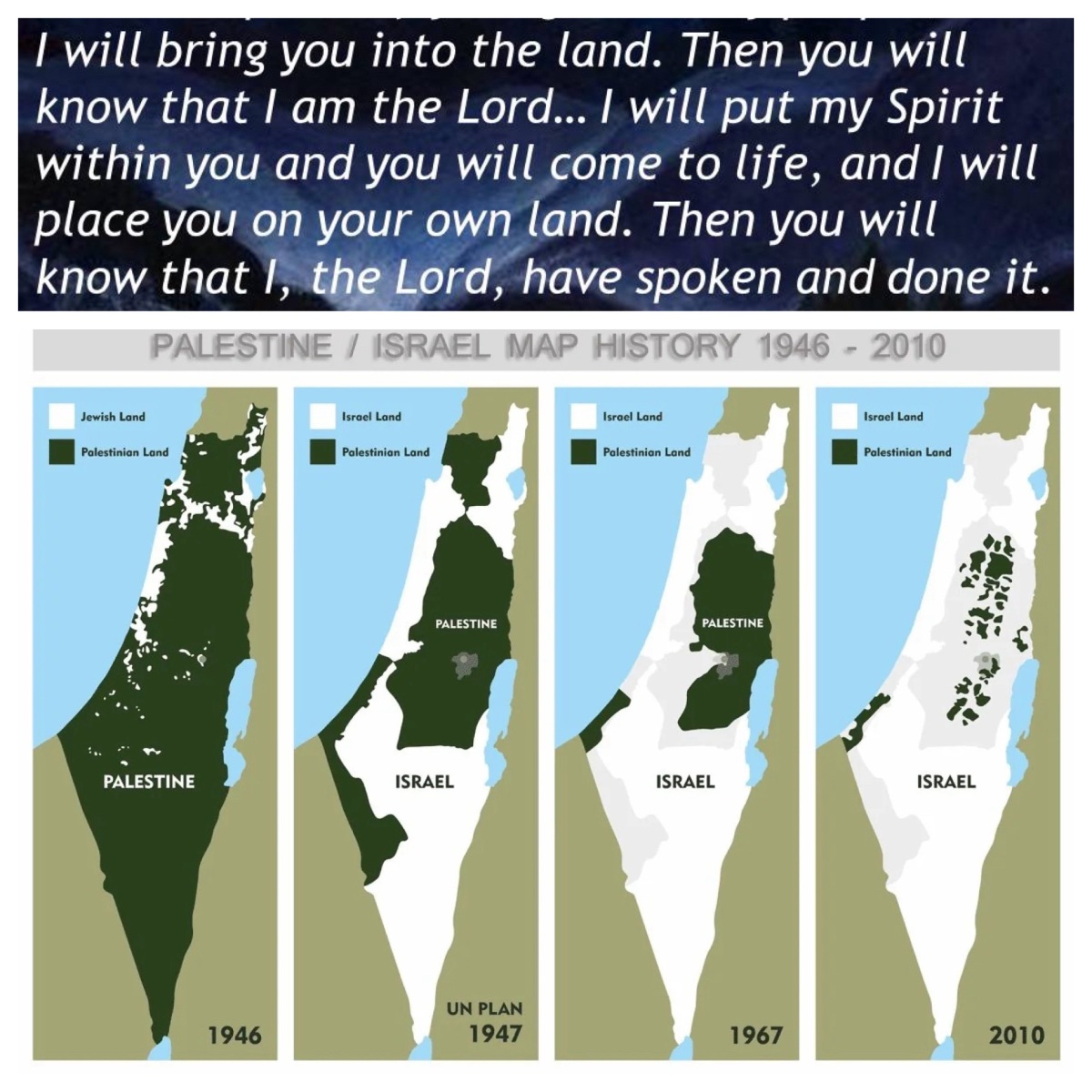
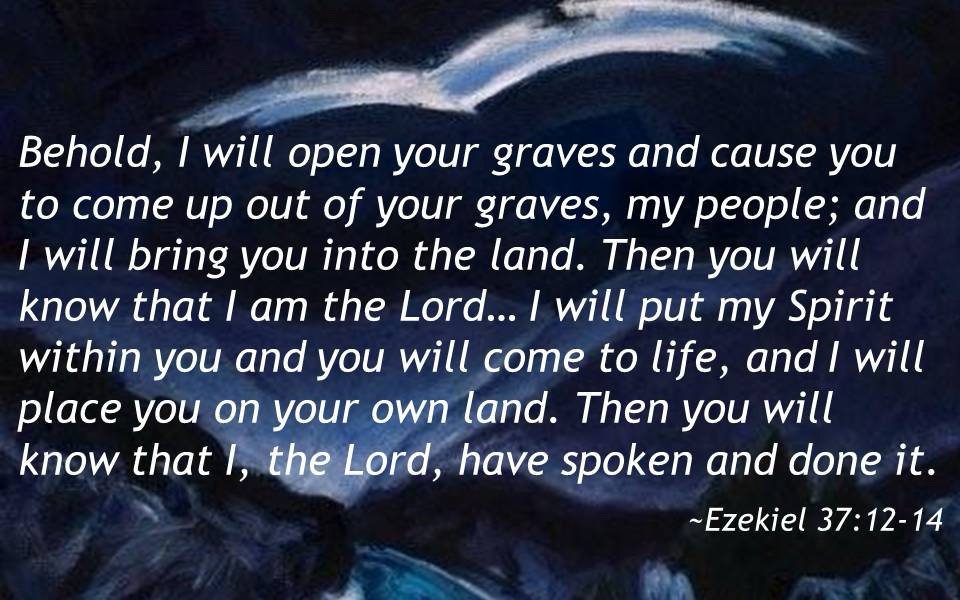
However, this passage also contains words which were filled with hope for the exiled people—but which, in the light of current events in the Middle East, and especially since the eruption of conflict on 7 October last year, are fraught with difficulties. God instructs Ezekiel, “prophesy, and say to them, Thus says the Lord God: I am going to open your graves, and bring you up from your graves, O my people; and I will bring you back to the land of Israel. … I will put my spirit within you, and you shall live, and I will place you on your own soil; then you shall know that I, the Lord, have spoken” (Ezek 37:12,14).

However, this passage also contains words which were filled with hope for the exiled people—but which, in the light of current events in the Middle East, and especially since the eruption of conflict on 7 October last year, are fraught with difficulties. God instructs Ezekiel, “prophesy, and say to them, Thus says the Lord God: I am going to open your graves, and bring you up from your graves, O my people; and I will bring you back to the land of Israel. … I will put my spirit within you, and you shall live, and I will place you on your own soil; then you shall know that I, the Lord, have spoken” (Ezek 37:12,14).

These words are fraught because of the long history of conflict relating to “the land of Israel”—the land to which the exiles would return under the decree of Cyrus of Persia; the land which today is the focus of such controversy and conflicted claims.

The land marked out for Israel was based on the historical reality that in ancient times Israelites/Jews had lived on that land for centuries until the scattering of all Jews under Roman rule first and second centuries of the Common Era. But since then, Arabs of various origins had held control of the land (see below), and those living there came to be known as Palestinians.

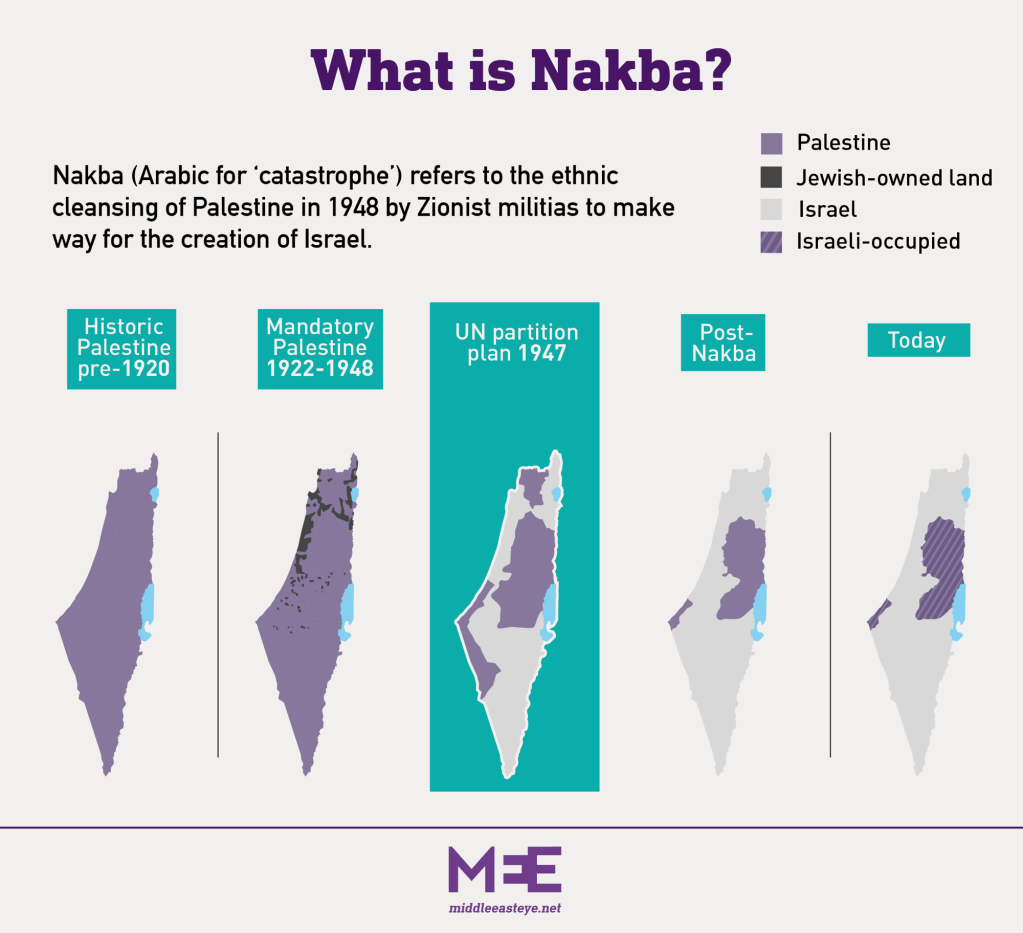
In the early 20th century, the place where Arabs who identified as Palestinians were living was decreed to be the British Mandate of Palestine (1920–1948). The ancient conflicts, it was hoped, would be well in the past. A place for Palestinians in the modern world was, it was thought, now settled. But this was not to be, as we well know today.

In part in response to the horrors of the Shoah, exposed by the ending of World War Two, the modern state of Israel was created in 1948. This was a hugely important, completely justified step to take, give the atrocities of genocide that had been inflicted on Jews in Europe by the Nazi regime of Germany.

The new nation of Israel took 78% of the area which had been provided for Palestinians in the British Mandate. That this was now Jewish territory was a blessing for Jews, but it was a huge and continuing irritant to Palestinian sensibilities, which is why the period from 1948 onwards is known as the Nakba, the Palestinian Catastrophe. A significant number of Palestinians fled the area declared as Israel, as (in one estimate) over 500 Palestinian villages were repopulated by Jews, becoming refugees with no national identity. That was indeed a catastrophe for those inhabitants.

The contested regions of the Gaza Strip (along the east coastline of the Mediterranean Sea) and the West Bank (land immediately to the west of the River Jordan) became known as the Palestinian Territories. They have been disputed territories ever since they were occupied by Israel, two decades later, in the Six-Day War of 1967. In the decades since then, continuing and increasingly aggressive expansion of Israeli settlements into areas where Palestinians were living has greatly exacerbated the situation.

And so those who were dispossessed—and offered the hope of return to “their land”—become the dispossessors of others, to whom that same land was also “their land”; and so the tragic cycle continues.

The biblical texts which claim that God gave land to a chosen people so long ago are not verbatim accounts of “what God said” long ago, nor are they historical reports of actual events. They were written by priests returning from Exile, trying to recapture the period when Israel had some autonomy, because of the strength of its army under various tribal leaders (presented as “kings”). The texts form aetiological tales—that is, they are written as stories at a point in time, purporting to be ancient records, laying the foundation for a claim such as “this is our land, God gave it to us”.

That same land, promised to Abraham, claimed by Moses, is in contention today. It has had a chequered history. The ancient land of Cana an eventually became the land of Israel, then (along with Judaea) part of the Roman province of Syria Palaestina (132–390), and then of the Diocese of the East in the Roman Empire (to 536). What followed the fall of the Roman Empire was a millennium and a half of Muslim rule of this land, first as a part of Bilad al-Sham, the Greater Syria region, under various Caliphates.

The region continued to be part of various organisational configurations under successive Muslim rule, on into the Ottoman Caliphate (from 1517) and then into the modern era, as already noted. (I am not an expert, by any means, of this ancient and medieval history; for this summary, I am dependent on what I read in what I consider to be reputable sources.)

An exaggerated, idealised view of the extent of the land claimed by modern-day Israelis is evident in so many ways in the portrayal of Solomon, who was seen to be filled with “wisdom and knowledge”, and granted “riches, possessions, and honour, such as none of the kings had who were before you, and none after you shall have the like” (2 Chron 1:7–12, especially verses 10 and 12). The biblical figure of Solomon is an exaggerated caricature, a description of an idealised ruler whose existence is actually still a matter of debate amongst ancient historians.

It is also worth noting that the large reach of land that Solomon ruled over, even more extensive than the oft-cited phrase “from Dan to Beersheba” (Judg 20:1; 1 Sam 3:20; 2 Sam 3:10; 17:11; 24:2, 15; 1 Ki 4:25; 1 Chron 21:2; 2 Chron 30:5), did not continue past his death. The hagiographical exaggeration of territory under Solomon is not noted in the period after his death. The narrative books that recount the stories of the kingdoms of Israel, in the north, and Judah, in the south, in the centuries after Solomon, indicate that the scope of those kingdoms was more constrained.

*****

In the light of this, we need to take care when we come across texts in the Hebrew Scriptures which dogmatically and definitively declare that this land belongs to the people of Israel. Indeed, even scripture itself tells the story of the invading colonisers who claimed this land for their own (in the book of Joshua).

So I don’t think it is responsible, today, to lay claim to the whole, extended territory of the land, from the biblical passages noted, as the scope for the modern state of Israel which was created in 1948. There is no justification for the continued aggressive expansion of Israeli settlements in Palestinian areas. So I have sympathy for Palestinians who have lived on the land for thousands of years prior to 1948, as they understand this to be their ancestral land. It has been a continuing Nakba, a catastrophe, for Palestinians over these decades.

I also have sympathy for Jews, both those living in the land of Israel today, as well as those living in diaspora, for whom the land of Israel has a powerful symbolic significance—especially since the Shoah of 1933—1945 and the terrible genocide perpetrated by the Nazis against Jews in so many countries during that period. Granting them land in the area where their ancestors long ago had lived, a homeland that gives them security in the modern world, is important and necessary.

That said, I don’t agree that Palestinians should take matters into their own hands to seek vengeance against people in Israel in the way that they have done, once again, in recent months. In the same manner, nor do I think that the Israeli forces should respond in the aggressive and violent manner that they have done, once again, in recent times, with deaths of women and children, and aid workers, noted on the news with dreadful persistence. Too many people—innocent people—are dying and being injured, making any possible progress towards peace with justice even more difficult each day.

We need to seek once more the peace of these peoples. And we need to find that peace on the basis of justice. Neither terrorist attacks nor military crackdowns will achieve this. They will simply exacerbate a dangerous situation.

How do we deal, today, with the promises of God made long ago? “I will bring you back to the land of Israel. … I will place you on your own soil” (Ezek 37:12,14). We need to tread with care. Perhaps some other texts from both Jewish scripture Christian scripture provide guidance.

“Depart from evil, and do good; seek peace, and pursue it.” (Psalm 34:14). “Blessed are the peacemakers, for they will be called children of God.” (Matt 5:9). “Justice, and only justice, you shall pursue, so that you may live and occupy the land that the Lord your God is giving you.” (Deut 16:20). “… the weightier matters of the law: justice and mercy and faith. It is these you ought to have practiced …” (Mat 23:23). May these be the principles that guide the leaders of the warring groups in Israel and Palestine today.

A new and right spirit (Ps 51; Lent 5B)

“Put a new and right spirit within me”, the psalmist sings (Ps 51:10), in the psalm that is offered by the lectionary for this coming Sunday, the Fifth Sunday in Lent, as a companion piece for the well-known Hebrew Scripture passage for this Sunday about the “new covenant” to be given to Israel and Judah (Jer 31:31–34).

Perhaps the key to this passage comes in the prophet’s words from God, “this is the covenant that I will make with the house of Israel; I will put my law within them, and I will write it on their hearts; and I will be their God, and they shall be my people.” (Jer 31:33). For more on this passage, see

The prophet indicates that the promise God offers is that “I will forgive their iniquity, and remember their sin no more” (Jer 31:34b), which is perhaps why the psalmist is confident to pray for God to have mercy: “blot out my transgressions, wash me thoroughly from my iniquity, and cleanse me from my sin” (v.2), then “purge me with hyssop, and I shall be clean; wash me, and I shall be whiter than snow” (v.7), and still more, “hide your face from my sins, and blot out all my iniquities” (v.9).

Forgiveness of sin has been a characteristic of the Lord God throughout the narrative books which tell the saga of Israel. Abraham bargains with God about forgiving Sodom (Gen 18:22–33). Moses likewise pleads with God, after the people had built a Golden Calf, to forgive them—“but if not, blot me out of the book that you have written” (Exod 32:32).

Yet these narratives also make it clear that God’s forgiving nature needs to be balanced by an understanding of the vengeance that upholds divine justice. In the wilderness of Paran, after spies returned from Canaan and stirred up discontent amongst the people, Moses recognises this capacity for vengeance; he implores the Lord not to kill the people in retaliation, praying, “forgive the iniquity of this people according to the greatness of your steadfast love, just as you have pardoned this people, from Egypt even until now”—to which the Lord God replied, “I have forgiven them, just as you have asked” (Num 14:19–20).

This story also indicates that divine forgiveness was conditional, for God immediately declared, “none of the people who have seen my glory and the signs that I did in Egypt and in the wilderness, and yet have tested me these ten times and have not obeyed my voice, shall see the land that I swore to give to their ancestors; none of those who despised me shall see it” (Num 14:22–23).

Later in this same book, note is made that “the Lord will forgive” a woman who makes a vow that displeases her father (Num 30:5) or her husband (Num 30:8, 12). God clearly sided with the male who had positional authority in the patriarchal structures of society!

At the renewal of the covenant when the people are in the land of Canaan, Joshua reminds the people that “you cannot serve the Lord, for he is a holy God. He is a jealous God; he will not forgive your transgressions or your sins. If you forsake the Lord and serve foreign gods, then he will turn and do you harm, and consume you, after having done you good” (Josh 24:19–20).

When Solomon dedicates the temple, he recounts the saga of Israel and five times asks for God to “hear in heaven” and “forgive your people who have sinned against you, and all their transgressions that they have committed against you” (1 Kings 8:30, 34, 36, 39, 50). And when Ezra leads a ceremony of rededication for the people as they return to the land after exile, in his extended prayer he reminds God, “you are a God ready to forgive, gracious and merciful, slow to anger and abounding in steadfast love, and you did not forsake them” (Neh 9:17).

So the psalmists pray for God to forgive sins (Ps 25:18; 65:3; 79:9), confident that “there is forgiveness with you, so that you may be revered” (Ps 130:4). Amos prays to God, “O Lord God, forgive, I beg you!How can Jacob stand? He is so small!” (Amos 7:2), Daniel likewise pleads, “O Lord, hear; O Lord, forgive; O Lord, listen and act and do not delay!” (Dan 9:19).

Both Jeremiah (Jer 33:8; 36:3) and Ezekiel (Ezek 16:63) envisage that God will forgive, although Hosea reports the strident command of God when his wife bore a daughter: “name her Lo-ruhamah, for I will no longer have pity on the house of Israel or forgive them” (Hos 1:6). This is what we have come to expect from the prophetic word, which consistently berates the people and warns them of the judgement that God will bring upon them because of their sinfulness. See

By contrast, God continues, “I will have pity on the house of Judah, and I will save them by the Lord their God” (Hos 1:7). So forgiveness—limited, directed by divine decree—is indeed possible. Accordingly, we see in the psalm for this Sunday (Psalm 51:1–12) that the psalmist is confident to seek divine forgiveness, declaring “I know my transgressions, and my sin is ever before me” (v.3), even going so far as to say “I was born guilty, a sinner when my mother conceived me” (v.5).

That’s a serious claim. Augustine would certainly agree, no doubt. Personally, I find this a hard view to agree with, however; see

It is in the spirit of seeking divine compassion for the sinfulness of humanity that the psalmist ends this section of the psalm with another petition for forgiveness: “restore to me the joy of your salvation, and sustain in me a willing spirit” (v.12). In forgiveness, there is joy at what God does and a willingness to continue to work with God into the future.

These ancient words, we can be confident, stand as relevant and nourishing for people of faith today, deep into this Lenten season. And so we hear this psalm this coming Sunday.

Lifted up in the wilderness (Num 21; John 3; Lent 4B)

A sermon preached by the Rev. Elizabeth Raine in Sunday worship at the Dungog Uniting Church on 10 March 2024.

The passage from Numbers which the lectionary places before us this Sunday (Num 21:4–9) is a strange reading. It is included in the lectionary primarily because it is alluded to in the passage from the Gospel of John, where the lifting up of Christ on the cross is compared to Moses lifting up the serpent in the wilderness (John 3:14–21).

For modern Western ears, this passage contains many unfamiliar or even superstitious concepts, concepts that do not fit with our Christian ideas of a God of love, compassion and forgiveness. Poisonous snakes biting the complaining people, bronze snakes on poles curing the bites – all of this seems to have stepped straight out of a myth.

I have always felt sorry for the Israelites in the story. The Hebrew text itself emphasises the psychological and physical predicament of the people. The Hebrew word translated as ‘impatient’ means a people who are utterly tired, completely discouraged and at the end of their tether – ‘impatient’ doesn’t begin to accurately describe their condition, and neatly lifts the blame for what follows from God onto the people.

And when the people begin to murmur against Moses and God, the retribution is swift. Instead of comforting the people, they are sent a plague of fiery serpents. Just imagine if you complained about the food at a restaurant and the chef’s response was to drop a red belly black on your table.

The punishment seems to be disproportionately harsh. Yet many of the commentators I looked at when preparing for this sermon took the line that Israel deserved to be punished. There seemed to be a calm acceptance that God’s action was good and necessary. I disagree, and the story needs some drastic reinterpreting to begin to make any sense, especially for us in a modern world.

The book of Numbers contains census, itineraries, statutes, rituals and priestly concerns, wilderness stories, and what is known as the ‘murmuring’ tradition. 

Other peculiar things found in Numbers include a talking donkey, the earth opening to swallow up people, fiery creatures, an extremely vengeful God and quarrelling prophets. Perhaps as an antidote to some of the other things, Numbers also contains the beautiful and well-known Priestly Blessing (The Lord bless you and keep you, Num 7:24-26). The promise of land is ever present in the book of Numbers, and the journey, albeit a long and circuitous one, depicts a gradual process of getting to the edge of that land.  

A lot of the material in Numbers is connected directly with the book of Exodus, especially in chapters 16 to 18, and the same journey of Israel in the wilderness is related somewhat differently. When the people’s complaint about the lack of food is heard in Exod 16–17, God provides them with meat, food and water. The God of Numbers is not quite so forgiving or generous.

In Exodus, God’s reaction was stern, but God heard and helped.  But in Numbers, God responds to complaint by killing the Israelites off with a plague of fiery snakes.

I can understand the weariness of the Israelites but I can’t understand the divinely sanctioned plague of snakes. What has changed? Is it God? Is it the people? Is it the author, who perhaps has a nastier and more theologically vindictive imagination than the author of Exodus?

The rabbis in the Targumim believed that the snakes came to teach humility and patience to a people apparently lacking both. The problem with this idea is twofold. First, it is hard to understand what lessons a bitten, and therefore dead person, can actually learn. And the surviving members of his or her family may not be terribly inclined to worship a God who sends such a punishment. 

Secondly snakes, particularly venomous ones, command our full attention. When someone mentions that a snake is nearby, I don’t stop to ask what lesson I can learn from its presence. Instead, I am much more inclined to climb a nearby tree or to run over the top of the nearest person to get away from it.

And what are these snakes? Numbers 21 does not use the common word for snake (nahash) but instead says the creatures are seraphs, a creature better known to us as the winged creatures around the throne of God in Isaiah’s vision: 

In the year that King Uzziah died, I saw the Lord sitting on a throne, high and lofty; and the hem of his robe filled the temple. Seraphs were in attendance above him; each had six wings: with two they covered their faces, and with two they covered their feet, and with two they flew. And one called to another and said: “Holy, holy, holy is the LORD of hosts;
the whole earth is full of his glory”
. (Isa. 6:1-3, NRSV)

These winged fiery creatures were known for their supernatural powers, both destructive and constructive.  The seraphs were the beings who carried the plagues and punishments decreed by the God.  They were also agents of healing and purification, as in the story from Isaiah. These seraphs were seenas fiery, serpent-like creatures, hence their association with venomous snakes.

When the people pray for forgiveness, God does not stop the plague of divinely-sanctioned poisonous seraphs but instead  commands Moses to craft a bronze seraph and raise it on a pole. When someone is bitten by a snaky seraph, they are to lift their eyes to the elevated bronze snake so as not to die from the bite. 

Theologically, this is a problematic solution. At best,  it appears as cheap grace: one glance at a serpent on a stick and all is restored. At worst, it reminds us of superstitious magic or of a healing idol of winged serpent, the type that was left behind in Egypt.

So what are we to do with this story of divine retribution, deadly angels and healing idols on sticks? 

We have seen with covid lockdowns that the wilderness, especially if we find ourselves in it for too long, can become life-draining, not life-giving. We can become worn out and disillusioned, and unsure where our journey is leading us. Our energy sapped, our faith tested, like the Israelites we became prey to self-doubt. 

We may find that deep spiritual and personal reflection spent in times ofwilderness has the downside of our own symbolic fiery seraphs returning to haunt us. Doubt, our past experiences and fears may get in the way as we attempt to move forward. Like the Israelites, we can tend to look downward to find mud and despair, and we miss seeing the stars of hope.

How do we prevent being stuck in the wilderness? 

In John 3, we find a first-century Christian author recycling the myth of Moses’ bronze seraph as a prophecy of the crucified one; the dying victim on a cross who is also the source of new life for those who look to him in faith. 

John’s gospel says the dreadful imagery of a crucified man achieves the same purpose. By looking toward the crucified Christ, the believer looks beyond it to the God who redeems. The symbol of the bronze serpent and the cross are signs of divine involvement in the people’s journey toward understanding, repentance and reconciliation.

In this case it will not just be ‘life’ given to the one who looks up to the Son of Man, but ‘eternal life’. John has taken the imagery of the bronze serpent and given it new meaning and power for the followers of Jesus. 

Most of us will have been overpowered by painful bites in our lives.  But the two lectionary stories today offer us comfort for those times. When we look up, we look to the face of the God who walks with us, who offers comfort to us, who helps restore us to equilibrium and who ultimately saves us.

To look up to Jesus as he is lifted up, is to see God’s healing presence in the world. Paradoxically, hidden in the crucifixion is the redemption and reconciliation of the Son of Man with God’s desire to heal the world. 

May we continue to look up, to see the stars and find hope and redemptionfrom the one who was crucified. And may we experience the love and healing that God intends us to find when we do. Amen.

A steadfast love that endures forever (Psalm 107; Lent 4B)

“O give thanks to the Lord, for he is good; for his steadfast love endures forever” (Ps 107:1) is the opening sentence of the psalm that is proposed by the lectionary for this coming Sunday, the Fourth Sunday in Lent. The reference to “steadfast love” recurs in verses 8, 15, 21, and 31, as the psalmist recounts key moments in the long story of the people of Israel and invites those hearing their words, “let them thank the Lord for his steadfast love”, before the psalm concludes, “let those who are wise give heed to these things, and consider the steadfast love of the Lord” (v.43).

Elsewhere throughout the psalms there are many references to God’s steadfast love: an affirmation that “with the Lord there is steadfast love, and with him is great power to redeem” (Ps 130:7); a plea, “let your face shine upon your servant; save me in your steadfast love” (Ps 31:16); a note of praise that “steadfast love and faithfulness will meet; righteousness and peace will kiss each other” (Ps 85:10); and the recurring phrase, “his steadfast love endures forever”, throughout the song recalling the acts of God in Ps 136. (The phrase occurs in each of the 26 verses of this psalm, and then around 100 times in the other psalms.)

The English phrase “steadfast love” translates an important Hebrew word, חֶ֫סֶד (hesed). It signifies a love that is loyal, faithful, dependable, and on many occasions, unconditional. The word is applied both to human beings, as they exhibit “steadfast love” to one another, but also—and more often—to God, who shows “steadfast love” to the people of Israel, with whom God was bound in covenant. This is clear from the use of the word in the final verse of Micah’s prophetic words, affirming that God “will show faithfulness to Jacob and unswerving loyalty (hesed) to Abraham, as you have sworn to our ancestors from the days of old” (Mic 7:20).

Moses is reported as having told Israel that “the Lord your God is God, the faithful God who maintains covenant loyalty (hesed) with those who love him and keep his commandments, to a thousand generations” (Deut 7:9). God, speaking through the prophet Nathan, offers assurance that “I will not take my steadfast love (hesed) from him [David], as I took it from Saul, whom I put away from before you” (2 Sam 7:15).

The unnamed prophet (by tradition, Jeremiah) who laments the destruction of Jerusalem and the ravaging of her people includes at the heart of their extended poems the ringing affirmation that “the steadfast love (hesed) of the Lord never ceases, his mercies never come to an end” (Lam 3:22). And then Nehemiah, when he hears about the damage in the city to which the exiles are returning, prays to the Lord, “God of heaven, the great and awesome God who keeps covenant and steadfast love (hesed) with those who love him and keep his commandments” (Neh 1:5; also 9:32).

So the steadfast love of the Lord is celebrated in the foundational sagas of the Israelite people, where it is found in words attributed to key characters such as Jacob (Gen 32:9–10), Moses (Exod 15:13; Num 14:18–19), David (2 Sam 2:6; 15:19–20; 22:51; 1 Chron 16:34), Solomon (1 Ki 3:6; 8:23-24; 2 Chron 1:8; 6:14–15, 42), Ezra (Ezra 7:27–28; 9:9; Neh 9:32) and Nehemiah (Neh 1:5; 13:22).

The Chronicler reports that under David, a specific group was engaged in the Temple “to render thanks to the Lord, for his steadfast love endures forever” (1 Chron 16:41); this continues under Solomon (2 Chron 7:4-6) and is reinstated after the Exile under Nehemiah (Ezra 3:10-11). So there is recurrent noting of the song which is regularly offered to God, “O give thanks to the Lord, for he is good; for his steadfast love endures forever” (1 Chron 16:34; 2 Chron 5:13; 7:3; 20:21; Ezra 3:11; Jer 33:10-11; in Ps 136 and in a number of other psalms).

Furthermore, God is affirmed as being “merciful and gracious, slow to anger, and abounding in steadfast love and faithfulness, keeping steadfast love for the thousandth generation” in a number of books (Exod 34:6; 2 Chron 30:8–9; Neh 9:17, 32; Jonah 4:2; Joel 2:13; Ps 86:15; 103:8, 11; 111:4; 145:8–9).

The compilers of the Revised Common Lectionary have selected a psalm for each Sunday of the year, noting that this has normally been in order to provide a passage that complements the First Reading, which is most often a passage from Hebrew Scripture. In this instance, the portion of the psalm chosen (Ps 107:17-22) appears to match a story told in Numbers, when poisonous serpents are sent by God to punish the complaining Israelites (Num 21:4–9).

The psalm summarises the incident as a time when “some were sick through their sinful ways” (v.17) and “loathed any kind of food” (v.18); this only generally approximates the account of Numbers, in which the people complain that “there is no food and no water, and we detest this miserable food” (Num 21:5). There is no mention in the psalm of the “poisonous [or fiery] serpents” sent by God to punish the people (Num 21:6), simply that “they drew near to the gates of death” (v.18), presumably because they did not eat the “miserable food”, whereas in the narrative of Numbers “many Israelites died” from being bitten by the serpents (Num 21:6).

Certainly, in both the poetry of the psalm and the prose of the narrative account, the people seek relief from the Lord God. The psalmist reports that “they cried to the Lord in their trouble, and he saved them from their distress … he healed them, and delivered them from destruction” (v.19-20). The prayer has been effective, so the song continues with the refrain, “let them thank the Lord for his steadfast love, for his wonderful works to humankind” (v.21) and an encouragement to the people to offer sacrifices and joyful songs (v.21).

In Numbers, it is Moses who offers prayer (Num 21:7), but an additional element is included: the Lord instructs Moses to “make a poisonous [or fiery] serpent, and set it on a pole; and everyone who is bitten shall look at it and live” (Num 21:8). Moses does as instructed, and so “whenever a serpent bit someone, that person would look at the serpent of bronze and live” (Num 21:9). Simply looking at the bronze figure was sufficient to effect healing! (And the narrative gives no indication of the response of the people to such healing, in contrast to the extended joyful response of the psalmist.)

On the language for “poisonous [or fiery] serpent” used in the story told in Numbers, see

As we hear this psalm this coming Sunday, we would do well to recall the joyful response to the way that God has acted, with a steadfast love that endures forever, that the psalmist reports. May this be our experience and our practice as we encounter difficulties in our lives and, through faith and persistence, surmount them and thrive.

The priority of the Torah: love God, love neighbour (Mark 12; Narrative Lectionary for Lent 4)

“You shall love the Lord your God with all your heart, and with all your soul, and with all your strength, and with all your mind” (Deuteronomy 6:5). “You shall love your neighbour as yourself” (Leviticus 19:8). These two commandments are cited in a story about Jesus engaging in a discussion with a scribe, a teacher of the Law, which ends with Jesus saying, “there is no commandment greater than these” (Mark 12:31).

The Narrative Lectionary includes this story (Mark 12:28–34) as the opening section of a longer Gospel passage that is proposed for worship this coming Sunday (12:28–44). It’s a passage that takes us deep into the heart of Torah—those guidelines for living all of life in covenant faithfulness with God. Torah sits at the centre of Judaism. See more on this at

Of course, Jesus hasn’t answered the question precisely in the terms that it was asked; he doesn’t indicate what is “the first” commandment, but which two are “greatest”. It’s like a dead heat in an Olympic race: a race when even a finely-tuned system can’t differentiate between the two winners, even down to one thousandth of a second. Both love of God and love of neighbour are equally important. Joint winners—like that high jump competition a year or two back where the two leading jumpers just decided to share the gold medal, rather than keep competing—and risk not getting gold.

Both commands are biblical commands, found within the foundational books of scripture within Judaism. They were texts that Jewish people, such as Jesus and his earliest followers would have known very well. Each command appears in a significant place within the books of Torah, the first five books of Hebrew Scriptures.

The command to “love God” sits at the head of a long section in Deuteronomy, which reports a speech by Moses allegedly given to the people of Israel (Deut 5:1–26:19). The speech rehearses many of the laws that are reported in Exodus and Leviticus, framing them in terms of the repeated phrases, “the statutes and ordinances for you to observe” (4:1,5,14; 5:1; 6:1; 12:1; 26:16–17), “the statutes and ordinances that the Lord your God has commanded you” (6:20; 7:11; 8:11).

After proclaiming the Ten Commandments which God gave to Israel through Moses (Deut 5:1–21; cf. Exod 20:1–17) and rehearsing the scene on Mount Sinai and amongst the people below (5:22–33; cf. Exod 19:1–25; 20:18–21). Moses then delivers the word which sits at the head of all that follows: “Hear, O Israel: The LORD is our God, the LORD alone. You shall love the LORD your God with all your heart, and with all your soul, and with all your might. Keep these words that I am commanding you today in your heart” (Deut 6:4–6). This, it would seem, is the key commandment amongst all the statutes and ordinances.

These words are known in Jewish tradition as the Shema, a Hebrew word literally meaning “hear” or “listen”. It’s the first word in this key commandment; and more broadly than simply “hear” or “listen”, it caries a sense of “obey”. These words are important to Jews as the daily prayer, to be prayed twice a day—in keeping with the instruction to recite them “when you lie down and when you rise” (Deut 6:7). As these daily words, “love the Lord your God” with all of your being are said, they reinforce the centrality of God and the importance of commitment to God within the covenant people.

The command to “love your neighbour” in Leviticus 19 culminates a series of instructions regarding the way a person is to relate to their neighbours: “you shall not defraud your neighbour … with justice you shall judge your neighbour … you shall not profit by the blood of your neighbour … you shall not reprove your neighbour … you shall love your neighbour” (Lev 19:13–18).

These instructions sit within the section of the book which is often called The Holiness Code—a section which emphasises the word to Israel, that “you shall be holy, for I the Lord your God am holy” (Lev 19:2; also 20:7, 26). Being holy means treating others with respect. Loving your neighbour is a clear manifestation of that ethos. Loving your neighbour exemplifies the way to be a faithful person in covenant relationship with God.

So it is for very good reasons that Jesus extracts these two commandments from amongst the 613 commandments that are to be found within the pages of the Torah. (The rabbis counted them all up—there are 248 “positive commandments”, giving instructions to perform a particular act, and 365 “negative commandments”, requiring people to abstain from certain acts.)

Jesus, of course, was a Jew, instructed in the way of Torah. He knew his scriptures—he argued intensely with the teachers of the Law over a number of different issues. He frequented the synagogue, read from the scroll, prayed to God, and went on pilgrimage to Jerusalem and into the Temple—where, once again, he offered a critique of the practices that were taking place in the courtyard of the Temple (11:15–17).

Then he engaged in debate and disputation with scribes and priests (11:27), Pharisees and Herodians (12:13), and Sadducees (12:18). Each of those groups came to Jesus with a trick question, which they expected would trap Jesus (12:13). Jesus inevitably bests them with his responses (11:33; 12:12, 17, 27). It was at this point that the particular scribe in our passage approached Jesus, perhaps intending to set yet another trap for him (12:28).

So Jesus, good Jew that he was, is well able to reach into his knowledge of Torah in his answer to the scribe. The commandments that he selects have been chosen with a purpose. They contain the essence of the Torah. His answer draws forth the agreement of the scribe—there will be no robust debate now! In fact, in affirming Jesus, the scribe reflects the prophetic perspective, that keeping the covenant in daily life is more important that following the liturgical rituals of sacrifice in the Temple (see Amos 5:21–24; Micah 6:6–8; Isaiah 1:10–17).

The scene is similar to a Jewish tale that is reported in the Babylonian Talmud, a 6th century CE work. In Shabbat 31a, within a tractate on the sabbath, we read: “It happened that a certain non-Jew came before Shammai and said to him, ‘Make me a convert, on condition that you teach me the whole Torah while I stand on one foot.’ Thereupon he repulsed him with the builder’s cubit that was in his hand. When he went before Hillel, he said to him, ‘What is hateful to you, do not to your neighbour: that is the whole Torah, the rest is the commentary; go and learn it.’”

Hillel, of course, had provided the enquiring convert, not with one of the 613 commandments, but with one that summarised the intent of many of those commandments. We know it as the Golden Rule, and it appears in the Synoptic Gospels as a teaching of Jesus (Matt 7:12; Luke 6:31).

Some Jewish teachers claim that the full text of Lev 19:18 is actually an expression of this rule: “You shall not take vengeance or bear a grudge against any of your people, but you shall love your neighbour as yourself: I am the LORD.” Later Jewish writings closer to the time of Jesus reflect the Golden Rule in its negative form: “do to no one what you yourself dislike” (Tobit 4:15), and “recognise that your neighbour feels as you do, and keep in mind your own dislikes” (Sirach 31:15).

Paul clearly knows the command to love neighbours, for he quotes it to the Galatians: “the whole law is summed up in a single commandment, ‘You shall love your neighbour as yourself’” (Gal 5:14), and James also cites it: “you do well if you really fulfill the royal law according to the scripture, ‘You shall love your neighbour as yourself’” (James 2:8). Both writers reflect the fact that this was an instruction that stuck in people’s minds!

And I wonder … perhaps there’s a hint, in these two letters, that the greater of these two equally-important commandments is actually the instruction to “love your neighbour”?

*****

I have provided a more detailed technical discussion of the words used in this passage, and its Synoptic parallels, in this blog:

On the Pharisees and Torah, see

In praise of Torah (Psalm 19; Lent 3B)

The compilers of the Revised Common Lectionary have selected a psalm for each Sunday of the year, noting that this has normally been in order to provide a passage that complements the First Reading, which is most often a passage from Hebrew Scripture.

The psalm for this coming Sunday, Psalm 19, was obviously chosen as a companion reading alongside the Hebrew Scripture passage from Exodus 20, which recounts The Ten Words given to Israel, through Moses, when he met with the Lord on Mount Sinai (Exod 20:1–17). For that passage, see

Creation is the focus in the first six verses of the psalm, where the psalmist’s view is fixed on “the heavens”, which are “telling the glory of God” (v.1). In those heavens the Lord “has set a tent for the sun, which comes out like a bridegroom from his wedding canopy, and like a strong man runs its course with joy” (v.4–5)—clearly a description of the daily movement of the sun across the sky (from our perspective), from east to west, as verse 6 then elucidates.

However, at this point the focus changes to Torah. The psalmist expresses a consistently positive attitude towards Torah in verses 7–14. Those verses contain a ringing affirmation of the Torah as “perfect, reviving the soul … sure, making wise the simple … right, rejoicing the heart … clear enlightening the eyes … pure, enduring forever … true and righteous altogether … more to be desired than gold … sweeter also than honey” (Ps 19:7–14).

The terms used here in parallel to describe Torah (law, decrees, precepts, commandment, fear, ordinances) are found regularly in the narrative books to describe the collection of laws (Deut 8:11; 11:1; 1 Ki 2:3; 6:12; 8:58; 2 Ki 17:34–37; 1 Chron 22:13; 28:17; Neh 9:13; 10:29) as well as right throughout Psalm 119. See

Such affirmations of Torah sound out insistently throughout the majestically grand doublets of the longest psalm, Psalm 119. The 176 verses of this psalm, artistically arranged into acrostic stanzas of eight verses at a time, are bracketed by delight and confidence (“happy are those … who walk in the way of the Lord … I long for your salvation, O Lord, and your law is my delight”, vv.1, 174). This psalm indicates that the Law shapes the way that the covenant is kept; and the covenant gives expression to the steadfast love and grace of God.

*****

So much is Torah valued, that it apparently offers perfection: “the law of the Lord is perfect” (Ps 19:7), which we might compare with “I have seen a limit to all perfection, but your commandment is exceedingly broad” (Ps 119:96). In this regard, the psalmist’s appreciation for Torah as perfection seems to reflect the priestly desire for people to offer perfect sacrifices, without blemish (Lev 22:21), and Solomon’s desire to build the Temple as a perfect house for God (1 Ki 6:22).

Indeed, such a conception of perfect Torah also resembles the sage’s musings regarding Wisdom: “to fix one’s thought on her is perfect understanding” (Wisdom 6:15), and thoughts found in a prayer attributed to Solomon: “even one who is perfect among human beings will be regarded as nothing without the wisdom that comes from you” (Wisdom 9:6).

Much value is accorded to these words of Torah. As well as calling the law “perfect”, we hear that “the decrees of the Lord are sure” (Ps 19:7), a claim echoed in another psalm (Ps 93:5). The precepts of the Lord that are right (Ps 19:8; see also 119:75, 137, 172) means that one who is faithful and obedient will be led “in right paths” (Ps 23:3) as they pray “put a new and right spirit within me” (Ps 51:10). “The commandment of the Lord is clear” (Ps 19:8) is a claim that informs the later portrayal of those who trace the course of Wisdom “from the beginning of creation … [who] make knowledge of her clear” (Wisd Sol 6:22).

The psalmist extends the adoration of the Law, declaring that “the fear of the Lord is pure” (Ps 19:9), a claim extended in another statement found in wisdom texts, “the fear of the Lord is the beginning of wisdom” (Ps 111:10; Prov 1:7; 9:10; 15:33; Sir 1:18, 27; 19:20). A further elaboration, “the ordinances of the Lord are true and righteous altogether” (Ps 19:9), is the way that Ezra describes the laws given to Moses on Mount Sinai (Neh 9:13). They are righteous (Ps 119:7, 62, 106, 160, 164), good (119:39), the basis of hope (119:43) and comfort (119:52).

The closing affirmation in this shorter psalm, “more to be desired are they than gold, even much fine gold; sweeter also than honey, and drippings of the honeycomb” (Ps 19:10), is echoed in the longest psalms, “how sweet are your words to my taste, sweeter than honey to my mouth!” (Ps 119:103).

By contrast, when Job asks, “where shall wisdom be found? and where is the place of understanding?”, he proposes that “gold and glass cannot equal it, nor can it be exchanged for jewels of fine gold” (Job 28:12–19), and concludes, “the fear of the Lord, that is wisdom; and to depart from evil is understanding” (Job 28:28).

Wisdom, love, the fear of the Lord, enlightenment, and rejoicing—these are the fruits of Torah, as the psalmist sings. These are the benefits of the law which are to be valued even into our own times, as this Sunday we hear again the words of this ancient psalm and affirm its relevance and importance in the contemporary world.