Saint Basil: scholar and gift-giver

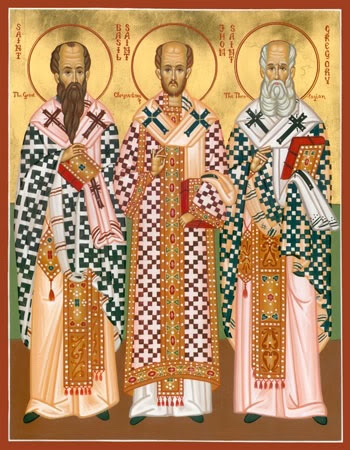
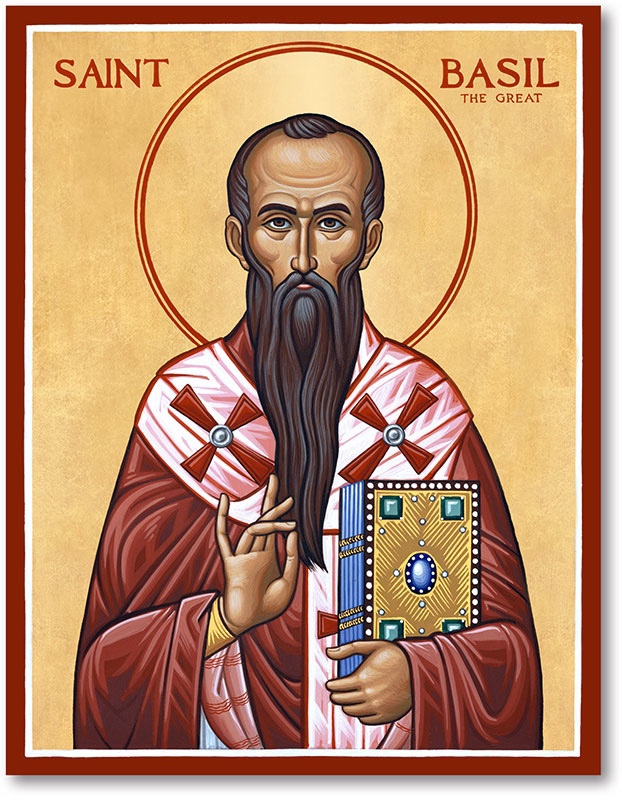
Today (1 January) is the feast day of Saint Basil the Great in the Eastern churches. Basil wrote many theological works and is remembered (along with the two Gregorys, of Nyssa and Nazianzus—pictured below) as one of the Cappadocian Fathers, who played an influential role in the development of patristic thinking about the triune God.

It is said that Basil was tall, thin, partly bald, with a long beard. (He is the one on the left in the icon above.) He ate no more than was absolutely necessary for his survival; he never ate meat. It is said that he had only one worn undergarment and one overgarment.

Basil said that prayer was the seasoning for our daily work, as we season food with salt; that sacred and holy songs can only inspire us and give us joy and not grief. His philosophy fits well into the Christmas Season, when we season our lives with carols!

At the age of 28, Basil “left the world” and became a monk; at 35 a priest, then at 41, the Bishop of Caesarea. It is said that Basil, being born into a wealthy family, gave away all his possessions to the poor, the underprivileged, those in need, and children.

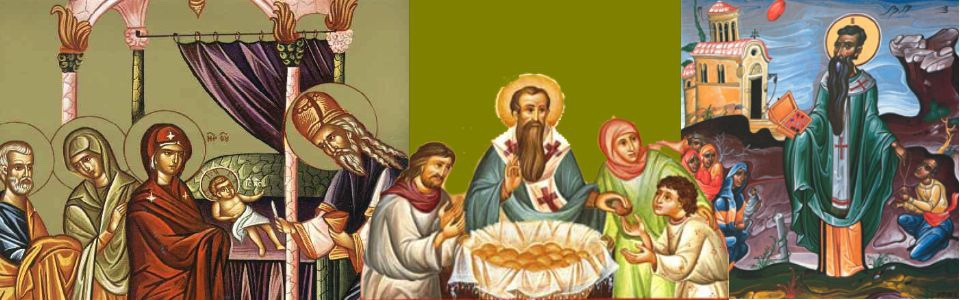
For Greeks and others in the Orthodox tradition, St Basil is the saint associated with Santa Claus. In Greek tradition, he brings gifts to children every January 1 (St Basil’s Day). It is traditional on St Basil’s Day to serve vasilopita, a rich bread baked with a coin inside.

It is also customary on his feast day to visit the homes of friends and relatives, to sing carols for the New Year, and to set an extra place at the table for Basil.

The celebration of St Basil on 1 January marks the day of his death. In the Western Church, because 1 January commemorates the Solemnity of Mary, Mother of God, Basil shares his saintly commemoration on the next day, 2 January, with Gregory of Nazianzus.

St Basil’s Hymn is one of many traditional Greek carols (often referred to as calanda) that are still sung by children on St Basil’s feast day (New Year’s Day). In the tradition still practiced to some extent in modern times, Greek children roam the neighborhoods from house-to-house on St Basil’s Day, playing instruments and singing songs, bidding New Year’s tidings to everyone, and receiving gifts of sweets and pastries from householders.

Here is the hymn (in a quirky and rather stilted translation):

It’s the beginning of the month
beginning of the year
High incense tree
Beginning of my good year
Church with the Holy Seat
It’s the beginning of our Christ
Saint and spiritual
He got out to walk on earth
And to welcome us
St. Basil is coming from Caesarea
And doesn’t want to deal with us
May you long live, my lady
He holds an icon and a piece of paper
With the picture of Christ our Saviour
A piece of paper and a quill
Please look at me, the young man

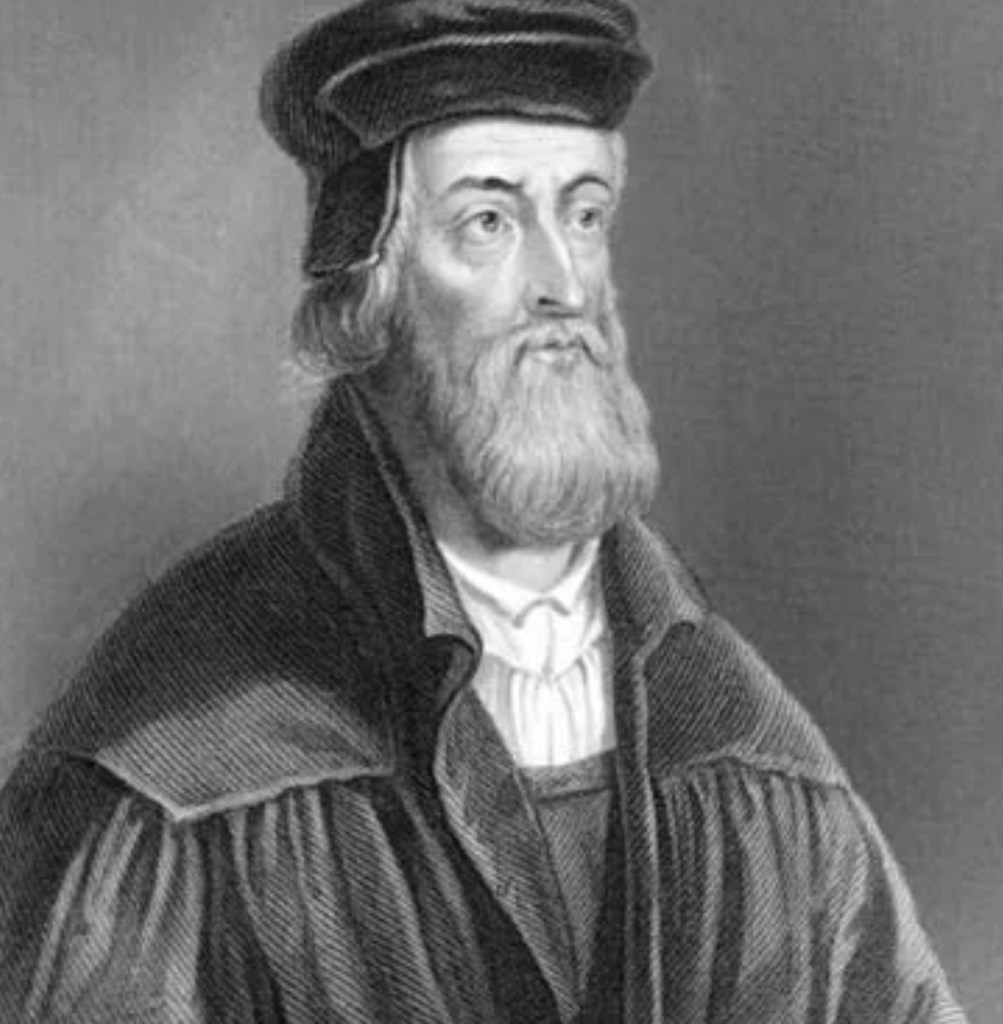
John Wycliffe: heretic? or hero?

One of the gifts that is treasured by many believers around the world is the ability to read the scriptures on their own language. It is something that we take for granted; but it is not something that has always been available to people of faith.

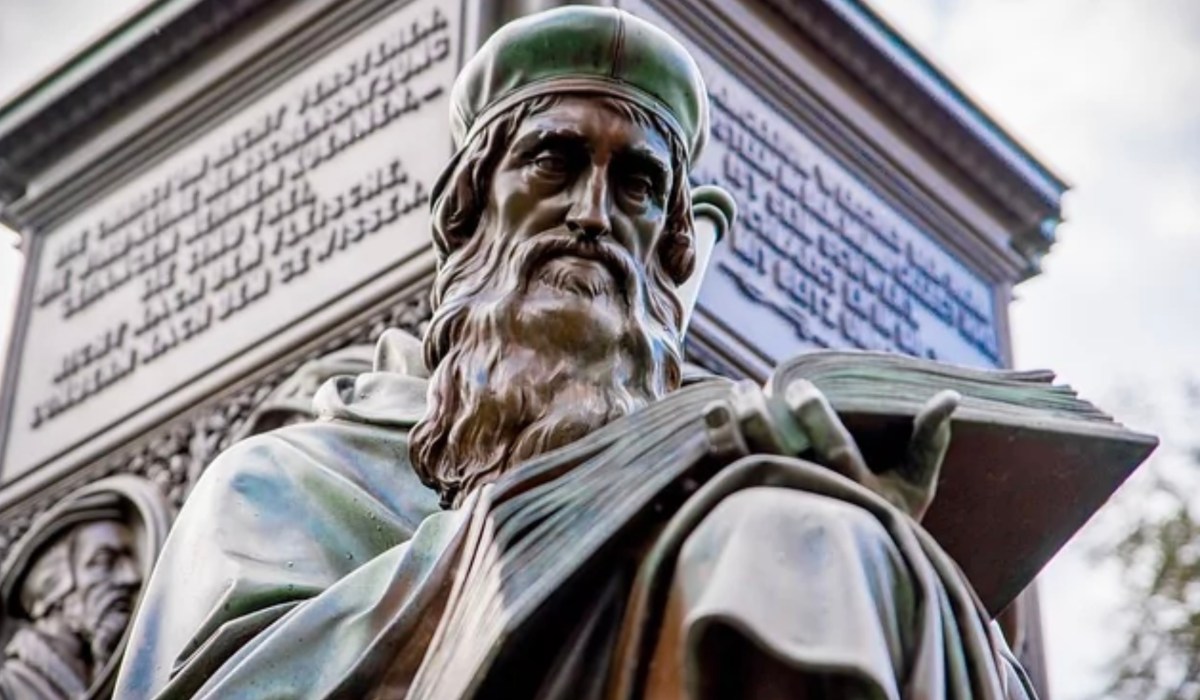
On this day it is good to pause and remember that we have the Greek and Hebrew and Aramaic writings of scripture translated into English and available for us to read. On this day perhaps we English-speaking people might spare a thought for the 14th century theologian and preacher, John Wycliffe (1328–1384), who is remembered as the person who made the first English translation of the Bible.

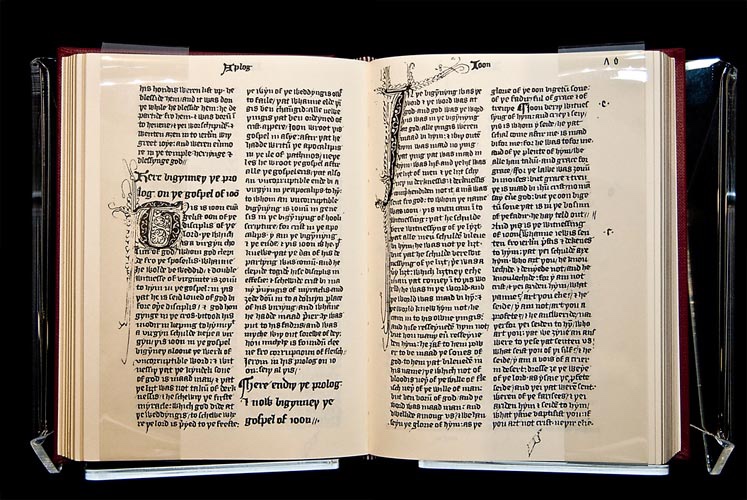
This copy is a facsimile reproduction of the very first translation of the Scriptures into the English language. The Wycliffe translations were hand-written manuscript Bibles, pre-dating printing by 70 years [Gutenberg, 1455].
https://digitalcommons.cedarville.edu/preserved_by_hand/7/

That is the legend; in fact, scholars believe that Wycliffe translated the Gospels, oversaw the translation of the rest of the New Testament, and outsourced the translation of the Old Testament to a team led by Nicholas of Hereford; the whole was later edited and revised by John Purvey. See https://kingscollections.org/exhibitions/specialcollections/bible/first-english-bible/wycliffe-bible

In fact, the Anglican Church designates today, 31 December, as a day to recall John Wycliffe. See https://www.churchofengland.org/prayer-and-worship/worship-texts-and-resources/common-worship/churchs-year/calendar Wycliffe is also often honoured as “the father of English prose”, because the clarity and the popularity of his writings and his sermons in the Middle English dialect did much to shape our language today; see https://www.christianitytoday.com/history/issues/issue-3/john-wycliffe-did-you-know.html

From his theological writings, it has been deduced that Wycliffe believed that “scripture was the only authoritative reliable guide to the truth about God”. That was a view that was later expressed by the key figures in the various Reformations that took place in the 16th century. Wycliffe therefore maintained that all Christians should rely on the Bible rather than on the teachings of popes and clerics—a position that drove Martin Luther two centuries later, in his criticisms of the church.

It follows from this, that all Christians should have direct access to those scriptures to nurture their own faith. “Englishmen learn Christ’s law best in English”, he wrote; “Moses heard God’s law in his own tongue; so did Christ’s apostles.” The many translations of the Bible into English that were made in the ensuing centuries stand on the foundation of Wycliffe’s work.

Blogger MJH writes that, as a translator of the Bible, “John Wycliffe and his successors such as Tyndale and Coverdale stand in line with Christian tradition, with the anonymous Latinisers and Jerome, with the anonymous translators of the Coptic Bible and the Syriac Peshitta, with Cyril and Methodius.” See https://thepocketscroll.wordpress.com/2012/12/30/sixthy-day-of-christmas-commemoration-of-john-wycliffe/

Certainly, the long list of people who translated the scriptures into their own vernacular attest to the importance of contextualising scripture and making it widely available to the people of God—a commitment that has enriched the lives of believers over the centuries. My own denomination continues that commitment with an affirmation that “the Uniting Church lays upon its members the serious duty of reading the Scriptures [and] commits its ministers to preach from these” (Basis of Union, para.5).

As a pre-Reformation protestor, Wycliffe said that there was no scriptural justification for the papacy (as did Luther). He also taught predestination (as did Calvin and Zwingli) and the consubstantiation of the elements in communion (as is sometimes attributed to Luther), in distinction from the Roman Catholic doctrine of transubstantiation. His theology also prefigured the Reformers in his affirmation that “faith in our Lord Jesus Christ is sufficient for salvation” (cf. Luther’s sola fide).

All of this, of course, set Wycliffe up for conflict with the authorities in the Roman Catholic Church. The “Constitutions of Oxford” of 1408 were issued after a synod called by the Archbishop of Canterbury, Thomas of Arundel. This decree aimed to reclaim authority in all ecclesiastical matters, and specifically named John Wycliffe as it banned certain writings, and noted that translation of Scripture into English by unlicensed laity was a crime punishable by charges of heresy.

In May 1377, Pope Gregory XI issued five bulls against John Wycliffe for heresy. In all, the Catholic Church in England tried him three times, and two Popes summoned him to Rome, but Wycliffe was never imprisoned nor ever went to Rome.

Three decades after his death, the Council of Constance declared Wycliffe a heretic on 4 May 1415, and banned his writings, effectively both excommunicating him retroactively and making him an early forerunner of Protestantism. Many Protestants consider Wycliffe to be something of a hero, for he stood against the Roman Church by insisting that the scriptures should not be locked up in Medieval Latin, but rather should be available in the vernacular—in his case, Middle English.

So, John Wycliffe: Bible translator and theologian, preacher and pre-Reformation protestor, a Roman Catholic declared a heretic whose name is remembered and highly valued by Protestants … how do you assess him: heretic? or hero?

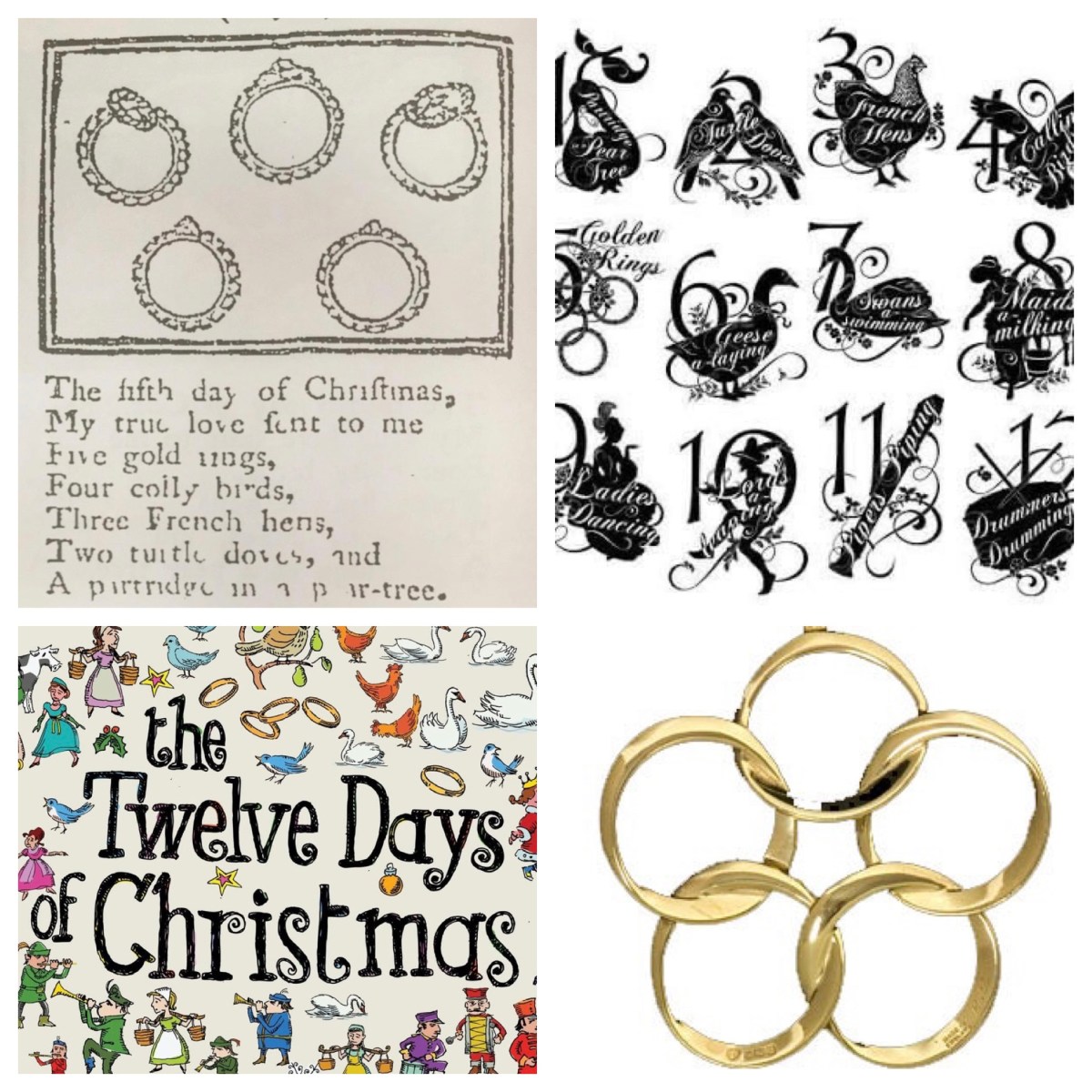
On the fifth day of Christmas: five gold rings

So today we come to the five gold rings in the twelve days of Christmas — you know, the place in the song where everyone turns into bathroom baritones (or the female equivalent), holding forth with the long notes in the “five go-old riiiiiiiiiiiiings” line!

And here we meet head-on the pietistic rhetoric about the song having hidden meanings—the five gold rings stand for the five Books of Moses, just as the two turtledoves signify the two testaments of the Bible, the three colly-birds point to the three persons of the Trinity, the ten lords a-leaping represent the Ten Commandments, and the twelve drummers drumming symbolise the twelve points of The Apostles’ Creed. Pietistic tosh, clearly debunked by snopes.com!

See further at

But beware: another danger lurks here! Recently, no less a venerable and reliable source than the UK Mirror (!!) has quoted a Canadian astrophysicist, Dr Anna Hughes, who tweeted that “’five gooolden riings’ is not in fact referring to 5 literal golden rings, but to five ring-necked pheasants, aka more birds”. Perhaps she felt that commenting on popular christmassy songs would bring her more fame and renown than her PhD is astrophysics and her research in quantum computing? (Thanks to my friend James Ellis for bringing this *learned* article to my attention 😁)

Sadly for the Mirror, and Dr Hughes, this theory is not new. In a 1951 article, Ben Shahn had suggested that “the five golden rings refer to the ringed pheasant”. A decade later (1962) William and Ceil Baring-Gould published a book in which they reiterate this idea, which implies that the gifts for first seven days are all birds. The Mirror, and Dr Hughes, are rather late to the party!!

According to Dr Wikipedia, “Others suggest the gold rings refer to “five goldspinks”—a goldspink being an old name for a goldfinch; or even canaries. In his blog entitled “The Illustrated Etymologicon”, journalist and author Mark Forsyth suggests “the rings could be ring-bills, ring-birds, ring-blackbirds, ring-buntings, ring-dotterels, ring-pigeons, ring-plovers, ring-sparrows or ring-thrushes. There’s a veritable aviary of birds that could be called rings and that, given the feathered context, is what the song is about.” So why pheasants?

See https://blog.inkyfool.com/2010/12/five-gold-rings.html

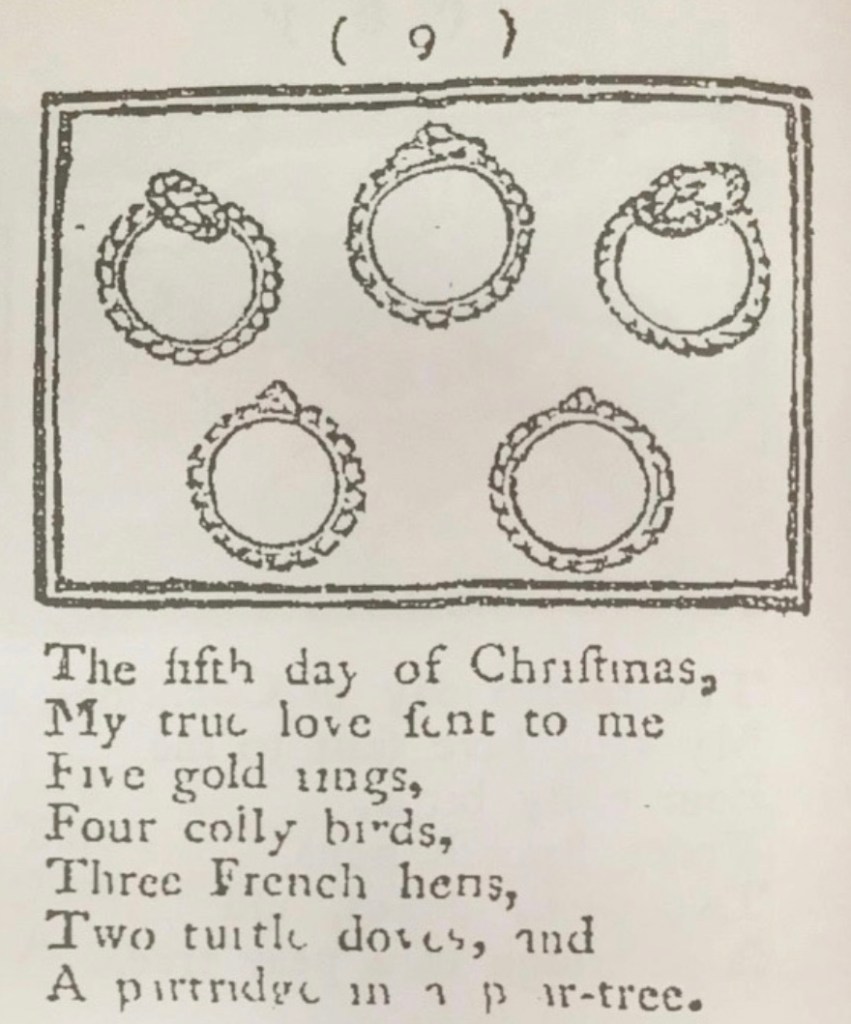
However, the original 1780 publication of the song included an illustration that clearly depicts the “five gold rings” as being jewellery.

Five Gold Rings from “The Twelve Days of Christmas sung at King Pepin’s Ball” in Mirth without Mischief (London: Printed by J. Davenport, George’s Court,
for C. Sheppard, No. 8, Aylesbury Street, Clerkenwell [ca. 1780 or 1800?])

Further light is shed on the gold rings by Dr Pamela Patton, an art historian who has specialised in medieval Spanish art and currently teaches at Princeton University. Dr Patton writes, “the familiar version of the carol that emerged in 1909, when Frederic Austin published his arrangement. And the “five gold rings” part that’s so fun to belt out? It was Austin who composed those two famous bars and added them to his arrangement of the traditional melody, which was copyrighted by the publisher!”

On a roll, she continues, “It was also Austin who added the word “On” to the beginning of each verse. Interestingly, for the twelfth day, Austin doubled down on the melisma, so the final verse calls for the word “gold” to be sung with a flourish of four notes rather than the two usually sung today.”

The publication she refers to is Frederic Austin, arr., The Twelve Days of Christmas (Traditional Song) (London: Novello, 1909). She records all of this on her blog site, “The Index of Medieval Art”. (The arrangement by Austin is not medieval, and the song itself falls just beyond her area of expertise, having first been published in the 18th century, but her blog post contains a fine exposition about a number of gold rings from antiquity in various museum collections.)

So the combination of the artwork and the musical arrangement would point to the five go-old rings being just that—not a gift of yet more birds, but rather an expensive jewellery gift from the true love in the song!

The Twelve Days of Christmas: some explanatory explorations

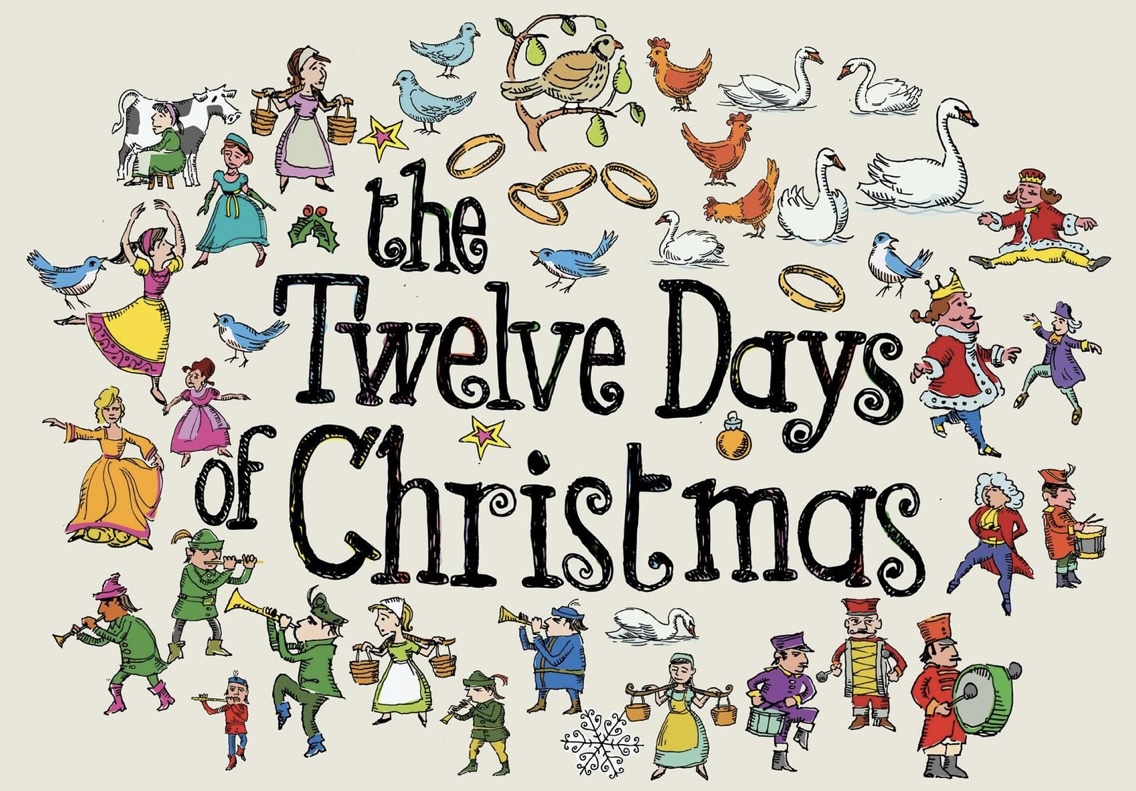
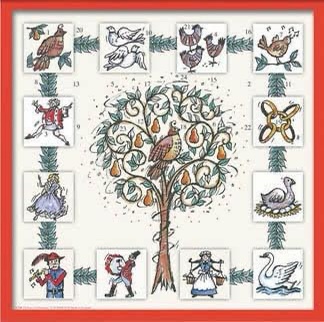
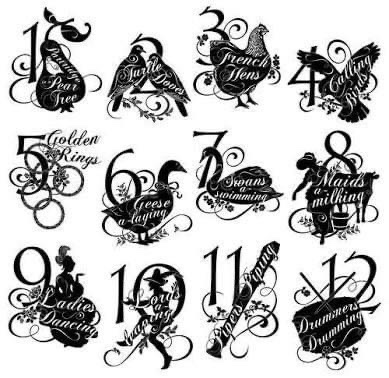
So, it is the night of Christmas Day, and it feels like it is all over—done and dusted, finished, put to bed. Hold it—not so fast!! This is only just the start. Christmas Day is just the first of twelve days of the Christmas season. You might have heard about those twelve days in the song, The Twelve Days of Christmas. This is an English Christmas Carol which is often sung in the lead up to Christmas. It actually belongs to the Christmas season—that is, the days on and after Christmas Day.

Now, some have claimed that this song had a pietistic purpose: a kind of sung catechism about the central features of the Christian Faith, put into code by Roman Catholics in England when their faith was outlawed. (One is Jesus, two symbolises the two testaments, three indicates faith, hope and love, four refers to the Gospels, five to the Books of Moses, ten to the Ten Commandments, twelve to the apostles, and so on …)

Nice theory, but there is no evidence at all that this was the case … and the origins of the theory go back no further than a speculation by a Canadian hymn writer in an article published in 1979. (And snopes.com agrees; you can read the detailed rebuttal at http://www.snopes.com/holidays/christmas/music/12days.asp)

The Twelve Days of the #twelvedaysofchristmas technically refer to the days from Christmas Day, the first day of Christmas, through to Twelfth Night. So the song should be sung from Christmas Day onwards. And the gifts that are given each day accumulate until the twelfth night, the evening before Epiphany, when gifts were given to Jesus by the Magi visiting from the east.

Professor Bruce Forbes writes that “In 567 the Council of Tours proclaimed that the entire period between Christmas and Epiphany should be considered part of the celebration, creating what became known as the twelve days of Christmas, or what the English, called Christmastide. On the last of the twelve days, called Twelfth Night, various cultures developed a wide range of additional special festivities. The variation extends even to the issue of how to count the days.” (Christmas: A Candid History, 2008; see p. 27).

Forbes also notes that there are divergent chronologies at work in different parts of the church: “If Christmas Day is the first of the twelve days, then Twelfth Night would be on January 5, the eve of Epiphany. If December 26, the day after Christmas, is the first day, then Twelfth Night falls on January 6, the evening of Epiphany itself.”

There’s a suggestion that The Twelve Days of Christmas song was originally sung in French . . . or, at least, that the line for the First Day originally included both French and English terms for the bird; thus, “partridge” (in English, and then in French, “perdrix” (pronounced per-dree) . . . which makes no sense, really; but this is a Christmas Carol, and such songs don’t really have to make sense, do they?

On the Second Day, two turtledoves are to be given. But for what purpose? Since this song relates to Christmas, can we assume that there is some religious or spiritual significance with this gift??

Turtle doves could be offered as a sin-offering (Lev 5:7). Is this why they were given? Or perhaps, as the alternate offering for a poor woman, seeking purification after giving birth (Lev 12:8)? This at least links in to the Christmas story (at Luke 2:24), which is what the song is supposed to be about! But it does seem like a long shot …

So, what about as a guilt-offering when cleansing a leper (Lev 14:22)? Or maybe for a Nazirite who has touched a corpse (Num 6:9)? Or as a means of cleansing after sexual discharge (Lev 15:14)? Or maybe the text is multivalent, and we are supposed to bring all of these allusions to mind. Because we know our Bible so well. And we know this is meant to be symbolic. Eh?

Next, on Day Three, the gift to be given is three French hens. Some suggest they are Faith, Hope and Charity, the key Theological Virtues. But only three? There are actually four types of French Hens (Faverolles, La Fleche, Crevecoeurs and Marans). So do we know which one of the four missed out on its moment of glory in this Christmas carol? It’s a worry.

On Day Four, four birds form the gift. Ah, but what type of birds? Calling birds? So you might think. But older versions of the song identify them as Colly Birds. Which are … …??? A colly bird is a black bird. A coal mine is called a colliery, so ‘colly’ or ‘collie’ is a derivation of this and means black like coal. So, no more whitewashing, let’s sing “four black birds”, and be clear about it, eh?

And … while we are at it … Day Five: Five Golden Rings? But they are surrounded by flocks of birds (swans, geese, colly birds, hens de la France, turtle doves, and a partridge). Rings are out of place. So, it is believed that this verse originally referred not to jewellery but to ring-necked birds such as the ring-necked pheasant. So, let’s now sing: “five ring-necked birds”! Context is everything!

The sixth of the #twelvedaysofchristmas is the midpoint of the 12 days, when we can look back on the story of Christmas (the birth and the shepherds), and forward to the story of Epiphany (the visit of the Magi). The gift for the Sixth Day focusses on new life: six geese a-laying.

It is said that, while chickens lay eggs regularly (usually each day ), geese only lay 30-50 eggs a year. This means they are a less productive bird to keep. It takes longer to increase the size of the flock for meat production. And their eggs are very high in cholesterol. Was this a wise gift? (Of course, you may well score the goose that lays the golden egg.)

On Day Seven, the gift is seven swans a-swimming. Well, yes; that’s what swans do. But who in their right might give this as a gift? Where would they all be put so that they could keep swimming? In a huge bathtub? This is quite unrealistic. Anyway, I guess it proves that the carol was not written by a football-mad fanatic. (They would have had swans kicking goals.)

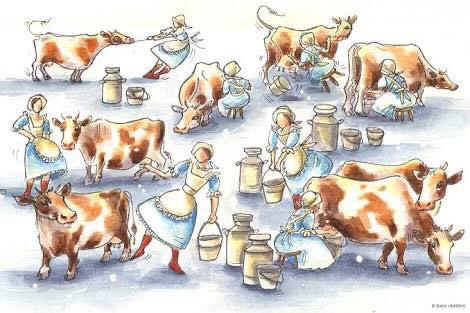
On Day Eight, we are exhorted to give eight maids a-milking. In older English, to “go a-milking” could mean to ask a woman for her hand in marriage; OR to ask a woman to go “for a roll in the hay”, as it were. Is this Christmas carol concealing a reference to illicit sexual encounters? And does that make it more interesting than just getting some milk in order to make some cheese?

Next: Day Nine. Nine ladies dancing. Liturgical dances, I presume? In explore the significance of these ladies, I am somewhat stumped. Any clues, anyone?

Meanwhile, I am starting to compile my list of ‘not relevant in Australia’ secular Christmas carols. Because here, downunder, we are in the midst of summer—not winter, as all the upover northern hemisphere Christmas songs assume. So, not relevant to downunder would include: Anything with snow, for a start. And bells. And holly. And fir trees. And … well, the possibilities are endless.

On Day Ten, the gift is to be ten Lords a-leaping. Alliteration, indeed; but why leaping? Perhaps there is a textual transmission problem here. Maybe it should be: Lords a-leasing? (what to do with their huge old castles and manors)? Or Lords a-sleeping? (in the upper chamber of the British parliament)? Or perhaps Lords a-weeping? (at the decline of their much- loved aristocratic powers). Who knows?

Which brings us to the eleventh day of (the season of) Christmas. On Day Eleven we meet eleven pipers piping. So perhaps this comes from a Scottish variant (like day one comes from the French version). Perhaps the Scots packed their song full of food? In this, the gifts would include twelve alka seltsers, eleven Blue Lagoons, ten creme de menthe, nine vodka and limes, eight nips of whisky, seven rum and cokes, six Carlsberg specials…you get the picture? (Yes, I know, this is becoming quite speculative!!)

Or — does the Scottish reference (bagpipes) mean that I should refer to the crackpot theory that this whole carol was a coded reference to the right of Bonny Prince Charlie to regain the British throne? Yegods … …

But I do note that, in other versions, there are eleven ladies spinning, eleven ladies dancing, eleven lads a-louping, eleven bulls a-beating, and eleven badgers baiting!! Make of them, what you will.

And then, we come to the ultimate (last) of the #twelvedaysofchristmas. Day Twelve. Twelve drummers drumming.

Since the gifts are cumulative, and repeated on each day, on Day Twelve we actually have drummers drumming, along with piping pipers, leaping lords, bleating cows, tapping toes, shuffling shoes, a horde of aviary escapees, and the whole schemozzle. 78 gifts in all (count them) just on this last, twelfth, day. Presumably the others gifts from earlier days are still there. That’s one heck of a menagerie!! It’s all too loud, I think — and the incessant fights amongst all those squawking birds! Oh dear; time for a doze, instead.

The evening of Day Twelve is thus Twelfth Night. The day after is Epiphany, a day to celebrate the coming of the magi to the infant Jesus. Time, indeed, to rest—when you get there. But, for the moment, there’s some geese to be sourced. And some drummers. And milkmaids … and Lords (Lords??) … and ………….

*****

See also https://claudemariottini.com/2022/12/26/the-12-days-of-christmas/

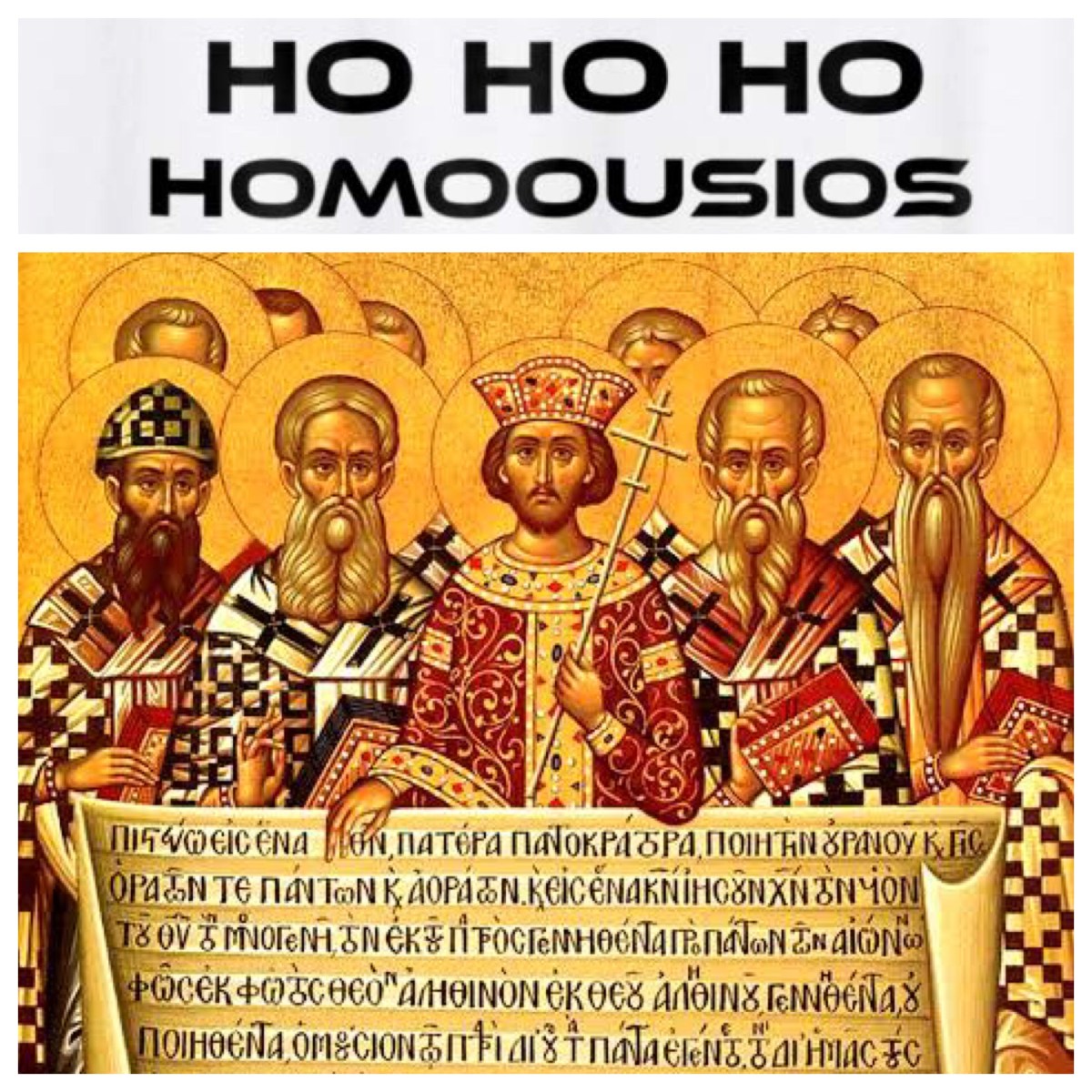
Putting the Homoousion back into Christmas

Four years ago I created my own contribution to the festive cheer, in the words below. I think that our Christmas carols need some rigorous theological input, so I am offering it up this year with my tongue still firmly in my cheek.

…..

As I listened to the mesmerising schloppp of the muzakked carols during my occasional forays into the shopping malls, and pondered the calls to put Christ back into Xmas, I thought that it was about time to finish the job that some of the traditional carols have only just started.

References to “Word of the Father now in flesh appearing”, and “Veiled in flesh the Godhead see”, are just the start. Explanations about the one who “abhors not the Virgin’s womb” really need to be expanded and developed. “Hail the incarnate Deity” needs to ring through all of our carolling. Surely, the carols we sing should joyously and vigorously affirm the fullness of our faith!!

With this in mind, in the spirit of the Wesleys (who took popular tunes and put Christian hymn lyrics to them), I have grabbed Jingle Bells by the short and danglies, and consulted with my resident critic and editor-in-chief, who has made sure that the verses, at least, conform to the scheme of rhyming pairs.

I therefore present the following offering, inspired by all that the Nicene-Chalcedonian tradition provides. And, in the spirit of this tradition, there is a special verse dedicated to the oft-overlooked Appendix to the Creed, which calls down a curse (an anathema, in Greek) on the heretics and their views.

Let the Homoousions rise to the heavens!

Enjoy!

1

Dashing through the mall

With a Christmas list to go,

Shoppers all around

Buzzing to and fro.

Carols sound on high

Repetitiously;

Santa, Rudolph, bells and snow,

But where can Jesus be?

Refrain A

Calchedon, Nicaea,

This is what we need:

Three in one and one in three,

Blessed Trinity, Hey!

God is now Incarnate,

God Emmanuel,

Human being, he became:

Homoousion!

2

Back in three two five,

The Emperor Constantine

Faced a mess of views,

which he needed to redeem.

“Sort this dogma mess,

Sort it once for all!”

And so the bishops did their job,

made a snappy Creed catch-all.

Refrain B

Jesus Christ, Son of God,

Essence of the Father,

Light from Light, and Very God,

Be-gotten not made. Hey!

Jesus Christ, Son of God,

Through whom all was made,

He came down, was incarnate,

Homoousion!

3

Though the bishops came,

met, and made a Creed,

Heretics were there,

Sowing their fake seeds.

So the Creed was stretched

To include some words

That ensured the views they held

Would damn them all with verbs:

Refrain C

Those who say, “he was not”,

Let them be accursed!

If they say “from naught he came”,

Let them be condemned! Hey!

If they claim “he’s changeable,

of quite another substance”,

Let them be condemned, we say,

Cast them out of church!

Refrain B

Jesus Christ, Son of God,

Essence of the Father,

Light from Light, and Very God,

Be-gotten not made. Hey!

Jesus Christ, Son of God,

Through whom all was made,

He came down, was incarnate,

Homoousion!

…..

The sections of the Nicene Creed which have informed this offering are:

We believe in one Lord Jesus Christ,

      the only Son of God,

      begotten from the Father before all ages,

           God from God,

           Light from Light,

           true God from true God,

      begotten, not made;

      of the same essence as the Father.

      Through him all things were made.

      For us and for our salvation

           he came down from heaven;

           he became incarnate by the Holy Spirit and the virgin Mary,

           and was made human.

and

‘There was a time when he was not;’ and ‘He was not before he was made;’ and ‘He was made out of nothing,’ or ‘He is of another substance’ or ‘essence,’ or ‘The Son of God is created,’ or ‘changeable,’ or ‘alterable’— they are condemned by the holy catholic and apostolic Church.

Reimagining ministry in these different times

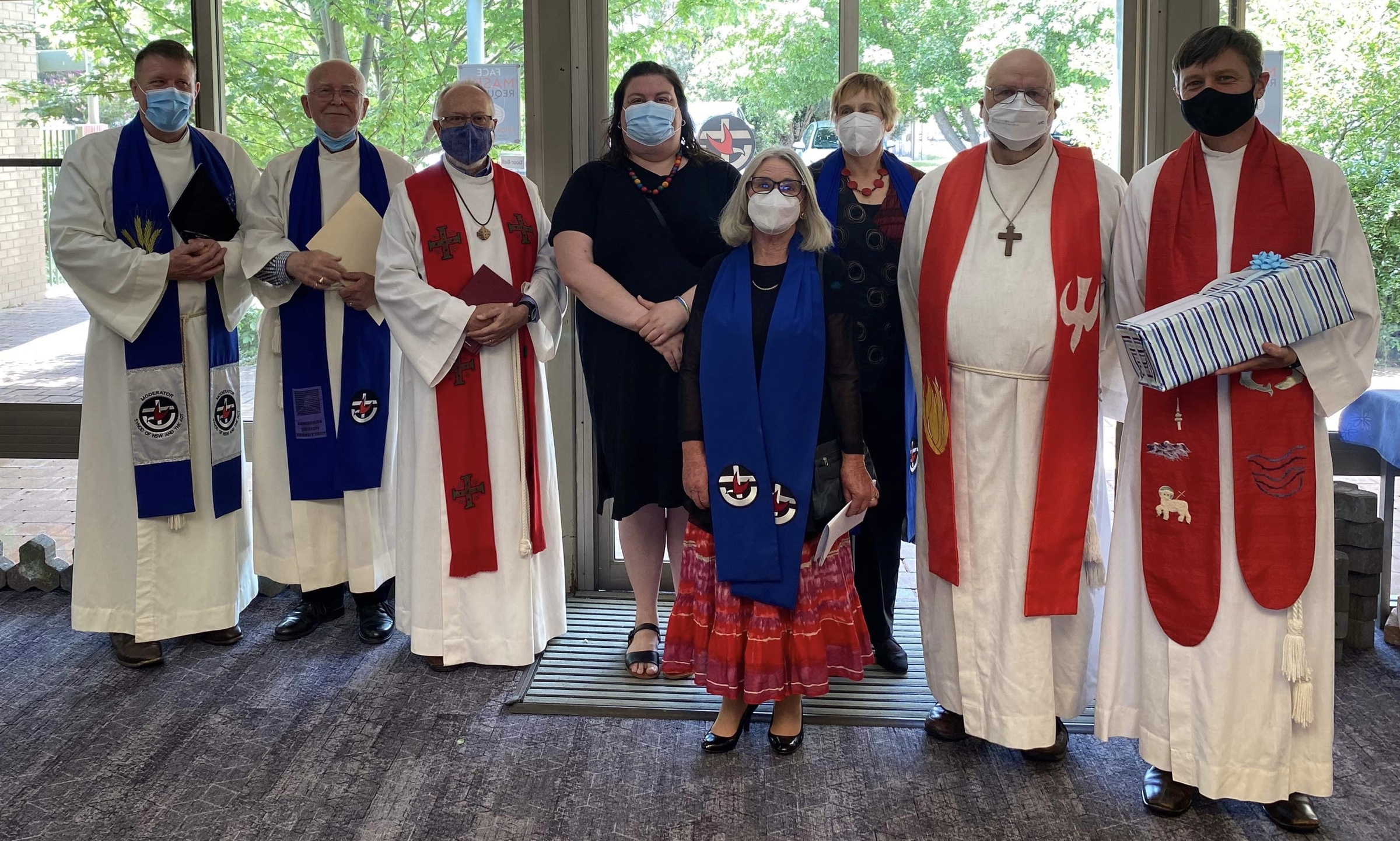
I have exercised ministries in the position of Presbytery Minister over the past 12 years, more than half of which have included an explicit linkage with a local Congregation as part of that ministry. I have served in my current position for forty-two months (initially in part-time supply, then fulltime from February 2020). On Thursday I became a retired minister, and today I have shared with friends and colleagues in a Closure of Ministry service for my role as Canberra Region Presbytery Minister–Wellbeing.
As I began this role, a huge swathe of the east coast of Australia was in the grip of multiple fires, during the Black Summer of 2019–2020. The air in Canberra was thick with smoke; one night, the fires came within just a few kilometres of our house. With most of the rest of our street, we stood in the dark, watching the flames at a distance, as planes and helicopters flew overhead, dropping water in an attempt to slow the spread of the fire. Many communities within the Canberra Region Presbytery were seriously impacted by these fires. It was a time of great tension, and continued breathing difficulties.

As the fires diminished, our car was caught outside in a hailstorm that raced through Canberra. Then a few weeks later, we began learning of the virus that was infecting many and spreading rapidly; and so much of the next two and a half years would be spent in lockdown, with all worship, Bible study, fellowship, and organisational meetings held online. It has been quite a learning curve!! And then, multiple times in the ensuing months, friends and family members in various locations were forced to leave their houses, as rain far beyond the normal range fell, flooding river systems and causing widespread havoc.

So there have been fires and smoke, a hailstorm, a viral pandemic–the plague, it would once have been called–and floods. All very apocalyptic!!

In the midst of this, I have exercised ministry. At the end of my time in stipended ministry in formal placements, as I step into a period of unstipended, non-placement, but perhaps still somewhat active, ministry, my thoughts have turned to what I have learned, what I have valued, what I would wish for, and what I might say.

Ministry is both a calling and a profession. Ministry is taken up as Jesus invites his faithful followers to live out their faith in adventurous ways. Over the last two years and more, restrictions on gathering in person have led to a suspension of the regular activities of the church–worship, fellowship, prayer groups and bible studies, discipleship activities, training courses.

Then, as restrictions were eased, a return to each of these forms of gathering became possible. But, as we regathered, under the conditions of the COVID Safe Plans that were required, it became obvious that we were not simply entering a “back to normal” phase. Each form of gathering would be different from the earlier, more familiar, form of gathering. Yes, there would be familiar elements; but there would be additional requirements, and some changes in what we do when we gather.

In short, we were moving on into a different form of gathering–be that for worship, for study, for prayer, for meeting, for learning, or for sharing the Gospel with others. In contrast to the pre-COVID period (a time of settled familiarity in our various gatherings), we were now moving into a time of post-COVID realities–or, at least, a time when the realities of COVID needed to co-exist with the hopes about how we might gather, informed by the traditional practices of the pre-COVID period.

All of this has presented a challenge to the church, as we have grappled with what is possible at each stage of the process. All of this has also opened an opportunity to rethink what we do and reimagine how we might go forward. Many Congregations have been doing exactly this.

Alongside this review and reshaping of congregational life, a similar revisioning and reimagining of ministry can be–indeed, should be–taking place. Ministry itself can be reviewed and reshaped in this current time.

*****

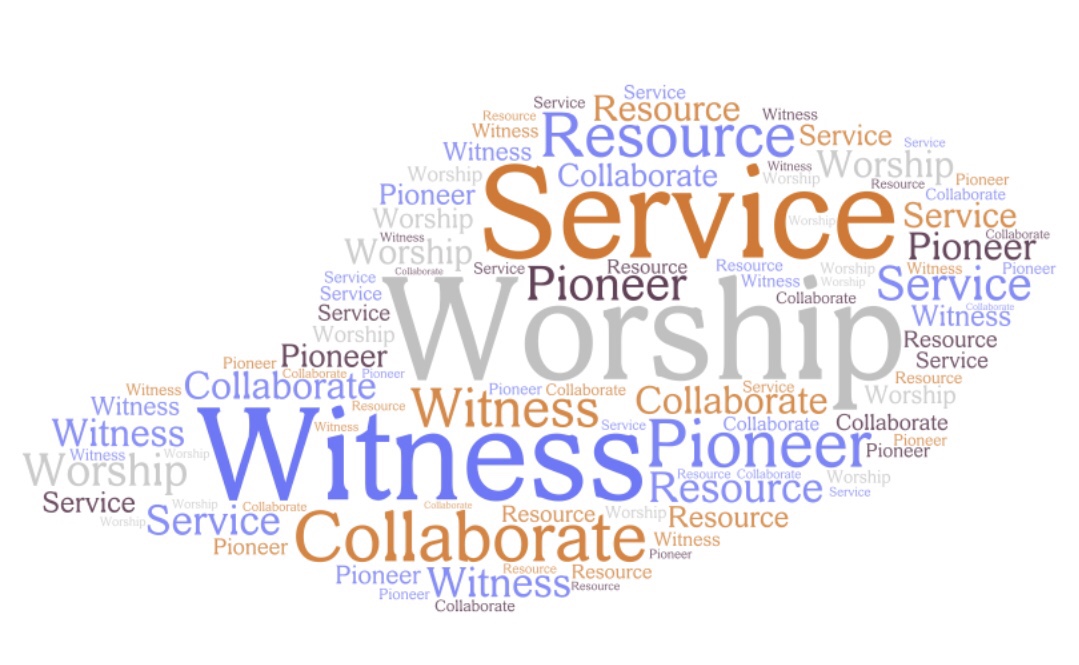
So in what follows, I want to offer a proposal about how we think about ministry in a refreshed way: that we might consider ministry to be a call to be on mission, through worship, witness and service, as we collaborate, resource, and pioneer.

These last three terms–collaborate, resource, and pioneer–invite us to approach ministry in a different way, when compared with the “traditional minister” of years past. These terms might sound like a different approach to ministry–different from the “preach the word, celebrate the sacraments, visit the people” pattern that shaped ministry for so many decades in the past.

Yet all three terms can be found in that section of the Regulations of the Uniting Church in Australia about the duties of a Minister. The Regulations provide a clear and comprehensive statement of the various duties that are expected of a Minister. (The full list is pasted below, from section 2.2.1 of the Regulations.)

Before we turn to this document, however, let me explain that I am using the term “Minister” to refer to a Minister of the Word or a Deacon, the two specified ministries to which people are ordained for life and for whom the normal form of ministry is exercised through placements under the oversight of the Presbytery. This is in accord with the definition that is given in section 3 of the UCA Constitution.

Deacons and Ministers of the Word are exercising their ministries in different, perhaps unprecedented, ways, in this current situation of change. The months where restrictions have been in place, prohibiting gatherings in person, have presented a challenge to many of my colleagues.

Our sense of what it is that we were called to, and how we have come to operate in response to that calling, has come to confront head-on the need to operate in different ways in this circumstance. How prepared are we, collectively, and individually, to meet these challenges and to re-orient our ministries to fit the new situation?

Tradition has seen that the role of Ministers has been to preach the Gospel, preside at the sacraments, and offer pastoral care. That threefold pattern has a long and valued history. I still hear it stated, from time to time, in the present age.

However, learning to do things differently, and re-prioritising what we do in ministry, is the challenge of the moment. I think it is worthwhile highlighting some of the points contained in this Regulation, to show that our ministerial charter actually invites and encourages us to engage in this process.

*****

Let’s start with the final point in that list of ministerial responsibilities, that a Minister will be involved in pioneering new expressions of the gospel. This contains a clear call to move beyond the “traditional” expectations of a Minister–that she or he will preach, undertake pastoral visitation, and organise the business of the congregation (which is perhaps the traditional way of reading a statement contained in the Basis of Union).

The restrictions of the past few months have forced us to develop new ways of ministering: new patterns of online worship, study groups online, distributing worship materials by email or post, and providing practical assistance through doorstop calls. We have developed new patterns of working, whilst new skills have been needed to minister effectively. Creativity has flourished under this stimulus.

The other clause in this final Regulation orients ministry in the same direction, emphasising the collegial or communal nature of the role of the Minister: that of encouraging effective ways of fulfilling the mission of the Church. This means that it is not up to “the Minister alone” to pioneer new expressions and develop the missional impetus of the church. It is to be “encouraged” by sharing the task with others–and presumably equipping those people to be effective in that role.

And that goal, to fulfil the mission of the church, has been to the fore in all that has been undertaken, in new ways, over recent times, as people have worked together in different ways–and as people previously unconnected or rarely engaged with each other, have co-operated and collaborated in many ways.

The same collegial and resourcing role is articulated in clause (iii). This clause follows two earlier clauses which specify that the Minister presides and preaches, but now it goes on to say that the Minister is charged with providing for other persons to undertake these roles.

That means that the Minister does not necessarily occupy the worship leading and preaching role for 48 Sundays a year (allowing for annual leave), but makes provision for sharing this role with others — who presumably are trained and equipped in appropriate ways for this role. I know of a number of Congregations where lay people have provided worship leadership for online gatherings, for instance, in situations where they have been reticent to do so in gatherings in person.

*****

The Basis of Union, at a number of points, identifies worship, witness and service as the lynchpin of the work of the congregation. Interestingly, whilst the “traditional” role of worship is embedded into the duties of the Minister, so too is witness specified at clause (iv) and service is likewise identified at clause (viii).

So what is expected of the congregation as a whole, is to be modelled and implemented by the Minister, personally, in their ministry. Those who argue that the Minister has a primary focus on worship and preaching, supplemented by pastoral care and administration, are not actually reading their Regulations carefully!

The “traditional” role of the Minister (the solo individual who preaches, presides, visits, and chairs) is so, so far removed from what the UCA Regulations actually articulate. We are called to be on mission, through worship, witness and service, collaborating, resourcing, and pioneering. It is a fine calling–and the challenges of the current context both enhance and challenge the way that we seek to carry that out.

*****

Regulation 2.2.1

(a) Within the ministry of the whole Church, Jesus Christ calls men and women to proclamation of the gospel in word and deed through the ministry of the Word and the ministry of Deacon. This calling is exercised by:

(i) preaching of the Word;

(ii) presiding at the celebration of the sacraments;

(iii) providing for other persons to preside at worship and/or preach within the pastoral charge in which the Minister is in placement;

(iv) witnessing in the community to the gospel of Jesus Christ;

(v) guiding and instructing the members of the Church and equipping them for their ministry in the community;

(vi) nurturing candidates for baptism and confirmation;

(vii) pastoral oversight and counsel wherever needed;

(viii) serving in the community, especially among those who are hurt, dis-advantaged, oppressed or marginalized;

(ix) careful attention to administrative responsibilities;

(x) due observance of the discipline of the Church;

(xi) the enhancement of the Minister’s own gifts for the work of ministry;

(xii) pioneering new expressions of the gospel and encouraging effective ways of fulfilling the mission of the Church.

*****

See also a series of posts that I made during 2020 about the challenges being faced and the changes being undertaken:

See also https://johntsquires.com/2019/11/14/ministry-and-mission-in-the-midst-of-change-and-transition-luke-2113/

https://johntsquires.com/2020/05/05/the-times-they-are-are-a-changin/

https://johntsquires.com/2020/05/04/not-this-year-so-what-about-next-year/

https://johntsquires.com/2020/04/22/its-been-just-over-a-month-but-there-have-been-lots-of-learnings/

https://johntsquires.com/2020/03/15/when-you-come-together-reflections-on-community-in-the-midst-of-a-pandemic/

https://johntsquires.com/2020/06/16/going-back-to-church-what-will-our-future-look-like-4/

https://johntsquires.com/2020/06/03/greet-one-another-2-cor-13-but-no-holy-kissing-and-no-joyful-singing/

https://johntsquires.com/2020/05/29/worship-like-the-first-christians-what-will-our-future-look-like-3/

https://johntsquires.com/2020/05/24/its-been-two-months-under-restrictions-what-will-our-future-look-like-2/

https://johntsquires.com/2020/05/22/its-been-two-months-under-restrictions-what-will-our-future-look-like-1/

 

Priorities in ministry: an ordination anniversary reflection

“Well, you only really work one day a week, don’t you?” After decades in ministry, I am not sure I can count how many times I have heard this comment—sometime flippant, but often rather serious.

Of course, ministers do not work only one day a week! That stereotype is based on the perception that the weekly sermon is the sum total of the work of ministry. Whilst it is true that many of my Protestant colleagues see the sermon as the most important, or critically significant, element of their weekly work, it is definitely the case that the work of ministry stretches far and wide beyond the weekly sermon.

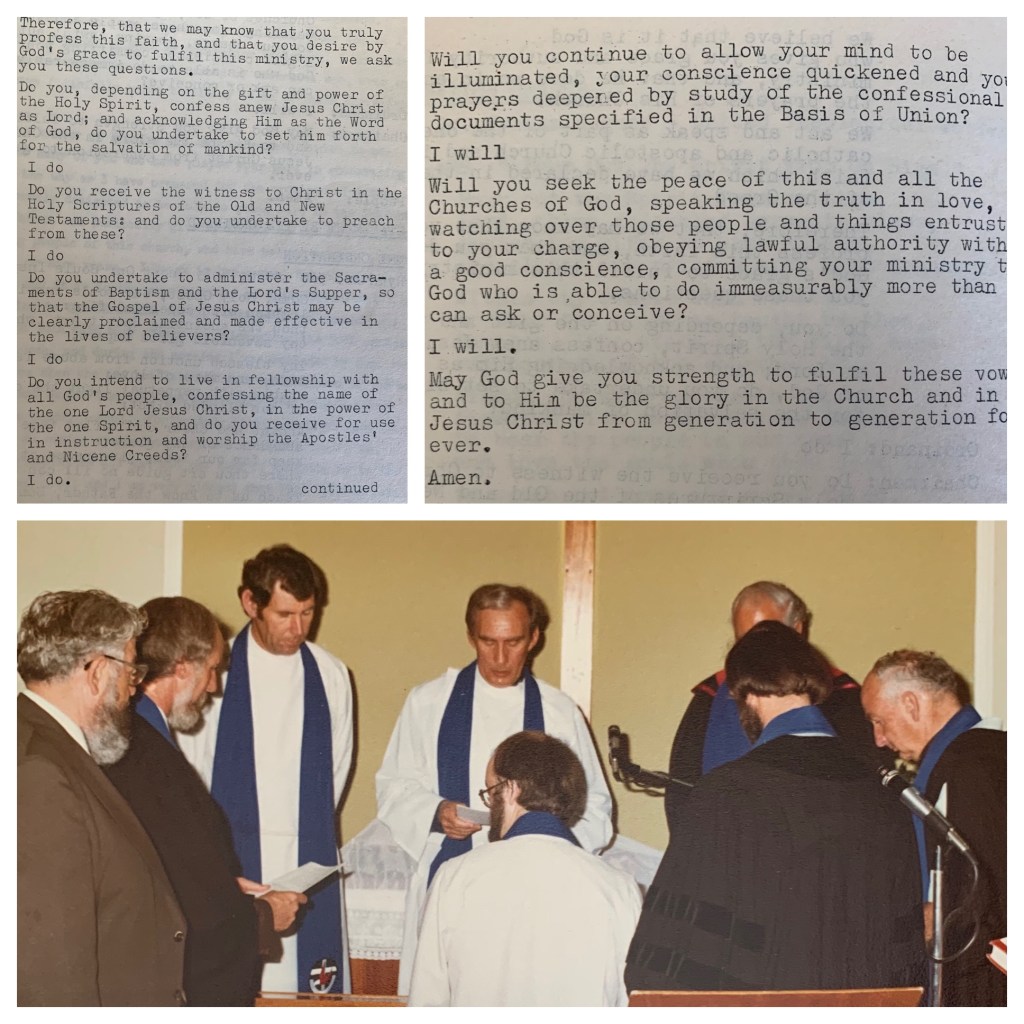
Today is the 42nd anniversary of my ordination; I was set aside to the Ministry of the Word in the Uniting Church in Australia in a service that took place on 3 December 1980 in my home Congregation of Seaforth, amongst the cloud of witnesses that had surrounded me in my early decades.

I have been privileged to have spent time in congregational ministry in two rural areas and one urban location, in regional roles in two presbyteries, in educational roles in two synods, and to have served the Assembly on a number of committees, as well as multiple committees in synod and presbytery roles over the years.

I have worked with some fine colleagues in each of these placements. And in each place, I have sought to live out those vows that I took at ordination, in the exercise of my ministry at Southern Illawarra and Waverley, in years of study at New Haven and two decades of teaching at North Parramatta, in sabbatical periods at Durham and Cambridge, back in ministry at Wauchope and the Mid North Coast Presbytery, in the venture overwest to Perth, and then at Queanbeyan and in this most recent Presbytery role.

In each of these placements, I have been comforted (and challenged) by the way that the Uniting Church articulates the various responsibilities of a minister. They are set out in section 2.2.1 of the national Regulations. The expression of those responsibilities has changed somewhat over time, although the basic shape of these responsibilities remains consistent in its focus. But there have been some interesting refinements over time.

(The current version of the Regulations is cited at the end of this blog.)

To start, we can note that preaching is given the first place in the list. Is this significant? Certainly, in the history of Protestant churches, the priority accorded to preaching is clear. And I know of colleagues today, who insist that, whatever else is happening, preparation of the weekly sermon is their first priority each week. That is central to our tradition.

Of course, preaching is not held exclusively to the ordained ministers. The Methodist Church contributed the ministry of lay people as preachers to the Uniting Church when it was formed, and Lay Preachers are now one of four specified ministries within the UCA, alongside the lay ministry of Pastor and the two ordained ministries of Deacon and Minister of the Word.

Second, presiding is noted. That sits hand in hand with the role of preaching; these are two of the key aspects in leading worship within the gathered community of faithful people. Leading prayers, reading scripture, explaining and expounding the message, baptising new members of the community, and gathering people around the table of the Lord at communion, are key aspects of leading worship on a regular basis.

Once again, presiding at the sacraments, within current Uniting Church understanding, is not limited exclusively to ordained people; in situations where access to an ordained minister is not regularly available, authorised lay people can preside, after having completed a training course and being recommended by their Church Council.

In fact, the third clause places conditions around the way that a minister exercises the roles of presider and preacher. The leading of worship is to be a shared, collaborative, team-based enterprise. All ministers should, in their practice, cultivate a team of people who can not only read scripture and lead prayers, but also preach and, if need be, preside at baptisms and communion within the placement. Certainly, neither the pulpit nor the table is the exclusive preserve of ordained ministers, as we have noted.

Clauses 3, 5 and 6 each indicate that a key function of ministry is to prepare others: prepare people to lead worship, prepare people to be baptised or confirmed within the church, prepare people to be faithful and more effective disciples, and prepare people to engage in the mission to which the church is committed. Each minister within the UCA is to exercise a ministry of education, training, equipping, resourcing. All ministers are educators; all ministers are called to build up the body of Christ by enabling others to exercise their gifts for ministry and carry out their roles in mission.

The classic understanding of ministry, which is even articulated at points in the Basis of Union, is that the minister the threefold role of preacher, presider, and pastor. Clause 7 addresses the matter of pastoring. Is it significant that this function is quite some way down the list? If the order is in any way significant, we should pause at this point and ponder the traditional expectation that the minister provides pastoral care to all members of the congregation. This is not what the Regulations specify.

And is it also significant, that pastoring the people is (like preaching and leading worship) not the preserve of the ordained alone? That is, all people are called to show care and concern for others. The role of pastor is exercised by those in ministry as an oversight role, ensuring that a team of pastoral careers or elders provide regular and personalised pastoral care. The clause is also made conditional by the phrase “wherever needed”, which suggests that what is in view is a responsive form of pastoring, on a needs basis, rather than a regular “visit the flock every three months” prescription simply because “that is what the minister does”.

Are ministers called to be prophets? Some colleagues that I know place a high value on this role. Nothing explicitly identifies this role, however. Yet understanding how the Bible relates to contemporary situations, and articulating the way that the Gospel speaks into our context, has a dynamic that is very similar to the dynamic that the prophets of old knew very well.

What is “the word of the Lord” for this situation? How do we do just that, in our preaching and teaching? What are the words that best identify prejudices and expose injustices, that advocate for the poor and speak for the voiceless or disempowered? That’s functioning as a prophet.

Practising faith, as a committed disciple, is indicated by a number of clauses. Clause 4 prescribes that ministers bear witness to their faith, while clauses 8, on serving, and 11, on being a committed lifelong learner, also relate to this important dimension of ministry. We need to live, and model, exactly what we say to others, in our own lives.

The final clause addresses the mission of the church. It specifies that Ministers will find ways to be effective in fulfilling that mission. Maintenance is not adequate. Missionary impetus is essential. And “pioneering new expressions of the Gospel” is integral to that process.

This final clause envisages that all ministers will be equally pioneers in mission, as much as they are preachers and presiders, or practising their faith and preparing others for leadership roles in their discipleship. Pioneering is closely linked to “fulfilling the mission of the church”. Over the centuries, the church has regularly reinvented itself, finding new forms for worship, for service, for witness, for fellowship. We need to keep doing that in our own times, to continue being effective in mission.

And might the last clause (following a familiar scriptural dictate) be made first? What would our ministry, and our mission, look like, if each minister made the task of “pioneering new expressions of faith” as their first priority—and, by implication, relegated preaching to a lower spot, maybe even the last spot, on the list? It is a challenge—but I think this might be an important clue for the way ahead.

See further at https://johntsquires.com/2022/12/04/reimagining-ministry-in-these-different-times/

*****

UCA Regulations 2.2.1

Within the ministry of the whole Church, Jesus Christ calls men and women to proclamation of the gospel in word and deed through the ministry of the Word and the ministry of Deacon. This calling is exercised by:

(i) preaching of the Word;

(ii) presiding at the celebration of the sacraments;

(iii) providing for other persons to preside at worship and/or preach within the pastoral charge in which the Minister is in placement;

(iv) witnessing in the community to the gospel of Jesus Christ;

(v) guiding and instructing the members of the Church and equipping them for their ministry in the community;

(vi) nurturing candidates for baptism and confirmation;

(vii) pastoral oversight and counsel wherever needed;

(viii) serving in the community, especially among those who are hurt, disadvantaged, oppressed or marginalized;

(ix) careful attention to administrative responsibilities;

(x) due observance of the discipline of the Church;

(xi) the enhancement of the Minister‘s own gifts for the work of ministry;

(xii) pioneering new expressions of the gospel and encouraging effective ways of fulfilling the mission of the Church.

Doing mission locally: an imperative for discipleship in the 2020s

In many Congregations around the country—in rural towns, in city suburbs, in regional centres, in inner city areas—members of the church are also members of local community groups. In many cases these relationships have a long history; it has always been seen to be important for people of faith to be active in their local communities, engaging alongside people of other faiths or no faith with those community groups—CWA, service groups like Lions and Rotary, Masonic groups, climate groups, organisations to feed the homeless or the lonely, refugee justice groups, craft groups, hobby groups, playgroups, and so many more.

In many cases, however, there is no clear understanding of how these relationships can provide a base for deepening the discipleship of these people and extending the mission of their local Congregation. The missional understanding or commitment within such Congregations was often shaped by an ethos of a past era in which the local church was the de facto “community hub”; and perhaps with a sense that mission is really about inviting people to “come and be with us”. Open the door, advertise the event, and folks will come; that was certainly the experience of a (now, rather distant) past.

Today, by contrast, there has been a significant development in our understanding of mission—that it is more, now, about “go and be with others” rather than “come and join us”. Mission, after all, is about “being sent”, rather than about “bringing in”. Indeed, the very word missio comes from a Latin word which means “sent”.

In my Presbytery, the Canberra Region Presbytery, there has been a year-long process of developing a mission plan for the next few years. It has been driven by my colleague, Andrew Smith, who has offered the following insightful reflection on how mission might be understood and expressed in such contexts, in ways that give expression to the developing understanding of mission that has been underway for some time now. He writes:

From “come and join us” to “go and be with others”

The references to a change from “come and join us” to “go and be with others” aim to describe a shift in mission focus for the church over time. Previously church mission could largely rely on a “come and join us” approach. This was a time when churches were highly respected and were at the centre of the wider community life, and being a good citizen entailed church attendance. That era was some of the heydays for the church when the church could expect people would come and join us. All we really needed to do was put on a church service, and people would come. The patterns of conventional church life (with its worship styles and times and models of discipleship) were well accepted, and people willingly obliged.

However, with changes in society, the church no longer enjoys the respect it once had, and people are less likely to be interested in making the changes needed for them to assimilate into the patterns of conventional church life. This means that the “come and join us” approach to mission no longer serves us as well as it once did for calling and forming disciples.

Now, our approach to mission needs to be more along the lines of “go and be with others”. We can no longer expect the wider community to come to us and assimilate into conventional church life to become and grow as disciples of Jesus Christ. Rather, the church needs to change to accommodate to the wider society to find fresh ways of calling people to discipleship. We need to be accommodating. We need to “go and be with others” to build trusting relationships on their turf and on their terms, and look for how the Holy Spirit is working in their lives, and respond appropriately to create fresh pathways aligning with the Spirit’s work toward discipleship.

Example from playgroups

Perhaps an example, growing out of the life of the congregations, might be helpful to illustrate the above intended meaning of mission being more, now, about “go and be with others” rather than “come and join us”.

Playgroups are often very well received acts of loving service by congregations, and a lovely and much appreciated community grows among the families who attend. However, it is not unusual for some individuals in congregations with playgroups to view their playgroup as a something like a funnel that would channel playgroup families to the church’s existing Sunday morning worship service. Such an attitude fits neatly with the “come and join us” approach to mission where the families are expected to assimilate into the patterns of conventional church for their growth as disciples.

However, “a go and be with others” approach to mission would take a very different journey with the families. A congregation with a playgroup has already listened to the needs of the young families in the wider community and has sought to be accommodating by setting up and running the playgroup. This is an act of loving service in which folk from the church are with folk from the wider community, and it is part of the mission of God. We hope and trust that the Holy Spirit is at work in the lives of the families, and we are aware of folk from the congregation praying for the families along these lines. A next key step in discerning the work of the Spirit could be to tell the families that folk from the congregation do indeed pray for them, and to ask the families for any matters that they would like the church folk to include in their prayers.

Such an initiative around prayer is likely to be well received as generally people do not find an offer of prayer to be confronting, rather they find it comforting. Such praying will also build the community among the group as people share what is important to be prayed about, and will also offer some clues about how God is working in their lives.

This is a fresh pathway into discipleship. It may even be that down the track one or two of the parents or grandparents find themselves drawn by the Spirit even more toward the God of this prayer, and may give off signs of seeking more about faith. Then one of the church folk involved in the play group might be able to meet up with them in a local café at a time that suits them to hear and respond to what they are seeking. If others have a similar interest, perhaps a small group could form.

Who knows where all this might lead, but one of the important points is that it is all based around being accommodating to the parents or grandparents – going and being with them on their terms, rather than them being required to come and join us by assimilating into the patterns of conventional church.

Presbytery Mission Plan

The account in Scripture of Philip and the Ethiopian Eunuch in Acts 8 is inspirational in this approach to mission. Read the passage to see how much is on the turf and terms, and at the initiative, of the Eunuch – Philip comes to the chariot where the Eunuch is; Philip gets into the chariot and sits beside the Eunuch at his invitation; Philip starts with the passage that the Eunuch is reading; Philip responds to Eunuch’s request for baptism. Notice as well how the angel of the Lord and the Spirit are at work.

The draft Presbytery Mission Plan gives expression to this approach to mission. It affirms:

  1. God is always present, preparing the way and calling us into mission
  2. God is doing new things in us and through us in unexpected, surprising, and amazing ways
  3. God is calling us outward to be present and engaged in our communities.
  4. God’s faithfulness leads us to share and grow our faith, calling and forming new disciples.

Perhaps the example above about playgroups could be the beginning of discerning and creating a new community of faith that fits with some of the playgroup families.

It is this fullness of God’s mission, and this approach to mission, that we are called to explore and implement.

The gender agenda: a multiplicity of matters

Over the past week, I’ve been aware of a number of happenings that point to the continuing shifts within the Christian church relating to the matter of gender. Some of these events have been encouraging. Some have been disappointing. Some raise serious questions. Others offer occasion for great joy. Together, they point to the gender agenda, which continues to agitate the churches. It’s something that involves a multiplicity of matters.

This week has been Transgender Awareness Week. On Sunday evening, the Rainbow Christian Alliance met at Tuggeranong Uniting Church in Canberra. There was sharing, as there is always is, but with a particular focus at this meeting on the stories of transgender members of the group. It was a rich time, celebrating the way that people have been able to be “true to themselves” and express that inner reality in the ways that they dress, relate, and function within society—and, indeed, undertake the daunting process of hormone replacement therapy and even surgery to fully assume the actual gender identity as a manifestation of their inner, real person.

I have reflected on the week in my blog, at

On the same weekend, the Baptist Union of NSW and the ACT held one of their regular gathering of representatives from across the state and territory, at which the issue of gender was to the fore. Specifically, discussion was held and then a decision was made, that Baptist pastors and churches which were agreeable to marrying couples of the same gender would be asked to affirm “the traditional understanding of marriage”—that is, that marriage involves always a male and a female—or that they leave the association of Baptist churches.

There is a blog by one Baptist pastor who feels that he is unable to affirm that “traditional understanding of marriage”; he has described the experience of that all-day meeting as being akin to “a casual crucifixion”—a searingly potent, and deeply saddening, description.

The blog by Will Small is at https://www.willsmall.com.au/words/a-casual-crucifixion-i-never-gave-a-shite-about-being-a-baptist-until-someone-else-decided-i-couldnt-be

There is also a fine article by Erin Martine Sessions, another member of the gathering, at https://www.abc.net.au/religion/have-baptists-just-sold-their-soul-over-same-sex-marriage/

The Baptists, sadly, have taken an approach to this particular issue of same-gender marriage that has recently led to a split in the United Methodist Church; see my reflections at

I have also written a series of blogs exploring how such an aggressive approach to the gender agenda has been prosecuted—unsuccessfully, fortunately—within the Uniting Church in Australia.

My posts on these various groups are at

and

It is sad to see the same divisive development taking place within the Baptist fellowship.

An event that took place during the week was the funeral of a Roman Catholic priest, Father Peter Maher. This was noteable for various reasons; for a start, there were three bishops and many priests in attendance. I’ve known Peter for five decades, and can attest to his valued ministry and important contribution to the consideration of the gender agenda within the Roman Catholic Church in Australia.

Peter was a strong advocate, throughout his ministry, for “the least and the lost”, and especially, in recent decades, for members of the LGBTIQA+ community. His weekly Mass for rainbow people, held at St Joseph’s Church in Newtown, attracted people and was the basis for the formation of a wonderfully extensive community of people of faith who identify with sexual or gender diversity.

Peter’s funeral signalled the lifetime of work devoted, in various ways, to the gender agenda—affirming, supporting, counselling, encouraging, and advocating for, the many people of faith (and of no faith) within the broad LGBTIQA+ community. There have been many tributes to Peter posted online, which I have canvassed in a blog post at

A fine tribute to Peter is at https://www.misacor.org.au/item/28929-rip-peter-maher-vigorous-priest-sydney-longtime-editor-of-the-swag

And then, on Friday night, a celebration of 30 years since the Anglican Church ordained women as priests was held in St John’s Anglican Cathedral in Brisbane. The issue of the ordination of women was a focus of intense debate and discussion throughout the Anglican Church for many years. Most dioceses throughout Australia came to a view that this was a most reasonable course of action; a few renegades, spurred on by the sectarian leadership in Sydney, dug their toes in and resisted at every step of the way.

But the truth of the Gospel shone through, and women were ordained in Goulburn—Canberra, Brisbane, and Perth Dioceses, in 1992, and the in many other places in the ensuing years. The celebration in Brisbane recognised an important step forward in addressing the gender agenda in the Anglican Church. An exhibition marking this step forward can be seen at

It would be tempting of me to end this review of recent events with a smug, self-satisfied comment about the ways that the Uniting Church in Australia (and, indeed, its three predecessor denominations) has been a trailblazer in many ways relating to the overarching gender agenda—ordaining women, female quotas to ensure diversity, ordaining gay and lesbian ministers, marrying same-gender couples, and so on.

However, just this past week, I was part of a conversation in which I observed that the particular Uniting Church Congregation, throughout the whole 45 years of its existence, had had a string of white male ministers in placement with them. In that conversation, I was told that before the current minister was called, one key person in leadership in that Congregation advised the Presbytery, “we won’t accept any minister other than a white male”.

So we, too, have work still to be done. The gender agenda remains a live concern. The gender question remains firmly on our agenda in the Uniting Church. There is still much work to be done.

See also