In recent weeks, the Revised Common Lectionary has offered passages from Acts which narrate the expansion of the early movement of followers of Jesus. The author of Acts provides a clear schematic account of how the good news spread out from the centre of the Jewish nation, Jerusalem, to the edges of Samaria and beyond (starting with a court official from Ethiopia), and into the widespread Gentile world (starting with a Roman soldier based in Caesarea).
In a couple of weeks, we will read the story of Pentecost, with Mews gathered in Jerusalem from many of the surrounding regions and nations. Encountering God in a dramatic new way, they return to their homes with good news bubbling over in joyful ways.
The Iona Community has a fine Affirmation which fits well within the context of these readings, reflecting God’s openness to the outsider, welcoming the diversity of humanity, affirming grace at work . Here it is:
Affirming the Global Church
We believe in God,
who befriended a wandering people,
calling them from slavery into freedom,
yet who in Rahab, Tamar, Ruth, Bathsheba,
Cyrus, Darius and many others,
called outsiders to be agents of God’s purpose.
We believe in Jesus,
who was revered by Persian sages,
sought and found asylum in Egypt,
preached the love of God to Syrians,
attracted Greeks to his cause,
found his first evangelist in a Samaritan,
saw incomparable faith in a Roman,
had his cross shouldered by a Libyan,
and ascended to his native land
that he might be present in all places.
We believe in the Holy Spirit,
who at Pentecost proved
that heaven has no mother tongue;
who, in the baptism of an Ethiopian,
denied racism a foothold in faith;
and who, in the ancient and modern worlds,
founded churches in different cultures.
We believe that God is supremely known in Jesus,
yet we affirm that the love of God is beyond our understanding.
Therefore we celebrate
that God’s ways are not our ways,
that God knows whom God chooses,
and reserves the right to surpass all human expectation.
From A Wee Worship Book, 2015, from Wild Goose Publications (page 105)
The Uniting Church is part of the one holy catholic and apostolic church – we see ourselves as just one part of a much larger whole. We do the things that other denominations within the church do: we gather for worship, preach the Gospel, care for the needy, witness to our faith, and connect with communities.
We have many organisations that cater specifically for pre-schoolers, school students, people with disabilities, theological students, adult learners, Indigenous people and aged and infirm people. We have chaplains in hospitals, schools, industry, and the defence forces. And we have congregations in many places across the continent.
When we worship, we feel connected with the people of God of all denominations across the globe. When we witness, we bear testimony to the faith shared by Christians of many varieties. When we reach out in service, we act in solidarity with people of Christian faith, people of other faiths, and people of goodwill of any stripe, in our communities and across the globe.
We share in the call to be missional, universal, set apart, and unified, as God’s people together. Or in more traditional theological language, we are part of the ‘one, holy, catholic and apostolic’ church.
But we believe that we have some distinctive elements to contribute to that larger whole. Our identity as the Uniting Church in Australia is marked by ten distinctive features.
I In Ecumenical Relationship
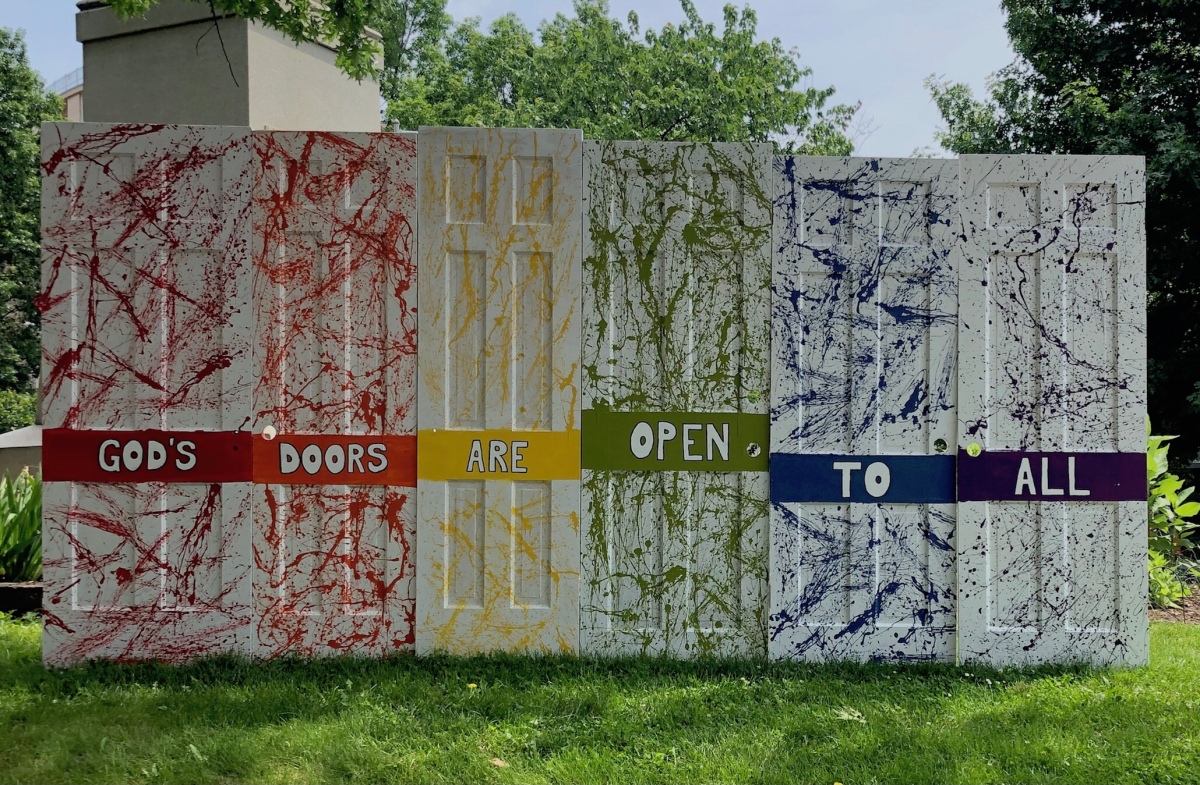
When the Congregational, Methodist and Presbyterian churches joined together in 1977 to form the Uniting Church in Australia, they declared that this union was both in accord with the will of God, and that it was a gift of God to the people of God in Australia.
Since then, the Uniting Church has been a church which is committed to working ecumenically with other Christian denominations. That commitment is one very important aspect of our identity as a Uniting Church. We belong to the National Council of Churches in Australia and the World Council of Churches, where we co-operate with many denominations.
Nationally, we have participated in ongoing conversations with other denominations (Anglican, Lutheran, Greek Orthodox, and Roman Catholic). At the grassroots level, our ministers participate in local ministers’ associations in hundreds of towns and cities across the nation. Some Congregations share buildings with other denominations; some worship and serve together, especially in rural towns.
We are an ecumenical church.
II In Covenant with First Peoples
A very important dimension to being the church in this country is that we are a church in Covenant with the First Peoples of Australia. From its earliest years, the Uniting Church has been involved in actions which express our solidarity with the Aboriginal and Torres Strait Islander peoples. Older members will recall events at Noonkanbah Station in the Kimberley in 1980, when Uniting Church members stood in solidarity with the traditional owners, the Yungngora people, against the mining of their land.
The Uniting Aboriginal and Islander Christian Congress (UAICC) was established in 1985, and a Covenant between the UAICC and the UCA was implemented in 1994. This Covenant recognises that working for reconciliation amongst people is central to the Gospel. This gives expression to our commitment to shape a destiny together.
In 2009, the Preamble to the UCA Constitution was revised to recognise the difficult history of relationships between the First Peoples and the later arrivals, as Second Peoples. In 2018, we agreed to support a Makarrata process to give a clear national voice to First Peoples, and to support a national Treaty. Our present relationship is one which seeks to ensure that we commit to the destiny together which we share as Australians. The Assembly fosters ongoing work in this area through the Walking Together as First and Second Peoples Circle.
We stand in covenant relationship with the First Peoples.
III A Multicultural Church
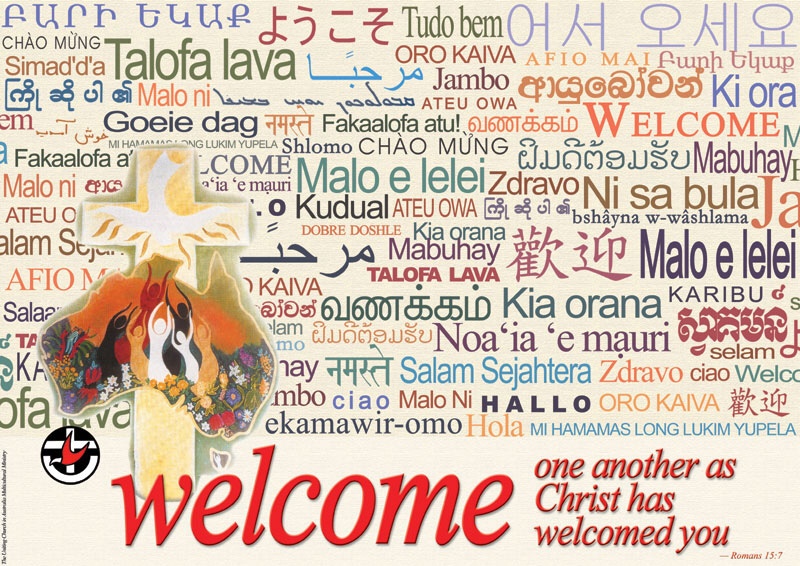
In the same year that the Congress was formed, the Uniting Church declared that it is a multicultural church, which rejoices in the diversity of cultures and languages which are found across Australia. The Basis of Union recognises that we share much, as Australians, with people of Asia and the Pacific. The Uniting Church has maintained strong relationships with churches from these regions, as well forging new links with churches in Africa and the Middle East.
The Statement to the Nation, issued in 1977, acknowledged that the Uniting Church seeks a unity that transcends cultural, economic and racial distinctions. Within Australia, there are at least 12 national conferences based on regional groupings and people from 193 language groups who belong to the Uniting Church.
Each Sunday, worship takes place in Uniting Churches in 26 languages from cultures beyond Australia, as well as many indigenous languages used in worship by first peoples across our church. We have learnt the importance of moving from “enjoying each other’s foods”, to conversing at a deep level about the hopes and expectations we bring from different cultural experiences. We have learnt that we need to be intercultural in our relationships.
Through UnitingWorld, we maintain partnerships with churches in Asia, the Pacific, Africa and the Middle East. We are truly a multicultural church. Through the Relations with Other Faiths Working Group and the Seeking Common Ground Circle, the Uniting Church has been active in developing relationships with other faith communities. We have had a long and fruitful Dialogue with the Jewish Community, and participate in a number of other interfaith Dialogue conversations. We are firmly committed to constructive interfaith relations.
We continue to develop as a church in deepening relationships with many cultures and faiths.
IV All the people of God
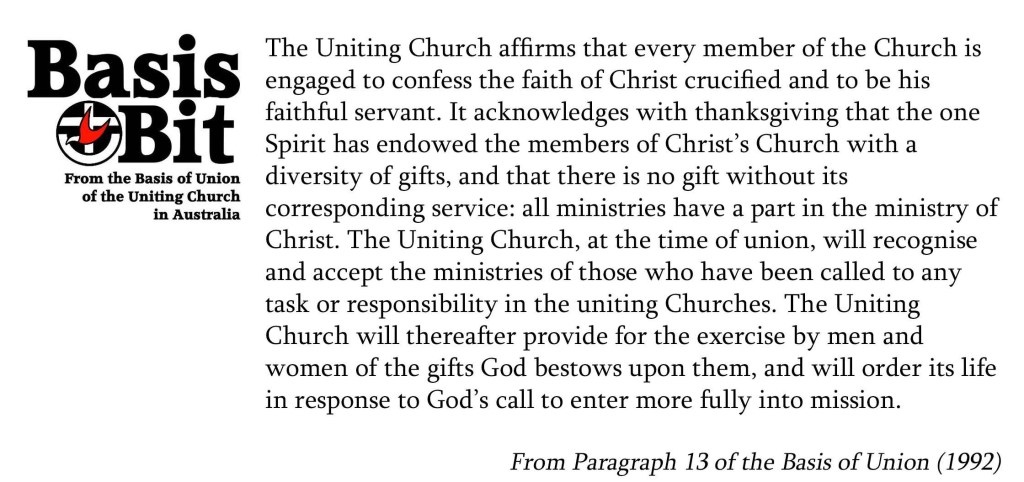
The Uniting Church is a church which values the ministry of all the people of God and seeks to order itself in accordance with the will of God. Our Basis of Union affirms that every member of the church is engaged to confess Christ crucified, and every person is gifted by the Spirit to engage in ministry in their own particular way. We are a church that values the ministry of each and every person.
Throughout the life of the Uniting Church, we have held our structures and forms of ministry accountable to ongoing scrutiny. Alongside the Ministry of the Word, to nurture and guide Congregations, we have introduced the Ministry of Deacon, to focus attention on people living on the margins. We have introduced the Ministry of Pastor to recognise the giftedness of lay people, and that sits alongside the Ministry of Lay Preacher (which we have had since 1977), and the more recent accreditation of Lay Presiders in many locations.
We have also undertaken important conversations about membership and the relationship of Baptism to Holy Communion. We now have a clear commitment to an open table when we gather for The Lord’s Supper: all who are baptised (whether adult or child, whether confirmed or not) are welcome to share at this table.
We are a church which values the ministry of all the people of God.
V Women and Men
The Basis of Union makes it very clear that we are a church which is committed to equality and mutuality of women and men in ministry. Even before 1977, the three previous denominations had ordained women to ministry. This is a very strong distinctive, especially in the Australian scene.
Since 1977, many women have stood on an equal basis alongside men, as Ministers of the Word, Deacons, Elders, Church Councillors, Lay Preachers, Lay Presiders, Chaplains, and Pastoral Carers. We value the insights and experience of women in each and every way that we seek to “be church”—as we gather to worship, as we witness to our faith, as we serve the wider community.
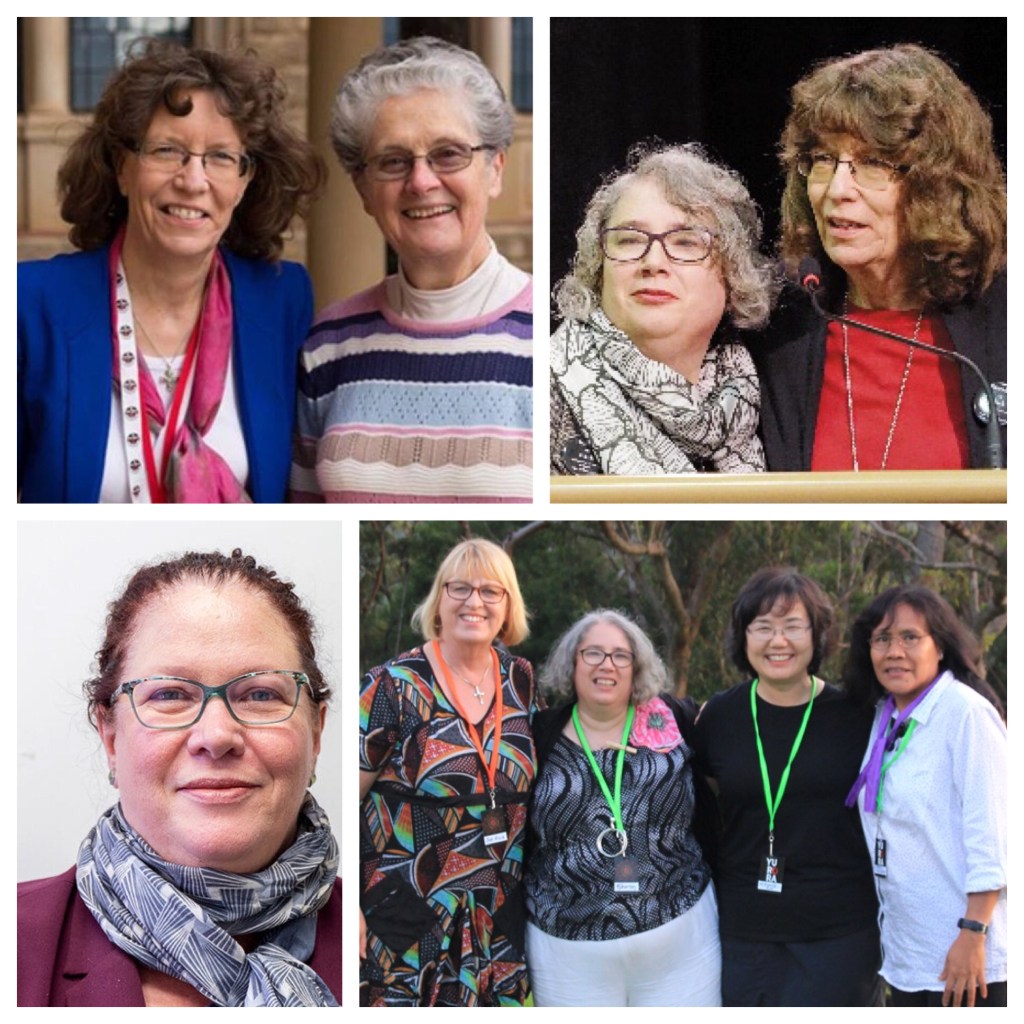
Women in leadership: Presidents Jill Tabart (1994–1997) and Deidre Palmer (2018–2021); Deidre Palmer and President-Elect Sharon Hollis (2021–2024); Assembly General Secretary Colleen Geyer (2016– ); and Moderators Sue Ellis (SA), Sharon Hollis (VicTas), Myung Hwa Park (NSW.ACT) and Thresi Mauboy (Northern Synod).
Both lay and ordained women have served in leadership positions across all councils of the Uniting Church, from Church Council Chairpersons to Presbytery Chairpersons, to Synod Moderators and Secretaries, to the Assembly General Secretary and President. Many couples minister together as husband and wife. Gender equality is most certainly part of our identity.
We are committed to mutuality and gender equality in every part of the church.
VI Discernment
Another contribution that the UCA has made has been to highlight the importance, when we gather in council, of being open to the Spirit, and seeking to discern the will of God. We live this out in our councils by practising a process of consensus decision-making. The Manual for Meetings sets out the various elements that are involved in making decisions by discernment: a time of information, a time of deliberation, and a time of decision-making.
The infamous “coloured cards” are only one small part of the whole. The focus is on listening to the Spirit before we speak, and striving to find a way forward that most, if not all, people can see as the will of God for the church. This way of decision-making, which originated in the UCA, has now been adopted by the World Council of Churches and a number of its member Churches.
We are a church which deliberately seeks to discern the movement of the Spirit in our midst.
VII Professional Standards
Over the last 20 years, the Uniting Church has developed a firm commitment to strong professional standards, for Ministers as well as for lay people who exercise leadership in the church. Our commitment to professional standards emerged initially in response to the problems of sexual misconduct within the church. A whole section of the Regulations is now devoted to this.
Since 1999, all Ministers have been expected to adhere to a Code of Ethics, and this has most recently been revised to provide a Code of Ethics Ministry Practice for Ministers and a Code of Conduct for Lay Leaders. Ministers and Pastors undertake regular training in aspects of this code, in ethical ministry workshops.
Since the Royal Commission into Institutional Responses to Child Sexual Abuse, we have intensified our efforts to ensure that our churches are Safe Places, valuing everybody, honouring integrity, avoiding negative and hurtful behaviours.
We are a church which values integrity and clarity about our ethical standards.
VIII Open to explore difficult issues
Over 40 years, the Uniting Church has shown that it is a church which is prepared to engage in difficult discussions about contentious issues. Our Basis of Union commits us to learn from the insights of contemporary scientific and historical studies, and affirms that we remain open to correction by God in the way we order our life together.
In the early years of the Uniting Church, debates about Baptism were the focus of great controversy. Infant baptism had been an integral part of the worship practices of each denomination which joined the Uniting Church, but Ministers and Elders Councils were receiving regular requests for baptism by adults who had been baptised as infants but had come to a personal faith later in their lives. After debates stretching through the 1980s and 1990s, the Uniting Church has developed a clear set of protocols to cover such requests.
Another area of enduring controversy has been that of human sexuality. There is a wide diversity of opinion within society relating to such matters, and this diversity is present within the Uniting Church. Once again, from the 1980s though into the present era, lively debates regarding human sexuality have taken place in the various councils of the church. We have worked through difficult decisions about sexuality and leadership, and then about sexuality, gender, and marriage. We continue to learn, explore, and adapt.
In dealing with such issues, we have learned how to debate with respect and integrity with ongoing conversations looking to employ a “Space for Grace” process to encourage respectful, empowering, and inclusive decision-making.
We seek to be a church that engages in the difficult discussions with honesty, transparency, and hopefulness.
IX Advocating for Justice
The Uniting Church inherited from its predecessor Churches a strong commitment to advocating for justice for all. Many Uniting Church congregations and members are actively committed to serving those people who find themselves on the margins of society. This commitment was clearly articulated in the 1977 Statement to the Nation and it has been evident in many actions undertaken by Uniting Church members over the decades.
The Uniting Church has joined in common cause with other groups and organisations in society, in advocating for a welcoming attitude towards refugees; in lobbying for a fair and just system of caring for people who are experiencing poverty and homelessness; in seeking equity for workers in their workplace; and in many other issues. The Assembly Working for JusticeCircle, brings together people who are strongly committed to this avenue of ministry.
A regular stream of policy documents and public resolutions point to a clear and unbroken commitment to seeking justice for all. Each federal election, we are provided with resources that encourage us, as people of faith, to consider the implications of our votes in the life of the nation.
We are a church which is strongly committed to justice for all.
X Environmental Sustainability
In like manner, the Uniting Church has always been a church which honours the environment and supports a sustainable lifestyle. Although such matters are firmly on the radar of the public now, they have long been integral to the identity of the UCA. Once again, the 1977 Statement to the Nation flagged such commitment. A series of subsequent documents attest to the ongoing determination of the church to live responsibly, in such a way that we minimise the damage we cause to the environment in which we live.
Our partnerships with Churches in the Pacific have intensified our awareness of the negative impacts that are resulting from climate change. We know that we need to act now, to reduce the threat. Each year, we experience catastrophic consequences from more regular and more intensified “natural disasters”—fires, floods, drought, cyclones. Just as we provide pastoral support in these situations through Disaster Response Chaplains, so too we maintain advocacy with governments, urging them to set policies which will turn us away from the trajectory of yet more environmental disasters.
Locally, many Congregations and individual members of the UCA are seeking to implement practices that will reduce their carbon footprint on the planet. We know that we owe it to future generations, to live responsibly in the present.
We are a church that lives, acts, and advocates for a sustainable environmental future.
*****
You may have some thoughts about what I have articulated above. You may have thought, “what about …?” – something that I have overlooked, that you see as important. You may have some questions about how I have described some of these elements. I encourage you to talk with others about how you respond. Together, we are the Uniting Church!
The most well-known verse in the Bible is surely John 3:16—“for God so loved the world that he gave his only Son, so that everyone who believes in him may not perish but may have eternal life.”
Actually, there is ANOTHER John 3:16 in the Bible. This “other” John 3:16 is actually in the first letter of John: “we know love by this, that he laid down his life for us—and we ought to lay down our lives for one another” (1 John 3:16).
There is an other verse in the Bible, also written by the author of John’s Gospel, which is being referenced in this “other” John 3:16—“I am the good shepherd. The good shepherd lays down his life for the sheep.” (John 10:11)
In a neat conjunction, these readings, set in the lectionary for the fourth Sunday in the season of Easter, are what is being read and heard in churches around Australia on this Sunday which, in 2021, is also ANZAC Day.
ANZAC Day is a day when we think about the laying down of lives. We remember, and pledge that we will not cease remembering, those who engaged in military service, including those who laid down their lives in that service, in wars from years past: at Lone Pine and Villers-Bretonneux, on the Somme and the Mekong, on the track to Kokoda and at Hellfire Pass, in multiple places in Asia (Borneo, Malaysia, Korea, Indonesia), in the Persian Gulf, Afghanistan, and Iraq; and peacekeeping forces working in co-operation with other United Nations forces in trouble spots near to and far from our continent.
There are so many places to remember, so many people in service and supporting them to remember, and so many who laid down their lives to remember.
To lay down your life for others is an action that those of us who have not had to face this prospect, cannot fully comprehend. To remember those who have been confronted by this reality, we can listen attentively to the stories from those who served, as they faced that prospect on a daily basis.
To remember those who laid down their lives, we can read the accounts of bravery in action, of soldiers and sailors persisting doggedly in the face of strategic errors committed by their officers. We can listen to accounts of personal hopes dashed by injuries sustained in battle.
We can pause and reflect on far too many instances of grief and sadness permeating the decades after the loved one failed to return home after serving in war. And as events this past week have reminded us, as a new Royal Commission was announced, we must work to ensure that returned veterans receive support, that they are not left to ruminate, grow in anxiety, deepen in depression, and, tragically, take their own lives in suicide.
To lay down your life takes us to the heart of being human; it reflects the essence of relationship, giving away of ourselves for the sake of another. To live our lives in such a way that the other person, the other people, are accorded greater importance than our own lives—this is admirable, this is something to be emulated, and this is something that is so difficult to achieve.
But to lay down our lives for others is to show what it is to be human; not necessarily to be prepared to die, but rather to be considerate of others, to place the needs of others ahead of our own. That’s what parents are required to do as they raise their children. That’s what couples are required to do when entering into faithful lifelong relationships. That’s what life in community means; to seek the good of the other, first and foremost.
And this takes us also to the centre of faith, for it shows how God became human amongst us: at the very core of the divine becoming human is the giving up of self for the sake of the other. Traditional Christian doctrine teaches that when God took on human form in the person of Jesus of Nazareth, God laid aside the glory and honour that was seen as being the essence of the holy, transcendent God.
God came into our midst, to be as one of us, even humbling himself to be crucified, to actually lay down the totality of his human life, as a demonstration of divine love for all humanity. As the letter writer states, “we know love by this, that he laid down his life for us”. That is at the heart of the faith we share, and celebrate, today.
ANZAC Day is the most intense religious moment in the life of our nation; and on this day of remembrance, stories of bravery, courage, and sacrifice, bleed into the Gospel narrative of humility, commitment, and sacrifice. The national story hums in tune with the Gospel story. Together, they sound in harmony.
1 John 3:16 and John 10:11 evoke the centre of the Gospel, as they refer to this key dynamic, “to lay down one’s life”, and today the foundational elements of ANZAC Day resonate with the very heart of the Gospel. Laying down our life, for the sake of the other: that is how we know the love of God.
Service of others, putting others first ahead of ourselves—we say these words, we repeat these formulas, year in and year out, in our services of worship.
We say these words, and we seek to put them into practice in our personal lives, by caring for others, going out of our way to care for the sick, visiting those in need, feeding the hungry, providing clothing to the poor at reasonable prices through Op Shops, ensuring that we are a warm and welcoming community when we gather.
In this way, we follow the guidance we have heard in the letter from John: “let us love, not in word or speech, but in truth and action” (3:18).
Through our words and our actions, we follow the command, following the way of Jesus, that “we ought to lay down our lives for one another” (3:16).
In this, we follow the example of Jesus that we have heard in the Gospel: “I am the good shepherd. The good shepherd lays down his life for the sheep.” (John 10:11).
In 2009, the United Nations designated 22 April as “Mother Earth Day”, and encouraged all member nations to observe this and advocate for sustainable ways of living, to show our care and respect for the earth on which we live.
The term “Mother Earth” was adopted, recognising that this was a common expression for the planet earth in a number of countries and regions. The term intends to reflect the interdependence that exists among human beings, other living species and the planet we all inhabit.
Over the years, the day has become better known by the shorter title, “Earth Day”. This year, the theme for Earth Day 2021 is Restore Our Earth™. The theme focuses our attention on natural processes, emerging green technologies, and innovative thinking that can restore the world’s ecosystems.
The theme rejects the notion that mitigation or adaptation are the only ways to address climate change. It is up to each and every one of us to Restore Our Earth, not just because we care about the natural world, but because we live on it. We all need a healthy Earth to support our jobs, livelihoods, health and survival, and happiness. A healthy planet is not an option — it is a necessity.
More than 1 billion people in 192 countries now participate in Earth Day activities each year, making it the largest civic observance in the world. So this week, why not be a part of Earth Day and help further climate action across the globe? There are plenty of suggestions at https://www.earthday.org/toolkit-earth-day-2021-restore-our-earth/
The Uniting Church has had a long commitment to living in a way that is sustainable, respectful to the environment, minimising our carbon footprint on the earth. More than forty years ago, a Statement to the Nation was promulgated by the first National Assembly of the Uniting Church. This statement recognised the importance of the kind of lifestyles that we lead, and the impact that they are having on the environment of which we are an integral part.
With growing awareness of this matter over the ensuing decades, we can clearly recognise, today, the imperative of the words from 1977, urging us to ensure the wise use of energy, the protection of the environment and the replenishment of the earth’s resources. These matters were evident then; they are pressing and urgent today.
Environmental responsibility sits at the heart of the story of God’s dealings with people, as it is recounted in the biblical texts. From the myth of origins of the creation, as recounted in Genesis, to the vision of a renewed heaven and earth, as portrayed in Revelation, the concern of the divine is for the goodness of creation.
Since then, a whole series of statements and policies relating to the environment have been produced by the Uniting Church, at national, regional, and local levels. The national statements and policies are collected at https://www.unitingjustice.org.au/environment. Many local churches have participated in projects promoted by the Five Leaf Eco-Awards, which has its own website at https://fiveleafecoawards.org
These churches have taken all sorts of actions for the environment, including crosses made of solar panels, restoring and replanting watercourses next to their church, leading mud brick shed building workshops, setting up community gardens, installing water tanks, developing a peace garden of native plants. Others have collected signatures for petitions, planted trees, rung their church bells for climate change, held talks and discussions of environmental issues, and held worship around environmental themes.
So recognising and participating in Earth Day is an important part of our faithful discipleship—and living each and every day in accord with these principles is even more important.
The Acts reading offered in the lectionary for this Sunday comes after an account of a healing, performed by Peter and John at the Beautiful Gate of the temple (Acts 3:1-11). The apostles heal a man who had been lame from birth. The passage we hear on Sunday places the focus on Peter, who provides an interpretation of what has taken place, just as he did on the day of Pentecost. The reading includes a part of Peter’s third speech (3:12-26).
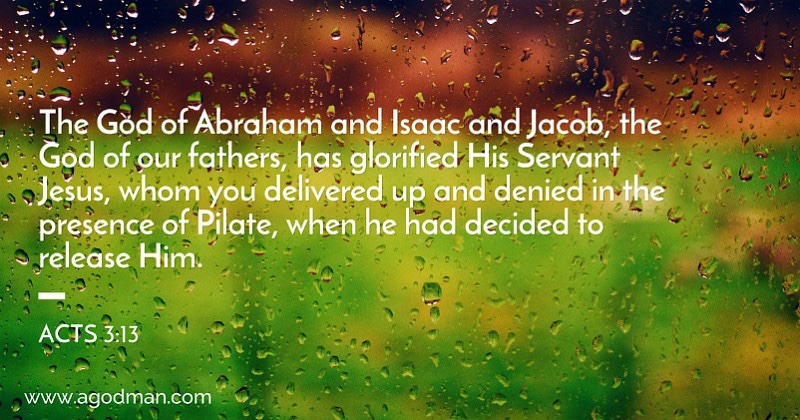
Peter begins his speech by accusing the people of thinking “as if by our own power or piety we have made him walk” (3:12). Not so, he claims. Peter asserts that it is God — “the God of Abraham and Isaac and Jacob, the God of our ancestors” (3:13) — who has enabled the miracle. Like many speeches in Acts, it begins by acknowledging what God has been doing (2:22; 7:2; 10:34; 13:17; 15:7; 17:24; 21:19).
In addition, the speech contains a number of other key elements of speeches, from the template established in Peter’s Pentecost speech. The healing took place in the name of “the Messiah, Jesus of Nazareth” (3:6; see 2:36), who is here represented to the people in ways largely familiar from this earlier speech. Jesus is the one whom God glorified (3:13) and God raised (3:15; see 2:24); he is the one of whom the apostles are witnesses (3:15; see 2:32) for of him they “see and know” (3:16).
Jesus is the suffering Messiah, in fulfilment of “what God announced beforehand through the mouth of all the prophets” (3:18). This extends the fulfilment of prophecy from Jesus’ resurrection (2:25-31) and exaltation (2:34-35) to his crucifixion. Such a claim is important for Luke; he has Paul make the same affirmation, that the suffering of the Messiah fulfils scripture, at 26:23; indeed, he places its initial appearance on the lips of Jesus at Luke 24:26. (However, Peter’s claim that “all the prophets” predicted this is surely one of a number of Lukan exaggerations.)
So the speech both reprises and develops the story of Jesus, using explicit language about how God was at work amongst these happenings, as told in 2:22-36, as well as the prophetic and apostolic witness which characterises the apostolic proclamation.
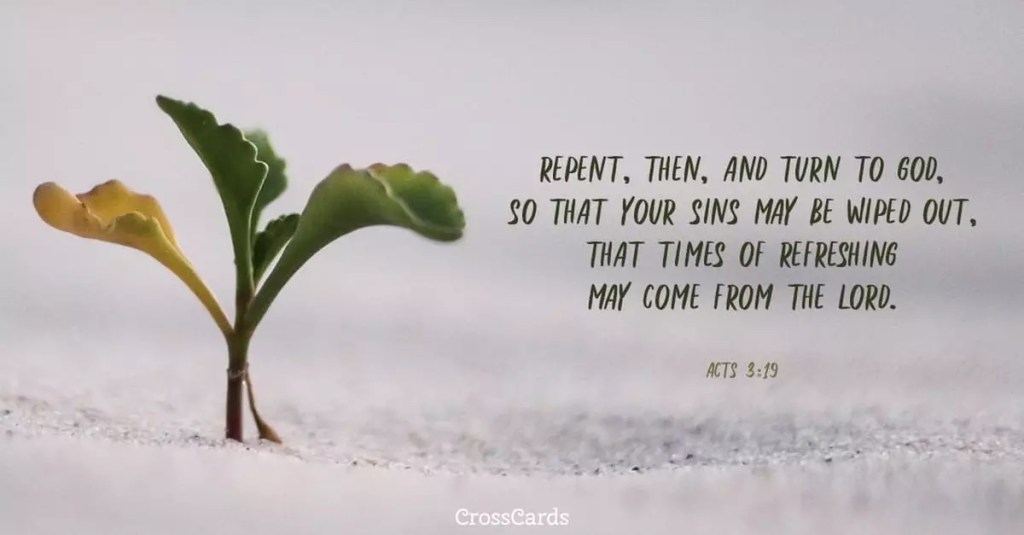
Luke has Peter once more evoke the response of repentance (3:19) by reference to God, as he did at 2:37-39. Repentance is portrayed as an integral element in the eschatological scenario. The eschatological hope which was often proclaimed by Jesus (Luke 4:43; 9:26-27; 10:1-16; 12:49-56; 13:22-30; 17:20-37; 19:11-27; 21:5-36) continues as an essential element in the apostolic proclamation.
Luke reports Peter as describing the eschatological sequence in some detail (3:19-21). The sovereignty of God is clearly in focus in this eschatological process: God will wipe out sins (3:19b) because people will have already repented and turned to God (3:19a); “times of refreshing” will come “from the presence of the Lord” (3:20a); and God will then send the appointed Messiah (3:20b).
After this, there is an interim period, as the ascended Jesus remains in heaven (cf. 1:11; 2:33), awaiting “the time of universal restoration” which will implement what God has long ago promised (3:21). The delay occasioned by this waiting does not signal a breakdown in God’s providential control of events, for Jesus remains in heaven by divine decree (he “must”, 3:21). This concentrated eschatological proclamation thus underlines the continuing sovereignty of God, which is especially manifested at the end times.
The “times of refreshing” may refer to Jesus’ teaching that “the Lord will cut short the end” (Mark 13:20, but omitted in Luke 21); the sense of “refreshing” is of a breathing space before the next event in sequence takes place (see Exod 8:15).
The “time of universal restoration” transcends the earlier question of the disciples concerning the restoration of the kingdom to Israel (1:6); here, restoration has a universal scope. It may thus correlate with the eschatological events which Peter has already reported at 2:17-21 (citing Joel 2:28-32; see also Mal 4:5-6).
References to the eschaton also appear in Peter’s Caesarea speech (10:42) and in Paul’s Areopagus speech (17:31). On these occasions, however, the description of the eschaton is limited to noting the role that Jesus will perform, as the one “ordained” (10:42) or “appointed” (17:31; cf. 3:20) to execute God’s judgement. Nowhere else in Acts do we find the fulsome eschatological description offered in this speech by Peter at Solomon’s Portico.
The time of universal restoration which Peter declares is that which “God spoke through the mouth of his holy prophets” (3:21; cf. Luke 1:70). In addition to the exaggerated claim that “all the prophets … predicted these days” (3:24), Luke has Peter cite specific scriptural passages in support of his statement about the eschatological role of Jesus.
Peter identifies Jesus in two eschatological roles: as the prophet promised by Moses (3:22-23, quoting Deut 18:15-16,19) and as the one who implements the blessing in the covenantal promise to Abraham (3:25, alluding to Gen 12:3; 18:18; 22:18; 26:4). The way that Peter here expresses the eschatological role of Jesus is evocative of the prophetic words of Mary (Luke 1:54-55) and Zechariah (Luke 1:68-75).
This eschatological act of God is still awaited. It is the decisive action which provides the springboard for Peter’s demand for repentance (3:19). Waiting for the coming kingdom is not simply a passive, do-nothing time. It requires active waiting—so Peter concludes his speech by urging the people to “turn, each one, from your sins because God raised up his son and sent him as a blessing to you” (3:26, as a fulfilment of the promise to Abraham cited in 3:25).
In addressing the issue posed in 3:12, Peter thus uses the affirmation that God has been at work in the healing, as the basis for expounding God’s eschatological actions, which will bring blessing to the people. Looking at what has happened in the immediate situation provides an important clue for understanding the larger scheme of things. That might be a clue for how we operate as the church today: sensing that each small, hopeful happening is a glimpse of what is still to come in the overarching plan of God.
This blog is based on a section of my commentary on Acts in the Eerdmans Commentary on the Bible, ed. Dunn and Rogerson (Eerdmans, 2003). I have also explored the theme of the plan of God at greater depth in my doctoral research, which was published in 1993 by Cambridge University Press as The plan of God in Luke-Acts (SNTSM 76).
When we look back over history, and explore it in the traditional framework that we use to mark the periods of history, people of the Christian faith see a large watershed around the time of Jesus.
Traditionally, we have marked this watershed by using the letters BC and AD—Before Christ, and Anno Domino (“in the year of our Lord”). Those letters stand us in good stead, however, when we reflect on the past year. The years prior to 2020 are BC years; we consider them to be “Before COVID”.
But then, from early in 2020, and spreading rapidly across the globe through the months of that year, we experienced a major disruption. COVID interrupted familiar patterns, forcing everyone to refrain from gathering together, pressing upon us all the imperative of using technology to connect, inviting us to provide pastoral care, worship, learning opportunities, and social gatherings in the virtual space online.
The disruptions of this time were extensive, reaching widely and deeply into our familiar patterns. From late 2020, then, we have been living in the years we can mark as AD: After the Disruption. Things are different. Events have made things different. Society has learnt to function in different ways—use the check-in app, sanitise, maintain social distancing, count numbers on the space, practice good personal hygiene, stay at home if you are unwell, or vulnerable.
People in the church have also learnt to function in different ways. We check in when we arrive for worship. We gather to worship and do not sing or hug. We support the church financially by online giving, not by “passing the plate”. We participate in regular learning opportunities online, and engage with people who are geographically quite distant from one another. We continue to offer worship in hybrid ways, both in person and online.
We continue the provision of worship resources in hard copy or via email to people who are vulnerable or frail. We have adapted to having morning tea after worship, served by people wearing masks and gloves, with individually-packaged food. We may not like all of these changes, but we recognise how important they are to ensure the safety of all our people.
When the Canberra Region Presbytery met on 20 March, we heard from the Secretary of Synod, the Rev. Jane Fry, who urged us to consider the new things that are emerging out of this change. “COVID erupted into society, and the church, bringing chaos”, Jane observed, “and we know, from scripture and history, that God works best through chaos.”
So what has been taking place in this time of chaos, as we move from BC (Before COVID) to AD (Anno Domino)? What changes have we recognised to be important? What new things is God doing in our midst, as a result of the chaotic disruptions of COVID. We explored various ideas during the Presbytery meeting conversation with Jane Fry.
Traditionally, we have ensured that stipended ministry is offered in places that can afford them; the challenge, now, is for us to move to a model that places community chaplaincy in an area with significant need. Work is underway on this exact matter, as Presbytery considers how to provide grater ministry resourcing in the South Coast regions which have been impacted so greatly by the bushfires.
We noted the importance of continuing our pastoral care of ageing people who have been faithful over many decades. The Synod Secretary affirmed that, and invited such groups to consider, “what is our legacy for the future?” Rather than “keeping the lights burning until we all done”, how might ageing congregations best envisage “how do we serve as midwives to the future?”
Relating to people outside the church is another challenge, and opportunity, facing us as the Uniting Church. The dominant voice for “Christianity” in the public arena has, for some time, expressed very different perspectives on many matters, when compared with the way the Uniting Church operates in society and what we value in our communities. How do we strategise to provide a stronger voice, in our distinctive tones, into those public conversations?
How do we leverage off the many assets that we have, as church, to ensure that mission and ministry are resourced and developed? What place does the “rationalisation of property” play in this process? Whilst church properties in the ACT have, in effect, a “zero dollar value”, nevertheless we are stewards of many properties—how do they figure in the ways that we foster our core activities as the people of God?
So, lots of important and helpful questions have been raised. How do we respond to them and work through them, is the challenge for the coming time.
As we head into the future After the Disruption, I personally yearn for a church where active discipleship is the key marker of membership; grace is the benchmark of who we are when we gather in community; the heart of the Gospel is known to be justice for all, where we work towards that goal for all people; and we take seriously those fearsome words that we pray all-too-easily, “your kingdom come, your will be done, on earth as in heaven.”
*****
Footnote: many people will know that I have long operated with the scholarly convention to refer to “Before the Common Era” (BCE) and “Common Era” (CE), as this offers clearer respect to our Jewish brothers and sisters and avoids the sense of Christian supercessionism in our language. But, for the purposes of this reflection, I have reverted to the old BC—AD language. It seems to fit.
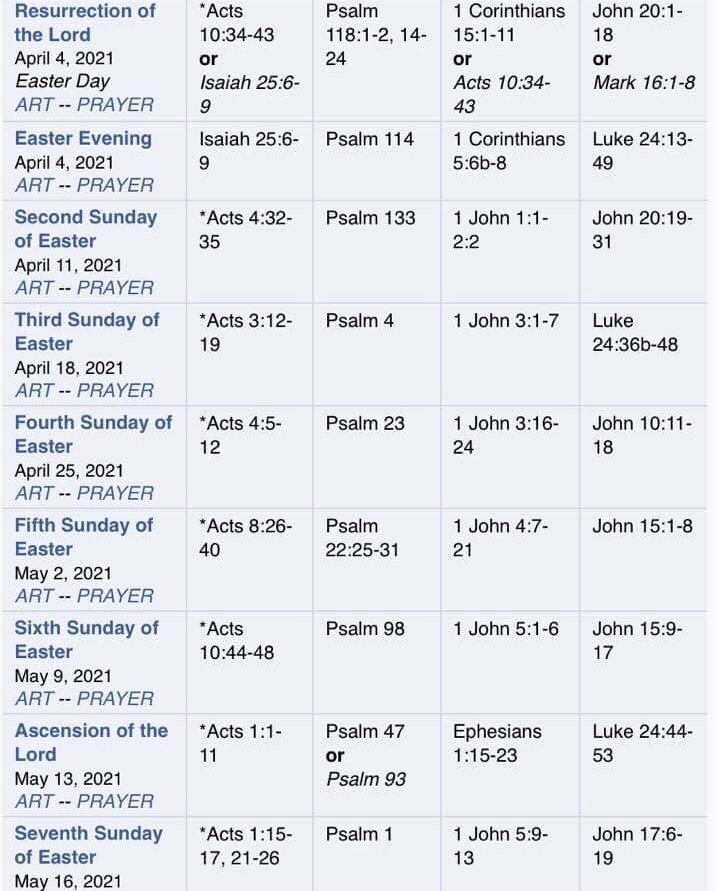
During the weeks that stretch out after Easter Sunday, we are in the season of the year (in the church calendar) that is called, simply, Easter. This coming Sunday will be the second Sunday in Easter (the second of seven, running through to the middle of May). During this season, the lectionary we use replaces the first reading from Hebrew Scripture with sections from the book of Acts—the second of two volumes attributed to Luke.
Acts recounts, from one perspective, the way that the church emerged as the key organisational response to the teachings and example of Jesus. Luke, the presumed author of the two volumes which provide an orderly account of the things fulfilled among us (Luke 1:1, 3), takes pains to indicate multiple lines of connection and continuity between his account of Jesus (the Gospel of Luke) and his subsequent account of the church (the book of Acts).
In this second volume, there are many indications of how Luke understood the emergence of the church to have occurred. It began as a series of loosely-connected Jewish communities, bonded by their common belief that Jesus of Nazareth was the Messiah (Acts 2:31,36,38; 3:6,18; 4:10; 8:5,37; 9:22; 10:36,48; 11:17; 15:26; 16:18; 17:3; 18:5; 20:21; 28:31).
They were messianic communities, followers of ‘The Way’ (9:2; 18:25; 19:9,23; 22:4; 24:14,22) which grew, over time, into groups identified as Christians (11:26)—and from that developed the Christian church. From these descriptive narratives, the church has drawn guidance for ways to shape its life in subsequent eras.
How do we characterise the church? A classic way from the traditions of the church is to cite ‘The Marks of the Church’: one, holy, catholic, and apostolic. Those four descriptions have been derived from various biblical sources (including the narrative shaped in Acts), and have certainly influenced theology, church organisation, and preaching over the centuries.
The Acts passage provided by the lectionary for this coming Sunday, although quite short (4:32-35), nevertheless is very rich. It offers another set of Marks, which the author of Acts used to describe the church. All three have already been offered in an earlier section of the narrative, as the author recounts them formation of the faith community after the preaching by Peter on the Day of Pentecost. (See https://johntsquires.com/2020/04/28/teaching-fellowship-bread-and-prayers-the-marks-of-community-acts-2/)
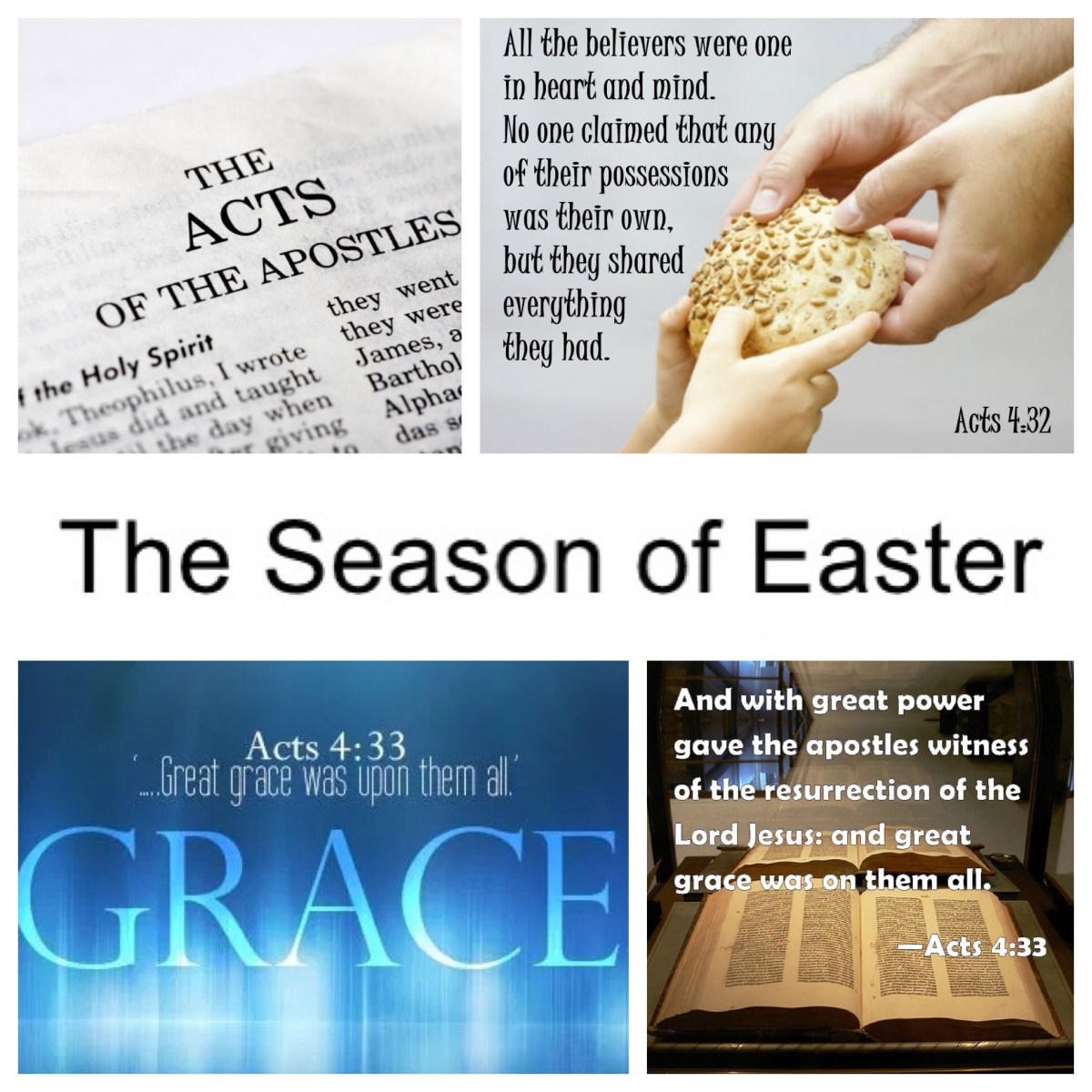
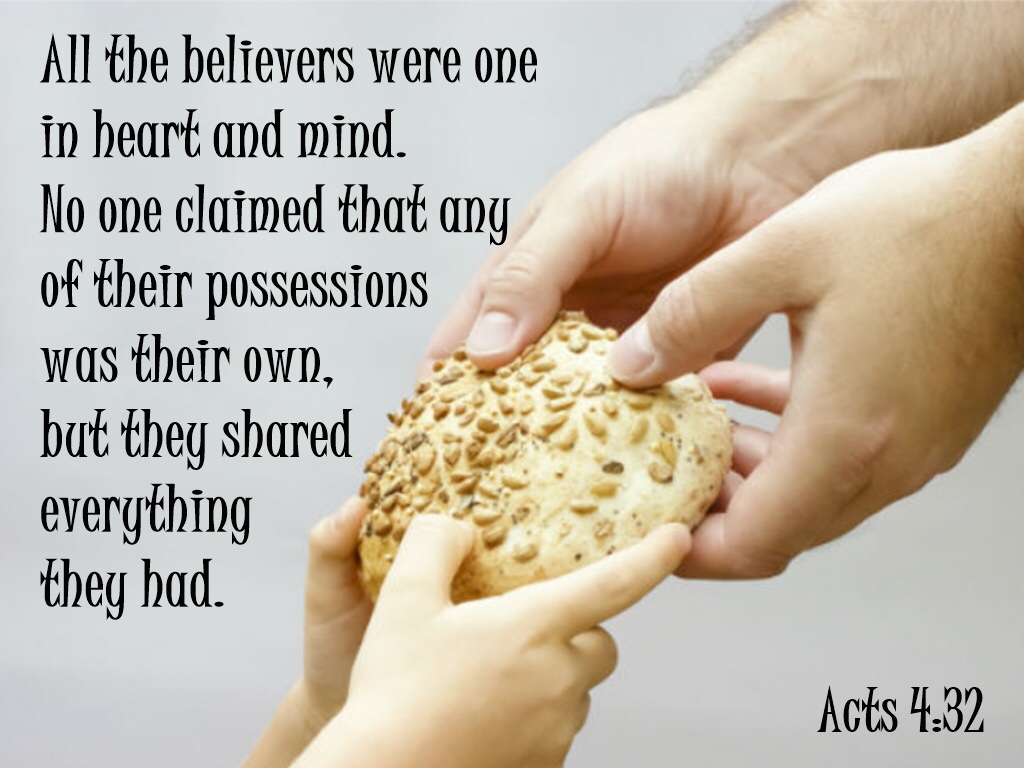
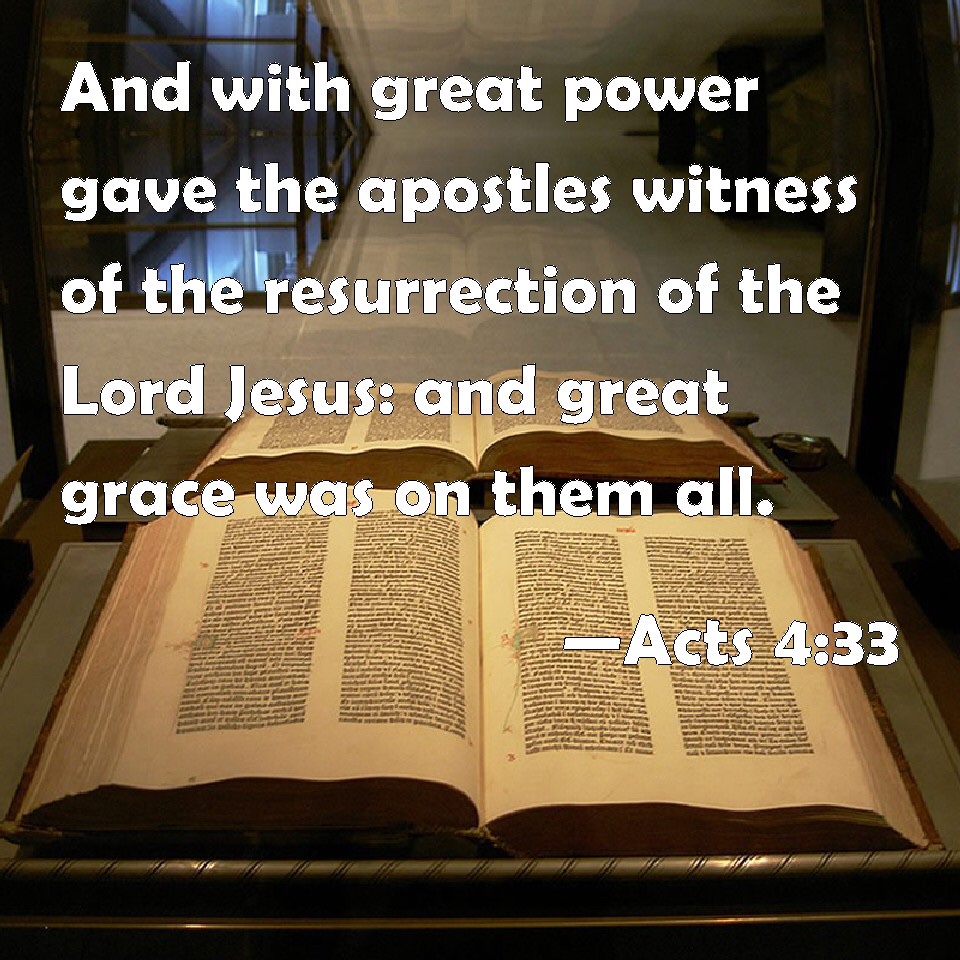
The first mark is unity of purpose (4:32; see 2:42,46). A second mark refers to the powerful testimony to the resurrection that the church offers (4:33; see 2:24,32; 3:15; 4:2). A third mark is the manifestation of grace (4:33b; see 2:47).
The major focus in this summary description is on the first feature, which is introduced with a striking phrase: the believers were “one in heart and soul”, to which is added a repetition of the earlier comment that “for them all things were common” (4:32; see 2:44).
Fellowship is identified as a key aspect of the community (2:42). The precise term koinonia occurs only here in Acts; however, the notion of sharing or togetherness which is inherent in it is evident in other ways. Members of the community gather with one mind (2:46) in a way that will consistently characterise the community (4:24; 5:12; 15:25).
These phrases used evoke the traditional Greek proverbs, ‘friends have one soul’ and ‘the goods of friends are common property’, which were known since the time of Aristotle (Aristotle, Nicomedian Ethics 9.8.2; Cicero, De officiis 1.16.51; Plutarch, On Brotherly Love 490E, How to Tell a Flatterer 65A and De amic. mult. 96E; Iamblichus, Life of Pythagoras 65A; Dio Chrysostom Oration 34.20; Diogenes Laertius Lives 5.20, 8.10).
The Essenes were described in a similar way by Philo, Every Good Man is Free 85, and Josephus, Jewish War 2 §122. The first phrase is also reminiscent of the common Deuteronomic reference to ‘heart and soul’ (Deut 6:5; 10:12; 11:13; 13:4; 26:16; 30:2,6,10). The early messianic communities shared in this central characteristic. For the author of this book, it was to be a defining mark of the messianic communities in each place they were found.
2. A second mark refers to the powerful testimony to the resurrection that the church offers (4:33; see 2:24,32; 3:15; 4:2). The proclamation the apostles, of course, is a regular element in the story of Acts: there is a comprehensive list of no less than thirty-six speeches in Act at
Proclaiming the good news about Jesus was at the centre of these messianic communities, as Acts takes pains to indicate (2:23; 3:7, 15, 26; 4:10; 5:30; 10:40; 13:30-37).
3. A third mark of these communities was the manifestation of grace (4:33b). The community in Jerusalem was earlier described in this way, as “having grace towards the whole of the people”—the NRSV translates this, less accurately, as “having the goodwill of all the people” (2:47). This introduces another term which will have significance in the narrative of Acts: charis. In 2:47, charis is linked with the inner life of the community as they “ate their food with glad and generous hearts, praising God and having grace towards the whole of the people”.
Grace is a characteristic which also marks Stephen, enabling him to perform “great wonders and signs” (6:8); in his speech, he notes that God ascribed grace to Moses (7:10) and to David (7:46). It is this grace of God which is evident in the growing community in Antioch (11:23) and continues to be a characteristic of the community in Iconium, where once again it is evident through the signs and wonders granted by God (14:3).
Such grace is regarded as the means of salvation (15:11) which enables people to believe that Jesus is Messiah (18:27-28). This same grace of God is attested by Paul throughout his ministry (20:24,32). It thus forms another of the characteristics of messianic communities in Jerusalem and beyond.
This blog is based on a section of my commentary on Acts in the Eerdmans Commentary on the Bible, ed. Dunn and Rogerson (Eerdmans, 2003). I have also explored the theme of the plan of God at greater depth in my doctoral research, which was published in 1993 by Cambridge University Press as The plan of God in Luke-Acts (SNTSM 76).
Events in Australian society over recent weeks have seen the emergence of a powerful hashtag: #IBelieveHer.
The announcement of Grace Tame as Australian of the Year for 2021 set in train a dramatic series of events. Grace’s testimony to the abuse she has suffered is powerful. Her appointment to this role validates the stories of countless survivors with similar stories.
Since Australia Day, it has been fascinating, and disturbing, to see how the announcement of this particular Australian of the Year has set in train a powerful and disturbing sequence of events in Australian public life. Sexual abuse, and especially male mistreatment of females, has been in the news each day since then.
The announcement about Grace Tame was soon followed by the testimony of Brittany Higgins, about being raped in Parliament House. This was another key catalyst in the public discussion of sexual abuse and misogyny in our society. In contrast to the shocking and shameful characterisation of her testimony by a Federal minister, her public words invited the clear response: #IBelieveHer.
The turmoil swirling around these revelations soon encompassed a matter that, apparently, had long been a widely-known secret in the corridors of Parliament House and amongst the media in the national capital. That secret started to leak into public awareness; rumour and supposition spread.
When the then Attorney General eventually spoke publicly, identifying himself as the subject of the rumours, we were offered the options: believe him, with his emotionally theatrical presentation of denial; or listen to the testimony of the sadly-deceased woman, as she grappled with her recollection of events in 1988, and attested to friends of her abuse by him at that time. The opportunity arose, once more, to consider our response; and many have responded with heightened intensity: #IBelieveHer.
And in the ensuing weeks, many other females: members of parliaments, parliamentary staffers, public figures, and private individuals, have borne testimony to their experiences of harassment, discrimination, and abuse. Each of them invites us to consider whether #IBelieveHer.
Brittany Higgins, Grace Tame, and the former Attorney General.
In this context, it is sobering for us to read and reflect on the Gospel texts which provide the underlying narrative for The Easter Story, which we remember and reflect on each year at this time.
*****
The earliest of our Gospels affirms that women were involved with the movement started by Jesus. They were present, they experienced life on the road with him, they heard his words and saw his deeds; and they remained faithful until the very end.
In his beginning of the good news about Jesus, Mark reports:
There were also women looking on from a distance; among them were Mary Magdalene, and Mary the mother of James the younger and of Joses, and Salome. These used to follow him and provided for him when he was in Galilee; and there were many other women who had come up with him to Jerusalem. (Mark 15:40–41)
The passage raises questions: how do we know about what happened to Jesus on the cross? Do we attend to, and give credence to, the testimony of the women? Do we respond, #IBelieveHer ?
Just a few verses later, Mark provides the first account of the scene at the tomb, where a group of female followers of Jesus were the first to discover that the tomb was empty. He ends the scene with the women fleeing, and the abrupt observation that “they said nothing to anyone” (Mark 16:8). Was that because they feared that nobody would believe them?
However, others who report this scene feels that this ending is quite inadequate—after all, we do have a story about that empty tomb encounter, so surely someone there must have spoken about it?
With that in mind, in his book oforigins, Matthew modifies the story, even as he repeats it: “So they left the tomb quickly with fear and great joy, and ran to tell his disciples.” (Matt 28:8) And the silence of the text about how this news was received, invites the unspoken question about their testimony: do #IBelieveHer ?
In narrating his orderly account of things being fulfilled, Luke provides a more nuanced account of the scene, more directly reflecting an awareness of the strong patriarchal context of his day. Why would men believe this report from the women? Would not the typical response be that this was simply women, gossiping, repeating hearsay, even causing trouble??
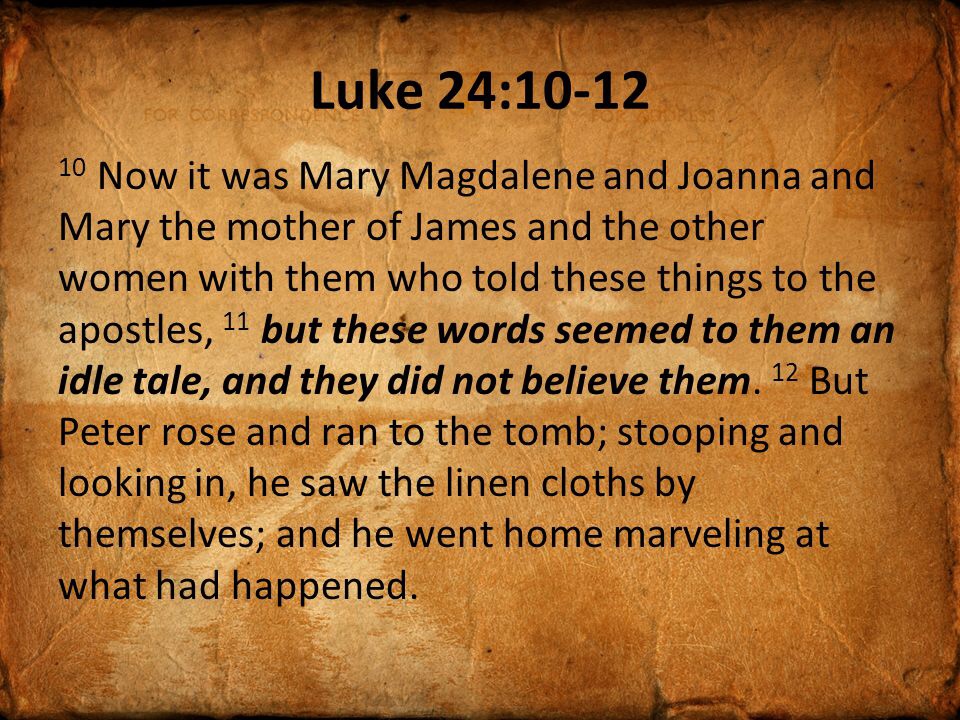
Luke notes: They remembered his words, and returning from the tomb, they told all this to the eleven and to all the rest. Now it was Mary Magdalene, Joanna, Mary the mother of James, and the other women with them who told this to the apostles. But these words seemed to them an idle tale, and they did not believe them. (Luke 24:10-11).
The male apostles (identified so by the same author at Acts 1:13) clearly did not believe the women. #IBelieveHer appears not to apply here.
So Luke continues: Peter got up and ran to the tomb; stooping and looking in, he saw the linen cloths by themselves; then he went home, amazed at what had happened. (Luke 24:12)
Male authorisation of female claims was still needed, even in this Gospel where women appear to have a stronger voice. Those male leaders did not respond with #IBelieveHer, until they were able to see and experience for themselves. In the house where they gathered in Jerusalem, them men at last believe the women—because one of their own had validated their words.
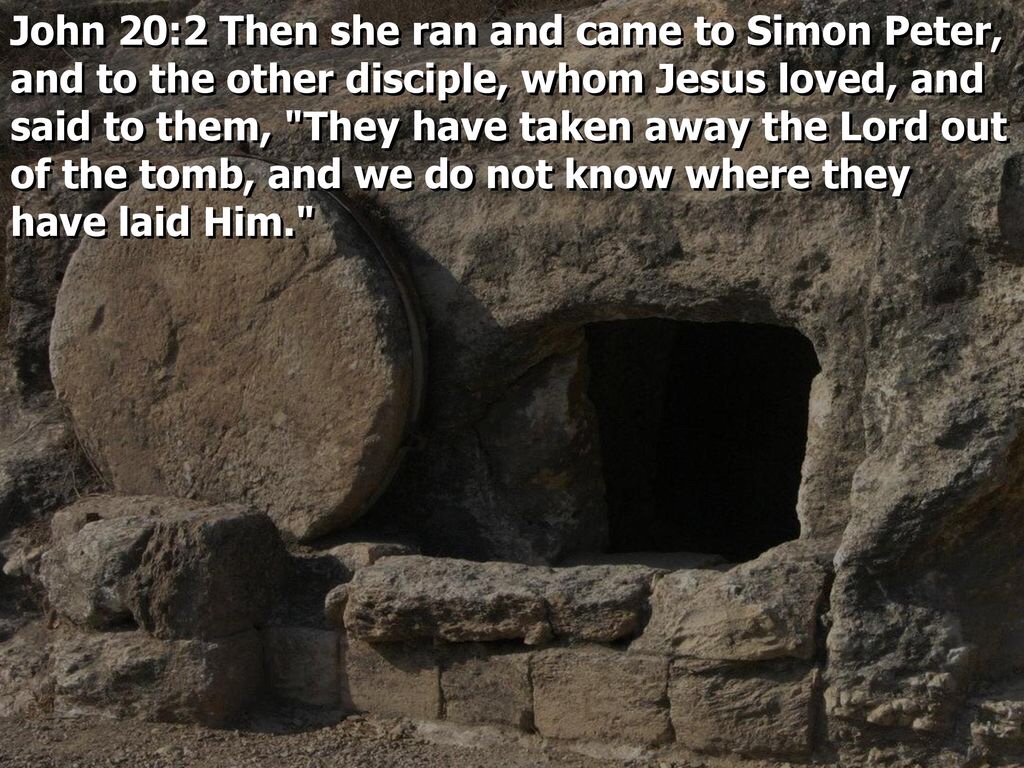
The latest of the four canonical Gospels locates this response of disbelief at the empty tomb, rather than in the house in Jerusalem. In this Gospel, the book of signs, Mary has come by herself to the tomb, found it empty, and returned to tell Simon Peter and the beloved disciple of this news.
As a result, John notes:
Peter and the other disciple set out and went toward the tomb. The two were running together, but the other disciple outran Peter and reached the tomb first. He bent down to look in and saw the linen wrappings lying there, but he did not go in.
Then Simon Peter came, following him, and went into the tomb. He saw the linen wrappings lying there, and the cloth that had been on Jesus’ head, not lying with the linen wrappings but rolled up in a place by itself. Then the other disciple, who reached the tomb first, also went in, and he saw and believed. (John 20:3–8)
Yet again, the males were required to inspect and authorise the claims of the women. In this Gospel, “seeing is believing” (see John 1:39, 46, 50; 4:29; 4:48–53; 6:30: 7:3; 9:15–17, 25; 11:9; 11:34–40; 12:21; 20:25–27). #IBeliveHer was conditional on male affirmation. They saw; we believe. Yet we take the story of Mary, in the garden, seeing Jesus, as part of our “Gospel truth”. It is clear that believers affirm: #IBelieveHer—even when the early male leaders did not!
John recounts another, more personal, more profound story, focussed solely on Mary of Magdala, who later encounters a man in the garden. Uncertain of his identity, she thinks he is the gardener. It takes only one word from the man to persuade her that he is, indeed, Jesus:
Jesus said to her, “Mary!” She turned and said to him in Hebrew, “Rabbouni!” (which means Teacher). (John 20:16)
This story ends, as the earlier accounts do, with a woman testifying to the male (and presumably other female) followers of Jesus:
Mary Magdalene went and announced to the disciples, “I have seen the Lord”; and she told them that he had said these things to her. (John 20:18).
#IBelieveHer. This is the logical deduction to draw from each of these narratives—at times, in counterpoint to the males in the story, but eventually, in relation to each account, with assurance that the voice of the females is acceptable, trustworthy, believable. #IBelieveHer.
And other Gospel narratives contain stories in which women are placed alongside men as experiencing the ministry of Jesus (most notably, Luke 8:1–3; John 11:20–27; Mark 1:29–31; and many other scenes), as well as accounts where the word of a woman was heard and believed: for instance, the woman of the Samaritan village (John 4:39–42); the unnamed woman who anoints Jesus in Bethany (Mark 14:3–9 and parallels); and the Syrophoenician woman in the region of Tyre (Mark 7:24–30), whose pushback against Jesus convinces him! In these stories, also, our response is: #IBelieveHer!
****
Of course, the passages noted above with women as the key protagonists raise the question: who told the evangelists about these incidents? Are they based on eye-witness testimony? Are they historical narratives, attested from the very beginning? Or are they stories developed and expanded over time, imaginative recreations of what is assumed to have taken place, shaped as stories for later generations?
In reconstructing “the historical Jesus”, scholars developed a number of criteria for assessing whether sayings and teachings in the Gospels were likely to have been authentic—that is, spoken by the historical Jesus himself. (See a simple listing at https://www.westmont.edu/~fisk/articles/CriteriaOfAuthenticity.htm)
One of these criteria was “dissimilarity”: does the saying sit uneasily, both with Judaism of the time, and in terms of what we know about the early church? The same criteria can be used, by extension, to consider narrative accounts in the Gospels: they are more likely to have been authentic if they reflect “dissimilarity”. Why would an author create something that sat uneasily within the worldview of the day?
On this basis, placing weight on the testimony of women might be seen to be as close as we can get to an authentic account. There is an argument that women were not regarded as valid witnesses—a passage in the Talmud (Shavuot 30a) interprets Deut 19:17 as requiring males only to be witnesses.
And they shall stand the two men, who have them the conflict, before God. Before the priests, and the judges, that will be, in those days.
Deliberately casting doubt on the testimony of women (Mark 16:8; Luke 24:11; John 20:3–8) would be a counter-productive move, if that testimony was to serve as the earliest account of what happened to Jesus. More likely than not, this was a tradition received and valued as plausible, perhaps even historical.
Indeed, feminist theological reflection on these and other narratives moves away from the “kyriachal” nature of these male-generated criteria, and into a “hermeneutic of remembrance” in which the voices of women—present, but often diluted, softened, or hidden in the final,form of the biblical text—are valued and accorded primary significance.
(See a useful discussion of the hermeneutics of remembrance, focussed on the writings of Schüssler Fiorenza, at https://www.degruyter.com/document/doi/10.1515/opth-2020-0117/html) In this approach to the texts, we read carefully and listen attentively, to hear the voices of ancient women, and respond affirmatively: #IBelieveHer.
At any rate, however we assess these early narratives, the way they have been handled throughout the ensuing two millennia is clear: #IBelieveHer. That is how we deal with the narratives of cross and resurrection that we receive in the scriptures. #IBelieveHer. And that principle is surely valid and valuable to guide us in life today. #IBelieveHer.
During Holy Week, it is Christian tradition to trace the pathway which Jesus took towards Jerusalem, sometimes following the stories recounted in Mark 11-14. In the city of Jerusalem, Jesus was arrested, crucified and died; in this city, for untold years, pilgrims had gathered in festive celebration, to remember, to retell the stories, to nurture their faith, to seek the Lord.
In Jewish tradition, the pilgrims travelling towards the city would join in songs—some of which are included within the book of Psalms in Hebrew Scripture and Christian Bibles. On their journey towards the city, according to this tradition, the pilgrims would sing Psalms 120—134. These are known as The Songs of Ascent, for they were sung as the pilgrims climbed higher towards the city, and then higher still towards the Temple at the highest point in the city.
This series of blogs use these ancient songs as the focus for reflecting, to envisage what that journey was like for Jesus and his followers, travelling as pilgrims to the city to celebrate Passover.
It was during that week that everything came to a head.
A gathering of friends and family; a joyful occasion, with exuberant celebration. We had walked with other pilgrims, heading towards the city, climbing the road, singing the psalms, looking forward to the festival.
Each step closer to the city was a step that brought us closer to the heart of our faith. Each step along the way was a step that brought us higher, nearer to the holy mount. Each stage along the way was matched with a psalm of ascent, singing with joy as we drew near to the holy place.
So we stood at the foot of the holy place, the Temple first built by Solomon, then rededicated and rebuilt in the time of Herod; the Temple where the Lord God dwelt, where he dwelt in the Holy of Holies.
So we prayed, and sang, once more, with hope: I have calmed and quieted my soul, like a weaned child with its mother; my soul is like the weaned child that is with me. O Israel, hope in the LORD from this time on and forevermore. (131) In the silence, reflect on Psalm 131
It was here, surely, that we would meet God; For, as we sang, The LORD has chosen Zion; he has desired it for his habitation:“This is my resting place forever; here I will reside, for I have desired it.” (132) In the silence, reflect on Psalm 132
So we gathered around the table, friends and family, a joyful occasion, with the drinking of wine, some singing, some laughing; a meal shared together. And we celebrated in song: How very good and pleasant it is when kindred live together in unity! (133) In the silence, reflect on Psalm 133
And again, in song, we sought to bless each other: Come, bless the LORD, all you servants of the LORD,who stand by night in the house of the LORD!Lift up your hands to the holy place, and bless the LORD.May the LORD, maker of heaven and earth, bless you from Zion. (134) In the silence, reflect on Psalm 134
So our songs of ascent had come to an end. We were in the holy city, near to the holy place, gathered once again for a joyful occasion, with the drinking of wine, some singing, some laughing; a meal shared together; but then, a kiss … a betrayal … a denial … a trial.
It had begun in celebration. For years, it was so; for decades, for centuries, on this very night, we would gather, joined as family, to remember, to rejoice, to recall the act of liberation.
It was on that night that everything came to a head.
During Holy Week, it is Christian tradition to trace the pathway which Jesus took towards Jerusalem, sometimes following the stories recounted in Mark 11-14. In the city of Jerusalem, Jesus was arrested, crucified and died; in this city, for untold years, pilgrims had gathered in festive celebration, to remember, to retell the stories, to nurture their faith, to seek the Lord.
In Jewish tradition, the pilgrims travelling towards the city would join in songs—some of which are included within the book of Psalms in Hebrew Scripture and Christian Bibles. On their journey towards the city, according to this tradition, the pilgrims would sing Psalms 120—134. These are known as The Songs of Ascent, for they were sung as the pilgrims climbed higher towards the city, and then higher still towards the Temple at the highest point in the city.
This series of blogs use these ancient songs as the focus for reflecting, to envisage what that journey was like for Jesus and his followers, travelling as pilgrims to the city to celebrate Passover.
It was during that week that everything came to a head.
A gathering of friends and family; a joyful occasion, with exuberant celebration, meeting up after months or years in our own villages. We had walked with other pilgrims, heading towards the city, climbing the road, singing the psalms, looking forward to the festival. We climbed, higher, nearer to the holy mount. Each stage along the way was matched with a psalm of ascent, singing with joy as we drew near to the holy place.
So we stood at the foot of the holy place, the Temple first built by Solomon, then rededicated and rebuilt in the time of Herod; the Temple where the Lord God dwelt, where he dwelt in the Holy of Holies.
And we prayed for one another, and we sang: The LORD bless you from Zion. May you see the prosperity of Jerusalem all the days of your life. (128) In the silence, reflect on Psalm 128
Yet when we came inside, into the court of the temple, there was no peace, no joyful singing, no celebration, no preparation for worship.
Instead: a whip of cords, a shout of anger, words of vengeance, judgement, rejection; tables overturned and coins scattered. A whip of cords, a shout of anger, tables overturned and coins scattered.
It was not a moment of peaceful reflection; it was a moment of fearsome agitation. So we sang, in fear: The LORD is righteous; he has cut the cords of the wicked. (129) In the silence, reflect on Psalm 129
and again, we sang, this time in hope: O Israel, hope in the LORD! for with the LORD there is steadfast love, and with him is great power to redeem. It is he who will redeem Israel from all its iniquities. (130) In the silence, reflect on Psalm 130
A gathering of friends and family; a joyful occasion, with exuberant celebration. We had walked with other pilgrims, heading towards the city,
climbing the road, singing the psalms, looking forward to the festival.
Each step closer to the city was a step that brought us closer to the heart of our faith. We climbed, higher, nearer to the holy mount. Each stage along the way was matched with a psalm of ascent, singing with joy as we drew near to the holy place. So we stepped out, full of faith, on our journey to Jerusalem.
It was during that week that everything came to a head.


























 An Informed Faith