Ramping up the rhetoric, generating guilt and provoking panic: the failed strategy of conservatives in the UCA (part I)

“My anecdotal feedback from contact with ACC and other evangelical congregations is that at least 3000 people have left since the 15th Assembly. Sadly, many members have just drifted away in hundreds of congregations, one, two, three or four at a time, perhaps some not even noticed, or worried about by ministers and leaders.”

So writes a leader from the Assembly of Confessing Congregations in their latest magazine, ACCatalyst. It seems to me to be a massive overreach in rhetoric, an attempt to generate a feeling of guilt amongst the faithful across the Uniting Church. “Look what terrible things have resulted from your decision about marriage”, is the implied message. I don’t know how the figure of 3,000 has been calculated. Inflated overestimates, I reckon.

It is also an inaccurate representation of the current situation. Personally, I know of some people in the context where I currently minister who have been upset by the decision. They have all received follow-up from pastoral carers, or myself as minister. Some have left, others are “hanging loose”. I spoke just two weeks ago with one person who had left the UCA last year because of the decision about marriage. He and his family are happily attending a church, geographically more convenient and theologically more suited to their views. I suspect there are more such stories amongst those who have left the UCA.

I know also of a number of Congregations where people have decided to come along to the Uniting Church, to take part in worship and fellowship, to align themselves with this denomination, precisely BECAUSE the Assembly made the decision that it did! I would not say there are 3,000 such people—in fact, I have no idea how many such people there might be—but I do know that there are, most certainly, a number of such people, who have JOINED the UCA since last July!

In talking with colleagues, who have similar stories, overall, of some small number of departures, as well as some stories of people joining, my sense is that the impact on numbers in the UCA over the past 12 months is small. Very small. And for most of those, there is another church, another spiritual home, where they have been welcomed. So it is not as bad as the ACC leader makes out.

This kind of scaremongering rhetoric is familiar and well-worn. I seem to have heard something very similar after each “controversial” decision relating to sexuality that has been made within the Uniting Church. Each time a decision was made, after much care, thought, prayer, and discussion, the noises about people leaving the church in droves have been heard. Each time, it is claimed, the Uniting Church is about to divide and die. And each time, we know, the church goes on, continuing to gather for worship and fellowship, maintaining its faithful witness in society, and providing loving service to people in the community.

The thread of a disenchanted reactionary minority, puffing and panting with an increasingly excessive rhetoric about the imminent demise of the church, has run through the Uniting Church for four decades. And we are still here. And still strong. The experience of the most recent Synod meeting I attended in Sydney attests to this: There was a significant contingent of younger members; in fact, we were told that one third of the members at this Synod were attending for the first time. Not all of them were “young”—but this in itself testifies to a strong commitment to the church across the board.

Why is it that we have had this irritant reactionary stream throughout our 42-year history?

I. The formation of the Uniting Church in Australia

When the Presbyterian church decided not to adopt the “one in, all in” approach that the Methodist church was utilising, in the voting about church union, the foundation was laid. Less involvement in the new denomination from Presbyterians, with their valuing of critical thinking and academic resourcing of thoughtful preaching, meant that, in some places, there was a higher proportion of Methodists, with their emphasis more on personal piety and evangelical fervour, within the new Uniting Church.

Had the Methodist Church allowed for more conservative dissidents not to join—as the Presbyterian and much smaller Congregational Churches did—the conservative thread in UCA history would have been much smaller. And the new church could have developed an even stronger focus on contextual theology, actions for social justice, and moving into the post-Christendom era. But such was not the case.

There was, to be sure, noise back in the 1970s to the effect that the new church was a rearguard action against declining numbers. Most often this came from disenchanted conservatives, frustrated at the fledgling church’s failure to stand for an understanding of the Bible as the “inerrant, infallible Word of God”. The church was going to die, they maintained, because of this failure.

However, the new church refused to die. It has continued on throughout the ensuing four decades of the Uniting Church. It remains the third largest denomination (counting by the census numbers) in Australia. True, like all other mainstream denominations, overall numbers have been falling. There is nothing different about the Uniting Church in this regard. Yet the UCA continues apace.

In those years since 1977, we have seen, one after another, the Evangelical Ministers of the Uniting Church, which in the early 1980s was renamed to Evangelical Members of the Uniting Church (EMU); then in the early 2000s, the Reforming Alliance (RA); and, in more recent years, the Assembly of Confessing Congregations (ACC).

The family resemblance is very clear. Each of these organisations advocated for a regressive conservative position on matters of morality (largely, sexuality) and veered towards a flat, literalist reading of scripture. They each made lots of noise about these issues but made little or no headway in achieving their aims. And, over time, the reactionary rhetoric has become more defensive, more rabid, more overreaching.

II. EMU, the Bible, and women in ministry

The ACC and RA are the children of EMU. What was Evangelical Members of the Uniting Church started as Evangelical Ministers of the Uniting Church, formed in South Australia out of a concern about the so-called “liberal” tendencies dominant in the Uniting Church. Over time, the SA group grew with branches formed in other Synods, and then a national organisation emerging.

In the early years of the church, various evangelical members and ministers had opposed the church’s commitment to equality and mutuality, specifically arguing against female ministers. In my first parish, for instance, in 1981-1983, I worked hard with parishioners and members of other nearby UCA congregations who held to that view and argued that the UCA was doing the wrong thing by ordaining women.

I was a member of a Synod working group later in the 1980s that produced resources addressing the issue of mutuality in ministry, and the ordination of women, in direct response to evangelical members pushing the counter position. I know that women in ministry in the UCA continued to experience discrimination and marginalisation into the 21st century.

EMU was strongly focused on the issue of biblical authority. (This stance has been used to undergird the claim that the Bible does not support the ordination of women). The doctrinal statement crafted by EMU had strong resonances with the general conservative evangelical assertion that the Bible was inerrant, infallible, and completely authoritative, even though the founding documents of the UCA had explicitly not included such terminology.

For a summary of the doctrinal position taken by EMU, see http://www.confessingcongregations.com/emusite/All%20About%20emu/Doctrinal%20Statement.pdf

On the commitment to an informed faith in the Basis of Union, see https://johntsquires.com/2018/08/15/what-i-really-like-about-the-basis-of-union/

As is clear in its founding document, the Basis of Union, the Uniting Church was formed with a commitment to the mutuality of men and women in ministry; indeed, all three denominations had already ordained women in the years prior to church union. Dr Julia Pitman has traced the long history of ordaining women in the Congregational Church—since 1927, in fact! — see https://www.insights.uca.org.au/reviews/read-this/small-church-big-step-for-women

Dr Avril Hannah-Jones provides a fine overview of the ministries of women in the predecessor denominations. She notes that the Congregational Church ordained Rev Winifred Kiek in 1927; Rev Dr Coralie Ling, a deaconess, became the first woman to be ordained in the Methodist Church in 1969; and Rev Marlene Thalheimer was ordained as the first female minister in the Presbyterian Church in 1974. You can read about these women, and more, at https://revdocgeek.com/2013/06/22/women-in-the-uniting-church-by-a-partial-prejudiced-ignorant-historian-to-quote-the-immortal-jane/

Indeed, the issue of the ordination of women was clearly and strongly affirmed in a UCA paper produced in 1990; see https://www.unitingjustice.org.au/society-religion-and-politics/uca-statements/item/download/947_0ff250e12a2db30ecf2027d7a831e979This has been a consistent practice of the church since 1977.

I clearly recall rhetoric from the 1980s to the effect that ordaining women would see other churches stop talking to us and the life of the Uniting Church would shrivel. Those churches continued to talk to us, and the Uniting Church continued on unabated.

I remember being a member of a Presbytery which had one curmudgeonly old member who regularly voted NO whenever anything to do with women in ministry was considered. He should not have been allowed to do this, as it was inconsistent with UCA policy. Fortunately, his ilk has all but died out, at least amongst clergy and lay leadership.

(… to be continued)

For online articles which reflect on the creation of the UCA and its core commitments over the years, see:

https://journeyonline.com.au/features/three-became-one-christ/

https://revivemagazine.org.au/2017/06/22/making-a-bold-statement/

https://sa.uca.org.au/new-times/40th-anniversary-reflection?

https://crosslight.org.au/2017/05/21/union-not-easy-step-many-congregations/

https://assembly.uca.org.au/about/uca

https://assembly.uca.org.au/component/k2/item/2609-forty-years-forty-days-forty-hours#prayer-1-revisiting-our-inauguration

For my musings on the DNA of the UCA, see

https://johntsquires.com/2019/06/18/the-dna-of-the-uca-part-i/

https://johntsquires.com/2019/06/18/the-dna-of-the-uca-part-ii/

Climate Change: a central concern in contemporary ministry

This year, I am sharing in ministry with a colleague who has a brief for fostering discipleship amongst young people, with adults open to fresh expressions of being church, and for strengthening community connections in our local area. She is my guest blogger for this post.

Thanks to Pastor Amy Junor for thoughtful words about the impact of climate change and centrality of this issue in ministry today.

The morning of Climate Change Pastoral Care training, we stood in a circle, acknowledging the traditional owners of the country on which me met. Smoke swirled up from the ceremony we had just shared. I stood with my hands being squeezed by two strangers, and I squeezed back my acknowledgement of their presence. We were outside, under beautiful trees – preparing, to ask together how we care for ourselves and others in a world where climate change is an encroaching issue.

Later in the morning, I was text-messaging members of my faith community about the statistics we were reminded on in the morning session. I told them I was feeling emotional, grieving again at the grim picture before us. I entered a session afterwards where we were given 10 things that ministry agents can do to help care for people experiencing climate distress. Number 8 was to live in a well-functioning and connected community where the burden can be shared. I told my people that I am grateful that we can speak about these things together.

In the afternoon, we listed to voices from our nearest neighbours in the pacific islands and what climate change means for them. We heard from indigenous voices. We spoke together about how we hold the information about our situation and respond helpfully and practically. I drove home that evening in the middle of an enormous rainstorm – the wild world we are called to care for refusing to be ignored. The first line of Psalm 19 played on repeat in my mind.

Fast forward a month, I am in a Generation Next conference in Canberra where attendees consider the health and wellbeing of young people. I ponder the anxiety about climate change that is clearly being announced to us via the actions of our young people (e.g. climate strikes). I wonder how we nurture the generations we are yet to see in a way that equips them to deal with the stress and pressures they will experience in a changing climate.

Two weeks later I am completing a sacraments course in Canberra Region Presbytery. I think about how the natural world plays such a central role in how we worship God. I wonder what it would sound like for our churches to share sacraments specifically acknowledging and committing to our shared stewardship of the planet.

Fast forward to Synod 2019 at Knox Grammar School in Sydney. As the Synod considers a proposal for action on climate change, one of the speakers asks all the people at Synod who are under 40 to stand. He gestures around the room and says ‘all these people are…’ – well, I won’t repeat here what he said exactly because it is an expletive. I wished strongly that this was news, but those exact words are frequently used in self-reference by my peer group (20-40-year olds) when they speak about their future considering climate change. I message my faith community and tell them about the proposal. We celebrate that a body of the wider church recognises the issues and corporately chooses to act.

I text messaged my youth group, asking what they know and think about the issue. Two girls respond; ‘VERY concerned about our climate + the environment in general’ (yes, one of them capitalized the ‘very’).

I have a friend who has been part of our congregation and is one of the most environmentally responsible people I know. She lives in a way that means her footprint on the planet is minimal, with very little waste and very much recycling. She said to me at one point as we spoke about climate action; ‘we don’t need one person to do this perfectly, we need everybody to be doing this imperfectly”. This has stayed with me as I have processed these stories.

In fact, another of the best ways we can care for people (and young people especially) is to be actively modelling proactive (if imperfect) care for the creation around us.

Maybe for you the first step is changing an aspect of your lifestyle to be more sustainable. Maybe for you it is working with your congregation to minimize the waste generated by your Sunday morning service. (There are resources relating to local congregations at http://ecofaith.org/ and https://sa.uca.org.au/justice-advocacy/environmental-advocacy/ea-resources)

Perhaps you want to start by contacting Common Grace to learn more about what you can do. (https://www.commongrace.org.au/climate_change)

You may even write a letter to your local MP informing them of changes that could be made in your neighbourhood to combat climate change.

These stories and others like it are far from over. I hope that we as followers of Jesus can step forward gently, squeezing hands as we acknowledge and grieve the reality and commit to hopeful action together.

Amy Junor, July 2019

See also https://johntsquires.com/2019/07/09/advocacy-and-climate-change-growth-and-formation-treaty-with-first-peoples-synod-2019/

https://johntsquires.com/2019/06/18/the-dna-of-the-uca-part-ii/

https://johntsquires.com/2019/05/05/to-care-for-honour-and-respect-the-creation-we-need-to-stopadani/

https://johntsquires.wordpress.com/2019/03/09/laudato-si-mi-signore-1/

https://johntsquires.wordpress.com/2019/03/09/laudato-si-mi-signore-2/

https://johntsquires.wordpress.com/2019/03/09/laudato-si-mi-signore-3/

https://johntsquires.com/2019/03/09/laudato-si-mi-signore-4/

Advocacy and Climate Change, Growth and Formation, Treaty with First Peoples: Synod 2019

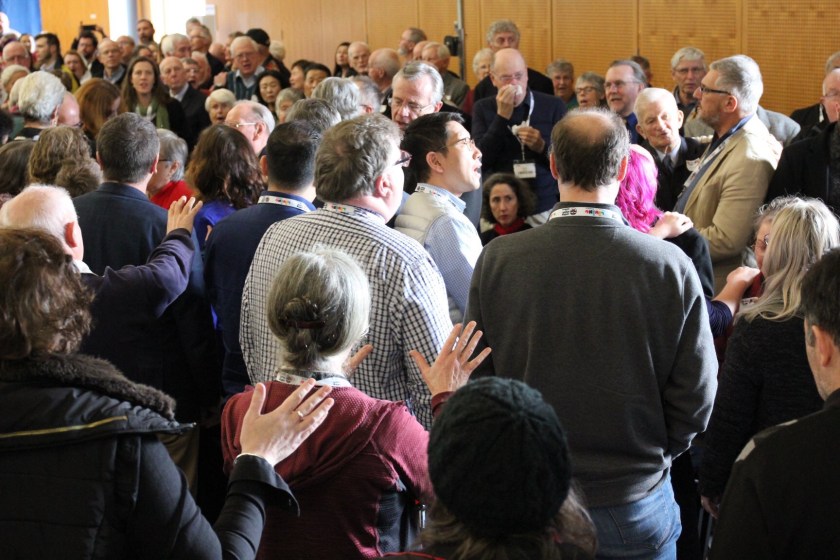
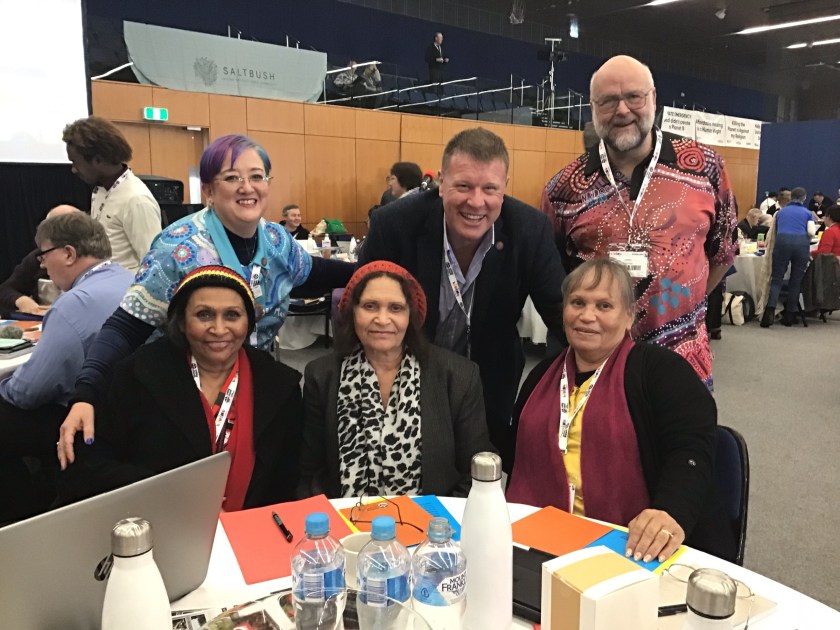
Synod this year was a rich experience of being the church. In the church, we are young and old, and at every point in between. In the church, we are black, brown, and white; we have round eyes and almond eyes, curly black hair and shiny bald pates, flowing blonde hair and cropped short hair.

Around 15 people from the Canberra Region Presbytery attended the three days of Synod this year, in grounds of one of the Uniting Church schools, Knox Grammar, in Wahroonga. We were part of over 300 people who participated in the meeting.

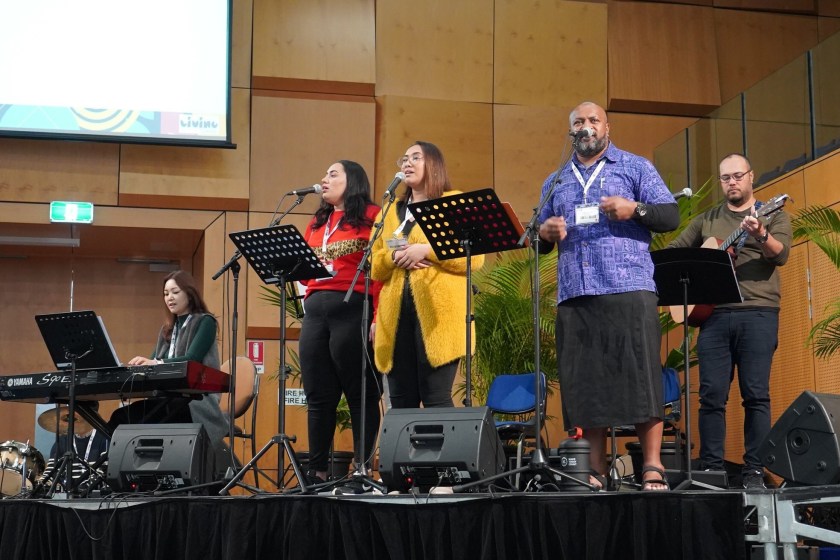
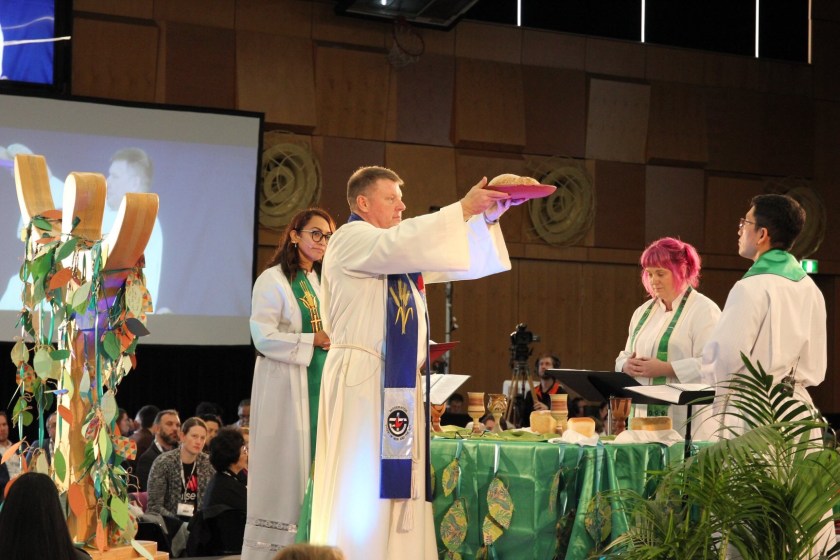
During Synod, we worshipped. Each day began with worship, supported by an amazingly-gifted group of musicians, filled with prayers and songs and scripture and silence. Each day ended with worship, with an act of reflection based on doing, not just listening.

At regular points, we were invited to pause, reflect, share, or pray about what we had been considering. In one session, we prepared for prayer by writing words of gratitude on a piece of paper, folding it into the shape of a plane; and then we prayed by sending the plane shooting through the air to the accompaniment of a resounding AMEN!

During Synod, we listened. Principal Peter Walker led three studies on scripture, drawing from the letters of Paul as well as medieval and reformed church leaders, focussing us on the Christ who is the unifying centre of our diversity. Pastor Jon Owen spoke of working on the ground with people, in inner city Melbourne and now, in his current role with Wayside Chapel in Sydney.

And we listened some more. Karina Kreminski inspired us to consider “what in the world is God up to?” in our neighbourhood. And Josh Gilbert, a young indigenous farming man, spoke with passion and commitment about how it is possible to have an impact, to make the changes, that will enable us to reduce our carbon footprint and move towards a healthier environment for future generations.

During Synod, we deliberated. Each day we listened to proposals, deliberated about clauses, discussed action plans, explored and debated and applauded and sighed and waved cards, making decisions about matters of significance within the church and across our society. This is the business component of Synod, and it is always important to give adequate time to prayerful consideration and thoughtful discussion of the array of proposals presented to the Synod.

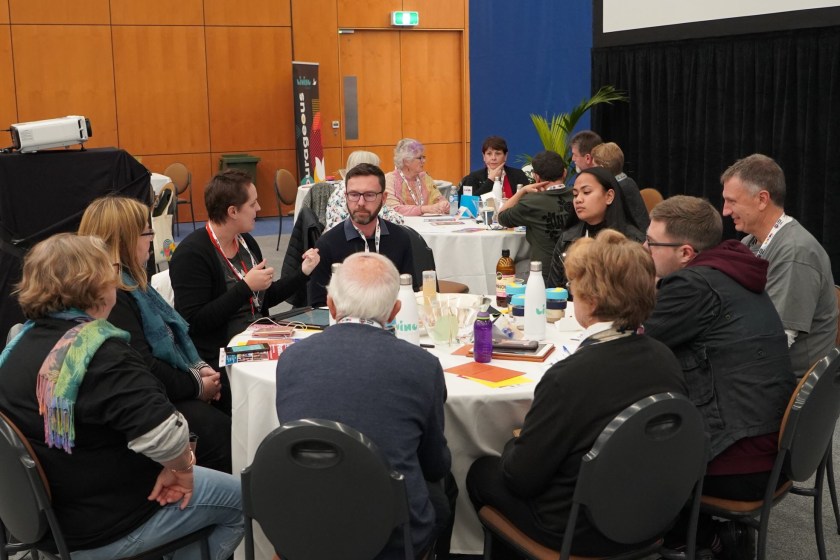
In two sessions, we met in smaller Discernment Groups of about ten people, to give focussed attention to one or two specific matters each day. Feedback from each group is then collated and fed back, the next day, to the Synod meeting in,plenary session. This is an important part of the way that the Uniting Church attends to business in its councils. Each person’s view is important, and Discernment Groups provide an opportunity for everyone, even the shyest person, to contribute to the making of policy.

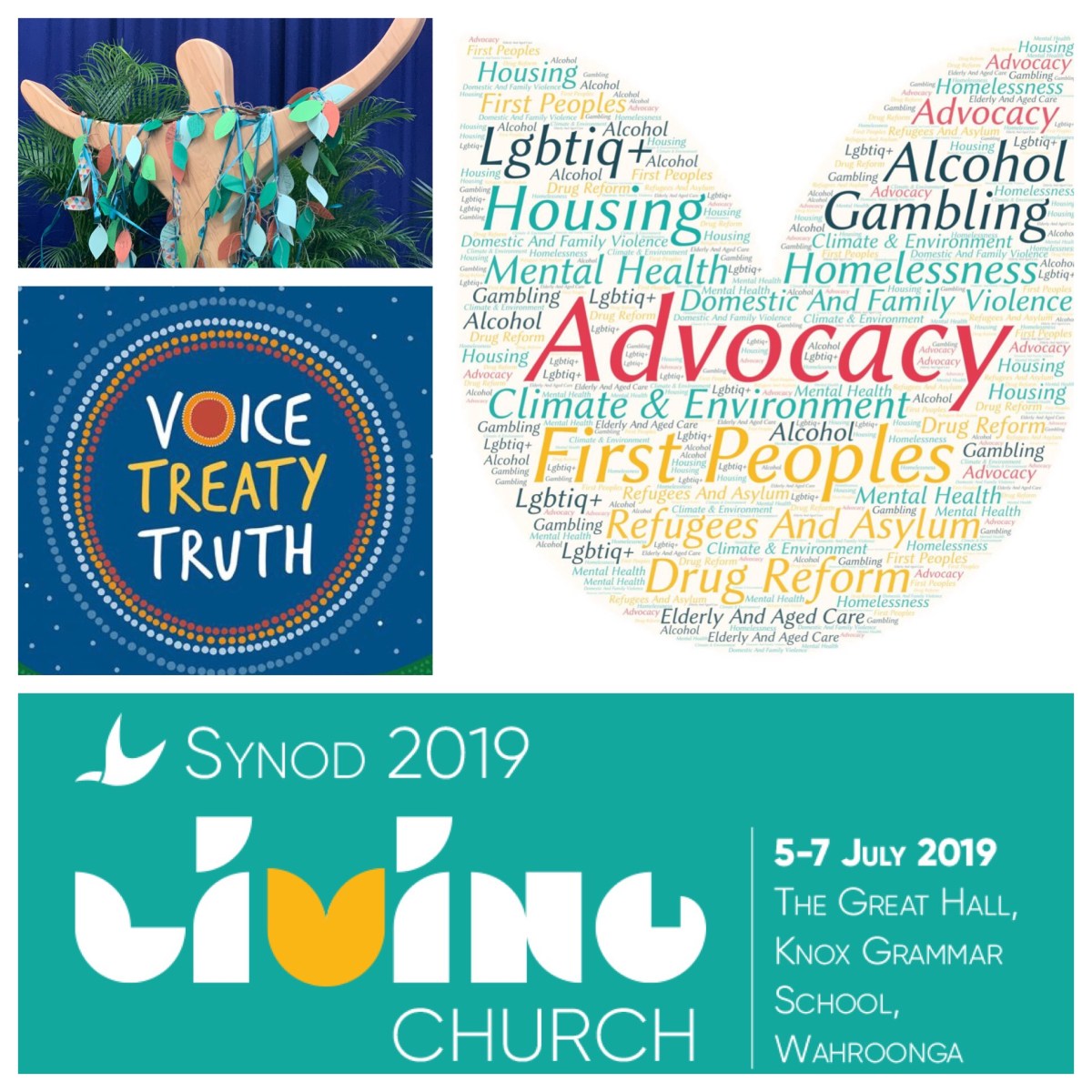
One thing that the Uniting Church does well, is advocate. On the first day, we spent a productive time exploring a comprehensive report on what is being done, and considering what might be done, to advocate for the needs and of particular groups in our society. The Uniting Church has been the lead body in seeking fair treatment in relation to illicit drug usage, and very active in the Give Hope campaign for Asylum Seekers and Refugees.

The Uniting Church has been involved in the broad community movement to seek better arrangements for Affordable Housing in Sydney, and relentless in pursuing responsible living within our environment and climate change advocacy. There has also been involvement in policy development relating to domestic and family violence, as well as the scourge of poker machine gambling. We were asked to consider what other issues required attention.

In one session, a large group of younger members of the Synod gathered on the stage, along with the Uniting Earth Advocates and the Uniting Director of Mission, Communities and Social Impact. They made a compelling presentation which convinced the Synod to adopt a Climate Change Strategy Plan. This has multiple elements, each of which needs significant and sustained buy-in from all of us across the Synod.

We adopted another proposal which urges the people across the Synod to Focus on Growth in a wide variety of ways: growth in discipleship and growth in relationships, as well as growth in numbers and in impacts. This is to be a priority for Congregations and Presbyteries in the coming years.

We approved a Renewed Vision for Formation, to engage people across the church in forming leaders in local contexts, discerning those gifted for ministry, and providing deeper Formation all pathways for those candidating for a specified ministry within the church.

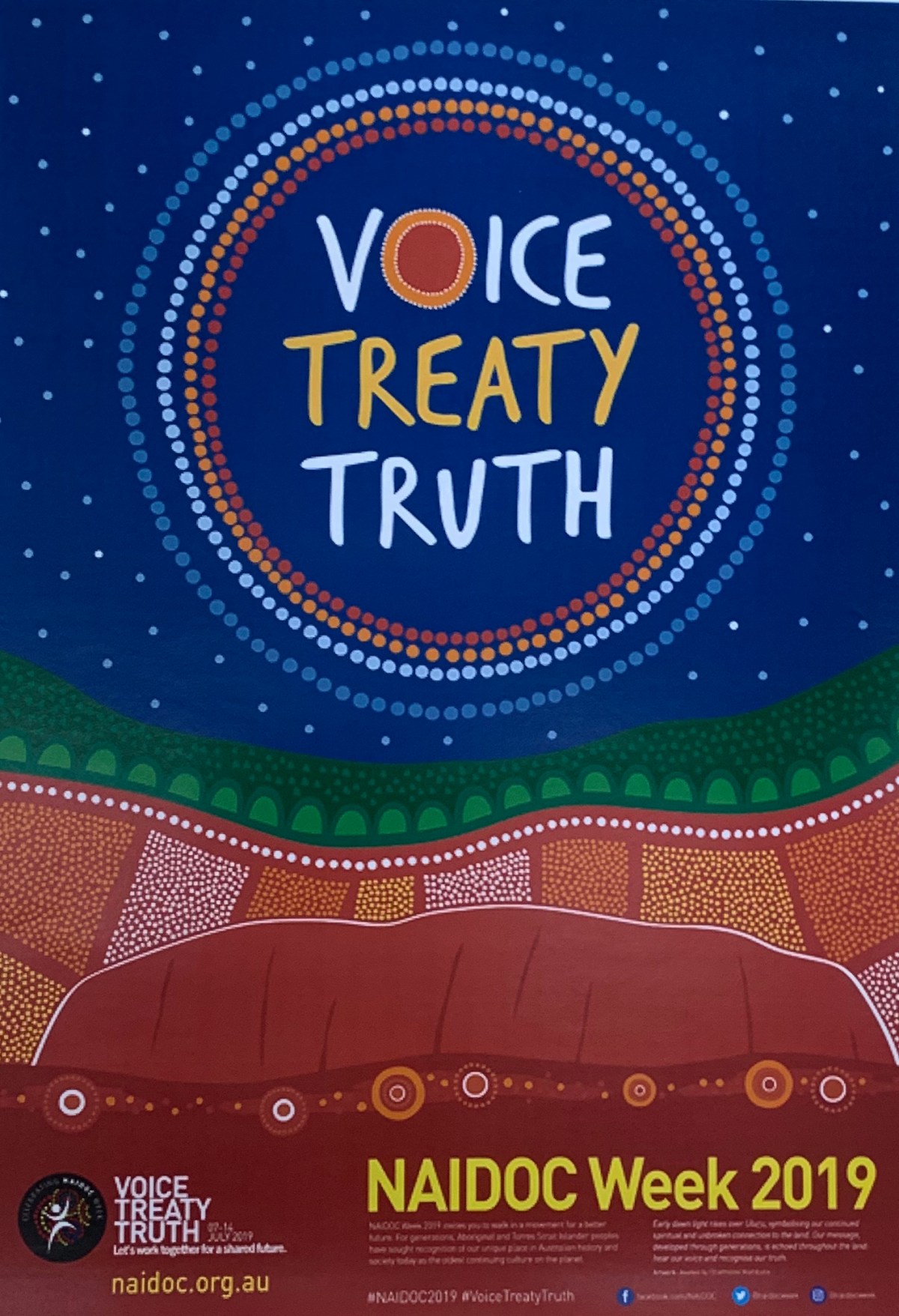
And we enthusiastically supported a set of proposals, shaped around the theme of NAIDOC Week 2019 (Giving Voice, Telling Truth, Talking Treaty) to encourage people across the church to become better aware of how to relate to First Peoples and to advocate with our governments for treaties to be established with First Peoples nations.

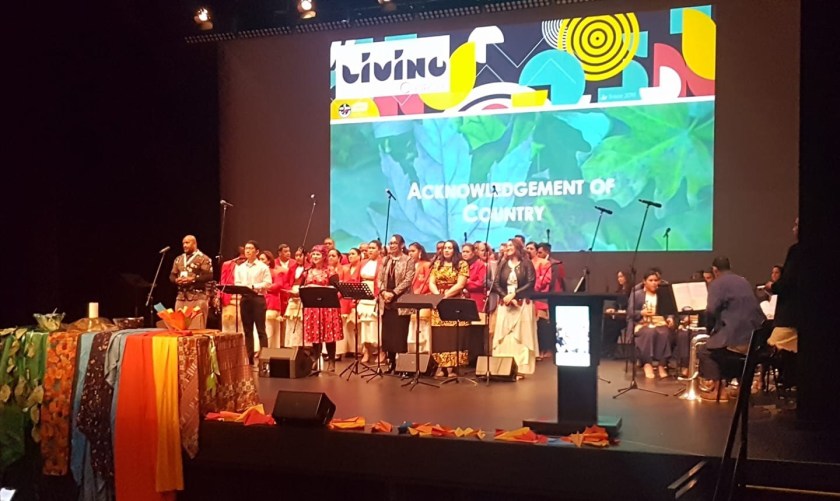
During Synod, we learnt and rejoiced. There were evening events outside the ‘business sessions” during Synod: the screening of the powerful documentary ‘Half a Million Steps’, highlighting the plight of people struggling to access drug treatment as part of the Uniting-led Fair Treatment campaign; and a Saturday night festive Revivify Worship Event with music from various cultures and a keynote address from Jon Owen.

During Synod, we made a bunch of regular administrative decisions. People were elected to vacancies on each of the four Synod Boards, as well as a new group of twelve people to serve as members of the Standing Committee of the Synod until the next meeting in 2020.

In a most unusual (but understandable) move, Synod decided to extend the term of the Moderator, Rev. Simon Hansford, by another three years. With this extension, the Moderator’s term will now finish in 2023. The combination of significant turnover of senior leadership within the Synod, and changing expectations in society, were the motivators for this decision.

Members of Synod are drawn from all fourteen presbyteries across NSW and the ACT, as well as from the Congress of First Peoples. Not every congregation has a person present at Synod—some have multiple members present. There is always an equal number of ordained and lay people attending, and CALD groups were particularly in evidence throughout the meeting—Korean, Tongan, Fijian, Samoan, Kiribati, and no doubt a number of other ethnicities. It was great to see the substantial number of younger delegates present. Almost one third of the membership was attending their first Synod meeting. We well depicted the diversity of people of faith in our contemporary church.

The meeting ended with a final worship service, featuring lively music, moving prayers, and thoughtful reflection on the three days of this gathering.

Synod meetings always serve an important personal function as well. After a couple of years interstate for Elizabeth and myself, this meeting offered us both opportunities to catch up with friends and colleagues from many different locations, as well as to meet new people and find out about the challenges and opportunities facing these folk. Those opportunities were greatly appreciated. It also offered opportunity to network in strategic ways about specific matters in our current placements. So that made attending the Synod a most worthwhile, enjoyable, and productive experience.

There are reports on many of the matters noted in this report, on the Insights website. Go to http://www.insights.uca.org.au/news

See also https://johntsquires.com/2019/07/07/giving-voice-telling-truth-talking-treaty-naidoc-2019/

https://johntsquires.com/2019/07/19/climate-change-a-central-concern-in-contemporary-ministry/

https://johntsquires.com/2018/09/19/discernment/

https://johntsquires.com/2018/11/26/the-uniting-church-is-not-a-political-democracy/

https://johntsquires.com/2019/06/18/the-dna-of-the-uca-part-i/

https://johntsquires.com/2019/06/18/the-dna-of-the-uca-part-ii/

Giving Voice, Telling Truth, Talking Treaty: NAIDOC 2019

NAIDOC Week runs for a week each July. NAIDOC originally was an acronym for the National Aborigines and Islanders Day Observance Committee. The organising committee behind the day adopted this name in 1991. It has been held, as a week, each year since then.

The theme for NAIDOC Week 2019 is Giving Voice, Telling Truth, Talking Treaty. This is something that all Australians should support. And this is certainly something that people within the Uniting Church are able to support.

The Uniting Church has given voice to First Peoples. Twenty five years ago the Uniting Church entered into a covenant relationship with the Uniting Aboriginal and Islander Christian Congress. The Covenant is an expression of how we seek to listen to the voice of First Peoples. (See https://assembly.uca.org.au/news/item/3035-the-25th-anniversary-of-the-covenant and https://assembly.uca.org.au/resources/covenanting/item/135-covenanting-statement-1994)

A covenant relationship is often an agreement between equals. Yet the relationships between First and Second Peoples is not one between equals. The voice of First Peoples, the place of First Peoples, has a priority over the voices and the place of those of us who have come more recently, in the past two and a half centuries, to this continent and its islands. We are committed to prioritising the voice of the First Peoples.

The Uniting Church is committed to telling truth. This truth is confronting and challenging. In the revised Preamble which was adopted a decade ago by the Uniting Church, we sought to tell the truth. Drawing on the voices of Indigenous Peoples, we have named the settlement of this continent as a colonising movement, generated by foreign imperialism, manifesting in violent invasion and genocidal massacres, spread from north to south, from east to west, of this continent. We must continue to prioritise this commitment to tell the truth. (See https://johntsquires.com/2019/01/16/the-profound-effect-of-invasion-and-colonisations/)

Likewise, at the 14th Assembly, we decided to repudiate the Doctrine of Discovery, that medieval theological foundation upon which the worldwide invasion and colonisation of lands was based—including the invasion and colonisation of Terra Australis. This has been part of our commitment to tell the truth. (See https://johntsquires.com/2018/08/13/affirming-the-sovereignty-of-first-peoples-undoing-the-doctrine-of-discovery/)

And the Uniting Church is committed to talking treaty. We are supportive of the formalisation of treaties with the various nations of Peoples who have inhabited, nurtured and cared for this land since time immemorial. This commitment is based on a recognition of the Sovereignty of each of those nations, sovereignty over the land that the people have inhabited, nurtured, and cared for over those many millennia.

Sovereignty, as articulated in the Statement from the Heart of 2017, is understood by the First Peoples as a spiritual notion, reflecting the ancestral tie between the land and the First Peoples (see https://johntsquires.wordpress.com/2018/10/13/on-covenant-reconciliation-and-sovereignty/ and https://johntsquires.wordpress.com/2018/10/13/on-covenant-reconciliation-and-sovereignty/)

Each of the hundreds of nations found before 1788 on this continent hold that sovereignty. The 15th Assembly of the Uniting Church recognised this sovereignty. This current proposal seeks to take the next step with regard to this sovereignty. A treaty between the governments of the invading, colonising settlers and the long-existing nations of First Peoples, is the logical next step. That is the pathway stretching out ahead of us.

Labor governments in Victoria and South Australia have already committed to signing a treaty with Indigenous peoples. SA has appointed a treaty commissioner, Roger Thomas, to consult with Aboriginal communities and help negotiate individual clan-based treaties. This work is now underway and resulting in regional treaties.

Victoria has also appointed a treaty commissioner, Gunditjmara woman Jill Gallagher, who will oversee the development of an elected representative body which will negotiate with the Victorian government on behalf of Victoria’s Aboriginal peoples. (See https://www.google.com.au/amp/s/amp.theguardian.com/australia-news/2019/apr/11/victoria-a-step-closer-to-indigenous-treaty-with-creation-of-first-peoples-assembly)

In NSW, the Aboriginal Land Council has a Strategic Plan which sets its direction. The Plan commits to an ambitious agenda of cultural protection, social wellbeing and economic development. In 2019, it now adds a new political call: that there be a process for establishing a Treaty or Treaties between the NSW Government and the Aboriginal people of this state. (See

http://alc.org.au/about-nswalc/strategic-plan-2018—2022.aspx)

The current NSW state government needs to be pressed with regard to this issue. It is not an optional matter. It is core business.

Finally, the Federal Government needs to be lobbied to return to the process set up some years ago, working towards reconciliation. National governments have formalised treaties with Indigenous peoples in New Zealand and Canada, and parts of the United States of America. (See https://www.google.com.au/amp/s/theconversation.com/amp/why-the-indigenous-in-new-zealand-have-fared-better-than-those-in-canada-84980)

The establishment of a Makarratta Commission within Australia, to oversee and facilitate the making of treaties, is essential to our national wellbeing. As a church, we should be strongly committed to encourage that process.

At the 2019 meeting of the Synod of NSW and the ACT, we have now agreed by consensus to enact a series of proposals to give support to the theme of Giving Voice, Telling Truth, Talking Treaty. A similar proposal was adopted by the Synod of Victoria and Tasmania. The church is committed to reconciliation, giving voice, telling truth, and working to secure treaties.

See https://www.insights.uca.org.au/news/hear-the-statement-from-the-heart

https://victas.uca.org.au/synod-day-three-recap/

https://www.insights.uca.org.au/news/its-a-time-for-a-treaty

Dividing the unity, splintering the connections: more ACC agitation

Recent posts from the warriors of the Assembly of Confessing Congregations suggest that they have been hard at work in Tonga, lobbying support for their retrograde sectarian minority opinion. The matter revolves around the decision of the 15th Assembly of the Uniting Church in Australia. The posts emanated from the Conference of the Free Wesleyan Church of Tonga, meeting in session over the past week.

A proposal went to the Conference, “That the conference of the FWC of Tonga suspend its formal relationship with the Assembly of the Uniting Church Australia until such a time as she repents of her apostate decision to approve its secular doctrine on diversity and same-gender marriage.” It was posted with the implication that this was adopted by the FWC. I don’t believe that it was.

In fact, the General Secretary of the Free Wesleyan Church of Tonga has issued a statement strongly affirming the relationships that the FWC has with the Uniting Church in Australia. Dr Tevita Koloa’ia Havea has said that “There is no change to the relationship between the Free Wesleyan Church of Tonga and the Uniting Church in Australia.”

The statement continues, quite pointedly, “Please disregard the rumours, regarding the termination of the relationship between our General Conferences and the Assembly of the Uniting Church in Australia.”

You can read this at http://fwc.to/

Meanwhile, the Uniting Church website reports that the President and General Secretary of the Assembly have issued a statement celebrating the UCA’s ongoing relationship with the Free Wesleyan Church of Tonga.

“The Uniting Church in Australia and the Free Wesleyan Church of Tonga have a partnership that is strong, and grounded in our shared life in Christ, the honouring of and respect for our expressions of ministry and mission and our proclamation of the Gospel of Christ. The formal relationship between the Assembly of the Uniting Church in Australia and the Free Wesleyan Church of Tonga remains strong. May God bless our churches with wisdom, grace and peace as we seek to serve our Lord and Saviour, Jesus Christ with joy and love.”


The statement was issued over the names of Dr Deidre Palmer, President, and Ms. Colleen Geyer, General Secretary of the Assembly of the Uniting Church in Australia.

You can read this at https://assembly.uca.org.au/news/item/3033-blessed-by-our-joyful-partnership

There can be no doubt that the tactics of the sectarians in the ACC are retrograde, divisive, and disturbing. Far from affirming “the faith and unity of the one, holy, catholic and apostolic church” (as the UCA Basis of Union declares), the ACC has acted to divide the unity of the church, challenge the commitment to holiness manifested in lives working for justice, splinter connections across worldwide church through agitations with a partner church outside of the regular lines of communication and fellowship, and turn away from the church’s commitment to “the discipline of interpreting [the apostolic] teaching in a later age.

That is a poor witness, acting in ways that were clearly not envisaged in the faithful work undertaken to form, and then strengthen, the Uniting Church, over many decades. The theme of the last Assembly was “abundant grace, liberating hope”. It would be good to see some grace and hope emanating from the ACC …….

also

https://johntsquires.com/2019/06/26/human-sexuality-and-the-bible/

https://johntsquires.com/2019/01/13/affirmations-we-can-make-together/

https://johntsquires.com/2019/05/26/once-again-affirming-our-diversity-celebrating-joyous-marriages/

https://johntsquires.com/2019/01/15/when-you-suffer-the-whole-body-of-christ-suffers/

https://johntsquires.com/2018/10/26/marriage-of-same-gender-people-a-gift-to-the-whole-church/

https://johntsquires.com/2018/09/19/discernment/

https://johntsquires.com/2018/07/31/abundant-grace-liberating-hope/

Human sexuality and the Bible

The recent Israel Folau controversy has highlighted various issues: freedom of expression in modern society, the place of religion in Australian society, the ethics of professionalism … and questions of biblical interpretation.

For people within the Uniting Church, the Basis of Union provides a foundation for careful and prayerful thinking about scripture. The Basis affirms that the witness of scripture is to be understood through the work undertaken by scholarly interpreters, by insights that have arisen in scientific and medical investigation, by understandings that have developed in society, as we better understand how human beings operate and how they function. All of these are important matters to consider when we think about human sexuality.

A number of passages are regularly cited in relation to matters of human sexuality, and particularly homosexuality. We need to think about those sections of scripture in the light of this way of approaching the biblical texts.

Elizabeth and I have written a brief discussion of the texts most often cited when “homosexuality” is debated by Christian people–especially conservative Christian people. It is an expansion of our earlier blog post (noted below).

A longer discussion of these issues is now posted on the Uniting Network website (see http://www.unitingnetworkaustralia.org.au/wp-content/uploads/2019/06/02-Human-Sexuality-in-Biblical-Perspectives.pdf) as part of a collection of resources for Open and Affirming Churches (see http://www.unitingnetworkaustralia.org.au/open-and-affirming-project/)

LGBTIQ+ people often refer to these passages as the “clobber passages”, since they are regularly (mis)used to “clobber” people who identify as LGBTIQ or other related designations.

These texts were originally written either in Hebrew or in Greek, so there are questions about how particular words should be translated, whether there are exact equivalences in English, and so on. Many translations use the word “homosexual” where the original language actually requires more nuance in translation.

A second factor is that we need to reflect on the cultural customs of the societies within which the Bible came to be written. It is important to consider how these cultural customs have shaped the way in which the words were written. “Homosexuality” is a modern concept, which was not known to the writers of the biblical texts in the way that we understand it.

Scripture does not include anything relating to the loving, committed, lifelong relationship of two people of the same gender. So we need to take care when we use these “clobber passages” in our discussions. None of them should actually be used to criticise LGBTIQ+ people.

Alongside these passages, there are many sections of scripture which provide a more positive outlook on human sexuality. So we have offered a short reflection on a number of the key affirming and inclusive verses.

Our discussion of these passages can be read at

http://www.unitingnetworkaustralia.org.au/wp-content/uploads/2019/06/02-Human-Sexuality-in-Biblical-Perspectives.pdf

Geoff Thompson has a careful consideration of the cluster of issues in the Israel Folau scenario at https://theconversation.com/amp/why-christians-disagree-over-the-israel-folau-saga-118773

See also

https://johntsquires.com/2018/07/30/marrying-same-gender-people-a-biblical-rationale/

https://johntsquires.com/2019/01/13/affirmations-we-can-make-together/

https://johntsquires.com/2019/05/26/once-again-affirming-our-diversity-celebrating-joyous-marriages/

https://johntsquires.com/2019/01/15/when-you-suffer-the-whole-body-of-christ-suffers/

https://johntsquires.com/2018/10/26/marriage-of-same-gender-people-a-gift-to-the-whole-church/

https://johntsquires.com/2018/09/19/discernment/

https://johntsquires.com/2018/07/31/abundant-grace-liberating-hope/

Freedom and unity: themes in Galatians

For freedom Christ has set us free. Stand firm, therefore, and do not submit again to a yoke of slavery … For you were called to freedom, brothers and sisters” (Gal 5:1, 13).

Paul’s letter to the Galatians continues in the Revised Common Lectionary for a number of Sundays. This Sunday, the focus is on freedom.

In last week’s reading, we saw that the gospel which Paul proclaims has the capacity to make believers “one in Christ”. This unity overshadows all divisions—as the most famous words in this letter declare, “there is no longer Jew or Greek, there is no longer slave or free, there is no longer male and female” (3:28). 

The threat against this unity has arisen through the insistence of other teachers, that true faith requires, first, circumcision (2:12; see Acts 15:1, 5). Paul asserts that they want their followers to be circumcised—although surprisingly, he notes that they themselves “do not obey the law” (6:13). 

Paul claims that the “circumcision faction” were preaching “another gospel” (1:6) in which they actually “pervert the gospel” (1:7). He calls them “false believers” (2:4) who have “bewitched” the Galatians (3:1). His vehemence at one point is such that he exclaims, “I wish those who unsettle you would castrate themselves!” (5:12). 

Paul’s problem, of course, is that he himself is circumcised, as he mentions at Phil 3:5 (a fact which he omits when he rehearses his past at Gal 1:13–14). How can he advocate the opening of the faith to those who are not circumcised, when he himself bears this sign of the covenant? 

He insists that the Galatians “become as I am” (4:12), and yet threatens that “if you let yourselves be circumcised, Christ will be of no benefit to you” (5:2). What applies to Gentile converts must be different from what is the case amongst Jewish converts. 

Circumcision was the pre-eminent sign of the Law for Jewish believers. Paul wants to move the Galatians away from their understanding of the Law. He re-interprets the scriptural passage which lies behind this Jewish custom. Galatians 3:1–5:1 thus contains a tightly-argued, complex argument concerning the Law. 

Paul uses the story of Abraham, the patriarch to whom the requirement of circumcision was first commanded, as a sign of the covenant (Gen 17). He interprets this story without once mentioning circumcision (3:6–18). It is the faith of Abraham, in believing God’s promise, which secured him righteousness (3:6–7) and opens the promise to Gentiles (3:8–9). It is that promise which is now fulfilled in Christ (3:13–14, 16, 29). This is the pathway to freedom in faith.

This letter demonstrates that freedom is at the heart of the Gospel. Paul offers this freedom anew to the believers in Galatia. The Gospel frees them from the complex web of duties and responsibilities under the Law. 

The call to freedom (5:1, 13) becomes a platform for ethical guidance, grounded in love (5:13–14), manifested in living by the spirit (5:22–26), not by the flesh (5:16–21). This ethic requires believers to “bear one another’s burdens “(6:2) and “work for the good of all” (6:10). In this way, they will become “a new creation” (6:15). The gospel which brings liberation in community (3:28) will also lead to liberation for the creation (6:15).

Galatians is important because of the central theme of freedom which it articulates. In what ways does your faith provide you with a sense of freedom?

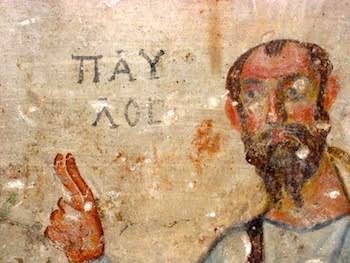
Image: Painting of Paul from Cave of St. Paul in Ephesus c. 450 AD

See also https://johntsquires.com/2019/06/17/harness-the-passion-but-restrain-the-rhetoric-musing-on-the-role-model-which-paul-offers-in-galatians/

https://johntsquires.com/2018/11/17/let-your-gentleness-be-known-to-everyone/

Providing for the exercise by men and women of the gifts God bestows upon them: lay people presiding at the sacraments in the Uniting Church

The Uniting Church has a firm commitment to being part of the one, holy, catholic and apostolic church. This is affirmed in our Basis of Union as well as in many places in liturgies and papers written on various topics.

Belonging to this body, along with many other denominations—Orthodox, Roman Catholic, Anglican, Baptist, Church of Christ, Presbyterian, Pentecostal, and others—means that we seek to find the things in common, that we hold across the denominations. As members of that one body, we share many beliefs, practices, customs and commitments.

From time to time, however, one of those denominations will make a decision or implement a policy that sets it apart, in some, from the others. This process of differentiation is perfectly normal and quite understandable. Human beings are all different from one another. We have many things in common, but some things that set us apart as different.

The matter of presiding at the sacraments is one such case in point. For twenty-five years, now, the Uniting Church has authorised lay people to preside at the sacraments. In many denominations, this role is the preserve of the clergy who have been ordained, set apart for a priestly role, which includes presiding at the sacraments. So, for the Uniting Church to introduce the practice of authorising lay people to undertake this role, is a distinctive feature.

Of course, there are other practices within the Uniting Church which differentiate us from other members of the one, holy, catholic and apostolic church. Ordaining women is one such practice; it is not done in many denominations around the world. Permitting ministers to be married is another; some denominations do not have such a practice. The ordaining of a person to the ministry of Deacon, a ministry that is equal in status and equivalent in function alongside the Minister of the Word, is another Uniting Church distinctive.

Despite these distinctive, we still maintain cordial and respectful relationships with other denominations where those practices are not found. We recognise that it is possible to be different within the one body. Diversity is not division, and unity is not uniformity. We co-exist in our diversity within unity.

We need also to note that, within the Uniting Church, authorising lay people to preside at the Sacraments is understood as being faithful to our commitment in the Basis of Union. In that document, the church affirms that the one Spirit has endowed the members of Christ’s Church with a diversity of gifts, and then declares that the Uniting Church will … provide for the exercise by men and women of the gifts God bestows upon them (Basis of Union para 13). Leading a gathering of faithful people in a celebration of one of the sacraments of the church is one such gifting, for which appropriate provision has been made.

Four four days over the last two months, Elizabeth and I have been working with a group of lay leaders from across our Presbytery as they prepare to fulfil this ministry within the community of faith where they worship and serve. It is always an inspiring opportunity, to work with committed people who are equipping themselves for new forms of service.

We take four days, across two weekends, to explore the Biblical passages relevant to the two sacraments of Baptism and Holy Communion, as well as the relevant paragraphs from the Basis of Union, which sets out the theological understandings held by the church in relation to these sacraments.

We spend some time exploring the structure of the liturgy for worship in Sunday services, where each sacrament “fits” within that structure, and what the component parts of each sacrament are. We look at the role of symbols, in life in general, and in worship in particular, and explore the various symbolisms inherent in each sacrament.

There are case studies and role plays included in the resources for the group to use. This helps participants to “get inside” the role of Lay Presider, both in the worship itself, and in the times of preparation for each sacrament, such as the pre-Baptism interview with candidates or parents of the child to be baptised.

We spend each Sunday morning attending the worship of a local congregation within the Presbytery, where Holy Communion is being celebrated. This gives participants an opportunity to experience worship led by an experienced minister (either ordained or lay), and then to reflect on the experience with critical insight.

Finally, there is a session for each sacrament devoted to the various practical considerations associated with each sacrament. Each member of the class takes a turn in leading a part of the liturgy, and we discuss matters such as voice projection, eye contact with the congregation, gestures, actions integral to the worship, and so on.

To complete the requirements of the course, participants seeking to become lay presieers must submit four written assignments followed by the conducting of a service with supervisory assessment of the candidate by an experienced Minister or Lay Presider.

In undertaking this course, we demonstrate the way that the Uniting Church works. Every one of the four councils of the church plays a role. We follow the national Assembly guidelines for Lay Presiders, using the educational resources provided by the Synod. The Presbytery (the regional body) offers the training. The local Church Council designates the candidate(s) for this ministry, who must share in the pastoral oversight of the congregation or faith community, and requests the Presbytery to approve them once they have completed their assignments.

The final step is for the Presbytery to approve for the conduct of Sacraments by the authorised Lay Presider within the designated congregation. Authorisation is for a designated period of time, and must be reviewed before it can be renewed, if appropriate, at a later time.

The process is relatively slow and complex, but that is to ensure that not just anybody can perform this role; those who do so must be recognised as gifted for the role, then trained and equipped for the role, before they are authorised.

In part, this is because the Uniting Church takes seriously the process of appropriate equipping people for ministry. In part, it is because of our ecumenical commitments, and sensitivities to how presiding at the Sacraments is understood and practised in other denominations within the one, holy, catholic and apostolic church.

And that is something for which, I believe, we ought to be most grateful.

The photo shows participants in the course, Understanding the Sacraments, held mid-2019 in the Canberra Region Presbytery.

For the Assembly guidelines on lay presidency, see https://assembly.uca.org.au/images/stories/ASCMinutes/2013/July/13.07Minutes-Attachment_A-_Lay_presidency_Guidelines.pdf

The DNA of the UCA (part II)

Two years ago, for the fortieth anniversary of the formation of the Uniting Church in Australia, I prepared a resource exploring the key characteristics of this church. This week, for the 52nd anniversary, I am reposting those thoughts. Here is a second set of five key characteristics.

VI A very important dimension to being the church in this country is that we are a church in Covenant with the First Peoples of Australia. From its earliest years, the Uniting Church has been involved in actions which express our solidarity with the Aboriginal and Torres Strait Islander peoples. Older members will recall events at Noonkanbah Station in the Kimberley in 1980, when Uniting Church members stood in solidarity with the traditional owners, the Yungngora people, against the mining of their land.

The Uniting Aboriginal and Islander Christian Congress (UAICC) was established in 1985, and a Covenant between the UAICC and the UCA was implemented in 1994. This Covenant recognises that working for reconciliation amongst people is central to the Gospel.

In 2009, the Preamble to the UCA Constitution was revised to recognise the difficult history of relationships between the First Peoples and the later arrivals, as Second Peoples. Our present relationship is one which seeks to ensure that we commit to the destiny together which we share as Australians.

VII In the same year that the Congress was formed, the Uniting Church declared that it is a multicultural church, which rejoices in the diversity of cultures and languages which are found across Australia. The Basis of Union recognises that we share much, as Australians, with people of Asia and the Pacific. The Uniting Church has maintained strong relationships with churches from these regions, as well forging new links with churches in Africa and the Middle East.

The Statement to the Nation, issued in 1977, acknowledged that the Uniting Church seeks a unity that transcends cultural, economic and racial distinctions. Within Australia, there are currently 12 national conferences based on regional groupings and people from 193 language groups who belong to the Uniting Church.

Each Sunday, worship takes place in Uniting Churches in 26 different languages, not including the many indigenous languages used in worship by first peoples across our church.

Through UnitingWorld, we maintain partnerships with churches in Asia, the Pacific, Africa and the Middle East. We are truly a multicultural church. Through the Relations with Other Faiths Working Group, the Uniting Church has been active in developing relationships with other faith communities. We are firmly committed to constructive interfaith relations.

VIII Over 40 years, the Uniting Church has shown that it is a church which is prepared to engage in difficult discussions about contentious issues. Our Basis of Union commits us to learn from the insights of contemporary scientific and historical studies, and affirms that we remain open to correction by God in the way we order our life together.

In the early years of the Uniting Church, debates about Baptism were the focus of great controversy. Infant baptism had been an integral part of the worship practices of each denomination which joined the Uniting Church, but Ministers and Elders Councils were receiving regular requests for baptism by adults who had been baptised as infants but had come to a personal faith later in their lives. After debates stretching through the 1980s and 1990s, the Uniting Church has developed a clear set of protocols to cover such requests.

Another area of enduring controversy has been that of human sexuality. There is a wide diversity of opinion within society relating to such matters, and this diversity is present within the Uniting Church. Once again, from the 1980s though into the present era, lively debates regarding human sexuality have taken place in the various councils of the church. In dealing with such issues, we have learned how to debate with respect and integrity with ongoing conversations looking to employ a “Space for Grace” process to encourage respectful, empowering, and inclusive decision-making. Let us hope that this trait stays firmly embedded in the DNA of the UCA.

IX The Uniting Church inherited from its predecessor Churches a strong commitment to advocating for justice for all. Many Uniting Church congregations and members are actively committed to serving those people who find themselves on the margins of society. This commitment was clearly articulated in the 1977 Statement to the Nation and it has been evident in many actions undertaken by Uniting Church members over the decades.

The Uniting Church has joined in common cause with other groups and organisations in society, in advocating for a welcoming attitude towards refugees; in lobbying for a fair and just system of caring for people who are experiencing poverty and homelessness; in seeking equity for workers in their workplace; and in many other issues.

A regular stream of policy documents and public resolutions point to a clear and unbroken commitment to seeking justice for all.

X In like manner, the Uniting Church has always been a church which honours the environment and supports a sustainable lifestyle.

Although such matters are firmly on the radar of the public now, they have long been integral to the DNA of the UCA. Once again, the 1977 Statement to the Nation flagged such commitment. A series of subsequent documents attest to the ongoing determination of the church to live responsibly, in such a way that we minimise the damage we cause to the environment in which we live.

Our partnerships with Churches in the Pacific have intensified our awareness of the negative impacts that are resulting from climate change. We know that we need to act now, to reduce the threat.

So, many congregations and individual members of the UCA are seeking to implement practices that will reduce their carbon footprint on the planet. We know that we owe it to future generations, to live responsibly in the present.

For the first five key characteristics, see https://johntsquires.com/2019/06/18/the-dna-of-the-uca-part-i/

So: these are ten strands to our DNA, as far as my thinking is concerned. What about you?

Would you add anything? Take anything away?

What do you think are the essential aspects of our UCA DNA?

See also https://johntsquires.com/2018/08/15/what-i-really-like-about-the-basis-of-union/

https://johntsquires.com/2018/08/20/alongside-the-basis-of-union-there-was-the-statement-to-the-nation/

The DNA of the UCA (part I)

Two years ago, for the fortieth anniversary of the formation of the Uniting Church in Australia, I prepared a resource exploring the key characteristics of this church. This week, for the 52nd anniversary, I am reposting those thoughts. Here are the first five characteristics.

I When the Congregational, Methodist and Presbyterian churches joined together in 1977 to form the Uniting Church in Australia, they declared that this union was both in accord with the will of God, and that it was a gift of God to the people of God in Australia.

Since then, the Uniting Church has been a church which is committed to working ecumenically with other Christian denominations. That commitment is one very important aspect of our DNA as a Uniting Church.

We belong to the National Council of Churches in Australia and the World Council of Churches, where we co-operate with many denominations.

Nationally, we have participated in ongoing conversations with other denominations (Anglican, Lutheran, Greek Orthodox, and Roman Catholic). At the grassroots level, our ministers participate in local ministers’ associations in hundreds of towns and cities across the nation. We are an ecumenical church.

II The Uniting Church is a church which values the ministry of all the people of God and seeks to order itself in accordance with the will of God. Our Basis of Union affirms that every member of the church is engaged to confess Christ crucified, and every person is gifted by the Spirit to engage in ministry in their own particular way. We are a church that values the ministry of each and every person.

Throughout the last 40 years, we have held our structures and forms of ministry accountable to ongoing scrutiny. Alongside the Ministry of the Word, to nurture and guide Congregations, we have introduced the Ministry of Deacon, to focus attention on people living on the margins.

We have also undertaken important conversations about membership and the relationship of Baptism to Holy Communion. We now have a clear commitment to an open table when we gather for The Lord’s Supper: all who are baptised (whether adult or child, whether confirmed or not) are welcome to share at this table.

III The Basis of Union makes it very clear that we are a church which is committed to equality and mutuality of women and men in ministry. Even before 1977, the three previous denominations had ordained women to ministry.

Since 1977, many women have stood on an equal basis alongside men, as Ministers of the Word, Deacons, Elders, Church Councillors, Lay Preachers,
Lay Presiders, Chaplains, and Pastoral Carers. We value the insights and experience of women.

In this our 40th year, lay and ordained women serve in leadership positions across all councils of the Uniting Church from Presbytery Chairpersons to Moderators to the Assembly General Secretary. Many couples minister together as husband and wife. Gender equality is most certainly part of our DNA!

IV Another contribution that the UCA has made has been to highlight the importance, when we gather in council, of being open to the Spirit, and seeking to discern the will of God.

We live this out in our councils by practising a process of consensus decision-making. The Manual for Meetings sets out the various elements that are involved in making decisions by discernment: a time of information, a time of deliberation, and a time of decision-making.

The infamous “coloured cards” are only one small part of the whole. The focus is on listening to the Spirit before we speak, and striving to find a way forward that most, if not all, people can see as the will of God for the church. This way of decision-making, which originated in the UCA, has now been adopted by the World Council of Churches and a number of its member Churches.

V Over the last 20 years, the Uniting Church has developed a firm commitment to strong professional standards, for Ministers as well as for lay people who exercise leadership in the church. Our commitment to professional standards emerged initially in response to the problems of sexual misconduct within the church. A whole section of the Regulations is now devoted to this.

Since 1999, all Ministers have been expected to adhere to a Code of Ethics, and this has most recently been revised to provide a Code of Ethics Ministry Practice for Ministers and a Code of Conduct for Lay Leaders. Ministers and pastors undertake regular training in aspects of this code, in ethical ministry workshops.

This, too, is integral to the DNA of the UCA.

For part two, see https://johntsquires.com/2019/06/18/the-dna-of-the-uca-part-ii/
See also https://johntsquires.com/2018/08/15/what-i-really-like-about-the-basis-of-union/

https://johntsquires.com/2018/08/20/alongside-the-basis-of-union-there-was-the-statement-to-the-nation/