“All of them condemned him as deserving death.” Interrogating the unlikely narrative of the Council (Mark 14; for Holy Week)

“They took Jesus to the high priest; and all the chief priests, the elders, and the scribes were assembled” (Mark 14:53). That’s how the author of the good news of Jesus the chosen one reports the scene when the fate of Jesus is sealed (Mark 14:53–65). Accused of predicting that the Temple would be destroyed (14:58), Jesus is interrogated by the high priest (14:60–63) before the declaration is made: “you have heard his blasphemy!” (14:64).

After further consultation by the chief priests “with the elders and scribes and the whole council”, Jesus is led away to Pilate, the Roman Governor (15:1). And so the fateful course of events is set in motion—questioned by Pilate, sentenced to be crucified, nailed to a cross where he dies, and the the lifeless body of Jesus is handed over to some of his followers (15:2–47).

The other evangelists follow suit. One notes that “the assembly of the elders of the people, both chief priests and scribes, gathered together, and they brought him to their council” (Luke 22:66), another specifies that “they took him to Caiaphas the high priest, in whose house the scribes and the elders had gathered” (Matt 26:57). The fourth gospel reports that “first they took him to Annas, who was the father-in-law of Caiaphas, the high priest that year” (John 18:13), and subsequently “Annas sent him bound to Caiaphas the high priest” (John 18:28).

The account of the time that Jesus spent being interrogated by them Jewish leadership appears, on the surface, to be an objective account of what transpired in that meeting. The council was the Great Sanhedrin, the supreme religious body in Israel during the Second Temple period—from the time when the exiles returned to the land under Nehemiah, until the destruction of the Temple in the year 70 CE. See more at https://www.jewishvirtuallibrary.org/the-sanhedrin

The source of the narrative in Mark 14 is unclear; indeed, the narrator has emphasised just before reporting on this meeting that when Jesus was seized in the garden by “a crowd with swords and clubs [who had come] from the chief priests, the scribes, and the elders” (14:43), after a token display of resistance (14:47), “all [of his followers] deserted him and fled” (14:50).

The narrator underscores this with a tantalising glimpse of the figure whom I (anachronistically) call “the first Christian streaker”— “a certain young man [who] was following him” who escaped the grasp of those in the crowd, shedding his linen cloth, “and “ran off naked” (14:51–52). And Peter, most pointedly, was outside the chamber, warming himself by the fire (14:54), and denying that he even knew Jesus—not once, but three times (14:68,70,71). There was nobody—absolutely nobody—from amongst the followers of Jesus who was present to witness what transpired as Jesus was brought before “the chief priests and the whole council” (14:55).

So how do we know what happened in that council meeting?

Further exploration of the scene is warranted. Such further examination might well consider some key factors. When did the council meet? Where did they meet? How did they conduct their business? And how did they come to a decision about Jesus?

To guide any exploration of these matters, scholars have turned—with due caution—to a Jewish text which sets out the designated procedures for a meeting of the Jewish council at which serious matters such as blasphemy were considered. The due caution is warranted, because the text is found in the Mishnah, a document written early in the third century CE—thus, almost 200 years after the time when Jesus was said to have been brought before the council. Did the provisions of this 3rd century text apply in the 1st century?
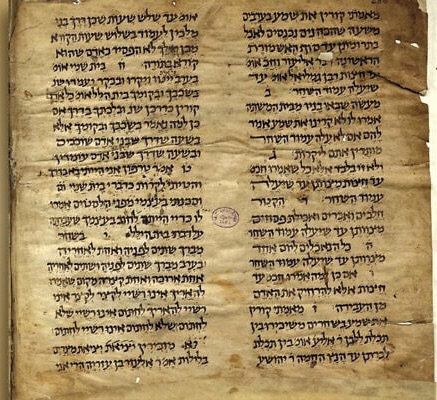
The opening page of the Kaufmann manuscript of the Mishnah, the most complete early manuscript of the Mishnah,
dated to the 10th or 11th centuries CE.

And such caution is intensified by the fact that the Mishnah is written at a time long after most Jews had been expelled from Jerusalem. This expulsion was finalised during the abortive uprising by Bar Kochba in 132–135 CE. Indeed, the book was written well after the time when the Sanhedrin had ceased to function as the peak legislative and judicial body in Jerusalem. After the failed war against the Romans of 66—74 CE, there was no longer any such body operating in Jerusalem. Yet 150 years later, a text was written that set out specific details of how the council was to function.

So some interpreters claim that this account is simply to be seen as an idealistic, romanticised recreation of “how things used to be”, expressed in such a way that is oblivious to the reality of the time—that there was no longer a functioning Sanhedrin in Jerusalem.

Alongside these notes of caution, we must hear also the claim that is made, not just about this text, but about many texts within the body of rabbinic literature that survives, from first through to sixth centuries. That claim is that, in an oral culture such as Second Temple Judaism and Rabbinic Judaism, where stories and laws and prescriptions and debates were passed on by word of mouth, from teacher to student, from that student to their student, and so on—the reliability and historical validity of what is written can be assessed positively.

For a more detailed discussion of the oral Torah, see https://www.jewishvirtuallibrary.org/the-oral-law-talmud-and-mishna

For myself, given what I have learnt in recent years about the importance and validity of stories and laws passed on over time in the oral cultures of First Nations peoples in Australia, I am inclined to accept this positive assessment of the ancient Jewish oral traditions in general, although specific texts are always open to informed critical exploration of their details.

I’m aware also, from discussions that have happened in the Uniting Church Dialogue with Jewish People that Elizabeth and I were members of for some years, that many rabbis today, who know their sacred texts well, consider that the Gospel narratives about this scene cannot be historical—for reasons that will be explored in what follows.

So, what does this text from the Mishnah say about a council meeting called to interrogate a possible criminal, such as we find in the Gospel narratives about Jesus? The relevant passages are in chapters 4 and 5 of tractate Sanhedrin, a part of the fourth order, Nezikin, which deals with Jewish criminal and civil law and the Jewish court system. And a comparison between the Gospel narratives and the Mishnah provisions raises a number of problems.

At night

The first matter is that the meeting with Jesus took place at night. Earlier, the narrator of Mark’s account has reported that the disciples “prepared the Passover meal; when it was evening, he came with the twelve” (14:16–17). Some hours later, after Jesus is apprehended in the Garden, he is taken to “the high priest … the chief priests, the elders, and the scribes” (Mark 14:53). It is still night when that meeting takes place. After coming to their decision that Jesus was “deserving death”, (14:64), the narrator notes that “as soon as it was morning, the chief priests held a consultation with the elders and scribes and the whole council” (15:1a).

So this meeting took place at night. But Mishnah Sanhedrin 4:1 states, “in cases of capital law, the court judges during the daytime, and concludes the deliberations and issues the ruling only in the daytime.” A court meeting at night, to determine a matter in which a person is determined to be “ deserving death”, is contrary to this provision.

The same section of the Mishnah also states that “in cases of capital law, the court may conclude the deliberations and issue the ruling even on that same day to acquit the accused, but must wait until the following day to find him liable” (Sanhedrin 4:1). Coming to a decision of guilty in the same session as the evidence is heard, without an overnight pause for the members of the council to consider, was also contrary to what was required. In the case of Jesus, this provision has been breached.

On a feast day

A second matter is that the meeting with Jesus took place during a festival. The whole sequence of events begins “on the first day of Unleavened Bread, when the Passover lamb is sacrificed” (14:12). At the end of their interrogation of Jesus, the narrator notes that “they bound Jesus, led him away, and handed him over to Pilate” (15:1b), and then observes that “at the festival he used to release a prisoner for them, anyone for whom they asked” (15:6).

Again, the provisions in Sanhedrin 4:1 state that “since capital cases might continue for two days, the court does not judge cases of capital law on certain days, neither on the eve of Shabbat [Sabbath] nor the eve of a Festival.” So the Markan narrative is in breach of this provision as well, by reporting that this meeting took place during Passover.

In the lack of evidence for this custom of releasing a prisoner at Passover, see more at

In the house of Caiaphas

Where exactly did this interrogation of Jesus take place? The implication in Mark is that the council was meeting in the house of Caiaphas. “Peter had followed him at a distance, right into the courtyard of the high priest; and he was sitting with the guards, warming himself at the fire” (14:54). This implication is made explicit at Matt 26:57 (“they took him to Caiaphas the high priest, in whose house the scribes and the elders had gathered”) and Luke 22:54 (“bringing him into the high priest’s house”).

Once more, this flies in the face of the prescriptions of tractate. Later in the tractate Sanhedrin, there is a reference to “the Sanhedrin of seventy-one judges that is in the Chamber of Hewn Stone” (Sanhedrin 11:2). This means the meeting should have taken place in this part of the Temple; in the Babylonian Talmud, it is stated to have been in the north wall (b.Yoma 25a). The Gospel narratives locate the meeting with Jesus in the house of the high priest; this is a third breach of the Mishnaic provisions.

The witnesses did not agree

A fourth issue is the observation that Mark makes and then repeats, that “many gave false testimony against him, and their testimony did not agree. Some stood up and gave false testimony against him … even on this point their testimony did not agree” (14:56–59).

Tractate Sanhedrin requires a verdict to be made only if the witnesses are in agreement, declaring, “At a time when the witnesses contradict one another, their testimony is void” (Sanhedrin 5:2). In a later rabbinic text, the Talmud, this requirement is expanded: “afterward they bring in the second witness and examine him in the same manner. If their statements are found to be congruent the judges then discuss the matter” (b.Sanhedrin 29a). This clearly did not occur in the case of Jesus.

A page of the Babylonian Talmud, showing how
the central text of Mishnah (in large print)
is then commented upon in Gemara (in medium print)
and later medieval notes (in small print)
surround these in the margins.

These various matters would seem, on the surface, to indicate that the members of the council were so panicked by Jesus that they acted to condemn him with flagrant disregard for their own provisions—assuming that the later text of the Mishnah does, in fact, describe the requirements in place in the first century.

An alternative explanation is that the narrative was compiled by someone who was ignorant of these provisions, and they simply “made up” a narrative which demonstrated the desperation of the Jewish authorities to deal with Jesus and have him out of the way.

We should place this view alongside the observation that the narratives in the Gospels take a number of steps to minimise the blame that Pilate must bear for sentencing Jesus to he crucified.

On the flawed picture of Pilate in the Gospels and the implausibility of the role assigned to him in these accounts, see

Minimising the culpability of the governor of the imperial power in these events, and strengthening the role of the Jewish authorities, go hand-in-hand. A clear apologetic purpose is at work in this narrative. It made sense for the narrator to avoid further condemnation by Rome, which held continuing power during the time he was writing, and to magnify the blame of the Jewish authorities, with whom the fledgling movement of followers of Jesus had been in increasing tension and conflict.

In other words, the narrative of this trial before the Sanhedrin is both historically implausible, and apologetically purposeful, as it shifts the blame for sentencing Jesus more onto the Jewish authorities than on Pilate. And in a later scene, it is the Jewish crowd which calls for Pilate to hand down the sentence of death (“crucify him! crucify him!”, 15:13–14). That is a most unlikely occurrence, indeed.

And so another element grew in the developing Christian ideology which placed the blame for the death of Jesus on the Jewish authorities (and sadly, in later centuries, on “the Jews” themselves). It is a view that we would do well to reject.

See also

I did not hide my face from insult and spitting (Isa 50 and the Passion Narrative; Lent 6B)

The passage of Hebrew Scripture we hear this coming Sunday (Isa 50:4–9a) is a significant passage. It comes from the second section of this long book (Isa 40—55), which opens with the familiar song, “comfort, comfort all my people” (Isa 40:1). Widely considered to be written in a period later than the earlier section (Isa 1—39), this section of Isaiah is called Second Isaiah. (The third main section, chapters 56—66, is called Third Isaiah.)

The comfort sung about by the prophet speaks to the situation of the people: their forebears had been taken into exile by the Babylonians in 587 BCE, and now a new generation (perhaps four to five decades later) yearns to return to the land of Israel, given to the people in ancient times, as recounted in the foundational myth—story of the Exodus. Other parts of the Hebrew Bible reflect the anguish of the people during their time of Exile (Ps 137 is the most famous instance). Deutero-Isaiah, however, focuses consistently on the hope of return to the land of Israel.

Looking to the new power of Persia to permit this return, the prophet of this later period speaks with hope and joy, to the people living in exile, using vivid imagery and dramatic scenes of promise and confidence. A joyous, positive tone runs right through the oracles in this section of Isaiah. “I am about to do a new thing”, says the Lord; “I will make a way in the wilderness and rivers in the desert” (43:19). “I will pour water on the thirsty land and streams on the dry ground”, the Lord continues; “I will pour my spirit upon your descendants, and my blessing on your offspring” (44:3).

Deutero-Isaiah is fundamental for the theological developments that we find in the New Testament. Scattered through this section, we find four Songs of the Servant—three relatively brief (42:1–9; 49:1–7; 50:4–11); and the fourth, best-known within Christian circles, a longer description of the servant who “was despised and rejected by others; a man of suffering and acquainted with infirmity” (Isa 52:13–53:12).

The resonances that this longer song has with the passion narrative of Jesus are crystal clear. The song is explicitly linked with Jesus six times in the New Testament (Matt 8:14–17; Luke 22:35–38; John 12:37–41; Acts 8:26–35; Romans 10:11–21; 1 Pet 2:19–25); furthermore, so many of the details of the passion narrative are shaped in the light of this song, along with a number of psalms of the righteous sufferer. (See

The third of these songs, which we hear this coming Passion Sunday, portrays the speaker as a Teacher. The resonances of this song with the story of Jesus are also clear. The punishment experienced by the Teacher—his back is struck, his beard is pulled, he is insulted, people spit on his face (Isa 50:6)—is echoed in the punishments inflicted on Jesus by Roman soldiers and Jewish passers-by. He is struck with a reed by Roman soldiers and spat upon (Mark 15:19). He is insulted by passers-by and the Jewish authorities (Mark 15:29–32).

The lectionary offers us this passage for Passion Sunday, a time when we reflect at some length on the passion of Jesus, which we recall also each Good Friday. The lectionary also offers the full story of the fate of Jesus after he entered Jerusalem at Passover. This part of the Gospel story (chapters 14–15 in Mark) is known as the passion narrative, because it tells about what Jesus suffered in his final days. (“Passion” comes from the Latin word passio, meaning suffering.)

The author of the beginning of the good news, which we know as Mark’s Gospel, seems to have been the first person (as far as we know from the evidence) who drew together a number of expressions about the way of Jesus, and worked them into a single, cohesive whole, in a continuous narrative style.

This narrative recounts the death of Jesus by relating it to the figure of righteous person who suffers injustice, who appears in various Hebrew Scripture passages. The author of this Gospel takes great pains to show that Jesus remains faithful to his calling despite the pressures he faces, just as the righteous sufferer of old also held to their faith.

The Gethsemane scene (Mark 14:32–42) draws on imagery from Hebrew Scripture to underline this. The narrative evokes the suffering of the faithful righteous person, referring especially to some phrases found in the Psalms. The Golgotha scene (Mark 15:21–41) also contains this orientation. What takes place is interpreted with reference to scripture; here, the allusions are both subtle, and more direct. The cry which Jesus utters at the ninth hour, Eloi, Eloi, lama sabachthani (15:34), is a clear reference to Psalm 22, by quoting its first verse. See more at

The offering of Isa 50:4–9a thus “fits” with the way that the author of the Markan passion narrative presents to story of the final hours of Jesus. His intense feeling of the agony inflicted on him, and yet his steadfast grappling with the faith he holds, is to the fore. The story invites us into sombre meditation as we approach the annual return of Easter.

Why Jesus never was, and never should be called, “meek and mild” (Lent 6; Palm Sunday)

This coming Sunday, known as Palm Sunday, we will hear the story of Jesus, riding into Jerusalem, acclaimed by the crowds, for the festival of Passover. This year, we hear the story as it is told by Mark (Mark 11:1–11). It is a story which is well-known across the church, and is often re-enacted by children waving branches, adults singing songs—and sometimes a co-opted donkey—at this time of the year. It is a story which is often misinterpreted as portraying the gentle Jesus, meek and mild, receiving the accolades of the crowd with a beatific smile as he gently trots in to the city amidst the cheering crowd of pilgrims.

The actual story is far from that, however. If we read it carefully, we will find a number of indications that point us in quite a different direction entirely. There is no “gentle Jesus, meek and mild” in this story. Instead, we find a politically acute Jesus, provocatively and deliberately entering the city at the start of the important festival of Passover, with a clear message to the people of Israel and to the powers of Rome.

(The interpretation that follows is the result of careful exploration of the text in the context of Jewish and Roman history, that my wife Elizabeth and I have undertaken. See the end of the blog for more details.)

The political focus of Passover

The festival of Passover recalls the story that is told in the Hebrew Scriptures, about the exodus of Israel out of Egypt. This is a story of the liberation of an oppressed people, suffering under the burdens of forced labour. Every year throughout the centuries, Jews have recounted the sequence of events that led to the miraculous escape from slavery of their ancestors, crossing through the Sea of Reeds, travelling unhindered through the wilderness, towards a land which the story claims was promised by God—a promised land, gifted to a chosen people by a holy God (Exod 13–15).

Passover is therefore a political festival, recalling a central event in which the leader of a group of enslaved people confronted the leader of an oppressive power and gained liberation through divine intervention. In the time of Jesus, Jews from around the ancient world flocked to Jerusalem for this high moment of celebration, and the story was retold each year with notes of jubilation and joy.

During feast days, especially at each Passover, tensions reached fever pitch. Fervent Jews known as Zealots would use the opportunity of the many pilgrims in the city to mingle in the crowd with daggers hidden under their tunic—and take the opportunity to cause a commotion in the crowd, hoping that they could stab Roman soldiers, their dreaded enemy. The Romans increased their military presence to prevent open revolt. (See Josephus, Jewish War 2:255; Jewish Antiquities 20:186.)

So the Roman soldiers charged with keeping the peace in Jerusalem at Passover would therefore have been on high alert as the pilgrims entered the city. It is in this context that the story of Mark 11 takes place.

Riding on a donkey shows messianic intention

Jesus, seated on the colt, riding on a donkey, was the centre of attention—at least for his own followers (Mark 11:7). Those in the crowd who knew their scriptures, would have immediately recognised the allusion. What did this mean for observant Jews? First, Jesus was on a donkey, not a horse. Indeed, Jesus, as a faithful Jew, would never ride in triumph on a horse! See more at

The account of this story that we find in Matthew’s Gospel actually specifies the verse that interprets the significance of the donkey (Matt 21:4-5). Matthew refers to Zechariah 9:9, where a clear vision is offered: “your king comes to you, triumphant and victorious, humble and riding on a donkey”. And Zechariah himself may well have been referencing the moment when the young Solomon is summonsed to his father, the old king, David, and instructed to “ride on my own mule, and bring him down to Gihon” (1 Ki 1:33)—which Solomon duly does (1 Ki 1:38).

On his arrival, “the priest Zadok took the horn of oil from the tent and anointed Solomon. Then they blew the trumpet, and all the people said, “Long live King Solomon!” And all the people went up following him, playing on pipes and rejoicing with great joy, so that the earth quaked at their noise.” (1 Ki 1:39–40). Solomon’s journey on a mule is the journey to his accession to the throne. The resonances in the story about Jesus are clear.

That is what the reference to the words of the prophet evokes. In this story of Passover pilgrims, Jesus can be seen to be bringing the prophetic vision to fruition, as the fulfilment of the role that kingship plays in Israel. Zechariah’s vision declares that this coming ruler “shall command peace to the nations, and his dominion will be from sea to sea, from the river to the ends of the earth” (Zech 9:10). That is the vision that Jesus evokes as he rides into Jerusalem on this donkey.

The cries of the crowd evoke political resistance to Rome

The crowd sings out, “Hosanna! Blessed is the one who comes in the name of the Lord” (Mark 11:9). The words were familiar words to observant Jews; they clearly evoke a well-known and oft-sung psalm, Psalm 118: “Save us, we beseech you, O Lord! Blessed is the one who comes in the name of the Lord” (Ps 118:25–26).

Why were they singing this psalm? Psalm 118 was one of the Hallel Psalms, the Praise Psalms, which were associated with celebrations on each of the three great festival days—the Feast of Tabernacles, or Booths; the Feast of Weeks, or Pentecost; and the Feast of Passover. These psalms of praise became particularly associated with the celebrations of the rebuilding of the Temple.

Rebuilding the Temple was an inherently political action. It was the foreign invasion of Palestine by the Hellenistic Seleucids some two centuries before Jesus which had led to the destruction of the Temple. It was the political activity of the Jewish Maccabees which had led to the reclaiming of the Temple two decades later.

The Hallel Psalms had become Psalms of Praise for liberating political activity. When the people cried out “hosanna”, a word from their native Hebrew language, they were crying “save us”. It is a cry for salvation; a yearning for deliverance. This is what the people were singing out; so the people singing this at the festival of Passover as Jesus entered the city was a strong political statement. See more at

The (palm) branches recall a political victory

This Sunday in the church year is traditionally called Palm Sunday. However, no palms are mentioned in the reading we have heard from Mark’s version of the story (nor in Matthew or Luke). That the branches are from palm trees is noted only in John’s version (John 12:13). Both Mark (11:8) and Matthew (21:8) refer to branches that the people cut and placed on the ground, even though they don’t specify that they are palm branches. (Nevertheless, waving palm branches has come to define this day—Palm Sunday—in contemporary re-enactments.)

This waving of palm branches was an activity intimately associated with the actions of the Maccabees, who were men from a priestly family who took up arms to fight back the Seleucid overlords and reclaim the Temple. The instructions in one of the Jewish books (2 Maccabees 10) direct the people to “carry ivy-wreathed wands and beautiful branches and fronds of palms, and offer hymns of thanksgiving to [God] who had given success to the purifying of their own holy place”. So the palms that are noted in John’s Gospel, at least, evoke the famous military campaign of centuries earlier.

The cloaks on the ground recall political leadership

Some people threw their cloaks over the donkey before Jesus sat on it—but Mark also notes that “many people spread their cloaks on the ground” (Mark 11:8). This is a curious detail; what can this mean? Perhaps the more astute of the Jews along the side of the road, would have had some insight; perhaps they recalled the story of the time when a young prophet from Ramoth-gilead declared that God was anointing Jehu, the son of Jehoshaphat, as the next king of Israel.

The story is recounted in 2 Kings 9, and it contains this striking detail, as the prophet decreed, “Thus says the Lord, ‘I anoint you king over Israel’”, and so they took their cloaks and spread them for him on the bare steps, and blew the trumpet, and proclaimed, ‘Jehu is King’” (2 Kings 9:13). There are clear resonances with the story of the Passover pilgrims. The cloaks on the steps, when Jehu is King … the cloaks on the wayside, when Jesus comes as King.

So Jesus, the prophet from Nazareth in Galilee, entered the city in the midst of the pilgrims, for the festival of Passover. Did he come as King, in the minds of the crowd? The festival of Passover was a most appropriate time for him to enter the city and make his mark as God’s chosen King. The donkey and the songs, the branches and the cloaks, all point to the immediate political significance of this event.

The incident in the temple sets the ball rolling

Once in the city, Jesus goes to the temple, where another famous incident occurs. Jesus, as he is portrayed in the striking account of this incident, demonstrates very little gracious, self-effacing humility. There is no “gentle Jesus, meek and mild” here, to be sure! Rather, Jesus is acting out his righteous anger, embodying zealous piety.

Jesus enters the temple precincts, overturning the tables of the money changers (Mark 11:15; Matt 21:12) and driving them out of the temple area (Mark 11:15; Matt 21:12; Luke 19:45). In John’s account, Jesus also tips out the coins of those money changers and knits together cords to form a whip (John 2:15), by which he drives out the moment changers. (Of course, John has completely relocated this scene to the beginning of the public activity of Jesus, rather than near its end, as in the Synoptic accounts of this scene).

Jesus was entering the area with intention and purpose. What was taking place there was, in his eyes, contrary to God’s will. So he performs a prophetic action designed to convey his message to those present (and to those of us in later times who hear and read the account of this incident).

James McGrath notes that “both the selling of animals for sacrifices and the payment of the temple tax were activities required by Jewish law and central to the temple’s functions” (see https://www.bibleodyssey.org/en/passages/main-articles/jesus-and-the-moneychangers). What Jesus does is therefore not an incidental act of anger; it is part of a deliberate plan of action.

McGrath suggests that the reference to the Temple as a marketplace might be an allusion to the eschatological prophecy of Zechariah, that “there shall no longer be traders in the house of the Lord of hosts on that day” (Zech 14:21). Is Jesus enacting this prophecy through his actions in the Temple forecourt?

Certainly, the actions of Jesus when “he would not allow anyone to carry anything through the temple” was confronting. He accuses the money changers of making the temple “a den of robbers” (Mark 11:17, Matt 21:13, and Luke 19:46). That most likely references the rhetorical question of the prophet Jeremiah: “Has this house, which is called by my name, become a den of robbers in your sight?” (Jer 7:11).

Gail O’Day considers that “by going to the Jerusalem temple and disrupting the practices that were necessary for the celebration of Passover, Jesus places himself in a long line of Israel’s prophets who go to Jerusalem, the center of religious and political power, and announce and enact the word of God.” (see https://www.bibleodyssey.org/en/passages/related-articles/cleansing-or-cursing)

In this dramatic prophetic action, Jesus acts and speaks carefully, deliberately, with “righteous anger”. He makes it clear what he is standing against, and what he is working towards—and he knows what the cost will be for him. After his dramatic entry into the city (Mark 11:1–11), he then presses on relentlessly into the temple (Mark 11:15–17), even symbolising his message in what he says to the fig tree: “may no one ever eat fruit from you again” (Mark 11:12–14).

Jesus knows exactly what he is doing. He has set in motion the events that will lead to his death: “when the chief priests and the scribes heard it, they kept looking for a way to kill him; for they were afraid of him” (Mark 11:18). His actions in the temple precincts were just as political as his entry into the city.

This is no “gentle Jesus, meek and mild”. This is a leader acting with a clear, focussed intent, regardless of the cost to himself and his followers. So this Palm Sunday, let us banish the Sunday School stereotype of Jesus, and acknowledge him in his full and fierce expression of his faith.

This blog on the Palm Sunday story is based on research by Elizabeth Raine and John Squires, published in Validating Violence—Violating Faith? Religion, Scripture and Violence. Edited by W. Emilsen & J.T. Squires, ATF Press, Adelaide 2008. See https://assembly.uca.org.au/rof/images/stories/interfaithsep/25sept.pdf

A version of this dialogue is also accessible at https://ruralreverend.blogspot.com/2019/04/palm-sunday-ps-1181-2-19-29-luke-1928.html

The end of the ages; the beginnings of the birth pangs (Mark 13; Narrative Lectionary for Lent 5)

The Gospel reading which the Narrative Lectionary proposes for this coming Sunday (Mark 13:1–8, 24–37) is an excerpt from a longer speech, a block of teaching which Jesus delivered to his disciples (13:3–37) some time after they had arrived in the city of Jerusalem (11:1–11). It’s a striking speech, with vivid language and dramatic imagery. As Jesus’ last long speech in this Gospel, it certainly makes a mark!

The speech is delivered beside the towering Temple, built under Solomon, rebuilt under Nehemiah (13:1, 3). That temple was a striking symbol for the people of Israel—it represented their heritage, their traditions, their culture. The Temple was the place where the Lord God dwelt, in the Holy of Holies; where priests received sacrifices, designed to enable God to atone for sins, and offerings, intended to express the people’s gratitude to God; where musicians led the people in singing of psalms and songs that exulted God, that petitioned God for help, that sought divine benevolence for the faithful covenant people.

Or so the story goes; so the scriptures said; so the priests proclaimed. The holiest place in the land that was holy, set apart and dedicated to God. Yet what does Jesus say about this magnificent construction? “Not one stone will be left here upon another; all will be thrown down” (13:2). Jesus envisages the destruction of the Temple. Not only this; he locates that destruction within the context of widespread turmoil and disruption: “nation will rise against nation, and kingdom against kingdom; there will be earthquakes in various places; there will be famines” (13:8). And then, to seal this all, Jesus refers directly to the fact that “the end is still to come” (13:7).

The End. Eight centuries before Jesus, the prophet Amos had declared, “the LORD said to me, ‘the end has come upon my people Israel; I will never again pass them by’” (Amos 8:2). Amos continues, declaring that God has decreed that “on that day … I will make the sun go down at noon, and darken the earth in broad daylight. I will turn your feasts into mourning, and all your songs into lamentation; I will bring sackcloth on all loins, and baldness on every head; I will make it like the mourning for an only son, and the end of it like a bitter day” (Amos 8:9–10).

That image of The Day when the Lord enacts justice and brings punishment upon the earth, because of the evil being committed by people on the earth, enters into the vocabulary of prophet after prophet. Amos himself declares that it is “darkness, not light; as if someone fled from a lion, and was met by a bear; or went into the house and rested a hand against the wall, and was bitten by a snake. Is not the day of the LORD darkness, not light, and gloom with no brightness in it?” (Amos 5:18–20).

Isaiah, just a few decades after Amos, joined his voice: “the Lord of hosts has a day against all that is proud and lofty, against all that is lifted up and high … the haughtiness of people shall be humbled, and the pride of everyone shall be brought low; and the Lord alone will be exalted on that day” (Isa 2:12, 17). He warns the people, “Wail, for the day of the Lord is near; it will come like destruction from the Almighty!” (Isa 13:6).

Isaiah uses a potent image to describe this day: “pangs and agony will seize them; they will be in anguish like a woman in labour” (Isa 13:7). He continues, “the day of the Lord comes, cruel, with wrath and fierce anger, to make the earth a desolation, and to destroy its sinners from it” (Isa 13:8), and later he portrays that day as “a day of vengeance” (Isa 34:8).

Zephaniah, who was active at the time when Josiah was king (640–609 BCE) declares that “the day of the Lord is at hand; the Lord has prepared a sacrifice, he has consecrated his guests” (Zeph 1:7); “the great day of the Lord is near, near and hastening fast; the sound of the day of the Lord is bitter, the warrior cries aloud there; that day will be a day of wrath, a day of distress and anguish, a day of ruin and devastation, a day of darkness and gloom, a day of clouds and thick darkness ” (Zeph 1:14–15).

Habakkuk, active in the years just before the Babylonian invasion of 587 BCE, declares that “there is still a vision for the appointed time; it speaks of the end, and does not lie” (Hab 2:3); it is a vision of “human bloodshed and violence to the earth, to cities and all who live in them” (Hab 2:17).

Later, during the Exile, Jeremiah foresees that “disaster is spreading from nation to nation, and a great tempest is stirring from the farthest parts of the earth!” (Jer 35:32); he can see only that “those slain by the Lord on that day shall extend from one end of the earth to the other. They shall not be lamented, or gathered, or buried; they shall become dung on the surface of the ground” (Jer 35:33). He also depicts this day as “the day of the Lord God of hosts, a day of retribution, to gain vindication from his foes” (Jer 46:10).

And still later (most likely after the Exile), the prophet Joel paints a grisly picture of that day: “the day of the Lord is coming, it is near—a day of darkness and gloom, a day of clouds and thick darkness! Like blackness spread upon the mountains, a great and powerful army comes; their like has never been from of old, nor will be again after them in ages to come. Fire devours in front of them, and behind them a flame burns. Before them the land is like the garden of Eden, but after them a desolate wilderness, and nothing escapes them.” (Joel 2:1-3).

Later in the same oracle, he describes the time when the Lord will “show portents in the heavens and on the earth, blood and fire and columns of smoke; the sun shall be turned to darkness, and the moon to blood, before the great and terrible day of the Lord comes” (Joel 2:30–31). Joel also asserts that “the day of the Lord is near in the valley of decision; the sun and the moon are darkened, and the stars withdraw their shining” (Joel 3:14–15).

*****

The language of The Day is translated, however, into references to The End, in some later prophetic works. In the sixth century BCE, the priest-prophet Ezekiel, writing in exile in Babylon, spoke about the end that was coming: “An end! The end has come upon the four corners of the land. Now the end is upon you, I will let loose my anger upon you; I will judge you according to your ways, I will punish you for all your abominations.” (Ezek 7:2–3).

And again, Ezekiel declares, “Disaster after disaster! See, it comes. An end has come, the end has come. It has awakened against you; see, it comes! Your doom has come to you, O inhabitant of the land. The time has come, the day is near—of tumult, not of reveling on the mountains. Soon now I will pour out my wrath upon you; I will spend my anger against you. I will judge you according to your ways, and punish you for all your abominations.” (Ezek 7:5–8). This day, he insists, will be “a day of clouds, a time of doom for the nations” (Ezek 30:3; the damage to be done to Egypt is described many details that follow in the remainder of this chapter).

Obadiah refers to “the day of the Lord” (Ob 1:15), while Malachi asserts that “the day is coming, burning like an oven, when all the arrogant and all evildoers will be stubble; the day that comes shall burn them up, says the Lord of hosts, so that it will leave them neither root nor branch” (Mal 4:1).

Malachi ends his prophecy with God’s promise that “I will send you the prophet Elijah before the great and terrible day of the Lord comes; he will turn the hearts of parents to their children and the hearts of children to their parents, so that I will not come and strike the land with a curse” (Mal 4:5–6). This particular word is the final verse in the Old Testament as it appears in the order of books in the Christian scriptures; it provides a natural hinge for turning, then, to the story of John the baptiser, reminiscent of Elijah, who prepares the way for the coming of Jesus, evocative of Moses.

Another prophet, Daniel, declares that “there is a God in heaven who reveals mysteries, and he has disclosed to King Nebuchadnezzar what will happen at the end of days” (Dan 2:28), namely, that “the God of heaven will set up a kingdom that shall never be destroyed, nor shall this kingdom be left to another people. It shall crush all these kingdoms and bring them to an end, and it shall stand forever” (Dan 2:44).

Whilst the story of Daniel is set in the time of exile in Babylon—the same time as when Ezekiel was active—there is clear evidence that the story as we have it was shaped and written at a much later period, in the 2nd century BCE; the rhetoric of revenge is directed squarely at the actions of Antiochus IV Epiphanes, who had invaded and taken control of Israel and begun to persecute the Jews from the year 175BCE onwards.

The angel Gabriel subsequently interprets another vision to Daniel, “what will take place later in the period of wrath; for it refers to the appointed time of the end” (Dan 8:19), when “at the end of their rule, when the transgressions have reached their full measure, a king of bold countenance shall arise, skilled in intrigue. He shall grow strong in power, shall cause fearful destruction, and shall succeed in what he does. He shall destroy the powerful and the people of the holy ones.” (Dan 8:23–24). This seems to be a clear reference to Antiochus IV.

Still later in his book, Daniel sees a further vision, of seventy weeks (9:20–27), culminating in the time of “the end” (9:26). In turn, this vision is itself spelled out in great detail in yet another vision (11:1–39), with particular regard given to the catastrophes taking place at “the time of the end” (11:1–12:13; see especially 11:25, 40; 12:4, 6, 9, 13).

This final vision makes it clear that there will be “a time of anguish, such as has never occurred since nations first came into existence” (12:1), when “evil shall increase” (12:3) and “the wicked shall continue to act wickedly” (12:10). The visions appear to lift beyond the immediate context of the Seleucid oppression, and paint a picture of an “end of times” still to come, after yet worse tribulations have occurred.

***

Could these visions of “the end” be what Jesus was referring to, as he sat with his followers on the Mount of Olives, opposite the towering Temple? Later in the same discussion with his disciples, he indicates that “in those days, after that suffering, the sun will be darkened, and the moon will not give its light, and the stars will be falling from heaven, and the powers in the heavens will be shaken” (Mark 13:24). This picks up the language we have noted consistently throughout the prophetic declarations, in Amos, Joel, Isaiah, Habakkuk, Zephaniah, Ezekiel, and Daniel.

The judgement of God, says Jesus, with the “gathering up the elect from the four words, from the ends of the earth to the ends of heaven” (13:27), will be executed by “the Son of Man coming in clouds with great power and glory” (13:25)—language which draws directly from the vision of Daniel concerning “one like the Son of Man, coming with the clouds of heaven” (Dan 7:13).

So the resonances are strong, the allusions are clear. Jesus is invoking the prophetic visions of The Day, The End; the judgement of God, falling upon the wicked of the earth. And he deliberately applies these vivid and fearsome prophetic and apocalyptic traditions to what he says about the Temple.

By linking his teaching directly to the question of four of his disciples, Peter, James, John, and Andrew (Mark 13:3), enquiring about the Temple, Jesus appears to be locating the end of the Temple—its sacrifices and offerings, its psalms and rituals, its wealth and glory … and perhaps also its priestly class—in the midst of the terrible, violent retributive judgements of the Lord God during the days of the end.

The language also resonates with the end section of 2 Esdras, in which God informs “my elect ones” that “the days of tribulation are at hand, but I will deliver you from them”. Those who fear God will prevail, whilst “those who are choked by their sins and overwhelmed by their iniquities” are compared with “a field choked with underbrush and its path overwhelmed with thorns” and condemned “to be consumed by fire” (2 Esdras 16:74–78). (This book claims to be words of Ezra, the scribe and priest who was prominent in the return to Jerusalem in the 5th century BCE, but scholarly opinion is that it was written after the Gospels, perhaps well into the 2nd century CE.)

All of the happenings that are described by Jesus in his teachings whilst seated with his followers outside the Temple (Mark 13:3) can be encapsulated in this potent image: “this is but the beginning of the birth pangs” (13:8). This is imagery which reaches right back to the foundational mythology of Israel, which tells of the pains of childbirth (Gen 3:16). It is language used by prophets (Jer 4:3; 22:23; 49:2; 49:24; Hos 13:13; Isa 21:3; 66:7–8; Micah 4:9; 5:3).

This chapter in Mark’s Gospel, along with the parallel accounts in Luke (chapter 21) and Matthew (chapter 24), are regarded as instances of apocalyptic material. The meaning of apocalyptic is straightforward: it refers to the “unveiling” or “revealing” of information about the end time, the heavenly realm, the actions of God.

Such a focus does not come as a surprise to the careful reader, or hearer, of this Gospel. This style of teaching is consistent with, and explanatory of, the message which the Gospels identify as being the centre of the message proclaimed by Jesus: “The time is fulfilled, and the kingdom of God has come near; repent, and believe in the good news” (Mark 1:14); “repent, for the kingdom of heaven has come near” (Matt 4:17); “I must proclaim the good news of the kingdom of God to the other cities also; for I was sent for this purpose” (Luke 4:43). Each of these distillations of the message is apocalyptic—revealing the workings of God as the way is prepared for the coming of the sovereign rule of God.

Apocalyptic is the essential nature of Jesus’ teachings about “the kingdom of God”. This final speech confirms the thoroughly apocalyptic character of Jesus’ teaching. The parables he tells about that kingdom are apocalyptic, presenting a vision of the promised future that is in view. The call to repent is apocalyptic, in the tradition of the prophets. The demand to live in a way that exemplifies righteous-justice stands firmly in the line of the prophetic call. Such repentance and righteous-just living is as demanding and difficult as giving birth can be.

Mark’s Gospel has drawn to a climax with the same focussed attention to the vision of God’s kingdom, as was expressed at the start. The beginnings of the birth pangs are pointers to the kingdom that Jesus has always had in view. Jesus was, indeed, a prophet of apocalyptic intensity.

*****

I have written another blog that sets this apocalyptic teaching of Jesus into its literary and historical contexts, at

The priority of the Torah: love God, love neighbour (Mark 12; Narrative Lectionary for Lent 4)

“You shall love the Lord your God with all your heart, and with all your soul, and with all your strength, and with all your mind” (Deuteronomy 6:5). “You shall love your neighbour as yourself” (Leviticus 19:8). These two commandments are cited in a story about Jesus engaging in a discussion with a scribe, a teacher of the Law, which ends with Jesus saying, “there is no commandment greater than these” (Mark 12:31).

The Narrative Lectionary includes this story (Mark 12:28–34) as the opening section of a longer Gospel passage that is proposed for worship this coming Sunday (12:28–44). It’s a passage that takes us deep into the heart of Torah—those guidelines for living all of life in covenant faithfulness with God. Torah sits at the centre of Judaism. See more on this at

Of course, Jesus hasn’t answered the question precisely in the terms that it was asked; he doesn’t indicate what is “the first” commandment, but which two are “greatest”. It’s like a dead heat in an Olympic race: a race when even a finely-tuned system can’t differentiate between the two winners, even down to one thousandth of a second. Both love of God and love of neighbour are equally important. Joint winners—like that high jump competition a year or two back where the two leading jumpers just decided to share the gold medal, rather than keep competing—and risk not getting gold.

Both commands are biblical commands, found within the foundational books of scripture within Judaism. They were texts that Jewish people, such as Jesus and his earliest followers would have known very well. Each command appears in a significant place within the books of Torah, the first five books of Hebrew Scriptures.

The command to “love God” sits at the head of a long section in Deuteronomy, which reports a speech by Moses allegedly given to the people of Israel (Deut 5:1–26:19). The speech rehearses many of the laws that are reported in Exodus and Leviticus, framing them in terms of the repeated phrases, “the statutes and ordinances for you to observe” (4:1,5,14; 5:1; 6:1; 12:1; 26:16–17), “the statutes and ordinances that the Lord your God has commanded you” (6:20; 7:11; 8:11).

After proclaiming the Ten Commandments which God gave to Israel through Moses (Deut 5:1–21; cf. Exod 20:1–17) and rehearsing the scene on Mount Sinai and amongst the people below (5:22–33; cf. Exod 19:1–25; 20:18–21). Moses then delivers the word which sits at the head of all that follows: “Hear, O Israel: The LORD is our God, the LORD alone. You shall love the LORD your God with all your heart, and with all your soul, and with all your might. Keep these words that I am commanding you today in your heart” (Deut 6:4–6). This, it would seem, is the key commandment amongst all the statutes and ordinances.

These words are known in Jewish tradition as the Shema, a Hebrew word literally meaning “hear” or “listen”. It’s the first word in this key commandment; and more broadly than simply “hear” or “listen”, it caries a sense of “obey”. These words are important to Jews as the daily prayer, to be prayed twice a day—in keeping with the instruction to recite them “when you lie down and when you rise” (Deut 6:7). As these daily words, “love the Lord your God” with all of your being are said, they reinforce the centrality of God and the importance of commitment to God within the covenant people.

The command to “love your neighbour” in Leviticus 19 culminates a series of instructions regarding the way a person is to relate to their neighbours: “you shall not defraud your neighbour … with justice you shall judge your neighbour … you shall not profit by the blood of your neighbour … you shall not reprove your neighbour … you shall love your neighbour” (Lev 19:13–18).

These instructions sit within the section of the book which is often called The Holiness Code—a section which emphasises the word to Israel, that “you shall be holy, for I the Lord your God am holy” (Lev 19:2; also 20:7, 26). Being holy means treating others with respect. Loving your neighbour is a clear manifestation of that ethos. Loving your neighbour exemplifies the way to be a faithful person in covenant relationship with God.

So it is for very good reasons that Jesus extracts these two commandments from amongst the 613 commandments that are to be found within the pages of the Torah. (The rabbis counted them all up—there are 248 “positive commandments”, giving instructions to perform a particular act, and 365 “negative commandments”, requiring people to abstain from certain acts.)

Jesus, of course, was a Jew, instructed in the way of Torah. He knew his scriptures—he argued intensely with the teachers of the Law over a number of different issues. He frequented the synagogue, read from the scroll, prayed to God, and went on pilgrimage to Jerusalem and into the Temple—where, once again, he offered a critique of the practices that were taking place in the courtyard of the Temple (11:15–17).

Then he engaged in debate and disputation with scribes and priests (11:27), Pharisees and Herodians (12:13), and Sadducees (12:18). Each of those groups came to Jesus with a trick question, which they expected would trap Jesus (12:13). Jesus inevitably bests them with his responses (11:33; 12:12, 17, 27). It was at this point that the particular scribe in our passage approached Jesus, perhaps intending to set yet another trap for him (12:28).

So Jesus, good Jew that he was, is well able to reach into his knowledge of Torah in his answer to the scribe. The commandments that he selects have been chosen with a purpose. They contain the essence of the Torah. His answer draws forth the agreement of the scribe—there will be no robust debate now! In fact, in affirming Jesus, the scribe reflects the prophetic perspective, that keeping the covenant in daily life is more important that following the liturgical rituals of sacrifice in the Temple (see Amos 5:21–24; Micah 6:6–8; Isaiah 1:10–17).

The scene is similar to a Jewish tale that is reported in the Babylonian Talmud, a 6th century CE work. In Shabbat 31a, within a tractate on the sabbath, we read: “It happened that a certain non-Jew came before Shammai and said to him, ‘Make me a convert, on condition that you teach me the whole Torah while I stand on one foot.’ Thereupon he repulsed him with the builder’s cubit that was in his hand. When he went before Hillel, he said to him, ‘What is hateful to you, do not to your neighbour: that is the whole Torah, the rest is the commentary; go and learn it.’”

Hillel, of course, had provided the enquiring convert, not with one of the 613 commandments, but with one that summarised the intent of many of those commandments. We know it as the Golden Rule, and it appears in the Synoptic Gospels as a teaching of Jesus (Matt 7:12; Luke 6:31).

Some Jewish teachers claim that the full text of Lev 19:18 is actually an expression of this rule: “You shall not take vengeance or bear a grudge against any of your people, but you shall love your neighbour as yourself: I am the LORD.” Later Jewish writings closer to the time of Jesus reflect the Golden Rule in its negative form: “do to no one what you yourself dislike” (Tobit 4:15), and “recognise that your neighbour feels as you do, and keep in mind your own dislikes” (Sirach 31:15).

Paul clearly knows the command to love neighbours, for he quotes it to the Galatians: “the whole law is summed up in a single commandment, ‘You shall love your neighbour as yourself’” (Gal 5:14), and James also cites it: “you do well if you really fulfill the royal law according to the scripture, ‘You shall love your neighbour as yourself’” (James 2:8). Both writers reflect the fact that this was an instruction that stuck in people’s minds!

And I wonder … perhaps there’s a hint, in these two letters, that the greater of these two equally-important commandments is actually the instruction to “love your neighbour”?

*****

I have provided a more detailed technical discussion of the words used in this passage, and its Synoptic parallels, in this blog:

On the Pharisees and Torah, see

The stone that the builders rejected (Mark 12; Narrative Lectionary for Lent 3)

The parable of Jesus which is set in this Sunday’s lectionary appears to offer an invitation to adopt a negative approach towards Jews and Judaism. The author of “the good news of Jesus, chosen one” (by tradition, the evangelist Mark) interpreted this story as a polemic against the Jewish authorities who had gathered to hear Jesus teach (Mark 11:27).

As Jesus concludes his parable with a typical rabbinic scripture citation, designed to drive the point home with deep authority (Mark 12:10–11, citing Ps 118:22–23), the narrator comments, “when they realized that he had told this parable against them, they wanted to arrest him, but they feared the crowd; so they left him and went away” (Mark 12:12).

Often in Christian history, that negative portrayal of the Jewish authorities of the first century has been used as the basis for a direct attack on Jews of later times. That’s a very poor line of interpretation that we should ensure we do not follow.

The parable that Jesus tells is set in a vineyard. That’s an age-old symbol for the people of Israel. We can see this most clearly in passages of Hebrew Scripture such as Isaiah 5:1–7 and Psalm 80:7–15; they show how old and enduring this imagery was.

The parable that Jesus tells recounts the hard-hearted way in which the tenants in the vineyard (a traditional symbol for the people of Israel) reject the messengers sent to them by the landowner (seen as a symbol for God), culminating in the atrocious treatment meted out to the landowner’s son (whom we are meant to identify as Jesus, son of God).

The son is put to death. The punchline that Jesus crafts for this parable is potent: the owner of the vineyard “will come and destroy the tenants and give the vineyard to others” (vv.8–9). In Matthew’s parallel version of this parable, Jesus extends this ending to include the clear statement that “those who do not produce the fruits of the kingdom will not inherit the kingdom” (Matt 21:43).

The parable of the vineyard is one of the passages that has been difficult for us to understand accurately. When taken at a literal level, it has led to modern interpretations that are as damaging as they are unfair. The assumption is that the Pharisees and scribes are the ‘bad guys’, and this has led to the belief that Pharisee equals hypocrite. It is disturbing that such a stereotype has found its way into the language of our modern church.

The context of the parable suggests that although its message was aimed at the chief priests and the Pharisees, it does not exclude other Jewish people. The parable is told in one of a number of encounters between Jesus and Jewish leaders (11:27—12:44). Was this a consistent attitude of Jesus?

Equally disturbing is the notion that Jesus here seems to contradict his own teaching about loving one’s enemy and turning the other cheek. He depicts God as the avenging Lord. So what is really happening here?

I don’t think the parable of Jesus is intended to be simply an anti-Jewish polemic, an invitation to deride or dismiss Judaism and Jews.

It is true that, in the Gospel of Matthew, we find Jesus making some strident accusations and engaging in some vigorous debate with the Jewish authorities. But does he really believe that no faithful Jew will ever again enter the kingdom of heaven?

Judaism was in a state of flux as people lived under the continuing oppression of Roman rule. The destruction of the Temple in 70 CE was a pivotal moment. Evidence indicates that, during this time, there were various sectarian groups within Judaism who were contesting with each other for recognition and influence. Instead of making common cause against Rome, they continued to fight each other. Vigorous polemic and robust debate amongst Jews were not uncommon. See

During this period, the Pharisees were becoming increasingly important as an alternative to the Temple cult, and emerging as the dominant Jewish religious movement. Their power base was moved from Jerusalem and spread throughout the area. When the Temple was destroyed, they moved into the vacuum that was created, and became even more dominant.

(From this time on, Pharisees evolved into the “Rabbis”, and they developed the kind of Judaism that became dominant through to the present time. We need to be sensitized to the fact that, for many modern Jews, when we make damning criticisms of the Pharisees, they hear that as a criticism of their Rabbis, and, by extension, of the faith that they practise today.)

The kind of debates that we see in the Gospels—debates where Jesus goes head-on with the Pharisees—need to be understood in this context. Jesus was not “cutting the cord” of his connection with Judaism. He was not rejecting his faith as irrelevant or obsolete.

He was advocating, vigorously and persistently, for the kind of faith that he firmly believed in—and criticisng the Pharisees for their failure, in his eyes, to adhere to all that they taught. He wanted to renew Israel, to refresh the covenant, as the prophets before him had done.

And let’s remember that the accounts that we have of these debates come from years later than when they actually occurred; years that had been strongly shaped by the polemic and antagonism of the intervening decades.

Older academic Christian scholarship and popular evangelical Christian tradition perpetuate the stereotype that the Judaism of the time of Jesus was a harsh, legalistic, rigid religion—a stereotype heightened by an unquestioning acceptance of the New Testament caricature of the Pharisees as hypocritical legalists who made heavy demands but had no soul commitment to their faith. It was claimed that they were the leaders of a static, dying religion.

This stereotype has been completely demolished in recent decades—both through the growing interaction between Christian and Jewish scholarship, and also through a more critical reading of the relevant primary texts. I am very pleased that the church to which I belong, the Uniting Church in Australia, has made it very clear that we do not adhere to these inaccurate and hurtful stereotypes.

In 2009, the UCA national Assembly adopted a Statement which says, amongst other things:

The Uniting Church does not accept Christian teaching that is derogatory towards Jews and Judaism; a belief that God has abolished the covenant with the Jewish people;  supersessionism, the belief that Christians have replaced Jews in the love and purpose of God; and forms of relationships with Jews that require them to become Christian, including coercion and manipulation, that violate their humanity, dignity and freedom.

We do not accept these things.

See https://www.jcrelations.net/article/jews-and-judaism.pdf

Indeed, when we look to Matthew’s Gospel, Jesus does nothing to overturn the Law or to encourage his followers to disregard the Law; he is portrayed as a Jew who keeps Torah to the full. “I have come, not to destroy, but to fulfil the Law”, he says (5:17). See

And in that same section of the Gospel, Jesus is quoted as advocating for a better righteous-justice; a righteous-justice that “exceeds that of the scribes and Pharisees” (5:20). See

Virtually all of his criticisms of the Pharisees in the Synoptic Gospels can be understood within the framework of first century debates over the meaning and application of Law. The memory of Jesus is as a Torah-abiding Jew, who nevertheless stakes out a distinctive position within the context of those contemporary debates.

We should not interpret the parable of Jesus in Mark 12 as an outright condemnation of Judaism as a whole. As he debates the Jewish leadership of his day, he makes strong statements. But let’s not claim that Jesus validates any sense of anti-Jewish or antisemitic attitude.

Unfortunately, these words of Jesus and other parts of the New Testament story have been used throughout the centuries to validate anti-Jewish attitudes, to foster antisemitic hatred of the Jews. It is important for us to remember the real sense of the words of Jesus, and not follow the pathway to bigotry, hatred, persecution, and tragic attempts to annihilate the Jews.

A ransom for many: a hint of atonement theology? (Mark 10; Narrative Lectionary for Lent 2)

When Jesus instructed his followers to tread the pathway of humility and submission (Mark 8:34–38; 9:35–37; 10:38–44)—the same pathway that he himself has been following as he walks towards Jerusalem (8:31; 9:31: 10:32–34), he speaks about laying down his own life, just as he urges his followers to lay down their lives (10:45). This has been a regular refrain throughout his teachings.

See https://johntsquires.com/2024/02/17/not-to-be-served-but-to-serve-the-model-provided-by-jesus-mark-10-narrative-lectionary-for-lent-2/

However, in this particular saying, Jesus indicates that the laying- down of his life is to be seen, not just as the model for his followers to emulate, but as “a ransom for many” (10:45). There are two important observations to make about this short statement. The first relates to the word “ransom”; the second will be canvassed in a later post.

Ransom is a term that we associate with the forced kidnapping of a person and the demand for a payment in order for them to be released. This is not the way the term is used in biblical texts, where payment in return for release of a captive is not in view. Rather, the orientation is towards the idea that there is a significant cost involved in the process of ransoming.

The Greek word used in Mark 10:45, lutron, comes from a verb, lutrein, which means “to release”. It was a common term for the payment needed to secure the release of slaves, debtors, and prisoners of war. The noun, translated as ransom, occurs in the Septuagint. It identifies the price paid to redeem a slave or captive (Lev 25:51–52) or a firstborn (Num 18:15). It also indicates the price to be paid as recompense for a crime (Num 35:31–32) or injury (Exodus 21:30). In these instances, it translates the Hebrew word koper, which has the basic meaning of “covering”.

Another form of that word appears in another form in the name of the Great High Holy Day in Judaism—Yom Kippur, the Day of Atonement (see Lev 16:1–34; Num 29:7–11). On that day, as the cloud of incense covers the mercy seat (kapporeth, Lev 16:13), the mercy seat is smeared with the blood of the sacrificed bull (16:14) and then the blood of the goat which provides the sin offering (16:15). According to Leviticus, it is these actions which “shall make atonement (kipper) for the sanctuary, because of the uncleannesses of the people of Israel, and because of their transgressions, all their sins” (16:16).

The process of atonement in the Israelite religion was to cover up, to hide away from view, the sins of the people. This is developed to some degree in the fourth Servant Song of Deutero-Isaiah, when the prophet honours the servant because “he was wounded for our transgressions, crushed for our iniquities” (Isa 53:5). His life was understood as “an offering for sin” (53:10) which “shall make many righteous” (53:11). Indeed, as the Song ends, it affirms that “he bore the sin of many” (53:12). The Song resonates with the language and imagery of righteous suffering as the means of dealing with, and perhaps atoning for, sins.

That notion is further expounded in a later text which provides an account of the way that a righteous man, Eleazar, was martyred as a means of ransoming the nation during the time of upheaval under Antiochus Epiphanes (175–167 BCE). “Be merciful to your people, and let our punishment suffice for them”, he prays; “make my blood their purification, and take my life in exchange for theirs” (4 Macc 6:28–29).

The idea then appears in New Testament texts which describe the effect of the death of Jesus for those who have placed their trust in him. Paul uses ransom language tells the saints that they were “bought with a price” (1 Cor 6:20; 7:23). He also uses apolutrosis, a compound word but from the base word lutrein, to describe the redemption which was accomplished by Jesus, both in a formulaic way (1Cor 1:30) and in a more discursive manner (Rom 3:24; 8:23). The term recurs in later letters which likely were not written by Paul (Col 1:14; Eph 1:7, 14; 4:30), as well as in the Lukan redaction of the final eschatological speech of Jesus (Luke 21:28).

In another later letter attributed to Paul, most likely written by one of his students, we read of “one mediator between God and humans, the man Christ Jesus, who gave himself as a ransom for all” (1 Tim 2:6), using the term lutron. In another later work providing guidance an account of Paul by an author at some remove from him, the book of Acts, Paul was said to have declared of the church that God “obtained [it] with the blood of his own Son” (Acts 20:28).

It was the combination of such passages that led the third century scholar, Origen of Alexandria to develop an idiosyncratic theory of the atonement (the way that Jesus enables God to deal with human sinfulness). Origen’s ransom theory of atonement reads Genesis 3 as an account of Adam and Eve being taken captive by Satan; this state was then inherited by all human beings. The death of Jesus is what enables all humans to be saved; the means for this was that the blood shed by Jesus was the price paid to Satan to ransom humanity (or, in a variant form, a ransom paid by Jesus to God to secure our release).

However, none of these texts—and particularly not Mark 10:45—require this overarching theological superstructure to make sense of what they say. Origen’s ransom theory held sway for some centuries, but was definitively rejected by the medieval scholar Anselm of Canterbury. It is not a favoured theory of atonement in much of the contemporary church (though it is still advocated in various fundamentalist backwaters). Certainly, none of this should be attributed to the saying of Jesus in Mark 10:45. It is far more likely that he is drawing on the Jewish tradition of the righteous sufferer in his words.

Jesus himself draws on various psalms of the righteous sufferer; psalms 22, 27, 31, 69, and 109 would each seem to express the despair and anguish being felt by Jesus in his passion. However, it is the fourth of the four Servant Songs (Isa 42:1–9; 49:1–7; 50:4–11; 52:13–53:12) to which this statement in Mark 10:45 might best be correlated.

The passion narratives that we have in scripture, recounting events leading to the death of Jesus, offer many connections with details of this fourth song (Isa 52:13–53:12). The prophet describes the marred appearance of the Servant (52:14); he is despised, rejected, and suffering (53:3), bearing our infirmities (53:4), and wounded for our transgressions (53:5).

The Servant is led like a lamb to the slaughter (53:7), suffering “a perversion of justice” (53:8), not practising violence or speaking deceit (53:9), and is buried with the rich (53:9). The Servant gives his life as “an offering for sin” (53:10), carrying the iniquities of many (53:11), making them righteous (53:11), bearing the sin of many (53:12), making “intercession for the transgressors” (53:12).

The role that the Servant plays in relation to sin, for the sake of the many, shapes the important saying of Jesus, that “the Son of Man came not to be served but to serve, and to give his life a ransom for many” (Mark 10:45). Jesus, according to Mark, foresees his role as that chosen one, destined to suffer for the sake of many. As we look to the cross, we can see that this was an ominous foreboding.

Not to be served, but to serve: the model provided by Jesus (Mark 10; Narrative Lectionary for Lent 2)

“The Son of Man came not to be served but to serve, and to give his life a ransom for many” (Mark 10:35-45). So Jesus instructs his followers, after a bruising encounter with James and John, two of the leading followers of Jesus (10:35-40) which enraged the rest of the disciples (10:42).

The dispute was over status; James and John wanted to claim the places next to Jesus: “one at your right hand and one at your left, in your glory” (10:37). This was not unusual in the world of that time (indeed, this is still the case in our own times). Public debate that was intended to best the other person was common in ancient Mediterranean societies. Seeking greater honour (higher status) by getting the upper hand, or the last word, in public debate, was common.

In an honour—shame society, such as that in which Jesus, James, and John lived, the culture was characterised by a constant and ongoing “challenge—riposte,” enacted in the public arena. Jesus engaged in such challenges on a regular basis; see the disputations of 2:1-3:6, when Jesus was travelling around Galilee, and later during his time in Jerusalem, in 11:27-12:34.

Such challenge—riposte encounters typically involved the challenger setting forth a claim, through either words or actions; a response to the challenge by the persons who was challenged; then, after further back-and-forth amongst the participants, once the challenge and riposte has run its course, the verdict is declared by the public who was watching the encounter.

(For a clear description of this process, as it applies in Mark 11:27–12:34, using the analysis of Jerome Neyrey and Bruce Malina, see https://www.etsjets.org/files/JETS-PDFs/43/43-2/43-2-pp213-228_JETS.pdf)

At this moment, Jesus critiques the common process of public disputation; he distances himself from the common cultural practice of seeking honour and working for a higher status. Those who lord it over others, who act as tyrants, are not to be the role models for his followers; “it is not so among you; but whoever wishes to become great among you must be your servant, and whoever wishes to be first among you must be slave of all” (10:43–44).

Indeed, Jesus rubs salt into the wound by inferring that James and John were acting like Gentiles (10:52). That was an insult, to be sure, for good Jews (see the sayings attributed the Jesus at Matt 5:47; 6:7, 32).

This was the third time, after demonstrating their misunderstanding of what Jesus was teaching, that his disciples were directly rebuked for their attitude. First, Peter represents the disciples’ lack of clarity about Jesus (8:27–38); then a number of the disciples arguing about being great, and John fails to welcome the activity of a person casting out demons (9:33–48); and now, James and John demonstrate their continued inability to understand the attitude of Jesus towards status (10:35–40).

At least in this last scene, the other ten disciples are angry about what James and John have asked for (10:41). Far too often, on earlier occasions, Jesus has lamented that the disciples failed to understand (4:22, 13; 6:52; 7:18: 8:17, 21; 9:32). It seems that finally, at this moment, things had fallen into place for the disciples. (Or were they simply annoyed at the way the brothers promoted their own interests over the hopes of the other disciples?)

On each of those three occasions of misunderstanding, Jesus responds by correcting the inadequacies displayed by his followers: he refers to the fate that is in store for him in Jerusalem (8:31; 9:31: 10:32–34), and then he indicates that his followers must tread that same pathway of humility and submission (8:34–38; 9:35–37; 10:38–44). See

On this occasion, Jesus goes one step further. His own life—or, more precisely, the laying-down of his own life—is to be seen, not just as the model for his followers to emulate, but as “a ransom for many” (10:45). This will be the focus of a subsequent blog post. See

A ransom for many: a hint of atonement theology? (Mark 10; Narrative Lectionary for Lent 2)

You lack one thing: Jesus and a rich man (Mark 10; Narrative Lectionary for Lent 1)

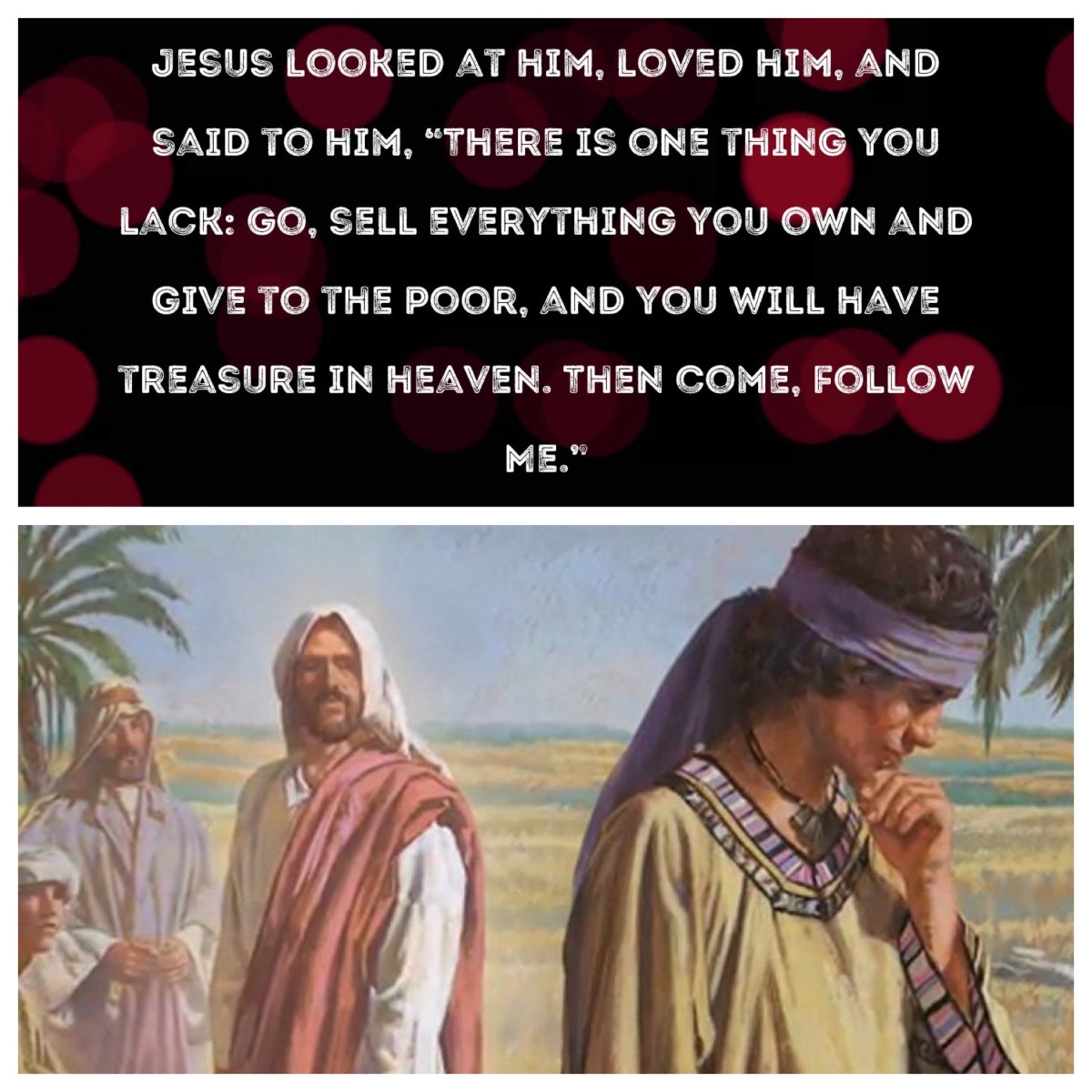
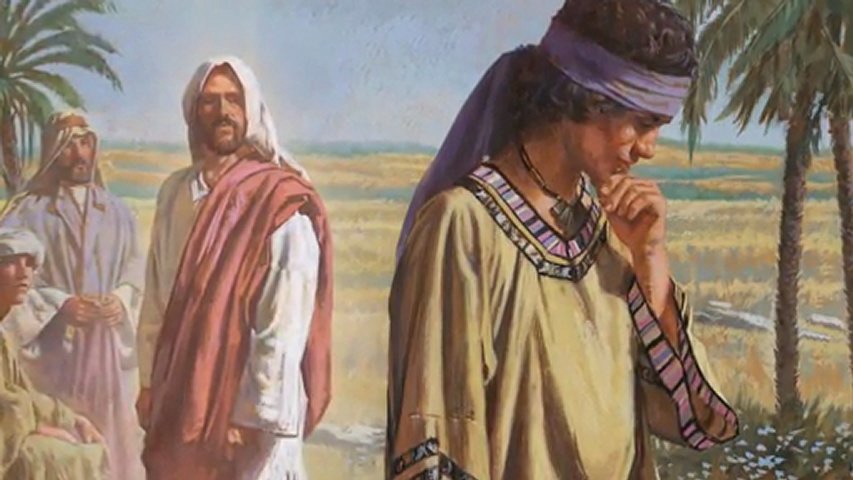
Next Sunday, the first Sunday in Lent, we will hear a Gospel passage in which Jesus sadly informs a man of means who prides himself on keeping all the commandments, that still “you lack one thing: go, sell what you own, and give the money to the poor, and you will have treasure in heaven; then come, follow me” (Mark 10:21).

The man left, shocked and grieving; he could not do what Jesus instructed. Jesus here draws the line of belonging or being alienated from him on the basis of whether a person is able to implement radical actions of obedience. It’s not just a matter of believing—it’s a matter of doing, of implementing radical, practical changes.

Quite some time earlier, Jesus had instructed his followers of that they were to be characterised by an ascetic way of life (6:8–9) as they undertook their public proclamation “that all should repent” (6:12). As Jesus sent them out on mission, “he charged them to take nothing for their journey except a staff—no bread, no bag, no money in their belts— but to wear sandals and not put on two tunics” (6:8–9).

The description given here is often compared with the form of dress of a wandering philosopher, particularly of a Cynic philosopher, renowned for their poverty and dependence on others for food and shelter. The fact that Jesus also instructs his followers to accept hospitality when offered (6:10) but not to stay on if there is no welcome offered (6:11) reinforces the similarities.

On this comparison, see

The teachings of Jesus contain many indications that this way of life is what is expected of those who follow Jesus. He tells them, “if any want to become my followers, let them deny themselves and take up their cross and follow me” (8:34). He then reinforces this after his encounter with the rich man by noting, “how hard it will be for those who have wealth to enter the kingdom of God!” (10:23). Later, in Jerusalem, Jesus concludes a debate with some Pharisees and Herodians with the instruction, “give to the emperor the things that are the emperor’s, and to God the things that are God’s” (12:17).

Beyond Mark’s narrative, Jesus was remembered for sayings in which he taught his followers to “love your enemies, do good, and lend, expecting nothing in return” (Luke 6:35) and “sell your possessions, and give alms” (Luke 12:33; Matt 19:21). “When you give a banquet”, he advised, “invite the poor, the crippled, the lame, and the blind” (Luke 14:13). “You cannot serve God and wealth”, he asserts (Luke 16:13; Matt 6:24). Accumulating possessions is not part of the agenda that Jesus set forth!

David Bentley Hart has written about the encounter between Jesus and the rich man: “Whatever else capitalism may be, it is first and foremost a system for producing as much private wealth as possible by squandering as much as possible of humanity’s common inheritance of the goods of creation. But Christ condemned not only an unhealthy preoccupation with riches, but the getting and keeping of riches as such. The most obvious example of this, found in all three synoptic Gospels, is the story of the rich young ruler, and of Christ’s remark about the camel and the needle’s eye.”

See https://www.plough.com/en/topics/faith/discipleship/what-lies-beyond-capitalism

As we listen to this story, from long ago, in our present context, we can sense how it remains pertinent for us. It remains a challenging word to disciples, caught in the swirl of constant consumption and encouragement to get more, more, more, in our contemporary capitalist society. “Go, sell what you own, and give the money to the poor, and you will have treasure in heaven; then come, follow me.”

Forty days, led by the Spirit: Jesus in the wilderness (Mark 1)

This week we once more read and hear the beginning of the story that Mark tells, about the very early stages of the public activity of Jesus. We have already read about John the baptiser during Advent (Advent 2), and heard Mark’s account of the baptism of Jesus (Epiphany 1).

Now, in this week’s Gospel reading (Lent 1), Jesus is baptised, plunged deep into the water, from which he emerges changed (1:9–11), driven into the wilderness, with wild beasts and angels, to be tested (1:12–13), and then announces what his message and mission will be (1:15–15).

This baptism is sometimes regarded as Jesus attesting to a deeply personal religious experience that he had in his encounter with John, who had been preaching his message of repentance with some vigour (1:4-11). His encounter with John deepens his faith and sharpens his commitment.

The relationship between Jesus and John is interesting. In the orderly account of things being fulfilled, which we attribute to Luke, it is clear from the start that John is related to Jesus (Luke 1:36). By tradition, they are considered to be cousins–although the biblical text does not anywhere expressly state this.

It seems also that some of the early followers of Jesus had previously been followers of John himself. This is evidenced in the book of signs, which we attribute to the evangelist John. Andrew, later to be listed among the earliest group of followers of Jesus, appears initially as one of two followers of John (John 1:35-40). They express interest in what John is teaching (John 1:39).

Andrew is the brother of Simon Peter, later acknowledged as the leader of the disciples of Jesus. He tells his brother about Jesus. It is Peter who comes to a clear and definitive understanding of the significance of Jesus, even at this very early stage: “we have found the Messiah” (John 1:41). Andrew and John are thenceforth committed disciples of Jesus.

Was Jesus engaging in “sheep-stealing”? Certainly, the dynamic in the narrative is of a movement shifting away from John the baptiser towards Jesus the Messiah; the juxtaposition of these two religious figures can be seen at a number of points (John 1:20, 29-34, 35-36; see also 3:22-30).

See further thoughts on John the baptiser in John’s Gospel at

and

(And I am looking forward to reading more about John in the most recent book by James McGrath, Christmaker: a life of John the Baptist, published by Eerdmans.)

None of this story relating to John is in view in the account we read in this Sunday’s Gospel. The rapid-fire movement in this opening chapter simply takes us from John, baptising in the Jordan, to Jesus at the Jordan and then in the wilderness, and on into Galilee, beside the lake and in Capernaum (Mark 1:1–45).

See my comments on the character of Mark 1 at

Mark has no concern with exploring the relationship between Jesus and John. He wishes only to indicate that, at the critical moment of the beginning of the public activity of Jesus, it was through contact with John, his message and his actions, that Jesus was impelled into his mission.

The Gospel account moves quickly on from the baptism, to a very different scene, set in the wilderness, where Jesus is tested, challenged about his call (1:12-15). The wilderness was the location of testing for Israel (Exod 17:1-7; Num 11:1-15; Deut 8:2). By the same token, the wilderness was also the place where “Israel tested God” (Num 14:20-23), when Israel grumbled and complained to God (see Exod 14-17, Num 11 and 14). Wilderness and testing go hand-in-hand.

The reference to Jesus being “forty days” in the wilderness evokes both the “forty years” of wilderness wandering for the people of Israel (Exod 16:35; Deut 2:7, 8:2, 29:5; Neh 9:21; Amos 2:10, 5:25), as well as the “forty days” that Moses spent fasting on Mount Sinai (Exod 34:28; Deut 9:9-11,18,25; 10:10).

Forty, however, should be regarded not as a strict chronological accounting, but as an expression indicating “an extended period of time”, whether that be in days or in years. It points to the symbolic nature of the account.

We see this usage of forty, for instance, in the comment in Judges, that “the land had rest forty years” (Judges 5:31, 8:28)–a statement that really means “for quite a long time”. Likewise, Israel was “given into the hands of the Philistines forty years” (Judges 13:1) and Eli the priest served for 40 years (1 Sam 4:18).

David the king reigned for 40 years (2 Sam 5:4, 1 Kings 2:11; 1 Chron 29:27), his son Solomon then reigned for another 40 years (1 Kings 11:42; 2 Chron 9:30), as also did Jehoash (2 Kings 12:1) and his son Jeroboam (2 Kings 14:23). If we take these as precise chronological periods, it is all very neat and tidy and orderly–and rather unbelievable!

Other instances of forty point to the same generalised sense of an extended time. Elijah journeyed from Mount Carmel to Mount Horeb “forty days and forty nights” (1 Kings 19:8), whilst the prophet Ezekiel’s announcement of punishments lasting forty years (Ezekiel 29:10-13) is intended to indicate “for a long time”, not for a precise chronological period. Jonah’s prophecy that there will be forty days until Nineveh is overthrown (Jonah 3:4) has the same force.

So the story of the testing of Jesus for “forty days in the wilderness” is not a precise accounting of exact days, but draws on a scriptural symbol for an extended, challenging period of time.

Details about the conversation that took place whilst Jesus was being tested in the wilderness are provided in the accounts in the Gospels attributed to Matthew (4:1-11) and Luke (4:1-13). This is not the case in Mark, where the much shorter account (1:12-13) focusses attention on the key elements of this experience: the wilderness, testing, wild beasts, angels–and the activity of the Spirit.

For more on Jesus in the wilderness, see

and

The Markan account of this period of testing is typically concise and focussed. The constituent elements in the story continue the symbolic character of the narrative.

The note that “he was with the wild beasts” sounds like the wilderness experience was a rugged time of conflict and tension for Jesus. However, commentators note that the particular Greek construction employed here is found elsewhere in this Gospel to describe companionship and friendly association: Jesus appointed twelve apostles “to be with him” (3:14); the disciples “took him [Jesus] with them onto the boat” (4:36); the man previously possessed by demons begged Jesus “that he might be with him” (5:14); and a servant girl declares to Peter that she saw “you also were with Jesus” (14:67).

If this Greek construction bears any weight, then it is pointing to the companionable, friendly association of the wild beasts with Jesus—a prefiguring of the eschatological harmony envisaged at the end of time, when animals and humans all live in harmony (Isaiah 11:6-9; Hosea 2:18). The wilderness scene has a symbolic resonance, then, with this vision.

Alongside the wild beasts, angels are present—and their function is quite specifically identified as “waiting on him” (1:13). The Greek word used here is most certainly significant. The word diakonein has the basic level of “waiting at table”, but in Markan usage it is connected with service, as we see in the descriptions of Peter’s healed mother-in-law (1:31), the women who followed Jesus as disciples from Galilee to the cross (15:41), and most clearly in the saying of Jesus that he came “not to be served, but to serve” (10:45). The service of the angels symbolises the ultimate role that Jesus will undertake.

Finally, we note that the whole scene of the testing of Jesus takes place under the impetus of the Spirit, which “drove him out into the wilderness” (1:12). This was the place that Jesus just had to be; the action of the Spirit, so soon after descending on him like a dove (1:11), reinforces the importance and essential nature of the testing that was to take place in the wilderness.

And the action of “driving out” is expressed in a word, ekballō, which contains strong elements of force—the word is used to describe the confrontational moment of exorcism (1:34, 39; 3:15, 22-23; 6:13; 9:18, 28, 38). The testing in the wilderness becomes a moment when Jesus comes face to face with his adversary, Satan—and casts his power aside. The more developed dialogues in Matthew and Luke expand on this understanding of the encounter.

Both of the key elements in this reading (baptism and testing) serve a key theological purpose in Mark’s narrative. They shape Jesus for what lies ahead. They signal that Jesus was dramatically commissioned by God, then rigorously equipped for the task he was then to undertake amongst his people. The two elements open the door to the activities of Jesus that follow in the ensuing 13 chapters, right up to the time when the long-planned plot against Jesus, initiated at 3:6, is put into action (14:1-2).

Of course, this story is offered in the lectionary each year on the first Sunday in the season of Lent. It serves as an introduction to the whole season. Jesus being tested in the wilderness points forward, to the series of events taking place in Jerusalem, that culminate in his crucifixion, death, and burial.

The narrative arc of Mark’s Gospel runs from the baptism and wilderness testing, through to death at Golgotha and burial in a tomb. The weekly pattern of Gospel readings during Lent follows a parallel path, from the wilderness testing of Lent 1, to the entry into Jerusalem on Lent 6, the farewell meal on Maundy Thursday, and the death and burial on Good Friday.

That is the path that Jesus trod. That is the way that he calls us to walk.