Where will we find hope? When will we see justice?

There are people in some of the Congregations of the Presbytery where I am currently serving in ministry, who will be finding the events of the next three weeks a challenge. They will be looking for hope, and seeking for justice. People from my Congregation at Queanbeyan, and people in the Goulburn Parish, will especially be impacted.

Today at Queanbeyan, the Prayers of the People were led by Marg Cotton, who invited members of the Congregation to pray for these people.

i invite you to join with her and the people today who prayed:

Lord God, we come before you today

seeking to make sense of a world

where there are many contradictions.

Bad things happen to the young and the innocent.

Wrongdoers prosper and seem to have

no remorse for the havoc they cause.

Sometimes it seems that there is no justice,

and that inequality and incivility are increasing at an exponential rate.

We make the effort to build a respectful

and hopeful community,

but the work of a lifetime can seem fragile

and doesn’t seem to be able to survive

without our continuing vigilance.

Misunderstood and misunderstanding,

we ponder our next steps.

Like the people in Jeremiah,

we feel cut off from your fountains of living water

and all we can see the is the cracked cistern

that can hold no water at all.

Where will we find hope?

When will we see justice?

Teach us, Lord, how we should be acting

in the current circumstances.

Let us first turn to you in humility

and recognise our need to be remade

and refreshed by you.

Come Lord and show us the path to take.

On this first day of spring

give us hope for the future

and a sense of purpose and optimism.

With the coming of spring

there is the hope of new life.

Help us to be ready to grow

and work together in this new season,

to hear your plans for us

and act to bring them into being.

In the name of Christ, we pray: Amen.

In the wake of the verdict (and appeal decision) relating to Pell …

With some slight modification, this post from earlier this year seems appropriate for revisiting today, the day when the appeal by Cardinal George Pell has been dismissed.

……..

There has been a lot of media discussion in recent times about the convictions handed down against Cardinal George Pell. Articles that I have read have ranged across the validity of the sentence, the quality of the evidence provided, the rhetoric of the defendant barrister, and the perception that Pell was targeted in a “tall poppy syndrome” or as part of a wider vendetta against the Church.

I have been thinking, not just about this particular case, but about the various elements of our culture that are involved in these discussions. There are many elements that deserve attention and careful consideration.

Fundamental to these discussions, should be the basic principle of respect for another human being. If an alleged victim raises an accusation, that person deserves to be heard with respect and integrity. It is not fair to label or accuse such a person, especially if the claim has not yet received measured and fair consideration in the courts. Disrespectful descriptions and negative labelling of victims should never be published by any media outlet.

Second, I sense, is a concern about the way that we demonstrate trust in institutions — whether those institutions are the justice system, religious bodies, or leadership in society. It is clear that, in modern Australian society, any institution is “fair game” for suspicion and distrust. That might well be justified in some instances—the banking and finance industry, for instance; or political parties, when it comes to “jobs for the boys” and (as we have seen lately) “goodbye to the girls”. But should it be the default setting when considering any institution in society?

A factor that I see running through all considerations relating to sexual abuse, is the pernicious influence of secrecy—whether that is secrecy by church leaders, concerned to maintain the good name of their church; or secrecy by perpetrators, seeking to quieten the noises made about their alleged activity. Perpetrators are particularly good at impressing the need for secrecy on their victims. That’s one of the main warning flags in a sexual abuse scenario. It is not a healthy trait.

Of course, there is a different between when something needs to be held as confidential, and when it has become a secret. Knowing the difference between secrecy and confidentiality, is an important process of discernment. Some matters do need to be held in confidence, while further investigations are undertaken, for instance. And knowing when it is inappropriate to hold on to a secret, is also important to discern.

The discussion raises questions, for me, about styles of leadership within our society. Cardinal Pell exercised a particular style of leadership. It may well have contributed to the surge of opposition to him, both in his role as a leader of the Roman Catholic Church, and as a person in the spotlight. Certainly, while his style of charge-through-and-win-at-all-costs, might have garnered him support from those who agreed with his ideological stances, it also generated a mountain of opposition to him. Is this really the best way to exercise leadership in society?

Of course, the recently-concluded Royal Commission has shone a spotlight in the culture and ethos which has been dominant in a number of institutions in our society, including the Roman Catholic Church, other church denominations, and other institutions dealing with children. The Roman Catholic Church has been carefully scrutinised and a number of the commission’s recommendations do deal with changes that need to be made, to create a more healthy culture with an ethos that values integrity and transparency above arcane processes and secrecy.

I found myself, again and again, coming back to the priority that should be shown (but which often has not been shown), to demonstrate authentic care and compassion for victims. There are too many examples, that I am aware of, where people who have been victims are saying that the way the issues are discussed in the public arena provides a trigger to their hurts and fears, to their anxieties and depressive feelings. We owe them more than this; we need to prioritise a way of discussing matters that does not replicate past abuses and reinforce negative emotions.

That leads to another matter; the importance of language. Nothing demonstrated this more, than the unfortunate and ill-chosen rhetoric of the defence lawyer representing Cardinal Pell. It carried an inference that the kind of sexual assault experienced by the victims in this particular instance, was a lesser grade of assault. The swift apology and withdrawal of the terrible phrase that Robert Richter used, is a clear indication of the power that is carried in the words we use. I know this from my experience in leading worship and interpreting texts, within my church roles. It is something that needs to be recognised in people right across society, in the public discourse.

In terms of my faith, the message that I hear pressing on me, again and again, is that the Gospel call to faithful discipleship is far more important than the matter of preserving the institutional reputation. The deeply sad fact at the heart of so many instances of sexual abuse by priests, ministers, and pastors, is that the Gospel call has been subordinated (and ignored) in favour of protecting the institution. That is completely wrong.

I guess that the culture of “let’s stick together”, “this is not who we are”, “don’t criticise us, we do lots of good things”, must have been strong within the Catholic Church. That explains why there was such a concerted effort by many, to protect their fellow priests. The same went on in the Anglican Church, and there are indications of it in other denominations and organisations.

There is something positive in looking out for your fellow priest, or minister, or believer. (Although I really dislike it when someone says to me—as they do, from time to time—“ah, but you Ministers always stick together”.) But, sadly, this sense of a priestly brotherhood, all looking out for one another, has contributed to this distorted culture. It is clear that the culture of the Catholic Church has actually fostered misogyny and secrecy in relation to abuse. The sense of belonging to “a brotherhood” has contributed to that culture.

I have noted a tendency, in some faith-based commentary, to look for conspiracy theories about the criticism of churches that is abroad in society. I don’t think it is helpful to become defensive in this way, and I certainly don’t think it is at all useful to label those who criticise the churches as demonic or guided by the devil. Such negative, condemnatory language is completely unhelpful. The church needs to be able to defend itself through reasoned argument, and not resort to judgemental stereotypes.

A final point needs to be made. There is a need to distinguish “The (Roman) Catholic Church” from other church denominations. There are things about the Catholic Church which are distinctive, and which set it apart from other denominations, such as the Uniting Church: the all-male priesthood, the lack of females in leadership, the power of episcopacy in setting the culture, the requirement of celibacy amongst the priesthood, the centralised bureaucracy in Rome, and the strongly bonded nature of “the brotherhood” amongst religious (men). These factors have contributed to create the kind of culture that has protected, and also fostered, abusers. The Catholic Church needs to work hard to dismantle that culture. And all denominations need to be on the alert for signs that secrecy and protection of abusers is continuing.

There is a fine prayer for the current situation, written by my colleague Avril Hannah-Jones, at https://revdocgeek.com/2019/02/27/prayer-for-the-survivors-and-victims-of-child-abuse/

This is a well-argued piece which focuses on the damage done by a Pell, to an individual as well as to the church:

https://www.smh.com.au/national/history-will-judge-george-pell-the-cardinal-who-sought-to-crush-me-20190227-p510ma.html

Frank Brennan offered this analysis immediately after the verdict:

https://www.eurekastreet.com.au/article/truth-and-justice-after-the-pell-verdict

However, Daniel Reeders has provided this careful critique of Brennan, and of others seeking to vindicate Pell:

https://badblood.blog/candle-lighting-the-catholic-response-to-the-pell-conviction/

Dark deeds in a sunny land: the exposé offered by John B. Gribble

I am currently reading an excellent work by Richard Broome, Professor of History at LaTrobe University in Melbourne. He is a much-published researcher in the area of Aboriginal history. The book, entitled Aboriginal Australians: a history since 1788, is comprehensive, providing many insights into the history of this country over the past 230 years, with many challenges in the narrative. I will be pondering much of what Broome writes as I work my way through the 400 pages of this book.

Today I read about a minister-missionary, of whom I was previously unaware. He was the Rev. John B. Gribble, who came originally from Cornwall in Britain, travelling as a one year old with his parents as they set out for a new life down under.

In October 1876, Gribble was admitted to the ministry of the United Free Methodist Church, but subsequently he joined the Congregational Union of Victoria and served as a home missionary. Apparently he had an encounter with the Kelly Gang during their heyday.

Over the years, Gribble worked with the Indigenous people, and in 1879 Gribble and his wife Mary opened the Warangesdah Aboriginal Mission at Darlington Point. The Bishop of the Church of England from Goulburn took on sponsorship of the mission, and then made Gribble a stipendiary reader in 1880, deacon in 1881 and priest in 1883.

In 1884, Gribble was invited by Bishop Henry Parry of Perth to work in Western Australia. He went to England, where he raised funds and published Black but Comely, a description of Aboriginal life in Australia. In 1885 he opened a mission on the Gascoyne River but was strongly opposed by settlers who exploited native labour.

In 1886, Gribble published Dark Deeds in a Sunny Land. This was a fierce castigation of his opponents; it created a furore and the welfare of the Aborigines was obscured by the fierce debate that ensued, which impacted the reputation of Gribble for some decades.

The booklet included an allegation that ‘quite sixty natives, men, women and children’ had been shot dead in one day in the Pilbara region. This exposé appears to have been one of the earliest, if not the earliest, public descriptions of what later became known as the Flying Foam massacre. The witness cited by Gribble, one David Carly, claimed to have seen ‘the skulls of fifteen who were shot’.

More information about the Flying Foam Massacre can be read at http://nationalunitygovernment.org/content/flying-foam-massacre-killing-fields-murujuga

I have read all of this information also in the Australian Dictionary of Biography (http://adb.anu.edu.au/biography/gribble-john-brown-3668). What this official biography does not mention—but Broome duly reports—is that Gribble’s license to preach was removed by his Bishop, and the Church later closed down the mission which he had started.

Gribble worked for a time as a labourer, sued the West Australian newspaper (but lost the case), then returned to the east and established another mission for Indigenous people in Queensland. Sadly, he died soon after this.

So much for the Church siding with the oppressed and standing for the Gospel!

The pictures show Gribble, the settlement at Warangesdah Aboriginal Mission, and relevant book covers.

See also

https://johntsquires.wordpress.com/2018/10/13/on-covenant-reconciliation-and-sovereignty/

https://johntsquires.wordpress.com/2018/10/13/on-covenant-reconciliation-and-sovereignty/

https://johntsquires.com/2019/01/16/the-profound-effect-of-invasion-and-colonisations/

https://johntsquires.com/2018/08/13/affirming-the-sovereignty-of-first-peoples-undoing-the-doctrine-of-discovery/

International Day of the World’s Indigenous Peoples

Today, 9 August, has been designated since 1982 by the United Nations as International Day of the World’s Indigenous Peoples. This year’s observance is dedicated to Indigenous Peoples’ Languages, since 2019 is being marked as the International Year of Indigenous Languages.

A person’s right to use his or her chosen language is a prerequisite for freedom of thought, opinion and expression, access to education and information, employment, building inclusive societies, and other values enshrined in the Universal Declaration of Human Rights. 

Many of us take it for granted that we can conduct our lives in our home languages without any constraints or prejudice. But this is not the case for everyone. Of the almost 7,000 existing languages, the majority have been created and are spoken by indigenous peoples who represent the greater part of the world’s cultural diversity. 

Yet many of these languages are disappearing at an alarming rate, as the communities speaking them are confronted with assimilation, enforced relocation, educational disadvantage, poverty, illiteracy, migration and other forms of discrimination and human rights.

It is estimated that, every 2 weeks, an indigenous language disappears, placing at risk the respective indigenous cultures and knowledge systems. That is why, on this International Day, the goal is to draw attention to the critical loss of indigenous languages and the urgent need to preserve, revitalize and promote them at both national and international levels.

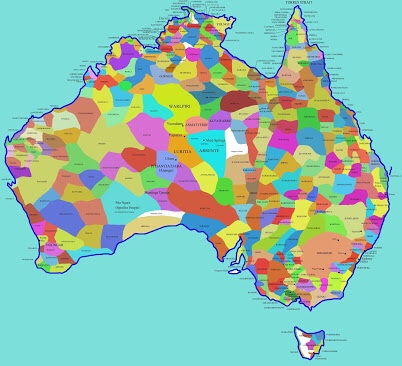
It is believed that there were more than 250 Indigenous Australian languages, as well as 800 local dialectal varieties, which were spoken on the continent of Australia at the time of European settlement in 1788. Today, only 13 of those traditional Indigenous languages are still acquired by children. Approximately another hundred or so are spoken to various degrees by older generations, with many of these languages at risk as Elders pass away.

A map indicative of the language groups across the continent (in the image above) was created in 1994 to illustrate the diversity of Indigenous cultures across the continent. It includes many language groups but is not definitive in this regard; it provides a visual representation of that cultural diversity. The map was developed along with the Encyclopedia of Aboriginal Australia as part of a national research project. The Encyclopedia is available in libraries and contains more detailed information about the groups represented on the map.

Today Aboriginal and Torres Strait Islander people across Australia are speaking out about the need to maintain, preserve and strengthen Indigenous Australian languages. There is currently a wave of activity, with people in many communities working to learn more about their languages, and to ensure they are passed on to the next generation.

An important resource for the preservation and revival of Aboriginal and Torres Strait Islander languages is the Australian Indigenous Languages Collection maintained by AIATSIS. The collection brings together over 4500 items such as children’s’ readers, bible translations, dictionaries, grammars, vocabularies, works of imagination and learning kits in 200 languages. The collection’s significance was recognised in 2009 when it was added to the UNESCO Australian Memory of the World Register.

Approximately 20 dictionaries of Australian Indigenous languages are being supported through the end of production cycle. This includes what will become an iconic Warlpiri encyclopedic dictionary, based on 60 years of research by teams of speakers and linguists, to support language maintenance in that community, and a facsimile edition of The Sydney Language (1993), to support language awareness and revival of the language which the First Fleet first encountered in 1788.

In 2016, then Prime Minister Malcom Turnbull made history by being the first Prime Minister to speak an Australian Indigenous language in a parliamentary speech. He gave an acknowledgment of country in Ngunawal for the annual Closing the Gap speech. The acknowledgment was written by Ngunawal men Tyronne Bell and Glen Freeman, with assistance from AIATSIS linguist Doug Marmion. This is particularly significant as the Ngunawal language has not been spoken fluently for almost a century, but AIATSIS has been working with the Ngunawal community for several years to revitalise it.

****

I have taken the above information from these websites:

https://www.un.org/en/events/indigenousday/

https://en.iyil2019.org/international-day-of-the-worlds-indigenous-peoples-9-august-2019/

https://en.iyil2019.org/role-of-language/

https://en.iyil2019.org

https://aiatsis.gov.au/explore/articles/indigenous-australian-languages

https://aiatsis.gov.au/collections/about-collection/languages

https://aiatsis.gov.au/explore/articles/aiatsis-map-indigenous-australia

https://aiatsis.gov.au/news-and-events/blog/indigenous-languages-australian-parliaments

https://aiatsis.gov.au

https://www.researchgate.net/publication/330293198_The_Encyclopaedia_of_Aboriginal_Australia

https://australianarchaeologicalassociation.com.au/journal/review-of-encyclopaedia-of-aboriginal-australia-aboriginal-and-torres-strait-islander-history-society-and-culture-edited-by-d-horton/

Ramping up the rhetoric, generating guilt and provoking panic: the failed strategy of conservatives in the UCA (part III)

Concluding my exploration of reactionary conservatism throughout the 42 years of the Uniting Church. In part one, I looked at the formation of the church in 1977, and EMU (the Evangelical Ministers of the Uniting Church, later renamed to the Evangelical Members of the Uniting Church (EMU). In part two, I considered the Reforming Alliance (RA) and the Assembly of Confessing Congregations (ACC), through to the present, with the formation of Propel.

VI. Conservative theology, the ACC, and CALD communities

From time to time, I hear the claim that goes something like, “lots of ethnic congregations disagree with the Uniting Church position on sexuality”. This is often applied to Pacific Island communities, referring to churches with their roots in Tonga, Fiji, Samoa, and a number of other islands in Oceania. It also applies to some Korean-speaking congregations.

One simple reason for this is historical: when Western churches sent missionaries to the Pacific Islands, and to Korea, the people that they sent were inevitably filled with missional zeal, conservative pietism, and intense desire to convert the people amongst whom they were living and ministering. The type of Christian faith that they brought with them, that they taught and advocated, and that was adopted by the people of the islands where they were based, was from a particular cultural context, which was conservative, evangelical, and in many cases, pre-critical.

Thus, the churches that they planted and that grew up in Korea and the Pacific Islands held strongly to conservative, evangelical, and even fundamentalist perspective on faith. That has carried over into the churches in Australia from those various Islander and Korean communities. Indeed, in those very cultures, pre-missionary understandings were often quite different from what we now hear as being from those cultures.

The same kind of rhetoric has been applied to these CALD communities (CALD = culturally and linguistically diverse). The dominant theological stance is conservative. The claim is made, from time to time, that people from these communities are leaving the church. In droves, it is sometimes said. Once again, the rhetoric is over-reaching; the numbers are highly exaggerated; the tactics are based on inaccuracies fed by fear, fostering division.

And the theological positions of people within these various CALD communities can no longer be stereotyped as being all the same, all conservative, all anti-homosexuals, all believing that the Bible is inerrant. There is, now, actually a wide range of opinions, perspectives, and theologies amongst these CALD communities. They are as diverse as any other part of the church, with all shades of theological commitment reflected.

After many generations of life in Australia, it is clear that people within the various CALD communities, like people within mono-Anglo church groups, have grappled with biblical interpretation, have sensed how traditional culture might be critiqued, and have realised that life is filled with diversity. They have adopted the Uniting Church’s commitment to an informed faith. It is not just a black-and-white situation. And that is part of the wonderful diversity that can be found within the Uniting Church.

On the commitment to an informed faith in the Basis of Union, see https://johntsquires.com/2018/08/15/what-i-really-like-about-the-basis-of-union/

I am proud to have many colleagues in ministry from non-Anglo origins, who have negotiated the pathway of being a “hyphenated” personality, straddling the culture of their place of origin and the culture of the place they now live. They serve with faithfulness. They know how to critique their culture of origin, how to critique their culture of current living, and how to apply these insights to biblical interpretation, theological exposition, pastoral care, and missional engagement.

I have been a member of the last two Assemblies. In debates on the floor of both Assemblies, the wide spread of theological positions advocated by members of the various CALD communities has been clearly evident. There is a diversity of voices within CALD communities. Not everyone in those groups accepts and repeats the conservative rhetoric about the crisis in the church, the decline of numbers. Indeed, most CALD communities hold fast to the Uniting Church as their faith home. They are not leaving in droves.

I have talked about this with a number of people who have worked, in different Synods, with people from many of the CALD communities. They know the diversity. They know the resentment of those who adopt “divisive, splintering tactics”, at some National Conferences, and in the public arena. Some CALD leaders attempt to speak to a wider audience as if they are speaking for all members of their ethnic community, and indeed all cultural groups across the UCA. They do not, and I have been told that this has been made clear in many sessions of various National Conferences.

The recent foray into Tonga is a case in point, when some leaders of the ACC went to the General Conference of the Free Wesleyan Church of Tonga (FWC), to raise their concerns about the UCA, citing the 2018 decision about marriage, and to raise the possibility that there might be a breaking of relations with the UCA. The renegade UCA people in leadership in the ACC did not succeed in this task of fomenting dissension. The leaders of the FWC have issued a statement explicitly repudiating the claim that the relationship has broken.

See my post on this issue and the divisive tactics employed at

https://johntsquires.com/2019/06/30/dividing-the-unity-splintering-the-connections-more-acc-agitation/

The current dominance in leadership, and in membership, of individuals from certain CALD communities, simply reflects the ineffective nature of their strategy in the church at large. It seems like cultural expectations are, in some situations, being used to sway adherence to a particular, narrow, theological dogma. I know of a number of locations where ACC leadership has explicitly sought to recruit whole CALD faith communities to their cause. That is a really sad way of operating.

VII. In conclusion

It is clear to me that the Uniting Church is firmly committed to being welcoming and inclusive, acting with integrity and grace. The President has signalled this with her 15th Assembly theme of abundant grace, liberating hope. (See https://johntsquires.com/2018/07/31/abundant-grace-liberating-hope/)

However, more recent statements by the ACC have exposed its theology as exclusionary, wrath-driven and judgemental. In my mind, it would be good if these advocates of “orthodoxy” were to have a different narrative.

There is clearly a place for an articulate, thoughtful, informed theology which is both conservative and evangelical. I don’t dispute that. I have always valued such voices, in the scholars I have read, the students I have taught, and the colleagues with whom I work and interact. Good conservative theology makes a valuable contribution to the life of the church.

However, the way that the case has been argued by some conservative leaders, the rhetorical strategy of crying doom and gloom, or worse, in an attempt to reverse decisions, does not provide a constructive contribution to the church. And in recent times it has descended into ugly rhetoric (“the UCA is apostate”, for instance). That’s counterproductive.

I yearn to hear conservative church leaders speaking in a way that highlights the GOOD news, that offers the GRACE of God, that models the INCLUSION of the Gospel and invites people into an EXPLORATION of faith, as is evident in the New Testament texts. This is the positive model of leadership which does well for the whole church.

Too often over the years, conservative leaders—and especially, more recently, the leadership of the ACC—have spoken to highlight JUDGEMENT, offering FEAR as the motivation for seeking repentance, and modelling the EXCLUSIVE character of a holy huddle which is entirely convinced that it, and it alone, possesses THE TRUTH about God.

We need to move away, once and for all, from these ineffective and disrespectful strategies.

We need to proclaim the good news!

******

For earlier parts, see

https://johntsquires.com/2019/07/25/ramping-up-the-rhetoric-generating-guilt-and-provoking-panic-the-failed-strategy-of-conservatives-in-the-uca-part-i/

https://johntsquires.com/2019/07/25/ramping-up-the-rhetoric-generating-guilt-and-provoking-panic-the-failed-strategy-of-conservatives-in-the-uca-part-ii/

For my musings on the DNA of the UCA, see

https://johntsquires.com/2019/06/18/the-dna-of-the-uca-part-i/

https://johntsquires.com/2019/06/18/the-dna-of-the-uca-part-I/

For the 1985 affirmation that the Uniting Church is a multicultural church, see https://assembly.uca.org.au/mcm/resources/assembly-resolutions-and-statements/item/1688-we-are-a-multicultural-church

For the 2012 statement on One Body Many Members: Living faith and life cross culturally, see https://assembly.uca.org.au/obmm

For overviews of the matter of sexuality within the Uniting Church over four decades, see https://assembly.uca.org.au/images/PDF/SexualityandLeadership_DocumentingtheHistory.pdf

https://www.southmoreton.org.au/wp-content/uploads/2018/10/Same-gender-marriage-the-UCA-journey-rev1018.pptx