Faith in Action: a religious response to the Climate Emergency (Part Two)

Today I am with people from a wide range of faith traditions from across the Australian continent and Aotearoa New Zealand, at the first national conference in Canberra of the Australian Religious Response to Climate Change (ARRCC).

During the morning, a series of keynote speakers addressed the Conference: a scientist, followed by a Muslim scholar and a Christian researcher and activist.

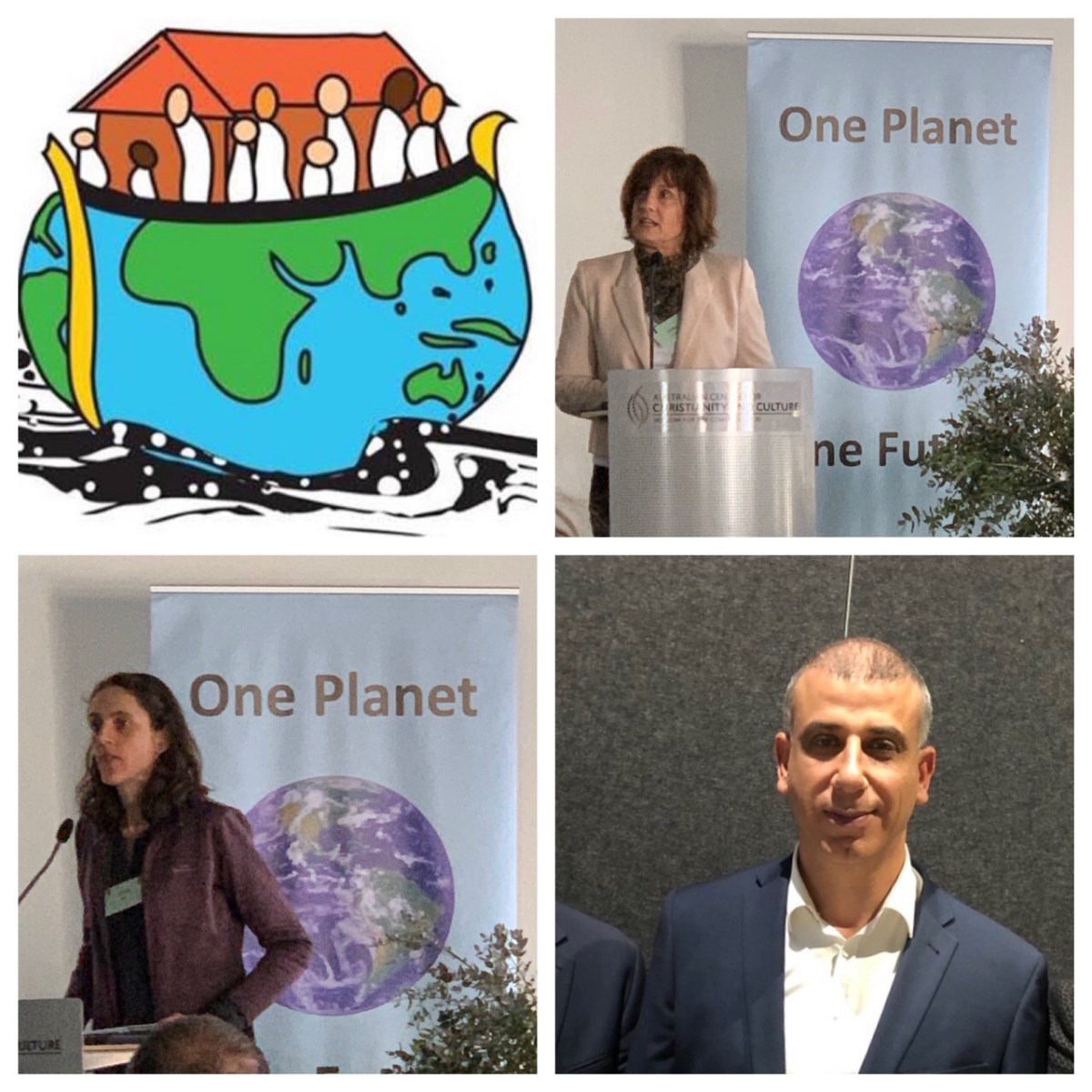
Prof. Lesley Hughes of the Climate Council and Macquarie University (top right in the photo montage) gave an overview of the impacts that are being felt right around the world in this climate emergency. Significant changes in the climate are clearly documented; the rate of change is alarming and disturbing in so many areas: temperatures are rising, heatwaves are growing, snow coverage is declining, water levels are rising.

Emissions in 18 countries have been declining in recent years; Australia is not one of those countries. Globally, there is less use of coal and more dependence on renewable sources of energy. However, Australia remains the largest exporter of coal in the world, and we have the 12th highest emissions per capita. Figures demonstrate that the introduction of a Carbon Price under Gillard had a clear impact, but there has been a strong reversal since the time of Abbott.

A number of articles by Prof. Hughes setting out the details of these factors can be read on The Conversation at https://theconversation.com/profiles/lesley-hughes-5823/articles, whilst the Climate Council has recently published a landmark report, This is what climate change looks like. It offers sobering reading. You can download and read the report from https://www.climatecouncil.org.au/wp-content/uploads/2019/09/This-is-What-Climate-Change-Looks-Like.pdf

Prof. Hughes concluded by quoting the inspiring slogan, We are the ones we have been waiting for!

Prof. Mehmet Ozalp, of Charles Sturt University (bottom right in the photo montage) spoke about an Islamic response to the climate emergency, arguing that within Islamic theology there is a clear ethical obligation to respond in practical ways. On the scale of assessment regarding ethical matters (allowed, recommended, neutral, not recommended, prohibited), this clearly sits within the realm of allowed (halal). He bases this on the premise that, where harm and benefit co-exist, alleviation of harm is the priority.

In 2015, the Islamic Declaration on Climate Change was issued. It sets out the theological and ethical imperatives, but is not strong on offering practical strategies. See https://unfccc.int/news/islamic-declaration-on-climate-change

What motivates change? Prof. Ozalp outlined four factors: awareness through education, activism and media reports; relationships with friends, acquaintances and organisations; religious teachings in worship; and individual consciences which generate a concern for the earth and its creatures.

Prof. Ozalp referred to a range of initiatives: questions relating to the hajj and the use of plastic bottles for water; green makeovers of 600 mosques in Morocco and 2000 mosques in Jordan; the Greening the Desert project in Jordan is one of many projects in the Middle East; and the partnership of Greenpeace and the Indonesian Government to avoid plastic during Ramadan.

Trees for Change in Tanzania is one of a number of African tree planting projects; a proposed gold mine in the Kaz Mountains near Gallipoli in Turkey has been stopped by mass protest; an Eco Mosque is being built in Cambridge, UK; and a strong Green Muslim movement has emerged in the USA.

In Australia, Monash University held a Greener Iftar whilst a recently-opened Eco Mosque in Punchbowl has won an architectural award. Australian Muslim leaders have supported the Stop Adani campaign and signed the letter prepared by ARRCC. ISRA has been active in holding public education events in the Muslim community, including the 2019 Living the Change Workshop.

Dr Miriam Pepper, from the Uniting Church (bottom left in the photo montage), then spoke about Engagement and mobilisation on climate change in Christian churches, both to outline the responses and help participants to discern opportunities for future mobilisation.

In Australia, 1.6 million people attend Christian worship on any given Sunday, providing a significant opportunity for networking, influencing, and acting. However, church participants are generally socially and politically conservative, and takeup of climate activism, despite the clear evidence about the climate emergency, has been low and slow across all Christian denominations. (Some have been more active than others.)

Attitudes towards the climate emergency and activities taken in response to it can be schematised as citizen, reformer, rebel, or change agent. Each has a place in the overall movement. Dr Pepper spoke of a range of actions undertaken in Australian Christian churches. Community gardens, solar panels and climate signs outside churches are increasingly found associated with churches. Christian participation in marches, rallies and strikes remains consistent—especially from Uniting Church members, but spread across many denominations.

Divestment from companies supporting fossil fuels is a strategy employed by a growing number of religious organisations. Some Christians have participated in nonviolent direct actions—following the example of Jesus himself! Organisationally, churches work through Congregations and Parishes, denominational agencies focussed on environmental issues, influential positional leaders (most notably, Pope Francis), national and regional church bodies, church schools, university student groups, theological and bible colleges, religious orders, as well as in partnership with parachurch organisations and ecumenical networks.

Drawing on data from the NCLS, Dr Pepper reported that the majority of church people do accept that climate change is happening, but taking action on environmental issues does not rate high on the list of social and religious issues that churchgoers believe should be prioritised by their churches. That places a challenge before all ministers and leaders in the churches to press the point concerning this vital set of issues. See a series of NCLS papers on the environment at http://www.ncls.org.au/topic/environment

In summary, she noted that congregational engagement remains low; however, a sign of hope is provided through an increasing Roman Catholic commitment to caring for the earth, which has grown since the release of the encyclical Laudato si’.

The three presentations we followed by a lively panel discussion, responding to a range of questions and comments form conference participants. A clear role was seen for church communities to press for changes in lifestyle as well as the policy framework of society—through individual and communal actions, through public education and activism, and through political lobbying.

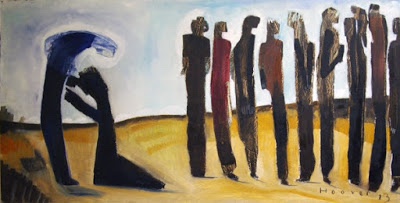
The importance of naming environmental issues in worship, inviting lament and grieving in prayers, offering practical strategies in sermons and study groups, and pointing to a hope for the future through specific actions, was also noted. The scientist on the panel, Prof. Hughes, made a strong statement about the importance of hope amongst everyone involved in responding to the climate emergency—both people of faith and people of no faith working together to a shared and hoped-for outcome.

Prof. Hughes also spoke about the interrelationship between environment, society, lifestyle and civilisation itself. We need to stop talking about “the environment” as an isolated entity, and frame it, rather, in terms of what impact the changes in climate will have on our way of living and our very existence as the human race. That is the extent of the challenge we face!

See related blogs at

https://johntsquires.com/2019/11/09/faith-in-action-a-religious-response-to-the-climate-emergency-part-one/

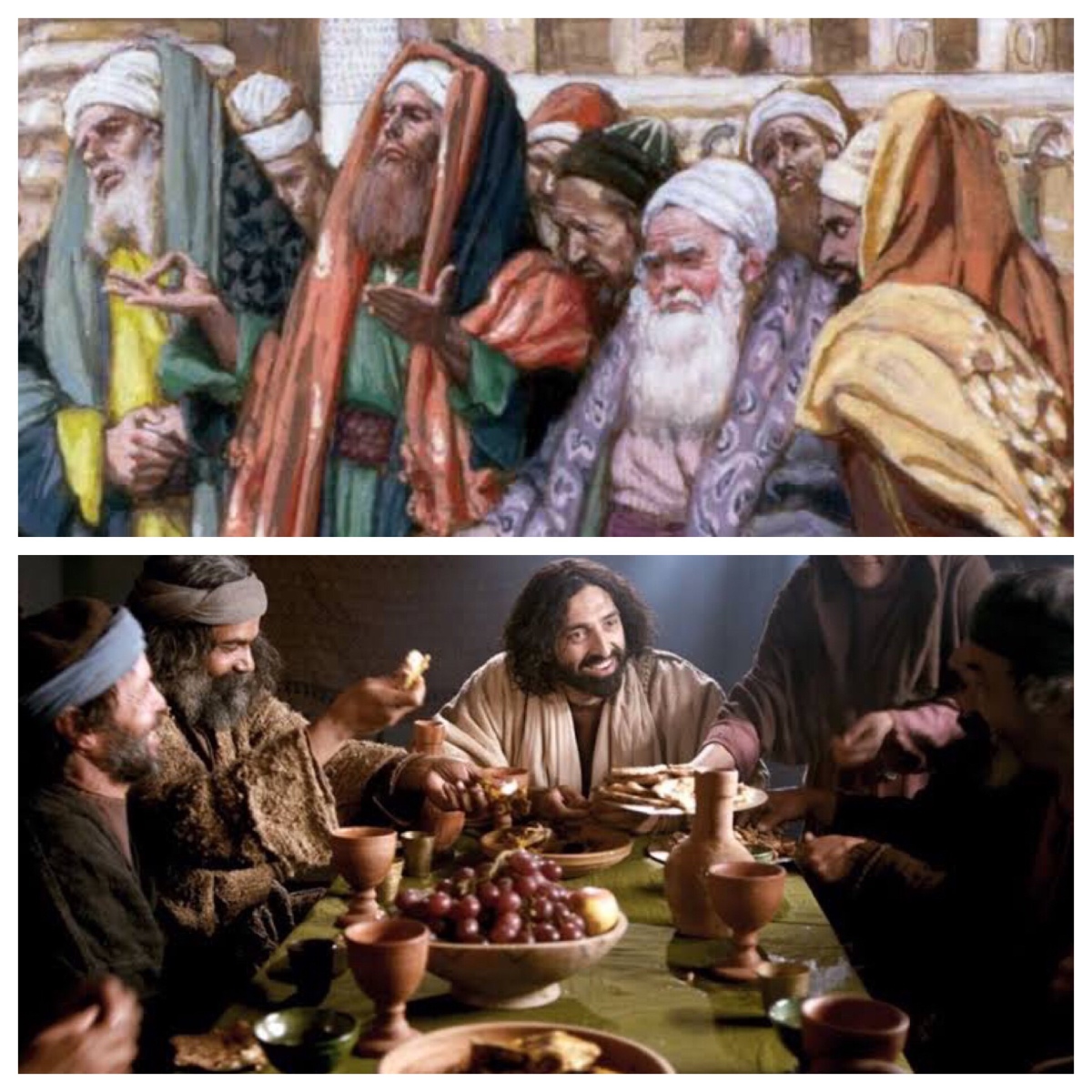
https://johntsquires.com/2019/11/08/look-up-to-the-sky-look-down-to-your-feet-luke-20/

https://johntsquires.com/2019/09/18/supporting-the-climate-strike/

https://johntsquires.com/2019/06/25/873/

https://johntsquires.com/2019/05/05/to-care-for-honour-and-respect-the-creation-we-need-to-stopadani-k/

https://johntsquires.com/2019/03/09/laudato-si-mi-signore-1/

https://johntsquires.com/2019/03/09/laudato-si-mi-signore-2/

https://johntsquires.com/2019/03/09/laudato-si-mi-signore-3/

https://johntsquires.com/2019/03/09/laudato-si-mi-signore-4/

Faith in Action: a religious response to the Climate Emergency (Part One)

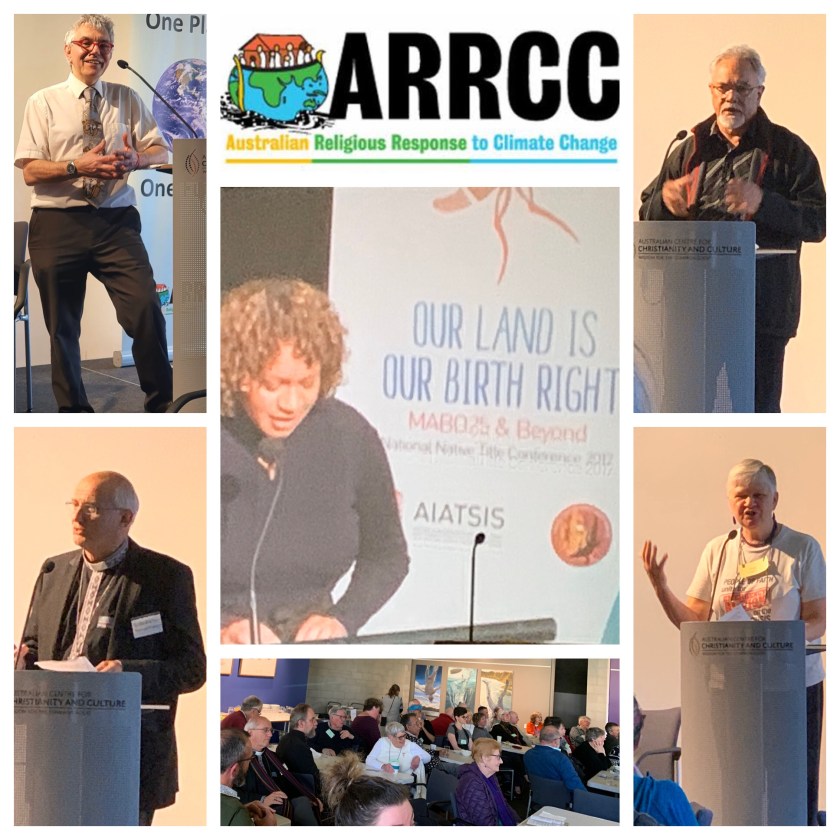
A good number of Uniting Church people from the ACT and NSW, and beyond, joined with people from a wide range of faith traditions from across the continent and Aotearoa New Zealand, at the first national conference in Canberra of the Australian Religious Response to Climate Change (ARRCC).

The Friday evening began with the Kiddush, a welcome to the Sabbath, with blessings and sharing of wine and bread, as is the Jewish custom for the Friday evening start of Sabbath. This was led, and explained, by Rabbi Jonathan Keren-Black from the Leo Baeck Centre in Melbourne.

A Welcome to Country was offered by Uncle Wally Bell, of the Buru Ngunawal Aboriginal Corporation, who sang and spoke in language as he explained the spiritual importance of land for the First Peoples of the country. This was followed by an introduction to the Conference by the President of ARRCC, Thea Ormerod, and a welcome to participants from Bishop Stephen Pickard, Director of the Australian Centre for Christianity and Culture, which was the location for the conference.

Spirituality is at the centre of the ethos of ARRCC, so prayers were led by people of faith from the Hindu, Muslim, Brahma Kumaris, and Buddhist faith traditions.

This was followed by a powerful reflection on how Indigenous spirituality informs the work of caring for and protecting the environment. The reflection was offered by Murrawah Johnson, a young Wirdi woman from Wangan and Jagalingou country, the land of the Galilee Basin where it is proposed to build the monstrous Adani coal mine. She is an activist, inspired by Eddie Mabo and others of his era, who has worked hard towards the goal of stopping the Adani mine. “When you love your people, amazing things can happen”, she observed, bringing a strong sense of optimism into the conference deliberations,

The Muslim speaker quoted a verse of the Quran which appears to provide a direct commentary on the climate emergency that we are currently experiencing, not shying away from the contribution that human beings have made to that emergency: Corruption has appeared in the land and the sea on account of what the hands of men have wrought, that He may make them taste a part of that which they have done, so that they may return. (Quran, 30:41)

That seems, to me, to be a powerful statement in our current context. It does not seek to excuse human beings for the scenario we are facing; in fact, it centres the ecological crisis deep in the heart of the spiritual dis-ease of human beings. It also signals some hope: is it possible that we might return (repent, change, transform) as a result of what we are currently experiencing. That means it is as much a spiritual, or religious, matter, as it is a political, legal, economic, and social matter.

For links to people and organisations noted above, see

http://www.buru-ngunawal.com/426483484

https://grist.org/grist-50/profile/murrawah-johnson/

https://www.arrcc.org.au/about

https://www.arrcc.org.au/arrcc_national_conference

https://about.csu.edu.au/community/accc/about

For some of my other blogs on the environment, see

https://johntsquires.com/2019/11/08/look-up-to-the-sky-look-down-to-your-feet-luke-20/

https://johntsquires.com/2019/09/18/supporting-the-climate-strike/

https://johntsquires.com/2019/06/25/873/

https://johntsquires.com/2019/05/05/to-care-for-honour-and-respect-the-creation-we-need-to-stopadani-k/

https://johntsquires.com/2019/03/09/laudato-si-mi-signore-1/

https://johntsquires.com/2019/03/09/laudato-si-mi-signore-2/

https://johntsquires.com/2019/03/09/laudato-si-mi-signore-3/

https://johntsquires.com/2019/03/09/laudato-si-mi-signore-4/
Stones singing and rivers vibrating … a liturgy for Holy Communion

A LITURGY FOR HOLY COMMUNION, AT THE CLOSE
OF A MINISTRY RETREAT FOR ‘MARKING THE TIME’

Gathering music

Psalm 19:1-6, 7-10, 14 is read

The community is gathered in these words:

There are stones that sing and rivers vibrating
under our feet and in our hearts,
one and the same, not distinct—
sacred blurring into secular,
secular fusing into sacred;
no binary bifurcation, no simplistic division,
but wholeness—shalom
infinite liminality, unlimited unfinality  …

As we have been marking the time, we remember …

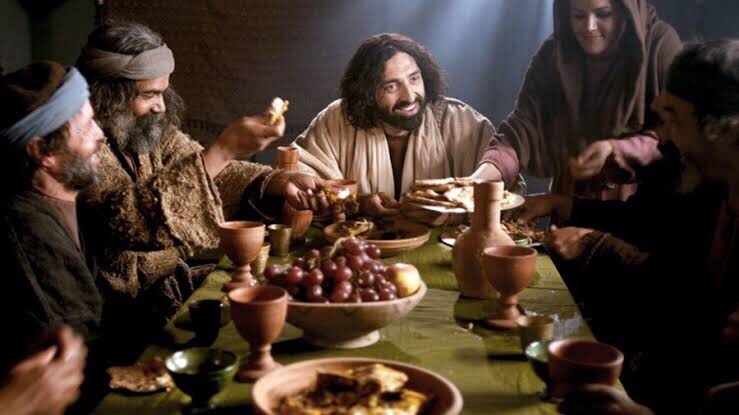
it is over food that everything happens;
it is over food that hearts are opened,
fears are revealed, and love is expressed;

it is over food that everything happens;
the sharing of hopes, the comforting of anxieties,
the telling of stories, the healing of hurts …

it is over food that we meet: food, bread and wine,
the basic stuff of life, here, now, for us, from eternity.


We offer our prayers:

In time beyond our dreaming, beyond our marking …
in Daramoolen … in Tjukurrpa … in Alcheringa
you brought forth light out of darkness:
swirling waters, dazzling colours, singing stones,
and you set woman and man in the midst of your creation.

In the covenant with Israel
you mandated holiness and steadfast love,
through the voices of the prophets
you called for justice and righteousness,
in the songs of the psalmists and the wisdom of the sages
you spoke truth and wisdom, hope at the gates.

And then, in the fullness of time
—in that particular wrinkle in time—
you sent forth Jesus, your Son:
gift of grace, gatekeeper of hope;
perfect grace, embodying you,
dangerous grace, confronting, challenging;
the grace of perfect danger
sent to the place of resistance and defiance
in the face of Empire: Roman—human—Empire.


We remember:

And so, as we have been marking the time,
we remember that time around the table, at the meal—
for everything happens over food.

And at this particular wrinkle in time, we remember:
how he took – blessed – broke – and gave them bread,
how he took – blessed – poured – and gave the cup;
blood shed from perfect danger,
blood shed as perfect grace,
sign of hope at the gates of hope,
promise and foretaste—stimulus and challenge—
the place of truth telling about our souls …
our ground … our struggle … our hope.

We mark that time in this time, now.


We pray for others:

And as we mark the time and remember that moment,
we celebrate this moment above the rivers vibrating,
amidst the stones singing, we celebrate and pray …

[specific names and issues may be named after each pause]

for each other …

for the people with whom we minister
and the urgencies that will undoubtedly claim us on our return …

for those who have been with us,
but have returned to responsibilities …

for colleagues unable to be with us here …

for those, here and beyond, who are pondering,
discerning, conversing, deciding about new possibilities …

for those who are moving on
into new pathways, new ventures …

for those towns and cities beyond us,
across this wide brown land …

for people and nations beyond our shores …

for creatures and ecosystems across the planet …

and we join in the Lord’s Prayer …

then we share the Peace …

then our Prayers continue:

Bless us, bless those for whom we pray, bless us all.

Bless this land,
with rivers vibrating, stones singing, land yearning.

Bless these gifts of bread and wine.

Send your Spirit to meet with our spirits, our very being.

Send your Spirit into these gifts of bread and wine,
that they may be for us body of Christ, blood of Christ,
to nourish us and change us
to be people of God, body of Christ, communion with Spirit,
here, now, on earth as in heaven.

The elements are shared amongst the people in silence

We mark the time of our moving on
and take the time to bless our going forth:

May you travel in an awakened way,
Gathered wisely into your inner ground,
That you may not waste the invitations
Which wait along the way to transform you.

May you travel safely, arrive refreshed,
As you have lived] your time [here] to its fullest;
Return home more enriched and free
To balance the gift of days which call you.


The Blessing of the Angels (sung)


John T. Squires
30 October 2019


Many thanks to the Rev. Dr Sarah Bachelard for the gentle leading, rich resourcing, and inspiring modelling of deep spirituality, which she offered throughout the Retreat.


Notes

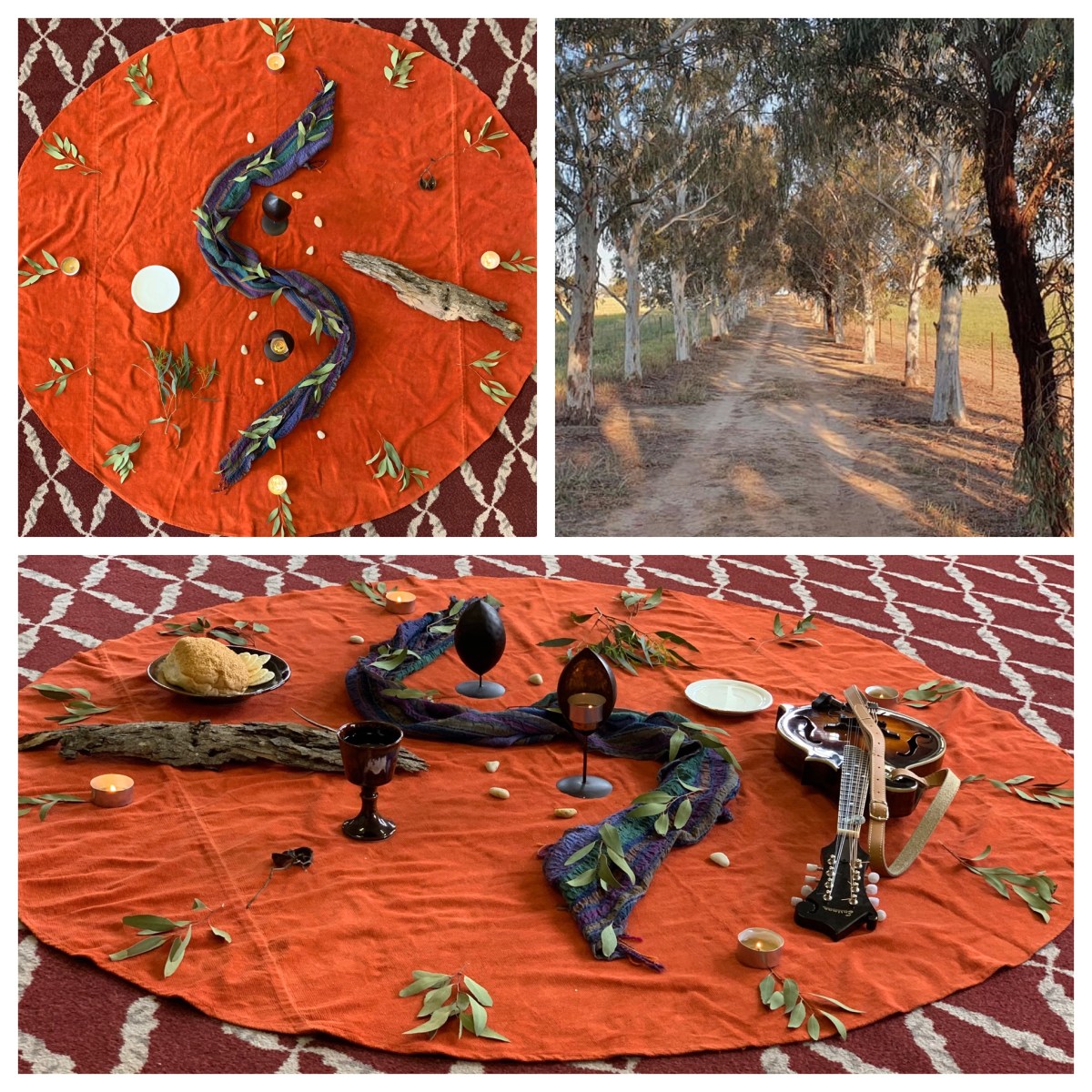
The featured image is of the symbol that sat at the centre of the group throughout the Retreat, which was variously adapted at points throughout.

The term Dreamtime is an English attempt to render various Indigenous words that describe Aboriginal culture and spirituality. Included here are Daramoolen (Ngunnawal), Tjukurrpa (Walpiri and Pitjantjatjara) and Alcheringa (Arrernte)

“Marking the times” was offered by Sarah as the overarching theme for the Retreat, inspired by a phrase in the Book of Common Prayer (‘read, mark and inwardly digest‘)

“A wrinkle in time” is the title of a book by Madeleine L’Engle

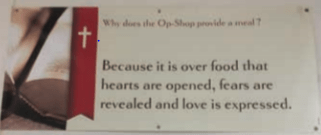
“It is over food that hearts are opened, fears are revealed, and love is expressed” is taken from a sign in the Op Shop at Jindabyne Uniting Church

Jindabyne Op SHop

“Stones that sing and rivers vibrating” is taken from There are stones that sing by Mary Oliver

“The grace of perfect danger” is taken from For the Artist at the Start of the Day by John O’Donohue

“The place of resistance and defiance” and “the gates of hope” is taken from The Gates of Hope by Victoria Safford

“The urgencies that claim you” and the closing blessing, “may you travel …”, are both slightly adapted from For the Traveller by John O’Donohue

Other poems used on the Retreat include A Morning Offering by John O’Donohue, A Sleep of Prisoners by Christopher Fry, Still Point by Max Reif, Sonnets to Orpheus Part Two, XIII by Rainer Maria Rilke, and No Sooner by Michael Leunig

This is the proper way: no climbing

34 years ago today, on 26 October 1985, Uluru was handed back to the Anangu peoples, the Traditional Custodians. On that day, the Governor-General, Sir Ninian Stephen, ceremonially handed over title for the Uluru-Kata Tjuta National Park to the Anangu peoples.

Now, 34 years later, as from today, 26 October 2019, Uluru will no longer be able to be climbed. The Anangu peoples have for a long time, decades even, asked visitors not to climb this sacred place. Now, that has come to be.

It is believed the first European explorer to climb Uluru was an Englishman, William Christie Gosse, in 1873. However, as there are no specific records for this, the first climb actually recorded climb was in 1936, with the introduction of tourism to the region.

Since the 1950s when records were first kept, there have been a total of 37 fatalities on the treacherous climb. The most recent fatality was on 4 July 2018, when a 76 year old Japanese tourist collapsed when he was attempting to ascend one of the steepest parts of the climb. There hadn’t been a death on the Uluru climb before this since 2010, when a 54-year old Victorian man collapsed while attempting to reach the top.

In 1966, after two fatalities occurred in 1964, a chain was installed along a portion of the climb, without consultation or consent from the Traditional Owners. The chain was upgraded and ultimately completed in 1976. What will happen with the chain, posts and landmark cairn installed on top of Uluru after the closure of the climb is yet to be determined.

(I obtained this information from https://www.ayersrockresort.com.au/uluru-and-kata-tjuta/uluru-and-kata-tjuta-national-park/can-i-climb-uluru)

The First People of the area are the Yankunytjatjara and Pitjantjatjara people, the traditional landowners of Uluru-Kata Tjuta National Park. In their language, they call themselves Anangu. The landscape of the region is closely related to a series of stories from their heritage. What can be told in public about these stories can be found at https://parksaustralia.gov.au/uluru/discover/culture/stories/.

On the website of the Uluru-Kata Tjuta National Park, the Anangu people have said this about climbing Uluru:

We Anangu have a responsibility to teach and safeguard visitors to our land. The climb can be dangerous. Too many people have died while attempting to climb Uluru. Many others have been injured while climbing. We feel great sadness when a person dies or is hurt on our land. We worry about you and we worry about your family. Our traditional law teaches us the proper way to behave.

See https://parksaustralia.gov.au/uluru/discover/culture/uluru-climb/

And they offer these words, from Kunmanara, a traditional owner:

“That’s a really important sacred thing that you are climbing… You shouldn’t climb. It’s not the real thing about this place. And maybe that makes you a bit sad. But anyway that’s what we have to say. We are obliged by Tjukurpa to say. And all the tourists will brighten up and say, ‘Oh I see. This is the right way. This is the thing that’s right. This is the proper way: no climbing’.”

(Tjukurpa is the traditional law, stories and spirituality of the Anangu)

See https://parksaustralia.gov.au/uluru/discover/culture/uluru-climb/

Please Leave ?? No — Please Stay !!

There has been a lot of media interest in the recent declaration by the Anglican Archbishop of Sydney, concerning the way that some dioceses, a number of ministers, and many, many people of faith are grappling with our changed understandings of gender and sexuality, and how that relates to Christian faith.

It is a complex matter, with many nuances, that deserve careful consideration, and compassionate reflection.

The words of the Sydney Diocese leader, however, cast the situation in a clear black-and-white manner, with the stinger of a sharp command to those with whom he (and many in his Diocese) disagree: “please leave”.

The full set of words from this part of his speech is instructive: “My own view is that if people wish to change the doctrine of our Church, they should start a new church or join a church more aligned to their views – but do not ruin the Anglican Church by abandoning the plain teaching of Scripture. Please leave us.”

So sayeth the Anglican Archbishop of Sydney, the Rev. Dr Glenn Davies.

(A full account of his speech to the Anglican Synod is reported on the Sydney Diocese webpage at https://sydneyanglicans.net/news/guarding-the-faith-in-a-changing-world and in Eternity News at https://www.eternitynews.com.au/australia/please-leave-us-sydneys-anglican-archbishop-tells-progressive-christians/)

But there are a number of problems with what Dr Davies said.

The Archbishop distanced himself from “people who] wish to change the doctrine of our Church”. The first problem is, that doctrine is always changing. It was changing in the early decades of the church. It changed significantly in the various Reformations of the 16th century, under the leadership of Jan Huss, Martin Luther, Jean Calvin, Huldrych Zwingli, John Knox, and then the response of the Council of Trent in the Roman Catholic Church.

It changed in 1540, when Henry VIII of England sanctioned the complete destruction of shrines to saints, and further in 1542, when Henry dissolved monasteries across the country—actions which changed doctrines and led to the formation of the very church in which Glenn Davies was ordained and then consecrated!

It changed when, during the Enlightenment, theologians and scholars applied principles of rational thinking to scriptural texts and faith concerns. It continues to change in the postmodern world, as new discoveries and insights lead Christian leaders to bring new questions to faith issues, and to formulate beliefs in ways that connect with and make sense within the changing world.

In my own denomination, the Uniting Church in Australia, we recognise this when we recall the paragraph in our Basis of Union that affirms “the continuing witness and service”, not only of evangelists, prophets, and martyrs, but also of scholars; and which notes that as we engage with “literary, historical and scientific enquiry … [of] recent centuries”, we are able to develop “an informed faith” of relevance to the current times.

Doctrine is dynamic; it is always in a state of flux. Theology is transient; it is always developing. Church teaching is constantly evolving; it is never static.

(On my take on interpreting the classic creeds of the church, see https://johntsquires.com/2018/11/02/interpreting-the-creeds-in-a-later-age/; on how the Uniting Church envisages the factors involved in this process, see https://johntsquires.com/2018/07/30/seeking-an-informed-faith/)

Second, the Archbishop referred to “the plain teaching of Scripture”. The second problem, then is that scripture does not actually have a plain teaching. There are words, written in the Bible, which need to be interpreted, if they are to be understood and applied to contemporary life. There is no plain and simple teaching in these words; they are words which always need interpretation.

This interpretation starts with the choice of text. We do not have an “original version”; we have copies of copies, some complete, many fragmented. There are always options to consider–and we all rely on experts in this matter. Then comes the matter of language. Biblical texts were written in languages other than English. We English-speakers are reliant on the careful work of translators and scholars, seeking to render the phrases of Hebrew, Aramaic, and Greek, into contemporary English. There are already multiple interpretive decisions that have been made for us, in our English Bibles.

Then, interpretation needs to take into account the differences in culture that exist, between the patriarchal, honour-shame cultures of antiquity, and the current state of play within (in our case) contemporary Australian society. We can’t just assume that something from an ancient culture “makes sense” in our contemporary culture, let alone that it can be “directly applied” into our context. There are interpretive decisions to be made.

(I have written about this dimension at https://johntsquires.com/2018/12/07/to-articulate-faith-contextually/)

The process of interpretation also needs to bear in mind how the usage of particular words and ideas has changed over time. Awful, for instance, once had a very positive sense, “full full of awe or admiration”, whilst nice had an earlier sense of “silly, foolish”. Guy (from the historical British figure Guy Fawkes) had an earlier sense of a frightening figure, not the generalised reference to men that it has today, whilst meat in earlier centuries was a catch-all term referring to food in general. (And, most pertinent to the particular issue at hand, “gay” once had a very different point of reference in English!)

These kinds of shifts in usage are also found in terms that appear in the Bible, especially in translations from some centuries ago. We need to factor that in to our interpretation.

And then, reading and interpretation of the Bible involves application, discerning how and in what ways a biblical passage is relevant for us today. That means knowing what our situation is as well as what we hear in the biblical text, and connecting the two. It is not simple or straightforward.

In an earlier interview about his view of matters of sexuality (and other issues), Dr Davies referred disparagingly to “a virus in the national church, caused by not teaching properly the word of God” (see https://www.thepastorsheart.net/podcast/2019/9/17/archbishop-davies-on-public-christian-leadership).

That’s an unfair and unhelpfully polemical characterisation of what is a complex and nuanced matter—reading biblical passages about sexuality in contemporary society. The biblical texts about sexual relationships involving people of the same gender are not simple and self-evident prohibitions on such behaviour, and should not be read as such.

Elizabeth and I have contributed a discussion of this matter which, I believe, offers more constructive lines of understanding; see https://johntsquires.com/2018/07/30/marrying-same-gender-people-a-biblical-rationale/ as well as https://johntsquires.com/2019/06/26/human-sexuality-and-the-bible/ and https://www.unitingnetworkaustralia.org.au/wp-content/uploads/2019/06/02-Human-Sexuality-in-Biblical-Perspectives.pdf.

(More generally, see https://johntsquires.com/2018/07/30/the-word-of-god-scripture-and-jesus-christ/)

Third, the Archbishop—quite strikingly—has urged certain people to leave the Anglican Church. I believe that advocating that people leave one church to start another church is not a helpful activity. Anglicans, like other mainstream denominations, have a commitment to unity in the church. So, the third problem is a lack of commitment to the unity of the church.

That’s quite an amazing position for a leader in a denomination which affirms that it is, indeed, an integral part of the One, Holy, Catholic and Apostolic Church—and which is universally recognised by other denominations as an integral part of that Church.

Each Sunday, in Anglican churches around Australia (and beyond), faithful people affirm, “I believe in one, holy, catholic and apostolic Church.” That’s a line in the Nicene Creed. And those Anglicans are joined by many Roman Catholics, members of the many Orthodox churches, and quite a number of folk in the various Protestant churches, to say these words together on regular (even weekly) occasions. Across the denominations, there is a commitment to unity.

Not in the Sydney Anglican Diocese, however. The Archbishop’s invitation to those who see things differently from him to leave the church and form their own branch is fracturing the unity of the church even more by this narrow, sectarian dogmatism.

Even his own colleagues, it seems, have recognised that Dr Davies has crossed a line with his rhetoric in recent days (see https://www.theage.com.au/national/even-conservative-rectors-shuddered-why-sydney-archbishop-s-words-hurt-20191018-p531ye.html). Such rhetoric serves only to exacerbate differences and intensify hurt. Is that really being faithful to the office into which he has been called?

The worldwide leader of the Anglican Communion, the Archbishop of Canterbury, the Most Revd Justin Welby, has affirmed that “reconciliation is the hallmark of Anglicanism, the heart of the gospel and a life to which we are all called” (see https://www.anglicancommunion.org/mission/reconciliation.aspx).

Archbishop Welby is promoting through the Anglican Communion a resource entitled Living Reconciliation, which “offers a vision of Church marked by honesty, truthfulness and love … [and] applies the teaching of the Gospel at precisely the point where we need it most today” (see http://living-reconciliation.org/thebook/).

Is the Archbishop of Sydney aware of just how contrary his words are, to the principles of reconciliation and the commitment to an honest, loving church that is being championed by the Archbishop of Canterbury?

Finally, the Archbishop of Sydney is quoted as imploring those with whom he disagrees: do not ruin the Anglican Church. The fourth problem I see is that exploring and developing ideas is not a process of ruination.

Rather, the exploration of ideas and the development of thought is a constructive process that offers a gift to the church at large: the gift of an ever-evolving, ever-refining articulation of beliefs in ways that resonate with life in the contemporary age. Questions, provocations, redefinitions, and developments in thinking and believing are wonderful gifts!

I wouldn’t characterise the process as one of causing ruin. Rather, I would celebrate it and affirm the importance of this process. The problem, it seems to me, is that if you really believe that you have The Truth, then you are impelled to convince others of that Truth. But if you believe you are called to Love others, then you will listen and learn.

Sadly, the Archbishop has demonstrated this stark difference: when we prioritise Truth, we inform, lecture, admonish, even berate; whereas when we prioritise Love, we enter into relationships, affirm, explore, nourish, question, rethink, and develop in community with each other. Quite a different ethos. Quite a different result.

Please Leave? No—Please Stay! To the people addressed by Dr Davies, I say: Please stay in the Christian church and help us to be faithful to the Gospel. Please stay in the Christian church and help us to change in ways that are positive and life-giving. Please stay and gift your distinctive contribution to the life of the church in your locality and beyond.

And to the Archbishop, if he really is committed to the process of leaving, I say: you please leave. Please leave behind homophobic fear and discriminatory rhetoric. Please leave behind your insistence on conformity to your particular dogmatic assertions. Please leave behind your criticisms of those who happen to be born different from you. That’s what I would like you to leave.

What does it mean to say that the Bible is inspired? (2 Tim 3:16; Pentecost 19C)

How many times have you heard it said, “the Bible is the inspired Word of God” ? Have you ever thought about what this phrase actually means ? Paul Achtemeier, in his book The Inspiration of Scripture, has indicated the problems that are inherent in using the terminology of “inspiration” loosely.  He points to issues related to the use (or abuse) of this term.  The matter is not quite as simple as it first appears.

 The traditional answer to the question of what this statement means, is to assert (quite correctly) that the Bible uses this concept of inspiration to define itself.  However, we need to be careful in simply lifting out one word (this is all it is, even in Greek!) and making it the lynchpin of a massive argument.  The claim that “God said it; I believe it; that settles it” is ultimately an inadequate answer if we are truly seeking understanding of our faith.

 What, then, is the biblical evidence for the claim of inspiration? 2 Timothy 3:16 is generally regarded as the “proof text” for this topic, with the claim being made that all scripture is inspired. This verse appears in the passage set for reading in churches this coming Sunday, as the epistle reading in the Revised Common Lectionary.

However, even this verse must be viewed in context.  It cannot readily be extracted from its context and pressed into service as an abstract definition; we cannot assume that it is the fundamental principle held by all biblical writers, as no other writers of other biblical books give any indication that it was adhered to in this way.  We should note a number of aspects of this verse which caution us against making it a fundamental universal principle which applies equally in every case.

Is this the last word on the matter? Some interpreters have argued that the whole of 2 Timothy should be seen as a last testament of Paul — an attempt to set out his final thoughts in a clear, systematic, programmatic manner, as his last will and testament for his followers. However, caution is again required at this point. 

The authenticity of 2 Timothy is debated. Some scholars claim that it was not written by Paul, others say that he dictated it to a secretary, while yet others argue that it does contain fragments of material written by Paul, which are placed within a larger framework of a whole letter by another writer.  (See https://johntsquires.com/2019/10/01/in-the-name-of-the-apostle/)

Whatever the origin of the letter, it is clear that it was written in a specific context; it is by no means an attempt to set out basic principles, but rather applies such principles to a given situation.

 Inspired. First, the Greek word translated “inspired” is theopneustos, which literally means, “breathed by God”.  This was not a common term in the first century CE; many other similar terms were available prior to the New Testament to describe the activity of inspiration.  So the use of this term is not in itself a clear-cut way of proposing a “doctrine of inspiration” in first century terms.

 Useful. Further, we should note that in 2 Timothy 3:16 the definition which is given is functional, not ontological that is to say, it identifies the effect scripture has, and does not define the essence of scripture in and of itself.  The emphasis is placed on the fact that scripture is “useful” or “profitable”.  Inspiration, so it seems, does not reside in the writings themselves, nor in the writer, but results from the process of using (or applying) scripture.

 Scripture. A further issue concerns the word graphe, usually translated as “scripture”.  This word literally means “writing”, and normally it applies to Old Testament books.  At the time of writing 2 Timothy, it could not yet apply to the New Testament in a direct manner, since the complete New Testament was not yet formed. 

In his authentic writings Paul himself shows little awareness of the Gospels or of Gospel traditions; and there is no evidence for the collection of Paul’s letters until early in the second century CE.  By contrast, Paul regularly cites scriptures from his own tradition, the Hebrew scriptures, and it is clear that he considers these works to be important guides for living by faith. Romans, Galatians, and both letters to the Corinthians contain numerous such instances.

(There are explicit citations of Hebrew scriptures at two places in the Pastoral Epistles: 1 Tim 5:17-20, quoting Deut 25:4 and alluding to Deut 19:5, and 2 Tim 2:19, citing Num 16:5 and Isa 26:13.)

Thus, this statement was originally NOT about the whole of the Bible; it is only by inference that we can refer it to the whole of the Bible.

 Useful for … Finally, let us note the diversity of functions here attributed to inspired writings: they can be used for teaching, reproof, correction, and training in righteousness.  Thus, a richness of meaning is perceived within scripture, indicating the diversity of ways of applying scripture.  There is no single function which is foundational; nor does this verse set out all the functions of scripture (the Psalms, for example, function in a number of different ways — for praise, lament, celebration, petition, confession, remembrance, and so on).

 Thus, 2 Timothy 3:16 itself does not offer a full and satisfactory answer to the question, what does it mean to say that the Bible is inspired?  It offers one insight, but it needs to be balanced against others.  It is not the last word on the matter.

Certainly, it is clear that this passage can refer only to the Hebrew scriptures, for the New Testament as we know it was not yet formed, even in the early decades of the second century. And it points towards a functional understanding of scripture, providing no basis for any claims about the divinely-inspired and absolutely authoritative nature of the books of the Bible.

See also https://johntsquires.com/2019/10/01/in-the-name-of-the-apostle/

https://johntsquires.com/2019/10/07/rightly-explaining-the-word-of-truth-2-tim-215/

https://johntsquires.com/2019/06/17/harness-the-passion-but-restrain-the-rhetoric-musing-on-the-role-model-which-paul-offers-in-galatians/

https://johntsquires.com/2018/11/17/let-your-gentleness-be-known-to-everyone/

Rightly explaining the word of truth (2 Tim 2:15; Pentecost 18C)

Do your best to present yourself to God as one approved by him, a worker who has no need to be ashamed, rightly explaining the word of truth. So writes Paul to his “beloved child”, Timothy, in the second letter that we have addressed to this co-worker.

(On the reasons why this letter may well not have been written by the apostle Paul himself, but by one of his followers after Paul’s lifetime, see https://johntsquires.com/2019/10/01/in-the-name-of-the-apostle/)

The letter presents a scenario that sees Paul in prison (1:8; 2:9), in contact with a group otherwise unknown from his letters—Eubulus, Pudens, Linus and Claudia (4:21). As Paul was previously in Corinth and Miletus (4:20) and is in Rome as he writes (1:17), the letter itself suggests a time near the end of his life. He writes, we are led to believe, as a mature believer, imparting wisdom to a younger co-worker.

This assumption is supported by some of the imagery used, with Paul describing his life as “poured out as a libation” (4:6) and stating that he has “fought the good fight” (4:7). We know virtually nothing of this period from Acts; the last description of Paul that we have in Acts (28:30–31) is generalized and non-specific, so we can’t cross-check with anything there.

This letter, like 1 Timothy and Titus, gives indication of disagreement and conflict within the early Christian communities, with varied understandings of faith being present in the place where the recipient of the letter is based.

 The opponents envisaged in this letter are described largely with reference to their verbal activity: they utter “profane chatter” (2:16), their “talk spreads like gangrene” (2:17), they engage in “wrangling over words” (2:14) and “stupid and senseless controversies” (2:23); they “captivate silly women” (3:6) and their “myths” are listened to by people with “itching ears” (4:3–4). The author certainly possesses a vivid vocabulary!

The author contends that these opponents are “people of corrupt mind and counterfeit faith” who oppose the truth (3:8), “wicked people and imposters” who deceive others (3:13); they have been “ensnared by the devil” (2:26). The long list of vices (3:2–5) might also be inferred as applying to these people. The rhetoric is aggressively antagonistic.

 The one specific identifying mark of these people who have “swerved from the truth” is their assertion that “the resurrection has already taken place” (2:18). Against this, the author refers to the future appearance of Jesus (4:1, using the Greek word epiphaneia, most unusually for Paul). There is also a quotation of scripture to refute the heresy (2:19, citing Num 16:5 and Isa 26:13).

Paul offers clear guidance to Timothy as to how he is to deal with such opponents. He provides Timothy with short, concise summaries of the faith that they share (2:11-13; see also 1 Tim 2:5-6 and 3:16) and advises, Remind them of this, and warn them before God that they are to avoid wrangling over words, which does no good but only ruins those who are listening. So Paul instructs Timothy, whom he charges to be an apologist (one who contends verbally, and vigorously, for the faith).

The apologetic that Timothy is to exhibit is succinctly expressed in the excerpt from the letter set in the lectionary as this Sunday’s epistle reading; Timothy is to rightly explain the word of truth (2:15).

This letter shares an apologetic quality with the first letter to Timothy, in its concern for “godliness” (2 Tim 3:5), “the truth” (2 Tim 2:18, 25; 3:7, 8; 4:4) and “the faith” (2 Tim 1:13; 2:18; 4:7). It provides various indications of the content of this faith: an epitome in three short clauses (2:8), a more discursive exposition of “the gospel” in poetic form (1:8–10) and a five-line hymn (2:11–13), introduced as yet another “sure saying” (2:11).

Paul, the nominal author of this letter, is set forth as a model for Timothy; he is described as having been “appointed a herald and an apostle and a teacher” (1:11) who provides “the standard of sound teaching” (1:13).

This “sound teaching” is entrusted to Timothy (1:12), who is exhorted to “guard the good treasure entrusted to you” (1:14). That’s the “word of truth”, direct from Paul. This word, in turn, is to be entrusted to “faithful people” (2:2) who in turn become teachers. So the letter clearly explains the way in which “the faith” is to be passed on from teacher to associate to local leaders. Paul’s authentic letters do not emphasise this line of authority in the same fashion.

 In his calling as a teacher, Paul has encountered suffering (1:12; 3:11), but he has placed his trust in Christ (1:12) and Christ has strengthened him (4:17). According to this pattern, Timothy ought then expect to suffer (2:3; 3:12) and should stand “strong in the grace that is in Christ Jesus” (2:1).

The imagery used to explain the leadership role entrusted to him refers to the soldier (2:3–4), the athlete (2:5) and the farmer (2:6); these images are consistent with the rhetoric of self-defence which Paul employs (1 Cor 3:8–9; 9:7, 10, 24–25). By contrast, the reference to household utensils (2:20–21) runs counter to the way Paul used similar imagery (“we have this treasure in clay jars”, 2 Cor 4:7).

 The author of this letter expresses a firm confidence that he has gained “the crown of righteousness” (4:8) in his eternal destiny. For Paul to write this would be unusual, as he elsewhere uses this imagery to describe other people (not his own destiny) as his crown (the Philippians, Phil 4:1; the Thessalonians, 1 Thess 2:19–20).

As the letter draws to a close, the author asserts that “the Lord will rescue me…and save me” (4:18). This heavenly rescue, assured for Paul, is promised also to those who faithfully exercise their ministry; Timothy, and other leaders, will find themselves in the company of Paul, in the heavenly kingdom (4:8). It is noteworthy that Paul regularly expresses hope in his future fate, without claiming clear certainty about it (Rom 5:1–2; 8:24–25; 1 Cor 9:10; 2 Cor 1:9–10; Gal 5:5).

It is doubtful, to me, that this element of the letter reflects Paul’s regular way of thinking. My reading of Paul’s letters is that he has much more of a concern for the present realities of life, and how the Gospel is at work in the present, than with the promise of a future off in the distance. He does not dismiss the future; but his energy and passion is oriented towards living by faith in the present.

The letter provokes us to ponder what it is that we regard as essential to the word of truth, how we go about rightly explaining that word of truth, so that others will be grasped by the good news and feel welcomed and affirmed within the community of faith.


See also https://johntsquires.com/2019/10/01/in-the-name-of-the-apostle/

https://johntsquires.com/2019/06/17/harness-the-passion-but-restrain-the-rhetoric-musing-on-the-role-model-which-paul-offers-in-galatians/

https://johntsquires.com/2018/11/17/let-your-gentleness-be-known-to-everyone/