Note: this blog post contains images of Indigenous people who have passed away.
Giving a Voice to Aboriginal and Torres Strait Islander peoples is in the news. Recently we learnt that a referendum about this matter will be held (the talk is that mid-October is the preferred time). The Uniting Church Assembly has already indicated its strong support for a YES vote in this referendum, and our Presbytery decided this earlier this year at the March meeting at Melba.
But did you know that, within the Uniting Church, we have been giving a Voice to Aboriginal and Torres Strait Islander peoples for almost four decades? That Aboriginal and Torres Strait Islander peoples are guaranteed places as members of Synods and Assemblies whenever they meet? That an Aboriginal or Islander person will often sit beside the Moderator of a Synod or President of the Assembly, and serve as co-chair of that meeting? That Aboriginal and Islander voices have a permanent pathway to speak to the whole church, through the Uniting Aboriginal and Islander Christian Conference (Congress)?
That Statement noted that “the movements of history have brought together here in one nation … people of many cultures and races, both Aboriginal and migrant”, and affirmed that within the Uniting Church, “Aboriginal and newer Australians have determined to stand together”. The Church was committing to a co-operative partnership with First Peoples—in 1988.
Before that Statement, in 1985, the Uniting Church had formed the Uniting Aboriginal and Islander Christian Conference (UAICC). The logo of the UAICC is depicted here. The Congress (as it is usually known) gave Aboriginal and Islander people a voice within the structures of the church—they are consulted about decisions and have a guaranteed number of members in the Synods and Assembly meetings of the church. The vision of the UAICC, in their own words, is:
We determine our own goals and objectives and decide policies and priorities;
We run our own programs and institutions;
We aim, in collaboration with other people, to bring to an end the injustices which hold Aboriginal and Islander people at the fringes of Australian society and to help Aboriginal and Islander people achieve spiritual, economic, social and cultural independence.
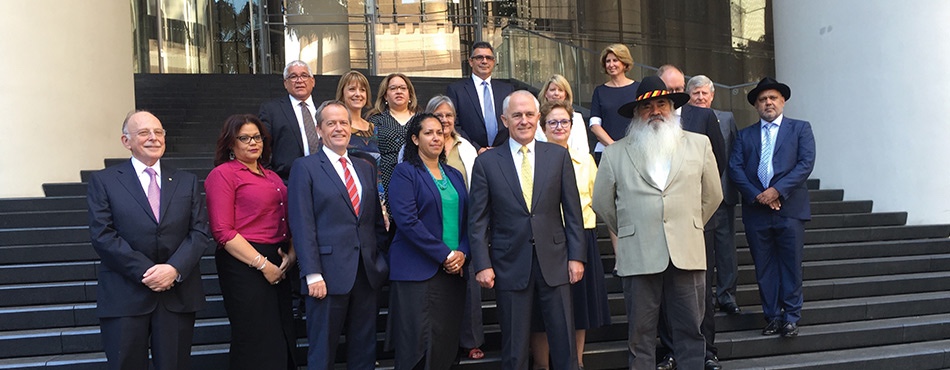
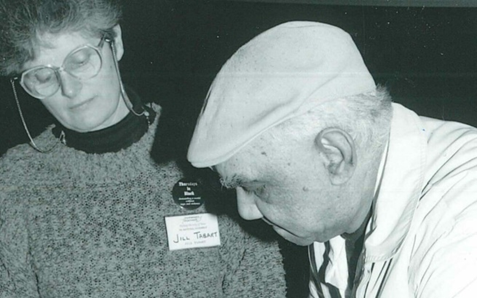
A decade later, in 1994, the President of the Uniting Church, Dr Jill Tabart, signed a Covenant Agreement with the Chairperson of the UAICC, Pastor Bill Hollingworth (pictured above). The Covenant expressed “our desire to work in solidarity … for the advancement of God’s kingdom of justice and righteousness in this land”. Since then, the church has really worked hard at putting this into practice.
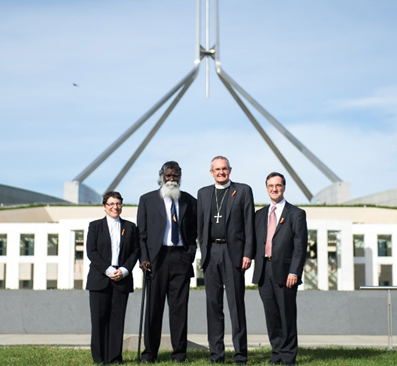
Then, in 2014, people from all over Australia travelled to Canberra to hold a prayer vigil for Our Destiny Together in front of Parliament House. Rev. Rronang Garrawurra, Chairperson of the Uniting Aboriginal and Islander Christian Congress (UAICC) and Assembly President, Rev. Prof. Andrew Dutney, led a service of worship. From remote communities in places like Arnhem Land and the Anangu Pitjantjatjara Yankunytjatjara (APY) Lands and from the centres of our big cities, people gathered to pray, pass the peace, and share in Holy Communion.
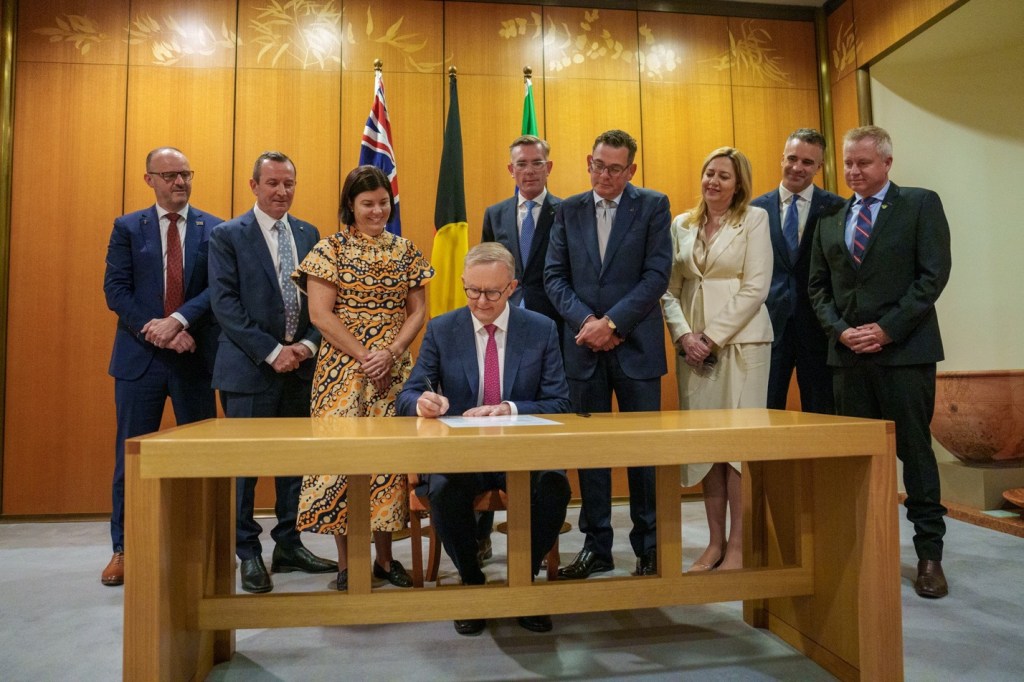
From left: the Rev. Elenie Poulus (Social Justice Director), the Rev. Rronang Garrawurra, Chairperson of the Uniting Aboriginal and Islander Christian Congress (UAICC), the Rev. Prof. Andrew Dutney, President of the Assembly, and the Rev. Terence Corkin, General Secretary of the Assembly, at Parliament House in 2014 for the A Destiny Together pilgrimage.
“It is enough for the disciple to be like the teacher”, Jesus says as he instructs his disciples about their mission (Matt 10:25). These developments within the Uniting Church show how we are striving to be like Jesus, sharing together with all people—especially the First Peoples of this continent (Aboriginal and Torres Strait Islander people).
And we know that it is possible—and, indeed, that it brings good value—for First Peoples to have a place in the councils of the church, discussing and deciding policy, and for their Voice, through the Congress, to be heard and responded to in appropriate ways.
That’s another good reason why we need to Vote YES in the referendum, surely. We need to ensure that, as well as recognising First Peoples in the Australian Constitution, we have a permanent Voice to Parliament in our ongoing structures.
Thanks to my colleague, the Rev. Dr Avril Hannah—Jones, and as Australians look ahead to voting in a referendum to make a change to our national constitution, here are some constitutional trivia questions—the answers are well worth considering!
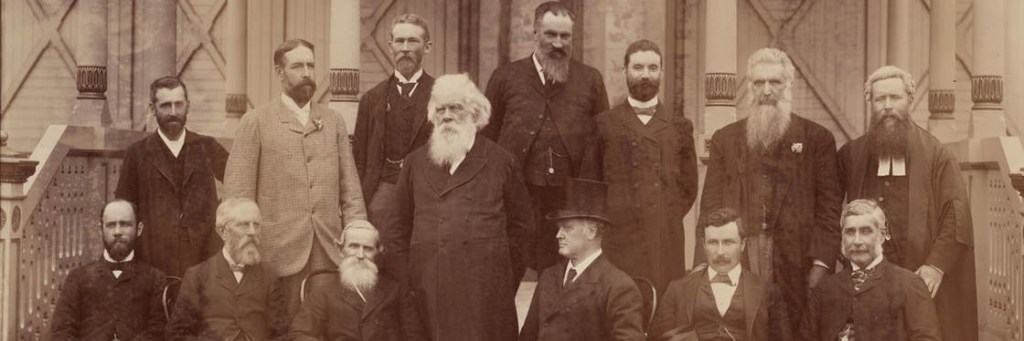
The Australasian Federation Conference, Melbourne, 1890. Source: National Library of Australia
Constitution Trivia 1: Did you know that neither the Prime Minister nor Cabinet is mentioned in the Constitution?
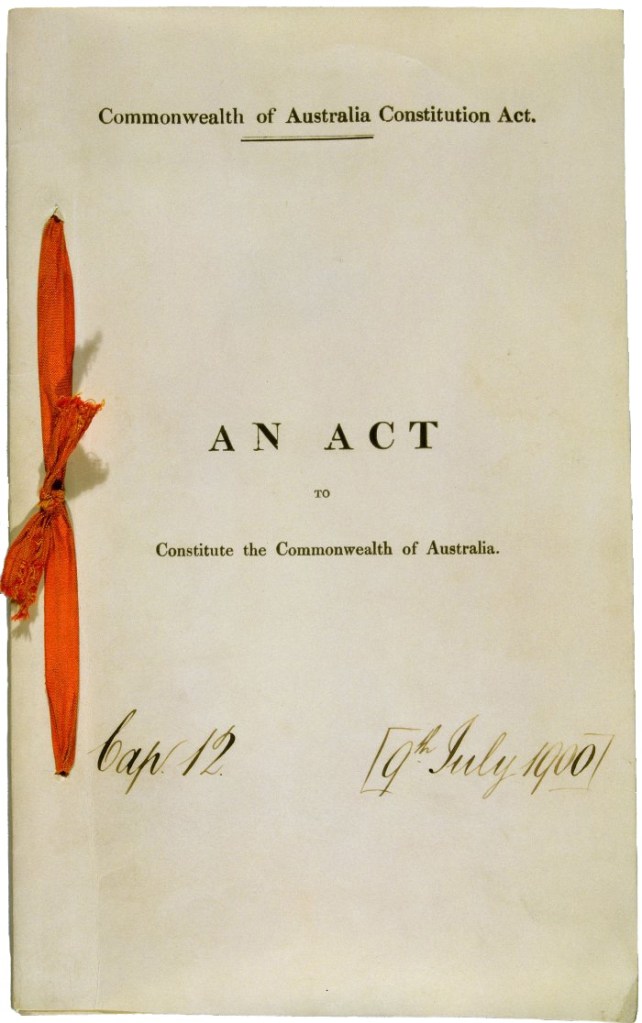
Constitution Trivia 2: Did you know that the Australian Constitution is an Act of the British Parliament?
In 1986 two simultaneous Acts were passed to formally sever all legal ties between Australia and the UK apart from the monarchy: the Australia Act 1986 (Cth) and the Australia Act 1986 (UK). These Acts had to be passed by both the Parliament of Australia and the Parliament of the UK because lawyers were unsure whether Australia alone had the authority to enact the legislation. The two Acts came into effect simultaneously, on 3 March 1986. Until 1986, the Privy Council was Australia’s highest court of appeal, and the UK Parliament could still have made laws for Australian states.
Constitution Trivia 3: Did you know Australians only have five constitutional rights?
These are the right to vote (s. 41); the right to receive ‘just terms’ if our property is acquired (s. 51 [xxxi]); trial by jury for offences against Commonwealth law (s. 80); freedom from the imposition of any religion (s. 116); and freedom from discrimination on the basis of residence in any state, so that a Western Australian cannot be discriminated against for not being a Tasmanian, for example (s. 117).
Constitution Trivia 4: Did you know New Zealand was almost part of the Commonwealth?
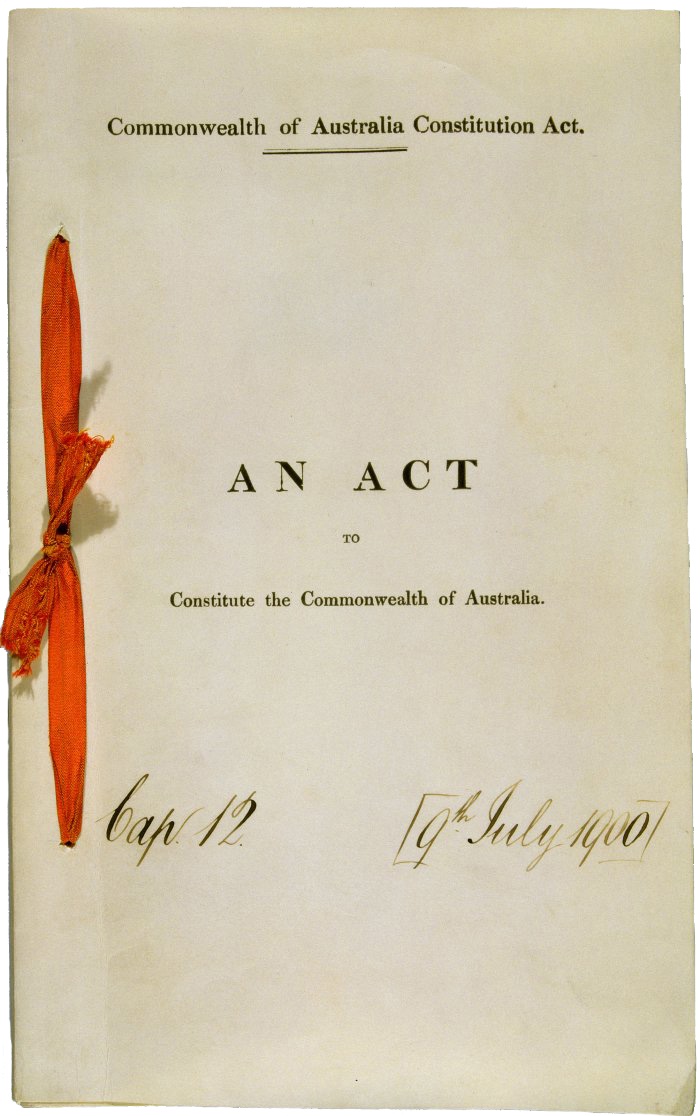
Covering Clause 6 of the Commonwealth of Australia Constitution Act, ‘Definitions,’ says that ‘the States’ in the Constitution means “such of the colonies of New South Wales, New Zealand, Queensland, Tasmania, Victoria, Western Australia, and South Australia, including the northern territory of South Australia, as for the time being are parts of the Commonwealth, and such colonies or territories as may be admitted into or established by the Commonwealth as States; and each of such parts of the Commonwealth shall be called a State”. If New Zealand does ever want to join us it can under s. 121 ‘New States may be admitted or established’.
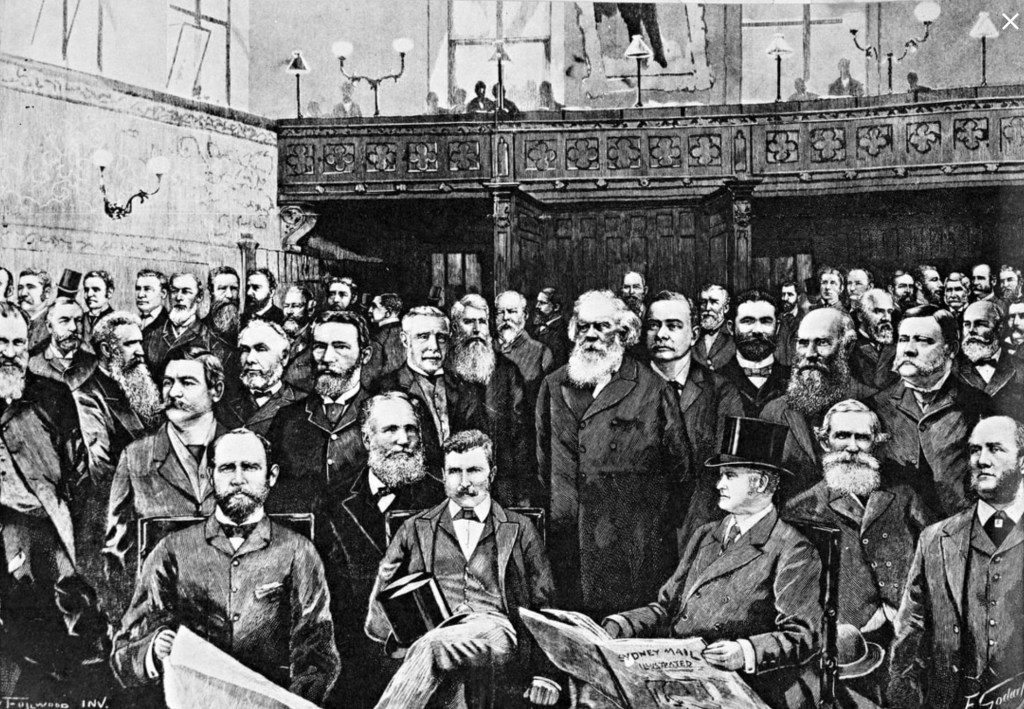
Delegates to the 1891 Federation Convention in Sydney. Source: National Archives of Australia
Constitution Trivia 5: Did you know ‘race’ is mentioned twice in the Constitution?
Section 25 says that for the purposes of determining the population of a State, in order to determine how many House of Representative seats it may have: “if by the law of any State all persons of any race are disqualified from voting at elections for the more numerous House of the Parliament of the State, then, in reckoning the number of the people of the State or of the Commonwealth, persons of that race resident in that State shall not be counted”.
Under section 51 (xxvi) the Commonwealth has the right to make laws with respect to “the people of any race for whom it is deemed necessary to make special laws”. This section was amended by the Constitution Alteration (Aboriginals) 1967, and previously read “(xxvi) the people of any race, other than the aboriginal race in any State, for whom it is deemed necessary to make special laws.” The Constitution Alteration (Aboriginals) 1967 also repealed section 127 which had said: “In reckoning the numbers of the people of the Commonwealth, or of a State or other part of the Commonwealth, aboriginal natives shall not be counted.”
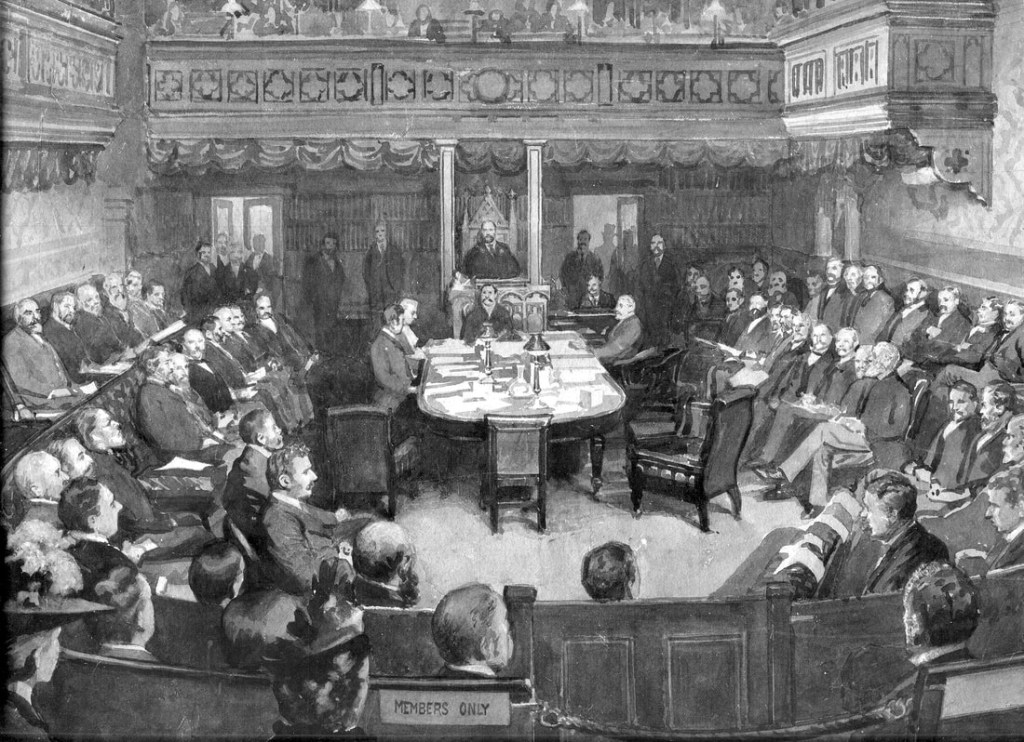
The Constitutional Convention in Sydney, 1897. Source: NSW Parliamentary Archive
Constitution Trivia 6: Did you know political parties are only mentioned in section 15 of the Constitution, and have only been there since 1977?
Section 15 covers casual vacancies in the Senate and now says that if the place of a Senator becomes vacant (for instance through resignation or death) they must be replaced by someone of the same political party. This clause was introduced after New South Wales Liberal Party Premier, Tom Lewis, appointed independent Cleaver Bunton to fill the vacancy left after ALP Senator Lionel Murphy became a High Court judge, and Queensland Country Party Premier John Bjelke-Petersen appointed independent Albert Field to fill the vacancy left after ALP Senator Bertie Milliner suddenly died, both in 1975. To prevent this from happening again section 15 was amended by Constitution Alteration (Senate Casual Vacancies) 1977.
Constitution Trivia 7: Did you know section 25. ‘Provisions as to races disqualified from voting’ is an anti-racist clause?
Andrew Inglis Clark introduced it to penalise any State that enacted racially discriminatory voting laws. If a State was to disqualify the people of any race from voting in State elections, then those people would not be counted to work out how many seats each State got in the House of Representatives, and so that State would have fewer seats than States without racially discriminatory voting laws. Sadly, there was no attempt made to penalise States that denied women the vote, and when the Constitution was being drafted some of them did!
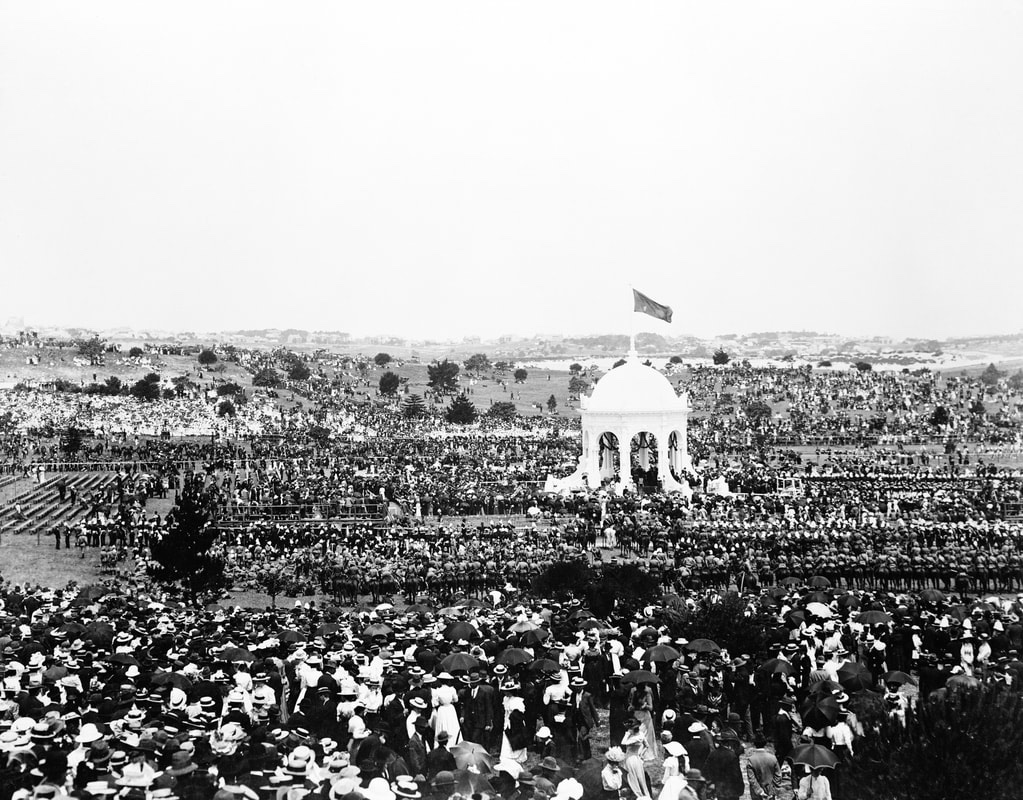
On 1 January 1901, the Constitution of Australia came into effect. A five mile parade was held to commemorate Federation, which included horse-drawn floats and specially constructed Federation Arches that the procession passed through. 500,000 people lined the route from the Domain to Centennial Park. More than 60,000 people poured into Centennial Park, including 7,000 dignitaries and guests and 300 members of the press, all watching as the first Federal Government was formed (pictured above). Three choirs sang for the occasion, including a choir of 10,000 school children, a church choir of 400 people and another choir of a thousand. Source: The Parliamentary Education Office, Canberra
Avril has promised that there are more trivia questions to come … so stay tuned!!
“I delight in the law of God in my inmost self, but I see in my members another law at war with the law of my mind” (Rom 7:23). So Paul writes, in the section of the letter written “to all God’s beloved in Rome, who are called to be saints” which is offered by the lectionary for this coming Sunday (Rom 7:15–25a).
The lectionary wants us to end this reading with the words of gratitude, “thanks be to God through Jesus Christ our Lord!” (15:25a). But in my analysis, Paul’s argument reaches its conclusion with the stalemate of verse 23—a clash between “the law of God” and “the law of my mind”. “Wretched man that I am”, he explodes in exasperation (7:24), after a lengthy and complex consideration of the issues which has led him to this damning conclusion.
What Paul is writing about in this complex section (7:1–25) is about the battle of wills, as God’s will comes into conflict with human will. The argument throughout this chapter—as, indeed, the argument throughout much of Romans—is presented as a dialectic, in which one point of view is put, to be met by an opposite point of view; followed by a rebuttal by the first voice, and a further oppositional claim by the second voice.
The thesis for discussion has been set out in 7:1–6, using the marriage relationship between husband and wife and “another man” (7:1–3) as the basis for an analogy (“in the same way”, 7:4) for the relationship between humans, “living in the flesh” (7:5) whilst also having “the new life of the Spirit” (7:6).
The use of analogy, already developed in earlier Greek rhetoric and used extensively by philosophers and political orators, does reflect rabbinic practice. The deployment of analogy, gezerahshewah, was one of Hillel’s principles of interpretation, indicating the influence of hellenistic thought and ideas on Jewish teachers and writers. So Paul here may well be operating as a rabbi, in the way that he sets out and developed his case.
But the fundamental dualism which underlies this whole chapter—the law of sin and death, the holy law of God—is thoroughly Greek in origin and character. Plato’s view of the soul trapped in the prison of the material world, which he set out in his Allegory of the Cave and which marks so many of his Dialogues: a clear line of demarcation between the spirit and the flesh, the body and the mind, the idea and the particular object.
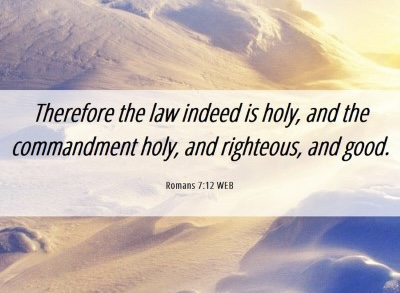
So Paul, trained as a Pharisee, being “far more zealous for the traditions of my ancestors” (Gal 1:14), brings into the discussion a “delight in the law of God in my inmost self” (Rom 7:22). He affirms that he upholds the Torah (Rom 3:31), alluding to various commands in The Ten Words which he insists are worth obeying (2:17–22), and affirming that, in its essential character, “the law is holy, and the commandment is holy and just and good” (7:12).
Yet his calling to be “apostle to the Gentiles” (Rom 11:23; Gal 2:8) led to his experience of eating at table with Jews and Gentiles together, in breach of kosher food laws (Gal 2:11–13)—an issue that is clearly in view decades later, as Luke writes his account of the early years of the Jesus movement, siding with Paul in the view that God has set aside the requirement for separate foods and separate tables (Acts 10:1–11:18; 15:19–20, 28–29).
This, in turn, leads Paul to his missionary goal of bridging the gap between Jews and Gentiles in practical ways (Rom 15:25–27), undergirded by the message that he preaches, affirming that salvation is offered “to everyone who has faith, to the Jew first and also to the Greek” (Rom 1:16; see also 2:10; 10:12; Gal 3:28; and the post-Pauline development in Eph 2:11–22). He is driven by the scriptural claim that “God shows no partiality” (Rom 2:11; Deut 16:19–20; 2 Chron 19:7; Sir 35:15–16).
So Paul brings a firm commitment of this universal availability of salvation into this discussion in Rom 7:1–25. The argument that he has set out in the thesis of 5:1, “since we are justified by faith, we have peace with God through our Lord Jesus Christ, through whom we obtained access to this grace in which we stand”, is argued throughout the ensuing verses, and given a ringing affirmation at the end in 6:23, that all humanity is able to know and access “the free gift of God [which is] eternal life in Christ Jesus our Lord” (6:23).
This sounds, to us today, like a formal debate: three speakers, alternating between the Government for the proposition, the Opposition against the proposition, and then short concluding remarks, before the adjudicator declares a result and announces a winner. In the ancient world, however, Paul is writing in the style of a diatribe—a form that was developed in Ancient Greece and which was widely practised by Greek rhetoricians, philosophers, and teachers during the Hellenistic period.
In the diatribe that Paul develops in Rom 7, he needs to address what he now sees as the inadequacy of Torah, given his affirmation that “God shows no partiality” (2:11) and his commitment to Jews and Gentiles eating together, without scruples regarding the food being shared. This deficiency in the law runs throughout the argument of Romans; it is impossible to keep the law (2:17–3:20).
Since his calling to work amongst the Gentiles, Paul has come to see that the law brings wrath (4:15) and increases sin (5:20), and indeed he maintains that the law “brought death” (7:9). As a consequence, righteousness must be gifted by God “apart from law”(3:21).
Paul, as we have seen, uses the scriptural example of Abraham, who “believed God, and it was reckoned to him as righteousness” (4:3), to argue that “the promise may rest on grace and be guaranteed to all his descendants, not only to the adherents of the law but also to those who share the faith of Abraham” (4:16). See
And so, he declares that “you have died to the law through the body of Christ, so that you may belong to another, to him who has been raised from the dead” (7:4), and thus “we are discharged from the law” (7:6). Paul then demonstrates this in what immediately follows. The law is not sin in and of itself; and yet, “if it had not been for the law, I would not have known sin” (7:6). This is seen, first, through the educational function of the law, which teaches for example, about covetousness (7:7–8a).
Then Paul notes that, paradoxically, the essential nature of the law reveals and activates sin (7:8b—10), so that “the very commandment which promised life proved to be death to me”, before he intensifies this with the claim that “sin, finding opportunity in the commandment, deceived me and by it killed me” (7:11).
He concludes this section with affirmation of the law as “holy, just, and good” (7:12), before clarifying that it was not the Law which brought death to him, but rather “it was sin … working death in me through what is good … through the commandment” (7:13). Paul has worked hard to differentiate sin from the Law; the one is evil, the other is good.
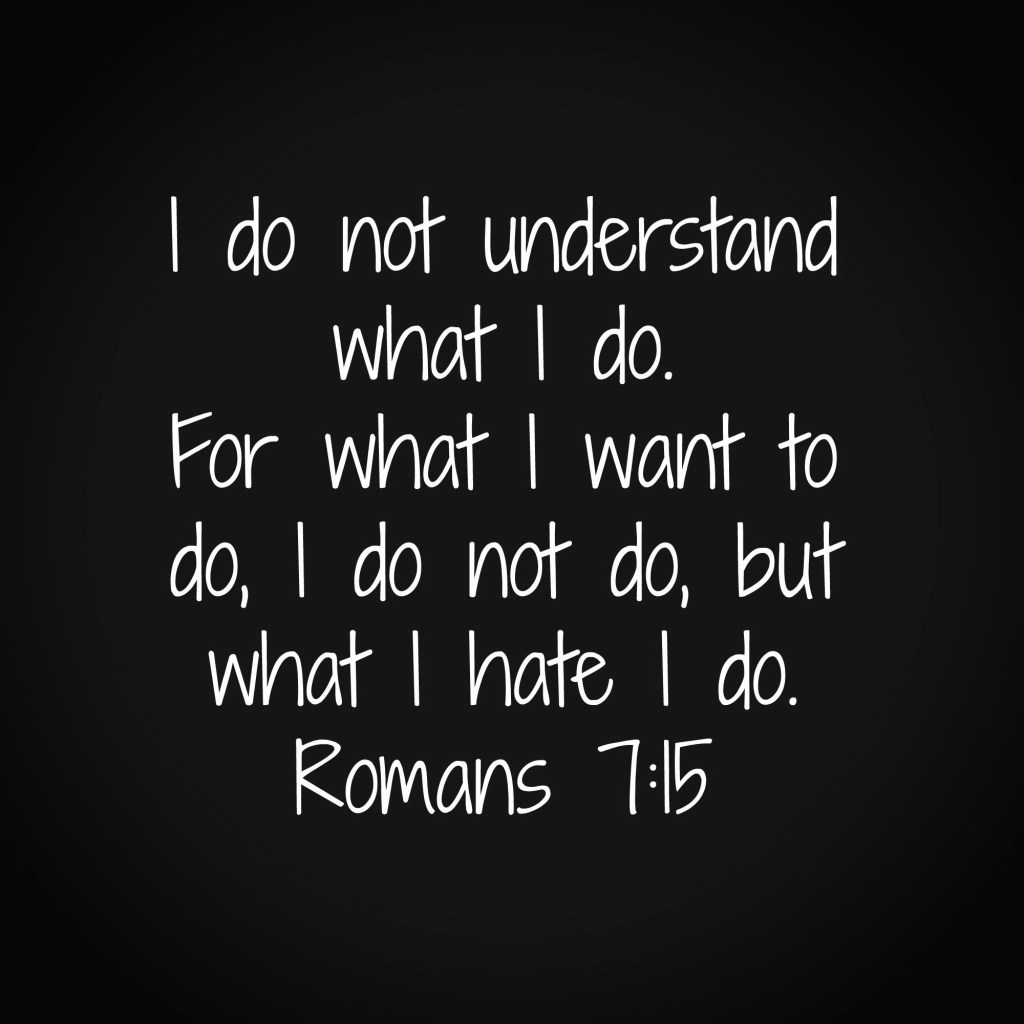
And yet, as he continues his diatribal discussion, more problems emerge (of course, since this is the nature of a diatribe!). Here is the dilemma: “we know that the law is spiritual; but I am of the flesh, sold into slavery under sin” (7:14). What follows is a foray into the murky mind of Paul, where, as he says, “I do not do what I want, but I do the very thing I hate” (7:15)—although he immediately attempts to excuse himself by stating that “it is no longer I that do it, but sin that dwells within me” (7:17).
That sits uncomfortably alongside Paul’s claim to the Galatians, that “it is no longer I who live, but it is Christ who lives in me”, and thus, Paul now “lives to God” (Gal 2:19–20). In writing to the Romans, Paul claims that “nothing good dwells within me, that is, in my flesh” (7:18), for it is “sin that dwells within me” (7:17, 20). The contradiction is confusing. What is the essential force that “lives within” Paul; it is Christ, as in Gal 2, or sin, as in Rom 7?
The confusion caused by “sin that dwells within me” (7:20) whilst still claiming that “I delight in the law of God in my inmost self” (7:22), drives Paul deeper into the hellenistic dualism, seeing “in my members another law at war with the law of my mind, making me captive to the law of sin that dwells in my members” (7:23). No wonder he throws his hands up in despair, exclaiming, “wretched man that I am! who will rescue me from this body of death?” (7:24).
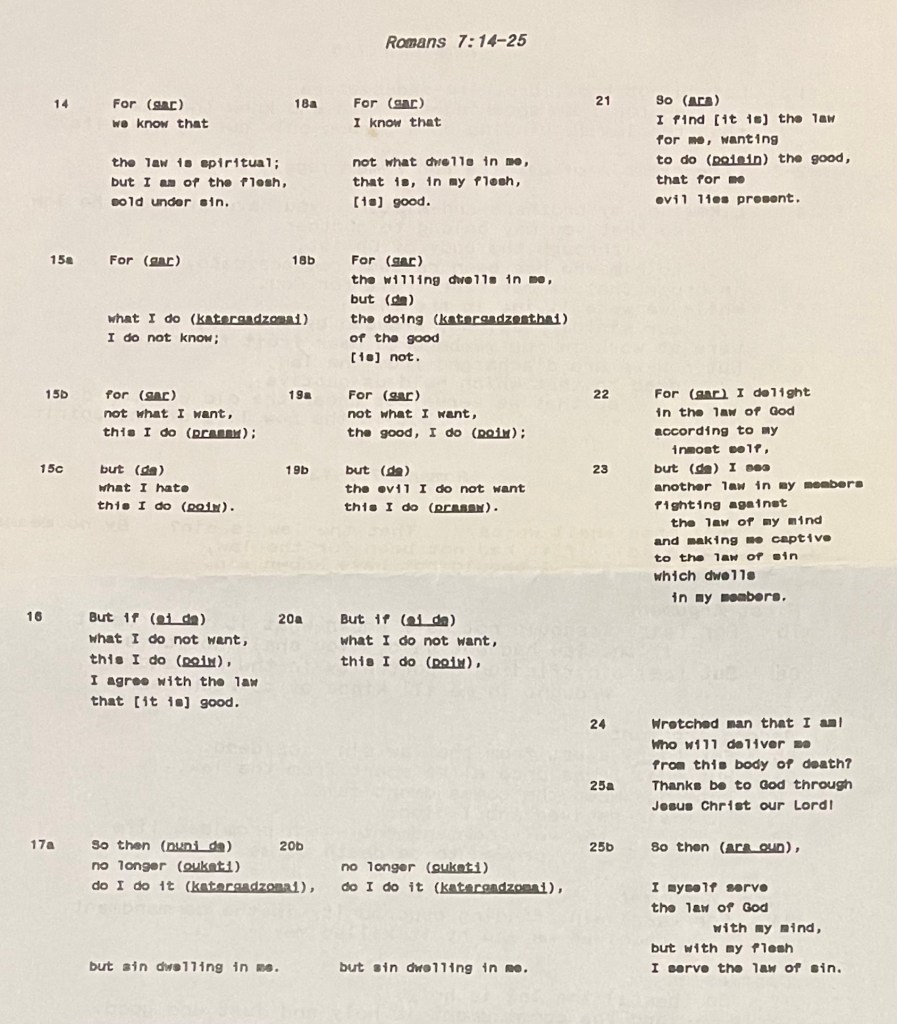
The argument runs a parallel course three times, as my schematic structuring (below) demonstrates. For each proposition that is put (introduced often by the Greek particle gar, “for”), a counter-proposition is offered (introduced by the Greek particle de, “but”).
Modern psychological insights have been used to dig deeper into what Paul writes in Romans 7. Paul appears to be fixated on his own self, using the Greek word egō many times (7:9, 10, 14, 17, 18, 20, 21, 24, and 25). And the language of “sin” and “death” which runs through this chapter exacerbates the tendency to adopt this approach. Declaring that these malicious forces are at work within his inmost being appears to present Paul as a figure consumed with internal contradictions and unresolved tensions. In short, he is a prime candidate for psychological investigation, if not psychiatric intervention!
Who is the person, the egō, who is referenced in these verses? Some interpreters consider that Paul here is talking about his “old self”—the person he was before he encountered the risen Jesus and was commissioned for the task he now undertakes, as “apostle to the Gentiles”. This chapter, reflecting Paul the pious and intense Jew, living under the Law, desperately seeking to obey it in every detail, is thus contrasted with the following chapter, portraying Paul the apostle, fervent and passionate for the mission he is undertaking, freed from the Law and living in the liberty of divine grace.
That simplistic analysis, however, owes more to the 19th century Pietism that was driving interpreters of that time, who considered the Christian life inevitably involved a fierce inner struggle with sin which fermented and eventually erupted into an existential crisis that would, hopefully, ultimately result in a decision to live a new, Christ-centered life. We can see how that dynamic can be extracted from Paul’s agonising words in Rom 7.
A second way of dealing with this chapter, by contrast, has been to claim that the struggle about which Paul here writes reflects precisely the struggle he was enduring after that dramatic encounter with Christ.
The commission that Paul received in that encounter is reported in graphic terms, many decades later, by Luke, who makes the moment into a grand call–and–commissioning scene (Acts 9:3–8; 22:6–11; 26:12–18). Of course, Luke was not present for this event, so he shaped in along the lines of classic call-and-commissioning narratives that existed in earlier Jewish writings. (I have explored this in detail in my commentary on Acts in the Eerdman’sCommentary on the Bible, 2003). In Paul’s own writings, by contrast, this mentioned only briefly, in passing (1 Cor 9:1 and Gal 1:1, 11–12).
Whatever took place in that encounter, it is clear that, as a believer, Paul was not exempt from the ongoing struggle between the desire to do what is pleasing to oneself, but is sinful (Rom 7), on the one hand; and on the other hand, the delight of living a life redeemed by grace (Rom 8). So the passage offered by this week’s lectionary (7:14–25a) is offered as a counterpoint to that which we have on the following Sunday (8:1–11).
This has been the line of interpretation advocated, to various degrees, by Augustine, Aquinas, Luther, and Calvin—but it has fallen into disfavour with contemporary interpreters, who see this as too simplistic and as presenting an unresolved and unintegrated egō. Surely Paul was not caught in that immature state?
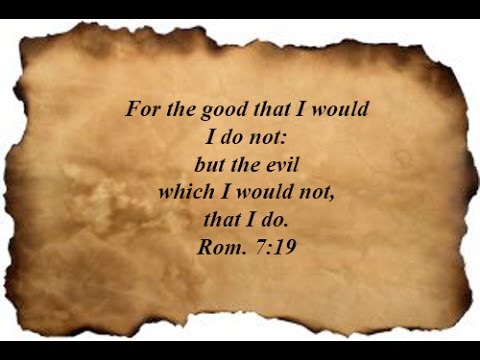
So a third line of interpretation has been that Paul here is setting forth the general, universal condition of the human being. The egō is Paul’s way to talk about “all of us”, for we are all still wrestling with that key characteristic of the human condition: we all, each one of us, “do not do the good [we] want, but the evil [we] do not want is what [we] do” (7:19).
This interpretation was proposed by Kümmel and has been followed by Bultmann, Käsemann, and Dunn, amongst others. Dunn argues that the struggle of Rom 7 provides the key to the argument developed by Paul throughout Rom 5—8 as a whole.
Beyond that, Kristen Stendhal has mounted a persuasive case, that the egō of Rom 7 should not be connected with Paul’s inner being, but rather with the broader issue to which Paul is addressing himself throughout the whole letter of Romans—what place does the Law have in the new community of faith, where both Jews and Gentiles are sharing together in fellowship? How might the demands of the Law function within such a context?
It’s a proposal that I find attractive and helpful, for indeed that broader question is what Paul comes back to in 8:1–8, and then in 9:30–33, 10:1–4, and 11:25–32; and finally in 13:8–10. The egō of Rom 7 is not the last word on this matter; Paul has “yet more light and truth to break forth” on this complex matter!
*****
You can look ahead to what I have to say about some of those passages, at
For this coming Sunday, the lectionary provides us with part of a larger story from the section of Genesis dealing with Abraham (Gen 24:34–38, 42–49, 58–67). As Abraham’s son Isaac comes to age, Abraham knows that there is a need to find him a wife.
Abraham now appears not to be living with his wife, Sarah—he is in Beersheba, with his servants (22:19) whilst Sarah remains at Hebron, where she dies (23:1–2). Was this because of the tension that grew between the patriarch and the matriarch after he had almost sacrificed his son? This is the story we read last week; see
Tensions were already evident earlier in the story, when Sarah had banished Hagar and Ishmael into the wilderness of Beersheba (21:10–14). To send them on their way, Abraham made sure that they had bread and water to sustain them in the wilderness (21:14). We do not see Abraham and Sarah together again in the story. In discussing this with my wife, Elizabeth Raine, last week, she proposed that Sarah was so upset with Abraham’s actions on Mount Mariah, threatening the life of their son Isaac (Gen 22:1–14), that she left him behind at Beersheba and moved to Hebron, some 42km to the north.
It is only on her death that Abraham travels to where Sarah had been living, in Hebron. Abraham sought to purchase a field there to serve as the burial place for Sarah. Ephron the Hittite, moved with compassion, wanted to gift him a field with a cave where Sarah’s body could be laid (23:7–12), but Abraham insisted and paid Ephron the value of the field, 400 shekels of silver (23:12–16). So he was doing the honourable thing for his wife after her death, even though there seems to have been a relationship breakdown prior to this.
Despite the fact that he willingly enters into these dealings with the Hittites in Beersheba, and the fact that he had earlier entered into a covenant with Abimelech, King of Gerar, a Philistine (21:22–34), Abraham is now concerned that Isaac not marry locally, to a Canaanite, but that a wife be found for him in “my country” and amongst “my people”, as he instructs his servant (24:4–5).
We may perhaps know of people who share that desire that their children not marry “foreigners”, but find a partner from amongst their own. So it is an ancient story with very modern resonances. Marlene Andrews, Church leader at Ngukurr, shares her perspective on this passage in the current issue of With Love to the World, a daily Bible study resource.
(Ngukurr is a town of about 1,000 people, located about 330 kilometres south-east of Katherine on the Roper Highway. Ngukurr is one of the largest Aboriginal communities in the Roper Gulf region.)
She says: “This story is about Abraham, his son. Abraham wanted the best for his son in marriage. Abraham knew that God was with him at the time of his decision-making. Abraham was faithful to God’s calling. Abraham knew how to go about finding a good wife for his son, Isaac. It was important that his son’s wife came from Abraham’s country. That is where Abraham came from, and where he wanted his son to connect to. Abraham knew the culture and the background of his people. Abraham knew in finding a wife for his son, she had to come from his homeland.”
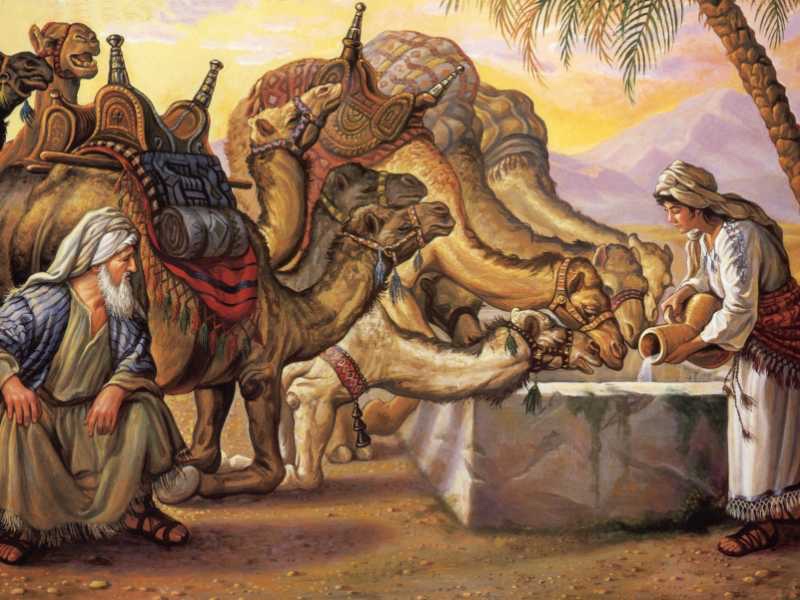
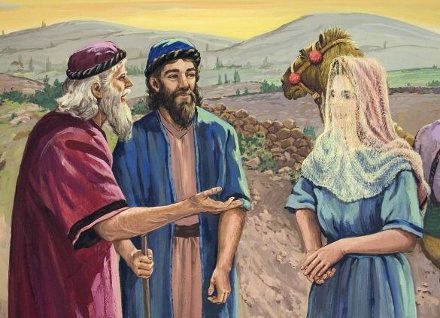
The marriage is arranged, at a distance, by Abraham. Isaac plays no part in the whole saga that is recounted in detail in Genesis 24. Abraham sends his servant all the way north to a well near the city of Nahor, which was back in Aramea, the homeland of Abraham. This was in the area we know as the Fertile Crescent, in between the two rivers of the Tigris and the Euphrates (24:10). The well near Nahor becomes the location for the match-making that Abraham undertakes, through the servant whom he sent there (24:10–14).
Isaac will, much later in time, notice Rebekah, the daughter of Bethuel, “son of Milcah, the wife of Nahor, Abraham’s brother” (24:15), but this is not until the story has almost come to its close (24:62–67). It is understandable that Isaac was agreeable to the arrangement that his father had made, for “the girl was very fair to look upon, a virgin, whom no man had known” (24:16).
This last comment is important, in the light of the drastic provision in the Torah that, if evidence of the young woman’s virginity is lacking, “they shall bring the young woman out to the entrance of her father’s house and the men of her town shall stone her to death, because she committed a disgraceful act in Israel by prostituting herself in her father’s house” (Deut 22:21).
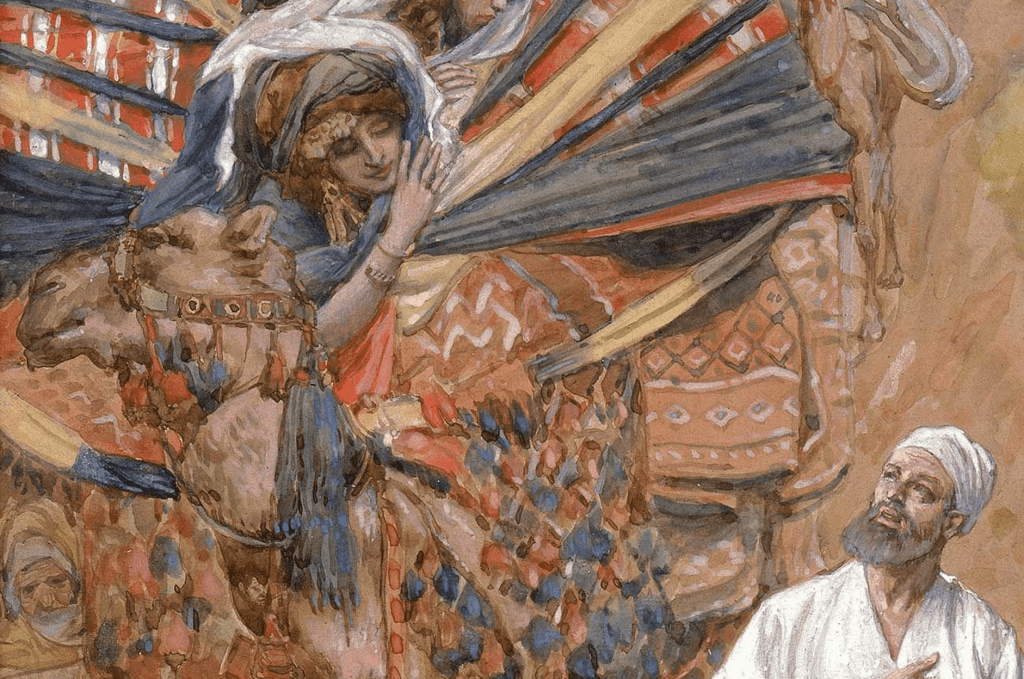
Reckoning that the woman was able to be considered for marriage (we have to trust the insight of the narrator at this point), the servant was prepared for what he hoped would transpire; he had with him “a gold nose-ring weighing a half shekel, and two bracelets for her arms weighing ten gold shekels” (24:22).
After Rebekah has brought her brother Laban into the story (24:28–29), and he noticed the nose-ring and bracelets (24:30), he offered hospitality to the servant, which was duly accepted (24:31–33). The purpose of the nose-ring and bracelets is then revealed—although surely those who heard this story in antiquity would be well aware of their significance. Brokering a marriage is the clear intention (24:34–41).
The woman had had a ring placed in her nose, and bracelets put around her arms (24:47); the action presumably took place at 24:22–27, although it was not explicitly narrated there. The ring and bracelets were obviously the custom for women in the time when the story was initially told, and they held their place within the story as it was passed down from generation to generation, even if customs may have changed.
Marriage customs do vary across time and place, from one culture to another. What held in the days of the patriarchs (or, at least, in the days in ancient Israel when people told stories about how they imagined things were in the “olden days” of the patriarchs) does not necessarily hold good for our time, today. A story of a man who married a woman so that, after a prescribed period of time (seven years!) he could marry her sister, as was the case with Jacob, Rachel, and Leah (Gen 29–30), for instance, would not hold today! And whilst rings remain the most common sign of a marriage, they are placed around fingers, and not into noses, in most modern cultures!
So Isaac, eventually, enters the story (some 47 verses after Rebekah was first introduced!). He notices, first, the camels which had come all the way from Nahor to the Negeb (24:62–63); and then, “Isaac brought her into his mother Sarah’s tent; he took Rebekah, and she became his wife; and he loved her” (24:67). All is well, that ends well—thanks to the well!
However, even though Isaac had never been to the well at Nahor where the marriage agreement was made, this well was the first of a number of wells where marriages were negotiated and confirmed within the sagas of ancient Israel. Jacob met his wife-to-be, Rachel, beside a well in Canaan, later Samaria (Gen 29:1–3). Moses, when travelling in Midian, “sat down by a well”, where, in due time, the local priest Jethro gave one of his daughters, Zipporah, to Moses in marriage (Exod 2:15–21).
The well in Canaan, known as Jacob’s well, is much later on the location for another famous encounter, between Jesus of Nazareth and an unnamed woman of Samaria (John 4:4–30)—although no marriage resulted from this encounter!
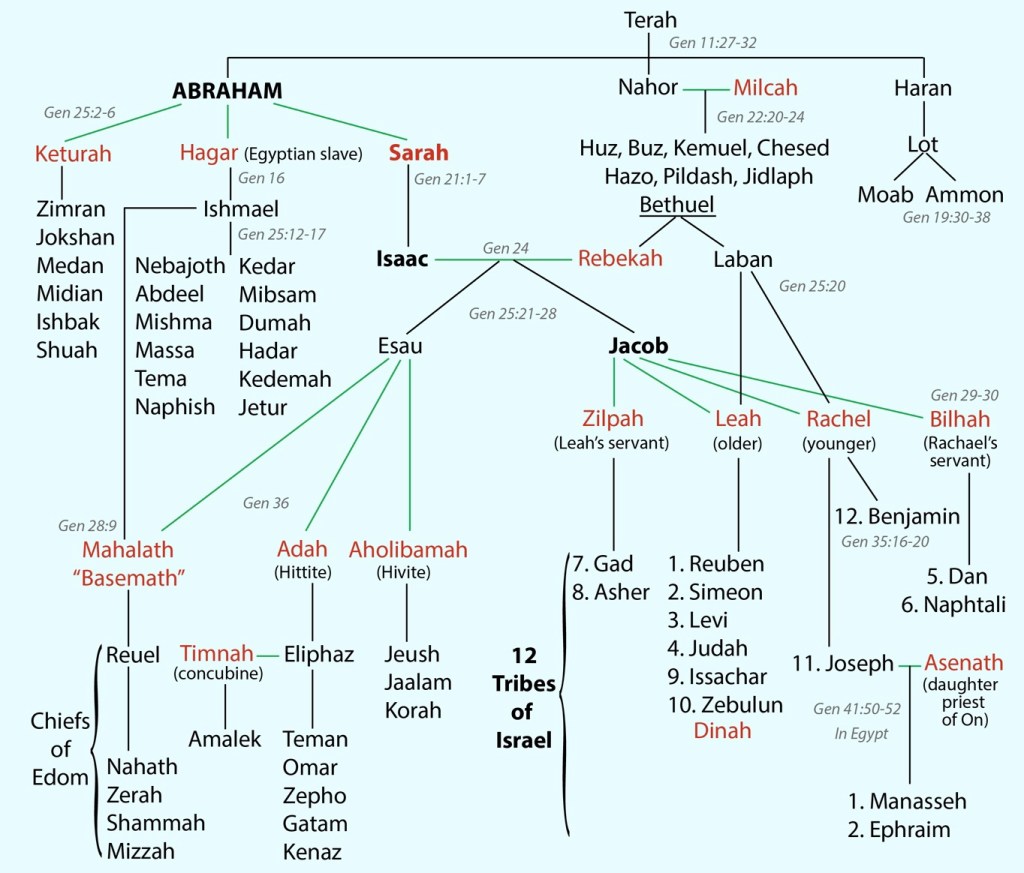
The two marriages, of the son and grandson of Abraham, which resulted from encounters beside the two wells, are important, for they demonstrate that the promise made to Abraham, of many descendants who will be blessed by God (Gen 12:2–3), will be guaranteed. Sure enough, Isaac and Rebekah produce twin boys, Esau and Jacob; and Jacob, in turn, is the father of twelve sons, whose names provide the identification of the twelve tribes of Israel. So these wells are integral to the divine promise!
Isaac was the son of Abraham; Rebekah was the granddaughter of Nahor, the brother of Abraham; so they were cousins. Tracy M. Lemos, Associate Professor of Hebrew Bible and ancient Near Eastern language and literature in the Faculty of Theology of Huron University College at Western University in London, Ontario, writes in Bible Odyssey that “Biblical texts make clear that marriages between cousins were strongly preferred”. She continues, “different Israelite communities and authors had diverse viewpoints on marriage and that Israelite viewpoints evolved over time”. See
The conclusion of Prof. Lemos, that “many biblical customs would be unfamiliar or even objectionable to many people living in western societies today”, certainly stands with regard to the passage we are offered for this coming Sunday. The detailed story that is told in Gen 24 is a fascinating insight into another world, another time, another culture. Yet it is part of our shared heritage, as Jews and Christians, in the modern era. It is good to hear the story, once again, as the lectionary offers it to us this Sunday.
We know that “she laughed”. And that she produced a miracle baby at the ripe old age of 90 (or so it is said). But what else do we know about Sarah? Before she disappears from view in the Hebrew Scripture passages that the lectionary is offering us, let’s spend some time thinking about Sarah.
During this season after Pentecost, the lectionary has been offering us stories selected from the ancestral sagas of Israel, tracing the way that the promise to Abraham—“I will make of you a great nation” (Gen 12:1), “look toward heaven and count the stars … so shall your descendants be” (Gen 15:5)—was able to come to fruition.
Over successive Sundays, we have read of the call to Abram (ch.12), the promise of a child to Sarah (ch.18), the banishment of Abraham’s son through his slave girl Hagar (ch.21), the near-sacrifice of the preferred son, Isaac (ch.22), and the manoeuvring by Abraham to ensure a wife for Isaac who is of “my country and my kindred” (ch.24).
In future Sundays, we move on to stories about the twin boys born to Isaac and his wife Rebekah (ch.25), Jacob’s dream at the Jabbok (ch.28), Jacob and his marriages to, first Leah, and then Rachel (ch.29), and then the story of Jacob at Penuel, which explains how he had his name changed to Israel (ch.32). The story then focusses on one of Jacob’s twelve sons, Joseph, who is taken to Egypt (ch.37) and later saves his brothers during a famine (ch.45).
These stories—have you noticed?—follow the male line of descent, and place the male at the centre of the story. It is Abram’s call, Abraham’s near-sacrifice of Isaac, Isaac who needs a wife, Jacob who has a dream, Jacob who obtains two wives, Jacob who wrestled with God, and Joseph who becomes the saviour of his brothers.
What role is played by the women in the story? We do know the names of the matriarchs—Sarah, Rebekah, Leah and Rachel—and they do figure in the stories; but the focus is quite patriarchal, as would befit the nature of ancient society.
Sarah, whom we meet initially as Sarai (11:29), is essential to the storyline at various points; and she has come to be venerated alongside Abraham in later traditions. Paul refers to her as the means by which God’s promise is fulfilled (Rom 9:9) and he even offers her and Hagar together as providing an allegory for “the present Jerusalem, in slavery … and the Jerusalem above [who is] free, our mother” (Gal 4:21–26).
In the letter to the Hebrews, Sarah is named (in contrast to many other women) and takes her place alongside Abraham as part of “so great a cloud of witnesses” (Heb 12:1)—although all that is said of her is the stark declaration, “Sarah herself was barren” (Heb 11:11). The miracle, it would seem, was that “from one person, and this one as good as dead, descendants were born” (Heb 11:12)—that is to say, it was the transformation of the “as good as dead Abraham” that is being celebrated here.
In 1 Peter, Sarah is put forward as one of the “holy women who hoped in God”—although, in this instance, what is said of her again mirrors the patriarchal dominance of society; “Sarah obeyed Abraham and called him lord. You have become her daughters as long as you do what is good and never let fears alarm you” (1 Pet 3:5–6).
It takes an exilic prophet, whose words were appended to the earlier scroll of Isaiah, to give Sarah (almost) equal billing with Abraham: “Listen to me, you that pursue righteousness, you that seek the Lord. Look to the rock from which you were hewn, and to the quarry from which you were dug. Look to Abraham your father and to Sarah who bore you; for he was but one when I called him, but I blessed him and made him many.” (Isa 51:1–2).
So, what do we know of Sarah from those ancestral narratives which were told by word of mouth, handed down the generations, and ultimately (sometime in the Exile in Babylon) written down in the form we now have them, in the scroll entitled Bereshit, which we know as the book of Genesis?
We meet Sarai (meaning “my princess”) in the list of descendants of Terah, the father of Abraham (Gen 11:29), although (as in the Hebrews reference) it is simply noted that “Sarai was barren; she had no child” (11:30). That’s a serious roadblock in a passage that is listing descendant upon descendant!
In that same passage, we are told that Sarai, daughter-in-law of Terra, accompanied the family when they journeyed from Ur of the Chaldeans to Haran, where they settled (11:31). The journey had been intended to go as far as Canaan; that would not take place until the Lord called Abram to “go from your country and your kindred and your father’s house to the land that I will show you” (12:1). Sarai is there, as well as Lot and his perpetually-unnamed wife, “and all the possessions that they had gathered, and the persons whom they had acquired in Haran” (12:5).
The next story involving Sarai is perplexing and disturbing. Because of a famine, Abram “went down to Egypt to reside there as an alien” (12:10). We know that Sarai accompanies him, because he forewarns her, “I know well that you are a woman beautiful in appearance; and when the Egyptians see you, they will say, ‘This is his wife’; then they will kill me, but they will let you live. Say you are my sister, so that it may go well with me because of you, and that my life may be spared on your account.” (12:11–13).
The story is repeated twice more in Genesis; once when Abraham repeats this ruse in Gerar, before King Abimelech (20:1–7), and again when Isaac tells the same Abimelech that Rebekah is his sister (26:6–11)! It seems that the fruit does not fall far from the tree; Isaac exactly replicates his father’s devious strategy.
In between those two instances of spousal deception in Gen 12 and Gen 20, Sarai has been the cause of plagues falling onto Pharaoh and his house (12:17), settled with her husband “by the oaks of Mamre, which are at Hebron” (13:1, 18), and presumably learnt from Abram about the covenant which the Lord made with him (15:1–21)—although the text is silent about where Sarai was as this revelation came to Abram.
Sarai is front and centre, however, in the next story told, as she offers her Egyptian slave-girl, Hagar, to Abram so that he might reproduce, and fulfil the divine promise (16:1–3). Tension between the servant girl and her mistress resulted, so “Sarai dealt harshly with her, and she [Hagar] ran away from her [Sarai]” (16:6). Eventually, an angel instructed Hagar to “return to your mistress, and submit to her” (16:9), so she did, and in time bore a child to Abram.
In the next story, the circumcision of Abram and “every male among you” (17:1–27), we might wonder what role was played by Sarai. Did she witness the ceremony? Did she and her women assist those who were subjected to this procedure? Certainly, in the midst of the conversation that Abram has with God at this time, both he and his wife are given new names: “no longer shall your name be Abram, but your name shall be Abraham” (17:5), and “as for Sarai your wife, you shall not call her Sarai, but Sarah shall be her name” (17:15).
Abram, whose name describes his status in the story as “exalted ancestor”, will henceforth be known as Abraham, “ancestor of a multitude”, in keeping with the promise of God that “you shall be the ancestor of a multitude of nations” (17:4), while Sarai, “my princess”, will henceforth be known simply as “princess”, without any inflection indicating that she is “owned” by anyone.
So Sarah takes her place at the centre of the story at this point. Her status as princess means that “she shall give rise to nations; kings of peoples shall come from her” (17:16), and the birth of a son, Isaac, is predicted (17:19) and his role in continuing the lineage is confirmed (17:20). That birth is again foreshadowed when three visitors stay with Abraham and Sarah at Mamre (18:10). Sarah’s sceptical laughter (18:12) was already prefigured in the name allocated to her son, Isaac—meaning “he laughs” (17:19).
Before Isaac is born, however, the terrible story of inhospitality and divine vengeance on Sodom and Gomorrah is told in some detail (18:16–19:29), and the origins of the southern neighbours of Israel, the Moabites and Ammonites, is told (19:30–38), as well as the deception of Abraham in Gerar, when he passes the pregnant Sarah off as his sister (20:1–7).
Then comes the birth of Isaac (21:2–3), after which she rejoices, “God has brought laughter for me; everyone who hears will laugh with me” (21:6)—after which Sarah again orders Hagar, and also Ishmael, to depart into the wilderness. Sarah instructs Abraham to “cast out this slave woman with her son” (21:10); “the matter was very distressing to Abraham on account of his son” (21:11).
And so the schism between Abraham and Sarah is opened up; the events of the next incident, when Abraham takes Isaac to a mountain in Mariah, to sacrifice him (22:1–3), appear to seal the split. As I was talking with my wife, Elizabeth Raine, about this difficult story last week, she pointed out to me that we do not see Abraham and Sarah together in the same place after this.
Abraham now appears not to be living with his wife, Sarah—he is in Beersheba, with his servants (22:19) whilst Sarah remains at Hebron, where she dies (23:1–2). Was this because of the tension that grew between the patriarch and the matriarch after he had almost sacrificed his son? This is the story we read last week; see
Tensions were already evident earlier in the story, when Sarah had banished Hagar and Ishmael into the wilderness of Beersheba (21:10–14). To send them on their way, Abraham made sure that they had bread and water to sustain them in the wilderness (21:14). As Elizabeth noted, we do not see Abraham and Sarah together again in the story.
It is only on her death that Abraham travels to where Sarah had been living, in Hebron, some 42km further north. Abraham sought to purchase a field there to serve as the burial place for Sarah. Ephron the Hittite, moved with compassion, wanted to gift him a field with a cave where Sarah’s body could be laid (23:7–12), but Abraham insisted and paid Ephron the value of the field, 400 shekels of silver (23:12–16). He dies at least honour her appropriately at the point of her death.
*****
Writing in My Jewish Learning, Jewish educator Rachael Gelfman Schultz notes that “Genesis contains the greatest concentration of female figures in the Bible (32 named and 46 unnamed women). The fact that Genesis consists of a series of family stories (including several genealogies) accounts for the remarkable concentration of female figures.” Sarah is an important figure in that list of women. Rabbinic tradition lists her among the seven women prophets, the others being Miriam, Deborah, Hannah, Abigail, Huldah, and Esther.
Nissan Mindel, writing in Chabad.org, observes that “Sarah was just as great as Abraham. She had all the great qualities that Abraham had. She was wise and kind, and a prophetess. And G‑d told Abraham to do as she says.”
He describes the home that they made in Beersheba, noting that whilst Abraham received visitors, offered them hospitality, and conversed with them (following the pattern shown in Gen 18), “Sarai was busy with the women folk, and long after all visitors were gone, or had retired to sleep, Sarai would sit up in her tent, making dresses and things for the poor and needy.
“When everybody was fast asleep, there was still a candle burning in Sarai’s tent, where she was sitting doing some hand-work, or preparing food for the next day. So G‑d sent a special Cloud of Light to surround her tent. For miles and miles around, the Cloud of Glory could be seen hovering over Sarai’s tent, and everybody said, “’There dwells a woman of worth.’”
So there is much to value, and honour, about Sarah, princess, prophet, and matriarch supreme. We would do well not to overlook her, the matriarch of matriarchs, amidst the stories of the patriarchs.
Among egalitarian religious congregations of Jews throughout the world, the most popular addition to the traditional liturgy is the mention of the Matriarchs in birkat avot (the blessing of the ancestors), the opening blessing of the Amidah:
Praised are You, Adonai our God and God of our ancestors, God of Abraham, Isaac, and Jacob, God of Sarah, Rebekah, Rachel, and Leah, great, mighty, awesome, exalted God who bestows lovingkindness, Creator of all. You remember the pious deeds of our ancestors and will send a redeemer to their children’s children because of Your loving nature.
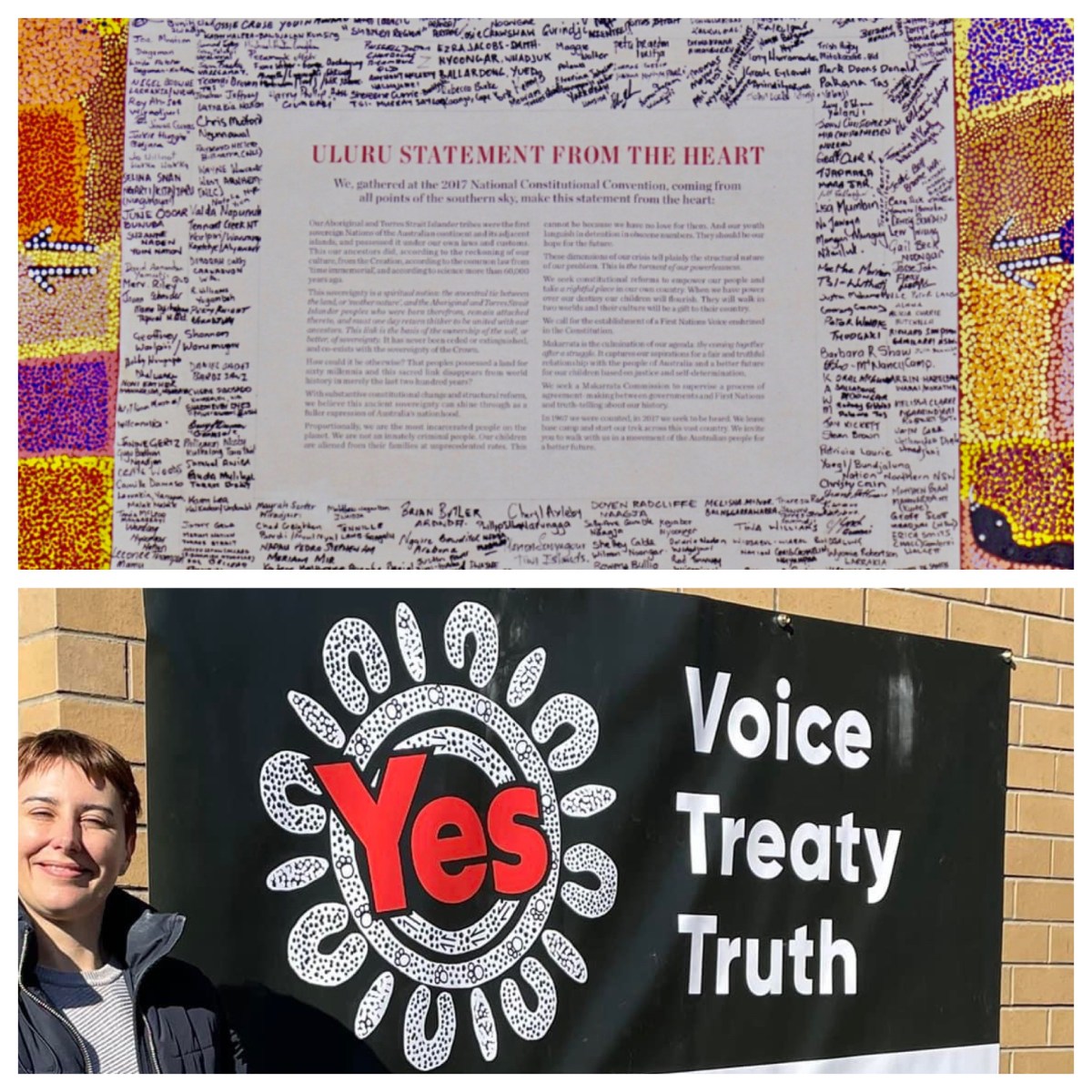
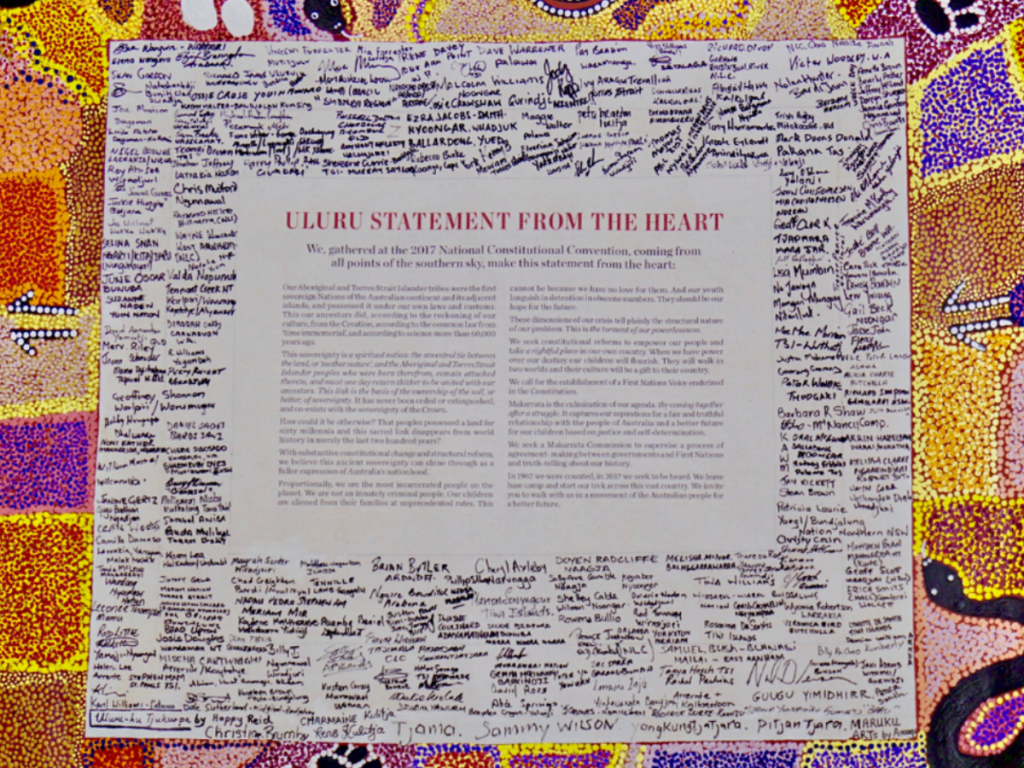
The referendum that will take place later this year is a response to the 2017 Statement from the Heart, which asked for recognition of First Nations people in the Constitution and a process of Makarrata, or treaty. The Statement was a result of a careful process of consultation amongst First Peoples for quite some time.
The Government established a Referendum Council, which set up a series of First Nations Regional Dialogues, which were Indigenous designed and led consultations across the country. Indigenous members of the Council formed an Indigenous Steering Group. Together, in consultation with Indigenous community stakeholders and with advice from constitutional experts, they designed an Indigenous consultation process called the First Nations Regional Dialogues.
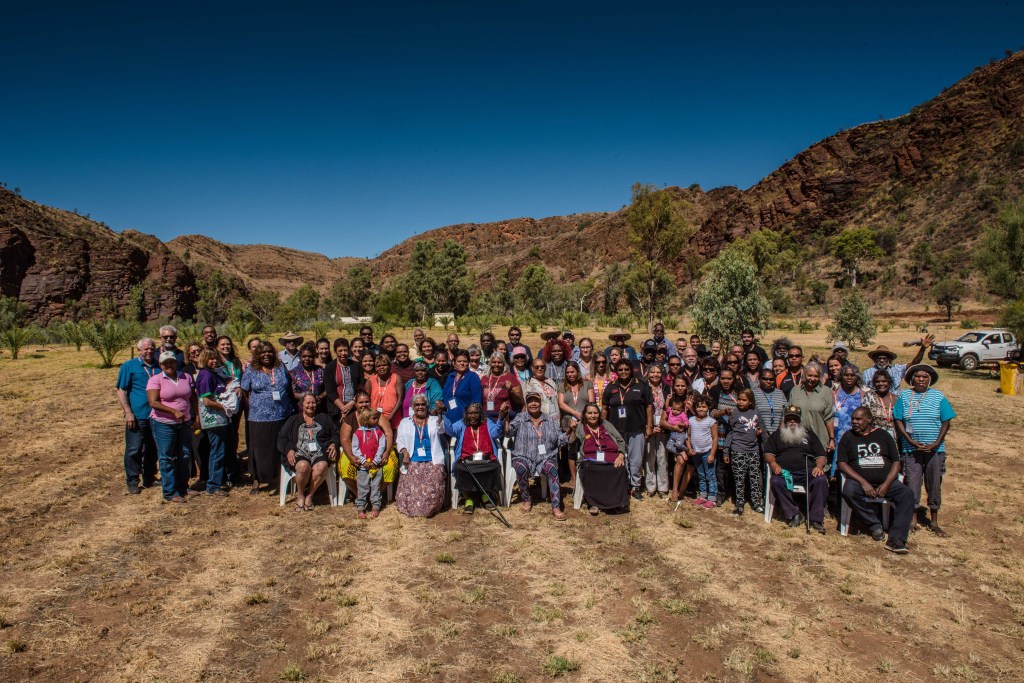
After an initial Trial Dialogue at Melbourne University to ensure the proposed format worked well, 13 Regional Dialogues were held across the country, culminating in an Indigenous Constitutional Convention at Uluru in May 2017. Each was hosted by a regional Indigenous organisation:
Hobart, hosted by Tasmanian Aboriginal Corporation (9–11 December 2016)
Broome, hosted by the Kimberley Land Council (10–12 February 2017)
Dubbo, hosted by the New South Wales Aboriginal Land Council (17–19 February 2017)
Darwin, hosted by the Northern Land Council (22–24 February 2017)
Perth, hosted by the South West Aboriginal Land and Sea Council (3–5 March 2017)
Sydney, hosted by the New South Wales Aboriginal Land Council (10–12 March 2017)
Melbourne, hosted by the Federation of Victorian Traditional Owners Corporation (17–19 March 2017)
Cairns, hosted by the North Queensland Land Council (24–27 March 2017)
Ross River, hosted by the Central Land Council (31 March – 2 April 2017)
Adelaide, hosted by the Aboriginal Legal Rights Movement Inc (7–9 April 2017)
Brisbane (21–23 April 2017)
Thursday Island, hosted by Torres Shire Council and a number of Torres Strait regional organisations (5–7 May 2017).
An information session hosted by the United Ngunnawal Elders Council was held in Canberra on 10 May 2017.
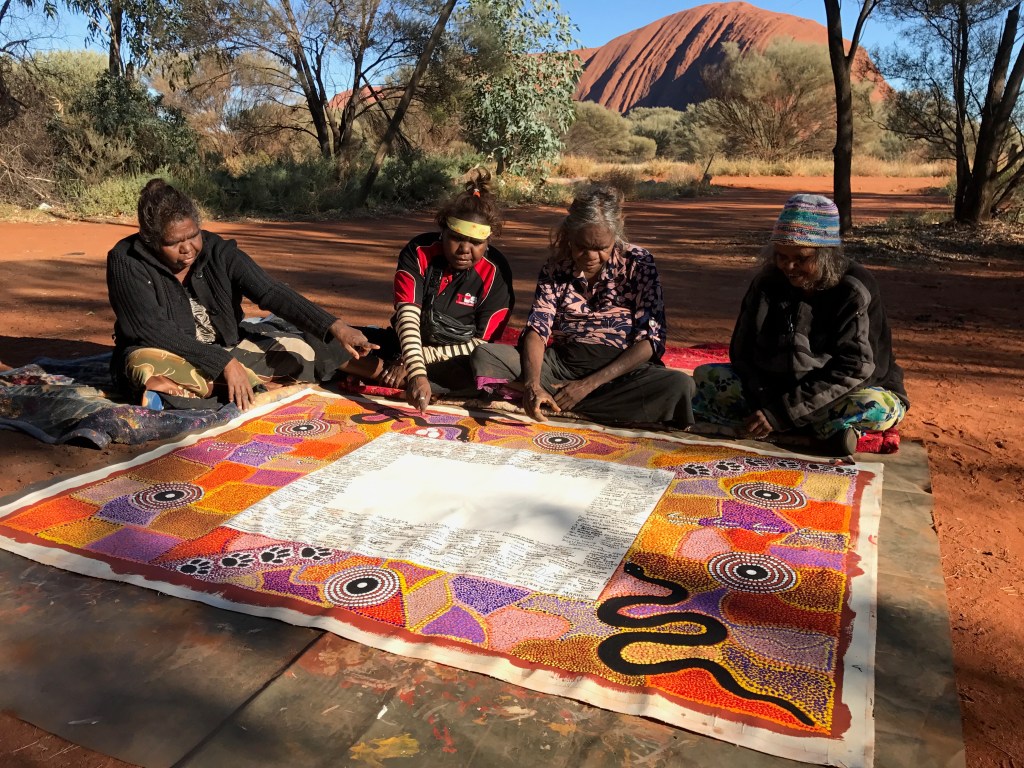
Then, a final national Indigenous Constitutional Convention was held at Uluru on 23–26 May 2017. This Convention gave rise to a national Indigenous consensus position on how Indigenous people want to be constitutionally recognised. This was an unprecedented breakthrough.
Although seven out of 250 delegates dissented, it was still an extraordinary consensus and a historic moment in Indigenous peoples’ struggle for constitutional recognition. Most the of the Indigenous advocacy of the past tended to emanate from particular regions. Never before had a national Indigenous consensus position been achieved. The majority position was powerfully expressed in the poetic Statement from the Heart.
This Statement asked for two things: a constitutionally guaranteed First Nations voice (a constitutionally enshrined Indigenous body to enable Indigenous people a fairer say in decision- making with respect to their rights) and a Makarrata Commission to oversee agreement-making and truth-telling about history.
It is this long, careful process, culminating in the Statement from the Heart, that lies behind the proposal that will be put to the Australian public in a referendum later this year.
“Abraham reached out his hand and took the knife to kill his son” (Gen 22:10). We read these chilling words in the passage that the lectionary offers for our reflection and consideration this coming Sunday (Gen 22:1–14). It’s hardly edifying reading material for worship, is it?
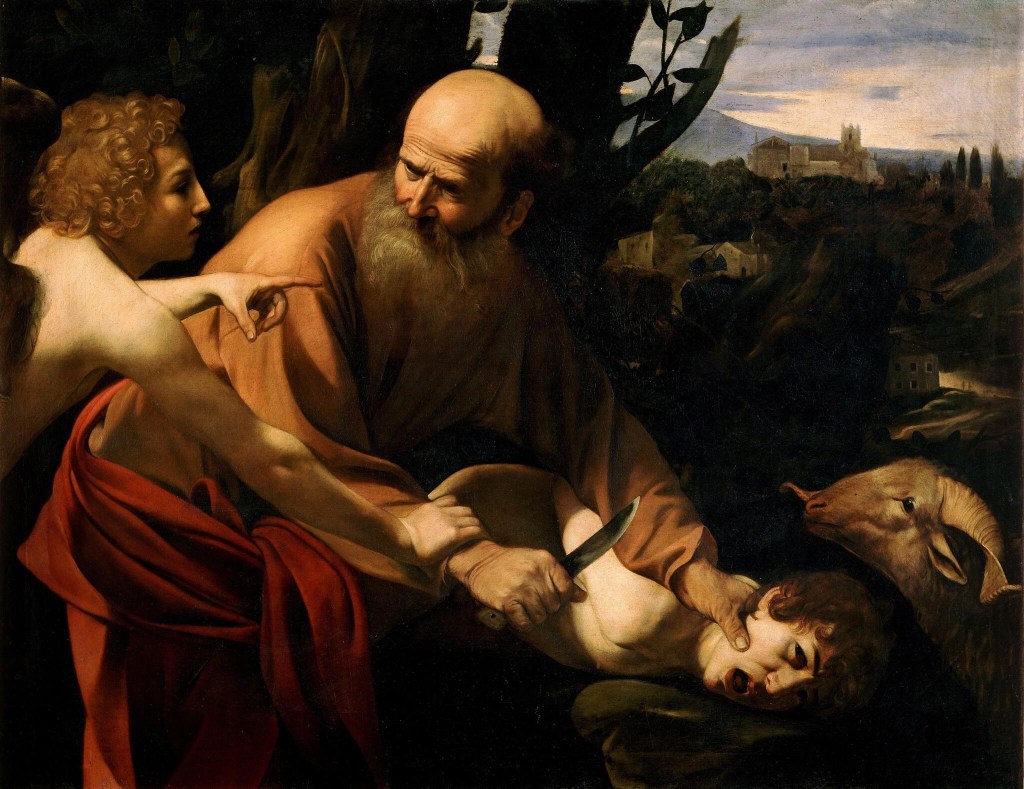
The Sacrifice of Isaac, by Caravaggio, c. 1603
It’s a horrifying story. Who is this God who calls Abraham to take his “only son” up the mountain and “offer him there as a burnt offering” (22:2)? How does this God relate to the God who, it is said, has shows “steadfast love” to the people of Israel (Exod 15:13), and before that to Joseph (Gen 39:21), to Jacob (Gen 32:9–19), and indeed to Abraham himself (Gen 24:27)? Why has God acted in a way that Is seemingly so out of character in this incident in Gen 22? Or is this the real nature of God, and later displays of “steadfast love” are simply for show?
Writing in With Love to the World, the Revd Sophia Lizares, a Uniting Church Minister originally from the Philippines, now serving in Perth, WA, says that this story is “an improbable and troubling reading: a God who demands a father to kill his beloved son, a father who questions not.” It is not just the knife in Abraham’s hand which is raised (22:10)—there are many such questions raised by these seemingly callous story.
My wife, Elizabeth Raine, has a cracker of a sermon in which she compares this story with the account of Jephthah and his daughter (Judg 11:29–40). Whilst the Lord commands Abraham to kill his son as a burnt offering, it is the vow made by Jephthah to sacrifice “whoever comes out of the doors of my house to meet me, when I return victorious from the Ammonites” as a burnt offering (Judg 11:30).
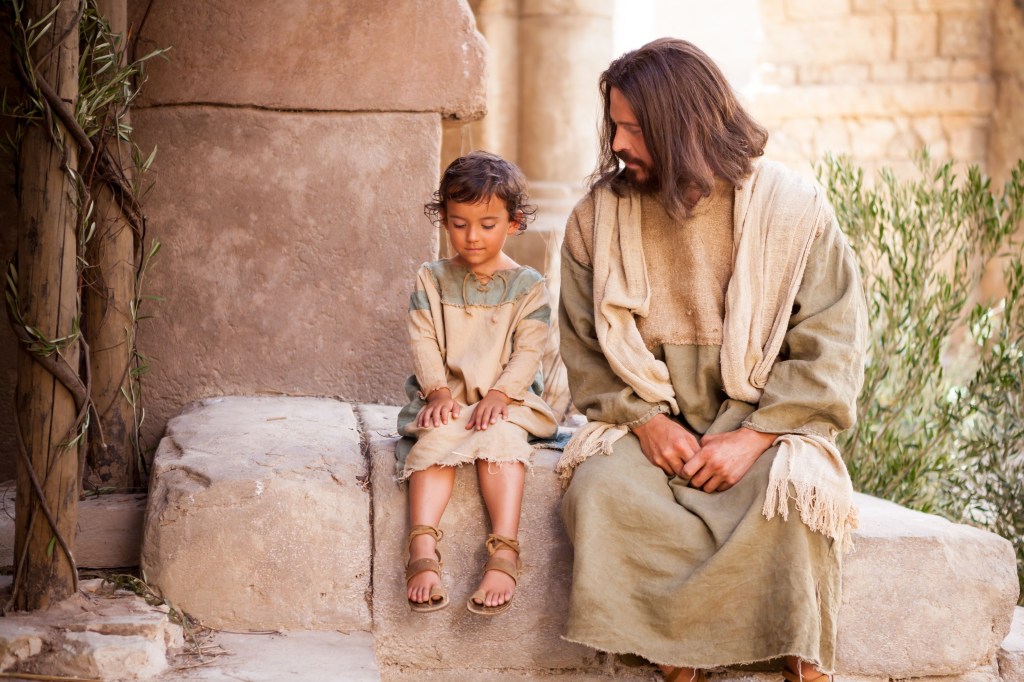
And whilst the Lord intervenes in what Abraham is planning to do at the very last moment, sending an angel to command him, “do not lay your hand on the boy or do anything to him” (Gen 22:11–12), Jephthah is held to the vow he has made—by his very own daughter, who knows that she will be the victim of this vow (Judg 11:39). There is no divine intervention in this story.
And worse, whilst Abraham had carefully prepared for the sacrifice, taking his donkey, two servants, and the wood for the fire up the mountain with him (Gen 22:3–6), Jephthah’s vow was made on the spur of the moment (Judg 11:30–31), and when his daughter insisted that he must carry through with this vow, he gives her, as requested, two full months for her to spend with her companions before he sacrificed her (Judg 11:37–39). Surely he might have had time in those two months to reconsider his vow and turn away from sacrificing his daughter?
It would seem, then, that the daughter was dispensable; the son, the much loved only son of Sarah and Abraham, was clearly indispensable. That would clearly reflect the values of the patriarchal society of the day, in which “sons are indeed a heritage from the Lord, the fruit of the womb a reward” (Ps 127:3).
And Abraham would have followed the same pathway, sacrificing his only son, had not the Lord intervened. Neither father is looking very appealing in these two stories! Which makes it hard to see how the story of the sacrifice told in Judg 11, and the story of the almost-sacrifice told in Gen 22, can be “the word of the Lord” for us, today, in the 21st century. Indeed, the story of Abraham and Isaac comes perilously close to being a story of child abuser—if not physical abuse, by the end of the story, at least emotional and spiritual abuse.
Situations of abuse destroy trust. After such an experience, how could Isaac ever trust his father again? And as we hear the story, how can we trust God? How could we ever believe that his commands to us are what we should follow?—if he follows the pattern of this story, and changes his mind at the last minute, after pushing us to the very brink of existence? How could we trust a God like this?
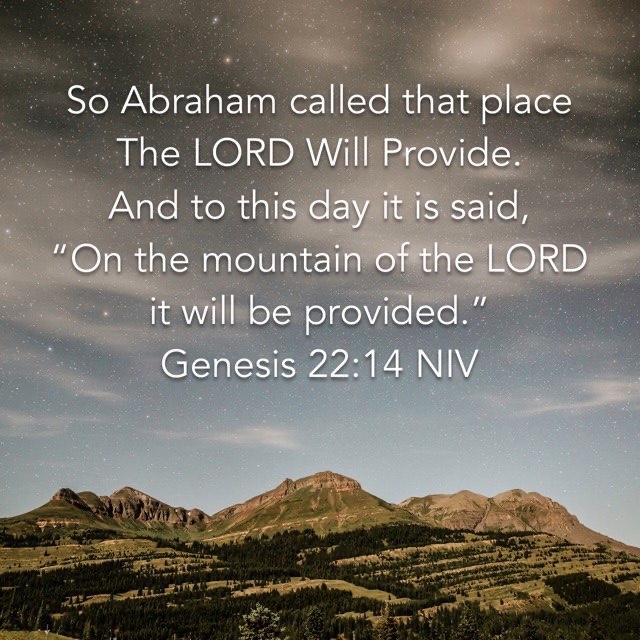
Or, if the story involving poor Isaac is really about God providing, as Abraham intimates early on (22:8), and then concludes at the end (22:14), then it is a rather malicious way for God to go about showing how he is able to “provide”. Provision, and providence, should be something positive—not perilous and threatening, as in this story.
Or yet again, if the story is about testing Abraham’s faith, as many interpreters conclude, then it is a particularly nasty and confronting way for God to do this—and that points to a nasty streak in the character of God. Is this really what we want to sit with? Was there not some other way for God to push Abraham to test his faith?
What do we do with such a story within our shared sacred scriptures?
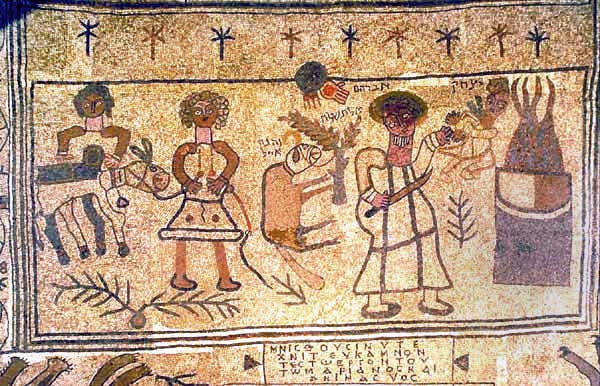
A sixth-century CE floor mosaic from the Beth Alpha synagogue, in Israel’s Jezreel Valley. The mosaic lay near the door, so that anyone who entered was confronted by the scene. In this mosaic, Abraham and Isaac are identified in Hebrew. The hand of God extends from heaven to prevent Abraham from proceeding. Below the hand are the Hebrew words, “Lay not [your hand].” Next to the ram are the words, “Behold a ram.”
*****
The Jewish site, My Jewish Learning, states that “although the story itself is quite troubling, it does contain a message of hope for Rosh Hashanah. In the liturgy we ask God to “remember us for life.” The binding of Isaac concludes with his life being spared, and he too is “remembered for life.” Abraham’s devotion results in hope for life.”
How does the message of hope for life emerge from this story? Clearly, the life of Isaac is spared; but this is a terrible way to teach that message!
James Goodman, writing in My Jewish Learning, explains how he was taught to understand this story. “I learned that the story was God’s way of proclaiming his opposition to human sacrifice”, Goodman writes.
He refers to the way his Hebrew-school teacher explained this story: “God had brought Abraham to a new land. A good and fertile land, where it was common for pagan tribes, hoping to keep the crops and flocks coming, to sacrifice first-born sons to God. Then one day, God commanded Abraham to sacrifice Isaac, the beloved son of his old age.
“Abraham set out to do it, and was about to, when God stopped him. He sacrificed a ram instead. In the end, Abraham had ‘demonstrated his—and the Jews’—heroic willingness to accept God and His law,’ and God had ‘proclaimed’ that ‘He could not accept human blood, that He rejected all human sacrifices’.”
Setting the story in the broader context of the practice of child sacrifice is a way of accepting that this terrible story might indeed have some value. Seeing the story is a dramatised version of God’s command not to sacrifice children can be a way to deal with it. “Do not lay your hand on the boy or do anything to him”, the angel says; so Abraham obeys, finds a ram, offers the ram as a burnt offering (22:12–13). And so, the name of the place is given: “the Lord will provide” (22:14).
Three kings of Israel, at different times in the history of Israel, are said to have practised child sacrifice, as they turned to practices found in nations other than Israel. Solomon in his old age is said to have turned to the worship of Molech (1 Ki 11:7); this practice was subsequently adopted by Ahaz, who “made offerings in the valley of the son of Hinnom, and made his sons pass through fire, according to the abominable practices of the nations whom the Lord drove out before the people of Israel” (2 Chron 28:3). Likewise, Manasseh “made his son pass through fire; he practiced soothsaying and augury, and dealt with mediums and with wizards” (2 Ki 21:6).
Direct commands not to sacrifice children are found in two books of Torah in the scriptural texts. Most direct is “you shall not give any of your offspring to sacrifice them to Molech, and so profane the name of your God: I am the Lord” (Lev 20:18). In Deuteronomy, other nations are condemned as they “burn their sons and their daughters in the fire to their gods” (Deut 12:31), so the command is “no one shall be found among you who makes a son or daughter pass through fire” (Deut 18:10). The prophet Jeremiah also asserts that this practice is not something that the Lord God had thought of (Jer 7:31).
So the passage we have in the lectionary responds to this practice by telling a tale which has, as its punchline, the command “do not lay your hand on the boy or do anything to him” (22:12). Might this be the one redeeming feature of this passage?
But if that is the case, the story belongs back in the days when child sacrifice was, apparently, widely practised. What, then, does it say to us today???
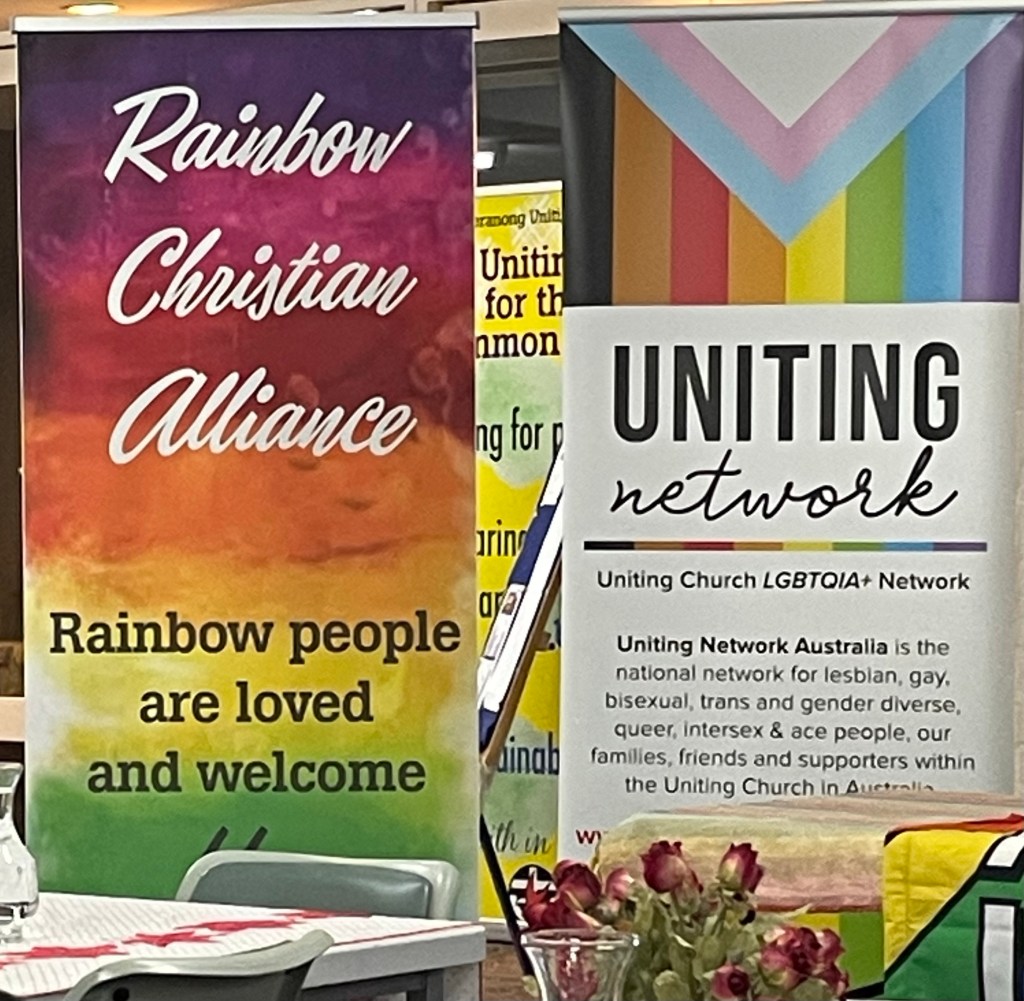
Earlier this month, Elizabeth and I attended the regular monthly gathering of Rainbow Christian Alliance (RCA), where rainbow people of faith, who identify with one or more of the letters in LGBTIQA, join with allies to share food, conversation, and prayer, and discuss matters of mutual concern.
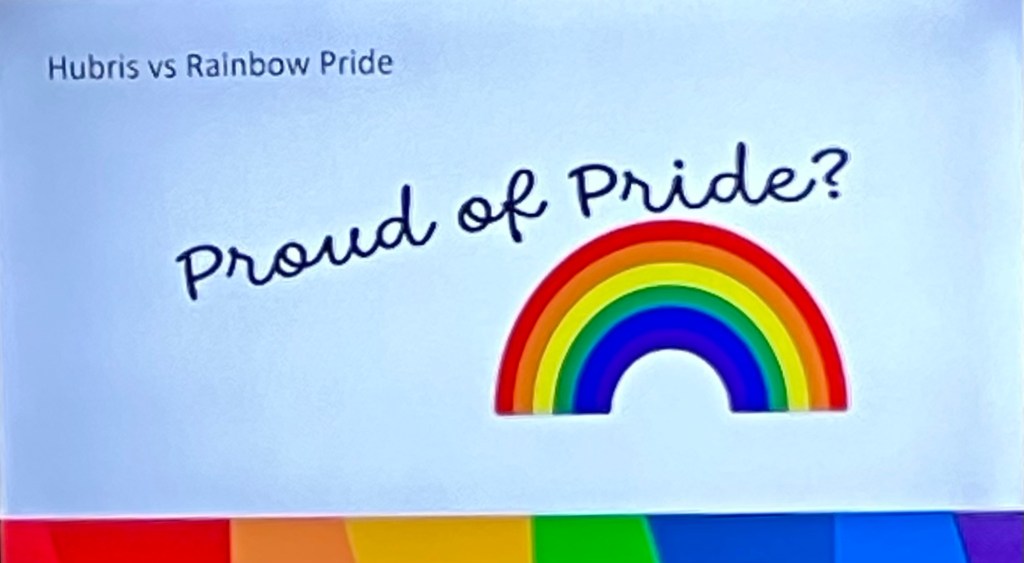
This time, the theme for RCA—since it is Pride Month during June—was “Proud of Pride?” Pride Month runs throughout the month of June. It honours the 1969 Stonewall Riots, a tipping point for the then Gay Liberation Movement in the USA.
In response to a police raid of a gay bar, the Stonewall Inn, on 28 June 1969, in Greenwich Village, New York City, members of the gay community began a rolling series of spontaneous protests that were marred by police violence, which generated increasingly aggressive protests in response.
Simultaneous Gay Pride marches were held a year later, in New York, Chicago, and Los Angeles, to remember the Stonewall Riots. That custom has continued each year since, and has grown into Pride Month.
The long-term result of these protests was that gay rights groups sprang up in every major US city, and the decriminalisation of homosexuality (which had already occurred in Illinois in 1962) spread across the fifty states over the next four decades. A similar slow-drip rollout occurred across the states and territories of Australia, from South Australia in 1972, to 1997 in Tasmania, the last state to decriminalise consenting homosexual activity.
Today, Pride Month is a time for celebrations, including pride parades, picnics, parties, workshops, symposia and concerts. It offers an opportunity to “celebrate the diversity of the lesbian, gay, bisexual, transgender and intersex community … to reflect on just how far civil rights have progressed in half a century… and an opportunity to protest discrimination and violence”. (quoted from https://unyouth.org.au/event/global-issues-resources/national-pride-month/)
Those present at the Rainbow Christian Alliance gathering earlier in June engaged in a discussion of the differences between the sin of pride—hubris, according to the ancient Greeks—and the situation of LGBTIQA+ people today, where their expressing of pride in their gender identity or their sexual orientation is encouraged.
It is my view that the longterm historical prejudice and discrimination that LGBTIQA+ people have experienced—and that many continue to experience today—means that it is quite different for rainbow people. To express pride in their identity is something that is important and necessary for them to do. It is a way of claiming a place as a respected, honoured, and valued member of society.
That is quite different from someone like myself (a cis-gender white straight male, who has experienced so many points of privilege in life) expressing pride. Any expression of pride by myself about my privileges would be hubris; rainbow pride is seeking to redress past wrongs and establish a good and positive place in society for LGBTIQA+ people.
The Rainbow Christian Alliance provides a safe space for people to gather under the umbrella of the church. The importance of this space is evident at every RCA gathering, where friendship, support, compassion, and empathy is always strong. Participants keep coming back because they are valued and respected. Acceptance and affirmation are central to what takes place at each gathering.
As an ally, I find that welcoming rainbow people into the physical space where I worship week by week is complemented by the fact that I always feel welcomed into the emotional “rainbow space” that people create on these Sunday nights. Being able to take part in such a gathering is so important for all of us; there are mutual benefits for all of us.
Many of the people who participate in RCA have had negative experiences, related to their sexuality and/or gender, from family members, and from churches. The churches that give the most grief are of a more conservative theology, and a substantial proportion of those are Pentecostal, but even mainstream churches, Anglican and Catholic alike, have inflicted hurt and perpetrated harm by the way they have dealt with people in their midst who “come out” in relation to their gender identity or sexual preference.
I am glad that the Uniting Church has held a strong line in relation to LGBTIQA+ people. We have consistently grappled with issues of sexuality and, more recently, gender identity, exploring the biblical, theological, and pastoral dimensions with care, compassion, and integrity. That we can offer safe spaces in so many of our Congregations, now, is a small testimony to the determination we have to hold fast to the Gospel, as we best understand: we value, we accept, we include, and we advocate for people across the spectrum, as integral members of our community of faith.
This Sunday, the lectionary offers a Gospel passage of just three succinct verses (Matt 10:40–42). In those verses, three key terms are used Jesus: prophet, righteous one, and little one. “Whoever welcomes you welcomes me, and whoever welcomes me welcomes the one who sent me,” Jesus asserts (Matt 10:42), before he proceed to extend this saying to include those who welcome a prophet, a righteous person, and “whoever gives even a cup of cold water to one of these little ones in the name of a disciple”. In each case, a reward is certain, says Jesus.
The last of these sayings, about “one of these little ones”, links these verses with the saying of Jesus he spoke after the disciples had been arguing about “who was the greatest”. This saying is reported in the triple tradition (Mark 9:33–37 and parallels in Matt 18 and Luke 9). In that scene, Jesus took a child in his arms and said, “whoever welcomes one such child in my name welcomes me, and whoever welcomes me welcomes not me but the one who sent me” (Mark 9:37; Matt 18:5; Luke 9:48).
Matthew here reports an expanded version of that saying, which is applied directly to the disciples. He begins by reversing Mark’s saying, taking the end of that version by referring initially to all the disciples: “whoever welcomes you”, before extending this to include “welcoming me” (10:40).
The disciples represent Jesus as “the one who sent me”, namely, God. This last phrase, found in the three Synoptic versions of this saying, is a favourite Johannine phrase for God (John 1:33; 6:44; 7:28; 8:26, 29; 9:4). The Johannine version of this saying is “whoever receives one whom I send receives me; and whoever receives me receives him who sent me” (John 13:20). That is very similar to the version that Matthew reports.
However, Matthew extends his version of Mark’s saying still further by adding “whoever welcomes a prophet”, then “whoever welcomes a righteous one” (10:41), before concluding with “whoever gives even a cup of cold water to one of these little ones in the name of a disciple” (10:52). The “little one” is presumably equivalent to “the child” which had begun Mark’s saying.
Jesus’ other saying about “the little ones” appears in all three Synoptic Gospels. The saying is highly likely to be authentic, if we adopt the classic form-critical criteria that were developed some decades ago. One marker of authenticity is for a saying to be hard, difficult, or unexpected. Jesus instructs his disciples, “if any of you put a stumbling block before one of these little ones who believe in me, it would be better for you if a great millstone were hung around your neck and you were thrown into the sea” (Mark 9:42; Luke 17:2; Matt 18:6).
This is a shocking, confronting instruction. It is undoubtedly a hard saying. In Mark 9, that shocking statement is extended regarding a hand or a foot or an eye causing a person to stumble; “it is better for you to enter life maimed … lame …[or] with one eye”, he advises (Mark 9:43-48). So Jesus is strenuously advocating for “the little ones”, and giving them a cup of water (Matt 10:42) is an essential act of discipleship.
*****
We have seen, then, that Matthew has inverted the order he received from Mark and extended the comparison he makes about welcoming a person who comes in his name. Adding the prophet to this saying (10:41) brings in another dimension to the story.
One line of interpretation that has been proposed intrigues me. Could these sayings reflect the on-the-ground nature of the earliest period of the movement that Jesus initiated? He had called disciples to follow him (4:18-22; 9:9), warned people of the difficulties that this would entail (8:18–22), selected an inner group to be designated as “emissaries—translating the Greek apostoloi (10:1–4), and commissioned them to proclaim the nearness of God’s presence in this world (10:5–15).
Jesus then warned these emissaries of the dangers that lay in store for them (10:16–25) and encourages them with the words, “do not fear those who kill the body but cannot kill the soul” (10:26–31), assuring them that “everyone who acknowledges me before others, I also will acknowledge before my Father in heaven” (10:32–33). The short lectionary passage brings the whole “mission discourse l (10:1–42) to a close. These words encapsulate the commission and the anticipated experience of the disciples.
How were the followers of Jesus to implement this? Gerd Theissen, a German New Testament scholar, has proposed that the message of Jesus was spread by itinerants within the early Jesus movement who travelled from village to village with their message. They were dependent on those who received them for hospitality and lodging, in literal obedience to what Jesus had told his disciples (Mark 6:10–11). They were living in complete obedience to “the Son of Man [who] has nowhere to lay his head” (Matt 8:20; Luke 9:58).
Evidence for such itinerant preachers can also be found in the Didache, which instructs: “Whosoever, therefore, comes and teaches you all these things that have been said before, receive him … Let every apostle that comes to you be received as the Lord. But he shall not remain except one day; but if there be need, also the next; but if he remain three days, he is a false prophet. And when the apostle goes away, let him take nothing but bread until he lodges; but if he ask money, he is a false prophet.” (Didache 11:1, 4–6).
The reference to prophets in Matthew’s account of the words of Jesus resonate with this portrayal of the early church. Receiving a prophet and welcoming them (providing them with hospitality—food, drink, and shelter) is affirmed, for the prophet comes as a representative of Jesus (10:41).
Throughout the story of Israel, the prophet has been the one who, literally, “speaks forth”; so the prophets sent by Jesus proclaim the message that “the kingdom of heaven has come near” (Matt 10:7). The prophets proclaiming this message, as prophets did in earlier times, accompany their message with acts that manifest the truth of what is proclaimed: “cure the sick, raise the dead, cleanse the lepers, cast out demons” (10:8).
*****
Matthew also adds a saying about receiving “a righteous one” 10:42). This is language which is very important to Matthew. The word dikaios, translated as righteous, refers to a person who adheres carefully to the prescriptions of Torah, who is faithfully trusting God, who follows the ways that God sets out, who contributes constructively to society so that it functions in a just and equitable way.
Torah and righteous-justice are linked in Jewish understanding. The psalmist, characteristically, places them in synonymous parallelism, when they sing, “your righteousness is an everlasting righteousness, and your law is the truth” (Ps 119:142). The prophet Habakkuk, lamenting the “destruction and violence” that surrounds him as the Babylonian army presses into Jerusalem, observes that “the law becomes slack and justice never prevails; the wicked surround the righteous—therefore judgment comes forth perverted” (Hab 1:4). The two go hand-in-hand.
Matthew reflects this close connection between Torah and righteous-justice, as he presents Jesus as being completely faithful to Torah. In reporting his baptism, only Matthew has Jesus declare to John, “it is proper for us in this way to fulfill all righteousness” (3:15). In beginning the Sermon on the Mount, Jesus declares blessed “those who hunger and thirst for righteousness” (5:6) and “those who are persecuted for righteousness’ sake” (5:10).
Jesus follows this by announcing his intention to intensify the demands of the Law (5:18) by demanding that his followers exhibit a righteous-justice that exceeds that demonstrated by the Pharisees (5:20). Only Matthew reports these words of Torah fidelity, and only Matthew has the various parables which affirm “the righteous” over against those who disobey the law (13:36–43; 13:47–49; 25:31–46).
Matthew presents Jesus as thoroughly Jewish, for he knows that God is righteous, as is declared in scripture (Deut 32:4; Ps 145:7; Job 34:17). The psalmists regularly thank God for God’s righteousness (Ps 5:8; 7:17; 9:8; 33:5; 35:24, 28; 36:6; 50:6; etc) and note the importance of humans living in that way for righteousness (Ps 18:20, 24; 85:10–13; 106:3, 31; 112:1–3, 9).
The book of Proverbs advises that the wisdom it offers is “for gaining instruction in wise dealing, righteousness, justice, and equity” (Prov 1:3) and the prophets consistently advocated for Israel to live in accordance with righteousness (Hos 10:12; Amos 5:24; Isa 1:22; 5:7; 28:17; 32:16–17; 54:14; Jer 22:3; Ezek 18:19–29; Dan 9:24; 12:3; Zeph 2:3; Mal 4:1–3; Hab 2:1–4).
So welcoming a righteous one is welcoming a person who follows, intensely and faithfully, the way that Jesus sets out, the way of God’s righteous law—just as welcoming a prophet is welcoming one who faithfully and persistently declares the message of that righteous law. That is the measure of faith that Matthew sets out in this saying. That is the intensity that the Jesus of Matthew presents.
As we continue through the season After Pentecost, the lectionary offers stories of some quite extraordinary people, drawn from the sagas that tell of the key moments in the story of Israel. The sagas we will hear are found in the narrative books, Genesis, Exodus, Deuteronomy, Joshua, and Judges.
This coming Sunday, we hear another story relating to the patriarch of Israel, Abraham, his Egyptian slave Hagar, and the child that is born to them, Ishmael (21:8–21). This is the first child of Abraham; he and Sarah had not produced any children over many years. The fact that his mother is Abraham’s servant, Hagar, rather than his wife, Sarah, is not unusual. Later in the Genesis saga, Abraham’s grandson Jacob, already married to Leah and then to her sister Rachel, has children by Leah (29:32–35), as well as his servant Bilhah (30:1–7), and later by Leah’s servant Zilpah (30:9–11), before eventually Rachel gave him a son, Joseph (30:22–24) and later, Benjamin (35:16–21).
Earlier in Genesis, in a passage omitted by the lectionary, a report is provided of the circumstances leading to the birth of Ishmael (16:1–16). The naming of the child is announced by angelic visitation to Hagar (16:7–12), establishing a pattern which will later be used in recounting the naming of Samson (Judg 14:2–7), the child of a young woman in the time of Isaiah (Isa 7:13–16), and then of Jesus (Matt 1:20–21; Luke 1:31). It appears, at this earlier point, that it is Ishmael through whom the promise made to Abraham would be fulfilled: “I will make you exceedingly fruitful; and I will make nations of you, and kings shall come from you” (17:6).
In this week’s passage, however, the enmity that was evident once Sarah learnt that Hagar had conceived, comes to full fruition. Once the pregnant Hagar had this news confirmed, “she looked with contempt on her mistress” (16:4), and so “Sarah dealt harshly with her, and she [Hagar] ran away from her” (16:6). Hagar retreats to a spring in the wilderness (16:7), which is where the angel makes their announcement about the name and character of the child. Ishmael means “God has heard”, signalling that God was acting to fulfil the promise. But the life foreseen for Ishmael was one of conflict and opposition: “he shall live at odds with his kin” (16:12).
Hagar presumably returned to be with Abraham and Sarah; in due time, a son, Isaac, is born to Abraham and Sarah (21:1–7). At the start of this week’s passage (21:8–21), it appears that Ishmael is playing happily with his brother (21:8). Jewish interpreters note that the Hebrew word used, tsachaq, can be interpreted as “playing” or “laughing”—or with a more menacing overtone, perhaps hinting at Ishmael’s envy of his half-brother as the favoured one, at least in Sarah’s eyes.
(The LXX, in translating this word into Greek, takes the more benign option, adding the words “with his brother” to imply that this is just children playing games; and that is what Christian translators reflect in their translations.)
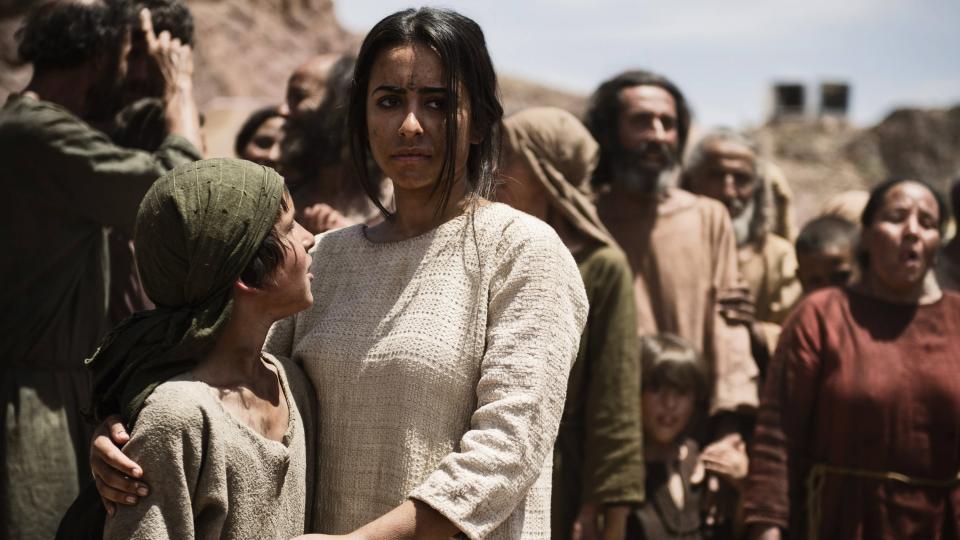
Sarah’s dissatisfaction with this moment of “play”—whether innocent or, perhaps more likely, with a threatening element—leads her to expel Hagar for another time, this time into the wilderness of Beersheba (21:9–14). Hagar’s distress is intense, such that she prepares for the death of the child Ishmael—only to be visited by another angelic intervention, inviting her to “lift up the boy and hold him fast with your hand”, assuring her that “I will make a great nation of him” (21:18).
Writing on the story in this week’s issue of With Love to the World, the Revd Sophia Lizares, a Uniting Church Minister originally from the Philippines, now serving in Perth, WA, says: “God is in the wilderness and hears even the least of the least. In times of trial, God opens our eyes to the goodness close at hand. Even those who have been banished, God accompanies into a unique and unexpected future. In God, the wilderness becomes a sanctuary where Hagar and Ishmael flourish.”
The story is told as an offering of hope—hope that what is yearned for will come to pass, even in the midst of distressingly difficult circumstances. The story has “a happy ending”, of sorts, for an angel intervenes (21:17)—does this perhaps indicate that Sarah was wrong to expel Hagar?
Guided by the angel, Hagar finds water (21:19) and the boy grows to become “an expert with the bow” (21:20). It is even said of him that “God was with the boy” (21:20), a presaging of what was later said of King Solomon (1 Chron 1:1), then later still of the infant Jesus, “the favour of God was upon him” (Luke 2:40), and of the whole life of Jesus, “God was with him” (Acts 10:38).
And the boy Ishmael does indeed become the father of “a great nation” (2:18)—through the 12 sons which he fathered! All’s well that ends well, it would seem.
*****
Yet the conflict that was to be visited upon Ishmael is an important element in this story which we must not pass by. “He shall be a wild ass of a man, with his hand against everyone, and everyone’s hand against him; and he shall live at odds with all his kin” (16:21) is a heavy burden to be laying on the child from the start of his life.
Although Ishmael was circumcised in accordance with the covenant that Abraham had entered into with the Lord God (17:23–27), and although he is indeed “blessed and made fruitful” (17:20) and does become the father of twelve sons (25:13–16) as well as a daughter (28:9), he still faced enmity. He bequeathed that conflicted state to his progeny. Indeed, the story of Ishmael functions (as do many of the stories in Genesis) as an aetiology.
An aetiology, as I have noted previously, tells of something that is said to have occurred long back in the past, but the focus is on present experiences and realities, for “such explanations elucidate something known in the contemporary world by reference to an event in the mythical past”.
In the developing Jewish tradition, Ishmael attracts negative stories. It is said that he prayed to idols—some rabbis offer this as the explanation for Sarah expelling Ishmael and Hagar into the wilderness. Other rabbis claim that Hagar, an Egyptian woman (16:1) was not “a slave girl” but rather a daughter of Pharaoh.
Some interpreters, following the opening given by the ambiguity in the Masoretic (Hebrew) text, interpret the “playing with Isaac” (21:9) as an attempt to usurp the birthright of Isaac, the son of Abraham’s wife. Was Ishmael play-acting how he planned to dispose of his half-brother, and claim the heritage of his father Abraham?
By contrast, Ishmael is honoured in Islam as a prophet and as the patriarch of Muslims. Abraham—Ibrahim in Arabic—is acknowledged as a messenger of God and recognised as father of the nations, as scripture attests. The Kaaba in Mecca, the holy site to which Muslims make pilgrimage each year, is considered to have been built by Abraham and Ishmael, while the near-sacrifice of Isaac, told in Gen 22, is commemorated by Muslims on the holy day of ‘Eid al-Ada (“the Feast of Sacrifice”). In Muslim thinking, Abraham cleansed the world of idolatry.
In the Muslim holy text, the Quran, there are a number of mentions of Ishmael, who is described as “an Apostle, a Prophet” (19:54), as “truly good”, along with Elijah (38:48), and as inspired, along with “Abraham … and Isaac, and Jacob, and their descendants, including Jesus and Job, and Jonah, and Aaron, and Solomon … and David” (4:163). He occupies a key place in the stories of their past.
*****
The Quran is well-disposed towards Isaac, declaring, “we believe in God, and in that which has been bestowed upon Abraham and Ishmael and Isaac and Jacob and their descendants, and that which has been vouchsafed by their Sustainer unto Moses and Jesus and all the [other] prophets: we make no distinction between any of them; and unto him do we surrender ourselves” (3:84; the term Islam, of course, means “surrender” or “submission”).
Antagonism between Jews and Muslims has nevertheless been experienced throughout much of the time which followed the establishment of Islam as a faith with its own doctrines and practices during the seventh century. Early Muslim expansionary undertakings brought cultural, technological, and literary developments through Persia, Syria, Arabia, Palestine, Egypt, and North Africa. There was a “golden age” under this Islamic rule, during which Jews, Christians, and Muslims lived together in harmony—the so-called convivienca.
During the Middle Ages, the Crusades undertaken under the auspices of the Roman Church scarred relationships between Christianity and Islam—the storming of Jerusalem in 1099 saw masses of Muslims slaughtered. Jerusalem was recaptured by Saladin in 1187, but he ordered that Christians not be slaughtered; Muslims controlled the city but allowed Christian pilgrims access to holy sites.
The Fall of Constantinople, capital of the Byzantine Christian empire, in 1453 and the later expulsion of Muslims from Spain marked the end of congenial relationships. Later Christian missionary enterprises regarded Indigenous and Muslim peoples as primitive and uncivilised, and forced a Western way of life onto them, creating a heritage that still plays out across the world today.
*****
In like manner, Jews living in Muslim lands throughout the Middle Ages were permitted to practise their faith and culture for many centuries, although there are various instances of localised massacres and ghettoisation of Jews by Muslims. The height of tension between these two faiths has been in the modern era, relating to the creation of the State of Israel.
In the 19th century, Zionist Jews were calling for Jews to return to their ancestral homeland, which had been under Muslim control for centuries. The declaration of the State of Israel in 1958, so soon after the Shoah (“the Destruction”) that Jews had so recently experienced in Nazi Germany, meant that Palestinians experienced the Nakba (“the Catastrophe”) of becoming displaced from a land that had been their home for many centuries.
Tensions about the borders of Israel, the rights of Jewish settlers, the removal of Palestinian (Muslim) residents, the barricading of the West Bank and the Golan Heights, as well as the Temple Mount in the centre of Jerusalem, have been the focus of increasing and apparently unresolvable tensions for the past 75 years. The Temple Mount—the place from which Abraham ascended into heaven, in Muslim belief—is also,contentious. This is where the Muslim Dome of the Rock is built, on the foundations which centuries ago formed the base of the two Jewish Temples (one built by Solomon, and then the second built under Nehemiah and extended by Herod the Great).
So the Ishmael story has been a potent saga throughout history, and stands today as a powerful signal of the possibility of co-operative relationships, but the unfortunate reality is one of fractured and unhappy relationships which have spilled out into aggressive and destructive conflict.
Might it be that as we hear again this story of Ishmael, Hagar, and Sarah, we might recommit to being makers of peace, and work towards the goal of co-operative harmony, so that “the wilderness becomes a sanctuary where Hagar and Ishmael flourish”, where Jews and Muslims and Christians can find a common, irenic venture?